MCQ 2511 Mark
If $\tan ^{-1} \frac{x-1}{x-2}+\tan ^{-1} \frac{x+1}{x+2}=\frac{\pi}{4},$ then find the value of $\mathrm{x}$
- A
$\pm \frac{1}{\sqrt{3}}$
- ✓
$\pm \frac{1}{\sqrt{2}}$
- C
$\pm \frac{1}{{2}}$
- D
$\pm \frac{\sqrt{3}}{2}$
AnswerCorrect option: B. $\pm \frac{1}{\sqrt{2}}$
b
$\tan ^{-1} \frac{x-1}{x-2}+\tan ^{-1} \frac{x+1}{x+2}=\frac{\pi}{4}$
$\Rightarrow \tan ^{-1}\left[\frac{\frac{x-1}{x-2}+\frac{x+1}{x+2}}{1-\left(\frac{x-1}{x+2}\right)\left(\frac{x+1}{x+2}\right)}\right]=\frac{\pi}{4}$
$\Rightarrow \tan ^{-1}\left[\frac{(x-1)(x+2)+(x+1)(x-2)}{(x+2)(x-2)-(x-1)(x+1)}\right]=\frac{\pi}{4}$
$\Rightarrow \tan ^{-1}\left[\frac{x^{2}+x-2+x^{2}-x-2}{x^{2}-4-x^{2}+1}\right]=\frac{\pi}{4}$
$\Rightarrow \tan ^{-1}\left[\frac{2 x^{2}-4}{-3}\right]=\frac{\pi}{4}$
$\Rightarrow \tan \left[\tan ^{-1} \frac{4-2 x^{2}}{3}\right]=\tan \frac{\pi}{4}$
$\Rightarrow \frac{4-2 x^{2}}{3}=1$
$\Rightarrow 4-2 x^{2}=3$
$\Rightarrow 2 x^{2}=4-3=1$
$\Rightarrow x=\pm \frac{1}{\sqrt{2}}$
Hence, the value of $x$ is $\pm \frac{1}{\sqrt{2}}$
View full question & answer→MCQ 2521 Mark
Solve $\tan ^{-1} \frac{1-x}{1+x}=\frac{1}{2} \tan ^{-1} x,(x>0)$
- A
$x=\frac{1}{\sqrt{2}}$
- ✓
$x=\frac{1}{\sqrt{3}}$
- C
$x=\frac{1}{{2}}$
- D
$x={\sqrt{3}}$
AnswerCorrect option: B. $x=\frac{1}{\sqrt{3}}$
b
$\tan ^{-1} \frac{1-x}{1+x}=\frac{1}{2} \tan ^{-1} x$
$\Rightarrow \tan ^{-1} 1-\tan ^{-1} x=\frac{1}{2} \tan ^{-1} x$
$\Rightarrow \frac{\pi}{4}=\frac{3}{2} \tan ^{-1} x$
$\Rightarrow \tan ^{-1} x=\frac{\pi}{6}$
$\Rightarrow x=\tan \frac{\pi}{6}$
$\therefore x=\frac{1}{\sqrt{3}}$
View full question & answer→MCQ 2531 Mark
Solve $\sin ^{-1}(1-x)-2 \sin ^{-1} x=\frac{\pi}{2},$ then $x$ is equal to
- A
$\frac{1}{2}$
- B
$0, \frac{1}{2}$
- C
$1, \frac{1}{2}$
- ✓
$0$
Answerd
$\sin ^{-1}(1-x)-2 \sin ^{-1} x=\frac{\pi}{2}$
$\Rightarrow-2 \sin ^{-1} x=\frac{\pi}{2}-\sin ^{-1}(1-x)$
$\Rightarrow-2 \sin ^{-1} x=\cos ^{-1}(1-x)$ $\dots(1)$
Let $\sin ^{-1} x=\theta \Rightarrow \sin \theta=x \Rightarrow \cos \theta=\sqrt{1-x^{2}}$
$\therefore \theta=\cos ^{-1}(\sqrt{1-x^{2}})$
$\therefore \sin ^{-1} x=\cos ^{-1}(\sqrt{1-x^{2}})$
Therefore, from equation $( 1 )$, we have
$-2 \cos ^{-1}(\sqrt{1-x^{2}})=\cos ^{-1}(1-x)$
Let, $x=\sin y .$ Then, we have:
$-2 \cos ^{-1}(\sqrt{1-\sin ^{2} y})=\cos ^{-1}(1-\sin y)$
$\Rightarrow-2 \cos ^{-1}(\cos y)=\cos ^{-1}(1-\sin y)$
$\Rightarrow-2 y=\cos ^{-1}(1-\sin y)$
$\Rightarrow 1-\sin y=\cos (-2 y)=\cos 2 y$
$\Rightarrow 1-\sin y=1-2 \sin ^{2} y$
$\Rightarrow 2 \sin ^{2} y-\sin y=0$
$\Rightarrow \sin y(2 \sin y-1)=0$
$\Rightarrow \sin y=0$ or $\frac{1}{2}$
$\therefore x=0$ OR $x=\frac{1}{2}$
When $x=\frac{1}{2},$ it can be observed that
L.H.S. $=\sin ^{-1}\left(1-\frac{1}{2}\right)-\sin ^{-1} \frac{1}{2}$
$=\sin ^{-1}\left(\frac{1}{2}\right)-2 \sin ^{-1} \frac{1}{2}$
$=-\sin ^{-1} \frac{1}{2}$
$=\frac{\pi}{6} \neq \frac{\pi}{2} \neq R . H . S$
$\therefore x=\frac{1}{2}$ is not a solution of the given equation. Thus, $x=0$
View full question & answer→MCQ 2541 Mark
${\cos ^{ - 1}}\left( {\frac{{3 + 5\cos x}}{{5 + 3\cos x}}} \right)$ is equal to
- A
${\tan ^{ - 1}}\left( {\frac{1}{2}\tan \frac{x}{2}} \right)$
- B
$2{\tan ^{ - 1}}\left( {2\tan \frac{x}{2}} \right)$
- C
$\frac{1}{2}{\tan ^{ - 1}}\left( {2\tan \frac{x}{2}} \right)$
- ✓
$2{\tan ^{ - 1}}\left( {\frac{1}{2}\tan \frac{x}{2}} \right)$
AnswerCorrect option: D. $2{\tan ^{ - 1}}\left( {\frac{1}{2}\tan \frac{x}{2}} \right)$
d
(d) We take $x = \frac{\pi }{2}$ then $\cos x = 0$
${\cos ^{ - 1}}\left( {\frac{{3 + 5\cos x}}{{5 + 3\cos x}}} \right) = {\cos ^{ - 1}}\left( {\frac{3}{5}} \right)$
$ = {\tan ^{ - 1}}\left( {\frac{4}{3}} \right)$
Put $x = \frac{\pi }{2}$ in $2{\tan ^{ - 1}}\left( {\frac{1}{2}\tan \frac{x}{2}} \right)$
we get $2{\tan ^{ - 1}}\left( {\frac{1}{2}\tan \frac{\pi }{4}} \right)$
$ = 2{\tan ^{ - 1}}\left( {\frac{1}{2}} \right) = {\tan ^{ - 1}}\left( {\frac{{2.\frac{1}{2}}}{{1 - \frac{1}{4}}}} \right)$$ = {\tan ^{ - 1}}\left( {\frac{4}{3}} \right)$.
View full question & answer→MCQ 2551 Mark
$2{\tan ^{ - 1}}\left[ {\sqrt {\frac{{a - b}}{{a + b}}} \tan \frac{\theta }{2}} \right] = $
- ✓
${\cos ^{ - 1}}\left( {\frac{{a\cos \theta + b}}{{a + b\cos \theta }}} \right)$
- B
${\cos ^{ - 1}}\left( {\frac{{a + b\cos \theta }}{{a\cos \theta + b}}} \right)$
- C
${\cos ^{ - 1}}\left( {\frac{{a\cos \theta }}{{a + b\cos \theta }}} \right)$
- D
${\cos ^{ - 1}}\left( {\frac{{a\cos + b\theta }}{{a + b\cos \theta }}} \right)$
AnswerCorrect option: A. ${\cos ^{ - 1}}\left( {\frac{{a\cos \theta + b}}{{a + b\cos \theta }}} \right)$
a
(a) $2{\tan ^{ - 1}}\left[ {\sqrt {\frac{{a - b}}{{a + b}}} \tan \frac{\theta }{2}} \right]$
$ = {\cos ^{ - 1}}\left[ {\frac{{1 - \left( {\frac{{a - b}}{{a + b}}} \right){{\tan }^2}\frac{\theta }{2}}}{{1 + \left( {\frac{{a - b}}{{a + b}}} \right){{\tan }^2}\frac{\theta }{2}}}} \right]$
$\left( {\because 2{{\tan }^{ - 1}}x = {{\cos }^{ - 1}}\frac{{1 - {x^2}}}{{1 + {x^2}}}} \right)$
$ = {\cos ^{ - 1}}\left[ {\frac{{(a + b) - (a - b){{\tan }^2}\frac{\theta }{2}}}{{(a + b) + (a - b){{\tan }^2}\frac{\theta }{2}}}} \right]$
$ = {\cos ^{ - 1}}\left[ {\frac{{a\left( {1 - {{\tan }^2}\frac{\theta }{2}} \right) + b\left( {1 + {{\tan }^2}\frac{\theta }{2}} \right)}}{{a\left( {1 + {{\tan }^2}\frac{\theta }{2}} \right) + b\left( {1 - {{\tan }^2}\frac{\theta }{2}} \right)}}} \right]$
$ = {\cos ^{ - 1}}\left[ {\frac{{\frac{{a\left( {1 - {{\tan }^2}\frac{\theta }{2}} \right)}}{{1 + {{\tan }^2}\frac{\theta }{2}}} + b}}{{a + b\left( {\frac{{1 - {{\tan }^2}\frac{\theta }{2}}}{{1 + {{\tan }^2}\frac{\theta }{2}}}} \right)}}} \right] $
$= {\cos ^{ - 1}}\left[ {\frac{{a\cos \theta + b}}{{a + b\cos \theta }}} \right]$.
View full question & answer→MCQ 2561 Mark
If ${\sin ^{ - 1}}x + {\sin ^{ - 1}}y + {\sin ^{ - 1}}z = \frac{{3\pi }}{2}$, then the value of ${x^{100}} + {y^{100}} + {z^{100}} - \frac{9}{{{x^{101}} + {y^{101}} + {z^{101}}}}$ is equal to
Answera
(a) As we know ${\sin ^{ - 1}}x$ cannot be greater than $\frac{\pi }{2}$,
So ${\sin ^{ - 1}}x = {\sin ^{ - 1}}y = {\sin ^{ - 1}}z = \frac{\pi }{2}$
Therefore $x = y = z = 1$
Putting these values in the expression, we get $1 + 1 + 1 - \frac{9}{{1 + 1 + 1}} = 0$.
View full question & answer→MCQ 2571 Mark
$tan^{-1} \frac{x}{\pi} < \frac{\pi}{3} ,x \in N,$ then the maximum value of $x$ is :-
Answerb
$\tan ^{-1} \frac{x}{\pi}<\frac{\pi}{3}$
$ \Rightarrow \tan \left(\tan ^{-1} \frac{x}{\pi}\right)<\tan \frac{\pi}{3}$
$\Rightarrow \quad \frac{\mathrm{x}}{\pi}<\sqrt{3}$
$ \Rightarrow \mathrm{x}<\sqrt{3} \pi=5.5$ (approxi)
The maximum value of $x$ is $5 .$
View full question & answer→MCQ 2581 Mark
The greatest and the least value of ${({\sin ^{ - 1}}x)^3} + {({\cos ^{ - 1}}x)^3}$ are
- A
$ - \frac{\pi }{2},\,\frac{\pi }{2}$
- B
$ - \frac{{{\pi ^3}}}{8},\,\frac{{{\pi ^3}}}{8}$
- ✓
$\frac{{7{\pi ^3}}}{8},\,\,\frac{{{\pi ^3}}}{{32}}$
- D
AnswerCorrect option: C. $\frac{{7{\pi ^3}}}{8},\,\,\frac{{{\pi ^3}}}{{32}}$
c
(c) We have ${({\sin ^{ - 1}}x)^3} + {({\cos ^{ - 1}}x)^3}$
$ = {({\sin ^{ - 1}}x + {\cos ^{ - 1}}x)^3}$$ - 3{\sin ^{ - 1}}x{\cos ^{ - 1}}x({\sin ^{ - 1}}x + {\cos ^{ - 1}}x)$
$= \frac{{{\pi ^3}}}{8} - 3({\sin ^{ - 1}}x{\cos ^{ - 1}}x)\frac{\pi }{2}$
$= \frac{{{\pi ^3}}}{8} - \frac{{3\pi }}{2}{\sin ^{ - 1}}x\left( {\frac{\pi }{2} - {{\sin }^{ - 1}}x} \right)$
$= \frac{{{\pi ^3}}}{8} - \frac{{3{\pi ^2}}}{4}{\sin ^{ - 1}}x + \frac{{3\pi }}{2}{({\sin ^{ - 1}}x)^2}$
$=\frac{{{\pi ^3}}}{8} + \frac{{3\pi }}{2}\left[ {{{({{\sin }^{ - 1}}x)}^2} - \frac{\pi }{2}{{\sin }^{ - 1}}x} \right]$
$ = \frac{{{\pi ^3}}}{8} + \frac{{3\pi }}{2}\left[ {{{\left( {{{\sin }^{ - 1}}x - \frac{\pi }{4}} \right)}^2}} \right] - \frac{{3{\pi ^3}}}{{32}}$
$ = \frac{{{\pi ^3}}}{{32}} + \frac{{3\pi }}{2}{\left( {{{\sin }^{ - 1}}x - \frac{\pi }{4}} \right)^2}$
$\therefore$ The least value is $\frac{{{\pi ^3}}}{{32}}$
and since ${\left( {{{\sin }^{ - 1}}x - \frac{\pi }{4}} \right)^2} \le {\left( {\frac{{3\pi }}{4}} \right)^2}$
$\therefore$ The greatest value is $\frac{{{\pi ^3}}}{{32}} + \frac{{9{\pi ^2}}}{{16}} \times \frac{{3\pi }}{2} = \frac{{7{\pi ^3}}}{8}$.
View full question & answer→MCQ 2591 Mark
If $a < \frac{1}{{32}},$ then the number of solution of ${({\sin ^{ - 1}}x)^3} + {({\cos ^{ - 1}}x)^3} = a{\pi ^3}$ is
Answera
(a) From previous solution $\frac{{{\pi ^3}}}{{32}} \le {({\sin ^{ - 1}}x)^3} + {({\cos ^{ - 1}}x)^3} \le \frac{{7\pi }}{8}$
Here $a < \frac{1}{{32}}$. So, number of solution is zero.
View full question & answer→MCQ 2601 Mark
${\tan ^{ - 1}}\frac{{{c_1}x - y}}{{{c_1}y + x}} + {\tan ^{ - 1}}\frac{{{c_2} - {c_1}}}{{1 + {c_2}{c_1}}} + $ ${\tan ^{ - 1}}\frac{{{c_3} - {c_2}}}{{1 + {c_3}{c_2}}} + ... + {\tan ^{ - 1}}\frac{1}{{{c_n}}} = $
AnswerCorrect option: C. ${\tan ^{ - 1}}\frac{x}{y}$
c
(c) ${\tan ^{ - 1}}\left( {\frac{{{c_1}x - y}}{{{c_1}y + x}}} \right) + {\tan ^{ - 1}}\left( {\frac{{{c_2} - {c_1}}}{{1 + {c_2}{c_1}}}} \right) + {\tan ^{ - 1}}\left( {\frac{{{c_3} - {c_2}}}{{1 + {c_3}{c_2}}}} \right) + $
$..... + {\tan ^{ - 1}}\frac{1}{{{c_n}}}$
$= {\tan ^{ - 1}}\left( {\frac{{\frac{x}{y} - \frac{1}{{{c_1}}}}}{{1 + \frac{x}{y}.\frac{1}{{{c_1}}}}}} \right) + {\tan ^{ - 1}}\left( {\frac{{\frac{1}{{{c_1}}} - \frac{1}{{{c_2}}}}}{{1 + \frac{1}{{{c_1}{c_2}}}}}} \right)$
$ + {\tan ^{ - 1}}\left( {\frac{{\frac{1}{{{c_2}}} - \frac{1}{{{c_3}}}}}{{1 + \frac{1}{{{c_2}{c_3}}}}}} \right) + ....... + {\tan ^{ - 1}}\frac{1}{{{c_n}}}$
$ = {\tan ^{ - 1}}\frac{x}{y} - {\tan ^{ - 1}}\frac{1}{{{c_1}}} + {\tan ^{ - 1}}\frac{1}{{{c_1}}} - {\tan ^{ - 1}}\frac{1}{{{c_2}}} + {\tan ^{ - 1}}\frac{1}{{{c_2}}}$
$ - {\tan ^{ - 1}}\frac{1}{{{c_3}}} + ... + {\tan ^{ - 1}}\frac{1}{{{c_{n - 1}}}} - {\tan ^{ - 1}}\frac{1}{{{c_n}}} + {\tan ^{ - 1}}\frac{1}{{{c_n}}}$
$={\tan ^{ - 1}}\left( {\frac{x}{y}} \right)$.
View full question & answer→MCQ 2611 Mark
$\sum\limits_{m = 1}^n {{{\tan }^{ - 1}}} \left( {\frac{{2m}}{{{m^4} + {m^2} + 2}}} \right)$ is equal to
- ✓
${\tan ^{ - 1}}\left( {\frac{{{n^2} + n}}{{{n^2} + n + 2}}} \right)$
- B
${\tan ^{ - 1}}\left( {\frac{{{n^2} - n}}{{{n^2} - n + 2}}} \right)$
- C
${\tan ^{ - 1}}\left( {\frac{{{n^2} + n + 2}}{{{n^2} + n}}} \right)$
- D
AnswerCorrect option: A. ${\tan ^{ - 1}}\left( {\frac{{{n^2} + n}}{{{n^2} + n + 2}}} \right)$
a
(a) We have $\sum\limits_{m = 1}^n {{{\tan }^{ - 1}}\left( {\frac{{2m}}{{{m^4} + {m^2} + 2}}} \right)} $
$ = \sum\limits_{m = 1}^n {{{\tan }^{ - 1}}\left( {\frac{{2m}}{{1 + ({m^2} + m + 1)({m^2} - m + 1)}}} \right)} $
$ = \sum\limits_{m = 1}^n {{{\tan }^{ - 1}}\left( {\frac{{({m^2} + m + 1) - ({m^2} - m + 1)}}{{1 + ({m^2} + m + 1)({m^2} - m + 1)}}} \right)} $
$= \sum\limits_{m = 1}^n {[{{\tan }^{ - 1}}({m^2} + m + 1) - {{\tan }^{ - 1}}({m^2} - m + 1)]} $
$ = ({\tan ^{ - 1}}3 - {\tan ^{ - 1}}1) + ({\tan ^{ - 1}}7 - {\tan ^{ - 1}}3) + $
$({\tan ^{ - 1}}13 - {\tan ^{ - 1}}7) + ...... + [{\tan ^{ - 1}}({n^2} + n + 1)$
$ - {\tan ^{ - 1}}({n^2} - n + 1)]$
$= {\tan ^{ - 1}}({n^2} + n + 1) - {\tan ^{ - 1}}1$
$= {\tan ^{ - 1}}\left( {\frac{{{n^2} + n}}{{2 + {n^2} + n}}} \right)$.
View full question & answer→MCQ 2621 Mark
If ${x_1},{x_2},{x_3},{x_4}$ are roots of the equation ${x^4} - {x^3}\sin 2\beta + {x^2}\cos 2\beta - x\cos \beta - \sin \beta = 0,$ then ${\tan ^{ - 1}}{x_1} + {\tan ^{ - 1}}{x_2} + {\tan ^{ - 1}}{x_3} + {\tan ^{ - 1}}{x_4} = $
AnswerCorrect option: B. $\frac{\pi }{2} - \beta $
b
(b) We have, $\Sigma {x_1} = \sin 2\beta ,\Sigma {x_1}{x_2} = \cos 2\beta ,\Sigma {x_1}{x_2}{x_3} = \cos \beta $
and ${x_1}{x_2}{x_2}{x_4} = - \sin \beta $
$\therefore$ ${\tan ^{ - 1}}{x_1} + {\tan ^{ - 1}}{x_2} + {\tan ^{ - 1}}{x_3} + {\tan ^{ - 1}}{x_4}$
$ = {\tan ^{ - 1}}\left( {\frac{{\Sigma {x_1} - \Sigma {x_1}{x_2}{x_3}}}{{1 - \Sigma {x_1}{x_2} + {x_1}{x_2}{x_3}{x_4}}}} \right)$
$ = {\tan ^{ - 1}}\left( {\frac{{\sin 2\beta - \cos \beta }}{{1 - \cos 2\beta - \sin \beta }}} \right)$
$ = {\tan ^{ - 1}}\left( {\frac{{(2\sin \beta - 1)\cos \beta }}{{\sin \beta (2\sin \beta - 1)}}} \right) = {\tan ^{ - 1}}(\cot \beta )$
$ = {\tan ^{ - 1}}\left[ {\tan \left( {\frac{\pi }{2} - \beta } \right)} \right] = \frac{\pi }{2} - \beta $.
View full question & answer→MCQ 2631 Mark
If ${\tan ^{ - 1}}x + {\cos ^{ - 1}}\frac{y}{{\sqrt {(1 + {y^2})} }} = {\sin ^{ - 1}}\frac{3}{{\sqrt {10} }}$ and both $x$ and $y$ are positive and integral, then $x$ and $y =$
- ✓
$(1, 2)$ and $(2, 7)$
- B
$(1, 2)$ and $(1, 7)$
- C
$(1, 7)$ and $(2, 7)$
- D
$(1, 7)$ and $(2, 1)$
AnswerCorrect option: A. $(1, 2)$ and $(2, 7)$
a
(a) ${\tan ^{ - 1}}x + {\tan ^{ - 1}}\frac{1}{y} = {\tan ^{ - 1}}3$
$\therefore$ $xy + 1 = 3(y - x)$
Hence $(1, 2)$ and $(2,7)$ since $x, y$ are positive and integral.
View full question & answer→MCQ 2641 Mark
If ${a_{1,}}{a_2},{a_3}.....,{a_n}$ is an $A.P.$ with common difference d then $\tan \left[ {{{\tan }^{ - 1}}\left( {\frac{d}{{1 + {a_1}{a_2}}}} \right) + {{\tan }^{ - 1}}\left( {\frac{d}{{1 + {a_2}{a_3}}}} \right) + ...} \right.$ $\left. { + {{\tan }^{ - 1}}\left( {\frac{d}{{1 + {a_{n - 1}}{a_n}}}} \right)} \right] = $
- A
$\frac{{(n - 1)d}}{{{a_1} + {a_n}}}$
- ✓
$\frac{{(n - 1)d}}{{1 + {a_1}{a_n}}}$
- C
$\frac{{nd}}{{1 + {a_1}{a_n}}}$
- D
$\frac{{{a_n} - {a_1}}}{{{a_n} + {a_1}}}$
AnswerCorrect option: B. $\frac{{(n - 1)d}}{{1 + {a_1}{a_n}}}$
b
(b) We have ${\tan ^{ - 1}}\left( {\frac{d}{{1 + {a_1}{a_2}}}} \right) + {\tan ^{ - 1}}\left( {\frac{d}{{1 + {a_2}{a_3}}}} \right) + .....$
$..... + {\tan ^{ - 1}}\left( {\frac{d}{{1 + {a_{n - 1}}{a_n}}}} \right)$
$ = {\tan ^{ - 1}}\left( {\frac{{{a_2} - {a_1}}}{{1 + {a_1}{a_2}}}} \right) + {\tan ^{ - 1}}\left( {\frac{{{a_3} - {a_2}}}{{1 + {a_2}{a_3}}}} \right) + .....$
$..... + {\tan ^{ - 1}}\left( {\frac{{{a_n} - {a_{n - 1}}}}{{1 + {a_{n - 1}}{a_n}}}} \right)$
$ = ({\tan ^{ - 1}}{a_2} - {\tan ^{ - 1}}{a_1}) + ({\tan ^{ - 1}}{a_3} - {\tan ^{ - 1}}{a_2}) + ....$
$..... + ({\tan ^{ - 1}}{a_n} - {\tan ^{ - 1}}{a_{n - 1}})$
$ = {\tan ^{ - 1}}{a_n} - {\tan ^{ - 1}}{a_1} = {\tan ^{ - 1}}\left( {\frac{{{a_n} - {a_1}}}{{1 + {a_n}{a_1}}}} \right)$
$ = {\tan ^{ - 1}}\left( {\frac{{(n - 1)d}}{{1 + {a_1}{a_n}}}} \right)$.
View full question & answer→MCQ 2651 Mark
${\sin ^{ - 1}}\frac{{2a}}{{1 + {a^2}}} - {\cos ^{ - 1}}\frac{{1 - {b^2}}}{{1 + {b^2}}} = {\tan ^{ - 1}}\frac{{2x}}{{1 - {x^2}}}$, then $x = $
AnswerCorrect option: D. $\frac{{a - b}}{{1 + ab}}$
d
(d) Put $a = \tan \theta ,b = \tan \varphi $and $x = \tan \psi ,$ then reduced form is ${\sin ^{ - 1}}(\sin 2\theta ) - {\cos ^{ - 1}}(\cos 2\phi ) = {\tan ^{ - 1}}(\tan 2\psi )$
==> $2\theta - 2\phi = 2\psi \Rightarrow \theta - \phi = \psi $
Taking ‘tan’ both sides, we get $\tan (\theta - \phi ) = \tan \psi $
==> $\frac{{\tan \theta - \tan \phi }}{{1 + \tan \theta \tan \phi }} = \tan \psi $
Substituting these values, we get $\frac{{a - b}}{{1 + ab}} = x$
View full question & answer→MCQ 2661 Mark
A value of ${\tan ^{ - 1}}\,\,\left( {\sin \,\left( {{{\cos }^{ - 1}}\left( {\sqrt {\frac{2}{3}} } \right)} \right)} \right)$ is
- A
$\frac {\pi }{4}$
- B
$\frac {\pi }{2}$
- C
$\frac {\pi }{3}$
- ✓
$\frac {\pi }{6}$
AnswerCorrect option: D. $\frac {\pi }{6}$
d
Consider ${\tan ^{ - 1}}\left[ {\sin \left( {{{\cos }^{ - 1}}\sqrt {\frac{2}{3}} } \right)} \right]$
Let ${\cos ^{ - 1}}\sqrt {\frac{2}{3}} = \theta \Rightarrow \cos \theta = \sqrt {\frac{2}{3}} $
$ \Rightarrow \sin \theta = \sqrt {1 - {{\cos }^2}\theta } = \sqrt {1 - \frac{2}{3}} = \sqrt {\frac{1}{3}} $
$\therefore {\tan ^{ - 1}}\left[ {\sin \left( {{{\cos }^{ - 1}}\sqrt {\frac{2}{3}} } \right)} \right] = {\tan ^{ - 1}}\left[ {\sin \theta } \right]$
$ = {\tan ^{ - 1}}\left[ {\sqrt {\frac{1}{3}} } \right] = {\tan ^{ - 1}}\left( {\frac{1}{{\sqrt 3 }}} \right)$
$ = \frac{\pi }{6}$
View full question & answer→MCQ 2671 Mark
If ${\sin ^{ - 1}}\frac{x}{5} + {\rm{cose}}{{\rm{c}}^{ - 1}}\left( {\frac{5}{4}} \right) = \frac{\pi }{2},$ then $x = $
Answerd
Given $\sin ^{-1}\left(\frac{x}{5}\right)+\csc ^{-1}\left(\frac{5}{4}\right)=\frac{\pi}{2}$
$\Rightarrow \sin ^{-1}\left(\frac{x}{5}\right)+\sin ^{-1}\left(\frac{4}{5}\right)=\frac{\pi}{2}$
$\Rightarrow \sin ^{-1}\left(\frac{x}{5}\right)=\frac{\pi}{2}-\sin ^{-1}\left(\frac{4}{5}\right)$
$\Rightarrow \sin ^{-1}\left(\frac{x}{5}\right)=\cos ^{-1}\left(\frac{4}{5}\right)$
$\Rightarrow \frac{x}{5}=\sin \left(\cos ^{-1} \frac{4}{5}\right)$
$\Rightarrow \frac{x}{5}=\sin \left(\sin ^{-1} \frac{3}{5}\right)$
$\Rightarrow \frac{x}{5}=\frac{3}{5}$
$\Rightarrow x=3$
View full question & answer→MCQ 2681 Mark
If ${\cos ^{ - 1}}x - {\cos ^{ - 1}}\frac{y}{2} = \alpha $, then $4{x^2} - 4xy\cos \alpha + {y^2}$ is equal to
- ✓
$4{\sin ^2}\alpha $
- B
$ - 4{\sin ^2}\alpha $
- C
$2\sin 2\alpha $
- D
$4$
AnswerCorrect option: A. $4{\sin ^2}\alpha $
a
(a) If ${\cos ^{ - 1}}\frac{x}{a} + {\cos ^{ - 1}}\frac{y}{b} = \theta $
Then $\frac{{{x^2}}}{{{a^2}}}\cos \theta + \frac{{{y^2}}}{{{b^2}}} = {\sin ^2}\theta $
Here ${\cos ^{ - 1}}\frac{x}{1} + {\cos ^{ - 1}}\frac{y}{2} = \alpha ;$
$\therefore \frac{{{x^2}}}{1} - \frac{{2xy}}{2}\cos \alpha + \frac{{{y^2}}}{4} = {\sin ^2}\alpha $
${x^2} - xy\cos \alpha + \frac{{{y^2}}}{4} = {\sin ^2}\alpha $
$4{x^2} - 4xy\cos \alpha + {y^2} = 4{\sin ^2}\alpha $.
View full question & answer→MCQ 2691 Mark
${\cot ^{ - 1}}[{(\cos \alpha )^{1/2}}] - {\tan ^{ - 1}}[{(\cos \alpha )^{1/2}}] = x,$ then $\sin x = $
- ✓
${\tan ^2}\left( {\frac{\alpha }{2}} \right)$
- B
${\cot ^2}\left( {\frac{\alpha }{2}} \right)$
- C
$\tan \alpha $
- D
$\cot \left( {\frac{\alpha }{2}} \right)$
AnswerCorrect option: A. ${\tan ^2}\left( {\frac{\alpha }{2}} \right)$
a
(a) ${\tan ^{ - 1}}\left[ {\frac{1}{{\sqrt {\cos \alpha } }}} \right] - {\tan ^{ - 1}}\left[ {\sqrt {\cos \alpha } } \right] = x$
==>${\tan ^{ - 1}}\left[ {\frac{{\frac{1}{{\sqrt {\cos \alpha } }} - \sqrt {\cos \alpha } }}{{1 + \frac{{\sqrt {\cos \alpha } }}{{\sqrt {\cos \alpha } }}}}} \right] = x$
==> $\tan x = \frac{{1 - \cos \alpha }}{{2\sqrt {\cos \alpha } }}$
$\therefore \sin x = \frac{{1 - \cos \alpha }}{{1 + \cos \alpha }} = \frac{{2{{\sin }^2}\frac{\alpha }{2}}}{{2{{\cos }^2}\frac{\alpha }{2}}} = {\tan ^2}\left( {\frac{\alpha }{2}} \right)$.
View full question & answer→MCQ 2701 Mark
If $tan^{-1} (x+ 2)+ tan^{- 1}( x -2)= tan^{-1} (\frac{1}{2}),$ then sum of value(s) of $x$ is equal to-
- ✓
$1$
- B
$-5$
- C
$-4$
- D
$\frac{1}{2}$
Answera
$\tan ^{-1}(x+2)+\tan ^{-1}(x-2)=\tan ^{-1}\left(\frac{1}{2}\right)$
$\tan ^{-1}\left(\frac{x+2+x-2}{1-(x+2)(x-2)}\right)=\tan ^{-1}\left(\frac{1}{2}\right)$
$x=1,-5(\text { reject })$
View full question & answer→MCQ 2711 Mark
The sum of all the solution $(s)$ of the equation $sin^{-1}\ 2x = cos^{-1}\ x$ is
- A
$0$
- B
$\frac{2}{{\sqrt 5 }}$
- ✓
$\frac{1}{{\sqrt 5 }}$
- D
$\frac{-1}{{\sqrt 5 }}$
AnswerCorrect option: C. $\frac{1}{{\sqrt 5 }}$
c
$\sin ^{-1} 2 \mathrm{x}=\cos ^{-1} \mathrm{x}$
$\sin ^{-1} 2 \mathrm{x}=\sin ^{-1} \sqrt{1-\mathrm{x}^{2}}$
$\Rightarrow \quad 2 \mathrm{x}=\sqrt{1-\mathrm{x}^{2}}$
$\Rightarrow \quad 4 \mathrm{x}^{2}=1-\mathrm{x}^{2}$
$\Rightarrow \quad \mathrm{x}=\pm \frac{1}{\sqrt{5}}$
$\mathrm{x}=\frac{1}{\sqrt{5}}\left(\because \quad \mathrm{x} \neq-\frac{1}{\sqrt{5}}\right)$
View full question & answer→MCQ 2721 Mark
The value of ${\sin ^{ - 1}}(\sin \,100) + \,{\cos ^{ - 1}}(\cos \,100) + {\tan ^{ - 1}}\,(\tan \,100) + {\cot ^{ - 1}}(\cot \,100)$
- A
$100-31\pi $
- B
$100-32\pi $
- ✓
$200-63\pi $
- D
$200-62\pi $
AnswerCorrect option: C. $200-63\pi $
c
$\sin ^{-1}(\sin 100)=100-32 \pi$
$\tan ^{-1}(\tan 100)=100-32 \pi$
$\cos ^{-1}(\cos 100)=32 \pi-100$
$\cot ^{-1}(\cot 100)=100-31 \pi$
$\therefore 32 \pi-\frac{\pi}{2}<100<32 \pi$
View full question & answer→MCQ 2731 Mark
${\cos ^{ - 1}}\left( {{x^2} + \frac{1}{{{x^2}}} - 1} \right) + {\sin ^{ - 1}}\left( {{x^2} - \frac{1}{{{x^2}}}} \right) + {\tan ^{ - 1}}{x^2}$ is equal to (where $x \in R - \{0\})$
- A
$\frac {\pi }{6}$
- ✓
$\frac {\pi }{4}$
- C
$\frac {\pi }{3}$
- D
$\frac {\pi }{2}$
AnswerCorrect option: B. $\frac {\pi }{4}$
b
$x^{2}+\frac{1}{x^{2}}-1 \geq 1$ but $x^{2}+\frac{1}{x^{2}}-1$ must be less
than $1$
$\Rightarrow x^{2}=1$
View full question & answer→MCQ 2741 Mark
For the equation ${\cos ^{ - 1}}\left| x \right| + {\cos ^{ - 1}}\left| {2x} \right| = \pi $ , the number of real solution $(s)$ is
Answerc
$\mathrm{x}>0$
$\cos ^{-1} x+\cos ^{-1} 2 x=\pi$
$2 x=\cos \left(\pi-\cos ^{-1} x\right)$
${=-\cos \left(\cos ^{-1} x\right)} $
${=-x \Rightarrow x=0}$
$\mathrm{x}<0$
$\cos ^{-1}(-x)+\cos ^{-1}(-2 x)=\pi$
$\pi-\cos ^{-1} x+\pi-\cos ^{-1}(2 x)=\pi$
$\cos ^{-1} x+\cos ^{-1}(2 x)=\pi$
View full question & answer→MCQ 2751 Mark
If the value of $x$ satisfying the equation ${\sin ^{ - 1}}\sqrt {1 - {x^2}} = {\tan ^{ - 1}}\sqrt {\frac{2}{x} - 1} $ is $\frac {a}{b}$ (where $a$ and $b$ are coprime), then the value of $a^2 + b^2$ is
Answerb
$\sin ^{-1} \sqrt{1-x^{2}}=\sin ^{-1} \sqrt{\frac{2-x}{2}}$
$2-2 x^{2}=2-x$
$\mathrm{x}=\frac{1}{2}$
View full question & answer→MCQ 2761 Mark
If $x = \sin \left( {2{{\tan }^{ - 1}}2} \right),\,y = \sin \left( {\frac{1}{2}{{\tan }^{ - 1}}\frac{4}{3}} \right),$ then -
- A
$x=1-y$
- B
$x^2 = 1-y$
- C
$x^2 = 1+y$
- ✓
$y^2 = 1-x$
AnswerCorrect option: D. $y^2 = 1-x$
d
$x=\sin \left(2 \tan ^{-1} 2\right): y=\sin \left(\frac{1}{2} \tan ^{-1} \frac{4}{3}\right)$
Let $\tan ^{-1} 2=\theta$
$2=\tan \theta$
$x=\sin 2 \theta$
$x=2 \sin \theta \cos \theta$
$x=2 \frac{2}{\sqrt{5}} \times \frac{1}{\sqrt{5}}=\frac{4}{5}$
$\because \quad 1-x=1 / 5$
and $ \quad \because y^{2}=\frac{1}{5}$
$\tan ^{-1} 4 / 3=\alpha$
$4 / 3=\tan \alpha$
$y=\sin \frac{\alpha}{2}$
$y=\sqrt{\frac{1-\cos \alpha}{2}}=\sqrt{\frac{1-3 / 5}{2}}$
$y=\frac{1}{\sqrt{5}} \quad \therefore \quad y^{2}=1-x$
View full question & answer→MCQ 2771 Mark
If $0 < x < 1$, then ${\cot ^{ - 1}}\left( {\frac{{2{x^2} - 1}}{{2x\sqrt {1 - {x^2}} }}} \right)$ is equal to
- A
$ - 2{\cot ^{ - 1}}x$
- B
$\pi - 2{\cos ^{ - 1}}x$
- ✓
$ 2{\cos ^{ - 1}}x$
- D
$2{\cos ^{ - 1}}x - \pi$
AnswerCorrect option: C. $ 2{\cos ^{ - 1}}x$
c
$\cot ^{-1}\left(\frac{2 x^{2}-1}{2 x \sqrt{1-x^{2}}}\right)$
put $x = \cos \theta $ $\because $ $\theta \in \left( {0,\frac{\pi }{2}} \right)\quad \therefore \quad 0 < x < 1$
$\Rightarrow \quad \cot ^{-1}\left(\frac{\cos 2 \theta}{2 \cos \theta|\sin \theta|}\right)$
$=\cot ^{-1}(\cot 2 \theta)=2 \theta=2 \cos ^{-1} x$
$\because 2 \theta \in(0, \pi)$
View full question & answer→MCQ 2781 Mark
The value of ${\cos ^{ - 1}}\left[ {\cot \left\{ {{{\sin }^{ - 1}}\sqrt {\frac{{2 - \sqrt 3 }}{4}} + {{\cos }^{ - 1}}\frac{{\sqrt {12} }}{4} + {{\sec }^{ - 1}}\sqrt 2 } \right\}} \right]$ is
- A
$0$
- B
$\frac {\pi}{4}$
- C
$\frac {\pi}{6}$
- ✓
$\frac {\pi}{2}$
AnswerCorrect option: D. $\frac {\pi}{2}$
d
$\cos ^{-1}\left[\cot \left\{\sin ^{-1} \sqrt{\left(\frac{\sqrt{3}-1}{2 \sqrt{2}}\right)^{2}}+\frac{\pi}{6}+\frac{\pi}{4}\right\}\right]$
$\cos ^{-1}\left[\cot \left\{\sin ^{-1}\left(\frac{\sqrt{3}-1}{2 \sqrt{2}}\right)+\frac{\pi}{6}+\frac{\pi}{4}\right\}\right]$
$\cos ^{-1}\left[\cot \left\{\frac{\pi}{12}+\frac{\pi}{6}+\frac{\pi}{4}\right\}\right]$
$\cos ^{-1}\left[\cot 90^{\circ}\right]=\cos ^{-1} 0=\frac{\pi}{2}$
View full question & answer→MCQ 2791 Mark
The value of ${\cos ^{ - 1}}\left[ {\cot \left\{ {{{\sin }^{ - 1}}\sqrt {\frac{{2 - \sqrt 3 }}{4}} + {{\cos }^{ - 1}}\frac{{\sqrt {12} }}{4} + {{\sec }^{ - 1}}\sqrt 2 } \right\}} \right]$ is
- A
$0$
- B
$\frac{\pi }{4}$
- C
$\frac{\pi }{6}$
- ✓
$\frac{\pi }{2}$
AnswerCorrect option: D. $\frac{\pi }{2}$
d
We have, $\cos ^{-1}\left\{\cot \left(\sin ^{-1} \sqrt{\frac{2-\sqrt{3}}{4}}+\cos ^{-1} \frac{\sqrt{12}}{4}+\sec ^{-1} \sqrt{2}\right)\right\}$
$=\cos ^{-1}\left\{\cot \left(\sin ^{-1} \frac{\sqrt{3}-1}{2 \sqrt{2}}+\cos ^{-1} \frac{\sqrt{3}}{2}+\sec ^{-1} \sqrt{2}\right)\right\}$
$=\cos ^{-1}\left\{\cot \left(\frac{\pi}{12}+\frac{\pi}{6}+\frac{\pi}{4}\right)\right\}$
$=\cos ^{-1}\left(\cot \frac{\pi}{2}\right)$
$=\cos ^{-1} 0=\frac{\pi}{2}$
View full question & answer→MCQ 2801 Mark
The number of solutions of $|sin^{-1}x|$ = $|x|$ is
Answerb
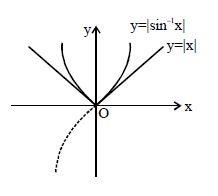
View full question & answer→MCQ 2811 Mark
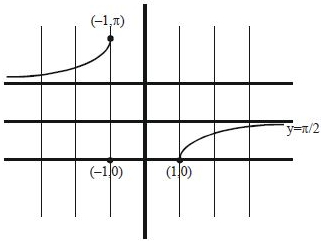
Identify the correct order
- A
$sec^{-1}(-2) < sec^{-1}(-1) < sec^{-1}(1) < sec^{-1}(2)$
- B
$sec^{-1}(2) < sec^{-1}(1) < sec^{-1}(-1) < sec^{-1}(-2)$
- C
$sec^{-1}(1) < sec^{-1}(-1) < sec^{-1}(2) < sec^{-1}(-2)$
- ✓
$sec^{-1}(1) < sec^{-1}(2) < sec^{-1}(-2) < sec^{-1}(-1)$
AnswerCorrect option: D. $sec^{-1}(1) < sec^{-1}(2) < sec^{-1}(-2) < sec^{-1}(-1)$
d
abvious from figure
$\sec ^{-1}(1)<\sec ^{-1}(2)<\sec ^{-1}(-2)<\sec ^{-1}(-1)$
View full question & answer→MCQ 2821 Mark
If ${\tan ^{ - 1}}\left( {\frac{1}{3}} \right)\, + \,{\tan ^{ - 1}}\left( {\frac{1}{7}} \right)\, + {\tan ^{ - 1}}\left( {\frac{1}{{13}}} \right)\, + \,{\tan ^{ - 1}}\left( {\frac{1}{{21}}} \right)\,$ $ + \,{\tan ^{ - 1}}\left( {\frac{1}{{31}}} \right)\, = \,{\tan ^{ - 1}}\left( {\frac{p}{q}} \right)$ , where $p$ and $q$ are relatively prime numbers, then $p + q$ is equal to-
Answerd
$\mathrm{T}_{\mathrm{r}}=\tan ^{-1}\left(\frac{1}{1+\mathrm{r}(\mathrm{r}+1)}\right)=\tan ^{-1}(\mathrm{r}+1)-\tan ^{-1}(\mathrm{r})$
$\mathrm{T}_{1}+\mathrm{T}_{2}+\mathrm{T}_{3}+\mathrm{T}_{4}+\mathrm{T}_{5}=\tan ^{-1} 6-\tan ^{-1} 1$
$=\tan ^{-1}\left(\frac{5}{7}\right)$
$p+q=5+7=12$
View full question & answer→MCQ 2831 Mark
Maximum value of expression, $\left[ {{{\tan }^{ - 1}}x - {{\tan }^{ - 1}}y} \right] - \left[ {{{\sin }^{ - 1}}u - {{\sin }^{ - 1}}v} \right]$ (where [.] denotes the greatest integer function, and $x$ , $y$ , $u$ , $v$ are independent variables)
Answerc
$\tan ^{-1} x-\tan ^{-1} y \in(-\pi, \pi)$
and $\sin ^{-1} u-\sin ^{-1} v \in[-\pi, \pi]$
$\therefore $ maximum value of expression is $[\pi]-[-\pi]=7$
View full question & answer→MCQ 2841 Mark
If the equation ${\sin ^{ - 1}}\left( {x - 1} \right) + {\cos ^{ - 1}}\left( {x - 3} \right) + {\tan ^{ - 1}}\left( {\frac{x}{{ - {x^2} + 2}}} \right) = m$ holds, then the value of $'m'$ is
- A
$\frac {-3\pi }{4}$
- B
$\frac {3\pi }{4}$
- C
$\frac {-5\pi }{4}$
- ✓
$\frac {5\pi }{4}$
AnswerCorrect option: D. $\frac {5\pi }{4}$
d
$ - 1 \le x - 1 \le 1, - 1 \le x - 3 < 1,{x^2} \ne 2$
$\Rightarrow 0 \leq x \leq 2,2 \leq x \leq 4, x \neq \pm \sqrt{2}$
$\therefore x=2$
$\therefore \mathrm{RHS}=\sin ^{-1}(1)+\cos ^{-1}(-1)+\tan ^{-1}(-1)$
$=\frac{\pi}{2}+\pi-\frac{\pi}{4}=\frac{\pi}{2}+\frac{3 \pi}{4}=\frac{5 \pi}{4}$
View full question & answer→MCQ 2851 Mark
If $\cot \frac{{2x}}{3} + \tan \frac{x}{3} = \cos ec\frac{{kx}}{3}$ , then the value of $tan^{-1} (tank)$ equals
- A
$2$
- ✓
$2 - \pi $
- C
$\pi - 2$
- D
$2\pi - 2$
AnswerCorrect option: B. $2 - \pi $
b
$LHS:$ $\frac{{\cos \frac{x}{3}}}{{\sin \frac{{2x}}{3}\cos \frac{x}{3}}} = \cos ec\frac{{2x}}{3} \Rightarrow k = 2$
$\tan ^{-1}(\tan 2)=2-\pi.$
View full question & answer→MCQ 2861 Mark
Number of solutions of the equation $2tan^{-1}(cos^2x) = tan^{-1}(2cosec^2x)$ in $\left[ {0,5\pi } \right]$ is $m$ , then
AnswerCorrect option: A. $m \le 1$
a
$2\cos e{c^2}x = \frac{{2{{\cos }^2}x}}{{1 - {{\cos }^4}x}}$
$ \Rightarrow \quad 1+\cos ^{2} x=\cos ^{2} x \Rightarrow \text { No solution } $
$ m=0$
View full question & answer→MCQ 2871 Mark
If $tan^{-1} (x^2 + 3|x|-4 )= tan^{-1} (4 \pi + sin^{-1}(sin14))$, then the value of $cos^{-1}(cos3|x|)$ is equal to
- A
$3 \pi - 9$
- B
$4 \pi - 9$
- C
$9$
- ✓
$9 - 2 \pi$
AnswerCorrect option: D. $9 - 2 \pi$
d
$x^2 + 3|x| -18 = 0 $
$|x| = 3 \Rightarrow cos^{-1}cos9 = 9 -2 \pi$
View full question & answer→MCQ 2881 Mark
If $2tan^{-1}(cosx) = tan^{-1}(cosec^2x)$ then $x =$
- A
$\frac{\pi}{2}$
- B
$\pi$
- C
$\frac{\pi}{6}$
- ✓
$\frac{\pi}{3}$
AnswerCorrect option: D. $\frac{\pi}{3}$
d
$\tan ^{-1} \frac{2 \cos x}{1-\cos ^{2} x}=\tan ^{-1}\left(\frac{1}{\sin ^{2} x}\right)$
$\Rightarrow \frac{2 \cos x}{\sin ^{2} x}=\frac{1}{\sin ^{2} x} \Rightarrow 2 \cos x=1 \Rightarrow x=\frac{\pi}{3}$
View full question & answer→MCQ 2891 Mark
The value of $x$ for which $\sin (\cot^{-1} (1 + x)) = \cos(\tan^{-1} \,x)$ is
- A
$\frac{1}{2}$
- B
$1$
- C
$0$
- ✓
$-\frac{1}{2}$
AnswerCorrect option: D. $-\frac{1}{2}$
d
$\cos \left(\tan ^{-1} x\right)$
Let $\tan ^{-1} \mathrm{x}=\theta \Rightarrow \mathrm{x}=\tan \theta$
$\cos \left(\tan ^{-1} x\right)=\cos \theta \Rightarrow \frac{1}{\sec \theta}=\frac{1}{\sqrt{1+\tan ^{2} \theta}}$
$=\frac{1}{\sqrt{1+x^{2}}}$
Now
$\sin \left[\cot ^{-1}(1+x)\right]$
$\cot ^{-1}(1+x)=\phi \Rightarrow 1+x=\cot \phi$
$\sin \cot ^{-1}(1+x)=\sin \phi=\frac{1}{\csc \phi}=\frac{1}{\sqrt{1+(1+x)^{2}}}$
Given $\frac{1}{\sqrt{1+(1+x)^{2}}}=\frac{1}{\sqrt{1+x^{2}}}$
$(1+x)^{2}=x^{2}$
$1+2 \mathrm{x}=0 \Rightarrow \mathrm{x}=-\frac{1}{2}$
View full question & answer→MCQ 2901 Mark
Let ${\tan ^{ - 1}}\left( {\tan \frac{{5\pi }}{4}} \right) = \alpha ,{\tan ^{ - 1}}\left( { - \tan \frac{{2\pi }}{3}} \right) = \beta $ Then :-
AnswerCorrect option: B. $4 \alpha -3 \beta = 0$
b
given, $\alpha=\tan ^{-1}\left(\tan \frac{5 \pi}{4}\right)$
$=\tan ^{-1}\left(\tan \left(\pi+\frac{\pi}{4}\right)\right)$
$=\tan ^{-1}\left(\tan \left(\frac{\pi}{4}\right)\right)$
$=\frac{\pi}{4}$
$\Rightarrow 4 \alpha=\pi$
$\beta=\tan ^{-1}\left(-\tan \frac{2 \pi}{3}\right)$
$=\tan ^{-1}\left(-\tan \left(\pi-\frac{\pi}{3}\right)\right)$
$=\tan ^{-1}\left(\tan \left(\frac{\pi}{3}\right)\right)$
$=\frac{\pi}{3}$
$\Rightarrow 3 \beta=\pi \quad \ldots \ldots$
From (1) and (2) we have
$\therefore 4 \alpha=3 \beta$
View full question & answer→MCQ 2911 Mark
If ${\cot ^{ - 1}}\frac{n}{\pi } > \frac{\pi }{6},\,\,n \in N$ , then the maximum value of $n$ is
Answerc
$\cot ^{-1} \frac{n}{\pi}>\frac{\pi}{6}$
$\Rightarrow \frac{\mathrm{n}}{\pi}<\cot \frac{\pi}{6}$
[as ${{{\cot }^{ - 1}}x}$ is a decreasing function]
$\Rightarrow \quad \frac{\mathrm{n}}{\pi}<\sqrt{3}$
$\Rightarrow \quad n<\sqrt{3} \pi$
$\Rightarrow \quad n<5.46$
$\Rightarrow \quad$ maximum value of $n$ is $5$
View full question & answer→MCQ 2921 Mark
If $sin^{-1}\,\theta = sin^{-1}(sin\,5)$ then $\theta $ is
- A
$sin\, (5 -\pi )$
- B
$sin\, (2\pi -5)$
- ✓
$sin\, (5 -2\pi )$
- D
AnswerCorrect option: C. $sin\, (5 -2\pi )$
c
$ \sin ^{-1} \theta =\sin ^{-1}(\sin 5) $
$ \sin ^{-1} \theta =5-2 \pi $
$ \theta =\sin (5-2 \pi) $
View full question & answer→MCQ 2931 Mark
If the equation ${\sin ^{ - 1}}\sqrt x + {\cos ^{ - 1}}\sqrt {{x^2} - 1} + {\tan ^{ - 1}}\left( {\tan \,y} \right) = a$ has at least one solution, then number of integral values of $a$ is
Answerc
Clearly $\sin ^{-1} \sqrt{x} \Rightarrow x \in[0,1]$
Also $\cos ^{-1} \sqrt{x^{2}-1} \Rightarrow 0 \leq x^{2}-1 \leq 1$
$\mathrm{x}^{2} \in[1,2]$
$\therefore $ Possible value of $x=1$
$\therefore $ Equation becomes $\frac{\pi}{2}+\frac{\pi}{2}+\tan ^{-1} \tan \mathrm{y}=\mathrm{a}$
$\therefore $ for solution $a \in\left(\frac{\pi}{2}, \frac{3 \pi}{2}\right)$
$\therefore $ integral values are $2,3,4$
View full question & answer→MCQ 2941 Mark
$\sum\limits_{r = 1}^\infty {{{\tan }^{ - 1}}\left( {\frac{3}{{{r^2} - r + 9}}} \right)} $ is-
- A
$\frac{\pi }{3}$
- B
$\frac{\pi }{6}$
- ✓
$\frac{\pi }{2}$
- D
$\frac{\pi }{12}$
AnswerCorrect option: C. $\frac{\pi }{2}$
c
$T_{r}=\tan ^{-1}\left(\frac{\frac{1}{3}}{1+\frac{r}{3} \frac{(r-1)}{3}}\right)$
$\mathrm{T}_{\mathrm{r}}=\tan ^{-1}\left(\frac{\mathrm{r}}{3}\right)-\tan ^{-1}\left(\frac{(\mathrm{r}-1)}{3}\right)$
$\mathrm{T}_{1}=\tan ^{-1}\left(\frac{1}{3}\right)-\tan ^{-1}(0)$
$\mathrm{T}_{2}=\tan ^{-1}\left(\frac{2}{3}\right)-\tan ^{-1}\left(\frac{1}{3}\right)$
$\mathrm{T}_{\mathrm{n}}=\tan ^{-1}\left(\frac{\mathrm{n}}{3}\right)-\tan ^{-1}\left(\frac{(\mathrm{n}-1)}{3}\right)$
$S_{n}=\tan ^{-1}\left(\frac{n}{3}\right)=\frac{\pi}{2}$
View full question & answer→MCQ 2951 Mark
If $tan^{-1 } \frac{1}{1+2}+tan^{-1 } \frac{1}{1+(2)(3)}+ tan^{-1 }\frac{1}{1+(3)(4)}+$ ......$tan^{-1}\frac{1}{{1 + n(n + 1)}}=tan^{-1} \theta,$ then $\theta$ =
- A
$\frac{n}{n+1}$
- B
$\frac{n+1}{n+2}$
- ✓
$\frac{n}{n+2}$
- D
$\frac{n-1}{n+2}$
AnswerCorrect option: C. $\frac{n}{n+2}$
c
$\tan ^{-1} \frac{1}{1+n(n+1)}=\tan ^{-1} \frac{n+1-n}{1+n(n+1)}$
$=\tan ^{-1}(\mathrm{n}+1)-\tan ^{-1}(\mathrm{n})$
so that $L.H.S.$ of the given eq uation is
${\tan ^{ - 1}}2 - {\tan ^{ - 1}}1 + {\tan ^{ - 1}}3 - {\tan ^{ - 1}}2 + .......$
$+\tan ^{-1}(\mathrm{n}+1)-\tan ^{-1} \mathrm{n}$
$=\tan ^{-1}(\mathrm{n}+1)-\tan ^{-1} 1$
$=\tan ^{-1} \frac{n+1-1}{1+(n+1)}=\tan ^{-1} \frac{n}{n+2}$
so that $\tan ^{-1} \frac{n}{n+2}=\tan ^{-1} \theta \Rightarrow \theta=\frac{n}{n+2}$
View full question & answer→MCQ 2961 Mark
$4tan^{-1} \frac{1}{5} -tan^{-1} \frac{1}{239}$ is equal to
- A
$\pi$
- B
$\frac{\pi}{2}$
- C
$\frac{\pi}{3}$
- ✓
$\frac{\pi}{4}$
AnswerCorrect option: D. $\frac{\pi}{4}$
d
$4 \tan ^{-1} \frac{1}{5}-\tan ^{-1} \frac{1}{239}$
$=2\left(2 \tan ^{-1} \frac{1}{5}\right)-\tan ^{-1} \frac{1}{239}$
$=2 \tan ^{-1} \frac{\frac{2}{5}}{1-\left(\frac{1}{5}\right)^{2}}-\tan ^{-1} \frac{1}{239} \quad\left(\because 2 \tan ^{-1} x=\tan ^{-1} \frac{2 x}{1-x^{2}}\right)$
$=2 \tan ^{-1} \frac{2 / 5}{24 / 25}-\tan ^{-1} \frac{1}{239}$
$=2 \tan ^{-1} \frac{5}{12}-\tan ^{-1} \frac{1}{239}$
$=2 \tan ^{-1} \frac{\frac{2}{5}}{1-\left(\frac{1}{5}\right)^{2}}-\tan ^{-1} \frac{1}{239} \quad\left(\because 2 \tan ^{-1} x=\tan ^{-1} \frac{2 x}{1-x^{2}}\right)$
$=2 \tan ^{-1} \frac{2 / 5}{24 / 25}-\tan ^{-1} \frac{1}{239}$
$=2 \tan ^{-1} \frac{5}{12}-\tan ^{-1} \frac{1}{239}$
$=\tan ^{-1} \frac{2 \cdot \frac{5}{12}}{1-\left(\frac{5}{12}\right)^{2}}-\tan ^{-1} \frac{1}{239} \quad\left(\because 2 \tan ^{-1} x=\tan ^{-1} \frac{2 x}{1-x^{2}}\right)$
$=\tan ^{-1} \frac{144 \times 5}{119 \times 6}-\tan ^{-1} \frac{1}{239}$
$=\tan ^{-1} \frac{120}{119}-\tan ^{-1} \frac{1}{239}$
$=\tan ^{-1} \frac{\frac{120}{119}-\frac{1}{239}}{1+\frac{120}{119} \cdot \frac{1}{239}} \quad\left(\because \tan ^{-1} x-\tan ^{-1} y=\tan ^{-1} \frac{x-y}{1+x y}\right)$
$=\tan ^{-1} \frac{120 \times 239-119}{119 \times 239+120}=\tan ^{-1} \frac{28680-119}{28441+120}$
$=\tan ^{-1} \frac{28561}{28561}=\tan ^{-1} 1=\frac{\pi}{4}$
View full question & answer→MCQ 2971 Mark
Let $\cos ^{-1}(x) + \cos ^{-1} (2x) + \cos ^{-1}(3x) = \pi.$ If $x$ satisfies the cubic $ax^3 + bx^2 + cx -1 = 0,$ then $(a + b + c)$ has the value equal to -
Answerc
$\cos ^{-1}(x)+\cos ^{-1}(2 x)+\cos ^{-1}(3 x)=\pi$
$\Rightarrow \cos ^{-1}(2 x)+\cos ^{-1}(3 x)=\pi-\cos ^{-1}(x)$
$\Rightarrow \cos ^{-1}(2 x \cdot 3 x-\sqrt{1-4 x^{2}} \sqrt{1-9 x^{2}})=\cos ^{-1}(-x)$
$\Rightarrow \quad 6 x^{2}-\sqrt{1-4 x^{2}} \sqrt{1-9 x^{2}}=-x$
$\Rightarrow \quad\left(6 x^{2}+x\right)=\sqrt{1-4 x^{2}} \sqrt{1-9 x^{2}}$
$\Rightarrow \quad 36 x^{4}+x^{2}+12 x^{3}=\left(1-4 x^{2}\right)\left(1-9 x^{2}\right)$
$\Rightarrow \quad 36 x^{4}+x^{2}+12 x^{3}=1-13 x^{2}+36 x^{4}$
$\Rightarrow 12 \mathrm{x}^{3}+14 \mathrm{x}^{2}-1=0$
$\therefore \quad a=12, b=14, c=0$
View full question & answer→MCQ 2981 Mark
The value of $\sum\limits_{n = 1}^\infty {\left( {{{\tan }^{ - 1}}\left( {\frac{n}{{n + 2}}} \right)\, - \,{{\tan }^{ - 1}}\left( {\frac{{n - 1}}{{n + 1}}} \right)} \right)} $ is equal to-
- ✓
$\frac{\pi }{4}$
- B
$\frac{\pi }{3}$
- C
$\frac{\pi }{2}$
- D
$\frac{3\pi }{4}$
AnswerCorrect option: A. $\frac{\pi }{4}$
a
$\sum\limits_{n = 1}^\infty {{{\tan }^{ - 1}}\left( {\frac{{\frac{n}{{n + 2}} - \frac{{n - 1}}{{n + 1}}}}{{1 + \frac{n}{{n + 2}} \times \frac{{n - 1}}{{n + 1}}}}} \right)} $
$\sum\limits_{n = 1}^\infty {{{\tan }^{ - 1}}\left( {\frac{1}{{{n^2} + n + 1}}} \right)} $
$\sum\limits_{n = 1}^\infty {\left( {{{\tan }^{ - 1}}\left( {n + 1} \right) - {{\tan }^{ - 1}}n} \right)} $
$ = {\tan ^{ - 1}}\left( 2 \right) - {\tan ^{ - 1}}\left( 1 \right) + {\tan ^{ - 1}}\left( 3 \right) - {\tan ^{ - 1}}\left( 2 \right)$
$ + .... + .... + {\tan ^{ - 1}}\left( \infty \right)$
$ = {\tan ^{ - 1}}\left( \infty \right) - {\tan ^{ - 1}}\left( 1 \right)$
$ = \frac{\pi }{2} - \frac{\pi }{4} = \frac{\pi }{4}$
View full question & answer→MCQ 2991 Mark
$\sum\limits_{\lambda = 1}^{10} {{{\sin }^{ - 1}}\left( {\sin \left( {\lambda \pi - \frac{\pi }{6}} \right)} \right)} $ is equal to-
- A
$\frac{{5\pi }}{3}$
- B
$\frac{{\pi }}{2}$
- ✓
$0$
- D
$5\pi$
Answerc
$ = \sum\limits_{n = 1}^5 {{{\sin }^{ - 1}}\left( {\sin \left( {2n\pi - \frac{\pi }{6}} \right)} \right) + } \sum\limits_{n = 1}^5 {{{\sin }^{ - 1}}\left( {\sin \left( {2n - 1} \right)\pi - \frac{\pi }{6}} \right)} $
$ = \sum\limits_{n = 1}^5 {{{\sin }^{ - 1}}\left( { - \sin \frac{\pi }{6}} \right) + \sum\limits_{n = 1}^5 {{{\sin }^{ - 1}}\left( {\sin \frac{\pi }{6}} \right)} } $
$ = - \frac{{5\pi }}{6} + \frac{{5\pi }}{6} = 0$
View full question & answer→MCQ 3001 Mark
${\tan ^{ - 1}}\left[ {\cos \left( {2\,{{\tan }^{ - 1}}\frac{3}{4}} \right)\, + \,\sin \,\left( {2\,{{\cot }^{ - 1}}\frac{1}{2}} \right)} \right]$ is
- A
- B
equal to $\frac{\pi }{4}$
- ✓
greater than $\frac{\pi }{4}$
- D
less than $\frac{\pi }{4}$
AnswerCorrect option: C. greater than $\frac{\pi }{4}$
c
$\tan ^{-1}\left[\cos \left(2 \tan ^{-1} \frac{3}{4}\right)+\sin \left(2 \cot ^{-1} \frac{1}{2}\right)\right]$
$=\tan ^{-1}\left(1+\frac{2}{25}\right)>\frac{\pi}{4}$
View full question & answer→