MCQ 511 Mark
Let $A$ denote the area bounded by the curve $y=\frac{1}{x}$ and the lines $y=0, x=1, x=10$, let $B=1+\frac{1}{2}+\ldots+\frac{1}{9}$, and let $C=\frac{1}{2}+\frac{1}{3}+\ldots+\frac{1}{10}$. Then,
AnswerCorrect option: D. $C < A < B$ and $B - A < A - C$
d
(d)
Area bounded by curve $y=\frac{1}{x}, y=0, x=1, x=10$ is
$\int \limits_1^{10} \frac{1}{x} d x$$=[\log _e x]_1^{10}$$=\log _e 10$
$A =\log _e 10=2.303$
$B =1+\frac{1}{2}+\frac{1}{3}+\frac{1}{4}+\ldots+\frac{1}{9}$
$C =\frac{1}{2}+\frac{1}{3}+\frac{1}{4} \ldots+\frac{1}{10}$
Clearly, $B > C$
Also, $\quad B > A$
$\left[\because \log _e(1+n) < 1+\frac{1}{2}+\frac{1}{3}+\ldots+\frac{1}{n}\right]$
$B > A > C$
$2 A > B + C$
$A-C > B-A$
View full question & answer→MCQ 521 Mark
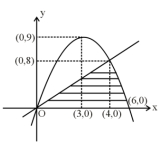
If the area of the region $\left\{(x, y): 0 \leq y \leq \min \left\{2 x, 6 x-x^2\right\}\right\}$ is $A$, then $12 A$ is equal to
Answerb
We have
$A=\frac{1}{2} \times 4 \times 8+\int_4^6\left(6 x-x^2\right) d x $
$A=\frac{76}{3} $
$12 A=304$
View full question & answer→MCQ 531 Mark
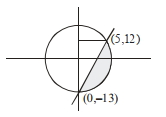
The area (in sq. units) of the part of circle $\mathrm{x}^2+\mathrm{y}^2=169$ which is below the line $5 \mathrm{x}-\mathrm{y}=13$ is $\frac{\pi \alpha}{2 \beta}-\frac{65}{2}+\frac{\alpha}{\beta} \sin ^{-1}\left(\frac{12}{13}\right)$ where $\alpha, \beta$ are coprime numbers. Then $\alpha+\beta$ is equal to__________.
Answerd
$ \text { Area }=\int_{-13}^{12} \sqrt{169-y^2} d y-\frac{1}{2} \times 25 \times 5 $
$ =\frac{\pi}{2} \times \frac{169}{2}-\frac{65}{2}+\frac{169}{2} \sin ^{-1} \frac{12}{13} $
$ \therefore \alpha+\beta=171$
View full question & answer→MCQ 541 Mark
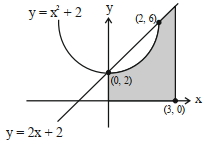
Let the area of the region $\{(x, y): 0 \leq x \leq 3,0 \leq y \leq$ $\left.\min \left\{x^2+2,2 x+2\right\}\right\}$ be $A$. Then $12 \mathrm{~A}$ is equal to
Answera
$ A=\int_0^2\left(x^2+2\right) d x+\int_2^3(2 x+2) d x $
$ A=\frac{41}{3} $
$ 12 A=41 \times 4=164$
View full question & answer→MCQ 551 Mark
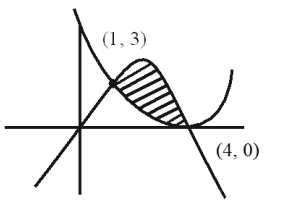
The area of the region enclosed by the parabola $y=4 x-x^2$ and $3 y=(x-4)^2$ is equal to
- A
$\frac{32}{9}$
- B
$4$
- ✓
$6$
- D
$\frac{14}{3}$
Answerc
$ \text { Area }=\left\lvert\, \int_1^4\left[\left(4 x-x^2\right)-\frac{(x-4)^2}{3}\right] d x\right. $
$ \text { Area }=\left|\frac{4 x^2}{2}-\frac{x^3}{3}-\frac{(x-4)^3}{9}\right|_1^4 $
$ =\left|\left(\frac{64}{2}-\frac{64}{3}-\frac{4}{2}+\frac{1}{3}-\frac{27}{9}\right)\right| $
$ \Rightarrow(27-21)=6$
View full question & answer→MCQ 561 Mark
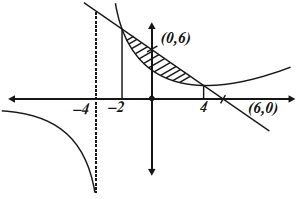
The area enclosed by the curves $x y+4 y=16$ and $x+y=6$ is equal to :
- A
$28-30 \log _e 2$
- B
$30-28 \log _e 2$
- ✓
$30-32 \log _e 2$
- D
$32-30 \log _e 2$
AnswerCorrect option: C. $30-32 \log _e 2$
c
$ x y+4 y=16 $
$ y(x+4)=16 \ldots $ (1)
$x+y=6 $
$ x+y=6$ $....(2)$
on solving, $(1) \& (2)$
we get $x=4, x=-2$
Area = $ \int_{-2}^4\left((6-x)-\left(\frac{16}{x+4}\right)\right) d x$
$ =30-32 \ln 2$
View full question & answer→MCQ 571 Mark
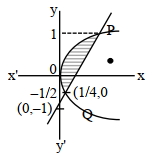
The area (in sq. units) of the region described by $\left\{(\mathrm{x}, \mathrm{y}): \mathrm{y}^2 \leq 2 \mathrm{x}\right.$, and $\left.\mathrm{y} \geq 4 \mathrm{x}-1\right\}$ is
- A
$\frac{11}{32}$
- B
$\frac{8}{9}$
- C
$\frac{11}{12}$
- ✓
$\frac{9}{32}$
AnswerCorrect option: D. $\frac{9}{32}$
d
$\text { Shaded area }=\int_{-\frac{1}{2}}^1\left(x_{\text {Right }}-x_{\text {Left }}\right) d y$
$\begin{aligned} & y^2=2 x \\ & y=4 x-1 \quad \text { Solve } \\ & y=1, y=-\frac{1}{2}\end{aligned}$
$ \text { Shaded area }=\int_{-\frac{1}{2}}^1\left(\frac{y+1}{4}-\frac{y^2}{2}\right) d y $
$ =\left(\frac{1}{4}\left(\frac{y^2}{2}+y\right)-\frac{y^3}{6}\right)_{-\frac{1}{2}}^1=\frac{9}{32}$
View full question & answer→MCQ 581 Mark
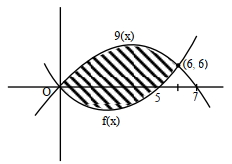
The area of the region enclosed by the parabolas $y=x^2-5 x$ and $y=7 x-x^2$ is....................
Answerc
$y=x^2-5 x$ and $y=7 x-x^2$
$Image$
$ \int_0^6(g(x)-f(x)) d x $
$ \int_0^6\left(\left(7 x-x^2\right)-\left(x^2-5 x\right)\right) d x $
$ \int_0^6\left(12 x-2 x^2\right) d x=\left[12 \frac{x^2}{2}-\frac{2 x^3}{3}\right]_0^6 $
$ \Rightarrow 6(6)^2-\frac{2}{3}(6)^3 $
$ =216-144=72 \text { unit }^2$
View full question & answer→MCQ 591 Mark
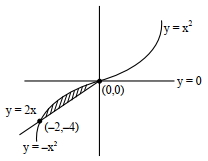
The area enclosed between the curves $y=x|x|$ and $\mathrm{y}=\mathrm{x}-|\mathrm{x}|$ is :
- A
$\frac{8}{3}$
- B
$\frac{2}{3}$
- C
$1$
- ✓
$\frac{4}{3}$
AnswerCorrect option: D. $\frac{4}{3}$
d
$Image$
$A=\int_{-2}^0-x^2-2 x=\frac{4}{3}$
View full question & answer→MCQ 601 Mark
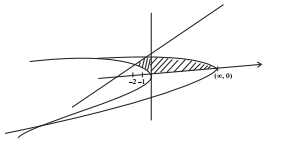
Let the area of the region $\{(x, y): x-2 y+4 \geq 0$, $\left.x+2 y^2 \geq 0, x+4 y^2 \leq 8, y \geq 0\right\}$ be $\frac{m}{n}$, where $m$ and $\mathrm{n}$ are coprime numbers. Then $\mathrm{m}+\mathrm{n}$ is equal to
Answerd
$A=\int_0^1\left[\left(8-4 y^2\right)-\left(-2 y^2\right)\right] \mathrm{dy}+
\int_1^{3 / 2}\left[\left(8-4 y^2\right)-(2 y-4)\right] \mathrm{dy}$
$ =\left[8 \mathrm{y}-\frac{2 \mathrm{y}^3}{3}\right]_0^1+\left[12 \mathrm{y}-\mathrm{y}^2-\frac{4 \mathrm{y}^3}{3}\right]_1^{3 / 2}=\frac{107}{12}=\frac{\mathrm{m}}{\mathrm{n}}$
$\therefore \mathrm{m}+\mathrm{n}=119$
View full question & answer→MCQ 611 Mark
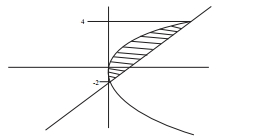
The area $(in\ square\ units)$ of the region bounded by the parabola $\mathrm{y}^2=4(\mathrm{x}-2)$ and the line $\mathrm{y}=2 \mathrm{x}-8$
Answerb
Let $ x=x-2 $
$ y^2=4 x, \quad y=2(x+2)-8$
$y^2=4 x, \quad y=2 x-4$
$A=\int_{-2}^4 \frac{y^2}{4}-\frac{y+4}{2}$
$=9$
View full question & answer→MCQ 621 Mark
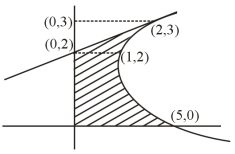
The area of the region enclosed by the parabola $(y-2)^2=x-1$, the line $x-2 y+4=0$ and the positive coordinate axes is
Answera
Solving the equations
$(y-2)^2=x-1 \text { and } x-2 y+4=0$
$x=2(y-2)$
$\frac{x^2}{4}=x-1$
$x^2-4 x+4=0$
$(x-2)^2=0 $
$x=2
$Exclose area (w.r.t. y-axis) $=\int_0^3 x \mathrm{dy}-$ Area of $\Delta$.
$ =\int_0^3\left((y-2)^2+1\right) d y-\frac{1}{2} \times 1 \times 2 $
$ =\int_0^3\left(y^2-4 y+5\right) d y-1$
$ =\left[\frac{y^3}{3}-2 y^2+5 y\right]_0^3-1 $
$ =9-18+15-1=5$
View full question & answer→MCQ 631 Mark
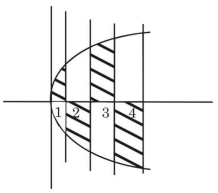
The area of the region $\left\{(x, y): y^2 \leq 4 x, x<4, \frac{x y(x-1)(x-2)}{(x-3)(x-4)}>0, x \neq 3\right\}$ is
- A
$\frac{16}{3}$
- B
$\frac{64}{3}$
- C
$\frac{8}{3}$
- ✓
$\frac{32}{3}$
AnswerCorrect option: D. $\frac{32}{3}$
d
$ y^2 \leq 4 x, x<4 $
$ \frac{x y(x-1)(x-2)}{(x-3)(x-4)}>0$
$\text { Case-I : y>0 }$
$\frac{x(x-1)(x-2)}{(x-3)(x-4)}>0$
$x \in(0,1) \cup(2,3)$
$\text { Case - II : y<0 }$
$\frac{x(x-1)(x-2)}{(x-3)(x-4)}<0, x \in(1,2) \cup(3,4)$
$ \text { Area }=2 \int_0^4 \sqrt{x} d x $
$ =2 \cdot \frac{2}{3}\left[x^{3 / 2}\right]_0^4=\frac{32}{3}$
View full question & answer→MCQ 641 Mark
The sum of squares of all possible values of $k$, for which area of the region bounded by the parabolas $2 \mathrm{y}^2=\mathrm{kx}$ and $\mathrm{ky}^2=2(\mathrm{y}-\mathrm{x})$ is maximum, is equal to :
Answerd
$ k y^2=2(y-x) $
$ 2 y^2=k x $
$ \text { Point of intersection } \rightarrow $
$ \mathrm{ky}^2=2\left(\mathrm{y}-\frac{2 \mathrm{y}^2}{\mathrm{k}}\right) $
$ \mathrm{y}=0 \quad \mathrm{ky}=2\left(1-\frac{2 \mathrm{y}}{\mathrm{k}}\right) $
$ \mathrm{ky}+\frac{4 \mathrm{y}}{\mathrm{k}}=2 $
$ y=\frac{2}{k+\frac{4}{k}}=\frac{2 k}{k^2+4} $
$ A=\int_0^{\frac{2 k}{k^2+4}}\left(\left(y-\frac{k y^2}{2}\right)-\left(\frac{2 y^2}{k}\right)\right) \cdot d y $
$ =\frac{\mathrm{y}^2}{2}-\left.\left(\frac{\mathrm{k}}{2}+\frac{2}{\mathrm{k}}\right) \cdot \frac{\mathrm{y}^3}{3}\right|_0 ^{\frac{2 \mathrm{k}}{\mathrm{k}^2+4}} $
$ =\left(\frac{2 \mathrm{k}}{\mathrm{k}^2+4}\right)^2\left[\frac{1}{2}-\frac{\mathrm{k}^2+4}{2 \mathrm{k}} \times \frac{1}{3} \times \frac{2 \mathrm{k}}{\mathrm{k}^2+4}\right] $
$ =\frac{1}{6} \times 4 \times\left(\frac{1}{\mathrm{k}+\frac{4}{\mathrm{k}}}\right)^2$
$A \cdot M \geq G \cdot M \frac{\left(k+\frac{4}{k}\right)}{2} \geq 2$
$\mathrm{k}+\frac{4}{\mathrm{k}} \geq 4$
Area is maximum when $\mathrm{k}=\frac{4}{\mathrm{k}}$
$\mathrm{k}=2,-2$
View full question & answer→MCQ 651 Mark
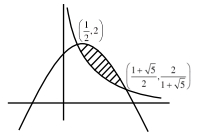
One of the points of intersection of the curves $\mathrm{y}=1+3 \mathrm{x}-2 \mathrm{x}^2$ and $\mathrm{y}=\frac{1}{\mathrm{x}}$ is $\left(\frac{1}{2}, 2\right)$. Let the area of the region enclosed by these curves be $\frac{1}{24}(\ell \sqrt{5}+\mathrm{m})-\operatorname{nlog}_{\mathrm{e}}(1+\sqrt{5})$, where $\ell, \mathrm{m}, \mathrm{n} \in$ $\mathrm{N}$. Then $\ell+\mathrm{m}+\mathrm{n}$ is equal to
Answerb
$ A=\int_{\frac{1}{2}}^{\frac{1+\sqrt{5}}{2}}\left(1+3 x-2 x^2-\frac{1}{x}\right) d x $
$ A=\left[x+\frac{3 x^2}{2}-\frac{2 x^3}{3}-\ln x\right]_{\frac{1}{2}}^{\frac{1+\sqrt{5}}{2}} $
$ A=\frac{1+\sqrt{5}}{2}+\frac{3}{2}\left(\frac{1+\sqrt{5}}{2}\right)^2-\frac{2}{3}\left(\frac{1+\sqrt{5}}{2}\right)^3-\ln \left(\frac{1+\sqrt{5}}{2}\right) $
$ -\frac{1}{2}-\frac{3}{2}\left(\frac{1}{4}\right)+\frac{2}{3}\left(\frac{1}{8}\right)+\ln \left(\frac{1}{2}\right) $
$ A=\frac{1}{2}+\frac{\sqrt{5}}{2}+\frac{3}{8}+\frac{3}{4} \sqrt{5}+\frac{15}{8}-\frac{4}{3}-\frac{2}{3} \sqrt{5} $
$ -\frac{1}{2}-\frac{3}{8}+\frac{1}{12}-\ln (1+\sqrt{5}) $
$ =\sqrt{5}\left(\frac{1}{2}+\frac{3}{4}-\frac{2}{3}\right)+\frac{15}{8}-\frac{4}{3}+\frac{1}{12}-\ln (1+\sqrt{5}) $
$ =\frac{14}{24} \sqrt{5}+\frac{15}{24}-\ln (1+\sqrt{5})$
View full question & answer→MCQ 661 Mark
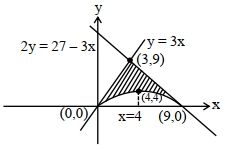
Let the area of the region enclosed by the curves $y=3 x, 2 y=27-3 x$ and $y=3 x-x \sqrt{x}$ be $A$. Then $10 \mathrm{~A}$ is equal to
Answerd
$y=3 x, 2 y=27-3 x \& y=3 x-x \sqrt{x}$
$Image$
$ \mathrm{A}=\int_0^3 3 \mathrm{x}-(3 \mathrm{x}-\mathrm{x} \sqrt{\mathrm{x}}) \mathrm{dx}+\int_3^9\left(\frac{27-3 \mathrm{x}}{2}-(3 \mathrm{x}-\mathrm{x} \sqrt{\mathrm{x}})\right) \mathrm{dx} $
$ \mathrm{A}=\int_0^3 \mathrm{x}^{3 / 2} \mathrm{dx}+\int_3^9 \frac{27}{2}-\frac{9 \mathrm{x}}{2}+\mathrm{x}^{3 / 2} \mathrm{dx} $
$ \mathrm{A}=\left[\frac{2 \mathrm{x}^{5 / 2}}{5}\right]_0^3+\frac{27}{2}[\mathrm{x}]_3^9-\frac{9}{2}\left[\frac{\mathrm{x}^2}{2}\right]_3^9+\left[\frac{2 \mathrm{x}^{5 / 2}}{5}\right]_3^9 $
$ \mathrm{~A}=\frac{2}{5}\left(3^{5 / 2}\right)+\frac{27}{2}(6)-\frac{9}{4}(72)+\frac{2}{5}\left(9^{5 / 2}-3^{5 / 2}\right) $
$ \mathrm{A}=\frac{2}{5}\left(3^{5 / 2}\right)+81-162+\frac{2}{5} \times 3^5-\frac{2}{5} \times 3^{5 / 2} $
$ \mathrm{~A}=\frac{486}{5}-81=\frac{81}{5} $
$ 10 \mathrm{~A}=162 $
$ A n s .=4$
View full question & answer→MCQ 671 Mark
If the area of the region
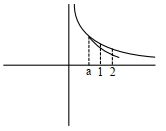
$\left\{(\mathrm{x}, \mathrm{y}): \frac{\mathrm{a}}{\mathrm{x}^2} \leq \mathrm{y} \leq \frac{1}{\mathrm{x}}, 1 \leq \mathrm{x} \leq 2,0<\mathrm{a}<1\right\}$ is
$\left(\log _e 2\right)-\frac{1}{7}$ then the value of $7 a-3$ is equal to:
Answerc
$ \operatorname{area} \int_1^2\left(\frac{1}{x}-\frac{a}{x^2}\right) d x $
$ {\left[\ln x+\frac{a}{x}\right]_1^2} $
$ \ell \operatorname{nn} 2+\frac{a}{2}-a=\log _e 2-\frac{1}{7} $
$ \frac{-a}{2}=-\frac{1}{7} $
$ a=\frac{2}{7} $
$ 7 a=2 $
$ 7 a-3=-1$
View full question & answer→MCQ 681 Mark
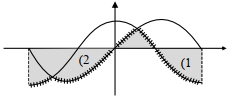
Let the area of the region enclosed by the curve $\mathrm{y}=\min \{\sin \mathrm{x}, \cos \mathrm{x}\}$ and the $\mathrm{x}$-axis between $\mathrm{x}=-\pi$ to $\mathrm{x}=\pi$ be $\mathrm{A}$. Then $\mathrm{A}^2$ is equal to...........
Answera
$\begin{aligned} & y=\min \{\sin x, \cos x\} \\ & x-\text { axis } \quad x-\pi \quad x=\pi\end{aligned}$
$ \int_0^{\pi / 4} \sin x=(\cos x)_{\pi / 4}^0=1-\frac{1}{\sqrt{2}} $
$Image$
$ \int_{-\pi}^{-3 \pi / 4}(\sin x-\cos x)=(-\cos x-\sin x)_{-\pi}^{-3 \pi / 4} $
$ =(\cos x+\sin x)_{-3 \pi / 4}^{-\pi} $
$ =(-1+0)-\left(-\frac{1}{\sqrt{2}}-\frac{1}{\sqrt{2}}\right) $
$ =-1+\frac{1}{\sqrt{2}}+\frac{1}{\sqrt{2}} $
$ \int_{\pi / 4}^{\pi / 2} \cos x d x=(\sin x)_{\pi / 4}^{\pi / 2}=1-\frac{1}{\sqrt{2}} $
$ A=4 $
$ A^2=16$
View full question & answer→MCQ 691 Mark
The area of the region in the first quadrant inside the circle $x^2+y^2=8$ and outside the pnrabola $\mathrm{y}^2=2 \mathrm{x}$ is equal to :
AnswerCorrect option: B. $\pi-\frac{2}{3}$
b
Required area $=\operatorname{Ar}$( circle from $0$ to $2$)-
$ \operatorname{ar}(\text { para from } 0 \text { to } 2) $
$ =\int_0^2 \sqrt{8-\mathrm{x}^2} \mathrm{dx}-\int_0^2 \sqrt{2 \mathrm{x}} \mathrm{dx} $
$ =\left[\frac{\mathrm{x}}{2} \sqrt{8-\mathrm{x}^2}+\frac{8}{2} \sin ^{-1} \frac{\mathrm{x}}{2 \sqrt{2}}\right]_0^2-\sqrt{2}\left[\frac{\mathrm{x} \sqrt{\mathrm{x}}}{3 / 2}\right]_0^2 $
$ =\frac{2}{2} \sqrt{8-4}+\frac{8}{2} \sin ^{-1} \frac{2}{2 \sqrt{2}}-\frac{2 \sqrt{2}}{3}(2 \sqrt{2}-0) $
$ \Rightarrow 2+4 \cdot \frac{\pi}{4}-\frac{8}{3}=\pi-\frac{2}{3}$
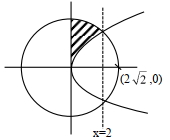
View full question & answer→MCQ 701 Mark
The parabola $y^2=4 x$ divides the area of the circle $x^2+y^2=5$ in two parts. The area of the smaller part is equal to :
- ✓
$\frac{2}{3}+5 \sin ^{-1}\left(\frac{2}{\sqrt{5}}\right)$
- B
$\frac{1}{3}+5 \sin ^{-1}\left(\frac{2}{\sqrt{5}}\right)$
- C
$\frac{1}{3}+\sqrt{5} \sin ^{-1}\left(\frac{2}{\sqrt{5}}\right)$
- D
$\frac{2}{3}+\sqrt{5} \sin ^{-1}\left(\frac{2}{\sqrt{5}}\right)$
AnswerCorrect option: A. $\frac{2}{3}+5 \sin ^{-1}\left(\frac{2}{\sqrt{5}}\right)$
a
$ y^2=4 x $
$ x^2+y^2=5$
$\therefore$ Area of shaded region as shown in the figure will be
$Image$
$ \mathrm{A}_1=\int_0^1 \sqrt{4 \mathrm{x}} \mathrm{dx}+\int_1^{\sqrt{5}} \sqrt{5-\mathrm{x}^2} \mathrm{dx} $
$ =\frac{4}{3} \cdot\left[\mathrm{x}^{\frac{3}{2}}\right]_0^1+\left[\frac{\mathrm{x}}{2} \sqrt{5-\mathrm{x}^2}+\frac{5}{2} \sin ^{-1} \frac{\mathrm{x}}{\sqrt{5}}\right]_1^{\sqrt{5}} $
$ =\frac{1}{3}+\frac{5 \pi}{4}-\frac{5}{2} \sin ^{-1}\left(\frac{1}{\sqrt{5}}\right) $
$ \therefore \text { Required Area }=2 \mathrm{~A}_1 $
$ =\frac{2}{3}+\frac{5 \pi}{2}-5 \sin ^{-1}\left(\frac{1}{\sqrt{5}}\right) $
$ =\frac{2}{3}+5\left(\frac{\pi}{2}-\sin ^{-1} \frac{1}{\sqrt{5}}\right) $
$ =\frac{2}{3}+5 \cos ^{-1} \frac{1}{\sqrt{5}} $
$ =\frac{2}{3}+5 \sin ^{-1}\left(\frac{2}{\sqrt{5}}\right)$
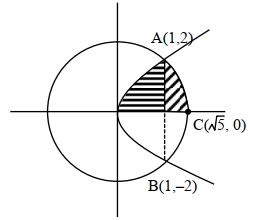
View full question & answer→MCQ 711 Mark
The area (in square units) of the region enclosed by the ellipse $x^2+3 y^2=18$ in the first quadrant below the line $y=x$ is :
AnswerCorrect option: B. $\sqrt{3} \pi$
b
$\frac{x^2}{18}+\frac{y^2}{6}=1$
$Image$
$ \frac{x^2}{18}+\frac{3 x^2}{18}=1 \Rightarrow 4 x^2=18 \Rightarrow x^2=\frac{9}{2} $
$ \int_{\frac{3}{\sqrt{2}}}^{3 \sqrt{2}} \frac{\sqrt{18-x^2}}{\sqrt{3}} d x $
$ =\frac{1}{\sqrt{3}}\left(\frac{x \sqrt{18-x^2}}{2}+\frac{18}{2} \sin ^{-1} \frac{x}{3 \sqrt{2}}\right)_{\frac{3}{\sqrt{2}}}^{3 \sqrt{2}} $
$ =\frac{1}{\sqrt{3}}\left(9 \times \frac{\pi}{2}-\frac{3}{2 \sqrt{2}} \times \frac{3 \sqrt{3}}{\sqrt{2}}-9 \times \frac{\pi}{6}\right)$
Required Area
$ =\frac{1}{2} \times \frac{9}{2}+\left(\frac{18 \pi}{6}-\frac{9 \sqrt{3}}{4}\right) \frac{1}{\sqrt{3}} $
$ =\sqrt{3} \pi$
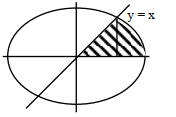
View full question & answer→MCQ 721 Mark
The area enclosed by the curves $y^2+4 x=4$ and $y-2 x=2$ is :
- A
$\frac{25}{3}$
- B
$\frac{22}{3}$
- ✓
$9$
- D
$\frac{23}{3}$
Answerc
$y^2+4 x=4$
$y^2=-4(x-1)$
$A=\int \limits_{-4}^2\left(\frac{4-y^2}{4}-\frac{y-2}{2}\right) d y=9$
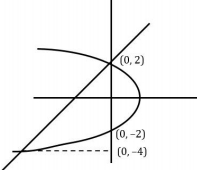
View full question & answer→MCQ 731 Mark
The area of the region enclosed by the curve $y=x^3$ and its tangent at the point $(-1,-1)$ is
- ✓
$\frac{27}{4}$
- B
$\frac{19}{4}$
- C
$\frac{23}{4}$
- D
$\frac{31}{4}$
AnswerCorrect option: A. $\frac{27}{4}$
a
equation of tangent : $y+1=3(x+1)$
i.e. $y=3 x+2$
Point of intersection with curve $(2,8)$
So Area $=\int \limits_{-1}^2\left((3 x+2)-x^3\right) d x=\frac{27}{4}$
View full question & answer→MCQ 741 Mark
The area of the region enclosed by the curve $f(x)=\max \{\sin x, \cos x\},-\pi \leq x \leq \pi$ and the $x$-axis is
- A
$2(\sqrt{2}+1)$
- B
$2 \sqrt{2}(\sqrt{2}+1)$
- C
$4(\sqrt{2})$
- ✓
$4$
Answerd
Area $=$
$\left|\int \limits_{-\pi}^{\frac{-3 \pi}{4}} \sin x d x\right|+\left|\int \limits_{\frac{-3 \pi}{4}}^{\frac{-\pi}{2}} \cos x d x\right|+\int \limits_{\frac{-\pi}{2}}^{\frac{\pi}{4}} \cos x d x+\int \limits_{\frac{\pi}{4}}^\pi \sin x d x$
$=4$
View full question & answer→MCQ 751 Mark
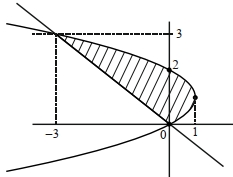
If the area of the region bounded by the curves $y^2-2 y=-x, x+y=0$ is $A$, then $8 A$ is equal to
Answerd
$y^2-2 y=-x$
$\Rightarrow y^2-2 y+1=-x+1$
$(y-1)^2=-(x-1)$
$y=-x$
Points of intersection
$x^2+2 x=-x$
$x^2+3 x=0$
$x=0,-3$
$A=\int \limits_0^3\left(-y^2+2 y+y\right) d y$
$=\frac{3 y^2}{2}-\left.\frac{y^3}{3}\right|_0 ^3=\frac{9}{2}$
$8 A=36$
View full question & answer→MCQ 761 Mark
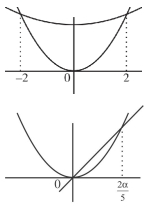
If the area enclosed by the parabolas $P_1: 2 y=5 x^2$ and $P_2: x^2-y+6=0$ is equal to the area enclosed by $P_1$ and $y=\alpha x, \alpha > 0$, then $\alpha^3$ is equal to $......$.
Answerb
Abscissa of point of intersection of $2 y =5 x ^2$
and $y=x^2+6$ is $\pm 2$
$\text { Area }=2 \int \limits_0^2\left(x^2+6-\frac{5 x^2}{2}\right) d x=\int \limits_0^{\frac{2 \alpha}{5}}\left(\alpha x-\frac{5 x^2}{2}\right) d x$
$\Rightarrow \int \limits_0^{\frac{2 \alpha}{5}}\left(\alpha x-\frac{5 x^2}{2}\right) d x=16$
$\Rightarrow \alpha^3=600$
View full question & answer→MCQ 771 Mark
Let $T$ and $C$ respectively be the transverse and conjugate axes of the hyperbola $16 x^2-$ $y^2+64 x+4 y+44=0$. Then the area of the region above the parabola $x^2=y+4$, below the transverse axis $T$ and on the right of the conjugate axis $C$ is:
- A
$4 \sqrt{6}+\frac{44}{3}$
- ✓
$4 \sqrt{6}+\frac{28}{3}$
- C
$4 \sqrt{6}-\frac{44}{3}$
- D
$4 \sqrt{6}-\frac{28}{3}$
AnswerCorrect option: B. $4 \sqrt{6}+\frac{28}{3}$
b
$16\left(x^2+4 x\right)-\left(y^2-4 y\right)+44=0$
$16(x+2)^2-64-(y-2)^2+4+44=0$
$16(x+2)^2-(y-2)^2=16$
$\frac{(x+2)^2}{1}-\frac{(y-2)^2}{16}=1$
$A=\int \limits_{-2}^{\sqrt{6}}\left(2-\left(x^2-4\right)\right) d x$
$A=\int \limits_{-2}^{\sqrt{6}}\left(6-x^2\right) d x=\left(6 x-\frac{x^3}{3}\right)_{-2}^{\sqrt{6}}$
$A=\left(6 \sqrt{6}-\frac{6 \sqrt{6}}{3}\right)-\left(-12+\frac{8}{3}\right)$
$A=\frac{12 \sqrt{6}}{3}+\frac{28}{3}$
$A=4 \sqrt{6}+\frac{28}{3}$
View full question & answer→MCQ 781 Mark
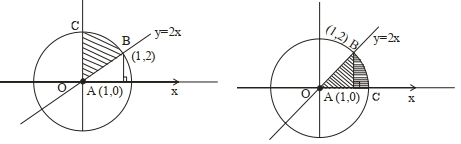
Let $A=\left\{(x, y) \in R ^2: y \geq 0,2 x \leq y \leq \sqrt{4-(x-1)^2}\right\}$ and $B=\left\{(x, y) \in R \times R : 0 \leq y \leq \min \left\{2 x, \sqrt{4-(x-1)^2}\right\}\right\}$ Then the ratio of the area of $A$ to the area of $B$ is
- ✓
$\frac{\pi-1}{\pi+1}$
- B
$\frac{\pi}{\pi-1}$
- C
$\frac{\pi}{\pi+1}$
- D
$\frac{\pi+1}{\pi-1}$
AnswerCorrect option: A. $\frac{\pi-1}{\pi+1}$
a
$y^2+(x-1)^2=4$
$\text { shaded portion }=\text { circular }( OABC )$
$-\operatorname{Ar}(\triangle OAB )$
$=\frac{\pi(4)}{4}-\frac{1}{2}(2)(1)$
$A =(\pi-1)$
$\text { Area } B=\operatorname{Ar}(\triangle AOB )+\text { Area of arc of circle }( ABC )$
$=\frac{1}{2}(1)(2)+\frac{\pi(2)^2}{4}=\pi+1$
$\frac{ A }{ B }=\frac{\pi-1}{\pi+1}$
View full question & answer→MCQ 791 Mark
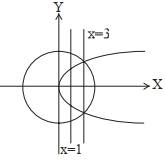
Let $\Delta$ be the area of the region $\left\{( x , y ) \in R ^2: x ^2+ y ^2 \leq 21, y ^2 \leq 4 x , x \geq 1\right\}$. Then $\frac{1}{2}\left(\Delta-21 \sin ^{-1} \frac{2}{\sqrt{7}}\right)$ is equal to
- A
$2 \sqrt{3}-\frac{1}{3}$
- B
$\sqrt{3}-\frac{2}{3}$
- C
$2 \sqrt{3}-\frac{2}{3}$
- ✓
$\sqrt{3}-\frac{4}{3}$
AnswerCorrect option: D. $\sqrt{3}-\frac{4}{3}$
d
$\text { Area } 2 \int \limits_1^3 2 \sqrt{x} d x+2 \int_3^{\sqrt{21}} \sqrt{21-x^2 d x}$
$\Delta=\frac{8}{3}(3 \sqrt{3}-1)+21 \sin ^{-1}\left(\frac{2}{\sqrt{7}}\right)-6 \sqrt{3}$
$\frac{1}{2}\left(\Delta-21 \sin ^{-1}\left(\frac{2}{\sqrt{7}}\right)\right)=\frac{2 \sqrt{3}-\frac{8}{3}}{2}$
$=\sqrt{3}-\frac{4}{3}$
View full question & answer→MCQ 801 Mark
The area of the region
$A=\left\{(x, y):|\cos x-\sin x| \leq y \leq \sin x, 0 \leq x \leq \frac{\pi}{2}\right\}$
- A
$1-\frac{3}{\sqrt{2}}+\frac{4}{\sqrt{5}}$
- B
$\sqrt{5}+2 \sqrt{2}-4.5$
- C
$\frac{3}{\sqrt{5}}-\frac{3}{\sqrt{2}}+1$
- ✓
$\sqrt{5}-2 \sqrt{2}+1$
AnswerCorrect option: D. $\sqrt{5}-2 \sqrt{2}+1$
d
$|\cos x-\sin x| \leq y \leq \sin x$
Intersection point of $\cos x-\sin x=\sin x$
$\Rightarrow \quad \tan x =\frac{1}{2}$
Let $\psi=\tan ^{-1} \frac{1}{2}$
So, $\tan \psi=\frac{1}{2}, \sin \psi=\frac{1}{\sqrt{5}}, \cos \psi=\frac{2}{\sqrt{5}}$
$Area =\int \limits_\psi^{\pi / 2}(\sin x-|\cos x-\sin x|) d x$
$=\int \limits_\psi^{\pi / 4}(\sin x-(\cos x-\sin x)) d x +\int \limits_{\pi / 4}^{\pi / 2}(\sin x-(\sin x-\cos x)) d x$
$=\int \limits_\psi^{\pi / 4}(2 \sin x-\cos x) d x+\int_{\pi / 4}^{\pi / 2} \cos x d x$
$=[-2 \cos x-\sin x]_\psi^{\pi / 4}+[\sin x]_{\pi / 4}^{\pi / 2}$
$=-\sqrt{2}-\frac{1}{\sqrt{2}}+2 \cos \psi+\sin \psi+\left(1-\frac{1}{\sqrt{2}}\right)$
$=-\sqrt{2}-\frac{1}{\sqrt{2}}+2\left(\frac{2}{\sqrt{5}}\right)+\left(\frac{1}{\sqrt{5}}\right)+1-\frac{1}{\sqrt{2}}$
$=\sqrt{5}-2 \sqrt{2}+1$
View full question & answer→MCQ 811 Mark
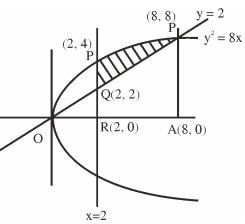
Let $\alpha$ be the area of the larger region bounded by the curve $y ^2=8 x$ and the lines $y = x$ and $x =2$, which lies in the first quadrant. Then the value of $3 \alpha$ is equal to $..............$.
Answerd
$y=x$
$y^2=8 x$
Solving it
$x ^2=8 x$
$x=0,8$
$y=0,8$
$x=2$ will intersect occur at
$y^2=16 \Rightarrow \quad y=\pm 4$
Area of shaded
$=\int \limits_2^8(\sqrt{8 x}-x) d x=\int_2^8(2 \sqrt{2} \sqrt{x}-x) d x$
$=\left[2 \sqrt{2} \cdot \frac{x^{3 / 2}}{3 / 2}-\frac{x^2}{2}\right]_0^8$
$=\left(\frac{4 \sqrt{2}}{3} \cdot 2^{9 / 2}-32\right)-\left(\frac{4 \sqrt{2}}{3} \cdot 2^{9 / 2}-2\right)$
$=\frac{128}{3}-32-\frac{16}{3}+2=\frac{112-90}{3}=\frac{22}{3}= A$
$\therefore 3 A =22$
View full question & answer→MCQ 821 Mark
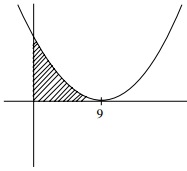
Let $q$ be the maximum integral value of $p$ in $[0,10]$ for which the roots of the equation $x ^2- px +\frac{5}{4} p =0$ are rational. Then the area of the region $\{(x, y): 0 \leq y$ $\left.\leq(x-q)^2, 0 \leq x \leq q\right\}$ is
- ✓
$243$
- B
$25$
- C
$\frac{125}{3}$
- D
$164$
Answera
$x ^2- px +\frac{5 p }{4}=0$
$D = p ^2-5 p = p ( p -5)$
$\therefore q =9$
$0 \leq y \leq( x -9)^2$
Area $=\int \limits_0^9(x-9)^2 dx =243$
View full question & answer→MCQ 831 Mark
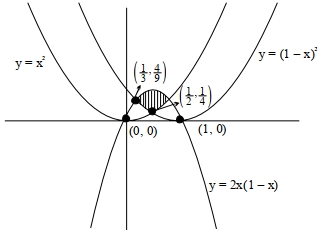
Let $A$ be the area of the region $\left\{(x, y): y \geq x^2, y \geq(1-x)^2, y \leq 2 x(1-x)\right\}$ Then $540\,A$ is equal to
Answerb
$A=2 \int \limits_{\frac{1}{3}}^{\frac{1}{2}}\left(2 x-2 x^2-(1-x)^2\right) d x$
$=2\left[2 x^2-x^3-x\right]_{1 / 3}^{1 / 2}$
$\therefore A=\frac{5}{108} \Rightarrow 540\,A=\frac{5}{108} \times 540=25$
View full question & answer→MCQ 841 Mark
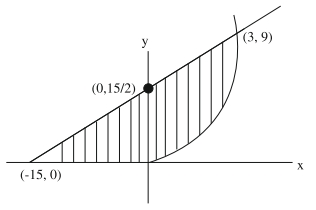
Let for $x \in R$ ; $f(x)=\frac{x+|x|}{2}$ and $g(x)=\left\{\begin{array}{ll}x, & x < 0 \\ x^2 & x \geq 0\end{array}\right.$ .Then area bounded by the curve $y=(f o g)(x)$ and the lines $y =0,2 y - x =15$ is equal to $...........$.
Answera
$f(x)=\frac{x+|x|}{2}=\left[\begin{array}{ll}x & x \geq 0 \\ 0 & x < 0\end{array}\right.$
$g(x)=\left[\begin{array}{ll}x^2 & x \geq 0 \\ x & x < 0\end{array}\right.$
$f o g(x)=f[g(x)]=\left[\begin{array}{cc}g(x) & g(x) \geq 0 \\ 0 & g(x) < 0\end{array}\right.$
$f o g(x)=\left[\begin{array}{cc}x^2 & x \geq 0 \\ 0 & x < 0\end{array}\right.$
$2 y-x=15$
$A=\int \limits_0^3\left(\frac{x+15}{2}-x^2\right) d x+\frac{1}{2} \times \frac{15}{2} \times 15$
$\frac{x^2}{4}+\frac{15 x}{2}-\left.\frac{x^3}{3}\right|_0 ^3+\frac{225}{4}$
$=\frac{9}{4}+\frac{45}{2}-9+\frac{225}{4}=\frac{99-36+225}{4}$
$=\frac{288}{4}=72$
View full question & answer→MCQ 851 Mark
Let the area of the region $\left\{(x, y):|2 x-1| \leq y \leq\left|x^2-x\right|, 0 \leq x \leq 1\right\}$ be $A$. Then $(6 A +11)^2$ is equal to $.......$.
Answerd
$y \geq|2 x -1|, y \leq\left| x ^2- x \right|$
Both curve are symmetric about $x =\frac{1}{2}$ Hence
$A=2 \int \limits_{\frac{3-\sqrt{5}}{2}}^{\frac{1}{2}}\left(\left(x-x^2\right)-(1-2 x)\right) d x$
$A=2 \int \limits_{\frac{3-\sqrt{5}}{2}}^{\frac{1}{2}}\left(-x^2+3 x-1\right) d x=2\left(\frac{-x^3}{3}+\frac{3}{2} x^2-x\right)_{\frac{3-\sqrt{5}}{2}}^{\frac{1}{2}}$
On solving $6 A +11=5 \sqrt{5}$
$(6 A +11)^2=125$
View full question & answer→MCQ 861 Mark
Let $A$ be the area bounded by the curve $y=x|x-3|$, the $x$-axis and the ordinates $x=-1$ and $x=2$. Then $12\,A$ is equal to $...........$.
Answerc
$A =\int \limits_{-1}^0\left( x ^2-3 x \right) dx +\int_0^2\left(3 x - x ^2\right) dx$
$\Rightarrow \quad A =\frac{ x ^3}{3}-\left.\frac{3 x ^2}{2}\right|_{-1} ^0+\frac{3 x ^2}{2}-\left.\frac{ x ^3}{3}\right|_0 ^2$
$\Rightarrow \quad A =\frac{11}{6}+\frac{10}{3}=\frac{31}{6}$
$\therefore \quad 12\,A =62$
View full question & answer→MCQ 871 Mark
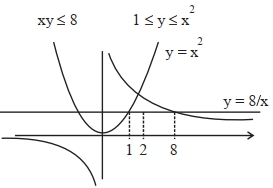
The area of the region given by $\left\{(x, y): x y \leq 8,1, \leq y \leq x^2\right\}$ is :
- A
$8 \log _e 2-\frac{13}{3}$
- ✓
$16 \log _{ e } 2-\frac{14}{3}$
- C
$8 \log _e 2+\frac{7}{6}$
- D
$16 \log _{ e } 2+\frac{7}{3}$
AnswerCorrect option: B. $16 \log _{ e } 2-\frac{14}{3}$
b
Area $=\int \limits_1^2\left(x^2-1\right) d x+\int \limits_2^8\left(\frac{8}{x}-1\right) d x$
$=\left(\frac{x^3}{3}\right)_1^2+8(\ell \operatorname{nx})_2^8-(x)_1^8$
$=\frac{7}{3}+8(2 \ell n 2)-7$
$=16 \ell n 2-\frac{14}{3}$
View full question & answer→MCQ 881 Mark
The area bounded by the curves $y=|x-1|+|x-2|$ and $y =3$ is equal to
Answerb
$y=|x-1|+|x-2| \text { and } y=3$
$\therefore \text { Required area }=\frac{1}{2}(1+3) \times 2=4$
View full question & answer→MCQ 891 Mark
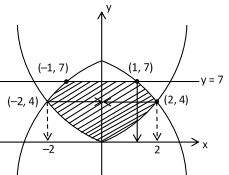
The area of the region $\left\{(x, y): x^2 \leq y \leq 8-x^2, y \leq 7\right\}$ is
Answerd
$y \geq x^2 \quad y \leq 8-x^2 \quad y \leq 7$
$x^2=8-x^2$
$x^2=4$
$x= \pm 2$
$2\left(1.7+\int \limits_1^2\left(8-2 x^2\right) d x\right)-2 \int \limits_0^1\left(x^2\right) d x$
$=2\left[7+\left(8 x-\frac{2 x^3}{3}\right)_1^2\right]-2\left(\frac{x^3}{3}\right)_0^1$
$=2\left[7+\left(16-\frac{16}{3}\right)-\left(8-\frac{2}{3}\right)\right]-2\left(\frac{1}{3}\right)$
$=2\left[7+\frac{32}{3}-\frac{22}{3}\right]=2\left[7+\frac{10}{3}\right] \frac{-2}{3}$
$=\frac{60}{3}=20$
View full question & answer→MCQ 901 Mark
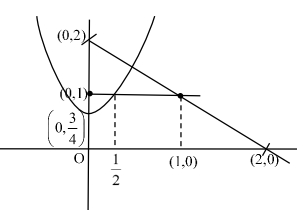
Let the area enclosed by the lines $x + y =2, y =0$, $x=0$ and the curve $f(x)=\min \left\{x^2+\frac{3}{4}, 1+[x]\right\}$ where $[ x ]$ denotes the greatest integer $\leq x$, be $A$. Then the value of $12\,A$ is $............$.
Answera
$\int \limits_0^{\frac{1}{2}}\left( x ^2+\frac{3}{4}\right) dx +\frac{1}{2} \times\left(\frac{3}{2}+\frac{1}{2}\right) \times 1$
$=\left[\frac{ x ^3}{3}+\frac{3 x }{4}\right]_0^{\frac{1}{2}}+1$
$A =\frac{1}{24}+\frac{3}{8}+1$
$12 A =\frac{1}{2}+\frac{36}{8}+12$
$=\frac{1}{2}+\frac{9}{2}+12$
$=5+12$
$=17$
View full question & answer→MCQ 911 Mark
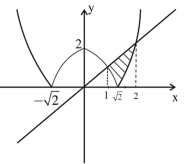
If the area of the region $\left\{( x , y ):\left| x ^2-2\right| \leq y \leq x \right\}$ is $A$, then $6 A +16 \sqrt{2}$ is equal to $...........$.
Answerc
$\left|x^2-2\right| \leq y \leq x$
$A=\int \limits_1^{\sqrt{2}}\left(x-\left(2-x^2\right)\right) d x+\int \limits_{\sqrt{2}}^2\left(x-\left(x^2-2\right)\right) d x$
$=\left(1-2 \sqrt{2}+\frac{2 \sqrt{2}}{3}\right)-\left(\frac{1}{2}-2+\frac{1}{3}\right)+\left(2-\frac{8}{3}+4\right)-\left(1-\frac{2 \sqrt{2}}{3}+2 \sqrt{2}\right)$
$=-4 \sqrt{2}+\frac{4 \sqrt{2}}{3}+\frac{7}{6}+\frac{10}{3}=\frac{-8 \sqrt{2}}{3}+\frac{9}{2}$
$6 A =-16 \sqrt{2}+27$
$\therefore 6 A +16 \sqrt{2}=27$
View full question & answer→MCQ 921 Mark
Area of the region $\left\{(x, y): x^2+(y-2)^2 \leq 4\right.$, $\left.x^2 \geq 2 y\right\}$ is
- ✓
$2 \pi-\frac{16}{3}$
- B
$\pi-\frac{8}{3}$
- C
$\pi+\frac{8}{3}$
- D
$2 \pi+\frac{16}{3}$
AnswerCorrect option: A. $2 \pi-\frac{16}{3}$
a
$x^2+(y-2)^2 \leq 2^2 \text { and } x^2 \geq 2 y$
Solving circle and parabola simultaneously :
$2 y+y^2-4 y+4=4$
$y^2-2 y=0$
$y=0,2$
Put $y =2$ in $x ^2=2 y \rightarrow x = \pm 2$
$\Rightarrow(2,2)$ and $(-2,2)$
$=2 \times 2-\frac{1}{4} \cdot \pi \cdot 2^2=4-\pi$
$=2\left[\int \limits_0^2 \frac{ x ^2}{2} dx -(4-\pi)\right]$
$=2\left[\left.\frac{ x ^3}{6}\right|_0 ^2-4+\pi\right]$
$=2\left[\frac{4}{3}+\pi-4\right]$
$=2\left[\pi-\frac{8}{3}\right]$
$=2 \pi-\frac{16}{6}$
View full question & answer→MCQ 931 Mark
If $A$ is the area in the first quadrant enclosed by the curve $C: 2 x^2-y+1=0$, the tangent to $C$ at the point $(1,3)$ and the line $x+y=1$, then the value of $60 A$ is
Answera
$y=2 x^2+1$
Tangent at $(1,3)$
$y =4 x -1$
$A =\int \limits_0^1\left(2 x ^2+1\right) dx \text {-area of }(\Delta QOT )-\text { area of }$
$(\Delta PQR )+\text { area of }(\Delta QRS )$
$A =\left(\frac{2}{3}+1\right)-\frac{1}{2}-\frac{9}{8}+\frac{9}{40}=\frac{16}{60}$
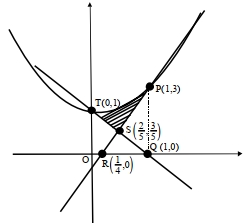
View full question & answer→MCQ 941 Mark
The area of the region $\left\{(x, y): x^2 \leq y \leq\left|x^2-4\right|, y \geq 1\right\}$ is
- A
$\frac{3}{4}(4 \sqrt{2}-1)$
- ✓
$\frac{4}{3}(4 \sqrt{2}-1)$
- C
$\frac{4}{3}(4 \sqrt{2}+1)$
- D
$\frac{3}{4}(4 \sqrt{2}+1)$
AnswerCorrect option: B. $\frac{4}{3}(4 \sqrt{2}-1)$
b
Required area $=2\left[\int \limits_1^2 \sqrt{ y } dy +\int \limits_2^4 \sqrt{4- y } dy \right]=\frac{4}{3}[4 \sqrt{2}-1]$
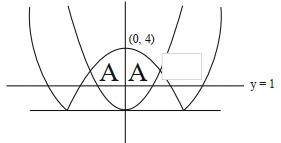
View full question & answer→MCQ 951 Mark
If the area bounded by the curve $2 y^2=3 x$, lines $x+y=3, y=0$ and outside the circle $(x-3)^2+y^2=2$ is $A$, then $4(\pi+4 A )$ is equal to $.........$.
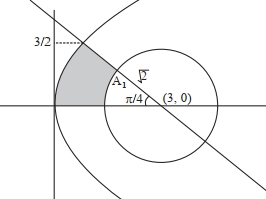
Answera
$y^2=\frac{3 x}{2}, x+y=3, y=0$
$2 y^2=3(3-y)$
$2 y^2+3 y-9=0$
$2 y^2-3 y+6 y-9=0$
$(2 y-3)(y+2)=0 ; y=3 / 2$
$\text { Area }\left[\int_0^{\frac{3}{2}}\left(x_R-x_2\right) d y\right)-A_1$
$=\int \limits_0^{\frac{3}{2}}\left((3-y)-\frac{2 y^2}{3}\right) d y-\frac{\pi}{8}(2)$
$A=\left(3 y-\frac{y^2}{2}-\frac{2 y^3}{9}\right)_0^{\frac{3}{2}}-\frac{\pi}{4}$
$4 A+\pi=4\left[\frac{9}{2}-\frac{9}{8}-\frac{3}{4}\right]=\frac{21}{2}=10.50$
$\therefore 4(4 A+\pi)=42$
View full question & answer→MCQ 961 Mark
If the area of the region $S=\left\{(x, y): 2 y-y^2 \leq x^2 \leq 2 y, x \geq y\right\}$ is equal to $\frac{ n +2}{ n +1}-\frac{\pi}{ n -1}$, then the natural number $n$ is equal to $...............$.
Answerd
$x^2+y^2-2 y \geq 0 \ x^2-2 y \leq 0, x \geq y$
Hence required area $=\frac{1}{2} \times 2 \times 2-\int_0^2 \frac{x^2}{2} d x-\left(\frac{\pi}{4}-\frac{1}{2}\right)$
$=\frac{7}{6}-\frac{\pi}{4} \Rightarrow n=5$
View full question & answer→MCQ 971 Mark
Let $y=p(x)$ be the parabola passing through the points $(-1,0),(0,1)$ and $(1,0)$. If the area of the region $\left\{(x, y):(x+1)^2+(y-1)^2 \leq 1, y \leq p(x)\right\}$ is $A$, then $12(\pi-4 A )$ is equal to $.........$.
View full question & answer→MCQ 981 Mark
The area of the region $S=\left\{(x, y): y^{2} \leq 8 x, y \geq \sqrt{2} x, x \geq 1\right\}$ is
- A
$\frac{13 \sqrt{2}}{6}$
- ✓
$\frac{11 \sqrt{2}}{6}$
- C
$\frac{5 \sqrt{2}}{6}$
- D
$\frac{19 \sqrt{2}}{6}$
AnswerCorrect option: B. $\frac{11 \sqrt{2}}{6}$
b
$y^{2}=8 x.......(1)$
$y=\sqrt{2} x.........(2)$
$y^{2}=2 x^{2}$
$\Rightarrow 8 x=2 x^{2}$
$\Rightarrow x=0 \,\,and \,\,4$
Area $:=\int\limits_{1}^{4}\, 2 \sqrt{2} \sqrt{x}-\sqrt{2} x \,d x$
$=2 \sqrt{2}\left(\frac{x^{\frac{3}{2}}}{3 / 2}\right)_{1}^{4}-\sqrt{2}\left(\frac{x^{2}}{2}\right)_{1}^{4}$
$=\frac{4 \sqrt{2}}{3}(8-1)-\frac{\sqrt{2}}{3}(16-1)$
$=\frac{28 \sqrt{2}}{3}-\frac{15 \sqrt{2}}{2}=\frac{11 \sqrt{2}}{6}$
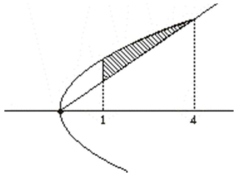
View full question & answer→MCQ 991 Mark
The area of the region enclosed between the parabolas $y ^{2}=2 x -1$ and $y ^{2}=4 x -3$ is
- ✓
$\frac{1}{3}$
- B
$\frac{1}{6}$
- C
$\frac{2}{3}$
- D
$\frac{3}{4}$
AnswerCorrect option: A. $\frac{1}{3}$
a
Required area $=2 \int \limits_{0}^{1}\left(\frac{y^{2}+3}{4}-\frac{y^{2}+1}{2}\right) d y$
$=2 \int \limits_{0}^{1} \frac{1-y^{2}}{4} d y=\frac{1}{2}\left|y-\frac{y^{3}}{3}\right|_{0}^{1}=\frac{1}{3}$
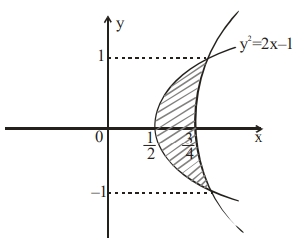
View full question & answer→MCQ 1001 Mark
For real numbers $a, b (a> b >0)$, let Area $\left\{(x, y): x^{2}+y^{2} \leq a^{2}\right.$ and $\left.\frac{x^{2}}{a^{2}}+\frac{y^{2}}{b^{2}} \geq 1\right\}=30 \pi$ and Area $\left\{(x, y): x^{2}+y^{2} \geq b^{2}\right.$ and $\left.\frac{x^{2}}{a^{2}}+\frac{y^{2}}{b^{2}} \leq 1\right\}=18 \pi$ Then the value of $(a-b)^{2}$ is equal to
Answerc
given $\pi a ^{2}-\pi ab =30 \pi$ and $\pi ab -\pi b ^{2}=18 \pi$
on subtracting, we get $(a-b)^{2}=a^{2}-2 a b+b^{2}=12$
View full question & answer→