MCQ 2511 Mark
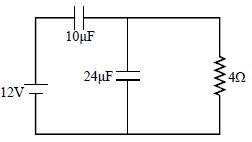
The charge on the capacitors of capacitance $10\,\mu F$ and $24\,\mu F$ steady state will be
- A
$0\, \mu C, \,0\, \mu C$
- B
$12\, \mu C, \,24\, \mu C$
- ✓
$120\, \mu C, \,0\, \mu C$
- D
$120\, \mu C, \,120\, \mu C$
AnswerCorrect option: C. $120\, \mu C, \,0\, \mu C$
c
In steady state no current will flow through capacitor of $10\,\mu F$ as it get full change and full voltage equal to $12\,V$, and charge aquired in transition peroid by $24\,\mu F$ will leak through resister of $4\,\Omega$. Hence final change on $2\,\mu C$ will be zero
View full question & answer→MCQ 2521 Mark
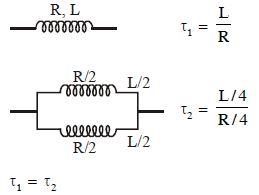
An inductance coil have the time constant $4\, sec$, if it is cut into two equal parts and connected parallel then new time constant of the circuit.....$sec$
Answera
View full question & answer→MCQ 2531 Mark
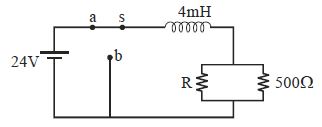
In given circuit, switch is in position $a$ , for what value of $R$ will the circuit have a time constant of $10\,\mu s$.......$K\Omega $
Answera
we know $\tau=\frac{\mathrm{L}}{\mathrm{R}_{\mathrm{eq}}}$ ........$(1)$
$\because \mathrm{R}_{\mathrm{eq}}=\frac{\mathrm{R} \times 500}{\mathrm{R}+500} \Rightarrow \mathrm{By} \mathrm{\,eq}^{\mathrm{n}}$ $(1)$
$\Rightarrow 10 \times 10^{-6}=\frac{4 \times 10^{-3}}{\mathrm{R}(500)} \times(\mathrm{R}+500)$
$\Rightarrow \mathrm{R}=2000 \Omega=2 \mathrm{K} \Omega$
View full question & answer→MCQ 2541 Mark
An inductance of $2\,H$ carries a current of $2\,A$. To prevent sparking when the circuit is broken a capacitor of $4\,\mu F$ is connected across the inductance. The voltage rating of the capacitor is of the order of
- ✓
$10^3\,V$
- B
$10\,V$
- C
$10^5\,V$
- D
$10^6\,V$
AnswerCorrect option: A. $10^3\,V$
a
$\frac{1}{2} C V^{2}=\frac{1}{2} L i^{2}$
$\Rightarrow \mathrm{V}^{2}=\frac{\mathrm{Li}^{2}}{\mathrm{C}}$
$=\frac{2 \times 2^{2}}{4 \times 10^{-6}}=2 \times 10^{6}$
$\Rightarrow \mathrm{V}=\sqrt{2} \times 10^{3} \mathrm{\,volt}$
$\mathrm{V}$ is of order $10^{3} \mathrm{\,V}$
View full question & answer→MCQ 2551 Mark
A $2\,\mu F$ capacitor is charged to $100\,V$. After disconnecting the battery, a $20\, mH$ coil is then connected across the charged capacitor.The capacitor discharges through the inductor and the current in the circuit is oscillatory. Maximum current in the circuit, assuming zero resistance of the coil, is.....$A$
Answerc
$\frac{1}{2}C{V^2} = \frac{1}{2}LI_{\max }^2$
View full question & answer→MCQ 2561 Mark
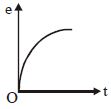
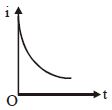
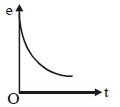
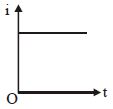
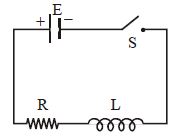
Switch $S$ of the circuit shown in figure is closed at $t = 0$. If $e$ denotes the induced $emf$ in $L$ and $i$ the current flowing through the circuit at time $t$, which of the following graphs is correct
Answerc
$i=\frac{E}{R}\left(1-e^{-t R / L}\right)$ curve D represents $i$
$e=L \frac{d i}{d t}=L \frac{E}{R} e^{-t R / L} \frac{R}{L}$ curve $C$ represents $e$
View full question & answer→MCQ 2571 Mark
A coil carrying a steady current is short-circuited. The current in it decreases $\alpha $ times in $t_0$. The time constant of the circuit is:-
- A
$\tau = {t_0}\,{\log _e}\,\alpha $
- ✓
$\tau = {t_0}/{\log _e}\,\alpha $
- C
$\tau = {t_0}/\alpha $
- D
$\tau = \frac{{{t_0}}}{{\alpha - 1}}$
AnswerCorrect option: B. $\tau = {t_0}/{\log _e}\,\alpha $
b
$\mathrm{I}=\frac{\mathrm{I}_{0}}{\alpha}$ at $\mathrm{t}=\mathrm{t}_{0}$
since ${\rm{I}} = {{\rm{I}}_0}{{\rm{e}}^{ - {{\rm{t}}_0}/\tau }} \Rightarrow \frac{{{{\rm{I}}_0}}}{\alpha } = {{\rm{I}}_0}{{\rm{e}}^{ - {{\rm{t}}_0}/\tau }}$
$\alpha=e^{t_{0} / \tau} \Rightarrow t_{0}=\tau \log _{e} \alpha$
$\boxed{\tau = \frac{{{t_0}}}{{{{\log }_e}\alpha }}}$
View full question & answer→MCQ 2581 Mark
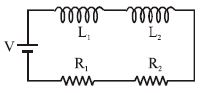
Given $L_1 = 1\, mH, R_1 = 1\,\Omega , L_2 = 2\,mH, R_2 = 2\,\Omega $ Neglecting mutual inductance the time constants (in $ms$) for circuit.....$ms$
Answera
We know $L=L_{1}+L_{2}$
$\mathrm{R}=\mathrm{R}_{1}+\mathrm{R}_{2}$
$\therefore$ $\tau=\frac{\mathrm{L}}{\mathrm{R}}=\frac{3 \mathrm{mH}}{3 \Omega}=1 \mathrm{\,ms}$
View full question & answer→MCQ 2591 Mark
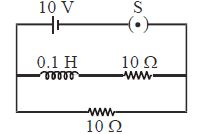
In the circuit initially switch $S$ is open the $S$ is closed at $t = 0$ the difference between the maximum and minimum current that can flow in the circuit is.....$Amp$
Answerc
Just after $\mathrm{S}$ is closed $\mathrm{i}=\frac{10}{10}=1$ $\mathrm{amp}$
Long after $\mathrm{S}$ is closed $= \mathrm{i}=\frac{10}{5}=2 \mathrm{\,amp}$
difference $=1$ $\mathrm{amp}$
View full question & answer→MCQ 2601 Mark
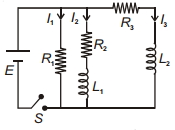
Figure shows an $L-R$ circuit. When the switch $S$ is closed, the current through resistor $R_1, R_2$ and $R_3$ are $l_1, l_2$ and $l_3$ respectively. The value of $I_1, I_2$ and $I_3$ at $t=0\, s$ is
- A
$I_1=I_2=I_3=0$
- ✓
$I_1=\frac{E}{R_1}, I_2=I_3=0$
- C
$I_1=0, I_2=\frac{E}{R_2}, I_3=\frac{E}{R_3}$
- D
$I_1=\frac{E}{R_1}, I_2=\frac{E}{R_2+L_1}, I_3=\frac{E}{R_3+L_3}$
AnswerCorrect option: B. $I_1=\frac{E}{R_1}, I_2=I_3=0$
b
(b)
At $t=0$, inductor offers infinite resistance
So, $I_1=\frac{E}{R_1}, I_2=I_3=0$
View full question & answer→MCQ 2611 Mark
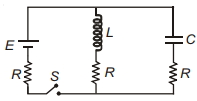
The switch shown in the circuit is closed at $t=0$. The current drawn from the battery by the circuit at $t=0$ and $t=\infty$ are in the ratio
- A
$2: 1$
- B
$1: 2$
- ✓
$1: 1$
- D
$1: 4$
AnswerCorrect option: C. $1: 1$
c
(c)
At $t=0, L$ offers infinite resistance
At $t \rightarrow \infty, C$ offers infinite resistance
So, in both the cases, $l=\frac{\varepsilon}{2 R}$
Hence ratio is $1: 1$.
View full question & answer→MCQ 2621 Mark
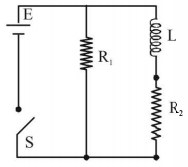
An inductor of inductance $L=400\,mH$ and resistors of resistance $R_1=2 \,\Omega$ and $R _2=2\,\Omega$ are connected to a battery of emf $12\,V$ as shown in the figure. The internal resistance of the battery is negligible. The switch $S$ is closed at $t=0$. The potential drop across $L$ as a function of time is
- A
$\frac{12}{t} e^{-3 t}\,V$
- B
$6\left(1-e^{-t / 0.2}\right)\,V$
- ✓
$12 e ^{-5 t}\,V$
- D
$6 e ^{-5 t}\,V$
AnswerCorrect option: C. $12 e ^{-5 t}\,V$
c
(c)
$i=\frac{E}{R_2}\left[1-e^{-R_2 t / L}\right]$
$\Rightarrow \frac{d i}{d t}=\frac{E}{R_2} \cdot \frac{R_2}{L} \cdot e^{-R_2 t / L}=\frac{E}{L} e^{-\frac{R_2 t}{L}}$
Hence, potential drop across
$L =\left(\frac{E}{L} e^{-R_2 t / L}\right) L=12 e ^{-5 t }\,V$
View full question & answer→MCQ 2631 Mark
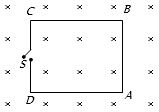
The magnetic field in the cylindrical region shown in figure increases at a constant rate of $20\, mT/sec$. Each side of the square loop $ABCD$ has a length of $1\, cm$ and resistance of $4 \Omega$. Find the current in the wire $AB$ if the switch $S$ is closed
- ✓
$1.25 \times {10^{ - 7}}A$, $(anti-clockwise)$
- B
$1.25 \times {10^{ - 7}}A$ $(clockwise)$
- C
$2.5 \times {10^{ - 7}}A$ $(anti\, clockwise)$
- D
$2.5 \times {10^{ - 7}}A$ $(clockwise)$
AnswerCorrect option: A. $1.25 \times {10^{ - 7}}A$, $(anti-clockwise)$
a
(a) $i = \frac{e}{R} = \frac{A}{R}.\frac{{dB}}{{dt}} = \frac{{{{(1 \times {{10}^{ - 2}})}^2}}}{{16}} \times 20 \times {10^{ - 3}} = 1.25 \times {10^{ - 7}}A$
$(Anti-clockwise).$
View full question & answer→MCQ 2641 Mark
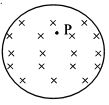
Figure shows auniform magnetic field $B$ confinedto a cylindrical volume and is increasing at a constant rate. The instantaneous acceleration experienced by an electron placed at $P$ is
Answerb
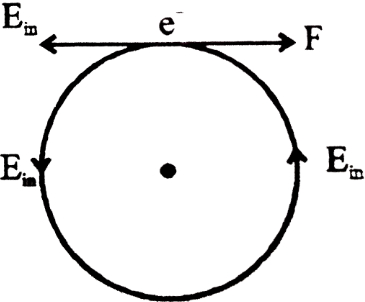
Fig. shows direction of electric filed. So electron will have instantaneous
acceleration towards right.
View full question & answer→MCQ 2651 Mark
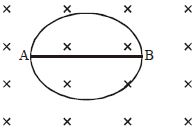
The radius of the circular conducting loop shown in figure is $R.$ Magnetic field is decreasing at a constant rate $\alpha$. Resistance per unit length of the loop is $r.$ Then current in wire $AB$ is ($AB$ is one of the diameters) :-
- A
$\frac{R\alpha}{2\rho}$ from $A$ to $B$
- B
$\frac{R\alpha}{2\rho}$ from $B$ to $A$
- C
$\frac{2R\alpha}{\rho}$ from $A$ to $B$
- ✓
Answerd
The induced current in upper semicircular and lower semicircular will cancel each other in diameter $(AB)$
View full question & answer→MCQ 2661 Mark
A flexible wire loop in the shape of a circle has a radius that grows linearly with time. There is a magnetic field perpendicular to the plane of the loop that has a magnitude inversely proportional to the distance from the centre of loop i.e. $B(r) \propto \frac{1}{r}$ . How does the emf $E$ vary with time?
- A
$E \propto t^2$
- B
$E \propto t$
- C
$E \propto \sqrt t$
- ✓
$E$ is constant
AnswerCorrect option: D. $E$ is constant
d
$E=\frac{d \phi}{d t}, \phi=B \pi r^{2}$ and $\frac{d r}{d t}=$ constant so $\mathrm{E}$ is constant
View full question & answer→MCQ 2671 Mark
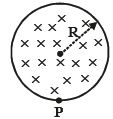
A uniform magnetic field of induction $B$ is confined to a cylindrical region of radius $R$. The magnetic field is increasing at a constant rate of $\frac{{dB}}{{dt}} (tesla/second)$. An electron is placed at the point $P$ on the periphery of the field experiences an acceleration
- ✓
$\frac{1}{2}\frac{{eR}}{m}\frac{{dB}}{{dt}}$ towards left
- B
$\frac{1}{2}\frac{{eR}}{m}\frac{{dB}}{{dt}}$ toward right
- C
$\frac{{eR}}{m}\frac{{dB}}{{dt}}$ toward left
- D
$0$
AnswerCorrect option: A. $\frac{1}{2}\frac{{eR}}{m}\frac{{dB}}{{dt}}$ towards left
a
Induced electric field at $\mathrm{P}$
$E=\frac{R}{2} \frac{d B}{d t}$
So, on electron at $\mathrm{P}(\mathrm{F})=\mathrm{e} \mathrm{E}$
$\mathrm{F}=\frac{\mathrm{eR}}{2} \frac{\mathrm{dB}}{\mathrm{dt}}$
$\therefore $ acceleration of $\mathrm{e}^{-}$ at $\mathrm{P}=\frac{\mathrm{F}}{\mathrm{m}}=\frac{\mathrm{e} \mathrm{R}}{2 \mathrm{m}} \frac{\mathrm{dB}}{\mathrm{dt}}$
(opposite in direction of induced current)
View full question & answer→MCQ 2681 Mark
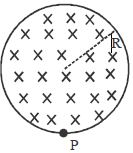
A uniform magnetic field of induction $B$ is confined to a cylinder region of radius $R$. The magnetic field is increasing at a constant rate of $\frac{{dB}}{{dt}}\left( {T/s} \right)$. A proton of charge $e$ and mass $m$ is placed at point $P$ on periphery. Its acceleration is
- A
$\frac{{eR}}{{2m}}\frac{{dB}}{{dt}}$ towards left
- ✓
$\frac{{eR}}{{2m}}\frac{{dB}}{{dt}}$ towards right
- C
$\frac{{eR}}{{m}}\frac{{dB}}{{dt}}$ towards left
- D
$\frac{{eR}}{{m}}\frac{{dB}}{{dt}}$ towards right
AnswerCorrect option: B. $\frac{{eR}}{{2m}}\frac{{dB}}{{dt}}$ towards right
b
By concept of induced electric field
$\mathrm{E}=\frac{\mathrm{R}}{2} \frac{\mathrm{dB}}{\mathrm{dt}} \Rightarrow=\frac{\mathrm{qE}}{\mathrm{m}}=\frac{\mathrm{eR}}{2 \mathrm{m}} \frac{\mathrm{dB}}{\mathrm{dt}}$
View full question & answer→MCQ 2691 Mark
A solenoid of radius $R$ and length $L$ has a Current $I = I_0\,sin\,\omega t$ . The value of induced electric field at a distance of $r$ inside the solenoid is
- A
$\left( {\frac{{{\mu _0}n{I_0}\omega {R^2}}}{{2r}}} \right)\sin \,\omega t$
- ✓
$\left( {\frac{{{\mu _0}n{I_0}\omega r}}{2}} \right)\cos \,\omega t$
- C
$\left( {\frac{{{\mu _0}n{I_0}\omega {R^2}}}{{2r}}} \right)\cos \,\omega t$
- D
$\left( {\frac{{{\mu _0}n{I_0}\omega r}}{2}} \right)\sin \,\omega t$
AnswerCorrect option: B. $\left( {\frac{{{\mu _0}n{I_0}\omega r}}{2}} \right)\cos \,\omega t$
b
$\mathrm{E}(2 \pi \mathrm{r})=\pi \mathrm{r}^{2} \frac{\mathrm{d}\left(\mu_{0} \mathrm{nI}_{0} \sin \omega \mathrm{t}\right)}{\mathrm{dt}}$
$\mathrm{E}(2 \pi r)=\pi r^{2} \mu_{0} \mathrm{nI}_{0} \omega \cos \omega t$
$\mathrm{E}=\left(\frac{\mu_{0} \mathrm{n} \mathrm{I}_{0} \mathrm{r} \omega}{2}\right) \cos \omega \mathrm{t}$
View full question & answer→MCQ 2701 Mark
A uniform but time-varying magnetic field $B(t)$ exists in a circular region of radius $a$ and is directed into the plane of the paper, as shown. The magnitude of the induced electric field at point $P$ at a distance $r$ from the centre of the circular region
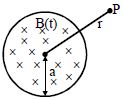
AnswerCorrect option: B. Decreases as $\frac{1}{r}$
b
$\oint \mathrm{Edl}=\frac{\mathrm{d} \phi_{\mathrm{B}}}{\mathrm{dt}}$
$\mathrm{E} 2 \pi \mathrm{r}=\pi \mathrm{a}^{2} \frac{\mathrm{d} \mathrm{B}}{\mathrm{dt}}$
$\mathrm{E}=\frac{\mathrm{a}^{2} \frac{\mathrm{d} \mathrm{B}}{\mathrm{dt}}}{\mathrm{r}}$
View full question & answer→MCQ 2711 Mark
Magnetic fleld changing at the rate of $4\,T/sec$ in a circular region of $5\, cm$ radius. The value of induced electric field at a point $'P'$, which is $10\, cm$ distance away from the centre $'O'$ of region is .....$V/m$
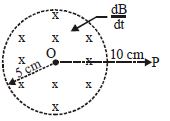
AnswerCorrect option: A. $0.05$
a
$\mathrm{E} \times 2 \pi \mathrm{r}=\pi \mathrm{a}^{2} \frac{\mathrm{dB}}{\mathrm{dt}}$
$E=\frac{a^{2} d B / d t}{2 r}=\frac{\left(5 \times 10^{-2}\right)^{2} \times 4}{2 \times 10 \times 10^{-2}}$
$\mathrm{E}=\frac{25 \times 10^{-4} \times 4}{2 \times 10^{-1}}=\frac{100}{2} \times 10^{3}=\frac{10^{-1}}{2}=0.05 \mathrm{\,V} / \mathrm{m}$
View full question & answer→MCQ 2721 Mark
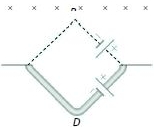
A square loop of side $1\,m$ is placed in a perpendicular magnetic field. Half of the area of the loop inside the magnetic field. A battery of $emf$ $10\, V$ and negligible internal resistance is connected in the loop. The magnetic field changes with time according to relation $B = (0.01 -2t)\, Tesla$. The resultant $emf$ in the loop will be.....$V$
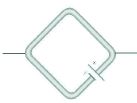
Answerd
Given $B=0.01-2 \,t$ $\mathrm{Tesla};$ $\frac{\mathrm{dB}}{\mathrm{dt}}=-2 \mathrm{\,Tesla} / \mathrm{sec},$
Induced emf $\mathrm{e}=-\frac{\mathrm{d} \phi}{\mathrm{dt}}=-\frac{\mathrm{d}}{\mathrm{dt}}(\mathrm{BA})$
$=-A \frac{d B}{d t}=-\frac{1}{2}\left(1^{2}\right) \times(-2)$
$\Rightarrow e=1 \,V$
Since magnetic field $( \times )$ decreasing so according to Lenz's law direction of induced current in upper part of square will be clockwise i.e. from $\mathrm{A}$ to $\mathrm{C}$ or in other words emf induces in a direction opposite to the main emf so resultant emf $=10-1=9 \,V.$
View full question & answer→MCQ 2731 Mark
Figure shows a circular region of radius $R$ in which uniform magnetic field $B$ exists. The magnetic field is increasing at a rate $\frac{d B}{d t}$. The induced electric field at a distance $r$ from the centre for $r < R$ is ............
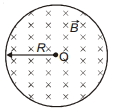
AnswerCorrect option: A. $\frac{d B}{d t} \frac{r}{2}$
a
(a)
Rate of increase of $B=\frac{d B}{d t}$
$E_{ m } \times 2 \pi r=-\frac{d \phi}{d t}$
or $E \times 2 \pi r=-A \frac{d B}{d t}$
$E \times 2 \pi r=-\pi r^2 \frac{d B}{d t}$
$\therefore E=\frac{-r}{2} \frac{d B}{d t}$
View full question & answer→MCQ 2741 Mark
The primary winding of a transformer has $100$ turns and its secondary winding has $200$ turns. The primary is connected to an ac supply of $120 \,V$ and the current flowing in it is $10\, A$. The voltage and the current in the secondary are
- ✓
$240 \,V, \,5\, A$
- B
$240\,V,\, 10\, A$
- C
$60\, V,\, 20\, A$
- D
$120 \,V,\, 20\, A$
AnswerCorrect option: A. $240 \,V, \,5\, A$
a
(a) $\frac{{{N_s}}}{{{N_p}}} = \frac{{{V_s}}}{{{V_p}}} $
$\Rightarrow \frac{{200}}{{100}} = \frac{{{V_s}}}{{120}} $
$\Rightarrow {V_s} = 240\;V$
also $\frac{{{V_s}}}{{{V_p}}} = \frac{{{i_p}}}{{{i_s}}}$
$\Rightarrow \frac{{240}}{{120}} = \frac{{10}}{{{i_s}}}$
$\Rightarrow {i_s} = 5\;A$
View full question & answer→MCQ 2751 Mark
A step-down transformer is connected to $2400 \,volts$ line and $80$ amperes of current is found to flow in output load. The ratio of the turns in primary and secondary coil is $20 : 1$. If transformer efficiency is $100\%$, then the current flowing in primary coil will be.....$A$
Answerc
(c) $\frac{{{N_s}}}{{{N_p}}} = \frac{{{V_s}}}{{{V_p}}}$
$\Rightarrow \frac{1}{{20}} = \frac{{{V_s}}}{{2400}}$
$\Rightarrow {V_s} = 120\;V$
For $100\%$ efficiency ${V_s}{i_s} = {V_p}{i_p}$
$ \Rightarrow 120 \times 80 = 2400\;{i_p}$
$\Rightarrow {i_p} = 4\;A$
View full question & answer→MCQ 2761 Mark
A loss free transformer has $500$ turns on its primary winding and $2500$ in secondary. The meters of the secondary indicate $200\,volts$ at $8$ amperes under these conditions. The voltage and current in the primary is
- A
$100 \,V, \,16 \,A$
- ✓
$40\, V,\, 40\, A$
- C
$160\, V, \,10 \,A$
- D
$80 \,V,\, 20\, A$
AnswerCorrect option: B. $40\, V,\, 40\, A$
b
(b) $\frac{{{V_p}}}{{{V_s}}} = \frac{{{N_p}}}{{{N_s}}} = \frac{{500}}{{2500}} = \frac{1}{5}$
$\Rightarrow {V_p} = \frac{{200}}{5} = 40\;V$
Also ${i_p}{V_p} = {i_s}{V_s}$
$\Rightarrow {i_p} = {i_s}\frac{{{V_s}}}{{{V_p}}} = 8 \times 5 = 40\;A$
View full question & answer→MCQ 2771 Mark
An ideal transformer has $100$ turns in the primary and $250$ turns in the secondary. The peak value of the $ac$ is $28 \,V$. The r.m.s. secondary voltage is nearest to.....$V$
Answera
(a) $\frac{{{N_s}}}{{{N_p}}} = \frac{{{V_s}}}{{{V_p}}}$
$\Rightarrow \frac{{250}}{{100}} = \frac{{{V_s}}}{{28/\sqrt 2 }}$
$\Rightarrow {V_s} = 50\;V$
View full question & answer→MCQ 2781 Mark
A $100\%$ efficient transformer has $100$ turns in the primary and $25$ turns in its secondary coil. If the current in the secondary coil is $4\, amp$, then the current in the primary coil is.....$amp$
Answera
(a) For 100% efficient transformer
${V_s}{i_s} = {V_p}{i_p}$
$\Rightarrow \frac{{{V_s}}}{{{V_p}}} = \frac{{{i_p}}}{{{i_s}}} = \frac{{{N_s}}}{{{N_p}}}$
$ \Rightarrow \frac{{{i_p}}}{4} = \frac{{25}}{{100}}$
$\Rightarrow {i_p} = 1\;A$
View full question & answer→MCQ 2791 Mark
A step-down transformer is connected to main supply $200\,V$ to operate a $6\,V$, $30\,W$ bulb. The current in primary is.....$A$
AnswerCorrect option: D. $0.15$
d
(d) ${V_p} = 200\;V,\;\;{V_s} = 6V$
${P_{out}} = {V_s}{i_s} \Rightarrow 30 = 6 \times {i_s}$
$\Rightarrow {i_s} = 5\;A$
From $\frac{{{V_s}}}{{{V_p}}} = \frac{{{i_p}}}{{{i_s}}}$
$\Rightarrow \frac{6}{{200}} = \frac{{{i_p}}}{5}$
$\Rightarrow {i_p} = 0.15\;A$
View full question & answer→MCQ 2801 Mark
In a step-up transformer the turn ratio is $1:10$. A resistance of $200 \,ohm$ connected across the secondary is drawing a current of $0.5$ A. What is the primary voltage and current
- A
$50\, V, \,1 \,amp$
- ✓
$10\, V, \,5\, amp$
- C
$25\, V,\, 4\, amp$
- D
$20 \,V, \,2 \,amp$
AnswerCorrect option: B. $10\, V, \,5\, amp$
b
${N_p}:{N_s} = 1:10$ and ${V_s} = 0.5 \times 200 = 100\;V$
$\frac{{{V_s}}}{{{V_p}}} = \frac{{{N_s}}}{{{N_p}}}$
$\Rightarrow \frac{{100}}{{{V_p}}} = \frac{{10}}{1} $
$\Rightarrow {V_p} = 10\;V$
$\frac{{{i_p}}}{{{i_s}}} = \frac{{{N_s}}}{{{N_p}}}$
$\Rightarrow \frac{{{i_p}}}{{0.5}} = \frac{{10}}{1},\;{i_p} = 5\;amp$
View full question & answer→MCQ 2811 Mark
A transformer has $100$ turns in the primary coil and carries $8 \,A$ current. If input power is one kilowatt, the number of turns required in the secondary coil to have $500\,V$ output will be
Answerc
(c) ${P_s} = {V_s}{i_s} \Rightarrow 1000 = {V_s} \times 8 \Rightarrow {V_s} = \frac{{1000}}{8}$
$\frac{{{V_p}}}{{{V_s}}} = \frac{{{N_p}}}{{{N_s}}} \Rightarrow \frac{{(1000/8)}}{{500}} = \frac{{100}}{{{N_s}}} \Rightarrow {N_s} = 400$
View full question & answer→MCQ 2821 Mark
A transformer with efficiency $80\%$ works at $4\, kW$ and $100\, V$. If the secondary voltage is $200 \,V$, then the primary and secondary currents are respectively
- ✓
$40\, A,\, 16\, A$
- B
$16\, A,\, 40\, A$
- C
$20\, A,\, 40\, A$
- D
$40\, A,\, 20\, A$
AnswerCorrect option: A. $40\, A,\, 16\, A$
a
(a) $\eta = \frac{{{\rm{output}}\,{\rm{power}}}}{{{\rm{input}}\,{\rm{power}}}} = \frac{{{E_s}{I_s}}}{{{E_p}{I_p}}}$
==> $\frac{{80}}{{100}} = \frac{{200 \times {I_s}}}{{4 \times {{10}^3}}}$
==> ${I_S} = \frac{{80}}{{100}} \times \frac{{4 \times 1000}}{{200}} = 16\,A$
Also, ${E_p}{I_p} = 4KW$
==>${I_p} = \frac{{4 \times {{10}^3}}}{{100}} = 40\,A$
View full question & answer→MCQ 2831 Mark
A step-down transformer is used on a $1000\,V$ line to deliver $20\, A$ at $120\,V$ at the secondary coil. If the efficiency of the transformer is $80\%$ the current drawn from the line is ......$A$
Answera
(a) $\eta = \frac{{{\rm{Output}}}}{{{\rm{Input}}}}$
==> $\frac{{80}}{{100}} = \frac{{20 \times 20}}{{1000 \times {i_l}}}$
==> ${i_l} = \frac{{20 \times 120 \times 100}}{{1000 \times 80}} = 3\,A$.
View full question & answer→MCQ 2841 Mark
A transformer may be used to provide maximum power transfer between two $AC$ circuits that have different impedances $Z_1$ and $Z_2. $ The ratio of turns $N_1/N_2$ needed to meet this condition is given by :-
- A
$\frac{N_1}{N_2}=\frac{Z_1}{Z_2}$
- B
$\frac{N_1}{N_2}=\frac{Z_2}{Z_1}$
- C
$\frac{N_1}{N_2}=\sqrt{\frac{Z_2}{Z_1}}$
- ✓
$\frac{N_1}{N_2}=\sqrt{\frac{Z_1}{Z_2}}$
AnswerCorrect option: D. $\frac{N_1}{N_2}=\sqrt{\frac{Z_1}{Z_2}}$
d
Maximum power transfer is In the state of resonance.
$\mathrm{P}=\mathrm{VI} \cos \theta$
$\cos \theta=1$
$\mathrm{P}=\frac{\mathrm{V}_{1}^{2}}{\mathrm{Z}_{1}}$
$\frac{V_{1}^{2}}{V_{2}^{2}}=\frac{Z_{1}}{Z_{2}}$
$\frac{V_{1}}{V_{2}}=\frac{N_{1}}{N_{2}}$
[By transformer (mutual induction) ]
View full question & answer→MCQ 2851 Mark
A transformer is used to light a $140\, watt, 24\, volt$ lamp from $240 \,V \,AC$ mains. The current in the main cable is $0.7 \,amp.$ The efficiency of the transformer is......$\%$
AnswerCorrect option: C. $83.3$
c
$\eta \%=\frac{E_{2} I_{2}}{E_{1} I_{1}} \times 100=\frac{140}{240 \times 0.7} \times 100=83.3 \%$
View full question & answer→MCQ 2861 Mark
A power transformer (step up) with an $1 : 8$ turn ratio has $60\, Hz, 120\, V$ across the primary; the load in the secondary is $10^4\ \Omega$. The current in the secondary is :-
- A
$96\ A$
- B
$0.96\ A$
- C
$9.6\ A$
- ✓
$96\ mA$
AnswerCorrect option: D. $96\ mA$
d
$\frac{\mathrm{V}_{2}}{\mathrm{V}_{1}}=\frac{\mathrm{N}_{2}}{\mathrm{N}_{1}}=\frac{8}{1}$
$\mathrm{V}_{2}=8 \times 120=960 \mathrm{\,volt}$
$\mathrm{I}=\frac{960}{10^{4}}=96 \mathrm{\,mA}$
View full question & answer→MCQ 2871 Mark
In a transformer, number of turns in the primary are $140$ and that in the secondary are $280$. If current in primary is $4\, A$, then that in the secondary is........$A$
Answerb
Given $: \mathrm{i}_{\mathrm{p}}=4 \mathrm{\,A}, \quad \mathrm{N}_{\mathrm{p}}=140;$
$\mathrm{N}_{\mathrm{s}}=280^{\circ}$
From the formula
$\frac{\mathrm{i}_{\mathrm{p}}}{\mathrm{i}_{\mathrm{s}}}=\frac{\mathrm{N}_{\mathrm{s}}}{\mathrm{N}_{\mathrm{p}}} \quad$ or $\quad \frac{4}{\mathrm{i}_{\mathrm{s}}}=\frac{280}{140}$
So, $\quad i_{s}=2 \,A$
View full question & answer→MCQ 2881 Mark
If a step up transformer have turn ratio $5$, frequency $50\,Hz$ root mean square value of potential difference on primary $100\,volts$ and the resistance of the secondary winding is $500\,\Omega $ then the peak value of voltage in secondary winding will be (the efficiency of the transformer is hundred percent)
- ✓
$500 \sqrt 2 $
- B
$10 \sqrt 2 $
- C
$50 \sqrt 2 $
- D
$20 \sqrt 2 $
AnswerCorrect option: A. $500 \sqrt 2 $
a
Peak voltage in primary $\mathrm{V}_{0}=\sqrt{2} \mathrm{V}_{\mathrm{rms}}=100 \sqrt{2}$
$\frac{V_{s}}{V_{p}}=\frac{N_{2}}{N_{1}} \Rightarrow V_{s}=\frac{N_{s}}{N_{p}} \times V_{p}$
$\mathrm{V}_{\mathrm{s}}=5 \times 100 \sqrt{2}=500 \sqrt{2} \mathrm{\,V}$
View full question & answer→MCQ 2891 Mark
The primary winding of a transformer has $100\,turns$ and its secondary winding has $200\,turns$. The primary is connected to an ac supply of $120\,V$ and the current flowing in it is $10\,A$. The voltage and the current in the secondary are
- ✓
$240\,V, 5\,A$
- B
$240\,V, 10\,A$
- C
$60\,V, 20\,A$
- D
$120\,V, 20\,A$
AnswerCorrect option: A. $240\,V, 5\,A$
a
$\frac{E_{S}}{E_{P}}=\frac{n_{S}}{n_{P}}=\frac{I_{P}}{I_{S}}$
$\mathrm{E}_{\mathrm{S}}=\frac{\mathrm{n}_{\mathrm{S}}}{\mathrm{n}_{\mathrm{P}}} \times \mathrm{E}_{\mathrm{P}}=\frac{200}{100} \times 120=240 \mathrm{\,V}$
$I_{s}=I_{P} \times \frac{n_{P}}{n_{S}}=10 \times \frac{100}{200}=5 \,A$
View full question & answer→MCQ 2901 Mark
An alternating current of frequency $200\,rad/sec$ and peak value $1\,A$ as shown in the figure, is applied to the primary of a transformer. If the coefficient of mutual induction between the primary and the secondary is $1.5\,H$ , the voltage induced in the secondary will be.....$V$
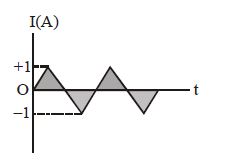
Answerb
$\mathrm{e}=-\mathrm{M} \frac{\mathrm{di}}{\mathrm{dt}}=-1.5 \frac{(1-0)}{(\mathrm{T} / 4)}=-\frac{6}{\mathrm{T}}$
Also $\mathrm{T}=\frac{2 \pi}{\omega}=\frac{2 \pi}{200}=\frac{\pi}{100}$
$\Rightarrow|\mathrm{e}|=\frac{600}{\pi}=190.9 \mathrm{V} \simeq 191 \mathrm{\,V}$
View full question & answer→MCQ 2911 Mark
In a transformer, number of turns in the primary coil are $140$ and that in the secondary coil are $280$. If current in primary is $4A$, then that in coil secondary is.....$A$
Answerb
$\frac{\mathrm{N}_{1}}{\mathrm{N}_{2}}=\frac{\mathrm{I}_{2}}{\mathrm{I}_{1}}$
$\frac{140}{280}=\frac{I_{2}}{4} \Rightarrow I_{2}=2 \,A$
View full question & answer→MCQ 2921 Mark
A transformer is used to light $140\, watt$ $24\, volt$ lamp from $240\, volt$ $AC$ mains; the current in the main cable is $0.7\, amp$. The efficiency of the transformer is......$\%$
AnswerCorrect option: C. $83.3$
c
$\eta=\frac{P_{0}}{P_{i}} \times 100$
$P_{i}=V I=240 \times 0.7=168$ $\mathrm{watt}$
$P_{0}=140$ $\mathrm{watt}$
View full question & answer→MCQ 2931 Mark
A transformer has $100\, turns$ in the primary coil and carries $8\,A$ current. If input power is one kilowatt, the number of turns in the secondary coil to have $500\,V$ output will be
Answerc
Power $=V . I$
$1000=500 I$
$(I)$ secondary $=2 \mathrm{A}$
Now $, \frac{I_{1}}{I_{2}}=\frac{N_{2}}{N_{1}} \Rightarrow \frac{8}{2}=\frac{N_{2}}{100}$
$\Rightarrow N_{2}=400$
View full question & answer→MCQ 2941 Mark
An electric motor operating on a $60\,V \,dc$ supply draws a current of $10\,A$ . If the efficiency of the motor is $50\%$ , the resistance of its winding is....$\Omega $
Answera
Efficiency of motor is
$\eta=\frac{\text { output power }}{\text { input power }}=\frac{\text { input power }-\text { resistance loss }}{\text { input power }}$$=\frac{ W -I^{2} R }{ V }$
$\eta=\frac{(50 \times 12)-12^{2} R}{50 \times 12}$
$\therefore \frac{30}{100}=\frac{600-144 R}{600}$
$\therefore 0.3 \times 600=600-144 R$
$\therefore 180=600-144 R$
$\therefore R=\frac{600-180}{144}=2.92 \Omega$
View full question & answer→MCQ 2951 Mark
A step down transformer converts transmission line voltage from $11000\, V$ to $220\, V$. The primary of the transformer has $6000\, turns$ and efficiency of the transformer is $60\%$. If the output power is $9\, kW$, then the input power will be........$kW$
Answerd
Here, $\mathrm{V}_{\mathrm{P}}=11000 \mathrm{\,V}, \mathrm{V}_{\mathrm{S}}=220 \mathrm{\,V}$
$\mathrm{N}_{\mathrm{P}}=6000, \eta=60 \% ; \mathrm{P}_{\mathrm{O}}=9 \mathrm{\,kW}=9 \times 10^{3} \mathrm{\,W}$
Efficiency, $\eta = \frac{{{\rm{ Output power }}}}{{{\rm{ Input power }}}} = \frac{{{{\rm{P}}_O}}}{{{{\rm{P}}_{\rm{i}}}}}$
$\therefore \mathrm{P}_{i}=\frac{\mathrm{P}_{\mathrm{O}}}{\eta}=\frac{9 \times 10^{3}}{60 / 100}=1.5 \times 10^{4}=15 \mathrm{\,kW}$
View full question & answer→MCQ 2961 Mark
In a step-up transformer, turn ratio is $8 : 1$. A $60\,Hz, 120\, volt$ input is connected with its primary coil. Load resistance in secondary coil is $10^4\,\Omega $ Find current in secondry coil.
- A
$96\, A$
- B
$0.96\, A$
- C
$9.6\, A$
- ✓
$96\, mA$
AnswerCorrect option: D. $96\, mA$
d
$\frac{\mathrm{N}_{\mathrm{s}}}{\mathrm{N}_{\mathrm{p}}}=\frac{8}{1}=\frac{\mathrm{e}_{\mathrm{s}}}{\mathrm{e}_{\mathrm{p}}}$
$\Rightarrow \mathrm{e}_{\mathrm{s}}=8 \times 120 \mathrm{\,V} \Rightarrow \mathrm{i}_{\mathrm{5}}=\frac{8 \times 120}{10^{4}}=96 \times 10^{-3} \mathrm{\,A}$
View full question & answer→MCQ 2971 Mark
A $100\%$ efficient transformer has $100$ turns in the primary and $25$ turns in its secondary coil. If the current in the secondary coil is $4$ amp, then the current in the primary coil is.....$ amp$
Answera
For $100 \%$ efficient transformer
$V_{s} i_{s}=V_{p} i_{p} \Rightarrow \frac{V_{s}}{V_{p}}=\frac{i_{p}}{i_{s}}=\frac{N_{s}}{N_{p}} \Rightarrow \frac{i_{p}}{4}=\frac{25}{100} i_{p}=1 A$
View full question & answer→MCQ 2981 Mark
A transformer is employed to reduce $220\, V$ to $11\, V$. The primary draws a current of $5\, A$ and the secondary $90\,A$. The efficiency of the transformer is......$\%$
Answerd
The efficiency of a transformer can be calculated using Equation,
Efficiency$=\frac{\text {Output} \text { power of the transformer}}{\text {Input power of the transformer}}=\frac{P_{s}}{P_{p}} \times 100$
In this case, the output power is calculated as follows.
The output voltage is $11 \mathrm{v}$ and current is $90 \mathrm{A}$
Power $=V I=11 \times 90=990 \mathrm{W}$
The input power is calculated as follows.
The input voltage is $220 \mathrm{V}$ and current is $5 \mathrm{A}$
Power $=V I=220 \times 5=1100 \mathrm{W}$
so, $\eta=\frac{990}{1100} \times 100=90 \%$
The efficiency of the transformer is $90 \%$
View full question & answer→MCQ 2991 Mark
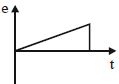
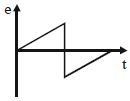
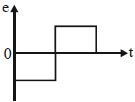
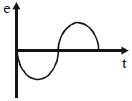
The figure shown has two coils of wires placed in close proximity. The current in primary coil $P$ is made to vary with time as shown in the graph, which of the following graphs best represents the variation of the emf induced in the secondary coil $S$ ?
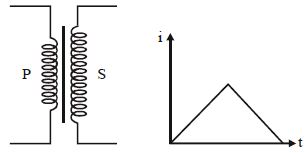
Answerc
$e = - \frac{{Mdi}}{{dt}}$
$e \propto \frac{{di}}{{dt}}$
Here $di/dt$ represent the slope of $i-t$ curve. In the given $i-t$ graph, during the first half time the slope is constant and has positive value and in the next half time, the slope is again constant but has negative value. Hence the correct representation of the curve in $e-t$ graph is $(C)$.
View full question & answer→MCQ 3001 Mark
A coil of area $80$ square cm and $50$ turns is rotating with $2000$ revolutions per minute about an axis perpendicular to a magnetic field of $0.05$ Tesla. The maximum value of the e.m.f. developed in it is
AnswerCorrect option: C. $\frac{{4\pi }}{3}\,volt$
c
(c)$e = NBA\omega ;\;\omega = 2\pi f = 2\pi \times \frac{{2000}}{{60}}$
$\therefore \;e = 50 \times 0.05 \times 80 \times {10^{ - 4}} \times 2\pi \times \frac{{2000}}{{60}} = \frac{{4\pi }}{3}$
View full question & answer→