MCQ 2011 Mark
A solenoid has $2000$ turns wound over a length of $0.3\,m$. The area of cross-section is $1.2\times10^{-3}\,m^2$. Around its central section a coil of $300$ turns is closely wound. If an initial current of $1\,A$ is reversed in $0.25\,s$. Find the emf induced in the coil.......$mV$
Answera
$ M =\frac{\mu_{0} N_{1} N_{2} A}{l}=\frac{4 \pi \times 10^{-7} \times 200 \times 300 \times 1.2 \times 10^{-3}}{0.3} $
$=3 \times 10^{-3} \mathrm{\,H} $
$\varepsilon = - M\frac{{dI}}{{dt}} = - 3 \times {10^{ - 3}}\left[ {\frac{{ - 1 - 1}}{{0.25}}} \right] = 24\,{\rm{mV}}$
View full question & answer→MCQ 2021 Mark
The mutual inductance of a pair of coils, each of $N\,turns$, is $M\,henry$. If a current of $I\, ampere$ in one of the coils is brought to zero in $t$ $second$ , the $emf$ induced per turn in the other coil, in volt, will be
- ✓
$\frac {MI}{t}$
- B
$\frac {NMI}{t}$
- C
$\frac {MN}{It}$
- D
$\frac {MI}{Nt}$
AnswerCorrect option: A. $\frac {MI}{t}$
a
$E = \frac{d}{{dt}}(NMI) \Rightarrow \,E = NM\frac{{dI}}{{dt}} \Rightarrow E = \frac{{NMI}}{t}$
$emf$ induced per unit turn $ = \frac{E}{N} = \frac{{MI}}{t}$
View full question & answer→MCQ 2031 Mark
A rectangular coil of $300$ turns has an average area of average area of $25\;cm \times 10\;cm.$ The coil rotates with a speed of $50$ cps in a uniform magnetic field of strength $4 \times {10^{ - 2}}T$ about an axis perpendicular of the field. The peak value of the induced $e.m.f$. is (in volt)
- A
$3000\pi $
- B
$300\pi $
- ✓
$30\pi $
- D
$3\pi $
AnswerCorrect option: C. $30\pi $
c
(c) Peak value of $emf = {e_0} = \omega NBA = 2\pi \nu NBA$
$ = 2\pi \times 50 \times 300 \times 4 \times {10^{ - 2}} \times (25 \times {10^{ - 2}} \times 10 \times {10^{ - 2}})$
$ = 30\;\pi \;volt$
View full question & answer→MCQ 2041 Mark
A circular coil of mean radius of $7 \,cm$ and having 4000 turns is rotated at the rate of $1800$ revolutions per minute in the earth's magnetic field ($B =\, 0.5$ gauss), the maximum $e.m.f.$ induced in coil will be....$ V$
- A
$1.158$
- ✓
$0.58$
- C
$0.29$
- D
$5.8$
AnswerCorrect option: B. $0.58$
b
(b) ${e_0} = \omega NBA = (2\pi \nu )NB(\pi {r^2})$ $ = 2 \times {\pi ^2}\nu \;NB{r^2}$
$ = 2 \times {(3.14)^2} \times \frac{{1800}}{{60}} \times 4000 \times 0.5 \times {10^{ - 4}} \times {(7 \times {10^{ - 2}})^2}$
$ = 0.58\;V$
View full question & answer→MCQ 2051 Mark
The number of turns in the coil of an ac generator is $5000$ and the area of the coil is $0.25\,{m^2}$. The coil is rotated at the rate of $100$ cycles/sec in a magnetic field of $0.2$ $W/{m^2}$. The peak value of the emf generated is nearly......$kV$
- A
$786 $
- B
$440$
- C
$220 $
- ✓
$157$
Answerd
(d) ${e_0} = \omega NBA = (2\pi \nu )\;NBA$
$ = 2 \times 3.14 \times 1000 \times 5000 \times 0.2 \times 0.25$= $157 \,kV$
View full question & answer→MCQ 2061 Mark
A student peddles a stationary bicyle. The pedals of the bicycle are attached to a $100$ turn coil of area $0.10$ $m^2$. The coil rotates at half a revolution per second and it is placed in a uniform megnetic field of $ 0.01$ $T$ perpendicular to the axis of rotation of the coil. What is the maximum voltage generated in the coil ?
- A
$1.314$ $V$
- B
$1.214$ $V$
- C
$2.314$ $V$
- ✓
$ 0.314$ $V$
AnswerCorrect option: D. $ 0.314$ $V$
d
Here $f = 0.5$ $HZ$; $N$ $=$ $100$,$ A$ $=$ $0.1$ $m^2$ and
$B $ $=$ $0.01$ $T$. Employing eq.
$e_0 = NBA $ $(2 \pi v)$
$= 100 × 0.01 × 0.1 × 2 × 3.14 × 0.5$
$= 0.314$ $ V$
The maximum voltage is $0.314 $ $V$
We urge you to explore such alternative
possibiliities for power generation.
View full question & answer→MCQ 2071 Mark
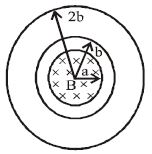
A uniform magnetic field $B$ that is perpendicular to the plane of the page now passes through the loops, as shown. The field is confined to a region of radius $a$, where $a < b$, and is changing at a constant rate. The induced $emf$ in the wire loop of radius $b$ is $\varepsilon $. What is the induced $emf$ in the wire loop of radius $2b$ :-
- A
$0$
- ✓
$\frac{\varepsilon }{2}$
- C
$\varepsilon $
- D
$2\varepsilon $
AnswerCorrect option: B. $\frac{\varepsilon }{2}$
b
$\varepsilon=\frac{\mathrm{a}^{2}}{2 \mathrm{r}} \frac{\mathrm{d} \mathrm{B}}{\mathrm{dt}}$
$\frac{\varepsilon_{2}}{\varepsilon_{1}}=\frac{r_{1}}{r_{2}}=\frac{b}{2 b}=\frac{1}{2}$
View full question & answer→MCQ 2081 Mark
A coil of area $80\, cm^2$ and $50\, turns$ is rotating with $2000$ revolutions per minute about an axis perpendicular to a magnetic field of $0.05\, tesla$. The maximum value of the $emf$ developed in it is
- A
$200\pi \,{\rm{volt}}$
- B
$\frac{{10\pi \,}}{3}\,volt$
- ✓
$\frac{{4\pi \,}}{3}\,volt$
- D
$\frac{{2 \,}}{3}\,volt$
AnswerCorrect option: C. $\frac{{4\pi \,}}{3}\,volt$
c
${\rm{E}} = {\rm{NAB }}\omega \sin \omega t$
$\mathrm{E}_{\max }=\mathrm{N} \mathrm{AB} \omega$
View full question & answer→MCQ 2091 Mark
A rectangular coil $ABCD$ is rotated in uniform magnetic field with constant angular velocity about its one of the diameter as shown in figure.The induced $emf$ will be maximum, when the plane of the coil is
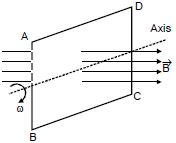
AnswerCorrect option: D. Parallel to the magnetic field
d
Let the angle between magnetic field and the line perpendicular to the surface of rectangular coil be $\theta$
Hence the flux through the coil is $\phi=\vec{B} . \vec{A}=B A \cos \theta$
Hence the induced emf $=$ Rate of change of flux $=-\frac{d \phi}{d t}=B A \sin \theta \frac{d \theta}{d t}=B A \omega \sin \theta$
Hence it is minimum when $\theta=0^{\circ}, 180^{\circ}$
Which means when the plane of coil is at right angle to the magnetic field.
View full question & answer→MCQ 2101 Mark
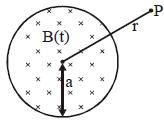
A uniform but time-varying magnetic field $B(t)$ exists in a circular region of radius $a$ and is directed into the plane of the paper, as shown. The magnitude of the induced electric field at point $P$ at a distance $r$ from the centre of the circular region
AnswerCorrect option: B. Decreases as $\frac {1}{r}$
b
The induced electric field is given by$:$
$\oint \vec{E} \cdot d \vec{l}=-\int \frac{d \vec{B}}{d t} \cdot d \vec{A}$
$\Longrightarrow|E|(2 \pi r)=\frac{d B}{d t} \cdot \pi a^{2}$
$\Longrightarrow|E| \propto \frac{1}{r}$
View full question & answer→MCQ 2111 Mark
In an $AC$ generator, a coil with $N$ turns, all of the same area $A$ and total resistance $R$, rotates with frequency $\omega $ in a magnetic field $B$. The maximum value of $emf$ generated in the coil is
- A
$N.A.B.R.\omega $
- B
$N.A.B.$
- C
$N.A.B.R.$
- ✓
$N.A.B.\omega $
AnswerCorrect option: D. $N.A.B.\omega $
d
$e = - \frac{{d\phi }}{{dt}} = - \frac{{d(N\overrightarrow B \cdot \overrightarrow A )}}{{dt}}$
$=-N \frac{d}{d t}(B A \cos \omega t)=N B A \omega \sin \omega t $
$ \Rightarrow e_{\max }=N B A \omega $
View full question & answer→MCQ 2121 Mark
A coil resistance $20\, \Omega$ and inductance $5H$ is connected with a $100\,V$ battery. Energy stored in the coil will be....$J$
- A
$41.5$
- ✓
$62.50$
- C
$125 $
- D
$250$
AnswerCorrect option: B. $62.50$
b
(b) $U = \frac{1}{2}L{i^2} = \frac{1}{2}L{\left( {\frac{E}{R}} \right)^2} = \frac{1}{2} \times 5 \times {\left( {\frac{{100}}{{20}}} \right)^2} = 62.50\,J$
View full question & answer→MCQ 2131 Mark
Which statement is correct from following -
$(a)$ Inductor store energy in the form of magnetic field
$(b)$ Capacitor store energy in the form of electric field
$(c)$ Inductor store energy in the form of electric and magnetic field both
$(d)$ Capacitor store energy in the form of electric and magnetic field both
- ✓
$a, b$
- B
$a, c$
- C
$b, d$
- D
$b, c$
AnswerCorrect option: A. $a, b$
View full question & answer→MCQ 2141 Mark
An inductor coil stores $U$ energy when $I$ current is passed through it and dissipates energy at the rate of $P.$ The time constant of the circuit, when this coil is connected across a battery of zero internal resistance is
- A
$\frac {4U}{P}$
- B
$\frac {U}{P}$
- ✓
$\frac {2U}{P}$
- D
$\frac {2P}{U}$
AnswerCorrect option: C. $\frac {2U}{P}$
c
$U=\frac{1}{2} L i^{2} \ldots(1)$
$P=I^{2} R \ldots(2)$
From on $( 1)$ and $( 2)$
$\frac{L}{2 R}=\frac{U}{A P} \Rightarrow \frac{L}{R}=\frac{2 U}{\Pi}$ mplies $\tau=\frac{2 U}{P}$
View full question & answer→MCQ 2151 Mark
The equivalent inductance of two inductances is $2.4\, henry$ when connected in parallel and $10 \,henry$ when connected in series. The difference between the two inductances is..........$ henry$
Answera
(a)${L_S} = {L_1} + {L_2} = 10H$ ..... $(i)$
${L_P} = \frac{{{L_1}{L_2}}}{{{L_1} + {L_2}}} = 2.4H$ ..... $(ii)$
On solving $(i)$ and $(ii)$ $L_1$ $L_2$ = 24 ..... $(iii)$
Also ${({L_1} - {L_2})^2} = {({L_1} + {L_2})^2} - 4{L_1}{L_2}$
$ \Rightarrow {({L_1} - {L_2})^2} = {(10)^2} - 4 \times 24 = 4$$ \Rightarrow {L_1} - {L_2} = 2H$
View full question & answer→MCQ 2161 Mark
Two identical induction coils each of inductance $L$ joined in series are placed very close to each other such that the winding direction of one is exactly opposite to that of the other, what is the net inductance
Answerd
(d)When the two coils are joined in series such that the winding of one is opposite to the other, then the emf produced in first coil is $180^o$ out of phase of the emf produced in second coil.
Thus, emf produced in first coil is negative and the emf produced in second coil is positive so, net inductance is
$L = {L_1} + {L_2} = L + L$
$ \Rightarrow L = - \frac{\phi }{i} + \frac{\phi }{i} = 0$
View full question & answer→MCQ 2171 Mark
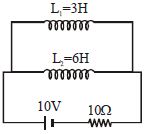
Two inductor coils of self inductance $3\,H$ and $6\,H$ respectively are connected with a resistance $10\,W$ and a battery $10\, V$ as shown in figure. The ratio of total energy stored at steady state in the inductors to that of heat developed in resistance in $10$ $seconds$ at the steady state is (neglect mutual inductance between $L_1$ and $L_2$) :-
- A
$\frac{1}{10}$
- ✓
$\frac{1}{100}$
- C
$\frac{1}{1000}$
- D
$1$
AnswerCorrect option: B. $\frac{1}{100}$
b
Energy stored in inductor $\frac{1}{2} \mathrm{Ll}^{2}$
$=\frac{1}{2} \times(2) \times(1)^{2}=1 \mathrm{\,J}$
Energy developed in resistance
$=1^{2} \mathrm{RT}=1^{2} \times 10 \times 10=100 \mathrm{\,J}$
Hence the required ratio is $\frac{1}{100}$
View full question & answer→MCQ 2181 Mark
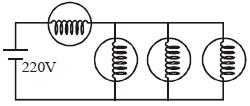
Four identical bulbs each rated $100\, watt, 220\, volts$ are connected across a battery as shown. The total electric power consumed by the bulbs is.......$watt$
- ✓
$75$
- B
$400$
- C
$300$
- D
$400/3 $
Answera
$\mathrm{R}=\frac{(220)^{2}}{100}$
$R_{e q}=\frac{R}{3}+R=\frac{4 R}{3}=\frac{4(220)^{2}}{300}$
$\mathrm{P}=\frac{\mathrm{V}^{2}}{\mathrm{R}_{\mathrm{eq}}}=\frac{\mathrm{V}^{2}}{\mathrm{R}_{\mathrm{eq}}}=\frac{(220)^{2} \times 300}{4(220)^{2}}=\frac{300}{4}=75 \mathrm{\,W}$
View full question & answer→MCQ 2191 Mark
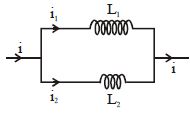
Two inductors $L_1$ and $L_2$ are connected in parallel and $a$ time varying current flow as shown the Ratio of currents $i_1/i_2$ at any time $t$ is
AnswerCorrect option: B. $L_2 / L_1$
b
since $L_{1}$ and $L_{2}$ are connected in parallel. Potential difference across $L_{1}$ is equal to
that across $L_{2}$ i.e. $\mathcal{E}_{1}=\mathcal{E}_{2}$
Or $-L_{1} \frac{d i_{1}}{d t}=-L_{2} \frac{d I_{2}}{d t}$
Or $L_{1} \int d i_{1}=L_{2} \int d i_{2}$
Or $L_{2} i_{2}=L_{1} i_{1}$
or $\frac{i_{1}}{i_{2}}=\frac{L_{2}}{L_{1}}$
View full question & answer→MCQ 2201 Mark
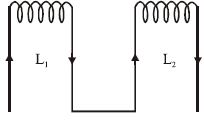
A circuit contains two inductors of self inductance $L_1$ and $L_2$ in series (Fig). If $M$ is the mutual inductance, then the effective inductance of the circuit shown will be
- A
$L_1 + L_2$
- B
$L_1 + L_2 -2M$
- C
$L_1 + L_2 + M$
- ✓
$L_1 + L_2 + 2M$
AnswerCorrect option: D. $L_1 + L_2 + 2M$
d
When inductances are connected like this in series, then $L = L_1 + L_2 + 2M$
View full question & answer→MCQ 2211 Mark
The magnetic flux through a coil perpendicular to its plane and directed into paper is varying according to the relation $\phi = (2t^2 + 4t + 6)\, m\,Wb$. The $emf$ induced in the loop at $t = 4\, s$ is.......$V$
- A
$0.12$
- B
$2.4$
- ✓
$0.02$
- D
$1.2$
AnswerCorrect option: C. $0.02$
c
$\mathrm{L}=\mathrm{L}_{1}+\mathrm{L}_{2}+2 \mathrm{\,M}$
Given, $\phi==\left(2 t^{2}+4 t+6\right) \,m W b$
$\mathrm{As}, \mathrm{\varepsilon}=\frac{\mathrm{d} \phi}{\mathrm{dt}}$
$=\frac{d}{d t}\left(2 t^{2}+4 t+6\right) \times 10^{-3} \mathrm{\,Wb} \mathrm{s}^{-1}$
$=(4 t+4) \times 10^{-3} \,V$
At $\quad t=4 \,s$
$ \varepsilon =(4 \times 4+4) \times 10^{-3} \mathrm{\,V}$
$=20 \times 10^{-3} \mathrm{\,V}=0.02 \mathrm{\,V} $
View full question & answer→MCQ 2221 Mark
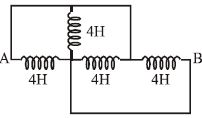
The equivalent inductance between $\mathrm{A}$ and $\mathrm{B}$ is.....$H$
Answera
The equivalent circuit diagram is as shown in the figure.
Here, all the inductances are connected in parallel.
Hence, the equivalent inductance between $\mathrm{A}$ and $\mathrm{B}$ is
$\frac{1}{L_{A B}}=\frac{1}{4}+\frac{1}{4}+\frac{1}{4}+\frac{1}{4}=\frac{4}{4}=1$
or $L_{A B}=1 \,H$
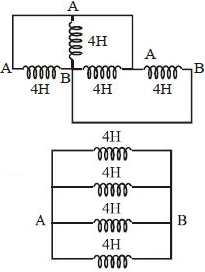
View full question & answer→MCQ 2231 Mark
The equivalent inductance of two inductors is $2.4\, H$ when connected parallel and $10\, H$ when connected in series. What is the value of inductances of the individual inductors ?
- A
$8\, H, 2\, H$
- ✓
$6\, H, 4\, H$
- C
$5\, H, 5\, H$
- D
$7\, H, 3\, H$
AnswerCorrect option: B. $6\, H, 4\, H$
b
In series connecttion $\mathrm{L}_{1}+\mathrm{L}_{2}=10 \mathrm{H} $ ........$(i)$
and in parallel connection
$\frac{L_{1} L_{2}}{\left(L_{1}+L_{2}\right)}=2.4 \mathrm{\,H}$ ........$(ii)$
Substituting the value of $\left(L_{1}+L_{2}\right)$ from $(i)$ into $(ii),$ we get
$\mathrm{L}_{1} \mathrm{L}_{2}=(2.4)\left(\mathrm{L}_{1}+\mathrm{L}_{2}\right)=(2.4) \times 10=24$
$\left(L_{1}-L_{2}\right)^{2}=\left(L_{1}+L_{2}\right)^{2}-4 L_{1} L_{2}$
$\mathrm{L}_{1}-\mathrm{L}_{2}=\left[(10)^{2}-4 \times 24\right]^{1 / 2}=2 \mathrm{\,H}$ .......$(iii)$
Solving $(i)$ and $(iii),$ we get
$\mathrm{L}_{1}=6 \mathrm{\,H}, \mathrm{L}_{2}=4 \mathrm{\,H}$
View full question & answer→MCQ 2241 Mark
An inductance $L$ and a resistance $R$ are first connected to a battery. After some time the battery is disconnected but $L$ and $R$ remain connected in a closed circuit. Then the current reduces to $37\%$ of its initial value in
- A
$RL\, sec$
- B
$\frac{R}{L}sec$
- ✓
$\frac{L}{R}sec$
- D
$\frac{1}{{LR}}sec$
AnswerCorrect option: C. $\frac{L}{R}sec$
c
(c)When battery disconnected current through the circuit start decreasing exponentially according to $i = {i_0}{e^{ - Rt/L}}$
==> $0.37{i_0} = {i_0}{e^{ - Rt/L}}$
==> $0.37 = \frac{1}{e} = {e^{ - Rt/L}}$
==> $t = \frac{L}{R}$
View full question & answer→MCQ 2251 Mark
In an $LR$ -circuit, time constant is that time in which current grows from zero to the value (where ${I_0}$ is the steady state current)
- ✓
$0.63\,{I_0}$
- B
$0.50\,{I_0}$
- C
$0.37\,{I_0}$
- D
${I_0}$
AnswerCorrect option: A. $0.63\,{I_0}$
a
(a) Current at any instant of time $t$ after closing an $L-R$ circuit is given by $I = {I_0}\left[ {1 - {e^{\frac{{ - R}}{L}t}}} \right]$ Time constant $t = \frac{L}{R}$
$\therefore \,\,I = {I_0}\left[ {1 - {e^{\frac{{ - R}}{L} \times \frac{L}{R}}}} \right] = {I_0}\,(1 - {e^{ - 1}}) = {I_0}\,\left( {1 - \frac{1}{e}} \right)$.
$ = {I_0}\,\left( {1 - \frac{1}{{2.718}}} \right) = 0.63{I_0} = 63\% $ of ${I_0}$
View full question & answer→MCQ 2261 Mark
In the figure magnetic energy stored in the coil is
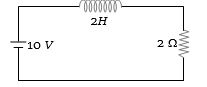
AnswerCorrect option: C. $25$ joules
c
(c)$i = \frac{V}{R} = \frac{{10}}{2} = 5A$
$U = \frac{1}{2}L{i^2} = \frac{1}{2} \times 2 \times 25 = 25\,J$
View full question & answer→MCQ 2271 Mark
A solenoid has an inductance of $60 \,henrys$ and a resistance of $30 \,ohms$. If it is connected to a $100 \,volt$ battery, how long will it take for the current to reach $\frac{{e - 1}}{e} \approx 63.2\% $ of its final value
- A
$1\, second$
- ✓
$2\, seconds$
- C
$e \,seconds$
- D
$2e\, seconds$
AnswerCorrect option: B. $2\, seconds$
b
(b) $t = \tau = \frac{L}{R} = \frac{{60}}{{30}} = 2\,\sec .$
View full question & answer→MCQ 2281 Mark
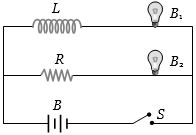
The resistance $R$ is the same as that of the coil that makes $L$. Which of the following statements gives the correct description of the happenings when the switch $S$ is closed
- A
The bulb $B_2$ lights up earlier than $B_1$ and finally both the bulbs shine equally bright
- B
$B_1$ light up earlier and finally both the bulbs acquire equal brightness
- ✓
$B_2$ lights up earlier and finally $B_1$ shines brighter than $B_2$
- D
$B_1$ and $B_2$ light up together with equal brightness all the time
AnswerCorrect option: C. $B_2$ lights up earlier and finally $B_1$ shines brighter than $B_2$
View full question & answer→MCQ 2291 Mark
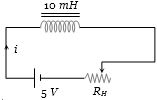
The resistance in the following circuit is increased at a particular instant. At this instant the value of resistance is $10\, \Omega$. The current in the circuit will be now
- A
$i = 0.5\, A$
- ✓
$i > 0.5 \,A$
- C
$i < 0.5 \,A$
- D
$i = 0$
AnswerCorrect option: B. $i > 0.5 \,A$
b
(b) If resistance is constant ($10\, \Omega$) then steady current in the circuit $i = \frac{5}{{10}} = 0.5\,A$. But resistance is increasing it means current through the circuit start decreasing. Hence inductance comes in picture which induces a current in the circuit in the same direction of main current. So $i > 0.5\, A.$
View full question & answer→MCQ 2301 Mark
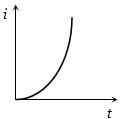
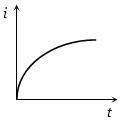
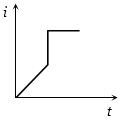
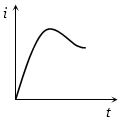
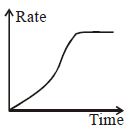
When a battery is connected across a series combination of self inductance $L$ and resistance $ R$, the variation in the current $i$ with time $t$ is best represented by
Answerb
(b) $i = {i_0}\left( {1 - {e^{ - \frac{R}{L}t}}} \right)$
View full question & answer→MCQ 2311 Mark
When a certain circuit consisting of a constant $e.m.f$. $E$ an inductance $L$ and a resistance $R$ is closed, the current in, it increases with time according to curve $1$. After one parameter $(E, L or R)$ is changed, the increase in current follows curve $ 2$ when the circuit is closed second time. Which parameter was changed and in what direction
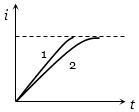
- ✓
$L$ is increased
- B
$L$ is decreased
- C
$R$ is increased
- D
$R$ is decreased
AnswerCorrect option: A. $L$ is increased
a
(a)$\frac{{di}}{{dt}} = $slope of $i -t $ graph slope of graph $(2)\,< $ slope of graph $(1)$ so ${\left( {\frac{{di}}{{dt}}} \right)_2} < {\left( {\frac{{di}}{{dt}}} \right)_1}$
Also $L \propto \frac{1}{{(di/dt)}} \Rightarrow {L_2} > {L_1}$
View full question & answer→MCQ 2321 Mark
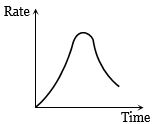
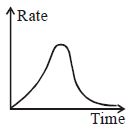
In an $L-R$ circuit connected to a battery the rate at which energy is stored in the inductor is plotted against time during the growth of the current in the circuit. Which of the following best represents the resulting curve
Answera
(a)$U = \frac{1}{2}L{i^2}$
$\therefore $Rate $ = \frac{{dU}}{{dt}} = Li\left( {\frac{{di}}{{dt}}} \right)$
At $t = 0,\;i = 0$ $\therefore rate = 0$
At $t = \infty ,\;i = {i_0}$ but $\frac{{di}}{{dt}} = 0,$ therefore rate = 0
View full question & answer→MCQ 2331 Mark
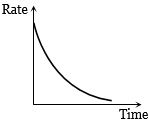
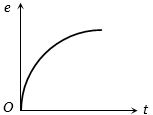
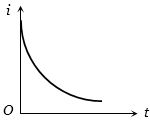
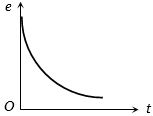
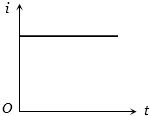
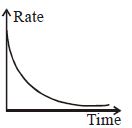
Switch $S$ of the circuit shown in figure. is closed at $t = 0$. If e denotes the induced emf in $L$ and i, the current flowing through the circuit at time $t $, which of the following graphs is correct
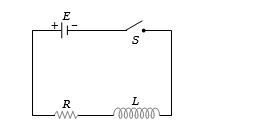
Answerc
(c) At the time $ t = 0$, $e$ is max and is equal to $E$, but current $i$ is zero.
As the time passes, current through the circuit increases but induced emf decreases.
View full question & answer→MCQ 2341 Mark
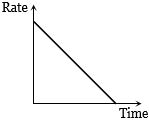
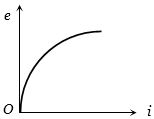
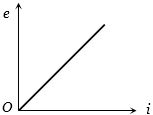
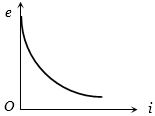
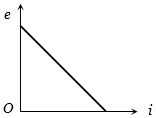
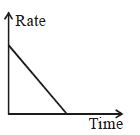
For previous objective, which of the following graphs is correct
Answerd
(d)If at any instant, current through the circuit is i then applying Kirchoffs voltage law,$iR + e = E \Rightarrow e = E - iR.$ Therefore, graph between $e$ and $i$ will be a straight line having negative slope and having a positive intercept.
View full question & answer→MCQ 2351 Mark
For $L-R$ circuit, the time constant is equal to
- ✓
twice the ratio of the energy stored in the magnetic field to the rate of dissipation of energy in the resistance
- B
ratio of the energy stored in the magnetic field to the rate of dissipation of energy in the resistance
- C
half the ratio of the energy stored in the magnetic field to the rate of dissipation of energy in the resistance
- D
square of the ratio of the energy stored in the magnetic field to the rate of dissipation of energy in the resistance
AnswerCorrect option: A. twice the ratio of the energy stored in the magnetic field to the rate of dissipation of energy in the resistance
a
The time required for the current flowing in the $LR$ series circuit to reach its maximum steady state value is equivalent to about $5$ time constants or $5 \tau$. This time constant $\tau$, is measured by $\tau=L / R$, in seconds, where $R$ is the value of the resistor in ohms and $L$ is the value of the inductor in Henries
View full question & answer→MCQ 2361 Mark
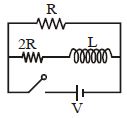
The ratio of time constant in charging and discharging in the circuit shown in figure is
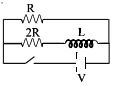
- A
$1 : 1$
- ✓
$3 : 2$
- C
$2 : 3$
- D
$1 : 3$
AnswerCorrect option: B. $3 : 2$
b
Time constant in Build up
$\tau_{1}=\frac{L}{2 R}$
Time contant for decay
$\tau_{2}=\frac{L}{3 R}$
$\frac{\tau_{1}}{\tau_{2}}=\frac{3}{2}$
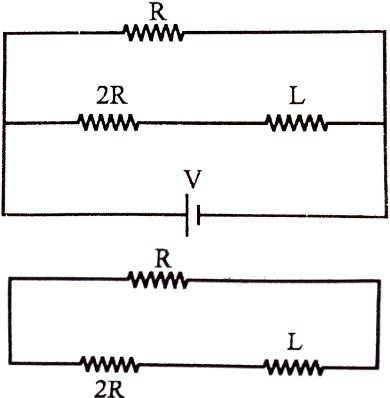
View full question & answer→MCQ 2371 Mark
In an $L-R$ circuit connected to a battery of constant $e.m.f$. $E$ switch $S$ is closed at time $t = 0$. If e denotes the magnitude of induced $e.m.f$. across inductor and $i$ the current in the circuite at any time $t$. Then which of the following graphs shows the variation of $e$ with $i$ ?
Answera
$E=e+I R \Rightarrow e=-I R+E$
View full question & answer→MCQ 2381 Mark
An induction coil stores $32$ joules of magnetic energy and dissipates energy as heat at the rate of $320$ watts. When $a$ current of $4$ amperes is passed through it. Find the time constant of the circuit when the coil is joined across a battery......$s$
- ✓
$0.25$
- B
$0.15$
- C
$0.35$
- D
$0.45$
AnswerCorrect option: A. $0.25$
a
Let inductance of coil is $L$ and resistance is $R$
$U=\frac{1}{2} L I^{2} \Rightarrow 32=\frac{1}{2} \times L \times(4)^{2}$
$L=4 H$
$P=I^{2} R \Rightarrow 320=(4)^{2} \times R$
$R=20 \Omega$
$\tau=\frac{L}{R}=\frac{4}{20}=0.25$
View full question & answer→MCQ 2391 Mark
An inductor coil stores $U$ energy when $i$ current is passed through it and dissipates energy at the rate of $P$. The time constant of the circuit, when this coil is connected across a battery of zero internal resistance is
- A
$\frac{{4U}}{P}$
- B
$\frac{{U}}{P}$
- ✓
$\frac{{2U}}{P}$
- D
$\frac{{2P}}{U}$
AnswerCorrect option: C. $\frac{{2U}}{P}$
c
$U=\frac{1}{2} L i^{2} \dots(1)$
$P=I^{2} R \ldots(2)$
From on $(1)$ and $(2)$
$\frac{L}{2 R}=\frac{U}{A P} \Rightarrow \frac{L}{R}=\frac{2 U}{\Pi}$ mplies$\tau$ $=\frac{2 U}{P}$
View full question & answer→MCQ 2401 Mark
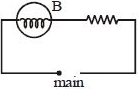
A $50\, W$ bulb is in series with a room heater and the combination is connected across the mains. To get max. heater output the $50\, W$ bulb should be replaced by ......$W$
Answerd
For power across heater is maximum resistance of bulb should be minimum.
$\mathrm{P}_{\text {heater }}=\left(\frac{\mathrm{V}}{\mathrm{R}_{\mathrm{H}}+\mathrm{R}_{\mathrm{b}}}\right)^{2} \mathrm{R}_{\mathrm{H}}$
View full question & answer→MCQ 2411 Mark
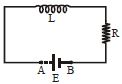
An inductor $(L = 100\, mH),$ a resistor $(R = 100 \, \Omega )$ and a battery $(E = 100 \,V)$ are initially connected in series as shown in the figure. After a long time the battery is disconnected after short circuiting the points $A$ and $B.$ The current in the circuit $1 \,ms$ after the short circuit is-
- ✓
$\frac{1}{e} \,A$
- B
$e \,A$
- C
$0.1\,A$
- D
$1\,A$
AnswerCorrect option: A. $\frac{1}{e} \,A$
a
$I=I_{0} e^{-t / \alpha}$
$\mathrm{I}_{0}=\mathrm{E} / \mathrm{R}=\frac{100}{100}=1 \mathrm{\,Amp}$
$\mathrm{t}=1 \mathrm{\,m} . \mathrm{s.}=10^{-3} \mathrm{\,sec}$
$\alpha=\mathrm{L} / \mathrm{R}=\frac{100 \times 10^{-3}}{100}$
$I=1 \times e-\frac{10^{-3}}{10^{-3}} \Rightarrow \frac{1}{e}$
View full question & answer→MCQ 2421 Mark
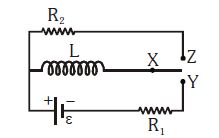
In the circuit shown, $X$ is joined to $Y$ for a longmtime, and then $X$ is joined to $Z$. The total heat produced in $R_2$ is
- ✓
$\frac{{L{\varepsilon ^2}}}{{2R_1^2}}$
- B
$\frac{{L{\varepsilon ^2}}}{{2R_2^2}}$
- C
$\frac{{L{\varepsilon ^2}}}{{2{R_1}{R_2}}}$
- D
$\frac{{L{\varepsilon ^2}{R_2}}}{{2R_1^3}}$
AnswerCorrect option: A. $\frac{{L{\varepsilon ^2}}}{{2R_1^2}}$
a
Steady-state current in $\mathrm{L}=\mathrm{i}_{0}=\frac{\varepsilon}{\mathrm{R}_{1}}.$
Energy stored in $\mathrm{L}=\frac{1}{2} \mathrm{Li}_{0}^{2}=\frac{1}{2} \mathrm{L}\left(\frac{\varepsilon^{2}}{\mathrm{R}_{1}^{2}}\right)$
$=$ heat produced in $\mathrm{R}_{2}$ during discharge.
View full question & answer→MCQ 2431 Mark
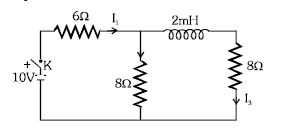
In the circuit shown in figure what is the value of $I_1$ just after pressing the key $K$ ?
- ✓
$\frac {5}{7}\,\, A$
- B
$\frac {5}{11}\,\, A$
- C
$1\,\, A$
- D
AnswerCorrect option: A. $\frac {5}{7}\,\, A$
a
At $t=0$
$\mathrm{I}=\frac{\mathrm{V}}{\mathrm{R}_{\mathrm{net}}}=\frac{10}{6+8}=\frac{10}{14}=\frac{5}{7} \mathrm{\,A}$
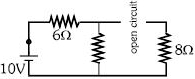
View full question & answer→MCQ 2441 Mark
In a $LR$ circuit connected to a battery the rate at which energy is stored in the inductor is plotted against time during the growth of current in the circuit. Which of the following best represents the resulting curve ?
Answera
$\mathrm{U}=\frac{1}{2} \mathrm{LI}^{2}$
Rate $=\frac{\mathrm{d} \mathrm{U}}{\mathrm{dt}}=\mathrm{LI}\left(\frac{\mathrm{dI}}{\mathrm{dt}}\right)$
At $t=0, I=0$ $\therefore$ Rate $=0$
At $\mathrm{t}=\infty, \mathrm{I}=\mathrm{I}_{0}$ but $\frac{\mathrm{d} \mathrm{I}}{\mathrm{dt}}=0,$ therefore, rate $=0$
View full question & answer→MCQ 2451 Mark
When a certain circuit consisting of emf $E$, an inductance $L$ and a resistance $R$ is closed, the current in it increases with time according to curve $1$. After one parameter ($L$ or $R$) is changed, the increase in the current follows curve $2$, when the circuit is closed second time. Which parameter was changed
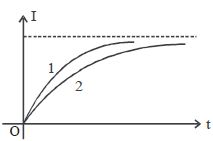
- ✓
$L$ is increased
- B
$L$ is decreased
- C
$R$ is increased
- D
$R$ is decreased
AnswerCorrect option: A. $L$ is increased
a
Final currrent is same so $R$ does not change. since time constant is more in $2.$ therefore $L$ is increased.
View full question & answer→MCQ 2461 Mark
A solenoid has turn density $5000\,turn/m$ and cross sectional area $10\,cm^2$. If a current of $1\,A$ flow in it and inside material has relative permeability of $1000$, then find energy per unit length of solenoid......$J/m$
- ✓
$15.7$
- B
$18.9$
- C
$12.31$
- D
$8.53$
AnswerCorrect option: A. $15.7$
a
Energy per unit length $=\frac{1}{\ell}\left(\frac{1}{2} \mathrm{LI}^{2}\right)$
$=\frac{1}{\ell}\left[\frac{1}{2}\left(\frac{\mu_{0} \mu_{\mathrm{r}} \mathrm{N}^{2} \mathrm{A}}{\ell}\right) \mathrm{I}^{2}\right]$
$=\frac{1}{2} \mu_{0} \mu_{r}\left(\frac{\mathrm{N}}{\ell}\right)^{2} \mathrm{AI}^{2}=\frac{1}{2} \mu_{0} \mu_{\mathrm{r}} \mathrm{n}^{2} \mathrm{AI}^{2}$
$=\frac{1}{2} \times 4 \pi \times 10^{-7} \times 1000(5000)^{2}\left(10 \times 10^{-4}\right)(1)^{2}$
$=15.7 \mathrm{\,J} / \mathrm{m}$
View full question & answer→MCQ 2471 Mark
Current in $2\, \Omega$ resistance shown in figure is
$(a)$ Just after the closing of the key
$(b)$ Some time after the closing of the key
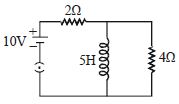
- A
$5\,A, \frac{5}{3}\,A$
- B
$\frac{10}{6}\,A$, Zero
- ✓
$\frac{5}{3}\,A,5\,A$
- D
Zero, $5\,A$
AnswerCorrect option: C. $\frac{5}{3}\,A,5\,A$
c
$t=0 \mathrm{\,L}$ will be ope
$I_{N}=\frac{10}{6}$
$t=\infty$ $L$ will be shorted
$I_{N}=\frac{10}{2}=5$
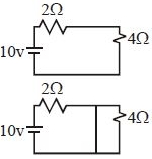
View full question & answer→MCQ 2481 Mark
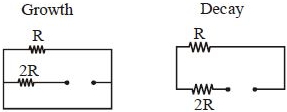
The ratio of time constants during growth and decay of current in circuit is
- A
$1 : 1$
- ✓
$3 : 2$
- C
$2 : 3$
- D
$1 : 3$
AnswerCorrect option: B. $3 : 2$
b
Growth
$\mathrm{R}_{\mathrm{N}}=2 \mathrm{R}$
$\left(\tau_{\mathrm{N}}\right)_{1}=\frac{\mathrm{L}}{2 \mathrm{R}}$
$\frac{\left(\tau_{\mathrm{N}}\right)_{1}}{\left(\tau_{\mathrm{N}}\right)_{2}}=\frac{3 \mathrm{R}}{2 \mathrm{R}}$
Decay
$\mathrm{R}_{\mathrm{N}}=3 \mathrm{R}$
$\left(\tau_{\mathrm{N}}\right)_{2}=\frac{\mathrm{I}}{3 \mathrm{R}}$
View full question & answer→MCQ 2491 Mark
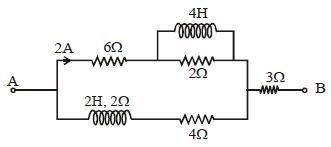
Find $V_A -V_B$ in steady state
Answerc
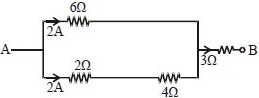
$\mathrm{R}_{\mathrm{AB}}=6$
$\mathrm{V}_{\mathrm{A}}-\mathrm{V}_{\mathrm{B}}=6 \times 2+3 \times 4=24 \mathrm{\,V}$
View full question & answer→MCQ 2501 Mark
An inductor-coil carries a steedy-state current of $2.0\, A$ when connected across an ideal battery of $emf$ $4.0\, V$. If its inductance is $1.0\, H$, find the time constant of the circuit.....$sec$
Answera
here $i=2 A, E=4 V, L=1 H$
$\therefore R=\left(\frac{E}{i}\right)=\left(\frac{4}{2}\right)=2 \Omega$
$i=\frac{L}{R}=\frac{1}{2}=0.5 A$
View full question & answer→