MCQ 1011 Mark
A triangle whose all three sides are of different lengths is called$..........$
AnswerA triangle whose all three sides are of different lengths is called a scalene triangle.
View full question & answer→MCQ 1021 Mark
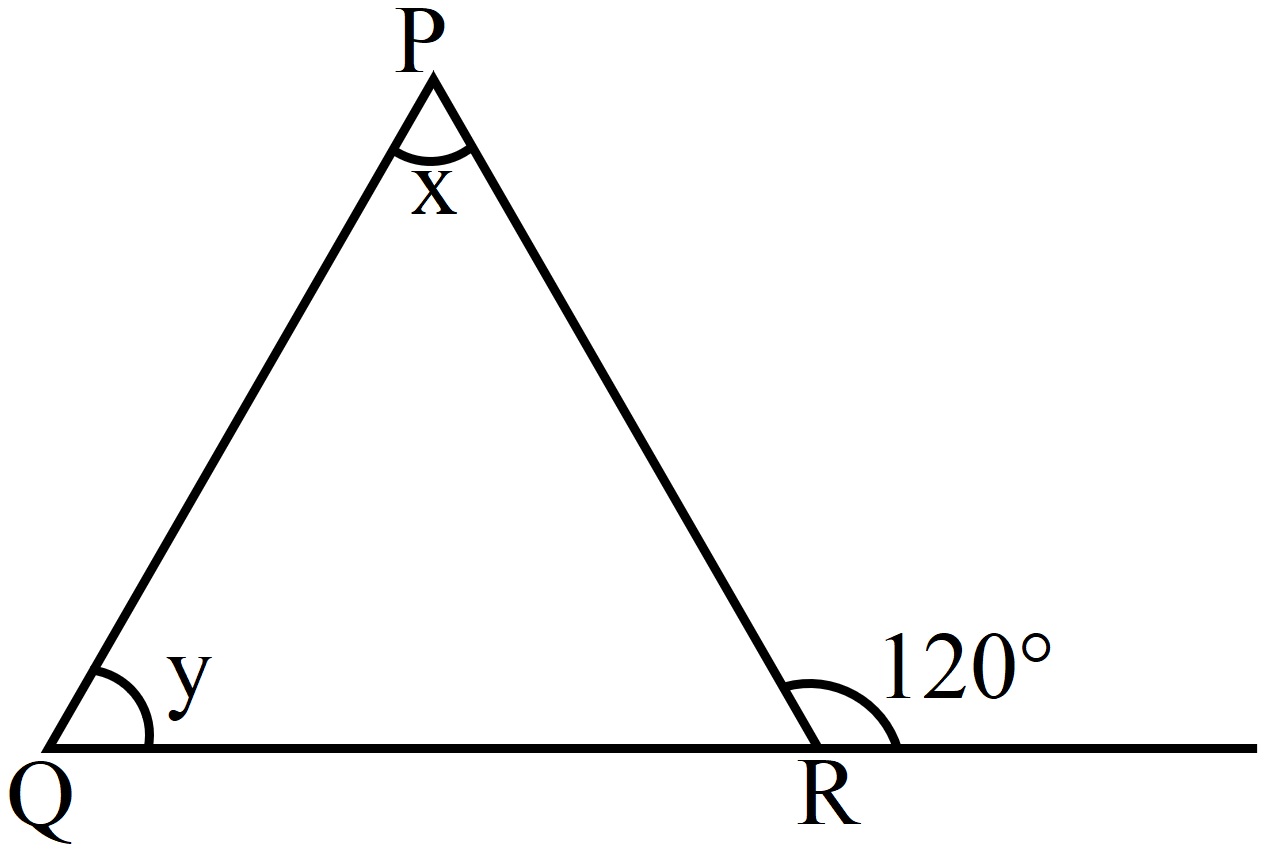
In $\triangle\text{PQR},$ if $\angle\text{P}=60^{\circ},$ and $\angle\text{Q}=40^{\circ},$ then the exterior angle formed by producing $QR$ is equal to:
- A
$60^\circ$
- B
$120^\circ$
- ✓
$100^\circ$
- D
$80^\circ$
AnswerCorrect option: C. $100^\circ$
As we know, the measure of exterior angle is equal to the sum of opposite two interior angles.
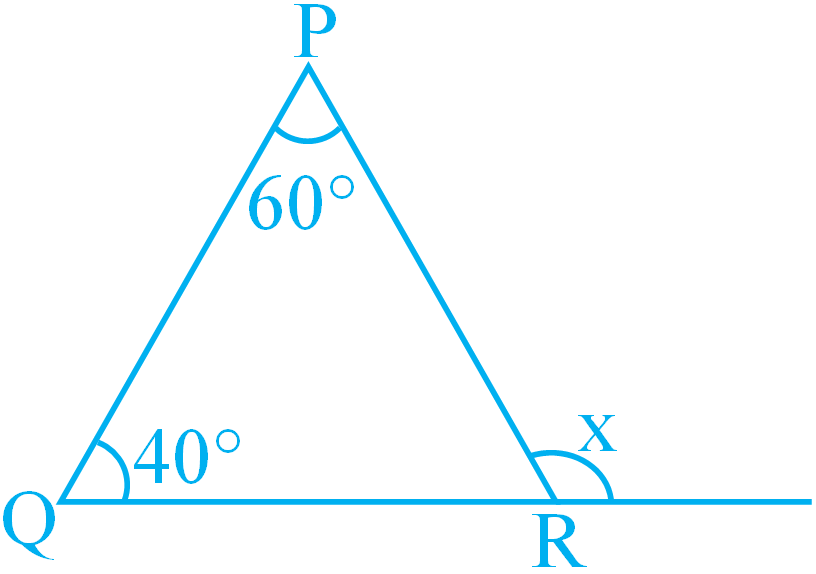
In $\triangle\text{PQR},$ $\angle\text{x}$ is the exterior angle.
So, $\angle\text{x}=\angle\text{P}+\angle\text{Q}$
$=60^{\circ}+40^{\circ}=100^{\circ}$
View full question & answer→MCQ 1031 Mark
Which of the following sets of measures cannot be the lengths of the sides of a right triangle?
- A
$5\ cm, 4\ cm$ and $03\ cm$
- ✓
$8\ cm, 6\ cm$ and $11\ cm$
- C
$1\ cm, 2.4\ cm$ and $2.6\ cm$
- D
$60\ cm, 25\ cm$ and $65\ cm$
AnswerCorrect option: B. $8\ cm, 6\ cm$ and $11\ cm$
$8\ cm, 6\ cm$ and $11\ cm$
View full question & answer→MCQ 1041 Mark
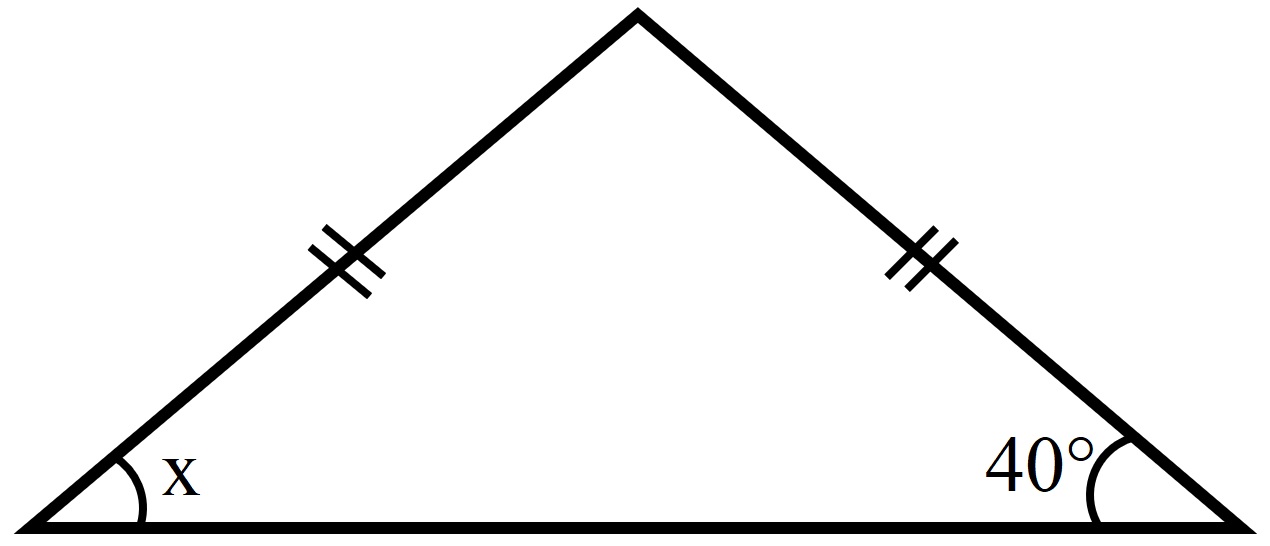
What is the measure of angle $x?$
- A
$30^\circ$
- ✓
$40^\circ$
- C
$25^\circ$
- D
$60^\circ$
AnswerCorrect option: B. $40^\circ$
$40^\circ$
View full question & answer→MCQ 1051 Mark
In any $\triangle\text{ABC},\text{AB}+\text{BC}+\text{CA}$ is________________
- A
$\text{Less than}\frac{1}{3}\text{AB}$
- B
$\text{Equal to}\frac{1}{2}\text{AB}$
- C
$\text{Less than}\text{ AB}$
- ✓
$\text{Greater than}\text{ 2AB}$
AnswerCorrect option: D. $\text{Greater than}\text{ 2AB}$
In any Triangle, the sum of any two sides is always greater than the
other side.in $\triangle\text{ABC},\text{AB}+\text{BC}>\text{CA}....\text{eqn(1)}$
$\text{BC + CA > AB}.....\text{eqn}(2)$
$\text{CA + AB > BC}...\text{eqn}(3)$ In equation $(2),$ adding $AB$ both side we
get, $\text{AB + BC + CA > 2AB}$
View full question & answer→MCQ 1061 Mark
If one angle of a triangle is equal to the sum of the other two angles, the triangle is:
AnswerLet $\ce{ABC}$ be the triangle
Given, $\angle\text{A}=\angle\text{B }+\angle\text{C}$
We know that
$\angle\text{A}=\angle\text{B }+\angle\text{C}=180^\circ$
$\Rightarrow\angle\text{A}+\angle\text{A}=180^\circ$
$\Rightarrow\angle\text{A}=90^\circ$
Thus, $\triangle\text{ABC}$ is a right angle triangle
View full question & answer→MCQ 1071 Mark
How many vertices does a triangle have?
MCQ 1081 Mark
In the Pythagoras property, the triangle must be $.......$
- A
Obtuse$-$angled
- B
Acute$-$angled
- ✓
Right$-$angled
- D
AnswerCorrect option: C. Right$-$angled
Right$-$angled
View full question & answer→MCQ 1091 Mark
$\text{In} \ \triangle\text{PQR},$
- A
$PQ - QR > PR$
- B
$PQ + QR < PR$
- ✓
$PQ - QR < PR$
- D
$PQ + PR< QR$
AnswerCorrect option: C. $PQ - QR < PR$
As we know, sum of the lengths of any two sides of a triangle is always greater than the length of the third side.
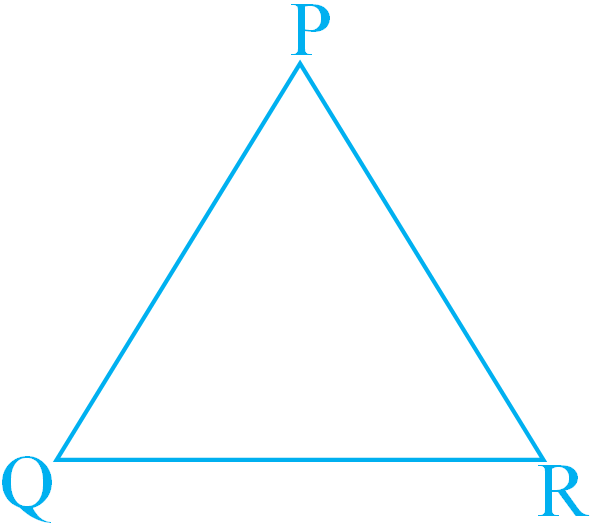
$\text{In} \ \triangle\text{PQR,}$ $PR + QR > PQ$
$\Rightarrow PR > PQ - QR$
$\Rightarrow PQ - QR < PR$
View full question & answer→MCQ 1101 Mark
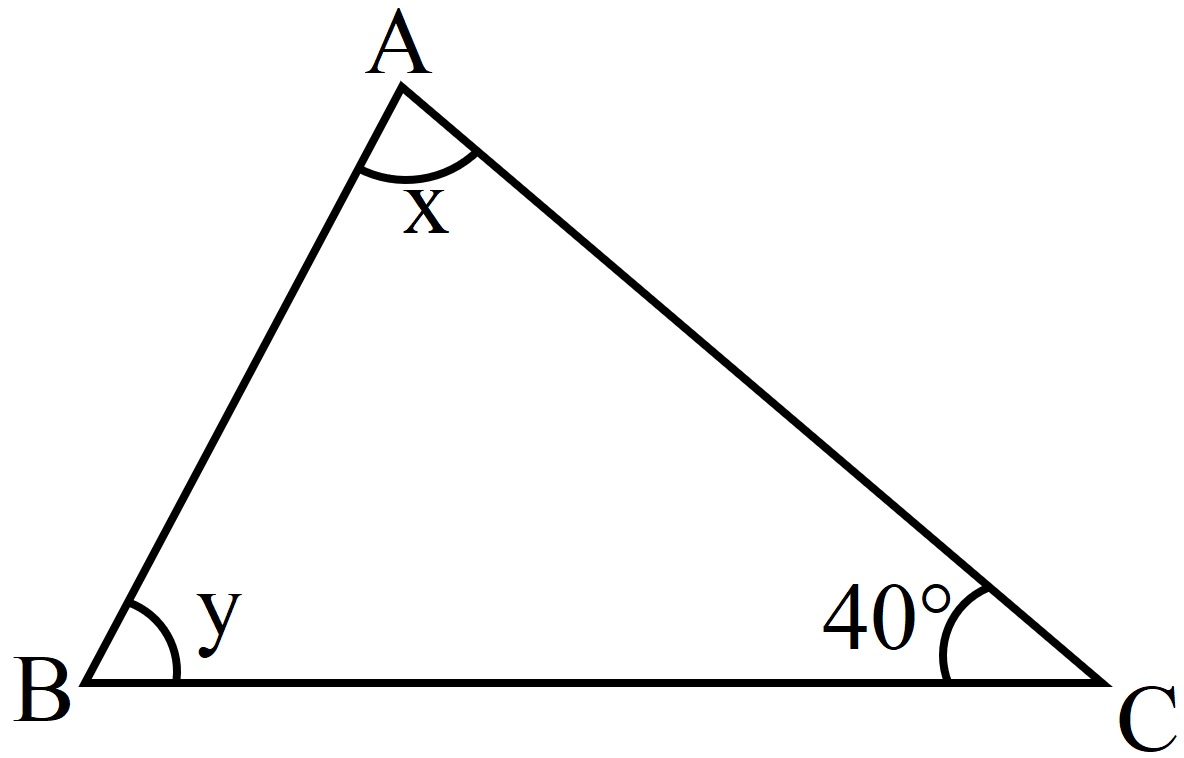
In the following figure, one angle of triangle $ABC$ is $40^\circ .$ If the difference of the other two angles is $30^\circ $, find the larger of the other two angles.
- ✓
$85^\circ$
- B
$80^\circ$
- C
$75^\circ$
- D
$70^\circ$
AnswerCorrect option: A. $85^\circ$
$x + y = 180^\circ - 40^\circ = 140^\circ x - y = 30^\circ .$
$x = 85^\circ .$
View full question & answer→MCQ 1111 Mark
Vertex opposite to the side $\text{RT}$ of $\triangle\text{RST}$ is.
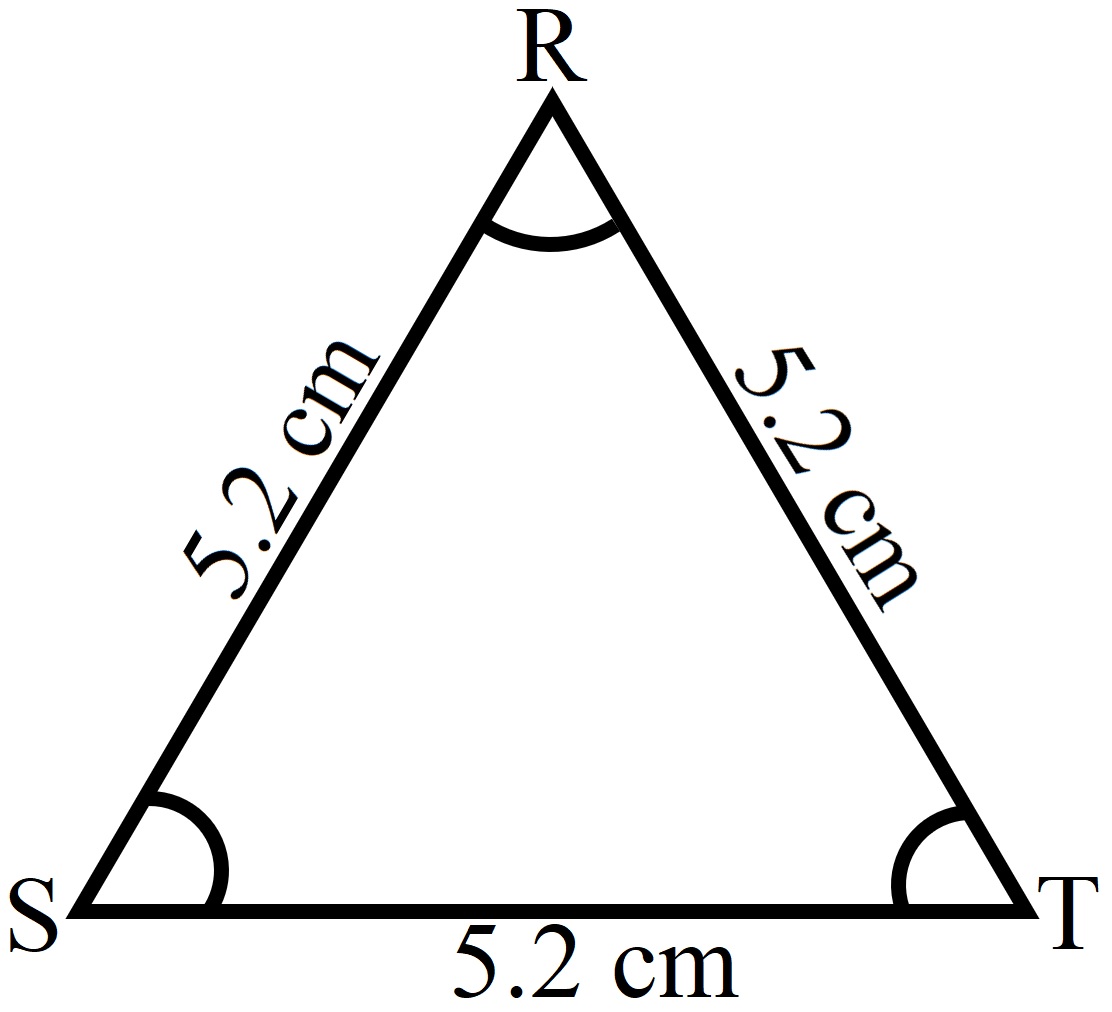
AnswerVertex opposite to any side of the triangle is just the facing vertex and not the vertex that is lying on the given line.
View full question & answer→MCQ 1121 Mark
Which of the following cannot be the sides of a right triangle?
- ✓
$2\ cm, 2\ cm, 4\ cm$
- B
$5\ cm, 12\ cm, 13\ cm$
- C
$6\ cm, 8\ cm, 10\ cm$
- D
$3\ cm, 4\ cm, 5\ cm$
AnswerCorrect option: A. $2\ cm, 2\ cm, 4\ cm$
$2^2 + 2^2= 8$
$4^2 = 16$
$\therefore2^2+2^2\neq4^2$
View full question & answer→MCQ 1131 Mark
In a $\triangle\text{ABC}$ which of the given condition holds?
- A
$AB - BC > CA$
- B
$AB + BC < CA$
- ✓
$AB - BC < CA$
- D
$AB + CA < BC$
AnswerCorrect option: C. $AB - BC < CA$
Theorem: In any triangle, sum of any two sides is greater than the third side. Also, the difference of any two sides must be smaller than the third side.
Therefore, in an $\triangle\text{ABC} AB - BC < CA$ and $AB + BC > CA.$
View full question & answer→MCQ 1141 Mark
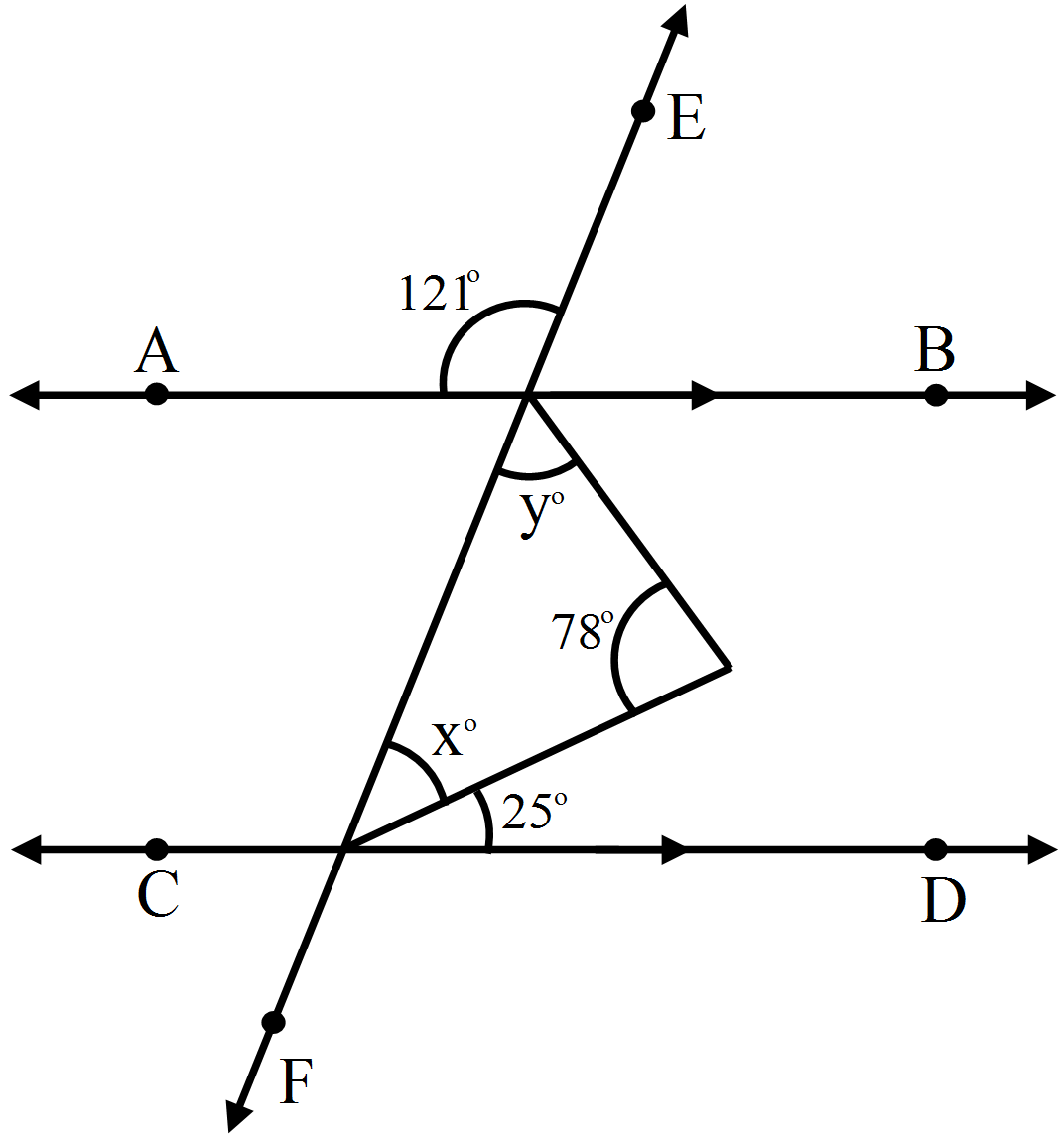
In Fig. if $AB \| CD$, then the values of $x$ and $y$ are:
- A
$x = 24, y = 48$
- ✓
$x = 34, y = 68$
- C
$x = 24, y = 68$
- D
$x = 34, y = 48$
AnswerCorrect option: B. $x = 34, y = 68$
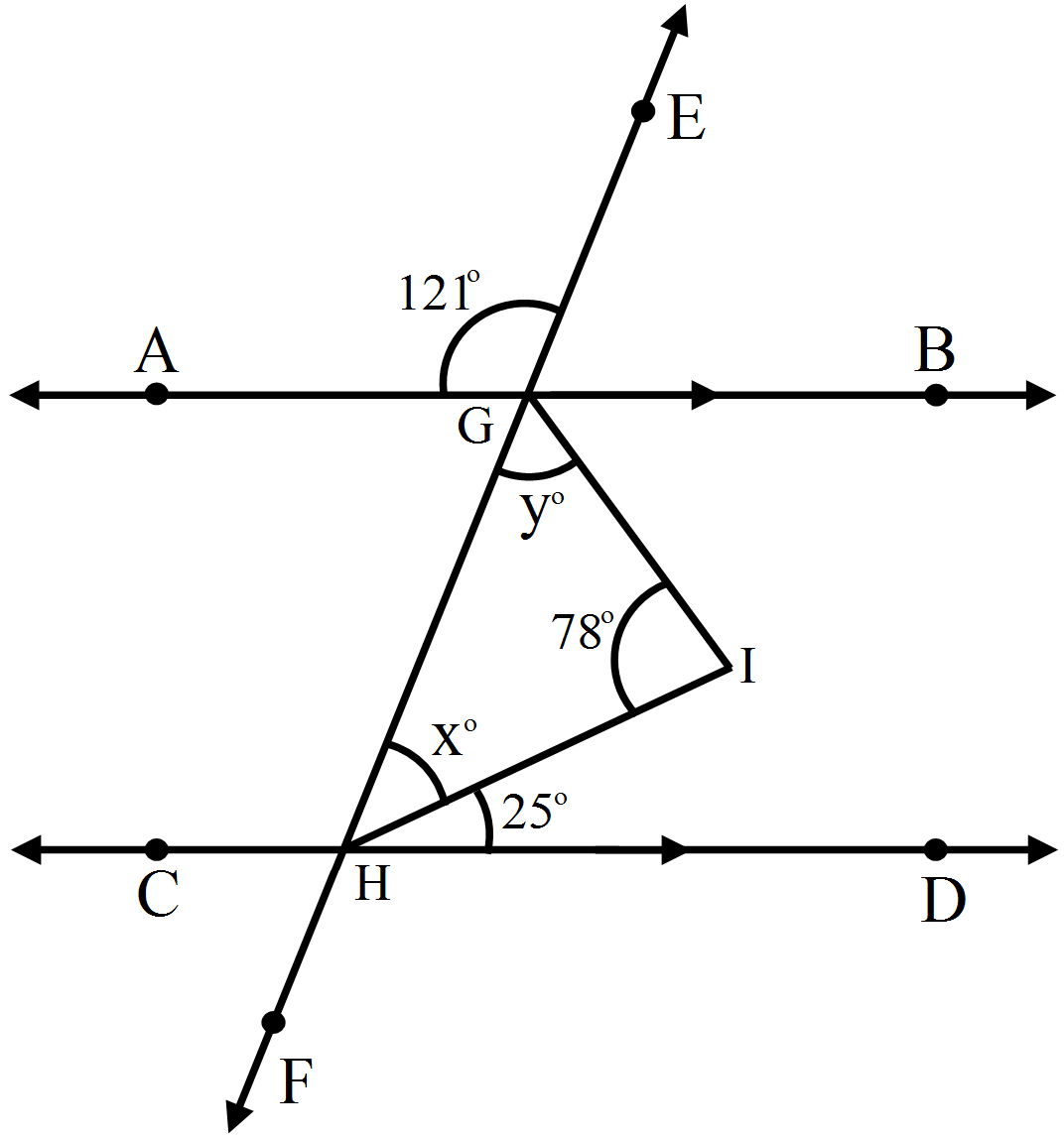
$\angle \text{AGE}+\angle \text{BGE}=180^\circ$ [Linear pair angles]
$\Rightarrow 121^\circ+\angle \text{BGE}=180^\circ$
$\Rightarrow \angle \text{BGE}=59^\circ$
Since, $AB \| CD$
$\therefore \angle \text{BGE}= \angle \text{GHD}=59^\circ$ [Corresponding angles]
$\Rightarrow \text{x}^\circ+25^\circ=59^\circ$
$\Rightarrow \text{x}=34$
In $\triangle \text{GHI},$
$\angle \text{GHI}+\angle \text{GIH}+\angle \text{HGI}=180^\circ$ [Angle sum property of triangle]
$\Rightarrow 34^\circ+78^\circ+\text{y}^\circ=180^\circ$
$\Rightarrow \text{y}=68$
Hence, the correct answer is option $(b).$ View full question & answer→MCQ 1151 Mark
Which of the following can be the length of the third side of a triangle whose two sides measure $18\ cm$ and $14\ cm?$
- A
$4\ cm$
- B
$3\ cm$
- ✓
$5\ cm$
- D
$32\ cm$
AnswerCorrect option: C. $5\ cm$
As we know, sum of any two sides of a triangle is always greater than the third side.
Hence, option (c) satisfies the given condition.
Verification$18 + 14 > 5$
$18 + 5 > 14$
$5 + 14 > 18.$
View full question & answer→MCQ 1161 Mark
A $15m$ long ladder is placed against a wall in such away that the foot of the ladder is $9m$ away from the wall. Up to what height does the ladder reach the wall?
Answer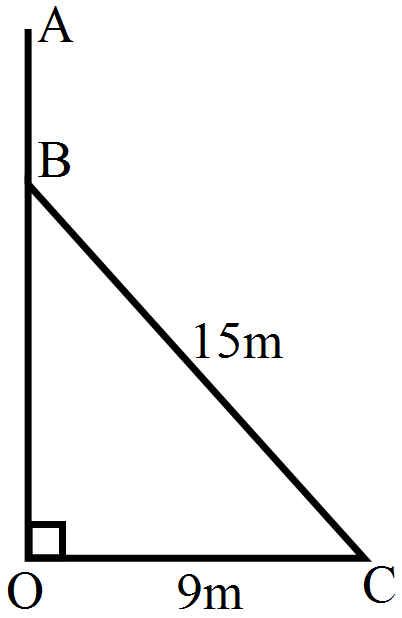
In right traingle $BOC,$
$BC^2 = OC^2 + OB^2$
$\Rightarrow (15)^2 = (9)^2 +OB^2$
$\Rightarrow 225 = 81 + OB^2$
$\Rightarrow OB^2 = 144$
$\Rightarrow OB^2 =(12)^2$
$\Rightarrow OB = 12m$
Hence, the correct answer is option $(d).$
View full question & answer→MCQ 1171 Mark
A triangle with the sides measuring $5\ cm 6\ cm$ and $4\ cm$ is called:
AnswerA triangle is known as scalene if all the three sides of triangle are different..since, all the sides given are different so it is a scalene triangle..
View full question & answer→MCQ 1181 Mark
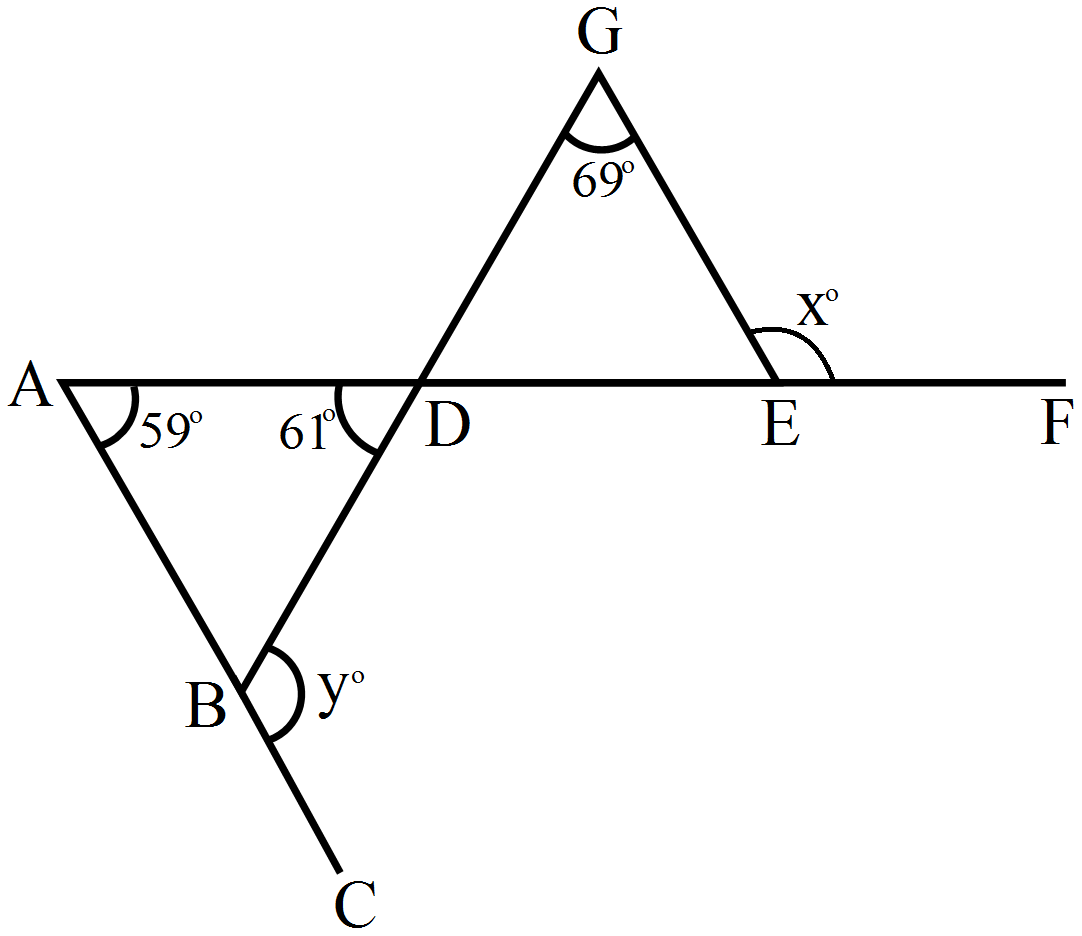
In Fig. the values of $x$ and $y$ are:
- ✓
$x = 130, y = 120$
- B
$x = 120, y = 130$
- C
$x = 120, y = 120$
- D
$x = 130, y = 130$
AnswerCorrect option: A. $x = 130, y = 120$
In $\triangle \text{ABD}$
$\angle \text{ADB}+\angle \text{BAD}+\angle \text{ABD}=180^\circ$ [Angle sum property of triangle]
$\Rightarrow 61^\circ+59^\circ+\angle \text{ABD}=180^\circ$
$\Rightarrow \angle \text{ABD}=60^\circ$
$\angle \text{ABD}+\angle \text{DBC}=180^\circ$ [Linear pair angles]
$\Rightarrow 60^\circ+\text{y}^\circ=180^\circ$
$\Rightarrow \text{y}=120$
Now, $\angle \text{ADB}=\angle \text{GDE}=61^\circ$ [Vertically opposite angles]
Now, In $\triangle \text{GDE},$
$\angle \text{GDE}+\angle \text{DGE}+\angle \text{GED}=180^\circ$ [Angle sum property of triangle]
$\Rightarrow 61^\circ+69^\circ+\angle \text{GED}=180^\circ$
$\Rightarrow \angle \text{GED}=50^\circ$
Now, $\angle \text{GED}+\angle \text{GEF}=180^\circ$ [Linear pair angles]
$\Rightarrow 50^\circ+\text{x}^\circ=180^\circ$
$\Rightarrow \text{x}=130$
Hence, the correct answer is option $(a).$
View full question & answer→MCQ 1191 Mark
In the following figure, find $\angle\text{x}$ and $\angle\text{y}$ if $\angle\text{x}-\angle\text{y}-10^\circ$
- ✓
$65^\circ , 55^\circ$
- B
$55^\circ , 45^\circ$
- C
$45^\circ , 35^\circ$
- D
$60^\circ , 60^\circ$
AnswerCorrect option: A. $65^\circ , 55^\circ$
$\angle\text{x}+\angle\text{y}=120^\circ,\angle\text{x}-\angle\text{y}=10^\circ$
$\angle\text{x}=65^\circ,\angle=55^\circ$
View full question & answer→MCQ 1201 Mark
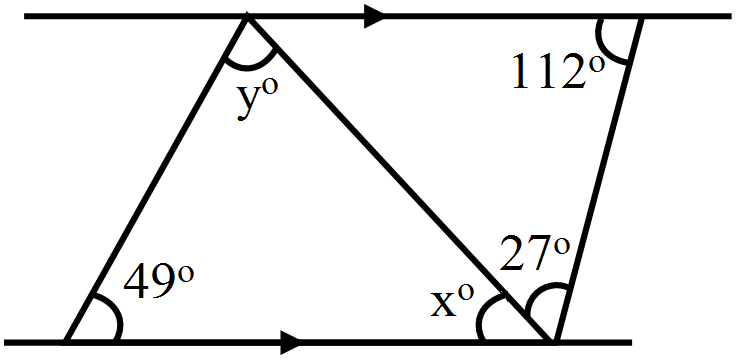
In Fig. if $AB \| CO$, $\angle \text{CAB}=49^\circ, \angle \text{CBD}=27^\circ$ and $\angle \text{BDC}=112^\circ,$ then the values of x and y are:
- ✓
$x = 41, y = 90$
- B
$x = 41, y = 63$
- C
$x = 63, y = 41$
- D
$x = 90, y = 41$
AnswerCorrect option: A. $x = 41, y = 90$
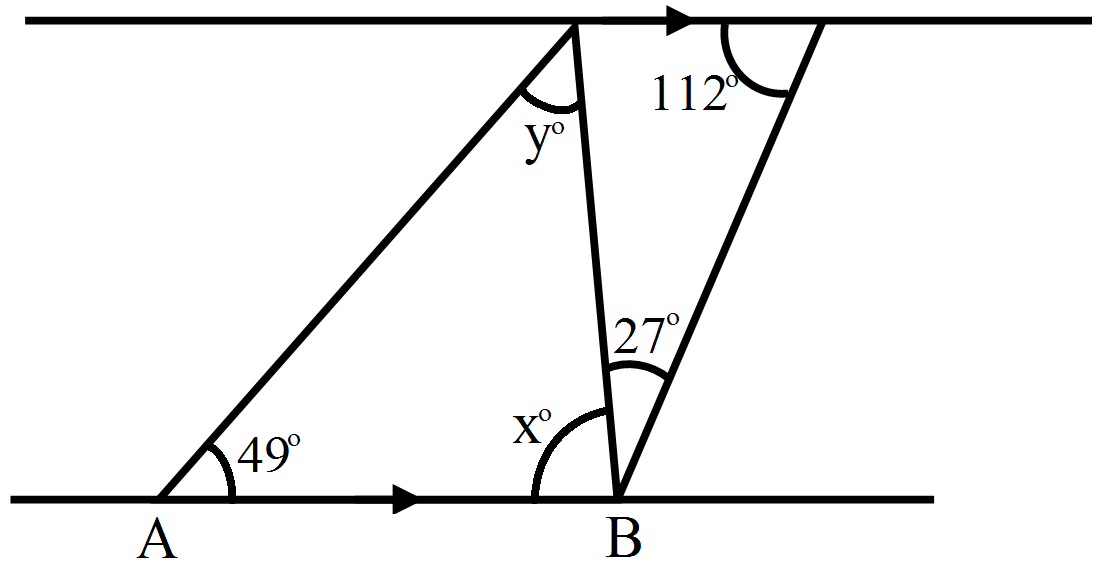
Since, $AB \| CD$
$\angle \text{ABD}+\angle \text{CDB}=180^\circ$ [Angles on the same side of a transversal line are supplementary]
$\Rightarrow \text{x}^\circ+27^\circ+112^\circ=180^\circ$
$\Rightarrow \text{x}^\circ=41^\circ$
$\Rightarrow \text{x}=41$
Now, In $\triangle \text{ABC},$
$\angle \text{A}+\angle \text{B}+\angle \text{C}=180^\circ$ [Angle sum property of triangle]
$\Rightarrow 49^\circ+41^\circ+\text{y}^\circ=180^\circ$
$\Rightarrow \text{y}^\circ=90^\circ$
$\Rightarrow \text{y}=90$
Hence, the correct answer is option $(a).$
View full question & answer→MCQ 1211 Mark
Triangle $DEF$ of Figure. is a right triangle with $\angle=90^{\circ}$. What type of angles are $\angle\text{D}$ and $\angle\text{F}$?
- A
- B
They form a pair of adjacent angles.
- ✓
They are complementary angles.
- D
They are supplementary angles.
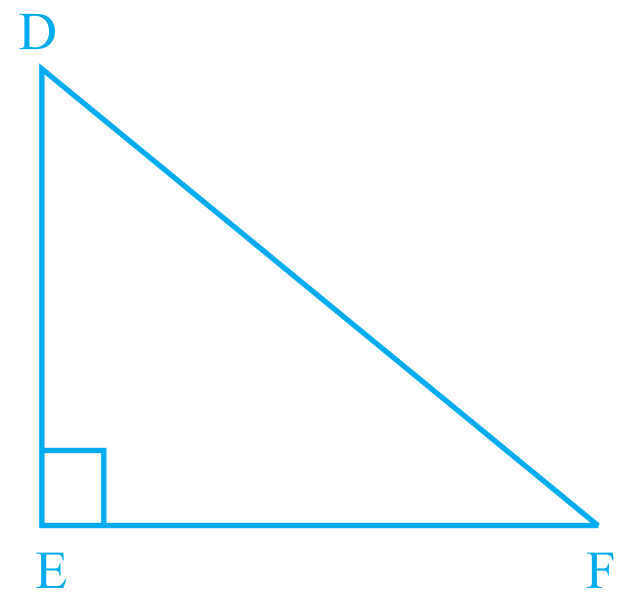
AnswerCorrect option: C. They are complementary angles.
Since, $∠\text{D}$ and $∠\text{F}$ are complementary angles.
In $\triangle\text{DEF},$
$∠\text{D}+\angle\text{E}+\angle\text{F}=180^{\circ}$ [angle sum property of a triangle]
$\Rightarrow \ ∠\text{D}+90^{\circ}+\angle\text{F}=180^{\circ}$$[\because\angle\text{E}=90^{\circ},\text{given}]$
$\Rightarrow \ ∠\text{D}+\angle\text{F}=180^{\circ}-90^{\circ}$
$\Rightarrow \ ∠\text{D}+\angle\text{F}=90^{\circ}$
Note: Two angles whose measures add to $180^\circ $ are known as supplementry angles and two angles whose measures add to $90^\circ $ are known as complementary angles.
View full question & answer→MCQ 1221 Mark
By which of the following criterion two triangles cannot be proved congruent?
- ✓
$AAA.$
- B
$SSS.$
- C
$SAS.$
- D
$ASA.$
AnswerCorrect option: A. $AAA.$
$AAA$ is not a congruency criterion, because if all the three angles of two triangles are equal; this does not imply that both the triangles fit exactly on each other.
View full question & answer→MCQ 1231 Mark
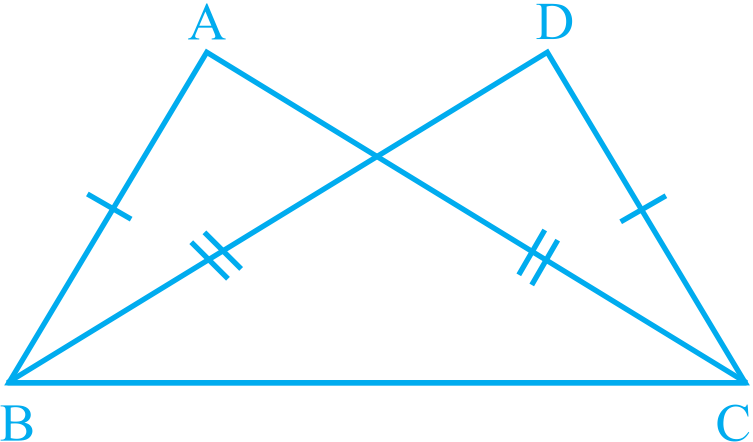
If $\triangle\text{ABC}$ and $ \triangle\text{DBC}$ are on the same base $BC, AB = DC$ and $AC = DB$ (figure). then which of the following gives a congruence relationship?
- A
$\triangle\text{ABC}\cong\triangle\text{DBC}$
- B
$\triangle\text{ABC}\cong\triangle\text{CBD}$
- ✓
$\triangle\text{ABC}\cong\triangle\text{DCB}$
- D
$\triangle\text{ABC}\cong\triangle\text{BCD}$
AnswerCorrect option: C. $\triangle\text{ABC}\cong\triangle\text{DCB}$
Since, $AB = DC$ [given]
and $AC = DB [common base]$
$BC = BC$
By $SSS$ congruence criterion, $\triangle\text{ABC}\cong\triangle\text{DCB}$
View full question & answer→MCQ 1241 Mark
In Fig. the value of $x$ is:
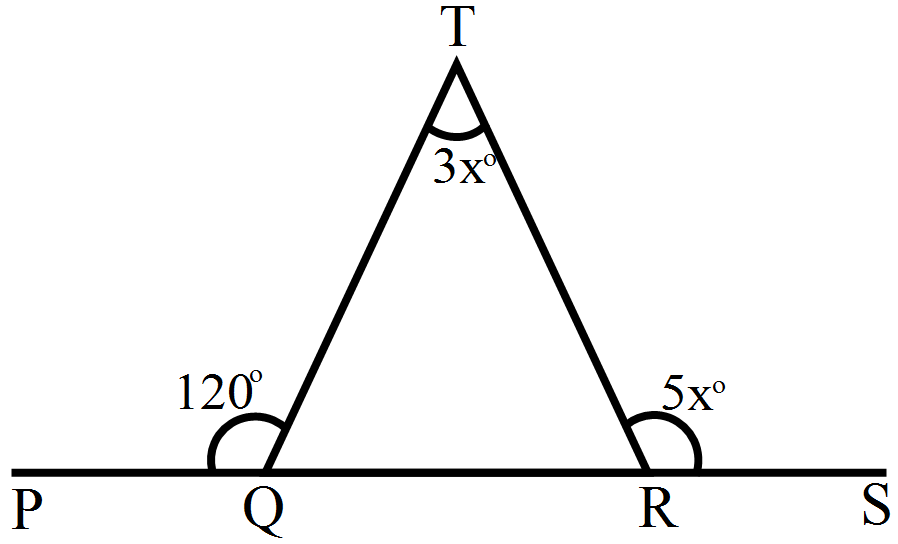
Answer$\angle \text{TRS}+\angle \text{TRQ}=180^\circ$ [Linear angles]
$\Rightarrow 5\text{x}^\circ+\angle \text{TRQ}=180^\circ$
$\Rightarrow \angle \text{TEQ}=180^\circ-5\text{x}^\circ$
Now, $\angle \text{QTR}+\angle \text{TRQ}=\angle \text{PQT}$ [Exterior angle property of triangle]
$\Rightarrow 3\text{x}^\circ+180^\circ-5\text{x}^\circ=120^\circ$
$\Rightarrow 2\text{x}^\circ=60^\circ$
$\Rightarrow \text{x}=30$
Hence, the correct answer is option $(b).$
View full question & answer→MCQ 1251 Mark
How many altitudes can a triangle have?
MCQ 1261 Mark
If two sides of a triangle are added then the result is:
AnswerAs the sum of the length of any two sides of a triangle is greater than the third side.
View full question & answer→MCQ 1271 Mark
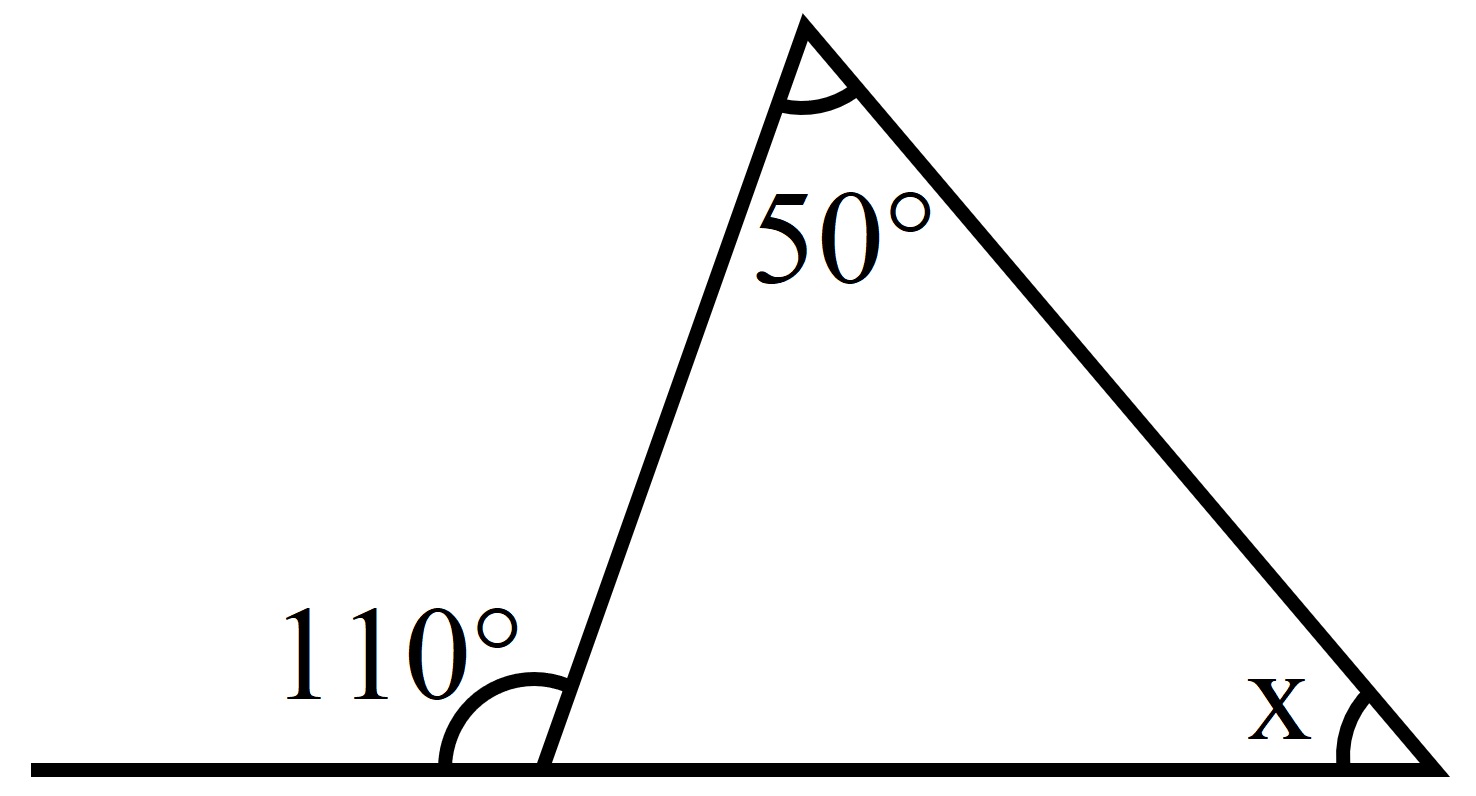
Find the value of $x.$
- A
$110^\circ$
- B
$50^\circ$
- ✓
$60^\circ$
- D
$70^\circ$
AnswerCorrect option: C. $60^\circ$
Value of exterior angle is equal to the sum of two opposite angles.
Thus, here, $110 = 50 + x$
so, $x = 60$ degree
View full question & answer→MCQ 1281 Mark
A ladder is placed in such a way that its foot is $15m$ away from the wall and its top reaches a window $20m$ above the ground. The length of the ladder is:
- A
$35m$
- ✓
$25m$
- C
$18m$
- D
$17.5m$
AnswerSuppose $BC$ is the ladder which is placed againts the wall $OA.$ The foot of the ladder $C$ is $15m$ away from the foot $O$ of the wall and its top reaches the window which is $20m$ above the ground.
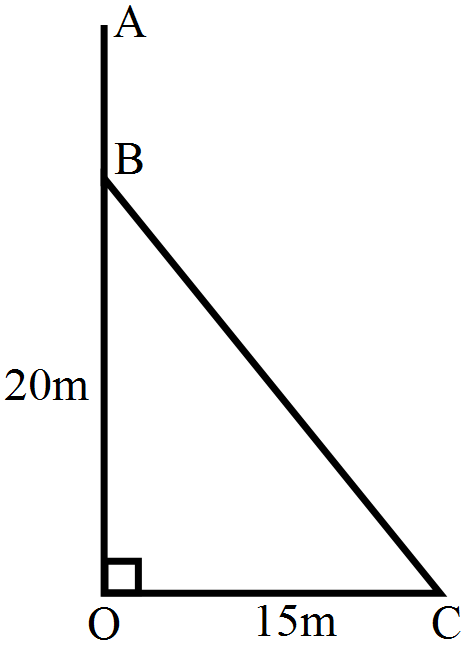
In right traingle $BOC,$
$B C^2=O C^2+O B^2 $
$\Rightarrow B C^2=(15)^2+(20)^2 $
$\Rightarrow B C^2=225+400 $
$\Rightarrow B C^2=625 $
$\Rightarrow B C^2=(25)^2 $
$\Rightarrow B C=25 m$
Hence, the correct answer is option $(b).$
View full question & answer→MCQ 1291 Mark
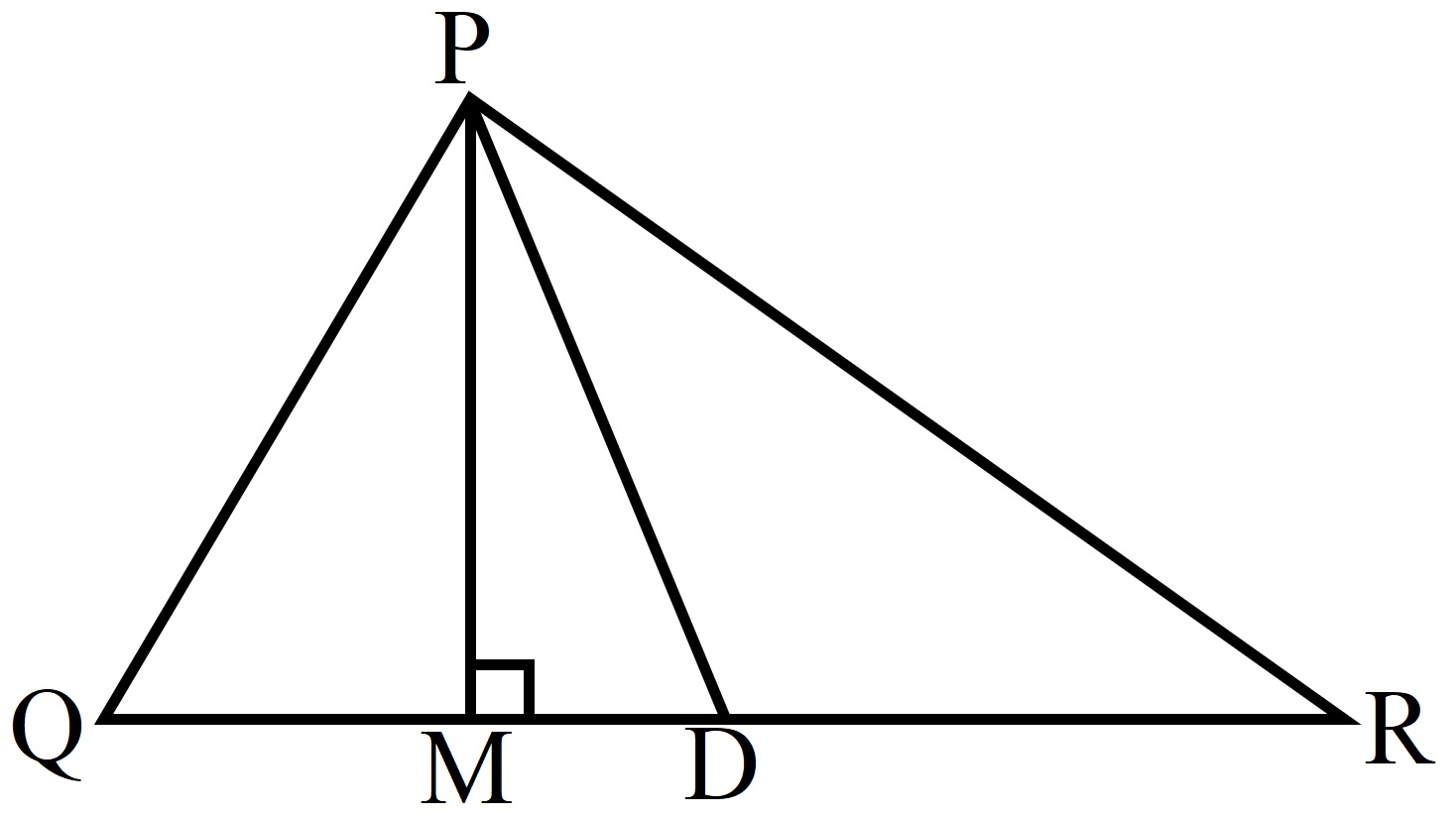
In $\triangle\text{PQR}, PM$ is.
View full question & answer→MCQ 1301 Mark
In which of the following cases can a right triangle $ABC$ be constructed?
- A
$AB = 5\ cm, BC = 7\ cm, AC = 10\ cm$
- B
$AB = 7\ cm, BC = 8\ cm, AC = 12\ cm$
- ✓
$AB = 8\ cm, BC = 17\ cm, AC = 15\ cm$
- D
AnswerCorrect option: C. $AB = 8\ cm, BC = 17\ cm, AC = 15\ cm$
In $(c)$
$BC^2 = AC^2 + AB^2$
$\Rightarrow (17)^2 = (15)^2 + (8)^2$
$\Rightarrow 289 =225 + 64$
$\Rightarrow 289 = 289$
Since, the sum of the square of two smallest side is equal to the square of largest side.
Hence, $ABC$ is a right angle triangle at $A.$
Hence, the correct answer is option $(c).$
View full question & answer→MCQ 1311 Mark
In which of the following cases, a right triangle cannot be constructed?
- ✓
$12\ cm, 5\ cm, 13\ cm$
- B
$8\ cm, 6\ cm, 10\ cm$
- C
$5\ cm, 9\ cm, 11\ cm$
- D
AnswerCorrect option: A. $12\ cm, 5\ cm, 13\ cm$
In $(a)$
$12^2 + 5^2 = 13^2$
$\Rightarrow 144 + 25 = 169$
$\Rightarrow 169$
Since, the sum of the square of two smallest side is equal to the square of largest side.
Hence, a right triangle can be constructed.
In $(b)$
$8^2 + 6^2 = 10^2$
$\Rightarrow 44 + 36 = 100$
$\Rightarrow 100 = 100$
Since, the sum of the square of two smallest side is equal to the square of largest side.
Hence, a right triangle can be constructed.
In $(c)$
$5^2+9^2\neq11^2$
$\Rightarrow 25+81\neq121$
$\Rightarrow 106\neq121$
Since, the sum of the square of two smallest side is not equal to the square of largest side.
Hence, a right triangle can not be constructed.
Hence, the correct answer is option $(a).$
View full question & answer→MCQ 1321 Mark
If the exterior angle of a triangle is $130^\circ $ and its interior opposite angles are equal, then measure of each interior opposite angle is:
- A
$55^\circ$
- ✓
$65^\circ$
- C
$50^\circ$
- D
$60^\circ$
AnswerCorrect option: B. $65^\circ$
As we know, the measure of any exterior angle is equal to the sum of two opposite interior angles.
Let the interior angle be $x.$
Given that, interior opposite angles are equal.
$\therefore \ 130^{\circ}=\text{x}+\text{x}$
$\Rightarrow \ 130^{\circ}=2\text{x}$
$\Rightarrow \ \text{x}=\frac{130^{\circ}}{2}$
$\Rightarrow \ \text{x}=65^{\circ}$
Hence, the interior angle is $= 65^\circ .$
View full question & answer→MCQ 1331 Mark
In a $\triangle \text{ABC},$ if $\angle \text{A}+\angle \text{B}=150^\circ$ and $\angle \text{B}+\angle \text{C}=75^\circ,$ then $\angle \text{B} =$
- A
$35^\circ$
- ✓
$45^\circ$
- C
$55^\circ$
- D
$25^\circ$
AnswerCorrect option: B. $45^\circ$
$\angle \text{A}+\angle \text{B}+\angle \text{C}=180^\circ$ [Angle sum property of triangle]
$\Rightarrow 150^\circ+\angle \text{C}=180^\circ$
$\Rightarrow \angle \text{C}=30^\circ$
Now, $\angle \text{B}+\angle \text{C}=75^\circ$
$\Rightarrow \angle \text{B}+30^\circ=75^\circ$
$\Rightarrow \angle \text{B}=45^\circ$
Hence, the correct answer is option $(b).$
View full question & answer→MCQ 1341 Mark
If we join a vertex to a point on opposite side which divides that side in the ratio $1:1$, then what is the special name of that line segment?
AnswerConsider $\triangle ABC$ in which $AD$ divides $BC$ in the ratio $1:1.$
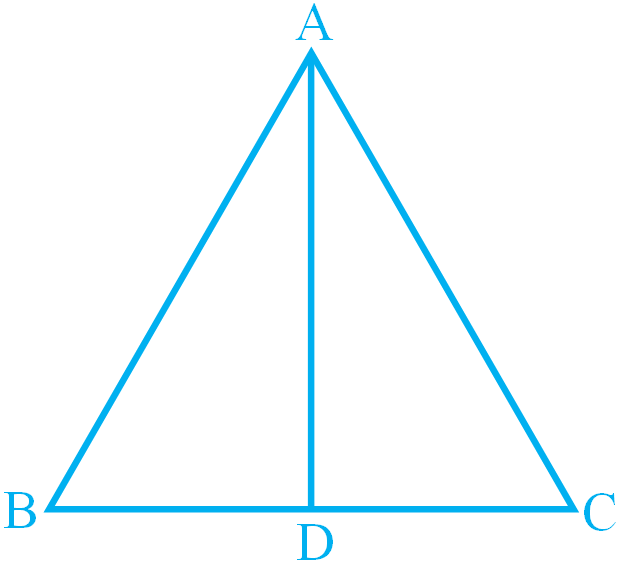
Now, $BD : DC = 1 : 1$
$\Rightarrow \ \frac{\text{BD}}{\text{DC}}=\frac{1}{1}$
$\therefore \ \text{BD}=\text{DC}$
Since, Ad divides BC into two equal parts. Hence, $AD$ is the median.
View full question & answer→MCQ 1351 Mark
In a right triangle, one of the acute angles is four times the other. Its measure is:
- A
$68^\circ$
- B
$84^\circ$
- C
$80^\circ$
- ✓
$72^\circ$
AnswerCorrect option: D. $72^\circ$
Let the smallest angle be x, then the other angle be $4x.$
Now,
$x + 4x + 90^\circ = 180^\circ $
$\Rightarrow 5x = 90^\circ $
$\Rightarrow x = 18^\circ $
Thus, the measure of the angles are $18^\circ $, and $4(18)^\circ = 72^\circ $
Hence, the correct answer is option $(d).$
View full question & answer→MCQ 1361 Mark
The measures of the angles of a triangle are in the ratio $4 : 5 : 9.$ The triangle is:
- A
- ✓
- C
An obtuse angled triangle
- D
Answerlet the angles be $4x, 5x$ and $9x + 4x + 5x + 9x = 180^\circ$
$18x = 180^\circ$
$\Rightarrow x = 10^\circ$ So the angles are $4 \times 10^\circ = 40^\circ$
$5 \times 10^\circ = 50^\circ $
$9 \times 10^\circ = 90$ One of the angle is $90^\circ,$
so the triangle is right angled triangle.
View full question & answer→MCQ 1371 Mark
If two angles in a triangle are $40^\circ $ and $60^\circ $, then the third angle is:
- A
$90^\circ$
- ✓
$80^\circ$
- C
$70^\circ$
- D
$60^\circ$
AnswerCorrect option: B. $80^\circ$
Let the third angle be $x$ Sum of angles $= 180^\circ 40^\circ + 60^\circ + x = 180^\circ 100^\circ + x = 180^\circ $
$\Rightarrow x = 80^\circ $
View full question & answer→MCQ 1381 Mark
In Fig. if $AB \| DE$, then the value of $x$ is:
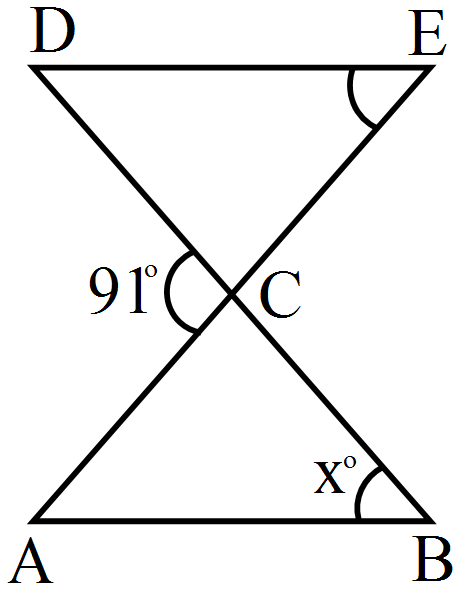
Answer$\angle \text{ACD}+\angle \text{ACB}=180^\circ$ [Linear angles]
$\Rightarrow 91^\circ+\angle \text{ACB}=180^\circ$
$\Rightarrow \angle \text{ACB}=89^\circ$
Since, $AB \| DE$
$\angle \text{DEC}=\angle \text{CAB}=46^\circ$ [Alternate angles]
Now,
$\angle \text{ACB}+\angle \text{CAB}+\angle \text{ABC}=180^\circ$ [Angle sum property of triangle]
$\Rightarrow 89^\circ + 46^\circ + \text{x}^\circ = 180^\circ$
$⇒ \text{x}^\circ = 45^\circ$
$\Rightarrow \text{x} = 45$
Hence, the correct answer is option $(d).$
View full question & answer→MCQ 1391 Mark
Which of the following statements is not correct?
AnswerCorrect option: D. Difference of any two sides of a triangle is greater than the third side.
The difference of the length of any two sides of a triangle is always smaller than the length of the third side.
View full question & answer→MCQ 1401 Mark
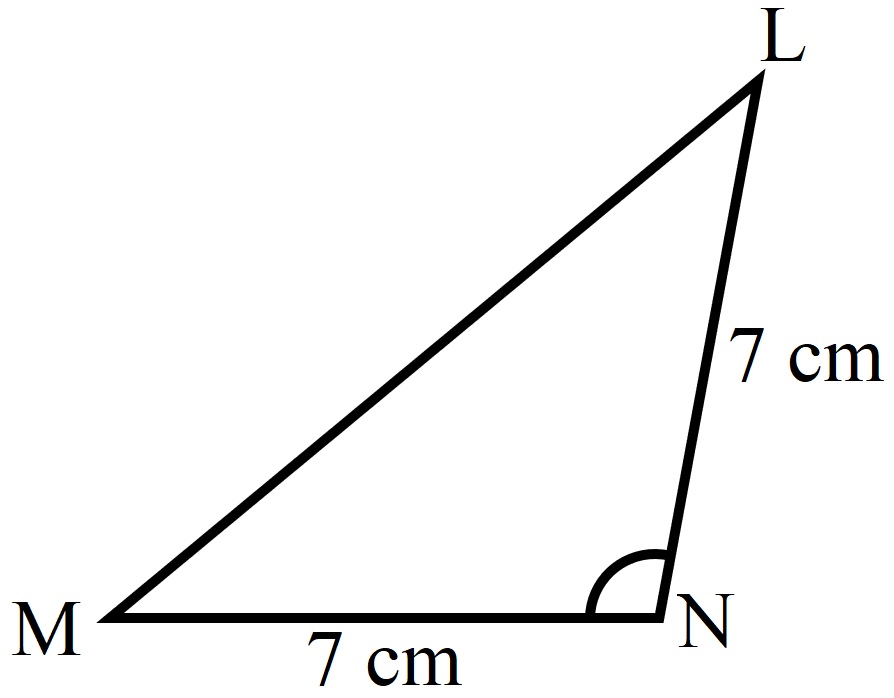
Angle opposite to the side $\text{LM}$ of $\triangle\text{LMN}$ is.
- A
$\angle\text{M}$
- ✓
$\angle\text{N}$
- C
$\angle\text{L}$
- D
AnswerCorrect option: B. $\angle\text{N}$
The angle opposite to any side of a triangle is always the angle between the other two sides
View full question & answer→MCQ 1411 Mark
A triangle has altitudes:
AnswerPerpendicular drawn from vertex is called median and as such there are three vertices in a triangle.
View full question & answer→MCQ 1421 Mark
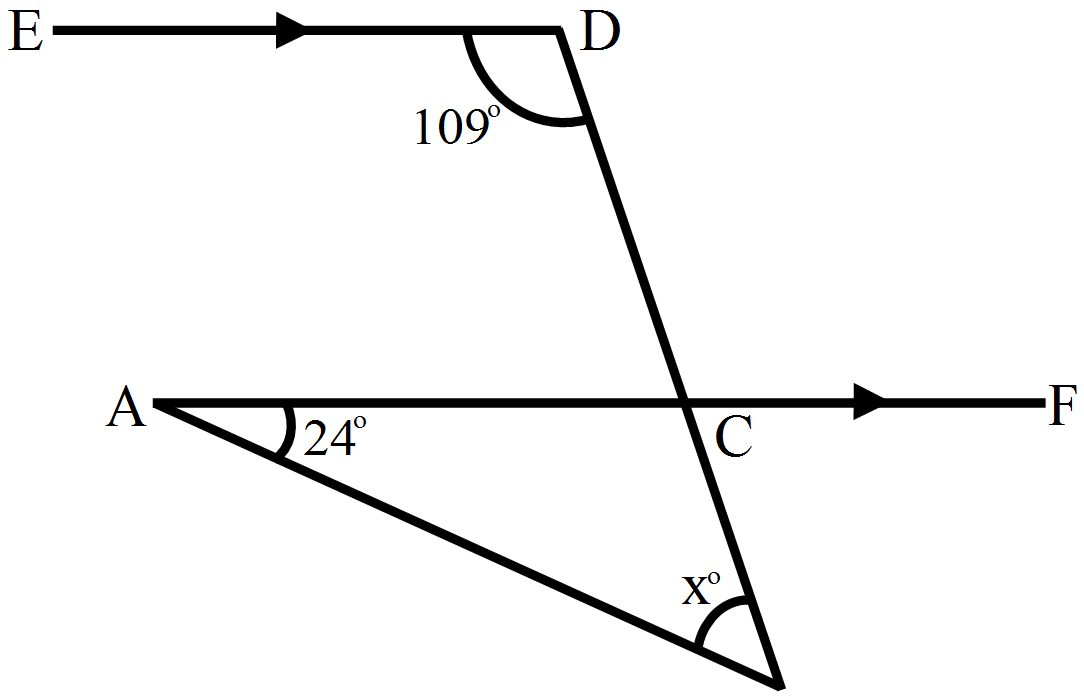
In Fig. if $AF \| DE$, then $x =$
Answer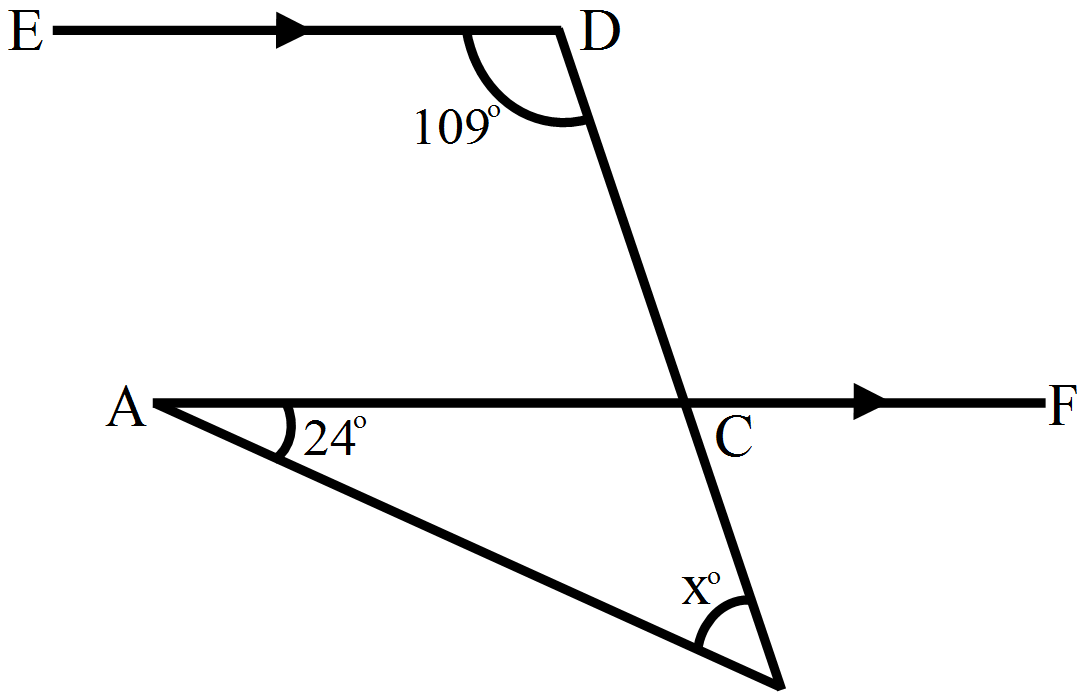
$\angle \text{EDC}=\angle \text{ACB}=109^\circ$ [Corresponding angles]
Now, In $\triangle \text{ABC}$
$\angle \text{ACB}+\angle \text{CAB}+\angle \text{CBA}=180^\circ$ [Angle sum property of triangle]
$\Rightarrow 109^\circ+24^\circ+\text{x}^\circ=180^\circ$
$\Rightarrow \text{x}^\circ=47^\circ$
$\Rightarrow \text{x}=47$
Hence, the correct answer is option $(c).$ View full question & answer→MCQ 1431 Mark
Which of the following triplets cannot be the angles of a triangle?
- A
$67^\circ , 51^\circ , 62^\circ$
- B
$70^\circ , 83^\circ , 27^\circ$
- C
$90^\circ , 70^\circ , 20^\circ$
- ✓
$40^\circ , 132^\circ , 18^\circ$
AnswerCorrect option: D. $40^\circ , 132^\circ , 18^\circ$
We know that, the sum of the interior angles of a triangle is $180^\circ .$
Now, we will verify the given triplets:
$a. 67^\circ + 51^\circ + 62^\circ = 180^\circ $
$b. 70^\circ + 83^\circ + 27^\circ = 180^\circ $
$c. 90^\circ + 70^\circ + 20^\circ = 180^\circ $
$d. 40^\circ + 132^\circ + 18^\circ = 190^\circ $
Clearly, triplets in option $(d)$ cannot be the angles of a triangle.
View full question & answer→MCQ 1441 Mark
Two angles of a triangle measure $90^\circ $ and $30^\circ $. The measure of the third angle is:
- A
$90^\circ$
- B
$30^\circ$
- ✓
$60^\circ$
- D
$120^\circ$
AnswerCorrect option: C. $60^\circ$
$60^\circ$
View full question & answer→MCQ 1451 Mark
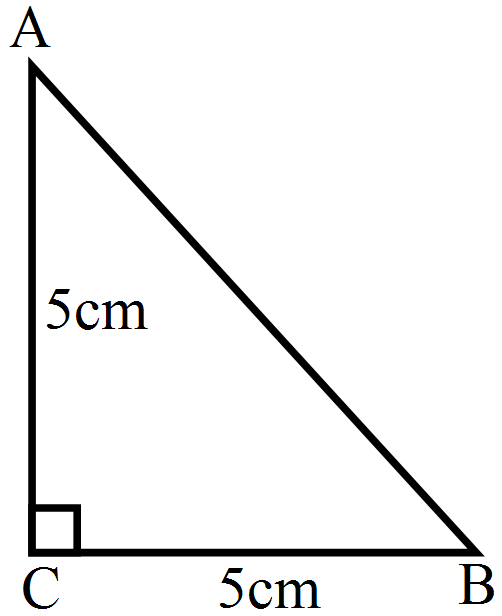
If $\triangle \text{ABC}$ is an isosceles right-triangle right angled at C such that $AC = 5cm.$ Then, $AB =$
- A
$2.5cm$
- ✓
$5\sqrt{2}\text{cm}$
- C
$10 cm$
- D
$5 cm$
AnswerCorrect option: B. $5\sqrt{2}\text{cm}$
Suppose $BC$ is the ladder which is placed againts the wall $OA$. The foot of the ladder $C$ is $15m$ away from the foot $O$ of the wall and its top reaches the window which is $20m$ above the ground.
In right traingle $ABC$
$AB^2 = BC^2 + AC^2$
$\Rightarrow AB^2 = (5)^2 + (5)^2$
$\Rightarrow AB^2 =25 + 25$
$\Rightarrow AB^2 = 50$
$\Rightarrow \text{AB}^2=(5\sqrt{2})^2$
$\Rightarrow \text{AB}=5\sqrt{2}\text{cm}$
Hence, the correct answer is option (b).
View full question & answer→MCQ 1461 Mark
In a right-angled triangle $ABC,$ if angle $B = 90^\circ , BC = 3cm$ and $AC = 5cm,$ then the length of side $AB$ is:
AnswerSince, $\triangle ABC$ is a right angled triangle.
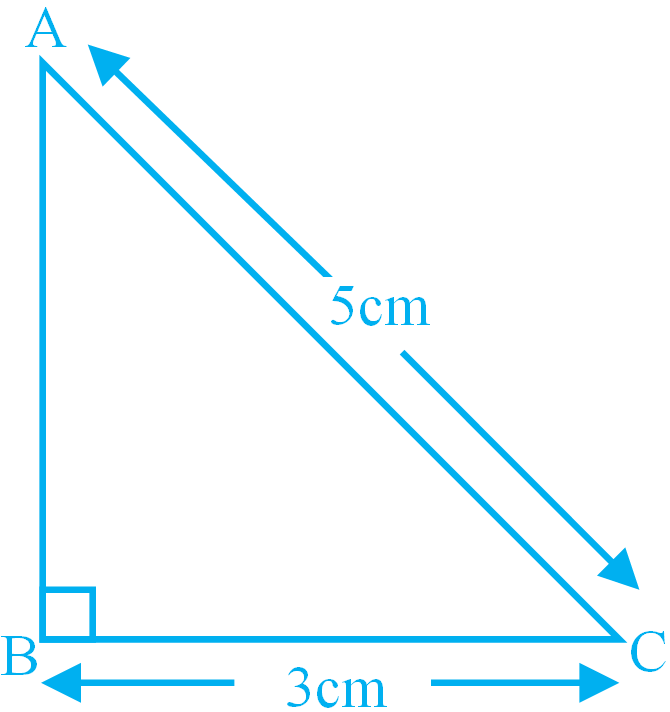
In right angled $\triangle \text{ABC},$
$AC^2 = AB^2 + BC^2$ [by pythagoras theoram]
$\Rightarrow 5^2 = AB^2+ 3^2$
$[\because AC = 5cm$ and $BC = 3cm$, given$]$
$\Rightarrow AB^2 = 25 - 9$
$\Rightarrow AB^2 = 16$
$\Rightarrow\text{AB}=\sqrt{16}$
$$\Rightarrow \text{AB} = 4\text{cm.}$ View full question & answer→MCQ 1471 Mark
The triangle formed by $BC = 5\ cm, AC = 3\ cm, AB = 5.8\ cm$ is:
- A
$\text{A right angled } \triangle$
- B
$\text{An isosceles } \triangle$
- C
$\text{An equilateral } \triangle$
- ✓
$\text{A scalene } \triangle$
AnswerCorrect option: D. $\text{A scalene } \triangle$
Given three lengths of sides are different. Also, the sides do not follow Pythagoras theorem.
So, it is a scalene triangle.
View full question & answer→MCQ 1481 Mark
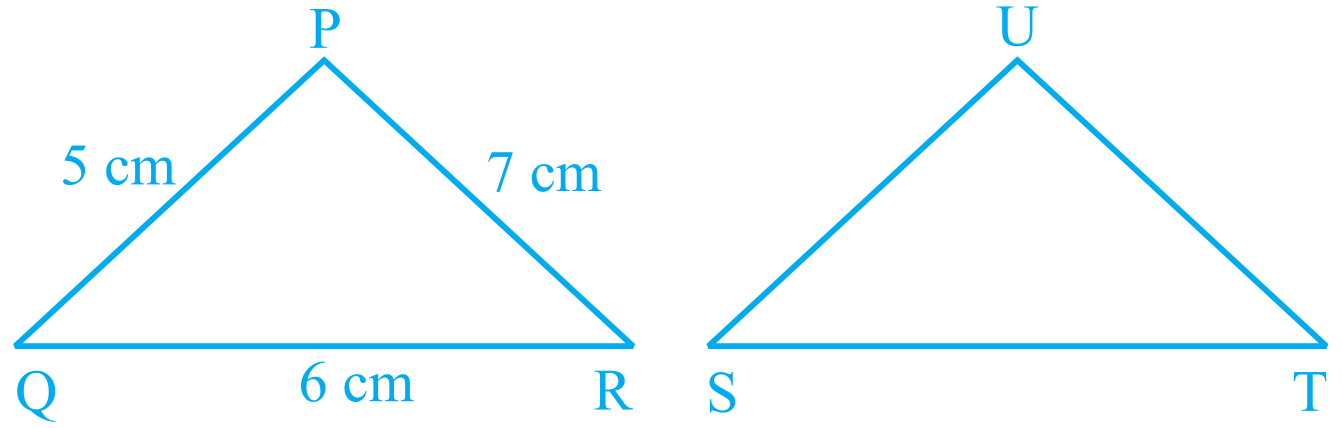
If $\triangle\text{PQR}$ is congruent to$ \triangle\text{STU}$ Figure. then what is the length of $TU?$
- A
$5\ cm.$
- ✓
$6\ cm.$
- C
$7\ cm.$
- D
AnswerCorrect option: B. $6\ cm.$
Given that, $\triangle\text{PQR}\cong\triangle\text{STU}$
$\Rightarrow \ \text{PQ} =\text{ST} $
$\Rightarrow \ \text{QR} =\text{TU} $
$\Rightarrow \ \text{PR} =\text{SU} $
Hence, $\text{TU}=\text{QR}=6\text{cm}.$
View full question & answer→MCQ 1491 Mark
A $26m$ long ladder reached a window $24m$ from the ground on placing it against a wall. Find the distance of the foot of the ladder from the wall.
View full question & answer→MCQ 1501 Mark
The sides of a triangle have lengths (in cm) $10, 6.5$ and a, where a is a whole number. The minimum value that a can take is:
AnswerAs we know, sum of any two sides in a triangle is always greater than the third side.
So, only $4$ is the minimum value that satisfies as a side in triangle.
$\begin{cases}10<6.5+4\\6.5<10+4\\4<10+6.5\end{cases}\Bigg\}$
View full question & answer→