Questions

4 Marks Questions

Take a timed test

10 questions · self-marked practice — reveal the answer and mark yourself.

Question 14 Marks
Answer
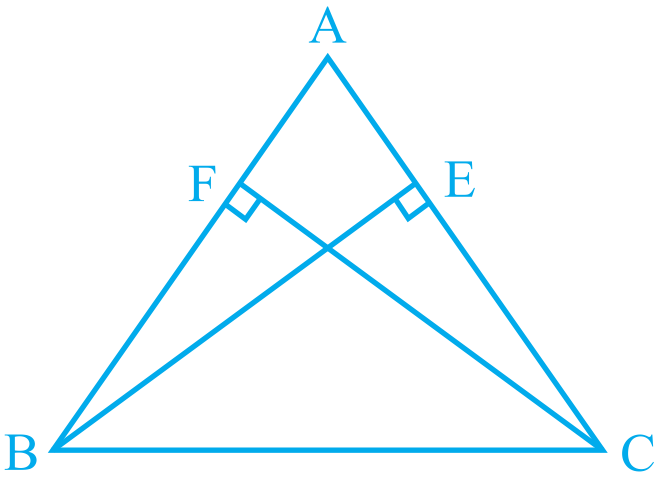
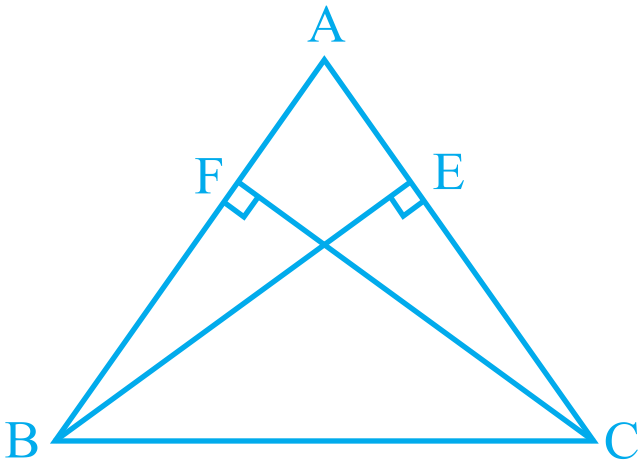
Given,
BE and CF are altitudes.
AC = AB To show,
BE = CF
In $\triangle\text{AEB}$ and $\triangle\text{AFC}$ 
$\angle \text{A}=\angle\text{A}$ (Common)
$\angle\text{AEB}=\angle \text{AFC}$ (Right angles)
AB = AC (Given)
Therefore, $\triangle\text{AEB}\cong \angle\text{AFC}$ by AAS congruence condition.
Thus, BE = CF (by CPCT).
View full question & answer
Question 34 Marks
Answer
Given,
BE = CF
In $\triangle\text{ABE}$ and $\triangle\text{ACF,}$
$\angle \text{A}=\angle\text{A}$ (Common)
$\angle \text{ABE}= \angle\text{ACF}$ (Right angles)
BE = CF (Given)
Therefore, $​​\triangle\text{ABE}\cong\triangle\text{ACF}$ by AAS congruence condition.
Thus, AB = AC by CPCT and therefore, ABC is an isosceles triangle.
View full question & answer
Question 44 Marks
Answer
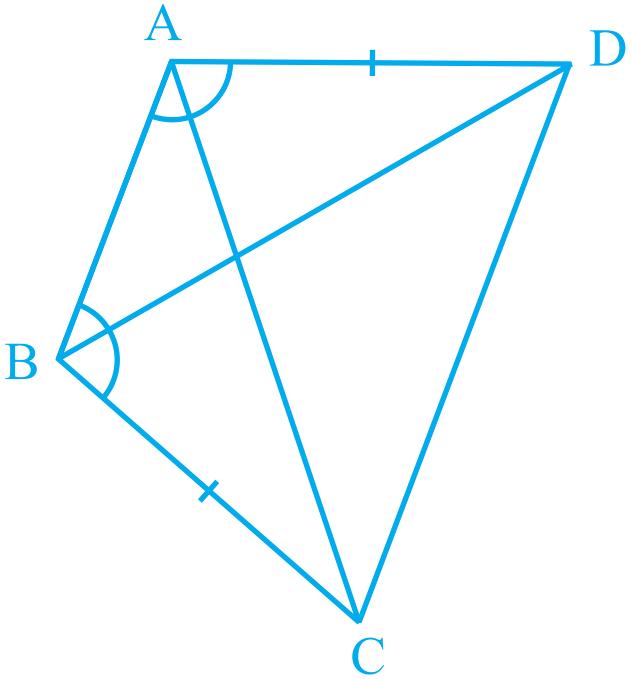
Given,

AD = BC and $\angle\text{ DAB }= \angle\text{CBA }$

  1. In $\triangle\text{ABD},\triangle\text{BAC},$

AB = BA (Common)

$\angle\text{ DAB }= \angle\text{CBA }$ (Given)

AD = BC (Given)

Therefore, $\triangle\text{ABCD}\cong\triangle\text{BAC}$ by SAS congruence condition.

  1. Since, $\triangle\text{ABCD}\cong\triangle\text{BAC}$

Therefore BD = AC by CPCT

  1. Since, $\triangle\text{ABCD}\cong\triangle\text{BAC}$

Therefore $\angle\text{ DAB }= \angle\text{CBA }$ by CPCT.

View full question & answer
Question 54 Marks
Answer
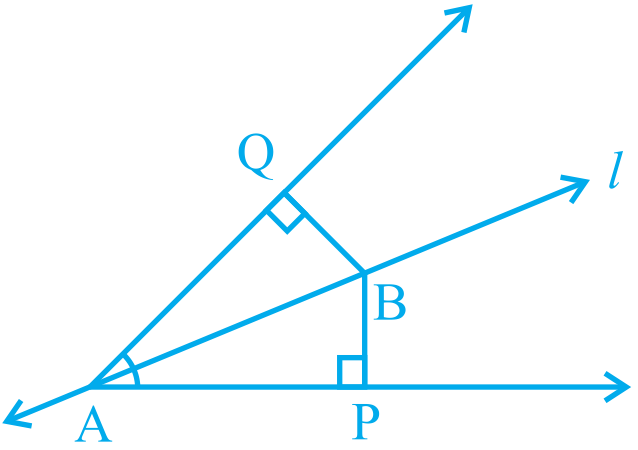
Given,

l is the bisector of an angle $\angle\text{A.}$

BP and BQ are perpendiculars.

  1. In $\triangle\text{APB}$ and $\triangle\text{AQB},$

$\angle\text{ P} = \angle\text{ Q}$ (Right angles)

$\angle\text{BAP }= \angle\text{ BAQ}$ (l is bisector)

AB = AB (Common)

Therefore, $\triangle\text{APB}\cong\triangle\text{AQB}$ by AAS congruence condition.

  1. BP = BQ by CPCT. Therefore, B is equidistant from the arms of $\angle\text{A.}$
View full question & answer
Question 64 Marks
Answer
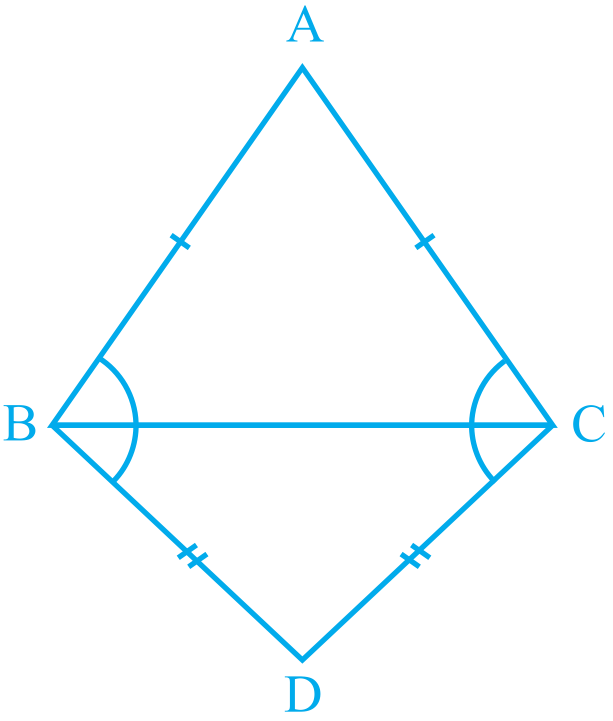
Given,
ABC and DBC are two isosceles triangles. To show,
$\angle\text{ABD}= \angle\text{ACD}$
In $\triangle\text{ABD}$ and $\triangle\text{ACD}$
AD = AD (Common)
AB = AC (ABC is an isosceles triangle.)
BD = CD (BCD is an isosceles triangle.)
Therefore, $\triangle\text{ABD}\cong\triangle\text{ACD}$ by SSS congruence condition.
Thus, $\angle\text{ABD}= \angle\text{ACD}$ (by CPCT).
View full question & answer
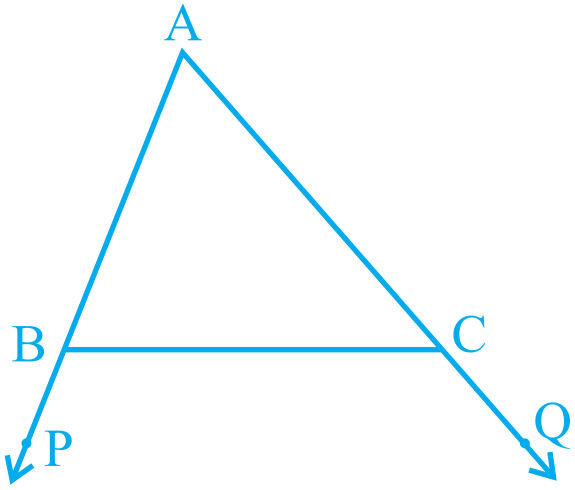
Question 74 Marks
Answer
Given,
$\angle\text{PBC}<\angle\text{QCB}$
Now,
$\angle\text{ABC}+\angle\text{PBC}=180^{0}$
$\Rightarrow \angle\text{ABC}=180^{0}-\angle\text{PBC}$ 
Also,
$\angle\text{ABC}+\angle\text{QBC}=180^{0}$
$\Rightarrow \angle\text{ABC}=180^{0}-\angle\text{QBC}$
Since,
$\angle\text{PBC}<\angle\text{QCB}$ therefore, $\angle\text{ABC}>\angle\text{ACB}$
Thus, AC > AB as sides opposite to the larger angle is larger.
View full question & answer
Question 84 Marks
Answer
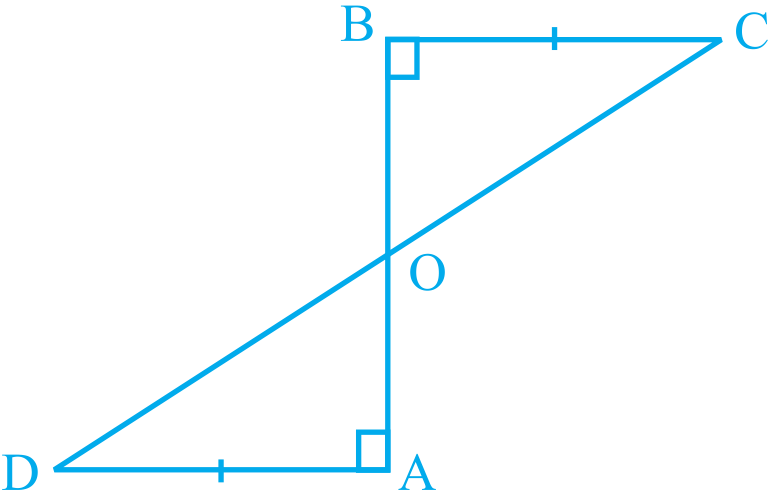
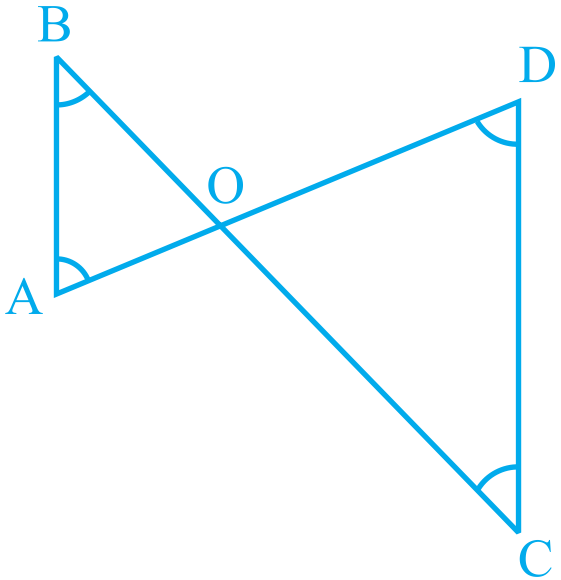
Given,
AD and BC are equal perprndiculars to AB.
To prove,
CD bisects AB
In $\triangle\text{AOD}$ and $\triangle\text{BOC}$
$\angle\text{A}=\angle\text{D}$(Perprndicular)
$\angle\text{ AOD} = \angle\text{ BOC}$ (Vertically opposite angle)
AD = BC (Given)
Therefore $\triangle \text{AOD}\cong\triangle \text{BOC}$ by AAS congruence condition.
Now,
AO = OB (CPCT). CD bisects AB.
View full question & answer
Question 94 Marks
Answer
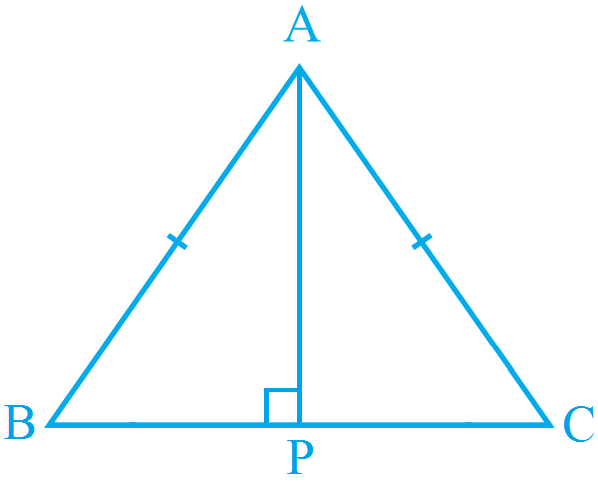
In $\triangle \text{APB}$ and $\triangle \text{APC}$
$\angle\text{APB}=\angle\text{APC}$ (Each) 
AB = AC (Given)
AP = AP (Common)
$\therefore \triangle\text{APB}\cong\triangle \text{APC}$ (by RHS)
AB = AC (Sides opposite to equal angles of a triangle are equal)
$\Rightarrow \angle\text{B}=\angle\text{C}$ (By using CPCT).
View full question & answer
Question 104 Marks
Answer
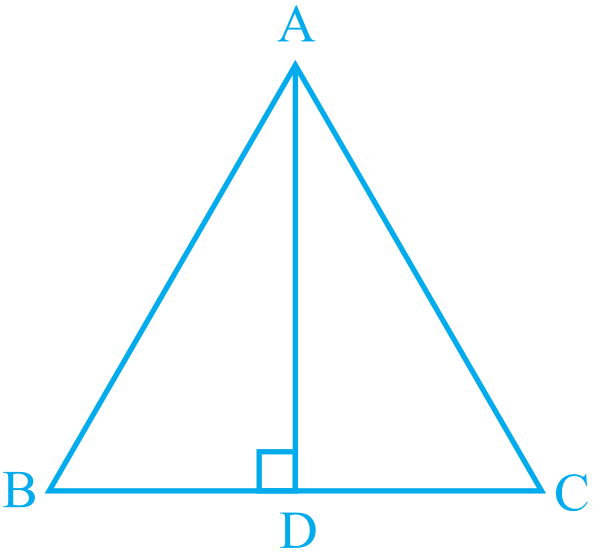
Given,
AD is the perprndicular bisector of BC To Show,
AB = AC 
In $\triangle\text{ADB}$ and $\triangle\text{ADC}$
AD = AD (Common)
$​​\angle\text{ADB}= \angle\text{ADC}$
BC = CD (AD is the perpendicular bisector)
$\therefore \angle\text{ADC}\cong \angle\text{ADC}$ by SAS congruence condition.
AB = AC (by CPCT).
View full question & answer
4 Marks Questions - Maths STD 9 Questions - Vidyadip