Questions

Que-Ans (Each of 3 Mark )

🎯

Test yourself on this topic

35 questions · timed · auto-graded

Question 13 Marks
What is the range of frequencies associated with $(a)$ infrasound $(b)$ audible sound, and $(c)$ ultrasound$?$
Answer
  1. Infrasounds include sounds of frequencies below $20Hz.$
  2. Audible sounds include sounds of frequencies between $20Hz$ and $20,000Hz.$
  3. Ultrasounds include sounds of frequencies above $20,000Hz.$
View full question & answer
Question 23 Marks
Distinguish between loudness and intensity of sound.
Answer
The loudness depends on energy per unit area of the wave and on the response of the ear but intensity depends only on the energy per unit area of the wave and is independent of the response of the ear.
View full question & answer
Question 33 Marks
Why do we hear more clearly in a room with curtains then a room withour curtains?
Answer
We hear more clearly in a room with curtains than in a room without curtains because curtains are bad reflectors of sound. They absorb most of the sound falling on them, and hence do not produce echoes. On the other hand, in rooms without curtains, there is a greater reflection of sound due to which some echoes are produced. These echoes cause a hindrance to hearing.
View full question & answer
Question 43 Marks
Give reason for the following: In most of the cases, we cannot see the vibrations of a sound producing object with our eyes.
Answer
In most of the cases, a sound producing object vibrates so fast that we cannot see its vibrations with our eyes. The time interval between two successive vibration is lower than the persistence of vision. Hence we see the object in static state and not in vibration mode.
View full question & answer
Question 53 Marks
Explain how the human ear works.
Answer
The outer ear is called pinna. It collects the sound from the surroundings. The collected sound passes through the auditory canal. At the end of the auditory canal there is a thin membrane called the eardrum or the tympanic membrane. When a compression of the medium reaches the eardrum the pressure on the outside of the membrane increases and forces the eardrum inward. Similarly, the eardrum moves outward when a rarefaction reaches it. In this way the eardrum vibrates. The vibrations are amplified several times by three bones (the hammer, anvil and stirrup) in the middle ear. The middle ear transmits the amplified pressure variations received from the sound wave to the inner ear. In the inner ear, the pressure variations are turned into electrical signals by the cochlea. These electrical signals are sent to the brain via the auditory nerve and the brain interprets them as sound.
View full question & answer
Question 63 Marks
Ocean waves of time period $0.01s$ have a speed of $15m/ s.$ Calculate the wavelength of these waves. Find the distance between the adjacent crest and the trough.
Answer
Speed $= 15\ m/ s$
Time period, $T = 0.01\sec$
Frequency $=\frac{1}{\text{T}}$
$=\frac{1}{0.01}$
$=100\text{Hz}$ Speed $=$ Frequency $\times $ Wavelength
$\therefore$ Wavelength $=$ Speed $÷$ frequency
$= 15 ÷ 100 = 0.15$
metres Wavelength $=$ distance between two consecutive crests OR
Wavelength $=$ distance between two consecutive troughs Distance between crest and adjoining trough $=$ Wavelength $÷ 2 = 0.15 ÷ 2 = 0.075$ metres
View full question & answer
Question 73 Marks
Give one difference between longitudinal and transverse wave.
Answer
 
Longitudinal
Transverse
$1.$
The movement of the medium is of the same direction of the wave.
The movement of the medium is perpendicular to the direction of wave.
$2.$
It acts in one dimension.
It acts in two dimension.
$3.$
The wave cannot be polarized or aligned.
The wave can be polarized or aligned.
$4.$
This wave can be produced in any medium such as gas, liquid or solid.
This wave can be produced in solid and liquid’s surface.
$5.$
Earthquake $P$ wave is an example.
Earthquake $S$ wave is an example.
$6.$
It is made of refractions and compressions.
It is made of troughs and crests.
View full question & answer
Question 83 Marks
Name four ways in which sound can be produced.
Answer
Sound can be produced by the following methods:
  1. By vibrating strings (as in a sitar).
  2. By vibrating air (as in a flute).
  3. By vibrating membranes (as in a drum).
  4. By vibrating plates (as in cymbals).
View full question & answer
Question 93 Marks
When we put our ear to a railway line, we can hear the sound of an approaching train even when the train is far off but its sound cannot be heard through the air. Why?
Answer
When we put our ear to a railway line, we can hear the sound of an approaching train even when the train is far off but its sound cannot be heard through the air. This is due to the fact that sound travels much more fast through the railway line made of steel than through air.
View full question & answer
Question 103 Marks
A girl is sitting in the middle of a park of dimension $12m × 12m.$ On the left side of it there is a building adjoining the park and on right side of the park, there is a road adjoining the park. A sound is produced on the road by a cracker. Is it possible for the girl to hear the echo of this sound$?$ Explain your answer.
Answer
If the time gap between the original sound and reflected sound received by the listener is around $0.1s,$ only then the echo can be heard. The minimum distance travelled by the reflected sound wave for the distinctly listening the echo $=$ velocity of sound $×$ time interval $\simeq344\times0.1$ $\simeq34.4\text{m}$ But in this case the distance travelled by the sound reflected from the building and then reaching to the girl will be $(6 + 6) = 12m,$ which is much smaller than the required distance. Therefore, no echo can be heard.
View full question & answer
Question 113 Marks
What is the difference between supersonic and ultrasonic$?$
Answer
The sounds having frequency more than $20,000$ hertz $(Hz)$ are called ultrasonic or ultrasound. The sounds having frequency less than $20\ Hz$ are called infrasonic or infrasound. Both of these sounds cannot be heard by human beings. The audible range for of hearing by human beings is $20\ Hz$ to $20000\ Hz.$ The speed of sound is same for all frequencies in a particular medium. So, speed of ultrasonic sound and infrasonic sound are same in a particular medium.
View full question & answer
Question 123 Marks
Define the terms ‘frequency’, ‘wavelength’ and ‘velocity’ of a sound wave. What is the relation between them?
Answer
Frequency: The number of vibrations per second is called frequency.
Wavelength: The minimum distance in which a sound wave repeats itself is called its wavelength.
Velocity: The distance travelled by a wave in one second is called velocity of wave.
Relation: Relation between velocity, frequency and wavelength of a wave: Velocity of wave $=$ frequency $×$ wavelength $\text{v}=\text{f}\times\lambda$
View full question & answer
Question 133 Marks
A device called oscillator is used to send waves along a stretched string. The string is $20cm$ long, and four complete waves fit along its length when the oscillator vibrates $30$ times per second. For the waves on the string:
  1. What is their wavelength$?$
  2. What is their frequency$?$
  3. What is their speed$?$
Answer
  1. Given that there are four complete waves. So,
$\text{Wavelength}=\frac{\text{Total length of string}}{\text{Number of waves}}$
Therefore,
$\text{Wavelength}=\frac{20}{4}\text{cm}$
$=5\text{cm}$
$=0.05\text{m}$
  1. We have to calculate frequency. We know,
Frequency $= ($Vibration per second$) × ($Number of complete waves formed$)$
Therefore frequency,
Frequency $= (30) × (4)Hz$
$= 120Hz$
  1. Now we have to calculate the velocity of the wave.
Given: Frequency $f = 120Hz$
Wavelength $\lambda=0.05\text{m}$
We know the relation between velocity, frequency, and wavelength
$\text{v}=\text{f}\times\lambda$
Where,
$ν$ is the velocity,
$f$ the frequency,
$\lambda$ the wavelength.
Therefore,
$ν = (120) × (0.05)m/s$
$= 6m/s$
Therefore, velocity of the wave is $6m/s.$
View full question & answer
Question 143 Marks
Explain how, flaws (or defects) in a metal block can be detected by using ultrasound.
Answer
Ultrasound waves are made to pass through one face of the metal block and ultrasound detectors are placed on the opposite face of the block to detect the transmitted ultrasound waves.
  1. If the ultrasound waves pass uninterrupted through all parts of the metal block, then the block is flawless.
  2. However, if the ultrasound waves are not able to pass through a part of the metal block and get reflected back, then there is a flaw in the metal block.
View full question & answer
Question 153 Marks
What is compression and rarefaction in longitudinal wave? Explain.
Answer
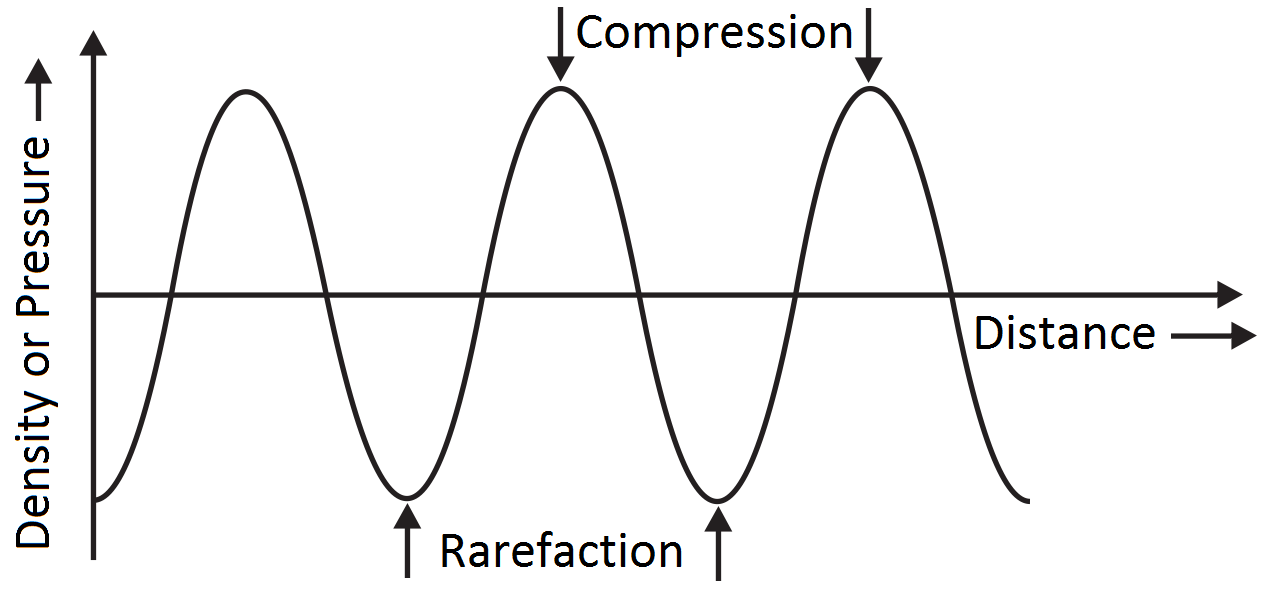
Longitudinal waves have compressions and rarefactions. Compression: A compression is a region in a longitudinal wave where the particles are closest together. Rarefaction: A rarefaction is a region in a longitudinal wave where the particles are furthest apart.
View full question & answer
Question 163 Marks
A submarine emits a sonar pulse, which returns from an underwater cliff in $1.02s$. If the speed of sound in salt water is $1531m/s$, how far away is the cliff$?$
Answer
Time taken by the sonar pulse to return, $t = 1.02s$
Speed of sound in salt water, $v = 1531ms^{-1}$
Distance of the cliff from the submarine $=$ Speed of sound $\times$ Time taken
Distance of the cliff from the submarine $= 1.02 \times 1531 = 1561.62m$
Distance travelled by the sonar pulse during its transmission and reception in water $= 2\ \times$ Actual distance $= 2d$ Actual Distance,
$\text{d}=\frac{\text{Distance of the cliff from the sub marine}}{2}$
$=\frac{1561}{2}$
$=780.31\text{m}$
View full question & answer
Question 173 Marks
An electric bell is suspended by thin wires in a glass vessel and set ringing. Describe and explain what happens if the air is gradually pumped out of the glass vessel.
Answer
If the air is gradually pumped out of the glass vessel, no sound of the electric bell can be heard because vacuum is created in the vessel and there are no air molecules to carry sound vibrations.
View full question & answer
Question 183 Marks
Explain how, bats use ultrasound to catch the prey.
Answer
Bats emit high frequency ultrasonic squeaks while flying and listen to the echoes produced by the reflection of their squeaks from their prey. From the time taken by the echo to be heard, bats can judge the distance of the prey in their path and catch it.
View full question & answer
Question 193 Marks
Why cannot a sound heard on the moon? How do astronauts talk to one another on the surface of moon?
Answer
Sound cannot be heard on the surface of moon because there is no air on the moon to carry the sound waves. Astronauts talk to one another on the surface of moon through wireless sets using radio waves. This is because radio waves can travel even through vacuum though sound waves cannot travel through vacuum.
View full question & answer
Question 203 Marks
Define the following terms: $(a)$ Echolocation $(b)$ Echocardiography, and $(c)$ Ultrasonography.
Answer
  1. Echolocation: Echolocation is the method used by some animals to locate the objects by hearing the echoes of their ultrasonic squeaks.
  2. Echocardiography: Echocardiography is the use of ultrasound waves to investigate the action of the heart.
  3. Ultra sonography: Ultra sonography is the technique of obtaining pictures of internal organs of the body by using echoes of ultrasound pulses.
View full question & answer
Question 213 Marks
Explain the terms 'crests' and 'troughs' of a wave? What type mof waves consist of crests and troughs?
Answer
Crest: The 'elevation' or 'hump' in a transverse wave is called crest. It is that part of the transverse wave which is above the line of zero disturbance of the medium. Trough: The 'depression' or 'hollow' in a transverse wave is called trough. It is that part of the transverse wave which is below the line of zero disturbance of medium. A transverse wave consists of crests and troughs.
View full question & answer
Question 223 Marks
A sonar device on a submarine sends out a signal and receives an echo $5s$ later. Calculate the speed of sound in water if the distance of the object from the submarine is $3625m.$
Answer
Time taken between transmission and reception of signal $= 5\sec.$
 Distance of the object from the sub marine $= 3625m.$
$\text{Speed of sound in water}=\frac{\text{Distance travveled}}{\text{Time taken}}=\frac{7250}{5}=1450\text{m/sec}$
View full question & answer
Question 233 Marks
Explain the working and application of a sonar.
Answer

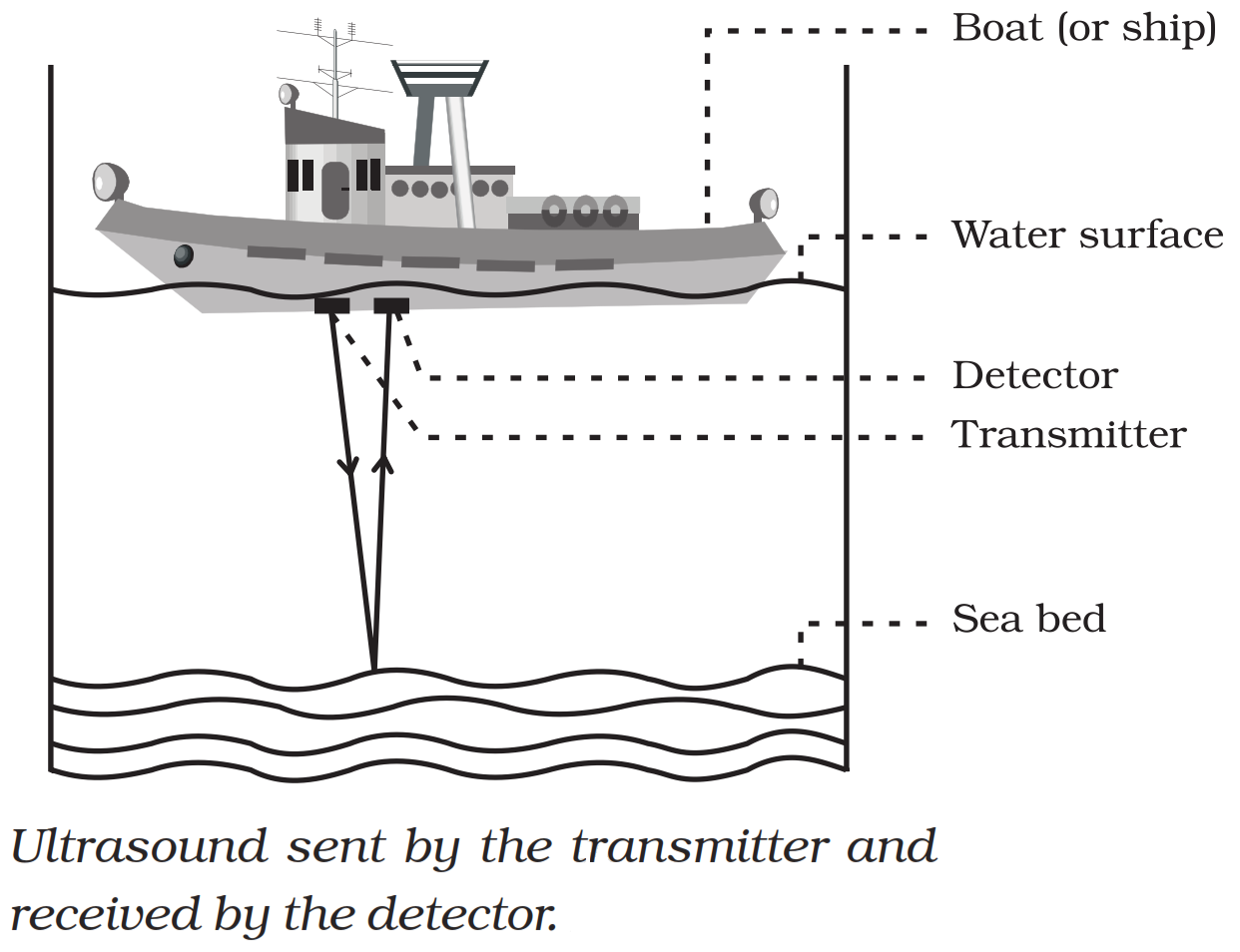
Working: $SONAR$ Consists of a transmitter and a detector and is installed in a boat or a ship as shown in the fig. The transmitter produces and transmits ultrasonic waves. These waves travel through water and after striking the object on the seabed, get reflected back and are sensed by the detector. The detector converts the ultrasonic waves into electrical signals which are appropriately interpreted. The distance of the object that reflected the sound wave can be calculated by knowing the speed of sound in water and the time interval between the transmission and reception of the ultrasound.

Ultrasound sent by the transmitter and recieved by the detector
Let, Depth of the sea $= d$
Speed of sound in sea water $=\nu$
Time taken for transmission and reception of signal $= t$
$\therefore$ Time taken to travel a distance, $\text{d}=\frac{\text{t}}{2}$
$\therefore$ Depth of the sea, $\text{d}=\frac{\text{t}}{2}\times\nu$ $(\because\ \text{Distance = Speed}\times\text{Time})$
View full question & answer
Question 243 Marks
The longitudinal waves travel in a coiled spring at a rate of $4m/s.$ The distance between two consecutive compressions is $20cm.$ Find:
  1. Wavelength of the wave.
  2. Frequency of the wave.
Answer
  1. The distance between two consecutive compressions or rare factions is equal to its wavelength.
Hence, from the diagram of wave we can say that wavelength is $0.2m.$
  1. Now we have to calculate the frequency of the wave.
Given: Velocity $ν = 4m/s$
Wavelength $\lambda= 0.2\text{m}$
We know the relation between velocity, frequency, and wavelength $\text{f}=\frac{\text{v}}{\lambda},$
Where $v$ is the velocity of sound, f the frequency, and $\lambda$ the wavelength.
So,
$\text{f}=\frac{4}{0.2}\text{Hz}$
$=20\text{Hz}$
Therefore, frequency of the wave is $20Hz.$
View full question & answer
Question 253 Marks
A stone is dropped from the top of a tower $500m$ high into a pond of water at the base of the tower. When is the splash heard at the top? Given, $g = 10ms^{–2}$ and speed of sound = $340ms^{–1}$.
Answer
Height of the tower, $s = 500m$
Velocity of sound, $v = 340ms^{−1}$
Acceleration due to gravity, $g = 10ms^{−2}$
Initial velocity of the stone, $u = 0 ($since the stone is initially at rest$)$
Time taken by the stone to fall to the base of the tower, $t_1.$
According to the second equation of motion: $\text{S}=\text{ut}_1+\frac{1}{2}\text{gt}_1^2$
$500=0\times\text{t}_1+\frac{1}{2}\times10\times\text{t}_1^2$
$\text{t}_1^2=100$
$\text{t}_1=10\text{s}$
Now, time taken by the sound to reach the top from the base of the tower,
$\text{t}_2=\frac{500}{340}=1.47\text{s}$
Therefore, the splash is heard at the top after time,
$​​​​​​​t$ Where, $t = t_1 + t_2 = 10 + 1.47 = 11.47s$.
View full question & answer
Question 263 Marks
What is ultrasound$?$ What is the difference between ordinary sound and ultrasound$?$
Answer
Ultrasounds: Ultrasounds are the sounds having very high frequency which cannot be heard by human beings.
Ordinary sound Ultrasound
These include sounds of frequencies in the range of $20Hz$ to $20,000hz.$ These include sounds of frequencies above $20,000Hz$.
These sounds are audiible to human ears. These sounds are inaudible to human ears.
View full question & answer
Question 273 Marks
How is it that bats are able to fly at night without colliding with other objects?
Answer
Bats are able to fly at night without colliding with other objects because they emit high frequency ultrasonic squeaks while flying and listen to the echoes produced by the reflection of their squeaks from the objects or obstacles in their path. From the time taken by the echo to be heard, bats can judge the distance of the object in their path and avoid it by changing the direction.
View full question & answer
Question 283 Marks
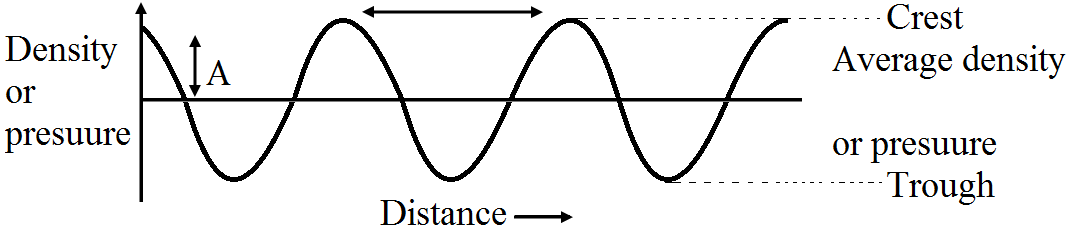
Explain the term ‘amplitude’ of a wave. Draw the diagram of a wave and mark its amplitude on it.
Answer
The maximum displacement of the particles of the medium from their original undisturbed positions, when a wave passes through the medium, is called amplitude $(A)$ of the wave.
View full question & answer
Question 293 Marks
State diagrammatically laws of reflections of sound and explain three applications based on these laws.
Answer
A light ray is a stream of light with the smallest possible cross-sectional area. (Rays are theoretical constructs.) The incident ray is defined as a ray approaching a surface. The point of incidence is where the incident ray strikes a surface. The normal is a construction line drawn perpendicular to the surface at the point of incidence. The reflected ray is the portion of the incident ray that leaves the surface at the point of incidence. The angle of incidence is the angle between the incident ray and the normal. The angle of reflection is the angle between the normal and the reflected ray.The Laws of reflection:
  • The angle of incidence is equal to the angle of reflection.
  • The incident ray, the normal, and the reflected ray are coplanar.
Specular reflection (regular reflection) occurs when incident parallel rays are also reflected parallel from a smooth surface. If the surface is rough (on a microscopic level), parallel incident rays are no longer parallel when reflected. This results in diffuse reflection (irregular reflection). The laws of reflection apply to diffuse reflection. The irregular surface can be considered to be made up of a large number of small planar reflecting surfaces positioned at slightly different angles. Indirect (or diffuse) lighting produces soft shadows. It produces less eye strain than harsher, direct lighting. The applet below illustrates how reflection and refraction takes place in common substances such as water, vacuum, air, glass, and even diamond.
View full question & answer
Question 303 Marks
Describe an activity to demonstrate that sound follows the same laws of reflection as light.
Answer
Yes, sound follow the same laws of reflection as light does. In case of light, the angle of incident light is equal to angle of reflection of light. In case of sound, the incident wave , the reflection wave and normal to a point of incidence all lie in the same plane. To observe the reflection of sound, take a drawing board and fix it on the floor. Put two metallic or cardboard tubes as shown in Fig. These tubes are making some angle with each other. Put a clock near the end of one tube and a screen between the two tubes so that sound of clock may not be heard directly. The sound (like tick-tick) waves pass through the tube are reflected by the drawing board. The reflected sound waves enter the second tube and are heard by the ear placed in front of the second tube
View full question & answer
Question 313 Marks
Which object is vibrating when the following sounds are produced?
  1. The sound of a sitar.
  2. The sound of table.
  3. The sound of a tuning fork.
  4. The buzzing of a bee or mosquito.
  5. The sound of a flute.
Answer
Sound is produced by the following objects:
  1. Vibrating stretched strings of sitar.
  2. Vibrating stretched membranes of tabla.
  3. Vibrating prongs of a tuning fork.
  4. Vibrating wings of mosquito.
  5. Vibrating air columns in flute.
View full question & answer
Question 323 Marks
Draw a curve showing density or pressure variations with respect to distance for a disturbance produced by sound. Mark the position of compression and rarefaction on this curve. Also define wavelengths and time period using this curve.
Answer


Wavelength is the distance between two consecutive compressions or two consecutive rarefactions. Time period is the time taken to travel the distance between any two consecutive compressions or rarefactions from a fixed point.
View full question & answer
Question 333 Marks
A body vibrating with a time-period of $\frac{1}{256}\text{s}$ produces a sound wave which travels in air with a velocity of $350m/s.$ Calculate the wavelength.
Answer
Time period, $\text{T}=\frac{1}{256}\text{s}$ Velocity, $\text{V} = 350\text{m/s}$
$\text{Frequency}=\frac{1}{\text{time period}}=256\text{Hz}$
$\lambda=\frac{\text{Velocity of wave}}{\text{Frequency}}$ Hence, $=\frac{350}{256}=1.36\text{m}$
View full question & answer
Question 343 Marks
What are wavelength, frequency, time period and amplitude of a sound wave?
Answer
  • Wavelength: The distance between two consecutive compressions or two consecutive rarefactions is known as the wavelength. Its SI unit is metre (m).
  • Frequency: The number of complete oscillations per second is known as the frequency of a sound wave. It is measured in hertz (Hz).
  • Amplitude: The maximum height reached by the crest or trough of a sound wave is called its amplitude.
View full question & answer
Question 353 Marks
Write any three applications (or use) of ultrasound.
Answer
Applications of ultrasound are:
  1. Ultrasound is used in industry for detecting flaws in metal blocks without damaging them.
  2. In hospitals, ultrasounds are used to investigate the internal organs of the human body such as liver, kidneys, uterus, etc.
  3. Ultrasounds are also used to monitor the growth of fetus inside the mother’s uterus.
View full question & answer
Que-Ans (Each of 3 Mark ) - Science STD 9 Questions - Vidyadip