Questions · Page 2 of 2

Answer the questions.[Bio-3M]

Question 513 Marks
Give reasons for:
We get a crunchy and granular feeling, when we chew pear fruit.
Answer
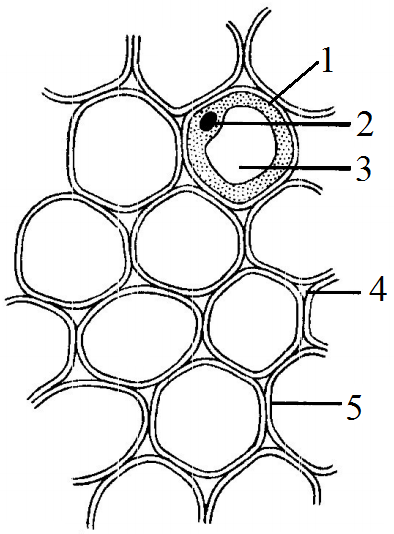
We get a crunchy and granular feeling when we chew pear fruit due to the presence of sclerenchyma tissue. The cell walls of sclerenchyma are greatly thickened due to the presence of lignin. Lignin is a complex polymer with high tensile strength e., it does not breaks easily on stretching and a high compressional strength, it does not buckle easily.
View full question & answer
Question 523 Marks
Give reasons for:
It is difficult to pull out the husk of a coconut tree.
Answer
It is difficult to pull out the husk of a coconut tree due to the presence of sclerenchyma tissue. The cells of sclerenchyma tissue are closely packed without intercellular spaces, a middle lamella exists between them. Middle lamella is a thin layer of connecting substance containing pectin, lignin and protein.
View full question & answer
Question 533 Marks
Give reasons for:
Branches of a tree move and bend freely in high wind velocity.
Answer
Collenchyma cells are characterised by the deposition of extra cellulose at corners of the cell. In collenchyma intercellular spaces are absent and ceils are elongated. It is a mechanical tissue which provides support and elasticity to the branches of a tree so that, they move and bend freely in high wind velocity.
View full question & answer
Question 543 Marks
Give four important functions of epithelial tissue. Name one specific place in the body where each function is carried out.
Answer
Functions of Epithelial tissues are:
  1. The cells of the body surface form the outer layer of skin. These cells protect the underlying cells from drying, injury, and chemical effects.
  2. Inside the body, epithelial cells form lining of mouth and alimentary canal and protect these organs.
  3. Epithelial tissues help in absorption of water and nutrients in small intestine.
  4. Some epithelial tissues perform secretory function such as sweat, saliva in skin and mouth cavity.
View full question & answer
Question 553 Marks
Give a short account of structure and function of adipose tissue.
Answer
It is fat storing connective tissue which is found mainly beneath the skin. The adipose tissue consists of several spherical or oval adipose cells (adipocytes or fat cells). Each adipose cell contains fat globules. It is found below the skin, around the internal organs like heart, kidneys and eyeballs.
Functions:
  1. It acts as an insulator.
  2. Provides support and protection to the vital organs.
  3. It acts as a storage of fat.
View full question & answer
Question 563 Marks
Give any two ways in which these tissues differ functionally from each other.
Answer
Function differences:
Xylem
Phloem
1.
It conducts water and minerals from root to different parts of the plant.
1.
It conducts food and nutrients from leaves to other parts of the plant.
2.
Conduction is mostly unidirectional.
2.
Conduction is often bidirectional from leaves to root and from roots to stem.
View full question & answer
Question 573 Marks
Give any two functions performed by epithelial tissue.
Answer
Functions of the epithelial tissue are:
  • The cells of the body surface (i.e., epidermis) from the outer layer of skin. These cells protect the underlying cells from drying, injury and chemical effects. They also protect the body from viral or bacteria infection.
  • Epithelial tissues help in absorption of water and nutrients.
  • Epithelial tissues help in elimination of waste products.
  • Some epithelial tissues perform secretary function. They secrete a variety of substances such as sweat, saliva, (mucus), enzymes, etc.
View full question & answer
Question 583 Marks
Enumerate the functions of blood.
Answer
The functions of blood:
  1. Transport oxygen from the lungs to different parts of the body.
  2. Transport CO2 from the body tissues to the lungs.
  3. Transport digested food i.e., glucose, amino acids, etc. from alimentary canal to various parts of the body for energy, growth and repair.
  4. Transport excretory waste product called urea from the liver to the kidneys for removal as urine.
  5. Plasma regulates water balance in the body.
  6. Regulates the body temperature.
View full question & answer
Question 593 Marks
Enlist three types of muscles with their locations.
Answer
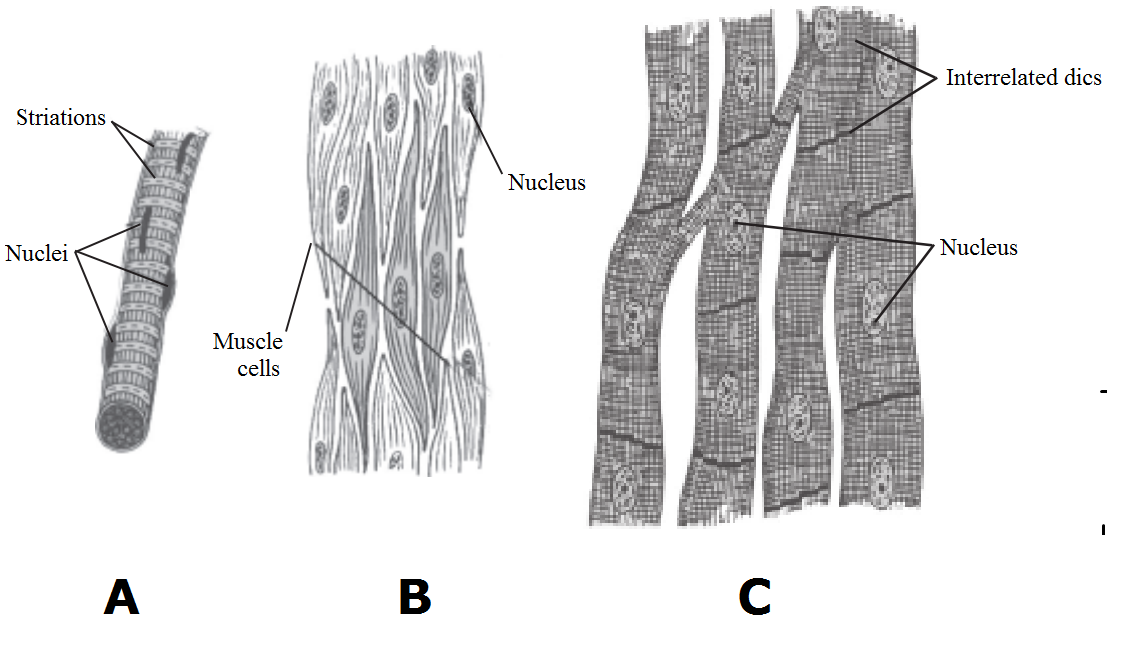
  1. Striated Muscles: It occur in the muscles of limbs, body wall, face, neck, etc. Striated muscles present in tongue, pharynx, diaphragm and upper part of oesophagus are called visceral straited muscles.

  2. Smooth Muscles: Smooth muscles are found in the walls of the hollow (tubular) visceral organs except that of the heart. They occur in the wall of alimentary canal and internal organs, ducts of glands, urogenital ducts and blood vessels.

  3. Cardiac Muscles: The cardiac muscles occur in the heart.

View full question & answer
Question 613 Marks
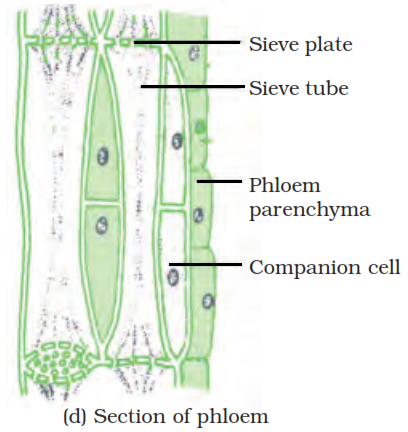
Draw and identify different elements of phloem.
Answer
Sieve tubes, companion cells, phloem fibres and pholem parenchyma.

View full question & answer
Question 623 Marks
Differentiate between tracheids and vessels.
Answer
Tracheids
Vessels
Shape & Size
Tracheids are the long elongated cells.
Vessels are wider and shorter cells.
Present
Tracheids are present in all vascular plants; in gymnosperms, they occur alone in the woody area of the plant while in angiosperms they are associated with vessels.
Vessels are typically found only in the angiosperms.
Ability to retain the water
Tracheids have the higher surface to volume ratio as compared to the vessels that is why they can resist gravity and have the ability to retain the water.
Lacks ability to retain water.
Formation
Tracheids are formed with the division of single individual cells.
The longitudinal bundle of cells is divided to form vessels.
Pits
Tracheids are imperforate cells, which have large pits that are less in number.
Vessels have smaller pits which are multiple in numbers.
View full question & answer
Question 633 Marks
Differentiate between the function of Xylem and Phloem.
Answer
No.
Xylem
Phloem
1.
Xylem tissues are tubular shaped structure, with the absence of cross walls. This tissue resembles the shape of a star.
Phloem tissues are elongated, tubular shaped structures that include thin sieve tubes with walls.
2.
Xylem occupies the centre of the vascular bundle.
Phloem is located on the outer side of the vascular bundle.
3.
Xylem fibres are smaller.
Phloem fibres are larger.
4.
They are present in leaves, stems, and roots.
They are present in leaves, roots, stems but transports and grow in fruits seeds and roots.
5.
These tissues move in a Unidirectional. (only in one direction – upward direction)
These tissues move in a Bidirectional. (both the ways – up and down)
View full question & answer
Question 643 Marks
Differentiate between striated, unstriated and cardiac muscles on the basis of their structure and site/location in the body.
Answer
Character
Striated muscles
Un-striated muscles
Cardiac muscles
Shape
Long, cylindrical, non – tapering.
They are un-branched.
Long and tapering.
They are un – branched.
Cylindrical and non – tapering.
They are branched.
Location in body
Hands, legs and skeletal muscles
Wall of stomach, intestine, ureter and bronchi
Heart
Dark and light bands
Present
Absent
Present but less prominent
View full question & answer
Question 653 Marks
Differentiate between blood and lymph.
Answer
Blood
Lymph
1.
Blood is red in colour due to presence of RBCs.
1.
Lymphs are colourless due to absence of RBCs.
2.
Blood plasma contains RBCs, WBCs and platelets.
2.
The lymph plasma contains WBCs.
3.
It contains diffusible and non-diffusible proteins like albumin, globulin and fibrinogen.
3.
It contains diffusible proteins.
4.
It can clot due to presence of more amount of fibrinogen.
4.
It clotes slowly due to presence of less fibrinogen.
View full question & answer
Question 663 Marks
Differentiate between axon and dendron.
Answer
Axon
Dendron
1.
An axon is a longest tubular process of the cyton.
1.
These are many short processes which arise from the cyton.
2.
It is efferent process as it carries impulses away from the cell body.
2.
These are afferent processes as they carry impulses towards the cell body.
3.
Nissl’s granules are absent.
3.
Nissl’s granules are present.
4.
End of each axon breaks into fine branches called telodendria.
4.
End of each dendron breaks into fine branches called dendrites.
View full question & answer
Question 683 Marks
Describe structure, location and functions of cuboidal epithelium.
Answer
It is composed of a single layer of cube- like cells. It is found in kidney tubules and salivary glands. It provides mechanical support to organs and helps in absorption and excretion.
View full question & answer
Question 693 Marks
Describe blood as a connective tissue.
Answer
It is a fluid connective tissue that links different parts of the body. it helps to maintain the continuity of the body. it contains fluid matrix called plasma and blood cells such as RBCs (red blood cells/ corpuscles) WBCs (white blood cells/ corpuscles) and platelets suspended in it.
Plasma also contains proteins, salts, hormones and vitamins to various tissues of the body it carries excretory products from the tissue to excretory organs it also conducts heat and regulates body temperature.
View full question & answer
Question 703 Marks
Define the following: tendon, ligament and cartilage.
Answer
  1. Tendons is a dense connective tissue which connects a bone with a muscle.
  2. Ligaments are elastic structures which connect bones to bones. 
  3. Cartilage is tough, flexible connective tissue found in all vertebrates. Its solid matrix is composed of proteins and sugars. The cells of cartilage are called chondrocytes. They don’t have blood vessels.
  4. Cartilage is present in the tip of nose, outer ear joints, between adjacent bones of the vertebral column, limbs and hands in adults.
View full question & answer
Question 713 Marks
Define meristematic tissue? Write down characteristics of meristematic cells.
Answer
Meristematic tissue: It is a group of cells which constantly divide and produce cells indefinitely throughout the life of a plant. Meristematic tissue is found in all the growing parts of a plant such as root tip, shoot tip, etc.
Characteristics of meristematic cells:
  1. The cells of this tissue are very active. They have dense cytoplasm.
  2. The cell wall is thin and made up of cellulose.
  3. They lack vacuoles.
  4. They have big nucleus.
View full question & answer
Question 723 Marks
Compare the three types of meristems.
Answer
There are total three types of meristems, they are:
  1. Apical meristem: These are situated at the growing tip of stem and roots, i.e., at shoot apex & root apex respectively. It is responsible for the growth or elongation of the root and stem, & it is called primary growth.
  2. Lateral meristem: These are found beneath the bark (called cork cambium) and in vascular bundle of dicot roots and stems (called vascular bundle). It is responsible for increase in girth, This is called secondary growth.
  3. Intercalary meristems: They are located at the base of leaves or internodes. It is responsible for the increase in the length of a leaves and internodes.
View full question & answer
Question 733 Marks
Compare the structure of striated, smooth and cardiac muscles on the basis of their shape, number of nuclei and position of nuclei within the cell.
Answer
No.
Cardiac Muscles
Skeletal Muscles
Smooth Muscles
1.
Cardiac muscles are found only in the heart.
Skeletal muscles are found attached to bones and skin.
Smooth muscle cells line walls of the internal organs.
2.
Perform involuntary muscular movements.
Perform voluntary muscular movements.
Perform involuntary muscular movements.
3.
Responsible for pumping blood throughout the body.
Power the joints, aiding physical movements.
Move internal organs to facilitate their functions.
4.
Comprise branching chains of cells, connected by porous intercalated discs with a single nucleus.
Comprise very long, cylindrical, multinucleated cells.
Comprise single, tapering, single nucleated cells.
5.
Striated with many myofibrils in orderly arrangements.
Striated with orderly arranged myofibrils.
Not striated, fewer myofibrils are found in varying length.
6.
Self-stimulating.
Not self-stimulating.
Self-stimulating.
7.
Under the regulation of the nervous system endocrine system, and various chemicals.
Under the regulation of the nervous system.
Under regulation of the nervous system, endocrine system, various chemicals, and stretching.
8.
Have an intermediate energy requirement.
Have a high energy requirement.
Have a low energy requirement
9.
Have an intermediate speed of contraction.
Have a high speed of contraction.
Have a low speed of contraction.
10.
Exhibit rhythmic contractions.
Do not exhibit rhythmic contractions.
Exhibit rhythmic contractions.
11.
Strength increases with stretching.
Exhibit a stressreleasing response.
12.
Do not fatigue.
Easily fatigue.
Do not fatigue.
View full question & answer
Question 743 Marks
Briefly describe cardiac muscle fibres.
Answer
These muscles are exclusively present in the heart. These muscles of the heart show rhythmic contraction and relaxation throughout life. They are striated but involuntary muscles. Heart muscle are cylindrical and uninucleated. They are branched and form a network in the walls of the heart.
View full question & answer
Question 763 Marks
Aquatic plants have the ability to float rather than being submerged in water. How?
Answer
Usually it is because their leaves have some spongy cells full of air. Some of them have spongy stems filled with air. Many also have a water repellent surface, so they don't get soaking wet when they go under the surface. Some have minute scales that trap air and help the leaves bounce back to the surface after they get pushed under water.
Examples of the water repellent scales can be seen on Salvinia plants. Water repellent leaves are seen on water lilies. Spongy air filled stems appear on the floating water chestnut. Air filled leaves are seen in Amazon frogbit or duckweeds.
View full question & answer
Answer the questions.[Bio-3M] - Page 2 - Science STD 9 Questions - Vidyadip