Questions

LONG ANS. QUESTIONS(5 Mark)

🎯

Test yourself on this topic

30 questions · timed · auto-graded

Question 15 Marks
Write down the differences between a delta and an estuary.
Answer
Delta:
  1. It is a triangular-shaped piece of land, formed at the mouth of a river, where it meets the sea.
  2. With the continuous deposition of silt on its bed, a river goes on splitting itself into channels or distributaries. They carry river water into the sea.
  3. Delta shows an extension of land into sea. It is continuously growing seawards.
  4. The sea is shallow. Tidal currents are not strong enough to remove deposits effectively.
  5. The world’s largest and the fastest growing delta is the Ganga-Brahmaputra delta known as the Sunderban delta. Peninsular rivers like the Mahanadi, Godavari, Krishna and Kaveri also form big deltas.
Estuary:
  1. An estuary is an inlet formed generally by the submergence of the mouth of a river.
  2. It has a single mouth or channel. It has steep banks or slopes. Where an estuary is formed, sea is deep.
  3. Strong tidal waves carry away the little amount of sediments deposited by a river.
  4. Estuaries produce an indented coastline and provide sites of natural harbours. They create conditions for better navigation.
  5. The mouths of rivers Narmada and Tapi present good examples of estuaries.
View full question & answer
Question 25 Marks
What are the main characteristics of the mighty river Brahmaputra?
Answer
  1. The Brahmaputra rises in Tibet east of Mansarovar Lake, very close to the sources of the Indus and the Satluj.
  2. It is slightly longer than the Indus and most of its course lies outside India.
  3. In Tibet, the river carries a smaller volume of water and less silt as it is a cold and a dry area.
  4. In India, it passes through a region of high rainfall. Here the river carries a large volume of water and considerable amount of silt.
  5. The Brahmaputra has a braided channel in its entire length in Assam and forms many riverine islands.
  6. Every year during the rainy season, the river overflows its banks causing widespread devastation due to floods in Assam and Bangladesh.
  7. Unlike other north Indian rivers, the Brahmaputra is marked by huge deposits of silt on its bed causing the river bed to rise. The river also shifts its channel frequently.
View full question & answer
Question 35 Marks
Compare the east flowing and the west flowing rivers of the Peninsular plateau.
Answer
East Flowing Rivers
West Flowing Rivers
Major rivers flowing eastwards: Mahanadi, Godavari, Krishna, Kaveri.
Only two long rivers flow westwards: Narmada, Tapi.
These rivers drain in the Bay of Bengal.
These rivers drain in the Arabian sea.
Carry greater amount of sediments, so form deltas at their mouths.
Carry lesser amount of sediments, so form estuaries at their mouths
Greater number of tributaries.
Lesser number of tributaries.
These river flow not through very deep canals.
These rivers flow in troughs.
View full question & answer
Question 45 Marks
How do lakes of India differ from each other in the size and other characteristics? Explain with examples.
Answer
  1. We find many lakes in India. These lakes differ from each other in the size and other characteristics. Most lakes are permanent, some contain water only during the rainy season, like the lakes in the basins of inland drainage of semi-arid regions. There are some of the lakes which are the result of the action of glaciers and ice sheets, while the others have been formed by wind, river action, and human activities.
  2. A meandering river across a floodplain forms cut-offs that later develop into ox-bow lakes. Spits and bars form lagoons in the coastal area, for instance, the Chilika lake, the Pulicat lake, the Kolleru lake. Lakes in the region of inland drainage are sometimes seasonal. For instance, the Sambhar lake in Rajasthan.
  3. Most of the fresh water lakes are located in the Himalayan region. These lakes are of glacial origin. It means that they formed when glaciers dug out a basin, which was later filled with snowmelt.
The Wular lake in Jammu and Kashmir, in contrast, is the result of the tectonic activity. It is the largest freshwater lake in India. Other freshwater lakes are the Dal lake, Bhimtal, Loitak, Nainital and Barapani.
  1. Some lakes are artificial, i.e., they are created by humans for the generation of hydel power. Guru Gobind Sagar is such a lake.
View full question & answer
Question 55 Marks
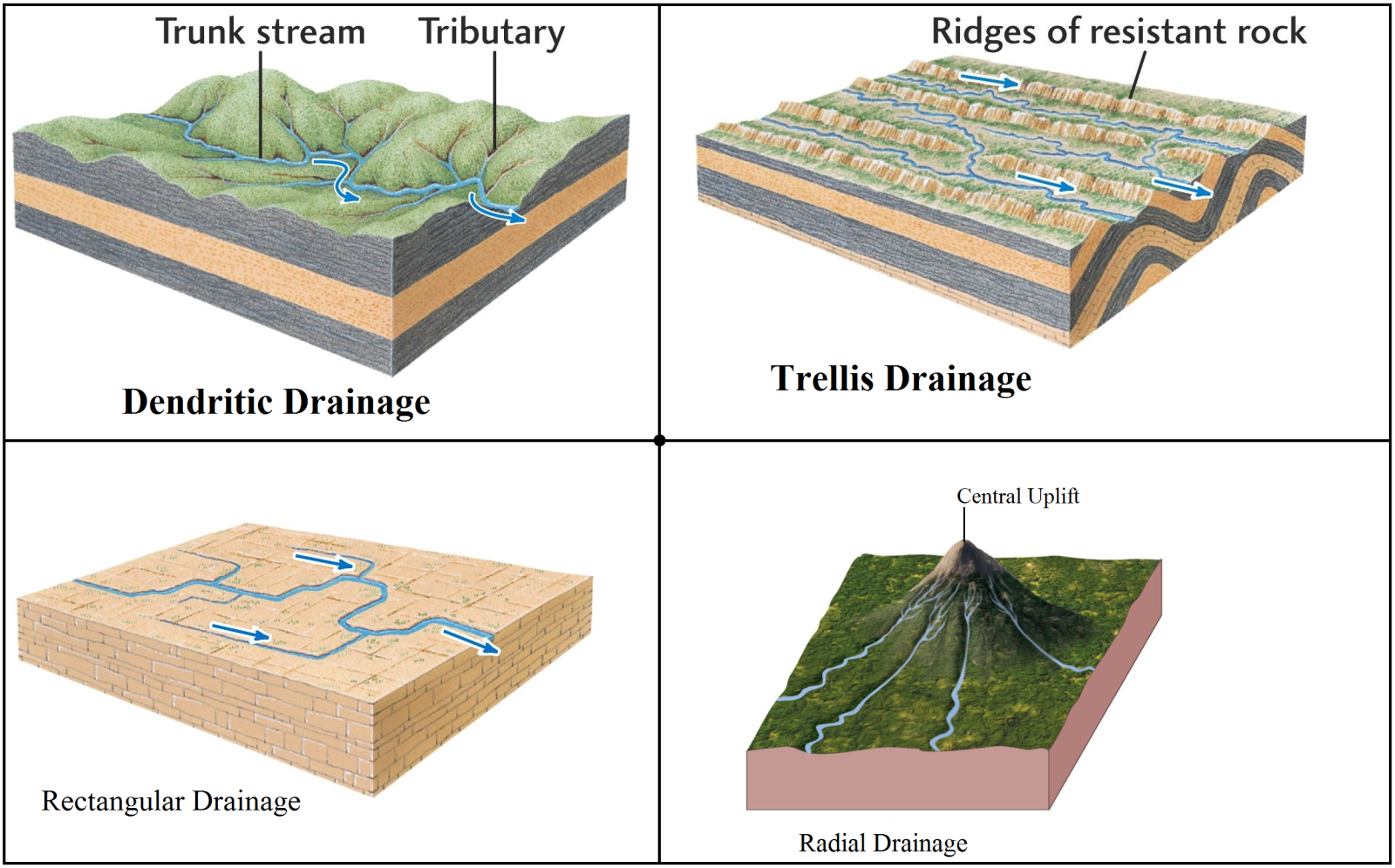
Define the following drainage patterns: Dendritic, Trellis, Rectangular and Radial.
Answer
  1. Dendritic: The dendritic pattern develops where the river channel follows the slope of the terrain. The stream with its tributaries resembles the branches of a tree.
  2. Trellis: A river joined by its tributaries at approximately right angles develops a trellis pattern. A trellis drainage pattern develops where hard and soft rocks exist parallel to each other.
  3. Rectangular: A rectangular drainage pattern develops on a strongly joined rocky terrain.
  4. Radial: A radial pattern develops when streams flow in different directions from a central peak or dome-like structure.
View full question & answer
Question 65 Marks
Write a note on the east-flowing and the west-flowing rivers of Peninsular India.
Answer
East Flowing Rivers: These rivers originate from the Western Ghats and flow eastwards. These rivers flow into the Bay of Bengal. These rivers from deltas at their mouths. They carry larger amount of water. Examples are Mahanadi, Godavari, Krishana and Kaveri.
West-Flowing Rivers: These rivers originate in central India and flow westwards. These rivers flow into the Arabian Sea. These rivers form estuaries at their mouths. They carry a lesser amount of water. Examples are Narmada and Tapi.
View full question & answer
Question 75 Marks
Name three main Himalayan river systems. Give two tributaries of each.
Answer
The three main Himalayan river systems are:
  1. Indus River System: It is the longest Himalayan river. It originates in Tibet and flows to India and then Pakistan. Its tributaries are Jhelem and Chenab.
  2. Ganga River system: It is the longest river of India. It originates in Uttrakhand and flows to Bangladesh. Its two tributaries are Yamuna and Kosi.
  3. Brahmaputra River System: It is the largest river of India. It flows in China, India and Bangladesh. Its two tributaries are Lohit and Manas.
View full question & answer
Question 85 Marks
Where are India's most of the freshwater lakes located and why?
Answer
India's most freshwater lakes are found in the Himalayan region. Because they are of glacial origin which means that they were formed when glaciers dug out a basin which was later filled with snow melt.
Wular Lake (also spelt Wullar) is one of the largest fresh water lakes in Asia. It is situated in the Indian state of Jammu and Kashmir, between the cities of Sopore and Bandipore. The lake was formed as a result of tectonic activity and is the largest freshwater lake in Asia. The River Jhelum feeds into the lake, which acts as a natural flood reservoir.
View full question & answer
Question 95 Marks
Describe the major peninsular rivers of India.
Answer
The major peninsular rivers are the Mahanadi, the Godavari, the Krishna and the Kaveri. These rivers flow eastwards and drain into the Bay of Bengal. They make deltas at their mouths.
  1. The Godavari Basin: The Godavari is the largest peninsular river. It rises from the slopes of the Western Ghats in the Nasik district of Maharashtra. Its length is about 1500km. It is joined by a number of tributaries such as the Purna, the Wardha, the Pranhita, the Manjra, the Wainganga and the Penganga. The last three tributaries are very large and collectively called the 'Dakshin Ganga'.
  2. The Mahanadi Basin: It rises in the high lands of Chhattisgarh. It flows through Odisha to reach the Bay of Bengal. The length of the river is about 860km. Its drainage basin is shared by Maharashtra, Chhattisgarh, Jharkhand and Odisha.
  3. The Krishna Basin: It rises from a spring near Mahabaleshwar. It flows for about 1400km and reaches the Bay of Bengal. The Tungabhadra, the Koyana, the Ghatprabha, the Musi and the Bhima are some of its tributaries. Its drainage basin is shared by Maharashtra, Karnataka and Andhra Pradesh.
  4. The Kaveri Basin: It rises in the Brahmagiri range of the Western Ghats and it reaches the Bay of Bengal in south of Cuddalore, in Tamil Nadu. Total length of this river is about 760km. Its main tributaries are Amravati, Bhavani, Hemavati and Kabini. Its basin drains part of Karnataka, Kerala and Tamil Nadu.
View full question & answer
Question 105 Marks
Classify lakes in three categories. Also give examples.
Answer
Indian lakes are classified into three categories namely:
  1. Freshwater lakes: They are mainly found in Himalayan region. They are of glacial origin. They are formed when glaciers dug out a basin, which was later filled with snowmelt. The Wular lake is the largest fresh water lake of India. Other freshwater lakes are the Dal lake, Bhimtal, Loktak and Barapani.
  2. Salt water lakes: They are mainly found in Rajasthan. The Sambhar Lake in the desert region of Rajasthan is a salt water lake. Its water is usedfor making salt.
  3. Lagoon: It is a shallow body of water separated from the sea by a narrow strip of land or by a sand bar. Spits and bars form lagoons in the coastal areas. The Chilka Lake in Odisha and the Pulicat lake near Chennai are examples of lagoons on the eastern coast of India.
View full question & answer
Question 115 Marks
How do urbanisation and industrialisation cause river pollution? Suggest three measures to control river pollution.
OR
What are the main causes of the pollution in the rivers of India? How can we prevent this kind of pollution?
Answer
  1. The main causes of pollution of Indian rivers are:
  1. The growing domestic, municipal, industrial and agricultural demand for water from rivers naturally affects the quality of water.
  2. As a result, more and more water is drained out of the rivers, thereby reducing their volume.
  3. A heavy load of untreated sewage and industrial effluents are emptied into the rivers.
  4. This affects not only the quality of water but also the self-cleansing capacity of the river.
  5. The increasing urbanisation and industrialisation has increased the pollution levels of the rivers.
  1. How to prevent pollution:
  1. The effluents of the industries should be treated before they enter the river waters.
  2. People of the urban areas living on the banks of the rivers should be sensitised about the pollution levels of the rivers and the difficulty in cleaning it.
  3. Since Indians are religious-minded and most of their festivals are associated with pure water of rivers, the immersing of deities, and of religious goods and even the dead are associated with these holy rivers, resulting into pollution, which needs to be checked and controlled.
View full question & answer
Question 125 Marks
Define the term 'drainage'. Describe different drainage patterns.
Answer
The term drainage describes the river system of an area. The streams within a drainage basin (the area drained by a single river system) form certain patterns which are given below:
  1. Dendritic pattern: The dendritic drainage pattern develops where the river channel follows the slope of the terrain. The stream with its tributaries resembles the branches of a tree, thus the name 'dendritic'.
  2. Trellis pattern: This drainage pattern develops when a river is joined by its tributaries at approximately right angles. This drainage pattern also develops where hard and soft rocks exist parallel to each other.
  3. Rectangular pattern: This drainage pattern develops on a strongly jointed rocky terrain.
  4. Radial pattern: This drainage pattern develops when streams flow in different directions from a central peak or a dome-like structure.
View full question & answer
Question 135 Marks
Explain five main features of the Narmada basin.
Answer
  1. River Narmada originates in the Amarkantak hills in Madhya Pradesh. It flows through a rift valley.
  2. The river drains the parts of Madhya Pradesh and Gujarat. While flowing towards the west, the river creates many picturesque locations such as Dhuadhar falls.
  3. It flows towards the west and drain into the Arabian Sea.
  4. All the tributaries of the narmada are very short and most of these join the main streams at right angle.
  5. The river forms an estuary before entering into the Gulf of Khambhat.
View full question & answer
Question 145 Marks
Describe the journey of river Ganga in India and which rivers join it en route.
Answer
  1. The river Ganga originates from Gangotri Glacier and is called Bhagirathi over here.
  2. It is joined by Alaknanda at Devaprayag in Uttarakhand.
  3. At Haridwar, it enters the plains and starts doing the job of transportation and deposition.
  4. The major Himalayan rivers joining Ganga are the Yamuna, the Ghaghra, the Gandak and the Kosi.
  5. The river Yamuna flows parallel to the Ganga and as a right bank tributary meets the Ganga at Allahabad.
  6. The Ghaghra, the Gandak and the Kosi originate from Nepal Himalayas and ultimately join river Ganga.
  7. These rivers flood northern plains almost every year causing widespread damage to life and property but enriching the soil for the extensive agricultural land.
  8. The tributaries coming from the peninsular uplands are the Chambal, the Betwa and the Son.
  9. Enlarged with waters from its right and left bank tributaries, the Ganga flows eastwards till Farakka in West Bengal. This is the northern most point of the Ganga Delta.
  10. The river bifurcates here; the Bhagirathi-Hooghly flows southwards through the deltic plains to the Bay of Bengal. With Brahmaputra, it forms the world’s biggest delta called the ‘Sunderbans Delta’. Here, ends the journey of river Ganga.
View full question & answer
Question 155 Marks
What types of lakes are found in India? Give suitable examples.
Answer
India has many lakes. They differ in size and other characteristics. Most lakes are permanent, whereas some contain water only during the rainy season. There are lakes which are formed by the action of glaciers and ice sheets, while the others have been formed by human activities.
  1. Salt water lakes: Spit and bars form lagoons or salt water lakes in the coastal areas like the Chilika lake, Pulicat lake and the Kolleru lake. Sometimes, salt water lakes are formed with island drainage like Sambhar lake in Rajasthan. Its water is used for producing salt.
  2. Freshwater lakes: Most of these are in the Himalayan region. They are of glacier origin. They are formed when glaciers dug out a basin, which was later filled with snow melt. The Wular lake in Jammu and Kashmir is the largest freshwater lake in India. Other freshwater lakes are the Dal, Bhimtal, Nainital, Loktak and Barapani.
  3. Man-made lakes: The damming of the rivers for the generation of hydel power has also led to the formation of lakes. These lakes are formed to drain excessive water of the river during floods and adding water to the rivers during the dry season. Such lakes are the Guru Gobind Sagar (Bhakra Nangal Project), Nizam Sagar, Nagarjuna Sagar, Rana Pratap Sagar, etc.
View full question & answer
Question 165 Marks
State some economic benefits of rivers and lakes.
Answer
  1. Water from the rivers is a basic natural resource, essential for various human activities.
  2. The river banks have attracted settlers from ancient times. These settlements have now become big cities.
  3. Using rivers for irrigation, navigation, hydro-power generation is of special significance.
  4. Rivers are very significant for countries like India where agriculture is the livelihood for a majority of the population.
  5. Lakes help to develop tourism and provide recreation. Rivers have been of fundamental importance throughout human history.
View full question & answer
Question 175 Marks
Write main features of Indus Basin.
Answer
  1. The river Indus rises in Tibet, near lake Mansarovar.
  2. Flowing west, it enters India in the Ladakh district of Jammu & Kashmir. It forms a picturesque gorge in this part.
  3. It flows through Baltistan and Gilgit and emerges from the mountain at Attock.
  4. All its major tributaries-the Satluj, the Beas, the Ravi, the Chenab and the Jhelum-join together to enter the Indus near Mithankot in Pakistan.
  5. Beyond this, the Indus flows southwards eventually reaching the Arabian Sea, east of Karachi. Indus is 2,900-km long and is one of the longest rivers of the world.
View full question & answer
Question 185 Marks
Give main characteristics of the largest peninsular river.
Or
Which river is known as ‘Dakshin Ganga’? State any twocharacteristics of it.
Answer
  1. The Godavari is the largest peninsular river.
  2. Its length is about 1500km. Its drainage basin is also the largest amongst the peninsular rivers.
  3. The basin covers the parts of Maharashtra, Madhya Pradesh, Odisha and Andhra Pradesh.
  4. The Godavari is joined by a number of tributaries such as the Purna, the Wardha, the Pranhita, the Manjra, the Wainganga and the Penganga.
  5. The last three tributaries are very large. Because of its length and the area it covers, it is also known as ‘Dakshin Ganga’.
View full question & answer
Question 195 Marks
Distinguish between the Himalayan rivers and the Peninsular rivers?
Answer
 
Himalayan River
 
Peninsular Rivers
1
Himalayan rivers are perennial and flow the throughout the year.
1
A large number of peninsular rivers are seasonal and flow during a certain period in a year.
2
They receive water from rainfall and melting snow of the mountains and glaciers.
2
They receive water from rainfall only.
3
The Himalayan rivers have long courses.
3
The peninsular river have short and shallow courses.
4
Their drainage basins are large.
4
Their drainage basins are small.
5
These rivers form big deltas.
5
They form small deltas.
View full question & answer
Question 205 Marks
Give characteristics of the Ganga-Brahmaputra river system.
Answer
The basin is separated from the Indus by the watershed in Haryana, i.e., Ambala. It covers the Central and the Eastern parts of the northern alluvial plains in Haryana, U.P., West Bengal and Assam. Its large central part is drained by river Ganga and its many tributaries. The general slope of the Ganga plain is from the north-west to south-east and south into Bay of Bengal. Its eastern part is drained by the mighty Brahmaputra river. It slopes from the north-east to south-west and then southward into Bangladesh.
View full question & answer
Question 215 Marks
Give main characteristics of the Ganga River System.
Answer
  1. The headwaters of the Ganga called the ‘Bhagirathi’ is fed by the Gangotri Glacier and joined by Alaknanda at Devaprayag in Uttarakhand.
  2. At Haridwar, the Ganga emerges from the mountains on to the plains. Its tributaries are flood parts of the northern plains every year, causing widespread damage to life and property but enriching the soil for the extensive agricultural lands.
  3. Enlarged with the waters from its right and left bank tributaries, the Ganga flows eastward till Farakka in West Bengal. This is the northern most point of Ganga Delta.
  4. The mainstream flows southwards into Bangladesh and is joined by the Brahmaputra. This mighty river along with Brahmaputra flows into the Bay of Bengal and the delta formed by these rivers is known as Sunderban delta.
View full question & answer
Question 225 Marks
Differentiate between the Ganga and the Godavari river system.
Answer
S.No.
Ganga River System
Godavari River System
(i)
It is a Himalayan river.
It is a peninsuriver lar river.
(ii)
At Haridwar the Ganga emerges from the mountains onto the plains.
It rises from the slopes of the Western Ghats in the Nashik district of Maharashtra.
(iii)
The length of the Ganga is over 2,500km.
Its length is 1,500km.
(iv)
Its tributaries are: Ghaghara, Kosi, Gandak, Son, Betwa, Chambal, etc.
Its tributaries are: Purna, Wardha, Pranhirta, etc.
View full question & answer
Question 235 Marks
Differentiate between the Indus river basin and the Ganga river basin.
Answer
 
Indus Basin
 
Ganga Basin
1
The Indus Basin is formed by the Indus and its tributaries.
1
The Ganga Basin is formed by the Ganga and its tributaries.
2
It is located in the states of Jammu and Kashmir, Himachal Pradesh and Punjab.
2
It is located in Haryana, Raj as then, Uttar Pradesh, M.P., Bihar and West Bengal.
3
The Indus flows over 2900 kms in length. Other important rivers of this basin are Satluj, Beas, Ravi, Chenab and Jhelum.
3
The Ganga flows over 1900 kms in length. The other tributaries of the Ganga include Yamuna, Gomati, Ghaghara, Gandak, Kosi, Chambal, Betwa, Ken and Son.
4
The highland (commonly known as Ambala- Saharanpur water divide) separates the Basin from the Ganga Basin. Rivers flow in this Basin from north-west to south-west.
4
The Ganga basin spreads from Ambala in the north-west to the Sundarbans in the east.
5
This Basin has fertile land and a dense network of canals for irrigation.
5
The Ganga basin spreads from Ambala in the north-west to the Sundarbans in the east.
View full question & answer
Question 245 Marks
Difference between the River Indus and the River Ganga Basin.
Answer
S.No
The Indus Basin
 
The Ganga Basin
1.
The Indus Basin is formed by the Indus and its tributaries.
1.
The Ganga Basin is formed by the Ganga and its tributaries.
2.
It is located in the states of Jammu and Kashmir, Himachal Pradesh and Punjab.
2.
It is located in Haryana, Raj as then, Uttar Pradesh, M.P., Bihar and West Bengal.
3.
The Indus flows over 2900km-s in length. Other important rivers of this basin are Satluj, Beas, Ravi, Chenab and Jhelum.
3.
The Ganga flows over 1900km-s in length. The other tributaries of the Ganga include Yamuna, Gomati, Ghaghara, Gandak, Kosi, Chambal, Betwa, Ken and Son.
4.
The highland (commonly known as Ambala- Saharanpur water divide) separates the Basin from the Ganga Basin. Rivers flow in this Basin from north-west to south-west.
4.
The Ganga basin spreads from Ambala in the north-west to the Sundarbans in the east.
5.
This Basin has fertile land and a dense network of canals for irrigation.
5.
Except in the upper portion irrigation facilities are comparatively less owing to high amount of rainfall.
6.
The Indus Basin is shared by Tibet, India and Pakistan.
6.
The Ganga Basin is shared by India and Bangladesh.
View full question & answer
Question 255 Marks
How do Indian lakes differ from each other?
Answer
India has many lakes. These differ from each other in size, and other characteristics. Most lakes are permanent; some contain water only during the rainy season, like the lakes in the basins of inland drainage of semi-arid region. There are some of the lakes which are the result of the action of glaciers and ice sheets, while the others have been formed by wind, river action and human activities.
View full question & answer
Question 265 Marks
Describe the major steps in brief taken by government of India to control the pollution level in rivers.
Answer
The government of India has taken some major steps to control the pollution level in rivers:
  1. Treating of waste before dumping in rivers.
  2. Taking projects to control water pollution in rivers, for example:
  • The river cleaning programme in the country was initiated with the launching of the Ganga Action Plan (GAP) in 1985. Its objective is to improve the water quality of rivers, which are major water sources in the country, through the implementation of pollution abatement work.
  • In June 2014, the Central Government approved a flagship programme "Namami Gange' which integrates the effects to clean and protect the national river Ganga in a comprehensive manner.
  • The Narmada river conservation mission has been undertaken by the government of Madhya Pradesh by a scheme named Namami Devi Narmade'.
View full question & answer
Question 275 Marks
Explain any three differences between east flowing peninsular rivers and west flowing peninsular rivers.
Answer
The East flowing rivers:
  1. These rivers originate from the Western Ghats and flow eastwards.
  2. They all form deltas at their mouths.
  3. They drain into the Bay of Bengal.
  4. They have large volume of water.
Examples: Mahanadi, Godavari, Krishna and Kaveri.
The West flowing rivers:
  1. These rivers originate in Central India and flow westwards.
  2. They form estuaries since they flow from rift valleys.
  3. They drain into the Arabian Sea.
  4. They have lesser volume of water.
Examples: Narmada and Tapi.
View full question & answer
Question 285 Marks
Give an account of the Himalayan rivers of India.
Answer
The major Himalayan rivers are the Indus, the Ganga and the Brahmaputra. These rivers are long and are joined by many large and important tributaries.
  1. The Indus River System: The Indus river rises in Tibet, near Lake Mansarovar. Flowing west, it enters India in the Ladakh district of Jammu and Kashmir. Several tributaries like the Zaskar, the Nubra, the Shyok and the Hunza join it in the Kashmir region. The Indus flows through Baltistan and Gilgit and emerges from the mountains at Attock. The Satluj, the Beas, the Ravi, the Chenab and the Jheium join together to enter the Indus near Mithankot in Pakistan. Beyond this, the Indus flows southwards eventually reaching the Arabian Sea, east of Karachi. The total length of this river is 2900km.
  2. The Ganga River System: Theheadwaters of the Ganga, called the Bhagirathi, is led by the Gangotri Glacier and joined by the Alaknanda at Devprayag in Uttarakhand. At Haridwar the Ganga emerges from the mountains on to the plains. The Ganga is joined by many tributaries from the Himalayas. These are the Yamuna, the Ghaghara, the Kosi and the Gandak. The river Yamuna rises from the Yamunotri Glacier in the Himalayas. It flows parallel to the Ganga and as a right bank tributary, meets the Ganga at Allahabad. The Ghaghara, the Gandak and the Kosi rise in the Nepal Himalayas. The main tributaries that come from the peninsular uplands are the Chambal, the Betwa and the Son. Enlarged with the waters from its right and left bank tributaries, the Ganga flows eastwards till Farakka in West Bengal. This is the northernmost point of the Ganga delta. The river bifurcates here. The Bhagirathi-Hooghly here flows southwards through the deltaic plains to the Bay of Bengal. The length of the Ganga is over 2500km.
  3. The Brahmaputra River System: The Brahmaputra rises in Tibet east of Mansarovar lake very close to the sources of the Indus and the Satluj. It is slightly longer than the Indus, and most of its course lies outside India. It flows eastwards parallel to the Himalayas. On reaching the Namcha Barwa, it takes a U-turn and enters India in Arunachal Pradesh through a gorge. Here it is called the Dihang and it is joined by the Dibang, the Lohit, and many other tributaries to form Brahmaputra in Assam.
View full question & answer
Question 295 Marks
Difference between a tributary and distributary.
Answer
Tributaries
Distributaries
When a small river joins the large or main river, it is called tributary.
When a large river breaks into small river, it is called distributary.
These are formed in mountains from glaciers, lakes etc.
Distributary is formed by a large river.
This occurs in the young age of the river.
This occurs in old age of river.
It does not change the course of the river.
It changes the course of the river and ofter forms a delta.
Example: Yamuna, Ghandak, Kosi, Ghaghora etc. Are tributaries of the Ganga.
Example: Sunderbans delts which is formed by distributaries of Ganga and Brahmaputra.
View full question & answer
Question 305 Marks
Rivers are very important for development in India'. Explain.
Answer
Rivers are very important for the development of India:
  1. Great cultural and economic progress has taken place in areas along the banks of rivers since ancient times.
  2. River is a basic natural source or water.
  3. River water is essential for daily human activities like washing, cooking, etc.
  4. They are an important source of irrigation and are the backbone of the development of agriculture.
  5. There are dense and concentrated settlements in River valleys. Most of the big cities are located on the banks of rivers. They are a means of water supply.
  6. Many industrial processes depend on water so industrial development takes place near rivers. Water is used as a raw material, to cool down the things and to generate electricity.
  7. Rivers act as primary channels of inland waterways.
  8. Rivers are also used for recreation and promotion of tourism. They are suitable for fishing.
View full question & answer