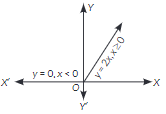
MCQ 1511 Mark
If $\text{y}=\sin^{-1}\Big(\frac{1-\text{x}^2}{1+\text{x}^2}\Big),$ then $\frac{\text{dy}}{\text{dx}}=$
AnswerCorrect option: A. $-\frac{2}{1+\text{x}^2}$
Let $\text{y}=\sin^{-1}\Big(\frac{1-\text{x}^2}{1+\text{x}^2}\Big)$
Differentiating with respect to $x$ using chain rule, we get,
$\frac{\text{dy}}{\text{dx}}=\frac{1}{\sqrt{1-\Big(\frac{1-\text{x}^2}{1+\text{x}^2}\Big)^2}}\frac{\text{d}}{\text{dx}}\Big(\frac{1-\text{x}^2}{1+\text{x}^2}\Big)$
$\Rightarrow\frac{\text{dy}}{\text{dx}}=\frac{(1+\text{x}^2)}{\sqrt{(1+\text{x}^2)^2-(1-\text{x}^2)^2}}\bigg[\frac{(1+\text{x}^2)\frac{\text{d}}{\text{dx}}(1-\text{x}^2)-(1-\text{x}^2)\frac{\text{d}}{\text{dx}}(1+\text{x}^2)}{(1+\text{x}^2)^2}\bigg]$
$\Rightarrow\frac{\text{dy}}{\text{dx}}=\frac{(1+\text{x}^2)}{\sqrt{(1+\text{x}^2)^2-(1-\text{x}^2)^2}}\bigg[\frac{(1+\text{x}^2)(-2\text{x})-(1-\text{x}^2)(2\text{x})}{(1+\text{x}^2)^2}\bigg]$
$\Rightarrow\frac{\text{dy}}{\text{dx}}=\frac{(1+\text{x}^2)}{2\text{x}}\Big[\frac{-2\text{x}-2\text{x}^3-2\text{x}+2\text{x}^3}{(1+\text{x}^2)^2}\Big]$
$\Rightarrow\frac{\text{dy}}{\text{dx}}=\frac{-4\text{x}}{2\text{x}(1+\text{x}^2)}$
$\Rightarrow\frac{\text{dy}}{\text{dx}}=\frac{-2}{1+\text{x}^2}$
View full question & answer→MCQ 1521 Mark
If $\text{xy}-\log_\text{e}\text{y}=1$ satisfies the equation $\text{x}(\text{yy}_2+\text{y}_1^2)-\text{y}_2+\lambda\text{yy}_1=0,$ then $\lambda=$
Answer$\text{xy}-\log_\text{e}\text{y}=1$
$\Rightarrow\text{xy}_1+\text{y}-\frac{\text{y}_1}{\text{y}}=0$
$\Rightarrow\text{xyy}_1+\text{y}^2-\text{y}_1=0$
$\Rightarrow\text{yy}_1+\text{xy}_1\text{y}_1+\text{xyy}_2+2\text{yy}_1-\text{y}_2=0$
$\Rightarrow\text{x}(\text{y}_1^2+\text{yy}_2)-\text{y}_2+3\text{yy}_2=0$
$\therefore\lambda=3$
View full question & answer→MCQ 1531 Mark
Let $f (x)$ be a polynomial. Then the second order derivatives of $f (e^x)$ is :
- A
$\text{f}(\text{e}^\text{x})\text{e}^{2\text{x}}+\text{f}(\text{e}^\text{x})\text{e}^\text{x}$
- B
$\text{f}(\text{e}^\text{x})\text{e}^{\text{x}}+\text{f}(\text{e}^\text{x})$
- C
$\text{f}(\text{e}^\text{x})\text{e}^{2\text{x}}+\text{f}(\text{e}^\text{x})\text{e}^\text{x}$
- ✓
$\text{f}(\text{e}^\text{x})$
AnswerCorrect option: D. $\text{f}(\text{e}^\text{x})$
Let $\text{y}=\text{f}(\text{e}^\text{x}),$ then
$\text{y}_1=\text{f}\ '(\text{e}^\text{x})\text{e}^\text{x}$
$\text{y}_2=\text{f}\ ''(\text{e}^\text{x})\text{e}^\text{x}\text{e}^\text{x}+\text{f}\ '(\text{e}^\text{x})\text{e}^\text{x}$
$=\text{e}^{2\text{x}}\text{f}\ ''(\text{e}^\text{x})+\text{f}'(\text{e}^\text{x})\text{e}^\text{x}$
View full question & answer→MCQ 1541 Mark
If $\text{y}=\text{a}\cos(\log_\text{e}\text{x})+\text{b}\sin(\log_\text{e}\text{x})$ then $\text{x}^2\text{y}^2+\text{xy}_1=$
Answer$\text{y}=\text{a}\cos(\log_\text{e}\text{x})+\text{b}\sin(\log_\text{e}\text{x})$
$\Rightarrow\text{y}_1=-\text{a}\sin(\log_\text{e}\text{x})\frac{1}{\text{x}}+\text{b}\cos(\log_\text{e}\text{x})\frac{1}{\text{x}}$
$\Rightarrow\text{y}_2=\frac{-\text{a}\sin(\log_\text{e}\text{x})+\text{b}\cos(\log_\text{e}\text{x})}{\text{x}}$
$\Rightarrow\text{y}_2=\frac{-\text{a}(\log_\text{e}\text{x})-\text{b}\sin(\log_\text{e}\text{x})-\{-\text{a}\sin(\log_\text{e}\text{x})+\text{b}\cos(\log_\text{e}\text{x})\}}{\text{x}^2}$
$\Rightarrow\text{x}^2\text{y}_2=-\{\text{a}\cos(\log_\text{e}\text{x})+\text{b}\sin(\log_\text{e}\text{x})\}$
$-\{-\text{a}\sin(\log\text{x})+\text{b}\cos(\log_\text{e}\text{x})\}$
$\Rightarrow\text{x}^2\text{y}_2=-\text{y}-\text{xy}_1$
$\Rightarrow\text{x}^2\text{y}_2+\text{xy}_1=-\text{y}$
View full question & answer→MCQ 1551 Mark
If $\text{f(x)}=\sqrt{1-\sqrt{1-\text{x}^2}},$ then $f(x)$ is :
- A
Continuous on $[-1, 1]$ and differentiable on $(-1, 1)$
- ✓
Continuous on $[-1, 1]$ and differentiable on $(-1,0)\cup(0,1)$
- C
Continuous and differentiable on $[-1, 1]$
- D
AnswerCorrect option: B. Continuous on $[-1, 1]$ and differentiable on $(-1,0)\cup(0,1)$
We have,
$\text{f(x)}=\sqrt{1-\sqrt{1-\text{x}^2}}$
Here, function will be defined for those values of $x$ for which
$1-\text{x}^2\geq0$
$\Rightarrow1\geq\text{x}^2$
$\Rightarrow\text{x}^2\leq1$
$\Rightarrow|\text{x}\leq1|$
$\Rightarrow-1\leq\text{x}\leq1$
Therefore, function is continuous in $-1, 1$
Now, we need to check the differentiability of $\text{f(x)}=\sqrt{1-\sqrt{1-\text{x}^2}}$ in the interval $-1, 1$
Now,
We will check the differentiable at $x = 0$
$\text{LHL}$ at $x = 0$
$=\lim\limits_{\text{x}\rightarrow\infty}\frac{\text{f(x)}-\text{f}(0)}{\text{x}-0}$
$=\lim\limits_{\text{x}\rightarrow\infty}\frac{\sqrt{1-\sqrt{1-\text{x}^2}}-0}{\text{x}}$
$=\lim\limits_{\text{x}\rightarrow\infty}\frac{\sqrt{1-\sqrt{1-\text{x}^2}}}{\text{x}}$
$=\lim\limits_{\text{h}\rightarrow0}\frac{\sqrt{1-\sqrt{1-(0-\text{h})^2}}}{0-\text{h}}$
$=\lim\limits_{\text{h}\rightarrow0}\frac{\sqrt{1-\sqrt{1-\text{h}^2}}}{-\text{h}}$
$=-\infty$
$\text{RHL}$ at $x = 0$
$=\lim\limits_{\text{x}\rightarrow0^{+}}\frac{\text{f(x)}-\text{f}(0)}{\text{x}-0}$
$=\lim\limits_{\text{x}\rightarrow0^{+}}\frac{\sqrt{1-\sqrt{1-\text{x}^2}}-0}{\text{x}}$
$=\lim\limits_{\text{h}\rightarrow0}\frac{\sqrt{1-\sqrt{1-(0+\text{h})^2}}}{0+\text{h}}$
$=\lim\limits_{\text{h}\rightarrow0}\frac{\sqrt{1-\sqrt{1-\text{h}^2}}}{\text{h}}$
$=\infty$
So, the function is not differentiable at $x = 0.$
View full question & answer→MCQ 1561 Mark
Choose the correct answers from the given four options : If $f(x) = 2x $ and $\text{g(x)}=\frac{\text{x}^2}{2}+1,$ then which of the following can be a discontinuous function :
- A
$\text{f(x)}+\text{g(x)}$
- B
$\text{f(x)}-\text{g(x)}$
- C
$\text{f(x)}\cdot\text{g(x)}$
- ✓
$\frac{\text{g(x)}}{\text{f(x)}}$
AnswerCorrect option: D. $\frac{\text{g(x)}}{\text{f(x)}}$
We have $f(x) = 2x$ and $\text{g(x)}=\frac{\text{x}^2}{2}+1,$ which are continuous functions,
So, $\text{f(x)}+\text{g(x)},\text{f(x)}-\text{g(x)}$ and $\text{f(x)}\times\text{g(x)}$ are also continuous.
But $\frac{\text{g(x)}}{\text{f(x)}}$ is discontinuous where $f(x) = 0,$ i.e., $x = 0$
View full question & answer→MCQ 1571 Mark
If $\text{f(x)}=\log_{\text{x}^2}(\log\text{x}),$ the $f(x)$ at $x = e$ is :
- A
$0$
- B
$1$
- C
$\frac{1}{\text{e}}$
- ✓
$\frac{1}{2\text{e}}$
AnswerCorrect option: D. $\frac{1}{2\text{e}}$
We have, $\text{f(x)}=\log_{\text{x}^2}(\log\text{x})$
$\Rightarrow\text{f(x)}=\frac{\log(\log\text{x})}{\log\text{x}^2}$
$\Rightarrow\text{f(x)}=\frac{\log(\log\text{x})}{2\log\text{x}}$
$\Rightarrow\text{f}\ '\text{(x)}=\frac{1}{2}\times\frac{\text{d}}{\text{dx}}\bigg\{\frac{\log(\log\text{x})}{\log\text{x}}\bigg\}$
$\Rightarrow\text{f}\ '\text{(x)}=\frac{1}{2}\times\Bigg\{\frac{\frac{1}{\log\text{x}}\times\frac{1}{\text{x}}\times\log\text{x}-\frac{\log(\log)\text{x}}{\text{x}}}{(\log\text{x})^2}\Bigg\}$
$\Rightarrow\text{f}\ '\text{(x)}=\frac{1}{2}\times\Bigg\{\frac{\frac{1}{\text{x}}-\frac{\log(\log)\text{x}}{\text{x}}}{(\log\text{x})^2}\Bigg\}$
$\Rightarrow\text{f}\ '\text{(e)}=\frac{1}{2}\times\Bigg\{\frac{\frac{1}{\text{e}}-\frac{\log(\log)\text{e}}{\text{e}}}{(\log\text{e})^2}\Bigg\}$
$[$Putting $x = e]$
$\Rightarrow\text{f}\ '\text{(e)}=\frac{1}{2}\times\bigg\{\frac{\frac{1}{\text{e}}}{1}\bigg\}$
$\Rightarrow\text{f}\ '\text{(x)}=\frac{1}{2\text{e}}$
View full question & answer→MCQ 1581 Mark
If $x=a \sec \theta, y=b \tan \theta$, then $\frac{d^2 y}{d x^2}$ at $\theta=\frac{\pi}{6}$ is
- ✓
$\frac{-3 \sqrt{3} b}{a^2}$
- B
$\frac{-2 \sqrt{3} b}{a}$
- C
$\frac{-3 \sqrt{3} b}{a}$
- D
$\frac{-b}{3 \sqrt{3} a^2}$
AnswerCorrect option: A. $\frac{-3 \sqrt{3} b}{a^2}$
We have, $x=a \sec \theta$
$\Rightarrow \frac{d x}{d \theta}=a \tan \theta \sec \theta \text { and } y=b \tan \theta $
$\Rightarrow \frac{d y}{d \theta}=b \sec ^2 \theta$
$\therefore \frac{d y}{d x}=\frac{b \sec ^2 \theta}{a \tan \theta \sec \theta}=\frac{b}{a} \operatorname{cosec} \theta$
$\Rightarrow \frac{d^2 y}{d x^2}=\frac{-b}{a} \operatorname{cosec} \theta \cot \theta \frac{d \theta}{d x}$
$=\frac{-b}{a} \operatorname{cosec} \theta \cot \theta \frac{1}{a \tan \theta \sec \theta}=\frac{-b}{a^2} \cot ^3 \theta$
$\therefore\left[\frac{d^2 y}{d x^2}\right]_{\theta=\frac{\pi}{6}}$
$=\frac{-3 \sqrt{3} b}{a^2}$
View full question & answer→MCQ 1591 Mark
If $y=5 \cos x-3 \sin x$, then $\frac{d^2 y}{d x^2}$ is equal to
Answer$\text {We have, } y=5 \cos x-3 \sin x$
$\Rightarrow \frac{d y}{d x}=-5 \sin x-3 \cos x$
$\Rightarrow \frac{d^2 y}{d x^2}=-5 \cos x+3 \sin x=-y$
View full question & answer→MCQ 1601 Mark
The derivative of $\sin ^{-1}\left(2 x \sqrt{1-x^2}\right) \text{w.r.t.} \sin ^{-1} x \frac{1}{\sqrt{2}} < x < 1$,is
- ✓
$2$
- B
$\frac{\pi}{2}-2$
- C
$\frac{\pi}{2}$
- D
$-2$
AnswerLet $u=\sin ^{-1}\left(2 x \sqrt{1-x^2}\right)$
and $v=\sin ^{-1} x, \frac{1}{\sqrt{2}}$
$\Rightarrow \sin v=x$
From $(i)$ and $(ii)$, we get
$\Rightarrow u=\sin ^{-1}(2 \sin v \cos v)=\sin ^{-1}(\sin 2 v)$
$ u=2 v$
Differentiating with respect to $v$ both sides, we get
$\frac{d u}{d v}=2$
View full question & answer→MCQ 1611 Mark
If $y=\log \left(\cos e^x\right)$, then $\frac{d y}{d x}$ is
- A
$\cos e^{x-1}$
- B
$e^{-x} \cos e^x$
- C
$e^x \sin e^x$
- ✓
$-e^x \tan e^x$
AnswerCorrect option: D. $-e^x \tan e^x$
We have, $y=\log \left(\cos e^x\right)$
Differentiating both sides w.r.t. $x$, we get
$\frac{d y}{d x}=\frac{1}{\cos e^x} \cdot\left(-\sin e^x\right) \cdot e^x$
$\Rightarrow \frac{d y}{d x}=-e^x \tan e^x$
View full question & answer→MCQ 1621 Mark
If $e^x+e^y=e^{x+y}$, then $\frac{d y}{d x}$ is
- A
$e^{y-x}$
- B
$e^{y+x}$
- C
$-e^{y-x}$
- D
$2 e^{x-y}$
AnswerWe have, $e^x+e^y=e^{x+y}$
$
\Rightarrow e^{-y}+e^{-x}=1
$
Differentiating w.r.t. $x$, we get
$
-e^{-y} \frac{d y}{d x}-e^{-x}=0 \Rightarrow \frac{d y}{d x}=-e^{y-x}
$
View full question & answer→MCQ 1631 Mark
The point $(s),$ at which the function $f$ given by $f(x)=\left\{\begin{array}{l}\frac{x}{|x|}, x<0 \\ -1, x \geq 0\end{array}\right.$ is continuous, is/are
- ✓
$x \in R$
- B
$x=0$
- C
$x \in R-\{0\}$
- D
$x=-1$ and $1$
AnswerCorrect option: A. $x \in R$
We have, $f(x)=\left\{\begin{array}{ll}\frac{x}{|x|}, & x<0 \\ -1, & x \geq 0\end{array}\right.$
$\begin{array}{l} \Rightarrow f(x)=\left\{\begin{array}{cc} \frac{x}{-x}=-1, & x<0 \\ -1, & x \geq 0 \end{array}\right. \\\end{array}$
$\Rightarrow f(x)=-1 \forall x \in R$
$\Rightarrow f(x)$ is continuous $\forall x \in R$ as it is a constant function.
View full question & answer→MCQ 1641 Mark
The value of $k(k<0)$ for which the function $f$ defined as $f(x)=\left\{\begin{array}{cc}\frac{1-\cos k x}{x \sin x} & , x \neq 0 \\ \frac{1}{2} & , x=0\end{array}\right.$ is continuous at $x=0$ is
- A
$\pm 1$
- ✓
$-1$
- C
$\pm \frac{1}{2}$
- D
$\frac{1}{2}$
AnswerWe have, $f(x)=\left\{\begin{array}{cc}\frac{1-\cos k x}{x \sin x}, & x \neq 0 \\ \frac{1}{2}, & x=0\end{array}\right.$
$\because f(x)$ is continuous at $x=0$.
$\therefore \lim _{x \rightarrow 0} \frac{1-\cos k x}{x \sin x}=\frac{1}{2} $
$\Rightarrow \lim _{x \rightarrow 0} \frac{2 \sin ^2 \frac{k x}{2}}{x^2 \frac{\sin x}{x}}=\frac{1}{2}$
$\Rightarrow \lim _{x \rightarrow 0} 2 \cdot \frac{k^2}{4}\left\{\frac{\sin \left(\frac{k x}{2}\right)}{\frac{k x}{2}}\right\}^2 \frac{1}{\frac{(\sin x)}{x}}=\frac{1}{2}$
$\Rightarrow \frac{k^2}{2}=\frac{1}{2} $
$\Rightarrow k= \pm 1$
$\text { But } k<0$
$ \therefore k=-1$
View full question & answer→MCQ 1651 Mark
If $y=\sin \left(2 \sin ^{-1} x\right)$, then $\left(1-x^2\right) y_2$ is equal to
- A
$-x y_1+4 y$
- B
$-x y_1-4 y$
- ✓
$x y_1-4 y$
- D
$x y_1+4 y$
AnswerCorrect option: C. $x y_1-4 y$
$\text { We have, } y=\sin \left(2 \sin ^{-1} x\right)$
$\Rightarrow y=\sin \left[\sin ^{-1}\left(2 x \sqrt{1-x^2}\right)\right]$
$\Rightarrow y=2 x \sqrt{1-x^2}.........(i)$
$\Rightarrow y_1=2 x \times \frac{-2 x}{2 \sqrt{1-x^2}}+2 \sqrt{1-x^2}=\frac{-4 x^2+2}{\sqrt{1-x^2}}.......(ii)$
$\therefore y_2=\frac{\sqrt{1-x^2}(-8 x)-\left(-4 x^2+2\right) \times \frac{-2 x}{2 \sqrt{1-x^2}}}{1-x^2}$
$\quad=\frac{4 x^3-6 x}{\left(1-x^2\right) \sqrt{1-x^2}} \Rightarrow\left(1-x^2\right) y_2=\frac{4 x^3-6 x}{\sqrt{1-x^2}}$
Now, consider $x y_1-4 y$
$=\frac{-4 x^3+2 x}{\sqrt{1-x^2}}-8 x \sqrt{1-x^2}$
$=\frac{4 x^3-6 x}{\sqrt{1-x^2}}$
$[$Using $(i)$ and $(ii)]$
Thus, $\left(1-x^2\right) y_2=x y_1-4 y$
View full question & answer→MCQ 1661 Mark
If $x=t^2+1, y=2 a t$, then $\frac{d^2 y}{d x^2}$ at $t=a$ is
- A
$-\frac{1}{a}$
- ✓
$-\frac{1}{2 a^2}$
- C
$\frac{1}{2 \sigma^2}$
- D
$0$
AnswerCorrect option: B. $-\frac{1}{2 a^2}$
Given, $x=t^2+1$ and $y=2 a t$
$\Rightarrow \frac{d x}{d t}=2 t$
$\Rightarrow \frac{d y}{d t}=2 a$
$\therefore \frac{d y}{d x}=\frac{a}{t}$
$\Rightarrow \frac{d^2 y}{d x^2}=\frac{-a}{t^2} \cdot \frac{d t}{d x}=\frac{-a}{2 t^3}$
$\therefore\left(\frac{d^2 y}{d x^2}\right)_{a t t=a}=\frac{-a}{2 a^3}=\frac{-1}{2 a^2}$
View full question & answer→MCQ 1671 Mark
If $y=e^{-x}$, then $\frac{d^2 y}{d x^2}$ is equal to
AnswerGiven, $y=e^{-x}$
$\Rightarrow \quad \frac{d y}{d x}=-e^{-x} \Rightarrow \frac{d^2 y}{d x^2}=e^{-x}=y$
View full question & answer→MCQ 1681 Mark
If $y=\tan ^{-1}\left(e^{2 x}\right)$, then $\frac{d y}{d x}$ is equal to
- A
$\frac{2 e^{2 x}}{1+e^{4 x}}$
- B
$\frac{1}{1+e^{4 x}}$
- C
$\frac{2}{e^{2 x}+e^{-2 x}}$
- D
$\frac{1}{e^{2 x}-e^{-2 x}}$
AnswerGiven, $y=\tan ^{-1}\left(e^{2 x}\right)$
$\therefore \frac{d y}{d x}=\frac{1}{1+e^{4 x}} \times 2 e^{2 x}=\frac{2 e^{2 x}}{1+e^{4 x}}$
View full question & answer→MCQ 1691 Mark
The function $f(x)=\left\{\begin{array}{cc}x^2 & \text { for } x<1 \\ 2-x & \text { for } x \geq 1\end{array}\right.$ is
AnswerAt $x=1 \lim _{x \rightarrow 1^{-}} f(x)=\lim _{x \rightarrow 1} x^2=1$
And $\lim _{x \rightarrow 1^{+}} f(x)=\lim _{x \rightarrow 1} 2-x=1$
Also, $f(1)=2-1=1 \because \lim _{x \rightarrow 1^{-}} f(x)=\lim _{x \rightarrow 1^{+}} f(x)=f(x)$
$\therefore f(x)$ is continuous at $x=1$
Now, L.H.D. $=\lim _{x \rightarrow 1^{-}} \frac{f(x)-f(1)}{x-1}=\lim _{x \rightarrow 1} \frac{x^2-1}{x-1}=\lim _{x \rightarrow 1}(x+1)=2$
R.H.D. $=\lim _{x \rightarrow 1^{+}} \frac{f(x)-f(1)}{x-1}=\lim _{x \rightarrow 1} \frac{(2-x)-1}{x-1}=-1$
$\because \quad$ L.H.D. $\neq$ R.H.D. $\therefore f(x)$ is not differentiable at $x=1$.
View full question & answer→MCQ 1701 Mark
If $y^2(2-x)=x^3$, then $\left(\frac{d y}{d x}\right)_{(1,1)}$ is equal to
Answer$\text {Given, } y^2(2-x)=x^3$
$\Rightarrow y^2=\frac{x^3}{2-x}$
$\Rightarrow 2 y \cdot \frac{d y}{d x}=\frac{(2-x) \times 3 x^2-x^3(-1)}{(2-x)^2}$
$\Rightarrow \frac{d y}{d x}=\frac{6 x^2-2 x^3}{2 y(2-x)^2}$
$\Rightarrow\left(\frac{d y}{d x}\right)_{(1,1)}=\frac{6-2}{2 \times 1}=2$
View full question & answer→MCQ 1711 Mark
If the function $f(x)=\left\{\begin{array}{cc}3 x-8, & \text { if } x \leq 5 \\ 2 k, & \text { if } x>5\end{array}\right.$ is continuous, then the value of $k$ is
- A
$2 / 7$
- ✓
$7 / 2$
- C
$3 / 7$
- D
$4 / 7$
AnswerCorrect option: B. $7 / 2$
$\text { : Since } f(x) \text { is continuous at } x=5 \text {, }$
$\Rightarrow \lim _{x \rightarrow 5} f(x)=\lim _{x \rightarrow 5^{+}} f(x)=f(5)$
$\Rightarrow 3(5)-8=2 k$
$\Rightarrow 7=2 k$
$\Rightarrow k=\frac{7}{2}$
View full question & answer→MCQ 1721 Mark
Derivative of $e^{2 x}$ with respect to $e^x$, is
- A
$e^x$
- B
$2 e^x$
- C
$2 e^{2 x}$
- D
$2 e^{3 x}$
AnswerLet $u=e^{2 x}$ and $v=e^x$
$
\Rightarrow \quad \frac{d u}{d x}=2 e^{2 x}, \frac{d v}{d x}=e^x \therefore \quad \frac{d u}{d v}=\frac{d u / d x}{d v / d x}=\frac{2 e^{2 x}}{e^x}=2 e^x
$
View full question & answer→MCQ 1731 Mark
Derivative of $e^{\sin ^2 x}$ with respect to $\cos x$ is
AnswerLet $P=e^{\sin ^2 x}$ and $Q=\cos x$
Differentiating both sides w.r.t. $x$, we get $\frac{d P}{d x}=e^{\sin ^2 x} \cdot 2 \sin x \cdot \cos x$ and $\frac{d Q}{d x}=-\sin x$
Now, $\frac{d p}{d Q}=\frac{\frac{d P}{d x}}{\frac{d Q}{d x}}=\frac{2 e^{\sin ^2 x} \sin x \cos x}{-\sin x}=-2 e^{\sin ^2 x} \cos x$
View full question & answer→MCQ 1741 Mark
If $y=\cos ^{-1}\left(e^x\right)$, then $\frac{d y}{d x}$ is :
- A
$\frac{1}{\sqrt{e^{-2 x}+1}}$
- B
$-\frac{1}{\sqrt{e^{-2 x}+1}}$
- C
$-\frac{1}{\sqrt{e^{-2 x}-1}}$
- D
$-\frac{1}{\sqrt{e^{-2 x}-1}}$
AnswerWe have, $y=\cos ^{-1}\left(e^x\right)$
$\Rightarrow \frac{d y}{d x}=\frac{-1}{\sqrt{1-\left(e^x\right)^2}} e^x=\frac{-e^x}{\sqrt{1-e^{2 x}}}=\frac{-e^x}{e^x \sqrt{e^{-2 x}-1}}=\frac{-1}{\sqrt{e^{-2 x}-1}}$
View full question & answer→MCQ 1751 Mark
The derivative of $\tan ^{-1}\left(x^2\right)$ w.r.t. $x$ is :
- A
$\frac{x}{1+x^4}$
- B
$\frac{2 x}{1+x^4}$
- C
$-\frac{2 x}{1+x^4}$
- D
$\frac{1}{1+ x ^4}$
AnswerLet $y=\tan ^{-1}\left(x^2\right)$
$\Rightarrow \frac{d y}{d x}=\frac{d}{d x}\left(\tan ^{-1}\left(x^2\right)\right)=\frac{1}{1+\left(x^2\right)^2} \times 2 x=\frac{2 x}{1+x^4}$
View full question & answer→MCQ 1761 Mark
For what value of $k$, the function given below is continuous at $x=0 \ ? f(x)=\left\{\begin{array}{cc}\frac{\sqrt{4+x}-2}{x} & , x \neq 0 \\ k & , x=0\end{array}\right.$
- A
$0$
- ✓
$\frac{1}{4}$
- C
$1$
- D
$4$
AnswerCorrect option: B. $\frac{1}{4}$
As $, f(x)=\left\{\begin{array}{cc}\frac{\sqrt{4+x-2}}{x}, & x \neq 0 \\ k, & x=0\end{array} \text { is continuous at } x=0\right.$
$\Rightarrow \text{LHL=RHL}=f(0)$ or $ \lim _{x \rightarrow 0} f(x)=f(0)$
$\Rightarrow \lim _{x \rightarrow 0} \frac{\sqrt{4+x}-2}{x} \times \frac{\sqrt{4+x}+2}{\sqrt{4+x}+2}=k$
$\Rightarrow \lim _{x \rightarrow 0} \frac{4+x-4}{x(\sqrt{4+x}+2)}=k $
$\Rightarrow k=\lim _{x \rightarrow 0} \frac{1}{(\sqrt{4+x}+2)}$
$\therefore k=\frac{1}{4}$
View full question & answer→MCQ 1771 Mark
The number of points of discontinuity of
$f(x)=\left\{\begin{array}{ll}|x|+3, & \text { if } x \leq-3 \\ -2 x, & \text { if }-3<x<3 is\\ 6 x+2, & \text { if } x \geq 3\end{array}\right.$
Answerwe have
$f(x)=\left\{\begin{array}{ll}|x|+3, & \text { if } x \leq-3 \\ -2 x, & \text { if }-3<x<3 is\\ 6 x+2, & \text { if } x \geq 3\end{array}\right.$
Now, $\lim _{x \rightarrow-3^{-}} f(x)=-(-3)+3=6$ and $\lim _{x \rightarrow-3^{+}} f(x)=-2(-3)=6$
Also, $f(-3)=-(-3)+3=3+3=6$
As $\lim _{x \rightarrow-3^{-}} f(x)=\lim _{x \rightarrow-3^{+}} f(x)=f(-3)$
$\therefore f(x)$ is discontinuous at $x=-3$
Again $\lim _{x \rightarrow 3^{-}} f(x)=-2(3)=-6$ and $\lim _{x \rightarrow 3^{+}} f(x)=6(3)+2=20 \neq-6$
$\therefore f(x)$ is discontinuous at $x=3$.
So, only one point of discontinuity.
View full question & answer→MCQ 1781 Mark
The function $f(x)=[x]$, where $[x]$ denotes the greatest integer less than or equal to $x$, is continuous at
- A
$x=1$
- B
$x=1.5$
- C
$x=-2$
- D
$x=4$
AnswerLet $x=1.5$
$\therefore$ L.H.L. $=\operatorname{Lt}_{x \rightarrow 1.5^{-}} f(x)=\underset{h \rightarrow 0}{\operatorname{Lt}}[1.5-h]=1$
and R.H.L. $=\operatorname{Lt}_{x \rightarrow 1.5^{+}} f(x)=\underset{h \rightarrow 0}{\operatorname{Lt}}[1.5+h]=1$
$\because \quad$ L.H.L. = R.H.L.
$\therefore f(x)$ is continuous at $x=1.5$
Also, greatest integer function is discontinuous at all integral values of $x$.
View full question & answer→MCQ 1791 Mark
The set of all points where the function $f(x)=x+|x|$ is differentiable, is
View full question & answer→MCQ 1801 Mark
A function $f: R \rightarrow R$ is defined by:
$f(x)=\left\{\begin{array}{cc}e^{-2 x}, & x<\ln \frac{1}{2} \\ 4, & \ln \frac{1}{2} \leq x \leq 0 \\ e^{-2 x}, & x>0\end{array}\right.$
Which of the following statements is true about the function at the point $x=\ln \frac{1}{2}$ ?
- A
$f(x)$ is not continuous but differentiable.
- ✓
$f(x)$ is continuous but not differentiable.
- C
$f(x)$ is neither continuous nor differentiable.
- D
$f(x)$ is both continuous as well as differentiable.
AnswerCorrect option: B. $f(x)$ is continuous but not differentiable.
$f(x)$ is continuous but not differentiable.
View full question & answer→MCQ 1811 Mark
If $f(x)=\cos ^{-1} \sqrt{x}$, 0 < x < 1, which of the following is aqual to $f^{\prime}(x) ?$
AnswerCorrect option: D. $\frac{-1}{2 \sqrt{x(1-x)}}$
$\frac{-1}{2 \sqrt{x(1-x)}}$
View full question & answer→MCQ 1821 Mark
If $f(x)=\left\{\begin{array}{l}\frac{k x}{|x|} \text {, if } x<0 \\ 3, \text { if } x \geq 0\end{array}\right.$ is continuous at $x=0$, then the value of $k$ is
Answer$\text {} f(x)=\left\{\begin{array}{l}\frac{k x}{|x|}, \text { if } x<0 \\ 3, \text { if } x \geq 0\end{array}\right. $
Since, $ f $ is continuous at $ x=0,$
$\Rightarrow \quad \text { L.H.L }=\text { R.H.L. }=f(0) $
$\Rightarrow \quad \lim _{x \rightarrow 0^{-}} f(x)=\lim _{x \rightarrow 0^{+}} f(x)=f(0)$
$\Rightarrow \quad \lim _{x \rightarrow 0^{-}} \frac{-k x}{x}=\lim _{x \rightarrow 0^{+}} 3=3 $
$\Rightarrow k=-3 $
View full question & answer→MCQ 1831 Mark
If $x=A \cos 4 t+B \sin 4 t$, then $\frac{d^2 x}{d t^2}$ is equal to
AnswerCorrect option: D. $-16 x$
We have, $x=A \cos 4 t+B \sin 4 t$
Differentiating both sides $\text{w.r.t. t,}$ we get
$\frac{d x}{d t}=A \cdot(-\sin 4 t) \cdot 4+B \cos 4 t \cdot 4$
Again differentiating both sides of (i) w.r.t. t, we get
$\frac{d^2 x}{d t^2}=-4 A(\cos 4 t) \cdot 4+4 B(-\sin 4 t) \cdot 4$
$=-16 A \cos 4 t-16 B \sin 4 t$
$=-16(A \cos 4 t+B \sin 4 t)$
$=-16 x$
View full question & answer→MCQ 1841 Mark
If $x=a \cos \theta+b \sin \theta, y=a \sin \theta-b \cos \theta$, then which one of the following is true?
- A
$y^2 \frac{d^2 y}{d x^2}-x \frac{d y}{d x}+y=0$
- B
$y^2 \frac{d^2 y}{d x^2}+x \frac{d y}{d x}+y=0$
- C
$y^2 \frac{d^2 y}{d x^2}+x \frac{d y}{d x}-y=0$
- D
$y^2 \frac{d^2 y}{d x^2}-x \frac{d y}{d x}-y=0$
AnswerGiven, $x=a \cos \theta+b \sin \theta$ and $y=a \sin \theta-b \cos \theta$ Differentiate w.r.t $\theta$, we get
$
\frac{d x}{d \theta}=-a \sin \theta+b \cos \theta \text { and } \frac{d y}{d \theta}=a \cos \theta+b \sin \theta
$
Now, $\frac{d y}{d x}=\frac{d y}{d \theta} \times \frac{d \theta}{d x}=\frac{a \cos \theta+b \sin \theta}{-(a \sin \theta-b \cos \theta)}=\frac{x}{-y}$
$
\Rightarrow \frac{d y}{d x}=\frac{-x}{y}
$
Differentiate (i) w.r.t. $x$, we get
$
\begin{aligned}
& \frac{d^2 y}{d x^2}=\frac{y(-1)+x(d y / d x)}{y^2} \\
\Rightarrow & y^2 \frac{d^2 y}{d x^2}=-y+\frac{x d y}{d x} \Rightarrow y^2 \frac{d^2 y}{d x^2}-\frac{x d y}{d x}+y=0
\end{aligned}
$
View full question & answer→MCQ 1851 Mark
If $(\cos x)^y=(\cos y)^x$, then $\frac{d y}{d x}$ is equal to:
- ✓
$\frac{y \tan x+\log (\cos y)}{x \tan y-\log (\cos x)}$
- B
$\frac{x \tan y+\log (\cos x)}{y \tan x+\log (\cos y)}$
- C
$\frac{y \tan x-\log (\cos y)}{x \tan y-\log (\cos x)}$
- D
$\frac{y \tan x+\log (\cos y)}{x \tan y+\log (\cos x)}$
AnswerCorrect option: A. $\frac{y \tan x+\log (\cos y)}{x \tan y-\log (\cos x)}$
Given, $(\cos x)^y=(\cos y)^x$
Taking $\log$ on both sides, we get
$\log \left[(\cos x)^y\right]=\log \left[(\cos y)^x\right] \Rightarrow y \log (\cos x)=x \log (\cos y)$
Differentiate $\text{w.r.t. x}$, we get
$\frac{d y}{d x} \log (\cos x)+\frac{y}{\cos x}(-\sin x)=\log (\cos y)+\frac{x}{\cos y}(-\sin y) \cdot \frac{d y}{d x}$
$\Rightarrow \frac{d y}{d x}(\log (\cos x)+x \tan y)=\log (\cos y)+y \tan x$
$\Rightarrow \frac{d y}{d x}=\frac{y \tan x+\log (\cos y)}{x \tan y+\log (\cos x)}$
View full question & answer→MCQ 1861 Mark
If $y=\log \left(\sin e^x\right)$, then $\frac{d y}{d x}$ is
Answer$y=\log \left(\sin e^x\right)$
Differentiating w.r.t. $x$, we get
$\begin{aligned}
\frac{d y}{d x}= & \frac{1}{\sin e^x} \cdot \frac{d}{d x}\left(\sin e^x\right)=\frac{1}{\sin e^x} \cos e^x \cdot \frac{d}{d x} e^x=\frac{1}{\sin e^x} \cos e^x \cdot e^x \\
& =e^x \cot e^x
\end{aligned}
$
View full question & answer→MCQ 1871 Mark
The derivative of $x^{2 x}$ w.r.t. $x$ is
- A
$x^{2 x-1}$
- B
$2 x^{2 x} \log x$
- C
$2 x^{2 x}(1+\log x)$
- D
$2 x^{2 x}(1-\log x)$
AnswerLet $y=x^{2 x}$
Taking log on both sides, we get
$
\log y=2 x \log x
$
Differentiating both sides w.r.t. $x$, we get
$
\begin{aligned}
& \frac{1}{y} \frac{d y}{d x}=2\left\{x \cdot \frac{1}{x}+\log x \cdot 1\right\} \\
\Rightarrow & \frac{d y}{d x}=2 y\{1+\log x\}=2 x^{2 x}(1+\log x)
\end{aligned}
$
View full question & answer→MCQ 1881 Mark
The function $f(x)=|x|$ is
AnswerCorrect option: C. continuous everywhere, but differentiable everywhere except at $x=0$.
$f(x)=|x|$ = $\left\{\begin{aligned} x, & x>0 \\ -x, & x<0\end{aligned}\right.$
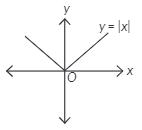
The function $f(x)$ is continuous everywhere but not differentiable at $x=0$ as at $x=0$
$L f^{\prime}(0)=\lim _{x \rightarrow 0^{-}} \frac{f(x)-f(0)}{x-0}$
$=\lim _{x \rightarrow 0} \frac{-x-0}{x}=-1$
$R f^{\prime}(0)=\lim _{x \rightarrow 0^{+}} \frac{f(x)-f(0)}{x-0}$
$=\lim _{x \rightarrow 0} \frac{x-0}{x}=1$
$\therefore L f^{\prime}(0) \neq R f^{\prime}(0),$
so $f(x)$ is not differentiable at $x=0$. View full question & answer→MCQ 1891 Mark
The value of $k$ for which $f(x)=\left\{\begin{array}{cc}3 x+5, & x \geq 2 \\ k x^2, & x<2\end{array}\right.$ is a continuous functions, is:
- A
$-\frac{11}{4}$
- B
$\frac{4}{11}$
- C
- D
$\frac{11}{4}$
AnswerGiven Function is
$f(x)=\left\{\begin{array}{cc}
3 x+5, & x \geq 2 \\
k x^2, & x<2
\end{array}\right.
$
For a function $f(x)$ to be continuous at $x=a$,
L.H.L of $f(x)$ at $a=$ R.H.L. of $f(x)$ at $a$
i.e., $\lim _{x \rightarrow a^{-}} f(x)=\lim _{x \rightarrow a^{+}} f(x)$
$\Rightarrow \quad \lim _{h \rightarrow 0} k(2-h)^2=\lim _{h \rightarrow 0} 3(2+h)+5 \Rightarrow 4 \times k=11 \Rightarrow k=\frac{11}{4}
$
View full question & answer→MCQ 1901 Mark
The value of $k$ for which the function $f(x)=\left\{\begin{array}{cll}\frac{1-\cos 4 x}{8 x^2}, & \text { if } & x \neq 0 \\ k, & \text { if } & x=0\end{array}\right.$ is continuous at $x=0$ is
AnswerGiven, the function $f$ is continuous at $x=0$.
$\therefore \lim _{x \rightarrow 0} f(x)=f(0)$.
Now, $\lim _{x \rightarrow 0} f(x)$
$=\lim _{x \rightarrow 0} \frac{1-\cos 4 x}{8 x^2}$
$=\lim _{x \rightarrow 0} \frac{2 \sin ^2 2 x}{8 x^2}$
$=\lim _{x \rightarrow 0} \frac{\sin ^2 2 x}{4 x^2}$
$=\lim _{x \rightarrow 0}\left(\frac{\sin 2 x}{2 x}\right)^2=1$
Also, $f(0)=k$
Hence $k=1$
View full question & answer→MCQ 1911 Mark
If $y=\log _e\left(\frac{x^2}{e^2}\right)$, then $\frac{d^2 y}{d x^2}$ equals
- A
$-\frac{1}{x}$
- B
$-\frac{1}{x^2}$
- C
$\frac{2}{x^2}$
- ✓
$-\frac{2}{x^2}$
AnswerCorrect option: D. $-\frac{2}{x^2}$
We have, $y=\log _e\left(\frac{x^2}{e^2}\right)$
$\therefore \frac{d y}{d x}=\frac{e^2}{x^2} \cdot \frac{1}{e^2} \cdot 2 x=\frac{2}{x} $
$\Rightarrow \frac{d^2 y}{d x^2}=-\frac{2}{x^2}$
View full question & answer→MCQ 1921 Mark
If $\sec ^{-1}\left(\frac{1+x}{1-y}\right)=a$, then $\frac{d y}{d x}$ is equal to
- A
$\frac{x-1}{y-1}$
- B
$\frac{x-1}{y+1}$
- C
$\frac{y-1}{x+1}$
- D
$\frac{y+1}{x-1}$
AnswerGiven, $\sec ^{-1}\left(\frac{1+x}{1-y}\right)=a \Rightarrow \sec a=\frac{1+x}{1-y}$
On differentiating, we get
$\frac{(1-y)+(1+x) \frac{d y}{d x}}{(1-y)^2}=0 \Rightarrow(1+x) \frac{d y}{d x}=y-1 \Rightarrow \frac{d y}{d x}=\frac{y-1}{1+x}
$
View full question & answer→MCQ 1931 Mark
If $x=f(t)$ and $y=g(t)$ are differentiable functions of $t$, then $\frac{d^2 y}{d x^2}$ is
- ✓
$\frac{f^{\prime}(t) \cdot g^{\prime \prime}(t)-g^{\prime}(t) \cdot f^{\prime \prime}(t)}{\left[f^{\prime}(t)\right]^3}$
- B
$\frac{f^{\prime}(t) \cdot g^{\prime \prime}(t)-g^{\prime}(t) \cdot f^{\prime \prime}(t)}{\left[f^{\prime}(t)\right]^2}$
- C
$\frac{g^{\prime}(t) \cdot f^{\prime \prime}(t)-f^{\prime}(t) \cdot g^{\prime \prime}(t)}{\left[f^{\prime}(t)\right]^3}$
- D
$\frac{g^{\prime}(t) \cdot f^{\prime \prime}(t)+f^{\prime}(t) \cdot g^{\prime \prime}(t)}{\left[f^{\prime}(t)\right]^3}$
AnswerCorrect option: A. $\frac{f^{\prime}(t) \cdot g^{\prime \prime}(t)-g^{\prime}(t) \cdot f^{\prime \prime}(t)}{\left[f^{\prime}(t)\right]^3}$
(a) : We have, $x=f(t), y=g(t)$
$
\Rightarrow \quad \frac{d x}{d t}=f^{\prime}(t) \text { and } \frac{d y}{d t}=g^{\prime}(t)
$
Now, $\frac{d y}{d x}=\frac{\frac{d y}{d t}}{\frac{d x}{d t}}=\frac{g^{\prime}(t)}{f^{\prime}(t)}$
$
\begin{aligned}
\Rightarrow \quad \frac{d^2 y}{d x^2} & =\frac{f^{\prime}(t) \cdot g^{\prime \prime}(t)-g^{\prime}(t) \cdot f^{\prime \prime}(t)}{\left(f^{\prime}(t)\right)^2} \cdot \frac{d t}{d x} \\
& =\frac{f^{\prime}(t) \cdot g^{\prime \prime}(t)-g^{\prime}(t) \cdot f^{\prime \prime}(t)}{\left(f^{\prime}(t)\right)^2} \cdot \frac{1}{f^{\prime}(t)} \\
& =\frac{f^{\prime}(t) \cdot g^{\prime \prime}(t)-g^{\prime}(t) f^{\prime \prime}(t)}{\left(f^{\prime}(t)\right)^3}
\end{aligned}
$
View full question & answer→MCQ 1941 Mark
If the function $f(x)=\left\{\begin{array}{l}\frac{\left(e^{k x}-1\right) \tan k x}{4 x^2}, x \neq 0 \\ 16, x=0\end{array}\right.$ is continuous at $x=0$, then $k=$
- A
$\pm \frac{1}{8}$
- B
$\pm 4$
- C
$\pm 2$
- ✓
$\pm 8$
AnswerCorrect option: D. $\pm 8$
Since, $f(x)$ is continuous at $x=0$.
$\therefore \lim _{x \rightarrow 0} f(x)=f(0)$
$\Rightarrow \lim _{x \rightarrow 0} \frac{\left(e^{k x}-1\right) \tan k x}{4 x^2}=16$
$\Rightarrow \frac{1}{4} \lim _{x \rightarrow 0} \frac{\left(e^{k x}-1\right)}{k x} \times \frac{\tan k x}{k x} \times k^2=16$
$\Rightarrow \frac{k^2}{4} \times 1 \times 1=16$
$\Rightarrow k^2=64 $
$\Rightarrow k= \pm 8$
View full question & answer→MCQ 1951 Mark
If $f(x)=\left\{\begin{array}{l}x, \text { if } x \leq 1 \\ 7, \text { if } x > 1\end{array}\right.,$ then
- A
$\lim _{x \rightarrow 1^{-}} f(x)=7$
- B
$f$ is continuous at $x=1$
- C
$\lim _{x \rightarrow 1^{+}} f(x)=1$
- ✓
$f$ is discontinuous at $x=1$
AnswerCorrect option: D. $f$ is discontinuous at $x=1$
$f(1)=1$
$\lim _{x \rightarrow 1^{-}} f(x)=\lim _{x \rightarrow 1} x=1, \lim _{x \rightarrow 1^{+}} f(x)$
$=\lim _{x \rightarrow 1} 7=7$
Since, $f(1) \neq \lim _{x \rightarrow 1^{+}} f(x)$
$\therefore f$ is discontinuous at $x=1$
View full question & answer→MCQ 1961 Mark
Determine the value of $k$ for which the function $f(x)$ is continuous at $x=4$.
$f(x)=\left\{ \frac{x^2-16}{x-4}, x \neq 4 k, x=4 \right.$
AnswerSince $f(x)$ is continuous at $x=4$. Therefore,
$\lim _{x \rightarrow 4} f(x)=f(4)$
$\Rightarrow \lim _{x \rightarrow 4} f(x)=k \quad[\because f(4)=k]$
$\Rightarrow \lim _{x \rightarrow 4} \frac{x^2-16}{x-4}=k$
$\Rightarrow \lim _{x \rightarrow 4} \frac{(x-4)(x+4)}{x-4}=k$
$\Rightarrow \lim _{x \rightarrow 4}(x+4)=k$
$\Rightarrow k=8$
View full question & answer→MCQ 1971 Mark
If $u=x^2+y^2$ and $x=s+3 t, y=2 s-t$, then $\frac{d^2 u}{d s^2}$ is equal to
AnswerGiven, $u=x^2+y^2, x=s+3 t, y=2 s-t$
$\Rightarrow \frac{d x}{d s}=1, \frac{d y}{d s}=2$
$\text { Now, } u=x^2+y^2$
$\Rightarrow \frac{d u}{d s}=2 x \frac{d x}{d s}+2 y \frac{d y}{d s}=2 x+4 y$
$\Rightarrow \frac{d^2 u}{d s^2}=2\left(\frac{d x}{d s}\right)+4\left(\frac{d y}{d s}\right)$
$\Rightarrow \frac{d^2 u}{d s^2}=2(1)+4(2)=10$
View full question & answer→MCQ 1981 Mark
Let $y=t^{10}+1$ and $x=t^8+1$, then $\frac{d^2 y}{d x^2}$ is equal to
- A
$\frac{5}{2} t$
- ✓
$\frac{5}{16 t^6}$
- C
$20 t^8$
- D
AnswerCorrect option: B. $\frac{5}{16 t^6}$
We have, $y=t^{10}+1, x=t^8+1$
$\Rightarrow \frac{d y}{d t}=10 t^9, \frac{d x}{d t}=8 t^7$
$\therefore \frac{d y}{d x}=\frac{d y / d t}{d x / d t}=\frac{10 t^9}{8 t^7}=\frac{5}{4} t^2$
$\Rightarrow \frac{d^2 y}{d x^2}=\frac{5}{4}(2 t) \frac{d t}{d x}$
$=\frac{5}{4} \times 2 t \times \frac{1}{8 t^7}$
$=\frac{5}{16 t^6}$
View full question & answer→MCQ 1991 Mark
The derivative of $e^{x^3}$ with respect to $\log x$ is
- A
$e^{x^3}$
- B
$3 x^2 2 e^{x^3}$
- ✓
$3 x^3 e^{x^3}$
- D
$3 x^2 e^{x^3}+3 x^2$
AnswerCorrect option: C. $3 x^3 e^{x^3}$
Differentiating $\text{w.r.t. x}$, we get
$\frac{d y}{d x}=e^{x^3}\left(3 x^2\right)=3 x^2 e^{x^3} \text { and } \frac{d z}{d x}=\frac{1}{x}$
$\therefore \frac{d y}{d z}=\frac{\frac{d y}{d x}}{\frac{d z}{d x}}=\frac{3 x^2 e^{x^3}}{\left(\frac{1}{x}\right)}=3 x^3 e^{x^3}$
View full question & answer→MCQ 2001 Mark
If $x^y=e^{x-y}$, then $\frac{d y}{d x}$ is
AnswerCorrect option: C. $\frac{\log x}{(1+\log x)^2}$
(c) : We have, $x^y=e^{x-y}$
Taking $\log$ on both sides, we get
$
y \log x=(x-y) \log e \Rightarrow y=\frac{x}{1+\log x}
$
Differentiating w.r.t. $x$, we get
$
\frac{d y}{d x}=\frac{(1+\log x)-x \cdot \frac{1}{x}}{(1+\log x)^2}=\frac{\log x}{(1+\log x)^2}
$
View full question & answer→