Questions · Page 3 of 5

5 Marks Questions

Question 1015 Marks
Maximum Z = 4x + 3y
Subject to
$3\text{x}+4\text{y}\leq24$
$8\text{x}+6\text{y}\leq48$
$\text{x}\leq5$
$\text{y}\leq6$
$\text{x},\text{y}\geq0$
Answer
We need to maximize Z= 4x + 3y
First, we will convert the given inequations into equations, we obtain the following equations:
3x + 4y = 24, 8x + 6y = 48, x = 5, y = 6, x = 0 and y = 0.
The line 3x + 4y = 24 meets the coordinate axis at A(8, 0) and B(0, 6).
Join these points to obtain the line 3x + 4y = 24.
Clearly, (0, 0) satisfies the inequation $3\text{x}+4\text{y}\leq24$.
So, the region in xy-plane that contains the origin represents the solution set of the given equation.
The line 8x + 6y = 48 meets the coordinate axis at C(6, 0) and D(0, 8).
Join these points to obtain the line 8x + 6y = 48.
Clearly, (0, 0) satisfies the inequation $8\text{x}+6\text{y}\leq48$.
So, the region in xy-plane that contains the origin represents the solution set of the given equation.
x = 5 is the line passing through x = 5 parallel to the Y axis.
y = 6 is the line passing through y = 6 parallel to the X axis.
Region represented by $\text{x}\geq0$ and $\text{y}\geq0$: Since, every point in the first quadrant satisfies these inequations.
So, the first quadrant is the region represented by the inequations.
These lines are drawn using a suitable scale.
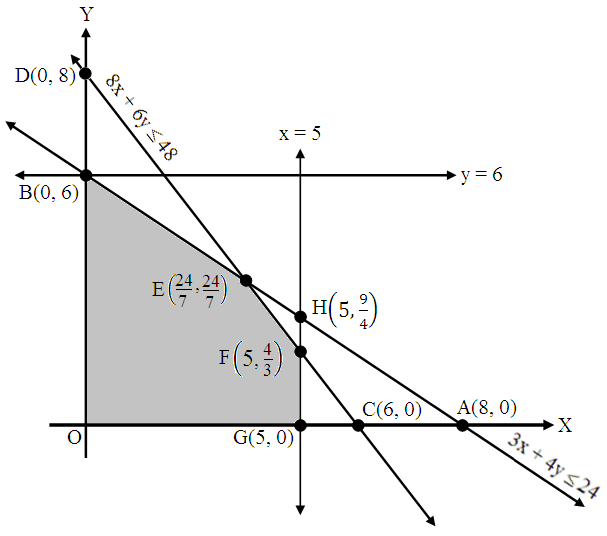
The corner points of the feasible region are O(0, 0), G(5, 0), $\text{F}\Big(5,\frac{4}{3}\Big),\text{E}\Big(\frac{24}{7},\frac{24}{7}\Big)$ and B(0, 6).
The values of Z at these corner points are as follows.
$\text{Corner point}$ $\text{Z}=4\text{x}+3\text{y}$
$\text{O}(0, 0)$ $4\times0+3\times0=0$
$\text{G}(5, 0)$ $4\times5+3\times0=20$
$\text{F}\Big(5,\frac{4}{3}\Big)$ $4\times5+3\times\frac{4}{3}=24$
$\text{E}\Big(\frac{24}{7},\frac{24}{7}\Big)$ $4\times\frac{24}{7}+3\times\frac{24}{7}=\frac{196}{7}=24$
$\text{B}(0, 6)$ $4\times0+3\times6=18$
We see that the maximum value of the objective function Z is 24 which is at $\text{F}\Big(5,\frac{4}{3}\Big)$ and $\text{E}\Big(\frac{24}{7},\frac{24}{7}\Big)$.
Thus. the optimal value of is 24.
View full question & answer
Question 1025 Marks
A small manufacturing firm produces two types of gadgets A and B, which are first processed in the foundry, then sent to the machine shop for finishing. The number of man-hours of labour required in each shop for the production of each unit of A and B, and the number of man-hours the firm has available per week are as follows:
Gadget
Fondry
Machine-shop
A
B
10
6
5
4
Firm's capacity per week
1000
600
The profit on the sale of A is Rs. 30 per unit as compared with Rs. 20 per unit of B. The problem is to determine the weekly production of gadgets A and B, so that the total profit is maximized. Formulate this problem as a LPP.
Answer
The given data may be put in the following tabular from:-
Gadget
Fondry
Machine-shop
Profit
A
B
10
6
5
4
Rs. 30
Rs. 20
Firm's capacity per week
1000
600
 
Let required weekly production of gadgets A and B be x and y respectively.
Given that, profit on each gadget A is Rs 30
So, profit on x gadget of type A = 30x
Profit on each gadget of type B = Rs. 20
So, profit on y gadget of type B = 20y
Let Z denote the total profit, so
Z = 30x + 20y
Given, production of one gadget A requires 10 hours per week for foundry and gadget B requires 6 hours per week for foundry.
So, x units of gadget A requires 10x hours per week and y units of gadget B requires by hours per week, But the maximum capacity of foundry per week is 1000 hours, so
10x + 6y s 1000
This is first constraint.
Given, production of one unit gadget A requires 5 hours per week of machine shop and production of one unit of gadget B requires 4 hours per week of machine shop.
So, x units of gadget A requires 5x hours per week and y units of gadget B requires 4y hours per week, but the maximum capacity of machine shop is 600
hours per week.
So, 5x + 4y = 600
This is second constraint.
Hence, mathematical formulation of LPP is:
Find x and y which
Maximize Z = 30x + 2y
Subject to constraints,
10x + 6y ≤ 1000
5x + 4y ≤ 600
And, x, y ≥ 0 [Since production cannot be less than zero]
View full question & answer
Question 1035 Marks
A library has to accommodate two different types of books on a shelf. The books are 6 cm and 4 cm thick and weigh 1kg and $1\frac{1}{2}$ kg each respectively. The shelf is 96 cm long and at most can support a weight of 21kg. How should the shelf be filled with the books of two types in order to include the greatest number of books? Make it as an LPP and solve it graphically.
Answer
Let x books of first type and y books of second type were accommodated. Number of books cannot be negative.

Therefore, x, y ≥ 0

According to question, the given information can be tabulated as:
  Thickness(cm) Weight(kg)
First type(x) 6 1
Second type(v) 4 1.5
Capacity of shelf 96 21
Therefore, the constraints

6x + 4y ≤ 96

x + 1.5y ≤ 21

Number of books = Z = x + y which is to be maximised

Thus, the mathematical formulation of the given linear programmimg problem is

Max Imize Z = x + y

Subject to

6x + 4y ≤ 96

x + 1.5y ≤ 21

First we will convert inequations into equations as follows:

6x + 4y = 96, x + 1.5y = 21, x = 0 and y = 0

Region represented by 6x + 4y ≤ 96:

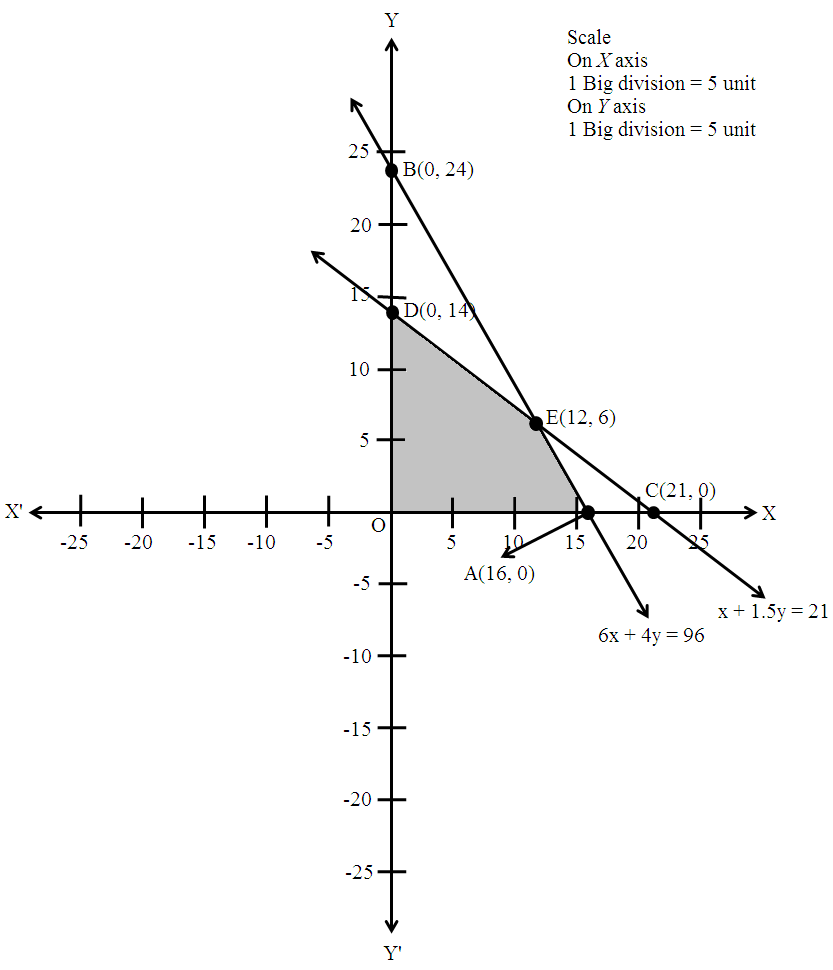
The line 6x + 4y = 96 meets the coordinate axes at A(16, 0) and B(O, 24) respectively.

By joining these points we obtain the line 6x + 4y = 96.

Clearly (0, 0) satisfies the 6x + 4y = 96.

So, the region which contains the origin represents the solution set of the inequation 6x + 4y ≤ 96.

Region represented by x + 1.5y ≤ 21:

The line x + 1.5y = 21 meets the coordinate axes at C(21, 0) and D(O, 14) respectively.

By joining these points we obtain the line x + 1.5y = 21.

Clearly (0, 0) satisfies the inequation x + 1.5y ≤ 21.

So, the region which contains the origin represents the solution set of the inequation x + 1.5y ≤ 21.

Region represented by x ≥ 0 and y ≥ 0:

Since, every point in the first quadrant satisfies these inequations.

So, the first quadrant is the region represented by the inequations x ≥ 0, and y ≥ 0.

The feasible region determined by the system of constraints 6x + 4y ≤ 96, x + 1.5y ≤ 21, x ≥ 0 and y ≥ 0 are as follows.


The corner points are O(0, 0), D(0, 14), E(12, 6), A(16,0)

The values of Z at these corner points are as follows.
Corner point
Z = x + y
O
0
D
14
E
18
A
16
The maximum value of Z is 18 which is attained at E(12, 6).

Thus, maximum number of books that can be arranged on shelf is 18 where 12 books are of first type and 6 books are the other type.
View full question & answer
Question 1045 Marks
A company produces two types of leather belts, say type A and B. Belt A is a superior quality and belt B is of a lower quality. Profits on each type of belt are Rs. 2 and Rs. 1.50 per belt, respectively. Each belt of type A requires twice as much time as required by a belt of type B. If all belts were of type B, the company could produce 1000 belts per day. But the supply of leather is sufficient only for 800 belts per day (both A and B combined). Belt A requires a fancy buckle and only 400 fancy buckles are available for this per day. For belt of type B, only 700 buckles are available per day.
How should the company manufacture the two types of belts in order to have a maximum overall profit?
Answer
Let the company produces x belts of type A and y belts of type B.
Number of belts cannot be negative.
Therefore, $\text{x},\text{y}\geq0$
It is given that leather is sufficient only for 800 belts per day (both A and B combined).
Therefore, $\text{x}+\text{y}\leq800$
It is given that the rate of production of belts of type B is 1000 per day.
Hence, the time taken to produce y belts of type B is $\frac{\text{y}}{1000}$
And, since each belt of type A requires twice as much time as a belt of type B, the rate of production of belts of type A is 500 per day and therefore, total time taken to produce x belts of type A is *
Thus, we have
$\frac{\text{x}}{500},\frac{\text{y}}{1000}\leq1$
$\Rightarrow2\text{x}+\text{y}\leq1000$
Belt A requires a fancy buckle and only 400 fancy buckles are available for this per day.
$\text{x}\leq400$
For belt of type B, only 700 buckles are available per day.
$\text{y}\leq700$
Profits on each type of belt are Rs. 2 and Rs. 1.50 per belt, respectively.
Therefore, profit gained on x belts of type A and y belts of type B is Rs. 2x and Rs. 1.50 yrespectively.
Hence, the total profit would be Rs. (2x + 1.50y).
Let Z denote the total profit.
$Z = 2x + 1.5y$
Thus, the mathematical formulation of the given linear programming problem is Max $Z = 2x + 1.5y$
Subject to
Max $Z = 2x + 1.5y$
Subject to
$\text{x}+\text{y}\leq800$
$2\text{x}+\text{y}\leq1000$
$\text{x}\leq400$
$\text{y}\leq700$
$\text{x},\text{y}\geq0$
First we will convert inequations into equations as follows:
$x + y = 800$
$2x + y = 1000$
$x = 400$
$y = 700$
$x = 0$
$y = 0$
Region represented by $\text{x}+\text{y}\leq800$:
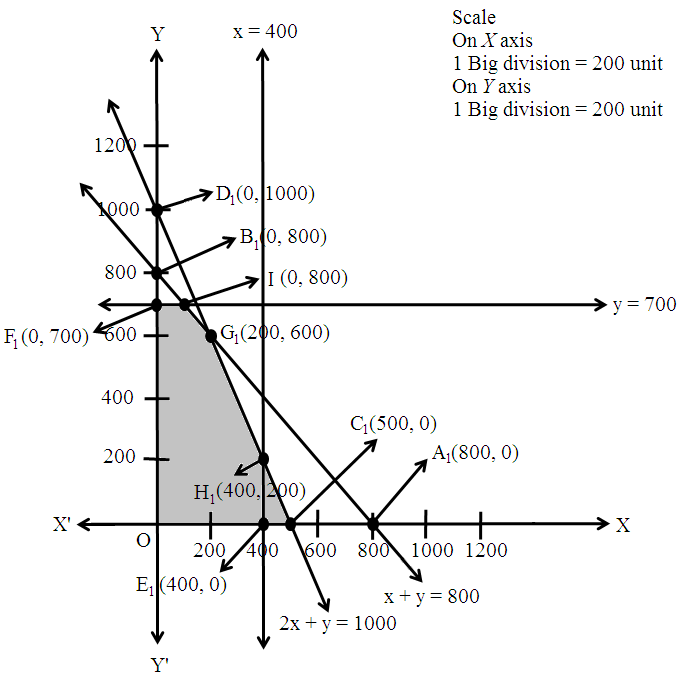
The line x + y = 800 meets the coordinate axes at $A_1(800, 0)$ and $B_1(0, 800)$ respectively.
By joining these points we obtain the line $x + y = 800.$
Clearly (0, 0) satisfies the $x + y = 800.$
So, the region which contains the origin represents the solution set of the inequation $\text{x}+\text{y}\leq800$.
Region represented by $2\text{x}+\text{y}\leq1000$:
The line 2x + y = 1000 meets the coordinate axes at $C_1(500, 0)$ and $D_1(0, 1000)$ respectively.
By joining these points we obtain the line $2x + y = 1000.$
Clearly (0, 0) satisfies the inequation $2\text{x}+\text{y}\leq1000$.
So,the region which contains the origin represents the solution set of the inequation $2\text{x}+\text{y}\leq1000$
Region represented by $\text{x}\leq400$:
The line x = 400 will pass through $E_1(400, 0).$
The region to the left of the line x = 400 will satisfy the inequation $\text{x}\leq400$.
Region represented by $\text{y}\leq700$:
The line y = 700 will pass through $F_1(0, 700).$
The region below the line $\text{y}\leq700$ will satisfy the inequation $\text{y}\leq700$.
Region represented by $\text{x}\geq0$ and $\text{y}\geq0$:
Since, every point in the first quadrant satisfies these inequations.
So, the first quadrant is the region represented by the inequations $\text{x}\geq0$, and $\text{y}\geq0$.
The feasible region determined by the system of constraints $\text{x}+\text{y}\leq800,2\text{x}+\text{y}\leq1000,\text{x}\leq400,\text{y}\leq700,\text{x}\geq0$ and $\text{y}\geq0$ are as follows.
The feasible region determined by the system of constraints is:

The corner points are $F_1(0, 700), G_1(200, 600), H_1(400, 200)$ and $E_1(400, 0).$
The values of Z at these corner points are as follows.
Corner point
$Z = 2x + 1.5y$
$F_1(0, 700)$
$1050$
$G_1(200, 600)$
$1300$
$H_1(400, 200)$
$1100$
$E_1(400, 0)$ $800$
The maximum value of Z is $1300$ which is attained at $G_1(200, 600).$
Thus, the maximum profit is Rs. $1300 $ obtained when 200 belts of type A and $600$ belts of type $8$ were produced.
View full question & answer
Question 1055 Marks
Reshma wishes to mix two types of food P and Q in such a way that the vitamin contents of the mixture contains at least 8 units of vitamin A and 11 units of vitamin B. Food P costs Rs 60/kg and food Q costs Rs 80/kg. Food P contains 3 units/kg of vitamin A and 5 units/kg of vitamin B while food Q contains 4 units/kg of vitamin A and 2 units/kg of vitamin B. Determine the minimum cost of the mixture.
Answer
Let x units of food P and y units of food Q are mixed together to make the mixture.

The cost of food P is Rs. 60/kg and that of Q is Rs. 80/kg.

So, x kg of food P and ykg of food Q will cost Rs. (60x+ 80y).

Since one kg of food P contains 3 units of vitamin A and one kg of food Q contains 4 units of vitamin A, therefore, x kg of food P and y kg of food Q will contain (3x+4y) units of vitamin A.

But, the mixture should contain atleast 8 units of vitamin A.

$3\text{x}+4\text{y}\geq8$

Similarly, x kg of food and y kg of food Q will contain (5x + 2y) units of vitamin B.

But, the mixture should contain atleast 11 units of vitamin B. 5x+ 2y 11.

Thus, the given linear programming problem is Minimise Z = 60x + 80y

Subject to the constraints

$3\text{x}+4\text{y}\geq8$

$5\text{x}+2\text{y}\geq11$

$\text{x},\text{y}\geq0$

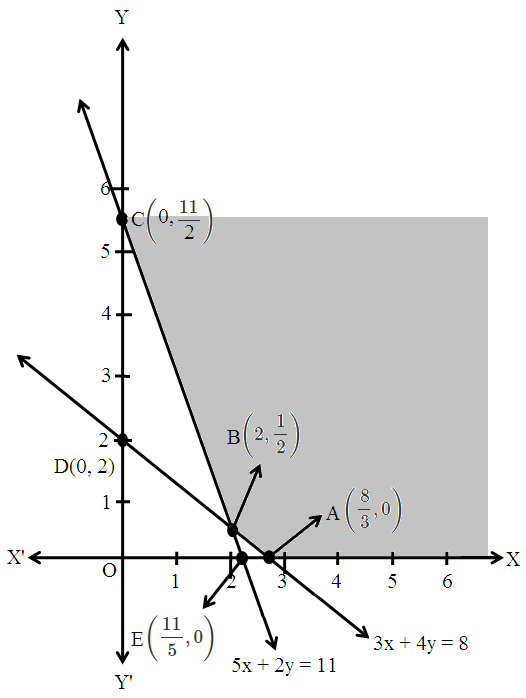
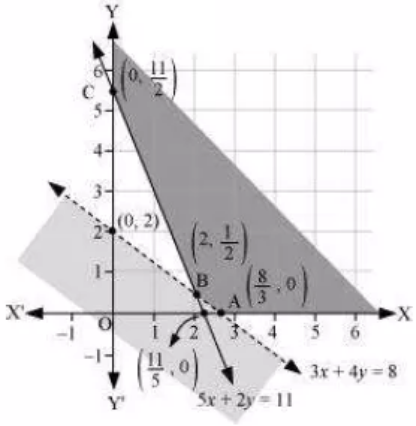
The feasible region determined by the given constraints can be diagrammatically represented as,


The coordinates of the corner points of the feasible region are points of the feasible region are $\text{A}\Big(\frac{8}{3},0\Big)\text{B}\Big(2,\frac{1}{2}\Big)$ and $\text{C}\Big(0,\frac{11}{2}\Big)$.

The value of the objective function at these points are given in the following table.
$\text{Corner point}$ $\text{Z}=60\text{x}+80\text{y}$
$\Big(\frac{8}{3},0\Big)$ $60\times\frac{8}{3}+80\times0=160\rightarrow\text{Minimum}$
$\Big(2,\frac{1}{2}\Big)$ $60\times2+80\times\frac{1}{2}=160\rightarrow\text{Minimum}$
$\Big(0,\frac{11}{2}\Big)$ $60\times0+80\times\frac{11}{2}=440$
The smallest value of Z is 160 which is obtained at the points $\Big(\frac{8}{3},0\Big)$ and $\Big(2,\frac{1}{2}\Big)$.

It can be verified that the open half-plane represented by $60\text{x}+80\text{y}\leq160$ has no common points with the feasible region.

So, the minimum value of Z is 160.

Hence, the minimum cost of the mixture is Rs. 160.
View full question & answer
Question 1065 Marks
Maximum Z = x - 5y + 20
Subject to
$\text{x}-\text{y}\geq0$
$-\text{x}+2\text{y}\geq2$
$\text{x}\geq3$
$\text{y}\geq4$
$\text{x},\text{y}\geq0$
Answer
First, we will convert the given inequations into equations, we obtain the following equations:

x - y = 0, -x + 2y = 2, x = 3, y = 4, x = 0 and y = 0.

Region represented by $\text{x}-\text{y}\geq0$ or $\text{x}\geq\text{y}$:

The line x - y = 0 or x = y passes through the origin.

The region to the right of the line x = y will satisfy the given inequation.

Let's check by taking an example like if we take a point (4, 3) to the right of the line x = y.

Here $\text{x}\geq\text{y}$.

So, it satisfy the given inequation.

Take a point (4, 5) to the left of the line x = y.

Here, $\text{x}\leq\text{y}$.

That means it does not satisfy the given inequation.

Region represented by $-\text{x}+2\text{y}\geq2$:

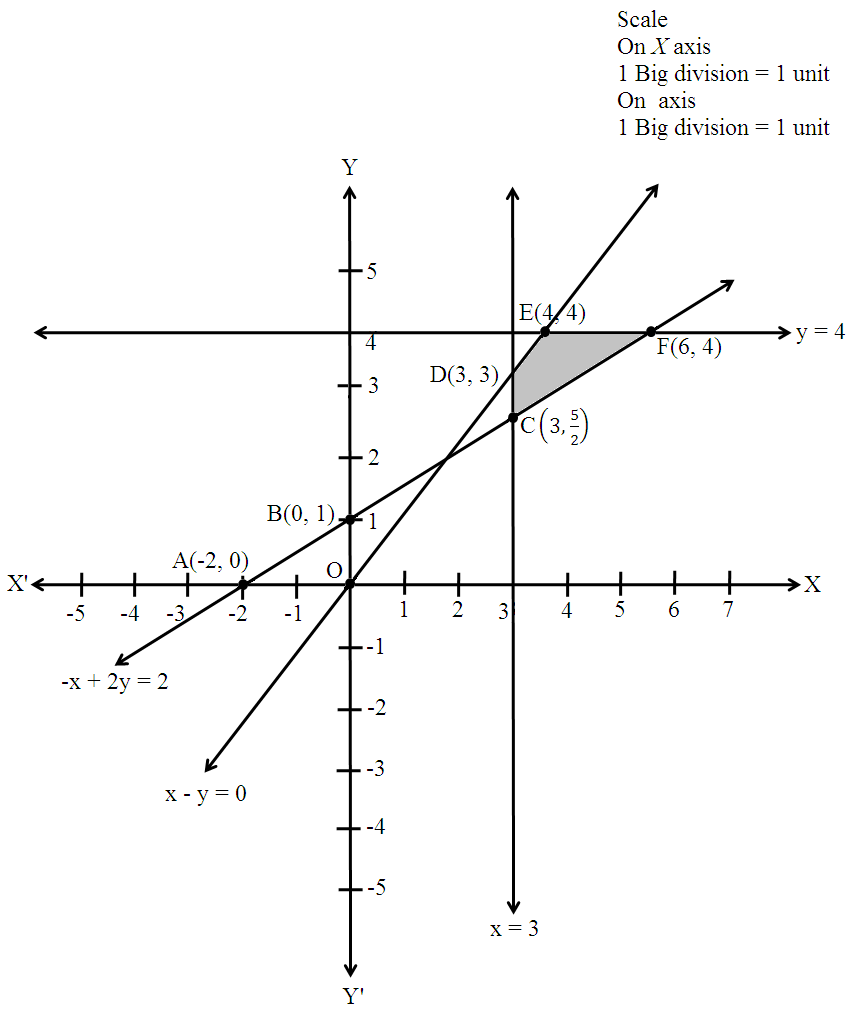
The line -x + 2y = 2 meets the coordinate axes at A(-2, 0) and B(0, 1) respectively.

By joining these points we obtain the line - x + 2y = 2.

Clearly (0, 0) does not satisfies the inequation $-\text{x}+2\text{y}\geq2$.

So, the region in xy plane which does not contain the origin represents the solution set of the inequation $-\text{x}+2\text{y}\geq2$.

The line x = 3 is the line that passes through the point (3, 0) and is parallel to Y axis. $\text{x}\geq3$ is the region to the right of the line x = 3.

The line y = 4 is the line that passes through the point (0, 4) and is parallel to X axis. $\text{y}\geq4$ is the region below the line y = 4.

Region represented by $\text{x}\geq0$ and $\text{y}\geq0$:

Since, every point in the first quadrant satisfies these inequations.

So, the first quadrant is the region represented by the inequations $\text{x}\geq0$ and $\text{y}\geq0$.

The feasible region determined by the system of constraints $\text{x}-\text{y}\geq0,-\text{x}+2\text{y}\geq2,\text{x}\geq3,\text{y}\geq4,\text{x}\geq0,$and $\text{y}\geq0$ are as follows.


The corner points of the feasible region are $\text{C}\Big(3,\frac{5}{2}\Big),\text{D}(3, 3),\text{E}(4, 4)$ and $\text{F}(6, 4)$.

The values of Z at these corner points are as follows.
$\text{Corner point}$
$\text{Z}=\text{x}-5\text{y}+20$
$\text{C}\Big(3,\frac{5}{2}\Big)$
$3-5\times\frac{5}{2}+20=\frac{21}{2}$
$\text{D}(3, 3)$
$3-5\times3+20=8$
$\text{E}(4, 4)$
$4-5\times4+20=4$
$\text{F}(6, 4)$
$6-5\times4+20=6$
Therefore, the minimum value of Z is 4 at the point E(4, 4).

Hence, x = 4 and y = 4 is the optimal solution of the given LPP.

Thus, the optimal value of Z is 4.
View full question & answer
Question 1075 Marks
A factory makes tennis rackets and cricket bats. A tennis racket takes $1.5$ hours of machine time and $3$ hours of craftman's time in its making while a cricket bat takes $3$ hours of machine time and $1$ hour of craftman's time. In a day, the factory has the availability of not more than $42$ hours of machine time and $24$ hours of craftman's time.
  1. What number of rackets and bats must be made if the factory is to work at full capacity?
  2. If the profit on a racket and on a bat is Rs. $20$ and Rs. $10$ respectively, find the maximum profit of the factory when it works at full capacity.
Answer
Let $x$ number of tennis rackets and y number of cricket bats were sold.
Number of tennis rackets and cricket balls cannot be negative.
Therefore, $x \geq 0, y \geq 0$
It is given that a tennis racket takes $1.5$ hours of machine time and $3$ hours of craftman's time in its making while a cricket bat takes 3 hours of machine time and $1$ hour of craftman's time.
Also, the factory has the availability of not more than $42$ hours of machine time and $24$ hours of craftman's time.
Therefore,
$1.5 x$ plus $3 y$ less or equal than $42$
$3 x$ plus $y$ less or equal than $24$
If the profit on a racket and on a bat is Rs. $20$ and Rs. $10$ respectively.
Therefore, profit made on x tennis rackets and y cricket bats is Rs. $20x$ and Rs. $10y$ respectively.
Total profit $= Z = 20x + 10y$
The mathematical form of the given LPP is:
Maximize $Z = 20x + 10y$
Subject to constraints:
$1.5 x$ plus $3 y$ less or equal than $42$
$3 x$ plus $y$ less or equal than $24$
$x \geq 0, y \geq 0$
First we will convert inequations into equations as follows:
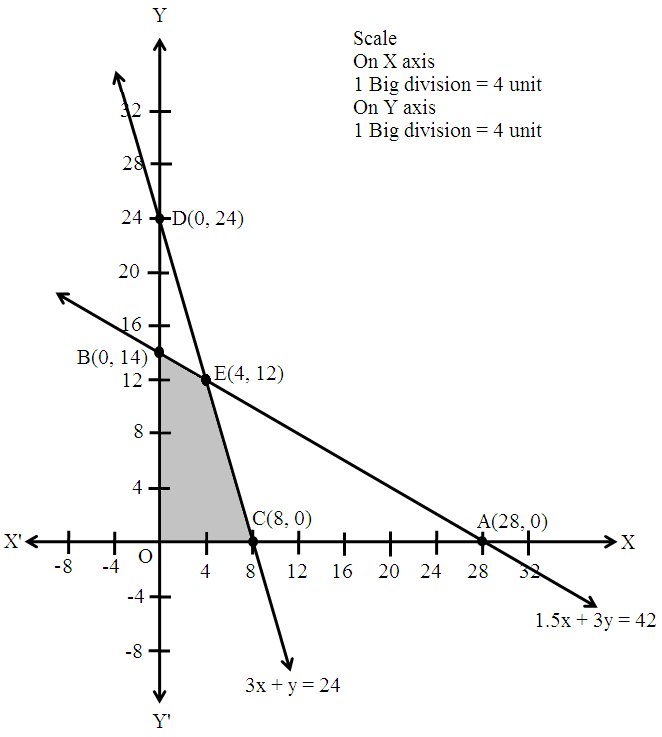
$1.5x + 3y = 42, 3x + y = 24, x = 0$ and $y = 0$
Region represented by $1.5x + 3y \leq 42:$
The line $1.5x + 3y = 42$ meets the coordinate axes at $A_1(28, 0)$ and $B_1(0, 14)$ respectively.
By joining these points we obtain the line $1.5x + 3y = 42.$
Clearly $(0, 0)$ satisfies the $1.5x + 3y = 42.$
So, the region which contains the origin represents the solution set of the inequation $1.5x + 3y \leq 42.$
Region represented by $3x + y \leq 24:$
The line $3x + y = 24$ meets the coordinate axes at $C_1(8,0)$ and $D_1(0, 24)$ respectively.
By joining these points we obtain the line $3x + y = 24.$
Clearly $(0, 0)$ satisfies the inequation $3x + y \leq 24.$
So the region which contains the origin represents the solution set of the inequation $3x + y \leq 24.$
Region represented by $x \geq 0$ and $y \geq 0:$
Since, every point in the first quadrant satisfies these inequations.
So, the first quadrant is the region represented by the inequations $x \geq 0$ and $y \geq 0.$
The feasible region determined by the system of constraints $1.5x + 3y \leq 42, 3x + y \leq 24, x \geq 0$ and $y \geq 0$ are as follows.

In the above graph, the shaded region is the feasible region.
The corner points are $O(0, 0), B_1(0, 14), E_1(04, 12),$ and $C_1(8, 0).$
The values of the objective function Z at corner points of the feasible region are given in the following table:
Corner Points
$Z = 20x + 10y$
 
$O(0, 0)$
$0$
 
$B_1(0, 14)$
$140$
 
$E_1(4, 12)$
$200$
Maximum
$C_1(8, 0)$
$160$
 
Clearly, $Z$ is maximum at $x = 4$ and $y= 12 $and the maximum value of $Z$ at this point is $200.$
Thus, maximum profit is of Rs. $200$ obtained when $4$ tennis rackets and $12$ cricket bats were sold.
 
View full question & answer
Question 1085 Marks
A manufacturing company makes two models $A$ and $B$ of a product. Each piece of model A requires $9$ labour hours for fabricating and $1$ labour hour for finishing. Each piece of model $B$ requires $12$ labour hours for fabricating and $3$ labour hours for finishing. For fabricating and finishing, the maximum labour hours available are $180$ and $30$ respectively. The company makes a profit of Rs. $8000$ on each piece of model $A$ and Rs. $12000$ on each piece of model $B$. How many pieces of model $A$ and model $B$ should be manufactured per week to realise a maximum profit? What is the maximum profit per week?
Answer
The given data can be written in the tabular form as follows:
Model
A
B
Maximum hours
Fabricating
$9$
$12$
$180$
Finishing
$1$
$3$
$30$
Profit
$8000$
$12000$
 
Let $x$ be the number of pieces of $A$ and $y$ be the number of pieces of $B$ manufactured to earn the maximum profit.
Then the mathematical model of the LPP is as follows:
Maximize $Z = 8000x + 12000$ Subject to $9x + 12y \leq 180, x + 3y \leq 30$ and $x \geq 0, y \geq 0.$
To solve the LPP We draw the lines, $9x + 12y = 180, x + 3y = 30$
The feasible region of the LPP is shaded in graph.


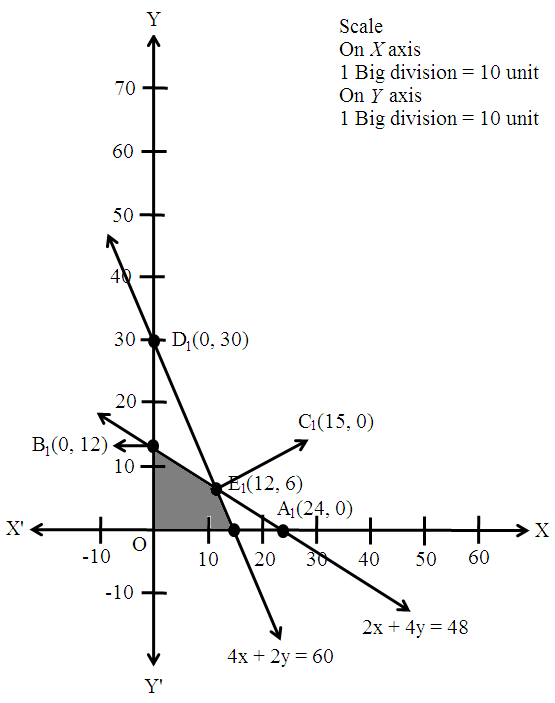
The coordinates of the vertices (Corner - points) of shaded feasible region $ABC$ are $A (20, 0), B(12,6)$ and $C(0, 10).$
The values of the objective of function at these points are given in the following table:
Paint $(X_1, X_1)$
Value of objective function $Z = 8,000x + 12,000y$
$A(20, 0)$
$Z = 1,60,000$
$B(12, 6)$
$Z = 1,68,000$
$C(0, 10)$
$Z = 1,20,000$
$12$ pieces of Model $A$ and $6$ pieces of Model $B$ should be eaned maximize the profit.
The maximum profit that can be eared is Rs. $1,68,000.$
 
View full question & answer
Question 1095 Marks
There are two types of fertilisers $F_1$ and $F_2. F_1$ consists of $10\%$ nitrogen and $6\%$ phosphoric acid and $F_2$ consists of $5\%$ nitrogen and $10\%$ phosphoric acid. After testing the soil conditions, a farmer finds that she needs atleast $14$ kg of nitrogen and $14$ kg of phosphoric acid for her crop. If $F_1$ costs Rs $6$/kg and $F2$ costs Rs $5$/kg, determine how much of each type of fertiliser should be used so that nutrient requirements are met at a minimum cost. What is the minimum cost?
Answer
Let the farmer buy $x$ kg of fertilizer $F_1$ and y kg of fertilizer $F_2.$ Therefore,
$\text{x}\ge0\text{ and y}\ge0$
The given information can be complied in a table as follows.
  Nitrogen (%) Phosphoric Acid (%) Cost (Rs/kg)
$F_1(x)$ $10$ $6$ $6$
$F_2(y)$ $5$ $10$ $5$
Requirement (kg) $14$ $14$  
$F_1$ consists of $10\%$ nitrogen and $F_2$ consists of $5\%$ nitrogen. However, the farmer requires at least $14$ kg of nitrogen.
$\therefore10\%\text{ of x}+5\%\text{ of y}\ge14$
$\frac{\text{x}}{10}+\frac{\text{y}}{20}\geq14$
$2\text{x}+\text{y}\ge280$
$F_1$ consists of $6\%$ phosphoric acid and $F_2$ consists of $10\%$ phosphoric acid. However, the farmer requires at least 14 kg of phosphoric acid.
farmer requires at least 14 kg of phosphoric acid.
$\therefore6\%\text{ of x}+10\%\text{ of y}\ge14$
$\frac{\text{6x}}{100}+\frac{\text{10y}}{100}\geq14$
$3\text{x}+56\text{y}\ge700$
Total cost of fertilizers, $Z = 6x + 5y$
The mathematical formulation of the given problem is Minimize $z = 6x + 5y ... (1)$
subject to the constraints,
$2\text{x}+\text{y}\ge280\dots(2)$
$3\text{x}+5\text{y}\ge700\dots(3)$
$\text{x},\ \text{y}\ge0\dots(4)$
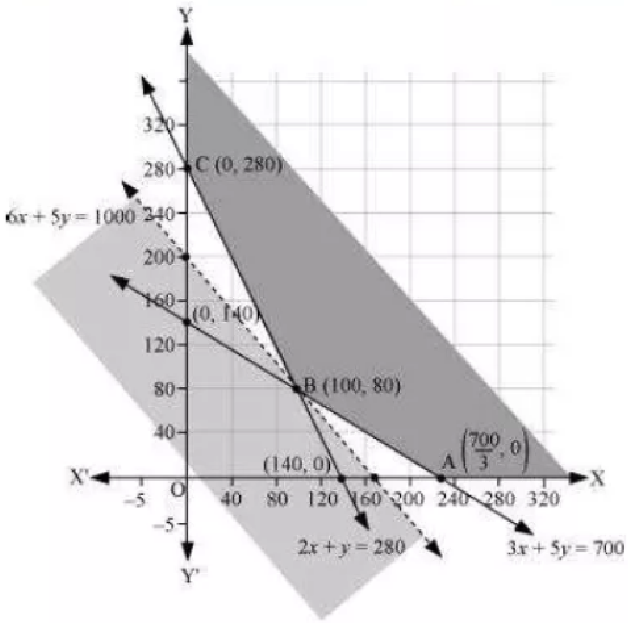
The feasible region determined by the system of constraints is as follows.

It can be seen that the feasible region ls unbounded.
The corner points are $\text{A}\Big(\frac{700}{3},\ 0\Big),\ \text{B}(100,\ 80),\ \text{and C}(0,\ 280).$
The values of $Z$ at these points are as follows.
Corner point $Z = 6x + 5y$  
$\text{A}\Big(\frac{700}{3},\ 0\Big)$ $1400$  
$B(100, 80)$ $1000$ \rightarrow Minimum
$C(0, 280)$ $1400$  
As the teasible region is unbounded, therefore, $1000$ mav or may not be the minimum value of $Z.$
For this, we draw a graph of the inequality, $6x + 5y < 1000$, and check whether the resulting half plane has points in common with the feasible region or not.
It can be seen that the feasible region has no common point with $6x + 5y < 1000$ Therefore, $100$ kg of fertiliser $F_1$ and $80$ kg of fertilizer $F_2$ should be used to minimize the cost. The minimurn cost is Rs $1000.$
View full question & answer
Question 1105 Marks
A diet of two foods $F_1$ and $F_2$ contains nutrients thiamine, phosphorous and iron.
The amount of each nutrient in each of the food $($in milligrams per $25$gms$) $is given in the following table:
Nutrients Food $F_1$ $F_2$
Thiamine $0.25$ $0.10$
Phosphorous $0.75$ $1.50$
Iron $1.60$ $0.80$
The minimum requirement of the nutrients in the diet are $1.00$mg of thiamine, $7.50$mg of phosphorous and $10.00$mg of iron.
The cost of $F_1$ is $20$  paise per $25$gms while the cost of $F_2$ is 15 paise per 25gms.
Find the minimum cost of diet.
Answer
Let $25x$ grams of food $F_1$ and $25y$ grams of food $F_2$ be used to fulfil the minimum requirement of thiamine, phosphorus and iron.
As, we are given,
Nutrients Food $F_1$ $F_2$
Thiamine $0.25$ $0.10$
Phosphorous $0.75$ $1.50$
Iron $1.60$ 0.80
And the minimum requirement of the nutrients in the diet are $1.00$mg of thiamine, $7.50$mg of phosphorous and $10.00$mg of iron.
Therefore, $0.25\text{x}+0.10\text{y}\geq1$
$0.75\text{x}+1.50\text{y}\geq7.5$
$1.6\text{x}+0.8\text{y}\geq10$
Since the quantity cannot be negative
$\therefore\text{x},\text{y}\geq0$
The cost of $F_1$ is 20 paise per $25$gms while the cost of $F_2$ is $15$ paise per $25$ gms.
Therefore, the cost of 25x grams of food $F_1$ and 25y grams of food $F_2$ is Rs. $(0.20x + 0.15y).$
Hence,
Minimize $Z = 0.20x + 0.15y$
Subject to
$0.25\text{x}+0.10\text{y}\geq1,0.75\text{x}+1.50\text{y}\geq7.5,$ $1.6\text{x}+0.8\text{y}\geq10,\text{x},\text{y}\geq0.$
First, we will convert the given inequations into equations, we obtain the following equations:
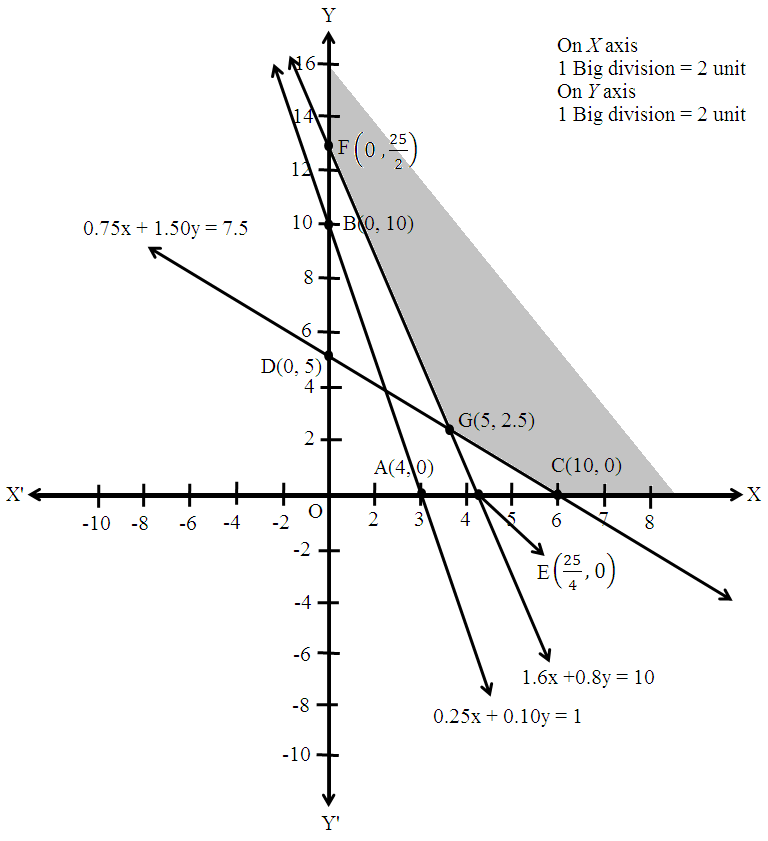
$0.25x + 0.10y = 1, 0.75x + 1.50y = 7.5, 1.6x + 0.8y = 10, x = 0$ and $y = 0.$
The line $0.25x + 0.10y = 1$ meets the coordinate axis at $A(4, 0)$ and $B(0, 10).$
Join these points to obtain the line $0.25x + 0.10y = 1.$
Clearly, $(0, 0) $ does not satisfies the inequation $0.25\text{x}+0.10\text{y}\geq1$.
So, the region in xy-plane that does not contains the origin represents the solution set of the given equation.
The line $0.75x + 1.50y = 7.5$. meets the coordinate axis at $C(10, 0)$ and $D(0, 5).$
Join these points to obtain the line $0.75x + 1.50y = 7.5.$
Clearly, $(0, 0)$ does not satisfies the inequation $0.75\text{x}+1.50\text{y}\geq7.5$.
So, the region in xyplane that does not contains the origin represents the solution set of the given equation.
The line $1.6x + 0.8y = 10$ meets the coordinate axis at $\text{E}\Big(\frac{25}{4},0\Big)$ and $\text{F}\Big(0,\frac{25}{2}\Big).$
Join these points to obtain the line $1.6x + 0.8y = 10.$
Clearly, $(0, 0)$ does not satisfies the inequation $1.6\text{x}+0.8\text{y}\geq10$.
So, the region in xy-plane that does not contains the origin represents the solution set of the given equation.
Region represented by $\text{x}\geq0$ and $\text{y}\geq0$:
Since, every point in the first quadrant satisfies these inequations.
So, the first quadrant is the region represented by the inequations.
These lines are drawn using a suitable scale.

The corner points of the feasible region are $F(0, 12.5), G(5, 2.5), C(10, 0)$
The value of the objective function at these points are given by the following table:
Points Value of Z
$F$ $0.20(0) + 0.15(12.5) = 1.875$
$G$ $0.20(5) + 0.15(2.5) = 1.375$
$C$ $0.20(10) + 0.15(0) = 200$
Thus, the minimum cost is at $G$ which is Rs. $1.375.$
View full question & answer
Question 1115 Marks
Reshma wishes to mix two types of food P and Q in such a way that the vitamin contents of the mixture contain at least 8 units of vitamin A and 11 units of vitamin B. Food P costs Rs 60/kg and Food Q costs Rs 80/kg. Food P contains 3 units/kg of Vitamin A and 5 units/kg of Vitamin B while food Q contains 4 units/kg of Vitamin A and 2 units/kg of vitamin B. Determine the minimum cost of the mixture?
Answer
Let the mixture contain x kg of food P and y kg of food Q. Therefore,
$\text{x}\geq0\text{ and }\text{y}\geq0$
The given inforrnation can be compiled in a table as follows.
  Vitamin A (units/kg) Vitamin B (units/kg) Cost (Rs/kg)
Food P 3 5 60
Food Q 4 2 80
Requirement (units/kg) 8 11  
The mixture must contain at least 8 units of vitamin A and 11 units of vitamin B.
Therefore, the constraints are
$3\text{x}+4\text{y}\geq8$
$5\text{x}+2\text{y}\geq11$
Total cost, z, of purchasing food is, z = 60x + 8oy
The methematical formulation of the given problem is Minimise Z = 60x + 80y ... (1)
subject to the constraints,
$3\text{x}+4\text{y}\geq8\dots(2)$
$5\text{x}+2\text{y}\geq11\dots(3)$
$\text{x},\ \text{y}\geq0\dots(4)$
The feasible region determined by the system of constraints is as follows.

It can be seen that the feasible region is unbounded.
The corner points of the feasible region are $\text{A}\Big(\frac83,\ 0\Big),\ \text{B}\Big(2,\ \frac12\Big),\ \text{and C}\Big(0,\frac{11}{2}\Big)$
The values of z at these corner points are as follows.
Corner point Z = 60x + 80y  
$\text{A}\Big(\frac83,\ 0\Big)$ 160 $\Bigg\}\rightarrow\text{Minimum}$
$\text{B}\Big(2,\frac12\Big)$ 160
$\text{C}\Big(0,\frac{11}{2}\Big)$ 440  
As the feasible region is unbounded, therefore, 160 may or may not be the minimum value of z.
For this, we graph the inequality, 60x + 80y < 160 or 3x + 4y < 8, and check whether the resulting half plane has points in common with the feasible region or not.
It can be seen that the feasible region has no common point with 3x + 4y < 8 Therefore, the minimum cost of the mixture will be Rs 160 at the line segment joining the points $\Big(\frac83,\ 0\Big)\text{ and }\Big(2,\ \frac12\Big).$
View full question & answer
Question 1125 Marks
A factory manufactures two types of screws, A and B, each type requiring the use of two machines - an automatic and a hand-operated. It takes 4 minute on the automatic and 6 minutes on the hand-operated machines to manufacture a package of screws 'A', while it takes 6 minutes on the automatic and 3 minutes on the hand-operated machine to manufacture a package of screws 'B'. Each machine is available for at most 4 hours on any day. The manufacturer can sell a package of screws 'A' at a profit of 70 P and screws 'B' at a profit of Rs. 1. Assuming that he can sell all the screws he can manufacture, how many packages of each type should the factory owner produce in a day in order to maximize his profit? Determine the maximum profit.
Answer
Let the factory manufacture x screws of type A and y screws of type B on each day.

Therefore, $\text{x}\geq0$ and $\text{y}\geq0$

The given information can be compiled in a table as follows.
 
Screw A
Screw B
Availability
Automatic Machine (min)
4
6
4 × 60 = 120
Hand Operated Machine (min)
6
3
4 × 60 = 120
The profit on a package of screws A is Rs. 7 and on the package of screws B is Rs. 10.

Therefore, the constraints are

$4\text{x}+6\text{y}\geq240$

$6\text{x}+3\text{y}\geq240$

Total profit, Z = 7x + 10y.

The mathematical formulation of the given problem is,

Maximize Z = 7x + 10y ...(1)

Subject to the constraints, $4\text{x}+6\text{y}\geq240\dots(2)$

$6\text{x}+3\text{y}\geq240\dots(3)$

$\text{x},\text{y}\geq0\dots(4)$

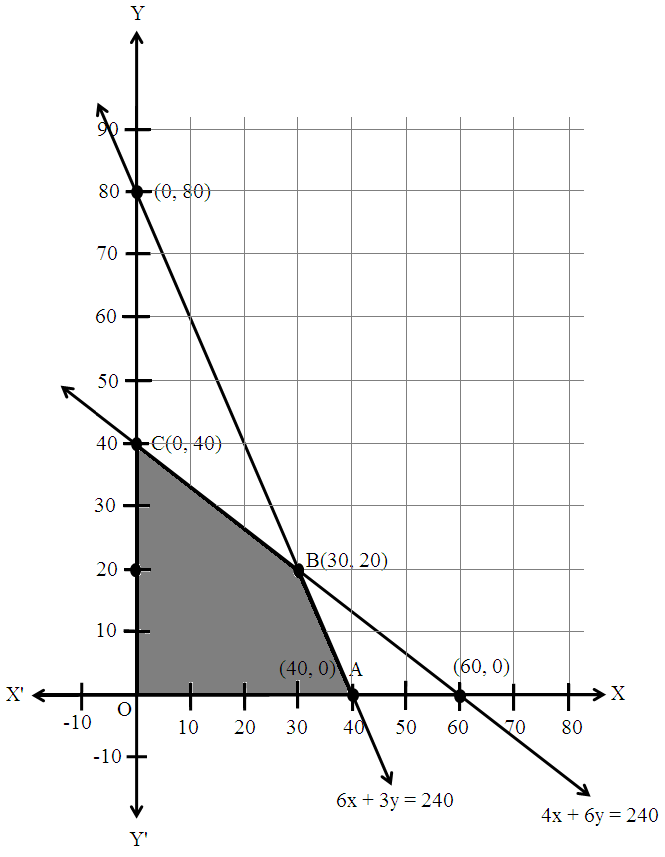
The feasible region determined by the system of constraints is


The corner points are A(40, 0), B(30, 20) and C(0, 40).

The values of Z at these corner points are as follows.
Corner point
Z = 7x + 10y
 
A(40, 0)
280
 
B(30, 20)
410
→ Maximum
C(0, 40)
400
 
The maximum value of Z is 410 at (30, 20).

Thus, the factory should produce 30 packages of screws A and 20 packages of screws B to get the maximum profit of Rs 410.
View full question & answer
Question 1135 Marks
Maximize Z = 18x + 10y
Subject to
$4\text{x}+\text{y}\geq20$
$2\text{x}+3\text{y}\geq30$
$\text{x},\text{y}\geq0$
Answer
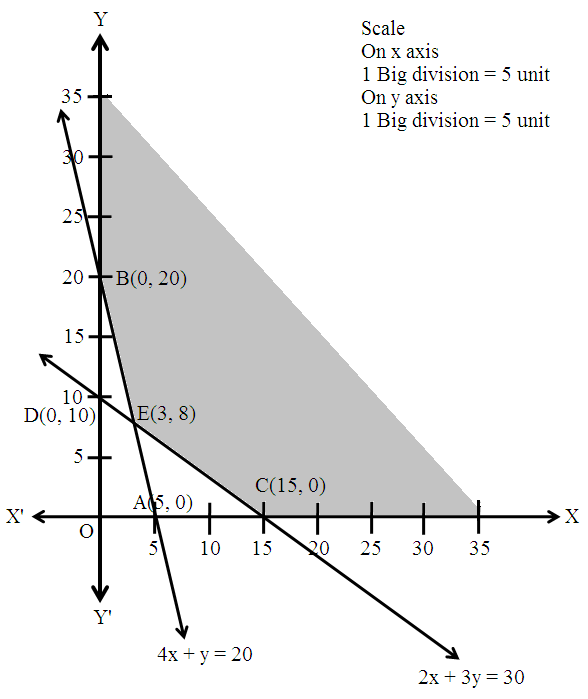
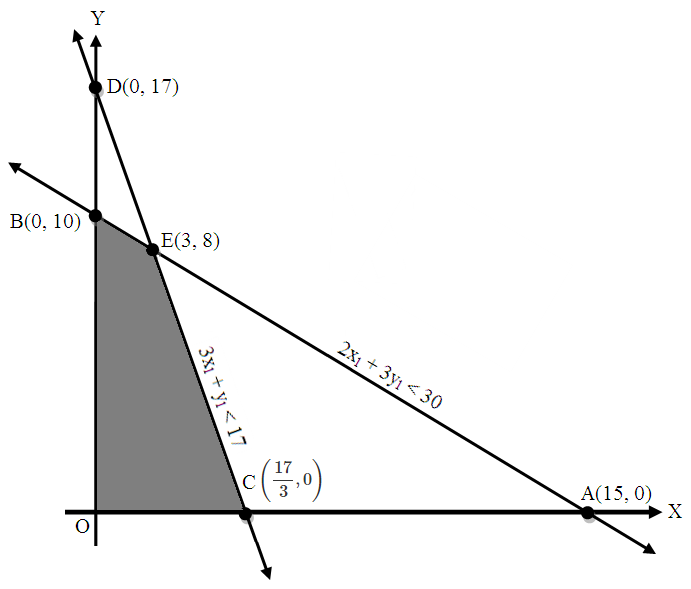
First, we will convert the given inequations into equations, we obtain the following equations: 4x + y = 20, 2x + 3y = 30, x = 0 and y = 0 Region represented by 4x + y ≥ 20: The line 4x + y = 20 meets the coordinate axes at A(5, 0) and B(0, 20) respectively. By joining these points we obtain the line 4x + y = 20. Clearly (0, 0) does not satisfies the inequation 4x + y ≥ 20. So, the region in xy plane which does not contain the origin represents the solution set of the inequation 4x + y ≥ 20. Region represented by 2x + 3y ≥ 30: The line 2x + 3y = 30 meets the coordinate axes at C(15, 0) and D(0, 10) respectively. By joining these points we obtain the line 2x + 3y = 30. Clearly (0, 0) does not satisfies the inequation 2x + 3y ≥ 30. So, the region which does not contain the origin represents the solution set of the inequation 2x + 3y ≥ 30. Region represented by x ≥ 0 and y ≥ 0: Since, every point in the first quadrant satisfies these inequations. So, the first quadrant is the region represented by the inequations x ≥ 0, and y ≥ 0. The feasible region determined by the system of constraints, 4x + y ≥ 20, 2x + 3y ≥ 30, x ≥ 0, and y ≥ 0, are as follows.
The corner points of the feasible region are B(0, 20), C(15, 0), E(3, 8) and C(15, 0). The values of Z at these corner points are as follows.
Corner point
Z = 18x + 10y
B(0, 20)
18 × 0 + 10 × 20 = 200
E(3, 8)
18 × 3 + 10 × 8 = 134
C(15, 0)
18 × 15 + 10 × 0 = 270
Therefore, the minimum value of Z is 134 at the point E(3, 8). Hence, x = 3 and y = 8 is the optimal solution of the given LPP. Thus, the optimal value of Z is 134.
View full question & answer
Question 1145 Marks
Maximise Z = 3x + 5y
subject to $\text{x}+2\text{y}\leq10,\ 3\text{x}+\text{y}\leq15,\ \text{x},\ \text{y}\geq0.$
Answer
Consider $\text{x}+2\text{y}\leq10$
Let x + 2y = 10
$\Rightarrow\frac{\text{x}}{10}+\frac{\text{y}}{5}=1$
Since, (0, 0) satisfies the inequation, therefore the half plane containing (0, 0) is the required plane.
Again $3\text{x}+\text{y}\leq15$
Let 3x + y = 15
$\Rightarrow\frac{\text{x}}{5}+\frac{\text{y}}{15}=1$
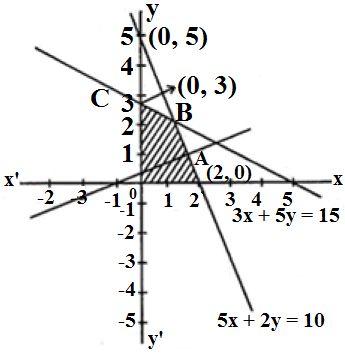
It also satisfies by (0, 0) and its required half plane contains (0, 0). Now double shaded region in the first quadrant contains the solution. Now OABC represents the feasible region.
Z = 3x + 2y
At O(0, 0) Z = 3 × 0 + 2 × 0 = 0
At A(5, 0) Z = 3 × 5 + 2 × 0 = 15
At B(4, 3) Z = 3 × 4 + 2 × 3 = 18
At C(0, 5) Z = 3 × 0 + 2 × 5 = 10
Hence, Z is maximum i.e., 18 at x = 4, y = 3.
View full question & answer
Question 1155 Marks
A firm manufactures two types of products $A$ and $B$ and sells them at a profit of Rs. $5$ per unit of type $A$ and Rs 3 per unit of type $B$. Each product is processed on two machines $\mathrm{M}_1$ and $\mathrm{M}_2$. One unit of type $A$ requires one minute of processing time on $M_1$ and two minutes of processing time on $M_2$, whereas one unit of type $B$ requires one minute of processing time on $\mathrm{M}_1$ and one minute on $\mathrm{M}_2$. Machines $\mathrm{M}_1$ and $\mathrm{M}_2$ are respectively available for at most $5$ hours and $6$ hours in a day. Find out how many units of each type of product should the firm produce a day in order to maximize the profit. Solve the problem graphically.
Answer
Let required number of product $A$ and $B$ be $x$ and $y$ respectively.
Since, profit on each product $A$ and B are Rs. $5$ and Rs. $3$ respectively, so, profits on x product $A$ and $y$ product $B$ are Rs. 5x and Rs. $3y$ respectively
Let $Z$ be total profit so
$Z = 5x + 3y$
Since each unit of product $A$ and $B$ require one min. each on machine $M_1$
So, $x$ unit of product $A$ and $y$ units of product $B$ require $x$ and $y$ min. respectivley on machine $M_1$ but $M_1$ can work at most $5 x 60= 300$ min., so
$x +y \leq 300 ($first constraint$)$
Since each unit of product A and B require $2$ and one min. respectively on machine $M_2.$
S0, $x$ unit of product A and y units of product B require $2x$ and $y$ min. respectivley on machine $M_2$ but $M_2$ can work at most $6 \times 60 = 360$ min., so
$2x +y \leq 360$ (second constraint)
Hence, mathematical formulation of LPP is find x and y which
maximize $Z = 5x + 3y$
Subject to constriants,
$x + y \leq 300$
$= 2x + y \leq 360$
$x, y \geq 0 [$Since production can not be less than zero$]$
Region $x + y \leq 300:$
Line $x + y = 300$ meets axes at $A_1(300, 0), B_1(0, 300)$ respectively,
Region containing origin represents $x +y \leq 300$ as $(0, 0)$ satisfies $x + y = 300.$
Region $2x + y \leq 360:$
Line $2x + y = 360$ meets axes at $A_2(180, 0), B_2(0, 360)$ respectively.
Region containing origin represents $2x + y \leq 360$ as $(0, 0)$ satisfies $2x + y \leq 360$
Region $x, y \geq 0:$
It represent first quandrant
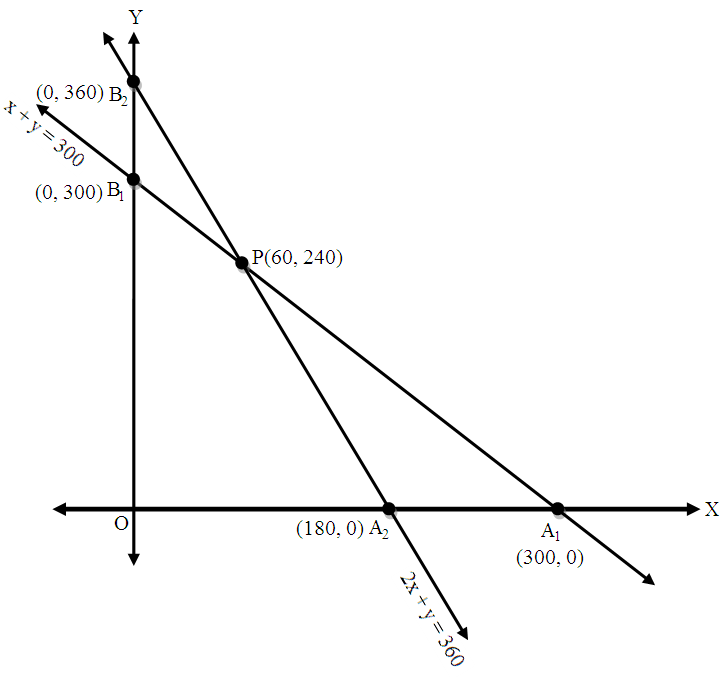
Shaded region $OA_2PB_2,$ represents feasible region.
Point $P(60, 240)$ is obtained by solving
$x +y = 300$ and $2x + y = 360$
$$
The value of $Z = 5x + 3y at$
$O(0, 0) = 5(0) + 3(0) = 0$
$A_2(180, 0) = 5(180) + 3(0) = 900$
$P(60, 240) = 5(60) + 3(240) = 1020$
$B_1(0, 300) = 5(0) + 3(300) = 900$
Maximum $Z = 1020$ at $x = 60, y = 240$
Number of product $A = 60,$ product $B = 240$
Maximum profit $= Rs. 1020.$
 
View full question & answer
Question 1165 Marks
How many of circuits of Type A and of Type B, should be produced by the manufacturer so as to maximise his profit? Determine the maximum profit.
Answer
We have
Maximise Z = 50x + 60y,
Subject to constraints,
$2\text{x}+\text{y}\leq20,$
$\text{x}+2\text{y}\leq12,$
$\text{x}+3\text{y}\leq15$
And $\text{x}\geq0,\text{y}\geq0$

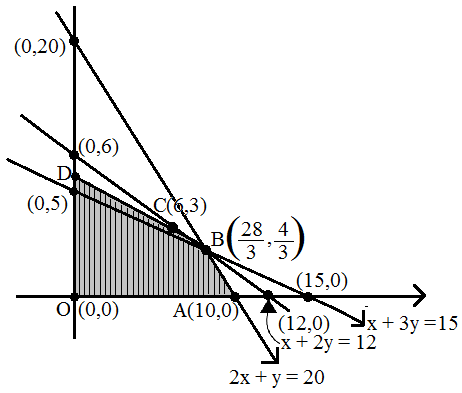
From the figure, feasible region is OABCD and is bounded and the coordinates of corner points are (0, 0), (10, 0), $\Big(\frac{28}{3},\frac{4}{3}\Big),$ (6, 3) and (0, 5), respectively,
[Since, x + 2y = 12 and 32x + y = 20 $\Rightarrow\text{x}=\frac{28}{3},\text{y}=\frac{4}{3}$ and x + 3y = 15 and x + 2y = 12 ⇒ y = 3 and x = 6]
Corner points Corresponding value of Z = 50x + 60y
(0, 0)
(10, 0)
$\Big(\frac{28}{3},\frac{4}{3}\Big)$
(6, 3)
(0, 5)
0
500
$\frac{1400}{3}+\frac{240}{3}=\frac{16400}{3}=546.66$ (Maximum)
480
300
Since, the manufacturer is required to produce two types of circuits A and B and it is clear that parts of resistor, transistor and capacitor cannot be in fraction, so the required maximum profit is 480 where circuits of type A is B and circuits of type 6 is 3.
View full question & answer
Question 1175 Marks
To maintain one's health, a person must fulfil certain minimum daily requirements for the following three nutrients: calcium, protein and calories. The diet consists of only items I and II whose prices and nutrient contents are shown below:
  Food I Food II Minimum daily requirement
Calcium 10 4 20
Protein 5 6 20
Calories 2 6 12
Price Rs. 0.60 per unit Rs. 1.00 per unit  
Find the combination of food items so that the cost may be minimum.
Answer
Let the person takes x units and y units of food I and II respectively that were taken in the diet.Since, per unit of food I costs Rs. 0.60 and that of food II costs Rs. 1.00.
Therefore, x lbs of food I costs Rs. 0.60 x and y lbs of food II costs Rs. 1.00y.
Total cost per day = Rs. (0.60x + 1.00y)
​Let Z denote the total cost per day
Then, Z = 0.60x + 1.00y
Since, each unit of food I contains 10 units of calcium.
Therefore, x units of food I contains 10x units of calcium.
Each unit of food II contains 4 units of calcium.
So, y units of food II contains 4y units of calcium.
Thus, x units of food I and y units of food II contains (10x + 4y) units of calcium.
But, the minimum requirement is 20 units of calcium.
$\therefore10\text{x}+4\text{y}\geq20$
Since, each unit of food I contains 5 units of protein.
Therefore, x units of food I contains 5x units of protein.
Each unit of food II contains 6 units of protein.
So, y units of food II contains 6y units of protein.
Thus, x units of food I and y units of food II contains (5x + 6y) units of protein.
But, the minimum requirement is 20 lbs of protein.
$\therefore5\text{x}+6\text{y}\geq20$
Since, each unit of food I contains 2 units of calories.
Therefore, x units of food I contains 2x units of calories.
Each unit of food II contains 6 units of calories.
So, y units of food II contains 6y units of calories.
Thus, x units of food I and y units of food II contains (2x + 6y) units of calories.
But, the minimum requirement is 12 lbs of calories.
$\therefore2\text{x}+6\text{y}\geq12$
Finally, the quantities of food I and food II are non negative values.
So, $\text{x},\text{y}\geq0$
Hence, the required LPP is as follow:
Min Z = 0.66x + 1.00y
Subject to
$10\text{x}+4\text{y}\geq20$
$5\text{x}+6\text{y}\geq20$
$2\text{x}+6\text{y}\geq12$
$\text{x},\text{y}\geq0$
First, we will convert the given inequations into equations, we obtain the following equations:
10x + 4y = 20, 5x +6y = 20, 2x + 6y = 12, x = 0 and y = 0
Region represented by 10x + 4y ≥ 20:
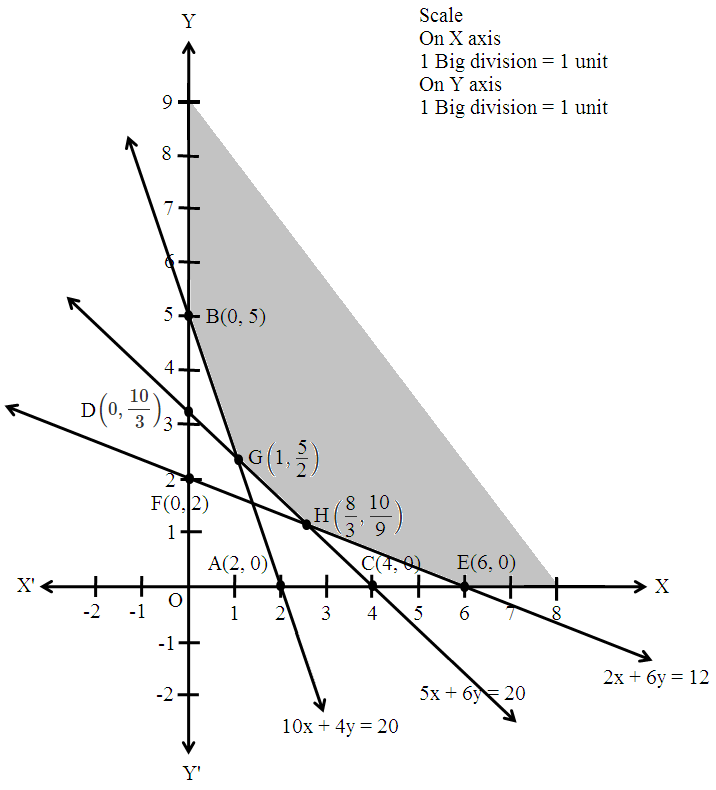
The line 10x + 4y = 20 meets the coordinate axes at A(2, 0) and B(0, 5) respectively.
By joining these points we obtain the line 10x + 4y = 20.
Clearly (0, 0) does not satisfies the inequation 10x + 4y ≥ 20.
So, the region in xy plane which does not contain the origin represents the solution set of the inequation 10x + 4y ≥ 20.
Region represented by $5\text{x}+6\text{y}\geq20$:
The line 5x + 6y = 20 meets the coordinate axes at C(4, 0) and $\text{D}\Big(0,\frac{10}{3}\Big)$ respectively.
By joining these points we obtain the line 5x + 6y = 20.
Clearly (0, 0) does not satisfies the inequation $5\text{x}+6\text{y}\geq20$.
So, the region in xy plane which does not contain the origin represents the solution set of the inequation $5\text{x}+6\text{y}\geq20$.
Region represented by 2x + 6y ≥ 12:
The line 2x + 6y =12 meets the coordinate axes at E(6, 0) and F(0, 2) respectively.
By joining these points we obtain the line 2x + 6y =12.
Clearly (0, 0) does not satisfies the inequation 2x + 6y ≥ 12.
So, the region which does not contains the origin represents the solution set of the inequation 2x + 6y ≥ 12.
Region represented by x ≥ 0 and y ≥ 0:
Since, every point in the first quadrant satisfies these inequations.
So, the first quadrant is the region represented by the inequations x ≥ 0, and y ≥ 0.
The feasible region determined by the system of constraints 10x + 4y ≥ 20, 5x +6y ≥ 20, 2x + 6y ≥ 12, x ≥ 0, and y ≥ 0 are as follows.

The set of all feasible solutions of the above LPP is represented by the feasible region shaded in the graph.
The corner points of the feasible region are B(0, 5), $\text{G}\Big(1,\frac{5}{2}\Big),\text{H}\Big(\frac{8}{3},\frac{10}{9}\Big)$ and E(6, 0).
The value of the objective function at these points are given by the following table:
$\text{Points}$ $\text{Value of Z}$
$\text{B}$ $0.6(0)+5=5$
$\text{G}$ $0.6(1)+\frac{5}{2}=3.1$
$\text{H}$ $0.6\Big(\frac{8}{3}\Big)+\Big(\frac{10}{9}\Big)=1.6+1.1=2.7$
$\text{E}$ $0.6(6)+(0)=3.6$
We see that the minimum cost is 2.7 which is at $\Big(\frac{8}{3},\frac{10}{9}\Big)$.
Thus, at minimum cost, $\frac{8}{3}$ unit of food I and $\frac{10}{9}$ units of food II should be included in the diet.
View full question & answer
Question 1185 Marks
A company sells two different products A and B. The two products are produced in a common production process and are sold in two different markets. The production process has a total capacity of 45000 man-hours. It takes 5 hours to produce a unit of A and 3 hours to produce a unit of B. The market has been surveyed and company officials feel that the maximum number of units of A that can be sold is 7000 and that of B is 10,000. If the profit is Rs. 60 per unit for the product A and Rs. 40 per unit for the product B, how many units of each product should be sold to maximize profit? Formulate the problem as LPP.
Answer
Product
Man hours
Maximum demand
Profit
A
5
7000
60
B
3
10000
40
Total capacity
45000
   
Let required production of product A be x units and production of product B be y units.

Given, profits on one unit of product A and B are Rs. 60 and Rs. 40 respectively, so profits on x units of product A and y units of product B are Rs. 60x and Rs. 40y.

Let Z be the total profit, so

Z = 60x + 40y

Given, production of one unit of product A and B require 5 hours and 3 hours respectively man hours, so x unit of product A and y units of product 8 require 5x hours and 3y hours of man hours respectively but total man hours available are 45000 hours, so

5x + 3y = 45000 (First constraint)

Given, dem and for product A is maximum 7000, so

$\times\leq7000$ (Second constraint)

Hence, mathematical formulation of LPP is,

Find x and y which

maximize Z = 60x + 40y

Subject to constraints,

$5\text{x}+3\text{y}\leq45000$

$\text{x}\leq7000$

$\text{y}\leq10000$

$\text{x},\text{y}\geq0$ [Since production can not be less than zero].
View full question & answer
Question 1195 Marks
A furniture manufacturing company plans to make two products : chairs and tables. From its available resources which consists of 400 square feet to teak wood and 450 man hours. It is known that to make a chair requires 5 square feet of wood and 10 man-hours and yields a profit of Rs. 45, while each table uses 20 square feet of wood and 25 man-hours and yields a profit of Rs. 80. How many items of each product should be produced by the company so that the profit is maximum?
Answer
Let x units of chairs and y units of tables were produced

Therefore, $\text{x},\text{y}\geq0$

The given information can be tabulated as follows:
 
Wood (square feet)
Man hours
Chairs (x)
5
10
Tables (y)
20
25
Availability
400
450
Therefore, the constraints are

$5\text{x}+20\text{y}\leq400$

$10\text{x}+25\text{y}\leq450$

It is known that to make a chair requires 5 square feet of wood and 10 man-hours and yields a profit of Rs. 45, while each table uses 20 square feet of wood and 25 man-hours and yields a profit of Rs. 80.

Therefore, profit gained to make x chairs and y tables is Rs. 45x and Rs. 80y respectively Total profit = Z = 45x +80y which is to be maximised.

Thus, the mathematical formulation of the given linear programming problem is

Max 2 = 45x + 80y

Subject to

$5\text{x}+20\text{y}\leq400$

$10\text{x}+25\text{y}\leq450$

$\text{x},\text{y}\geq0$

First we will convert inequations into equations as follows:

5x + 20y = 400, 10x + 25y = 450, X = 0 and y = 0

Region represented by $5\text{x}+20\text{y}\leq400$:

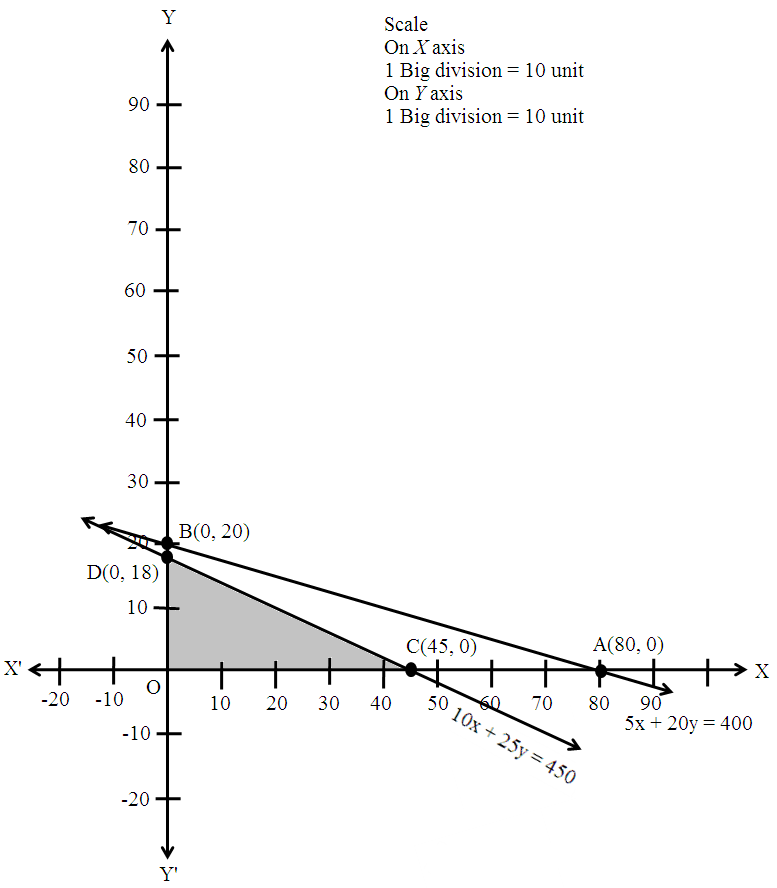
The line 5x + 20y = 400 meets the coordinate axes at A(80, 0) and B(0, 20) respectively.

By joining these points we obtain the line 5x + 20y = 400.

Clearly (0, 0) satisfies the $5\text{x}+20\text{y}\leq400$.

So, the region which contains the origin represents the solution set of the inequation $5\text{x}+20\text{y}\leq400$.

Region represented by $10\text{x}+25\text{y}\leq450$:

The line 10x + 25y = 450 meets the coordinate axes at C(45, 0) and D(0, 18) respectively.

By joining these points we obtain the line 10x + 25y = 450.

Clearly (0, 0) satisfies the inequation $10\text{x}+25\text{y}\leq450$.

So the region which contains the origin represents the solution set of the inequation $10\text{x}+25\text{y}\leq450$.

Region represented by $\text{x}\geq0$ and $\text{y}\geq0$:

Since, every point in the first quadrant satisfies these inequations.

So, the first quadrant is the region represented by the inequations $\text{x}\geq0$, and $\text{y}\geq0$.

The feasible region determined by the system of constraints $5\text{x}+20\text{y}\leq400,10\text{x}+25\text{y}\leq450,\text{x}\geq0,$ and $\text{y}\geq0$ are as follows.


The corner points are A(0, 18), B(45, 0)

The values of Z at these corner points are as follows.
Corner point
Z = 45x + 80y
A
1440
B
2025
The maximum value of Z is 2025 which is attained at B(45, 0).

Thus, the maximum profit is of Rs. 2025 obtained when 45 units of chairs and no units of tables are produced.
View full question & answer
Question 1205 Marks
A company is making two products A and B. The cost of producing one unit of products A and B are Rs 60 and Rs 80 respectively. As per the agreement, the company has to supply at least 200 units of product B to its regular customers. One unit of product A requires one machine hour whereas product B has machine hours available abundantly within the company. Total machine hours available for product A are 400 hours. One unit of each product A and B requires one labour hour each and total of 500 labour hours are available. The company wants to minimize the cost of production by satisfying the given requirements. Formulate the problem as a LPP.
Answer
Let the company produces x units of product A and y units of product B.
Since, each unit of product A costs Rs. 60 and each unit of product B costs Rs. 80.Therefore, x units of product A and y units of product B will cost Rs. 60x and Rs 80y respectively.
Let Z denotes the total cost.
$\therefore$ Z = Rs. (60x + 80y)
Also, one unit of product A requires one machine hour.
The total machine hours available with the company for product A are 400 hours.
$\therefore\text{x}\leq400$
This is our first constraint
Also, one unit of product A and B require 1 labour hour each and there are a total of 500 labours hours.
Thus, $\text{x}+\text{y}\leq500$
​This is our second constraint.
Since, x and y are non negative integers, therefore $\text{x},\text{y}\geq\text{x},\text{y}\geq00$
Also, as per agreement, the company has to supply atleast 200 units of product B to its regular customers.
$\therefore\text{y}\geq200$
Hence, the required LPP is as follows:
Minimize Z = 60x + 80y
Subject to
$\text{x}\leq400$
$\text{x}+\text{y}\leq500$
$\text{y}\geq200$
$\text{x},\text{y}\geq0$
View full question & answer
Question 1215 Marks
How many packets of each food should be used to maximise the amount of vitamin A in the diet? What is the maximum amount of vitamin A in the diet?
Answer

Let x and y be the number of packets of food P and Q respectively, $\text{x}\ge0,\ \text{y}\ge0.$
We have to maximize Z = 6x + 3y (vitamin A) subject to the constraints $12\text{x}+3\text{y}\ge240$ (constraints on Calcium), $\text{i.e., }4\text{x}+\text{y}\ge80\dots(\text{i})$
$\text{And }4\text{x}+50\text{y}\ge460$ (constraints on Iron), $\text{i.e., }\text{x}+5\text{y}\ge115\dots(\text{ii})$
$\text{Also }6\text{x}+4\text{y}\le300$ (constraints on Cholesterol), i.e., $3\text{x}+2\text{y}\le150\dots(\text{iii})$
$\text{x}\ge0,\ \text{y}\ge0\dots(\text{iv})$
Consider $4\text{x}+\text{y}\ge80$
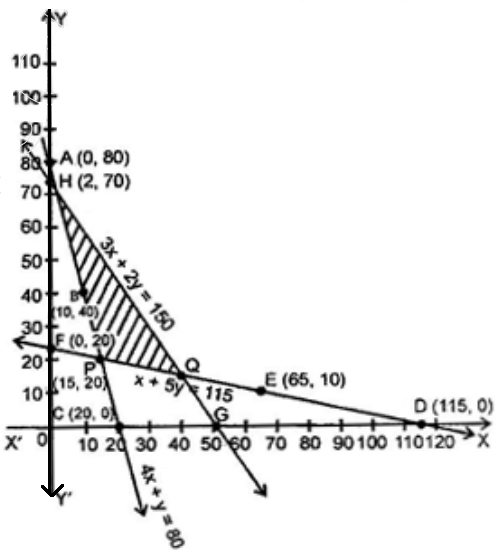
Let 4x + y = 80
⇒ y = 80 - 4x
  A B C
x 0 10 20
y 80 40 0
Here, (0, 0) does not satisfy this inequation, therefore the required half plane does not include the point (0, 0)
Again consider $\text{x}+5\text{y}\ge115$
Let x + 5y = 115
⇒ x = 115 - 5y
  D E F
x 115 65 0
y 0 10 23
Here, also (0, 0) does not satisfy this inequation, therefore the required half plane does not include the point (0, 0)
Again consider $3\text{x}+2\text{y}\le150$
$\text{Let }3\text{x}+2\text{y}=150\Rightarrow\frac{\text{x}}{50}+\frac{\text{y}}{75}=1$
Therefore, G(50, 0) and H(0, 75) satisfy the equation.
As (0, 0) satisfies the inequation 3x + 2y = 150, therefore the required half plane contains (0, 0). The shaded region is the feasible solution and its corners are P(15, 20), Q(40, 15) and R(2, 72).
Now   Z = 6x + 3y
At P(15, 20) Z = 6 × 15 + 3 × 20 = 90 + 60 = 150
At Q(40, 15) Z = 6 × 40 + 3 × 15 = 240 + 45 = 285
At R(2, 72) Z = 6 × 2 + 3 × 72 = 12 + 216 = 228
Hence, maximum Z = 285 units of vitamin A at x = 40, y = 15.
View full question & answer
Question 1225 Marks
Maximise $Z = 3x + 5y$
such that $\text{x}+3\text{y}\geq3,\ \text{x}+\text{y}\geq2,\ \text{x},\ \text{y}\geq0.$
Answer

For plotting the graphs of x + 3y = 3 and x + y = 2, we have the following tables:
For $eq^n x + 3y = 3$,
x
0 3
y
1
0
For $eq^n x + y = 2$,
x
0
2
y
2 0
The feasible portion represented by the inequalities $\text{x}+3\text{y}\geq3,\ \text{x}+\text{y}\geq2\text{ and x},\text{ y}\geq0$ is ABC which is shaded in the figure. The coordinates of point B are $\Big(\frac32,\ \frac12\Big).$
Which can be obtained by solving x + 3y = 3 and x + y = 2.
At A(0, 2)
  Z = 3 × 0 + 5 × 2 = 10
At $\text{B}\Big(\frac32, \frac12\Big)$
$\text{Z}=3\times\frac32+5\times\frac12=\frac92+\frac52=\frac{14}{2}=7$
At C(3, 0)
Z = 3 × 3 + 5 × 0 = 9
Hence, Z is minimum is 7 when $\text{x}=\frac32\text{ and y}=\frac12.$
View full question & answer
Question 1235 Marks
A diet is to contain at least $80$ units of vitamin $A$ and $100$ units of minerals. Two foods $F_1$ and $F_2$ are available. Food $F_1$ costs Rs $4$ per unit and $F_2$ costs Rs $6$ per unit one unit of food $F_1$ contains $3$ units of vitamin $A$ and $4$ units of minerals. One unit of food $F_2$ contains $6$ units of vitamin $A$ and $3$ units of minerals. Formulate this as a linear programming problem and find graphically the minimum cost for diet that consists of mixture of these foods and also meets the mineral nutritional requirements.
Answer
Let the dietician wishes to mix $x$ units of food $F_1$ and y kg of $F_2.$
Clearly, $\text{x},\text{y}\geq0$
The given information can be tabulated as follows:
 
Vitamin A
Vitamin B
Food $F_1$
$3$ $4$
Food $F_2$
$6$ $3$
Minimum requirement $80$ $100$
The constraints are
$3\text{x}+6\text{y}\geq80$
$4\text{x}+3\text{y}\geq100$
It is given that cost of food $F_1$ and $F_2$ is Rs. $4$ and Rs. $6$ per unit respectively.
Therefore, cost of x units of food $F_1$ and y units of food $F_2$ is Rs. $4x$ and Rs. $6y$ respectively.
Let $Z$ denote the total cost
$\therefore Z = 4x + 6y$
Thus, the mathematical formulat​ion of the given linear programmimg problem is Minimize $Z = 4x+6y$
subject to
$3\text{x}+6\text{y}\geq80$
$4\text{x}+3\text{y}\geq100$
$\text{x},\text{y}\geq0$
First, we will convert the given inequations into equations, we obtain the following equations:
$3x + 6y = 80, 4x + 3y = 100, x = 0$ and $y = 0$
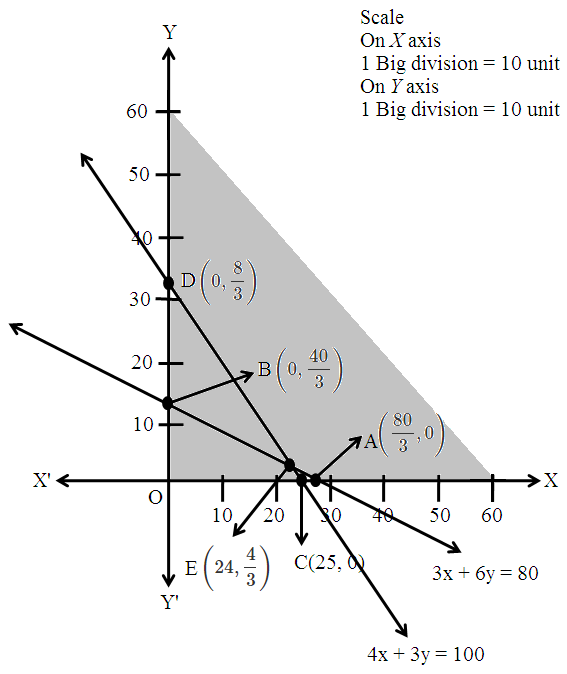
The line 3x + 6y = 80 meets the coordinate axis at $\text{A}\Big(\frac{80}{3},0\Big)$ and $\text{B}\Big(0,\frac{40}{3}\Big)$.
Join these points to obtain the line $3x + 6y= 80.$
Clearly, $(0, 0)$ does not satisfies the inequation $3\text{x}+6\text{y}\geq80$.
So, the region in xy-plane that does not contains the origin represents the solution set of the given equation.
The line $4x + 3y = 100$ meets the coordinate axis at $C(25, 0)$ and $\text{D}\Big(0,\frac{100}{3}\Big)$.
Join these points to obtain the line $4x + 3y = 100.$
Clearly, $(0, 0)$ does not satisfies the inequation $4\text{x}+3\text{y}\geq100$.
So, the region in xyplane that does not contains the origin represents the solution set of the given equation.
Region represented by $x \geq 0$ and $y \geq 0:$
Since, every point in the first quadrant satisfies these inequations.
So, the first quadrant is the region represented by the inequations.
These lines are drawn using a suitable scale.
The feasible region determined by the system of constraints is

The corner points are $\text{D}\Big(0,\frac{100}{3}\Big),\text{E}\Big(24,\frac{4}{3}\Big)$ and $\text{A}\Big(\frac{80}{3},0\Big)$.
The values of $Z$ at these corner points are as follows:
$\text{Corner point}$ $\text{Z}=4\text{x}+6\text{y}$
$\text{D}\Big(0,\frac{100}{3}\Big)$ $200$
$\text{E}\Big(24,\frac{4}{3}\Big)$ $104$
$\text{A}\Big(\frac{80}{3},0\Big)$ $\frac{320}{3}$
The minimum value of $Z$ is Rs. $104$ which is at $\text{E}\Big(24,\frac{4}{3}\Big)$.
View full question & answer
Question 1245 Marks
A factory owner purchases two types of machines, $A$ and $B,$ for his factory. The requirements and limitations for the machines are as follows:
 
Area occupied by the
machine
Labour force for each
machine
Daliy outputin
units
Machines
$1000$ sp.m
$12$ mem
$60$
Machines
$1200$ sp.m
$8$ mem
$40$
He has an area of $7600$ sq. m available and $72$ skilled men who can operate the machines.
How many machines of each type should he buy to maximize the daily output?
Answer
Let required number of machine $A$ and $B$ are $x$ and $y$ respectively.
Since, production of each machine $A$ and $B$ are $60$ and $40$ units daily respectively.
So, productions by $x$ number of machine $A$ and $y$ number of machine $B$ are $60x$ and $40y$ respectively,
Let $z$ denote total output daily, so,
$Z = 60x + 40y$ 
Since, each machine of type $A$ and $B$ require $1000$ sq.m and $1200 $ sq.m area so, $x$ machine of type A and y machine of type $B$ require $100x$ and $1200y$ sq.m area but, Total area available for machine is 7600 sq.m. so,
$1000\text{x}+1200\text{y}\leq7600$
$5\text{x}+6\text{y}\leq38$ (first constraint)
Since, each machine of type $A$ and $B$ require $12$ men and 8 men to work respectively so, $x$ machine of type $A$ and $y$ machine of type B require 12x and By men to work respectively but, Total $72$ men available for work so,
$12\text{x}+8\text{y}\leq72$
$3\text{x}+2\text{y}\leq18$ (second constraint)
Hence, mathematical formulation of LPP is,
Find x and y which maximize
$Z = 60x + 40y$
Subject to constraints,
$5\text{x}+6\text{y}\leq38$
$3\text{x}+2\text{y}\leq18$
$\text{x},\text{y}\geq0$ [Number of machines can not be less than zero]
Region $5\text{x}+6\text{y}\leq38$:
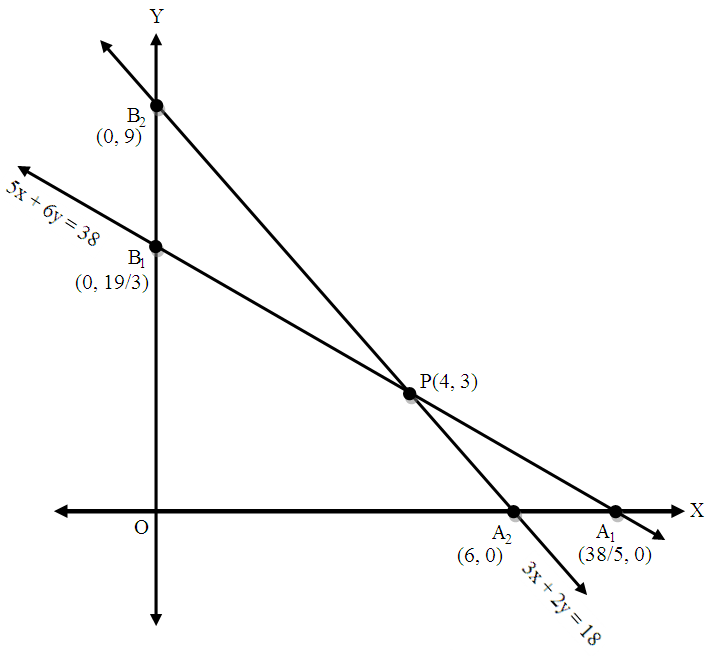
Line $5x + 6y = 38$ meets axes at $\text{A}_2\Big(\frac{38}{5},0\Big),\text{B}_1\Big(0,\frac{19}{3}\Big)$ respectively.
Region containing origin represents $5\text{x}+6\text{y}\leq38$ as origin satisfies $5\text{x}+6\text{y}\leq38$.
Region $3\text{x}+2\text{y}\leq18$:
line $3x + 2y = 18$ meets axes at $A_2(6, 0), B_2(0, 9)$ respectively.
Region containing origin represents $3x + 2y = 18$ as $(0, 0)$ satisfies $3\text{x}+2\text{y}\leq18$.
Region $\text{x},\text{y}\geq0$:
It represents first quadrant.

Shaded region $OA_2PB_1, $ is the feasible region $P(4, 3)$ is obtained by solving $3x + 2y = 18$ and $5x+6y - 38$
The value of $Z = 60x + 40y$ at
$\text{O}(0, 0) = 60(0) + 40(0) = 0$
$\text{A}_2(6, 0) = 60(6) + 40(0) = 360$
$\text{P}(4,3) =60(4)+ 40 (3) = 360$
$\text{B}_1\Big(0,\frac{19}{3}\Big)=60(0)+ 40\Big(\frac{19}{3}\Big)=\frac{760}{3}$
Therefore maximum $2 = 360$ at $x = 4, y = 3$ or $x = 6, y = 0$
Output is maximum when $4$ machines of type $A$ and $3$ machine of type $B$ or $6$ machines of type $A$ and no machine of type $B.$
 
View full question & answer
Question 1255 Marks
A man owns a field of area 1000 sq.m. He wants to plant fruit trees in it. He has a sum of Rs. 1400 to purchase young trees. He has the choice of two types of trees. Type A requires 10 sq.m of ground per tree and costs Rs. 20 per tree and type B requires 20 sq.m of ground per tree and costs Rs. 25 per tree. When fully grown, type A produces an average of 20kg of fruit which can be sold at a profit of Rs. 2.00 per kg and type B produces an average of 40kg of fruit which can be sold at a profit of Rs. 1.50 per kg. How many of each type should be planted to achieve maximum profit when the trees are fully grown? What is the maximum profit?
Answer
Let the man planted x trees of type A and y trees of type B.

Number of trees cannot be negative.

Therefore, x, y ≥ 0

To plant tree of type A requires 10 sq. m and type B requires 20 sq. m of ground per tree.

And, it is given that a man owns a field of area 1000 sq. m.

Therefore,

10x + 20y ≤ 1000

Type A costs Rs 20 per tree and type B costs Rs. 25 per tree.

Therefore, x trees of type A and y trees of type B costs Rs. 20x and Rs. 25y respectively.

A man has a sum of Rs 1400 to purchase young trees.

20x + 25y ≤ 1400

Thus, the mathematical formulation of the given linear programmimg problem is

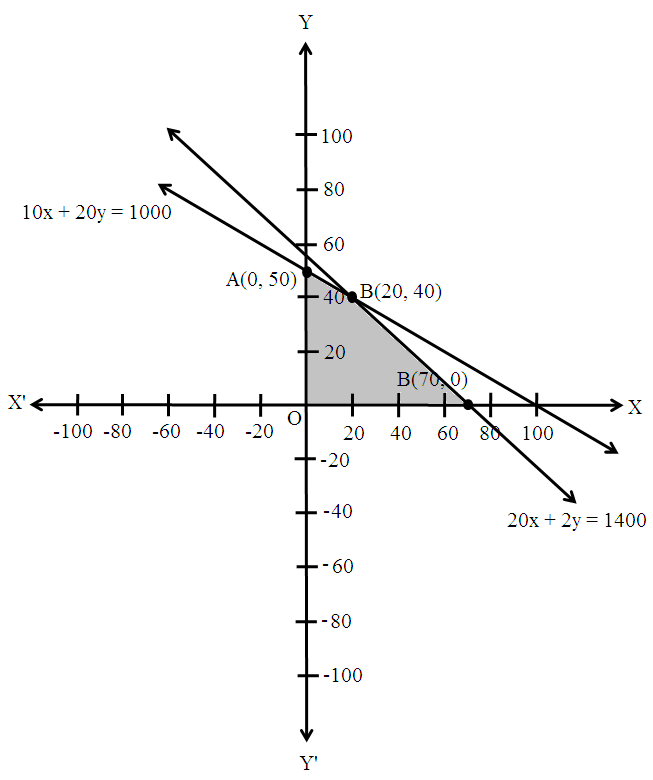
Max Z = 40x - 20x + 60y - 25y = 20x + 35y

Subject to

10x + 20y ≤ 1000, 20x + 25y ≤ 1400

The feasible region determined by the system of constraints is


The corner points are A(0, 50), B(20, 40), C(70, 0)

The values of Z at these corner points are as follows:
Corner point
Z = 20x + 35y
A
1750
B
1800
C
1400
The maximum value of Z is 1800 which is attained at B(20, 40)

Thus, the maximum profit is Rs. 1800 obtained when Rs. 20 were invested on type A and Rs. 40 were invested on type B.
View full question & answer
Question 1265 Marks
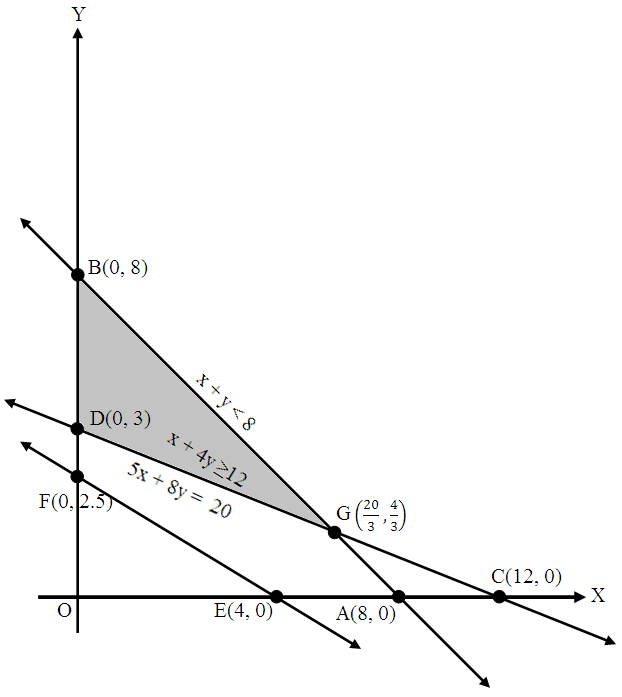
Maximum Z = 30x + 20y Subject to $\text{x}+\text{y}\leq8$ $\text{x}+4\text{y}\geq12$ $5\text{x}+8\text{y}=20$$\text{x},\text{y}\geq0$
Answer
First, we will convert the given inequations into equations, we obtain the following equations: x + y = 8, x + 4y = 12, x = 0 and y = 0 5x + 8y = 20 is already an equation. Region represented by x + y ≤ 8: The line x + y = 8 meets the coordinate axes at A(8, 0) and B(0, 8) respectively. By joining these points. we obtain the line x + y = 8. Clearly (0, 0) satisfies the inequation x + y ≤ 8. So,the region in xy plane which contain the origin represents the solution set of the inequation x + y ≤ 8.Region represented by x + 4y ≥ 12:
The line x + 4y = 12 meets the coordinate axes at C(12, 0) and D(0, 3) respectively.
By joining these points we obtain the line x + 4y = 12.Clearly (0,0) satisfies the inequation x + 4y ≥ 12.
So,the region in xy plane which does not contain the origin represents the solution set of the inequation x + 4y ≥ 12.
The line 5x + 8y = 20 is the line that passes through E(4, 0) and $\text{F}\Big(0,\frac{5}{2}\Big)$.
Region represented by x ≥ 0 and y ≥ 0: Since, every point in the first quadrant satisfies these inequations. So, the first quadrant is the region represented by the inequations x ≥ 0 and y ≥ 0. The feasible region determined by the system of constraints, x + y ≤ 8, x + 4y ≥ 12, 5x + 8y = 20, x ≥ 0 and y ≥ 0 are as follows.
The corner point of the feasible region are B(0, 8), D(0, 3), $\text{G}\Big(\frac{20}{3},\frac{4}{3}\Big)$. The value of Z at these corner points are as follows.
$\text{Corner point}$
$\text{Z}=30\text{x}+20\text{y}$
$\text{B}(0,8)$
$160$
$\text{D}(0,3)$
$60$
$\text{G}\Big(\frac{20}{3},\frac{4}{3}\Big)$
$266.66$
Therefore, the minimum value of Z is 60 at the point D(0, 3). Hence, x = 0 and y = 3 is the optimal solution of the given LPP. Thus, the optimal value of Z is 60.
View full question & answer
Question 1275 Marks
A manufacturer produces two types of steel trunks. He has two machines $A$ and $B$. For completing, the first types of the trunk requires $3$ hours on machine $A$ and $3$ hours on machine $B$, whereas the second type of the trunk requires $3$ hours on machine $A$ and $2$ hours on machine $B$. Machines $A$ and $B$ can work at most for $18$ hours and $15$ hours per day respectively. He earns a profit of Rs. $30$ and Rs. $25$ per trunk of the first type and the second type respectively. How many trunks of each type must he make each day to make maximum profit?
Answer
Let $x$ trunks of first type and $y$ trunks of second type were manufactured.
Number of trunks cannot be negative.
Therefore,
$x, y \geq 0$
According to question, the given information can be tabulated as
 
Machine A (hrs)
Machine B (hrs)
First type $(x)$
$3$
$3$
Second type $(y)$
$3$
$2$
Availability
$18$
$15$
Therefore, the constraints are
$3\text{x}+3\text{y}\leq18$
$3\text{x}+2\text{y}\leq15$
He earns a profit of Rs. $30$ and Rs. $25$ per trunk of the first type and the second type respectively.
Therefore, profit gained by him from x trunks of first type and y trunks of second type is Rs. $30x$ and Rs. $25y$ respectively.
Total profit $= Z = 30x + 25y$ which is to be maximised
Thus, the mathematical formulat​ion of the given linear programmimg problem is
Max $Z = 30x + 25y$
Subject to
$3\text{x}+3\text{y}\leq18$
$3\text{x}+2\text{y}\leq15$
$\text{x},\text{y}\geq0$
First we will convert inequations into equations as follows:
$3x + 3y = 18, 3x + 2y = 15, x = 0$ and $y = 0$
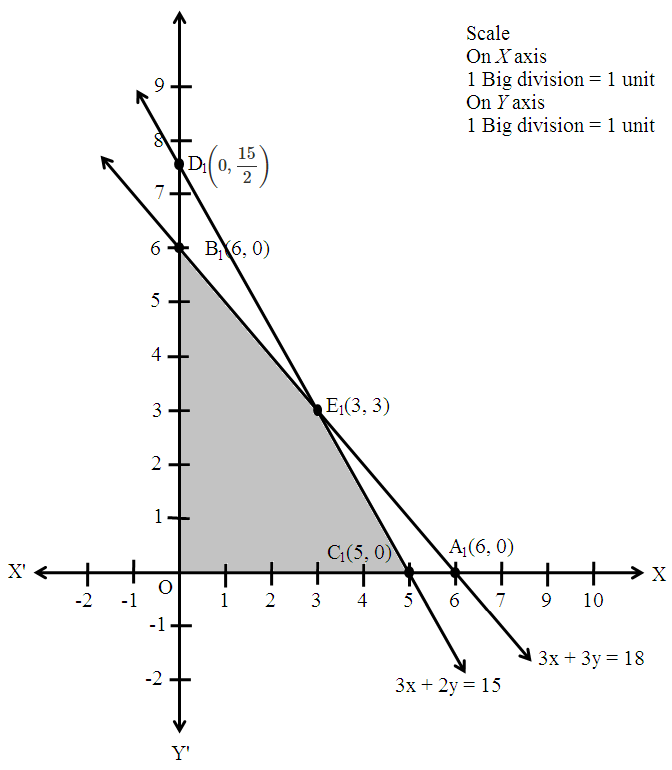
Region represented by $3x + 3y \leq 18:$
The line $3x + 3y = 18$ meets the coordinate axes at $A_1(6, 0)$ and $B_1(0, 6)$ respectively.
By joining these points we obtain the line $3x + 3y = 18.$
Clearly $(0, 0)$ satisfies the $3x + 3y = 18.$
So, the region which contains the origin represents the solution set of the inequation $3x + 3y \leq 18.$
Region represented by $3x + 2y \leq 15:$
The line $3x + 2y = 15$ meets the coordinate axes at $C_1(5, 0)$ and $\text{D}_1\Big(0,\frac{15}{2}\Big)$ respectively.
By joining these points we obtain the line $3x + 2y = 15.$
Clearly $(0, 0)$ satisfies the inequation $3x + 2y \leq 15.$
So, the region which contains the origin represents the solution set of the inequation $3x + 2y \leq 15.$
Region represented by $x \geq 0$ and $y \geq 0:$
Since, every point in the first quadrant satisfies these inequations.
So, the first quadrant is the region represented by the inequations $x \geq 0,$ and $y \geq 0.$
The feasible region determined by the system of constraints $3x + 3y \leq 18, 3x + 2y \leq 15, x \geq 0$ and $y \geq 0$ are as follows.

The corner points are $O(0, 0), B_1(0, 6), E_1(3, 3)$ and $C_1(5, 0).$
The values of $Z$ at these corner points are as follows.
Corner point
$Z = 30x + 25y$
$O$
$0$
$B_1$ 
$15$
$E_1$ 
$165$
$C_1$  $150$
The maximum value of $Z$ is $165$ which is attained at $E_1(3, 3).$
Thus, the maximum profit is Rs. $165$ obtained when 3 units of each type of trunk is manufactured.
View full question & answer
Question 1285 Marks
A dietician wishes to mix together two kinds of food X and Y in such a way that the mixture contains at least 10 units of vitamin A, 12 units of vitamin B and 8 units of vitamin C. The vitamin contents of one kg food is given below:
Food Vitamin A Vitamin B Vitamin C
X 1 2 3
Y 2 2 1
One kg of food X costs Rs. 16 and one kg of food Y costs Rs. 20. Find the least cost of the mixture which will produce the required diet?
Answer
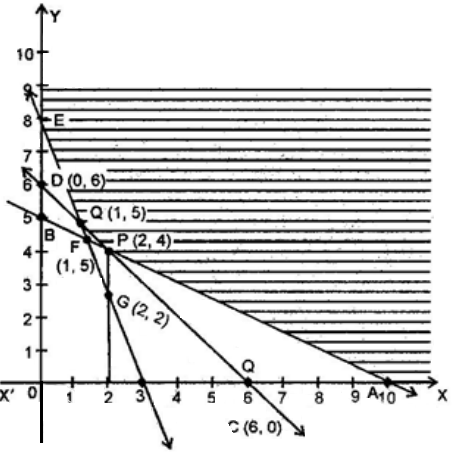
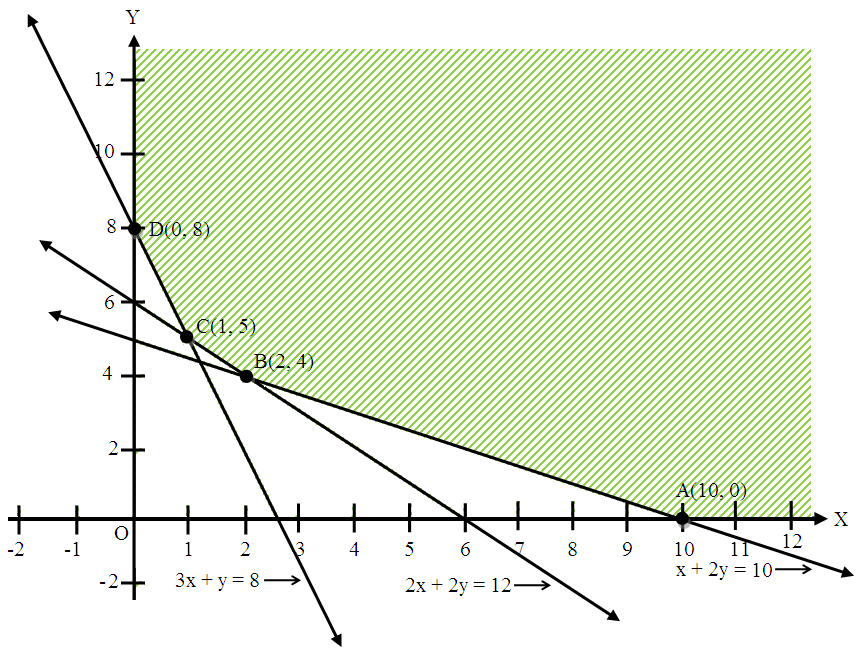
Let in the mixture food X weighs = x kg and in the mixture food Y weighs = y kg. We have to minimize Z = 16x + 20 y subject to constraints $\text{x}+2\text{y}\geq10,\ 2\text{x}+2\text{y}\geq12,\ 3\text{x}+\text{y}\geq8,\ \text{x}\geq0,\ \text{y}\geq0$ Consider $\text{x}+2\text{y}\geq10$ Let x + 2y = 10 $\Rightarrow\ \frac{\text{x}}{10}+\frac{\text{y}}{5}=1$ $\therefore\ $Points A(10, 0) and B(0, 5) lies on the line. Here, (0, 0) does not satisfy the inequation $\text{x}+2\text{y}\geq10,$ therefore the required half plane does not include (0, 0). Again consider $2\text{x}+2\text{y}\geq12$
Let 2x + 2y = 12 $\Rightarrow\ $ x + y = 6 $\Rightarrow\ \frac{\text{x}}{6}+\frac{\text{x}}{6}=1$ $\therefore\ $Points C(6, 0) and D(0, 6) lies on the line. Again consider $3\text{x}+\text{y}\geq8$ Let 3x + y = 8 $\Rightarrow\ \text{y}=8-3\text{x}$ Again in the inequation (0, 0) is not included in the required half plane.
  E F G
X 0 100 200
Y 140 80 20
The shaded region is our feasible solution A(10, 0), P(2, 4), Q(1, 5), E(0, 8). The corners of the feasible region are A(10, 0), P(2, 4), Q(1, 5), E(0, 8). Now Z = 16x + 20y
At A(10, 0) Z = 16 × 10 + 20 × 0 = 160
At P(2, 4) Z = 16 × 2 + 20 × 4 = 112
At Q(1, 5) Z = 16 × 1 + 20 × 5 = 116
At E(0, 8) Z = 16 × 0 +20 × 8 = 160
Therefore minimum Z = Rs. 112 at x = 2, y = 4 Hence, minimum cost of the mixture = Rs. 112 when he mixes 2 kg of food X and 4 kg of food Y.
View full question & answer
Question 1295 Marks
A company sells two different products, $A$ and $B$. The two products are produced in a common production process, which has a total capacity of $500$ man-hours. It takes 5 hours to produce a unit of A and $3$ hours to produce a unit of B. The market has been surveyed and company officials feel that the maximum number of unit of A that can be sold is $70$ and that for B is $125$. If the profit is Rs. $20$ per unit for the product A and Rs. $15$ per unit for the product B, how many units of each product should be sold to maximize profit?
Answer
Let $x$ units of product $A$ and $y$ units of product $B$ were manufactured.
Clearly, $x \geq 0, y \geq 0$
It takes 5 hours to produce a unit of $A$ and 3 hours to produce $a$ unit of $B$.
The two products are produced in a common production process, which has a total capacity of 500 man-hours.
$5 x+3 y \leq 500$
The maximum number of unit of $A$ that can be sold is 70 and that for $B$ is 125 .
$x \leq 70$
$y \leq 125$
If the profit is Rs. 20 per unit for the product $A$ and Rs. 15 per unit for the product $B$.
Therefore, profit $x$ units of product $A$ and $y$ units of product $B$ is Rs. 20x and Rs. 15y respectively.
$\text { Total profit }=Z=20 x+15 y$
The mathematical formulation of the given problem is
Max $Z = 20x + 15y$
Subject to
$5x + 3y \leq 500$
$x \leq 70$
$y \leq 125$
$x \geq 0$
$y \geq 0$
First we will convert inequations into equations as follows:
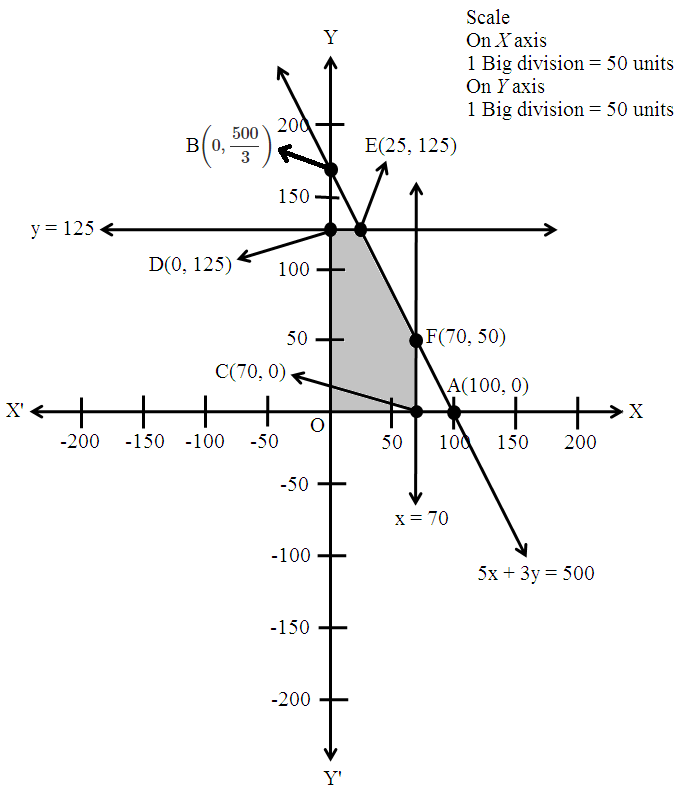
$5 x+3 y=500, x=70, y=125, x=0 \text { and } y=0$
Region represented by $5 x+3 y \leq 500$ :
The line $5 x+3 y=500$ meets the coordinate axes at $A_1(100,0)$ and $B_1(0,5003)$ respectively.
By joining these points we obtain the line $5 x+3 y=500$.
Clearly $(0,0)$ satisfies the $5 x+3 y=500$.
So, the region which contains the origin represents the solution set of the inequation $5 x+3 y \leq 500$.
Region represented by $x \leq 70$ :
The line $x=70$ is the line passes through $C_1(70,0)$ and is parallel to $Y$ axis.
The region to the left of the line $x=70$ will satisfy the inequation $x \leq 70$.
Region represented by $y \leq 125$ :
The line $y=125$ is the line passes through $D_1(0,125)$ and is parallel to $X$ axis.
The region below the the line $y=125$ will satisfy the inequation $y \leq 125$.
Region represented by $x \geq 0$ and $y \geq 0$ :
Since, every point in the first quadrant satisfies these inequations.
So, the first quadrant is the region represented by the inequations $x \geq 0$, and $y \geq 0$.
The feasible region determined by the system of constraints $5 x+3 y \leq 500, x \leq 70, y \leq 125, x \geq 0$ and $y \geq 0$ are as follows.

The corner points are $O(0, 0), D_1(0, 125), E_1(25, 125), F_1(70, 50)$ and $C_1(70, 0)$.
The values of $Z$ at the corner points are
Corner points
Z = 20x + 15y
O
$0$
$D_1$
$1875$
$E_1​​​​​​​$
$2375$
$F_1​​​​​​​$
$2150$
$C_1​​​​​​​$
$1400$
The maximum value of $Z$ is $2375$ which is at $E_1(25, 125).$
Thus, maximum profit is Rs. $2375, 25$ units of A and $125$ units of $B$ should be manufactured.
View full question & answer
Question 1305 Marks
Kellogg is a new cereal formed of a mixture of bran and rice that contains at least 88 grams of protein and at least 36 milligrams of iron. Knowing that bran contains 80 grams of protein and 40 milligrams of iron per kilogram, and that rice contains 100 grams of protein and 30 milligrams of iron per kilogram, find the minimum cost of producing this new cereal if bran costs Rs. 5 per kg and rice costs Rs 4 per kg.
Answer
Let required quantity of bran and rice be x kg and y kg.

Given, costs of one kg of bran and rice are Rs. 5 and Rs. 4 per kg,

So, costs of X unit of bran and Y kg of rice are 5x and Rs 4y respectively,

Let total cost of bran and rice be Z, so,

Z = 5x + 4y

Since one kg of bran and rice contain 80 and 100 mg of protien, so, x kg of bran and y kg of rice contain 80x and 100y grms of protien respectively, but minimum requirement of protien for kelloggs is 88 gms, so

$80\text{x}+100\text{y}\geq88$

$20\text{x}+25\text{y}\geq22$ (first constraint)

Since one kg of bran and rice contain 40 mg and 30 mg of iron, so, x kg of bran and y kg of rice contain 40x and 30y mg of iron respectively, but minimum requirement of iron is 36 mg for kelloggs, so $40\text{x}+30\text{y}\geq36$

$40\text{x}+30\text{y}\geq36$ (second constraint)

Hence, mathematical formulation of LPP is,

Find x and y which minimize

Z = 5x + 4y

subject to constraints,

$20\text{x}+25\text{y}\geq22$

$40\text{x}+30\text{y}\geq36$

$\text{x},\text{y}\geq0$ [Since quantity of bran and rice can not be less than zero]

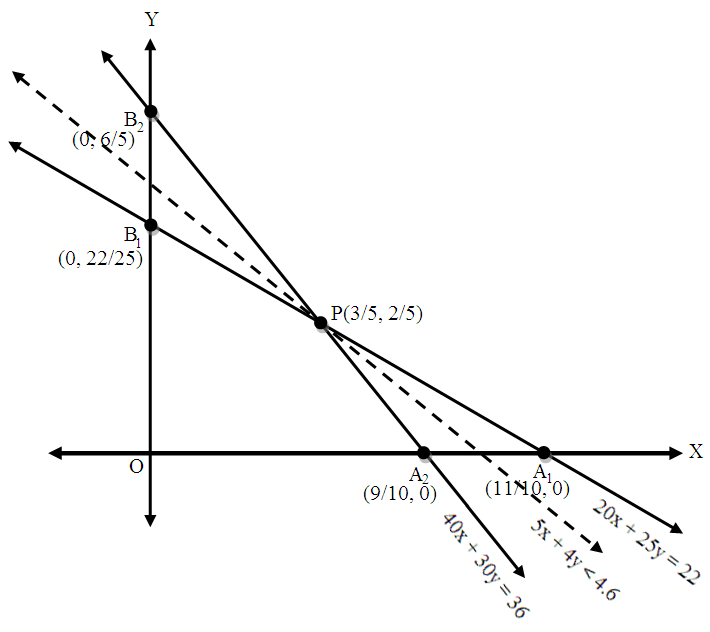
Region $20\text{x}+25\text{y}\geq22$: line 20x + 25y = 22 meets axes at $\text{A}_1\Big(\frac{11}{10},0\Big),\text{B}_1\Big(0,\frac{22}{25}\Big)$ espectively.

Region not containing origin represents $20\text{x}+25\text{y}\geq22$ as (0, 0) does not satisfy $20\text{x}+25\text{y}\geq22$.

Region $40\text{x}+30\text{y}\geq36$ line 40x + 30y = 36 meets axes at $\text{A}_1\Big(\frac{9}{10},0\Big),\text{B}_1\Big(0,\frac{6}{5}\Big)$

Region not containing origin represents $40\text{x}+30\text{y}\geq36$ as (0, 0) does not satisfy $40\text{x}+30\text{y}\geq36$.


The value of Z = 5x + 4y at

$\text{A}_1\Big(\frac{11}{10},0\Big)=5\Big(\frac{11}{10}\Big)+4(0)=5.5$

$\text{P}\Big(\frac{3}{5},\frac{2}{5}\Big)=5\Big(\frac{3}{5}\Big)+4\Big(\frac{6}{5}\Big)=4.6$

$\text{B}_2\Big(0,\frac{6}{5}\Big)=5(0)+4\Big(\frac{6}{5}\Big)=4.8$

Smallest value of Z is 4.6.

Now open half plane 5x + 4y < 4.6 has no point in common with feasible region so, smallest value z is the minimum value.

Hence,

Minimum cost of mixture = Rs 4.6
View full question & answer
Question 1315 Marks
A company manufactures two types of novelty souvenirs made of plywood. Souvenirs of type A require 5 minutes each for cutting and 10 minutes each for assembling. Souvenirs of type B require 8 minutes each for cutting and 8 minutes each for assembling. There are 3 hours 20 minutes available for cutting and 4 hours for assembling. The profit is Rs 5 each for type A and Rs 6 each for type B souvenirs. How many souvenirs of each type should the company manufacture in order to maximise the profit?
Answer
Let the company manufacture x souvenirs of type A and y souvenirs of type B.
Therefore, $\text{x}\ge0\text{ and y}\ge0$
The given information can be complied in a table as follows.
  Type A Type B Availability
Cutting (min) 5 8 3 × 60 + 20 = 200
Assembling (min) 10 8 4 × 60 = 240
The profit on type A souvenirs is Rs 5 and on type B souvenirs is Rs 6. Therefore, the constraints are
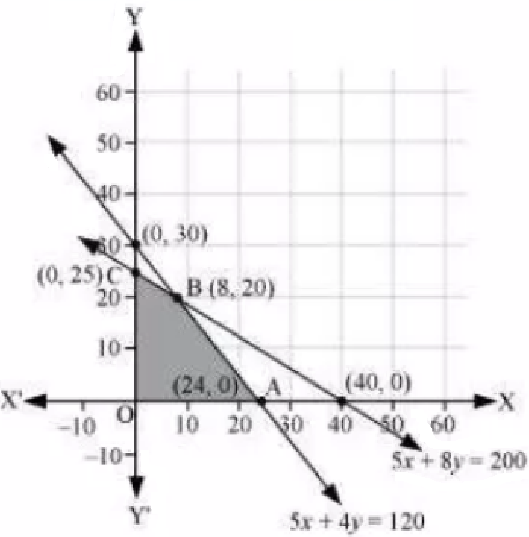
$5\text{x}+8\text{y}\le200\\10\text{x}+8\text{y}\le240\text{ i.e.},\ 5\text{x}+4\text{y}\le120$
Total profit, z = 5x + 6y
The mathematical formulation of the given problem is Maximize Z = 5x + 6y ... (1)
subject to the constraints,
$5\text{x}+8\text{y}\le200\dots(2)\\5\text{x}+4\text{y}\le120\dots(3)\\\text{x},\ \text{y}\ge0\dots(4)$
The feasible region determined by the system of constraints is as follows.

The corner points are A(24, 0), B(8, 20), and C(0, 25).
The values of z at these corner points are as follows.
Corner point Z = 5x + 6y  
A(24, 0) 120  
B(8, 20) 160 → Maximum
C(8, 25) 150  
The maximum value of z is 200 at (8, 20).
Thus, 8 souvenirs of type A and 20 souvenirs of type B should be produced each day to get the maximum profit of Rs 160.
View full question & answer
Question 1325 Marks
A firm manufacturing two types of electric items, $A$ and $B,$ can make a profit of Rs. $20$ per unit of A and Rs. $30$ per unit of $B$. Each unit of $A$ requires $3$ motors and $4$ transformers and each unit of $B$ requires $2$ motors and $4$ transformers. The total supply of these per month is restricted to $210$ motors and $300$ transformers. Type $B$ is an export model requiring a voltage stabilizer which has a supply restricted to $65$ units per month. Formulate the linear programing problem for maximum profit and solve it graphically.
Answer
Let $x$ units of item $A$ and $y$ units of item $B$ were manufactured.
Number of items cannot be negative.
Therefore, $\text{x},\text{y}\geq0$
The given information can be tabulated as follows:
Product
Motors
Transformers
$A(x)$
$3$
$4$
$B(y)$
$2$
$4$
Availability
$210$
$300$
Further, it is given that type B is an export model, whose supply is restricted to 65 units per month.
Therefore, the constraints are
$3\text{x}+2\text{y}\leq210$
$4\text{x}+4\text{y}\leq300$
$\text{y}\leq65$
A and B can make a profit of Rs. $20$ per unit of A and Rs. $30$ per unit of $B.$
Therefore, profit gained from x units of item A and y units of item B is Rs. $20x$ and Rs. $30y$ respectively.
Total profit $= Z = 20x + 30y$ which is to be maximised.
Thus, the mathematical formulation of the given linear programmimg problem is
Max $Z = 20x + 30y$
Subject to
$3\text{x}+2\text{y}\leq210$
$4\text{x}+4\text{y}\leq300$
$\text{y}\leq65$
$\text{x},\text{y}\geq0$
First we will convert inequations into equations as follows:
$3x + 2y = 210, 4x + 4y = 300, y = 65, x = 0$ and $y = 0$
Region represented by $3\text{x}+2\text{y}\leq210$:
The line $3x + 2y = 210$ meets the coordinate axes at $A_1(70, 0)$ and $B_1(0, 105)$ respectively.
By joining these points we obtain the line $3x + 2y = 210.$
Clearly $(0, 0)$ satisfies the $3x + 2y = 210.$
So, the region which contains the origin represents the solution set of the inequation $3\text{x}+2\text{y}\leq210$.
Region represented by $4\text{x}+4\text{y}\leq300$:
The line $4x + 4y = 300$ meets the coordinate axes at $C_1(75,0)$ and $D_1(0,75)$ respectively.
By joining these points we obtain the line $4x + 4y = 300.$
Clearly $(0, 0)$ satisfies the inequation $4\text{x}+4\text{y}\leq300$.
So,the region which contains the origin represents the solution set of the inequation $4\text{x}+4\text{y}\leq300$.
$y = 65$ is the line passing through the point $E_1(0, 65)$ and is parallel to $X$ axis.
Region represented by $\text{x}\geq0$ and $\text{y}\geq0$:
Since, every point in the first quadrant satisfies these inequations.
So, the first quadrant is the region represented by the inequations $\text{x}\geq0$, and $\text{y}\geq0$.
The feasible region determined by the system of constraints $3\text{x}+2\text{y}\leq210,4\text{x}+4\text{y}\leq300,\text{x}\geq0,$ and $\text{y}\geq0$ are as follows:

The corner points are $O(0, 0), E_1(0, 65), G_1(10, 65), F_1(60, 15)$ and $A_1(70, 0).$
The values of Z at these corner points are as follows.
Corner point
$Z = 20x + 30y$
$O$
$0$
$E_1$ 
$1950$
$G_1$ 
$2150$
$F_1$ 
$1650$
$A_1$ 
$1400$
The maximum value of $Z$ is $2150$ which is attained at $G(10, 65).$
Thus, the maximum profit is Rs.$ 2150$ obtained when $10$ units of item A and 65 units of item Bwere manufactured.
 
View full question & answer
Question 1335 Marks
A factory uses three different resources for the manufacture of two different products, $20$ units of the resources $A, 12$ units of $B$ and $16$ units of C being available. $1$ unit of the first product requires $2, 2$ and $4$ units of the respective resources and $1$ unit of the second product requires $4, 2$ and $0$ units of respective resources. It is known that the first product gives a profit of $2$ monetary units per unit and the second $3$. Formulate the linear programming problem. How many units of each product should be manufactured for maximizing the profit? Solve it graphically.
Answer
Let x units of first product and y units of second product be manufactured.
Therefore, $x, y \geq 0$
The given information can be tabulated as follows:
Product
Resource A Resource B Resource C
First$(x)$
$2$ $2$ $4$
Second $(y)$
$4$ $2$ $0$
Availability
$20$
$12$ $16$
Therefore, the constraints are
$2\text{x}+4\text{y}\leq20$
$2\text{x}+2\text{y}\leq12$
$4\text{x}+0\text{y}\leq16$
$4\text{x}\leq16$
It is known that the first product gives a profit of $2$ monetary units per unit and the second $3.$
Therefore, profit gained from $x$ units of first product and y units of second product is $2x$ monetary units and $4y$ monetary units respectively.
Total profit $= Z = 2x + 3y$ which is to be maximised
Thus, the mathematical formulat​ion of the given linear programmimg problem is
Max $Z = 2x + 3y$
Subject to
$2\text{x}+4\text{y}\leq20$
$2\text{x}+2\text{y}\leq12$
$4\text{x}+0\text{y}\leq16$
$4\text{x}\leq16$
$\text{x},\text{y}\geq0$
First we will convert inequations into equations as follows:
$2x + 4y = 20, 2x + 2y = 12, 4x = 16, x = 0$ and $y = 0$
Region represented by $2x + 4y \leq 20:$
The line $2x + 4y = 20$ meets the coordinate axes at $A_1(10, 0)$ and $B_1(0, 5)$ respectively.
By joining these points we obtain the line $2x + 4y = 20.$
Clearly $(0, 0)$ satisfies the $3x + 2y = 210.$
So, the region which contains the origin represents the solution set of the inequation $2x + 4y \leq 20.$
Region represented by $2x + 2y \leq 12:$
The line $2x + 2y = 16$ meets the coordinate axes at $C_1(6, 0)$ and $D_1(0, 6)$ respectively.
By joining these points we obtain the line $2x + 2y = 12.$
Clearly $(0, 0)$ satisfies the inequation $2x + 2y \leq 12.$
So, the region which contains the origin represents the solution set of the inequation $2x + 2y \leq 12$.
Region represented by $4x \leq 16:$
The line $4x =16$ or $x = 4$ is the line passing through the point $E_1(4, 0)$ and is parallel to $Y$ axis.
The region to the left of the line $x = 4$ would satisfy the inequation $4x \leq 16.$
Region represented by $x \geq 0$ and $y \geq 0:$
Since, every point in the first quadrant satisfies these inequations.
So, the first quadrant is the region represented by the inequations $x \geq 0,$ and $y \geq 0.$
The feasible region determined by the system of constraints $2x + 4y \leq 20, 2x + 2y \leq 12, 4x \leq 16, x \geq 0$ and $y \geq 0$ are as follows.

The corner points are $O(0, 0), B_1(0, 5), G_1(2, 4), F_1(4, 2)$ and $E_1(4, 0).$
The values of $Z$ at these corner points are as follows.
Corner point
$Z = 2x + 3y$
$O$
$0$
$B_1$
$15$
$G_1$ 
$16$
$F_1$ 
$14$
$E_1$  $8$
The maximum value of $Z$ is $16$ which is attained at $G_1(2, 4)$
Thus, the maximum profit is $16$ monetary units obtained when $2$ units of first product and $4$ units of second product were manufactured.
View full question & answer
Question 1345 Marks
A dietician wishes to mix together two kinds of food X and Y in such a way that the mixture contains at least 10 units of vitamin A, 12 units of vitamin B and 8 units of vitamin C. The vitamin contents of one kg food is given below:
Food
Vitamin A
Vitamin B
Vitamin C
X
1
2
3
Y
2
2
1
One kg of food X costs Rs. 16 and one kg of food Y costs Rs 20. Find the least cost of the mixture which will produce the required diet?
Answer
Let x be the amount of food X and Y be the amount of food Y that is to be mixed which will produce the required diet.
Then the mathematical modal of the LPP is as follows:
Minimise Z = 16x + 20y
Subject to
$2\text{x}+2\text{y}\geq12$
$3\text{x}+\text{y}\geq8$
$\text{x}\geq0,\text{y}\geq0$
To solve the LPP we draw the lines,
x + 2y = 10
2x + 2y = 12
3x + y = 8
The feasible region of the LPP is shaded in graph.

The coordinates of the vertices (corner points) of the feasible region ABCD are A(10, 0), B(2, 4), C(1, 5) and D(0, 8).
The value of the objective function at these points are given in the following table.
Point $(x_1, x_2)$
Value of objective function Z = 16x + 20y
A(10, 0) Z = 160
B(2, 4)
Z = 112
C(1, 5) Z = 116
D(0, 8) Z = 160
2kg of food X and 4kg of food Y will be required to minimize the cost of the diet.
The least cost of the mixture is Rs. 112.
View full question & answer
Question 1355 Marks
A manufacturer produces nuts and bolts. It takes 1 hour of work on machine A and 3 hours on machine B to produce a package of nuts. It takes 3 hours on machine A and 1 hour on machine B to produce a package of bolts. He earns a profit of Rs 17.50 per package on nuts and Rs 7.00 per package on bolts. How many packages of each should be produced each day so as to maximise his profit, if he operates his machines for at the most 12 hours a day?
Answer
Let the manufacturer produce x packages of nuts and y packages of bolts. Therefore, $\text{x}\ge0\text{ and y}\ge0.$
The given information can be compiled in a table as follows.
  Nuts Bolts Availability
Machine A (h) 1 3 12
Machine B (h) 3 1 12
The profit on a package of nuts is Rs 17.50 and on a package of bolts is Rs 7. Therefore, the constraints are
$\text{x}+3\text{y}\le12\\3\text{x}+\text{y}\le12$
Total profit, z = 17.5x + 7y
The mathematical formulation of the given problem is
Maximise Z = 17.5x + 7y ... (1)
subject to the constraints,
$\text{x}+3\text{y}\le12\dots(2)\\3\text{x}+\text{y}\le12\dots(3)\\\text{x},\ \text{y}\ge0\dots(4)$
The feasible region determined by the system of constraints is as follows.

The corner points are A(4, 0), B(3, 3), and C(0, 4).
The values of Z at these corner points are as follows.
Corner point Z = 17.5x + 7y  
O(0, 0) 0  
A(4, 0) 70  
B(3, 3) 73.5 → Maximum
C(0, 4) 28  
The maximum value of Z is Rs 73.50 at (3, 3).
Thus, 3 packages of nuts and 3 packages of bolts should be produced each day to get the maximum profit of Rs 73.50.
View full question & answer
Question 1365 Marks
An airline agrees to charter planes for a group. The group needs at least 160 first class seats and at least 300 tourist class seats. The airline must use at least two of its model 314 planes which have 20 first class and 30 tourist class seats. The airline will also use some of its model 535 planes which have 20 first class seats and 60 tourist class seats. Each flight of a model 314 plane costs the company Rs 100,000 and each flight of a model 535 plane costs Rs 150,000. How many of each type of plane should be used to minimize the flight cost? Formulate this as a LPP.
Answer
Let x number of model 314 planes and y number of model 535 planes were used.

It is given that cost of one model 314 plane is Rs 100000 and cost of one model 535 plane is Rs 150000.

Therefore, cost of x model 314 plane is Rs 100000x and cost of y model 535 plane is Rs 150000y.

Total cost price = 100000x +150000 y

Let Z denote the total cost

Then, Z = 100000x +150000y

Also,

Each model 314 planes have 20 first class and 30 tourist class seats and each model 535 planes has 20 first class and 60 tourist class seats.

The group needs 160 first class seats and 300 tourist class seats.

$\therefore20\text{x}+20\text{y}\geq160,30\text{x}+60\text{y}\geq300$

Number of planes cannot be negative.

Therefore, $\text{x},\text{y}\geq0$

Hence, the required LPP is as follows:

Min Z = 100000x+150000y

Subject to

$\therefore20\text{x}+20\text{y}\geq160$

$30\text{x}+60\text{y}\geq300$

$\text{x}\geq0,\text{y}\geq0$
View full question & answer
Question 1375 Marks
A firm makes items A and B and the total number of items it can make in a day is 24. It takes one hour to make an item of A and half an hour to make an item of B. The maximum time available per day is 16 hours. The profit on an item of A is Rs. 300 and on one item of B is Rs. 160. How many items of each type should be produced to maximize the profit? Solve the problem graphically.
Answer
Let the number of item A produced be x, and the number of item B produced be y. Since the total number of items are at most 24. $\text{x} + \text{y} \leq 24 \ \dots(1)$ Item A takes 1 hour to manufacture and item B takes half an hour to manufacture. x item takes x hour to manufacture and y items take $\frac{\text{y}}{2}$ hour to a manufacture. and maximum time available is 16 hours. $\therefore \text{x} + \frac{\text{y}}{2}\leq16 \dots (2)$ The profit on one unit of A is Rs. 300 and the profit on one unit of B is Rs. 160 Since we want to maximize profit. Let the profit be z. Max z = 300x + 160y .....(3)
The shaded region will satisfy the equation (1) and (2), their intersection point is E(8, 16). Vertices of OAED are O(0, 0), A(0, 24), E(8, 16) and D(16, 0). At A Z = 160 × 24 = 3840 At E Z = 300 × 8 + 160 × 16 = 2400 + 2560 = 4960 At D Z = 300 × 16 + 160 × 0 = 4800 Therefore the maximum value is at point E. i.e. x = 8 and y = 16 Thus they should produce 8 items of type A and 16 items of type B.
View full question & answer
Question 1385 Marks
Determine the maximum value of $\text{Z}=11\text{x}+7\text{y}$ subject to the constraints:
$2\text{x}+\text{y}\leq6,\text{x}\leq2,\text{x}\geq0,\text{y}\geq0. $
Answer
We have, maximise $\text{Z}=11\text{x}+7\text{y}\ .....(\text{i})$
Subject to the constraints
$2\text{x}+\text{y}\leq6\ .....(\text{ii})$
$\text{x}\leq2\ ......(\text{iii})$
$\text{x}\geq0,\text{y}\geq0\ .....(\text{iv}) $
We see that, the feasible region as shaded determined by the system of constraint (ii) to (iv) is OABC and is bounded. So, now we shall use corner point method to determine the maximum value of Z.
Corner Points
Corresponding value of Z
(0, 0)
(2, 0)
(2, 2)
(0, 6)
0
22
36
42 (Maximum)
Hence, the maximum value of Z is 42 at (0, 6).
View full question & answer
Question 1395 Marks
Maximum Z = 2x + 4y Subject to$\text{x}+\text{y}\geq8$
$\text{x}+4\text{y}\geq12$
$\text{x}\geq3,\text{y}\geq2$
Answer
First, we will convert the given inequations into equations, we obtain the following equations:
x + y = 8, x + 4y = 12, x = 3, y = 2
Region represented by x + y ≥ 8:
The line x + y = 8 meets the coordinate axes at A(8, 0) and B(0, 8) respectively. By joining these points we obtain the line x + y = 8.
Clearly (0, 0) does not satisfies the inequation x + y ≥ 8.
So, the region in xy plane which does not contain the origin represents the solution set of the inequation x + y ≥ 8.
Region represented by x + 4y ≥ 12:
The line x + 4y = 12 meets the coordinate axes at C(12, 0) and D(0, 3) respectively. By joining these points we obtain the line x + 4y = 12.
Clearly (0, 0) satisfies the inequation x + 4y ≥ 12.
So, the region in xy plane which contain the origin represents the solution set of the inequation x + 4y ≥ 12.
The line x = 3 is the line that passes through the point (3, 0) and is parallel to Y axis. x ≥ 3 is the region to the right of the line x = 3.

The line y = 2 is the line that passes through the point (0, 12) and is parallel to X axis. y ≥ 2 is the region above the line y = 2.

The corner points of the feasible region are E(3, 5) and F(6, 2).
The values of Z at these corner points are as follows.
Corner point
Z = 2x + 4y
E(3, 5)
2 × 3 + 4 × 5 = 26
F(6, 2)
2 × 6 + 4 × 2 = 20
Therefore, the minimum value of Z is 20 at the point F(6, 2).
Hence, x = 6 and y = 2 is the optimal solution of the given LPP.
Thus, the optimal value of Z is 20.
View full question & answer
Question 1405 Marks
Show the solution zone of the following inequalities on a graph paper:
$5\text{x}+\text{y}\geq10$
$\text{x}+\text{y}\geq6$
$\text{x}+4\text{y}\geq12$
$\text{x}\geq,\text{y}\geq0$
Answer
Converting the given inequations into equations
5x + y = 10, x + y = 6, x + 4y = 12, x = y = 0

Region represented by $5\text{x}+\text{y}\geq10$:

Line 5x + y - 10 meets coordinate axes at $A_1(2, 0)$ and $B_1(0, 10).$

Clearly, (0, 0) does not satisfy $5\text{x}+\text{y}\geq10$, so region not containing origin represents $5\text{x}+\text{y}\geq10$ in xy -plane.

Region represented by $\text{x}+\text{y}\geq6$:

Line x + y = 6 meets coordinate axes at $A_2(6, 0)$ and $B_2(0, 6)$.

Clearly, (0, 0) does not satisfy $\text{x}+\text{y}\geq6$, so region not containing origin represents $\text{x}+\text{y}\geq6$ in xy -plane.

Region represented by $\text{x}+4\text{y}\geq12$:

Line x + 4y = 12 meets coordinate axes at $A_3(12, 0)$ and $B_3(0, 3).$

Clearly, (0, 0) does not satisfy $\text{x}+4\text{y}\geq12$, so, region not containing origin $\text{x}+4\text{y}\geq12$ in xy - plane.

Region represented by $\text{x}\geq,\text{y}\geq0$:

It represents first quadrant in xy-plane.

The unbounded shaded region with corner points $A_3(12, 0), P(4, 2), Q(1, 5), B_1(0, 10)$ represents feasible region.

Point P is obtained by solving x + 4y = 12 and x + y = 6, Q by solving x + y = 6 and 5x + y = 10.

The value of Z = 3x + 2y at

$A_3(12, 0) = 3(12) + 2(0) = 36$

P(4, 2) = 3(4) + 2(2) = 16

Q(1, 5) = 3(1) + 2(5) = 13

B(0, 10) = 3(0) + 2(10) = 20

Smallest value of Z = 13,

Now open half plane $3\text{x}+2\text{y}\leq13$ has no point in common with feasible region, so, smallest value is the minimum value of Z,

Hence,

Minimum z = 13 at x = 1, y = 5
View full question & answer
Question 1415 Marks
A company manufactures two articles A and B. There are two departments through which these articles are processed: (i) assembly and (ii) finishing departments. The maximum capacity of the first department is 60 hours a week and that of other department is 48 hours per week. The product of each unit of article A requires 4 hours in assembly and 2 hours in finishing and that of each unit of B requires 2 hours in assembly and 4 hours in finishing. If the profit is Rs. 6 for each unit of A and Rs 8 for each unit of B, find the number of units of A and B to be produced per week in order to have maximum profit.
Answer
Let x units and y units of articles A and B are produced respectively.
Number of articles cannot be negative.
Therefore, x, y ≥ 0
The product of each unit of article A requires 4 hours in assembly and that of article B requires 2 hours in assembly and the maximum capacity of the assembly department is 60 hours a week
4x + 2y ≤ 60
The product of each unit of article A requires 2 hours in finishing and that of article B requires 4 hours in assembly and the maximum capacity of the finishing department is 48 hours a week.
2x + 4y ≤ 48
If the profit is Rs. 6 for each unit of A and Rs. 8 for each unit of B.
Therefore, profit gained from​ x units and y units of articles A and B respectively is Rs. 6x and Rs. 8y respectively.
Total revenue = Z = 6x + 8y which is to be maximised.
Thus, the mathematical formulat​ion of the given linear programmimg problem is
Max Z = 6x + 8y
Subject to
2x + 4y ≤ 48
4x + 2y ≤ 60
x, y ≥ 0
First we will convert inequations into equations as follows:
2x + 4y = 48, 4x + 2y = 60, x = 0 and y = 0
Region represented by 2x + 4y ≤ 48:
The line 2x + 4y = 48 meets the coordinate axes at $A_1(24, 0)$ and $B_1(0, 12)$ respectively.
By joining these points we obtain the line 2x + 4y = 48.
Clearly (0, 0) satisfies the 2x + 4y = 48.
So, the region which contains the origin represents the solution set of the inequation 2x + 4y ≤ 48.
Region represented by 4x + 2y ≤ 60:
The line 4x + 2y = 60 meets the coordinate axes at $C_1(15, 0)$ and $D1(0, 30)$ respectively.
By joining these points we obtain the line 4x + 2y = 60.
Clearly (0, 0) satisfies the inequation 4x + 2y ≤ 60.
So, the region which contains the origin represents the solution set of the inequation 4x + 2y ≤ 60.
Region represented by x ≥ 0 and y ≥ 0:
Since, every point in the first quadrant satisfies these inequations.
So, the first quadrant is the region represented by the inequations x ≥ 0, and y ≥ 0.
The feasible region determined by the system of constraints 2x + 4y ≤ 48, 4x + 2y ≤ 60, x ≥ 0 and y ≥ 0 are as follows.

The corner points are $O(0, 0), B_1(0, 12), E_1(12, 6)$ and $C_1(15, 0)$.
The values of Z at these corner points are as follows.
Corner points
Z = 6x + 8y
$O$
0
$B_1$
96
$E_1$
120
$C_1$
90
The maximum value of Z is 120 which is attained at $E_1(12, 6)$.
Thus, the maximum profit is Rs. 120 obtained when 12 units of article A and 6 units of article B were manufactured.
View full question & answer
Question 1425 Marks
A company produces two types of goods, A and B, that require gold and silver. Each unit of type A requires 3gm of silver and 1 gm of gold while that of type B requires 1 gm of silver and 2gm of gold. The company can produce 9gm of silver and 8gm of gold. If each unit of type A brings a profit of Rs. 40 and that of type B Rs. 50, find the number of units of each type that the company should produce to maximize the profit. What is the maximum profit?
Answer
Let number of goods A and B are x and y respectively.
Since, profits on each A and B are Rs. 40 and Rs. 50 respectively.
So, profits on x of type A and y of type B are 40x and 50y respectively, Let Z be total profit on A and B, so,
Z = 40x + 50y
Since, each A and B require 3gm and 1gm of silver respectively.
So, x of type A and y type B require 3x and y gm silver respectively but, Total silver available is 9 gm. so,
$3\text{x}+\text{y}\leq9$ (first constraint)
Since, each A and B require 1gm and 2gm of gold respectively.
So, x of type A and y type B require x and 2y gm of gold respectively but, Total gold available is 8 gm, so,
$\text{x}+2\text{y}\leq8$ (second constraint)
Hence, mathematical formulation of LPP is,
Find x and y which maximize
Z = 40x + 50y
Subject to constraints,
$3\text{x}+\text{y}\leq9$
$\text{x}+2\text{y}\leq8$
$\text{x},\text{y}\geq0$ [Since production of A and B can not be less than zero]
Region $3\text{x}+\text{y}\leq9$:
Line 3x +y = 9 meets axes at A(3, 0), B(0, 9) respectively.
Region containing origin represents $3\text{x}+\text{y}\leq9$ as (0, 0) satisfies $3\text{x}+\text{y}\leq9$.
Region $\text{x}+2\text{y}\leq8$:
Line x +2y = 8 meets axes at $A_2(8, 0), B_2(0, 4)$ respectively.
Region containing origin represents $\text{x}+2\text{y}\leq8$ as (0, 0) satisfies $\text{x}+2\text{y}\leq8$.
Region $\text{x},\text{y}\geq0$:
It represents first quadrant.

Shaded region $OA_2PB_2$ is the feasible region.
Point P(2, 3) is obtained by solving 3x + y - 9 and x + 2y = 8
The value of $Z = 40x + 50y$ at
$O(0, 0) = 40(0) + 50(0) = 0$
$A_1(3, 0) = 40(3) + 50(0) = 120$
$P(2, 3) = 40(2) + 50(3) = 230$
$B_2(0, 4) = 40(0) + 50(4) = 200$
Therefore maximum Z = 230 at x = 2, y = 3
Hence,
Maximum profit = Rs. 230 number of goods of type A = 2, type B = 3
View full question & answer
Question 1435 Marks
Minimise and Maximise Z = 5x + 10y
Subject to $\text{x}+2\text{y}\leq120,\ \text{x}+\text{y}\geq60,\ \text{x}- 2\text{y}\geq0,\ \text{x},\ \text{y}\geq0.$
Answer

Consider $\text{x}+2\text{y}\leq120$
Let x + 2y = 120
$\Rightarrow\frac{\text{x}}{120}+\frac{\text{y}}{60}=1$
The half plane containing (0, 0) is the required half plane as (0, 0) makes $\text{x}+2\text{y}\leq120$, true.
gain $\text{x}+\text{y}\geq6$
Let x + y = 60
Also the half plane containing (0, 0) does not make $\text{x}+\text{y}\geq6$ true.
Therefore, the required half plane does not contain (0, 0).
Again $\text{x}-2\text{y}\geq0$
Let x - 2y = 0 ⇒ x = 2y
Let test point be (30, 0).
x 0 30 60
y 60 30 0
$\Rightarrow\text{x}-2\text{y}\geq0\Rightarrow30-2\times0\geq0$ It is true.
Therefore, the half plane contains (30, 0).
The region CFEKC represents the feasible region.
At C(60, 0) Z = 5 × 60 = 300
At F(120, 0) Z = 5 × 120 = 600
At E(60, 30) Z = 5 × 60 + 10 × 30 = 600
At K(40, 20) Z = 5 × 40 + 10 × 20 = 400
Hence, minimum Z = 300 at x = 60, y = 0 and maximum Z = 600 at x = 120, y = 0 or x = 60, y = 30.
View full question & answer
Question 1445 Marks
A small manufacturer has employed 5 skilled men and 10 semi-skilled men and makes an article in two qualities deluxe model and an ordinary model. The making of a deluxe model requires 2 hrs. work by a skilled man and 2 hrs. work by a semi-skilled man. The ordinary model requires 1 hr by a skilled man and 3 hrs. by a semi-skilled man. By union rules no man may work more than 8 hrs per day. The manufacturers clear profit on deluxe model is Rs. 15 and on an ordinary model is Rs. 10. How many of each type should be made in order to maximize his total daily profit.
Answer
Let x articles of deluxe model and y articles of an ordinary model be made.

Number of articles cannot be negative.

Therefore, $\text{x},\text{y}\geq0$

According to the question, the making of a deluxe model requires 2 hrs.

Work by a skilled man and the ordinary model requires 1 hr by a skilled man

$2\text{x}+\text{y}\leq40$

The making of a deluxe model requires 2 hrs.

Work by a semi-skilled man ordinary model requires 3 hrs.

Work by a semi-skilled man. $2\text{x}+3\text{y}\leq80$

Total profit = Z = 152 + 10y which is to be maximised

Thus, the mathematical formulation of the given linear programmimg problem is

Max Z = 15x + 10y

Subject to

$2\text{x}+\text{y}\leq40$

$2\text{x}+3\text{y}\leq80$

$\text{x}\geq0$

$\text{y}\geq0$

The feasible region determined by the system of constraints is:


The corner points are $\text{A}\Big(0,\frac{800}{3}\Big)$, B(10, 20), C(20, 0).

The values of Z at these corner points are as follows.
Corner point
Z = 15x + 10y
A
$\frac{800}{3}$
B
350
C
300
The maximum value of Z is 300 which is attained at C(20, 0).

Thus, the maximum profit is Rs. 300 obtained when 10 units of deluxe modal and 20 unit of ordinary model is produced.
View full question & answer
Question 1455 Marks
Show the solution zone of the following inequalities on a graph paper:
$\text{x}+\text{y}\leq50$
$3\text{x}+\text{y}\geq90$
$\text{x},\text{y}\geq0$
Answer
We have to maximize Z = 60x + 15y.

First, we will convert the given inequations into equations, we obtain the following equations:

x + y = 50, 3x + y = 90, x = 0 and y = 0

Region represented by $\text{x}+\text{y}\leq50$.

The line x + y = 50 meets the coordinate axes at A(50, 0) and B(0, 50) respectively.

By joining these points we obtain the line 3x + 5y = 15.

Clearly (0, 0) satisfies the inequation $\text{x}+\text{y}\leq50$.

So, the region containing the origin represents the solution set of the inequation $\text{x}+\text{y}\leq50$.

Region represented by $3\text{x}+\text{y}\geq90$.

The line 3x + y = 90 meets the coordinate axes at C(30, 0) and D(0, 90) respectively.

By joining these points we obtain the line $3\text{x}+\text{y}\geq90$.

Clearly (0, 0) satisfies the inequation $3\text{x}+\text{y}\geq90$.

So, the region containing the origin represents the solution set of the inequation $3\text{x}+\text{y}\geq90$.

Region represented by $\text{x}\geq0$ and $\text{y}\geq0$:

Since, every point in the first quadrant satisfies these inequations.

So, the first quadrant is the region represented by the inequations $\text{x}\geq0$ and $\text{y}\geq0$:

The feasible region determined by the system of constraints,

$\text{x}+\text{y}\leq50,3\text{x}+\text{y}\geq90,\text{x}\geq0$ and $\text{y}\geq0$, are as follows.


The corner points of the feasible region are O(0, 0), C(30, 0), E(20, 30 ) and B(0, 50).

The values of Z at these corner points are as follows.
Corner point Z = 60x + 15y
O(0, 0) 60 × 0 + 15 × 0 = 0
C(30, 0) 60 × 30 + 15 × 0 = 1800
E(20, 30) 60 × 20 + 15 × 30 = 1650
B(0, 50) 60 × 0 + 15 × 50 = 50
Therefore, the maximum value of Z is 1800 at the point (30, 0).

Hence, x = 30 and y = 0 is the optimal solution of the given LPP.

Thus, the optimal value of Z is 1800.
View full question & answer
Question 1465 Marks
Maximise Z = 5x + 3y
subject to $3\text{x}+5\text{y}\leq15,\ 5\text{x}+2\text{y}\leq10,\ \text{x}\geq0,\ \text{y}\geq0.$
Answer

We first draw the graph of equation 3x + 5y = 15
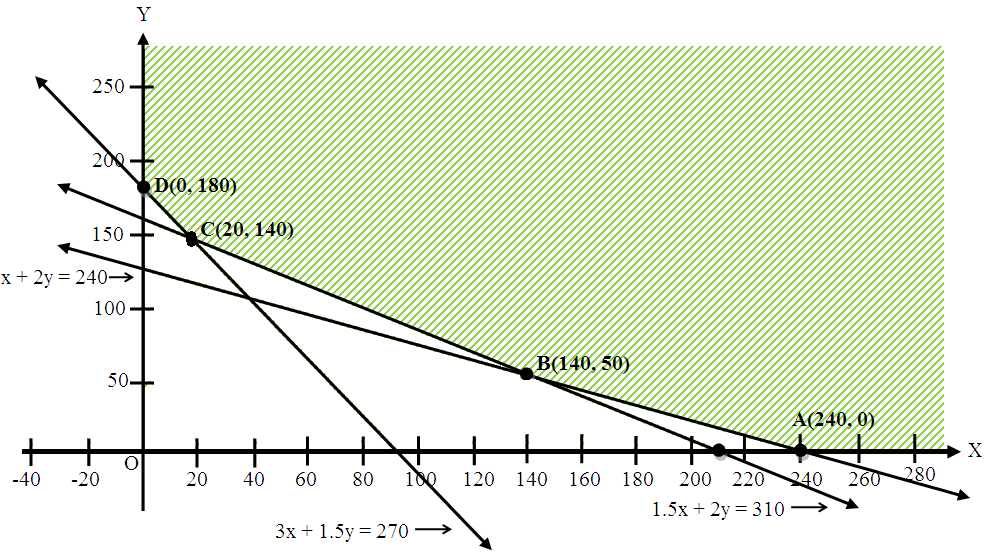
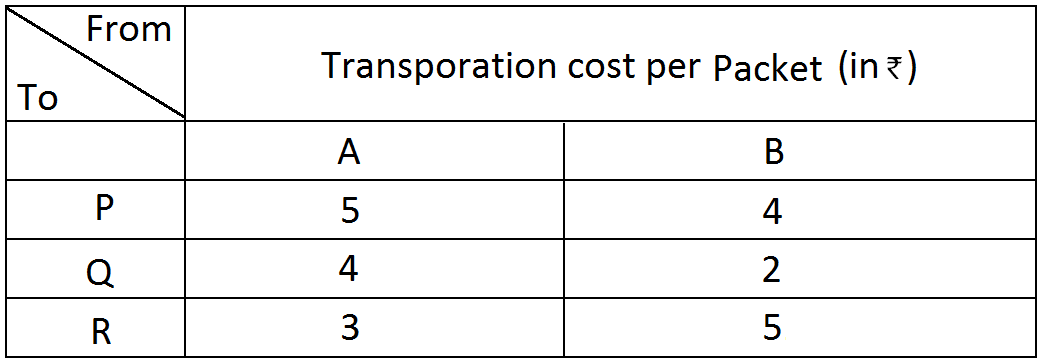
$\Rightarrow\text{x}=\frac{15-5\text{y}}{3}$
For y = 3, x = 0
And for y = 0, x = 5
Similarly, for equation 5x + 2y = 10, the points are (2, 0) and (0, 5).
As (0, 0) satisfies both the inequations and also $\text{x}\geq0,\ \text{y}\geq0,$ then the feasible require contains the half-plane containing (0, 0).
Therefore, the feasible portion is OABC which is shown as shaded in the graph.
Co-ordinates of point B can be obtained by solving 3x + 5y = 15 and 5x + 2y = 10 and it is $\text{B}\Big(\frac{20}{19},\ \frac{45}{19}\Big).$
Thus, co-ordinates of O, A, B and C are (0, 0), (2, 0), $\Big(\frac{20}{19},\ \frac{45}{19}\Big)$ and (0, 3).
Z = 5x + 3y = 0 (if x = 0, y = 0)
Z = 5 × 2 + 3 × 0 = 10 (if x = 2, y = 0)
$\text{Z}=5\times\frac{20}{19}+3\times\frac{45}{19}=\frac{235}{19}$ $\Big(\text{if x}=\frac{20}{19},\ \text{y}=\frac{45}{19}\Big)$
Z = 5 × 0 + 3 × 3 = 9 (if x = 0, y = 3)
Hence, $\text{z}=\frac{235}{19}$ is maximum when $\text{x}=\frac{20}{19},\ \text{y}=\frac{45}{19}.$
View full question & answer
Question 1475 Marks
A fruit grower can use two types of fertilizer in his garden, brand P and Q. The amounts (in kg) of nitrogen, phosphoric acid, potash, and chlorine in a bag of each brand are given in the table. Tests indicate that the garden needs at least 240kg of phosphoric acid, at least 270kg of potash and at most 310kg of chlorine.
Kg per bag
 
Brand P
Brand P
Nitrogen
32
3.5
Phosphoric
1
2
Potash
3
1.5
Chlorine
1.5
2
If the grower wants to minimize the amount of nitrogen added to the garden, how many bags of each brand should be used? What is the minimum amount of nitrogen added in the garden?
Answer
Let x bags of fertilizer P and Y bags of fertilizer Q used in the garden to minimize the usage of nitrogen.
Then the mathematical modal of the LPP is as follows:
Minimise Z = 3x + 3.5y
Subject to
$\text{x}+2\text{y}\geq240$
$3\text{x}+1.5\text{y}\geq270$
$1.5\text{x}+2\text{y}\leq310$
$\text{x}\geq0,\text{y}\geq0$
To solve the LPP we draw the lines,
x + 2y = 240
3x + 1.5y = 270
1.5x + 2y = 310
The feasible region of the LPP is shaded in graph.

The coordinates of the vertices (corner points) of the feasible region ABC are A(40, 100), B(140, 50), and C(20, 140).
The value of the objective function at these points are given in the following table.
Point $(x_1, x_2)$
Value of objective function Z = 3x + 3.5y
A(40, 100) Z = 470
B(140, 50)
Z = 595
C(20, 140) Z = 550
D(0, 8) Z = 160
40 bags of brand P and 100 bags of brand Q should be used to minimize.
The amount of nitrogen added to the garden.
The minimum amount of notrogen added in the garden is 470kg.
View full question & answer
Question 1485 Marks
A medical company has factories at two places, A and B. From these places, supply is made to each of its three agencies situated at P, Q and R. The monthly requirements of the agencies are respectively 40, 40 and 50 packets of the medicines, while the production capacity of the factories, A and B, are 60 and 70 packets respectively. The transportation cost per packet from the factories to the agencies are given below:

How many packets from each factory be transported to each agency so that the cost of transportation is minimum? Also find the minimum cost?
Answer
The given information can be exhibited diagramatically as below:

Let factory A transports x packets to agency P and y packet to agency Q.
Since factory A has capacity of 60 packets so, rest [60 - (x + y)] packets transported to agency R.
Since requirements are always non negative so,
= x , y ≥ 0 (first constraint)
and
60 = (x + y) ≥ 0
(x + y) ≥ 60 (second constraint)
Since requirement of agency P is 40 packet but it has recieved x packet, so (40 - x) packets are transported from factory B, requirement of agency Q is 40 packets but it has recieved y packets, so (40 - y) packets are transported from factory B.
Requirement of agency R is 50 packets but it has recieved (60 - x - y) packets from factory A, so 50 - (60 - x - y) - (x + y - 10) is transported from factory B, As the requirements of agencies P, Q, R are always non negative, so,
40 - x ≥ 0
X ≤ 40 (third constraint)
40- y ≥ 0
y ≤ 40 (fourth constraint)
x + y - 10 ≥ 0
x + y ≥ 10 (fifth constraint)
Costs of transportation of each packet from factory A to agency P, Q, R are Rs. 5,4,3 respectively and costs of transportation of each packet from factory 8 to agency P, Q, R are Rs. 4, 2, 5 respectively,
Let Z be total cost of transportation so,
Z = 5x + 4y + 3(60 - x - y) + 4(40 - x) + 2(40 - y) + 5(x + y - 10)
= 5x + 4y + 180 - 3x - 3y + 160 - 4x + 80 - 2y + 5x + 5y - 50
= 3x + 4y + 370
Hence, mathematical formulation of LPP is find x and y which
Maximize Z = 3x + 4y + 370
Subject to constraints,
x, y ≥ 0
x + y ≤ 60
x ≤ 40
y ≤ 0
x + y ≥ 10
Region x, y ≥ 0:
It is represents first quandrant.
Region x + y ≤ 60:
Line x + y ≤ 60 meets axes at $A_1(60, 0), B_1(0, 60)$ respectively.
Region containing origin represents x +y ≤ 60 as (0, 0) satisfies x + y ≤ 60
Region X ≤ 40:
Line x = 40 is parallel to y-axis and meets x-axis at $A_2(40, 0)$.
Region containing origin represents x ≤ 40 as (0, 0) satisfies x ≤ 40.
Region y ≤ 40:
line y = 40 is parallel to x-axis and meets y-axis at $B_2(0, 40)$.
Region containing origin represents y ≤ 40 as (0, 0) satisfies y ≤ 40.
Region x + y ≥ 10:
Line x + y = 10 meets axes at $A_2(10, 0), B_3(0, 10)$ respectively.
Region containing origin represents x + y ≥ 10 as (0, 0) does not satisfy x + y ≥ 10.
Shaded region $A_2A_2PQB_2B_3$ represents feasible region.
Point P(40, 20) is obtained by solving x = 40 and x + y = 60
Point Q(20, 40) is obtained by solving y = 40 and x + y = 60

The value of Z = 3x + 4y + 370 at
$A_3(10, 0) = 3(10) + 4(0) + 370 = 400$
$A_2(40, 0) = 3(40) + 4(0) + 370 = 490$
$P(40, 20) = 3(40) + 4(20) + 370 = 570$
$Q(20, 40) = 3(20) + 4(40) + 370 = 590$
$B_2(0, 40) = 3(0) + 4(40) + 370 = 530$
$B_3(0, 10) = 3(0) + 4(10) + 370 = 410$
Minimum Z = 400 at x = 10, y = 0
From A → P = 10 packets
From A → Q = 0 packets
From A → R = 50 packets
From B → P = 30 packets
From B → Q = 40 packets
From B → R = O packets
Minimum cost = Rs. 400
View full question & answer
Question 1495 Marks
A producer has 30 and 17 units of labour and capital respectively which he can use to produce two type of goods x and y. To produce one unit of x, 2 units of labour and 3 units of capital are required. Similarly, 3 units of labour and 1 unit of capital is required to produce one unit of y. If x and y are priced at Rs. 100 and Rs. 120 per unit respectively, how should be producer use his resources to maximize the total revenue? Solve the problem graphically.
Answer
Let xl and yl units of goods x and y were produced respectively.
Number of units of goods cannot be negative.
Therefore, $x_1, y_1 \geq 0$
To produce one unit of x, 2 units of labour and for one unit of y, 3 units of labour are required.
$2x_1 + 3y_1 \leq 30$
To produce one unit of x, 3 units of capital is required and 1 unit of capital is required to produce one unit of y
$3x_1 + y_1 \leq 17$
If x and y are priced at Rs. 100 and Rs. 120 per unit respectively,
Therefore, cost of $x_1$ and $y_1$ units of goods x and y is Rs. $100x_1$ and Rs. $120y_1$ respectively.
Total revenue $= Z = 100x_1 + 120y_1$​​​​​​​ which is to be maximised.
Thus, the mathematical formulation of the given linear programmimg problem is
Max $Z = 100x_1 + 120y_1$
Subject to
$2x_1 + 3y_1 \leq 30$
$3x_1 + y_1 \leq 17$
$x_1, y_1 \geq 0$
First we will convert inequations into equations as follows:
$2x_1 + 3y_1 = 30, 3x_1 + y_1 = 17, x = 0$ and $y = 0$
Region represented by $2x_1 + 3y_1 \leq 30$:
The line $2x_1 + 3y_1 = 30$ meets the coordinate axes at A(15, 0) and B(0, 10) respectively.
By joining these points we obtain the line $2x_1 + 3y_1 = 30$.
Clearly (0, 0) satisfies the $2x_1 + 3y_1 = 30$.
So, the region which contains the origin represents the solution set of the inequation $2x_1 + 3y_1 \leq 30$.
Region represented by $3x_1 + y_1 \leq 17$:
The line $3x_1 + y_1 = 17$ meets the coordinate axes at $C(173, 0)$ and $D(0, 17)$ respectively.
By joining these points we obtain the line $3x_1 + y_1 = 17$.
Clearly (0, 0) satisfies the inequation $3x_1 + y_1 \leq 17$.
So, the region which contains the origin represents the solution set of the inequation $3x_1 + y_1 \leq 17$.
Region represented by $x_1 \geq 0$ and $y_1 \geq 0$:
Since, every point in the first quadrant satisfies these inequations.
So, the first quadrant is the region represented by the inequations $x_1 \geq 0$, and $y_1 \geq 0$.
The feasible region determined by the system of constraints $2x_1 + 3y_1 \leq 30, 3x_1 + y_1 \leq 17, x_1 \geq 0$ and $y_1 \geq 0$ are as follows.

The corner points are B(0, 10), E(3, 8) and C(173, 0).
The values of Z at these corner points are as follows.
Corner point
$Z = 100x_1 + 120y_1$
B
1200
E
1260
C
17003
The maximum value of Z is 1260 which is attained at E(3, 8).
Thus, the maximum revenue is Rs. 1260 obtained when 3 units of x and 8 units of y were produced.
View full question & answer
Question 1505 Marks
Maximize $Z = x + y$
Subject to
$-2\text{x}+\text{y}\leq1$
$\text{x}\leq2$
$\text{x}+\text{y}\leq3$
$\text{x},\text{y}\geq0$
Answer
Converting the given inequations into equation,

-2x + y = 1, x = 2, x + y = 3, x= y = 0


Region represented by - 2x + y = 1:

Line - 2x + y = 1 meets coordinate axes at $\text{A}_1\Big(\frac{-1}{2},0\Big)$ and $B_1(0, 1)$, clearly, $(0, 0)$ satisfies $-2\text{x}+\text{y}\leq1$, so region containing origin represents $-2\text{x}+\text{y}\leq1$ in xy-plane.
Region represented by $\text{x}\leq2$:
Linex - 2 is parallel to y-axis and meets x-axis at $A_3(2, 0)$.
Clearly, (0, 0) satisfies $\text{x}\leq2$, so region containing origin represents $\text{x}\leq2$ in xy-plane.
Region represented by $\text{x}+\text{y}\leq3$:
Line $x + y - 3$ meets coordinate axes at $A_2(3, 0)$ and $B_2(0, 3)$.
Clearly, (0, 0) satisfies $\text{x}+\text{y}\leq3$, so region containing origin represents $\text{x}+\text{y}\leq3$ in xy-plane.
Region represented $\text{x},\text{y}\geq0$:
It represents first quadrant in xy-plane.
So, shaded region $OA_3PQ8$, represents the feasible region.
Coordinates of P(2, 1) is obtained by solving x + y = 3 and x = 2, $\text{Q}\Big(\frac{2}{3},\frac{7}{3}\Big)$ by solving -2x + y = 1 and x + y = 3.
The value of Z = x + y at
$\text{O}(0, 0) = 0 + 0 = 0$
$\text{A}_3(2, 0) = 2 + 0 = 2$
$\text{P}(2, 1) = 2 +1 = 2$
$\text{Q}\Big(\frac{2}{3},\frac{7}{3}\Big)=\frac{2}{3}+\frac{7}{3}=3$
$\text{B}_1(0, 1) = 0 + 1 = 1$
So, maximum Z = 3 is at every point on the line joining PQ.
Hence, maximum z = 3 at x = 2 and y = 1 Or $\text{x}=\frac{2}{3}$ and $\text{y}=\frac{7}{3}.$
View full question & answer
5 Marks Questions - Page 3 - Maths STD 12 Science Questions - Vidyadip