Questions · Page 2 of 5

5 Marks Questions

Question 515 Marks
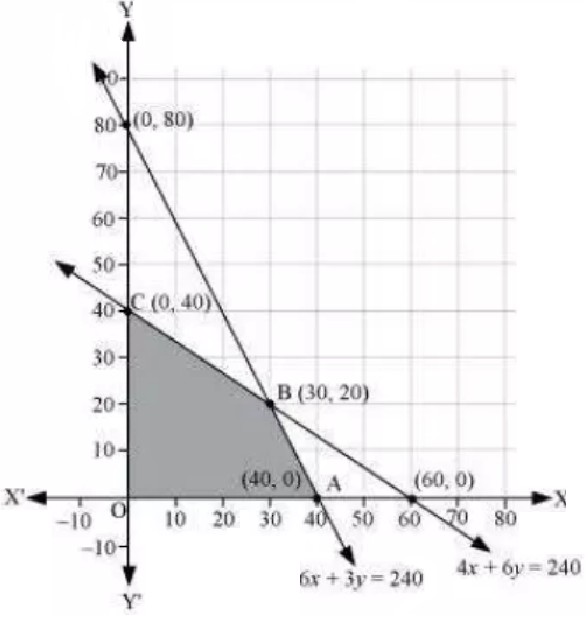
A factory manufactures two types of screws A and B, each type requiring the use of two machines, an automatic and a hand-operated. It takes 4 minutes on the automatic and 6 minutes on the hand-operated machines to manufacture a packet of screws ‘A’ while it takes 6 minutes on the automatic and 3 minutes on the hand-operated machine to manufacture a packet of screws ‘B’. Each machine is available for at most 4 hours on any day. The manufacturer can sell a packet of screws ‘A’ at a profit of 70 paise and screws ‘B’ at a profit of Rs. 1. Assuming that he can sell all the screws he manufactures, how many packets of each type should the factory owner produce in a day in order to maximize his profit? Formulate the above LPP and solve it graphically and find the maximum profit.
Answer
Let the number of package of screw A = x Number of packages of screw B = y
Item
Number
Machine A
Machine B
Profit
Screw A
x
4 minutes
6 minutes
To paise = 7 Rs
Screw B
y
6 minutes
3 minutes
Rs. 1
Max time
Available
 
4 hours
= 240 min
4 hours
= 240 minutes
 
Automated Machine
Works for screw A → 4 min
Works on screw B → 6 min
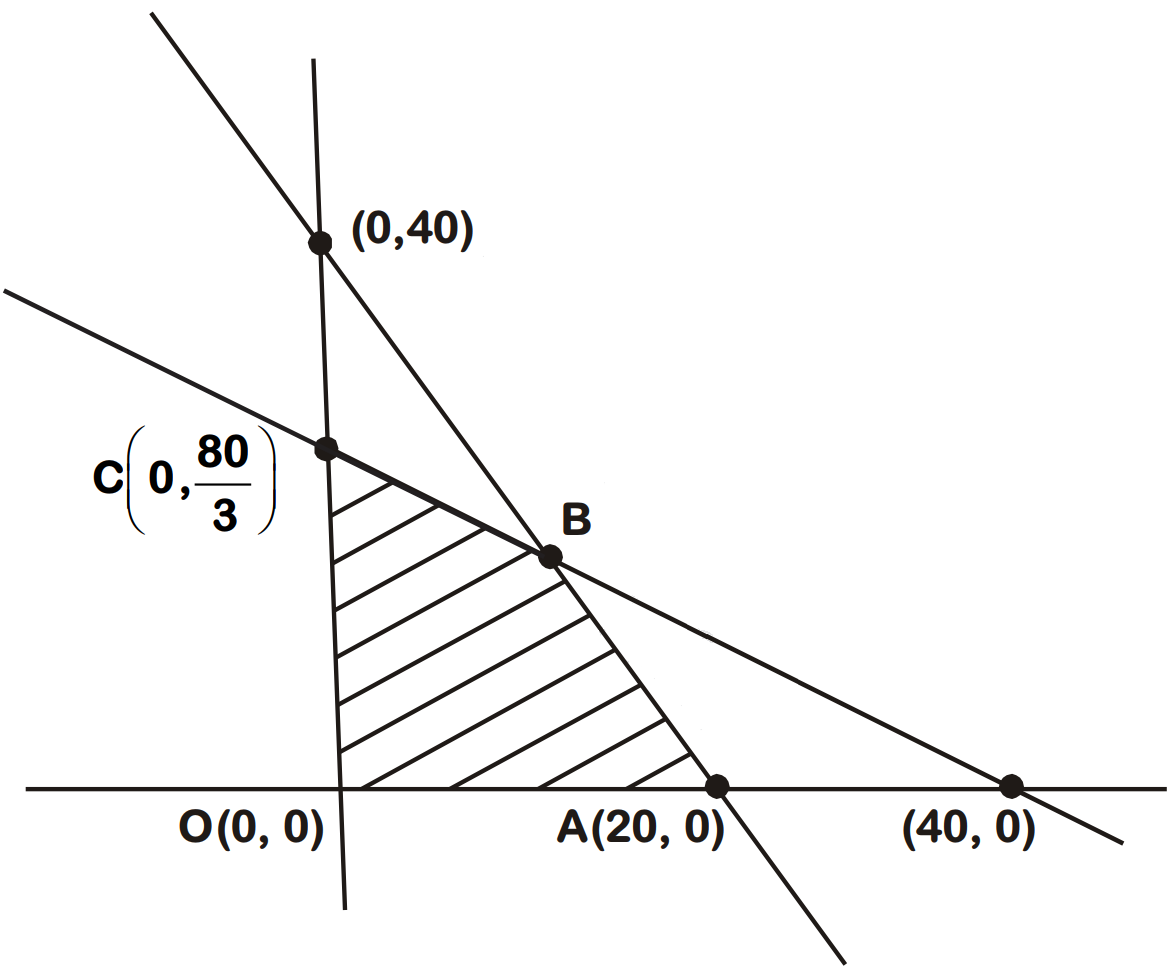
$\therefore4\text{x}+6\text{y}\leq240$
$2\text{x}+3\text{y}\leq120$
$\text{x},\text{y}\geq0$
Hand operated machine
Works on screw A → 6 min
Works on screw B → 3 min
$\therefore6\text{x}+3\text{y}\leq240$
$2\text{x}+\text{y}\leq80$
$\text{x},\text{y}\geq0$
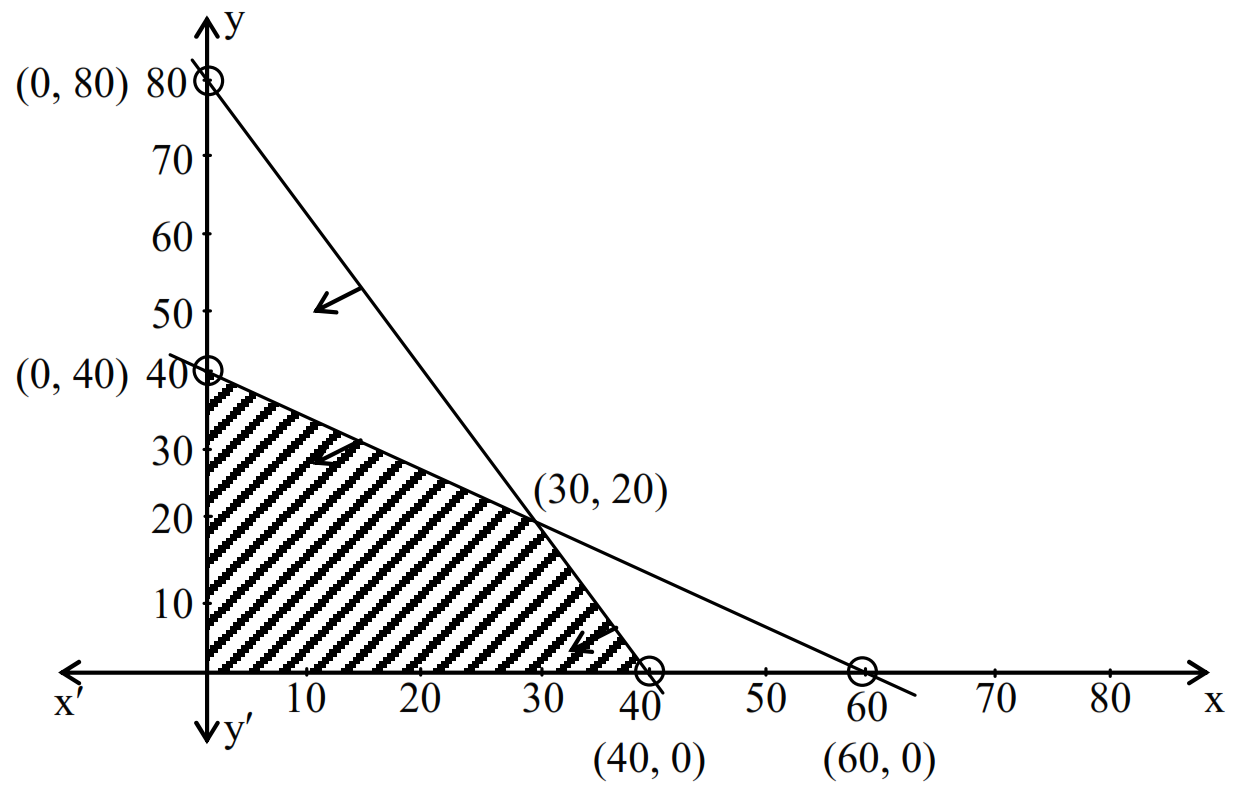
Now max Z = 0.7 x + y $2\text{x}+3\text{y}\leq120$ $2\text{x}+\text{y}\leq80$ $\text{x},\text{y}\geq0$ $2\text{x}+3\text{y}\leq120$ $\begin{array}{c|c} \text{x}&0 & 60 \\ \hline \text{y}&40 & 0 \end{array}$ $2\text{x}+\text{y}\leq80$ $\begin{array}{c|c} \text{x}&0 & 40 \\ \hline \text{y}&80 & 0 \end{array}$ Hence, profit will be maximum, if the company produces, 30 packages of screw A 20 packages of screw B Maximum Profit = Rs. 41.
View full question & answer
Question 525 Marks
A factory manufactures two types of screws A and B, each type requiring the use of two machines, an automatic and a hand-operated. It takes 4 minutes on the automatic and 6 minutes on the hand-operated machines to manufacture a packet of screws ‘A’ while it takes 6 minutes on the automatic and 3 minutes on the hand-operated machine to manufacture a packet of screws ‘B’. Each machine is available for at most 4 hours on any day. The manufacturer can sell a packet of screws ‘A’ at a profit of 70 paise and screws ‘B’ at a profit of Rs. 1. Assuming that he can sell all the screws he manufactures, how many packets of each type should the factory owner produce in a day in order to maximize his profit? Formulate the above LPP and solve it graphically and find the maximum profit.
Answer
Let the number of package of screw A = x Number of packages of screw B = y
Item
Number
Machine A
Machine B
Profit
Screw A
x
4 minutes
6 minutes
To paise = 7 Rs
Screw B
y
6 minutes
3 minutes
Rs. 1
Max time
Available
 
4 hours
= 240 min
4 hours
= 240 minutes
 
Automated Machine
Works for screw A → 4 min
Works on screw B → 6 min
$\therefore4\text{x}+6\text{y}\leq240$
$2\text{x}+3\text{y}\leq120$
$\text{x},\text{y}\geq0$
Hand operated machine
Works on screw A → 6 min
Works on screw B → 3 min
$\therefore6\text{x}+3\text{y}\leq240$
$2\text{x}+\text{y}\leq80$
$\text{x},\text{y}\geq0$
Now max Z = 0.7 x + y $2\text{x}+3\text{y}\leq120$ $2\text{x}+\text{y}\leq80$ $\text{x},\text{y}\geq0$ $2\text{x}+3\text{y}\leq120$ $\begin{array}{c|c} \text{x}&0 & 60 \\ \hline \text{y}&40 & 0 \end{array}$ $2\text{x}+\text{y}\leq80$ $\begin{array}{c|c} \text{x}&0 & 40 \\ \hline \text{y}&80 & 0 \end{array}$ Hence, profit will be maximum, if the company produces, 30 packages of screw A 20 packages of screw B Maximum Profit = Rs. 41.
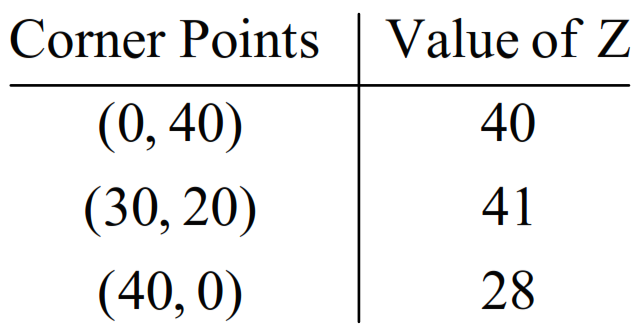
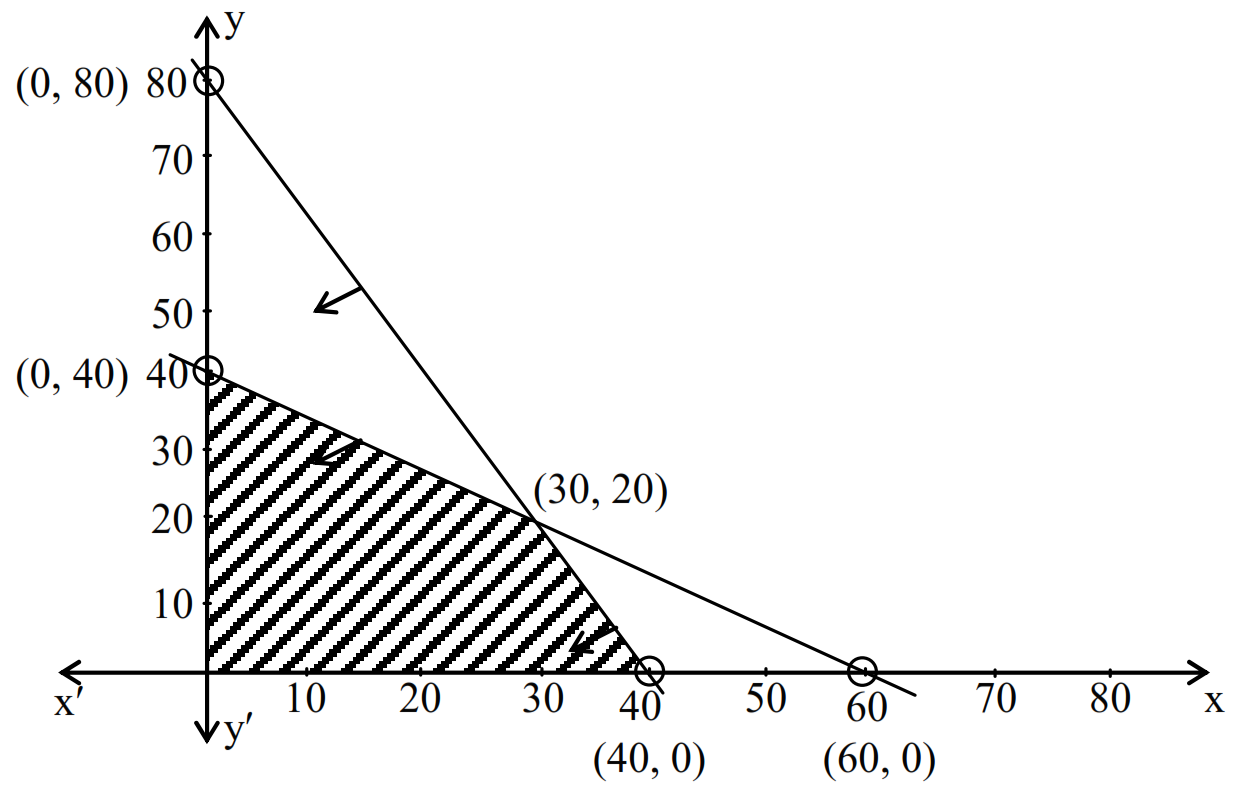
View full question & answer
Question 535 Marks
A factory manufactures two types of screws A and B, each type requiring the use of two machines, an automatic and a hand-operated. It takes 4 minutes on the automatic and 6 minutes on the hand-operated machines to manufacture a packet of screws ‘A’ while it takes 6 minutes on the automatic and 3 minutes on the hand-operated machine to manufacture a packet of screws ‘B’. Each machine is available for at most 4 hours on any day. The manufacturer can sell a packet of screws ‘A’ at a profit of 70 paise and screws ‘B’ at a profit of Rs. 1. Assuming that he can sell all the screws he manufactures, how many packets of each type should the factory owner produce in a day in order to maximize his profit? Formulate the above LPP and solve it graphically and find the maximum profit.
Answer
Let the number of package of screw A = x Number of packages of screw B = y
Item
Number
Machine A
Machine B
Profit
Screw A
x
4 minutes
6 minutes
To paise = 7 Rs
Screw B
y
6 minutes
3 minutes
Rs. 1
Max time
Available
 
4 hours
= 240 min
4 hours
= 240 minutes
 
Automated Machine
Works for screw A → 4 min
Works on screw B → 6 min
$\therefore4\text{x}+6\text{y}\leq240$
$2\text{x}+3\text{y}\leq120$
$\text{x},\text{y}\geq0$
Hand operated machine
Works on screw A → 6 min
Works on screw B → 3 min
$\therefore6\text{x}+3\text{y}\leq240$
$2\text{x}+\text{y}\leq80$
$\text{x},\text{y}\geq0$
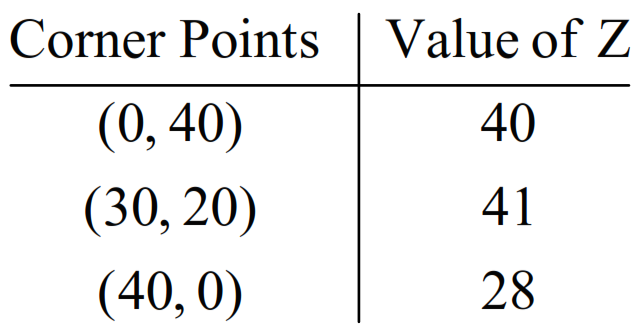
Now max Z = 0.7 x + y $2\text{x}+3\text{y}\leq120$ $2\text{x}+\text{y}\leq80$ $\text{x},\text{y}\geq0$ $2\text{x}+3\text{y}\leq120$ $\begin{array}{c|c} \text{x}&0 & 60 \\ \hline \text{y}&40 & 0 \end{array}$ $2\text{x}+\text{y}\leq80$ $\begin{array}{c|c} \text{x}&0 & 40 \\ \hline \text{y}&80 & 0 \end{array}$ Hence, profit will be maximum, if the company produces, 30 packages of screw A 20 packages of screw B Maximum Profit = Rs. 41.
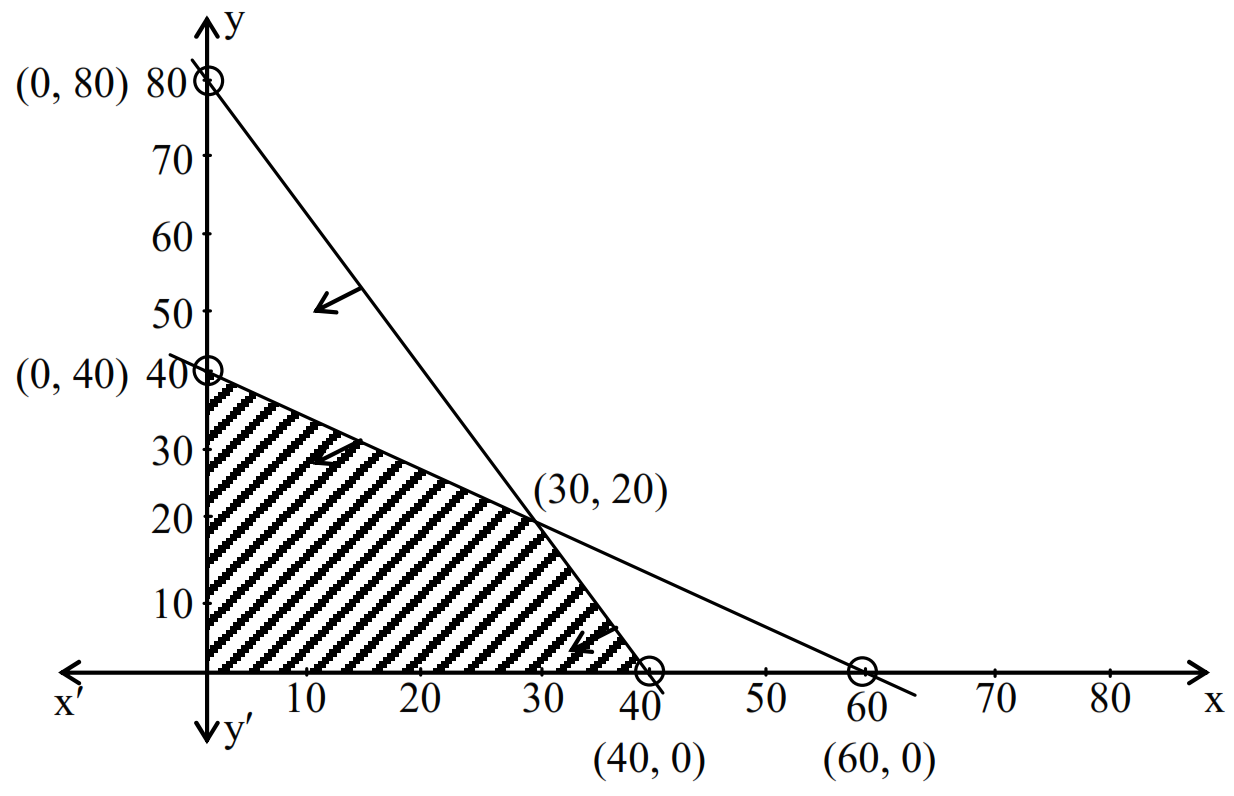
View full question & answer
Question 545 Marks
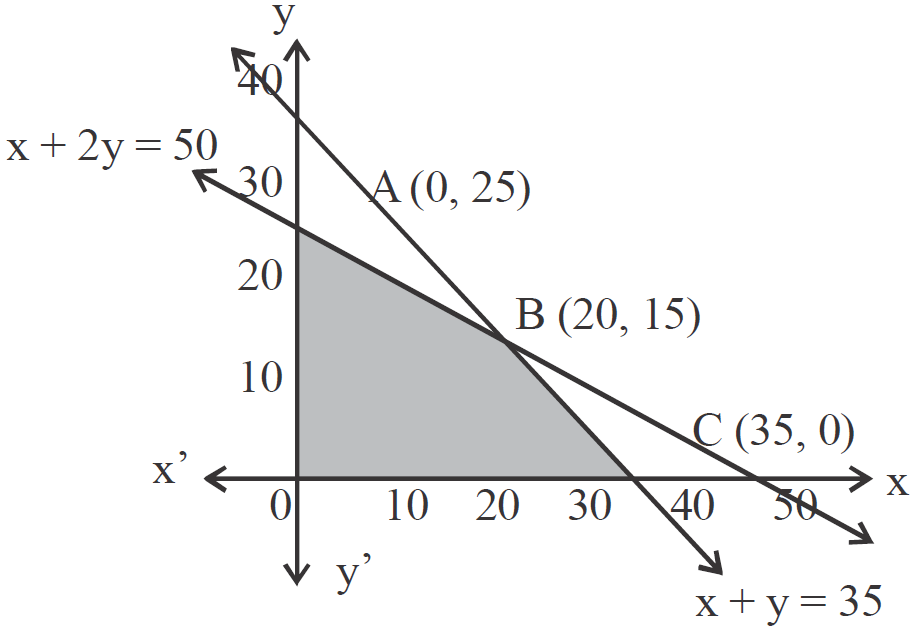
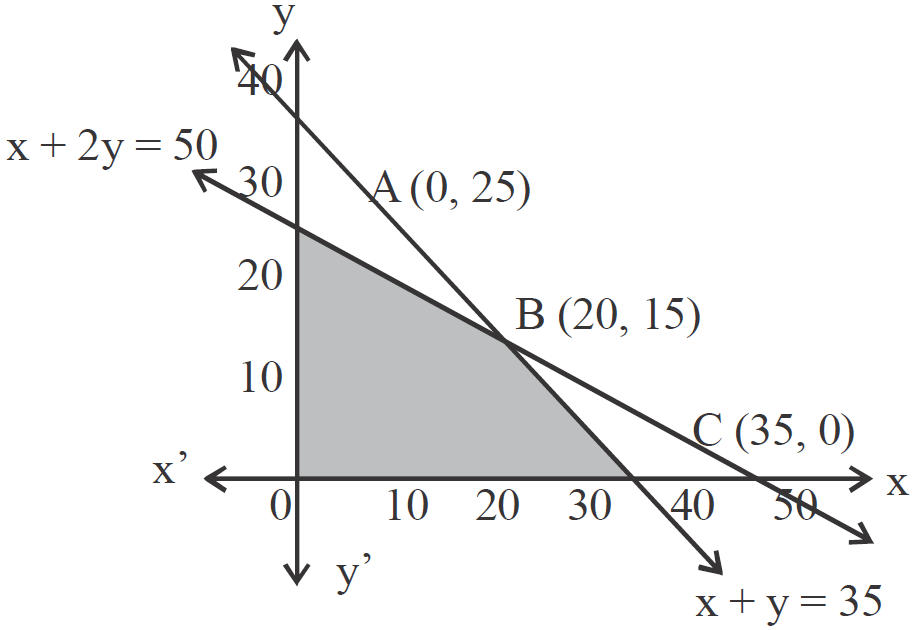
A furniture trader deals in only two items – chairs and tables. He has ₹ 50,000 to invest and a space to store at most 35 items. A chair costs him ₹ 1000 and a table costs him ₹ 2000 The trader earns a profit of ₹ 150 and ₹ 250 on a chair and table, respectively. Formulate the above problem as an LPP to maximise the profit and solve it graphically.
Answer
Let x and y be the number of chairs and tables.
cost of x table = ₹ 2000 and cost of y chair = ₹ 1000
Since the dealer is maximum invest ₹ 50,000 and the maximum number of items.
Also, the dealer want to sell a chair and table at the profit ₹ 150 and ₹ 250 respectively.
So, from the above explanation, we get following mathematical form as follows
2000x + 1000y ≤ 50,000
x + 2y ≤ 50
x + y ≤ 35, x ≥ 0, y ≥ 0
and objective function Z = 150x + 250y
Now, we have to maximize Z = 250x + 150y
Subject to constraints
x + 2y = 50
x + y = 35,
x = 0, y = 0

Corner Points Z = 150x + 250y
A(0, 25)
Z = 150 ₹ 0 + 250 ₹ 25
Z = 6250
B(20, 15)
Z = 150 ₹ 20 + 250 ₹ 15
Z = 3000 + 3750
Z = 6750
C(35, 0)
Z = 150 ₹ 35 + 250 ₹ 0
Z = 5250
Hence, the value of Z = 6750 is the maximum value
6750 = 150x + 250y
675 = 15x + 25y
135 = 3x + 5y ...(i)
35 = x + y ...(ii)
x = 35 - y
3(35 - y) + 5y = 135
105 - 3y +5y = 135
2y = 135 - 105
2y = 30
y = 15 Tables
x = 35 - 15
x = 20 Chairs.
View full question & answer
Question 555 Marks
A manufacturer has employed 5 skilled men and 10 semi-skilled men and makes two models A and B of an article. The making of one item of model A requires 2 hours work by a skilled man and 2 hours work by a semi-skilled man. One item of model B requires 1 hour by a skilled man and 3 hours by a semi-skilled man. No man is expected to work more than 8 hours per day. The manufacturer’s profit on an item of model A is Rs. 15 and on an item of model B is Rs. 10. How many of items of each model should be made per day in order to maximize daily profit? Formulate the above LPP and solve it graphically and find the maximum profit.
Answer
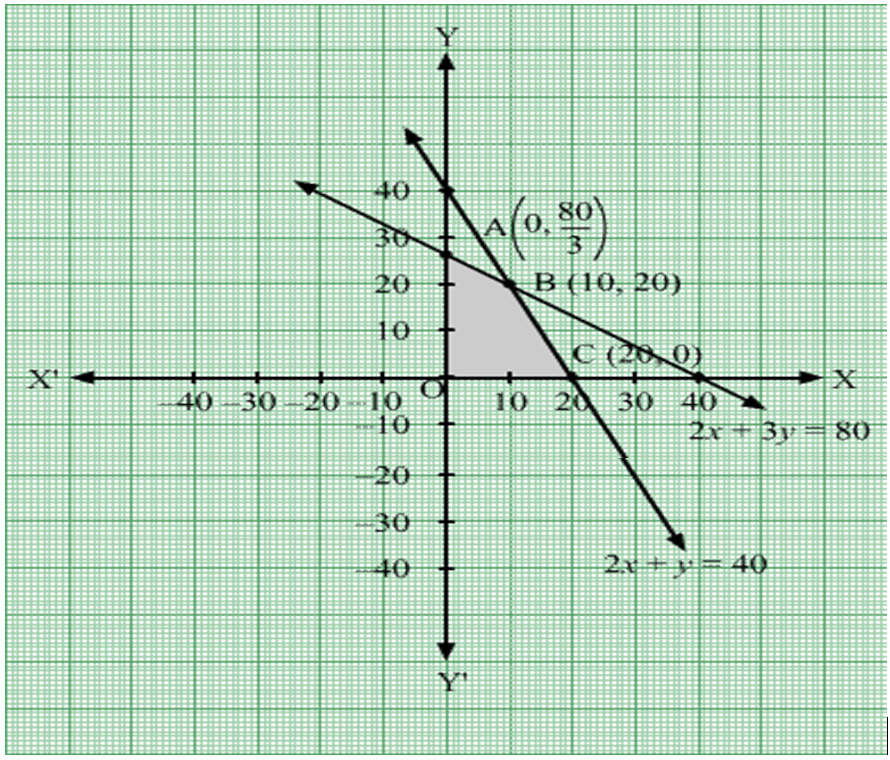
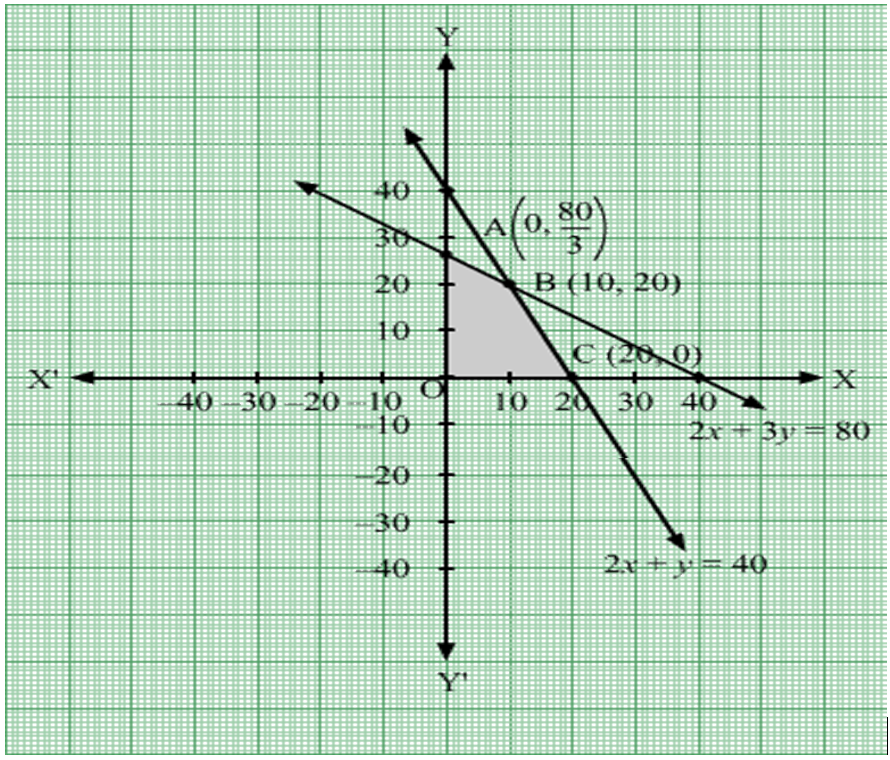
Let x articles of model A and y articles of model B be made. Number of articles cannot be negative. Therefore, $\text{x},\text{y}\leq0$ According to the question, the making of a model A requires 2 hrs. work by a skilled man and the model B requires 1 hrs. by a skilled man $2\text{x}+\text{y}\leq40$ The making of a model A requires 2 hrs. work by a semi-skilled man model B requires 3 hrs. work by a semi-skilled man. $2\text{x}+3\text{y}\leq80$ Total profit = Z = 15x + 10y which is to be maximised Thus, the mathematical formulat​ion of the given linear programmimg problem is Max Z = 15x + 10y Subject to $2\text{x}+\text{y}\leq40$ $2\text{x}+3\text{y}\leq80$ $\text{x}\geq0$ $\text{y}\geq0$ The feasible region determined by the system of constraints is
The corner points are $\text{A}\Big(\frac{80}{3}\Big), \text{B}(10, 20), \text{C}(20, 0)$ The values of Z at these corner points are as follows
Corner point Z = 15x + 10y
A $\frac{800}{3}$
B $350$
C $300$
The maximum value of Z is 300 which is attained at C(20, 0) Thus, the maximum profit is Rs. 300 obtained when 10 units of deluxe model and 20 unit of ordinary model is produced.
View full question & answer
Question 565 Marks
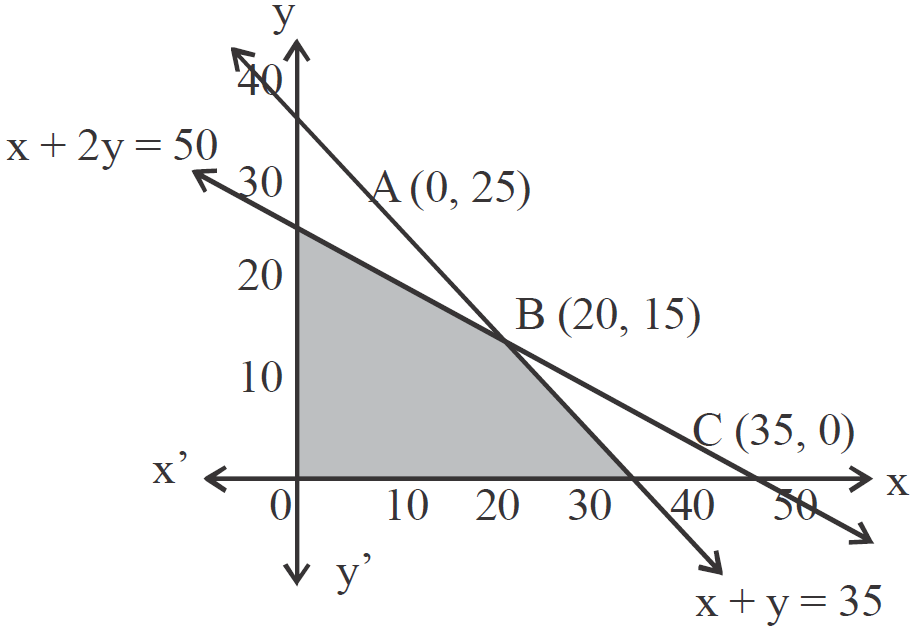
A furniture trader deals in only two items – chairs and tables. He has ₹ 50,000 to invest and a space to store at most 35 items. A chair costs him ₹ 1000 and a table costs him ₹ 2000 The trader earns a profit of ₹ 150 and ₹ 250 on a chair and table, respectively. Formulate the above problem as an LPP to maximise the profit and solve it graphically.
Answer
Let x and y be the number of chairs and tables.
cost of x table = ₹ 2000 and cost of y chair = ₹ 1000
Since the dealer is maximum invest ₹ 50,000 and the maximum number of items.
Also, the dealer want to sell a chair and table at the profit ₹ 150 and ₹ 250 respectively.
So, from the above explanation, we get following mathematical form as follows
2000x + 1000y ≤ 50,000
x + 2y ≤ 50
x + y ≤ 35, x ≥ 0, y ≥ 0
and objective function Z = 150x + 250y
Now, we have to maximize Z = 250x + 150y
Subject to constraints
x + 2y = 50
x + y = 35,
x = 0, y = 0

Corner Points Z = 150x + 250y
A(0, 25)
Z = 150 ₹ 0 + 250 ₹ 25
Z = 6250
B(20, 15)
Z = 150 ₹ 20 + 250 ₹ 15
Z = 3000 + 3750
Z = 6750
C(35, 0)
Z = 150 ₹ 35 + 250 ₹ 0
Z = 5250
Hence, the value of Z = 6750 is the maximum value
6750 = 150x + 250y
675 = 15x + 25y
135 = 3x + 5y ...(i)
35 = x + y ...(ii)
x = 35 - y
3(35 - y) + 5y = 135
105 - 3y +5y = 135
2y = 135 - 105
2y = 30
y = 15 Tables
x = 35 - 15
x = 20 Chairs.
View full question & answer
Question 575 Marks
A manufacturer has employed 5 skilled men and 10 semi-skilled men and makes two models A and B of an article. The making of one item of model A requires 2 hours work by a skilled man and 2 hours work by a semi-skilled man. One item of model B requires 1 hour by a skilled man and 3 hours by a semi-skilled man. No man is expected to work more than 8 hours per day. The manufacturer’s profit on an item of model A is Rs. 15 and on an item of model B is Rs. 10. How many of items of each model should be made per day in order to maximize daily profit? Formulate the above LPP and solve it graphically and find the maximum profit.
Answer
Let x articles of model A and y articles of model B be made. Number of articles cannot be negative. Therefore, $\text{x},\text{y}\leq0$ According to the question, the making of a model A requires 2 hrs. work by a skilled man and the model B requires 1 hrs. by a skilled man $2\text{x}+\text{y}\leq40$ The making of a model A requires 2 hrs. work by a semi-skilled man model B requires 3 hrs. work by a semi-skilled man. $2\text{x}+3\text{y}\leq80$ Total profit = Z = 15x + 10y which is to be maximised Thus, the mathematical formulat​ion of the given linear programmimg problem is Max Z = 15x + 10y Subject to $2\text{x}+\text{y}\leq40$ $2\text{x}+3\text{y}\leq80$ $\text{x}\geq0$ $\text{y}\geq0$ The feasible region determined by the system of constraints is
The corner points are $\text{A}\Big(\frac{80}{3}\Big),\text{B}(10,20),\text{C}(20,0)$ The values of Z at these corner points are as follows
Corner point Z = 15x + 10y
A $\frac{800}{3}$
B $350$
C $300$
The maximum value of Z is 300 which is attained at C(20, 0) Thus, the maximum profit is Rs. 300 obtained when 10 units of deluxe model and 20 unit of ordinary model is produced.
View full question & answer
Question 585 Marks
A furniture trader deals in only two items – chairs and tables. He has ₹ 50,000 to invest and a space to store at most 35 items. A chair costs him ₹ 1000 and a table costs him ₹ 2000 The trader earns a profit of ₹ 150 and ₹ 250 on a chair and table, respectively. Formulate the above problem as an LPP to maximise the profit and solve it graphically.
Answer
Let x and y be the number of chairs and tables.
cost of x table = ₹ 2000 and cost of y chair = ₹ 1000
Since the dealer is maximum invest ₹ 50,000 and the maximum number of items.
Also, the dealer want to sell a chair and table at the profit ₹ 150 and ₹ 250 respectively.
So, from the above explanation, we get following mathematical form as follows
2000x + 1000y ≤ 50,000
x + 2y ≤ 50
x + y ≤ 35, x ≥ 0, y ≥ 0
and objective function Z = 150x + 250y
Now, we have to maximize Z = 250x + 150y
Subject to constraints
x + 2y = 50
x + y = 35,
x = 0, y = 0

Corner Points Z = 150x + 250y
A(0, 25)
Z = 150 ₹ 0 + 250 ₹ 25
Z = 6250
B(20, 15)
Z = 150 ₹ 20 + 250 ₹ 15
Z = 3000 + 3750
Z = 6750
C(35, 0)
Z = 150 ₹ 35 + 250 ₹ 0
Z = 5250
Hence, the value of Z = 6750 is the maximum value
6750 = 150x + 250y
675 = 15x + 25y
135 = 3x + 5y ...(i)
35 = x + y ...(ii)
x = 35 - y
3(35 - y) + 5y = 135
105 - 3y +5y = 135
2y = 135 - 105
2y = 30
y = 15 Tables
x = 35 - 15
x = 20 Chairs.
View full question & answer
Question 595 Marks
A manufacturer has employed 5 skilled men and 10 semi-skilled men and makes two models A and B of an article. The making of one item of model A requires 2 hours work by a skilled man and 2 hours work by a semi-skilled man. One item of model B requires 1 hour by a skilled man and 3 hours by a semi-skilled man. No man is expected to work more than 8 hours per day. The manufacturer’s profit on an item of model A is Rs. 15 and on an item of model B is Rs. 10. How many of items of each model should be made per day in order to maximize daily profit? Formulate the above LPP and solve it graphically and find the maximum profit.
Answer
Let x articles of model A and y articles of model B be made. Number of articles cannot be negative. Therefore, $\text{x},\text{y}\leq0$ According to the question, the making of a model A requires 2 hrs. work by a skilled man and the model B requires 1 hrs. By a skilled man $2\text{x}+\text{y}\leq40$ The making of a model A requires 3 hrs. work by a semi-skilled man model B requires 3 hrs. Work by a semi-skilled man. $2\text{x}+3\text{y}\leq80$ Total profit = Z = 15x + 10y which is to be maximised Thus, the mathematical formulat​ion of the given linear programmimg problem is Max Z = 15x + 10y Subject to, $2\text{x}+\text{y}\leq40$ $2\text{x}+3\text{y}\leq80$ $\text{x}\geq0$ $\text{y}\geq0$ The feasible region determined by the system of constraints is
The corner points are $\text{A}=0,\frac{80}{3}$, B(10, 20), C(20, 0) The values of Z at these corner points are as follows
Corner point Z = 15x + 10y
A $\frac{800}{3}$
B $350$
C $300$
The maximum value of Z is 300 which is attained at C(20, 0) Thus, the maximum profit is Rs. 300 obtained when 10 units of deluxe model and 20 unit of ordinary model is produced.
View full question & answer
Question 605 Marks
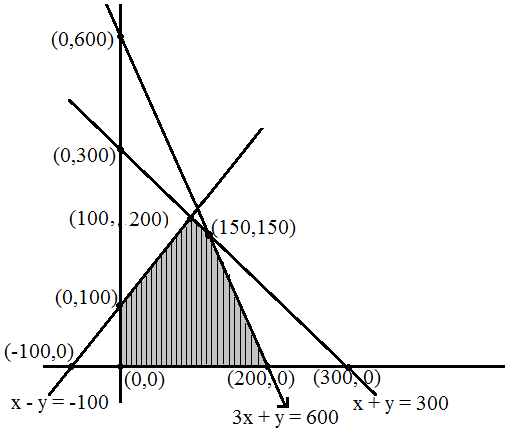
A company manufactures two types of sweaters: type A and type B. It costs Rs. 360 to make a type A sweater and Rs. 120 to make a type B sweater. The company can make at most 300 sweaters and spend at most Rs. 72000 a day. The number of sweaters of type B cannot exceed the number of sweaters of type A by more than 100. The company makes a profit of Rs. 200 for each sweater of type A and Rs. 120 for every sweater of type B.
Answer
Let the company manufactures x number of type A sweaters and y number of type B.
The Company spend at most Rs. 7200 a day.
$\therefore360\text{x}+120\text{y}\leq72000$
$\Rightarrow3\text{x}+\text{y}\leq600\ .....(\text{i})$
Also, company can make at most 300 sweaters.
$\therefore\text{x}+\text{y}\leq300\ .....(\text{ii})$
Also, the number of sweatrrs of type B cannot exceed the bumber of swqaters of type A by more than 100 i.e., $\text{y}-\text{x}\leq100$
The company makes a profit of Rs. 200 for each sweater of typ0e A and Rs. 120 for sweater of type B so, the obective function for profit is Z = 200x + 120y subject to constraints.
$3\text{x}+\text{y}\leq600$
$\text{x}+\text{y}\leq300$
$\text{x}-\text{y}\geq-100$
$\text{x}\geq0,\text{y}\geq0$
View full question & answer
Question 615 Marks
Solve the following LPP graphically:
Manimize Z = 6x + 3y
Subject to the constraints:
$4\text{x}+\text{y}\geq80$
$\text{x}+5\text{y}\geq115$
$3\text{x}+2\text{y}\leq150$
$\text{x}\geq0,\text{y}\geq0$
Answer
The given contraints are:
$4\text{x}+\text{y}\geq80$
$\text{x}+5\text{y}\geq115$
$3\text{x}+2\text{y}\leq150$
$\text{x}\geq0,\text{y}\geq0$
Converting the given inequation into equation, we get
4x + y = 80, x + 5y = 115, 3x + 2y = 150, x = 0 and y = 0
These lines are drawn on the graph and the shaded region ABC represents the feasible region of the given LPP.

It can be observed that the feasible region is bounded.
The coordinates of the corner points of the feasible region are A(2, 72), B(15, 20), and C(40, 15).
The values of the objective function, Z at these corner points are given in the following table:
Corner point Value of the objective Function Z = 6x + 3y
A(2, 72) Z = 6 × 2 + 3 × 72 = 228
B(15, 20) Z = 6 × 15 + 3 × 20 = 150
C(40, 15) Z = 6 × 40 + 3 × 15 = 150
From the table, Z is manimum at x = 15 and y = 20 and the manimum value of Z is 150.
Thus, the manimum value of Z is 150.
View full question & answer
Question 625 Marks
A firm has to transport 1200 packages using large vans which can carry 200 packages each and small vans which can take 80 packages each. The cost for engaging each large van is Rs. 400 and each small van is Rs. 200. Not more than Rs. 3000 is to be spent on the job and the number of large vans can not exceed the number of small vans. Formulate this problem as a LPP given that the objective is to minimise cost.
Answer
Let the firm has x number of large vans and y number of small vans. From the given information, we have following corresponding constraint table.
 
Large vans (x)
Small vans (y)
Maximum/Minimum
Package
200
80
1200
Cast
400
200
3000
Thus, objective function for minimum cost is Z = 400 x + 200y.
Subject to constraints
$200\text{x}+80\text{y}\geq1200$
$\Rightarrow5\text{x}+2\text{y}\geq30\ .....(\text{i})$
and $400\text{x}+200\text{y}\leq3000$
$\Rightarrow2\text{x}+\text{y}\leq15\ .....(\text{ii})$
and $\text{x}\leq\text{y}\ .....(\text{iii})$
and $\text{x}\geq0,\text{y}\geq0\ .....(\text{iv})$
Thus, required LPP to minimize cost is minimize z = 400x + 200y, subject to
$5\text{x}+2\text{y}\geq30$
$2\text{x}+\text{y}\leq15$
$\text{x}\leq\text{y}$
$\text{x}\geq0,\text{y}\geq0$
View full question & answer
Question 635 Marks
Maximum Z = 10x + 6y
Subject to
$3\text{x}+\text{y}\leq12$
$2\text{x}+5\text{y}\leq34$
$\text{x},\text{y}\geq0$
Answer
Converting the given inequations in to equations.
3x + y = 12, 2x + 5y = 34, x = y = 0

Region represented by $3\text{x}+\text{y}\leq12$:
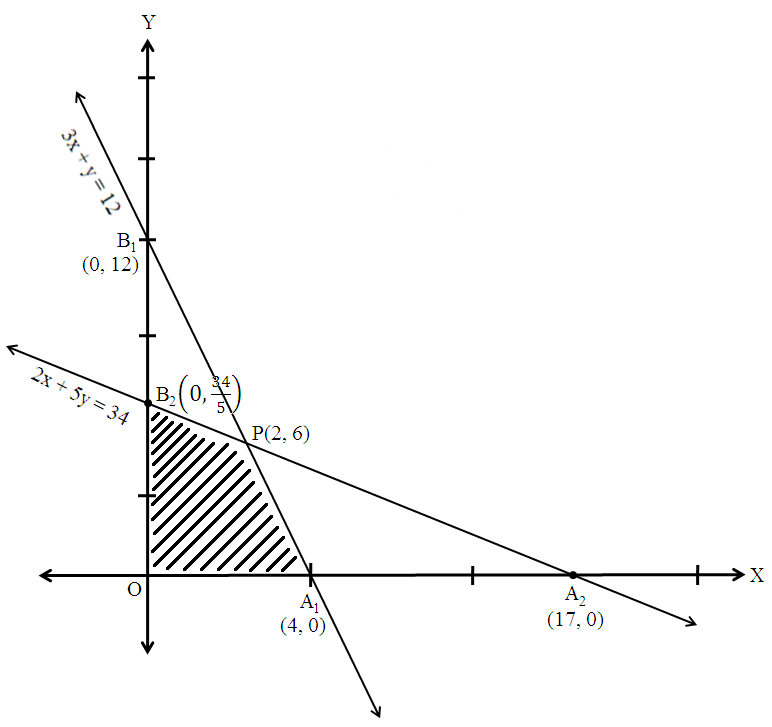
Line 3x + y = 12 meets the coordinate axes at $A_1(4, 0)$ and B(0, 12), clearly, (0, 0) satisfies $3\text{x}+\text{y}\leq12$, so, region containing origin is represented by $3\text{x}+\text{y}\leq12$ in xy-plane.
Region represented by $2\text{x}+5\text{y}\leq34$:
Line 2x +y = 34 meets coordinate axes at $A_2 (17, 0)$ and $\text{B}\Big(0,\frac{34}{5}\Big)$ clearly, (0, 0) satisfies the $2\text{x}+5\text{y}\leq34$ so, region containing origin represents $2\text{x}+5\text{y}\leq34$ in xy-plane.
Region represented by $\text{x},\text{y}\geq0$:
It represent the first quadrant in xy-plane
Therefore, shaded area $OA_1PB_2$ is the feasible region.
The coordinate of P(2, 6) is obtained by solving 2x + 5y = 34 and 3x + y = 12
The value of Z = 10x + 6y at
$\text{O}(0, 0) = 10(0) + 6(0) = 0$
$\text{A}_1(4, 0) = 10(4) + 6(0) = 40$
$\text{P}(2, 6) = 10(2) + 6(6) = 56$
$\text{B}_2\Big(0,\frac{34}{5}\Big)=10(0)+6\Big(\frac{34}{5}\Big)=\frac{204}{5}=40\frac{4}{5}$
Hence, maximum Z = 56 at x = 2, y = 6.
View full question & answer
Question 645 Marks
Maximize Z = 9x + 3y
Subject to
$2\text{x}+3\text{y}\leq13$
$3\text{x}+\text{y}\leq5$
$\text{x},\text{y}\geq0$
Answer
Coverting the given inequation into equations, we get
2x + 3y = 13, 3x + y = 5 and x = 0, y = 0

Region represented by $2\text{x}+3\text{y}\leq13:$
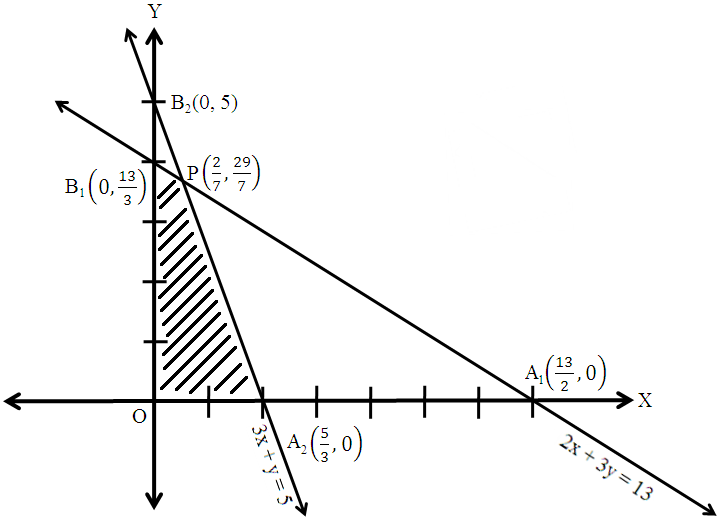
The line meets coordinate axes at $\text{A}_1\Big(\frac{13}{2},0\Big)$ and $\text{B}_1\Big(0,\frac{13}{3}\Big)$ respectively.
Join these points to obtain the line 2x + 3y = 13, clearly, (0,0) satisfies the in eqation $2\text{x}+3\text{y}\leq13$, so, the region in xy-plane that contains origin represents the solution set of $2\text{x}+3\text{y}\leq13$.
Region represented by $3\text{x}+\text{y}\leq5:$
The line meets coordinate axes at $\text{A}_2\Big(\frac{5}{3},0\Big)$ and $B_2(0, 5)$ respectively.
Join these points to obtain the line 3x + y = 5, clearly, (0, 0) satisfies the in eqation $3\text{x}+\text{y}\leq5$, so, the region in xy-plane that contains origin represents the solution set of $3\text{x}+\text{y}\leq5$.
Region represented by $\text{x},\text{y}\geq0:$
It clearly represent first quadrant of xy-plane.
The common region to regions represented by above in equalities.
The coordinates of the corner points of the shaded region are $\text{O}(0,0),\text{A}\Big(\frac{5}{3},0\Big),\text{P}\Big(\frac{2}{7},\frac{29}{7}\Big),\text{B}_2\Big(0,\frac{13}{3}\Big)$.
The value of Z = 9x + 3y at
$\text{O}(0,0)=9(0)+3(0)=0$
$\text{A}_1\Big(\frac{5}{3},0\Big)=9\Big(\frac{5}{3}\Big)+3(0)=15$
$\text{P}\Big(\frac{2}{7},\frac{29}{7}\Big)=9\Big(\frac{2}{7}\Big)+3\Big(\frac{29}{7}\Big)=15$
$\text{B}_2\Big(0,\frac{13}{3}\Big)=9(0)+3\Big(\frac{13}{3}\Big)=13$
Clearly, Z is maximum at every point on the line joining $A_1$ and P, So
$\text{x}=\frac{2}{7}$ or $\frac{2}{7}$, $\text{y}=0$ or $\frac{29}{7}$
and maximum Z = 15.
View full question & answer
Question 655 Marks
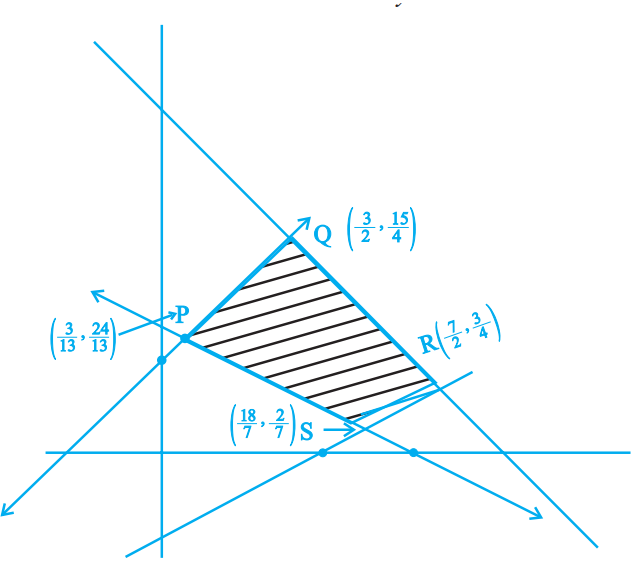
In the feasible region (shaded) for a LPP is shown. Determine the maximum and minimum value of Z = x + 2y.
Answer
From the shaded bounded region, it is clear that the coordinates of corner points are $\Big(\frac{3}{13},\frac{24}{13}\Big),\Big(\frac{8}{7},\frac{2}{7}\Big),\Big(\frac{7}{2},\frac{3}{4}\Big)$and $\Big(\frac{3}{2},\frac{15}{4}\Big)$
Also, we have to determine maximum and minimum value of Z = x + 2y.
Corner points Corresponding value of Z
$\Big(\frac{3}{13},\frac{24}{13}\Big)$ $\frac{3}{13}+\frac{48}{13}=\frac{51}{13}=3\frac{12}{13}$
$\Big(\frac{8}{7},\frac{2}{7}\Big)$ $\frac{18}{7}+\frac{4}{7}=\frac{22}{7}=3\frac{1}{7}(\text{Minimum})$
$\Big(\frac{7}{2},\frac{3}{4}\Big)$ $\frac{7}{2}+\frac{6}{4}=\frac{20}{4}=5$
$\Big(\frac{3}{2},\frac{15}{4}\Big)$ $\frac{3}{2}+\frac{30}{4}=\frac{36}{4}=9(\text{Maximum})$
Hence, the maximum and minimum value of are 9 and $3\frac{1}{7}$ respectively.
View full question & answer
Question 665 Marks
A man rides his motorcycle at the speed of 50km/ hour. He has to spend Rs. 2 per km on petrol. If he rides it at a faster speed of 80km/ hour, the petrol cost increases to Rs. 3 per km. He has atmost Rs. 120 to spend on petrol and one hour’s time. He wishes to find the maximum distance that he can travel.
Express this problem as a linear programming problem.
Answer
Let the man rides to his motorcycle to a distance x km at the speed of 50km/h and to a distance y km at the speed of 80 km/h.Therefore, he has to spend Rs. 120 at most on petrol.
$\therefore2\text{x}+3\text{y}\leq120\ ......(\text{i})$
Also, he has at most 1 hour time.
$\therefore\frac{\text{x}}{50}+\frac{\text{y}}{80}\leq1$
$\Rightarrow8\text{x}+5\text{y}\leq400\ .....(\text{ii})$
Also, we have $​​\text{x}\geq0,​​\text{y}\geq0$ [non-negative constraints]
Thus, required LPP to travel maximum distance by him is
Maximise $\text{Z}=\text{x}+\text{y},$ subject to $2\text{x}+3\text{y}\leq120,8\text{x}+5\text{y}\leq400,\text{x}\geq0,\text{y}\geq0.$
View full question & answer
Question 675 Marks
Maximum Z = 3x + 4y
Subject to
$2\text{x}+2\text{y}\leq80$
$2\text{x}+4\text{y}\leq120$
Answer
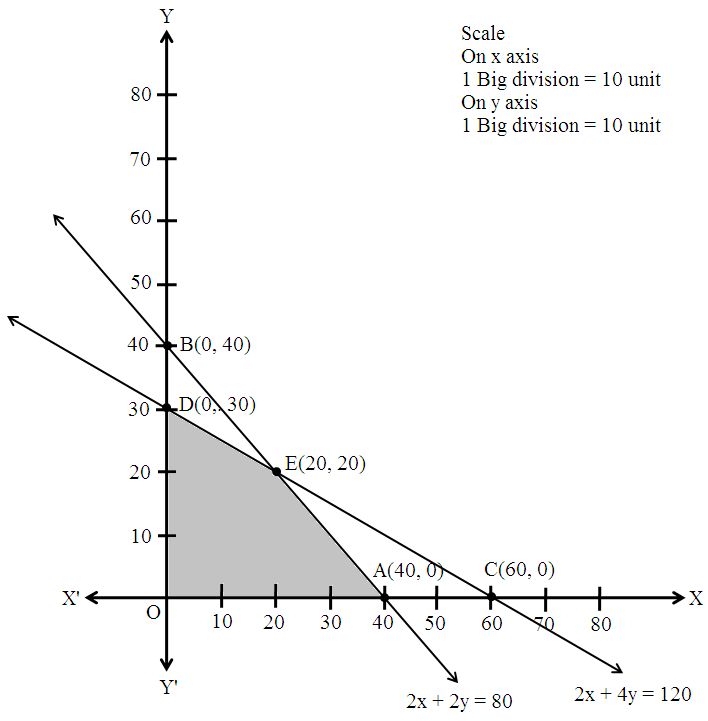
We have to maximize Z = 3x + 4y First, we will convert the given inequations into equations, we obtain the following equations: 2x + 2y = 80, 2x + 4y = 120 Region represented by 2x + 2y ≤ 80: The line 2x + 2y = 80 meets the coordinate axes at A(40, 0) and B(0, 40) respectively. By joining these points we obtain the line 2x + 2y = 80. Clearly (0, 0) satisfies the inequation 2x + 2y ≤ 80. So,the region containing the origin represents the solution set of the inequation 2x + 2y ≤ 80. Region represented by 2x + 4y ≤ 120: The line 2x + 4y = 120 meets the coordinate axes at C(60, 0) and D(0, 30) respectively. By joining these points we obtain the line 2x + 4y ≤ 120. Clearly (0, 0) satisfies the inequation 2x + 4y ≤ 120. So,the region containing the origin represents the solution set of the inequation 2x + 4y ≤ 120. The feasible region determined by the system of constraints, 2x + 2y ≤ 80, 2x + 4y ≤ 120 are as follows:
The corner points of the feasible region are O(0, 0), A(40, 0), E(20, 20) and D(0, 30). The values of Z at these corner points are as follows:
Corner point
Z = 3x +4y
O(0, 0)
3 × 0 + 4 × 0 = 0
A(40, 0)
3 × 40 + 4 × 0 = 120
E(20, 20)
3 × 20 + 4 × 20 = 140
D(0, 30)
10 × 0 + 4 × 30 = 120
We see that the maximum value of the objective function Z is 140 which is at E(20, 20) that means at x = 20 and y = 20. Thus, the optimal value of Z is 140.
View full question & answer
Question 685 Marks
Maximize Z = 5x + 3y
Subject to
$3\text{x}+5\text{y}\leq15$
$5\text{x}+2\text{y}\leq10$
$\text{x},\text{y}\geq0$
Answer
First, we will convert the given inequations into equations, we obtain the following equations:

3x + 5y = 15, 5x + 2 y = 10, x = 0 and y = 0

Region represented by $3\text{x}+5\text{y}\leq15:$

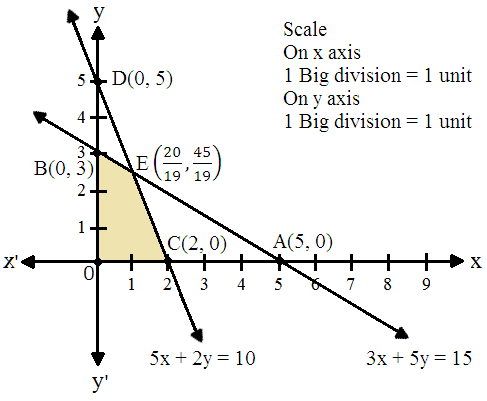
The line 3x + 5y = 15 meets the coordinate axes at A(5, 0) and B(0, 3) respectively.

By joining these points we obtain the line 3x + 5y = 15.

Clearly (0, 0) satisfies the inequation $3\text{x}+5\text{y}\leq15$.

So, the region containing the origin represents the solution set of the inequation $3\text{x}+5\text{y}\leq15$.

Region represented by $5\text{x}+2\text{y}\leq10:$

The line 5x + 2y = 10 meets the coordinate axes at C(2, 0) and D(0, 5) respectively.

By joining these points we obtain the line 5x + 2y = 10.

Clearly (0, 0) satisfies the inequation $5\text{x}+2\text{y}\leq10$.

So, the region containing the origin represents the solution set of the inequation $5\text{x}+2\text{y}\leq10$.

Region represented by $\text{x}\geq0$ and $\text{y}\geq0:$

Since, every point in the first quadrant satisfies these inequations.

So, the first quadrant is the region represented by the inequations $\text{x}\geq0$, and $\text{y}\geq0$.

The feasible region determined by the system of constraints, $3\text{x}+5\text{y}\leq15,5\text{x}+2\text{y}\leq10,\text{x}\geq0$ and $\text{y}\geq0$,are as follows.

View full question & answer
Question 695 Marks
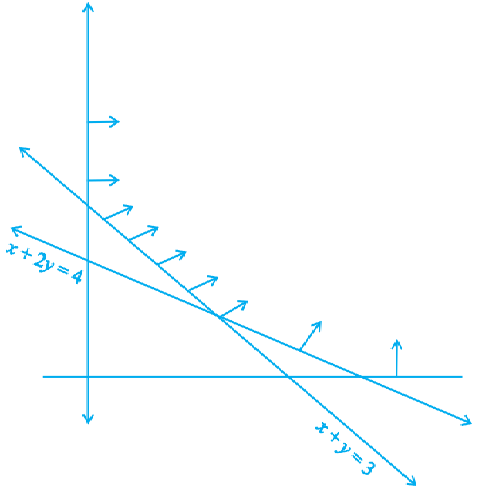
The feasible region for a LPP is shown in Evaluate Z = 4x + y at each of the corner points of this region. Find the minimum value of Z, if it exists.
Answer
Lines x + 2y = 4 and x + y = 3 interdect at (2, 1)
From the it is unbounded shaded regiobn with the cornre points A(4, 0), B (2, 1) and C(0, 3)
Also, We have z = 4x + y.
Corner points
Corresponding value of Z
(4, 0)
(2, 1)
(0, 3)
16
9
3 $\leftarrow$ minimum
Now, we see that 3 is the smallest value of Z at the corner point (0, 3). Note that here we see that the region is unbounded, therefore 3 may or may not be the minimum value of Z. To decide this issue, we graph the inequality 4x + y < 3 and check whether the resulting open half plan has no point in common with feasible region otherwise, Z has no minimum value.
From the shown graph above, it is clear that there is no point in common with feasible region and hence Z has minimum value of 3 at (0, 3).
View full question & answer
Question 705 Marks
A small firm manufactures necklaces and bracelets. The total number of necklaces and bracelets that it can handle per day is at most 24. It takes one hour to make a bracelet and half an hour to make a necklace. The maximum number of hours available per day is 16. If the profit on a necklace is Rs. 100 and that on a bracelet is Rs. 300. Formulate on L.P.P. for finding how many of each should be produced daily to maximize the profit?
It is being given that at least one of each must be produced.
Answer
Let the number of necklaces manufacture be x, and the number of bracelets manufacture be y.

Since the total number of items are at most 24.

$\text{x}+\text{y}\leq24\ ....(1)$

Bracelets takes 1 hour to manufacture and necklaces takes half an hour to manufacture.

x item takes x hour to manufacture and y items take y/2 hour to manufacture and maximum time available is 16 hours. therefore

$\text{x}_2+\text{y}\leq16\ ....(2)$

the profit on one necklace is Rs. 100 and the profit on one bracelet is Rs. 300

Let the profit be Z.

Now we wish to maximize the profit.

So,

Max Z = 100x + 300y ....(3)

So,

$\text{x}+\text{y}\leq24$

$\text{x}_2+\text{y}\leq16$

Max Z = 100x + 300 is the required L.P.P.
View full question & answer
Question 715 Marks
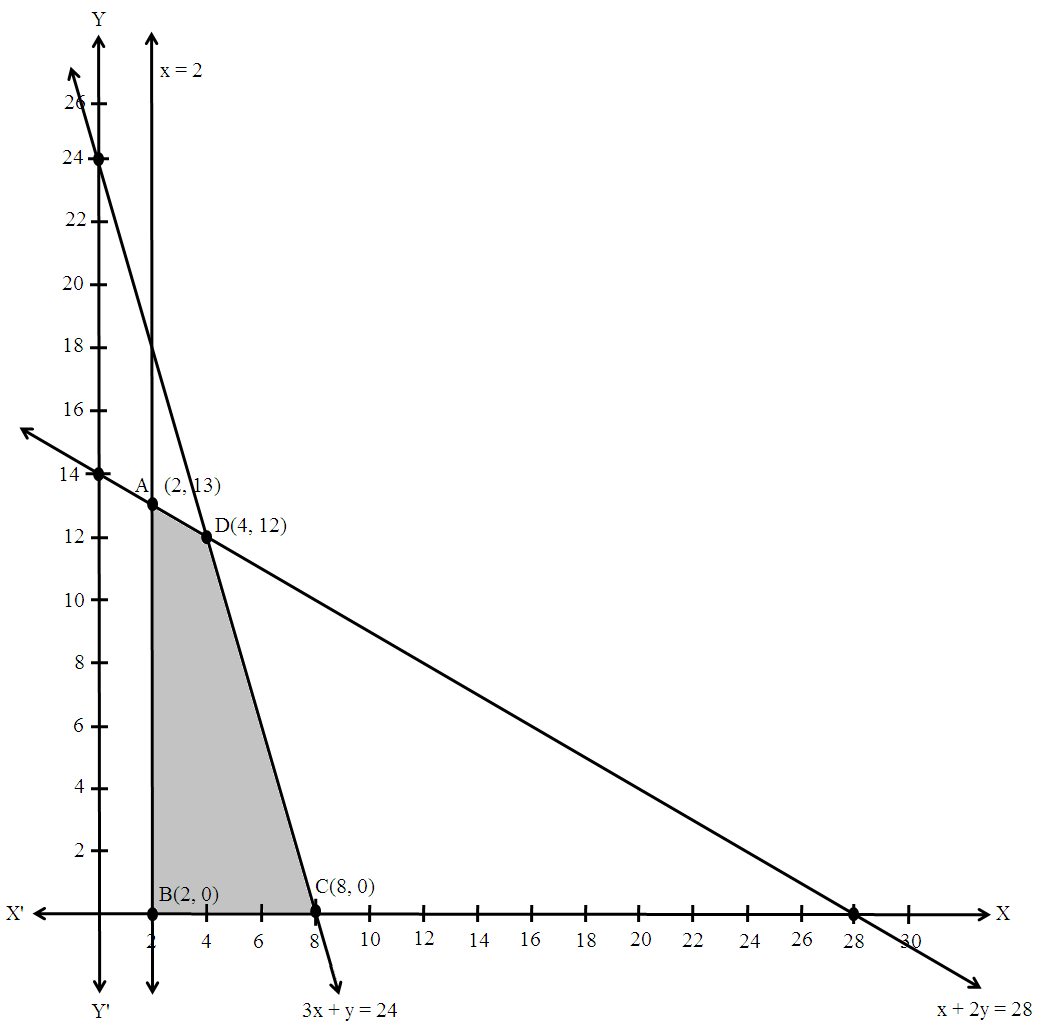
Solve the following LPP graphically:
Maximize Z = 20x + 10y
Subject to the following constraints
$\text{x}+2\text{y}\leq28$
$3\text{x}+\text{y}\leq24$
$\text{x}\geq2$
$\text{x},\text{y}\geq0$
Answer
The given contraints are:
$\text{x}+2\text{y}\leq28$
$3\text{x}+\text{y}\leq24$
$\text{x}\geq2$
$\text{x},\text{y}\geq0$
Converting the given inequation into equation, we get
x + 2y = 28, 3x + y = 24, x = 2 and y = 0
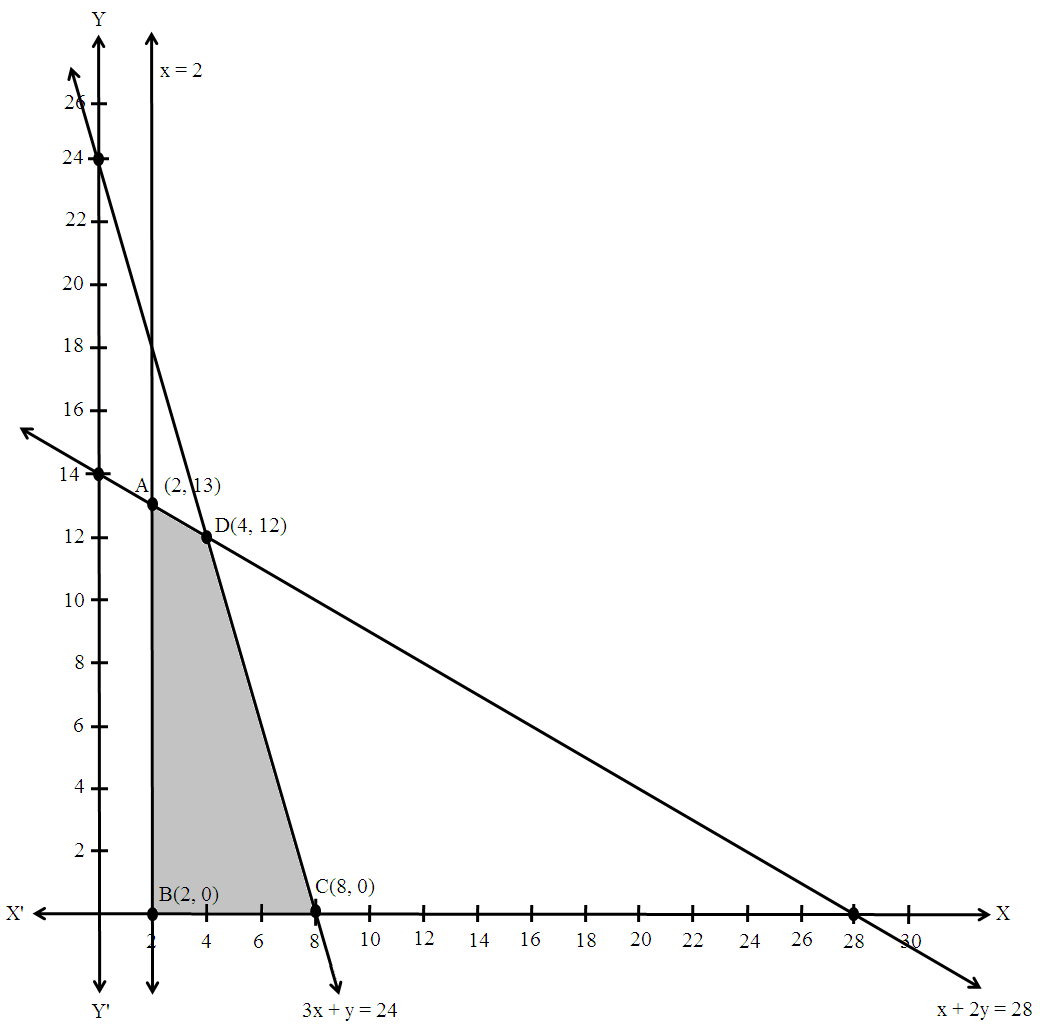
These lines are drawn on the graph and the shaded region ABCD represents the feasible region of the given LPP.

It can be observed that the feasible region is bounded.
The coordinates of the corner points of the feasible region are A(2, 13), B(2, 0), C(4, 12) and D(8, 0).
The values of the objective function, Z at these corner points are given in the following table:
Corner point Value of the objective Function Z = 20x + 10y
A(2, 13) Z = 20 × 2 + 10 × 13 = 170
B(2, 0) Z =20 × 2 + 10 × 0 = 40
C(8, 0) Z = 20 × 8 + 10 × 0 = 160
D(4, 12) Z = 20 × 4 + 10 × 12 = 200
From the table, Z is maximum at x = 4 and y = 12 and the maximum value of Z is 200.
Thus, the maximum value of Z is 200.
View full question & answer
Question 725 Marks
Determine the maximum distance that the man can travel.
Answer

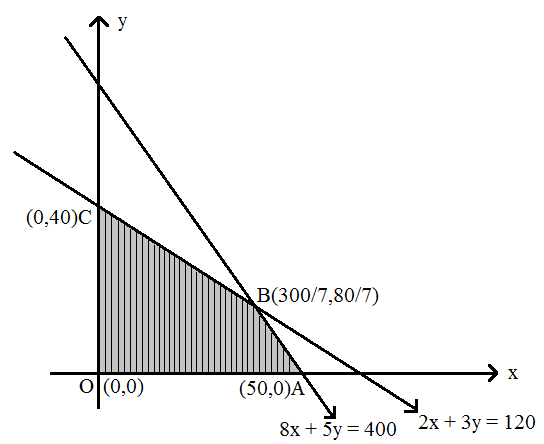
We have to maximize z = x + y subject to constraints.
$2\text{x}+3\text{y}\leq120,8\text{x}+5\text{y}\leq400,\text{x}\geq0,\text{y}\geq0$
These inequalities are plotted as shown in the following figure.
From the figure shaded region is bounded with the corner points O(0, 0), A(50, 0), $\text{B}\Big(\frac{300}{7},\frac{80}{7}\Big),$ C(0, 0)
Corner points
Corresponding value of Z = x + y
(0, 0)
0
(50, 2)
50
$\Big(\frac{300}{7},\frac{80}{7}\Big)$
$\frac{380}{7}=54\frac{2}{7}\text{km (maximum)}$
(0, 40)
40
Hence, the maximum distance that the man can travel is $54\frac{2}{7}\text{km}.$
View full question & answer
Question 735 Marks
Maximum Z = 15x + 10y
Subject to
$3\text{x}+2\text{y}\leq80$
$2\text{x}+3\text{y}\leq70$
$\text{x},\text{y}\geq0$
Answer
First, we will convert the given inequations into equations, we obtain the following equations:

3x + 2y = 80, 2x + 3y = 70, x = 0 and y=0

Region represented by $3\text{x}+2\text{y}\leq80:$

The line 3x + 2y = 80 meets the coordinate axes at $\text{A}\Big(\frac{80}{3},0\Big)$ and B(0, 40) respectively.

By joining these points we obtain the line 3x + 2y = 80.

Clearly (0,0) satisfies the inequation $3\text{x}+2\text{y}\leq80$.

So, the region containing the origin represents the solution set of the inequation $3\text{x}+2\text{y}\leq80$.

Region represented by $2\text{x}+3\text{y}\leq70:$

The line 2x + 3y = 70 meets the coordinate axes at C(35, 0) and $\text{D}\Big(0,\frac{70}{3}\Big)$ respectively.

By joining these points we obtain the line $2\text{x}+3\text{y}\leq70$.

Clearly (0,0) satisfies the inequation $2\text{x}+3\text{y}\leq70$.

So, the region containing the origin represents the solution set of the inequation $2\text{x}+3\text{y}\leq70$.

Region represented by $\text{x}\geq0$ and $\text{y}\geq0$.

Since, every point in the first quadrant satisfies these inequations.

So, the first quadrant is the region represented by the inequations $\text{x}\geq0$ and $\text{y}\geq0$.

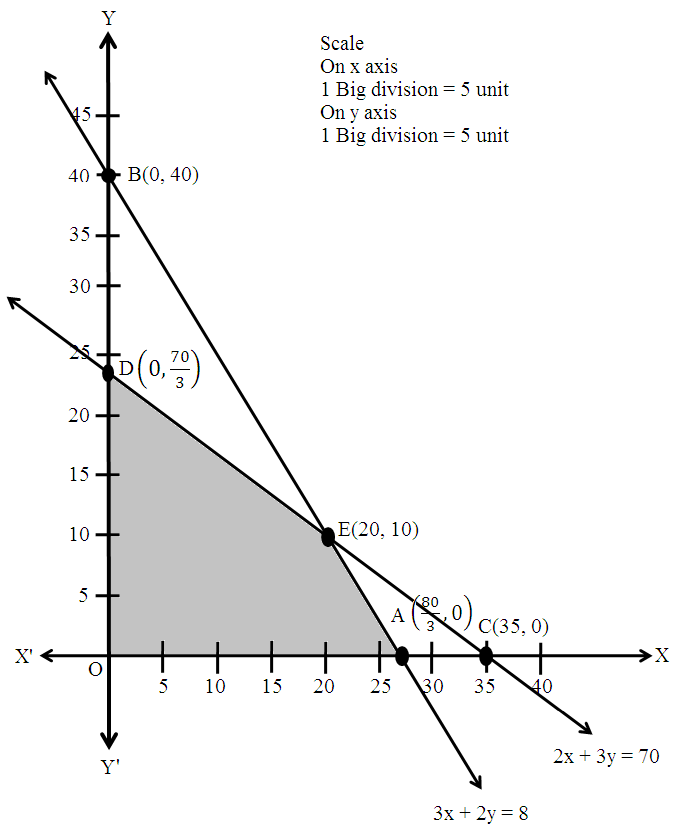
The feasible region determined by the system of constraints $3\text{x}+2\text{y}\leq80$, $2\text{x}+3\text{y}\leq70$, $\text{x}\geq0$ and $\text{y}\geq0$ are as follows.


The corner points of the feasible are O(0, 0), $\text{A}\Big(\frac{80}{3},0\Big)\text{E}(20,10)$ and $\text{D}\Big(0,\frac{700}{3}\Big)$ .

The values of Z at these corner point are as follows.
$\text{Corner point}$
$\text{Z}=15\text{x}+10\text{y}$
$\text{O}(0, 0)$
$15\times0+10\times0=0$
$\text{A}\Big(\frac{80}{3},0\Big)$
$15\times\frac{80}{3}+10\times0=400$
$\text{E}(20, 10)$
$15\times20+10\times10=400$
$\text{D}\Big(0,\frac{70}{3}\Big)$
$15\times0+10\times\frac{70}{3}=\frac{700}{3}$
We see that maximum value of the objective functioin Z is 400 which is at $\text{A}\Big(\frac{80}{3},0\Big)$ and E(20, 10).

Thus, the optimal value of Z is 400.
View full question & answer
Question 745 Marks
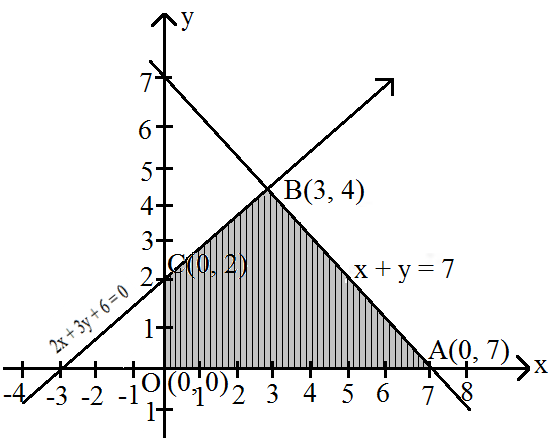
Minimise $\text{Z}=13\text{x}-15\text{y},$ subject to the constraints: $\text{x}+\text{y}\leq7,2\text{x}-3\text{y}+6\geq0,\text{x}\geq0,\text{y}\geq0.$
Answer
Minimise $\text{Z}=13\text{x}-15\text{y},$ subject to the constraints
$\text{x}+\text{y}\leq7,2\text{x}-3\text{y}+6\geq0,\text{x}\geq0,\text{y}\geq0.$

replace (0, 7) by (7, 0) in horizontal line
Shaded region shown as OABC is bounded and coordinates of its corner points are (0, 0), (7, 0), (3, 4) and (0, 2), respectively.
Corner points
Corresponding value of Z
(0, 0)
(7, 0)
(3, 4)
(0, 2)
0
91
-21
-30 (Minimum)
Hence, the minimum value of Z is -30 at (0, 2).
View full question & answer
Question 755 Marks
How many sweaters of each type should the company make in a day to get a maximum profit? What is the maximum profit.
Answer
We have
Maximize Z =200x + 120y
Subject to constraints
$\text{x}+\text{y}\leq3000,$
$3\text{x}+\text{y}<600,$
$\text{x}-\text{y}\leq100,$
$\text{x}\geq0$ and $\text{y}\geq0.$

Now, on solving x + y = 300 and 3x + y = 600, we get
x = 150, y = 150
again, on solving x - y = 100 and x + y = 300, we get
x = 100, y = 200
Thus, from the graph the feasible region is the shaded region with coordinates of corner points as (0, 0), (200, 0), (150, 150), (100, 200) and (0, 100).
Corner points
Corresponding value of Z = 200x + 120y
(0, 0)
(200, 0)
(150, 150)
(100, 200)
(0, 100)
0
40000
150 × 200 + 120 × 150 = 48000 (Maximum)
100 × 200 + 120 × 200 = 44000
120 × 100 = 12000
Hence, 150 sweaters of each type made by company and maximum profit = Rs. 48000.
View full question & answer
Question 765 Marks
A manufacturer produces two Models of bikes-Model X and Model Y. Model X takes a 6 man-hours to make per unit, while Model Y takes 10 man-hours per unit. There is a total of 450 man-hour available per week. Handling and Marketing costs are Rs. 2000 and Rs. 1000 per unit for Models X and Y respectively. The total funds available for these purposes are Rs. 80,000 per week. Profits per unit for Models X and Y are Rs. 1000 and Rs. 500, respectively.
How many bikes of each model should the manufacturer produce so as to yield a maximum profit? Find the maximum profit.
Answer

Let the manufacturer produces x number of models X and y number of model Y bikes. Model X takes 6 man-hours to make per unit and model Y takes 10 man-hours to make per unit.
There is total of 450 man-hours available per week.
$\therefore6\text{x}+10\text{y}\leq450$
$\Rightarrow3\text{x}+5\text{y}\leq225\ .....(\text{i})$
For model X and Y, handling and marketing costs are Rs. 2000 and Rs. 1000, respectively, total funds available for these purposes are Rs. 80000 per week.
$\therefore2000\text{x}+1000\text{y}\leq80000$
$\Rightarrow2\text{x}+\text{y}\leq80\ .....(\text{ii})$
Also $\text{x}\geq0,\text{y}\geq0$
the profits per unit for models X and Y are Rs. 1000 and Rs. 500, respectively,
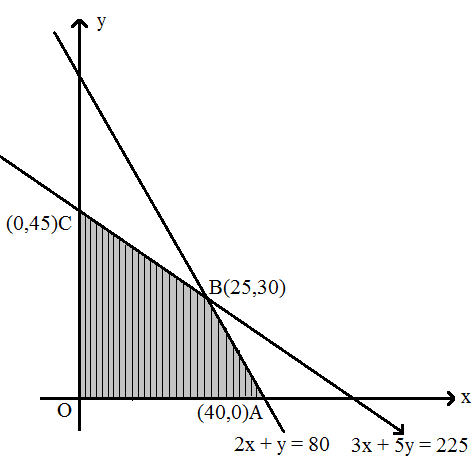
So, we have to maximize Z - 1000x + 500y Subject to $3\text{x}+5\text{y}\leq225,2\text{x}+\text{y}\leq80,\text{x}\geq0,\text{y}\geq0$
These inequalities are plotted as shown in the figure.
Corner points
Value of Z = 1000x + 500y
(0, 0)
0
(40, 0)
40000 (Maximum)
(25, 30)
40000 (Maximum)
(0, 45)
22500
So, for maximum profit manufacturer must produces 25 number of model X and 30 number of model bikes.
View full question & answer
Question 775 Marks
A company manufactures two types of screws A and B. All the screws have to pass through a threading machine and a slotting machine. A box of Type A screws requires 2 minutes on the threading machine and 3 minutes on the slotting machine. A box of type B screws requires 8 minutes of threading on the threading machine and 2 minutes on the slotting machine. In a week, each machine is available for 60 hours.
On selling these screws, the company gets a profit of Rs 100 per box on type A screws and Rs 170 per box on type B screws.
Answer
Let the company manufacture x boxes of type A screws and y boxes of type B screws. From the given information, we have following corresponding constraint table.
 
Type A(x)
Type B(x)
Maximum time available on each machine in a week
Time required for screws on threading machine
2
8
60 × 60 (min)
Time required for screws on slotting machine
3
2
60 × 60 (min)
Thus, we see that objective function for maximum profit is Z = 100x + 170y.
Subject to constraints.
$2\text{x}+8\text{y}\leq60\times60$ [time constraint for threading machine]
$\Rightarrow\text{x}+4\text{y}\leq1800\ ....(\text{i})$
And $3\text{x}+2\text{y}\leq60\times60$ [time constraint for slotting machine]
$\Rightarrow3\text{x}+2\text{y}\leq3600\ ....(\text{ii})$
Also, $\text{x}\geq0,\text{y}\geq0$ [non-negative constraints] …(iii)
$\therefore$ Required LPP is,
Maximise $\text{z}=100\text{x}+170\text{y}$
Subject to constraints $\text{x}+4\text{y}\leq1800,3\text{x}+2\text{y}\leq3600,\text{x}\geq0,\text{y}\geq0$
View full question & answer
Question 785 Marks
What will be the minimum cost?
Answer

We have minimize z = 400x + 200y, subject to
$5\text{x}+2\text{y}\geq30$
$2\text{x}+\text{y}\leq15$
$\text{x}\leq\text{y}$
$\text{x}\geq0,\text{y}\geq0$
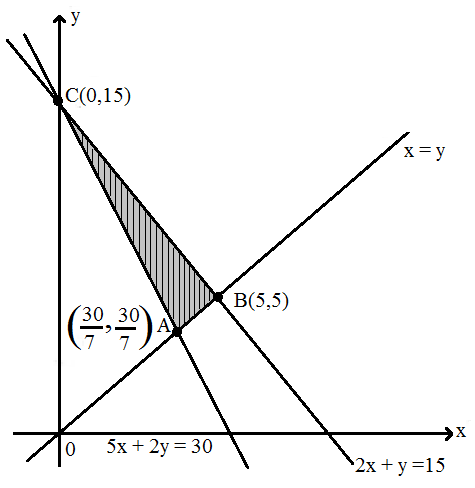
These inequalities are plotted as shown in the adjucent figure.
From the figure shaded region is bounded with the corner points $\text{A}\Big(\frac{30}{7},\frac{30}{7}\Big),$ B(5, 5) and C(0, 15).
Corner points
Corresponding value of Z = 400x + 200
$(0, 15)$
$3000$
$(5,5)$
$3000$
$\Big(\frac{30}{7},\frac{30}{7}\Big)$
$400\times\frac{30}{7}+200\times\frac{30}{7}=\frac{18000}{7}=2571.43$ (Minimum)
Hence, the minimum cast is Rs. 2571.43.
View full question & answer
Question 795 Marks
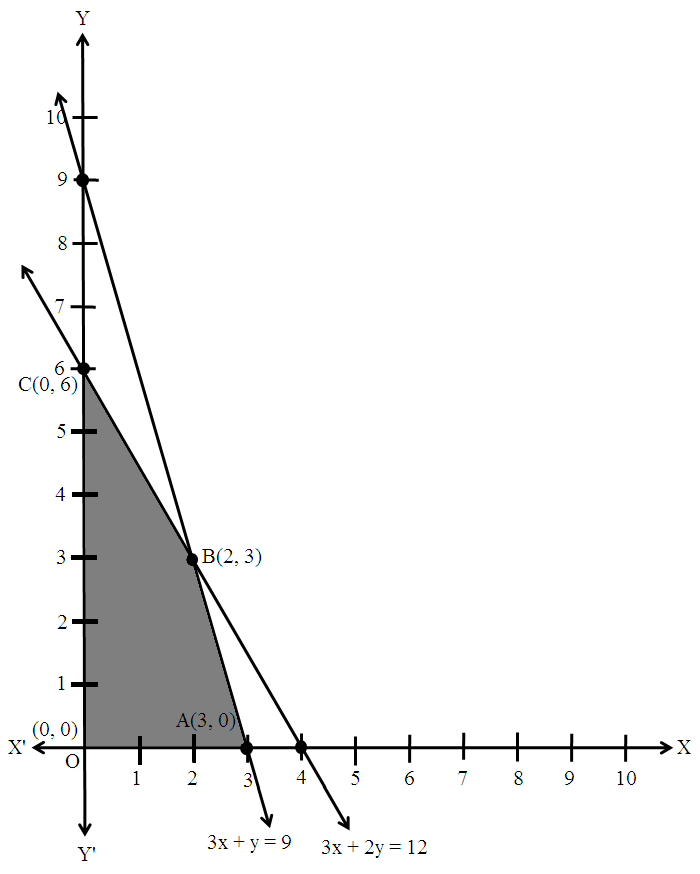
Maximise Z = x + y subject to $\text{x}+4\text{y}\leq8,2\text{x}+3\text{y}\leq12,3\text{x}+\text{y}\leq9,\text{x}\geq0,\text{y}\geq0.$
Answer
We have to Maximise z = x + y
Subject to constraints,
$\text{x}+4\text{y}\leq8,$
$2\text{x}+3\text{y}\leq12,$
$3\text{x}+\text{y}\leq9,$
$\text{x}\geq0$ and $\text{y}\geq0.$
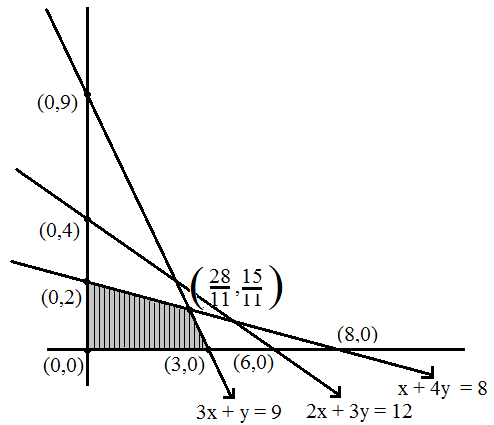
These inequalities are plotted as shown in the following figure:

On solving x + 4y = 8 and 3x + y = 9, we get $\text{x}=\frac{28}{11},\text{y}=\frac{15}{11}$
From the graph, feasible region is bounded with corner points (0, 0), (3, 0), $\Big(\frac{28}{11},\frac{15}{11}\Big)$ and (0, 2)
Corner points
Value of Z = x + y
(0, 0)
(3, 0)
$\Big(\frac{28}{11},\frac{15}{11}\Big)$
(0, 2)
0
3
$\frac{43}{11}=3\frac{10}{11}$ (Maximum)
2
Hence, the maximum value is $3\frac{10}{11}.$
View full question & answer
Question 805 Marks
Maximise Z = 3x + 4y, subject to the constraints: $\text{x}+\text{y}\leq1,\text{x}\geq0,\text{y}\geq0.$
Answer
We have to maximise Z = 3x + 4y,
Subject to the constraints
$\text{x}+\text{y}\leq1$
$\text{x}\geq0$
And $\text{y}\geq0.$
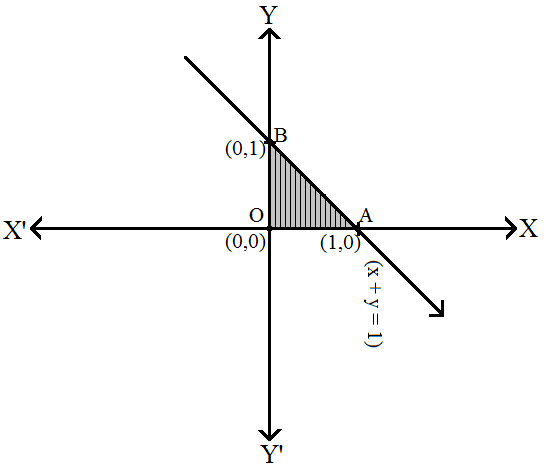
All these inequalities are plotted as shown below,

The shaded region shown in the figure as OAB is bounded and the coordinates of corner points O,
A and Bare (0, 0), (1, 0) and (0, 1), respectively.
corner points
Corresponding value of Z
(0, 0)
(1, 0)
(0, 1)
0
3
4 (Maximum)
Hence, the maximum value of Z is 4 at (0, 1).
View full question & answer
Question 815 Marks
Solve the linear programming problem and determine the maximum profit to the manufacturer.
Answer
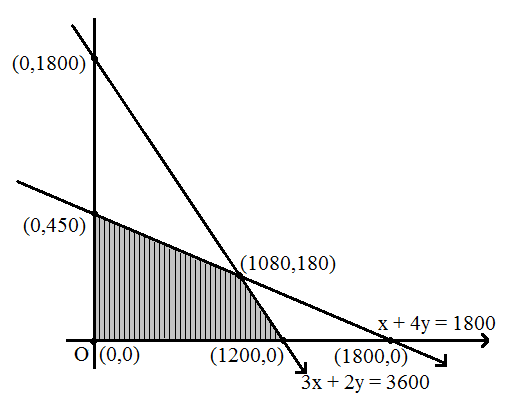
We have Maximise Z = 100x + 170y Subject to
$3\text{x}+2\text{y}\leq3600,\text{x}+4\text{y}\leq1800,\text{x}\geq0,\text{y}\geq0$
From the shaded feasible region it is clear that the coordinates of corner points are (0, 0), (1200, 0), (1080, 180) and (0, 450).
On solving x + 4y = 1800 and 3x + 2y = 3600, we get x = 1080 and y = 180.
Corner points
Corresponding value of Z = 100x + 170y
(0, 0)
(1200, 0)
(1080, 180)
(0, 450)
0
1200 ×100 = 12000
100 × 1080 + 170 × 180 = 138600 (maximum)
0 + 170 × 450 = 76500
Hence, the maximum profit to the manufacture is 138600.
View full question & answer
Question 825 Marks
Minimise Z = -3x + 4 y
subject to $\text{x}+2\text{y}\leq8,\ 3\text{x}+2\text{y}\leq12,\ \text{x}\geq0,\ \text{y}\geq0.$
Answer

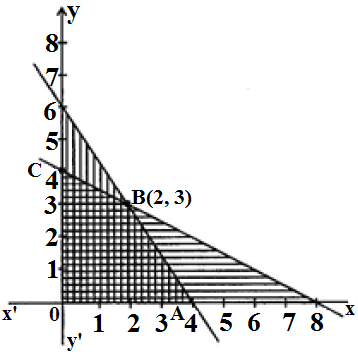
Consider $\text{x}+2\text{y}\leq8$
Let x + 2y = 8
$\Rightarrow\frac{\text{x}}{8}+\frac{\text{y}}{4}=1$
$\therefore$ a = 8, b = 4
Since, (0, 0) satisfies the inequaitons $\text{x}+2\text{y}\leq8$
Therefore, its solution contains (0, 0)
Again $3\text{x}+2\text{y}\leq12$
Let 3x + 2y = 12
$\Rightarrow\frac{\text{x}}{4}+\frac{\text{y}}{6}=1$
Again, (0, 0) satisfies $3\text{x}+2\text{y}\leq12$
Therefore its solution contains (0, 0).
The feasible region is the solution set which is double shaded and is OABCO.
At O(0, 0) Z = 0
At A(4, 0) Z = -3 × 4 = -12
At B(2, 3) Z = -3 × 2 + 4 × 3 = 6
At C(0, 4) Z = 4 × 4 = 16
Hence, minimum Z = -12 at x = 4, y = 0.
View full question & answer
Question 835 Marks
Maximum Z = 5x + 3y Subject to $2\text{x}+\text{y}\geq10$ $\text{x}+3\text{y}\geq15$ $\text{x}\leq10$$\text{y}\leq8$
$\text{x},\text{y}\geq0$
Answer
First, we will convert the given inequations into equations, we obtain the following equations:

2x + y = 10, x + 3y = 15, x = 10, y = 8

Region represented by $2\text{x}+\text{y}\geq10$:

The line 2x + y = 10 meets the coordinate axes at A(5, 0) and B(0, 10) respectively.

By joining these points we obtain the line 2x + y = 10. Clearly (0, 0) does not satisfies the inequation $2\text{x}+\text{y}\geq10$.

So,the region in xy plane which does not contain the origin represents the solution set of the inequation $2\text{x}+\text{y}\geq10$.

Region represented by $\text{x}+3\text{y}\geq15$:

The line x + 3y = 15 meets the coordinate axes at C(15, 0) and D(0, 5) respectively.

By joining these points we obtain the line x + 3y = 15.

Clearly (0, 0) satisfies the inequation $\text{x}+3\text{y}\geq15$. o, the region in xy plane which does not contain the origin represents the solution set of the inequation $\text{x}+3\text{y}\geq15$.

The line x = 10 is the line that passes through the point (10, 0) and is parallel to Y axis. $\text{x}\leq10$ is the region to the left of the line x = 10.

The line y = 8 is the line that passes through the point (0, 8) and is parallel to X axis. $\text{y}\leq8$ is the region below the line y = 8.

Region represented by $\text{x}\geq0$ and $\text{y}\geq0$:

Since, every point in the first quadrant satisfies these inequations.

So, the first quadrant is the region represented by the inequations $\text{x}\geq0$ and $\text{y}\geq0$.

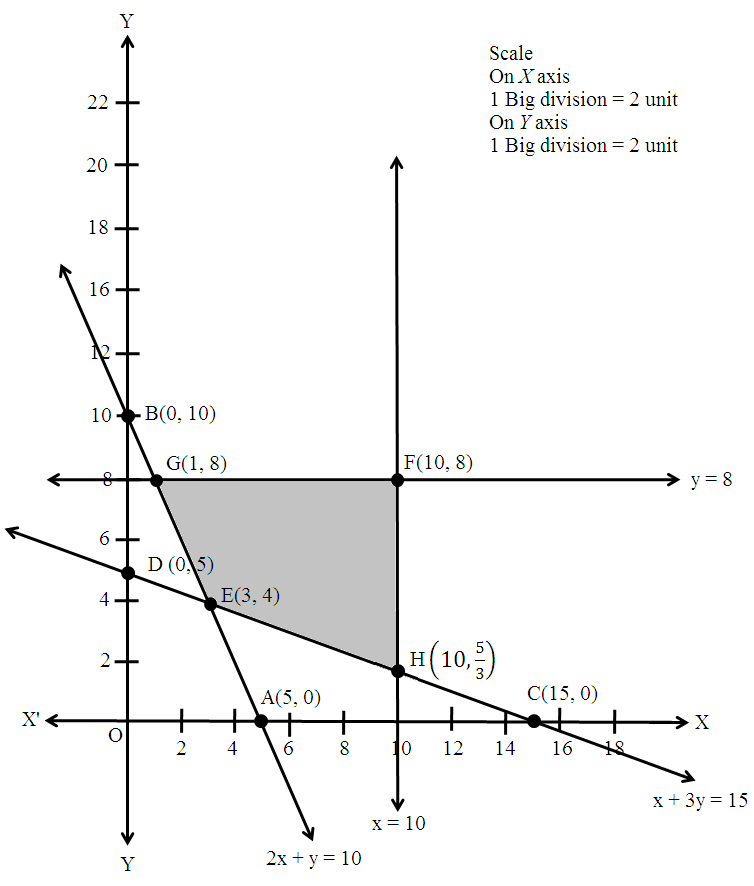
The feasible region determined by the system of constraints, $2\text{x}+\text{y}\geq10$, $\text{x}+3\text{y}\geq15$, $\text{x}\leq10$, $\text{y}\leq8$, $\text{x}\geq0$ and $\text{y}\geq0$ are as follows.


The corner point of the feasible region are E(3, 4), $\text{H}\Big(10,\frac{5}{3}\Big),$ F(10, 8) and G(1, 8).

The values of Z at these corner points are as follows.
$\text{Corner point}$
$\text{Z}=5\text{x}+3\text{y}$
$\text{E}(3, 4)$
$5\times3+3\times4=27$
$\text{H}\Big(10,\frac{5}{3}\Big)$
$5\times10+3\times\frac{5}{3}=55$
$\text{F}(10, 8)$
$5\times10+3\times8=74$
$\text{G}(1, 8)$
$5\times1+3\times8=29$
Therefore, the minimum value of Z is 27 at the point F(3, 4).

Hence, x = 3 and y = 4 is the optimal solution of the given LPP.

Thus, the optimal value of Z is 27.
View full question & answer
Question 845 Marks
Minimise and Maximise Z = x + 2y
subject to $\text{x}+2\text{y}\geq100,\ 2\text{x}-\text{y}\leq0,\ 2\text{x}+ \text{y}\leq200;\ \text{x},\ \text{y}\geq0.$
Answer

Consider $\text{x}+2\text{y}\geq100$
Let x + 2y = 100 ⇒ $\frac{\text{x}}{100}+\frac{\text{y}}{50}=1$
$\text{x}+2\text{y}\geq100$ represents which does not include (0, 0) as it does not made it true.
gain consider $2\text{x}-\text{y}\leq0$
Let 2x - y = 0 ⇒ y = 2x
Let the test point be (10, 0).
x 0 25 50 100
y 0 50 100 200
$\therefore2\times10-0\leq0$ which is false.
herefore, the required half does not contain (10, 0).
Again consider $2\text{x}+\text{y}\leq200$
Let 2x + y = 200
$\Rightarrow\frac{\text{x}}{100}+\frac{\text{y}}{200}=1$
Now (0, 0) satisfies $2\text{x}+\text{y}\leq200$
Therefore, the required half place contains (0, 0).
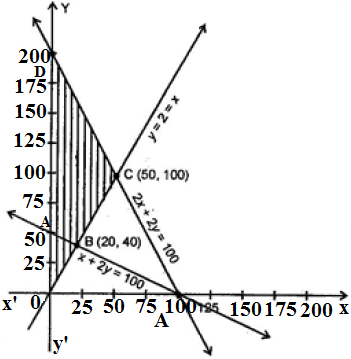
Now triple shaded region is ABCDA which is the required feasible region.
At A (0, 50)
  Z = x + 2y = 0 + 2 × 50 = 100
At B(20, 40), Z = 20 + 2 × 40 = 100
At C(50, 100), Z = 50 + 2 × 100 = 250
At D(0, 200), Z = 0 + 2 × 200 = 400
Hence maximum Z = 400 at x = 0, y = 200 and minimum Z = 100 at x = 0, y = 50 or x = 20, y = 40.
View full question & answer
Question 855 Marks
A firm manufactures two types of products $A$ and $B$ and sells them at a profit of Rs $2$ on type $A$ and Rs $3$ on type $B.$ Each product is processed on two machines $M_1$ and $M_2.$ Type A requires one minute of processing time on $M_1$ and two minutes of $M_2;$ type $B$ requires one minute on $M_1$ and one minute on $M_2$. The machine $M_1$ is available for not more than $6$ hours $40$ minutes while machine $M_2$ is available for $10$ hours during any working day. Formulate the problem as a LPP.
Answer
Let the firm produces $x$ units of product $A$ and $y$ units of product $B.$
Since, each unit of product A requires one minute on machine M, and two minutes on machine $M_2$
Therefore, $x$ units of product A will require product $x$ minutes on machine $M,$ and $2x$ minutes on machine $M_2$
Also,
Since each unit of product $B$ requires one minute on machine $M$, and one minute on machine $M_2$
Therefore, $y$ units of product $A$ will require product $y$ minutes on machine $M$, and $y$ minutes on machine $M_2$
It is given that the machine $M_1$ is available for $6$ hours and $40$ minutes i.e. $400$ minutes and machine $M_2$ is available for $10$ hours i.e. $600$ minutes.
Thus,
$\text{x}+\text{y}\leq400$
$2\text{x}+\text{y}\leq600$
Since, units of the products cannot be negative, so $\text{x},\text{y}\geq0$
Let $Z$ denotes the total profit
$\therefore Z = 2x + 3y$ which is to be maximised
Hence, the required LPP is as follows:
Maximize $Z = 2x + 3y$
Subject to
$\text{x}+\text{y}\leq400$
$2\text{x}+\text{y}\leq600$
$\text{x},\text{y}\geq0$.
 
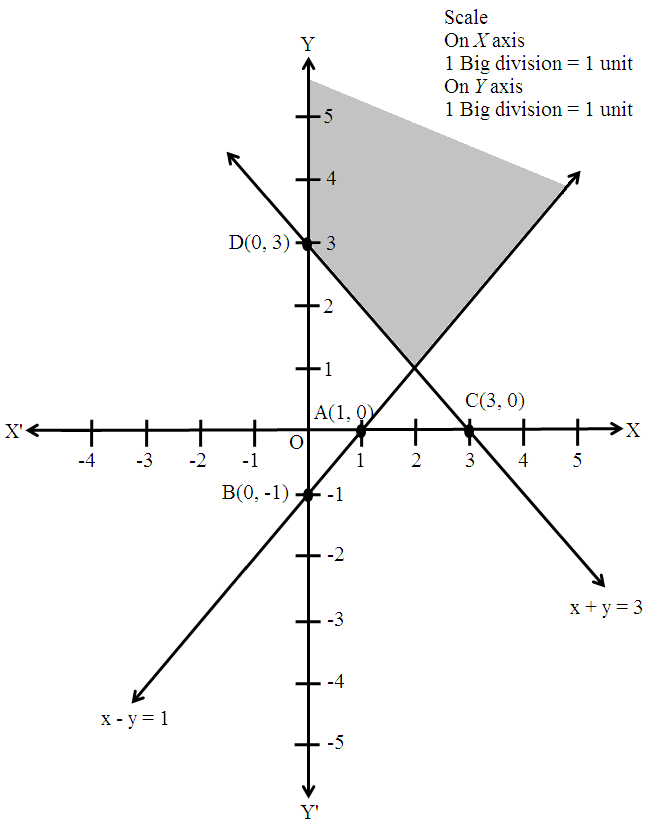
View full question & answer
Question 865 Marks
Maximize Z = 3x + 3y, if possible,
Subject to the constraints
$\text{x}-\text{y}\leq1$
$\text{x}+\text{y}\geq3$
$\text{x},\text{y}\geq0$
Answer
First, we will convert the given inequations into equations, we obtain the following equations:
x − y = 1, x + y = 3, x = 0 and y = 0
Region represented by x − y ≤ 1:
The line x − y = 1 meets the coordinate axes at A(1, 0) and B(0, −1) respectively.
By joining these points we obtain the line x − y = 1.
Clearly (0, 0) satisfies the inequation x + y ≤ 8.
So,the region in xy plane which contain the origin represents the solution set of the inequation x − y ≤ 1.
Region represented by x + y ≥ 3:
The line x + y = 3 meets the coordinate axes at C(3, 0) and D(0, 3) respectively.
By joining these points we obtain the line x + y = 3.
Clearly (0, 0) satisfies the inequation x + y ≥ 3.
So,the region in xy plane which does not contain the origin represents the solution set of the inequation x + y ≥ 3.
Region represented by x ≥ 0 and y ≥ 0:
Since, every point in the first quadrant satisfies these inequations.
So, the first quadrant is the region represented by the inequations x ≥ 0 and y ≥ 0.
The feasible region determined by the system of constraints x − y ≤ 1, x + y ≥ 3, x ≥ 0 and y ≥ 0 are as follows.

The feasible region is unbounded.
We would obtain the maximum value at infinity.
Therefore, maximum value will be infinity i.e. the solution is unbounded.
View full question & answer
Question 875 Marks
A box manufacturer makes large and small boxes from a large piece of cardboard. The large boxes require $4$ sq. metre per box while the small boxes require $3$ sq. metre per box. The manufacturer is required to make at least three large boxes and at least twice as many small boxes as large boxes. If $60$ sq. metre of cardboard is in stock, and if the profits on the large and small boxes are Rs. $3$ and Rs. $2$ per box, how many of each should be made in order to maximize the total profit?
Answer
Let required quantity of large and small boxes are $x$ and $y$ respectively.
Since, profits on each unit of large and small boxes are Rs. $3$ and Rs. $2$ respectively, so, profit on x units of large and y units of small boxes are Rs. $3x$ and Rs. $2y$ respectively
Let $Z$ be total profit so,
$Z = 3x + 2y$
Since each large and small box require $4$ sq. m. and $3$ sq. m. cardboard respectively, so, $x$ units of large and y units of small boxes require $4x$ and $3y$ sq.m. cardboard respectivley but only $60$ sq. m. of cardboard is available, so
$4x + 3y \leq 60 ($first constraint$)$
Since manufacturer is required to make at least three large boxes, so,
$X \geq 3 ($second constraint$)$
Since manufacturer is required to make at least twice as many small boxes as large boxes, so,
$y \geq 2x ($third constraint$)$
Hence, mathematical formulation of LPP is find $x$ and $y$ which
Maximize $Z = 20x + 15y$
Subject to constriants,
$4x + 3y \leq 60$
$x \geq 3$
$y \geq 2x$
$x, y \geq 0 [$Since production can not be less than zero$]$
Region $4x + 3y \leq 60:$
Line $4x + 3y = 60$ meets axes at $A_1(15, 0), B_1(0, 20)$ respectively.
Region containing origin represents $4x + 3y \leq 60$ as $(0, 0)$ satisfies $4x + 3y \leq 60.$
Region $x \geq 3:$
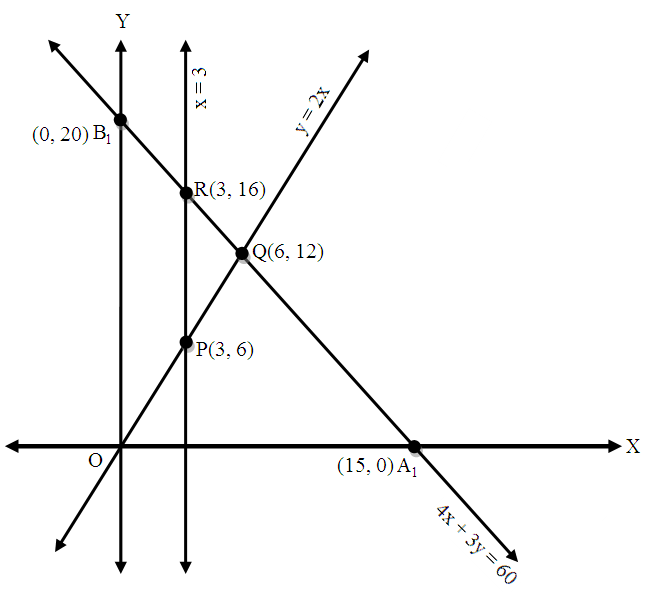
Line $x = 3 $ is parallel to $y-$axis meets $x-$axes at $A_2(3, 0).$
Region containing origin represents $x \geq 70$ as$(0, 0)$ satisfies $x \geq 3.$
Region $y \geq 2x:$
Line $y = 2x$ is passes throgh origin and $P(3, 6).$
Region containging $B_1(0, 20)$ represents $y \geq 2x$ as $(0, 20)$ satisfies $y \geq 2x.$
Region $x, y \geq 0:$
It represent first quandrant.

Shaded region $PQR$ represents feasible region.
Point $Q(6, 12)$ is obtained by solving $y = 2x$ and $4x + 3y = 60$
Point $R(3, 16)$ is obtained by solving $x = 3$ and $4x + 3y = 60.$
The value of $Z = 3x + 2y$ at
$P(3, 6) = 3(3) +2(6) = 21$
$Q(6, 12) = 3(6) + 2(12) = 42$
$R(3, 16) = 3(3) +2(16) = 41$
Maximum $Z = 42$ at $x = 6, y = 12$
Number of large box $= 6,$ small box $=12$
Maximum profit $-$ Rs. $42.$
 
View full question & answer
Question 885 Marks
A farmer has a 100 acre farm. He can sell the tomatoes, lettuce, or radishes he can raise. The price he can obtain is Rs 1 per kilogram for tomatoes, Rs 0.75 a head for lettuce and Rs 2 per kilogram for radishes. The average yield per acre is 2000 kgs for radishes, 3000 heads of lettuce and 1000 kilograms of radishes. Fertilizer is available at Rs 0.50 per kg and the amount required per acre is 100 kgs each for tomatoes and lettuce and 50 kilograms for radishes. Labour required for sowing, cultivating and harvesting per acre is 5 man-days for tomatoes and radishes and 6 man-days for lettuce. A total of 400 man-days of labour are available at Rs 20 per man-day. Formulate this problem as a LPP to maximize the farmer's total profit.
Answer
Let the farmer sow tomatoes in x acres, lettuce in y acres & radishes in z acres of the farm.
Average yield per acre is 2000 kgs for tomatoes, 3000 kgs of lettuce and 1000 kg of radishes.
Thus, the farmer raised 2000x kg of tomatoes, 3000y kg of lettuce and 1000z kg of radishes.
Given, price he can obtain is Re 1 per kilogram for tomatoes, Re 0.75 a head for lettuce and Rs. 2 per kilogram for radishes.
$\therefore$ Selling price = Rs. [2000x(1)+3000y(0.75)+1000z(2)]
=Rs.(2000x + 2250y + 2000z)
Labour required for sowing, cultvating and harvesting per acre is 5 man-days for tomatoes and radishes and 6 man-days for lettuce.
Therefore, labour required for sowing, cultivating and harvesting per acre is 5x for tomatoes, 6y for lettuce and 5z for radishes.
Number of man-days required in sowing, cultivating and harvesting
= 5x + 6y + 5z
Price of one man-day = Rs. 20
$\therefore$ Labour cost = 20(5x + 6y + 5z) = 100x + 120y +100z
Also, fertilizer is available at Re 0.50 per kg and the amount required per acre is 100 kgs each for tomatoes and lettuce and 50 kgs for radishes.
Therefore, fertilizer required is 100x kgs for the tomatoes sown in x acres, 100y kgs for the lettuce sown in y acres and 50z kgs for radishes sown in z acres of land.
Hence, total fertilizer used= (100x + 100y +50z) kgs
Thus, fertilizer's cost
= Rs. 0.5 × (100x + 100y + 5z) = Rs. (50x + 50y + 25z)
So, the total price that has been cost to farmer = Labour cost + Fertilizer cost
= Rs. (150x + 170y + 125z)
Profit made by farmer = selling Price - cost price
= Rs. (2000x + 2250y 2000z) - Rs. (150x + 170y + 125z)
= Rs. (1850x + 2080y + 1875z)
Let Z denotes the total profit
$\therefore$ Z = 1850x + 2080y + 1875z
Now,
Total area of the farm = 100 acres
$\text{x}+\text{y}+\text{z}\leq100$
Also, it is given thet the total man - dayas available are 400.
Thus, $5\text{x}+6\text{y}+5\text{z}\leq400$
Area of the land cannot be negative.
Therefore, $\text{x}+\text{y}\geq0$
Hence, the required LPP is as follows:
Maximize Z = 1850x + 2080y + 1875z
Subject to
$\text{x}+\text{y}+\text{z}\leq100$
$5\text{x}+6\text{y}+5\text{z}\leq400$
$\text{x}+\text{y}\geq0$
View full question & answer
Question 895 Marks
An oil company has two depots A and B with capacities of 7000 L and 4000 L respectively. The company is to supply oil to three petrol pumps, D, E and F whose requirements are 4500L, 3000L and 3500L respectively. The distances (in km) between the depots and the petrol pumps is given in the following table:
Distance in (km.)
From / To
A
B
D
E
F
7
6
3
3
4
2
Assuming that the transportation cost of 10 litres of oil is Re 1 per km, how should the delivery be scheduled in order that the transportation cost is minimum? What is the minimum cost?
Answer
Let x liters of oil is supplied from depot A to petrol pump D and y liters of oil supplied from depot A to petrol pump E then 7000 - (x + y) liters of oil will be supplied from depot A to petrol pump F.
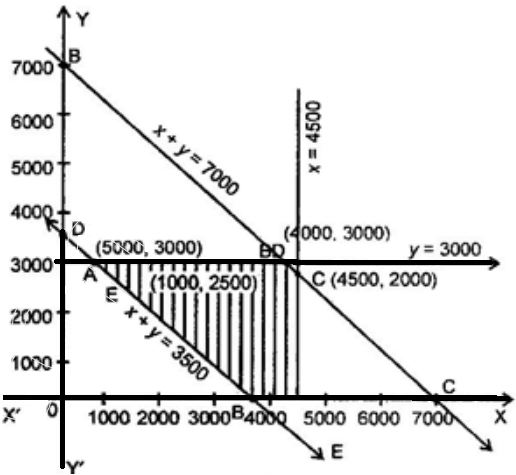
$\therefore\ \text{we have x}\geq0,\ \text{y}\geq0\text{ and }7000-(\text{x}+\text{y})\geq0$ $\Rightarrow\ \text{x}+\text{y}\leq700$ Since requirements of oil at petrol pump, D, E and F are (4500 - x), (5000 - x) and [3500-(x + y)] liters respectively. $\therefore\ 4500-\text{x}\geq0$ $\Rightarrow\ \text{x}\leq4500$ And $300-\text{y}\geq0\Rightarrow\ \text{y}\leq3000$ And $3500-[7000-(\text{x}+\text{y})]\geq0\ \Rightarrow\ \text{x}+\text{y}\geq3500$ $\therefore\ $The cost of transportation per km for 10 liters oil is Re 1 $\therefore\ $The cost of transportation per km per liter $=\text{Rs}.\frac{1}{10}$ $\therefore\ $The cost of transportation Z = 0.7x + 0.6y + 0.3[700 -(x + y)] + 0.3(4500 - x) + 0.4(3000 - y) + [(x + y) -3500] Z = 0.3x + 0.1y + 3950 Therefore, the feasible region is ABECD. Its corners are A(500, 3000), B(35, 0), E(4500, 0), C(4500, 2500), D(4000, 3000). Now Z = 0.3 + 0.1y + 3950
At A(500, 3000) Z = 0.3 × 500 + 0.1 × 3000 + 3950 = 4400
At B(3500, 0) Z = 0.3 × 3500 + 0.1 × 0 + 3950 = 5000
At E(4500, 0) Z = 0.3 × 4500 + 0.1 × 0 + 3950 = 5300
At C(4500, 2500) Z = 0.3 × 4500 + 0.1 × 2500 + 3950 = 5550
At D(4000, 3000) Z = 0.3 × 4000 + 0.1 × 3000 + 3950 = 5450
Minimum transportation charges are Rs. 4400 at x = 500, y = 3000 Hence, 500 liters, 3000 liters and 3500 liters of oil should be transported from depot A to petrol pumps D, E, F and 4000 liters, 0 liter and 0 liter of oil be transported from depot B to petrol pumps D, E and F with minimum cost of transportation of Rs. 4400.
View full question & answer
Question 905 Marks
Maximise Z = -x + 2y, subject to the constraints:
$\text{x}\geq3,\ \text{x}+\text{y}\geq5,\ \text{x}+ 2\text{y}\geq6,\ \text{y}\geq0.$
Answer

Consider $\text{x}\geq3$
Let x = 3 which is a line parallel to y-axis at a positive distance of 3 from it.
Since $\text{x}\geq3,$ therefore the required half-plane does not contain (0, 0).
Now consider $\text{x}+\text{y}\geq5$
Let x + y = 5
$\Rightarrow\frac{\text{x}}{5}+\frac{\text{y}}{5}=1$
Now (0, 0) does not satisfy $\text{x}+\text{y}\geq5,$ therefore the required half plane does not contain (0, 0).
Again consider $\text{x}+2\text{y}\geq6$
Let x + 2y = 6
$\Rightarrow\frac{\text{x}}{6}+\frac{\text{y}}{3}=1$
Here also (0, 0) does not satisfy $\text{x}+2\text{y}\geq6,$ therefore the required half plane does not contain (0, 0).
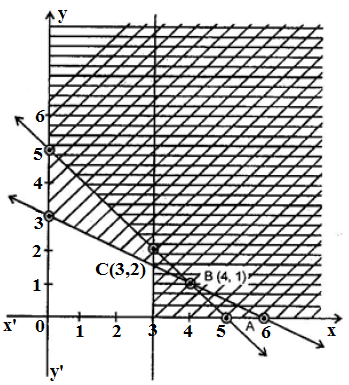
The corners of the feasible region are A(6, 0), B(4, 1) and C(3, 2).
At A(6, 0) Z = -6 + 2 × 0 = -6
At B(4, 1) Z = -4 + 2 × 1 = -2
At C(3, 2) Z = -3 + 2 × 2 = 1
Hence, maximum Z = 1 at x = 3, y = 2.
View full question & answer
Question 915 Marks
Maximize $Z = 3x_1 + 4x_2,$ if possible,
Subject to the constraints
$\text{x}_1-\text{x}_2\leq-1$
$-\text{x}_1+\text{x}_2\leq0$
$\text{x}_1,\text{x}_2\geq0$
Answer
First, we will convert the given inequations into equations, we obtain the following equations:
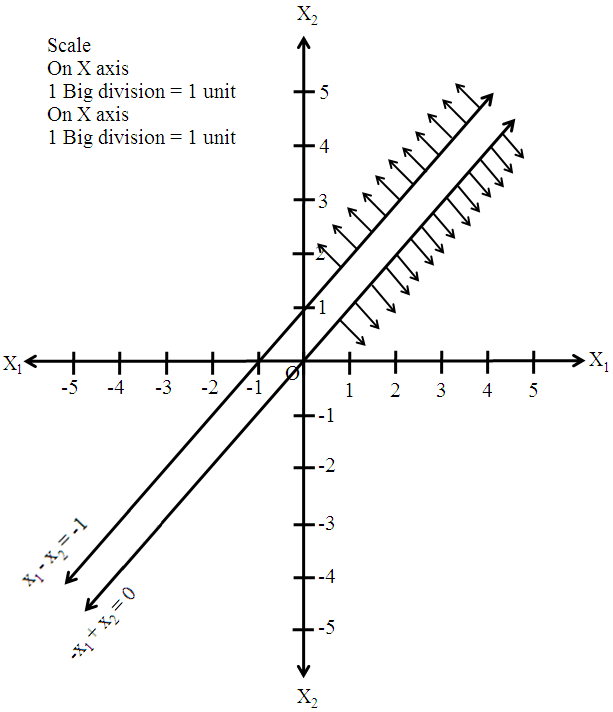
$X_1 - X_2 = -1, -X_1 + x_2 = 0, X_1 = 0$ and $X_2 = 0$
Region represented by $\text{x}_1-\text{x}_2\leq-1$:
The line $x_1 - x_2 = -1$ meets the coordinate axes at $A(-1, 0)$ and $B(0, 1)$ respectively.
By joining these points we obtain the line $x_1 - x_2 = -1.$
Clearly $(0, 0)$ does not satisfies the inequation $\text{x}_1-\text{x}_2\leq-1$.
So,the region in the plane which does not contain the origin represents the solution set of the inequation $\text{x}_1-\text{x}_2\leq-1$.
Region represented by $-\text{x}_1+\text{x}_2\leq0$ or $\text{x}_1\geq\text{x}_2$:
The line $-X_1 + x_2 = 0$ or $X_1 = x_2$_ is the line passing through $(0, 0).$
The region to the right of the line $x1 = x2$ will satisfy the given inequation $-\text{x}_1+\text{x}_2\leq0$.
If we take a point $(1, 3)$ to the left of the line $x_1 = x_2.$
Here, $1\leq3$ which is not satifying the inequation $\text{x}_1\geq\text{x}_2$.
Therefore, region to the right of the line $x_1 = x_2$​​​​​​​_ will satisfy the given inequation $-\text{x}_1+\text{x}_2\leq0$.
Region represented by $\text{x}_1\geq0$ and $\text{x}_2\geq0$:
Since, every point in the first quadrant satisfies these inequations.
So, the first quadrant is the region represented by the inequations $\text{x}_1\geq0$ and $\text{x}_2\geq0$.
The feasible region determined by the system of constraints, $\text{x}_1-\text{x}_2\leq-1,-\text{x}_1+\text{x}_2\leq0,\text{x}_1\geq0$ and $\text{x}_2\geq0$, are as follows.
We observe that the feasible region of the given LPP does not exist.
View full question & answer
Question 925 Marks
Find the maximum and minimum value of 2x + y subject to the constraints:

$\text{x}+3\text{y}\geq6,\text{x}-3\text{y}\leq3,3\text{x}+4\text{y}\leq24,$ $-3\text{x}+2\text{y}\leq6,5\text{x}+\text{y}\geq5,\text{x},\text{y}\geq0$
Answer
First, we will convert the given inequations into equations, we obtain the following equations:

x + y = 4, x + y = 3, x - 2y = 2, x = 0 and y = 0.

The line x + 3y = 6 meets the coordinate axis at A(6, 0) and B(0, 2).

Join these points to obtain the line x + 3y = 6.

Clearly, (0, 0) does not satisfies the inequation $\text{x}+3\text{y}\geq6$.

So, the region in xy-plane that does not contains the origin represents the solution set of the given equation.

The line x - 3y = 3 meets the coordinate axis at C(3, 0) and D(0, -1).

Join these points to obtain the line x - 3y = 3.

Clearly, (0, 0) satisfies the inequation $\text{x}-3\text{y}\leq3$.

So, the region in xy-plane that contains the origin represents the solution set of the given equation.

The line 3x + 4y = 24 meets the coordinate axis at E(8, 0) and F(0, 6).

Join these points to obtain the line 3x + 4y = 24.

Clearly, (0, 0) satisfies the inequation $3\text{x}+4\text{y}\leq24$.

So, the region in xy-plane that contains the origin represents the solution set of the given equation.

The line -3x + 2y = 6 meets the coordinate axis at G(-2, 0) and H(0, 3).

Join these points to obtain the line -3x + 2y = 6.

Clearly, (0, 0) satisfies the inequation $-3\text{x}+2\text{y}\leq6$.

So, the region in xy-plane that contains the origin represents the solution set of the given equation.

The line 5x + y = 5 meets the coordinate axis at I(1, 0) and J(0, 5).

Join these points to obtain the line 5x + y = 5.

Clearly, (0, 0) does not satisfies the inequation $5\text{x}+\text{y}\geq5$.

So, the region in xy-plane that does not contains the origin represents the solution set of the given equation.

Region represented by $\text{x}\geq0$ and $\text{y}\geq0$:

Since, every point in the first quadrant satisfies these inequations.

So, the first quadrant is the region represented by the inequations.

These lines are drawn using a suitable scale.
View full question & answer
Question 935 Marks
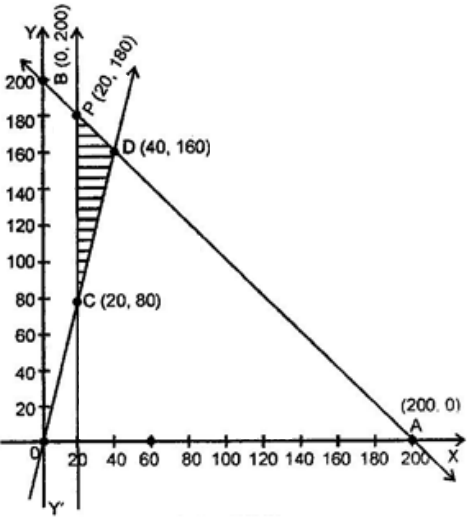
An aeroplane can carry a maximum of 200 passengers. A profit of Rs. 1000 is made on each executive class ticket and a profit of Rs 600 is made on each economy class ticket. The airline reserves at least 20 seats for executive class. However, at least 4 times as many passengers prefer to travel by economy class than by the executive class. Determine how many tickets of each type must be sold in order to maximise the profit for the airline. What is the maximum profit?
Answer
Let number of tickets of executive class sold = x and number of tickets of economy class sold = y
We have to maximize = Z = 1000x + 600 y subject to $\text{x}+\text{y}\leq200,\ \text{x}\geq20\text{ and y}\geq4\text{x }\text{ x}\geq0,\ \text{y}\geq0$

consider $\text{x}+\text{y}\leq200$
Let x + y = 200
$\Rightarrow\ \frac{\text{x}}{200}+\frac{\text{y}}{200}=1$
$\therefore\ $Points A(200, 0) and B(0, 200) are on the line and therefore (0, 0) is included in the required half plane. Again consider $\text{x}\geq20$
Let x = 20
It is the line parallel to y-axis at a positive distance 20 and the half plane lies towards right of it. Again consider $\text{y}\geq4\text{x}$
Let y = 4x
  O C D
X 0 20 40
Y 0 80 160
Here, (40, 0) does not satisfy $\text{y}\geq4\text{x},$ therefore plane does not include (40, 0).
The shaded portion is the feasible region. Its corners are C(20, 80), D(40, 160) and P(20, 180)
Now Z = 1000x + 600y
At C(20, 80) Z = 1000 × 20 + 600 × 80 = 20000 + 48000 = 68,000
At D(40, 60) Z = 1000 × 40 + 600 × 60 = 40000 + 96000 = 1,36,000
At P(20, 180) Z = 1000 × 20 + 600 × 180 = 20000 + 108000 = 1,228,000
Hence Maximum profit Z = Rs. 1,36,000 at x = 40, y = 160.
View full question & answer
Question 945 Marks
A factory manufactures two types of screws, A and B. Each type of screw requires the use of two machines, an automatic and a hand operated. It takes 4 minutes on the automatic and 6 minutes on hand operated machines to manufacture a package of screws A, while it takes 6 minutes on automatic and 3 minutes on the hand operated machines to manufacture a package of screws B. Each machine is available for at the most 4 hours on any day. The manufacturer can sell a package of screws A at a profit of Rs 7 and screws B at a profit of Rs 10. Assuming that he can sell all the screws he manufactures, how many packages of each type should the factory owner produce in a day in order to maximise his profit? Determine the maximum profit.
Answer
Let the factory manufacture x screws of type A and y screws of type B on each day. Therefore, $\text{x}\ge0\text{ and y}\ge0.$
The given information can be compiled in a table as follows.
  Screw A Screw B Availability
Automatic Machine (min) 4 6 4 × 60 = 120
Hand Operated Machine (min) 6 3 4 × 60 = 120
The proflt on a package of screws A is Rs 7 and on the package of screws B is Rs 10.
Therefore, the constraints are
$4\text{x}+6\text{y}\le240\\6\text{x}+3\text{y}\le240$
Total profit, z = 7x + 10y
The mathematical formulation of the given problem is Maximize Z = 7x + 10y ... (1)
subject to the constraints,
$4\text{x}+6\text{y}\le240\dots(2)\\6\text{x}+3\text{y}\le240\dots(3)\\\text{x},\ \text{y}\ge0\dots(4)$
The feasible region determined by the system of constraints is

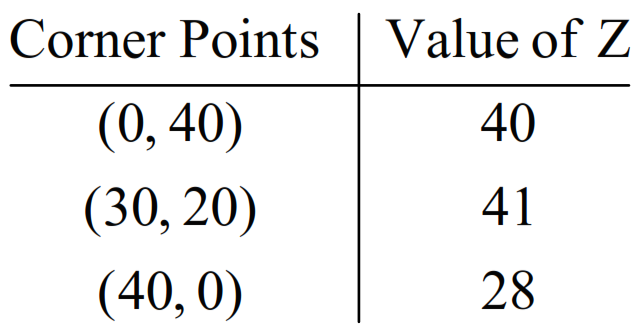
The corner points are A(40, 0), B(30, 20), and C(0, 40).
The values of Z at these corner points are as follows.
Corner point Z = 7x + 10y  
A(40, 0) 280  
B(30, 20) 410 → Maximum
C(0, 40) 400  
The maximum value of Z is 410 at (30, 20).
Thus, the factory should produce 30 packages of screws A and 20 packages of screws B to get the maximum profit of Rs 410.
View full question & answer
Question 955 Marks
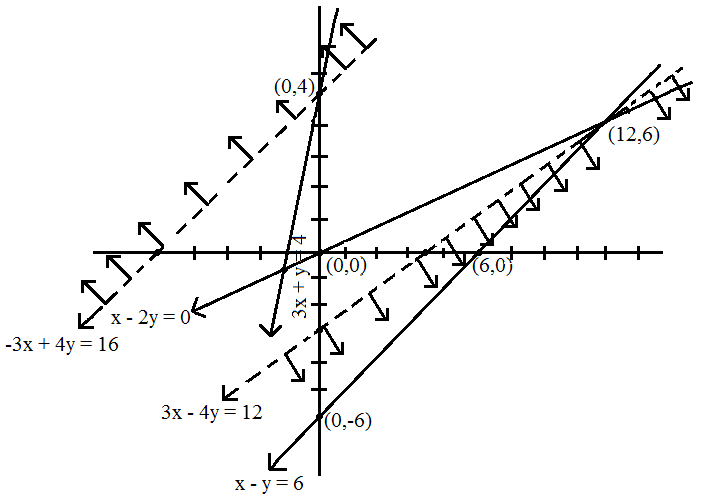
Maximise and Minimise Z = 3x – 4y subject to:
$\text{x}-2\text{y}\leq0$
$-3\text{x}+\text{y}\leq4$
$\text{x}-\text{y}\leq6$
$\text{x},\text{y}\geq0$
Answer
Given LPP is
Maximise and minimise z = 3x - 4y subject to
$\text{x}-2\text{y}\leq0,-3\text{x}+\text{y}\leq4,\text{x}-\text{y}\leq6,\text{x},\text{y}\geq0.$
[ On solving x - y = 6 and x - 2y = 0, we get x = 12, y = 6]
From the shown graph, for the feasible region, we see that it is unbounded and coordinates of corner points are (0, 0), (12, 6) and (0, 4).
Corner points
Corresponding value of Z = 3x - 4y
(0, 0)
(0, 4)
(12, 6)
0
-16 (minimum)
12 (maximum)
For given unbounded region the minimum value of Z may or may not be -16. So, for deciding this, we graph the inequality.
3x - 4y < -16
And check whether the resulting open half plane has common points with feasible region or not.
Thus, from the figures it shows it has common points with feasible region, So, it does not have any minimise value.
Also, similarly for maximum value, we graph the inequality 3x - 4y > 12
And see that resulting open half plane has no common points with the feasible region and hence maximum value of 12 exits for Z = 3x - 4y.
View full question & answer
Question 965 Marks
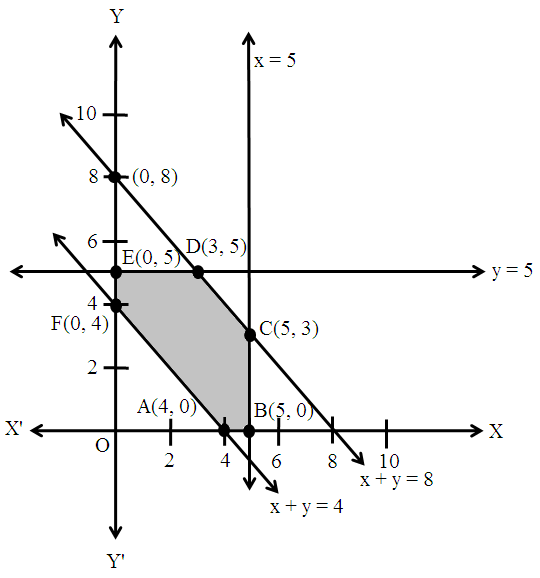
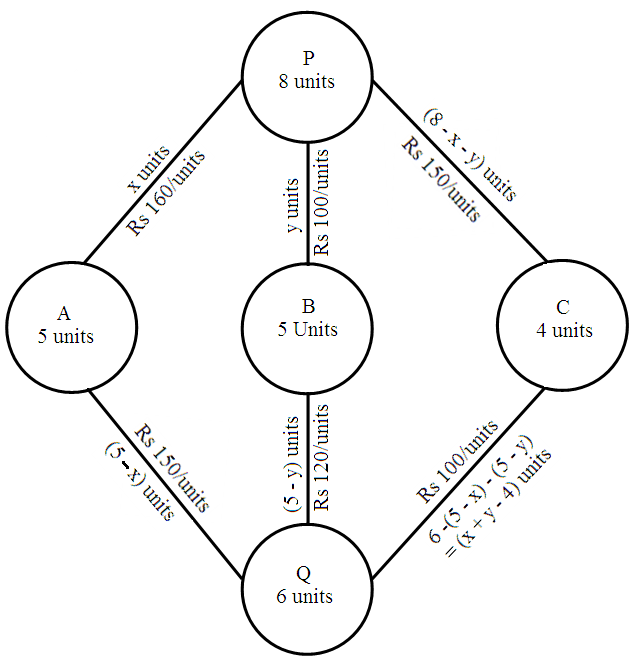
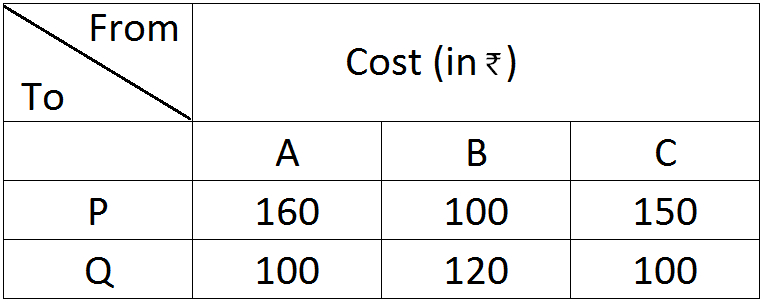
There are two factories located one at place P and the other at place Q. From these locations, a certain commodity is to be delivered to each of the three depots situated at A, B and C. The weekly requirements of the depots are respectively 5, 5 and 4 units of the commodity while the production capacity of the factories at P and Q are respectively 8 and 6 units. The cost of transportation per unit is given below:
How many units should be transported from each factory to each depot in order that the transportation cost is minimum. What will be the minimum transportation cost?
Answer
Here, demand of the commodity (5 + 5 + 4 = 14 units) is equal the supply of the commodity (8 + 6 = 14 units).
So, no commodity would be left at the two factories.
Let x units and y units of the commodity be transported from the factory P to the depots at A and B, respectively.

Then, (8 − x − y) units of the commodity will be transported from the factory P to the depot C.
Now, the weekly requirement of depot A is 5 units of the commodity.
Now, x units of the commodity are transported from factory P, so the remaining (5 − x) units of the commodity are transported from the factory Q to the depot A.
The weekly requirement of depot B is 5 units of the commodity.
Now, y units of the commodity are transported from factory P, so the remaining (5 − y) units of the commodity are transported from the factory Q to the depot B.
Similarly, 6 − (5 − x) − (5 − y) = (x + y − 4) units of the commodity will be transported from the factory Q to the depot C.
Since the number of units of commodity transported are from the factories to the depots are non-negative, therefore,

x ≥ 0, y ≥ 0, 8 − x − y ≥ 0, 5 − x ≥ 0, 5 − y ≥ 0, x + y − 4 ≥ 0

Or x ≥ 0, y ≥ 0, x + y ≤ 8, x ≤ 5, y ≤ 5, x + y ≥ 4

Total transportation cost = 160x + 100y + 150(8 − x − y) + 100(5 − x) + 120(5 − y) + 100(x + y − 4) = 10x − 70y + 1900

Thus, the given linear programming problem is
Minimise Z = 10x − 70y + 1900
Subject to the constraints
x + y ≤ 8
x ≤ 5
y ≤ 5
x + y ≥ 4
x ≥ 0, y ≥ 0
The feasible region determined by the given constraints can be diagrammatically represented as,

The coordinates of the corner points of the feasible region are A(4, 0), B(5, 0), C(5, 3), D(3, 5), E(0, 5) and F(0, 4).

The value of the objective function at these points are given in the following table.
Corner Point
Z = 10x - 70y + 1900
(4, 0)
10 × 4 - 70 × 0 + 1900 = 1940
(5, 0)
10 × 5 - 70 × 0 + 1900 = 1950
(5, 3)
10 × 5 - 70 × 3 + 1900 = 1740
(3, 5)
10 × 3 - 70 × 5 + 1900 = 15800
(0, 5)
10 × 0 - 70 × 5+ 1900 = 1550 → Maximum
(0, 4) 10 × 0 - 70 × 4 + 1900 = 1620
The minimum value of Z is 1550 at x = 0, y = 5.
Hence, for minimum transportation cost, factory P should supply 0, 5, 3 units of commodity to depots A, B, C respectively and factory Q should supply 5, 0, 1 units of commodity to depots A, B, C respectively.
The minimum transportation cost is Rs. 1,550.
View full question & answer
Question 975 Marks
Vitamins $A$ and $B$ are found in two different foods $F_1$ and $F_2$. One unit of food $F_1$ contains $2$ units of vitamin $A$ and 3 units of vitamin $B$. One unit of food $F_2$ contains $4$ units of vitamin $A$ and 2 units of vitamin $B$. One unit of food $F_1$ and $F_2$ cost Rs $50$ and $25$ respectively. The minimum daily requirements for a person of vitamin $A$ and $B$ is $40$ and $50$ units respectively. Assuming that anything in excess of daily minimum requirement of vitamin $A$ and $B$ is not harmful, find out the optimum mixture of food $F _1$ and $F _2$ at the minimum cost which meets the daily minimum requirement of vitamin $A$ and $B$. Formulate this as a LPP.
Answer
Let x and y units of food $F_1$ and food $F_2$ were mixed.
Clearly, $\text{x}\geq0$ and $\text{y}\geq0$
One unit of food $F_1$ contains 2 units of vitamin $A$ and one unit of of food $F_2$ contains 4 units of vitamin $A$. Therefore, $x$ and $y$ units of food $F_1$ and food $F_2$ respectively contains $2 x$ and $4 y$ units of vitamin $A$. It is given that the minimum daily requirements for a person of vitamin $A$ is 40 units. Hence, $2 x+4 y \geq 40$ One unit of food $F_1$ contains 3 units of vitamin $B$ and one unit of food $F_2$ contains 2 units of of vitamin $B$. Therefore, $x$ and $y$ units of $F_1$ and $F_2$ respectively contains $3 x$ and $2 y$ units of vitamin $B$. It is given that the minimum daily requirements for a person of vitamin $B$ is 50 units. Hence, $3 x+2 y \geq 50$ One unit of food $F_1$ and food $F_2$ cost Rs 50 and 25 respectively.
Therefore, $x$ and $y$ units of food $F_1$ and food $F_2$ costs Rs. $50 x$ and Rs. $25 y$ respectively.
Let $Z$ denote the total cost
Then, $Z=$ Rs. $(50 x +25 y )$
Hence, the required LPP is Minimize $Z=50 x+25 y$
subject to
$2\text{x}+4\text{y}\geq40$
$3\text{x}+2\text{y}\geq50$
$\text{x}\geq0,\text{y}\geq0$
View full question & answer
Question 985 Marks
A publisher sells a hard cover edition of a text book for Rs. $72.00$ and paperback edition of the same ext for Rs. $40.00$. Costs to the publisher are Rs. $56.00$ and Rs. $28.00$ per book respectively in addition to weekly costs of Rs. $9600.00.$ Both types require $5$ minutes of printing time, although hardcover requires $10$ minutes binding time and the paperback requires only $2$ minutes. Both the printing and binding operations have $4,800$ minutes available each week. How many of each type of book should be produced in order to maximize profit?
Answer
Let the sale of hand cover edition be 'h' and that of paperback editions be $'t'.$
SP of a hard cover edition of the textbook $= Rs. 72$
SP of a paperback edition of the textbook $= Rs. 40$
Cost to the publisher for hard cover edition $= Rs. 56$
Cost to the publisher for a paperback edition $= Rs. 28$
Weekly cost to the publisher $= Rs. 9600$
Profit to be maximised, $Z = (72 − 56) h + (40 − 28) t − 9600$
$\Rightarrow Z = 16h + 12t – 9600$
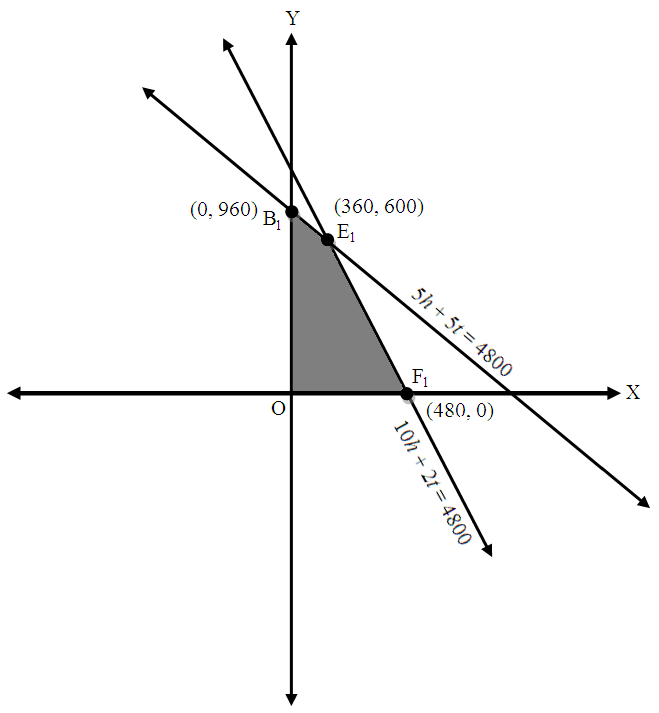
$5(h + t) \leq 4800$
$10h + 2t \leq 4800$

The corner points are $O(0, 0), B_1(0, 960), E_1(360, 600)$ and $F_1(480, 0).$
The values of $Z$ at these corner points are as follows:
Corner point
$Z = 16h + 12t - 9600$
$O$
$-9600$
$B_1$ 
$1920$
$G_1$ 
$3360$
$F_1$ 
$-1920$
The maximum value of $Z$ is $3360$ which is attained at $E_1(360, 600).$
The maximum profit is $3360$ which is obtained by selling $360$ copies of hardcover edition and $600$ copies of paperback edition.
View full question & answer
Question 995 Marks
Amit's mathematics teacher has given him three very long lists of problems with the instruction to submit not more than 100 of them (correctly solved) for credit. The problem in the first set are worth 5 points each, those in the second set are worth 4 points each, and those in the third set are worth 6 points each. Amit knows from experience that he requires on the average 3 minutes to solve a 5 point problem, 2 minutes to solve a 4 point problem, and 4 minutes to solve a 6 point problem. Because he has other subjects to worry about, he can not afford to devote more than $3\frac{1}{2}$ hours altogether to his mathematics assignment. Moreover, the first two sets of problems involve numerical calculations and he knows that he cannot stand more than $2\frac{1}{2}$ hours work on this type of problem. Under these circumstances, how many problems in each of these categories shall he do in order to get maximum possible credit for his efforts? Formulate this as a LPP.
Answer
Given information can be tabulated as below:
Sets
Time requirement
points
I
3
5
II
2
 
III
4
6
Time for all three sets $=3\frac{1}{2}$ hours
Time for set I and II $=2\frac{1}{2}$ hours
Number of quations maximum 100
Given, each question from set I, II, III earn 5,4,6 points respectively, so x questions of set I, y questions of set II and z questions of set III earn 5x, 4y and 6z points, let total point credit be U

So, U = 5x + 4y + 6z

Given, each question of set I, II and III require 3,2 and 4 minutes respectively, so x questions of set I, y questions of set II and z questions of set III require 3x, 2y and 4z mimutes respectively but given that total time to devote in all three sets is

$3\frac{1}{2}$ hours = 210 minutes and first two sets is $2\frac{1}{2}$ hours = 150 minutes

So,

$3\text{x}+2\text{y}+4\text{z}\leq210$ (First constraint)

$3\text{x}+2\text{y}\leq150$ (Second constraint)

Given, total number of questions cannot exceed 100

So, $\text{x}+\text{y}+\text{z}\leq100$ (Third constraint)

Hence, mathematical formulation of LPP is

Find x and y which maximize U = 5x + 4y + 6z

Subject to constraint,

$3\text{x}+2\text{y}+4\text{z}\leq210$

$3\text{x}+2\text{y}\leq150$

$\text{x}+\text{y}+\text{z}\leq100$
$\text{x},\text{y},\text{z}\geq0$

[Since number of questions to solve from each set cannot be less than zero].
View full question & answer
Question 1005 Marks
A manufacturer produces two products A and B. Both the products are processed on two different machines. The available capacity of first machine is 12 hours and that of second machine is 9 hours per day. Each unit of product A requires 3 hours on both machines and each unit of product B requires 2 hours on first machine and 1 hour on second machine. Each unit of product A is sold at Rs. 7 profit and that of B at a profit of Rs. 4. Find the production level per day for maximum profit graphically.
Answer
Let x units of product A and y units of product B be manufactured by the manufacturer per day.
It is given that one unit of product A requires 3 hours of processing time on first machine, while one unit of product B requires 2 hours of processing time on first machine.
It is also given that first machine is available for 12 hours per day.
$\therefore$ 3x + 2y ≤ 12
Also, one unit of product A requires 3 hours of processing time on second machine, while one unit of product B requires 1 hour of processing time on second machine.
It is also given that second machine is available for 9 hours per day.
$\therefore$ 3x + y ≤ 9
The profits on one unit each of product A and product B is Rs. 7 and Rs 4, respectively.
So, the objective function is given by Z = Rs. (7x + 4y).
Therefore, the mathematical formulation of the given linear programming problem can be stated as:

Maximize Z = 7x + 4y
Subject to the constraints
3x + 2y ≤ 12 .....(1)
3x + y ≤ 9 .....(2)
x ≥ 0, y ≥ 0 .....(3)
The feasible region determined by constraints (1) to (3) is graphically represented as:

Here, it is seen that OABCO is the feasible region and it is bounded.
The values of Z at the corner points of the feasible region are represented in tabular form as:
Corner point
Z = 7x + 4y
O(0, 0)
Z = 7 × 0 + 4 × 0 = 0
A(0, 10)
Z = 7 × 3 + 4 × 0 = 21
B(173, 0)
Z = 7 × 2 + 4 × 3 = 26
C(3, 8)
Z = 7 × 0 + 4 × 6 = 24
The maximum value of Z is 26, which is obtained at x = 2 and y = 3.
Thus, 2 units of product A and 3 units of product B should be manufactured by the manufacturer per day in order to maximize the profit.
Also, the maximum daily profit of the manufacturer is Rs. 26.
View full question & answer