Question 1013 Marks
The angles of a quadrilateral are in $A.P.$ whose common difference is $10^\circ .$ Find the numbers.
AnswerA quadrilateral has four angles. Given, four angles are in $A.P.$ with common difference $10.$
Let the four angles be, $a - 3d, a - d, a + d, a + 3d$ with common difference $= 2d.$
$2d = 10$
$\text{d}=\frac{10}{2}=5$
In a quadrilateral, sum of all angles $= 360^\circ $
$(a - 3d) + (a - d) + (a + d) + (a + 3d) = 360$
$4a = 360$
$\text{a}=\frac{\text{360}}{4}=90^\circ$
$\therefore$ The angles are $a - 3d, a - d, a + d, a + 3d$ with $a = 90, d = 5$
$i.e. 90 - 3(5), 90 - 5, 90 + 3(5)$
$\Rightarrow 75^\circ , 85^\circ , 95^\circ , 105^\circ .$
View full question & answer→Question 1023 Marks
The $n^{th}$ term of an A.P is given by $(-4n + 15),$ Find the sum of first $20$ terms of this A.P.
Answer$T_n=(-4 n+15), S_{20}=?$
$T_1=-4 \times 1+15=-4+15=11$
$T_2=-4 \times 2+15=-8+15=7$
$\therefore a=11, d=T_2-T_1=7-11=-4$
$\text{S}_{20}=\frac{\text{n}}{2}[2\text{a}+(\text{n}-1)\text{d}]$
$=\frac{20}{2}[2\times11+(20-1)(-4)]$
$=10[22+19(-4)]$
$=10(22-76)=10\times(-54)=-540$
View full question & answer→Question 1033 Marks
How many terms of the $A.P. 9, 17, 25, .....$ must be taken so that sum is $636?$
AnswerGiven,
$ \text { A.P. } 9,17,25, \ldots \ldots .$
$ a=9, d=17-9=8, \text { and } S_n=636$
$ 636=\frac{n}{2}(2.9+(n-1) 8)$
$ 1272=n(18-8+8 n)$
$ 1272=n(10+8 n)$
$ 2 \times 636=2 n(5+4 n)$
$ 636=5 n+4 n^2$
$ 4 n^2+5 n-636=0$
$ 4 n^2+53 n-48 n-636=0$
$ 4 n^2-48 n+53 n-636=0$
$ 4 n(n-12)+53(n-12)=0 \\
(4 n+53)(n-12)=0$
$\therefore\ \text{n}=12 ($Since n $\frac{-53}{4}$ is not a natural number$)$
Therefore, value of $n$ is $12.$
View full question & answer→Question 1043 Marks
Write the sum of first $n$ even natural numbers.
AnswerLet,
Even numbers are, $2, 4, 6, 8, .....$
Here,
First term $a = 2$
Difference $d = 4 - 2 = 2$
We know. Sum of $n$ terms,
$\text{S}_\text{n}=\frac{\text{n}}{2}[2\text{a}+(\text{n}-1)\text{d}]$
$\Rightarrow\ \text{S}_\text{n}=\frac{\text{n}}{2}[2(2)+(\text{n}-1)2]$
$\Rightarrow\ \text{S}_\text{n}=\frac{\text{n}}{2}[4+2\text{n}-2]$
$\Rightarrow\ \text{S}_\text{n}=\frac{\text{n}}{2}[2\text{n}+2]$
$\Rightarrow\ \text{S}_\text{n}=\frac{\text{n}}{2}\times2[\text{n}+1]$
$\Rightarrow\ \text{S}_\text{n}=\text{n}(\text{n}+1)$
Hence, Sum of even numbers is $n(n + 1).$
View full question & answer→Question 1053 Marks
Write the arithmetic progression when first term $a$ and common difference $d$ are as following:
$\text{a}=-1,\text{d}=\frac{1}{2}$
Answer$\text{a}=-1,\text{d}=\frac{1}{2}$
Now, as $a = -1$
$A.P.$ would be represented by a, $a_1, a_2, a_3, a_4, .....$
So,
$a_1 = a + d$
$\text{a}_1=-1+\Big(\frac{1}{2}\Big)$
$\text{a}_1=\frac{-2+1}{2}$
$\text{a}_1=\frac{-1}{2}$
Similarly.
$a_2 = a_1 + d$
$\text{a}_2=\frac{-1}{2}+\Big(\frac{1}{2}\Big)$
$a_2 = 0$
Also,
$a_3 = a_2 + d$
$\text{a}_3=0+\Big(\frac{1}{2}\Big)$
$\text{a}_3=\frac{1}{2}$
Further,
$a_4 = a_3 + d$
$\text{a}_4=\Big(\frac{1}{2}\Big)+\Big(\frac{1}{2}\Big)$
$\text{a}_4=\frac{2}{2}$
$\text{a}_4=1$
Therefore, A.P. with $a = -1$ and $\text{d}=\frac{1}{2}$ is $-1,\frac{-1}{2},0,\frac{1}{2},1\ .....$
View full question & answer→Question 1063 Marks
Find n if the given value of x is the $n^{th}$ term of the given A.P.
$-1, -3, -5, -7, .....; x = -151.$
AnswerGiven sequence $-1, -3, -5, -7, .....; x = -151$
First term $(a) = -1$
Common difference $(d) = -3 - (-1) = -3 + 1 = -2$
$n^{th}$ term $a_n= a + (n - 1)d$
Given $a_n= -151,$
$-151 = -1 + (n - 1)(-2)$
$-151 + 1 = (n - 1)(-2)$
$-150 = (n - 1)(-2)$
$=\frac{-150}{-2}=\text{n}-1$
$75 = n - 1$
$75 + 1 = n$
$n = 76.$
View full question & answer→Question 1073 Marks
If the sum of a certain number of terms starting from first term of an $A.P.$ is $25, 22, 19, ...,$ is $116.$ Find the last term.
AnswerGiven $A.P.$ is $25, 22, 19, .....$
First term $(a) = 25, d = 22 - 25 = -3.$
Given, $\text{S}_\text{n}=\frac{\text{n}}{2}\big[2\text{a}+(\text{n}-1)\text{d}\big]$
$116=\frac{\text{n}}{2}\big[2\times25+(\text{n}-1)(-3)\big]$
$ 232=n(50-3(n-1))$
$ 232=n(53-3 n)$
$ 232=53 n-3 n^2$
$ 3 n^2-53 n+232=0$
$ 3 n^2-29 n-24 n+232=0$
$ 3 n^2-24 n-29 n+232=0$
$ 3 n(n-8)-29(n-8)=0$
$ (n-8)(3 n-29))$
$\therefore n = 8$
$⇒ a_8= 25 + (8 - 1)(-3)$
$\therefore n = 8, a_8= 4$
$= 25 - 21 = 4.$
View full question & answer→Question 1083 Marks
Which term of the $A.P. 3, 15, 27, 39, ...$ will be $120$ more than its $21^{st}$ term$?$
AnswerGiven,
$A.P.$ is $3, 15, 27, 39, .....$
Let $n^{th}$ term is $120$ more than $21^{st}$ term
Then $a_n= 120 + a_{21}$
For the given sequence
$a = 3, d = 15 - 3 = 12$
$a + (n - 1)d = 120 + a + (21 - 1)d$
$(n - 1)12 = 120 + 20(12)$
$(n - 1)12 = 360$
$(\text{n}-1)=\frac{360}{12}=30$
$n = 31$
$\therefore$ $31^{st}$ term is $120$ more than $21^{st}$ term.
View full question & answer→Question 1093 Marks
Find:
Which term of the $A.P. 3, 8, 13, .....$ is $248?$
AnswerIn the given problem, we are given an $A.P.$ and the value of one of its term. We need to find which term it is $(n).$
So here we will find the value of n using the formula, $a_n= a + (n - 1)d.$
Here,
$A.P.$ is $3, 8, 13, .....$
$a_n= 248$
$a = 3$
Now,
Common difference $(d) = a_1- a$
$= 8 - 3$
$= 5$
Thus, using the above mentioned formula
$a_n= a + (n - 1)d$
$248 = 3 + (n - 1)5$
$248 - 3 = 5n - 5$
$245 + 5 = 5n$
$\text{n}=\frac{250}{5}$
$n = 50$
Thus, $n = 50$
Therefore $248$ is the $50^{th}$ term of the given $A.P.$
View full question & answer→Question 1103 Marks
The first term of an $A.P.$ is $5,$ the last term is $45$ and the sum is $400.$ Find the number of terms and the common difference.
AnswerGiven,
$a = 5, l = 45,$ Sum of terms $= 400$
$\therefore\ \text{S}_{\text{n}}=400$
$\frac{\text{n}}{2}\{5+45\}=400$
$\frac{\text{n}}{2}=50=400$
$\text{n}=40\times\frac{2}{5}$
$\therefore\ \text{n}=16$
$16^{th}$ term is $45$
$\text{a}_{16}=45\Rightarrow5+(16-1)\text{d}=45\Rightarrow15\text{d}=40$
$\text{d}=\frac{40}{15}=\frac{8}{3}$
$\therefore\ \text{n}=16,\text{d}=\frac{8}{3}$
View full question & answer→Question 1113 Marks
Find n if the given value of x is the $n^{th}$ term of the given A.P.
$5\frac{1}{2},11,16\frac{1}{2},22,\ .....;\text{ x}=550$
AnswerWe are given,
$a_n= 550$
Let us take the total number of terms as n,
So,
First term $(\text{a})=5\frac{1}{2}$
Last term $(a_n)= 550$
Common difference $(\text{d})=11-5\frac{1}{2}$
$=11-\frac{11}{2}$
$=\frac{22-11}{2}$
$=\frac{11}{2}$
Now, as we know,
$a_n= a + (n - 1)d$
So, for the last term.
$550=5\frac{1}{2}+(\text{n}-1)\Big(\frac{11}{2}\Big)$
$550=\frac{11}{2}+\frac{11}{2}\text{n}-\frac{11}{2}$
$550=\frac{11}{2}\text{n}$
$\text{n}=\frac{550(2)}{11}$
On further simplifying, we get,
$\text{n}=\frac{1100}{11}$
$n = 100$
Therefore, the total number of terms of the given A.P. is $n = 100.$
View full question & answer→Question 1123 Marks
The sums of first $n$ terms of three $A.P. $ $S$ are $\mathrm{S}_1, \mathrm{~S}_2$ and $\mathrm{S}_3$. The first term of each is $5$ and their common differences are $2,4$ and $6$ respectively. Prove that $S_1+S_3=2 S_2$.
Answer$\text{S}_\text{n}=\frac{\text{n}}{2}[2\text{a}+(\text{n}-1)\text{d}]$
Now, For $S_1$, when $a = 5$ and $d = 2$
$\text{S}_\text{n}=\frac{\text{n}}{2}[2(1)+(\text{n}-1)(2)]=\frac{\text{n}}{2}[10+2\text{n}-2]$
$=\frac{\text{n}}{2}[2\text{n}+8]$
$\text{s}_1=\text{n}^2+4\text{n}\ ...(\text{i})$
For $S_2$, when $a = 5$ and $d = 4$
$\text{S}_2=\frac{\text{n}}{2}[2(5)+(\text{n}-1)(4)]$
$=\frac{\text{n}}{2}[10+4\text{n}-4]$
$=\frac{\text{n}}{2}[4\text{n}+6]$
$\text{S}_2=2\text{n}^2+3\text{n}\ ...(\text{ii})$
For $S_3$, when $a = 5$ and $d = 6$
$\text{S}_3=\frac{\text{n}}{2}[2(5)+(\text{n}-1)(6)]$
$=\frac{\text{n}}{2}[10+6\text{n}-6]=\frac{\text{n}}{2}[6\text{n}+4]$
$\text{S}_3=3\text{n}^2+2\text{n}\ ...(\text{iii})$
Putting the value of $S_1, S_2$ and $S_3$ in equation
$\mathrm{S}_1+\mathrm{S}_3=2 \mathrm{~S}_2$
From equation $(i), (ii)$ and $(iii)$
$ \left(n^2+4 n\right)+\left(3 n^2+2 n\right)=2\left(2 n^2+3 n\right) $
$ 4 n^2+6 n=4 n^2+6 n $
$ 0=0$
Hence proved.
View full question & answer→Question 1133 Marks
All integers between $1$ and $500$ which are multiplies of $2$ as well as of $5.$
AnswerSince, multiples of $2$ as well as of $5 = LCM$ of $(2, 5) = 10$
$\therefore$ Multiples of $2$ as well as of $5$ between $1$ and $500$ is $10, 20, 30, ......, 490$ which from an $AP$ with first term $(a) = 10$ and common difference $(d) = 20 - 10 = 10$
$n^{th}$ term $a_n=$ Last term $(l) = 490$
$\therefore$ Sum of n terms between $1$ and $500$
$\text{S}_\text{n}=\frac{\text{n}}{2}[\text{a}+\text{l}]\ .....\text{(i)}$
$\because a_n= a + (n - 1)d = l$
$⇒ 10 + (n - 1)10 = 490$
$⇒ (n - 1)10 = 480$
$⇒ n - 1 = 48 ⇒ n = 49$
From Eq. $(i), \text{S}_{49}=\frac{49}{2}(10+490)$
$=\frac{49}{2}\times500$
$=49\times250=12250$
View full question & answer→Question 1143 Marks
The eighth term of an $A.P.$ is half of its second term and the eleventh term exceeds one third of its fourth term by $1.$ Find the $15^{th}$ term.
AnswerLet a and d be the first term and common difference of an $A.P,$ respectively.
Now, by given condition, $\text{a}_8=\frac{1}{2}\text{a}_2$
$\Rightarrow\ \text{a}+7\text{d}=\frac{1}{2}(\text{a}+\text{d})\ [\because \text{a}_\text{n}=\text{a}+(\text{n}-1)\text{d]}$
$\Rightarrow\ 2\text{a}+14\text{d}=\text{a}+\text{d}$
$\Rightarrow\ \text{a}+13\text{d}=0\ .....\text{(i)}$
and $\text{a}_{11}=\frac{1}{3}\text{a}_4+1$
$\Rightarrow\ \text{a}+10\text{d}=\frac{1}{3}[\text{a}+3\text{d}]+1$
$\Rightarrow\ 3\text{a}+30\text{d}=\text{a}+3\text{d}+3$
$\Rightarrow\ 2\text{a}+27\text{d}=3\ .....\text{(ii)}$
From Eqs. $(i)$ and $(ii),$
$2(-13d) + 27d = 3$
$⇒ -26d + 27d = 3$
$⇒ d = 3$
From Eq. $(i),$
$a + 13(3) = 0 ⇒ a = -39$
$\therefore a_{15}= a + 14d = -39 + 14(3)$
$= -39 + 42 = 3.$
View full question & answer→Question 1153 Marks
Let there be an A.P. with first term ' $a$ ', common difference ' $d$ '. If $a_n$ denotes in $n^{\text {th }}$ term and $S_n$ the sum of first $n$ terms, find.
$n$ and $a_n$, if $a=2, d=8$ and $S_n=90$.
Answer$a=2, d=8, S_n=90$
$S_n=\frac{n}{2}[2 a+(n-1) d] \Rightarrow 90=\frac{n}{2}[2 \times 2+(n-1) 8]$
$\Rightarrow 180=n(4+8 n-8) \Rightarrow 180=n(8 n-4)$
$\Rightarrow 8 n^2-4 n-180=0 $
$\Rightarrow 2 n^2-n-45=0 \text { (Dividing by 4) }$
$\Rightarrow 2 n^2-10 n+9 n-45=0$
$\begin{Bmatrix}\because-45\times2=-90\\ \therefore-90=-10\times9\\ -1=-10+9 \end{Bmatrix}$
$\Rightarrow 2 n(n-5)+9(n-5)=0 $
$\Rightarrow(n-5)(2 n+9)=0$
Either $n - 5 = 0,$ then $n = 5$
or $2n + 9 = 0,$
Then, $2\text{n}=-9\Rightarrow\ \text{n}=\frac{-9}{2}$ but is is not possible being fraction
$\therefore n=5 $
$a_n=a+(n-1) d=2+(5-1) \times 8 $
$=2+4 \times 8=2+32=34$
View full question & answer→Question 1163 Marks
The sum of first n terms of an A.P. is $3 n^2+4 n$. Find the $25^{th}$ term of this A.P.
Answer$S_n=3 n^2+4 n$
$\text { We know }$
$ a_n=S_n-S_{n-1} $
$ \therefore a_n=3 n^2+4 n-3(n-1)^2-4(n-1) $
$ \Rightarrow a_n=6 n+1 $
$ a_{25}=6(25)+1=151$
View full question & answer→Question 1173 Marks
If the sum of n terms of an A.P. is $S_n=3 n^2+5 n$. Write its common difference.
AnswerHere, we are given,
$S_n=3 n^2+5 n$
Let us take the first term as a and the common difference as d.
Now, as we know,
$a_n=S_n-S_{n-1}$
So, we get,
$ a_n=\left(3 n^2+5 n\right)-\left[3(n-1)^2+5(n-1)\right]$
$=3 n^2+5 n-\left[3\left(n^2+1-2 n\right)+5 n-5\right]\left[\text { Using }(a-b)^2=a^2+b^2-2 a b\right]$
$ =3 n^2+5 n-\left(3 n^2+3-6 n+5 n-5\right)$
$ =3 n^2+5 n-3 n^2-3+6 n-5 n+5$
$ =6 n+2 \ldots . .(i)$
Also,
$a_n=a+(n-1) d$
$= a + nd - d$
$= nd + (a - d) .....(ii)$
On comparing the terms containing n in (i) and (ii), we get,
$dn = 6n$
$d = 6$
Therefore, the common difference is $d = 6.$
View full question & answer→Question 1183 Marks
For the following arithmetic progressions write the first term a and the common difference d:
$\frac{1}{5},\frac{3}{5},\frac{5}{5},\frac{7}{5}.$
Answer$\frac{1}{5},\frac{3}{5},\frac{5}{5},\frac{7}{5}.$
Here, first term of the given A.P. is $\text{(a)}=\frac{1}{5}$
Now, we will find the difference between the two terms of the given A.P.
$\text{a}_2-\text{a}_1=\frac{3}{5}-\frac{1}{5}$
$\text{a}_2-\text{a}_1=\frac{2}{5}$
Similarly,
$\text{a}_3-\text{a}_2=\frac{5}{5}-\frac{3}{5}$
$\text{a}_3-\text{a}_2=\frac{2}{5}$
Also,
$\text{a}_4-\text{a}_3=\frac{7}{5}-\frac{5}{5}$
$\text{a}_4-\text{a}_3=\frac{2}{5}$
As $\text{a}_2-\text{a}_1=\text{a}_3-\text{a}_2=\text{a}_4-\text{a}_3=\frac{2}{5}$
Therefore, the first term of the given A.P. is $\text{a}=\frac{1}{5}$ and the common differece is $\text{d}=\frac{2}{5}$.
View full question & answer→Question 1193 Marks
If the $5^{th}$ term of an $A.P.$ is $31$ and $25^{th}$ term is $140$ more than the $5^{th}$ term, find the $A.P.$
AnswerWe know that,
$T_n= a + (n - 1)d$
$T_5= a + 4d$
$⇒ a + 4d = 31 .....(i)$
and $T_{25}= a + 24d$
$⇒ a + 24d = 140 + T_5$
$⇒ a + 24d = 140 + 31 = 171 .....(ii)$
Subtracting $(i)$ from $(ii).$
$20d = 140$
$\text{d}=\frac{140}{20}=7$
and $a + 4d = 31$
$⇒ a + 4 × 7 = 31$
$⇒ a + 28 = 31$
$⇒ a + 31 - 28 = 3$
$a = 3$ and $d = 7$
$A.P.$ will be $3, 10, 17, 24, 31, .....$
View full question & answer→Question 1203 Marks
The sum of first $q$ terms of an $A.P.$ is $63q - 3q^2$. If its $p^{th}$ term is $-60$, find the value of $p.$ Also, find the $11^{th}$ term of this $A.P.$
Answer$S_q=63 q-3 q^2$
We know
$ a_q=S_q-S_{q-1} $
$ \therefore a_q=63 q-3 q^2-63(q-1)+3(q-1)^2 $
$ a_q=66-6 q$
Now, $a_p=-60$
$ \Rightarrow 60-6 p=-60 $
$ \Rightarrow 126=6 p $
$ \Rightarrow p=21 $
$ a_{11}=66-6 \times 11=0$
View full question & answer→Question 1213 Marks
How many terms are there in the $A.P.?$
$18, 15\frac{1}{2},13,\ ....,-47$
AnswerGiven,
A.P. $18, 15\frac{1}{2},13,\ ....,-47$
Here,
First term $a = 18$
Difference $\text{d}=15\frac{1}{2}-18=\frac{-5}{2}$
Last $\mathrm{n}^{\text {th }}$ term $\mathrm{a}_{\mathrm{n}}=-47$
We know, $\mathrm{n}^{\text {th }}$ term of A.P.
$a_n=a+(n-1) d$
$\Rightarrow\ -47=18+(\text{n}-1)\frac{-5}{2}$
$\Rightarrow\ -47=18\frac{-5\text{n}}{2}+\frac{5}{2}$
$\Rightarrow\ \frac{5\text{n}}{2}=18+47+\frac{5}{2}$
$\Rightarrow\ \frac{5\text{n}}{2}=\frac{36+94+5}{2}$
$\Rightarrow\ 5\text{n}=135$
$\Rightarrow\ \text{n}=\frac{135}{5}$
$\Rightarrow\ \text{n}=27$
Hence, Total $27$ terms in given $A.P.$
View full question & answer→Question 1223 Marks
The $n^{th}$ term of an $A.P.$ is $6n + 2.$ Find the common difference.
AnswerIn the given problem, $n^{th}$ term is given by $"a_n= 6n + 2"$. To find the common diffrence of the $A.P.,$ we need two consecutive terms of the $A.P.$
So, let us find the first and the second term of the given $A.P.$
First term $(n = 1).$
$a_1= 6(1) + 2$
$= 6 +2$
$= 8$
Second term $(n = 2),$
$a_2= 6(2) + 2$
$= 12 + 2$
$= 14$
Now, the common difference of the $A.P. (d) = a_2- a_1$
$= 14 - 8$
$= 6$
Therefore, the common difference is $d = 6.$
View full question & answer→Question 1233 Marks
If an $A.P.$ consists of n terms with first term a and $n^{th}$ terml show that the sum of the $m^{th}$ term from the beginning and the $m^{th}$ term from the end is $(a + l).$
AnswerIn the given problem, we have an $A.P.$ which consists of $n$ terms.
Here,
The first term $(a) = a$
The last term $(a_n) = l$
Now, as we know,
$a_n= a + (n - 1)d$
So, for the $m^{th}$ term from the beginning, we take $(n = m),$
$a_m= a + (m - 1)d$
$= a + md - d .....(i)$
Similarly, for the $m^{th}$ term from the end, we can take/ as the first term.
So, we get,
$a_{m'} = l - (m - 1)d$
$= l - md + d ..... (ii)$
Now, we need to prove $a_m+ a_m'= a + l$
So, adding (i) and (ii), we get,
$a_m+ a_{m'}= (a + md - d) + (l - md + d)$
$= a + md - d + l - md + d$
$= a + l$
Therefore, $a_m+ a_{m'}= a + l$
Hence proved.
View full question & answer→Question 1243 Marks
Prove that no matter what the real numbers $a$ and $b$ are, the sequence with $n^{th}$ term $a + nb$ is always an $A.P.$ What is the common difference$?$
Answer$ \text { Given sequence }\left(a_n\right)=a_n+6 n$
$n^{\text {th }} \text { term }\left(a_n\right)=a+n b$
$(n+1)^{\text {th }} \text { term }\left(a_{n+1}\right)=a+(n+1) b$
$\text { Common difference }(d)=a_{n+1}-a_n$
$d=(a+(n+1) b)-(a+n b)$
$=a+n b+b-a-n b$
$=b$
$\therefore$ Common difference $(d)$ does not depend on $n^{th}$ value so, given sequence is in $AP$ with $(d) = b.$
View full question & answer→Question 1253 Marks
Resham wanted to save at least $6500$ for sending her daughter to school next year $($after $12$ months$).$ She saved $Rs. 450$ in the first month and raised her savings by $Rs. 20$ every next month. How much will she be able to save in next $12$ months$?$ Will she be able to send her daughter to the school next year$?$
AnswerGiven,
Resham saved $Rs. 450$ in the first month and raised her saving by $Rs. 20$ every month and saved in next $12$ months.
First term $(a) = 450$
Common difference $(d) = 20$
and No. of terms $(n) = 12$
We know sum of $n$ terms is in $A.P.$
$\text{S}_\text{n}=\frac{\text{n}}{2}[2\text{a}+(\text{n}-1)\text{d]}$
$\text{S}_\text{n}=\frac{12}{2}[2\times450+(12-1)\times20]$
$\Rightarrow\ \text{S}_\text{n}=6[900+220]$
$\Rightarrow\ \text{S}_\text{n}=6720$
Here we can see that Resham saved $Rs. 6720$ which is more than $6500.$
So, yes Resham shall be able to send her daughter to school.
View full question & answer→Question 1263 Marks
Find the sum of the following arithmetic progressions:
$1, 3, 5, 7, .....$ to $12$ terms.
AnswerIn an $A.P.$ let first term $= a,$ common difference $= d, $and there are $n$ terms. Then, sum of $n$ terms is,
$\text{S}_\text{n}=\frac{\text{n}}{2}\{2\text{a} + (\text{n} - 1)\text{d}\}$
Given,
$1, 3, 5, 7, .....$
Here,
First term $a = 1$
Difference $d = 3 - 1 = 2$
and no of terms $n = 12$
We know $\text{S}_\text{n}=\frac{\text{n}}{2}\{2\text{a} + (\text{n} - 1)\text{d}\}$
$\Rightarrow\ \text{S}_\text{n}=\frac{12}{2}[2(1)+(12-1)2]$
$ \Rightarrow S_n=6[2+11 \times 2] $
$ \Rightarrow S_n=6 \times 24 $
$ \Rightarrow S_n=144$
Hence, sum of $12$ terms is $144.$
View full question & answer→Question 1273 Marks
Find the number of all three digit natural numbers which are divisible by $9.$
AnswerFirst three-digit number that is divisible by $9$ is $108.$
Next number is $108 + 9 = 117.$
And the last three-digit numbet that is divisible by $9$ is $999.$
Thus, the progression will be $108, 117, ....., 999.$
All are three digit numbers which are divisible by $9,$ and thus forms an $A.P.$ having first term a $180$ and the common difference as $9.$
We know that, $n^{\text {th }}$ term $a_n=a+(n-1) d$
According to the question,
$999 = 108 + (n - 1)9$
$⇒ 108 + 9n - 9 = 999$
$⇒ 99 + 9n = 999$
$⇒ 9n = 999 - 99$
$⇒ 9n = 900$
$⇒ n = 100$
Thus, the number of all three digit natural numbers which are divisible by $9$ is $100.$
View full question & answer→Question 1283 Marks
Find the sum of two middle terms of the $\text{A.P.:}-\frac{4}{3},-1,\frac{-2}{3},-\frac{1}{3}, .....\ ,4\frac{1}{3}.$
Answer$\text{a}_\text{n}=\text{a}+(\text{n}-1)\text{d}$
$\text{a}=-\frac{4}{3},\text{d}=\frac{1}{3},\text{a}_\text{n}=\frac{13}{3}$
$\Rightarrow\ \text{a}+(\text{n}-1)\text{d}=\frac{13}{3}$
$\Rightarrow\ \Big(-\frac{4}{3}\Big)+(\text{n} - 1)\big(\frac{1}{3}\big)=\frac{13}{3}$
$\Rightarrow\ 13=-4+\text{n}-1$
$\Rightarrow\ \text{n}=18$
Midlle terms are $\frac{\text{n}}{2}^{\text{th}}\text{ and }\frac{\text{n}}{2}+1^{\text{th}},$ i.e., $9^{\text {th }}$ and $10^{\text {th }}$ terms.
$\text{a}_9=\text{a}+8\text{d}=-\frac{4}{3}+\frac{8}{3}=\frac{4}{3}$
$\text{a}_{10}=\text{a}+9\text{d}=-\frac{4}{3}+\frac{9}{3}=\frac{5}{3}$
$\therefore\ \text{a}_9+\text{a}_{10}=\frac{4}{3}+\frac{5}{3}=\frac{9}{3}=3$
View full question & answer→Question 1293 Marks
Find n if the given value of x is the $n^{th}$ term of the given A.P.
$20, 50, 75, 100, .....; x = 1000.$
AnswerWe have,
$25, 50, 75, 100, ...., x = 1000$
First term $a = 25$
Difference $d = 50 - 25 = 25$
and Last term $a_n= 1000$
We know
$a_n= a + (n - 1)d$
$1000 = 25 + (n - 1)25$
$1000 = 25 + 25n - 25$
$\text{n}=\frac{1000}{25}=40$
Hence, The value of $n$ is $40.$
View full question & answer→Question 1303 Marks
The sum of first m terms of an A.P. is $4m^2- m.$ If its $n^{th}$ term is 107. find the value of n. Also, find the $21^{st}$ term of this A.P.
Answer$ \mathrm{S}_{\mathrm{m}}=4 \mathrm{~m}^2-\mathrm{m}, \mathrm{~T}_{\mathrm{n}}=107$
$\mathrm{~S}_1=4(1)^2-1=4-1=3$
$\mathrm{~S}_2=4(2)^2-2=16-2=14$
$\therefore \mathrm{~T}_2=\mathrm{S}_2-\mathrm{S}_1=14-3=11$
$\text { and } a=\mathrm{S}_1=3$
$\mathrm{~d}=\mathrm{t}_2-\mathrm{t}_1=11-3=8$
$\text { Now, } \mathrm{T}_{\mathrm{n}}=\mathrm{a}+(\mathrm{n}-1) \mathrm{d}$
$107=3+(\mathrm{n}-1) 8$
$\Rightarrow 107-3=(\mathrm{n}-1) 8$
$\Rightarrow 104=(\mathrm{n}-1) \times 8$
$\mathrm{n}-1=\frac{104}{8}=13$
$\therefore \mathrm{n}=13+1=14$
$\mathrm{~T}_{21}=\mathrm{a}+(\mathrm{n}-1) \mathrm{d}$
$=3+(21-1) \times 8=3+20 \times 8$
$=3+160=163$
View full question & answer→Question 1313 Marks
The $19^{th}$ term of an $A.P.$ is equal to three times its sixth term. If its $9^{th}$ term is $19,$ find the $A.P.?$
AnswerLet $a$ be the first term, $d$ be the common difference, then
$T_{19}=3 . T_6 \text { and } T_9=19$
$T_n=a+(n-1) d$
$\text { Now, } T_{19}=a+(19-1) d=a+18 d$
$T_6=a+(6-1) d=a+5 d$
$T_9=19 \Rightarrow a+(9-1) d=19$
$\Rightarrow a+8 d=19 \ldots . . .(i)$
$T_{19}=3 T_6$
$a+18 d=3(a+5 d)$
$a+18 d=3 a+15 d$
$18 d-15 d=3 a-a$
$3 d=2 a$
$2 a=3 d$
$\Rightarrow\ \text{a}=\frac{3}{2}\text{d}\ ...(\text{ii})$
From $(i), a + 8d = 19$
$\Rightarrow\ \frac{3}{2}\text{d}+8\text{d}=19\Rightarrow\ \frac{19}{2}\text{d}=19$
$\Rightarrow\ \text{d}=\frac{19\times2}{19}=2$
and $\text{a}=\frac{3}{2},\text{d}=\frac{3}{2}\times2=3$
$\therefore A.P.$ will be $3, 5, 7, 9, 11, .....$
View full question & answer→Question 1323 Marks
Show that the sum of all odd integers between $1$ and $1000$ which are divisible by $3$ is $83667.$
AnswerAll odd numbers divisible by $3$ between $1$ to
$1000$ will be $3, 9, 15, 21, ......, 999$
Where $a = 3, d = 9 - 3 = 6$ and $l = 999$
$\therefore a_n = a + (n - 1)d$
$⇒ 999 = 3 + (n - 1) × 6$
$⇒ 999 = 3 + 6n - 6 ⇒ 6n = 999 + 6 - 3$
$\Rightarrow\ 6\text{n}=1002\Rightarrow\ \text{n}=\frac{1002}{6}=167$
$\therefore$ Number of terms $= 167$
Now, $\text{S}_{167}=\frac{\text{n}}{2}[\text{a}+\text{l}]=\frac{167}{2}[3+999]$
$=\frac{167}{2}(1002)$
$=167(501)$
$=83667$
Hence proved.
View full question & answer→Question 1333 Marks
Which of the following sequences are arithmetic progressions. For those which are arithmetic progressions, find out the common difference.
$a + b, (a + 1) + b, (a + 1) + (b + 1), (a + 2) + (b + 1), (a + 2) + (b + 2), .....$
AnswerIn the given problem, we are given various sequences.
We need to find out that the given sequences are an A.P. of not and then find its common difference $(d),$
$a + b, (a + 1) + b, (a + 1) + (b + 1), (a + 2) + (b + 1), (a + 2) + (b + 2), .....$
$ \text { Let } a_1=a+b $
$ a_2=(a+1)+b $
$ a_3=(a+1)+(b+1) $
$ a_4=(a+2)+(b+1) $
$ a_5=(a+2)+(b+2)$
$\text { Now } a_2-a_1=(a+1)+b-a-b$
$ =a+1+b-a-b=1 $
$ a_3-a_2=(a+1)+(b+1)-\{(a+1)+b\} $
$ =a+1+b+1-a-1-b=1 $
$ a_4-a_3=\{(a+2)+(b+1)\}-\{(a+1)+(b+1)\} $
$ =a+2+b+1-a-1-b-1=1 $
$ a_5-a_4=\{(a+2)+(b+2)\}-\{(a+2)+(b+1)\} $
$ =a+2+b+2-a-2-b-1=1$
We see that common diffrence is $1$
$\therefore$ It is an $A.P.$
View full question & answer→Question 1343 Marks
Find the sum of the first 15 terms of each of the following sequences having $n^{th}$ term as
$a_n = 3 + 4n$
Answer$ a_n=3+4 n, \text { number of terms }=15 $
$ a_1=3+4 \times 1=3+4=7 \text { or } a=7 $
$ a_2=3+4 \times 2=3+8=11 $
$ \therefore d=a_2-a_1=11-7=4$
Now $\text{S}_\text{n}=\frac{\text{n}}{2}[2\text{a}+(\text{n}-1)\text{d}]$
$\text{S}_{15}=\frac{15}{2}[2\text{a}+(15-1)\text{d}]$
$=\frac{15}{2}[2\times7+(15-1)\times4]$
$=\frac{15}{2}[14+14\times4]=\frac{15}{2}[14+56]$
$=\frac{15}{2}\times70=15\times35=525$
View full question & answer→Question 1353 Marks
The sum of three numbers in $A.P.$ is $12$ and the sum of their cubes is $288.$ Find the numbers.
AnswerLet the three numbers in $A.P.$ be
$a - d, a, a + d$
$\therefore$ $a - d + a + a + d = 12 ⇒ 3a = 12$
$\Rightarrow\ \text{a}=\frac{12}{3}=4$
$ \text { and }(a-d)^3+a^3+(a+d)^3=288 $
$ a^3-3 a^2 d+3 a d^2-d^3+a^3+a^3+3 a^2 d+3 a d^2+d^3=288 $
$ 3 a^3+6 a d^2=288 \Rightarrow 3(4)^3+6 \times 4 d^2=288 $
$ 192+24 d^2=288 \Rightarrow 24 d^2=288-192=96$
$\Rightarrow\ \text{d}^2=\frac{96}{24}=4=(\pm2)^2$
$\therefore\ \text{d}=\pm2$
$\therefore$ Number will be $4 - 2, 4, 4 + 2 or 2, 4, 6$ or $4 + 2, 4, 4 - 2 $ or $6, 4, 2.$
View full question & answer→Question 1363 Marks
Write the sequence with $n^{th}$ term:
$a_n= 3 + 4n.$
Show the all of the above sequences form $A.P.$
Answer$a_n= 3 + 4n$
Put $n = 1, 2, 3...$
$a_1= 3 + 4 × 1 = 7$
$a_2= 3 + 4 × 2 = 11$
$a_3= 3 + 4 × 3 = 15$
Now, $a_2 - a_1 = a_3 - a_2$
$11 - 7 = 15 - 11$
$4 = 4$
Common difference is $4$
So that $A.P$
$7, 11, 15, 19...$
View full question & answer→Question 1373 Marks
Write the first five terms of the following sequences whose $n^{th}$ terms are:
$a_n=2 n^2-3 n+1$.
Answer$a_n=2 n^2-3 n+1$
The given sequence is $a_n=2 n^2-3 n+1$.
To write first tive terms of given sequence an, we put $n=1,2,3,4,5$. Then we get
$ a_1=2.1^2-3.1+1=2-3+1=0 $
$ a_2=2.2^2-3.2+1=8-6+1=3 $
$ a_3=2.3^2-3.3+1=18-9+1=10 $
$ a_4=2.4^2-3.4+1=32-12+1=21 $
$ a_5=2.5^2-3.5+1=50-15+1=36$
$\therefore$ The required first five tms of given sequence $a_n=2 n^2-3 n+1$ are $0,3,10,21,36$.
View full question & answer→Question 1383 Marks
A thief, after committing a theft runs at a uniform speed of $50\ m/$ minute. After $2$ minutes, a policeman runs to catch him. He goes $60$ min first minute and increases his speed by $5\ m/$ minute every succeeding minute. After how many minutes, the policeman will catch the thief$?$
AnswerLet total time be $22$ minutes.
Total distance covered by thief in $22$ minutes $=$ Speed $×$ Time
$= 100 × n = 100\ n$ metres
Total distance covered by policeman
$1^{\text{st}}\text{ min.}+2^{\text{nd}}\text{ min.}+3^\text{rd}\text{ min}+\ .....(\text{n}-1)\text{terms} \\ 100 \ \ \ \ \ \ \ \ \ \ \ \ 110 \ \ \ \ \ \ \ \ \ \ \ \ \ \ \ 120 \ \ \ \ \ \ \ \ \ \ \ \ \ \ \ \ \ \ \ \ \ \ \ \ \ \ \ \ \ \ \ \ \ \ \ \ \ $
$\begin{bmatrix}\because\ \text{Thirf runs = n miss}\ \ \ \ \ \ \ \ \ \ \ \ \\ \text{Policeman runs = (n - 1)mins} \end{bmatrix}$
Here,
$a = 100, d = 110 - 100 = 10, 'n' = n - 1$
$\text{S}_\text{n}=\frac{\text{n}}{2}[2\text{a}+(\text{n}-1)\text{d}]$
$\therefore\ 100\text{n}=\frac{(\text{n}-1)}{2}[2(100)+(\text{n}-1-1)(10)]$
$ \Rightarrow(n-1)[200+10 n-20]=200 n $
$ \Rightarrow(n-1)[10 n+180]=200 n$
$ \Rightarrow 10 n^2+180 n-10 n-180-200 n=0 $
$ \Rightarrow 10 n^2-30 n-180=0 $
$ n^2-3 n=18=0 \text { [Dividing both sides by 10] } $
$ \Rightarrow n^2-6 n+3 n-18=0$
$ \Rightarrow n(n-6)+3(n-6)=0 $
$ \Rightarrow(n+3)(n-6)=0$
$ \Rightarrow n+3=0 \text { or } n-6=0$
$ \Rightarrow n=-3 \text { (reject) or } n=6$
Since $n ($time$)$ cannot be negative.
$\therefore$ Time taken by policeman to cathc the thief
$= n - 1 = 6 - 1 = 5$ minutes.
View full question & answer→Question 1393 Marks
Find the sum of first $n$ odd natural numbers.
AnswerIn this problem, we need to find the sum of first $n$ odd natural numbers.
So, we know that the first odd natural number is $1.$ Also, all the odd terms will form an $A.P.$ with the common difference of $2.$
So here,
First term $(a) = 1$
Common difference $(d) = 2$
So, let us take the number of terms as $n$
Now, as we know,
$\text{S}_\text{n}=\frac{\text{n}}{2}[2\text{a}+(\text{n}-1)\text{d}]$
So, for n terms,
$\text{S}_\text{n}=\frac{\text{n}}{2}[2(1)+(\text{n}-1)2]$
$=\frac{\text{n}}{2}[2+2\text{n}-2]$
$=\frac{\text{n}}{2}(2\text{n})$
$=\text{n}^2$
Therefore, the sum of first $n$ odd natural numbers is $S_n=n^2$.
View full question & answer→Question 1403 Marks
Find $n$ if the given value of $x$ is the $n^{th}$ term of the given $A.P.$
$1,\frac{21}{11},\frac{31}{11},\frac{41}{11}, .....;\text{ x}=\frac{171}{11}.$
AnswerGiven $A.P.$
$1,\frac{21}{11},\frac{31}{11},\frac{41}{11}, .....\frac{171}{11}$
First term $a = 1$
Difference $\text{d}=\frac{21}{11}-1=\frac{21-11}{11}=\frac{10}{11}$
and last term $\text{a}_\text{n}=\frac{171}{11}$
We know
$a_n=a+(n-1) d$
$\Rightarrow\ \frac{171}{11}=1+(\text{n}-1)\frac{10}{11}$
$\Rightarrow\ \frac{171}{11}=1+\frac{10}{11}\text{n}-\frac{10}{11}$
$\Rightarrow\ \frac{10}{11}\text{n}=\frac{171}{11}-1+\frac{10}{11}$
$\Rightarrow\ \frac{10\text{n}}{11}=\frac{171-11+10}{11}\Rightarrow\ 10\text{n}=170$
$\Rightarrow\ \text{n}=17$
Hence, value of $n$ is $17.$
View full question & answer→Question 1413 Marks
The first term of an $A.P.$ is $p$ and its common difference is $q.$ Find its $10^{th}$ term.
AnswerGiven,
First term, $a = p$
and Difference, $d = q$
We have to find $10^{\text {th }}$ term,
We knaw $a_n=a+(n-1) d$
$\Rightarrow a_{10}=p+(10-1) q $
$\Rightarrow a_{10}=p+9 q$
Hence, $10^{\text {th }}$ term of given A.P. is $\mathrm{p}+9 \mathrm{q}$.
View full question & answer→Question 1423 Marks
The $7^{th}$ term of an $A.P.$ is $32$ and its $13^{th}$ term is $62.$ Find the $A.P.$
AnswerGiven,
$a = 32$
$a + (7 - 1)d = 32$
$a + 6d = 32 .....(i)$
and $a_{13}= 62$
$a + (13 - 1)d = 62$
$a + 12d = 62 .....(ii)$
Subtract $(1)$ from $(2)$
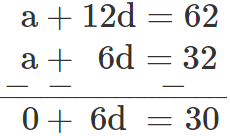
$\text{d}=\frac{30}{6}=5$
Put $d = 5$ in $a + 6d = 32$
$a + 6 × 5 = 32$
$a = 2$
Then the sequence is $a, a + d, a + 2d, a + 3d, .....$
$⇒ 2, 7, 12, 17, .....$ View full question & answer→Question 1433 Marks
Write the value of $x$ for which $2x, x + 10$ and $3x + 2$ are in $A.P.$
AnswerHere, we are given three terms,
First term $\left(a_1\right)=2 x$
Second term $\left(a_2\right)=x+10$
Third term $\left(a_3\right)=3 x+2$
We need to find the value of $x$ for which these terms are in $A.P.$ So, in an $A.P.$ the difference of two adjacent terms is always constant. So, we get,
$d = a_2- a_1$
$d = (x + 10) - (2x)$
$d = x + 10 - 2x$
$d = 10 - x .....(i)$
Also,
$d = a3 - a2$
$d = (3x + 2) - (x + 10)$
$d = 2x - 8 .....(ii)$
Now, on equatin $(i)$ and $(ii),$ we get,
$10 - x = 2x - 8$
$2x + x = 10 + 8$
$3x = 18$
$\text{x}=\frac{18}{3}$
$x = 6$
Therefore, for $x = 6,$ these three terms will from an $A.P.$
View full question & answer→Question 1443 Marks
Find:
Is $68$ a term of the A.P. $7, 10, 13, ...?$
AnswerIn the given problem, we are given an $A.P.$ and the Value of one of its term.
We need to find whether it is a term of the $A.P.$ or not so here we will use the formula $a_n = a + (n - 1)d.$
Here,
$A.P$ is $7, 10, 13, .....$
$a_n= 68, a = 7$ and $d = 10 - 7 = 3$
Using the above mentioned formula, we get
$68 = 7 + (n - 1)3$
$⇒ 68 - 7 = 3n - 3$
$⇒ 61 + 3 = 3n$
$⇒ 64 = 3n$
$\Rightarrow\ \text{n}=\frac{64}{3}$
Since, the value of $n$ is a fraction.
Thus, $68$ is not team of the given $A.P.$
View full question & answer→Question 1453 Marks
Find the sum of the following arithmetic progressions:
$-26, -24, -22, .....$ to $36$ terms.
AnswerIn an $A.P.$ let first term $= a,$ common difference $= d, $and there are $n$ terms. Then, sum of $n$ terms is,
$\text{S}_\text{n}=\frac{\text{n}}{2}\big[2\text{a} + (\text{n} - 1)\text{d}\big]$
Given expression $-26, -24, -22, .....$ to $36$ terms
First term $(a) = -26$
Common difference $(d) = -24 - (-26) = -24 + 26 = 2$
Sum of n terms $\text{S}_\text{n}=\frac{\text{n}}{2}\big[2\text{a} + (\text{n} - 1)\text{d}\big]$
Sum of n terms $\text{S}_{36}=\frac{36}{2}\big[2(-26)+(36-1)2\big]$
$= 18[-52 + 70]$
$= 18 × 18$
$= 324$
$\therefore\ \text{S}_\text{n}=324$
View full question & answer→Question 1463 Marks
Find the sum of all natural numbers between $1$ and $100,$ which are divisible by $3.$
AnswerNatural number which are divisible by $3$
Between $1$ to $100$ are $3, 6, 9, ....., 96, 99$
Whose first term $(a) = 3$
and common difference $(d) = 6 - 3 = 3$
$a_n= a + (n - 1)d$
$99 = 3 + (n - 1) × 3$
$99 = 3 + 3n - 3 ⇒ 99 = 3n$
$\therefore\ \text{n}=\frac{99}{3}=33$
Now $\text{S}_\text{n}=\frac{\text{n}}{2}[\text{a}+\text{l}]$
$=\frac{33}{2}[3+99]=\frac{33}{2}\times102$
$=33\times51=1683$
View full question & answer→Question 1473 Marks
Find the sum of the first $25$ terms of an $A.P.$ whose $n^{th}$ term is given by $a_n= 7 - 3n.$
AnswerHere, we are given an $A.P.$ whose $n^{th}$ term given by the following expression, $a_n= 7 - 3n.$ We need to fint the sum of first $25$ terms.
So, here we can find the sum of the n terms of the given $A.P.$, using the formula, $\text{S}_\text{n}=\Big(\frac{\text{n}}{2}\Big)(\text{a}+\text{l})$
Where, $a =$ the first term
$l =$ the last term
So, for the given $A.P.$
the first term $(a)$ will be calculated using $n = 1$ in the given equation for nth term of $A.P.$
$a = 7 - 3(1)$
$= 7 - 3$
$= 4$
Now, the last term $(l)$ of the nth term is given
$l = a_n= 7 - 3n$
So, on substituting the values in the formula for the sum of $n$ term of an $A.P.$, we get
$\text{S}_{25}=\Big(\frac{25}{2}\Big)[(4)+7-3(25)]$
$=\Big(\frac{25}{2}\Big)[11-75]$
$=\Big(\frac{25}{2}\Big)(-64)$
$=(25)(-32)$
$=-800$
Therefore, the sum of the $25$ terms of the given $A.P.$ is $S_n= -800.$
View full question & answer→Question 1483 Marks
$51$ terms of the $A.P.$ whose second term is $2$ and fourth term is $8.$
AnswerGiven,
$a_2= 2$ and $a_4= 8$
$a + d = 2 .....(i)$
$a + 3d = 8 .....(ii)$
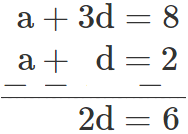
Put $d = 3 in .....(i) ⇒ a + d = 2$
$a + 3 = 2$
$a = -1$
$\text{S}_{51}=\frac{51}{2}(2\times-1+(51-1)\times3)$
$\Big(\therefore\ \text{S}_\text{n}=\frac{\text{n}}{2}(2\text{a}+(\text{n}-1)\text{d})\Big)$
$=\frac{51}{2}(-2+50\times3)$
$=\frac{51}{2}\times148$
$=3774$
$\therefore\ \text{S}_{\text{n}}=3774$ View full question & answer→