Question 11 Mark
If $56 \times n !=8 !$ then find the value of $n$.
Answer$\begin{aligned} & 56 \times n !=8 \times 7 \times 6 ! \\ \therefore \quad & n !=6 ! \\ \therefore \quad & n=6 \end{aligned}$
View full question & answer→Question 21 Mark
If $n P _{ 3 }=210$, find the value of $n$.
Answer$n P_3=210$
$\therefore \frac{n!}{(n-3)!}=210$
$\therefore \frac{n(n-1)(n-2)=210}{(n-3)!}=210$
$\therefore n(n-1)(n-2)=210$
$\therefore n(n-1)(n-2)=7 \times 6 \times 5=7(7-1)(7-2)$
$\therefore n =7$, Hence, $n =7$
View full question & answer→Question 31 Mark
If ${ }^n C _{ 2 }=15$, then find the value of $n$.
Answer${ }^n C_2=15$
$\therefore \frac{n!}{2!(n-2)!}=15$
$\therefore \frac{n(n-1)(n-2)!}{2(n-2)!}=15$
$\therefore \frac{n(n-1)}{2 \times 1}=15$
$\therefore n(n-1)=15 \times 2$
$\therefore n(n-1)=30=6 \times 5$
$\therefore n(n-1)=6(6-1)$
View full question & answer→Question 41 Mark
There are $5$ empty seats in the coach of a train. In how many ways will $3$ persons be seated ?
AnswerIn $5$ empty seats In the coach of a train $3$ persons can be seated in ${ }^5 P_3=5 \times 4 \times 3=60$ ways.
View full question & answer→Question 51 Mark
Write the general term of the expansion $(x+a)^n$.
AnswerThe general term of the expansion of $( x + a )^{ n }$ is ${ }^n C_r x ^{ n - r a r}$.
View full question & answer→Question 61 Mark
Write the coefficients of the terms in the expansion of $(x+a)^n$ for $n=6$.
AnswerThe coefficients of the terms in the expansion of $(x+a)^n$ for $n=6$ are $1,6,15,20,15,6,1$.
View full question & answer→Question 71 Mark
Write the mathematical relationship between permutation and combination in usual notations.
AnswerIn usual notations the mathematical relationship between permutation and combination is : ${ }^n P_r=:{ }^n C_r . r!$
View full question & answer→Question 81 Mark
Write the fundamental principle of counting for multiplication.
AnswerIf the first operation can be done in m ways and second operation can be done in $n$ Ways, then two operations together can be done in m x n ways. This rule is called the fundamental Principle of counting for multiplication.
View full question & answer→Question 91 Mark
Write the fundamental principle of counting for addition.
AnswerIf there are m distinct things in Group $1$ and $n$ distinct things in Group $2$, then selection of one thing from total things of both groups can be done in $m + n$ ways. This rule is called the fundamental principle of counting for addition.
View full question & answer→Question 101 Mark
If ${ }^{ n } C _{ X }={ }^{ n } C _{ y }$ then write the two possible relationships between $x$ and $y.$
AnswerIf ${ }^n C_{x^{\prime}}={ }^{ n } C_y$ then possible relationships between $x$ and $y$ are : $(1) x = y$ $(2) x + y = n$
View full question & answer→Question 111 Mark
Write the coefficient of $(n+1)$ terms in the expansion of $(x+a)^n$.
AnswerThe coefficient of $( n +1)$ terms in the expansion of $( x + a )^{ n }$ are : ${ }^{ n } C_0,{ }^{ n } C_1,{ }^{ n } C_2 \cdot{ }^{ n } C_{3^{\prime}}{ }^{ n } C_4,{ }^{ n } C_{5^{\prime}}, \cdots \cdots{ }^{ n } C_{n-2},{ }^{ n } C_{n-1},{ }^{ n } C_n$ :
View full question & answer→Question 121 Mark
What is ${ }^{ n } P _{ r }$ ?
AnswerIf $r$ distinct things out of n distinct things are to be arranged in $r$ different places, then total number of such arrangements is called ${ }^{ n } P _{ r }$
View full question & answer→Question 131 Mark
In how many ways can $5$ different letters be placed in $5$ covers ?
Answer$5$ different letters can be place in $5$ covers in ${ }^5 P_3=5!=120$ ways.
View full question & answer→Question 141 Mark
How many arrangements can be made using all the letters of the world $VIAAN ?$
AnswerIn $5$ letters of the word $VIAAN.$ A is repeated $2$ times.
$\therefore$ Number of arrangements $=\frac{5!}{2!}=\frac{120}{2}=60$.
View full question & answer→Question 151 Mark
How many new arrangements can be made using all the letters of the word TUESDAY ?
AnswerUsing $7$ letters of the word, total number of arrangement $TUESDAY$ $=7$
$=7 \times 6 \times 5 \times 4 \times 3 \times 2 \times 1=5040$
New arrangements
$=5040-1 \text { (Given arrangement TUESDAY) }$
$=5039$
View full question & answer→Question 161 Mark
What is the main difference between permutation and combination ?
AnswerPermutation means an arrangement of things in which order of arrangement is important, while combination means selection of things in which order of selection is not important.
View full question & answer→Question 171 Mark
In how many ways can $3$ clerks and $1$ peon be selected from $14$ clerks and 6 peons working in a bank?
View full question & answer→Question 181 Mark
Obtain the values of : ${ }^{8} C_{8}$
Answer${ }^n C_r=1$
$\therefore{ }^8 C_8=1$
View full question & answer→Question 191 Mark
Obtain the values of : ${ }^{25} C_{23}$
Answer$
\begin{aligned}
& { }^n C_r=\frac{n !}{r !(n-r) !} \\
& \therefore{ }^{25} C_{23}=\frac{25 !}{23 !(25-23) !} \\
& =\frac{25 !}{23 ! 2 !} \\
& =\frac{25 \times 24 \times 23 !}{23 ! \times 2 \times 1}=\frac{600}{2}=300
\end{aligned}
$
View full question & answer→Question 201 Mark
Obtain the values of : ${ }^{9} C_{0}$
Answer$^n C_0=1 $
$\therefore{ }^9 C_0=$
View full question & answer→Question 211 Mark
Obtain the values of : ${ }^{11} C_{4}$
Answer
$
\begin{aligned}
& { }^n \mathrm{C}_r=\frac{n !}{r !(n-r) !} \\
& \therefore{ }^{11} C_4=\frac{11 !}{41(11-4) !} \\
& =\frac{11 \times 10 \times 9 \times 8 \times 7 !}{4 \times 3 \times 2 \times 1 \times 7 !} \\
& =\frac{7920}{24}=330
\end{aligned}
$
View full question & answer→Question 221 Mark
In how many ways can $4$ persons be arranged in a row ?
Answer4 persons are to be arranged in a row.
$\therefore n=4, r=4$
$ \therefore \text { Total permutations }={ }^4 P_4$
$ =4 !\left(\because{ }^n P_n=n !\right)$
$ =4 \times 3 \times 2 \times 1$
$ =24$
View full question & answer→Question 231 Mark
If $^{n} p_{3}=990$, then find the value of $n$.
Answer${ }^n P_3=990$
$ \therefore n(n-1)(n-2)$
$ \therefore n(n-1)(n-2)=11 \times 10 \times 9$
$ \therefore n(n-1)(n-2)=11(11-1)(11-2)$
$ \therefore n=11$
View full question & answer→Question 241 Mark
Obtain the values of : ${ }^{9} P_{9}$
Answer${ }^9 \mathrm{P}_9=\frac{9 !}{(9-9) !}$
$ =\frac{9 !}{0 !}$
$ =9 !$
$ =9 \times 8 \times 7 \times 6 \times 5 \times 4 \times 3 \times 2 \times 1=362880$
$ \therefore{ }^9 \mathrm{P}_9=362880$
View full question & answer→Question 251 Mark
Obtain the values of : ${ }^{8} P_{7}$
Answer${ }^8 P_7=\frac{8 !}{(8-7) !}$
$ =\frac{8 !}{1 !}$
$ =8 \times 7 \times 6 \times 5 \times 4 \times 3 \times 2 \times 1=40320$
$ \therefore{ }^8 P_7=40320$
Alternative method:
${ }^8 P_7=8(8-1)(8-2)(8-3)(8-4)(8-5)(8-6) .$
$ =8 \times 7 \times 6 \times 5 \times 4 \times 3 \times 2=40320$
$ { }^8 P_7=40320$
View full question & answer→Question 261 Mark
${ }^{50} P _{ 2 }$ Obtain the value of the following.
Answer${ }^{50} P_2=\frac{50!}{(50-2)!}=\frac{50!}{48!}=\frac{50 \times 49 \times 48!}{48!}=50 \times 49=2450$
$\therefore{ }^{50} P_2=2450$
View full question & answer→Question 271 Mark
Obtain the values of : ${ }^{10} P_{2}$
Answer${ }^{10} \mathrm{P}_2=\frac{10 !}{(10-3) !}$
$ =\frac{10 !}{7 !}$
$ =\frac{10 \times 9 \times 8 \times 7 !}{7 !}$
$ =10 \times 9 \times 8=720$
$ \therefore{ }^{10} \mathrm{P}_2=720$
Alternative method:
${ }^{10} \mathrm{P}_2=10(10-1)(10-2)$
$ =10 \times 9 \times 8=720$
$ \therefore{ }^{10} \mathrm{P}_2=720$
View full question & answer→Question 281 Mark
Who had prepared a triangle to find the coefficients of terms of binomial expansion?
AnswerTo find the coefficients of terms of binomial expansion, a triangle had been prepared by French mathematician Blez Pascle in $1623 - 62.$
View full question & answer→Question 291 Mark
What is binomial expression?
AnswerBinomial expression is sum or difference of two terms.
View full question & answer→Question 301 Mark
In which is it seen about $63$ taste combinations that can be made out of 6 different tastes?
AnswerIn the book ‘Sushruta Samhita’ it is seen about $63$ taste combinations that can be made out of 6 different tastes.
View full question & answer→Question 311 Mark
How many ways are there of selecting two balls of same colour from $3$ red and $4$ black balls?
View full question & answer→Question 321 Mark
How many numbers of three digits can be formed using the digits of $301$?
View full question & answer→Question 331 Mark
If all items are identical, in how many ways they can be arranged?
AnswerIf all items are identical they can be arranged in one way only.
View full question & answer→Question 341 Mark
$10$ schools participate in a science fair. In how many ways can the first, second and the third prizes be distributed among these schools?
View full question & answer→Question 351 Mark
A student in $12$th standard commerce stream has to appear for exam in $7$ subjects. It is necessary to pass in all the subjects to pass an exam. Certain minimum marks must be obtained to pass in a subject. In how many ways can a student appearing for the exam fail?
AnswerA student has to appear for exam in $7$ subjects. Certain minimum marks are required to pass in the subject. He fails if he does not reach to the level of minimum marks required in at least one of $7$ subjects.
$\therefore$ Total combination in which a student can fail
$={ }^7 C_1 \times{ }^7 C_2 \times{ }^7 C_3 \times{ }^7 C_4 \times{ }^7 C_5 \times{ }^7 C_6 \times \times^7 C_7$
$=7+\frac{7 \times 6}{2 \times 1}+\frac{7 \times 6 \times 5}{3 \times 2 \times 1}+\frac{7 \times 6 \times 5 \times 4}{4 \times 3 \times 2 \times 1}+\frac{7 \times 6 \times 5 \times 4 \times 3}{5 \times 4 \times 3 \times 2 \times 1}+7+1$
$=7+21+35+35+21+7+1$
$=127$
View full question & answer→Question 361 Mark
A person has $6$ friends. In how many ways can he invite at least one friend to his house ?
AnswerA person has $6$ friends. He wants to invite at least one of his friends to his house.
He may invite his $1$ friend or $2$ friends or $3$ friends or $4$ friends or $5$ friends or $6$ friends out of his $6$ friends.
$\therefore$Total combinations
$={ }^6 C_1 \times{ }^6 C_2 \times{ }^6 C_3 \times{ }^6 C_4 \times{ }^6 C_5 \times{ }^6 C_6$
$=6+\frac{6 \times 5}{2 \times 1}+\frac{6 \times 5 \times 4}{3 \times 2 \times 1}+\frac{6 \times 5 \times 4 \times 3}{4 \times 3 \times 2 \times 1}+6+1$
$=6+15+20+15+6+1=63$
View full question & answer→Question 371 Mark
In an office, there are $8$ employees of which $3$ are females and remaining are males. $3$ employees are to be selected from the office for training. In how many ways can the selection be done so that at least one male is selected?
AnswerIn an office, out of $8$ employees $3$ are females and $5$ are males. $3$ employees are to be selected for training,
The different options for selecting $3$ employees so that at least one male is selected are as follows :
$(1)$One males and $2$ females $OR$
$(2)$Two males and $1$ females $OR$
$(3)$ Three males and no female
$\therefore$ Total combinations $=\left[{ }^5 C_1 \times{ }^3 C_2\right]+\left[{ }^5 C_2 \times{ }^3 C_1\right]+\left[{ }^5 C_3 \times{ }^3 C_0\right]$
$=\left[5 \times \frac{3 \times 2}{2 \times 1}\right]+\left[\frac{5 \times 4}{2 \times 1} \times 3\right]+\left[\frac{5 \times 4 \times 3}{3 \times 2 \times 1} \times 1\right]$
$=15+30+10=55$
View full question & answer→Question 381 Mark
There are $9$ employees in a bank of which $6$ are clerks, $2$ are peons and $1$ is a manager. In how many ways can a committee of $4$ members be formed such that $(1)$ the manager must be selected ? $(2)$ two peons are not to be selected and the manager is to be selected ?
AnswerOut of $9$ employees In a bank, $6$ are clerks, $2$ are peons and $1$ is a manager. A committee of $4$ members is to be formed.
$(1)$ The manager must be selected in the committee:
If the manager is to be selected in the committee of $4$ members, than from the remaining ( $6$ clerks $+2$ peons) $8$ employees, the remaining $3$ members of the committee can be selected in ${ }^8 C_3$ ways.
$\therefore$ Total combinations $={ }^1 C_1 \times{ }^8 C_3$
$=1 \times \frac{8 \times 7 \times 6}{3 \times 2 \times 1}=56$
$(2)$ Two peons are not be selected and the manager is to be selected:
If the manager is to be selected in the committee of $4$ members and two peons are not be selected than from the remaining $6$ clerks, the remaining $3$ members of the committee can be selected in ${ }^6 C_3$ ways.
$\therefore$ Total combinations $={ }^1 C_1 \times{ }^6 C_3=1 \times \frac{6 \times 5 \times 4}{3 \times 2 \times 1}=20$
View full question & answer→Question 391 Mark
Two cards are randomly selected from a pack of $52$ cards. In how Many ways can $2$ cards be selected such that, $(1)$ both are of heart ? $(2)$one is a king and the other is a queen ?
Answer$(1)$ In a pack of 52 cards, there are $13$ cards of heart. $2$ cards of heart out of $13$ cards of heart can be selected in ${ }^{13} C_2$ ways.
$\therefore$ Total combinations $={ }^{13} C_2=\frac{13 \times 12}{2}=78$
$(2)$ In a pack of $52$ cards, there are $4$ cards of king and $4$ cards of queen one card of king out of $4$ cards of king can be selected in ${ }^4 C_1$ ways and one card of queen out of $4$ cards of queen can be selected in $4 C_1$ ways.
$\therefore$ Total combinations $=4 C_1 \times 4 C_1=4 \times 4=16$
View full question & answer→Question 401 Mark
Selected two flowers are of different colours :
Answer$1$ white flowers out of $3$ white flowers can be selected in $3 C_1$ Ways and $1$ pink flower out of $5$ Pink flowers can be selected in $5 C_1$ ways.
$\therefore$ Total combinations $=3 C_1+5 C_1=3 \times 5=15$
View full question & answer→Question 411 Mark
$5$ countries participate in a cricket tournament. In the first round, every country plays a match with the other country. How many matches will be played in this round?
Answer$5$ countries participate in a cricket tournament. Every country plays a match with the other country. Therefore, in every round two countries are selected to play a match.
$\therefore$ Total combinations $={ }^5 C_2=\frac{5 \times 4}{2 \times 1}=10$ Matches
View full question & answer→Question 421 Mark
$8$ candidates applied for $2$ posts of peon in a school. In how many ways can $2$ peons be selected from $8$ candidates?
AnswerTotal number of combinations selecting $2$ candidates for the post of peon out of $8$ candidates $={ }^8 C_2=\frac{8!}{2!(8-2)!}=\frac{8!}{2!6!}=\frac{8 \times 7 \times 6!}{2 \times 6!}=\frac{8 \times 7}{2}=28$
Alternative method:
${ }^8 C_2=\frac{8 \times 7}{2 \times 1}=28$
View full question & answer→Question 431 Mark
There are $5$ seats in a car including the driver’s seat. If $3$ out of $10$ members in a family know driving then in how many ways, $5$ persons out of $10$ members can be arranged in the car?
Answer$3$ out of $10$ members in a family know driving.
$\therefore$ On the driver's seat a member can be place in ${ }^3 P_1$ ways.
Now, there are $5$ seats in a car including the driver's seat.
$\therefore$ The remaining $4$ members out of remaining $9$ members of the family can be placed in ${ }^9 P_4$ ways.
$\therefore$ Total permutations of such arrangement $={ }^3 P_1 \times{ }^9 P_4=3 \times(9 \times 8 \times 7 \times 6)=3 \times 3024=9072$
View full question & answer→Question 441 Mark
What is the ratio of number of arrangements of all letters of the word $ASHOK$ and $GEETA?$
AnswerTotal permutations of arranging $5$ letters of word $ASHOK$ $={ }^5 P_5=5!=120$
Total permutations of arranging $5$ letters of which $E$ is repeated $2$ times of word $GEETA$ $=\frac{5!}{2!}=\frac{120}{2}=60$
$\therefore$ The ratio of number of arrangements of all letters of the word $ASHOK$ and $GEETA$ $=\frac{120}{60}=2: 1$
View full question & answer→Question 451 Mark
A person has $5$ chocolates of different sizes. These chocolates are to be distributed among $5$ children of different ages. If the biggest chocolate is to be given to the youngest child then in how many ways, $5$ chocolates can be distributed among $5$ children?
AnswerA person has $5$ chocolates of different sizes and they are to be distributes among $5$ children of different ages. If the biggest chocolate is to be given to the youngest child, then remaining $4$ chocolates can be distributed among the remaining $4$ children in ${ }^4 P_4$ ways.
$\therefore$ Total permutations $={ }^1 P_1 \times{ }^4 P_4=1 \times 4!=1 \times 24=24$
View full question & answer→Question 461 Mark
Using all the digits $2, 3, 5, 8, 9,$ how many numbers greater than $50,000$ can be formed ?
AnswerGiven digits are $2, 3, 5, 8, 9.$
For the numbers greater than $50,000$ the digit at the first place may be $5$ or greater than it.
$\therefore$ Out of the digit $5,8,9$, the first digit can be placed in ${ }^3 P_1$ ways.
Now, from the remaining $4$ digits, all four can be placed in ${ }^4 P_4$ ways.
$\therefore$ Total permutations for the numbers greater $50,000={ }^3 P_1 \times{ }^4 P_4=3 \times 4!=3 \times 24=72$
View full question & answer→Question 471 Mark
There are $7$ cages for $7$ lions in a zoo. $3$ cages out of $7$ cages are so small that $3$ out of $7$ lions cannot fit in it. In how many ways can $7$ lions be caged in $7$ cages ?
Answer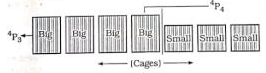
Except $3$ small cages in remaining $4$ cages $3$ lions can be caged in ${ }^4 P_3$ ways.
Now, in the remaining ( $1$ big $+3$ small) $4$ cages the remaining $4$ lions can be caged in $4 p_4$ ways.
$\therefore$ Total permutations of caging $7$ lions in
$7$ cages $={ }^4 P_3 .{ }^4 P_4=(4 \times 3 \times 2) \times 4!=24 \times 24=576$ View full question & answer→Question 481 Mark
In how many ways can $5$ boys and $3$ girls be arranged in a row such that all the boys are together?
Answer$5$ boys and $3$ girls are to be arranged in a row such that all the boys are together.
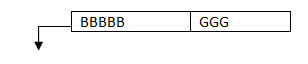
${ }^5 p_5 1+3=4 \Rightarrow{ }^4 p_4$
$5$ boys are to be arranged together, therefore considering them as one person total $4$ persons can be arranged in $4$
$p_4$ ways.
Now, In each of these arrangments, $5$ boys can be arranged among themselves in ${ }^5 p_5$ ways.
$\therefore$ Total permutation $={ }^4 p_4 \times{ }^5 p_5=4!\times 5!=24 \times 120=2880$
Hence, $5$ boys and $3$ girls can be arranged in a row such that $5$ boys are together in $2880$ ways. View full question & answer→Question 491 Mark
How many six digit numbers can be formed using all the digits $1, 2, 3, 0, 7, 9 ?$
AnswerUsing all the digits $1, 2, 3, 0, 7, 9,$ six digit numbers are to be formed.
$\therefore$ Excluding digit $0$ , one of the five digits can be placed at the first place in ${ }^5 p_1$ ways Now, remaining $5$ digits (including $0$ ) can be arranged in remaining $5$ places in ${ }^5 p_5$ ways.
$\therefore$ Total permutations for six digit numbers $={ }^5 p_1 \times{ }^5 p_5=5 \times 5!=5 \times 120=600$ Hence, $600$ numbers of $6$ digit can be formed.
View full question & answer→Question 501 Mark
In how many ways can $4$ persons be arranged in a row ?
Answer$4$ persons are to be arranged in a row.
$\therefore n =4, r =4$
$\therefore$ Total permutations $={ }^4 P_4=4!\left(\because{ }^n P_n=n!\right)=4 \times 3 \times 2 \times 1=24$
View full question & answer→