Question
Attempt any five of the following:
1. What effect does branching of an alkene chain has on its boiling point?
2. What are Arenes?
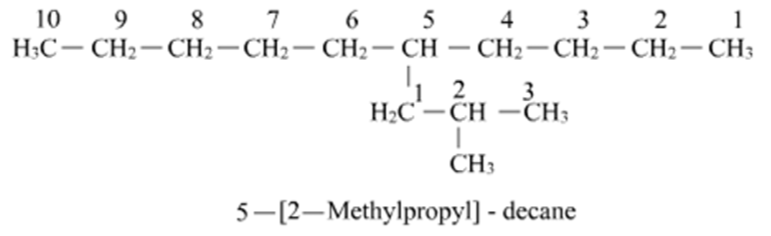
3. Write IUPAC name of the following: $CH _3\left( CH _2\right)_4 CH \left( CH _2\right)_3 CH _3 CH _2- CH \left( CH _3\right)_2$
4. Why are alkanes called paraffins?
5. State Le chatelier's principle.
6. What is decarboxylation? Give an example.
7. Arrange the following: $HCl , HBr , Hl , HF$ in order of decreasing reactivity towards alkenes.

Answer

1. Branching of carbon atom chain decreases the boiling point of alkane.
2. Arenes are aromatic hydrocarbons
3. The IUPAC name of given compound is:

4. Paraffins means little affinity. Alkanes due to strong C-C and C-H bonds are relatively chemically inert.
5. Le chatelier's principle: If a system at equilibrium is subjected to change in the temperature, pressure or concentration of the reactants or the products that govern the equilibrium, then the equilibrium shifts in that direction in which this change is reduced or nullified.
6. The process by which carbon dioxide is removed from sodium acetate (or any sodium salt of acid) with the help of sodalime is called decarboxylation.
Image
7. $HI> HBr > HCl > HF$

Need a full question paper?

Generate a complete, print-ready paper with questions like this in minutes — across 16+ boards, with answer keys.

Start Generating Free

Similar questions

Suggest reasons why the B-F bond lengths in $BF_3$ (130pm) and $\text{BF}_4^{-}$ (143pm) differ.
  1. Consider the following redox reaction that produce electricity in a galvanic cell:
    1. $2\text{Fe}^{3+}+2\text{Cl}^-\xrightarrow{ \ \ \ \ \ \ \ \ \\ }2\text{Fe}^2+\text{Cl}_2\text{(g)}$
    2. $\text{Cd}\text{(s)}+\text{I}_2\xrightarrow{ \ \ \ \ \ \ \ }\text{Cd}^{2+}+2\text{I}^-$
    3. $2\text{Cr}\text{s}+3\text{Cu}^{2+}\xrightarrow{ \ \ \ \ \ \ \\ \ \ }+3\text{Cu}\text{(s)}+2\text{Cr}^{3+}$
Write the anode and cathode reaction for galvanic cell.
  1. Split the following redox reaction into the oxidation and reduction hay reactions:
    1. $\text{Zn}+\text{Cu}^{2+}\xrightarrow{ \ \ \ \ \ \ \ \\}2\text{n}^{2+}+\text{Cu} $
    2. $\text{Sn}^2+2\text{Hg}^+\xrightarrow{ \ \ \ \\ \ \ \ }\text{Sn}^{4+}+\text{Hg}_2^{2+}$
When an electric discharge is passed through hydrogen gas, the hydrogen molecules dissociate to produce excited hydrogen atoms. These excited atoms emit electromagnetic radiation of discrete frequencies which can be given by the general formula.
$\bar{\text{v}}=109677\frac{1}{\text{n}^2_\text{i}}-\frac{1}{\text{n}_\text{f}^2}$
What points of Bohr’s model of an atom can be used to arrive at this formula? Based on these points derive the above formula giving description of each step and each term.
Discuss the various reactions that occur in the Solvay process.
Derive the equation required to determine pH of acidic buffer.
Bromine monochloride, BrCl decomposes into bromine and chlorine and reaches the equilibrium:$2\text{BrCl (g)}\rightleftharpoons\text{Br}_2\text{ (g) + Cl}_2\text{ (g)}$for which $K_c= 32$ at $500K$. If initially pure BrCl is present at a concentration of
$3.3 \times 10^{–3} mol L^{–1}$, what is its molar concentration in the mixture at equilibrium?
  1. When alkali metals are heated in excess of air, what is the nature of oxides formed?
  2. How can you prepare baking soda?
  3. Which is having more reducing characteristics out of alkali metals and alkaline earth metals?
  4. Alkaline earth metals impart a characteristic colour to the flame but Be and Mg do not give. Why?
  5. Write balanced equations for the reactions between $Na_2O$ and $CO_2$.
Write short note on carcinogenic and toxicity of aromatic hydrocarbons.
The first ionization enthalpy values (in $\mathrm{kJ} \mathrm{~mol}^{-1}$ ) of group 13 elements are:
B Al Ga In Tl
801 577 579 558 589
How would you explain this deviation from the general trend?
What is the significance of the terms — ‘isolated gaseous atom’ and ‘ground state’
while defining the ionization enthalpy and electron gain enthalpy?
Hint : Requirements for comparison purposes.