Questions

SECTION - A [CHEMISTY - MCQ]

Take a timed test

20 questions · self-marked practice — reveal the answer and mark yourself.

MCQ 14 Marks
In Dumas' method for estimation of nitrogen, 0.5 gram of an organic compound gave 60 mL of nitrogen collected at 300 K temperature and 715 mm Hg pressure. The percentage composition of nitrogen in the compound (Aqueous tension at $300 \mathrm{~K}=15 \mathrm{~mm} \mathrm{Hg}$ ) is
  • A
    1.257
  • B
    20.87
  • C
    18.67
  • D
    12.57
Answer
D. 12.57
Pressure of $\mathrm{N}_{2}$ gas $=(715-15)$
$=700 \mathrm{mmHg}$
$\mathrm{n}_{\mathrm{N}_{2}}=\frac{\mathrm{PV}}{\mathrm{RT}}$
$\mathrm{n}_{\mathrm{N}_{2}}=\frac{700 \times 60 \times 10^{-3}}{760 \times 0.0821 \times 300}$
$\begin{aligned}=2.24 & \times 10^{-3} mol \\ \text { Mass of } N _2 & =2.24 \times 10^3 \times 28 g \\ & =0.06272 g\end{aligned}$
$\% \mathrm{~N}_{2}=\frac{0.06272}{0.5} \times 100 \simeq 12.57$
View full question & answer
MCQ 24 Marks
A tetrapeptide "$x$" on complete hydrolysis produced glycine (Gly), alanine (Ala), valine (Val), leucine (Leu) in equimolar proportion each. The number of tetrapeptides (sequences) possible involving each of these amino acids is
  • A
    16
  • B
    32
  • C
    8
  • D
    24
Answer
D. 24
The number of tetrapeptides (sequences) possible involving each of these amino acids (glycine, alanine, valine, leucine) ; It has three (3) peptides linkage the number of permutations in which they can be arranged
$=4 \times 3 \times 2 \times 1$
$=24$
View full question & answer
MCQ 34 Marks
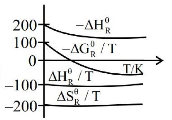
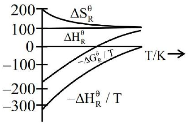
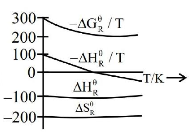
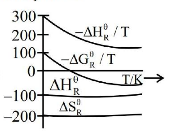
Which of the following graphs correctly represents the variation of thermodynamic properties of Haber's process ?
  • A
    Image
  • B
    Image
  • C
    Image
  • D
    Image
View full question & answer
MCQ 44 Marks
Consider the following chemical equilibrium of the gas phase reaction at a constant temperature : $\mathrm{A}(\mathrm{g}) \rightleftharpoons \mathrm{B}(\mathrm{g})+\mathrm{C}(\mathrm{g})$
If $p$ being the total pressure, $K_{p}$ is the pressure equilibrium constant and $\alpha$ is the degree of dissociation, then which of the following is true at equilibrium?
  • A
    If p value is extremely high compared to $\mathrm{K}_{\mathrm{p}}, \alpha \approx 1$
  • B
    When $p$ increases $\alpha$ decreases
  • C
    If $k_{p}$ value is extremely high compared to $p, \alpha$ becomes much less than unity
  • D
    When $p$ increases $\alpha$ increases
Answer
B. When $p$ increases $\alpha$ decreases
$\mathrm{A}(\mathrm{g}) \rightleftharpoons \mathrm{B}(\mathrm{g})+\mathrm{C}(\mathrm{g})$
$\begin{array}{cccc} t =0 & a & 0 & 0 \\ t = t & a (1-\alpha) & a \alpha & a \alpha\end{array}$
a moles of $\mathrm{A}(\mathrm{g})$ taken initially and at time
Now moles fraction of $\mathrm{A}(\mathrm{g}), \mathrm{B}(\mathrm{g})$ and $\mathrm{C}(\mathrm{g})$ are
$X_{A}=\frac{a-a \alpha}{a+a \alpha}=\frac{1-\alpha}{1+\alpha}$
$X_{B}=\frac{a \alpha}{a+a \alpha}=\frac{\alpha}{1+\alpha}$
$X_{C}=\frac{a \alpha}{a+a \alpha}=\frac{\alpha}{1+\alpha}$
Now if P is total pressure then partial pressure of $\mathrm{A}(\mathrm{g}), \mathrm{B}(\mathrm{g})$ and $\mathrm{C}(\mathrm{g})$ are
$\mathrm{P}_{\mathrm{A}}=\left(\frac{1-\alpha}{1+\alpha}\right) \mathrm{P}$
$\mathrm{P}_{\mathrm{B}}=\left(\frac{\alpha}{1+\alpha}\right) \mathrm{P}$
$\mathrm{P}_{\mathrm{C}}=\left(\frac{\alpha}{1+\alpha}\right) \mathrm{P}$
$K_{P}=\frac{\left(\frac{\alpha}{1+\alpha}\right) P\left(\frac{\alpha}{1+\alpha}\right) P}{\left(\frac{1-\alpha}{1+\alpha}\right) P}$
$K_{P}=\frac{\alpha^{2} P}{1-\alpha^{2}}$
As $K_{P}$ is only function of temperature.
So as $\mathrm{P} \uparrow \quad \alpha \downarrow$
View full question & answer
MCQ 54 Marks
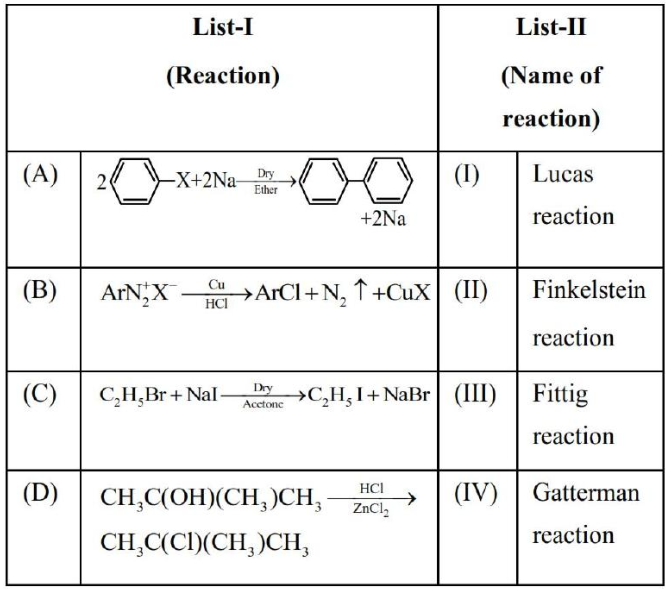
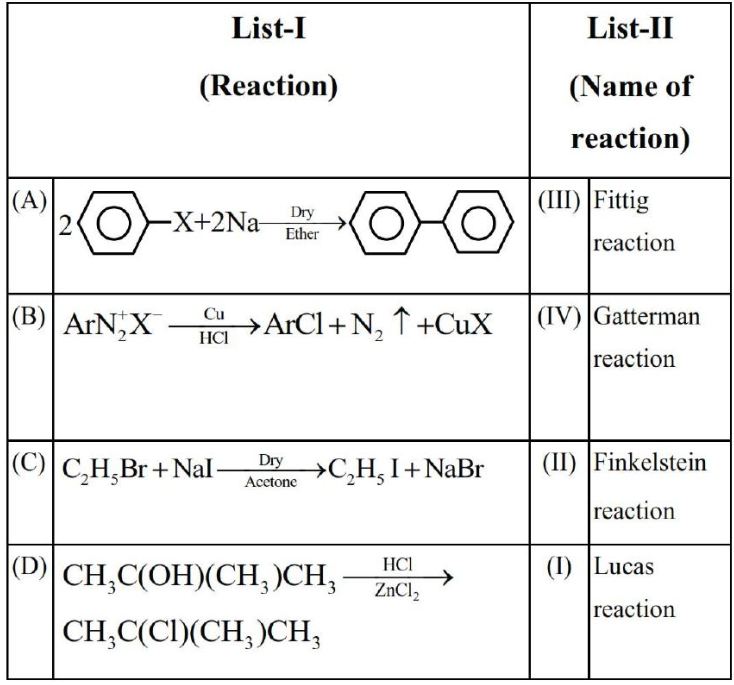
Match List-I with List-II
Image
Choose the correct answer from the options given below :
  • A
    (A)-(III), (B)-(II), (C)-(IV), (D)-(I)
  • B
    (A)-(III), (B)-(IV), (C)-(II), (D)-(I)
  • C
    (A)-(IV), (B)-(III), (C)-(I), (D)-(II)
  • D
    (A)-(IV), (B)-(I), (C)-(II), (D)-(III)
Answer
B. (A)-(III), (B)-(IV), (C)-(II), (D)-(I)Image
View full question & answer
MCQ 64 Marks
The nature of oxide $\left(\mathrm{TeO}_{2}\right)$ and hydride $\left(\mathrm{TeH}_{2}\right)$ formed by Te , respectively are :
  • A
    Oxidising and acidic
  • B
    Reducing and basic
  • C
    Reducing and acidic
  • D
    Oxidising and basic
Answer
A. Oxidising and acidic
$\mathrm{TeO}_{2}$ is oxidizing in nature because it can be reduced from +4 oxidation state to lower oxidation state.
$\mathrm{TeH}_{2}$ due to less bond dissociation energy easily breaks and hence acidic in nature.
View full question & answer
MCQ 74 Marks
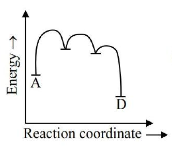
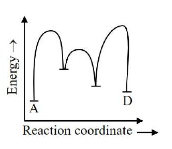
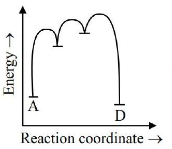
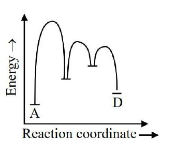
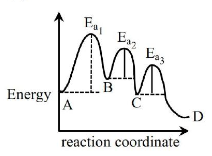
Reactant A converts to product D through the given mechanism (with the net evolution of heat) :
$\mathrm{A} \rightarrow \mathrm{B}$ slow ; $\Delta \mathrm{H}=+\mathrm{ve}$
$\mathrm{B} \rightarrow \mathrm{C}$ fast; $\Delta \mathrm{H}=-\mathrm{ve}$
$\mathrm{C} \rightarrow \mathrm{D}$ fast; $\Delta \mathrm{H}=-\mathrm{ve}$
Which of the following represents the above reaction mechanism?
  • A
    Image
  • B
    Image
  • C
    Image
  • D
    Image
View full question & answer
MCQ 84 Marks
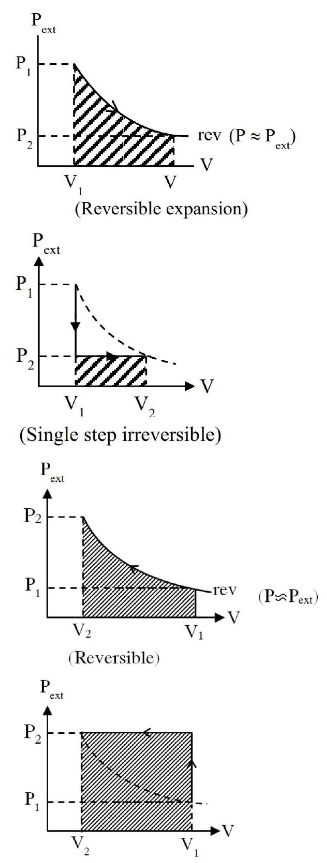
Arrange the following in order of magnitude of work done by the system / on the system at constant temperature :
(a) $\left|\omega_{\text {reversible }}\right|$ for expansion in infinite stage.
(b) $\left|w_{\text {irreversible }}\right|$ for expansion in single stage.
(c) $\left|\omega_{\text {reversible }}\right|$ for compression in infinite stage.
(d) $\left|w_{\text {irreversible }}\right|$ for compression in single stage.
Choose the correct answer from the options given below :
  • A
    $a>b>c>d$
  • B
    $d>c=a>b$
  • C
    $c=a>d>b$
  • D
    $a>c>b>d$
View full question & answer
MCQ 94 Marks
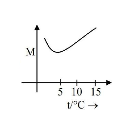
'x' g of NaCl is added to water in a beaker with a lid. The temperature of the system is raised from $1^{\circ} \mathrm{C}$ to $25^{\circ} \mathrm{C}$. Which out of the following plots, is best suited for the change in the molarity (M) of the solution with respect to temperature?
[Consider the solubility of NaCl remains unchanged over the temperature range]
  • A
    Image
  • B
    Image
  • C
    Image
  • D
    Image
View full question & answer
MCQ 104 Marks
Match List-I with List-II
List-I
(Purification technique)
List-II
(Mixture of organic compounds)
(A)Distillation (simple)(I)Diesel + Petrol
(B)Fractional distillation(II)Aniline + Water
(C)Distillation under reduced pressure(III)Chloroform + Aniline
(D)Steam distillation(IV)Glycerol + Spent-lye
Choose the correct answer from the options given below :
  • A
    (A)-(II), (B)-(III), (C)-(IV), (D)-(I)
  • B
    (A)-(II), (B)-(IV), (C)-(I), (D)-(III)
  • C
    (A)-(III), (B)-(IV), (C)-(II), (D)-(I)
  • D
    (A)-(III), (B)-(I), (C)-(IV), (D)-(II)
Answer
D. (A)-(III), (B)-(I), (C)-(IV), (D)-(II)
List-I (Purification technique)List-II (Mixture of organic compounds)
(A)Distillation (simple)(III)Chloroform + Aniline
(B)Fractional distillation(I)Diesel + Petrol
(C)Distillation under reduced pressure(IV)Glycerol + Spent-lye
(D)Steam distillation(II)Aniline + Water
View full question & answer
MCQ 114 Marks
Electronic configuration of four elements $\mathrm{A}, \mathrm{B}, \mathrm{C}$ and D are given below :
(A) $1 \mathrm{~s}^{2} 2 \mathrm{~s}^{2} 2 \mathrm{p}^{3}$
(B) $1 s^{2} 2 s^{2} 2 p^{4}$
(C) $1 \mathrm{~s}^{2} 2 \mathrm{~s}^{2} 2 \mathrm{p}^{5}$
(D) $1 \mathrm{~s}^{2} 2 \mathrm{~s}^{2} 2 \mathrm{p}^{2}$
Which of the following is the correct order of increasing electronegativity (Pauling's scale)?
  • A
    A $<$ D $<$ B $<$ C
  • B
    A $<$ C $<$ B $<$ D
  • C
    A $<$ B $<$ C $<$ D
  • D
    D $<$ A $<$ B $<$ C
Answer
D. D $<$ A $<$ B $<$ C
$\mathrm{N}:-1 \mathrm{~s}^{2} 2 \mathrm{~s}^{2} 2 \mathrm{p}^{3}$ (Electronegativity $=3$ )
$\mathrm{O}:-1 \mathrm{~s}^{2} 2 \mathrm{~s}^{2} 2 \mathrm{p}^{4}$ (Electronegativity $=3.5$ )
$\mathrm{F}:-1 \mathrm{~s}^{2} 2 \mathrm{~s}^{2} 2 \mathrm{p}^{5}$ (Electronegativity $=4$ )
$\mathrm{C}:-1 \mathrm{~s}^{2} 2 \mathrm{~s}^{2} 2 \mathrm{p}^{2}$ (Electronegativity $=2.55$ )
Correct order $=\mathrm{C}>\mathrm{B}>\mathrm{A}>\mathrm{D}$
View full question & answer
MCQ 124 Marks
  • A
    A and D only
  • B
    A, B and E only
  • C
    B, C and E only
  • D
    B and E only
View full question & answer
MCQ 134 Marks
The type of hybridization and the magnetic property of $\left[\mathrm{MnCl}_{6}\right]^{3-}$ are :
  • A
    $d^{2} s p^{3}$, paramagnetic with four unpaired electrons
  • B
    $s p^{3} d^{2}$, paramagnetic with four unpaired electrons
  • C
    $d ^2 sp ^3$, paramagnetic with two unpaired electrons
  • D
    $\mathrm{sp}^{3} \mathrm{~d}^{2}$, paramagnetic with two unpaired electrons
Answer
B. $s p^{3} d^{2}$, paramagnetic with four unpaired electrons
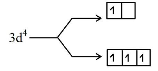
$\left[\mathrm{MnCl}_{6}\right]^{3-}$ contains $\mathrm{Mn}^{+3}$
$\mathrm{Mn}^{+3}$ :- $[\mathrm{Ar}] 3 \mathrm{~d}^{4}$
Ligand $\Rightarrow \mathrm{Cl}^{-}$(WFL)
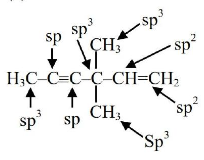
Image
Hybridisation $=\mathrm{sp}^{3} \mathrm{~d}^{2}$
4 unpaired electrons
View full question & answer
MCQ 144 Marks
  • A
    (B) and (D) only
  • B
    (A), (B) and (C) only
  • C
    (C) and (D) only
  • D
    (A) and (B) only
Answer
D. (A) and (B) only
(A) Azimuthal quantum number ( $\ell$ ) indicates the shape of orbital occupied by the electron
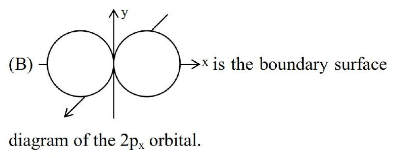
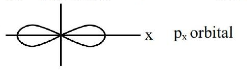
(B) Image
(C) The + and - sign in the wave function of $2 p_{x}$ orbital refer to the sign (Phase) of the wave function, not the charge
(D) The wave function of $2 p_{x}$ orbital will be zero in yz plane (Nodal plane).
View full question & answer
MCQ 164 Marks
Formation of $\mathrm{Na}_{4}\left[\mathrm{Fe}(\mathrm{CN})_{5} \mathrm{NOS}\right]$, a purple coloured complex formed by addition of sodium nitroprusside in sodium carbonate extract of salt indicates the presence of:
  • A
    Sodium ion
  • B
    Sulphate ion
  • C
    Sulphide ion
  • D
    Sulphite ion
Answer
C. Sulphide ion
$\underset{\substack{\text { Sodiun } \\ \text { sulphide }}}{\mathrm{Na}_{2} \mathrm{~S}}+\underset{\substack{\text { Sodium nitro } \\ \text { Prusside }}}{\mathrm{Na}_{2}}\left[\mathrm{Fe}(\mathrm{CN})_{5} \mathrm{NO}\right] \rightarrow \underset{4}{ } \rightarrow \underset{\text { Violet Colour }}{\mathrm{Na}_{4}}\left[\mathrm{Fe}(\mathrm{CN})_{5} \mathrm{NOS}\right]$
View full question & answer
MCQ 174 Marks
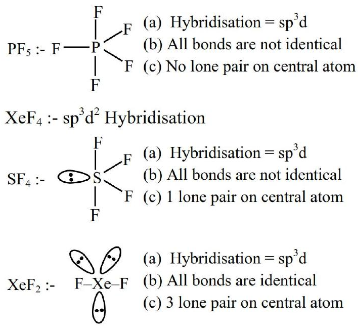
Which among the following molecules is (a) involved in $\mathrm{sp}^{3} \mathrm{~d}$ hybridization, (b) has different bond lengths and (c) has lone pair of electrons on the central atom ?
  • A
    $\mathrm{PF}_{5}$
  • B
    $\mathrm{XeF}_{4}$
  • C
    $\mathrm{SF}_{4}$
  • D
    $\mathrm{XeF}_{2}$
View full question & answer
MCQ 184 Marks
Given below are two statements :
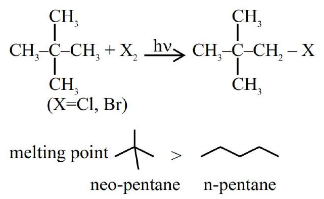
Statement (I) : Neopentane forms only one monosubstituted derivative.
Statement (II) : Melting point of neopentane is higher than n-pentane
In the light of the above statements, choose the most appropriate answer from the options given below :
  • A
    Statement I is correct but Statement II is incorrect
  • B
    Both Statement I and Statement II are correct
  • C
    Both Statement I and Statement II are incorrect
  • D
    Statement I is incorrect but Statement II is correct
View full question & answer
MCQ 194 Marks
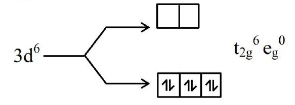
The d-orbital electronic configuration of the complex among $\left[\mathrm{Co}(\mathrm{en})_{3}\right]^{3+}, \left[\mathrm{CoF}_{6}\right]^{3-}$, $\left[\mathrm{Mn}\left(\mathrm{H}_{2} \mathrm{O}\right)_{6}\right]^{2+}$ and $\left[\mathrm{Zn}\left(\mathrm{H}_{2} \mathrm{O}\right)_{6}\right]^{2+}$ that has the highest CFSE is :
  • A
    $t_{2 g}^{6} e_{g}^{0}$
  • B
    $t_{2 g}^{6} e_{g}^{4}$
  • C
    $t_{2 g}^{3} e_{g}^{2}$
  • D
    $t_{2 g}^{4} e_{g}^{2}$
View full question & answer