Questions

SECTION - A [CHEMISTY - MCQ]

Take a timed test

20 questions · 19 auto-graded MCQ + 1 self-marked written.

MCQ 14 Marks
Which among the following react with Hinsberg's reagent?
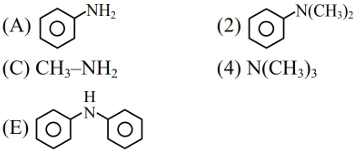
Image
Choose the correct answer from the options given below :
  • A
    B and D only
  • B
    C and D only
  • C
    A, B and E only
  • A, C and E only
Answer
Correct option: D.
A, C and E only
(D)
B and D are $3^{\circ}$ amine which does not have replaceable H on N , So does not react.
View full question & answer
MCQ 24 Marks
Match the list - i with list - ii
LIST - I
(Classification of molecules,based on octet rule)
 LIST - II
(Example)
A. Molecules obeying octet ruleI.NO,NO_(2)
B.Molecules with incomplete octetII.BCl_(3),AlCl_(3)
C.Molecules with incomplete octet with odd electronIII.H_(2)SO_(4),PCl_(5)
D.Molecules with expanded octetIV.CCl_(4),CO_(2)
 choose the correct answer from the questions given below :
  • A-IV, B-II, C-I, D-III
  • B
    A-III, B-II, C-I, D-IV
  • C
    A-IV, B-I, C-III, D-II
  • D
    A-II, B-IV, C-III, D-I
Answer
Correct option: A.
A-IV, B-II, C-I, D-III
(A)
(A) A $\rightarrow$ IV
(B) B $\rightarrow$ II
(C) $C \rightarrow I$
(D) $D \rightarrow$ III
View full question & answer
MCQ 34 Marks
Which of the following happens when $NH _4 OH$ is added gradually to the solution containing $1 M A ^{2+}$ and $1 M B ^{3+}$ ions ?
Given : $K _{\text {sp }}\left[ A ( OH )_2\right]=9 \times 10^{-10}$ and
$
K_{\text {sp }}\left[B(OH)_3\right]=27 \times 10^{-18} \text { at } 298 K
$
  • $B ( OH )_3$ will precipitate before $A ( OH )_2$
  • B
    $A ( OH )_2$ and $B ( OH )_3$ will precipitate together
  • C
    $A ( OH )_2$ will precipitate before $B ( OH )_3$
  • D
    Both $A ( OH )_2$ and $B ( OH )_3$ do not show precipitation with $NH _4 OH$
Answer
Correct option: A.
$B ( OH )_3$ will precipitate before $A ( OH )_2$
(A)
Condition for precipitation $Q _{ ip }> K _{\text {sp }}$
For $\left[ A ( OH )_2\right]$
$
\begin{array}{l}
{\left[A^{2+}\right]\left[OH^{-}\right]^2>9 \times 10^{-10}} \\
{\left[A^{+2}\right]=1 M} \\
\Rightarrow\left[OH^{-}\right]>3 \times 10^{-5} M
\end{array}
$
For $\left[ B ( OH )_3\right]$
$
\begin{array}{l}
{\left[B^{3+}\right]\left[OH^{-}\right]^3>27 \times 10^{-18}} \\
{\left[B^{3+}\right]=1 M} \\
\Rightarrow\left[OH^{-}\right]>3 \times 10^{-6} M
\end{array}
$
So, $B ( OH )_3$ will precipitate before $A ( OH )_2$
View full question & answer
MCQ 44 Marks
Given below are two statements :
Statement I : In Lassaigne's test, the covalent organic molecules are transformed into ionic compounds.
Statement II : The sodium fusion extract of an organic compound having N and S gives prussian blue colour with $FeSO _4$ and $Na _4\left[ Fe ( CN )_6\right]$In the light of the above statements, choose the correct answer from the options given below
  • A
    Both Statement I and Statement II are true
  • B
    Both Statement I and Statement II are false
  • C
    Statement I is false but Statement II is true
  • Statement I is true but Statement II is false
Answer
Correct option: D.
Statement I is true but Statement II is false
(D)
The sodium fusion extract of organic compound having $N \& S$ gives blood red colour with $FeSO _4$ and $Na _4\left[ Fe ( CN )_6\right]$
View full question & answer
MCQ 54 Marks
The correct set of ions (aqueous solution) with same colour from the following is :
  • $V ^{2+}, Cr ^{3+}, Mn ^{3+}$
  • B
    $Zn ^{2+}, V ^{3+}, Fe ^{3+}$
  • C
    $Ti ^{4+}, V ^{4+}, Mn ^{2+}$
  • D
    $Sc ^{3+}, Ti ^{3+}, Cr ^{2+}$
Answer
Correct option: A.
$V ^{2+}, Cr ^{3+}, Mn ^{3+}$
(A)
(1) $V ^{2+}$ (Violet), $Cr ^{3+}$ (Violet), $Mn ^{3+}$ (Violet)
(2) $Zn ^{2+}$ (Colourless), $V ^{3+}$ (Green), $Fe ^{3+}$ (Yellow)
(3) $Ti ^{4+}$ (Colourless), $V ^{4+}$ (Blue), $Mn ^{2+}$ (Pink)
(4) $Sc ^{3+}$ (Colourless), $Ti ^{3+}$ (Purple), $Cr ^{2+}$ (Blue)
View full question & answer
MCQ 64 Marks
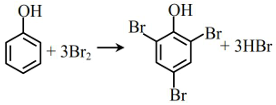
What amount of bromine will be required to convert 2 g of phenol into 2, 4, 6-tribromophenol ? (Given molar mass in $g mol ^{-1}$ of $C , H , O , Br$ are $12,1,16,80$ respectively)
  • 10.22 g
  • B
    6.0 g
  • C
    4.0 g
  • D
    20.44 g
Answer
Correct option: A.
10.22 g
(A)
Image
$\begin{array}{l}\text { Moles of phenol }=\frac{2}{94}=0.021 \\ \therefore \text { Moles of bromine }=0.021 \times 3=0.064 \\ \therefore \text { Mass of bromine }=0.064 \times 160=10.22 g\end{array}$
View full question & answer
MCQ 74 Marks
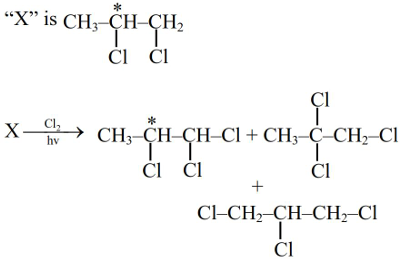
Propane molecule on chlorination under photochemical condition gives two di-chloro products, " $x$ " and " $y$ ". Amongst " $x$ " and " $y$ ", " $x$ " is an optically active molecule. How many tri-chloro products (consider only structural isomers) will be obtained from " $x$ " when it is further treated with chlorine under the photochemical condition?
  • A
    4
  • B
    2
  • C
    5
  • 3
Answer
Correct option: D.
3
(D)
Image
View full question & answer
MCQ 84 Marks
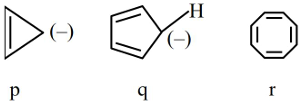
The correct stability order of the following species/molecules is :
Image
  • $q>r>p$
  • B
    $r>q>p$
  • C
    $q>p>r$
  • D
    $p>q>r$
Answer
Correct option: A.
$q>r>p$
(A)
q is aromatic r is nonaromatic p is antiaromatic
View full question & answer
MCQ 94 Marks
The major product of the following reaction is :
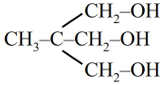
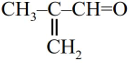
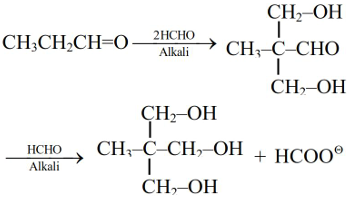
$CH _3 CH _2 CH = O \xrightarrow[\text { reflux }]{\substack{\text { excess } HCHO \\ \text { alkali }}}$ ?
  • A
    $CH _3- CH _2- CH _2- OH$
  • Image
  • D
    Image
Answer
Correct option: C.
Image
(C)
This is an example of Tollen's reaction i.e. multiple cross aldol followed by cross Cannizaro reaction

Image
View full question & answer
MCQ 104 Marks
The complex that shows Facial - Meridional isomerism is
  • $\left[ Co \left( NH _3\right)_3 Cl _3\right]$
  • B
    $\left[ Co \left( NH _3\right)_4 Cl _2\right]^{+}$
  • C
    $\left[ Co ( en )_3\right]^{3+}$
  • D
    $\left[ Co ( en )_2 Cl _2\right]^{+}$
Answer
Correct option: A.
$\left[ Co \left( NH _3\right)_3 Cl _3\right]$
(A)
$Ma _3 b_3$ type complexes show Facial - Meridional isomerism
(i) $\left[ Co \left( NH _3\right)_3 Cl _3\right] \Rightarrow Ma _3 b_3$
(ii) $\left[ Co \left( NH _3\right)_4 Cl _2\right]^{+} \Rightarrow Ma _4 b_2$
(iii) $\left[ Co ( en )_3\right]^{3+} \Rightarrow M ( AA )_3$
(iv) $\left[ Co ( en )_2 Cl _2\right]^{+} \Rightarrow M ( AA )_2 b_2$
$a , b ,= NH _3, Cl ^{-}$
$AA = en$
View full question & answer
MCQ 114 Marks
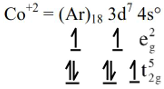
The d-electronic configuration of an octahedral $Co ( II )$ complex having magnetic moment of 3.95 BM is :
  • A
    $t_{2 g}^6 e_g^1$
  • B
    $t_{2 g}^3 e_g^0$
  • $t_{2 g}^5 e_g^2$
  • D
    $e^4 t_2^3$
Answer
Correct option: C.
$t_{2 g}^5 e_g^2$
(C)
Image
View full question & answer
MCQ 124 Marks
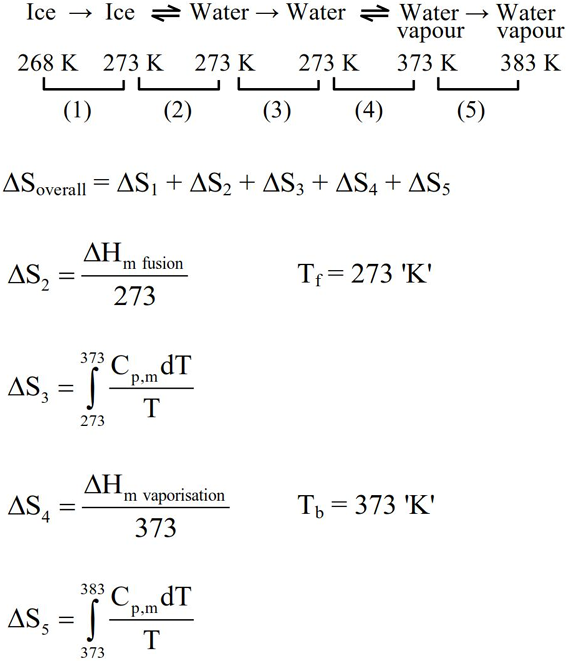
Ice at $-5^{\circ} C$ is heated to become vapor with temperature of $110^{\circ} C$ at atmospheric pressure. The entropy change associated with this process can be obtained from :
  • A
    $\int_{268 K}^{383 K} C _{ p } dT +\frac{\Delta H _{\text {melting }}}{273}+\frac{\Delta H _{\text {boiling }}}{373}$
  • $\begin{array}{l}\int_{268 K}^{273 K} \frac{ C _{ p , m }}{ T } dT +\frac{\Delta H _{ m }, \text { fusion }}{ T _{ f }}+\frac{\Delta H _{ m , \text { vaporisation }}}{ T _{ b }} \\ +\int_{273 K}^{373 K} \frac{ C _{ p , m } dT }{ T }+\int_{373 K}^{383 K} \frac{ C _{ p , m } dT }{ T }\end{array}$
  • C
    $\int_{268 K}^{383 K} C _{ p } dT +\frac{ q _{ rev }}{ T }$
  • D
    $\begin{array}{l}\int_{268 K}^{273 K} C _{ p , m } dT +\frac{\Delta H _{ m }, \text { fusion }}{ T _{ f }}+\frac{\Delta H _{ m , \text { vaporisation }}}{ T _{ b }} \\ +\int_{273 K}^{373 K} C _{ p , m } dT +\int_{373 K}^{383 K} C _{ p , m } dT \end{array}$
Answer
Correct option: B.
$\begin{array}{l}\int_{268 K}^{273 K} \frac{ C _{ p , m }}{ T } dT +\frac{\Delta H _{ m }, \text { fusion }}{ T _{ f }}+\frac{\Delta H _{ m , \text { vaporisation }}}{ T _{ b }} \\ +\int_{273 K}^{373 K} \frac{ C _{ p , m } dT }{ T }+\int_{373 K}^{383 K} \frac{ C _{ p , m } dT }{ T }\end{array}$
(B)
Image
View full question & answer
MCQ 134 Marks
$2.8 \times 10^{-3} mol$ of $CO _2$ is left after removing $10^{21}$ molecules from its ' $x$ ' mg sample. The mass of $CO _2$ taken initially is<br>Given : $N _{ A }=6.02 \times 10^{23} mol^{-1}$
  • 196.2 mg
  • B
    98.3 mg
  • C
    150.4 mg
  • D
    48.2 mg
Answer
Correct option: A.
196.2 mg
(A)
$
\begin{array}{l}
(\text { moles })_{\text {initial }}=\frac{x \times 10^{-3}}{44} \\
(\text { moles })_{\text {removal }}=\frac{10^{21}}{6.02 \times 10^{23}} \\
(\text { moles })_{\text {left }}=(moles)_{\text {initial }}-(moles)_{\text {removed }} \\
2.8 \times 10^{-3}=\frac{x \times 10^{-3}}{44}-\frac{10^{21}}{6.02 \times 10^{23}} \\
\Rightarrow x=196.2 mg
\end{array}
$
View full question & answer
MCQ 144 Marks
Given below are two statements :
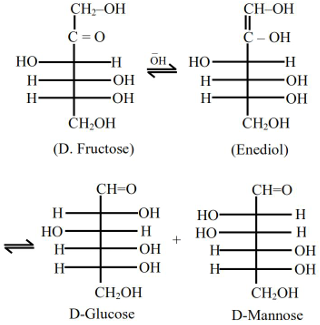
Statement I : Fructose does not contain an aldehydic group but still reduces Tollen's reagent
Statement II : In the presence of base, fructose undergoes rearrangement to give glucose.In the light of the above statements, choose the correct answer from the options given below
  • A
    Statement I is false but Statement II is true
  • Both Statement I and Statement II are true
  • C
    Both Statement I and Statement II are false
  • D
    Statement I is true but Statement II is false
Answer
Correct option: B.
Both Statement I and Statement II are true
(B)
Image
View full question & answer
MCQ 154 Marks
Match the list - I with list - II
 LIST-I
Name reaction
 LIST-II
Product obtainable
 A. Swarts reaction I. Ethyl benzene
 B. Sandmeyer's reaction II. Ethyl iodide
 C. Wurtz Fittig reaction III. Cyanobenzene
 D. Finkelstein reaction IV. Ethyl fluoride
Choose the correct answer from the option given below :
  • A
    A-II, B-III, C-I, D-IV
  • B
    A-IV, B-I, C-III, D-II
  • C
    A-IV, B-III, C-I, D-II
  • D
    A-II, B-I, C-III, D-IV
View full question & answer
MCQ 164 Marks
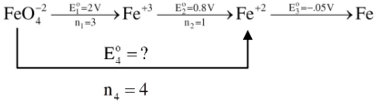
$FeO _4^{2-} \xrightarrow{+2.0 V} Fe ^{3+} \xrightarrow{0.8 V} Fe ^{2+} \xrightarrow{-0.5 V} Fe ^0$In the above diagram, the standard electrode potentials are given in volts (over the arrow). The value of $E _{ FeO _4^{2-} / Fe ^{2+}}^{\Theta}$ is
  • 1.7 V
  • B
    1.2 V
  • C
    2.1 V
  • D
    1.4 V
Answer
Correct option: A.
1.7 V
(A)
Image
$\begin{aligned} & \Delta G _4^{ o }=\Delta G _1^{ o }+\Delta G _2^{ o } \\ \Rightarrow & - n _4 FE _4^{ o }=- n _1 FE _1^0- n _2 FE _2^{ o } \\ \Rightarrow & +4 E _4^{ o }=3 \times 2+(1 \times 0.8) \\ \Rightarrow & E _4^{ o }=\frac{6.8}{4} V \\ \Rightarrow & E _4^{ o }=1.7 V\end{aligned}$
View full question & answer
MCQ 174 Marks
$CrCl _3 \cdot xNH _3$ can exist as a complex. 0.1 molal aqueous solution of this complex shows a depression in freezing point of $0.558^{\circ} C$. Assuming $100 \%$ ionisation of this complex and coordination number of Cr is 6 , the complex will be (Given $K _{ f }=1.86 K kg mol ^{-1}$ )
  • A
    $\left[ Cr \left( NH _3\right)_6\right] Cl _3$
  • B
    $\left[ Cr \left( NH _3\right)_4 Cl _2\right] Cl$
  • $\left[ Cr \left( NH _3\right)_5 Cl \right] Cl _2$
  • D
    $\left[ Cr \left( NH _3\right)_3 Cl _3\right]$
Answer
Correct option: C.
$\left[ Cr \left( NH _3\right)_5 Cl \right] Cl _2$
(C)
$\begin{array}{c}\text { Given : } \Delta T _{ f }=0.558^{\circ} C \\ k _{ f }=1.86 \frac{K \times kg }{ mol } \\ 0.1 m \text { aq. sol. } \\ \Rightarrow \Delta T _{ f }= i \times k _{ f } \times m \\ \Rightarrow 0.558= i \times 1.86 \times 0.1 \\ \Rightarrow i =3\end{array}$
View full question & answer
MCQ 184 Marks
The incorrect statements among the following is
  • A
    $PH _3$ shows lower proton affinity than $NH _3$.
  • B
    $PF _3$ exists but $NF _5$ does not.
  • C
    $NO _2$ can dimerise easily.
  • $SO _2$ can act as an oxidizing agent, but not as a reducing agent.
Answer
Correct option: D.
$SO _2$ can act as an oxidizing agent, but not as a reducing agent.
(D)
$SO _2$ can oxidise as well as reduce.
Hence it can act as both oxidising and reducing agent.
View full question & answer
MCQ 194 Marks
Heat treatment of muscular pain involves radiation of wavelength of about 900 nm . Which spectral line of H atom is suitable for this ?
Given: Rydberg constant
$
\left.R_{H}=10^5 cm^{-1}, h=6.6 \times 10^{-34} J s, c=3 \times 10^8 m / s\right)
$
  • Paschen series, $\infty \rightarrow 3$
  • B
    Lyman series, $\infty \rightarrow 1$
  • C
    Balmer series, $\infty \rightarrow 2$
  • D
    Paschen series, $5 \rightarrow 3$
Answer
Correct option: A.
Paschen series, $\infty \rightarrow 3$
(A)
$
\begin{array}{l}
\lambda=900 nm \\
=9 \times 10^{-5} cm \\
R_{H}=10^5 cm^{-1} \\
\text { Ryderg eq. }=\frac{1}{\lambda}=R_{H} Z^2 \times\left(\frac{1}{n_1^2}-\frac{1}{n_2^2}\right) \\
\Rightarrow \frac{1}{\lambda \times R_{H}}=\frac{1}{n_1^2}-\frac{1}{n_2^2} \\
\Rightarrow \frac{1}{9 \times 10^{-5} cm \times 10^5 cm^{-1}}=\left(\frac{1}{n_1^2}-\frac{1}{n_2^2}\right) \\
\Rightarrow \frac{1}{n_1^2}-\frac{1}{n_2^2}=\frac{1}{9}
\end{array}
$
It is possible when $n_1=3, n_2=\infty$
Possible series : $\infty \rightarrow 3$
View full question & answer
MCQ 204 Marks
The element that does not belong to the same period of the remaining elements (modern periodic table) is:
  • Palladium
  • B
    Iridium
  • C
    Osmium
  • D
    Platinum
Answer
Correct option: A.
Palladium
(A)
Palladium $\Rightarrow 5^{\text {th }}$ period
Iridium, Osmium, Platinum $\Rightarrow 6^{\text {th }}$ Period
View full question & answer