Questions

SECTION - A [CHEMISTY - MCQ]

Take a timed test

20 questions · auto-graded multiple-choice test.

MCQ 14 Marks
$
\begin{array}{l}
S(g)+\frac{3}{2} O_2(g) \rightarrow SO_3(g)+2 x \text { kcal } \\
SO_2(g)+\frac{1}{2} O_2(g) \rightarrow SO_3(g)+y kcal
\end{array}
$
The heat of formation of $SO _2(g)$ is given by :
  • A
    $\frac{2 x }{ y } kcal$
  • $y-2 x$ kcal
  • C
    $2 x+y$ kcal
  • D
    $x+y$ kcal
Answer
Correct option: B.
$y-2 x$ kcal
(B) $y-2 x$ kcal
Sol. $\underset{( g )}{ SO _2}+\frac{1}{2} \underset{(g)}{ O _2} \longrightarrow \underset{(g)}{ SO _3} \quad \Delta H =- y$
$
\begin{array}{l}
\Delta H_{r}=\left(\Delta H_{f}\right)_{SO_3}-\left(\Delta H_{f}\right)_{SO_2} \\
-y=-2 x-\left(\Delta H_{f}\right)_{SO_2} \\
\left(\Delta H_{f}\right)_{SO_2}=y-2 x
\end{array}
$
Option (2)
View full question & answer
MCQ 24 Marks
Which of the following mixing of 1 M base and 1 M acid leads to the largest increase in temperature?
  • 30 mL HCl and 30 mL NaOH
  • B
    $30 mL CH _3 COOH$ and 30 mL NaOH
  • C
    50 mL HCl and 20 mL NaOH
  • D
    $45 mL CH _3 COOH$ and 25 mL NaOH
Answer
Correct option: A.
30 mL HCl and 30 mL NaOH
(A) 30 mL HCl and 30 mL NaOH
Sol. Higher the number of milli moles of acid or base reacted higher will be temperature rise.
Option (4) $n _{\text {seid }}$ or $n _{\text {base }}$ reacted $=30 m mol$
Option (2) $n _{\text {seid }}$ or $n _{\text {base }}$ reacted $=30 m mol$
but less energy will be released by neutralisation reaction of weak acid hence option (2) can not be correct.
Option (3) $\Rightarrow 20 m mol$
Option (4) $\Rightarrow 25 m mol$
Hence Correct Option (1)
View full question & answer
MCQ 34 Marks
For hydrogen atom, the orbital/s with lowest energy is/are :
(A) 4 s
(B) $3 p_x$
(C) $3 d_{x^2-y^2}$
(D) $3 d_{z^2}$
(E) $4 p _2$
Choose the correct answer from the options given below :
  • A
    (A) and (E) only
  • B
    (B) only
  • C
    (A) only
  • (B), (C) and (D) only
Answer
Correct option: D.
(B), (C) and (D) only
(D) (B), (C) and (D) only
Sol. In hydrogen atom the orbitals in a shell are degenerate means energy depends only on ' $n$ '
$\therefore E_{3 p,}=E_{3 d_{s^2, y^2}}=E_{3 d_{\gamma_2}}$
View full question & answer
MCQ 44 Marks
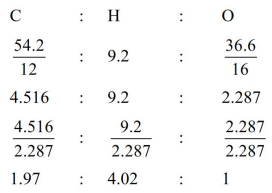
The elemental composition of a compound is $54.2 \%, C , 9.2 \% H$ and $36.6 \% O$. If the molar mass of the compound is $132 g mol ^{-1}$, the molecular formula of the compound is :
[Given : The relative atomic mass of $C : H : O =$ 12:1:16]
  • A
    $C _4 H _9 O _3$
  • B
    $C _6 H _{12} O _6$
  • $C _6 H _{12} O _3$
  • D
    $C _4 H _8 O _2$
Answer
Correct option: C.
$C _6 H _{12} O _3$
(C) $C _6 H _{12} O _3$
Sol.
Image
$C _2 H _4 O \Rightarrow$ Empirical formula
E.F. mass $=24+4+16=44$
and molar mass $=132$
Hence molecular formula $=\left( C _2 H _4 O \right)_3$
$\quad \quad\quad\quad\quad\quad\quad\quad\quad\quad
=C_6 H_{12} O_3
$
Correct Option (3)
View full question & answer
MCQ 54 Marks
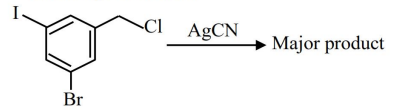
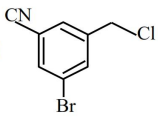
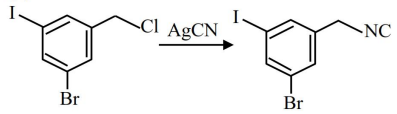
The structure of the major product formed in the following reaction is :
Image
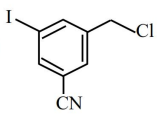
  • A

    Image

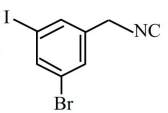
  • Image
  • C

    Image
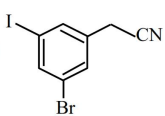
  • D

    Image
Answer
Correct option: B.

Image
(B) Image
Sol.
Image
View full question & answer
MCQ 64 Marks
Based on the data given below:
$\begin{array}{l}
E_{Cr_2 O_7^{2-} / Cr^{3+}}^0=1.33 V \quad E_{C_2 / Cr^{(-1}}^0=1.36 V \\
E_{MnO_4^{-} / Mn^{2+}}^0=1.51 V \quad E_{Cr^{2+} / Cr}^0=-0.74 V
\end{array}
$
the strongest reducing agent is :
  • A
    $Mn ^{2+}$
  • Cr
  • C
    $MnO _4^{-}$
  • D
    $Cl ^{-}$
Answer
Correct option: B.
Cr
(B) Cr
Sol. For strongest reducing agent
Reduction potential should be lowest
Hence Cr is the strongest reducing agent.
Options (2)
View full question & answer
MCQ 74 Marks
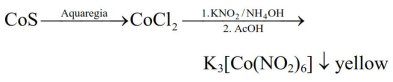
Find the compound ' A ' from the following reaction sequences.
Image
  • A
    ZnS
  • CoS
  • C
    MnS
  • D
    Nis
Answer
Correct option: B.
CoS
(B) CoS
Sol.
Image
View full question & answer
MCQ 84 Marks
Identify correct statement/s :
(A) $- OCH _3$ and $- NHCOCH _3$ are activating group
(B) - CN and - OH are meta directing group
(C) - CN and $- SO _3 H$ are meta directing group
(D) Activating groups act as ortho - and para directing groups
(E) Halides are activating groups
Choose the correct answer from the options given below :
  • (A), (C) and (D) only
  • B
    (A), (B) and (E) only
  • C
    (A) only
  • D
    (A) and (C) only
Answer
Correct option: A.
(A), (C) and (D) only
(A) (A), (C) and (D) only
Sol. (B) - CN is meta directing But - OH is ortho / pera directing.
(E) Halides are deactivating groups.
View full question & answer
MCQ 94 Marks
The conditions and consequence that favours the $t _{2 g}{ }^3, e _{ g }{ }^1$ configuration in a metal complex are :
  • weak field ligand, high spin complex
  • B
    strong field ligand, high spin complex
  • C
    strong field ligand, low spin complex
  • D
    weak field ligand, low spin complex
Answer
Correct option: A.
weak field ligand, high spin complex
(A) weak field ligand, high spin complex
Sol. For $3 d^4$
If ligand is SFL: $t _{2 g}{ }^4 e _{ g }{ }^0 \quad$ (Low spin)
If ligand is WFL: $t _{2 z }{ }^3 e _{\underline{z}}{ }^1$ (High spin)
View full question & answer
MCQ 104 Marks
Match List-I with List-II.
List-I
(Transition metal ion)
List-II
(Spin only magnetic moment (B.M.))
(A) $Ti ^{3+}$(I) 3.87
(B) $V ^{2+}$(II) 0.00
(C) $Ni ^{2+}$(III) 1.73
(D) $Sc ^{3+}$(IV) 2.84
Choose the correct answer from the options given below :
  • A
    (A)-(III), (B)-(I), (C)-(II), (D)-(IV)
  • (A)-(III), (B)-(I), (C)-(IV), (D)-(II)
  • C
    (A)-(IV), (B)-(II), (C)-(III), (D)-(I)
  • D
    (A)-(II), (B)-(IV), (C)-(I), (D)-(III)
Answer
Correct option: B.
(A)-(III), (B)-(I), (C)-(IV), (D)-(II)
(B) (A)-(III), (B)-(I), (C)-(IV), (D)-(II)
Sol.
$
\begin{array}{lc}
Sc^{+3}=3 d^{\circ} & \therefore \mu_{\text {spin }}=0 \\
V^{+2}=3 d^3 & \therefore \mu_{\text {spin }}=3.87 \text { B.M. } \\
Ni^{+2}=3 d^8 & \therefore \mu_{\text {spin }}=2.84 \text { B.M. } \\
Ti^{+3}=3 d^1 & \therefore \mu_{\text {spin }}=1.73 \text { B.M. }
\end{array}
$
View full question & answer
MCQ 114 Marks
The successive 5 ionisation energies of an element are $800,2427,3658,25024$ and $32824 kJ / mol$, respectively. By using the above values predict the group in which the above element is present :
  • A
    Group 2
  • Group 13
  • C
    Group 4
  • D
    Group 14
Answer
Correct option: B.
Group 13
(B) Group 13
Sol. The $IE _4$ is suddenly very high therefore element must have 3 valence $e ^{-}( s )$ and it belong to group 13
View full question & answer
MCQ 124 Marks
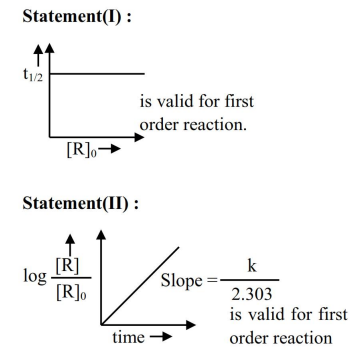
Given below are two statements :
Image
In the light of the above statements, choose the correct answer from the options given below :
  • A
    Both Statement I and Statement II are false
  • B
    Statement I is false but Statement II is true
  • C
    Both Statement I and Statement II are true
  • Statement I is true but Statement II is false
Answer
Correct option: D.
Statement I is true but Statement II is false
(D) Statement I is true but Statement II is false
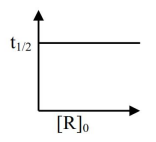
Sol. For first order reaction $t _{1 / 2}=\frac{\ell n 2}{ k }$
Image
For first order reaction
$
\begin{array}{l}
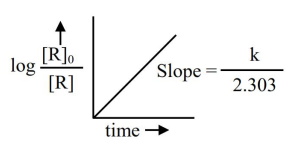
\log \frac{[R]_0}{[R]}=\frac{1}{2.303} kt \\
\log \frac{[R]_0}{[R]}=\left(\frac{k}{2.303}\right) \times t
\end{array}
$
Image
View full question & answer
MCQ 134 Marks
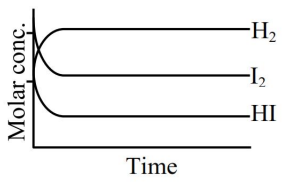
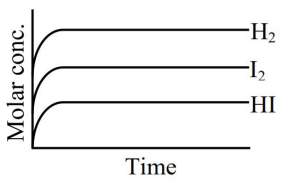
For the reaction,
$
H_2(g)+I_2(g) \rightleftharpoons 2 HI(g)
$
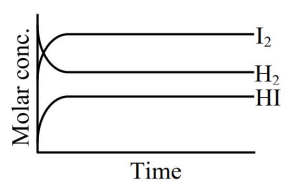
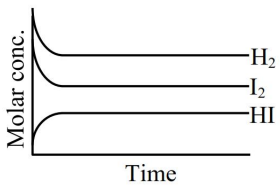
Attainment of equilibrium is predicted correctly by:
  • A

    Image

  • Image
  • C

    Image
  • D

    Image
Answer
Correct option: B.

Image
(B) Image
Sol$\quad H _2+ I _2 \rightleftharpoons 2 HI$
Concentration of $H _2$ and $I _2$ decreases untill equilibrium condition and concentration of HI increases till equilibrium condition and after equilibrium concentration of all the reactant and products remain constant.
Correct option (2)
View full question & answer
MCQ 144 Marks
When Ethane-1,2-diamine is added progressively to an aqueous solution of Nickel (II) chloride, the sequence of colour change observed will be :
  • A
    Pale Blue $\rightarrow$ Blue $\rightarrow$ Green $\rightarrow$ Violet
  • B
    Pale Blue $\rightarrow$ Blue $\rightarrow$ Violet $\rightarrow$ Green
  • Green $\rightarrow$ Pale Blue $\rightarrow$ Blue $\rightarrow$ Violet
  • D
    Violet $\rightarrow$ Blue $\rightarrow$ Pale Blue $\rightarrow$ Green
Answer
Correct option: C.
Green $\rightarrow$ Pale Blue $\rightarrow$ Blue $\rightarrow$ Violet
(C) Green $\rightarrow$ Pale Blue $\rightarrow$ Blue $\rightarrow$ Violet
Sol. $
\left[Ni\left(H_2 O\right)_6\right]^{+2}{ }_{(aq)}+en_{(aq)} \rightarrow\left[Ni\left(H_2 O\right)_4(en)\right]_{(sq)}+2 H_2 O
$
Green$
\left[Ni\left(H_2 O\right)_4(en)\right]_{(a aq)}^{+2}+en_{(a 4)} \rightarrow\left[Ni\left(H_2 O\right)_2(en)_2\right]_{(aq4)}^{+2}+2 H_2 O
$
Pale Blue
$
\left[Ni\left(H_2 O\right)_2(en)\right]_{(aq)}^{+2}+en_{((aq)} \rightarrow\left[Ni(en)_3\right]_{(aq)}^{+2}+2 H_2 O
$
Blue / purple
View full question & answer
MCQ 154 Marks
Given below are two statements :
Statement(I) : Experimentally determined oxygen-oxygen bond lengths in the $O _3$ are found to be same and the bond length is greater than that of a $O = O$ (double bond) but less than that of a single ( $O - O$ ) bond.
Statement (II) : The strong lone pair-lone pair repulsion between oxygen atoms is solely responsible for the fact that the bond length in ozone is smaller than that of a double bond $( O = O )$ but more than that of a single bond $( O - O )$.
In the light of the above statements, choose the correct answer from the options given below:
  • Statement I is true but Statement II is false
  • B
    Both Statement I and Statement II are true
  • C
    Both Statement I and Statement II are false
  • D
    Statement I is false but Statement II is true
Answer
Correct option: A.
Statement I is true but Statement II is false
(A) Statement I is true but Statement II is false
Sol. Due to resonance bond length is identical in ozone. Therefore statement I is true and statement II is false
View full question & answer
MCQ 164 Marks
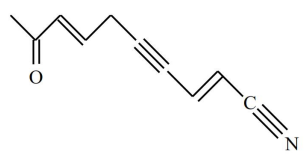
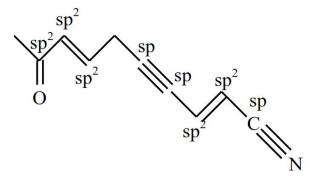
In the given structure, number of sp and $sp ^2$ hybridized carbon atoms present respectively are :
Image
  • A
    3 and 6
  • 3 and 5
  • C
    4 and 6
  • D
    4 and 5
Answer
Correct option: B.
3 and 5
(B) 3 and 5
Sol.
Image
Number of sp and $sp ^2$ hybridised carbon atom are 3 and 5 .
View full question & answer
MCQ 174 Marks
Match List-I with List-II.
 List - I List - II
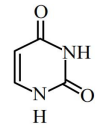
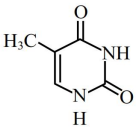
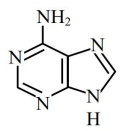
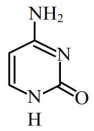
(A)Adenine(I)Image
(B)Cytosine(II)Image
(C)Thymine(III)Image
(D)Uracil(IV)Image
Choose the correct answer from the options given below :
  • (A)-(III), (B)-(IV), (C)-(II), (D)-(I)
  • B
    (A)-(III), (B)-(I), (C)-(IV), (D)-(II)
  • C
    (A)-(IV), (B)-(III), (C)-(II), (D)-(I)
  • D
    (A)-(III), (B)-(IV), (C)-(I), (D)-(II)
Answer
Correct option: A.
(A)-(III), (B)-(IV), (C)-(II), (D)-(I)
(A) (A)-(III), (B)-(IV), (C)-(II), (D)-(I)
Sol.
 List - I List - II
(A)Adenine(III)Image
(B)Cytosine(IV)Image
(C)Thymine(II)Image
(D)Uracil(I)Image
 
View full question & answer
MCQ 184 Marks
For reaction
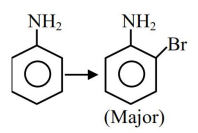
Image
The correct order of set of reagents for the above conversion is :
  • A
    $Br _2 \mid FeBr _3, H _2 O (\Delta), NaOH$
  • $H _2 SO _4, Ac _2 O , Br _2, H _2 O (\Delta), NaOH$
  • C
    $Ac _2 O , Br _2, H _2 O (\Delta), NaOH$
  • D
    $Ac _2 O , H _2 SO _4, Br _2, NaOH$
Answer
Correct option: B.
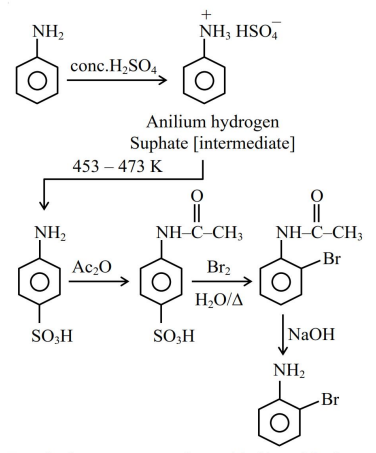
$H _2 SO _4, Ac _2 O , Br _2, H _2 O (\Delta), NaOH$
(B) $H _2 SO _4, Ac _2 O , Br _2, H _2 O (\Delta), NaOH$
Sol.
Image
View full question & answer
MCQ 194 Marks
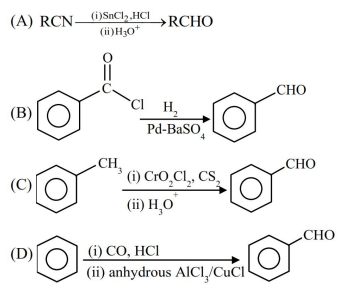
Match List-I with List-II
List-I 
Image
List-II
(I) Etard reaction
(II) Gatterman -Koch reaction
(III) Rosenmund reduction
(IV) Stephen reaction
Choose the correct answer from the options given below :
  • (A)-(IV), (B)-(III), (C)-(I), (D)-(II)
  • B
    (A)-(III), (B)-(IV), (C)-(II), (D)-(I)
  • C
    (A)-(I), (B)-(III), (C)-(II), (D)-(IV)
  • D
    (A)-(III), (B)-(IV), (C)-(I), (D)-(II)
Answer
Correct option: A.
(A)-(IV), (B)-(III), (C)-(I), (D)-(II)
(A) (A)-(IV), (B)-(III), (C)-(I), (D)-(II)
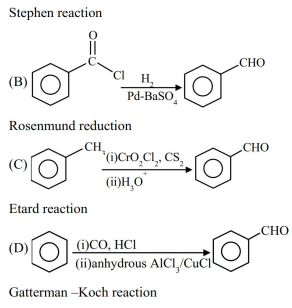
Sol. List-I
(A) $RCN \xrightarrow[\text { (ii) } H _3 O ^{+}]{\text {(i) } SuCl _2 HCl } RCHO$
Image
View full question & answer
MCQ 204 Marks
Given below are two statements :
Statement (I) : The first ionization energy of Pb is greater than that of Sn
Statement(II) : The first ionization energy of Ge is greater than that of Si .
In the light of the above statements, choose the correct answer from the options given below :
  • Statement I is true but Statement II is false
  • B
    Both Statement I and Statement II are false
  • C
    Statement I is false but Statement II is true
  • D
    Both Statement I and Statement II are true
Answer
Correct option: A.
Statement I is true but Statement II is false
(A) Statement I is true but Statement II is false
Sol. Order of I.E. (in KJ/mol) :
$
\begin{array}{ccccc}\quad C> Si>Ge>Sn<Pb\\1086\quad 786\quad 761\quad 708 \quad 715
\end{array}
$
View full question & answer