MCQ 14 Marks
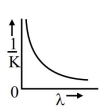
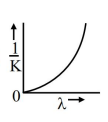
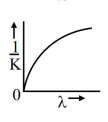
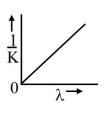
If $\lambda$ and K are de Broglie Wavelength and kinetic energy, respectively, of a particle with constant mass. The correct graphical representation for the particle will be :-
Answer(B)
Sol.
$\lambda=\frac{\mathrm{h}}{\mathrm{mv}}=\frac{\mathrm{h}}{\sqrt{2 \mathrm{mK}}}$
$\lambda^{2}=\frac{\mathrm{h}^{2}}{2 \mathrm{~m}}\left(\frac{1}{\mathrm{k}}\right)$
$\mathrm{Y}=\mathrm{cx}^{2}$
Upward facing parabola passing through origin.
View full question & answer→MCQ 24 Marks
Given below are two statements : one is labelled as
Assertion (A) and other is labelled as Reason (R).
Assertion (A) : Electromagnetic waves carry energy but not momentum.
Reason (R): Mass of a photon is zero.
In the light of the above statements, choose the most appropriate answer from the options given below:
- A
(A) is true but (R) is false.
- ✓
(A) is false but (R) is true.
- C
Both (A) and (R) are true but (R) is not the correct explanation of (A).
- D
Both (A) and (R) are true and (R) is the correct explanation of (A).
AnswerCorrect option: B. (A) is false but (R) is true.
(B)
Sol. Assertion is false because em waves have momentum.
View full question & answer→MCQ 34 Marks
The workdone in an adiabatic change in an ideal gas depends upon only :
- A
- B
change in its specific heat
- C
- ✓
change in its temperature
AnswerCorrect option: D. change in its temperature
(D)
Sol.
$\Delta \mathrm{W}=-\Delta \mathrm{U}=-\mathrm{nC}_{\mathrm{v}} \Delta \mathrm{T}$
View full question & answer→MCQ 44 Marks
Match List-I with List-II.| | List-I | | List-II |
| (A) | Electric field inside (distance r > 0 from center) of a uniformly charged spherical shell with surface charge density $\sigma$, and radius R. | (I) | $\sigma / \varepsilon_0$ |
| (B) | Electric field at distance r > 0 from a uniformly charged infinite plane sheet with surface charge density $\sigma$. | (II) | $\sigma / 2 \varepsilon_0$ |
| (C) | Electric field outside (distance r > 0 from center) of a uniformly charged spherical shell with surface charge density $\sigma$, and radius R | (III) | 0 |
| (D) | oppositely charged infinite plane parallel sheets with uniform surface charge density $\sigma$. | (IV) | $\frac{\sigma}{\varepsilon_0 r^2}$ |
Choose the correct answer from the options given below : - A
(A)-(IV), (B)-(I), (C)-(III), (D)-(II)
- B
(A)-(IV), (B)-(II), (C)-(III), (D)-(I)
- C
(A)-(II), (B)-(I), (C)-(IV), (D)-(III)
- ✓
(A)-(III), (B)-(II), (C)-(IV), (D)-(I)
AnswerCorrect option: D. (A)-(III), (B)-(II), (C)-(IV), (D)-(I)
(D)
Sol.
(A) $\rightarrow 0$ (III)
(B) $\rightarrow \frac{\sigma}{2 \varepsilon_{0}}$ (II)
(C) $\rightarrow \frac{\sigma \mathrm{R}^{2}}{\varepsilon_{0} \mathrm{r}^{2}}$ (No row matching)
(D) $\rightarrow \frac{\sigma}{\varepsilon_{0}}$ (I)
View full question & answer→MCQ 54 Marks
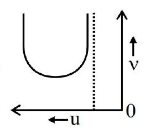
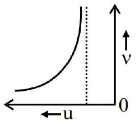
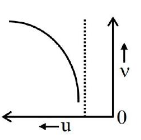
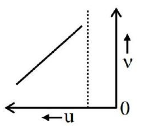
Let $u$ and $v$ be the distances of the object and the image from a lens of focal length $f$. The correct graphical representation of $u$ and $v$ for a convex lens when $|\mathbf{u}|>f$, is
Answer(B)
Sol.
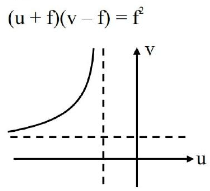
View full question & answer→MCQ 64 Marks
A body of mass ' $m$ ' connected to a massless and unstretchable string goes in verticle circle of radius ' R ' under gravity g . The other end of the string is fixed at the center of circle. If velocity at top of circular path is $n \sqrt{g R}$, where, $n \geq 1$, then ratio of kinetic energy of the body at bottom to that at top of the circle is
- A
$\frac{n}{n+4}$
- B
$\frac{n+4}{n}$
- C
$\frac{n^{2}}{n^{2}+4}$
- ✓
$\frac{n^{2}+4}{n^{2}}$
AnswerCorrect option: D. $\frac{n^{2}+4}{n^{2}}$
(D)
Sol.
$\mathrm{V}_{\text {Top }}=\sqrt{\mathrm{n}^{2} \mathrm{gR}}$
$\mathrm{V}_{\text {Botom }}=\sqrt{\mathrm{n}^{2} \mathrm{gR}+4 \mathrm{gR}}$
Ratio $=\frac{n^{2}+4}{n^{2}}$
View full question & answer→MCQ 74 Marks
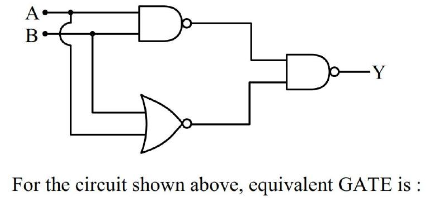
Answer(A)
Sol.$\Rightarrow$ OR Gate View full question & answer→MCQ 84 Marks
The fractional compression $\left(\frac{\Delta V}{V}\right)$ of water at the depth of 2.5 km below the sea level is___________ %. Given, the Bulk modulus of water $=2 \times 10^{9} \mathrm{Nm}^{-2}$, density of water $=10^{3} \mathrm{~kg} \mathrm{~m}^{-3}$, acceleration due to gravity $=\mathrm{g}=10 \mathrm{~ms}^{-2}$.
Answer(D)
Sol.
$ B=\frac{\rho g h}{\left(\frac{\Delta v}{v}\right)}$
$\frac{\Delta \mathrm{v}}{\mathrm{v}} \times 100=\frac{\rho \mathrm{gh}}{\mathrm{B}} \times 100$
$\frac{1000 \times 10 \times 2.5 \times 10^{3}}{2 \times 10^{9}} \times 100 \%$
$=1.25 \%$
View full question & answer→MCQ 94 Marks
A coil of area A and N turns is rotating with angular velocity $\omega$ in a uniform magnetic field $\vec{B}$ about an axis perpendicular to $\vec{B}$. Magnetic flux $\varphi$ and induced emf $\varepsilon$ across it, at an instant when $\overrightarrow{\mathrm{B}}$ is parallel to the plane of coil, are :
- A
$\varphi=\mathrm{AB}, \varepsilon=0$
- ✓
$\varphi=0, \varepsilon=\mathrm{NAB} \omega$
- C
$\varphi=0, \varepsilon=0$
- D
$\varphi=\mathrm{AB}, \varepsilon=\mathrm{NAB} \omega$
AnswerCorrect option: B. $\varphi=0, \varepsilon=\mathrm{NAB} \omega$
(B)
Sol.
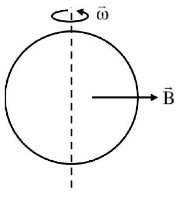
$\phi=\mathrm{BAN} \cdot \cos (\omega \mathrm{t})$
$\varepsilon=\frac{-\mathrm{d} \phi}{\mathrm{dt}}=\mathrm{BA} \omega \mathrm{N} \cdot \sin (\omega \mathrm{t})$
When $B$ is parallel to plane, $\underline{\underline{\omega}} \mathrm{t}=\frac{\pi}{2}$
$\Rightarrow \phi=0, \varepsilon=\mathrm{BA} \omega \mathrm{N}$
View full question & answer→MCQ 104 Marks
Given below are two statements: one is labelled as Assertion (A) and the other is labelled as Reason (R).
Assertion (A) : Emission of electrons in photoelectric effect can be suppressed by applying a sufficiently negative electron potential to the photoemissive substance.
Reason (R): A negative electric potential, which stops the emission of electrons from the surface of a photoemissive substance, varies linearly with frequency of incident radiation.
In the light of the above statements, choose the most appropriate answer from the options given below:
AnswerCorrect option: D. Both (A) and (R) are true but ( $\mathbf{R}$ ) is not the correct explanation of (A).
(D)
Sol.
(A) : True
(B) : True but not correct explanation
View full question & answer→MCQ 114 Marks
As shown below, bob $A$ of a pendulum having massless string of length ' R ' is released from $60^{\circ}$ to the vertical. It hits another bob B of half the mass that is at rest on a friction less table in the centre. Assuming elastic collision, the magnitude of the velocity of bob A after the collision will be (take $g$ as acceleration due to gravity)
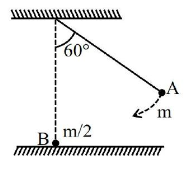
AnswerCorrect option: A. $\frac{1}{3} \sqrt{\mathrm{Rg}}$
(A)
Sol.
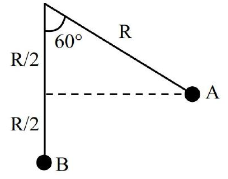
Velocity of a just before hitting :
$u=\sqrt{2 g \frac{R}{2}}=\sqrt{g R}$
Just after collision, let velocity of $A$ and $B$ are $v_{1}$ and $v_{2}$ respectively
$\therefore$ by COM:
$\mathrm{mu}=\mathrm{mv}_{1}+\frac{\mathrm{m}}{2} \mathrm{v}_{2}$
$2 \mathrm{v}_{1}+\mathrm{v}_{2}=2 \mathrm{u}\qquad\ldots(i)$
$\mathrm{e}=1=\frac{\mathrm{v}_{2}-\mathrm{v}_{1}}{\mathrm{u}}$
$\Rightarrow \mathrm{v}_{2}-\mathrm{v}_{1}=\mathrm{u}\qquad\ldots(ii)$
From (i) -(ii)
$\Rightarrow 3 \mathrm{v}_{1}=\mathrm{u}\ \Rightarrow \mathrm{v}_{\mathrm{t}}=\frac{\mathrm{u}}{3}=\frac{1}{3} \sqrt{\mathrm{gR}}$ View full question & answer→MCQ 124 Marks
Consider a long straight wire of a circular cross-section (radius a) carrying a steady current I. The current is uniformly distributed across this cross-section. The distances from the centre of the wire's cross-section at which the magnetic field [inside the wire, outside the wire] is half of the maximum possible magnetic field, any where due to the wire, will be
- A
$[a / 4,3 a / 2]$
- ✓
$[a / 2,2 a]$
- C
$[a / 2,3 a]$
- D
$[a / 4,2 a]$
AnswerCorrect option: B. $[a / 2,2 a]$
(B)
Sol. Maximum possible magnetic field is at the surface
$B_{\max }=\frac{\mu_{0} I}{2 \pi \mathrm{a}}$
$\frac{\mathrm{B}_{\max }}{2}=\frac{\mu_{0} \mathrm{I}}{4 \pi \mathrm{a}}$
It can be obtained inside as well as outside the wire For inside,
$\frac{\mu_{0} \mathrm{I}}{4 \pi \mathrm{a}}=\frac{\mu_{0} \mathrm{Ir}}{2 \pi \mathrm{a}^{2}}$
$\Rightarrow \mathrm{r}=\frac{\mathrm{a}}{2}$
For outside
$\frac{\mu_{0} \mathrm{I}}{4 \pi \mathrm{a}}=\frac{\mu_{0} \mathrm{I}}{2 \pi \mathrm{r}}$
$\Rightarrow \mathrm{r}=2 \mathrm{a}$
Correct answer $\left[\frac{\mathrm{a}}{2}, 2 \mathrm{a}\right]$
View full question & answer→MCQ 134 Marks
At the interface between two materials having refractive indices $n_{1}$ and $n_{2}$, the critical angle for reflection of an em wave is $\theta_{1 C}$. The $n_{2}$ material is replaced by another material having refractive index $n_{3}$, such that the critical angle at the interface between $n_{1}$ and $n_{3}$ materials is $\theta_{2 C}$. If $n_{3}>n_{2}>n_{1}$; $\frac{\mathrm{n}_{2}}{\mathrm{n}_{3}}=\frac{2}{5}$ and $\sin \theta_{2 \mathrm{C}}-\sin \theta_{1 \mathrm{C}}=\frac{1}{2}$, then $\theta_{1 \mathrm{C}}$ is
- A
$\sin ^{-1}\left(\frac{1}{6 n_{1}}\right)$
- B
$\sin ^{-1}\left(\frac{2}{3 n_{1}}\right)$
- C
$\sin ^{-1}\left(\frac{5}{6 n_{1}}\right)$
- ✓
$\sin ^{-1}\left(\frac{1}{3 \mathrm{n}_{1}}\right)$
AnswerCorrect option: D. $\sin ^{-1}\left(\frac{1}{3 \mathrm{n}_{1}}\right)$
(D)
Sol.
$\sin \theta_{1 \mathrm{C}}=\frac{\mathrm{n}_{1}}{\mathrm{n}_{2}}$
$\sin \theta_{2 C}=\frac{n_{1}}{n_{3}}$
$\sin \theta_{2 \mathrm{C}}-\sin \theta_{1 \mathrm{C}}=\frac{1}{2}$
$\mathrm{n}_{1} \frac{\mathrm{n}_{2}}{\mathrm{n}_{3}}-\frac{\mathrm{n}_{1}}{\mathrm{n}_{2}}=\frac{1}{2}$
$\mathrm{n}_{1} \frac{\mathrm{n}_{2}}{\mathrm{n}_{3}}-\mathrm{n}_{1}=\frac{\mathrm{n}_{2}}{2}$
$\mathrm{n}_{1}\left(\frac{2}{5}-1\right)=\frac{\mathrm{n}_{2}}{2}$
$\frac{\mathrm{n}_{1}}{\mathrm{n}_{2}}=\frac{-5}{6}$
$=\sin ^{-1}\left(-\frac{5}{6}\right)$
View full question & answer→MCQ 144 Marks
Consider $I_{1}$ and $I_{2}$ are the currents flowing simultaneously in two nearby coils $1 \& 2$, respectively. If $L_{1}=$ self inductance of coil 1 , $\mathrm{M}_{12}=$ mutual inductance of coil 1 with respect to coil 2 , then the value of induced emf in coil 1 will be
- A
$\varepsilon_{1}=-L_{1} \frac{d I_{1}}{d t}+M_{12} \frac{d I_{2}}{d t}$
- B
$\varepsilon_{1}=-\mathrm{L}_{1} \frac{\mathrm{dI}_{1}}{\mathrm{dt}}-\mathrm{M}_{12} \frac{\mathrm{dI}_{1}}{\mathrm{dt}}$
- ✓
$\varepsilon_{1}=-\mathrm{L}_{1} \frac{\mathrm{dI}_{1}}{\mathrm{dt}}-\mathrm{M}_{12} \frac{\mathrm{dI}_{2}}{\mathrm{dt}}$
- D
$\varepsilon_{1}=-\mathrm{L}_{1} \frac{\mathrm{dI}_{2}}{\mathrm{dt}}-\mathrm{M}_{12} \frac{\mathrm{dI}_{1}}{\mathrm{dt}}$
AnswerCorrect option: C. $\varepsilon_{1}=-\mathrm{L}_{1} \frac{\mathrm{dI}_{1}}{\mathrm{dt}}-\mathrm{M}_{12} \frac{\mathrm{dI}_{2}}{\mathrm{dt}}$
(C)
Sol.
$\phi_{1}=L_{1} I_{1}+M_{12} I_{2}$
$\varepsilon_{1}=-\frac{\mathrm{d} \phi_{1}}{\mathrm{dt}}=-\mathrm{L}_{1} \frac{\mathrm{dI}_{1}}{\mathrm{dt}}-\mathrm{M}_{12} \frac{\mathrm{dI}_{2}}{\mathrm{dt}}$
View full question & answer→MCQ 154 Marks
The expression given below shows the variation of velocity ( $v$ ) with time ( t ), $v=\mathrm{At}^{2}+\frac{\mathrm{Bt}}{\mathrm{C}+\mathrm{t}}$. The dimension of ABC is :
- ✓
$\left[\mathrm{M}^{0} \mathrm{~L}^{2} \mathrm{~T}^{-3}\right]$
- B
$\left[\mathrm{M}^{0} \mathrm{~L}^{1} \mathrm{~T}^{-3}\right]$
- C
$\left[\mathrm{M}^{0} \mathrm{~L}^{1} \mathrm{~T}^{-2}\right]$
- D
$\left[\mathrm{M}^{0} \mathrm{~L}^{2} \mathrm{~T}^{-2}\right]$
AnswerCorrect option: A. $\left[\mathrm{M}^{0} \mathrm{~L}^{2} \mathrm{~T}^{-3}\right]$
(A)
Sol.
$\left[\mathrm{LT}^{-1}\right]=[\mathrm{A}]\left[\mathrm{T}^{2}\right]=\frac{[\mathrm{B}][\mathrm{T}]}{[\mathrm{C}]+[\mathrm{T}]}$
$[\mathrm{C}]=[\mathrm{T}]$
$[\mathrm{A}]=\left[\mathrm{LT}^{-3}\right]$
$[\mathrm{B}]=\left[\mathrm{LT}^{-1}\right]$
$[\mathrm{ABC}]=\left[\mathrm{L}^{2} \mathrm{~T}^{-3}\right]$
View full question & answer→MCQ 164 Marks
Given below are two statements: one is labelled as Assertion (A) and the other is labelled as Reason (R).
Assertion (A) : Time period of a simple pendulum is longer at the top of a mountain than that at the base of the mountain.
Reason (R): Time period of a simple pendulum decreases with increasing value of acceleration due to gravity and vice-versa.
In the light of the above statements, choose the most appropriate answer from the options given below:
AnswerCorrect option: B. Both (A) and (R) are true and (R) is the correct explanation of (A).
(B)
Sol.
As $h$ increases, $g$ decreases, $T$ increases
$T =2 \pi \sqrt{\frac{\ell}{g}}$
$g=\frac{g_0 R^2}{(R+h)^2}$
View full question & answer→MCQ 174 Marks
The pair of physical quantities not having same dimensions is :
- A
- ✓
Surface tension and impulse
- C
Angular momentum and Planck's constant
- D
Pressure and Young's modulus
AnswerCorrect option: B. Surface tension and impulse
(B)
Sol.
$[\tau]=[\mathrm{E}]$
$[\sigma] \neq[\mathrm{I}]$
$[\mathrm{L}]=[\mathrm{h}]$
$[\mathrm{P}]=[\mathrm{Y}]$
View full question & answer→MCQ 184 Marks
An electric dipole of mass $m$, charge $q$, and length $l$ is placed in a uniform electric field $\overrightarrow{\mathrm{E}}=\mathrm{E}_{0} \hat{\mathrm{i}}$. When the dipole is rotated slightly from its equilibrium position and released, the time period of its oscillations will be :
- A
$\frac{1}{2 \pi} \sqrt{\frac{2 \mathrm{~m} l}{\mathrm{qE}_{0}}}$
- B
$2 \pi \sqrt{\frac{\mathrm{~m} l}{\mathrm{qE}_{0}}}$
- C
$\frac{1}{2 \pi} \sqrt{\frac{\mathrm{~m} l}{2 \mathrm{qE}_{0}}}$
- ✓
$2 \pi \sqrt{\frac{m l}{2 q E_{0}}}$
AnswerCorrect option: D. $2 \pi \sqrt{\frac{m l}{2 q E_{0}}}$
(D)
Sol.
$\mathrm{I} \omega 2 \theta=\mathrm{q} \ell \mathrm{E}_{0} \theta$
$2 \mathrm{~m}\left(\frac{\ell}{2}\right)^{2} \omega^{2}=\mathrm{q} \ell \mathrm{E}_{0}$
$\omega^{2}=\frac{2 \mathrm{qE}_{0}}{\mathrm{~m} \ell}$
$\mathrm{T}=2 \pi \sqrt{\frac{\mathrm{~m} \ell}{2 \mathrm{qE}_{0}}}$
View full question & answer→MCQ 194 Marks
Two projectiles are fired with same initial speed from same point on ground at angles of $\left(45^{\circ}-\alpha\right)$ and $\left(45^{\circ}+\alpha\right)$, respectively, with the horizontal direction. The ratio of their maximum heights attained is :
- A
$\frac{1-\tan \alpha}{1+\tan \alpha}$
- B
$\frac{1+\sin \alpha}{1-\sin \alpha}$
- ✓
$\frac{1-\sin 2 \alpha}{1+\sin 2 \alpha}$
- D
$\frac{1+\sin 2 \alpha}{1-\sin 2 \alpha}$
AnswerCorrect option: C. $\frac{1-\sin 2 \alpha}{1+\sin 2 \alpha}$
(C)
Sol.
$H_{M a x}=\frac{(u \sin \theta)^{2}}{2 g}$
$\frac{\left(\mathrm{H}_{\max }\right)_{1}}{\left(\mathrm{H}_{\max }\right)_{2}}=\frac{\mathrm{u}^{2} \sin ^{2}(45-\alpha)}{\mathrm{u}^{2} \sin ^{2}(45+\alpha)}$
$=\frac{\left(\frac{1}{\sqrt{2}} \cos \alpha-\frac{1}{\sqrt{2}} \sin \alpha\right)^{2}}{\left(\frac{1}{\sqrt{2}} \cos \alpha+\frac{1}{\sqrt{2}} \sin \alpha\right)^{2}}$
$=\frac{1-\sin 2 \alpha}{1+\sin 2 \alpha}$
View full question & answer→MCQ 204 Marks
Given below are two statements : one is labelled as Assertion (A) and the other is labelled as Reason (R).
Assertion (A) : Choke coil is simply a coil having a large inductance but a small resistance. Choke coils are used with fluorescent mercury-tube fittings. If household electric power is directly connected to a mercury tube, the tube will be damaged.
Reason (R): By using the choke coil, the voltage across the tube is reduced by a factor $\left(R / \sqrt{R^{2}+\omega^{2} L^{2}}\right)$, where $\omega$ is frequency of the supply across resistor R and inductor L . If the choke coil were not used, the voltage across the resistor would be the same as the applied voltage.
In the light of the above statements, choose the most appropriate answer from the options given below:
AnswerCorrect option: C. Both (A) and (R) are true and $(\mathbf{R})$ is the correct explanation of (A).
(C)
Sol. A: Correct
B : Correct with correct explanation
View full question & answer→