MCQ
At the interface between two materials having refractive indices $n_{1}$ and $n_{2}$, the critical angle for reflection of an em wave is $\theta_{1 C}$. The $n_{2}$ material is replaced by another material having refractive index $n_{3}$, such that the critical angle at the interface between $n_{1}$ and $n_{3}$ materials is $\theta_{2 C}$. If $n_{3}>n_{2}>n_{1}$; $\frac{\mathrm{n}_{2}}{\mathrm{n}_{3}}=\frac{2}{5}$ and $\sin \theta_{2 \mathrm{C}}-\sin \theta_{1 \mathrm{C}}=\frac{1}{2}$, then $\theta_{1 \mathrm{C}}$ is
  • A
    $\sin ^{-1}\left(\frac{1}{6 n_{1}}\right)$
  • B
    $\sin ^{-1}\left(\frac{2}{3 n_{1}}\right)$
  • C
    $\sin ^{-1}\left(\frac{5}{6 n_{1}}\right)$
  • $\sin ^{-1}\left(\frac{1}{3 \mathrm{n}_{1}}\right)$
Answer

Correct option: D.
$\sin ^{-1}\left(\frac{1}{3 \mathrm{n}_{1}}\right)$
(D)
Sol.
$\sin \theta_{1 \mathrm{C}}=\frac{\mathrm{n}_{1}}{\mathrm{n}_{2}}$
$\sin \theta_{2 C}=\frac{n_{1}}{n_{3}}$
$\sin \theta_{2 \mathrm{C}}-\sin \theta_{1 \mathrm{C}}=\frac{1}{2}$
$\mathrm{n}_{1} \frac{\mathrm{n}_{2}}{\mathrm{n}_{3}}-\frac{\mathrm{n}_{1}}{\mathrm{n}_{2}}=\frac{1}{2}$
$\mathrm{n}_{1} \frac{\mathrm{n}_{2}}{\mathrm{n}_{3}}-\mathrm{n}_{1}=\frac{\mathrm{n}_{2}}{2}$
$\mathrm{n}_{1}\left(\frac{2}{5}-1\right)=\frac{\mathrm{n}_{2}}{2}$
$\frac{\mathrm{n}_{1}}{\mathrm{n}_{2}}=\frac{-5}{6}$
$=\sin ^{-1}\left(-\frac{5}{6}\right)$

Need a full question paper?

Generate a complete, print-ready paper with questions like this in minutes — across 16+ boards, with answer keys.

Start Generating Free

Similar questions

A simple pendulum with a metallic bob has a time period $T$. The bob is now immersed in a non-viscous liquid and oscillated. If the density of the liquid is $1 / 4$ that of metal, the time period of the same pendulum will be ...........
A stone is dropped from a height $h$. Simultaneously, another stone is thrown up from the ground which reaches a height $4 \,h$. The two stones cross each other after time
A student studying the similarities and differences between a camera and the human eye makes the following observations:

$I$. Both the eye and the camera have convex lenses.

$II$. In order to focus, the eye lens expands or contracts while the camera lens moves forward or backward.

$III$. The camera lens produces upside down real images while the eye lens produces only upright real images.

$IV$. A screen in camera is equivalent to the retina in the eyes.

$V$. A camera adjusts the amount of light entering in it by adjusting the aperture of the lens. In the eye, the cornea controls the amount of light. Which of the above statements are correct?

If the radius of curvature of the path of two particles of same mass are in the ratio $3:4,$ then in order to have constant centripetal force, their velocities will be in the ratio of:
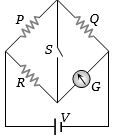
In the circuit shown $P \ne R$, the reading of the galvanometer is same with switch $S$ open or closed. Then
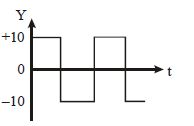
The $r.m.s.$ voltage of the wave form shown is
Nuclear reactions are given as $(i)$ ${(n,\;p)_{15}}{p^{32}}$ $(ii)$ ${(p,\;\alpha )_8}{O^{16}}$ $(iii)$ $_7{N^{14}}$ $( p)$ $_6{C^{14}}$ missing particle or nuclide (in $box$ ) in these reactions are respectively
An object is placed in front of a spherical mirror whose $2\, times$ magnified image is formed on screen. Then choose $CORRECT$ option
A spring $40 \,mm$ long is stretched by the application of a force. If $10 \,N$ force required to stretch the spring through $1 \,mm$, then work done in stretching the spring through $40\, mm$ is ............. $\mathrm{J}$
The wavelength of ultrasonic waves in air is of the order of