MCQ 14 Marks
If for the solution curve $y=f(x)$ of the differential equation $\frac{d y}{d x}+(\tan x) y=\frac{2+\sec x}{(1+2 \sec x)^2}$,
$x \in\left(\frac{-\pi}{2}, \frac{\pi}{2}\right), f\left(\frac{\pi}{3}\right)=\frac{\sqrt{3}}{10}$, then $f\left(\frac{\pi}{4}\right)$ is equal to:
- A
$\frac{9 \sqrt{3}+3}{10(4+\sqrt{3})}$
- B
$\frac{\sqrt{3}+1}{10(4+\sqrt{3})}$
- C
$\frac{5-\sqrt{3}}{2 \sqrt{2}}$
- ✓
$\frac{4-\sqrt{2}}{14}$
AnswerCorrect option: D. $\frac{4-\sqrt{2}}{14}$
(D) $\frac{4-\sqrt{2}}{14}$
$
\begin{array}{l}Sol.\
\text { If } e^{\int \tan x d x}=e^{(n(\sec x)}=\sec x \\
\therefore y \cdot \sec x=\int\left\{\frac{2+\sec x}{(1+2 \sec x)^2}\right\} \sec x d x \\
=\int \frac{2 \cos x+1}{(\cos x+2)^2} d x \text { Let } \cos x=\frac{1-t^2}{1+t^2} \\
=\int \frac{2\left(\frac{1-t^2}{1+t^2}\right)+1}{\left(\frac{1-t^2}{1+t^2}+2\right)^2} 2 d t \\
=\int \frac{2-2 t^2+1+t^2}{\left(1-t^2+2+2 t^2\right)^2} \times 2 d t \\
=2 \int \frac{3-t^2}{\left(t^2+3\right)^2} d t
\end{array}
$
Let $t +\frac{3}{ t }= u$
$
\begin{array}{l}
\left(1-\frac{3}{t^2}\right) dt=du \\
=-2 \int \frac{du}{u^2}
\end{array}
$
$
\begin{array}{l}
y \cdot(\sec x)=\frac{2}{u}+c \\
y \cdot \sec x=\frac{2}{t+\frac{3}{t}}+c \\
\text { At } x=\frac{\pi}{3}, t=\tan \frac{x}{2}=\frac{1}{\sqrt{3}} \\
2 \cdot \frac{\sqrt{3}}{10}=\frac{2}{\frac{1}{\sqrt{3}}+3 \sqrt{3}}+c \\
2 \cdot \frac{\sqrt{3}}{10}=\frac{2 \sqrt{3}}{10}+c \Rightarrow C=0
\end{array}
$
$\begin{array}{l}\text { At } x=\frac{\pi}{4}, t =\tan \frac{x}{2}=\sqrt{2}-1 \\ \therefore y \cdot \sqrt{2}=\frac{2}{\sqrt{2}-1+\frac{3}{\sqrt{2}-1}} \\ y \cdot \sqrt{2}=\frac{2(\sqrt{2}-1)}{6-2 \sqrt{2}} \\ y=\frac{\sqrt{2}(\sqrt{2}-1)}{2(3-\sqrt{2})}=\frac{1}{\sqrt{2}} \times \frac{2 \sqrt{2}-1}{7} \\ =\frac{4-\sqrt{2}}{14}\end{array}$
View full question & answer→MCQ 24 Marks
Let â be a unit vector perpendicular to the vectors $\overrightarrow{ b }=\hat{ i }-2 \hat{ j }+3 \hat{ k }$ and $\overrightarrow{ c }=2 \hat{ i }+3 \hat{ j }-\hat{ k }$, and makes an angle of $\cos ^{-1}\left(-\frac{1}{3}\right)$ with the vector $\hat{ i }+\hat{ j }+\hat{ k }$. If $\hat{ a }$ makes an angle of $\frac{\pi}{3}$ with the vector $\hat{ i }+\alpha \hat{ j }+\hat{ k }$, then the value of $\alpha$ is :
- A
$-\sqrt{3}$
- B
$\sqrt{6}$
- ✓
$-\sqrt{6}$
- D
$\sqrt{3}$
AnswerCorrect option: C. $-\sqrt{6}$
(C) $-\sqrt{6}$
Sol. Let $\overrightarrow{ v }=\hat{ i }+\hat{ j }+\hat{ k }$
$
\begin{array}{l}
\overrightarrow{b} \times \overrightarrow{c}=\left|\begin{array}{ccc}
\hat{i} & \hat{j} & \hat{k} \\
1 & -2 & 3 \\
2 & 3 & -1
\end{array}\right| \\
=-7 \hat{i}+7 \hat{j}+7 \hat{k} \\
=-7(\hat{i}-\hat{j}-\hat{k})
\end{array}
$
Now $\hat{ a }=\frac{\hat{ i }-\hat{ j }-\hat{ k }}{\sqrt{3}}$ or $\frac{-\hat{ i }+\hat{ j }+\hat{ k }}{\sqrt{3}}$$
\cos \theta=\frac{\hat{a} . \overrightarrow{v}}{|\overrightarrow{v}|}=\frac{1-1-1}{\sqrt{3} \sqrt{3}}=\frac{-1}{3} \quad \cos \theta=\frac{\frac{a}{a} \vec{v}}{|\overrightarrow{v}|}=\frac{-1+1+1}{3}=\frac{1}{3}
$
$\Rightarrow \hat{ a }=\frac{\hat{ i }-\hat{ j }-\hat{ k }}{\sqrt{3}}$
$\begin{array}{l}\text { Now } \cos \frac{\pi}{3}=\frac{\hat{ a } \cdot(\hat{ i }+\alpha \hat{ j }+\hat{ k })}{\sqrt{1+\alpha^2+1}} \\ \Rightarrow \frac{1}{2}=\frac{1-\alpha-1}{\sqrt{3} \sqrt{\alpha^2+2}} \\ \Rightarrow \frac{\sqrt{3}}{2} \sqrt{\alpha^2+2}=-\alpha \quad(\therefore \alpha<0) \\ 3 \alpha^2+6=4 \alpha^2 \\ \Rightarrow \alpha=-\sqrt{6}\end{array}$
View full question & answer→MCQ 34 Marks
Let $f(x)=\int_0^x t\left(t^2-9 t+20\right) d t, \quad 1 \leq x \leq 5$. If the range of $f$ is $[\alpha, \beta]$, then $4(\alpha+\beta)$ equals:
Answer(A) 147
Sol. $f^{\prime}(x)=x^3-9 x^2+20 x=x(x-4)(x-5)$
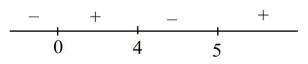
$\begin{array}{l}\therefore f(x)=\frac{x^4}{4}-\frac{9 x^3}{3}+\frac{20 x^2}{2} \\ f(1)=\frac{1}{4}-3+10=\frac{29}{4}=\alpha \\ \left.f(4)=\frac{256}{4}-3(64) \right\rvert\,+10(16)=32=\beta \\ 4(\alpha+\beta)=4\left(\frac{29}{4}+32\right)=157\end{array}$ View full question & answer→MCQ 44 Marks
The remainder, when $7^{103}$ is divided by 23 , is equal to:
Answer(A) 14
$
\begin{array}{l}Sol.\
7^{103}=7\left(7^{102}\right)=7(343)^{44}=7(345-2)^{34} \\
7^{103}=23 K_1+7.2^{44} \\
\text { Now } 7.2^{34}=7 \cdot 2^2 \cdot 2^{12} \\
=28 \cdot(256)^4 \\
=28(253+3)^4 \\
\therefore 28 \times 81 \Rightarrow(23+5)(69+12) \\
23 K_2+60 \\
\therefore \text { Remainder }=14
\end{array}
$
View full question & answer→MCQ 54 Marks
Bag 1 contains 4 white balls and 5 black balls, and Bag 2 contains n white balls and 3 black balls. One ball is drawn randomly from Bag 1 and transferred to Bag 2. A ball is then drawn randomly from Bag 2. If the probability, that the ball drawn is white, is $29 / 45$, then n is equal to:
Answer(D) 6
$
\begin{array}{l}Sol.\
\text { Bag } 1=\{4 W, 5 B\} \\
\text { Bag } 2=\{nW, 3 B\} \\
P\left(\frac{W}{Bag 2}\right)=\frac{29}{45} \\
\Rightarrow P\left(\frac{W}{B_1}\right) \times P\left(\frac{W}{B_2}\right)+P\left(\frac{B}{B_1}\right) \times P\left(\frac{W}{B_2}\right)=\frac{29}{45} \\
\frac{4}{9} \times \frac{n+1}{n+4}+\frac{5}{9} \times \frac{n}{n+4}=\frac{29}{45} \\
n=6
\end{array}
$
View full question & answer→MCQ 64 Marks
Let $A=\left[a_{i j}\right]$ be a $2 \times 2$ matrix such that $a_{i j} \in\{0,1\}$ for all i and j . Let the random variable X denote the possible values of the determinant of the matrix A . Then, the variance of X is:
- A
$\frac{1}{4}$
- ✓
$\frac{3}{8}$
- C
$\frac{5}{8}$
- D
$\frac{3}{4}$
AnswerCorrect option: B. $\frac{3}{8}$
(B) $\frac{3}{8}$
Sol.
$\begin{aligned} & |A|=\left|\begin{array}{ll}a_{11} & a_{12} \\ a_{21} & a_{22}\end{array}\right| \\ & =a_{11} a_{22}-a_{21} a_{12} \\ & =\{-1,0,1\}\end{aligned}$
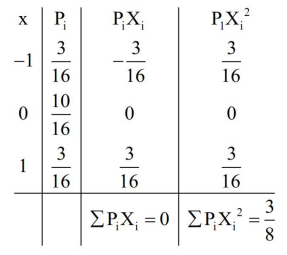
$\begin{array}{l}\therefore \operatorname{var}(x)=\sum P_i X_i^2-\left(\sum P_i X_i\right)^2 \\ =\frac{3}{8}-0=\frac{3}{8}\end{array}$ View full question & answer→MCQ 74 Marks
Let a circle C pass through the points $(4,2)$ and $(0$, 2 ), and its centre lie on $3 x+2 y+2=0$. Then the length of the chord, of the circle C , whose midpoint is $(1,2)$, is:
- A
$\sqrt{3}$
- ✓
$2 \sqrt{3}$
- C
$4 \sqrt{2}$
- D
$2 \sqrt{2}$
AnswerCorrect option: B. $2 \sqrt{3}$
(B) $2 \sqrt{3}$
Sol.
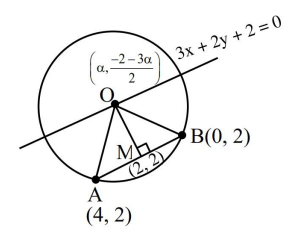
$\begin{array}{l} M _{A B}=0 \Rightarrow OM \text { is vertical } \\ \Rightarrow \alpha=2 \\ \therefore \text { Centre }(0)=(2,-4) \\ \quad r = OA =\sqrt{(2-4)^2+(2+4)^2}=\sqrt{40} \\ \text { mid point of chord is } N =(1,2) \therefore ON =\sqrt{37} \\ \therefore \text { length of chord }=2 \sqrt{r^2-( ON )^2} \\ \qquad=2 \sqrt{40-37}=2 \sqrt{3}\end{array}$ View full question & answer→MCQ 84 Marks
Let P be the foot of the perpendicular from the point $(1,2,2)$ on the line $L: \frac{x-1}{1}=\frac{y+1}{-1}=\frac{z-2}{2}$. Let the line $\overrightarrow{ r }=(-\hat{ i }+\hat{ j }-2 \hat{ k })+\lambda(\hat{ i }-\hat{ j }+\hat{ k }), \lambda \in R$, intersect the line L at Q . Then $2( PQ )^2$ is equal to:
Answer(A) 27
Sol.
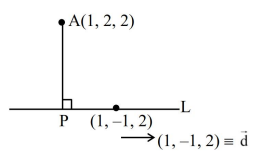
$
\begin{array}{l}
L: \frac{x-1}{1}=\frac{y+1}{-1}=\frac{z-2}{2}=\mu \\
P(\mu+1,-\mu-1,2 \mu+2) \\
\overrightarrow{AP} \cdot \overrightarrow{d}=0 \Rightarrow(\mu,-\mu-3,2 \mu) \cdot(1,-1,2)=0 \\
\Rightarrow \mu+\mu+3+4 \mu=0 \Rightarrow \mu=-\frac{1}{2} \\
\therefore P\left(\frac{-1}{2}+1,+\frac{1}{2}-1,2\left(\frac{-1}{2}\right)+2\right) \\
P\left(\frac{1}{2}, \frac{-1}{2}, 1\right)
\end{array}
$
Now general pt. on $L _2$ is $Q (-1+\lambda, 1-\lambda,-2+\lambda)$
Equate it with general pt of L
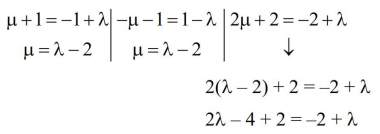
$\begin{array}{l}\therefore \quad \mu=-2, \lambda=0 \\ \therefore \quad Q \equiv(-1,1-2) \\ P \left(\frac{1}{2}, \frac{-1}{2}, 1\right) \text { and } Q (-1,1,-2) \\ PQ =\sqrt{\left(\frac{1}{2}+1\right)^2+\left(\frac{-1}{2}-1\right)^2+(1+2)^2} \\ \quad=\sqrt{\frac{9}{4}+\frac{9}{4}+9}=\sqrt{\frac{54}{4}} \\ \therefore \quad 2( PQ )^2=2\left(\frac{54}{4}\right)=27\end{array}$ View full question & answer→MCQ 94 Marks
Let $A =\left[ a _{ i }\right]$ be a matrix of order $3 \times 3$, with $a _{ ij }=(\sqrt{2})^{ i + j }$. If the sum of all the elements in the third row of $A ^2$ is $\alpha+\beta \sqrt{2}, \alpha, \beta \in Z$, then $\alpha+\beta$ is equal to
Answer(D) 224
Sol.
$
\begin{array}{l}
A=\left[\begin{array}{lll}
(\sqrt{2})^2 & (\sqrt{2})^3 & (\sqrt{2})^4 \\
(\sqrt{2})^3 & (\sqrt{2})^4 & (\sqrt{2})^5 \\
(\sqrt{2})^4 & (\sqrt{2})^5 & (\sqrt{2})^6
\end{array}\right] \\
A=\left[\begin{array}{ccc}
2 & 2 \sqrt{2} & 4 \\
2 \sqrt{2} & 4 & 4 \sqrt{2} \\
4 & 4 \sqrt{2} & 8
\end{array}\right] \\
A^2=2^2\left[\begin{array}{ccc}
1 & \sqrt{2} & 2 \\
\sqrt{2} & 2 & 2 \sqrt{2} \\
2 & 2 \sqrt{2} & 4
\end{array}\right]\left[\begin{array}{ccc}
1 & \sqrt{2} & 2 \\
\sqrt{2} & 2 & 2 \sqrt{2} \\
2 & 2 \sqrt{2} & 4
\end{array}\right]
\end{array}
$$
=4\left[\begin{array}{ccc}
- & - & - \\
- & - & - \\
(2+4+8) & (2 \sqrt{2}+4 \sqrt{2}+8 \sqrt{2}) & (4+8+16)
\end{array}\right]
$
Sum of elements of $3^{\text {rd }}$ row $=4(14+14 \sqrt{2}+28)$
$
\begin{aligned}
& =4(42+14 \sqrt{2}) \\
& =168+56 \sqrt{2} \\
& \alpha+\beta \sqrt{2} \\
\therefore \alpha & \alpha+\beta=168+56=224
\end{aligned}
$
View full question & answer→MCQ 104 Marks
Let $\alpha, \beta(\alpha \neq \beta)$ be the values of $m$, for which the equations $x+y+z=1 ; x+2 y+4 z=m$ and $x+4 y+10 z=m^2$ have infinitely many solutions. Then the value of $\sum_{n=1}^{10}\left(n^\alpha+n^\beta\right)$ is equal to :
Answer(A) 440
Sol.
$ \begin{aligned} \Delta & =\left|\begin{array}{ccc} 1 & 1 & 1 \\ 1 & 2 & 4 \\ 1 & 4 & 10 \end{array}\right|=1(20-16)-1(10-4)+1(4-2) \\ & =4-6+2=0 \end{aligned} $
For infinite solutions
$
\begin{array}{l}
\Delta_{x}=\Delta_y=\Delta_x=0 \\
m^2-3 x+2=0 \\
m=1,2 \\
\alpha=1, \beta=2 \\
\therefore \sum_{n=1}^{10}\left(n^\alpha+n^\beta\right)=\sum_{n=1}^{10} n^1+\sum_{n=1}^{10} n^2 \\
= \frac{10(11)}{2}+\frac{10(11)(21)}{6} \\
= 55+385 \\
= 440
\end{array}
$
View full question & answer→MCQ 114 Marks
If all the words with or without meaning made using all the letters of the word "KANPUR" are arranged as in a dictionary, then the word at $440^{\text {th }}$ position in this arrangement, is :
Answer(C) PRKAUN
Sol.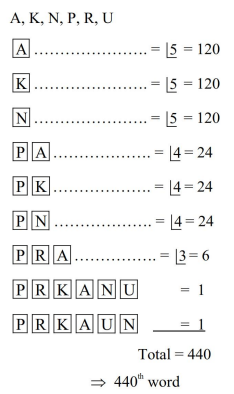
View full question & answer→MCQ 124 Marks
If $\alpha x+\beta y=109$ is the equation of the chord of the ellipse $\frac{x^2}{9}+\frac{y^2}{4}=1$, whose mid point is $\left(\frac{5}{2}, \frac{1}{2}\right)$, then $\alpha+\beta$ is equal to
Answer(C) 58
Sol.
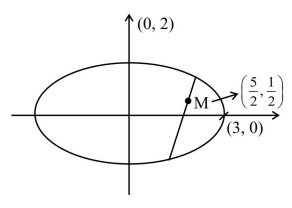
Equation of chord $T = S _1$
$
\begin{array}{l}
\frac{5}{2}\left(\frac{x}{9}\right)+\frac{1}{2}\left(\frac{y}{4}\right)=\frac{25}{36}+\frac{1}{16} \\
\Rightarrow \frac{5 x}{18}+\frac{y}{8}=\frac{100+9}{144}=\frac{109}{144} \\
\Rightarrow 40 x+18 y=109 \\
\Rightarrow \alpha=40, \beta=18 \\
\Rightarrow \alpha+\beta=58
\end{array}
$ View full question & answer→MCQ 134 Marks
Let the line $x+y=1$ meet the axes of $x$ and $y$ at $A$ and $B$, respectively. A right angled triangle AMN is inscribed in the triangle OAB , where O is the origin and the points M and N lie on the lines OB and $A B$, respectively. If the area of the triangle AMN is $\frac{4}{9}$ of the area of the triangle OAB and $AN : NB =\lambda: 1$, then the sum of all possible value(s) of is $\lambda$ :
- A
$\frac{1}{2}$
- B
$\frac{13}{6}$
- C
$\frac{5}{2}$
- ✓
Answer(D) 2
Sol.
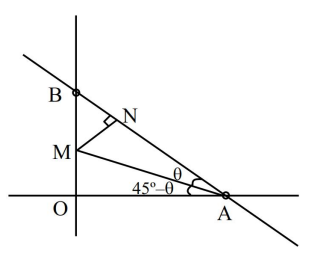
Area of $\triangle AOB =\frac{1}{2}$
Area of $\triangle AMN =\frac{4}{9} \times \frac{1}{2}=\frac{2}{9}$
Equation of AB is $x + y =1$
$
\begin{array}{l}
OA=1, AM=\sec \left(45^{\circ}-\theta\right) \\
AN=\sec \left(45^{\circ}-\theta\right) \cos \theta \\
MN=\sec \left(45^{\circ}-\theta\right) \sin \theta
\end{array}
$
$\begin{array}{l}\operatorname{Ar}(\triangle AMN )=\frac{1}{2} \times \sec ^2\left(45^{\circ}-\theta\right) \sin \theta \cdot \cos \theta=\frac{2}{9} \\ \Rightarrow \tan \theta=2, \frac{1}{2} \\ \tan \theta=2 \text { is rejected } \\ \frac{ AN }{ NB }=\frac{\lambda}{1}=\cot \theta=2\end{array}$ View full question & answer→MCQ 144 Marks
Let $S = N \cup\{0\}$. Define a relation $R$ from $S$ to $R$ by :$
R =\left\{(x, y): \log _e y=x \log _e\left(\frac{2}{5}\right), x \in S, y \in R \right\}
$
Then, the sum of all the elements in the range of $R$ is equal to
- A
$\frac{3}{2}$
- ✓
$\frac{5}{3}$
- C
$\frac{10}{9}$
- D
$\frac{5}{2}$
AnswerCorrect option: B. $\frac{5}{3}$
(B) $\frac{5}{3}$
$\begin{array}{ll}\text {Sol. } S =\{0,1,2,3 \ldots . .\} \\ \log _{ c } y =\log _c\left(\frac{2}{5}\right) \\ \Rightarrow y =\left(\frac{2}{5}\right)^x\end{array}$
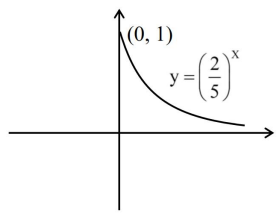
Required$
\text { Sum }=1+\left(\frac{2}{5}\right)^1+\left(\frac{2}{5}\right)^2+\left(\frac{2}{5}\right)^3+\ldots . .-=\frac{1}{1-\frac{2}{5}}=\frac{5}{3}
$ View full question & answer→MCQ 154 Marks
Let a straight line L pass through the point $P (2,-1,3)$ and be perpendicular to the lines $\frac{x-1}{2}=\frac{y+1}{1}=\frac{z-3}{-2}$ and $\frac{x-3}{1}=\frac{y-2}{3}=\frac{z+2}{4}$. If the line L intersects the yz -plane at the point Q , then the distance between the points P and Q is :
- A
- B
$\sqrt{10}$
- ✓
- D
$2 \sqrt{3}$
Answer(C) 3
Sol. Vector parallel to 'L'
$
\begin{array}{l}
=\left|\begin{array}{ccc}
\hat{i} & \hat{j} & \hat{k} \\
2 & 1 & -2 \\
1 & 3 & 4
\end{array}\right|=10 \hat{i}-10 \hat{j}+5 \hat{k} \\
=5(2 \hat{i}-2 \hat{j}+\hat{k})
\end{array}
$
Equation of 'L'
$
\frac{x-2}{2}=\frac{y+1}{-2}=\frac{z-3}{1}=\lambda \text { (say) }
$
Let $Q (2 \lambda+2,-2 \lambda-1, \lambda+3)$
$
\begin{array}{l}
\Rightarrow 2 \lambda+2=0 \Rightarrow \lambda=-1 \\
\Rightarrow Q(0,1,2) \\
d(P, Q)=3
\end{array}
$
View full question & answer→MCQ 164 Marks
Let the function $f(x)=\left(x^2-1\right)\left|x^2-a x+2\right|+\cos |x|$ be not differentiable at the two points $x =\alpha=2$ and $x=\beta$. Then the distance of the point $(\alpha, \beta)$ from the line $12 x+5 y+10=0$ is equal to :
Answer(A) 3
Sol. $\cos | x |$ is always differentiable
$\therefore$ we have to check only for $\left| x ^2- ax +2\right|$
$\therefore$ Not differentiable at
$
x^2-a x+2=0
$
One root is given, $\alpha=2$
$
\begin{aligned}
\therefore & 4-2 a+2=0 \\
& a=3
\end{aligned}
$$\therefore$
other root $\beta=1$
but for $x=1 f(x)$ is differentiable
(Drop)
View full question & answer→MCQ 174 Marks
If the domain of the function $\log _5\left(18 x-x^2-77\right)$ is $(\alpha, \beta)$ and the domain of the function $\log _{(x-1)}\left(\frac{2 x^2+3 x-2}{x^2-3 x-4}\right)$ is $(\gamma, \delta)$, then $\alpha^2+\beta^2+\gamma^2$ is equal to :
Answer(C) 186
$
\begin{array}{l}Sol.\
f_1(x)=\log _5\left(18 x-x^2-77\right) \\
\therefore 18 x-x^2-77>0 \\
\quad x^2-18 x+77<0 \\
\quad x \in(7,11) \alpha=7, \beta=11 \\
f_2(x)-\log _{(x-1)}\left(\frac{2 x^2+3 x-2}{x^2-3 x-4}\right) \\
\therefore x-1>0, x-1 \neq 1, \frac{2 x^2+3 x-2}{x^2-3 x-4}>0 \\
x>1, x \neq 2, \frac{(2 x-1)(x+2)}{(x-4)(x+1)}>0 \\
x>1, x \neq 2
\end{array}
$
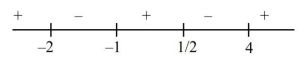
$\begin{array}{l}\therefore x \in(4, \infty) \\ \therefore \gamma=4 \\ \therefore \alpha^2+\beta^2+\gamma^2=49+121+16 \\ =186\end{array}$ View full question & answer→MCQ 184 Marks
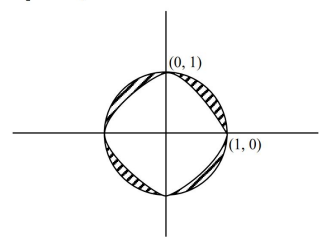
Let the area enclosed between the curves $|y|=1-$ $x^2$ and $x^2+y^2=1$ be $\alpha$. If $9 \alpha=\beta \pi+\gamma ; \beta, \gamma$ are integers, then the value of $|\beta-\gamma|$ equals
View full question & answer→MCQ 194 Marks
If $\sin x+\sin ^2 x=1, x \in\left(0, \frac{\pi}{2}\right)$, then $\left(\cos ^{12} x+\tan ^{12} x\right)+3\left(\cos ^{10} x+\tan ^{10} x+\cos ^8 x+\tan ^8 x\right)$ $+\left(\cos ^6 x+\tan ^6 x\right)$ is equal to
Answer(C) 2
$
\begin{array}{l}Sol.\
\sin x+\sin ^2 x=1 \\
\Rightarrow \sin x=\cos ^2 x \Rightarrow \tan x=\cos x
\end{array}
$
$\therefore$Given expression
$\begin{array}{l}=2 \cos ^{17} x+6\left[\cos ^{31} x+\cos ^8 x\right]+2 \cos ^6 x \\
=2\left[\sin ^6 x+3 \sin ^3 x+3 \sin ^4 x+\sin ^3 x\right] \\
=2 \sin ^3 x\left[(\sin x+1)^3\right] \\
=2\left[\sin ^2 x+\sin x\right]^3 \\
=2
\end{array}
$
View full question & answer→MCQ 204 Marks
If the set of all $a \in R$, for which the equation $2 x^2+$ $(a-5) x+15=3$ a has no real root, is the interval $(\alpha, \beta)$, and $X=\{x \in Z: \alpha < x < \beta\}$, then $\sum_{x \in X} x^2$ is equal to
Answer(C) 2139
$\begin{array}{l}Sol. (a-5)^2-8(15-3 a)<0 \\ a^2+14 a+25-120<0 \\ a^2+14 a-95<0 \\ (a+19)(a-5)<0 \\ a \in(-19,5) \\ \therefore-19<x<5 \\ \therefore \sum_{x \in \times} x^2=\left(1^2+2^2+\ldots .+4^2\right)+\left(1^2+2^2+\ldots+18^2\right) \\ =\frac{4 \times 5 \times 9}{6}+\frac{18 \times 19 \times 37}{6} \\ =30+2109 \\ =2139\end{array}$
View full question & answer→