Questions

SECTION - A [CHEMISTY - MCQ]

Take a timed test

20 questions · 17 auto-graded MCQ + 3 self-marked written.

MCQ 14 Marks
Given below are two statements :
Statement I : $\mathrm{H}_{2} \mathrm{Se}$ is more acidic than $\mathrm{H}_{2} \mathrm{Te}$.
Statement II : $\mathrm{H}_{2} \mathrm{Se}$ has higher bond enthalpy for dissociation than $\mathrm{H}_{2} \mathrm{Te}$.
In the light of the above statements, choose the correct answer from the options given below.
  • A
    Both statement I and Statement II are false.
  • B
    Both statement I and Statement II are true.
  • C
    Statement I is true but Statement II is false.
  • Statement I is false but Statement II is true.
Answer
Correct option: D.
Statement I is false but Statement II is true.
(D) Statement I is false but Statement II is true.
Acidic strength : $\mathrm{H}_{2} \mathrm{Se}<\mathrm{H}_{2} \mathrm{Te}$
$\begin{array}{rlll}\Delta_{\text {dis }} H & : H _2 Se \quad>\quad H _2 Te \\ & {[276 KJ / mol ] \quad[238 KJ / mol ]}\end{array}$
View full question & answer
MCQ 24 Marks
Match the LIST-I with LIST-II
LIST-I
(Complex/Species)
LIST-II
(Shape & magnetic moment)
A.$\left[\mathrm{Ni}(\mathrm{CO})_{4}\right]$I.Tetrahedral, 2.8 BM
B.$\left[\mathrm{Ni}(\mathrm{CN})_{4}\right]^{2-}$II.Square planar, 0 BM
C.$\left[\mathrm{NiCl}_{4}\right]^{2-}$III.Tetrahedral, 0 BM
D.$\left[\mathrm{MnBr}_{4}\right]^{2-}$IV.Tetrahedral, 5.9 BM
Choose the correct answer from the options given below : 
  • A
    A-III, B-IV, C-II, D-I
  • B
    A-I, B-II, C-III, D-IV
  • C
    A-III, B-II, C-I, D-IV
  • D
    A-IV, B-I, C-III, D-II
View full question & answer
MCQ 34 Marks
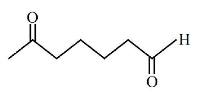
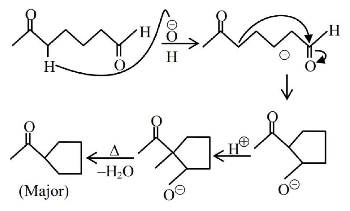
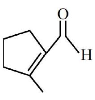
When Image undergoes intramolecular aldol condensation, the major product formed is :
  • Image
  • B
    Image
  • C
    Image
  • D
    Image
Answer
Correct option: A.
Image
(A) Image
Aldol condensation reaction
Image
View full question & answer
MCQ 44 Marks
Match the LIST-I with LIST-II
LIST-I
(Reagent)
LIST-II
(Functional Group detected)
A.Sodium bicarbonate solutionI.double bond/unsaturation
B.Neutral ferric chlorideII.carboxylic acid
C.ceric ammonium nitrateIII.phenolic – OH
D.alkaline $\mathrm{KMnO}_{4}$IV.alcoholic - OH
Choose the correct answer from the options given below :
  • A-II, B-III, C-IV, D-I
  • B
    A-II, B-III, C-I, D-IV
  • C
    A-III, B-II, C-IV, D-I
  • D
    A-II, B-IV, C-III, D-I
Answer
Correct option: A.
A-II, B-III, C-IV, D-I
(A) A-II, B-III, C-IV, D-I
(1) Carboxylic acid gives efferve scence with sodium bicarbonate solution
(2) Phenolic-OH gives voilet coloured complex with Neutral $\mathrm{FeCl}_{3}$.
(3) Alcoholic-OH gives Red colour with cerric ammonium Nitrate.
(4) When alkaline $\mathrm{KMnO}_{4}$ reacts with an unsaturated compound (Alkene or alkyne) the purple colour of $\mathrm{KMnO}_{4}$ solution disappears, indicating positive test for unsaturation.
View full question & answer
MCQ 54 Marks
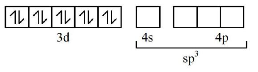
The number of species from the following that are involved in $\mathrm{sp}^{3} \mathrm{~d}^{2}$ hybridization is $\left[\mathrm{Co}\left(\mathrm{NH}_{3}\right)_{6}\right]^{3+}, \mathrm{SF}_{6},\left[\mathrm{CrF}_{6}\right]^{3-},\left[\mathrm{CoF}_{6}\right]^{3-},\left[\mathrm{Mn}(\mathrm{CN})_{6}\right]^{3-}$ and $\left[\mathrm{MnCl}_{6}\right]^{3-}$
  • A
    5
  • B
    6
  • 4
  • D
    3
Answer
Correct option: C.
4
(C) 4
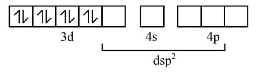
In $\left[\mathrm{Co}\left(\mathrm{NH}_{3}\right]_{6}\right]^{3+}, \mathrm{Co}^{+3}:[\mathrm{Ar}] 3 \mathrm{~d}^{6}, \mathrm{NH}_{3}$ is S.F.L
Hybridisation state of $\mathrm{Co}^{3+}$ is $\mathrm{d}^{2} \mathrm{sp}^{3}$
In $\mathrm{SF}_{6}$, Hybridisation state of sulphur is $\mathrm{sp}^{3} \mathrm{~d}^{2}$
In $\left[\mathrm{CrF}_{6}\right]^{3-}, \mathrm{Cr}^{+3}:[\mathrm{Ar}] 3 \mathrm{~d}^{3}$
Hybridisation state of $\mathrm{Cr}^{3+}$ is $\mathrm{d}^{2} \mathrm{sp}^{3}$
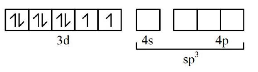
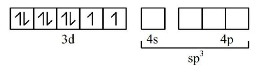
$\left[\mathrm{CoF}_{6}\right]^{3-}, \mathrm{Co}^{+3}:[\mathrm{Ar}] 3 \mathrm{~d}^{6} \mathrm{~F}^{-}$is W.F.L
Hybridisation state of $\mathrm{Co}^{3+}$ is $\mathrm{sp}^{3} \mathrm{~d}^{2}$
$\left[\mathrm{Mn}(\mathrm{CN})_{6}\right]^{3-}, \mathrm{Mn}^{+3}:[\mathrm{Ar}] 3 \mathrm{~d}^{4} \mathrm{CN}^{-}$is S.F.L
Hybridisation state of $\mathrm{Mn}^{3+}$ is $\mathrm{d}^{2} \mathrm{sp}^{3}$
$\left[\mathrm{MnCl}_{6}\right]^{3-}, \mathrm{Mn}^{+3}:[\mathrm{Ar}] 3 \mathrm{~d}^{4} \mathrm{Cl}^{-}$is W.F.L
Hybridisation state of $\mathrm{Cl}^{-}$is $\mathrm{sp}^{3} \mathrm{~d}^{2}$
Total number of $\mathrm{sp}^{3} \mathrm{~d}^{2}$ hybridized molecules is 3

View full question & answer
MCQ 64 Marks
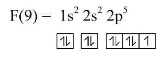
Correct statements for an element with atomic number 9 are
A. There can be 5 electrons for which $\mathrm{m}_{\mathrm{s}}=+\frac{1}{2}$ and 4 electrons for which $\mathrm{m}_{\mathrm{s}}=-\frac{1}{2}$
B. There is only one electron in $p_{z}$ orbital
C. The last electron goes to orbital with $\mathrm{n}=2$ and $l=1$
4. The sum of angular nodes of all the atomic orbitals is 1 .
Choose the correct answer from the options given below:
  • A
    C and D Only
  • B
    A and C Only
  • C
    A, C and D Only
  • D
    A and B Only
View full question & answer
MCQ 84 Marks
On combustion 0.210 g of an orgainc compound containing $\mathrm{C}, \mathrm{H}$ and O gave $0.127 \mathrm{~g} \mathrm{H}_{2} \mathrm{O}$ and 0.307 $\mathrm{g} \mathrm{CO}_{2}$. The percentages of hydrogen and oxygen in the given organic compound respectively are:
  • A
    $53.41,39.6$
  • $6.72,53.41$
  • C
    $7.55,43.85$
  • D
    $6.72,39.87$
Answer
Correct option: B.
$6.72,53.41$
(B) $6.72,53.41$
In the combustion of organic compound, all "C" in $\mathrm{CO}_{2}$ and all "H" in $\mathrm{H}_{2} \mathrm{O}$ comes from organic compound
$\underset{\substack{\\ 0.210 \mathrm{gm}}}{\mathrm{C}_{\mathrm{x}} \mathrm{H}_{\mathrm{y}}\mathrm{O}_{\mathrm{z}}}+\mathrm{O}_{2} \longrightarrow \underset{0.307 \mathrm{gm}}{\mathrm{CO}_{2}}+\underset{0.127 \mathrm{gm}}{\mathrm{H}_{2} \mathrm{O}}$
Weight of "C" in $\mathrm{CO}_{2}=\frac{12}{44} \times 0.307$
$=0.0837 \mathrm{gm}$
Weight of "H" in $\mathrm{H}_{2} \mathrm{O}=\frac{2}{18} \times 0.127=0.0141 \mathrm{~g}$
$\% ' H '$ in compound $=\frac{0.0141}{0.21} \times 100=6.719 \%$
$=6.72 \%$
Weight of "O" in compound
$\begin{array}{l}=0.210-(0.0837+0.0141) \\ =0.1122\end{array}$
$\%$ of "O" in compound $=\frac{0.1122}{0.21} \times 100$
$=53.41 \%$
View full question & answer
MCQ 94 Marks
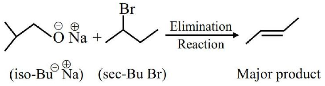
Which one of the following reactions will not lead to the desired ether formation in major proportion?
(iso-$\mathrm{Bu} \Rightarrow$ isobutyl, sec-$\mathrm{Bu} \Rightarrow$ sec-butyl, $\mathrm{nPr} \Rightarrow$ n-propyl, ${ }^{\mathrm{t}} \mathrm{Bu} \Rightarrow$ tert-butyl, $\mathrm{Et} \Rightarrow$ ethyl)
  • A
    ${ }^{\mathrm{t}} \mathrm{Bu} \stackrel{\ominus}{\mathrm{O}} \stackrel{\oplus}{\mathrm{Na}}+\mathrm{EtBr} \longrightarrow{ }^{\mathrm{t}} \mathrm{Bu}-\mathrm{O}-\mathrm{Et}$
  • B
    Image
  • C
    Image
  • D
    iso-$\mathrm{Bu} \stackrel{\ominus}{\mathrm{O}} \stackrel{\oplus}{\mathrm{Na}}+\mathrm{sec}-\mathrm{BuBr} \longrightarrow \mathrm{Sec}-\mathrm{Bu}-\mathrm{O}-$ iso-Bu
View full question & answer
MCQ 104 Marks
The correct decreasing order of spin only magnetic moment values $(\mathrm{BM})$ of $\mathrm{Cu}^{+}, \mathrm{Cu}^{2+}, \mathrm{Cr}^{2+}$ and $\mathrm{Cr}^{3+}$ ions is :
  • A
    $\mathrm{Cu}^{+}>\mathrm{Cu}^{2+}>\mathrm{Cr}^{3+}>\mathrm{Cr}^{2+}$
  • B
    $\mathrm{Cu}^{2+}>\mathrm{Cu}^{+}>\mathrm{Cr}^{2+}>\mathrm{Cr}^{3+}$
  • $\mathrm{Cr}^{2+}>\mathrm{Cr}^{3+}>\mathrm{Cu}^{2+}>\mathrm{Cu}^{+}$
  • D
    $\mathrm{Cr}^{3+}>\mathrm{Cr}^{2+}>\mathrm{Cu}^{+}>\mathrm{Cu}^{2+}$
Answer
Correct option: C.
$\mathrm{Cr}^{2+}>\mathrm{Cr}^{3+}>\mathrm{Cu}^{2+}>\mathrm{Cu}^{+}$
(C) $\mathrm{Cr}^{2+}>\mathrm{Cr}^{3+}>\mathrm{Cu}^{2+}>\mathrm{Cu}^{+}$
$\mathrm{Cu}^{+}:[\mathrm{Ar}] 3 \mathrm{~d}^{10}$, Spin only magnetic moment $=0$ B.M.
$\mathrm{Cu}^{+2}:[\mathrm{Ar}] 3 \mathrm{~d}^{9}$, Spin only magnetic moment $=\sqrt{3}$ B.M.
$\mathrm{Cr}^{+2}:[\mathrm{Ar}] 3 \mathrm{~d}^{4}$, Spin only magnetic moment $=\sqrt{24}$ B.M.
$\mathrm{Cr}^{+3}:[\mathrm{Ar}] 3 \mathrm{~d}^{3}$, Spin only magnetic moment $=\sqrt{15}$ B.M.
Order of $\mu: \mathrm{Cr}^{+2}>\mathrm{Cr}^{+3}>\mathrm{Cu}^{+2}>\mathrm{Cu}^{+}$
View full question & answer
MCQ 114 Marks
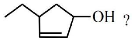
What is the correct IUPAC name of
Image
  • A
    4-Ethyl-1-hydroxycyclopent-2-ene
  • B
    1-Ethyl-3-hydroxycyclopent-2-ene
  • C
    1-Ethylcyclopent-2-en-3-ol
  • 4-Ethylcyclopent-2-en-1-ol
Answer
Correct option: D.
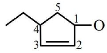
4-Ethylcyclopent-2-en-1-ol
(D) 4-Ethylcyclopent-2-en-1-ol
Image
4-Ethylclopent-2-en-1-ol
View full question & answer
MCQ 124 Marks
$\mathrm{HA}(\mathrm{aq}) \rightleftharpoons \mathrm{H}^{+}(\mathrm{aq})+\mathrm{A}^{-}(\mathrm{aq})$
The freezing point depression of a 0.1 m aqueous solution of a monobasic weak acid HA is $0.20^{\circ} \mathrm{C}$.
The dissociation constant for the acid is
Given :
$\mathrm{K}_{\mathrm{f}}\left(\mathrm{H}_{2} \mathrm{O}\right)=1.8 \mathrm{~K} \mathrm{~kg} \mathrm{~mol}^{-1}$, molality $\equiv$ molarity
  • $1.38 \times 10^{-3}$
  • B
    $1.1 \times 10^{-2}$
  • C
    $1.90 \times 10^{-3}$
  • D
    $1.89 \times 10^{-1}$
Answer
Correct option: A.
$1.38 \times 10^{-3}$
(A) $1.38 \times 10^{-3}$
$\Delta \mathrm{T}_{\mathrm{f}}=\mathrm{ik}_{\mathrm{f}} \mathrm{m}$
$0.2=\mathrm{i} \times 1.8 \times 0.1$
$\mathrm{i}=\frac{20}{18}=\frac{10}{9}$
For $\quad \mathrm{HA}_{(\mathrm{aq})} \rightleftharpoons \mathrm{H}_{(\mathrm{aq})}^{+}+\mathrm{A}_{(\mathrm{aq})}^{-}$
$\mathrm{t}=0 \quad 1$
$t=t_{\text {eq }} 1-\alpha \quad \alpha \quad \alpha$
$\mathrm{i}=1+\alpha$
$\frac{10}{9}=1+\alpha$
$\alpha=\frac{1}{9}$
$\mathrm{K}_{\mathrm{eq}}=\frac{\left[\mathrm{H}^{+}\right]\left[\mathrm{A}^{-}\right]}{[\mathrm{HA}]}=\frac{\mathrm{Ca}^{2}}{1-\alpha}$
$=\frac{0.1\left(\frac{1}{9}\right)^{2}}{1-\frac{1}{9}}=\frac{1}{720}$
$\mathrm{K}_{\text {eq.}}=1.38 \times 10^{-3}$
View full question & answer
MCQ 134 Marks
Which of the following binary mixture does not show the behaviour of minimum boiling azeotropes?
  • A
    $\mathrm{H}_{2} \mathrm{O}+\mathrm{CH}_{3} \mathrm{COC}_{2} \mathrm{H}_{5}$
  • $\mathrm{C}_{6} \mathrm{H}_{5} \mathrm{OH}+\mathrm{C}_{6} \mathrm{H}_{5} \mathrm{NH}_{2}$
  • C
    $\mathrm{CS}_{2}+\mathrm{CH}_{3} \mathrm{COCH}_{3}$
  • D
    $\mathrm{CH}_{3} \mathrm{OH}+\mathrm{CHCl}_{3}$
Answer
Correct option: B.
$\mathrm{C}_{6} \mathrm{H}_{5} \mathrm{OH}+\mathrm{C}_{6} \mathrm{H}_{5} \mathrm{NH}_{2}$
(B) $\mathrm{C}_{6} \mathrm{H}_{5} \mathrm{OH}+\mathrm{C}_{6} \mathrm{H}_{5} \mathrm{NH}_{2}$
Binary mixture of $\mathrm{C}_{6} \mathrm{H}_{5} \mathrm{OH}$ and $\mathrm{C}_{6} \mathrm{H}_{5} \mathrm{NH}_{2}$ shows negative deviation from Raoult's law
So vapour pressure of solution is less than V.P of pure $\mathrm{C}_{6} \mathrm{H}_{5} \mathrm{OH} \& \mathrm{C}_{6} \mathrm{H}_{5} \mathrm{NH}_{2}$
So B.P. of solution is greater than boiling point of pure $\mathrm{C}_{6} \mathrm{H}_{5} \mathrm{OH} \& \mathrm{C}_{6} \mathrm{H}_{5} \mathrm{NH}_{2}$
So shows maximum Boiling azeotrope
View full question & answer
MCQ 144 Marks
The atomic number of the element from the following with lowest $1^{\text {st }}$ ionisation enthalpy is :
  • A
    32
  • B
    35
  • 87
  • D
    19
Answer
Correct option: C.
87
(C) 87
Atomic no. $32 \Rightarrow \mathrm{Ge}$
Atomic no. $35 \Rightarrow \mathrm{Br}$
Atomic no. $87 \Rightarrow \mathrm{Fr}$
Atomic no. $19 \Rightarrow \mathrm{~K}$
Lowest first I.E. among the given element will be of Fr [87].
$\mathrm{Fr}-[\mathrm{Rn}] 7 \mathrm{~s}^{1}$
View full question & answer
MCQ 154 Marks
Given below are two statements :
Statement I : A homolepitc octahedral complex, formed using monodentate ligands, will not show stereoisomerism.
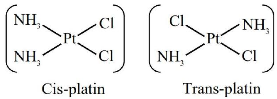
Statement II : cis- and trans- platin are heteroleptic complexes of Pd .
In the light of the above statements, choose the correct answer from the options given below.
  • A
    Both statement I and Statement II are false.
  • B
    Statement I is false but Statement II is true.
  • C
    Both statement I and Statement II are true.
  • Statement I is true but Statement II is false.
Answer
Correct option: D.
Statement I is true but Statement II is false.
(D) Statement I is true but Statement II is false.
Homoleptic complex of type $\left[\mathrm{Ma}_{6}\right]$ (Where $\mathrm{a} \Rightarrow$ monodentate ligand) cannot show geometrical as well as optical isomerism.
Cis-platin and trans-platin has formula $\left[\mathrm{Pt}\left(\mathrm{NH}_{3}\right)_{2} \mathrm{Cl}_{2}\right]$ which is a heteroleptic complex of platinum.
Image
View full question & answer
MCQ 174 Marks
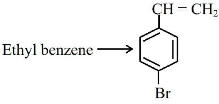
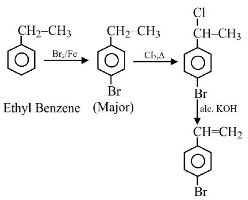
Choose the correct set of reagents for the following conversion.
Image
  • $\mathrm{Br}_{2}/\mathrm{Fe}; \mathrm{Cl}_{2}, \Delta$; alc. KOH
  • B
    $\mathrm{Cl}_{2}/\mathrm{Fe}; \mathrm{Br}_{2} /$anhy.$\mathrm{AlCl}_{3}$; aq. KOH
  • C
    $\mathrm{Br}_{2} /$anhy.$\mathrm{AlCl}_{3}; \mathrm{Cl}_{2}, \Delta$; aq. KOH
  • D
    $\mathrm{Cl}_{2} /$anhy.$\mathrm{AlCl}_{3}; \mathrm{Br}_{2} / \mathrm{Fe}$; alc. KOH
Answer
Correct option: A.
$\mathrm{Br}_{2}/\mathrm{Fe}; \mathrm{Cl}_{2}, \Delta$; alc. KOH
(A) $\mathrm{Br}_{2} / \mathrm{Fe} ; \mathrm{Cl}_{2}, \Delta$; alc. KOH
Image
View full question & answer
MCQ 184 Marks
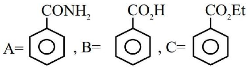
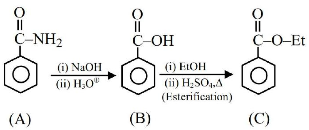
$\mathrm{A} \xrightarrow[\text { (ii) } \mathrm{H}_{3} \mathrm{O}^{+}]{(\mathrm{i}) \mathrm{NaOH}} \mathrm{B} \xrightarrow[\text { (ii) } \mathrm{H}_{2} \mathrm{SO}_{4}, \Delta]{\text { (i) } \mathrm{EtOH}} \mathrm{C}$
'A' shows positive Lassaign's test for N and its molar mass is 121.
'B' gives effervescence with aq. $\mathrm{NaHCO}_{3}$.
'C' gives fruity smell.
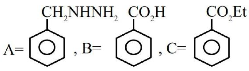
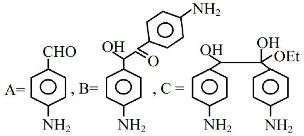
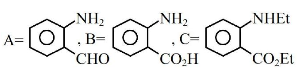
Identify A, B and C from the following.
  • Image
  • B
    Image
  • C
    Image
  • D
    Image
Answer
Correct option: A.
Image
(A)
Image
Image
Molar mass $=121$
A $\rightarrow$ Benzamide Shows positive Lassaigh's test.
$B \rightarrow$ Benzoic acid gives effervescence with aq. $\mathrm{NaHCO}_{3}$.
$\mathrm{C} \rightarrow$ Ester gives fruity smell.
View full question & answer
MCQ 194 Marks
Match the LIST-I with LIST-II
 LIST - I LIST - II
A.CarbocationI.Species that can supply a pair of electrons.
B.C-Free radicalII.Species that can receive a pair of electrons.
C.NucleophileIII.$sp ^2$ hybridized carbon with empty p-orbital.
D.ElectrophileIV.$sp ^2 / sp ^3$ hybridized carbon with one unpaired electron.
Choose the correct answer from the options given below :
  • A
    A-IV, B-II, C-III, D-I
  • B
    A-II, B-III, C-I, D-IV
  • C
    A-III, B-IV, C-II, D-I
  • A-III, B-IV, C-I, D-II
Answer
Correct option: D.
A-III, B-IV, C-I, D-II
(D) A-III, B-IV, C-I, D-II
(A) Carbocation $\rightarrow \mathrm{sp}^{2}$ hybridised carbon with empty P-orbital
Image
(B) Carbon free radical $\rightarrow \mathrm{sp}^{2} / \mathrm{sp}^{3}$ hybridised carbon with one unpaired electron.
Image
(C) Nuecleophile $\rightarrow$ species of that can supply a pair of electron.
(D) Electrophile $\rightarrow$ species that can receive a pair of electron.
View full question & answer
MCQ 204 Marks
In a first order decomposition reaction, the time taken for the decomposition of reactant to one fourth and one eighth of its initial concentration are $t_{1}$ and $t_{2}(s)$, respectively. The ratio $t_{1} / t_{2}$ will :
  • A
    $\frac{4}{3}$
  • B
    $\frac{3}{2}$
  • C
    $\frac{3}{4}$
  • $\frac{2}{3}$
Answer
Correct option: D.
$\frac{2}{3}$
(D) $\frac{2}{3}$
For I ${ }^{\text {st }}$ order reaction
When $\mathrm{C}_{\mathrm{t}}=\mathrm{Co} / 4$
$\mathrm{t}_{1}=2 \mathrm{t}_{50 \%}$.
when $\mathrm{C}_{\mathrm{t}}=\mathrm{Co} / 8$
$\mathrm{t}_{2}=3 \mathrm{t}_{50 \%}$
so $\frac{t_{1}}{t_{2}}=\frac{2}{3}$
View full question & answer