MCQ 14 Marks
A block of mass 2 kg is attached to one end of a massless spring whose other end is fixed at a wall. The spring-mass system moves on a frictionless horizontal table. The spring's natural length is 2 m and spring constant is $200 \mathrm{~N} / \mathrm{m}$. The block is pushed such that the length of the spring becomes 1 m and then released. At distance $\mathrm{x} \mathrm{m}(\mathrm{x}<2)$ from the wall. the speed of the block will be :
- A
$10[1-(2-x)]^{3 / 2} \mathrm{~m} / \mathrm{s}$
- ✓
$10\left[1-(2-x)^{2}\right]^{1 / 2} \mathrm{~m} / \mathrm{s}$
- C
$10\left[1-(2-x)^{2}\right] \mathrm{m} / \mathrm{s}$
- D
$10\left[1-(2-x)^{2}\right]^{2} \mathrm{~m} / \mathrm{s}$
AnswerCorrect option: B. $10\left[1-(2-x)^{2}\right]^{1 / 2} \mathrm{~m} / \mathrm{s}$
(B) $10\left[1-(2-x)^{2}\right]^{1 / 2} \mathrm{~m} / \mathrm{s}$
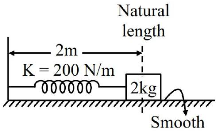
Given, Natural length of spring $=2 \mathrm{~m}$
Initial compression in spring $\left(\mathrm{x}_{\mathrm{i}}\right)=1 \mathrm{~m}$
Final compression in spring $\left(x_{\mathrm{f}}\right)=(2-\mathrm{x}) \mathrm{m}$
Using energy conservation
$\mathrm{K}_{\mathrm{i}}+\mathrm{U}_{\mathrm{i}}=\mathrm{K}_{\mathrm{f}}+\mathrm{U}_{\mathrm{f}}$
$0+\frac{1}{2} K x_{i}^{2}=\frac{1}{2} \mathrm{mv}^{2}+\frac{1}{2} K \mathrm{x}_{\mathrm{f}}^{2}$
$\frac{1}{2} \mathrm{mv}^{2}=\frac{1}{2} \mathrm{~K}\left(\mathrm{x}_{\mathrm{i}}^{2}-\mathrm{x}_{\mathrm{f}}^{2}\right)$
$\frac{1}{2} \times 2 \times v^{2}=\frac{1}{2} \times 200 \times\left(1^{2}-(2-x)^{2}\right)$
$v^{2}=100\left[1-(2-x)^{2}\right]$
$\mathrm{v}=10\left[1-(2-\mathrm{x})^{2}\right]^{1 / 2}$ View full question & answer→MCQ 24 Marks
For a nucleus of mass number A and radius R, the mass density of nucleus can be represented as
Answer(D) Independent of A
Conceptual
View full question & answer→MCQ 34 Marks
In a Young's double slit experiment, the source is white light. One of the slits is covered by red filter and another by a green filter. In this case
- A
There shall be an interference pattern for red distinct from that for green.
- ✓
There shall be no interference fringes.
- C
There shall be alternate interference fringes of red and green.
- D
There shall be an interference pattern, where each fringe's pattern center is green and outer edges is red.
AnswerCorrect option: B. There shall be no interference fringes.
(B) There shall be no interference fringes.
Different colours will have different fringe width. Within a few fringes of red, there will be several fringes of violet.
Also, there will be overlapping of colours.
View full question & answer→MCQ 44 Marks
The amplitude and phase of a wave that is formed by the superposition of two harmonic travelling waves, $\mathrm{y}_{1}(\mathrm{x}, \mathrm{t})=4 \sin (\mathrm{kx}-\omega \mathrm{t})$ and $\mathrm{y}_{2}(\mathrm{x}, \mathrm{t})=2 \sin \left(\mathrm{kx}-\omega \mathrm{t}+\frac{2 \pi}{3}\right)$, are $:$
(Take the angular frequency of initial waves same as $\omega$ )
- A
$\left[6, \frac{2 \pi}{3}\right]$
- B
$\left[6, \frac{\pi}{3}\right]$
- C
$\left[\sqrt{3}, \frac{\pi}{6}\right]$
- ✓
$\left[2 \sqrt{3}, \frac{\pi}{6}\right]$
AnswerCorrect option: D. $\left[2 \sqrt{3}, \frac{\pi}{6}\right]$
(D) $\left[2 \sqrt{3}, \frac{\pi}{6}\right]$
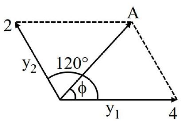
$\begin{aligned} A & =\sqrt{2^2+4^2+2 \times 2 \times 4 \times \cos 120^{\circ}}
\\ & =\sqrt{12}=2 \sqrt{3}\end{aligned}$
$\begin{array}{l}\tan \phi=\frac{2 \sin 120^{\circ}}{4+2 \cos 120^{\circ}}=\frac{\sqrt{3}}{3}=\frac{1}{\sqrt{3}} \\ \phi=\frac{\pi}{6}\end{array}$ View full question & answer→MCQ 54 Marks
Two balls with same mass and initial velocity, are projected at different angles in such a way that maximum height reached by first ball is 8 times higher than that of the second ball. $T_{1}$ and $T_{2}$ are the total flying times of first and second ball, respectively, then the ratio of $T_{1}$ and $T_{2}$ is :
- ✓
$2 \sqrt{2}: 1$
- B
$2: 1$
- C
$\sqrt{2}: 1$
- D
$4: 1$
AnswerCorrect option: A. $2 \sqrt{2}: 1$
(A) $2 \sqrt{2}: 1$
Given, $\left( H _{\max }\right)_1=8 \times\left( H _{\max }\right)_2$
$
\frac{u^2 \sin ^2 \theta_1}{2 g}=8 \times \frac{u^2 \sin ^2 \theta_2}{2 g}
$
$\begin{array}{l}\Rightarrow \sin \theta_1=2 \sqrt{2} \sin \theta_2 \\ \frac{T_1}{T_2}=\frac{2 u \sin \theta_1 / g }{2 u \sin \theta_2 / g }=\frac{\sin \theta_1}{\sin \theta_2}=2 \sqrt{2}\end{array}$
View full question & answer→MCQ 64 Marks
A body of mass 2 kg moving with velocity of $\overrightarrow{\mathrm{V}}_{\mathrm{in}}=3 \hat{\mathrm{i}}+4 \hat{\mathrm{j}} \mathrm{ms}^{-1}$ enters into a constant force field of 6N directed along positive z-axis. If the body remains in the field for a period of $\frac{5}{3}$ seconds, then velocity of the body when it emerges from force field is
- A
$4 \hat{i}+3 \hat{j}+5 \hat{k}$
- ✓
$3 \hat{\mathrm{i}}+4 \hat{\mathrm{j}}+5 \hat{\mathrm{k}}$
- C
$3 \hat{i}+4 \hat{j}-5 \hat{k}$
- D
$3 \hat{\mathrm{i}}+4 \hat{\mathrm{j}}+\sqrt{5} \hat{\mathrm{k}}$
AnswerCorrect option: B. $3 \hat{\mathrm{i}}+4 \hat{\mathrm{j}}+5 \hat{\mathrm{k}}$
(B) $3 \hat{\mathrm{i}}+4 \hat{\mathrm{j}}+5 \hat{\mathrm{k}}$
$\overrightarrow{\mathrm{a}}=\frac{\mathrm{B}}{2} \hat{\mathrm{k}}=3 \hat{\mathrm{k}}, \mathrm{t}=\frac{5}{3} \mathrm{~s}$
$\overrightarrow{\mathrm{u}}=3 \hat{\mathrm{i}}+4 \hat{\mathrm{j}}$
$\overrightarrow{\mathrm{v}}=\overrightarrow{\mathrm{u}}+\overrightarrow{\mathrm{a}} \mathrm{t}=3 \hat{\mathrm{i}}+4 \hat{\mathrm{j}}+5 \hat{\mathrm{k}}$
View full question & answer→MCQ 74 Marks
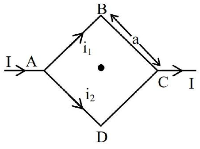
Figure shows a current carrying square loop ABCD of edge length is ' $a$ ' lying in a plane. If the resistance of the ABC part is $r$ and that of ADC part is $2 r$, then the magnitude of the resultant magnetic field at centre of the square loop is
- A
$\frac{3 \pi \mu_{0} \mathrm{I}}{\sqrt{2} a}$
- B
$\frac{\mu_{0} I}{2 \pi a}$
- ✓
$\frac{\sqrt{2} \mu_{0} I}{3 \pi \mathrm{a}}$
- D
$\frac{2 \mu_{0} \mathrm{I}}{3 \pi \mathrm{a}}$
AnswerCorrect option: C. $\frac{\sqrt{2} \mu_{0} I}{3 \pi \mathrm{a}}$
(C) $\frac{\sqrt{2} \mu_{0} I}{3 \pi \mathrm{a}}$
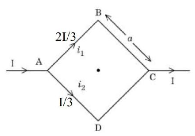
$\overrightarrow{\mathrm{B}}=\overrightarrow{\mathrm{B}}_{\mathrm{AB}}+\overrightarrow{\mathrm{B}}_{\mathrm{BC}}+\overrightarrow{\mathrm{B}}_{\mathrm{CD}}+\overrightarrow{\mathrm{B}}_{\mathrm{DA}}$
$\overrightarrow{\mathrm{B}}=\left[\frac{-\mu_{0}(2 \mathrm{I} / 3)}{4 \pi(\mathrm{a} / 2)} \sqrt{2}-\frac{\mu_{0}(2 \mathrm{I} / 3)}{4 \pi(\mathrm{a} / 2)} \sqrt{2}\right.$
$\left.+\frac{\mu_{0}(\mathrm{I} / 3)}{4 \pi(\mathrm{a} / 2)} \sqrt{2}+\frac{\mu_{0}(\mathrm{I} / 3)}{4 \pi(\mathrm{a} / 2)} \sqrt{2}\right] \hat{\mathrm{k}}$
$\overrightarrow{\mathrm{B}}=\left[\frac{-2 \sqrt{2} \mu_{0} \mathrm{I}}{3 \pi \mathrm{a}}+\frac{\sqrt{2} \mu_{0} \mathrm{I}}{3 \pi \mathrm{a}}\right] \hat{\mathrm{k}}$
$\overrightarrow{\mathrm{B}}=\frac{-\sqrt{2} \mu_{0} \mathrm{I}}{3 \pi \mathrm{a}} \hat{\mathrm{k}}$ View full question & answer→MCQ 84 Marks
Two strings with circular cross section and made of same material, are stretched to have same amount of tension. A transverse wave is then made to pass through both the strings. The velocity of the wave in the first string having the radius of cross section $R$ is $v_{1}$, and that in the other string having radius of cross section $R / 2$ is $\mathrm{v}_{2}$. Then $\frac{\mathrm{v}_{2}}{\mathrm{v}_{1}}=$
Answer(B) 2
$v=\sqrt{\frac{T}{\mu}}=\sqrt{\frac{\mathrm{T}}{\mathrm{f} \pi \mathrm{R}^{2}}}$
$\frac{\mathrm{v}_{2}}{\mathrm{v}_{1}}=\frac{\mathrm{R}_{1}}{\mathrm{R}_{2}}=2$
View full question & answer→MCQ 94 Marks
A convex lens of focal length 30 cm is placed in contact with a concave lens of focal length 20 cm . An object is placed at 20 cm to the left of this lens system. The distance of the image from the lens in cm is __________
Answer(D) 15
Equivalent focal length
$\frac{1}{\mathrm{f}}=\frac{1}{\mathrm{f}_{1}}+\frac{1}{\mathrm{f}_{2}}$
$=\frac{1}{30}+\frac{1}{-20}=\frac{2-3}{60}=-\frac{1}{60}$
$\mathrm{f}=-60 \mathrm{~cm}$
Lens formula
$\frac{1}{v}-\frac{1}{u}=\frac{1}{f}$
$\frac{1}{v}-\frac{1}{-20}=\frac{1}{-60}$
$\mathrm{v}=-15 \mathrm{~cm}$
View full question & answer→MCQ 104 Marks
A monoatomic gas having $\gamma=\frac{5}{3}$ is stored in a thermally insulated container and the gas is suddenly compressed to $\left(\frac{1}{8}\right)^{\text {th }}$ of its initial volume. The ratio of final pressure and initial pressure is: ( $\gamma$ is the ratio of specific heats of the gas at constant pressure and at constant volume)
Answer(C) 32
$\quad P_{i} V_{i}^{\gamma}=P_{f} V_{f}^{\gamma}$
$\frac{P_{f}}{P_{i}}=\left(\frac{V_{i}}{V_{f}}\right)^{\gamma}=(8)^{5 / 3}$
$\frac{\mathrm{P}_{\mathrm{f}}}{\mathrm{P}_{\mathrm{i}}}=32$
View full question & answer→MCQ 114 Marks
A quantity Q is formulated as $\mathrm{X}^{-2} \mathrm{Y}^{+\frac{3}{2}} \mathrm{Z}^{-\frac{2}{5}} \cdot \mathrm{X}, \mathrm{Y}$ and Z are independent parameters which have fractional errors of 0.1, 0.2 and 0.5 , respectively in measurement. The maximum fractional error of $Q$ is
Answer(C) 0.7
Fractional error $=2 \frac{\Delta \mathrm{X}}{\mathrm{X}}+\frac{3}{2} \frac{\Delta \mathrm{Y}}{\mathrm{Y}}+\frac{2}{5} \frac{\Delta \mathrm{Z}}{\mathrm{Z}}$
$=2(0.1)+\frac{3}{2}(0.2)+\frac{2}{5}(0.5)$
$=0.2+0.3+0.2=0.7$
View full question & answer→MCQ 124 Marks
Two metal spheres of radius $R$ and 3R have same surface charge density $\sigma$. If they are brought in contact and then separated, the surface charge density on smaller and bigger sphere becomes $\sigma_{1}$ and $\sigma_{2}$, respectively. The ratio $\frac{\sigma_{1}}{\sigma_{2}}$ is
- A
$\frac{1}{9}$
- B
- C
$\frac{1}{3}$
- ✓
Answer(D) 3
For conducting sphere, $\mathrm{V}=\frac{\sigma \mathrm{r}}{\varepsilon_{0}}$
After contact, $\mathrm{V}_{1}=\mathrm{V}_{2}$
$\sigma_{1} r_{1}=\sigma_{2} r_{2}$
$\frac{\sigma_{1}}{\sigma_{2}}=\frac{r_{2}}{r_{1}}$
$\frac{\sigma_{1}}{\sigma_{2}}=3$
View full question & answer→MCQ 134 Marks
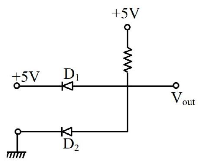
The output voltage in the following circuit is (Consider ideal diode case)
Answer(B) 0 V
Here $D_{1}$ is reverse biased and $D_{2}$ is forward biased. Therefore current flow through $\mathrm{D}_{\mathrm{Q}}$ and 5V drop on resistor.
So, $V_{\text {out }}=0$
View full question & answer→MCQ 144 Marks
An infinitely long wire has uniform linear charge density $\lambda=2 \mathrm{nC} / \mathrm{m}$. The net flux through a Gaussian cube of side length $\sqrt{3} \mathrm{~cm}$, if the wire passes through any two corners of the cube, that are maximally displaced from each other, would be $\mathrm{xNm}^{2} \mathrm{C}^{-1}$, where x is :
[Neglect any edge effects and use $\frac{1}{4 \pi \varepsilon_{0}}=9 \times 10^{9}$ SI units]
- A
$0.72 \pi$
- B
$1.44 \pi$
- C
$6.48 \pi$
- ✓
$2.16 \pi$
AnswerCorrect option: D. $2.16 \pi$
(D) $2.16 \pi$
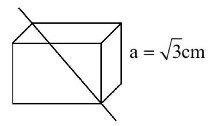
$\phi=\frac{\mathrm{q}_{\mathrm{enc}}}{\varepsilon_{0}}=\frac{\lambda \cdot \sqrt{3 \mathrm{a}}}{\varepsilon_{0}}$
$=2 \times 10^{-9} \times \sqrt{3} \times \sqrt{3} \times 10^{-2} \times 36 \pi \times 10^{9} \mathrm{Nm}^{2} \mathrm{C}^{-1}$
$=2.16 \pi \mathrm{Nm}^{2} \mathrm{C}^{-1}$ View full question & answer→MCQ 154 Marks
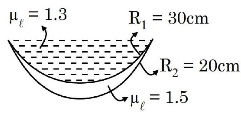
A concave-convex lens of refractive index 1.5 and the radii of curvature of its surfaces are 30 cm and 20 cm , respectively. The concave surface is upwards and is filled with a liquid of refractive index 1.3. The focal length of the liquid-glass combination will be
- A
$\frac{500}{11} \mathrm{~cm}$
- B
$\frac{800}{11} \mathrm{~cm}$
- C
$\frac{700}{11} \mathrm{~cm}$
- D
$\frac{600}{11} \mathrm{~cm}$
View full question & answer→MCQ 164 Marks
Water falls from a height of 200 m into a pool. Calculate the rise in temperature of the water assuming no heat dissipation from the water in the pool.
$\left(\right.$ Take $g=10 \mathrm{~m} / \mathrm{s}^{2}$, specific heat of water $\left.=4200 \mathrm{~J} /(\mathrm{kg} \mathrm{K})\right)$
Answer(D) 0.48 K
$\mathrm{mgh}=\mathrm{ms} \Delta \mathrm{T}$
$\Delta \mathrm{T}=\frac{\mathrm{gh}}{\mathrm{s}}=\frac{10 \times 200}{4200} \mathrm{~K}=\frac{10}{21} \mathrm{~K}$
View full question & answer→MCQ 174 Marks
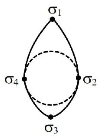
Electric charge is transferred to an irregular metallic disk as shown in figure. If $\sigma_{1}, \sigma_{2}, \sigma_{3}$ and $\sigma_{4}$ are charge densities at given points then, choose the correct answer from the options given below:
(A) $\sigma_{1}>\sigma_{3} ; \sigma_{2}=\sigma_{4}$
(B) $\sigma_{1}>\sigma_{2} ; \sigma_{3}>\sigma_{4}$
(C) $\sigma_{1}>\sigma_{3}>\sigma_{2}=\sigma_{4}$
(D) $\sigma_{1}<\sigma_{3}<\sigma_{2}=\sigma_{4}$
(E) $\sigma_{1}=\sigma_{2}=\sigma_{3}=\sigma_{4}$ Answer(A) A, B and C Only
$\quad \sigma \propto \frac{1}{\mathrm{ROC}}$
$(\mathrm{ROC})_{1}<(\mathrm{ROC})_{3}<(\mathrm{ROC})_{2}=(\mathrm{ROC})_{4}$
$\sigma_{1}>\sigma_{3}>\sigma_{2}=\sigma_{4}$
View full question & answer→MCQ 184 Marks
A 3 m long wire of radius 3 mm shows an extension of 0.1 mm when loaded vertically by a mass of 50 kg in an experiment to determine Young's modulus. The value of Young's modulus of the wire as per this experiment is $\mathrm{P} \times 10^{11} \mathrm{Nm}^{-2}$, where the value of $P$ is: (Take $\left.g=3 \pi \mathrm{~m} / \mathrm{s}^{2}\right)$
Answer(A) 5
$\frac{50 \mathrm{~g}}{\pi \mathrm{r}^{2}}=\mathrm{y} \cdot \frac{\Delta \ell}{\ell}$
$\frac{50 \times 3 \pi}{\pi \times\left(3 \times 10^{-3}\right)^{2}}=\mathrm{P} \times 10^{11} \times \frac{0.1 \times 10^{-3}}{3}$
$\Rightarrow \mathrm{P}=\frac{50 \times 3 \times 3}{3^{2} \times 10^{-6} \times 10^{11} \times 0.1 \times 10^{-3}}$
$\mathrm{P}=5$
View full question & answer→MCQ 194 Marks
A rod of linear mass density ' $\lambda$ ' and length ' $L$ ' is bent to form a ring of radius 'R'. Moment of inertia of ring about any of its diameter is :
- A
$\frac{\lambda L^{3}}{16 \pi^{2}}$
- B
$\frac{\lambda L^{3}}{12}$
- C
$\frac{\lambda L^{3}}{4 \pi^{2}}$
- ✓
$\frac{\lambda L^{3}}{8 \pi^{2}}$
AnswerCorrect option: D. $\frac{\lambda L^{3}}{8 \pi^{2}}$
(D) $\frac{\lambda L^{3}}{8 \pi^{2}}$
$L=2 \pi R$
$\mathrm{I}=\frac{\mathrm{MR}^{2}}{2}=\frac{\lambda \times \mathrm{L}}{2} \times\left(\frac{\mathrm{L}}{2 \pi}\right)^{2}=\frac{\lambda \mathrm{L}^{3}}{8 \pi^{2}}$
View full question & answer→MCQ 204 Marks
Given below are two statements : one is labelled as Assertion A and the other is labelled as Reason R
Assertion A : Work done in moving a test charge between two points inside a uniformly charged spherical shell is zero, no matter which path is chosen.
Reason R : Electrostatic potential inside a uniformly charged spherical shell is constant and is same as that on the surface of the shell.
In the light of the above statements, choose the correct answer from the options given below
- A
- ✓
Both A and R are and R is the correct explanation of A
- C
- D
Both A and R are true but R is NOT the correct explanation of A
AnswerCorrect option: B. Both A and R are and R is the correct explanation of A
(B) Both A and R are and R is the correct explanation of A
Conceptual
View full question & answer→