MCQ
Two strings with circular cross section and made of same material, are stretched to have same amount of tension. A transverse wave is then made to pass through both the strings. The velocity of the wave in the first string having the radius of cross section $R$ is $v_{1}$, and that in the other string having radius of cross section $R / 2$ is $\mathrm{v}_{2}$. Then $\frac{\mathrm{v}_{2}}{\mathrm{v}_{1}}=$
  • A
    $\sqrt{2}$
  • 2
  • C
    8
  • D
    4

Answer

Correct option: B.
2
(B) 2
$v=\sqrt{\frac{T}{\mu}}=\sqrt{\frac{\mathrm{T}}{\mathrm{f} \pi \mathrm{R}^{2}}}$
$\frac{\mathrm{v}_{2}}{\mathrm{v}_{1}}=\frac{\mathrm{R}_{1}}{\mathrm{R}_{2}}=2$

Need a full question paper?

Generate a complete, print-ready paper with questions like this in minutes — across 16+ boards, with answer keys.

Start Generating Free

Similar questions

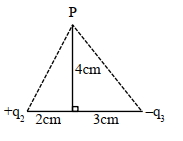
If the net electric field at point $\mathrm{P}$ along $\mathrm{Y}$ axis is zero, then the ratio of $\left|\frac{q_2}{q_3}\right|$ is $\frac{8}{5 \sqrt{x}}$, where $\mathrm{x}=$. . . . . .
Two vectors of magnitude $3$ & $4$ have resultant which make angle $\alpha$ & $\beta$ respectively with them $\{given\, \alpha + \beta \neq 90^o\}$
The electromotive force of a primary cell is $2\, volts$. When it is short-circuited it gives a current of $4$ amperes. Its internal resistance in $ohms$ is
The value of the current through an inductance of $1H$ and of negligible resistance, when connected through an $ac$ source of $200 \,V$ and $50 \,Hz$ is
Two projectiles are thrown with same initial velocity making an angle of $45^{\circ}$ and $30^{\circ}$ with the horizontal respectively. The ratio of their respective ranges will be.
In a potentiometer arrangement. $E_1$ is the cell establishing current in primary circuit. $E_2$ is the cell to be measured. $AB$ is the potentiometer wire and $G$ is a galvanometer. Which of the following are the essential condition for balance to be obtained.
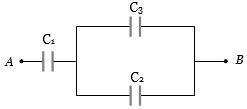
The combination of capacitors with ${C_1} = 3\,\mu \,F,\,{C_2} = 4\,\mu \,F$ and ${C_3} = 2\,\mu \,F$ is charged by connecting $AB$ to a battery. Consider the following statements

$I.$ Energy stored in ${C_1}$ $=$ Energy stored in ${C_2}$ $+$ Energy stored in ${C_3}$

$II.$ Charge on ${C_1}$ $=$ Charge on ${C_2}$ $+$ Charge on ${C_3}$

$III.$ Potential drop across ${C_1}$ $=$ Potential drop across ${C_2}$ $=$ Potential drop across ${C_3}$

Which of these is/are correct

Myopia is due to
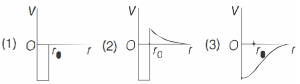
Given below are three schematic graphs of potential energy $V(r)$ versus distance $r$ for three atomic particles : electron $\left(e^{-}\right)$, proton $\left(p^{+}\right)$and neutron $(n)$, in the presence of a nucleus at the origin $O$. The radius of the nucleus is $r_0$. The scale on the $V$-axis may not be the same for all figures. The correct pairing of each graph with the corresponding atomic particle is
The dimension of where $\sqrt {\frac{\mu }{ \in }} $ is permeability $\& \varepsilon$ is permittivity is same as :