MCQ 11 Mark
If the mean of the numbers $27 + x$, $31 + x$, $89 + x$, $107 + x,\,156 + x$ is $82,$ then the mean of $130 + x,\,126 + x,\,68 + x,\,50 + x,\,1 + x$ is
Answera
(a) Given,
$82 = \frac{{(27 + x) + (31 + x) + (89 + x) + (107 + x) + (156 + x)}}{5}$
==> $82 \times 5 = 410 + 5x$ ==> $410 - 410 = 5x$
==> $x = 0$
Required mean is,
$\bar x = \frac{{130 + x + 126 + x + 68 + x + 50 + x + 1 + x}}{5}$
$\bar x = \frac{{375 + 5x}}{5}$
$ = \frac{{375 + 0}}{5}$$ = \frac{{375}}{5}$= $75.$
View full question & answer→MCQ 21 Mark
Consider the frequency distribution of the given numbersIf the mean is known to be $3$, then the value of $f$ is
|
Value :
|
$1$
|
$2$
|
$3$
|
$4$
|
|
Freq :
|
$5$
|
$4$
|
$6$
|
$f$
|
Answerd
(d) Mean = $\frac{{1 \times 5 + 2 \times 4 + 3 \times 6 + 4 \times f}}{{5 + 4 + 6 + f}}$
i.e., $3 = \frac{{5 + 8 + 18 + 4f}}{{15 + f}}$
==> $45 + 3f = 31 + 4f$
==> $45 - 31 = f$ ==> $f = 14$.
View full question & answer→MCQ 31 Mark
If the algebraic sum of deviations of $20$ observations from $30$ is $20$, then the mean of observations is
Answerd
(d) $\sum\limits_{i = 1}^{20} {({x_i} - 30) = 20} $
==> $\sum\limits_{i = 1}^{20} {{x_i} - 20 \times 30 = 20} $
==> $\sum\limits_{i = 1}^{20} {{x_i} = 620} $.
Mean = $\frac{{\sum\limits_{i = 1}^{20} {{x_i}} }}{{20}} $
$= \frac{{620}}{{20}} = 31$.
View full question & answer→MCQ 41 Mark
If the values $1,\,\frac{1}{2},\,\frac{1}{3},\,\frac{1}{4},\,\frac{1}{5},\,.....,\frac{1}{n}$ occur at frequencies $1, 2, 3, 4, 5, ….n$ in a distribution, then the mean is
- A
$1$
- B
$n$
- C
$\frac{1}{n}$
- ✓
$\frac{2}{{n + 1}}$
AnswerCorrect option: D. $\frac{2}{{n + 1}}$
d
(d) Mean $ = \frac{{1.1 + \frac{1}{2}.2 + \frac{1}{3}.3 + \frac{1}{4}.4 + \frac{1}{5}.5 + ..... + \frac{1}{n}.n}}{{1 + 2 + 3 + ..... + n}}$
$ = \frac{{1 + 1 + 1 + 1 + ..... + 1}}{{\frac{{n(n + 1)}}{2}}}$
$ = \frac{n}{{\frac{{n(n + 1)}}{2}}} = \frac{2}{{n + 1}}$.
View full question & answer→MCQ 51 Mark
The number of observations in a group is $40$. If the average of first $10$ is $4.5$ and that of the remaining $30$ is $3.5$, then the average of the whole group is
- A
$\frac{1}{5}$
- ✓
$\frac{{15}}{4}$
- C
$4$
- D
$8$
AnswerCorrect option: B. $\frac{{15}}{4}$
b
(b) $\frac{{{x_1} + {x_2} + ..... + {x_{10}}}}{{10}} = 4.5$
==> ${x_1} + {x_2} + ..... + {x_{10}} = 45$
$\frac{{{x_{11}} + {x_{12}} + ..... + {x_{40}}}}{{30}} = 3.5$
==> ${x_{11}} + {x_{12}} + ..... + {x_{40}} = 105$
${x_1} + {x_2} + ..... + {x_{40}} = 150$
$\frac{{{x_1} + {x_2} + ..... + {x_{40}}}}{{40}} $
$= \frac{{150}}{{40}}$$ = \frac{{15}}{4}$.
View full question & answer→MCQ 61 Mark
If the mean of the distribution is $2.6$, then the value of $y$ is
|
Variate $x$
|
$1$
|
$2$
|
$3$
|
$4$
|
$5$
|
|
Freq $f$ of $x$
|
$4$
|
$5$
|
$y$
|
$1$
|
$2$
|
Answerc
(c) We know that, Mean$ = \frac{{\sum\limits_{i = 1}^n {{f_i}{x_i}} }}{{\sum\limits_{i = 1}^n {{f_i}} }}$
i.e., $2.6 = \frac{{1 \times 4 + 2 \times 5 + 3 \times y + 4 \times 1 + 5 \times 2}}{{4 + 5 + y + 1 + 2}}$
or $31.2 + 2.6y = 28 + 3y$ or $0.4y = 3.2$
==> $y = 8$.
View full question & answer→MCQ 71 Mark
If the mean of the set of numbers ${x_1},\,{x_2},\,{x_3},\,.....,\,{x_n}$ is $\bar x$, then the mean of the numbers ${x_i} + 2i$, $1 \le i \le n$ is
- A
$\bar x + 2n$
- ✓
$\bar x + n + 1$
- C
$\bar x + 2$
- D
$\bar x + n$
AnswerCorrect option: B. $\bar x + n + 1$
b
(b) We know that $\bar x = \frac{{\sum\limits_{i = 1}^n {{x_i}} }}{n}$ i.e., $\sum\limits_{i = 1}^n {{x_i}} = n\bar x$
$\frac{{\sum\limits_{i = 1}^n {({x_i} + 2i)} }}{n} = \frac{{\sum\limits_{i = 1}^n {{x_i}} + 2\sum\limits_{i = 1}^n i }}{n} = \frac{{n\bar x + 2(1 + 2 + ...n)}}{n} = \frac{{n\bar x + 2\frac{{n(n + 1)}}{2}}}{n} = \bar x + (n + 1)$
$ = \frac{{n\bar x + 2\frac{{n(n + 1)}}{2}}}{n} = \bar x + n + 1$.
View full question & answer→MCQ 81 Mark
Mean of $100$ items is $49$. It was discovered that three items which should have been $60, 70, 80$ were wrongly read as $40, 20, 50$ respectively. The correct mean is
- A
$48$
- B
$82\frac{1}{2}$
- ✓
$50$
- D
$80$
Answerc
(c) Sum of 100 items $ = 49 \times 100 = 4900$
Sum of items added$ = 60 + 70 + 80 = 210$
Sum of items replaced$ = 40 + 20 + 50 = 110$
New sum $ = 4900 + 210 - 110 = 5000$
Correct mean$ = \frac{{5000}}{{100}} = 50$.
View full question & answer→MCQ 91 Mark
The mean of $5$ numbers is $18$. If one number is excluded, their mean becomes $16$. Then the excluded number is
Answerc
(c) Sum of total number = $18 × 5 = 90$
After one number excluded
Sum of total number = $16 × 4 = 64$
Then, excluded number is $90 -64 = 26.$
View full question & answer→MCQ 101 Mark
The mean weight per student in a group of seven students is $55\ kg$ If the individual weights of $6$ students are $52, 58, 55, 53, 56$ and $54$; then weights of the seventh student is.....$kg$
Answerc
(c) Total weight of $7$ students is = $55× 7 = 385\ kg$
Sum of weight of $6$ students
$= 52 + 58 + 55 + 53 + 56 + 54 = 328\ kg$
$\therefore $ Weight of seventh student = $385 -328 = 57\ kg.$
View full question & answer→MCQ 111 Mark
Mean of $100$ observations is $45$. It was later found that two observations $19$ and $31$ were incorrectly recorded as $91$ and $13$. The correct mean is...
- A
$44$
- ✓
$44.46$
- C
$45$
- D
$45.54$
AnswerCorrect option: B. $44.46$
b
(b) Sum of $100$ items = $45×100 = 4500$
Sum of items added = $19 +31 = 50$
Sum of items replaced = $91+ 13 = 104$
New sum = $4500 - 104 + 50$ = $4446$
New mean$ = \frac{{4446}}{{100}}$ = $44.46$
View full question & answer→MCQ 121 Mark
The following data gives the distribution of height of studentsThe median of the distribution is
|
Height (in cm)
|
160
|
150
|
152
|
161
|
156
|
154
|
155
|
|
No of students
|
12
|
8
|
4
|
4
|
3
|
3
|
7
|
Answerb
(b)Arranging the data in ascending order of magnitude, we obtain
|
Height
(in cm)
|
$150$
|
$152$
|
$154$
|
$155$
|
$156$
|
$160$
|
$161$
|
|
Number of students
|
$8$
|
$4$
|
$3$
|
$7$
|
$3$
|
$12$
|
$4$
|
|
Cumulative frequency
|
$8$
|
$12$
|
$15$
|
$22$
|
$25$
|
$37$
|
$41$
|
Here, total number of items is $41$
$i.e.$, an odd number.
Hence, the median is $\frac{{41 + 1}}{2}^{th}$
$i.e.$, $21^{st}$ item.
From cumulative frequency table, we find that median
$i.e.$, $21^{st}$ item is $155$,
(All items from $16$ to $22^{nd}$ are equal, each $155$).
View full question & answer→MCQ 131 Mark
If a variable takes values $0, 1, 2, ….., n$ with frequencies ${q^n},\,\frac{n}{1}{q^{n - 1}}p,\,\frac{{n(n - 1)}}{{1.2}}{q^{n - 2}}{p^2},\,......,\,{p^n}$, where $p + q = 1$, then the mean is
Answera
(a) The required mean is,
$\bar x = \frac{{0.{q^n} + 1.\frac{n}{1}{q^{n - 1}}p + 2.\frac{{(n)(n - 1)}}{{2!}}{q^{n - 2}}{p^2} + .....n.{p^n}}}{{{q^n} + \frac{n}{1}{q^{n - 1}}p + \frac{{n(n - 1)}}{2}{q^{n - 2}}{p^2} + ..... + {p^n}}}$
$ = \frac{{0.{^n}{C_0}{q^n}{p^0} + {{1.}^n}{C_1}\,{q^{n - 1}}p + ..... + n.{\,^n}{C_n}{q^0}{p^n}}}{{^n{C_0}{q^n}{p^0}{ + ^n}{C_1}{q^{n - 1}}{p^1} + .....{ + ^n}{C_n}{q^{n - n}}{p^n}}}$
$ = \frac{{\sum\limits_{r = 0}^n r {.^n}{C_r}{q^{n - r}}{p^r}}}{{\sum\limits_{r = 0}^n {^n{C_r}{q^{n - r}}{p^r}} }}$
$ = \frac{{\sum\limits_{r = 1}^n r .\frac{n}{r}\,{\,^{n - 1}}{C_{r - 1}}{q^{n - r}}.p.\,{p^{r - 1}}}}{{\sum\limits_{r = 0}^n {^n{C_r}{q^{n - r}}{p^r}} }}$
$ = \frac{{np\left( {\sum\limits_{r = 1}^n {^{n - 1}{C_{r - 1}}{p^{r - 1}}{q^{(n - 1) - (r - 1)}}} } \right)}}{{\sum\limits_{r = 0}^n {^n{C_r}{q^{n - r}}{p^r}} }}$
$ = \frac{{np{{(q + p)}^{n - 1}}}}{{{{(q + p)}^n}}} = np$, . $[\because q + p = 1]$
View full question & answer→MCQ 141 Mark
Compute the median from the following table
|
Marks obtained
|
No. of students
|
|
$0-10$
|
$2$
|
|
$10-20$
|
$18$
|
|
$20-30$
|
$30$
|
|
$30-40$
|
$45$
|
|
$40-50$
|
$35$
|
|
$50-60$
|
$20$
|
|
$60-70$
|
$6$
|
|
$70-80$
|
$3$
|
- ✓
$36.55$
- B
$35.55$
- C
$40.05$
- D
AnswerCorrect option: A. $36.55$
a
(a)
|
Marks obtained
|
No. of students
|
Cumulative frequency
|
|
$0-10$
|
$2$
|
$2$
|
|
$10-20$
|
$18$
|
$20$
|
|
$20-30$
|
$30$
|
$50$
|
|
$30-40$
|
$45$
|
$95$
|
|
$40-50$
|
$35$
|
$130$
|
|
$50-60$
|
$20$
|
$150$
|
|
$60-70$
|
$6$
|
$156$
|
|
$70-80$
|
$3$
|
$159$
|
$n = \sum f = 159$. Here $n = 159$, which is odd
$\therefore $Median number$ = \frac{1}{2}(n + 1) = \frac{1}{2}(159 + 1) = 80$,
which is in the class $30-40$. (see the row of cumulative frequency $95$, which contains $80$).
Hence median class is $30-40$.
$\therefore$ We have,
$l$ = Lower limit of median class = $30$
$f$ = Frequency of median class = $45$
$C$ = Total of all frequencies preceding median class = $50$
$i$ = Width of class interval of median class = $10$
$\therefore$ Required median $ = l + \frac{{\frac{N}{2} - C}}{f} \times i$ $ = 30 + \frac{{\frac{{159}}{2} - 50}}{{45}} \times 10 = 30 + \frac{{295}}{{45}} = 36.55$.
View full question & answer→MCQ 151 Mark
$x_1,x_2........x_{34}$ are numbers such that $x_i = x_{i+1} = 150 \,\,\forall i \in \,\,\{1,2,3,......9\}$ and $x_{i+1} -x_i + 2 = 0 \,\,\forall i \in \,\,\{10,11,12,......33\},$ then median of $x_1,x_2,......x_{34}$ is-
Answerc
$34$ terms so mean of $17^{\text {th }}$ and $18^{\text {th }}$ term is median
$\mathrm{x}_{10+\mathrm{n}}=148+(\mathrm{n}-1)(-2)=\mathrm{x}_{17}=136, \mathrm{x}_{18}=134$
hence median $=135$
View full question & answer→MCQ 161 Mark
The following data gives the distribution of height of students
| Height (in $cm$) |
$160$ |
$150$ |
$152$ |
$161$ |
$156$ |
$154$ |
$155$ |
| No of students |
$12$ |
$8$ |
$4$ |
$4$ |
$3$ |
$3$ |
$7$ |
The median of the distribution is
Answerb
Arranging the data in ascending order of magnitude, we obtain
| Height(in cm) |
$150$ |
$152$ |
$154$ |
$155$ |
$156$ |
$160$ |
$161$ |
| No of students |
$8$ |
$4$ |
$3$ |
$7$ |
$3$ |
$12$ |
$4$ |
| Cf |
$8$ |
$12$ |
$12$ |
$22$ |
$25$ |
$37$ |
$41$ |
Here, total number of items is $41$ i.e., an odd number.
Hence, the median is $\frac{41+1}{2}$ th i.e., $21^{\text {st }}$ item.
From cumulative frequency table, we find that median
i.e., $21^{\text {st }}$ item is $155,$
(All items from $16$ to $22^{\text {nd }}$ are equal, each $155$ ).
View full question & answer→MCQ 171 Mark
Find median for the following distribution :-
Class Frequency
$10-20$ $180$
$20-30$ $82$
$30-40$ $34$
$40-50$ $180$
$50-60$ $136$
$60-70$ $23$
$70-80$ $50$
AnswerCorrect option: A. $42.6$
a
| Interval |
$f$ |
$c.f.$ |
| $10-20$ |
$180$ |
$180$ |
| $20-30$ |
$82$ |
$262$ |
| $30-40$ |
$34$ |
$296$ |
| $40-50$ |
$180$ |
$476$ |
| $50-60$ |
$136$ |
$612$ |
| $60-70$ |
$23$ |
$635$ |
| $70-80$ |
$50$ |
$685$ |
$\frac{685}{2}=342.5$
$40+\frac{342.5-296}{180} \times 10$
$40+\frac{46.5}{18}=40+2.8=42.6$
View full question & answer→MCQ 181 Mark
The mean of $10$ terms is $3$ . If the first term is increased by $1$ , second by $2$ and so on, then the new mean is
- A
$4$
- ✓
$\frac{{17}}{2}$
- C
$8$
- D
$\frac{{11}}{2}$
AnswerCorrect option: B. $\frac{{17}}{2}$
b
New mean
$=\frac{\mathrm{x}_{1}+1+\mathrm{x}_{2}+2+\mathrm{x}_{3}+3+\mathrm{x}_{4}+4+\ldots+\mathrm{x}_{10}+10}{10}$
$=\frac{\sum x_{i}+\frac{10 \times 11}{2}}{10}=3+\frac{11}{2}=\frac{17}{2}$
View full question & answer→MCQ 191 Mark
In a given frequency distribution, the respective values of mean and median are $21$ and $22$ . The value of mode is
Answerd
Mode $= 3$ median $- 2$ mean
$= 66 - 42 = 24$
View full question & answer→MCQ 201 Mark
The mean deviation of the numbers $3, 4, 5, 6, 7$ is
Answerb
(b) $A.M.$ = $\frac{{3 + 4 + 5 + 6 + 7}}{5} = 5$
Mean deviation$ = \frac{{\Sigma |{x_i} - \bar x|}}{n}$
$ = \frac{{|3 - 5| + |4 - 5| + |5 - 5| + |6 - 5| + |7 - 5|}}{5}$
$ = \frac{{2 + 1 + 0 + 1 + 2}}{5}$$ = \frac{6}{5} = 1.2$.
View full question & answer→MCQ 211 Mark
In a series of $3n$ observations, if $n$ observations are equal $a$ and remaining observations are equal $-2a$, then the mean deviation of observations about their mean will be:-
- A
$0$
- B
$\frac{a}{3}$
- ✓
$\frac{4a}{3}$
- D
$4a$
AnswerCorrect option: C. $\frac{4a}{3}$
c
Here, given observatios are $a, a$ $\ldots \ldots$ $n$ times, $-$ $2 a,-2 a \ldots 2 n$ times
No. of observations $=3 \mathrm{n}$
mean $(\bar X) = \frac{{n \times a + 2n \times ( - 2a)}}{{3n}} = - a$
$\therefore $ Mean deviation about mean $ = \frac{{\Sigma \left| {{{\rm{x}}_1} - {\rm{\bar x}}} \right|}}{{3{\rm{n}}}}$
$\frac{\mathrm{n} \times 2 \mathrm{a}+2 \mathrm{n} \times \mathrm{a}}{3 \mathrm{n}}=\frac{4 \mathrm{a}}{3}$
View full question & answer→MCQ 221 Mark
If mean deviations about median of $x$ , $2x$ , $3x$ , $4x$ , $5x$ , $6x$ , $7x$ , $8x$ , $9x$ , $10x$ is $30$ , then $|x|$ equals
Answera
Median is $(5.5 \mathrm{x})=\mathrm{a}$
Mean deviation $=\frac{\sum\left|\mathrm{x}_{\mathrm{i}}-\mathrm{a}\right|}{10}=30$
$\frac{2(4.5 x+3.5 x+2.5 x+1.5 x+.5 x)}{10}=30$
$\frac{2(12.5)|\mathrm{x}|}{10}=30$
$|x|=12$
View full question & answer→MCQ 231 Mark
The $S.D.$ of $5$ scores $1, 2, 3, 4, 5$ is
- A
$\frac{2}{5}$
- B
$\frac{3}{5}$
- ✓
$\sqrt 2 $
- D
$\sqrt 3 $
AnswerCorrect option: C. $\sqrt 2 $
c
(c) Mean $\bar x = \frac{{1 + 2 + 3 + 4 + 5}}{5} = 3$
$S.D.$ = $\sigma $ = $\sqrt {\frac{1}{n}\sum {x_i^2 - (\bar x} {)^2}} $
=$\sqrt {\frac{1}{5}(1 + 4 + 9 + 16 + 25) - 9} $=$\sqrt {11 - 9} = \sqrt 2 $.
View full question & answer→MCQ 241 Mark
The variance of the data $2, 4, 6, 8, 10$ is
Answerc
(c) Here, $\bar x = \frac{{2 + 4 + 6 + 8 + 10}}{5} = 6$
Hence, variance = $\frac{1}{n}\Sigma {({x_i} - \overline x )^2}$
$ = \frac{1}{5}\{ {(2 - 6)^2} + {(4 - 6)^2} + {(6 - 6)^2} + {(8 - 6)^2} + {(10 - 6)^2}\} $
$ = \frac{1}{5}\left\{ {(16 + 4 + 0 + 4 + 16} \right\}$$ = \frac{1}{5}\left\{ {40} \right\}$ $ = 8$.
View full question & answer→MCQ 251 Mark
If the standard deviation of $0, 1, 2, 3, …..,9$ is $K$, then the standard deviation of $10, 11, 12, 13 …..19$ is
- ✓
$K$
- B
$K + 10$
- C
$K + \sqrt {10} $
- D
$10\ K$
Answera
As the standard deviation only depend upon total no of values and the difference between mean and each value,
Both sequence have same standard deviation.
Note:
If $1^{\text {st }}$ sequence is $x _{ i }$ and $2^{\text {nd }}$ sequence is $y _{ i }$,
$y _{ i }=10+ x _{ i } \Rightarrow \overline{ y }=10+\overline{ x }$
So, $\overline{ y }- y _{ i }=\overline{ x }- x _{ i }$
View full question & answer→MCQ 261 Mark
The variance of the first $n$ natural numbers is
AnswerCorrect option: A. $\frac{{{n^2} - 1}}{{12}}$
a
(a) Variance $ = {({\rm{S}}{\rm{.D}}{\rm{.}})^2}$$ = \frac{1}{n}\Sigma {x^2} - {\left( {\frac{{\Sigma x}}{n}} \right)^2}$,$\left( {\because \;\;\bar x = \frac{{\Sigma x}}{n}} \right)$
$ = \frac{{n(n + 1)\;(2n + 1)}}{{6n}} - {\left( {\frac{{n(n + 1)}}{{2n}}} \right)^2} $
$= \frac{{{n^2} - 1}}{{12}}$.
View full question & answer→MCQ 271 Mark
The mean and $S.D.$ of $1, 2, 3, 4, 5, 6$ is
AnswerCorrect option: A. $\frac{7}{2},\,\sqrt {\frac{{35}}{{12}}} $
a
(a) Mean $\bar x = \frac{{1 + 2 + 3 + 4 + 5 + 6}}{6}$
$ = \frac{{21}}{6} = \frac{7}{2}$
$S.D.$ $ = \sigma = \sqrt {\frac{1}{n}\Sigma x_i^2 - {{(\bar x)}^2}} $
$ = \sqrt {\frac{1}{6}(1 + 4 + 9 + 16 + 25 + 36) - \frac{{49}}{4}} $
$ = \sqrt {\frac{{91}}{6} - \frac{{49}}{4}} $
$ = \sqrt {\frac{{182 - 147}}{{12}}} $
$ = \sqrt {\frac{{35}}{{12}}} $.
View full question & answer→MCQ 281 Mark
The means of five observations is $4$ and their variance is $5.2$. If three of these observations are $1, 2$ and $6$, then the other two are
- A
$2$ and $9$
- B
$3$ and $8$
- ✓
$4$ and $7$
- D
$5$ and $6$
AnswerCorrect option: C. $4$ and $7$
c
(c) Let the two unknown items be $x$ and $y$, then
Mean $ = 4 \Rightarrow \frac{{1 + 2 + 6 + x + y}}{5} = 4$
==> $x + y = 11$ .....$(i)$
and variance = $5. 2$
==> $\frac{{{1^2} + {2^2} + {6^2} + {x^2} + {y^2}}}{5} - {({\rm{mean}})^2} = 5.2$
$41 + {x^2} + {y^2} = 5[5.2 + {(4)^2}]$
$41 + {x^2} + {y^2} = 106$
${x^2} + {y^2} = 65$.....$(ii)$
Solving $(i)$ and $(ii)$ for $x$ and $y$, we get
$x = 4,y = 7$ or $x = 7,y = 4$.
View full question & answer→MCQ 291 Mark
The variance of $\alpha$, $\beta$ and $\gamma$ is $9$, then variance of $5$$\alpha$, $5$$\beta$ and $5$$\gamma$ is
- A
$45$
- B
$9\over5$
- C
$5\over9$
- ✓
$225$
Answerd
(d) When each item of a data is multiplied by $\lambda $, variance is multiplied by ${\lambda ^2}$.
Hence, new variance $ = {5^2} \times 9$$ = 225$.
View full question & answer→MCQ 301 Mark
What is the standard deviation of the following series
|
class
|
0-10
|
10-20
|
20-30
|
30-40
|
|
Freq
|
1
|
3
|
4
|
2
|
Answerc
(c)
|
$Class$
|
$f_i$ |
$y_i$
|
$d = {y_i} - A$
$A = 25$
|
$f_id_i$
|
$f_id_i^2$
|
|
$0-10$
|
$1$
|
$5$
|
$-20$
|
$-20$
|
$400$
|
|
$10-20$
|
$3$
|
$15$
|
$-10$
|
$-30$
|
$300$
|
|
$20-30$
|
$4$
|
$25$
|
$0$
|
$0$
|
$0$
|
|
$30-40$
|
$2$
|
$35$
|
$10$
|
$20$
|
$200$
|
|
$Total$
|
$10$
|
|
|
$-30$
|
$900$
|
${\sigma ^2} = \frac{{\sum {f_i}d_i^2}}{{\sum {f_i}}} - {\left( {\frac{{\sum {f_i}{d_i}}}{{\sum {f_i}}}} \right)^2}$
$= \frac{{900}}{{10}} - {\left( {\frac{{ - 30}}{{10}}} \right)^2}$
${\sigma ^2} = 90 - 9 = 81$
==> $\sigma$ = $9$.
View full question & answer→MCQ 311 Mark
The mean and $S.D.$ of the marks of $200$ candidates were found to be $40$ and $15$ respectively. Later, it was discovered that a score of $40$ was wrongly read as $50$. The correct mean and $S.D.$ respectively are...
- A
$14.98, 39.95$
- ✓
$39.95, 14.98$
- C
$39.95, 224.5$
- D
AnswerCorrect option: B. $39.95, 14.98$
b
(b) Corrected $\Sigma x = 40 \times 200 - 50 + 40 = 7990$
Corrected $\bar x = 7990/200$$ = 39.95$
Incorrect $\Sigma {x^2} = n\,[{\sigma ^2} + {\bar x^2}] = 200[{15^2} + {40^2}] = 365000$
Correct $\Sigma {x^2} = 365000 - 2500 + 1600$$ = 364100$
Corrected $\sigma = \sqrt {\frac{{364100}}{{200}} - {{(39.95)}^2}} $
$ = \sqrt {(1820.5 - 1596)} $$ = \sqrt {224.5} = 14.98$.
View full question & answer→MCQ 321 Mark
One set containing five numbers has mean $8$ and variance $18$ and the second set containing $3$ numbers has mean $8$ and variance $24$. Then the variance of the combined set of numbers is
AnswerCorrect option: B. $20.25$
b
(b) Here ${n_1} = 5$, ${\bar x_1} = 8$, $\sigma _1^2 = 18$, ${n_2} = 3$ ${\bar x_2} = 8$, $\sigma _2^2 = 24$
$\bar x = $ combined mean $ = \frac{{5 \times 8 + 3 \times 8}}{{5 + 3}}$ $ = \frac{{64}}{8} = 8$
Combined variance $ = \frac{{{n_1}(\sigma _1^2 + D_1^2) + {n_2}(\sigma _2^2 + D_2^2)}}{{{n_1} + {n_2}}}$,
where ${D_1} = {\bar x_1} - \bar x$, ${D_2} = {\bar x_2} - \bar x$
Now, ${D_1} = 8 - 8;\,\,{D_2} = 8 - 8 = 0$
Combined variance $ = \frac{{5(18) + 3(24)}}{{5 + 3}}$ $ = \frac{{90 + 72}}{8}$ $ = \frac{{162}}{8}$ = $20.25$.
View full question & answer→MCQ 331 Mark
The mean of $5$ observations is $4.4$ and their variance is $8.24$. If three observations are $1, 2$ and $6$, the other two observations are
- A
$4$ and $8$
- ✓
$4$ and $9$
- C
$5$ and $7$
- D
$5$ and $9$
AnswerCorrect option: B. $4$ and $9$
b
(b) Let the two unknown items be $x$ and $y$.
Then, mean $ = 4.4 \Rightarrow \frac{{1 + 2 + 6 + x + y}}{5} = 4.4$
==> $x + y = 13$.....$(i)$
and variance $= 8.24$
==> $\frac{{{1^2} + {2^2} + {6^2} + {x^2} + {y^2}}}{5}$ -${({\rm{mean}})^2} = 8.24$
==> $41 + {x^2} + {y^2} = 5\,\{ {(4.4)^2} + 8.24\} $
==> ${x^2} + {y^2} = 97$.....$(ii)$
Solving $(i)$ and $(ii)$ for $x$ and $y$, we get
$x = 9,\,\,y = 4$ or $x = 4,y = 9$.
View full question & answer→MCQ 341 Mark
What is the standard deviation of the following series
| class |
$0-10$ |
$10-20$ |
$20-30$ |
$30-40$ |
| Freq |
$1$ |
$3$ |
$4$ |
$2$ |
Answerc
| Class |
$f$ |
${y_i}$ |
$d = {y_i} - A,$
$A = 25$
|
${f_i}{d_i}$ |
${f_i}d_i^2$ |
| $0-10$ |
$1$ |
$5$ |
$-20$ |
$-20$ |
$400$ |
| $10-20$ |
$3$ |
$15$ |
$-10$ |
$-30$ |
$300$ |
| $20-30$ |
$4$ |
$25$ |
$0$ |
$0$ |
$0$ |
| $30-40$ |
$2$ |
$35$ |
$10$ |
$20$ |
$200$ |
| Total |
$10$ |
|
|
$-30$ |
$900$ |
${\sigma ^2} = \frac{{\sum {{f_i}} d_i^2}}{{\sum {{f_i}} }} - {\left( {\frac{{\sum {{f_i}} {d_i}}}{{\sum {{f_i}} }}} \right)^2}$
$=\frac{900}{10}-\left(\frac{-30}{10}\right)^{2}$
$\sigma^{2}=90-9=81 $
$\Rightarrow \sigma=9$
View full question & answer→MCQ 351 Mark
The variance of $10$ observations is $16$. If each observation is doubled, then standard deviation of new data will be -
Answerc
$\operatorname{Var}\left(a x_{i}+b\right)=a^{2} \operatorname{var}\left(x_{i}\right)$
Variance on doubling each observation
$=2^{2} \times 16=64$
Std. deviation $=\sqrt{\operatorname{var}}=8$
View full question & answer→MCQ 361 Mark
Mean and variance of a set of $6$ terms is $11$ and $24$ respectively and the mean and variance of another set of $3$ terms is $14$ and $36$ respectively. Then variance of all $9$ terms is equal to
Answerb
$\sigma^{2}=\frac{n_{1} \sigma_{1}^{2}+n_{2} \sigma_{2}^{2}}{n_{1}+n_{2}}+\frac{n_{1} n_{2}}{\left(n_{1}+n_{2}\right)^{2}}\left(\bar{x}_{1}-\bar{x}_{2}\right)^{2}$
$\sigma^{2}=\frac{6 \times 24+3 \times 36}{6+3}+\frac{6 \times 3}{(6+3)^{2}}(11-14)^{2}$
$\sigma^{2}=\frac{144+108}{9}+\frac{18}{81} \times 9=28+2=30$
View full question & answer→MCQ 371 Mark
The varience of data $1001, 1003, 1006, 1007, 1009, 1010$ is -
Answera
Varience remains unchanged on subtraction
varience $=\frac{1^{2}+3^{2}+6^{2}+7^{2}+9^{2}+10^{2}}{6}-\left(\frac{1+3+6+7+9+10}{6}\right)^{2}$
$=10$
View full question & answer→MCQ 381 Mark
The variance of $20$ observation is $5$ . If each observation is multiplied by $2$ , then the new variance of the resulting observations, is
Answerc
$\frac{1}{{20}}\sum\limits_{i = 1}^{20} {{{\left( {{x_i} - \bar x} \right)}^2} = 5} $
$\sum\limits_{i = 1}^{20} {{{\left( {{x_i} - \bar x} \right)}^2} = 100} $
new observations are $2 \mathrm{x}_{1}, 2 \mathrm{x}_{2}, \ldots \ldots, 2 \mathrm{x}_{20}$
Their mean $=\overline{\mathrm{x}}_{1}=\frac{2\left(\mathrm{x}_{1}+\mathrm{x}_{2}+\ldots+\mathrm{x}_{20}\right)}{20}=2 \overline{\mathrm{x}}$
Now, variance$ = \frac{1}{{20}}\sum\limits_{i = 1}^{20} {{{\left( {2{x_i} - 2\bar x} \right)}^2}} $
$ = \frac{1}{{20}} \times 4\sum\limits_{i = 1}^{20} {{{\left( {{x_i} - \bar x} \right)}^2}} $
$ = \frac{1}{{20}} \times 4 \times 100 = 20$
View full question & answer→MCQ 391 Mark
The average marks of $10$ students in a class was $60$ with a standard deviation $4$, while the average marks of other ten students was $40$ with a standard deviation $6$. If all the $20$ students are taken together, their standard deviation will be
AnswerCorrect option: D. $11.2$
d
$\mathrm{n}_{1}=10, \mathrm{n}_{2}=10$
average $\mathrm{m}_{1}=60, \mathrm{m}_{2}=40$
$\sigma_{1}=4, \sigma_{2}=6$
Standard deviation of combined series
$\sigma=\sqrt{\frac{n_{1} \sigma_{1}^{2}+n_{2} \sigma_{2}^{2}}{n_{1}+n_{2}}+\frac{n_{1} n_{2}\left(m_{1}-m_{2}\right)^{2}}{\left(n_{1}+n_{2}\right)^{2}}}$
$=\sqrt{\frac{10 \times 16+10 \times 36}{10+10}+\frac{10 \times 10(60-40)^{2}}{(10+10)^{2}}}$
$=\sqrt{8+18+100}=\sqrt{126}=11.2$
View full question & answer→MCQ 401 Mark
A student obtain $75\%, 80\%$ and $85\%$ in three subjects. If the marks of another subject are added, then his average cannot be less than.....$\%$
Answera
(a) Marks obtained from $3$ subjects out of $300$
= $75 + 80 + 85$= $240$
If the marks of another subjected is added, then the marks will be $ \ge $ $240$ out of $400$
Minimum average marks $ = \frac{{240}}{4} = 60\% $,
[When marks in the fourth subject = $0$].
View full question & answer→MCQ 411 Mark
The mean age of a combined group of men and women is $30$ years. If the means of the age of men and women are respectively $32$ and $27$, then the percentage of women in the group is
Answerb
(b) The formula for combined mean is $\bar x = \frac{{{n_1}{{\bar x}_1} + {n_2}{{\bar x}_2}}}{{{n_1} + {n_2}}}$
Given, $\bar x = 30$, ${\bar x_1} = 32$, $\overline {{x_2}} = 27$
Let ${n_1} + {n_2} = 100$ and ${n_1}$ denotes men, ${n_2}$ denotes women for this ${n_2} = 100 - {n_1}$
$30 = \frac{{32{n_1} + (100 - {n_1})27}}{{100}}$
==> $30 = \frac{{32{n_1} + 2700 - 27{n_1}}}{{100}}$
==> $3000 - 2700 = 32{n_1} - 27{n_1}$
==>$300 = 5{n_1}$ ==>${n_1} = 60$
So, ${n_2} = 40$
Hence, the percentage of women in the group is $40$.
View full question & answer→MCQ 421 Mark
An automobile driver travels from plane to a hill station $120\ km$ distant at an average speed of $30\ km$ per hour. He then makes the return trip at an average speed of $25\ km$ per hour. He covers another $120\ km$ distance on plane at an average speed of $50\ km$ per hour. His average speed over the entire distance of $360\ km$ will be
- A
$\frac{{30 + 25 + 50}}{3}$ $km/hr$
- B
${(30,\,25,\,50)^{\frac{1}{3}}}$ $km/hr$
- ✓
$\frac{3}{{\frac{1}{{30}} + \frac{1}{{25}} + \frac{1}{{50}}}}$ $km/hr$
- D
AnswerCorrect option: C. $\frac{3}{{\frac{1}{{30}} + \frac{1}{{25}} + \frac{1}{{50}}}}$ $km/hr$
c
(c) Average speed $ = $$\frac{{120 + 120 + 120}}{{\frac{{120}}{{30}} + \frac{{120}}{{25}} + \frac{{120}}{{50}}}}$
$ = \frac{3}{{\frac{1}{{30}} + \frac{1}{{25}} + \frac{1}{{50}}}} \ km/hr$.
View full question & answer→MCQ 431 Mark
The average weight of students in a class of $35$ students is $40\ kg$. If the weight of the teacher be included, the average rises by $\frac{1}{2}$ $kg$; the weight of the teacher is.....$kg$
Answerd
(d) Let the weight of the teacher is $w$ $kg$ , then
$40 + \frac{1}{2} = \frac{{35 \times 40 + w}}{{35 + 1}}$
==> $36 \times 40 + 36 \times \frac{1}{2} = 35 \times 40 + w$
==> $w = 58$
Weight of the teacher = $58\ kg$.
View full question & answer→MCQ 441 Mark
A school has four sections of chemistry in class $XII$ having $40, 35, 45$ and $42$ students. The mean marks obtained in chemistry test are $50, 60, 55$ and $45$ respectively for the four sections, the over all average of marks per students is
- A
$53$
- B
$45$
- C
$55.3$
- ✓
$52. 25$
AnswerCorrect option: D. $52. 25$
d
(d) Total number of students = $40 + 35 + 45 + 42$ = $162$
Total marks obtained
$= (40 × 50) + (35 × 60) + (45 × 55) + (42 × 45)$
$= 8465$
Overall average of marks per students ,
$ = \frac{{8465}}{{162}} = 52.25$.
View full question & answer→MCQ 451 Mark
The mean monthly salary of the employees in a certain factory is Rs. $500$. The mean monthly salaries of male and female employees are respectively Rs. $510$ and Rs. $460$. The percentage of male employees in the factory is
Answerc
(c) The formula for combined mean is $\bar x = \frac{{{n_1}{{\bar x}_1} + {n_2}{{\bar x}_2}}}{{{n_1} + {n_2}}}$
Given, $\bar x = 500$,${\bar x_1} = 510$,${\bar x_2} = 460$
Let ${n_1} + {n_2} = 100$ and ${n_1}$ denotes male, ${n_2}$ denotes female for this ${n_2} = 100 - {n_1}$
$500 = \frac{{510{n_1} + (100 - {n_1})460}}{{100}}$
==> $50000{\rm{ }} = 510{n_1} + 46000 - 460{n_1}$
==> $50000{\rm{ }} - 46000 = 50{n_1}$
==> $4000 = 50{n_1}$
==> ${n_1} = \frac{{4000}}{{50}} = 80$.
Hence, the percentage of male employees in the factory is $80$.
View full question & answer→MCQ 461 Mark
A car completes the first half of its journey with a velocity ${v_1}$ and the rest half with a velocity ${v_2}$. Then the average velocity of the car for the whole journey is
AnswerCorrect option: C. $\frac{{2{v_1}{v_2}}}{{{v_1} + {v_2}}}$
c
(c) Vav$ = \frac{{{\rm{Total}}\,{\rm{distance}}}}{{{\rm{Total time taken }}}}$
Time taken for first half journey is, ${t_1} = (d/{v_1})$ and time taken for rest half journey is, ${t_2} = (d/{v_2})$
$\therefore$ ${V_{av}} = \frac{{2d}}{{(d/{v_1}) + (d/{v_2})}}$$ = \frac{{2{v_1}{v_2}}}{{{v_1} + {v_2}}}$.
View full question & answer→MCQ 471 Mark
Let $x_1, x_2, \ldots, x_{11}$ be 11 distinct positive integers. If we replace the largest of these integers by the median of the other $10$ integers, then
- A
the median remains the same
- B
- ✓
- D
the mean remains the same
Answerc
(c)
Let the given $11$ distinct positive integers are in increasing order
$x_1, x_2, x_3, x_4, x_5, x_6, x_7, x_8, x_9, x_{10}, x_{11}$, so $x_{11}$ is largest of these integers and the median is $x_6$.
Now, median of first $10$ numbers is
$\frac{x_6+x_6}{2}=m$ (Let)
Now, we have to replace largest number $x_{11}$ by $m$ and then increasing order will be
$x_1, x_2, x_3, x_4, x_5, m, x_6, x_7, x_8, x_9, x_{10}$
$m < x_6$ as $x_5 < \frac{x_5+x_6}{2} < x_6$
So, median decreases.
View full question & answer→MCQ 481 Mark
A $100$ mark examination was administered to a class of $50$ students. Despite only integer marks being given, the average score of the class was $47.5$. Then, the maximum number of students who could get marks more than the class average is
Answerd
(d)
Total number of students $=50$
Average marks of student $=47.5$
$\therefore$ Total marks of students
$=50 \times 47.5=2375$
Now, the student get integer marks Hence, the maximum number of students we will divide total mark by $48$.
$\frac{2375}{48}=49$
View full question & answer→MCQ 491 Mark
The median of all $4-$digit numbers that are divisible by $7$ is
- A
$5797$
- ✓
$5498.5$
- C
$5499.5$
- D
$5490$
AnswerCorrect option: B. $5498.5$
b
(b)
Four digits number which is divisible by $7$ are $1001,1008,1015, \ldots .$ $9996 .$
Hence, total number of such numbers $=1286$
$Median=\frac{\left(\frac{N}{2}\right)^{\text {th }} observatio+\left(\frac{N}{2}+1\right)^{\text {th }}\,observation}{2}$
$Median=\frac{\left(\frac{1286}{2}\right)^{\text {th }}\,observation+\left(\frac{N}{2}+1\right)^{\text {th }}\,observation}{2}$
$=\frac{643^{th}+644^{th}}{2}$
$=\frac{(1001+(642)7)+(1001)+(643)7)}{2}$
$=\frac{2(1001)+7(642+643)}{2}$
$=\frac{2(1001)+7(1285)}{2}$
$=1001+4497.5=5498.5$
View full question & answer→MCQ 501 Mark
The average incomes of the people in two villages are $P$ and $Q$, respectively. Assume that $P \neq Q$. A person moves from the first village to the second village. The new average incomes are $P^{\prime}$ and $Q$, respectively. Which of the following is not possible?
- A
$P^{\prime}>P$ and $Q^{\prime}>Q$
- B
$P^{\prime}>P$ and $Q^{\prime} < Q$
- ✓
$P^{\prime}=P$ and $Q^{\prime}=Q$
- D
$P^{\prime} < P$ and $Q^{\prime} < Q$
AnswerCorrect option: C. $P^{\prime}=P$ and $Q^{\prime}=Q$
c
$(c)$ Let the number of people in two villages are $x$ and $y$ respectively.
Given, average income of $x$ people $=P$ and average income of $y$ people $=Q$
$\therefore$ Total income of people in two villages are $P_x$ and $Q_y$ respectively.
One person moves from first village to second village.
Then, number of people in first village
$=x-1$ and second village $=y+1$.
Average income $=P^{\prime}$ and $Q^{\prime}$
$\therefore$ Total income $=P^{\prime}(x-1)$ and $Q^{\prime}(y+1)$
Total income in both cases are same
$\therefore P x+Q y=P^{\prime}(x-1)+Q^{\prime}(y+1)$
$\Rightarrow P x-P^{\prime}(x-1)=Q^{\prime}(y+1)-Q y$
$\Rightarrow x\left(P-P^{\prime}\right)+P^{\prime}=y\left(Q^{\prime}-Q\right)+Q^{\prime}$
$\therefore P^{\prime} \neq P$ and $Q^{\prime} \neq Q$
Hence, option $(c)$ is correct.
View full question & answer→MCQ 511 Mark
Let $n \geq 3$. A list of numbers $x_1, x, \ldots, x_n$ has mean $\mu$ and standard deviation $\sigma$. A new list of numbers $y_1, y_2, \ldots, y_n$ is made as follows $y_1=\frac{x_1+x_2}{2}, y_2=\frac{x_1+x_2}{2}$ and $y_j=x_j$ for $j=3,4, \ldots, n$.
The mean and the standard deviation of the new list are $\hat{\mu}$ and $\hat{\sigma}$. Then, which of the following is necessarily true?
AnswerCorrect option: B. $\mu=\hat{\mu}$ and $\sigma \geq \hat{\sigma}$
b
(b)
Given,
$\mu=\frac{\sum x_i}{n}$
$\sigma=\sqrt{\frac{\sum x_1^2}{n}-(\mu)^2}$
$\hat{\mu}=\frac{\Sigma y_i}{n}$
$=\frac{\frac{x_1+x_2}{2}+\frac{x_1+x_2}{2}+x_3+x_4+\ldots+x_n}{n}$
$\hat{\mu}=\frac{x_1+x_2+x_3 \ldots+x_n}{n}=\frac{\Sigma x_i}{n}=\mu$
$\sigma=\sqrt{\frac{\sum y_1^2}{n}-\left(\mu^{\prime}\right)^2}=\sqrt{\frac{\sum y_1^2}{n}-\mu^2}$
$\sum x_1^2=x_1^2+x_2^2+x_3^2+\ldots+x_n^2$
$\sum y_1^2=$
$\frac{\left(x_1+x_2\right)^2}{4}+\frac{\left(x_1+x_2\right)^2}{4}+x_3^2+x_4^2+\ldots+x_n^2$
$\Sigma x_1^y-\Sigma y_1^2=x_1^2+x_2^2-2 x_1 x_2=\left(x_1-x_2\right)^2 \geq 0$
$\sum x_1^2 \geq \Sigma y_1^2$
View full question & answer→MCQ 521 Mark
Let $n \geq 3$. A list of numbers $0 < x_1 < x_2 < \ldots < x_n$ has mean $\mu$ and standard deviation $\sigma$. A new list of numbers is made as follows: $y_1=0, y_2=x_2, \ldots, x_{n-1}$ $=x_n-1, y_n=x_1+x_n$. The mean and the standard deviation of the new list are $\hat{\mu}$ and $\hat{\sigma}$. Which of the following is necessarily true?
- ✓
$\mu=\hat{\mu}, \sigma \leq \hat{\sigma}$
- B
$\mu=\hat{\mu}, \sigma \geq \hat{\sigma}$
- C
$\sigma=\hat{\sigma}$
- D
$\mu$ may or may not be equal to $\hat{\mu}$
AnswerCorrect option: A. $\mu=\hat{\mu}, \sigma \leq \hat{\sigma}$
a
(a)
We have,
$\operatorname{Mean}(\mu)=\frac{x_1+x_2+x_3+\ldots+x_n}{n}$
$\mu=\frac{\Sigma x_i}{n}$
Standard deviation $\sigma=\sqrt{\frac{\Sigma x_i^2}{n}-(\mu)^2}$
Mean of other observations
$\operatorname{Mean}\left(\mu^{\prime}\right)=\frac{y_1+y_2+y_3+\ldots+y_{n-1}+y_n}{n}$
$=\frac{0+x_2+x_3+\ldots+x_{n-1}+x_1+x_n}{n}$
$=\frac{\Sigma x_i}{n}=\mu$
$\mu^{\prime} =\mu$
$\mu^{\prime} =\sqrt{\frac{\sum y_i^2}{n}-\left(\mu^{\prime}\right)^2}$
$\sigma^{\prime}=\sqrt{\frac{0+x_2^2+x_3^2+\ldots+x_{n-1}^2}{+\left(x_1+x_n\right)^2}-\mu}$
$\quad \Sigma x_1^2=x_1^2+x_2^2+\ldots+x_n^2$
$\quad \Sigma y_1^2=0+x_2^2+\ldots+x_{n-1}^2+x_1^2+x_n^2+2 x_1 x_n$
$\text { Clearly, } \Sigma y_1^2 \geq \Sigma x_1^2$
$\therefore \quad \sigma^{\prime} \geq \sigma$
Hence, option (a) is correct.
View full question & answer→MCQ 531 Mark
In a city, the total income of all people with salary below $₹ 10000$ per annum is less than the total income of all people with salary above $₹ 10000$ per annum. If the salaries of people in the first group increases by $5 \%$ and the salaries of people in the second group decreases by $5 \%$, then the average income of all people
- A
- ✓
- C
- D
cannot be determined from the data
Answerb
(b)
Let total number of people whose salary less than $10000\,Rupees$ per annum $=x$ and annual salary of each person $=a$
$\therefore$ Total salary $=a x$
and total number of people whose salary more than $10000\,Rupees$ per annum $=y$ and annual salary of each person $=b$
$\therefore$ Total salary $=b x$
When $5 \%$ increase of salary of people $x$ i.e. $\quad x(a+5 \%$ of $a)=\frac{105 a x}{100}$
and $5 \%$ decrease of salary of people $y$ i.e. $y(b-5 \%$ of $b)=\frac{95 b y}{100}$
$\frac{\text { Average salary after }}{\text { Average salary before }} =\frac{105 a x+95 b y}{a x+b y}$
$=1+\frac{5}{100}\left(\frac{a x-b y}{a x+b y}\right)$
$a x-b y < 0$
$\therefore$ Average salary af ter be decreases.
View full question & answer→MCQ 541 Mark
The frequency distribution of the age of students in a class of $40$ students is given below.
| Age |
$15$ |
$16$ |
$17$ |
$18$ |
$19$ |
$20$ |
| No. of students |
$5$ |
$8$ |
$5$ |
$12$ |
$X$ |
$Y$ |
If the mean deviation about the median is $1.25$ , then $4 x+5 y$ is equal to :
Answerb
$ \mathrm{x}+\mathrm{y}=10 \ldots \ldots \ldots(1) $
$ \text { Median }=18=\mathrm{M} $
$ \text { M.D. }=\frac{\sum \mathrm{f}_{\mathrm{i}}\left|\mathrm{x}_{\mathrm{i}}-\mathrm{M}\right|}{\sum \mathrm{f}_{\mathrm{i}}} $
$ 1.25=\frac{36+\mathrm{x}+2 \mathrm{y}}{40} $
$ \mathrm{x}+2 \mathrm{y}=14 \ldots \ldots \ldots .(1)$
$ \text { by (1) \& (2) } $
$ x=6, y=4 $
$ \Rightarrow 4 x+5 y=24+20=44$
| $\operatorname{Age}\left(\mathrm{x}_{\mathrm{i}}\right)$ |
$f$ |
$\left|\mathrm{x}_{\mathrm{i}}-\mathrm{M}\right|$ |
$\mathrm{f}_{\mathrm{i}}\left|\mathrm{x}_{\mathrm{i}}-\mathrm{M}\right|$ |
| $15$ |
$5$ |
$3$ |
$15$ |
| $16$ |
$8$ |
$2$ |
$16$ |
| $17$ |
$5$ |
$1$ |
$5$ |
| $18$ |
$12$ |
$0$ |
$0$ |
| $19$ |
$X$ |
$1$ |
$X$ |
| $20$ |
$Y$ |
$2$ |
$2Y$ |
View full question & answer→MCQ 551 Mark
Let $a, b \in R$. Let the mean and the variance of $6$ observations $-3,4,7,-6$, $a,\ b$ be $2$ and $23$ , respectively. The mean deviation about the mean of these $6$ observations is :
- ✓
$\frac{13}{3}$
- B
$\frac{16}{3}$
- C
$\frac{11}{3}$
- D
$\frac{14}{3}$
AnswerCorrect option: A. $\frac{13}{3}$
a
$ \frac{\sum x_i}{6}=2 \text { and } \frac{\sum x_i^2}{N}-\mu^2=23 $
$ \alpha+\beta=10 $
$ \alpha^2+\beta^2=52$
solving we get $\alpha=4, \beta=6$
$\frac{\sum\left|\mathrm{x}_{\mathrm{i}}-\overline{\mathrm{x}}\right|}{6}=\frac{5+2+5+8+2+4}{6}=\frac{13}{3}$
View full question & answer→MCQ 561 Mark
If the mean and variance of the data $65,68,58,44$, $48,45,60, \alpha, \beta, 60$ where $\alpha>\beta$ are $56$ and $66.2$ respectively, then $\alpha^2+\beta^2$ is equal to
- A
$6435$
- B
$6798$
- ✓
$6344$
- D
$4312$
AnswerCorrect option: C. $6344$
c
$ \overline{\mathrm{x}}=56 $
$ \sigma^2=66.2 $
$ \Rightarrow \frac{\alpha^2+\beta^2+25678}{10}-(56)^2=66.2 $
$ \therefore \alpha^2+\beta^2=6344$
View full question & answer→MCQ 571 Mark
The variance $\sigma^2$ of the data is $ . . . . . .$
| $x_i$ |
$0$ |
$1$ |
$5$ |
$6$ |
$10$ |
$12$ |
$17$ |
| $f_i$ |
$3$ |
$2$ |
$3$ |
$2$ |
$6$ |
$3$ |
$3$ |
Answerb
| $x_i$ |
$f_i$ |
$f_ix_i$ |
$f_ix_i^2$ |
| $0$ |
$3$ |
$0$ |
$0$ |
| $1$ |
$2$ |
$2$ |
$2$ |
| $5$ |
$3$ |
$15$ |
$75$ |
| $6$ |
$2$ |
$12$ |
$72$ |
| $10$ |
$6$ |
$60$ |
$600$ |
| $12$ |
$3$ |
$36$ |
$432$ |
| $17$ |
$3$ |
$51$ |
$867$ |
| |
$\sum f_i = 22$
|
|
$\sum f_ix_i^2 = 2048$ |
$ \therefore \quad \sum \mathrm{f}_{\mathrm{i}} \mathrm{x}_{\mathrm{i}}=176$
$ \text { So } \overline{\mathrm{x}}=\frac{\sum \mathrm{f}_{\mathrm{i}} \mathrm{x}_{\mathrm{i}}}{\sum \mathrm{f}_{\mathrm{i}}}=\frac{176}{22}=8 $
$ \text { for } \sigma^2=\frac{1}{\mathrm{~N}} \sum \mathrm{f}_{\mathrm{i}} \mathrm{x}_{\mathrm{i}}^2-(\overline{\mathrm{x}})^2 $
$ \quad=\frac{1}{22} \times 2048-(8)^2$
$ \quad=93.090964 $
$\quad=29.0909$
View full question & answer→MCQ 581 Mark
The mean and standard deviation of $20$ observations are found to be $10$ and $2$, respectively. On respectively, it was found that an observation by mistake was taken $8$ instead of $12$ . The correct standard deviation is
- A
$\sqrt{3.86}$
- B
$ 1.8$
- ✓
$\sqrt{3.96}$
- D
$1.94$
AnswerCorrect option: C. $\sqrt{3.96}$
c
Mean $(\bar{x})=10$
$ \Rightarrow \frac{\Sigma \mathrm{x}_{\mathrm{i}}}{20}=10 $
$ \Sigma \mathrm{x}_{\mathrm{i}}=10 \times 20=200$
If $8$ is replaced by $12$ , then $\Sigma x_1=200-8+12=204$
$\therefore$ Correct mean $(\overline{\mathrm{x}})=\frac{\Sigma \mathrm{x}_{\mathrm{i}}}{20}$
$=\frac{204}{20}=10.2$
$ \because$ Standard deviation $=2$
$ \therefore$ Variance $=( S.D.)^2=2^2=4 $
$ \Rightarrow \frac{\Sigma \mathrm{x}_{\mathrm{i}}^2}{20}-\left(\frac{\Sigma \mathrm{x}_{\mathrm{i}}}{20}\right)^2=4 $
$ \Rightarrow \frac{\Sigma \mathrm{x}_{\mathrm{i}}^2}{20}-(10)^2=4 $
$ \Rightarrow \frac{\Sigma \mathrm{x}_{\mathrm{i}}^2}{20}=104 $
$ \Rightarrow \Sigma \mathrm{x}_{\mathrm{i}}^2=2080$
Now, replaced $'8'$ observations by $'12'$
$\text { Then, } \Sigma \mathrm{x}_{\mathrm{i}}^2=2080-8^2+12^2=2160$
$\therefore$ Variance of removing observations
$ \Rightarrow \frac{\Sigma x_i^2}{20}-\left(\frac{\Sigma x_i}{20}\right)^2 $
$ \Rightarrow \frac{2160}{20}-(10.2)^2 $
$ \Rightarrow 108-104.04 $
$ \Rightarrow 3.96$
Correct standard deviation
$=\sqrt{3.96}$
View full question & answer→MCQ 591 Mark
If the variance of the frequency distribution is $160$ , then the value of $\mathrm{c} \in \mathrm{N}$ is
| $X$ |
$c$ |
$2c$ |
$3c$ |
$4c$ |
$5c$ |
$6c$ |
| $f$ |
$2$ |
$1$ |
$1$ |
$1$ |
$1$ |
$1$ |
Answerc
| $x$ |
$C$ |
$2C$ |
$3C$ |
$4C$ |
$5C$ |
$6C$ |
| $f$ |
$2$ |
$1$ |
$1$ |
$1$ |
$1$ |
$1$ |
$\bar{x}=\frac{(2+2+3+4+5+6) C}{7}=\frac{22 C}{7}$
$ \operatorname{Var}(\mathrm{x})=\frac{\mathrm{c}^2\left(2+2^2+3^2+4^2+5^2+6^2\right)}{7} $
$ -\left(\frac{22 c}{7}\right)^2 $
$ =\frac{92 c^2}{7}-\mathrm{c}^2 \times \frac{484}{49} $
$ =\frac{(644-484) c^2}{49}=\frac{160 c^2}{49} $
$ 160=\frac{160 \times c^2}{49} \Rightarrow c=7$
View full question & answer→MCQ 601 Mark
Let $\mathrm{M}$ denote the median of the following frequency distribution.then $20$ $M$ is equal to :
| Class |
$0-4$ |
$4-8$ |
$8-12$ |
$12-16$ |
$16-20$ |
| Freq |
$3$ |
$9$ |
$10$ |
$8$ |
$6$ |
Answerd
| Class |
Frequency |
Cumulative frequency |
| $0-4$ |
$3$ |
$3$ |
| $4-8$ |
$9$ |
$12$ |
| $8-12$ |
$10$ |
$22$ |
| $12-16$ |
$8$ |
$30$ |
| $16-20$ |
$6$ |
$36$ |
$ \mathrm{M}=1+\left(\frac{\frac{\mathrm{N}}{2}-\mathrm{C}}{\mathrm{f}}\right) \mathrm{h} $
$ \mathrm{M}=8+\frac{18-12}{10} \times 4 $
$ \mathrm{M}=10.4 $
$ 20 \mathrm{M}=208$
View full question & answer→MCQ 611 Mark
Let the median and the mean deviation about the median of $7$ observation $170,125,230,190,210$, $a, b$ be 1$70$ and $\frac{205}{7}$ respectively. Then the mean deviation about the mean of these $7$ observations is :
Answerc
$\text { Median }=170 \Rightarrow 125, \mathrm{a}, \mathrm{b}, 170,190,210,230$
Mean deviation about
Median $=$ $\frac{0+45+60+20+40+170-a+170-b}{7}=\frac{205}{7}$
$\Rightarrow \mathrm{a}+\mathrm{b}=300$
Mean=$\frac{50+175-a+175-b+5+15+35+55}{7}=30$
Mean deviation
About mean $=$ $\frac{50+175-a+175-b+5+15+35+55}{7}=30$
View full question & answer→MCQ 621 Mark
Let $a_1, a_2, \ldots . a_{10}$ be $10$ observations such that $\sum_{\mathrm{k}=1}^{10} \mathrm{a}_{\mathrm{k}}=50$ and $\sum_{\forall \mathrm{k}<\mathrm{j}} \mathrm{a}_{\mathrm{k}} \cdot \mathrm{a}_{\mathrm{j}}=1100$. Then the standard deviation of $a_1, a_2, \ldots, a_{10}$ is equal to :
- A
$5$
- ✓
$\sqrt{5}$
- C
$10$
- D
$\sqrt{115}$
AnswerCorrect option: B. $\sqrt{5}$
b
$ \sum_{\mathrm{k}=1}^{10} \mathrm{a}_{\mathrm{k}}=50 $
$ \mathrm{a}_1+\mathrm{a}_2+\ldots+\mathrm{a}_{10}=50$ $.........(i)$
$ \sum_{\forall \mathrm{k}<\mathrm{j}} \mathrm{a}_{\mathrm{k}} \mathrm{a}_{\mathrm{j}}=1100 $ $...........(ii)$
$ \text { If } \mathrm{a}_1+\mathrm{a}_2+\ldots+\mathrm{a}_{10}=50$ .
$ \left(\mathrm{a}_1+\mathrm{a}_2+\ldots+\mathrm{a}_{10}\right)^2=2500 $
$\Rightarrow \sum_{\mathrm{i}=1}^{10} \mathrm{a}_{\mathrm{i}}^2+2 \sum_{\mathrm{k}<\mathrm{j}} \mathrm{a}_{\mathrm{k}} \mathrm{a}_{\mathrm{j}}=2500$
$ \Rightarrow \sum_{\mathrm{i}=1}^{10} \mathrm{a}_{\mathrm{i}}^2=2500-2(1100) $
$ \sum_{\mathrm{i}=1}^{10} \mathrm{a}_{\mathrm{i}}^2=300, \text { Standard deviation ' } \sigma \text { ' } $
$ \frac{\sum^{\frac{a_i^2}{2}}}{10}-\left(\frac{\sum \mathrm{a}_{\mathrm{i}}}{10}\right)^2=\sqrt{\frac{300}{10}-\left(\frac{50}{10}\right)^2}$
$ =\sqrt{30-25}=\sqrt{5}$
View full question & answer→MCQ 631 Mark
The mean and standard deviation of $15$ observations were found to be $12$ and $3$ respectively. On rechecking it was found that an observation was read as $10$ in place of $12$ . If $\mu$ and $\sigma^2$ denote the mean and variance of the correct observations respectively, then $15\left(\mu+\mu^2+\sigma^2\right)$ is equal to$...................$
- ✓
$2521$
- B
$3562$
- C
$1245$
- D
$2356$
AnswerCorrect option: A. $2521$
a
Let the incorrect mean be $\mu^{\prime}$ and standard deviation be $\sigma^{\prime}$
We have
$\mu^{\prime}=\frac{\Sigma x_i}{15}=12 \Rightarrow \Sigma x_i=180$
As per given information correct $\Sigma x_i=180-10+12$
$\Rightarrow \mu(\text { correct mean })=\frac{182}{15}$
Also
$ \sigma^{\prime}=\sqrt{\frac{\sum \mathrm{x}_{\mathrm{i}}^2}{15}-144}=3 \Rightarrow \Sigma \mathrm{x}_{\mathrm{i}}^2=2295 $
$\text { Correct } \Sigma \mathrm{x}_{\mathrm{i}}^2=2295-100+144=2339 $
$ \sigma^2(\text { correct variance })=\frac{2339}{15}-\frac{182 \times 182}{15 \times 15}$
Required value
$ =15\left(\mu+\mu^2+\sigma^2\right) $
$ =15\left(\frac{182}{15}+\frac{182 \times 182}{15 \times 15}+\frac{2339}{15}-\frac{182 \times 182}{15 \times 15}\right) $
$ =15\left(\frac{182}{15}+\frac{2339}{15}\right) $
$ =2521$
View full question & answer→MCQ 641 Mark
If the mean and variance of five observations are $\frac{24}{5}$ and $\frac{194}{25}$ respectively and the mean of first four observations is $\frac{7}{2}$, then the variance of the first four observations in equal to
- A
$\frac{4}{5}$
- B
$\frac{77}{12}$
- ✓
$\frac{5}{4}$
- D
$\frac{105}{4}$
AnswerCorrect option: C. $\frac{5}{4}$
c
$\bar{X}=\frac{24}{5} ; \sigma^2=\frac{194}{25}$
Let first four observation be $\mathrm{x}_1, \mathrm{x}_2, \mathrm{x}_3, \mathrm{x}_4$
Here, $\frac{x_1+x_2+x_3+x_4+x_5}{5}=\frac{24}{5}$.
Also, $\frac{\mathrm{x}_1+\mathrm{x}_2+\mathrm{x}_3+\mathrm{x}_4}{4}=\frac{7}{2}$
$\Rightarrow \mathrm{x}_1+\mathrm{x}_2+\mathrm{x}_3+\mathrm{x}_4=14$
Now from eqn $-1$
$\mathrm{x}_5$=$10$
Now, $\sigma^2=\frac{194}{25}$
$ \frac{\mathrm{x}_1^2+\mathrm{x}_2^2+\mathrm{x}_3^2+\mathrm{x}_4^2+\mathrm{x}_5^2}{5}-\frac{576}{25}=\frac{194}{25} $
$ \Rightarrow \mathrm{x}_1^2+\mathrm{x}_2^2+\mathrm{x}_3^2+\mathrm{x}_4^2=54$
Now, variance of first $4$ observations
Var $=\frac{\sum_{i=1}^4 x_i^2}{4}-\left(\frac{\sum_{i=1}^4 x_i}{4}\right)^2$
$ =\frac{54}{4}-\frac{49}{4}=\frac{5}{4}$
View full question & answer→MCQ 651 Mark
Let the mean and the variance of 6 observation $a, b$, $68,44,48,60$ be $55$ and $194 $, respectively if $a>b$, then $a+3 b$ is
Answerc
$\mathrm{a}, \mathrm{b}, 68,44,48,60$
Mean $=55$ $a>b$
Variance $=194$ $a+3 b$
$\frac{a+b+68+44+48+60}{6}=55$
$\Rightarrow 220+a+b=330$
$\therefore a+b=110 \ldots . .(1)$
Also,
$\sum \frac{\left(\mathrm{x}_{\mathrm{i}}-\overline{\mathrm{x}}\right)^2}{\mathrm{n}}=194 $
$\Rightarrow(\mathrm{a}-55)^2+(\mathrm{b}-55)^2+(68-55)^2+(44-55)^2$
$+(48-55)^2+(60-55)^2=194 \times 6$
$\Rightarrow(\mathrm{a}-55)^2+(\mathrm{b}-55)^2+169+121+49+25=1164$
$\Rightarrow(\mathrm{a}-55)^2+(\mathrm{b}-55)^2=1164-364=800$
$\mathrm{a}^2+3025-110 \mathrm{a}+\mathrm{b}^2+3025-110 \mathrm{~b}=800$
$\Rightarrow \mathrm{a}^2+\mathrm{b}^2=800-6050+12100$
${a}^2+\mathrm{b}^2=6850 \ldots \ldots .(2)$
Solve $(1) \& (2);$
$a=75, b=35$
$\therefore$ $a+3 b=75+3(35)=75+105=180$
View full question & answer→MCQ 661 Mark
Consider $10$ observation $\mathrm{x}_1, \mathrm{x}_2, \ldots, \mathrm{x}_{10}$. such that $\sum_{i=1}^{10}\left(x_i-\alpha\right)=2$ and $\sum_{i=1}^{10}\left(x_i-\beta\right)^2=40$, where $\alpha, \beta$ are positive integers. Let the mean and the variance of the observations be $\frac{6}{5}$ and $\frac{84}{25}$ respectively. The $\frac{\beta}{\alpha}$ is equal to :
- ✓
$2$
- B
$\frac{3}{2}$
- C
$\frac{5}{2}$
- D
$1$
Answera
$ \mathrm{x}_1, \mathrm{x}_2 \ldots \ldots . \mathrm{x}_{10} $
$ \sum_{\mathrm{i}=1}^{10}\left(\mathrm{x}_{\mathrm{i}}-\alpha\right)=2 \Rightarrow \sum_{\mathrm{i}=1}^{10} \mathrm{x}_{\mathrm{i}}-10 \alpha=2 $
$ \text { Mean } \mu=\frac{6}{5}=\frac{\sum \mathrm{x}_{\mathrm{i}}}{10} $
$ \therefore \quad \sum_{\mathrm{i}}=12 $
$ \quad 10 \alpha+2=12 \quad \therefore \alpha=1 $
$ \text { Now } \sum_{\mathrm{i}=1}^{10}\left(\mathrm{x}_{\mathrm{i}}-\beta\right)^2=40 \text { Let } \mathrm{y}_{\mathrm{i}}=\mathrm{x}_{\mathrm{i}}-\beta $
$ \therefore \sigma_{\mathrm{y}}^2=\frac{1}{10} \sum \mathrm{y}_{\mathrm{i}}^2-(\overline{\mathrm{y}})^2 $
$ \sigma_{\mathrm{x}}^2=\frac{1}{10} \sum\left(\mathrm{x}_{\mathrm{i}}-\beta\right)^2-\left(\frac{\sum_{\mathrm{i}=1}^{10}\left(\mathrm{x}_{\mathrm{i}}-\beta\right)}{10}\right)^2 $
$ \frac{84}{25}=4-\left(\frac{12-10 \beta}{10}\right)^2 $
$ \therefore\left(\frac{6-5 \beta}{5}\right)^2=4-\frac{84}{25}=\frac{16}{25} $
$ 6-5 \beta= \pm 4 \Rightarrow \beta=\frac{2}{5} \text { (not possible) or } \beta=2$
Hence $\frac{\beta}{\alpha}=2$
View full question & answer→MCQ 671 Mark
From a lot of $12$ items containing $3$ defectives, a sample of $5$ items is drawn at random. Let the random variable $\mathrm{X}$ denote the number of defective items in the sample. Let items in the sample be drawn one by one without replacement. If variance of $X$ is $\frac{m}{n}$, where $\operatorname{gcd}(m, n)=1$, then $n-m$ is equal to..........
Answera
$ \mathrm{a}=1-\frac{{ }^3 \mathrm{C}_5}{{ }^{12} \mathrm{C}_5} $
$ \mathrm{~b}=3 \cdot \frac{{ }^9 \mathrm{C}_4}{{ }^{12} \mathrm{C}_5} $
$ \mathrm{c}=3 \cdot \frac{{ }^9 \mathrm{C}_3}{{ }^{12} \mathrm{C}_5} $
$ \mathrm{~d}=1 \cdot \frac{{ }^9 \mathrm{C}_2}{{ }^{12} \mathrm{C}_5} $
$ \mathrm{u}=0 \cdot \mathrm{a}+1 \cdot \mathrm{b}+2 \cdot \mathrm{c}+3 \cdot \mathrm{d}=1.25 $
$ \sigma^2=0 \cdot \mathrm{a}+1 \cdot b+4 \cdot c+9 \mathrm{~d}-\mathrm{u}^2 $
$ \sigma^2=\frac{105}{176}$
Ans. $176-105=71$
View full question & answer→MCQ 681 Mark
Let $\mathrm{a}, \mathrm{b}, \mathrm{c} \in \mathrm{N}$ and $\mathrm{a}<\mathrm{b}<\mathrm{c}$. Let the mean, the mean deviation about the mean and the variance of the $5$ observations $9$,$25$, $a$, $b$, $c$ be $18$,$4$ and $\frac{136}{5}$, respectively. Then $2 \mathrm{a}+\mathrm{b}-\mathrm{c}$ is equal to ..............
Answerd
$ a, b, c \in N \quad a < b < c $
$ \bar{x}=\text { mean }=\frac{9+25+a+b+c}{5}=18 $
$ a+b+c=56 $
$ \text { Mean deviation }=\frac{\sum\left|x_i-\bar{x}\right|}{n}=4 $
$ =9+7+|18-a|+|18-b|+|18-c|=20 $
$ =|18-a|+|18-b|+|18-c|=4 $
$ \text { Variance }=\frac{\Sigma\left|x_i-\bar{x}\right|^2}{n}=\frac{136}{5} $
$ =81+49+|18-a|^2+|18-b|^2+|18-c|^2=136 $
$ =(18-a)^2+(18-b)^2+(18-c)^2=6 $
$ \text { Possible values }(18-a)^2=1, \quad(18-b)^2=1 \quad(18-c)^2=4 $
$ \mathrm{a}<\mathrm{b}<\mathrm{c} \quad 18-\mathrm{a}=1 \quad 18-b=-1 \quad 18-\mathrm{c}=-2 $
$ \text { so } \quad \quad \quad \mathrm{a}=17 \quad \mathrm{~b}=19 \quad \mathrm{c}=20 $
$ \mathrm{a}+\mathrm{b}+\mathrm{c}=56 \quad 2 \mathrm{a}+\mathrm{b}-\mathrm{c} \quad 34=19-20=33$
View full question & answer→MCQ 691 Mark
Let the mean of 6 observation $1,2,4,5, x$ and $y$ be $5$ and their variance be $10$ . Then their mean deviation about the mean is equal to $........$.
- A
$\frac{10}{3}$
- B
$\frac{7}{3}$
- C
$3$
- ✓
$\frac{8}{3}$
AnswerCorrect option: D. $\frac{8}{3}$
d
$x+y=18\{\because$ mean $=5\}$
$10=\frac{1+4+16+25+ x ^2+ y ^2}{6}-25$
$x ^2+ y ^2=164 \ldots \ldots \text { (ii) }$
By solving $(i)$ and $(ii)$
$x =8, y =10$
$\text { M.D. }(\overline{ x })=\frac{\sum\left| x _{ i }-\overline{ x }\right|}{6}=\frac{8}{3}$
View full question & answer→MCQ 701 Mark
Let the six numbers $a_1, a_2, a_3, a_4, a_5, a_6$ be in $A.P.$ and $a_1+a_3=10$. If the mean of these six numbers is $\frac{19}{2}$ and their variance is $\sigma^2$, then $8 \sigma^2$ is equal to
Answerb
$a_1+a_3=10=a_1+d \Rightarrow 5$
$a_1+a_2+a_3+a_4+a_5+a_6=57$
$\Rightarrow \frac{6}{2}\left[a_1+a_6\right]=57$
$\Rightarrow a_1+a_6=19$
$\Rightarrow 2 a_1+5 d=19 \text { and } a_1+d=5$
$\Rightarrow a_1=2, d=3$
$\text { Numbers }: 2,5,8,11,14,17$
$\text { Variance }=\sigma^2=\text { mean of squares }-\text { square of mean }$ $=\frac{2^2+5^2+8^2+(11)^2+(14)^2+(17)^2}{6}-\left(\frac{19}{2}\right)^2 ~\\ =\frac{699}{6}-\frac{361}{4}=\frac{105}{4}$
$8 \sigma^2=210$
View full question & answer→MCQ 711 Mark
The mean and variance of the marks obtained by the students in a test are $10$ and $4$ respectively. Later, the marks of one of the students is increased from $8$ to $12$ . If the new mean of the marks is $10.2.$ then their new variance is equal to :
- A
$4.04$
- B
$4.08$
- ✓
$3.96$
- D
$3.92$
AnswerCorrect option: C. $3.96$
c
$\sum \limits_{ i =1}^{ n } x _{ i }=10\,n$
$\text { Now } \frac{\sum \limits_{ i =1}^{ n } x _{ i }^2}{20} x _{ i }-8+12=(10.2) n \quad \therefore n =20$
$\frac{\sum \limits_{ i =1}^{20} x _{ i }2-8^2+12^2}{20}-4 \Rightarrow \sum \limits_{ i =1}^{20} x _{ i }^2=2080$
$=108-104.04=3.96$
View full question & answer→MCQ 721 Mark
Let $X=\{11,12,13, \ldots ., 40,41\}$ and $Y=\{61,62$, $63, \ldots ., 90,91\}$ be the two sets of observations. If $\bar{x}$ and $\bar{y}$ are their respective means and $\sigma^2$ is the variance of all the observations in $X \cup Y$, then $\left|\overline{ x }+\overline{ y }-\sigma^2\right|$ is equal to $.................$.
Answera
$\overline{ x }=\frac{\sum \limits_{ i =11}^{41} i }{31}=\frac{11+41}{2}=26 \quad(31 \text { elements) }$
$\overline{ y }=\frac{\sum \limits_{ j =61}^{91} j }{31}=\frac{61+91}{2}=76 \quad \text { (31 elements) }$
$\text { Combined mean, }$
$\mu =\frac{31 \times 26+31 \times 76}{31+31}$
$=\frac{26+76}{2}=51$
$\sigma^2=\frac{1}{62} \times\left(\sum_{i=1}^{31}\left(x_i-\mu\right)^2+\sum_{i=1}^{31}\left(y_i-\mu\right)^2\right)=705$
Since, $x _{ i } \in X$ are in $A.P.$ with $31$ elements and common difference $1$,same is $y _{ i } \in y$, when written
in increasing order.
$\therefore \sum \limits_{i=1}^{31}\left(x_i-\mu\right)^2=\sum \limits_{i=1}^{31}\left(y_i-\mu\right)^2$
$=10^2+11^2+\ldots . .+40^2$
$=\frac{40 \times 41 \times 81}{6}-\frac{9 \times 10 \times 19}{6}=21855$
$\therefore \left|\bar{x}+\bar{y}-\sigma^2\right|=|26+76-705|=603$
View full question & answer→MCQ 731 Mark
The mean and variance of $7$ observations are $8$ and $16$ respectively. If one observation $14$ is omitted a and $b$ are respectively mean and variance of remaining $6$ observation, then $a+3 b-5$ is equal to $..........$.
Answerd
$\frac{x_1+x_2+\ldots .+x_7}{7}=8$
$\frac{x_1+x_2+x_3 \ldots .+x_6+14}{7}=8$
$\Rightarrow x_1+x_2+\ldots .+x_6=42$
$\therefore \frac{x_1+x_2 \ldots .+x_6}{6}=\frac{42}{6}=7=a$
$\frac{\sum x_i^2}{7}-8^2=16$
$\Rightarrow x^2=560$
$\Rightarrow x_1^2+x_2^2+\ldots+x_6^2=364$
$b=\frac{x_1^2+x_2^2+\ldots . .+x_6^2}{6}-7^2$
$=\frac{364}{6}-49$
$b=\frac{70}{6}$
$a+3 b-5=7+3 \times \frac{70}{6}-5$
$=37$
View full question & answer→MCQ 741 Mark
Let $S$ be the set of all values of $a_1$ for which the mean deviation about the mean of $100$ consecutive positive integers $a _1, a _2, a _3, \ldots ., a _{100}$ is $25$. Then $S$ is
- A
$\phi$
- B
$\{99\}$
- ✓
$N$
- D
$\{9\}$
Answerc
let $a_1$ be any natural number
$a_1, a_1+1, a_1+2, \ldots ., a_1+99 \text { are values of } a_i ' S$
$\bar{x}=\frac{a_1+\left(a_1+1\right)+\left(a_1+2\right)+\ldots . .+a_1+99}{100}$
$=\frac{100 a_1+(1+2+\ldots . .+99)}{100}=a_1+\frac{99 \times 100}{2 \times 100}$
$=a_1+\frac{99}{2}$
$\text { Mean deviation about mean }=\frac{\sum \limits_{i=1}^{100}\left|x_i-\bar{x}\right|}{100}$
$=\frac{2\left(\frac{99}{2}+\frac{97}{2}+\frac{95}{2}+\ldots .+\frac{1}{2}\right)}{100}$
$=\frac{1+3+\ldots .+99}{100}$
$=\frac{\frac{50}{2}[1+99]}{100}$
$=25$
So, it is true for every natural no. ' $a_1{ }^{\prime}$
View full question & answer→MCQ 751 Mark
Let the mean and standard deviation of marks of class $A$ of $100$ students be respectively $40$ and $\alpha( > 0)$, and the mean and standard deviation of marks of class $B$ of $n$ students be respectively $55$ and $30-\alpha$. If the mean and variance of the marks of the combined class of $100+ n$ students are respectively $50$ and $350$,then the sum of variances of classes $A$ and $B$ is
Answera
| $A$ |
$B$ |
$A+B$ |
| $\overline{ x }_1=40$ |
$\overline{ x }_2=55$ |
$\overline{ x }=50$ |
| $\sigma_1=\alpha$ |
$\sigma_2=30-\alpha$ |
$\sigma^2=350$ |
| $n _1=100$ |
$n _2= n$ |
$100+ n$ |
$\overline{ x }=\frac{100 \times 40+55 n }{100+ n }$
$5000+50 n =4000+55 n$
$1000=5 n$
$n =200$
$\sigma_1{ }^2=\frac{\sum x _{ i }^2}{100}-40^2$
$\sigma_2{ }^2=\frac{\sum x _{ j }^2}{100}-55^2$
$350=\sigma^2=\frac{\sum x _{ i }^2+\sum x _{ j }^2}{300}-(\overline{ x })^2$
$350=\frac{\left(1600+\alpha^2\right) \times 100+\left[(30-\alpha)^2+3025\right] \times 200}{300}-(50)^2$
$2850 \times 3=\alpha^2+2(30-\alpha)^2+1600+6050$
$8550=\alpha^2+2(30-\alpha)^2+7650$
$\alpha^2+2(30-\alpha)^2=900$
$\alpha^2-40 \alpha+300=0$
$\alpha=10,30$
$\sigma_1^2+\sigma_2^2=10^2+20^2=500$
View full question & answer→MCQ 761 Mark
The mean and variance of $5$ observations are $5$ and $8$ respectively. If $3$ observations are $1,3,5$, then the sum of cubes of the remaining two observations is
- ✓
$1072$
- B
$1792$
- C
$1216$
- D
$1456$
AnswerCorrect option: A. $1072$
a
$\frac{1+3+5+a+b}{5}=5$
$a+b=16 \ldots \ldots(1)$
$\sigma^2=\frac{\sum x_1^2}{5}-\left(\frac{\sum x}{5}\right)^2$ $8=\frac{1^2+3^2+5^2+a^2+b^2}{5}-25$
$a^2+b^2=130 \ldots \ldots(2)$
$b y(1),(2)$
$a=7, b=9$
View full question & answer→MCQ 771 Mark
Let $9 < x_1 < x_2 < \ldots < x_7$ be in an $A.P.$ with common difference $d$. If the standard deviation of $x_1, x_2 \ldots$, $x _7$ is $4$ and the mean is $\overline{ x }$, then $\overline{ x }+ x _6$ is equal to:
Answerb
$9=x_1 < x_2 < \ldots \ldots < x_7$
$9,9+d, 9+2 d, \ldots \ldots .9+6 d$
$0, d, 2 d, \ldots \ldots \cdot 6$
$\bar{x}_{\text {new }}=\frac{21 d }{7}=3 d$
$16=\frac{1}{7}\left(0^2+1^2+\ldots \ldots+6^2\right) d^2-9 d^2$
$=\frac{1}{7}\left(\frac{6 \times 7 \times 13}{6}\right) d ^2-9 d ^2$
$16=4 d^2$
$d^2=4$
$d=2$
$\bar{x}+x_6=6+9+10+9$
View full question & answer→MCQ 781 Mark
If the mean and variance of the frequency distribution
| $x_i$ |
$2$ |
$4$ |
$6$ |
$8$ |
$10$ |
$12$ |
$14$ |
$16$ |
| $f_i$ |
$4$ |
$4$ |
$\alpha$ |
$15$ |
$8$ |
$\beta$ |
$4$ |
$5$ |
are $9$ and $15.08$ respectively, then the value of $\alpha^2+\beta^2-\alpha \beta$ is $............$.
Answerc
$N=\sum f_i=40+\alpha+\beta$
$\sum f_i x_i=360+6 \alpha+12 \beta$
$\sum f _{ i } x _{ i }^2=3904+36 \alpha+144 \beta$
$\operatorname{Mean}(\overline{ x })=\frac{\sum f _{ i } x _{ i }}{\sum f _{ i }}=9$
$\Rightarrow 360+6 \alpha+12 \beta=9(40+\alpha+\beta)$
$3 \alpha=3 \beta \Rightarrow \alpha=\beta$
$\sigma^2=\frac{\sum f _{ i } x _1^2}{\sum f _{ i }}-\left(\frac{\sum f _{ i } x _{ i }}{\sum f _{ i }}\right)^2$
$\Rightarrow \frac{3904+36 \alpha+144 \beta}{40+\alpha+\beta}-(\overline{ x })^2=15.08$
$\Rightarrow \frac{3904+180 \alpha}{40+2 \alpha}-(9)^2=15.08$
$\Rightarrow \alpha=5$
Now, $\alpha^2+\beta^2-\alpha \beta=\alpha^2=25$
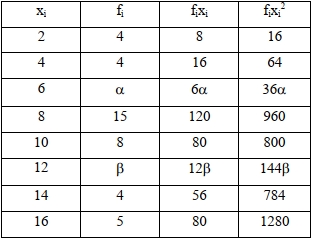
View full question & answer→MCQ 791 Mark
Let the mean and variance of $8$ numbers $x , y , 10$, $12,6,12,4,8$, be $9$ and $9.25$ respectively. If $x > y$, then $3 x-2 y$ is equal to $...........$.
Answerb
$\frac{x+y+52}{8}=9 \Rightarrow x+y=20$
For variance
$x-9, y-9,3,3,1,-5,-1,-3$
$\bar{x}=0$
$\therefore \frac{(x-9)^2+(y-9)^2+54}{8}-0^2=9.25$
$(x-9)^2+(11-x)^2=20$
$x=7 \text { or } 13 \therefore y=13,7$
$3 x-2 y=3 \times 13-2 \times 7=25$
View full question & answer→MCQ 801 Mark
Let the mean and variance of $12$ observations be $\frac{9}{2}$ and $4$ respectively. Later on, it was observed that two observations were considered as $9$ and $10$ instead of $7$ and $14$ respectively. If the correct variance is $\frac{m}{n}$, where $m$ and $n$ are co-prime, then $m + n$ is equal to
Answerc
$\frac{\sum x }{12}=\frac{9}{2}$
$\sum x =54$
$\frac{\Sigma x ^2}{12}-\left(\frac{9}{2}\right)^2=4$
$\sum x ^2=291$
$\sum x _{\text {new }}=54-(9+10)+7+14=56$
$\sum x _{\text {new }}^2=291-(81+100)+49+196=355$
$\sigma_{\text {new }}^2=\frac{355}{12}-\left(\frac{56}{12}\right)^2$
$\sigma_{\text {new }}^2=\frac{281}{36}=\frac{ m }{ n }$
$m + n =317$
View full question & answer→MCQ 811 Mark
If the mean of the frequency distribution
| Class: |
$0-10$ |
$10-20$ |
$20-30$ |
$30-40$ |
$40-50$ |
| Frequency |
$2$ |
$3$ |
$x$ |
$5$ |
$4$ |
is $28$ , then its variance is $........$.
Answerd
Given mean is $=28$
$\frac{2 \times 5+3 \times 15+x \times 25+5 \times 35+4 \times 45}{14+x}=28$
$x =6$
$\text { Variance }=\left(\frac{\sum x_i^2 f_i}{\sum f_i}\right)-(\text { mean })^2$
$\text { Variance }==\frac{2 \times 5^2+3 \times 15^2+6 \times 25^2+5 \times 35^2+4 \times 45^2}{20}-(28)^2$
$=151$
View full question & answer→MCQ 821 Mark
Let $\mu$ be the mean and $\sigma$ be the standard deviation of the distribution
| $X_i$ |
$0$ |
$1$ |
$2$ |
$3$ |
$4$ |
$5$ |
| $f_i$ |
$k+2$ |
$2k$ |
$K^{2}-1$ |
$K^{2}-1$ |
$K^{2}-1$ |
$k-3$ |
where $\sum f_i=62$. if $[x]$ denotes the greatest integer $\leq x$, then $\left[\mu^2+\sigma^2\right]$ is equal $.........$.
Answera
$\sum f _{ i }=62$
$3 k ^2+16 k -12 k -64=0$
$k =\text { or }-\frac{16}{3}(\text { rejected) }$
$\mu=\frac{\sum f _{ i } x _{ i }}{\sum f _{ i }}$
$\mu=\frac{8+2(15)+3(15)+4(17)+5}{62}=\frac{156}{62}$
$\sigma^2=\sum f _{ i } x _{ i }^2-\left(\sum f _{ i } x _{ i }\right)^2$
$=\frac{8 \times 1^2+15 \times 13+17 \times 16+25}{62}-\left(\frac{156}{62}\right)^2$
$\sigma^2=\frac{500}{62}-\left(\frac{156}{62}\right)^2$
$\sigma^2+\mu^2=\frac{500}{62}$
${\left[\sigma^2+\mu^2\right]=8}$
View full question & answer→MCQ 831 Mark
Let sets $A$ and $B$ have $5$ elements each. Let the mean of the elements in sets $A$ and $B$ be $5$ and $8$ respectively and the variance of the elements in sets $A$ and $B$ be $12$ and $20$ respectively $A$ new set $C$ of $10$ elements is formed by subtracting $3$ from each element of $A$ and adding 2 to each element of B. Then the sum of the mean and variance of the elements of $C$ is $.......$.
Answerb
$\omega A=\left\{a_1, a_2, a_3, a_4, a_5\right\}$
$B=\left\{b_1, b_2, b_3, b_4, b_5\right\}$
$\text { Given, } \sum_{ i =1}^3 ai =25, \sum_{ i =1}^3 bi =40$
$\frac{\sum_{ i =1}^5 a _{ i }^2}{5}-\left(\frac{\sum_{ i =1}^5 a _{ i }}{5}\right)^2=12, \frac{\sum_{ i =1}^5 b _{ i }^2}{5}-\left(\frac{\sum_{ i =1}^5 b _{ i }}{5}\right)^2=20$
$\sum_{ i =1}^5 a _{ i }^2=185 \quad, \quad \sum_{ i =1}^5 b _{ i }^2=420$
$\text { Now, } C =\left\{ C _1, C _2, \ldots . C _{10}\right\}$
$\text { s.f. } C_i=a_i=3 \text { or } b_i+2$
$\therefore \text { Mean of } C , \overline{ C }=\frac{\left(\sum a _{ i }-15\right)+\left(\sum b _{ i }+10\right)}{10}$
$\overline{ C }=\frac{10+50}{10}=6$
$\therefore \quad \sigma^2=\frac{\sum \limits_{ i =1}^{10} C _{ i }^2}{10}=(\overline{ C })^2$
$=\frac{\sum\left( a _{ i }-3\right)^2+\sum\left( b _{ i }+2\right)^2}{10}-(6)^2$
$=\frac{\sum a _{ i }{ }^2+\sum b _{ i }{ }^2-6 \sum a _{ i }+4 \sum b _{ i }+65}{10}-36$
$=\frac{185+420-150+160+65}{10}-36$
$=32$
$\therefore \quad$ Mean + Variance $=\overline{ C }+\sigma^2=6+32=38$
View full question & answer→MCQ 841 Mark
Let the mean of the data
| $X$ |
$1$ |
$3$ |
$5$ |
$7$ |
$9$ |
| $(f)$ |
$4$ |
$24$ |
$28$ |
$\alpha$ |
$8$ |
be $5.$ If $m$ and $\sigma^2$ are respectively the mean deviation about the mean and the variance of the data, then $\frac{3 \alpha}{m+\sigma^2}$ is equal to $..........$.
Answerc
$5=\bar{x}=\frac{\sum x_i f_i}{\sum f_i}=\frac{4+72+140+7 \alpha+72}{64+\alpha}$
$\Rightarrow 320+5 \alpha=288+7 \alpha \Rightarrow 2 \alpha=32 \Rightarrow \alpha=16$
$\text { M.. }(\bar{x})=\frac{\sum f _{ i }\left| x _{ i }-\overline{ x }\right|}{\sum f _{ i }} \text { where } \sum f _{ i }=64+16=80$
$\text { M.D. }(\bar{x})=\frac{4 \times 4+24 \times 2+28 \times 0+16 \times 2+8 \times 4}{80}$
$=\frac{8}{5}$
$\text { Variance }=\frac{\sum f _{ i }\left( x _{ i }-\overline{ x }\right)^2}{\sum f _{ i }}$
$=\frac{4 \times 16+24 \times 4+0+16 \times 4+8 \times 16}{80}=\frac{352}{80}$
$\therefore \frac{3 \alpha}{m+\sigma^2}=\frac{3 \times 16}{\frac{128}{80}+\frac{352}{80}}=8$
View full question & answer→MCQ 851 Mark
The mean and standard deviation of the marks of $10$ students were found to be $50$ and $12$ respectively. Later, it was observed that two marks $20$ and $25$ were wrongly read as $45$ and $50$ respectively. Then the correct variance is $............$.
Answerb
Sol. $\bar{x}=50$
$\sum x_i=500$
$\sum x_{i \text { correct }}=500+20+25-45-50=450$
$\sigma^2=144$
$\frac{\sum x_i^2}{10}-(50)^2=144$
$\sum x_{i c o r r e c t}^2=\left(144+(50)^2\right) \times 10-(45)^2-(50)^2+(20)^2+(25)^2$
$22940$
Correct variance $=\frac{\sum\left(x_{\text {icorrect }}\right)^2}{10}-\left(\frac{\sum x_{\text {icorrect }}}{10}\right)^2$
$=2294-(45)^2$
$=2294-2025=269$
View full question & answer→MCQ 861 Mark
The mean and standard deviation of $10$ observations are $20$ and $84$ respectively. Later on, it was observed that one observation was recorded as $50$ instead of $40$. Then the correct variance is:
Answerb
$\mu=20, \sigma=8$
$\mu_{\text {Corrected }}=\frac{200-50+40}{10}=19$
$\sigma^2=\frac{1}{10} \sum x_i^2-20^2$
$(64+400) 10=\sum x_i^2$
$\sigma_{\text {Corrected }}^2=\frac{1}{10}[(64+400) 10-2500+1600]-19^2$
$=374-361$
$=13$
View full question & answer→MCQ 871 Mark
The mean and variance of a set of $15$ numbers are $12$ and $14$ respectively. The mean and variance of another set of $15$ numbers are $14$ and $\sigma^2$ respectively. If the variance of all the $30$ numbers in the two sets is $13$,then $\sigma^2$ is equal to $.........$.
Answerd
$\text { Combine var. }=\frac{ n _1 \sigma^2+ n _2 \sigma^2}{ n _1+ n _2}+\frac{ n _1 n _2\left( m _1- m _2\right)^2}{\left( n _1+ n _2\right)^2}$
$13=\frac{15.14+15 \cdot \sigma^2}{30}+\frac{15.15(12-14)^2}{30 \times 30}$
$13=\frac{14+\sigma^2}{2}+\frac{4}{4}$
$\sigma^2=10$
View full question & answer→MCQ 881 Mark
The mean and standard deviation of $50$ observations are $15$ and $2$ respectively. It was found that one incorrect observation was taken such that the sum of correct and incorrect observations is $70$ . If the correct mean is $16$ , then the correct variance is equal to
Answerc
No. of observations: - $50$
mean $(\bar{x})=15$
Standard deviation $(\sigma)=2$
Let incorrect observation is $x_{1}$ and correct observation is $\left( x _{1}^{\prime}\right)$
Given $x_{1}+x_{1}^{\prime}=70$
$\bar{x}=\frac{x_{1}+x_{2}+\ldots+x_{\text {s0 }}}{50}=15(\text { given })$
$\Rightarrow x_{1}+x_{2}+\ldots . x_{50}=750$ $\ldots(i)$
Now
Mean of correct observation is $16$
$\frac{x_{1}^{\prime}+x_{2}+\ldots+x_{50}}{50}=16$
$x_{1}^{\prime}+x_{2}+x_{3}+\ldots x_{s 0}=16 \times 50$ $\ldots(ii)$
eq. $(ii)$ - eq. $(i)$
$\Rightarrow x_{1}^{\prime}-x_{1}=16 \times 50-15 \times 50$
$x_{1}^{\prime}-x_{1}=50 and x_{1}+x_{1}^{\prime}=70$
$x_{1}^{\prime}=60$
$x_{1}=10$
$\Rightarrow 4=\frac{x_{1}^{2}+x_{2}^{2}+\ldots .+x_{50}^{2}}{50}-15^{2}$ $\ldots(iii)$
$\Rightarrow \sigma^{2}=\frac{x_{1}^{\prime 2}+x_{2}^{2}+\ldots . x_{50}^{2}}{50}-16^{2}$ $\ldots(iv)$
from $(iii)$
$\Rightarrow 4=\frac{(10)^{2}}{50}+\frac{x_{2}^{2}+x_{3}^{2}+\ldots .+x_{50}^{2}}{50}-225$
$\Rightarrow 4=2-225+\frac{\left(x_{2}^{2}+x_{3}^{2}+\ldots .+x_{90}^{2}\right)}{50}$
$\Rightarrow 227=\frac{\left(x_{2}^{2}+x_{3}^{2}+\ldots x_{50}^{2}\right)}{50}$
$\text { From }( iv )$
$\sigma^{2}=\frac{(60)^{2}}{50}+\left(\frac{x_{2}^{2}+x_{3}^{2}+\ldots+x_{90}^{2}}{50}\right)-(16)^{2}$
$\sigma^{2}=\frac{60 \times 60}{50}+227-256$
$\sigma^{2}=72+227-256$
$\sigma^{2}=43$
View full question & answer→MCQ 891 Mark
If the mean deviation about the mean of the numbers $1,2,3, \ldots ., n$, where $n$ is odd, is $\frac{5(n+1)}{n}$, then $n$ is equal to
Answerd
Mean deviation about mean of first $n$ natural numbers is $\frac{ n ^{2}-1}{4 n }$
$\therefore n =21$
View full question & answer→MCQ 901 Mark
Suppose a class has $7$ students. The average marks of these students in the mathematics examination is $62$, and their variance is $20$ . A student fails in the examination if $he/she$ gets less than $50$ marks, then in worst case, the number of students can fail is
Answerd
$20=\frac{\sum\limits_{ i =1}^{7}\left| x _{ i }-62\right|^{2}}{7}$
$\Rightarrow\left| x _{1}-62\right|^{2}+\left| x _{2}-62\right|^{2}+\ldots .+\left| x _{7}-62\right|^{2}=140$
$If$ $x _{1}=49$
$|49-62|^{2}=169$
then, $\left| x _{2}-62\right|^{2}+\ldots .+\left| x _{7}-62\right|^{2}=$ Negative Number which is not possible, therefore, no student can fail.
View full question & answer→MCQ 911 Mark
The mean and standard deviation of $15$ observations are found to be $8$ and $3$ respectively. On rechecking it was found that, in the observations, $20$ was misread as $5$ . Then, the correct variance is equal to......
Answerd
We have
$\text { Variance }=\frac{\sum\limits_{ r =1}^{15} x _{ r }^{2}}{15}-\left(\frac{\sum\limits_{ r =1}^{15} x _{ r }}{15}\right)^{2}$
Now, as per information given in equation
$\frac{\sum x _{ r }^{2}}{15}-8^{2}=3^{2} \Rightarrow \sum x _{ T }^{2}=\log 5$
Now, the new $\sum x _{ r }^{2}=\log 5-5^{2}+20^{2}=1470$
And, new $\sum x _{ r }=(15 \times 8)-5+(20)=135$
Variance $=\frac{1470}{15}-\left(\frac{135}{15}\right)^{2}=98-81=17$
View full question & answer→MCQ 921 Mark
The number of values of $a \in N$ such that the variance of $3,7,12 a, 43-a$ is a natural number is (Mean $=13$)
Answera
Mean $=13$
Variance $=\frac{9+49+144+ a ^{2}+(43- a )^{2}}{5}-13^{2} \in N$
$\Rightarrow \frac{2 a^{2}-a+1}{5} \in N$
$\Rightarrow 2 a^{2}-a+1-5 n=0$ must have solution as natural numbers
its $D=40 n-7$ always has $3$ at unit place
$\Rightarrow D$ can't be perfect square
So, a can't be integer.
View full question & answer→MCQ 931 Mark
If the mean deviation about median for the number $3,5,7,2\,k , 12,16,21,24$ arranged in the ascending order, is $6$ then the median is
Answerd
Median $=\frac{2 k+12}{2}=k+6$
Mean deviation $=\sum \frac{\left|x_{i}-M\right|}{n}=6$
$(k+3)+(k+1)+(k-1)+(6-k)+(6-k)$
$\frac{+(10-k)+(15-k)+(18-k)}{8}$
$\therefore \quad \frac{58-2 k}{8}=6$
$k=5$
Median $=\frac{2 \times 5+12}{2}=11$
View full question & answer→MCQ 941 Mark
The mean and variance of $10$ observations were calculated as $15$ and $15$ respectively by a student who took by mistake $25$ instead of $15$ for one observation. Then, the correct standard deviation is$.....$
Answerc
$n =10, \bar{x}=\frac{\sum x_{i}}{10}=15$
$6^{2}=\frac{\sum x_{i}^{2}}{10}-(\bar{x})^{2}=15$
$\sum_{i=1}^{10} x_{i}=150$
$\sum_{i=1}^{9} x_{i}+25=150$
$\sum_{i=1}^{9} x_{i}=125$
$\sum_{i=1}^{9} x_{i}+15=140$
Actual mean $=\frac{140}{10}=14=\bar{x}_{\text {nev }}$
$\sum_{i=1}^{9} \frac{x_{i}^{2}+25^{2}-15^{2}}{10}=15$
$\sum_{i=1}^{9} x_{i}^{2}+625=2400$
$\sum_{i=1}^{9} x_{i}^{2}=1775$
$\sum_{i=1}^{9} x_{i}^{2}+15^{2}=2000=\left(\sum x_{i}^{2}\right)_{\text {acnaal }}$
$6_{\text {actual }}^{2}=\frac{\left(\sum x_{i}^{2}\right)_{\text {actual }}-\left(\bar{x}_{\text {new }}\right)^{2}}{10}$
$=\frac{2000}{10}-14^{2}$
$=200-196=4$
$(\text { S.D })_{\text {attul }}=6=2$
View full question & answer→MCQ 951 Mark
The mean and variance of the data $4, 5,6,6,7,8, x$, $y$ where $x < y$ are $6$ , and $\frac{9}{4}$ respectively. Then $x^{4}+y^{2}$ is equal to
Answerb
mean $\bar{x}=\frac{4+5+6+6+7+8+x+y}{8}=6$
$\Rightarrow x+y=48-36=12$
Variance
$=\frac{1}{8}\left(16+25+36+36+49+64+x^{2}+y^{2}\right)-36=\frac{9}{4}$
$\Rightarrow x^{2}+y^{2}=80$
$\therefore x=4 ; y=8$
$x^{4}+y^{2}=256+64=320$
View full question & answer→MCQ 961 Mark
The mean of the numbers $a, b, 8,5,10$ is $6$ and their variance is $6.8$. If $M$ is the mean deviation of the numbers about the mean, then $25\; M$ is equal to
Answera
$\sigma^{2}=\frac{\sum\limits_{i=1}^{5}\left(x_{i}-\bar{x}\right)^{2}}{n}$
Mean $=6$
$\frac{a+b+8+5+10}{5}=6$
$a+b=7$
$b=7-a$
$6.8=\frac{(a-6)^{2}+(b-6)^{2}+(8-6)^{2}+(5-6)^{2}+(10-6)^{2}}{5}$
$34=(a-6)^{2}+(7-a-6)^{2}+4+1+18$
$a^{2}-7 a+12=0 \Rightarrow a=4$ or $a=3$
$a=4 \quad a=3$
$b=3 \quad b=4$
$M=\frac{\sum\limits_{i=1}^{5}\left|x_{i}-x\right|}{n}$
$M=\frac{|a-6|+|b-6|+|8-6|+|5-6|+|10-6|}{5}$
when $a =3, b =4 \quad$
$M =\frac{3+2+2+1+4}{5}$
$M =\frac{12}{5}$
when $a =4, b =3$
$ M =\frac{2+3+2+1+7}{5}$
$M =\frac{12}{5}$
$25\;M =25 \times \frac{12}{5}=60$
View full question & answer→MCQ 971 Mark
Let the mean and the variance of $5$ observations $x_{1}, x_{2}, x_{3}, x_{4}, x_{5}$ be $\frac{24}{5}$ and $\frac{194}{25}$ respectively. If the mean and variance of the first $4$ observation are $\frac{7}{2}$ and $a$ respectively, then $\left(4 a+x_{5}\right)$ is equal to
Answerb
$\bar{x}=\frac{\sum x_{i}}{5}=\frac{24}{5} \Rightarrow \sum x_{i}=24$
$\sigma^{2}=\frac{\sum x_{i}^{2}}{5}-\left(\frac{24}{5}\right)^{2}=\frac{194}{25}$
$\Rightarrow \sum x_{i}^{2}=154$
$x_{1}+x_{2}+x_{3}+x_{4}=14$
$\Rightarrow x_{5}=10$
$\sigma^{2}=\frac{x_{1}^{2}+x_{2}^{2}+x_{3}^{2}+x_{4}^{2}}{4}-\frac{49}{4}=a$
$x_{1}^{2}+x_{2}^{2}+x_{3}^{2}+x_{4}^{2}=4 a+49$
$x_{5}^{2}=154-4 a-49$
$\Rightarrow 100=105-4 a \Rightarrow 4 a=5$
$4 a+x_{5}=15$
View full question & answer→MCQ 981 Mark
The mean and standard deviation of $40$ observations are $30$ and $5$ respectively. It was noticed that two of these observations $12$ and $10$ were wrongly recorded. If $\sigma$ is the standard deviation of the data after omitting the two wrong observations from the data, then $38 \sigma^{2}$ is equal to$.........$
Answera
Wrong mean $=\mu_{1}=30$
Wrong $S.D$ $=\sigma_{1}=5$
$\frac{\sum x _{ i }}{40}=30$
$\sum x _{ i }=1200$
$\sigma_{1}^{2}=25$
$\frac{\sum x _{ i }^{2}}{40}-30^{2}=25$
$\sum x _{ i }^{2}=925 \times 40=37000$
New sum $=\sum x _{ i }^{\prime}=1200-10-12=1178$
New mean $=\mu_{1}^{\prime}=\frac{1178}{38}=31$
New $\sum x _{ i }^{2}=37000-(10)^{2}-(12)^{2}=36756$
New $S.D$, $\sigma_{1}^{\prime}=\sqrt{\frac{36756}{38}-(31)^{2}}=\sigma$
$36756-(31)^{2} \times 38=38 \sigma^{2}$
$38 \sigma^{2}=238$
View full question & answer→MCQ 991 Mark
Let the mean and the variance of $20$ observations $x_{1}, x_{2}, \ldots x_{20}$ be $15$ and $9 ,$ respectively. For $\alpha \in R$, if the mean of $\left( x _{1}+\alpha\right)^{2},\left( x _{2}+\alpha\right)^{2}, \ldots,\left( x _{20}+\alpha\right)^{2}$ is $178 ,$ then the square of the maximum value of $\alpha$ is equal to $...........$
Answerd
$\sum x_{1}=15 \times 20=300 \quad \ldots(i)$
$\frac{\sum x_{1}^{2}}{20}-(15)^{2}=9$
$\sum x_{1}^{2}=234 \times 20=4680$
$\frac{\sum\left(x_{1}+\alpha\right)^{2}}{20}=178 \Rightarrow \sum\left(x_{1}+\alpha\right)^{2}=3560$
$\Rightarrow \sum x_{1}^{2}+2 \alpha \sum x_{1}+\sum \alpha^{2}=3560$
$4680+600 \alpha+20 \alpha^{2}=3560$
$\Rightarrow \alpha^{2}+30 \alpha+56=0$
$\Rightarrow(\alpha+28)(\alpha+2)=0$
$\alpha=-2,-28$
Square of maximum value of $\alpha$ is $4$
View full question & answer→MCQ 1001 Mark
The mean of $6$ distinct observations is $6.5$ and their variance is $10.25$. If $4$ out of $6$ observations are $2,4,5$ and $7 ,$ then the remaining two observations are:
- ✓
$10,11$
- B
$8,13$
- C
$1,20$
- D
$3,18$
AnswerCorrect option: A. $10,11$
a
Let other two numbers be $a$, (21-a)
Now,
$10.25=\frac{\left(4+16+25+49+a^{2}+(21-a)^{2}\right)}{6}$
(Using formula for variance)
$\Rightarrow 6(10.25)+6(6.5)^{2}=94+a^{2}+(21-a)^{2}$
$\Rightarrow a 2+\left(21-a^{2}\right)=221$
$\therefore a=10 \text { and }(21-a)=21-10=11$
so, remaining two observations are $10,11 .$
View full question & answer→MCQ 1011 Mark
If the mean and variance of six observations $7,10,11,15, a, b$ are $10$ and $\frac{20}{3}$, respectively, then the value of $|a-b|$ is equal to:
Answerd
$10=\frac{7+10+11+15+a+b}{6}$
$\Rightarrow a+b=17$
$\frac{20}{3}=\frac{7^{2}+10^{2}+11^{2}+15^{2}+a^{2}+b^{2}}{6}-10^{2}$
$a^{2}+b^{2}=145$
Solve $(i)$ and $(ii)$ $\mathrm{a}=9, \mathrm{~b}=8$ or $\mathrm{a}=8, \mathrm{~b}=9$
$|a-b|=1$
View full question & answer→MCQ 1021 Mark
Consider three observations $a, b$ and $c$ such that $b = a + c .$ If the standard deviation of $a +2$ $b +2, c +2$ is $d ,$ then which of the following is true ?
- A
$b^{2}=3\left(a^{2}+c^{2}\right)+9 d^{2}$
- B
$b^{2}=a^{2}+c^{2}+3 d^{2}$
- C
$b^{2}=3\left(a^{2}+c^{2}+d^{2}\right)$
- ✓
$b ^{2}=3\left( a ^{2}+ c ^{2}\right)-9 d ^{2}$
AnswerCorrect option: D. $b ^{2}=3\left( a ^{2}+ c ^{2}\right)-9 d ^{2}$
d
For $a, b, c$
mean $=\frac{a+b+c}{3}(=\bar{x})$
$b = a + c$
$\Rightarrow \quad \bar{x}=\frac{2 b}{3}$ $.....(1)$
S.D. $(a+2, b+2, c+2)=$ S.D. $(a, b, c)=d$
$\Rightarrow \quad d ^{2}=\frac{ a ^{2}+ b ^{2}+ c ^{2}}{3}-(\overline{ x })^{2}$
$\Rightarrow \quad d^{2}=\frac{a^{2}+b^{2}+c^{2}}{3}-\frac{4 b^{2}}{9}$
$\Rightarrow 9 d^{2}=3\left(a^{2}+b^{2}+c^{2}\right)-4 b^{2}$
$\Rightarrow \quad b^{2}=3\left(a^{2}+c^{2}\right)-9 d^{2}$
View full question & answer→MCQ 1031 Mark
Let $\mathrm{n}$ be an odd natural number such that the variance of $1,2,3,4, \ldots, \mathrm{n}$ is $14 .$ Then $\mathrm{n}$ is equal to ..... .
Answerb
$\frac{\mathrm{n}^{2}-1}{12}=14 \Rightarrow \mathrm{n}=13$
View full question & answer→MCQ 1041 Mark
The mean and variance of $7$ observations are $8$ and $16$ respectively. If two observations are $6$ and $8 ,$ then the variance of the remaining $5$ observations is:
- A
$\frac{92}{5}$
- B
$\frac{134}{5}$
- ✓
$\frac{536}{25}$
- D
$\frac{112}{5}$
AnswerCorrect option: C. $\frac{536}{25}$
c
Let $8,16, \mathrm{x}_{1}, \mathrm{x}_{2}, \mathrm{x}_{3}, \mathrm{x}_{4}, \mathrm{x}_{5}$ be the observations.
Now $\frac{x_{1}+x_{2}+\ldots+x_{5}+14}{7}=8....(i)$
$\Rightarrow \sum_{i=1}^{5} x_{i}=42$
Also $\frac{x_{1}^{2}+x_{2}^{2}+\ldots x_{5}^{2}+8^{2}+6^{2}}{7}-64=16$
$\Rightarrow \sum_{i=1}^{5} x_{i}^{2}=560-100=460....(ii)$
So variance of $x_{1}, x_{2}, \ldots, x_{5}$
$=\frac{460}{5}-\left(\frac{42}{5}\right)^{2}=\frac{2300-1764}{25}=\frac{536}{25}$
View full question & answer→MCQ 1051 Mark
If the mean and variance of the following data:
$6,10,7,13, a, 12, b, 12$ are 9 and $\frac{37}{4}$ respectively, then $(a-b)^{2}$ is equal to:
Answerc
$\text { Mean }=\frac{6+10+7+13+a+12+b+12}{8}=9$
$60+a+b=72$
$a+b=12$
$\text { veriance }=\frac{\sum x_{i}^{2}}{n}-\left(\frac{\sum x_{i}}{n}\right)=\frac{37}{4}$
$\sum x_{i}^{2}=6^{2}+10^{2}+7^{2}+13^{2}+a^{2}+b^{2}+12^{2}+12^{2}$
$=a^{2}+b^{2}+642$
$\frac{a^{2}+b^{2}+642}{8}-(9)^{2}=\frac{37}{4}$
$\frac{a^{2}+b^{2}}{8}+\frac{321}{4}-81=\frac{37}{4}$
$\frac{a^{2}+b^{2}}{8}=81+\frac{37}{4}-\frac{321}{4}$
$\frac{a^{2}+b^{2}}{8}=81-71$
$\therefore a^{2}+b^{2}=80$
From $(1)$ $a^{2}+b^{2}+2 a b=144$
$80+2 a b=144 \therefore 2 a b=64$
$(a-b)^{2}=a^{2}+b^{2}-2 a b=80-64=16$
View full question & answer→MCQ 1061 Mark
The mean age of $25$ teachers in a school is $40$ years. A teacher retires at the age of $60$ years and a new teacher is appointed in his place. If the mean age of the teachers in this school now is $39$ years, then the age (in years) of the newly appointed teacher is..........
Answerb
$\frac{\sum x _{ i }}{25}=40 \& \frac{\sum x _{ i }-60+ N }{25}=39$
Let age of newly appointed teacher is $N$
$\Rightarrow 1000-60+ N =975$
$\Rightarrow N =35$ years
View full question & answer→MCQ 1071 Mark
Let the mean and variance of the frequency distribution
| $\mathrm{x}$ |
$\mathrm{x}_{1}=2$ |
$\mathrm{x}_{2}=6$ |
$\mathrm{x}_{3}=8$ |
$\mathrm{x}_{4}=9$ |
| $\mathrm{f}$ |
$4$ |
$4$ |
$\alpha$ |
$\beta$ |
be $6$ and $6.8$ respectively. If $x_{3}$ is changed from $8$ to $7 ,$ then the mean for the new data will be:
- A
$\frac{16}{3}$
- B
$4$
- ✓
$\frac{17}{3}$
- D
$5$
AnswerCorrect option: C. $\frac{17}{3}$
c
$\text { Given } 32+8 \alpha+9 \beta=(8+\alpha+\beta) \times 6$
$\Rightarrow 2 \alpha+3 \beta=16 \quad \ldots \text { (i) }$
$\text { Also, } 4 \times 16+4 \times \alpha+9 \beta=(8+\alpha+\beta) \times 6.8$
$\Rightarrow 640+40 \alpha+90 \beta=544+68 \alpha+68 \beta$
$\Rightarrow 28 \alpha-22 \beta=96$
$\Rightarrow 14 \alpha-11 \beta=48 \quad \ldots (ii)$
from $(i)\, \, (ii)$
$\alpha=5 \, \,\beta=2$
so, new mean $=\frac{32+35+18}{15}=\frac{85}{15}=\frac{17}{3}$
View full question & answer→MCQ 1081 Mark
Consider the following frequency distribution :
| Class: |
$0-6$ |
$6-12$ |
$12-18$ |
$18-24$ |
$24-30$ |
| Frequency : |
$a$ |
$b$ |
$12$ |
$9$ |
$5$ |
If mean $=\frac{309}{22}$ and median $=14$, than value $(a-b)^{2}$ is equal to $.....$
Answerc
| Class |
Frequency |
$X_i$ |
$F_i\,X_i$ |
| $0-6$ |
$a$ |
$3$ |
$3a$ |
| $6-12$ |
$b$ |
$9$ |
$9b$ |
| $12-18$ |
$12$ |
$15$ |
$180$ |
| $18-24$ |
$9$ |
$21$ |
$189$ |
| $24-30$ |
$5$ |
$27$ |
$135$ |
| |
$N=(26+a+b)$ |
|
$(504+3a+9b)$ |
Mean $=\frac{3 a+9 b+180+189+135}{a+b+26}=\frac{309}{22}$
$\Rightarrow 66 a+198 b+11088=309 a+309 b+8034$
$\Rightarrow 243 a+111 b=3054$
$\Rightarrow 81 a+37 b=1018 ....(1)$
Now, Median $=12+\frac{\frac{a+b+26}{2}-(a+b)}{2} \times 6=14$
$\Rightarrow \frac{13}{2}-\left(\frac{a+b}{4}\right)=2$
$\Rightarrow \frac{a+b}{4}=\frac{9}{2}$
$\Rightarrow a+b=18 \rightarrow(2)$
From equation $(1)\, and\,(2)$
$a=8, b=10$
$\therefore(a-b)^{2}=(8-10)^{2}$
View full question & answer→MCQ 1091 Mark
Consider the following frequency distribution:
| Class: |
$10-20$ |
$20-30$ |
$30-40$ |
$40-50$ |
$50-60$ |
| Freq: |
$\alpha$ |
$110$ |
$54$ |
$30$ |
$\beta$ |
If the sum of all frequencies is $584$ and median is $45$ , then $|\alpha-\beta|$ is equal to $.....$
Answerb
| $Class$ |
$Frequency$ |
$C.F.$ |
| $10-20$ |
$\alpha$ |
$\alpha$ |
| $20-30$ |
$110$ |
$\alpha+110$ |
| $30-40$ |
$54$ |
$\alpha+164$ |
| $40-50$ |
$30$ |
$\alpha+194$ |
| $50-60$ |
$\beta$ |
$\alpha+\mathrm{b}+194=584$ |
| |
$\mathrm{N}=\sum \mathrm{f}=584$
$\alpha+\beta=390$
|
|
Median $(\mathrm{m})=\ell+\left[\frac{\left(\frac{\mathrm{N}}{2}\right)-\mathrm{c}}{\mathrm{f}}\right] \times \mathrm{h}$
$\mathrm{N}=\frac{584}{2}=292$
$\mathrm{~m}=45=40+\left[\frac{292-(\alpha+164)}{30}\right] \times 10$
$45=40+\left(\frac{128-\alpha}{3}\right)$
$15=128-\alpha$
$\alpha=113$
$\beta=277$
$|\alpha-\beta|=|113-277|=164$
View full question & answer→MCQ 1101 Mark
Consider the statistics of two sets of observations as follows :
| |
Size |
Mean |
Variance |
| Observation $I$ |
$10$ |
$2$ |
$2$ |
| Observation $II$ |
$n$ |
$3$ |
$1$ |
If the variance of the combined set of these two observations is $\frac{17}{9},$ then the value of $n$ is equal to ..... .
Answerc
$\sigma^{2}=\frac{ n _{1} \sigma_{1}^{2}+ n _{2} \sigma_{2}^{2}}{ n _{1}+ n _{2}}+\frac{ n _{1} n _{2}}{\left( n _{1}+ n _{2}\right)}\left(\overline{ x }_{1}-\overline{ x }_{2}\right)^{2}$
$n _{1}=10, n _{2}= n , \sigma_{1}^{2}=2, \sigma_{2}^{2}=1$
$\overline{ x }_{1}=2, \overline{ x }_{2}=3, \sigma^{2}=\frac{17}{9}$
$\frac{17}{9}=\frac{10 \times 2+ n }{ n +10}+\frac{10 n }{( n +10)^{2}}(3-2)^{2}$
$\frac{17}{9}=\frac{(n+20)(n+10)+10 n}{(n+10)^{2}}$
$17 n^{2}+1700+340 n=90 n+9\left(n^{2}+30 n+200\right)$
$8 n^{2}-20 n-100=0$
$2 n^{2}-5 n-25=0$
$(2 n+5)(n-5)=0 \Rightarrow n=\frac{-5}{2} \,(Rejected) , 5$
Hence $n =5$
View full question & answer→MCQ 1111 Mark
Consider a set of $3 n$ numbers having variance $4.$ In this set, the mean of first $2 n$ numbers is $6$ and the mean of the remaining $n$ numbers is $3.$ A new set is constructed by adding $1$ into each of first $2 n$ numbers, and subtracting $1$ from each of the remaining $n$ numbers. If the variance of the new set is $k$, then $9 k$ is equal to .... .
Answerb
Let number be $a _{1}, a _{2}, a _{3}, \ldots \ldots a _{2 n }, b _{1}, b _{2}, b _{3} \ldots b _{ n }$
$\sigma^{2}=\frac{\sum a^{2}+\sum b^{2}}{3 n}-(5)^{2}$
$\Rightarrow \sum a^{2}+\sum b^{2}=87 n$
Now, distribution becomes
$a _{1}+1, a _{2}+1, a _{3}+1, \ldots \ldots a _{2 n }+1, b _{1}-1,b_{2}-1 \ldots \ldots b_{n}-1$
Variance
$=\frac{\sum(a+1)^{2}+\sum(b-1)^{2}}{3 n}-\left(\frac{12 n+2 n+3 n-n}{3 n}\right)^{2}$
$=\frac{\left(\sum a^{2}+2 n+2 \sum a\right)+\left(\sum b^{2}+n-2 \sum b\right)}{3 n}$
$=\frac{\left(\sum a^{2}+2 n+2 \sum a\right)+\left(\sum b^{2}+n-2 \sum b\right)}{3 n}-\left(\frac{16}{3}\right)^{2}$
$=\frac{87 n+3 n+2(12 n)-2(3 n)}{3 n}-\left(\frac{16}{3}\right)^{2}$
$\Rightarrow k=\frac{108}{3}-\left(\frac{16}{5}\right)^{2}$
$\Rightarrow 9 k=3(108)-(16)^{2}=324-256=68$
View full question & answer→MCQ 1121 Mark
Let in a series of $2 n$ observations, half of them are equal to $a$ and remaining half are equal to $-a.$ Also by adding a constant $b$ in each of these observations, the mean and standard deviation of new set become $5$ and $20 ,$ respectively. Then the value of $a^{2}+b^{2}$ is equal to ....... .
Answera
Let observations are denoted by $x _{i}$ for $1 \leq i< 2 n$
$\bar{x}=\frac{\sum x_{i}}{2 n}=\frac{(a+a+\ldots+a)-(a+a+\ldots+a)}{2 n}$
$\Rightarrow \overline{ x }=0$
and $\sigma_{ x }^{2}=\frac{\sum x _{i}^{2}}{2 n }-(\overline{ x })^{2}=\frac{ a ^{2}+ a ^{2}+\ldots+ a ^{2}}{2 n }-0= a ^{2}$
$\Rightarrow \sigma_{x}=a$
Now, adding a constant $b$ then $\overline{ y }=\overline{ x }+ b =5$
$\Rightarrow b =5$
and $\sigma_{y}=\sigma_{x}$ (No change in S.D.) $\Rightarrow a=20$
$\Rightarrow a^{2}+b^{2}=425$
View full question & answer→MCQ 1131 Mark
If the variance of $10$ natural numbers $1,1,1, \ldots ., 1, k$ is less than $10 ,$ then the maximum possible value of $k$ is ...... .
Answerb
$\sigma^{2}=\frac{\Sigma x ^{2}}{ n }-\left(\frac{\Sigma x }{ n }\right)^{2}$
$=\frac{9+ k ^{2}}{10}-\left(\frac{9+ k }{10}\right)^{2}<10$
$90+10 k^{2}-81-k^{2}-18 k < 1000$
$9 k ^{2}-18 k -991 < 0$
$k^{2}-2 k < \frac{991}{9}$
$( k -1)^{2} < \frac{1000}{9}$
$\frac{-10 \sqrt{10}}{3} < k -1 < \frac{10 \sqrt{10}}{3}$
$k < \frac{10 \sqrt{10}}{3}+1$
$k \leq 11$
Maximum value of $k$ is $11 .$
View full question & answer→MCQ 1141 Mark
Let $X _{1}, X _{2}, \ldots, X _{18}$ be eighteen observations such that $\sum_{ i =1}^{18}\left( X _{ i }-\alpha\right)=36 \quad$ and $\sum_{i=1}^{18}\left(X_{i}-\beta\right)^{2}=90,$ where $\alpha$ and $\beta$ are distinct real numbers. If the standard deviation of these observations is $1,$ then the value of $|\alpha-\beta|$ is ...... .
Answera
$\sum_{i=1}^{18}\left(x_{i}-\alpha\right)=36, \sum_{i=1}^{18}\left(x_{i}-\beta\right)^{2}=90$
$\Rightarrow \sum_{i=1}^{18} x_{i}=18(\alpha+2), \sum_{i=1}^{18} x_{i}^{2}-2 \beta \sum_{i=1}^{18} x_{i}+18 \beta^{2}=90$
Hence $\sum x _{ i }^{2}=90-18 \beta^{2}+36 \beta(\alpha+2)$
Given $\frac{\sum x _{ i }^{2}}{18}-\left(\frac{\sum x _{ i }}{18}\right)^{2}=1$
$\Rightarrow 90-18 \beta^{2}+36 \beta(\alpha+2)-18(\alpha+2)^{2}=18$
$\Rightarrow 5-\beta^{2}+2 \alpha \beta+4 \beta-\alpha^{2}-4 \alpha-4=1$
$\Rightarrow(\alpha-\beta)^{2}+4(\alpha-\beta)=0 \Rightarrow|\alpha-\beta|=0$ or $4$
As $\alpha$ and $\beta$ are distinct $|\alpha-\beta|=4$
View full question & answer→MCQ 1151 Mark
The mean and standard deviation of $20$ observations were calculated as $10$ and $2.5$ respectively. It was found that by mistake one data value was taken as $25$ instead of $35 .$ If $\alpha$ and $\sqrt{\beta}$ are the mean and standard deviation respectively for correct data, then $(\alpha, \beta)$ is :
- A
$(11,26)$
- B
$(10.5,25)$
- C
$(11,25)$
- ✓
$(10.5,26)$
AnswerCorrect option: D. $(10.5,26)$
d
Given :
Mean $(\bar{x})=\frac{\Sigma x_{i}}{20}=10$
or $\Sigma \mathrm{x}_{\mathrm{i}}=200$ (incorrect)
or $200-25+35=210=\Sigma \mathrm{x}_{\mathrm{i}}$ (Correct)
Now correct $\bar{x}=\frac{210}{20}=10.5$
again given $S . D=2.5(\sigma)$
$\sigma^{2}=\frac{\Sigma \mathrm{x}_{\mathrm{i}}^{2}}{20}-(10)^{2}=(2.5)^{2}$
or $\Sigma \mathrm{x}_{\mathrm{i}}^{2}=2125$ (incorrect)
or $\Sigma \mathrm{x}_{\mathrm{i}}^{2}=2125-25^{2}+35^{2}$ $=2725$ (Correct)
$\therefore$ correct $\sigma^{2}=\frac{2725}{20}-(10.5)^{2}$
$\underline{\underline{\sigma}}^{2}=26$
or $\sigma=26$
$\therefore \underline{\alpha}=10.5, \beta=26$
View full question & answer→MCQ 1161 Mark
Let the mean and variance of four numbers $3,7, x$ and $y(x>y)$ be $5$ and $10$ respectively. Then the mean of four numbers $3+2 \mathrm{x}, 7+2 \mathrm{y}, \mathrm{x}+\mathrm{y}$ and $x-y$ is ..... .
Answerc
$5=\frac{3+7+x+y}{4} \Rightarrow x+y=10$
$\operatorname{Var}(x)=10=\frac{3^{2}+7^{2}+x^{2}+y^{2}}{4}-25$
$140=49+9+x^{2}+y^{2}$
$x^{2}+y^{2}=82$
$x+y=10$
$\Rightarrow(x, y)=(9,1)$
Four numbers are $21,9,10,8$
$\text { Mean }=\frac{48}{4}=12$
View full question & answer→MCQ 1171 Mark
Let $\mathrm{X}$ be a random variable with distribution.
| $\mathrm{x}$ |
$-2$ |
$-1$ |
$3$ |
$4$ |
$6$ |
| $\mathrm{P}(\mathrm{X}=\mathrm{x})$ |
$\frac{1}{5}$ |
$\mathrm{a}$ |
$\frac{1}{3}$ |
$\frac{1}{5}$ |
$\mathrm{~b}$ |
If the mean of $X$ is $2.3$ and variance of $X$ is $\sigma^{2}$, then $100 \sigma^{2}$ is equal to :
- ✓
$781$
- B
$100$
- C
$529$
- D
$1310$
Answera
| $\mathrm{x}$ |
$-2$ |
$-1$ |
$3$ |
$4$ |
$6$ |
| $\mathrm{P}(\mathrm{X}=\mathrm{x})$ |
$\frac{1}{5}$ |
$\mathrm{a}$ |
$\frac{1}{3}$ |
$\frac{1}{5}$ |
$\mathrm{~b}$
|
$\bar{X}=2.3$
$-a+6 b=\frac{9}{10} \ldots (1)$
$\sum P_{i}=\frac{1}{5}+a+\frac{1}{3}+\frac{1}{5}+b=1$
$a+b=\frac{4}{15} \ldots (2)$
From equation $(1)$ and $(2)$
$a=\frac{1}{10}, b=\frac{1}{6}$
$\sigma^{2}=\Sigma p_{i} x_{i}^{2}-(\bar{X})^{2}$
$\frac{1}{5}(4)+a(1)+\frac{1}{3}(9)+\frac{1}{5}(16)+b(36)-(2.3)^{2}$
$=\frac{4}{5}+a+3+\frac{16}{5}+36 b-(2.3)^{2}$
$=4+a+3+36 b-(2.3)^{2}$
$=7+a+36 b-(2.3)^{2}$
$=7+\frac{1}{10}+6-(2.3)^{2}$
$=13+\frac{1}{10}-\left(\frac{23}{10}\right)^{2}$
$=\frac{131}{10}-\left(\frac{23}{10}\right)^{2}$
$=\frac{1310-(23)^{2}}{100}$
$=\frac{1310-529}{100}$
$=\frac{781}{100}$
$100 \sigma^{2}=781$
View full question & answer→MCQ 1181 Mark
The first of the two samples in a group has $100$ items with mean $15$ and standard deviation $3 .$ If the whole group has $250$ items with mean $15.6$ and standard deviation $\sqrt{13.44}$, then the standard deviation of the second sample is:
Answerc
$n_{1}=100 \quad n=250$
$\therefore n_{2}=250-100 \Rightarrow n_{2}=150$
$\bar{x}=\frac{n_{1} \bar{x}_{1}+n_{2} \bar{x}_{2}}{n_{1}+n_{2}}$
$15.6=\frac{100(15)+(150)\left(\bar{x}_{2}\right)}{250}$
$\Rightarrow \overline{\mathrm{x}}_{2}=16$
$\overline{\mathrm{X}}_{1}=15 \quad\quad\quad\quad \Rightarrow$
$\sigma_{1}^{2}=V_{1}(x)=9 \quad \sigma^{2}=\operatorname{Var}(x)=13.44$
$\sigma^{2}=\frac{\mathrm{n}_{1} \sigma_{1}^{2}+\mathrm{n}_{2} \sigma_{2}^{2}}{\mathrm{n}_{1}+\mathrm{n}_{2}}+\frac{\mathrm{n}_{1} \mathrm{n}_{2}}{\left(\mathrm{n}_{1}+\mathrm{n}_{2}\right)}\left(\overline{\mathrm{x}}_{1}-\overline{\mathrm{x}}_{2}\right)^{2}$
$\mathrm{n}_{2}=150, \overline{\mathrm{x}}_{2}=16, \mathrm{~V}_{2}(\mathrm{x})=\sigma_{2}$
$13.44=\frac{100 \times 9+150 \times \sigma_{2}^{2}}{250}+\frac{100 \times 150}{(250)^{2}} \times 1$
$\Rightarrow \sigma_{2}^{2}=16 \Rightarrow \sigma_{2}=4$
View full question & answer→MCQ 1191 Mark
An online exam is attempted by $50$ candidates out of which $20$ are boys. The average marks obtained by boys is $12$ with a variance $2 .$ The variance of marks obtained by $30$ girls is also $2 .$ The average marks of all $50$ candidates is $15 .$ If $\mu$ is the average marks of girls and $\sigma^{2}$ is the variance of marks of $50$ candidates, then $\mu+\sigma^{2}$ is equal to ...... .
Answerb
$\sigma_{b}^{2}=2 \quad$ (variance of boys) $n_{1}=$ no. of boys
$\bar{x}_{b}=12 \quad\quad\quad\quad\quad\quad\quad\quad n_{2}=$ no. of girls
$\sigma_{\mathrm{g}}^{2}=2$
$\bar{x}_{g}=\frac{50 \times 15-12 \times \sigma_{b}}{30}=\frac{750-12 \times 20}{30}=17=\mu$
variance of combined series
$\sigma^{2}=\frac{n_{1} \sigma_{b}^{2}+n_{2} \sigma_{g}^{2}}{n_{1}+n_{2}}+\frac{n_{1} \cdot n_{2}}{\left(n_{1}+n_{2}\right)^{2}}\left(\bar{x}_{b}-\bar{x}_{g}\right)^{2}$
$\sigma^{2}=\frac{20 \times 2+30 \times 2}{20+30}+\frac{20 \times 30}{(20+30)^{2}}(12-17)^{2}$
$\sigma^{2}=8$
$\Rightarrow \mu+\sigma^{2}=17+8=25$
View full question & answer→MCQ 1201 Mark
Let $x _{ i }(1 \leq i \leq 10)$ be ten observations of a random variable $X .$ If $\sum \limits_{ i =1}^{10}\left( x _{ i }- p \right)=3$ and $\sum \limits_{ i =1}^{10}\left( x _{ i }- p \right)^{2}=9$ where $0 \neq p \in R ,$ then the standard deviation of these observations is
- A
$\sqrt{\frac{3}{5}}$
- B
$\frac{7}{10}$
- ✓
$\frac{9}{10}$
- D
$\frac{4}{5}$
AnswerCorrect option: C. $\frac{9}{10}$
c
Variance $=\frac{\sum\left( x _{ i }- p \right)^{2}}{ n }-\left(\frac{\sum\left( x _{ i }- p \right)}{ n }\right)^{2}$
$=\frac{9}{10}-\left(\frac{3}{10}\right)^{2}=\frac{81}{100}$
$S.D. =\frac{9}{10}$
View full question & answer→MCQ 1211 Mark
For the frequency distribution :
| Variate $( x )$ |
$x _{1}$ |
$x _{1}$ |
$x _{3} \ldots \ldots x _{15}$ |
| Frequency $(f)$ |
$f _{1}$ |
$f _{1}$ |
$f _{3} \ldots f _{15}$ |
where $0< x _{1}< x _{2}< x _{3}<\ldots .< x _{15}=10$ and
$\sum \limits_{i=1}^{15} f_{i}>0,$ the standard deviation cannot be
Answerd
$\because \sigma^{2} \leq \frac{1}{4}( M - m )^{2}$
Where $M$ and $m$ are upper and lower bounds
of values of any random variable.
$\therefore \quad \sigma^{2}<\frac{1}{4}(10-0)^{2}$
$\Rightarrow 0<\sigma<5$
$\therefore \sigma \neq 6$
View full question & answer→MCQ 1221 Mark
If the variance of the following frequency distribution :
| Class |
$10-20$ |
$20-30$ |
$30-40$ |
| Frequency |
$2$ |
$x$ |
$2$ |
then $x$ is equal to
Answera
Variance is independent of shifting of origin
$\Rightarrow y_{i}: 15 \quad 25 \quad 35 \;\; or\;\;-10 \quad 0 \quad 10$
$\Rightarrow f_{i}: 2 \quad \;\;\;x \quad \;2 \;\;\;\;\;\;\;\;\;\;\;\;\;\;\;\;\; 2 \quad \;\;x \quad \;2$
$\Rightarrow \quad$ Variance $\left(\sigma^{2}\right)=\frac{\Sigma x _{ i }^{2} f _{ i }}{\Sigma f _{ i }}-(\overrightarrow{ x })^{2}$
$\Rightarrow \quad 50=\frac{200+0+200}{x+4}-0 \quad\{\bar{x}=0\}$
$\Rightarrow \quad 200+50 x=200+200$
$\Rightarrow \quad x=4$
View full question & answer→MCQ 1231 Mark
If $\sum \limits_{i=1}^{n}\left(x_{i}-a\right)=n$ and $\sum \limits_{i=1}^{n}\left(x_{i}-a\right)^{2}=n a,(n, a>1)$ then the standard deviation of $n$ observations $x _{1}, x _{2}, \ldots, x _{ n }$ is
- A
$n \sqrt{ a -1}$
- ✓
$\sqrt{a-1}$
- C
$a-1$
- D
$\sqrt{n(a-1)}$
AnswerCorrect option: B. $\sqrt{a-1}$
b
$S.D =\sqrt{\frac{\sum_{i=1}^{n}\left( x _{ i }- a \right)}{ n }-\left(\frac{\sum_{i=1}^{ n }\left( x _{ i }- a \right)}{ n }\right)^{2}}$
$=\sqrt{\frac{ na }{ n }-\left(\frac{ n }{ n }\right)^{2}}$
$\left\{\right.$ Given $\left.\sum_{i=1}^{n}\left(x_{i}-a\right)=n \sum_{i=1}^{n}\left(x_{i}-a\right)^{2}=n a\right\}$
$=\sqrt{a-1}$
View full question & answer→MCQ 1241 Mark
Consider the data on x taking the values $0,2,4,8, \ldots, 2^{n}$ with frequencies ${ }^{n} C_{0},{ }^{n} C_{1},{ }^{n} C_{2}, \ldots$ ${ }^{ n } C _{ n }$ respectively. If the mean of this data is $\frac{728}{2^{ n }},$ then $n$ is equal to
Answerd
$ \begin{array}{|c|c|c|c|c|c|c|} \hline x & 0 & 2 & 4 & 8 & & 2^{ n } \\ \hline f & { }^{ n } C _{0} & { }^{ n } C _{1} & { }^{ n } C _{2} & { }^{ n } C _{3} & & { }^{ n } C _{ n } \\ \hline \end{array}$
Mean $=\frac{\sum x_{i} f_{i}}{\sum f_{i}}=\frac{\sum_{x=1}^{n} 2^{x}{ }^{n} C_{x}}{\sum_{x=0}^{n}{ }^{n} C_{r}}$
Mean $=\frac{(1+2)^{n}-{ }^{n} C_{0}}{2^{n}}=\frac{728}{2^{n}}$
$\Rightarrow \frac{3^{n}-1}{2^{n}}=\frac{728}{2^{n}}$
$\Rightarrow 3^{n}=729 \Rightarrow n=6$
View full question & answer→MCQ 1251 Mark
If the mean and the standard deviation of the data $3,5,7, a, b$ are $5$ and $2$ respectively, then $a$ and $b$ are the roots of the equation
- A
$2 x^{2}-20 x+19=0$
- ✓
$x^{2}-10 x+19=0$
- C
$x^{2}-10 x+18=0$
- D
$x^{2}-20 x+18=0$
AnswerCorrect option: B. $x^{2}-10 x+19=0$
b
Mean $=5$
$\frac{3+5+7+a+b}{5}=5$
$a+b=10$
S.d. $=2 \Rightarrow \sqrt{\frac{\sum_{i=1}^{5}\left(x_{i}-\bar{x}\right)^{2}}{5}}=2$
$(3-5)^{2}+(5-5)^{2}+(7-5)^{2}+(a-5)^{2}+(b-5)^{2}=20$
$\Rightarrow 4+0+4+(a-5)^{2}+(b-5)^{2}=20$
$a^{2}+b^{2}-10(a+b)+50=12$
$(a+b)^{2}-2 a b-100+50=12$
$a b=19$
Equation is $x^{2}-10 x+19=0$
View full question & answer→MCQ 1261 Mark
If the mean and variance of eight numbers $3,7,9,12,13,20, x$ and $y$ be $10$ and $25$ respectively, then $\mathrm{x} \cdot \mathrm{y}$ is equal to
Answerc
$\frac{3+7+9+12+13+20+x+y}{8}=10$
$x+y=16$
$\frac{\Sigma x^{2}}{n}-\left(\frac{\Sigma x}{n}\right)^{2}=25$
$3^{2}+7^{2}+9^{2}+12^{2}+13^{2}+20^{2}+\mathrm{x}^{2}+\mathrm{y}^{2}=1000$
$x^{2}+y^{2}=148$
$x y=54$
View full question & answer→MCQ 1271 Mark
If the variance of the first $n$ natural numbers is $10$ and the variance of the first m even natural numbers is $16$, then $m + n$ is equal to
Answerb
Variance of first 'n' natural numbers $=\frac{\mathrm{n}^{2}-1}{12}=10$
$\Rightarrow n=11$
and variance of first 'm' even natural numbers
$=4\left(\frac{\mathrm{m}^{2}-1}{12}\right) \Rightarrow \frac{\mathrm{m}^{2}-1}{3}=16 \Rightarrow \mathrm{m}=7$
$m+n=18$
View full question & answer→MCQ 1281 Mark
The mean and variance of $20$ observations are found to be $10$ and $4,$ respectively. On rechecking, it was found that an observation $9$ was incorrect and the correct observation was $11$. Then the correct variance is
- ✓
$3.99$
- B
$3.98$
- C
$4.02$
- D
$4.01$
AnswerCorrect option: A. $3.99$
a
$\frac{\sum \mathrm{x}_{\mathrm{i}}}{20}=10 \Rightarrow \Sigma \mathrm{x}_{\mathrm{i}}=200$
$\frac{\sum \mathrm{x}_{\mathrm{i}}^{2}}{20}-100=4 \Rightarrow \Sigma \mathrm{x}_{\mathrm{i}}^{2}=2080$
Actual mean $=\frac{200-9+11}{20}=\frac{202}{20}$
Variance $=\frac{2080-81+121}{20}-\left(\frac{202}{20}\right)^{2}=3.99$
View full question & answer→MCQ 1291 Mark
The mean and the standard deviation (s.d.) of $10$ observations are $20$ and $2$ resepectively. Each of these $10$ observations is multiplied by $\mathrm{p}$ and then reduced by $\mathrm{q}$, where $\mathrm{p} \neq 0$ and $\mathrm{q} \neq 0 .$ If the new mean and new s.d. become half of their original values, then $q$ is equal to
Answera
$20 \mathrm{p}-\mathrm{q}=10\ldots(i)$
and $2|p|=1 \Rightarrow p=\pm \frac{1}{2}\ldots(ii)$
so, $\mathrm{p}=-\frac{1}{2}$ and $\mathrm{q}=-20$
View full question & answer→MCQ 1301 Mark
Let the observations $\mathrm{x}_{\mathrm{i}}(1 \leq \mathrm{i} \leq 10)$ satisfy the equations, $\sum\limits_{i=1}^{10}\left(x_{i}-5\right)=10$ and $\sum\limits_{i=1}^{10}\left(x_{i}-5\right)^{2}=40$ If $\mu$ and $\lambda$ are the mean and the variance of the observations, $\mathrm{x}_{1}-3, \mathrm{x}_{2}-3, \ldots ., \mathrm{x}_{10}-3,$ then the ordered pair $(\mu, \lambda)$ is equal to :
- A
$(6, 6)$
- B
$(3, 6)$
- C
$(6, 3)$
- ✓
$(3, 3)$
AnswerCorrect option: D. $(3, 3)$
d
$\sum_{i=1}^{10}\left(x_{i}-5\right)=10$
$\Rightarrow$ Mean of observation $\mathrm{x}_{\mathrm{i}}-5=\frac{1}{10} \sum_{\mathrm{i}=1}^{3}\left(\mathrm{x}_{\mathrm{i}}-5\right)=1$
$\Rightarrow \mu=$ mean of observation $\left(\mathrm{x}_{\mathrm{i}}-3\right)$
$=\left(\text { mean of observation }\left(\mathrm{x}_{\mathrm{i}}-5\right)\right)+2$
$=1+2=3$
Variance of observation
$\mathrm{x}_{\mathrm{i}}-5=\frac{1}{10} \sum_{\mathrm{i}=1}^{10}\left(\mathrm{x}_{\mathrm{i}}-5\right)^{2}-\left(\mathrm{Mean} \text { of }\left(\mathrm{x}_{\mathrm{i}}-5\right)\right)^{2}=3$
$\Rightarrow \quad \lambda=$ variance of observation $\left(\mathrm{x}_{\mathrm{i}}-3\right)$
$=$ variance of observation $\left(\mathrm{x}_{\mathrm{i}}-5\right)=3$ $\therefore \quad(\mu, \lambda)=(3,3)$
View full question & answer→MCQ 1311 Mark
Let $X=\{\mathrm{x} \in \mathrm{N}: 1 \leq \mathrm{x} \leq 17\}$ and $\mathrm{Y}=\{\mathrm{ax}+\mathrm{b}: \mathrm{x} \in \mathrm{X}$ and $\mathrm{a}, \mathrm{b} \in \mathrm{R}, \mathrm{a}>0\} .$ If mean and variance of elements of $Y$ are $17$ and $216$ respectively then $a + b$ is equal to
Answera
$\sigma^{2}=$ variance
$\mu=$ mean
$\sigma^{2}=\frac{\sum_{i=1}^{n}\left(x_{i}-\mu\right)^{2}}{n}$
$\mu=17$
$\Rightarrow \frac{\sum_{x=1}^{17}(a x+b)}{17}=17$
$\Rightarrow \quad 9 a+b=17$
$\sigma^{2}=216$
$\Rightarrow \quad \frac{\sum_{x=1}^{17}(a x+b-17)^{2}}{17}=216$
$\Rightarrow \frac{\sum_{x=1}^{17} a^{2}(x-9)^{2}}{17}=216$
$\Rightarrow \quad a^{2} 81-18 \times 9 a^{2}+a^{2} 3 \times(35)=216$
$\Rightarrow \quad$ From $(1), b=-10$
So, $a+b=-7$
View full question & answer→MCQ 1321 Mark
The mean and variance of $8$ observations are $10$ and $13.5,$ respectively. If $6$ of these observations are $5,7,10,12,14,15,$ then the absolute difference of the remaining two observations is
Answera
$\bar{x}=10$
$\Rightarrow \bar{x}=\frac{63+a+b}{8}=10 \Rightarrow a+b=17$
since, variance is independent of origin. So, we subtract 10 from each observation.
$So , \sigma^{2}=13.5=\frac{79+( a -10)^{2}+( b -10)^{2}}{8}-(10-10)^{2}$
$\Rightarrow a ^{2}+ b ^{2}-20( a + b )=-171$
$\Rightarrow a ^{2}+ b ^{2}=169 \quad \ldots(2)$
From
$(i) and (ii)$ $; a=12 \& b=5$
View full question & answer→MCQ 1331 Mark
The mean and variance of $7$ observations are $8$ and $16,$ respectively. If five observations are $2, 4, 10,12,14,$ then the absolute difference of the remaining two observations is
Answera
$\bar{x}=\frac{2+4+10+12+14+x+y}{7}=8$
$x+y=14$
$(\sigma)^{2}=\frac{\sum\left( x _{ i }\right)^{2}}{ n }-\left(\frac{\sum x _{ i }}{ n }\right)^{2}$
$16=\frac{4+16+100+144+196+x^{2}+y^{2}}{7}-8^{2}$
$16+64=\frac{460+x^{2}+y^{2}}{7}$
$560=460+x^{2}+y^{2}$
$x^{2}+y^{2}=100$ (ii)
Clearly by (i) and (ii), $|x-y|=2$
View full question & answer→MCQ 1341 Mark
If for some $x \in R$, the frequency distribution of the marks obtained by $20$ students in a test is
Marks $2$ $3$ $5$ $7$
Frequency $(x+1)^2$ $2x -5$ $x^2 -3x$ $x$
Then the mean of the marks is
Answera
$\bar x = \frac{{\sum {{x_i}{f_i}} }}{{\sum {{x_i}} }}$
$\because$ $\sum {{f_i}} = {\left( {x + 1} \right)^2} + \left( {2x - 5} \right) + \left( {{x^2} - 3x} \right) + x = 20$
$ \Rightarrow x = 3, - 4$ (rejected)
$\therefore \bar x = \frac{{\sum {{x_i}{f_i}} }}{{\sum {{x_i}} }} = 2.8$
View full question & answer→MCQ 1351 Mark
The mean and the median of the following ten numbers in increasing order $10, 22, 26, 29, 34, x, 42, 67, 70, y$ are $42$ and $35$ respectively, then $\frac{y}{x}$ is equal to
- ✓
$\frac{7}{3}$
- B
$\frac{9}{4}$
- C
$\frac{7}{2}$
- D
$\frac{8}{3}$
AnswerCorrect option: A. $\frac{7}{3}$
a
means $=42$
$ \Rightarrow \frac{{10 + 22 + 26 + 29 + 34 + x + 42 + 67 + 70 + y}}{{10}} = 45$
$ \Rightarrow x + y = 120\,\,\,\,......\left( i \right)$
and median $=35$
$ \Rightarrow \frac{{34 + x}}{2} = 35 \Rightarrow x = 36$
from $(i)$ $y = 84$
$\frac{y}{x} = \frac{{84}}{{36}} = \frac{7}{3}$
View full question & answer→MCQ 1361 Mark
If the sum of the deviations of $50$ observations from $30$ is $50$, then the mean of these observations is
Answerd
Given $\sum\limits_{i = 1}^{50} {\left( {{x_i} - 30} \right)} = 50$
$ \Rightarrow \sum {{x_i} = 30\left( {50} \right) + 50 \Rightarrow \frac{{\sum {{x_i}} }}{{50}}} = 31$
View full question & answer→MCQ 1371 Mark
A data consists of $n$ observations
${x_1},{x_2},......,{x_n}.$ If $\sum\limits_{i - 1}^n {{{({x_i} + 1)}^2}} = 9n$ and $\sum\limits_{i - 1}^n {{{({x_i} - 1)}^2}} = 5n,$ then the standard deviation of this data is
- A
$5$
- ✓
$\sqrt 5$
- C
$\sqrt 7$
- D
$2$
AnswerCorrect option: B. $\sqrt 5$
b
${\sum {\left( {{x_i} + 1} \right)} ^2} = 9n\,\,\,\,\,\,....\left( 1 \right)$
${\sum {\left( {{x_i} - 1} \right)} ^2} = 5n\,\,\,\,\,\,....\left( 2 \right)$
$\left( 1 \right) + \left( 2 \right) \Rightarrow \sum {\left( {x_i^2 + 1} \right)} = 7n$
$ \Rightarrow \frac{{\sum {x_i^2} }}{n} = 6$
$\left( 1 \right).\left( 2 \right) \Rightarrow 4\sum {{x_i}} = 4n$
$ \Rightarrow \sum {{x_i} = n} $
$ \Rightarrow \frac{{\sum {{x_i}} }}{n} = 1$
$ \Rightarrow $ variance $=6-1=5$
$ \Rightarrow $standard diviation $ = \sqrt 5 $
View full question & answer→MCQ 1381 Mark
The mean of five observations is $5$ and their variance is $9.20$. If three of the given five observations are $1, 3$ and $8$, then a ratio of other two observations is
- A
$10 : 3$
- ✓
$4 : 9$
- C
$5 : 8$
- D
$6 : 7$
AnswerCorrect option: B. $4 : 9$
b
$\mu = \frac{{1 + 3 + 8 + x + y}}{5}$
$25 = 12 + x + y \Rightarrow x + y = 13\,\,\,\,\,\,\,\,........\left( 1 \right)$
${\sigma ^2} = \frac{{\sum {{{\left( {{x_i} - \mu } \right)}^2}} }}{N}$
$9.2 = \frac{{1 + 9 + 64 + {x^2} + {y^2}}}{5} - 25$
$34.2 \times 5 = 74 + {x^2} + {y^2}$
$171 = 74 + {x^2} + {y^2}$
$97 = {x^2} + {y^2}..........\left( 2 \right)$
${\left( {x + y} \right)^2} = {x^2} + {y^2} + 2xy$
$169 - 97 = 2xy \Rightarrow xy = 36$
$T = 4,9$
So, ratio is $\frac{4}{9}$ or $\frac{9}{4}$
View full question & answer→MCQ 1391 Mark
If mean and standard deviation of $5$ observations $x_1 ,x_2 ,x_3 ,x_4 ,x_5$ are $10$ and $3$, respectively, then the variance of $6$ observations $x_1 ,x_2 ,.....,x_3$ and $-50$ is equal to
- A
$509.5$
- B
$586.5$
- C
$582.5$
- ✓
$507.5$
AnswerCorrect option: D. $507.5$
d
$\sum {x = 50} $
${\left( 3 \right)^2} = \frac{1}{5}\left( {e{x^2} - \frac{{{{\left( {ex} \right)}^2}}}{5}} \right)$
$9 = \frac{1}{5}\left( {\sum {{x^2} - \frac{{2500}}{5}} } \right)$
$\therefore \sum {{x^2} = 545} $
New variable $ = \frac{1}{6}\left( {3045 - \frac{0}{6}} \right) = 507.5$
View full question & answer→MCQ 1401 Mark
The outcome of each of $30$ items was observed; $10$ items gave an outcome $\frac{1}{2} - d$ each, $10$ items gave outcome $\frac {1}{2}$ each and the remaining $10$ items gave outcome $\frac{1}{2} + d$ each. If the variance of this outcome data is $\frac {4}{3}$ then $\left| d \right|$ equals
- A
$\frac {2}{3}$
- B
$2$
- C
$\frac {\sqrt 5}{2}$
- ✓
$\sqrt 2$
AnswerCorrect option: D. $\sqrt 2$
d
Variance remains some if same number is subracted from each observation. (subtract $10$ from each observation)
$\therefore \frac{{1{{\left( { - d} \right)}^2} + 10{{\left( 0 \right)}^2} + 10{{\left( d \right)}^2}}}{{30}} - {\left( {\frac{{10\left( { - d} \right) + 10\left( 0 \right) + 10\left( d \right)}}{{30}}} \right)^2} = \frac{4}{3}$
$\frac{{20{d^2}}}{{30}} = \frac{4}{3}$
$ \Rightarrow {d^2} = 2$
$\left( d \right) = \sqrt 2 $
View full question & answer→MCQ 1411 Mark
The mean and the variance of five observations are $4$ and $5.20,$ respectively. If three of the observations are $3, 4$ and $4;$ then the absolute value of the difference of the other two observations, is
Answera
Mean $\bar x = 4,{\sigma ^2} = 5.2,n = 5,{x_1} = 3,{x_2} = 4 = {x_3}$
$\sum {{x_i} = 20} $
${x_4} + {x_5} = 9\,\,\,\,\,\,\,........\left( i \right)$
$\frac{{\sum {x_i^2} }}{x} - {\left( {\bar x} \right)^2} = {\sigma ^2} \Rightarrow \sum {x_i^2} = 106$
$x_4^2 + x_5^2 = 65\,\,\,\,\,\,\,\,........\left( {ii} \right)$
Using $(i)$ and $(ii)$ ${\left( {{x_4} - {x_5}} \right)^2} = 49$
$\left| {{x_4} - {x_5}} \right| = 7$
View full question & answer→MCQ 1421 Mark
The mean and variance of seven observations are $8$ and $16$, respectively. If $5$ of the observations are $2, 4, 10, 12, 14,$ then the product of the remaining two observations is
Answerd
Let $7$ observation be ${x_1},{x_2},{x_3},{x_4},{x_5},{x_6},{x_7}$
$\bar x = 8 \Rightarrow \sum\limits_{i = 1}^7 {{x_i}} = 56\,\,\,\,\,\,.......\left( 1 \right)$
Also ${\sigma ^2} = 16$
$ \Rightarrow 16 = \frac{1}{7}\left( {\sum\limits_{i = 1}^7 {x_i^2} } \right) - {\left( {\bar x} \right)^2}$
$ \Rightarrow 16 = \frac{1}{7}\left( {\sum\limits_{i = 1}^7 {x_i^2} } \right) - 64$
$ \Rightarrow \left( {\sum\limits_{i = 1}^7 {x_i^2} } \right) = 560\,\,\,\,\,\,\,\,\,.......\left( 2 \right)$
Now, ${x_1} = 2,{x_2} = 4,{x_3} = 10,{x_4} = 12,{x_5} = 14$
$ \Rightarrow {x_6} + {x_7} = 14$ (from $(1)$) and $x_6^2 + x_7^2 = 100$ (from$(2)$)
$\therefore x_6^2 + x_7^2 = {\left( {{x_6} + {x_7}} \right)^2} - 2{x_6}{x_7} \Rightarrow {x_6}{x_7} = 48$
View full question & answer→MCQ 1431 Mark
If the standard deviation of the numbers $-1, 0, 1, k$ is $\sqrt 5$ where $k > 0,$ then $k$ is equal to
- A
$4\sqrt {\frac {5}{3}}$
- B
$\sqrt 6$
- ✓
$2\sqrt 6$
- D
$2\sqrt {\frac {10}{3}}$
AnswerCorrect option: C. $2\sqrt 6$
c
$S.D. = \sqrt {\frac{{\sum {{{\left( {x - \bar x} \right)}^2}} }}{n}} $
$\bar x = \frac{{\sum x }}{4} = \frac{{ - 1 + 0 + 1 + k}}{4} = \frac{k}{4}$
Now $\sqrt 5 = \sqrt {\frac{{{{\left( { - 1 - \frac{k}{4}} \right)}^2} + {{\left( {0 - \frac{k}{4}} \right)}^2} + {{\left( {1 - \frac{k}{4}} \right)}^2} + {{\left( {k - \frac{k}{4}} \right)}^2}}}{4}} $
$ \Rightarrow 5 \times 4 = 2{\left( {1 + \frac{k}{{16}}} \right)^2} + \frac{{5{k^2}}}{8}$
$ \Rightarrow 18 = \frac{{3{k^2}}}{4}$
$ \Rightarrow {k^2} = 24$
$ \Rightarrow k = 2\sqrt 6 $
View full question & answer→MCQ 1441 Mark
If both the means and the standard deviation of $50$ observations $x_1, x_2, ………, x_{50}$ are equal to $16$ , then the mean of $(x_1 - 4)^2, (x_2 - 4)^2, …., (x_{50} - 4)^2$ is
Answera
Mean $\left( \mu \right) = \frac{{\sum {{x_i}} }}{{50}} = 16$
Standard deviation $\left( \sigma \right) = \sqrt {\frac{{\sum {x_i^2} }}{{50}} - {{\left( \mu \right)}^2}} = 16$
$ \Rightarrow \left( {256} \right) \times 2 = \frac{{\sum {x_i^2} }}{{50}}$
$\Rightarrow$ New mean
$ = \frac{{\sum {{{\left( {{x_i} - 4} \right)}^2}} }}{{50}} = \frac{{\sum {x_i^2 + 16 \times 50 - 8\sum {{x_i}} } }}{{50}}$
$ = \left( {256} \right) \times 2 + 16 - 8 \times 16 = 400$
View full question & answer→MCQ 1451 Mark
If the data $x_1, x_2, ...., x_{10}$ is such that the mean of first four of these is $11$, the mean of the remaining six is $16$ and the sum of squares of all of these is $2,000$; then the standard deviation of this data is
- A
$2\sqrt 2 $
- ✓
$2$
- C
$4$
- D
$\sqrt 2 $
Answerb
${x_1} + ... + {x_4} = 44$
${x_5} + ... + {x_{10}} = 96$
$\bar x = 14,\sum {{x_i} = 140} $
Variance $ = \frac{{\sum {x_i^2} }}{n} - {{\bar x}^2} = 4$
Standard deviation $=2$
View full question & answer→MCQ 1461 Mark
$5$ students of a class have an average height $150\, cm$ and variance $18\, cm^2$. A new student, whose height is $156\, cm$, joined them. The variance (in $cm^2$) of the height of these six students is
Answerc
Let $5$ students are ${x_1},{x_2},{x_3},{x_4},{x_5}$
Given $\bar x = \frac{{\sum {{x_i}} }}{5} = 150\,\,\,\, \Rightarrow \sum\limits_{i = 1}^5 { = 750\,\,\,\,\,\,.....\left( 1 \right)} $
$\frac{{\sum {x_i^2} }}{5} - {\left( {\bar x} \right)^2} = 18 \Rightarrow \frac{{\sum {x_i^2} }}{5} - {\left( {150} \right)^2} = 180$
$ \Rightarrow \sum {x_i^2} = \left( {22500 + 18} \right) \times 5\,\,\, \Rightarrow \sum\limits_{i = 1}^5 {\,x_i^2 = 112590\,\,\,\,\,.....\left( 2 \right)} $
Heght of new standent $ = 156\left( {Let\,{x_6}} \right)$
Then ${x_1} + {x_2} + {x_3} + {x_4} + {x_5} + {x_6} = 750 + 156$
${{\bar x}_{new}} = \frac{{{x_1} + {x_2} + {x_3} + {x_4} + {x_5} + {x_6}}}{6} = \frac{{906}}{6} = 151\,\,\,\,\,\,....\left( 3 \right)$
Variance (new) $ = \frac{{\sum {x_i^2} }}{6} - {\left( {{{\bar x}_{new}}} \right)^2}$
from equation $(2)$ and $(3)$
variance (new) $ = \frac{{112590 + {{\left( {156} \right)}^2}}}{6} - {\left( {151} \right)^2} = 2281 - 22801 = 20$
View full question & answer→MCQ 1471 Mark
A student score the following marks in five tests : $45, 54, 41, 57, 43$. His score is not known for the sixth test. If the mean score is $48$ in the six tests, then the standard deviation of the marks in six tests is:
AnswerCorrect option: D. $\frac{{10}}{{\sqrt 3 }}$
d
$AM = \frac{{41 + 45 + 54 + 57 + 43 + x}}{6} = 48$
$ \Rightarrow x = 48$
${\sigma ^2} + {48^2} = \frac{1}{6}\left( {{{41}^2} + {{45}^2} + {{54}^2} + {{57}^2} + {{43}^2} + {{48}^2}} \right)$
${\sigma ^2} = \frac{{14024}}{6} - 2304$
$ = \frac{{100}}{3}$
View full question & answer→MCQ 1481 Mark
The mean of a set of $30$ observations is $75$. If each other observation is multiplied by a nonzero number $\lambda $ and then each of them is decreased by $25$, their mean remains the same. The $\lambda $ is equal to
- A
$\frac{{10}}{3}$
- ✓
$\frac{{4}}{3}$
- C
$\frac{{1}}{3}$
- D
$\frac{{2}}{3}$
AnswerCorrect option: B. $\frac{{4}}{3}$
b
As mean is a linear operation, so if each observation is multipied by $\lambda $ and decreased by $25$ then the mean becomes $75$ $\lambda - 25$.
According to the question,
$75\lambda - 25 = 75 \Rightarrow \lambda = \frac{4}{3}$.
View full question & answer→MCQ 1491 Mark
If $\mathop \sum \limits_{i = 1}^9 \left( {{x_i} - 5} \right) = 9$ and $\mathop \sum \limits_{i = 1}^9 {\left( {{x_i} - 5} \right)^2} = 45,$ then the standard deviation of the $9$ items ${x_1},{x_2},\;.\;.\;.\;,{x_9}$ is :
Answerb
Given $\sum\limits_{i = 1}^9 {\left( {{x_i} - 5} \right)} = 9 \Rightarrow \sum\limits_{i = 1}^9 {{x_i} = 54\,\,\,.....\left( i \right)} $
Also, $\sum\limits_{i = 1}^9 {{{\left( {{x_i} - 5} \right)}^2}} = 45$
$\sum\limits_{i = 1}^9 {x_i^2} - 10\sum\limits_{i = 1}^9 {{x_i} + 9\left( {25} \right)} = 45\,\,\,\,\,...\left( {ii} \right)$
From $(i)$ and $(ii)$ we get,
$\sum\limits_{i = 1}^9 {x_i^2} = 360$
Since, variance $ = \frac{{\sum {x_i^2} }}{9} - {\left( {\frac{{\sum {{x_i}} }}{9}} \right)^2}$
$ = \frac{{360}}{9} - {\left( {\frac{{54}}{9}} \right)^2} = 40 - 36 = 4$
Standared deviation $ = \sqrt {Variance} = 2$
View full question & answer→MCQ 1501 Mark
If the mean of the data : $7, 8, 9, 7, 8, 7, \mathop \lambda \limits^. , 8$ is $8$, then the variance of this data is
- A
$\frac{9}{8}$
- B
$2$
- C
$\frac{7}{8}$
- ✓
$1$
Answerd
$\left( d \right)\,\,\bar x = \frac{{7 + 8 + 9 + 7 + 8 + 7 + \lambda + 8}}{8} = 8$
$ \Rightarrow \frac{{54 + \lambda }}{8} = 8 \Rightarrow \lambda = 10$
Now variance $ = {\sigma ^2}$
$ = \frac{\begin{array}{l}
{\left( {7 - 8} \right)^2} + {\left( {8 - 8} \right)^2} + {\left( {9 - 8} \right)^2} + {\left( {7 - 8} \right)^2} + {\left( {8 - 8} \right)^2}\\
\,\,\,\,\,\,\,\,\,\,\,\,\,\,\,\,\, + {\left( {7 - 8} \right)^2} + {\left( {10 - 8} \right)^2} + {\left( {8 - 8} \right)^2}
\end{array}}{8}$
$ \Rightarrow {\sigma ^2} = \frac{{1 + 0 + 1 + 1 + 0 + 1 + 4 + 0}}{8} = \frac{8}{8} = 1$
Hence, the variance is $1$.
View full question & answer→MCQ 1511 Mark
The mean and the standard deviation $(s.d.)$ of five observations are $9$ and $0,$ respectively. If one of the observations is changed such that the mean of the new set of five observations becomes $10,$ then their $s.d.$ is?
Answerc
Here mean $ = \bar x = 9$
$ \Rightarrow \bar x = \frac{{\sum {{x_i}} }}{n} = 9$
$ \Rightarrow \sum {{x_i}} = 9 \times 5 = 45$
Now, standard deviation $=0$
$\therefore $ all the five terms are same i.e.;$9$.
Now for changed observation
${{\bar x}_{new}} = \frac{{36 + {x_5}}}{5} = 10$
$ \Rightarrow {x_5} = 14$
$\therefore {\sigma _{new}} = \sqrt {\frac{{\sum {{{\left( {{x_i} - {{\bar x}_{new}}} \right)}^2}} }}{n}} $
$ = \sqrt {\frac{{4{{\left( {9 - 10} \right)}^2} + {{\left( {14 - 10} \right)}^2}}}{5}} $
$ = 2$
View full question & answer→MCQ 1521 Mark
The mean age of $25$ teachers in a school is $40\, years$. A teacher retires at the age of $60\, years$ and a new teacher is appointed in his place. If now the mean age of the teachers in this school is $39\, years$, then the age (in years) of the newly appointed teacher is
Answerc
$\frac{{{x_1} + {x_2} + ... + {x_{25}}}}{{25}} = \bar x = 40$
$ \Rightarrow {x_1} + {x_2} + ... + {x_{25}} = 1000$
Let $A$ be the age of new teacher.
$\therefore {x_1} + {x_2} + ... + {x_{25}} - 60 + A = 39 \times 25$
$ \Rightarrow 1000 - 60 + A = 975$
$ \Rightarrow A = 975 - 940 = 35$
View full question & answer→MCQ 1531 Mark
The sum of $100$ observations and the sum of their squares are $400$ and $2475$, respectively. Later on, three observations, $3, 4$ and $5$, were found to be incorrect . If the incorrect observations are omitted, then the variance of the remaining observations is
Answerd
$\sum\limits_{i = 1}^{100} {{x_i}} = 400$ $\sum\limits_{i = 1}^{100} {x_i^2} = 2475$
Variance
${\sigma ^2} = \frac{{\sum {x_i^2} }}{N} - {\left( {\frac{{\sum {{x_i}} }}{N}} \right)^2}$
$ = \frac{{2475}}{{97}} - {\left( {\frac{{388}}{{97}}} \right)^2}$
$ = \frac{{2425 - 1552}}{{97}} = \frac{{873}}{{97}} = 9$
View full question & answer→MCQ 1541 Mark
If the standard deviation of the numbers $ 2,3,a $ and $11$ is $3.5$ then which of the following is true ?
AnswerCorrect option: D. $\;3{a^2} - 32a + 84 = 0$
d
$\mathrm{SD}=\sqrt{\frac{\Sigma \mathrm{x}_{\mathrm{i}}^{2}}{\mathrm{n}}-\left(\frac{\Sigma \mathrm{x}_{\mathrm{i}}}{\mathrm{n}}\right)^{2}}$
$\frac{49}{4}=\frac{4+9+a^{2}+121}{4}-\left(\frac{16+a}{4}\right)^{2}$
$3 a^{2}-32 a+84=0$
View full question & answer→MCQ 1551 Mark
lf the mean deviation of the numbers $1, 1 + d, . . . ,1 + 100d$ from their mean is $255,$ then a value of $d$ is
- ✓
$10.1$
- B
$5.05$
- C
$20.2$
- D
$10$
AnswerCorrect option: A. $10.1$
a
$\bar x = \frac{1}{{101}}\left[ {1 + \left( {1 + d} \right) + \left( {1 + 2d} \right).....\left( {1 + 100d} \right)} \right]$
$ = \frac{1}{{101}} \times \frac{{101}}{2}\left[ {1 + \left( {1 + 100d} \right)} \right] = 1 + 50d$
mean deviation from mean
$ = \frac{1}{{101}}[\left| {1 - \left( {1 + 50d} \right)} \right.\left| + \right|\left( {1 + d} \right) - $
$\,\,\,\,\,\,\,\,\,\,\,\,\,\,\,\left( {1 + 50d} \right)\left| {......} \right|\,\left. {\left[ {1 + 100d} \right] - \left( {1 + 50d} \right)} \right|]$
$ = \frac{{2\left| d \right|}}{{101}}\left( {1 + 2 + 3... + 50} \right)$
$ = \frac{{2\left| d \right|}}{{101}} \times \frac{{50 \times 51}}{2} = \frac{{2550}}{{101}}\left| d \right|$
$ = \frac{{2550}}{{101}}\left| d \right| = 225 \Rightarrow \left| d \right| = 10.1$
View full question & answer→MCQ 1561 Mark
The mean of $5$ observations is $5$ and their variance is $124$ . If three of the observations are $1, 2$ and $6$; then the mean deviation from the mean of the data is
Answerc
$n = 5$
$\bar x = 5$
variance $=124$
${x_1} = 1,{x_2} = 2,{x_3} = 6$
$\bar x = 5$
$\frac{{{x_1} + {x_2} + {x_3} + {x_4} + {x_5}}}{5} = 5$
$ \Rightarrow {x_4} + {x_5} + 9 = 25$
$ \Rightarrow {x_4} + {x_5} = 16$
$ \Rightarrow {x_4} + {x_5} + 10 - 10 = 16$
$ \Rightarrow \left( {{x_4} - 5} \right) + \left( {{x_5} - 5} \right) = 16 - 10$
$ \Rightarrow \left( {{x_4} - 5} \right) + \left( {{x_5} - 5} \right) = 6$
Mean deviation $ = \frac{{\sum {\left| {{x_i} - \bar x} \right|} }}{N}$
$ = \left| {{x_1} - 5} \right| + \left| {{x_2} - 5} \right| + \left| {{x_3} - 5} \right| + \left| {{x_4} - 5} \right| + \left| {{x_5} - 5} \right|$
$ = \frac{{4 + 3 + 1 + 6}}{5} = \frac{{14}}{5} = 2.8$
View full question & answer→MCQ 1571 Mark
The mean of the data set comprising of $16$ observations is $16.$ If one of the observation valued $16$ is deleted and three new observations valued $3, 4$ and $5$ are added to the data, then the mean of the resultant data, is:
Answera
Given, $\frac{x_{1}+x_{2}+x_{3}+\ldots+x_{16}}{16}=16$
$ \Rightarrow \sum\limits_{i = 1}^{16} {{x_i}} = 16 \times 16$
Sum of new observations
$ = \sum\limits_{i = 1}^{18} {{y_i}} = (16 \times 16 - 16) + (3 + 4 + 5) = 252$
Number of observations $=18$
$\therefore $ New mean $ = \frac{{\sum\limits_{i = 1}^{18} {{y_i}} }}{{18}} = \frac{{252}}{{18}} = 14$
View full question & answer→MCQ 1581 Mark
A factory is operating in two shifts, day and night, with $70$ and $30$ workers respectively . If per day mean wage of the day shift workers is $Rs. 54$ and per day mean wage of all the workers is $Rs. 60,$ then per day mean wage of the night shift workers(in $Rs. $ )is
Answerc
Let average wage of Night shift worker is $x$
$70 \times 54 + 30 \times x = 60 \times100$
$x =74$
View full question & answer→MCQ 1591 Mark
The variance of first $50$ even natural numbers is
- A
$437$
- B
$\frac{{437}}{4}$
- C
$\frac{{833}}{4}$
- ✓
$833$
Answerd
$2,4,6,8,......,98,100$
${\sigma ^2} = \frac{{\sum x_1^2}}{n} - {\left( {\overline {.x} } \right)^2}$
$\frac{{{2^2} + {4^2} + {6^2} + .... + {{100}^2}}}{{50}}$$ - {\left( {\frac{{2 + 4 + 6 + .... + 100}}{{50}}} \right)^2}$
${i_1} = \frac{{{2^2} + {4^2} + {6^2} + .... + {{100}^2}}}{{50}}$
$ = {2^2}\frac{{{1^2} + {2^2} + {3^2} + ... + {{50}^2}}}{{50}}$
$ = \frac{{{2^2}}}{{50}} \times 50\left( {50 + 1} \right)\left( {100 + 1} \right)$
$ = 3434$
${i_2} = {\left( {\frac{{2 + 4 + 6 + ..... + 100}}{{50}}} \right)^2}$
$ = {\left( {\frac{{50 \times \frac{{2 + 100}}{2}}}{{50}}} \right)^2}$
$ = {\left( {51} \right)^2}$
${\sigma ^2} = 3434 - 2661 = 833$
View full question & answer→MCQ 1601 Mark
In a set of $2n$ distinct observations, each of the observations below the median of all the observations is increased by $5$ and each of the remaining observations is decreased by $3$. Then the mean of the new set of observations
- ✓
increases by $1$
- B
decreases by $1$
- C
decreases by $2$
- D
increases by $2$
AnswerCorrect option: A. increases by $1$
a
There are $2n$ abservations ${{x_1},{x_2},......,{x_{2n}}}$
So, maen $ = \sum\limits_{i = 1}^{2n} {\frac{{{x_i}}}{{2n}}} $
Let these observations be divided into two parts ${{x_1},{x_2},......,{x_n}}$ and ${x_{n + 1}},......{x_{2n}}$
Each in ${1^{st}}$ part $5$ is added, so total of
first part is $\sum\limits_{i = 1}^n {{x_i} + 5n} $.
In second part $3$ is subtracted from each
So, total os second part is $\sum\limits_{i = n + 1}^{2n} {{x_i} - 3n} $
Total of $2n$ terms are
$\sum\limits_{i = 1}^n {{x_i} + 5n} + \sum\limits_{i = n + 1}^{2n} {{x_i} - 3n} = \sum\limits_{i = 1}^{2n} {{x_i} + 2n} $
Mean $ = \sum\limits_{i = 1}^{2n} {\frac{{{x_i} + 2n}}{{2n}}} = \sum\limits_{i = 1}^{2n} {\frac{{{x_i}}}{{2n}} + 1} $
View full question & answer→MCQ 1611 Mark
Let $\bar X$ and $M.D.$ be the mean and the mean deviation about $\bar X$ of $n$ observations $x_i,$ $i = 1, 2,........ , n.$ If each of the observations is increased by $5,$ then the new mean and the mean deviation about the new mean, respectively, are
- A
$\bar X,M.D.$
- ✓
$\bar X + 5,M.D.$
- C
$\bar X,M.D. + 5$
- D
$\bar X + 5,M.D. + 5$
AnswerCorrect option: B. $\bar X + 5,M.D.$
b
Let ${{x_i}}$ be $n$ observations, $i = 1,2,...n$
Let ${\bar X}$ be the mean and $M.D.$be the mean deviation about ${\bar X}$.
If each observation is incerased by $5$
then new mean will be $\bar X + 5$ and new $M.D.$ about new mean wil be $M.D.$
($\because $ Mean $ = \sum\limits_{i = 1}^n {\frac{{{x_i}}}{n}} $)
View full question & answer→MCQ 1621 Mark
Let $ \bar x , M$ and $\sigma^2$ be respectively the mean, mode and variance of $n$ observations $x_1 , x_2,...,x_n$ and $d_i\, = - x_i - a, i\, = 1, 2, .... , n$, where $a$ is any number.
Statement $I$: Variance of $d_1, d_2,.....d_n$ is $\sigma^2$.
Statement $II$ : Mean and mode of $d_1 , d_2, .... d_n$ are $-\bar x -a$ and $- M - a$, respectively
- A
Statement $I$ and Statement $II$ are both false
- ✓
Statement $I$ and Statement $II$ are both true
- C
Statement $I$ is true and Statement $II$ is false
- D
Statement $I$ is false and Statement $II$ is true
AnswerCorrect option: B. Statement $I$ and Statement $II$ are both true
b
$\left( b \right)\,\,\bar x = \frac{{{x_1} + {x_2} + {x_3} + ... + {x_n}}}{n}$
${\sigma ^2} = \frac{1}{n}\sum\limits_{i = 1}^n {{{\left( {{x_i} - \bar x} \right)}^2}} $
Mean of ${d_1},{d_2},{d_3},......,{d_n}$
$ = \frac{{{d_1} + {d_2} + {d_3} + ...... + {d_n}}}{n}$
$ = \frac{{\left( { - {x_1} - a} \right) + \left( { - {x_2} - a} \right) + \left( { - {x_3} - a} \right) + ..... + \left( { - {x_n} - a} \right)}}{n}$
$ = - \left[ {\frac{{{x_1} + {x_2} + {x_3} + ... + {x_n}}}{n}} \right] - \frac{{na}}{n}$
$ = - \bar x - a$
Since, ${d_i} = - {x_i} - a$ and we multiply or subtract each observation by any number the mode remains the same. Hence mode of $ - {x_i} - a$ i.e. ${d_i}$ and ${x_i}$ are same.
Now variance of ${d_1},{d_2},......,{d_n}$
$ = \frac{1}{n}\sum\limits_{i = 1}^n {{{\left[ {{d_i} - \left( { - \bar x - a} \right)} \right]}^2}} $
$ = \frac{1}{n}\sum\limits_{i = 1}^n {{{\left[ { - {x_i} - a + \bar x - a} \right]}^2}} $
$ = \frac{1}{n}\sum\limits_{i = 1}^n {{{\left( { - {x_i} + \bar x} \right)}^2}} $
$ = \frac{1}{n}\sum\limits_{i = 1}^n {{{\left( {\bar x - {x_i}} \right)}^2}} = {\sigma ^2}$
View full question & answer→MCQ 1631 Mark
Mean of $5$ observations is $7.$ If four of these observations are $6, 7, 8, 10$ and one is missing then the variance of all the five observations is
Answerd
Let ${5^{th}}$ observation be $x$.
Given mean $=7$
$\therefore 7 = \frac{{6 + 7 + 8 + 10 + x}}{5}$
$ \Rightarrow x = 4$ Now, Variance
$ = \sqrt {\frac{{{{\left( {6 - 7} \right)}^2} + {{\left( {7 - 7} \right)}^2} + {{\left( {8 - 7} \right)}^2} + {{\left( {10 - 7} \right)}^2} + {{\left( {4 - 7} \right)}^2}}}{5}} $
$ = \sqrt {\frac{{{1^2} + {0^2} + {1^2} + {3^2} + {3^2}}}{5}} = \sqrt {\frac{{20}}{5}} = \sqrt 4 = 2$
View full question & answer→MCQ 1641 Mark
All the students of a class performed poorly in Mathematics. The teacher decided to give grace marks of $10$ to each of the students. Which of the following statistical measures will not change even after the grace marks were given $?$
Answerd
$y = x + 10;\overline y = \overline x + 10$
$\sigma = \sqrt {\frac{{\sum \left( {x - \overline {.x} } \right)}}{n}} $
$ = \sqrt {\frac{{\sum \left( {y - 10 - \overline y + 10} \right)}}{n}} $
$ = \sqrt {\frac{{\sum \left( {y - \overline y } \right)}}{n}} $
variance does not change
View full question & answer→MCQ 1651 Mark
The mean of a data set consisting of $20$ observations is $40$. If one observation $53$ was wrongly recorded as $33$, then the correct mean will be
Answera
Correct mean $ = \frac{{20 \times 40 - 33 + 55}}{{20}} = 41.1$
Nearest option : $(a) 41$
View full question & answer→MCQ 1661 Mark
If the median and the range of four numbers $\{x, y, 2x + y, x-y \}$ , where $0 < y < x < 2y$ , are $10$ and $28$ respectively, then the mean of the numbers is
Answerd
Since $0 < y < x < 2y$
$\therefore y > \frac{x}{2} \Rightarrow x - y < \frac{x}{2}$
$\therefore x - y < y < x < 2x + y$
Hence median $ = \frac{{y + x}}{2} = 10$
$ \Rightarrow x + y = 20\,\,\,\,\,\,\,\,....\left( i \right)$
And range $ = \left( {2x + y} \right) - \left( {x - y} \right) = x + 2y$
But range $=28$
$\therefore x + 2y = 28\,\,\,\,\,\,\,.....\left( {ii} \right)$
From equation $(i)$ and $(ii)$,
$x = 12,y = 8$
$\therefore $ Mean
$ = \frac{{\left( {x - y} \right) + y + x + \left( {2x + y} \right)}}{4} = \frac{{4x + y}}{4}$
$ = x + \frac{y}{4} = 12 + \frac{8}{4} = 14$
View full question & answer→MCQ 1671 Mark
In a series of $2n$ observation, half of them are equal to $'a'$ and remaining half observations are equal to $' -a'$. If the standard deviation of this observations is $2$ then $\left| a \right|$ equals
- ✓
$2$
- B
$\sqrt 2 $
- C
$4$
- D
$2\sqrt 2 $
Answera
Clerly mean $A=0$
Now, standard deviation $\sigma = \sqrt {\frac{{\sum {{{\left( {x - A} \right)}^2}} }}{{2n}}} $
$2 = \sqrt {\frac{{{{\left( {a - 0} \right)}^2} + {{\left( {a - 0} \right)}^2} + ... + {{\left( {0 - a} \right)}^2} + ...}}{{2n}}} $
$ = \sqrt {\frac{{{a^2}.2n}}{{2n}}} = \left| a \right|$
Hence, $\left| a \right| = 2$
View full question & answer→MCQ 1681 Mark
Let $X$ be a random variable, and let $P(X=x)$ denote the probability that $X$ takes the value $x$. Suppose that the points $(x, P(X=x)), x=0,1,2,3,4$, lie on a fixed straight line in the $x y$-plane, and $P(X=x)=0$ for all $x \in R$ $\{0,1,2,3,4\}$. If the mean of $X$ is $\frac{5}{2}$, and the variance of $X$ is $\alpha$, then the value of $24 \alpha$ is. . . . .
Answerd
Let equation of line is $y=m x+c$
| $x$ |
$0$ |
$1$ |
$2$ |
$3$ |
$4$ |
$R -\{0,1,2,3,4\}$ |
| $P ( x )$ |
$C$ |
$m + c$ |
$2 m + c$ |
$3 m + c$ |
$4 m+c$ |
$0$ |
$\sum_{ x =0}^4( mx + c )=1 \Rightarrow 10 m +5 c =1 \Rightarrow 2 m + c =\frac{1}{5}$ $. . . (1)$
$\text { mean }=\sum x _{ i } P _{ i }=\sum_{ i =0}^4\left( mx _{ i }+ c \right) x _{ i }=30 m +10 c =\frac{5}{2}$
$\therefore 3 m + c =\frac{1}{4} \ldots(2)$
$\text { from (1) and (2) m= } \frac{1}{20}, c =\frac{1}{10}$
$\sum P _{ i } x _{ i }^2=\sum_{ i =0}^4\left( mx _{ i }+ c \right) x _1^2$
$=\sum_{ i =0}^4\left( mx _{ i }^3+ cx _{ i }^2\right) \Rightarrow 100 m +30 c (\text { Now putting } m \text { and } c )$
$\Rightarrow \Sigma P _{ i }^2=5+3=8$
$\text { Variance }=\Sigma P _{ i } x _{ i }^2-\left(\Sigma P _{ i } x _{ i }\right)^2=8-\left(\frac{5}{2}\right)^2=\frac{7}{4}$
$\therefore 24 \alpha=42$
View full question & answer→MCQ 1691 Mark
Consider the given data with frequency distribution
$\mathrm{x}_{\mathrm{i}}$ $\ \ 3\ \ 8\ \ 11\ \ 10\ \ 5\ \ 4$
$\mathrm{f}_{\mathrm{i}}$ $\ \ 5 \ \ 2 \ \ 3 \ \ 2 \ \ 4 \ \ 4$
Match each entry in List-$I$ to the correct entries in List-$II$.
| List-$I$ |
List-$II$ |
| ($P$) The mean of the above data is |
$(1) 2.5$ |
| ($Q$) The median of the above data is |
$(2) 5$ |
| ($R$) The mean deviation about the mean of the above data is |
$(3) 6$ |
| ($S$) The mean deviation about the median of the above data is |
$(4) 2.7$ |
| |
$(5) 2.4$ |
The correct option is :
- ✓
$(\mathrm{P}) \rightarrow(3)(\mathrm{Q}) \rightarrow(2)(\mathrm{R}) \rightarrow(4)(\mathrm{S}) \rightarrow(5)$
- B
$(\mathrm{P}) \rightarrow(3) (\mathrm{Q}) \rightarrow(2) (R) \rightarrow (1) (S) \rightarrow (5)$
- C
$(\mathrm{P}) \rightarrow(2)(\mathrm{Q}) \rightarrow(3)(\mathrm{R}) \rightarrow(4) (S) \rightarrow (1)$
- D
$(\mathrm{P}) \rightarrow(3)(\mathrm{Q}) \rightarrow(3)(\mathrm{R}) \rightarrow(5)(\mathrm{S}) \rightarrow(5)$
AnswerCorrect option: A. $(\mathrm{P}) \rightarrow(3)(\mathrm{Q}) \rightarrow(2)(\mathrm{R}) \rightarrow(4)(\mathrm{S}) \rightarrow(5)$
a
$\mathrm{x}_{\mathrm{i}}$ $\ \ 3 \ \ 4\ \ 5 \ \ 8 \ \ 10 \ \ 11$
$\mathrm{f}_{\mathrm{i}}$ $\ \ 5 \ \ 4 \ \ 4 \ \ 2 \ \ 2 \ \ 3$
($P$) Mean
($Q$) Median
($R$) Mean deviation about mean
($S$) Mean deviation about median
| $\mathrm{x}_{\mathrm{i}}$ |
$\mathrm{f}_{\mathrm{i}}$ |
$\mathrm{x}_{\mathrm{i}}$ $\mathrm{f}_{\mathrm{i}}$ |
$C.F$ |
$\mid \mathrm{x}_{\mathrm{i}}-$ Mean $\mid$ |
$\mathrm{f}_{\mathrm{i}} \mid \mathrm{x}_{\mathrm{i}}-$ Mean $\mid$ |
$\mid \mathrm{x}_{\mathrm{i}}-$ Median $\mid$ |
$\mathrm{f}_{\mathrm{i}} \mathrm{x}_{\mathrm{i}}$ - Median $\mid$ |
| $3$ |
$5$ |
$15$ |
$5$ |
$3$ |
$15$ |
$2$ |
$10$ |
| $4$ |
$4$ |
$16$ |
$9$ |
$2$ |
$8$ |
$1$ |
$4$ |
| $5$ |
$4$ |
$20$ |
$13$ |
$1$ |
$4$ |
$0$ |
$0$ |
| $8$ |
$2$ |
$16$ |
$15$ |
$2$ |
$4$ |
$3$ |
$6$ |
| $10$ |
$2$ |
$20$ |
$17$ |
$4$ |
$8$ |
$5$ |
$10$ |
| $11$ |
$3$ |
$33$ |
$20$ |
$5$ |
$15$ |
$6$ |
$18$ |
| |
$\overline{\Sigma f_1}=20$ |
$\Sigma \mathrm{x}_{\mathrm{i}} \mathrm{f}_{\mathrm{i}}=120$ |
|
|
$\overline{\Sigma f_i} \mid x_i-$ Mean $\mid=54$ |
|
$\Sigma f_i \mid x_i-$ Median $\mid=48$ |
($P$) Mean $=\frac{\Sigma x_i f_i}{\Sigma f_i}=\frac{120}{20}=6$
($Q$) Median $=\left(\frac{20}{2}\right)^{\text {th }}$ observation $=10^{\text {th }}$ observation $=5$
($R$) Mean deviation about mean $=\frac{\Sigma \mathrm{f}_{\mathrm{i}} \mid \mathrm{x}_{\mathrm{i}}-\text { Mean } \mid}{\Sigma \mathrm{f}_{\mathrm{i}}}=\frac{54}{20}=2.70$
($S$) mean deviation about median $=\frac{\Sigma \mathrm{f}_{\mathrm{i}} \mid \mathrm{x}_{\mathrm{i}}-\text { Median } \mid}{\Sigma \mathrm{f}_{\mathrm{i}}}=\frac{48}{20}=2.40$
View full question & answer→MCQ 1701 Mark
If the mean of $3, 4, x, 7, 10$ is $6$, then the value of $x$ is
Answerc
(c) $6 = \frac{{3 + 4 + x + 7 + 10}}{5}$
==> $30 = 24 + x$
==> $x = 6$.
View full question & answer→MCQ 1711 Mark
The mean of a set of numbers is $\bar x$. If each number is multiplied by $\lambda$, then the mean of new set is
- A
$\bar x$
- B
$\lambda + \bar x$
- ✓
$\lambda \bar x$
- D
AnswerCorrect option: C. $\lambda \bar x$
c
(c) $\bar x = \frac{{\Sigma {x_i}}}{n}$, $\Sigma {x_i} = n\bar x$
New mean = $\frac{{\Sigma \lambda {x_i}}}{n}$
$ = \lambda \frac{{\Sigma {x_i}}}{n}$$ = \lambda \bar x$.
View full question & answer→MCQ 1721 Mark
The mean of a set of observation is $\bar x$. If each observation is divided by $\alpha$, $\alpha$ $\neq$ $0$ and then is increased by $10$, then the mean of the new set is
- A
$\frac{{\bar x}}{\alpha }$
- B
$\frac{{\bar x + 10}}{\alpha }$
- ✓
$\frac{{\bar x + 10\alpha }}{\alpha }$
- D
$\alpha \bar x + 10$
AnswerCorrect option: C. $\frac{{\bar x + 10\alpha }}{\alpha }$
c
(c) Let ${x_1},{x_2}$ ......,${x_n}$ be n observations.
Then, $\bar x = \frac{1}{n}\Sigma {x_i}$ let ${y_i} = \frac{{{x_i}}}{\alpha } + 10$
then, $\frac{1}{n}\sum\limits_{i = 1}^n {{y_i}} = \frac{1}{\alpha }$ $\left( {\frac{1}{n}\Sigma {x_i}} \right) + \frac{1}{n}(10n)$
==> $\bar y = \frac{1}{\alpha }\bar x + 10$
$ = \frac{{\bar x + 10\alpha }}{\alpha }$.
View full question & answer→MCQ 1731 Mark
If the arithmetic mean of the numbers ${x_1},{x_2},{x_3},\,......,\,{x_n}$ is $\bar x$, then the arithmetic mean of numbers $a{x_1} + b,\,a{x_2} + b,\,a{x_3} + b,\,........,a{x_n} + b$, where $a, b$ are two constants would be
- A
$\bar x$
- B
$n\,a\bar x + nb$
- C
$a\bar x$
- ✓
$a\bar x + b$
AnswerCorrect option: D. $a\bar x + b$
d
(d) Required mean $ = \frac{{(a{x_1} + b) + (a{x_2} + b) + ..... + (a{x_n} + b)}}{n}$
$ = \frac{{a({x_1} + {x_2} + ..... + {x_n}) + nb}}{n} $
$= a\bar x + b$
View full question & answer→MCQ 1741 Mark
The $A.M.$ of $n$ observations is $M$. If the sum of $n - 4$ observations is $a$, then the mean of remaining $4$ observations is
- ✓
$\frac{{n\,M - a}}{4}$
- B
$\frac{{n\,M + a}}{2}$
- C
$\frac{{n\,M - A}}{2}$
- D
$n\ M + a$
AnswerCorrect option: A. $\frac{{n\,M - a}}{4}$
a
(a) Let the mean of the remaining $4$ observations be ${\bar x_1}$.
Then, $M = \frac{{a + 4{{\bar x}_1}}}{{(n - 4) + 4}}$
==> $\overline {{x_1}} = \frac{{nM - a}}{4}$.
View full question & answer→MCQ 1751 Mark
For a frequency distribution $7^{th}$ decile is computed by the formula
- A
${D_7} = l + \frac{{\left( {\frac{N}{7} - C} \right)}}{f} \times i$
- B
${D_7} = l + \frac{{\left( {\frac{N}{{10}} - C} \right)}}{f} \times i$
- ✓
${D_7} = l + \frac{{\left( {\frac{{7N}}{{10}} - C} \right)}}{f} \times i$
- D
${D_7} = l + \frac{{\left( {\frac{{10N}}{7} - C} \right)}}{f} \times i$
AnswerCorrect option: C. ${D_7} = l + \frac{{\left( {\frac{{7N}}{{10}} - C} \right)}}{f} \times i$
View full question & answer→MCQ 1761 Mark
The median of $10, 14, 11, 9, 8, 12, 6$ is
Answera
(a) Arrange the items in ascending order i.e., $6, 8, 9, 10, 11, 12, 14.$
If $ n$ is odd then,
Median = value of ${\left( {\frac{{n + 1}}{2}} \right)^{th}}$ term
Median $ = {\left( {\frac{{7 + 1}}{2}} \right)^{th}}$term
$ = {4^{th}}$ term $ = 10$.
View full question & answer→MCQ 1771 Mark
If a variable takes the discrete values $\alpha - 4,\,\alpha - \frac{7}{2},\,\alpha - \frac{5}{2},\,\alpha - 3,\,\alpha - 2,\,\alpha + \frac{1}{2},\,\alpha - \frac{1}{2},\,\alpha + 5\,(\alpha > 0)$, then the median is
- ✓
$\alpha - \frac{5}{4}$
- B
$\alpha - \frac{1}{2}$
- C
$\alpha - 2$
- D
$\alpha + \frac{5}{4}$
AnswerCorrect option: A. $\alpha - \frac{5}{4}$
a
(a) Arrange the data as
$\alpha - \frac{7}{2},\alpha - 3,\alpha - \frac{5}{2},\alpha - 2,\alpha - \frac{1}{2},\alpha + \frac{1}{2},\alpha + 4,\alpha + 5$
Median $ = \frac{1}{2}[{\rm{value\ of\ }}{{\rm{4}}^{{\rm{th}}}}{\rm{\ item}} + {\rm{value \ of\ }}{{\rm{5}}^{{\rm{th}}}}{\rm{\ item]}}$
Median $ = \frac{{\alpha - 2 + \alpha - \frac{1}{2}}}{2}$
$ = \frac{{2\alpha - \frac{5}{2}}}{2}$= $\alpha - \frac{5}{4}$.
View full question & answer→MCQ 1781 Mark
If in a moderately asymmetrical distribution mode and mean of the data are $6$ $\lambda$ and $9$ $\lambda$ respectively, then median is
- ✓
$8$ $\lambda$
- B
$7$ $\lambda$
- C
$6$ $\lambda$
- D
$5$ $\lambda$
AnswerCorrect option: A. $8$ $\lambda$
a
(a) For a moderately Skewed distribution,
Mode = $3$ median -$2$ mean
==> $6\lambda $ = $3$ median -$18$ $\lambda $
==> median = $8\ \lambda $.
View full question & answer→MCQ 1791 Mark
The range of following set of observations $2, 3, 5, 9, 8, 7, 6, 5, 7, 4, 3$ is
Answerb
(b) Range $ = {X_{\max }} - {X_{\min }}$$ = 9 - 2$$ = 7$.
View full question & answer→MCQ 1801 Mark
The average of $n$ numbers ${x_1},\,{x_2},\,{x_3},\,......,\,{x_n}$ is $M$. If ${x_n}$ is replaced by $x'$, then new average is
- A
$M - {x_n} + x'$
- ✓
$\frac{{nM - {x_n} + x'}}{n}$
- C
$\frac{{(n - 1)M + x'}}{n}$
- D
$\frac{{M - {x_n} + x'}}{n}$
AnswerCorrect option: B. $\frac{{nM - {x_n} + x'}}{n}$
b
(b) $M = \frac{{{x_1} + {x_2} + {x_3}......{x_n}}}{n}$
i.e., $\mathop {\underline {\begin{array}{*{20}{c}}{nM}\\{nM - {x_n}}\\{nM - {x_n} + x'}\end{array}} }\limits_n \begin{array}{*{20}{c}} = \\ = \\ = \end{array}\mathop {\underline {\begin{array}{*{20}{c}}{{x_1} + {x_2} + {x_3} + ......{x_{n - 1}} + {x_n}}\\{{x_1} + {x_2} + {x_3} + ......{x_{n - 1}}\;\;\;\;\;}\\{{x_1} + {x_2} + {x_3} + ......{x_{n - 1}} + x'}\end{array}} }\limits_n $
New average $ = \frac{{nM - {x_n} + x'}}{n}$.
View full question & answer→MCQ 1811 Mark
If for a slightly assymetric distribution, mean and median are $5$ and $6$ respectively. What is its mode
Answerd
(d) We know that,Mode = $3$ Median $-2$ Mean $= 3(6) -2(5) = 8.$
View full question & answer→MCQ 1821 Mark
If $\mu$ is the mean of distribution $({y_i},\,{f_i})$, then $\sum {f_i}({y_i} - \mu ) = $
Answerc
(c) We have, $\sum {f_i}({y_i} - \mu ) = \sum {f_i}{y_i} - \mu \sum {f_i}$,$ = \mu \sum {f_i} - \mu \sum {f_i} = 0$, .
View full question & answer→MCQ 1831 Mark
If mean = ($3$ median -mode) $k$, then the value of $k$ is
Answerc
(c) By the given condition,
Mean = ($2$ mean) $k$
==> $k = \frac{1}{2}$,
[ Mode = $3$ median -$2$ mean].
View full question & answer→MCQ 1841 Mark
In a moderately asymmetrical distribution the mode and mean are $7$ and $4$ respectively. The median is
Answerb
(b) For a moderately Skewed distribution,
Mode = $3$ median -$2$ mean
==> $7 = 3$ median -$2× 4$
==> $15 = 3$ median
Median = $5$.
View full question & answer→MCQ 1851 Mark
The mean deviation from the mean for the set of observations $-1, 0, 4$ is
Answerb
(b) Mean $ = \frac{{ - 1 + 0 + 4}}{3} = 1$.
Hence $ M.D.$ (about mean) $ = \frac{{| - 1 - 1| + |0 - 1| + |4 - 1|}}{3} = 2$.
View full question & answer→MCQ 1861 Mark
Consider any set of observations ${x_1},\,{x_2},\,.{x_3},.\,...,{x_{101}}$; it being given that ${x_1} < {x_2} < {x_3} < .... < {x_{100}} < {x_{101}}$; then the mean deviation of this set of observations about a point $k$ is minimum when $k$ equals..
AnswerCorrect option: B. ${x_{51}}$
b
(b) Mean deviation is minimum when it is considered about the item, equidistant from the beginning and the end $i.e.$, the median.
In this case median is $\frac{{101 + 1}}{2}^{th}$
$i.e.$, $51^{st}$ item
$i.e.$, ${x_{51}}$.
View full question & answer→MCQ 1871 Mark
A batsman scores runs in $10$ innings $38, 70, 48, 34, 42, 55, 63, 46, 54, 44$ then the mean deviation is
- ✓
$8.6$
- B
$6.4$
- C
$10.6$
- D
$9.6$
Answera
(a) Arrange the given data in ascending order,
We have $34, 38, 42, 44, 46, 48, 54, 55, 63, 70$
Here, median = $M$ = $\frac{{46 + 48}}{2} = 47$
$(\because n = 10,$ median is the mean of $5^{th}$ and $6^{th}$ items)
$\therefore $ Mean deviation $ = \frac{{\Sigma |{x_i} - M|}}{n}$$ = \frac{{\Sigma |{x_i} - 47|}}{{10}}$
$ = \frac{{13 + 9 + 5 + 3 + 1 + 1 + 7 + 8 + 16 + 23}}{{10}} = 8.6$.
View full question & answer→MCQ 1881 Mark
If $M.D.$ is $12$, the value of $S.D.$ will be
Answera
(a) We know that ${\rm{Q}}{\rm{.D}}{\rm{.}} = \frac{5}{6} \times {\rm{M}}{\rm{.D}}{\rm{.}}$$ = \frac{5}{6} \times 12 = 10$
${\rm{S}}{\rm{.D}}{\rm{.}} = \frac{3}{2} \times {\rm{Q}}{\rm{.D}}{\rm{.}}$
$ = \frac{3}{2} \times 10$
==> ${\rm{S}}{\rm{.D}}{\rm{.}} = 15$.
View full question & answer→MCQ 1891 Mark
For a given distribution of marks mean is $35.16$ and its standard deviation is $19.76$. The co-efficient of variation is..
- A
$\frac{{35.16}}{{19.76}}$
- B
$\frac{{19.76}}{{35.16}}$
- C
$\frac{{35.16}}{{19.76}} \times 100$
- ✓
$\frac{{19.76}}{{35.16}} \times 100$
AnswerCorrect option: D. $\frac{{19.76}}{{35.16}} \times 100$
d
(d) Coefficient of variation $ = \frac{{{\rm{S}}{\rm{.D}}{\rm{.}}}}{{{\rm{Mean}}}} \times 100$
$ = \frac{{19.76}}{{35.16}} \times 100$.
View full question & answer→MCQ 1901 Mark
If the variance of observations ${x_1},\,{x_2},\,......{x_n}$ is ${\sigma ^2}$, then the variance of $a{x_1},\,a{x_2}.......,\,a{x_n}$, $\alpha \ne 0$ is
AnswerCorrect option: C. ${a^2}{\sigma ^2}$
c
Varivence of $x_1 \cdot x_2 \cdot \cdots \quad x_n=6^2$
Variane of $a x_1 a x_2, \ldots a x_n=$ ?
varience $=\sigma^2=\frac{1}{n} \sum \limits_{i=1}^r y_i\left(n_i-\bar{x}\right)^2$
If each obs is weltiplied $2 y$ a the $y_i=a x_i \quad i . e \quad x_i=\frac{1}{a} y_i$
$y_i=a x_i n$
$\therefore \bar{y}=\frac{1}{n} \sum\limits_{i=1}^n y_i=\frac{1}{n} \sum\limits_{i=1}^n a x_i=\frac{a}{n} \sum\limits_{i=1}^n x_i=a \bar{x} .$
${\left[\because \bar{x}=\frac{1}{n} \sum\limits_{i=1}^n x_i\right]}$
$(1) \Rightarrow \quad \sigma^2=\frac{1}{A} \sum_{i=1}^n\left(\frac{1}{a} y_i-\frac{1}{a} \bar{y}\right)^2$
$\Rightarrow a a^2 \sigma^2=\frac{1}{n} \sum_{i=1}^n\left(y_i-\bar{y}\right)^2$
These varieme of new obs' is $a^2 \sigma^2$
View full question & answer→MCQ 1911 Mark
The standard deviation of $25$ numbers is $40$. If each of the numbers is increased by $5$, then the new standard deviation will be
- ✓
$40$
- B
$45$
- C
$40 + \frac{{21}}{{25}}$
- D
Answera
(a) If each item of a data is increased or decreased by the same constant, the standard deviation of the data remains unchanged.
View full question & answer→MCQ 1921 Mark
The $S.D$ of $15$ items is $6$ and if each item is decreased or increased by $1$, then standard deviation will be
- A
$5$
- B
$7$
- C
$\frac{91}{15}$
- ✓
$6$
Answerd
(d) If each item of a data is increased or decreased by the same constant, the standard deviation of the data remains unchanged.
View full question & answer→MCQ 1931 Mark
The sum of squares of deviations for $10$ observations taken from mean $50$ is $250$. The co-efficient of variation is.....$\%$
Answerb
(b) ${\rm{S}}{\rm{.D}}{\rm{.}}$
$(\sigma ) = \sqrt {\frac{{250}}{{10}}} = \sqrt {25} = 5$
Hence, coefficient of variation $ = \frac{\sigma }{{{\rm{mean}}}} \times 100$
$ = \frac{5}{{50}} \times 100 = 10\%$.
View full question & answer→MCQ 1941 Mark
For $(2n+1)$ observations ${x_1},\, - {x_1}$, ${x_2},\, - {x_2},\,.....{x_n},\, - {x_n}$ and $0$ where $x$’s are all distinct. Let $S.D.$ and $M.D.$ denote the standard deviation and median respectively. Then which of the following is always true
AnswerCorrect option: B. $S.D. > M.D.$
b
(b) On arranging the given observations in ascending order, we get
All negative terms $\underbrace {\,\,O\,\,}_{{{(n + 1)}^{th}}\ term}$ All positive terms
The median of given observations $ = {(n + 1)^{th}}$ term = $0$
$ S. D. > M .D.$
View full question & answer→MCQ 1951 Mark
The $S.D.$ of a variate $x$ is $\sigma$. The $S.D.$ of the variate $\frac{{ax + b}}{c}$ where $a, b, c$ are constant, is
- A
$\left( {\frac{a}{c}} \right)\,\sigma $
- ✓
$\left| {\frac{a}{c}} \right|\,\sigma $
- C
$\left( {\frac{{{a^2}}}{{{c^2}}}} \right)\,\sigma $
- D
AnswerCorrect option: B. $\left| {\frac{a}{c}} \right|\,\sigma $
b
(b) Let $y = \frac{{ax + b}}{c}$ i.e., $y = \frac{a}{c}x + \frac{b}{c}$
i.e., $y = Ax + B$, where $A = \frac{a}{c}$,$B = \frac{b}{c}$
$\bar y = A\bar x + B$
$y - \bar y = A(x - \bar x)$ ==> ${(y - \bar y)^2} = {A^2}{(x - \bar x)^2}$
==> $\sum {(y - \bar y)^2} = {A^2}\sum {(x - \bar x)^2}$
==> $n.\sigma _y^2 = {A^2}.n\sigma _x^2$ ==> $\sigma _y^2 = {A^2}\sigma _x^2$
==> ${\sigma _y} = \,|A|{\sigma _x}$ ==> ${\sigma _y} = \,\left| {\frac{a}{c}} \right|{\sigma _x}$
Thus, new $S.D$. $ = \left| {\frac{a}{c}} \right|\,\sigma $.
View full question & answer→MCQ 1961 Mark
The $S.D$. of the first $n$ natural numbers is
AnswerCorrect option: C. $\sqrt {\frac{{{n^2} - 1}}{{12}}} $
c
(c) $S. D.$ of first $n$ natural numbers $ = \sqrt {\frac{1}{n}\Sigma {x^2} - {{\left( {\frac{{\Sigma x}}{n}} \right)}^2}} $,
$ = \sqrt {\frac{{n(n + 1)(2n + 1)}}{{6n}} - {{\left[ {\frac{{n(n + 1)}}{{2n}}} \right]}^2}} $
$ = \sqrt {\frac{{(n + 1)(2n + 1)}}{6} - {{\left( {\frac{{n + 1}}{2}} \right)}^2}} = \sqrt {\frac{{n + 1}}{2}\left( {\frac{{2n + 1}}{3} - \frac{{n + 1}}{2}} \right)} $
$ = \sqrt {\frac{{n + 1}}{2}\left( {\frac{{4n + 2 - 3n - 3}}{6}} \right)} $
$ = \sqrt {\frac{{{n^2} - 1}}{{12}}} $.
View full question & answer→MCQ 1971 Mark
In any discrete series (when all values are not same) the relationship between $M.D.$ about mean and $S.D.$ is
- A
$M.D. = S.D.$
- B
$M.D.\ge S.D.$
- C
$M.D. < S.D.$
- ✓
$M.D. \le S.D.$
AnswerCorrect option: D. $M.D. \le S.D.$
d
(d) Let ${x_i}/{f_i};$ $i = 1,2,......n$ be a frequency distribution.
Then,${\rm{S}}{\rm{.D}}{\rm{.}} = \sqrt {\frac{1}{N}\sum\limits_{i = 1}^n {{f_i}{{({x_i} - \bar x)}^2}} } $
and ${\rm{M}}{\rm{.D}}{\rm{.}} = \frac{1}{N}\sum\limits_{i = 1}^n {{f_i}|{x_i}} - \bar x|$
Let $|{x_i} - \bar x| = {z_i};i = 1,2,.....n$ .
Then,
$(S.D.)2 -(M.D.)2$ $ = \frac{1}{N}\sum\limits_{i = 1}^n {{f_i}z_i^2 - {{\left( {\frac{1}{N}\sum\limits_{i = 1}^n {{f_i}{z_i}} } \right)}^2}} $
$ = \sigma _z^2 \ge 0$==> S. D. $ \ge $ $M.D.$
View full question & answer→MCQ 1981 Mark
The mean of $n$ items is $\bar x$. If the first term is increased by $1$, second by $2$ and so on, then new mean is
AnswerCorrect option: C. $\bar x + \frac{{n + 1}}{2}$
c
(c) Let ${x_1},{x_2},$....... ${x_n}$ be $n$ items. Then, $\bar x = \frac{1}{n}\Sigma {x_i}$
Let ${y_1} = {x_1} + 1,\;{y_2} = {x_2} + 2,\;{y_3} = {x_3} + 3,..,{y_n} = {x_n} + n$
Then the mean of the new series is $\frac{1}{n}\Sigma {y_i} = \frac{1}{n}\sum\limits_{i = 1}^n {({x_i} + i)} $
$ = \frac{1}{n}\sum\limits_{i = 1}^n {{x_i}} + \frac{1}{n}(1 + 2 + 3 + ..... + n)$
$ = \bar x + \frac{1}{n}.\frac{{n(n + 1)}}{2}$
$ = \bar x + \frac{{n + 1}}{2}$.
View full question & answer→MCQ 1991 Mark
The mean of the values $0, 1, 2,......,n$ having corresponding weight $^n{C_0},{\,^n}{C_1},{\,^n}{C_2},........\,,{\,^n}{C_n}$ respectively is
AnswerCorrect option: D. $\frac{n}{2}$
d
(d) The required mean is
$\bar x = \frac{{0.1 + {{1.}^n}{C_1} + {{2.}^n}{C_2} + {{3.}^n}{C_3} + ...... + n{.^n}{C_n}}}{{1{ + ^n}{C_1}{ + ^n}{C_2} + ....{ + ^n}{C_n}}}$
$ = \frac{{\sum\limits_{r = 0}^n {r.\,{\,^{n}}{C_r}} }}{{\sum\limits_{r = 0}^n {^n{C_r}} }} = \frac{{\sum\limits_{r = 1}^n {r.\frac{n}{r}\,{\,^{n - 1}}{C_{r - 1}}} }}{{\sum\limits_{r = 0}^n {^n{C_r}} }}$= $\frac{{n\sum\limits_{r = 1}^n {^{n - 1}{C_{r - 1}}} }}{{\sum\limits_{r = 0}^n {^n{C_r}} }}$
$ = \frac{{n{{.2}^{n - 1}}}}{{{2^n}}}$ $ = \frac{n}{2}$.
View full question & answer→MCQ 2001 Mark
Find the mean deviation about the mean for the data.
| Height in cms |
Number of boys |
| $95-105$ |
$9$ |
| $105-115$ |
$13$ |
| $115-125$ |
$26$ |
| $125-135$ |
$30$ |
| $135-145$ |
$12$ |
| $145-155$ |
$10$ |
- ✓
$11.28$
- B
$10.48$
- C
$12.64$
- D
$14.56$
AnswerCorrect option: A. $11.28$
a
The following table is formed.
| height in cms |
Number of boys ${f_i}$ |
Mid-point ${x_i}$ |
${f_i}{x_i}$ |
$\left| {{x_i} - \bar x} \right|$ |
${f_i}\left| {{x_i} - \bar x} \right|$ |
| $95-105$ |
$9$ |
$100$ |
$900$ |
$25.3$ |
$227.7$ |
| $105-115$ |
$13$ |
$110$ |
$1430$ |
$15.3$ |
$198.9$ |
| $115-125$ |
$26$ |
$120$ |
$3120$ |
$5.3$ |
$137.8$ |
| $125-135$ |
$30$ |
$130$ |
$3900$ |
$4.7$ |
$141$ |
| $135-145$ |
$12$ |
$140$ |
$1680$ |
$14.7$ |
$176.4$ |
| $145-155$ |
$10$ |
$150$ |
$1500$ |
$24.7$ |
$247$ |
Here, $N = \sum\limits_{i = 1}^6 {{f_i}} = 100,\sum\limits_{i = 1}^6 {{f_i}{x_i}} = 12530$
$\therefore \bar x = \frac{1}{N}\sum\limits_{i = 1}^6 {{f_i}{x_i}} = \frac{1}{{100}} \times 12530 = 125.3$
$M.D.\left( {\bar x} \right) = \frac{1}{N}\sum\limits_{i = 1}^6 {{f_i}\left| {{x_i} - \bar x} \right|} = \frac{1}{{100}} \times 1128.8 = 11.28$
View full question & answer→MCQ 2011 Mark
If the mean of $4, 7, 2, 8, 6$ and $a$ is $7$, then the mean deviation from the median of these observations is
Answerd
Given observatons are $4,7,2,8,6,a$ and mean is $7$.
We know
Mean $ = \frac{{4 + 7 + 2 + 8 + 6 + a}}{6}$
$ \Rightarrow 7 = \frac{{4 + 7 + 2 + 8 + 6 + a}}{6} \Rightarrow a = 15$
Now, given observations can be written in ascending order which is $2,4,6,7,8,15$
Since, No. of observation is even
$\therefore $ Median
$ = \frac{{{{\left( {\frac{6}{2}} \right)}^{th}}observation + {{\left( {\frac{6}{2} + 1} \right)}^{th}}observation}}{2}$
$ = \frac{{{3^{rd}}observation + {4^{th}}observation}}{2}$
$ = \frac{{6 + 7}}{2} = \frac{{13}}{2}$
Now, Mean deviation $ = \frac{{\sum\limits_{i = 1}^6 { \ge \left| {{x_i} - \frac{{13}}{2}} \right|} }}{6}$
View full question & answer→MCQ 2021 Mark
Let ${x_1}\;,\;{x_2}\;,\;.\;.\;.\;,{x_n}$ be $n$ observations, and let $\bar x$ be their arithmaetic mean and ${\sigma ^2}$ be the variance
Statement $-1$ :Variance of $2{x_1}\;,2\;{x_2}\;,\;.\;.\;.\;,2{x_n}$ is $4{\sigma ^2}$ .
Statement $-2$: Arithmetic mean $2{x_1}\;,2\;{x_2}\;,\;.\;.\;.\;,2{x_n}$ is $4\bar x$.
- A
Statement $-1$ is false, Statement $-2$ is true;
- B
Statement $-1$ is true, Statement $-2$ is true; Statement $-2$ is not acorrect explanation for Statement $-1$
- C
Statement $-1$ is true, Statement $-2$ is true; Statement $-2$ is a correct explanation for Statement $-1$
- ✓
Statement $-1$ is true, Statement $-2$ is false
AnswerCorrect option: D. Statement $-1$ is true, Statement $-2$ is false
d
$x_{1}, x_{2}, x_{3}, \ldots . x_{n}, \mathrm{A.M} .=\bar{x}, \text { Variance }=\sigma^{2}$
Statement $2 : A.M.$ of $2 x_{1}, 2 x_{2}, \ldots ., 2 x_{n}$
$=\frac{2\left(x_{1}+x_{2}+\ldots . .+x_{n}\right)}{n}=2 \bar{x}$
Given $A . M .=4 \bar{x} $
$ \therefore$ Statement $2$ is false.
View full question & answer→MCQ 2031 Mark
The median of $100$ observations grouped in classes of equal width is $25.$ If the median class interval is $20 - 30$ and the number of observations less than $20$ is $4 5,$ then the frequency of median class is
Answera
Median is given as
$M = l + \frac{{\frac{N}{2} - F}}{f} \times C$ where
$l=$ lower limit of the median -class
$f=$ frequency of the median class
$N=$ total frequency
$F=$ cumulative frequency of the class just before the median class
$C=$ legth of median class
Now, given , $M=25,N=100,F=45,C=20-30=10,l=20$.
$\therefore $ By using formula, we have
$25 = 20 + \frac{{50 - 45}}{f} \times 10$
$25 - 20 = \frac{{50}}{f} \Rightarrow 5 = \frac{{50}}{f} \Rightarrow f = 10$
View full question & answer→MCQ 2041 Mark
Statement $1$ : The variance of first $n$ odd natural numbers is $\frac{{{n^2} - 1}}{3}$
Statement $2$ : The sum of first $n$ odd natural number is $n^2$ and the sum of square of first $n$ odd natural numbers is $\frac{{n\left( {4{n^2} + 1} \right)}}{3}$
- ✓
Statement $1$ is true, Statement $2$ is false.
- B
Statement $1$ is true, Statement $2$ is true;
Statement $2$ is not a correct explanation for Statement $1$.
- C
Statement $1$ is false, Statement $2$ is true.
- D
Statement $1$ is true, Statement $2$ is true,
Statement $2$ is a correct explanation for Statement $1$.
AnswerCorrect option: A. Statement $1$ is true, Statement $2$ is false.
a
Statement $2$ : Sum of first $n$ odd natural numbers is not equal to $n^2$ So, statement $- 2$ is false.
View full question & answer→MCQ 2051 Mark
If the mean deviation about the median of the numbers $a,2a,3a,\;.\;.\;.\;.,50a$ is $50 $ thne $|a| $ equals
Answerb
Median $=25.5 \mathrm{a}$
Mean deviation about median $=50$
$\Rightarrow \frac{\Sigma\left|x_{i}-25.5 a\right|}{50}=50$
$\Rightarrow 24.5 \mathrm{a}+23.5 \mathrm{a}+\ldots . .+0.5 \mathrm{a}+0.5 \mathrm{a}+\ldots .+24.5 \mathrm{a}=2500$
$\Rightarrow a+3 a+5 a+\ldots \ldots+49 a=2500$
$\Rightarrow 25 / 2(50 a)=2500 \Rightarrow a=4$
Median $=25.5 \mathrm{a}$
Mean deviation about median $=50$
$\Rightarrow \frac{\Sigma\left|x_{i}-25.5 a\right|}{50}=50$
$\Rightarrow 24.5 \mathrm{a}+23.5 \mathrm{a}+\ldots . .+0.5 \mathrm{a}+0.5 \mathrm{a}+\ldots .+24.5 \mathrm{a}=2500$
$\Rightarrow a+3 a+5 a+\ldots .+49 a=2500$
$\Rightarrow 25 / 2(50 a)=2500 \Rightarrow a=4$
View full question & answer→MCQ 2061 Mark
For two data sets, each of size $5$, the variances are given to be $4$ and $5$ and the corresponding means are given to be $2$ and $4$, respectively. The variance of the combined data set is
- ✓
$\frac{{11}}{2}$
- B
$6$
- C
$\frac{{13}}{2}$
- D
$\frac{5}{2}$
AnswerCorrect option: A. $\frac{{11}}{2}$
a
Given: $\sigma_{x}^{2}=4$ and $\sigma_{y}^{2}=5$
Also given that $\frac{\Sigma x_{i}}{5}=2$ and $\frac{\Sigma y_{i}}{5}=4$
$\Rightarrow \Sigma x_{i}=\bar{x}=10$ and $\Sigma y_{i}=\bar{y}=20$
$\sigma_{x}^{2}=\left(\frac{1}{5} \Sigma x_{i}^{2}\right)-(\bar{x})^{2}$
$=\left(\frac{1}{5} \Sigma x_{i}^{2}\right)-(2)^{2}$ ......$(i)$
$\sigma_{y}^{2}=\frac{1}{5}\left(\Sigma y_{i}^{2}\right)-(\bar{y})^{2}$
$=\frac{1}{5}\left(\Sigma y_{i}^{2}\right)-16$ ..........$(ii)$
Substituting $\sigma_{x}^{2}=4$ in $(i)$ we get
$4=\left(\frac{1}{5} \Sigma x_{i}^{2}\right)-4$
$\Rightarrow 4+4=\frac{1}{5} \Sigma x_{i}^{2}$
$\Rightarrow \Sigma x_{i}^{2}=40$
Similarly by substituting $\sigma_{y}^{2}=5$ in $(ii)$ we have
$5=\frac{1}{5} \Sigma y_{i}^{2}-16$
$\Rightarrow 5+16=\frac{1}{5} \Sigma y_{i}^{2}$
$\Rightarrow 21=\frac{1}{5} \Sigma y_{i}^{2}$
$\Rightarrow \Sigma y_{i}^{2}=105$
Combined varience $=\sigma_{z}^{2}=\frac{1}{10}\left(\Sigma x_{i}^{2}+\Sigma y_{i}^{2}\right)-\left(\frac{\bar{x}+\bar{y}}{2}\right)^{2}$
$=\frac{1}{10}(40+105)-\left(\frac{2+4}{2}\right)^{2}$
$=\frac{145-90}{10}$
$=\frac{55}{10}=\frac{11}{2}$
View full question & answer→MCQ 2071 Mark
If the mean deviation of the numbers $1,1 + d,1 + 2d,\;.\;.\;.\;.,1 + 100d$ from their mean is $255$, then $d$ is equal to:
AnswerCorrect option: B. $10.1$
b
The given series $1,1+d, 1+2 d \ldots \ldots 1+100 d$ is $A.P.$
No. of terms in this series $=101$
Mean of this series $=\bar{x}=\frac{1+(1+d)+(1+2 d)+\ldots+(1+100 d)}{101}$
$1+(1+d)+(1+2 d)+\ldots \ldots+(1+100 d)=\frac{101}{2}(2+(101-1) d)$
$=101(50 d+1)$
$\therefore \bar{x}=\frac{101(50 d+1)}{101}=1+50 d$
Therefore mean deviation from mean
$ = \frac{1}{{101}}\sum\limits_{r = 0}^{100} {\left[ {\left( {1 + rd} \right) - \left( {1 + 50d} \right)} \right]} $
$=\frac{2 d}{101}\left(\frac{50 \times 51}{2}\right)$
$\Rightarrow 255=\frac{50 \times 51 \times d}{101}$
$d=\frac{255 \times 101}{50 \times 51}$
$=10.1$
View full question & answer→MCQ 2081 Mark
The mean of the numbers $a, b, 8, 5, 10$ is $6$ and the variance is $6.80.$ Then which one of the following gives possible values of $a$ and $b$ $?$
- A
$a=0 ,b=7$
- B
$a=5 ,b=2$
- C
$a=1 ,b=6$
- ✓
$a=3 ,b=4$
AnswerCorrect option: D. $a=3 ,b=4$
d
$6.80=\frac{(6-a)^{2}+(6-b)^{2}+(6-8)^{2}+(6-5)^{2}+(6-10)^{2}}{5}$
$\Rightarrow(6-a)^{2}+(6-b)^{2}+4+1+16=34$
$(6-a)^{2}+(6-b)^{2}=34-21$
$(6-a)^{2}+(6-b)^{2}=13$
$(6-a)^{2}+(6-b)^{2}=9+4$
$(6-a)^{2}+(6-b)^{2}=3^{2}+2^{2}$
$(6-a)^{2}=3^{2}(6-b)^{2}=2^{2}$
$6-a=3 \quad 6-b=2$
$-a=-3 \quad-b=-4$
$a=3$
$b=4$
View full question & answer→MCQ 2091 Mark
The average marks of boys in class is $52$ and that of girls is $42.$ The average marks ofboys and girls combined is $50.$ The percentage of boys in the class is
Answera
Let the number of boys and girls be $x$ and $y$
$\therefore 52 x+42 y=50(x+y)$
$52 x+42 y=50 x+50 y$
$52 x-50 x=50 y-42 y$
$2 x=8 y$
$x=4 y$
Total number of students in the class $=x+y$
$=4 y+y$
$=5 y$
Percentage of boys $=\frac{4 y}{5 y} \times 100^{20}$
$=80$
View full question & answer→MCQ 2101 Mark
Suppose a population $A $ has $100$ observations $ 101,102, . . .,200 $ and another population $B $ has $100$ observation $151,152, . . .,250$ .If $V_A$ and $V_B$ represent the variances of the two populations , respectively then $V_A / V_B$ is
- ✓
$1$
- B
$\frac{9}{4}$
- C
$\frac{4}{9}$
- D
$\frac{2}{3}$
Answera
Series $A=101,102 \ldots \ldots 200$
Series $\mathrm{B}=151,152 \ldots \ldots .250$
Here series $\mathrm{B}$ can be obtained if we change the origin of $A$ by $50$ units.
And we know the variance does not change by changing the origin.
So, $\quad V_{A}=V_{B}$
$\Rightarrow \quad \frac{V_{A}}{V_{B}}=1$
View full question & answer→MCQ 2111 Mark
If in a frequency distribution, the mean and median are $21$ and $22$ respectively, then its mode is approximately
Answerb
(b) We know that,
Mode = $3$ Median -$2$ Mean = $3(22) -2(21)$
$= 66 -42 = 24.$
View full question & answer→MCQ 2121 Mark
Let ${x_1},\,{x_2},....,{x_n}$ be $n$ observations such that $\sum x_i^2 = 400$ and $\sum x_i^{} = 80$. Then a possible value of $n$ among the following is
Answerd
(d) Since, root mean square $\ge$ arithmetic mean
$\sqrt {\frac{{\sum\limits_{i = 1}^n {x_i^2} }}{n}} \ge \frac{{\sum\limits_{i = 1}^n {{x_i}} }}{n} = \sqrt {\frac{{400}}{n}} \ge \frac{{80}}{n} \Rightarrow n \ge 16$
Hence, possible value of $n = 18.$
View full question & answer→MCQ 2131 Mark
In a series of $2n$ observations, half of them equal to $a$ and remaining half equal to $-a$. If the standard deviation of the observations is $2$, then $|a|$ equals
- A
$\frac{{\sqrt 2 }}{n}$
- B
$\sqrt 2 $
- ✓
$2$
- D
$\frac{1}{n}$
Answerc
(c) Let $a, a, ........n$ times and $-a, -a, -a, -a, ........n$ times i.e., mean = $0$ and $S.D.$ $ = \sqrt {\frac{{n{{(a - 0)}^2} + n{{( - a - 0)}^2}}}{{2n}}} $
$2 = \sqrt {\frac{{n{a^2} + n{a^2}}}{{2n}}} = \sqrt {{a^2}} = \pm a$.
Hence $|a|\; = 2$.
View full question & answer→MCQ 2141 Mark
The median of a set of $9$ distinct observations is $20.5$. If each of the largest $4$ observation of the set is increased by $2$, then the median of the new set
- A
Is increased by $2$
- B
Is decreased by $2$
- C
Is two times the original median
- ✓
Remains the same as that of the original set
AnswerCorrect option: D. Remains the same as that of the original set
d
(d) Since $n = 9$, then median term $ = {\left( {\frac{{9 + 1}}{2}} \right)^{th}}$
$ = {5^{th\ }} {\rm{ term}}$.
Now, last four observations are increased by $2$.
The median is $5^{th}$ observation, which is remaining unchanged.
There will be no change in median.
View full question & answer→MCQ 2151 Mark
In an experiment with $15$ observations on $x$, the following results were available $\sum {x^2} = 2830$, $\sum x = 170$. On observation that was $20$ was found to be wrong and was replaced by the correct value $30$. Then the corrected variance is..
- ✓
$78$
- B
$188.66$
- C
$177.33$
- D
$8.33$
Answera
(a) $\sum x = 170$, $\sum {x^2} = 2830$
Increase in $\sum x = 10$, then $\sum x' = 170 + 10 = 180$
Increase in $\sum {x^2} = 900 - 400 = 500$, then
$\sum {x'^2} = 2830 + 500 = 3330$
Variance $ = \frac{1}{n}\sum {x'^2} - {\left( {\frac{{\sum x'}}{n}} \right)^2}$
$ = \frac{{3330}}{{15}} - {\left( {\frac{{180}}{{15}}} \right)^2} = 222 - 144 = 78$.
View full question & answer→MCQ 2161 Mark
In a class of $100$ students there are $70$ boys whose average marks in a subject are $75$. If the average marks of the complete class are $72$, then what are the average marks of the girls
Answerb
(b) Let the average marks of the girls students be $x$, then $72 = \frac{{70 \times 75 + 30 \times x}}{{100}}$ (Number of girls = $100-70$ = $30$)
i.e., $\frac{{7200 - 5250}}{{30}} = x$;
$x = 65.$
View full question & answer→MCQ 2171 Mark
If in an examination different weights are assigned to different subjects. Physics $(2)$, Chemistry $(1)$, English $(1) $ Mathematics $(2)$. If a student scored $60$ in Physics, $70$ in Chemistry, $70$ in English and $80$ in Mathematics, then his weighted $A.M.$ is :-
Answerb
Weighted $A.M.$
$=\frac{2 \times 60+1 \times 70+1 \times 70+2 \times 80}{2+1+1+2}=70$
View full question & answer→MCQ 2181 Mark
Sum of the absolute deviations remains minimum with respect to
Answerb
Minimum deviation (MD) from mean $=\frac{\sum|X-\bar{X}|}{n}$
MD from median $=\frac{\sum \mid X-\text { median } \mid}{n}$
MD from mode $=\frac{\sum \mid X-\text { mode } \mid}{n}$
Since median $>$ mean $(\bar{X})$ and median $>$ mode.
So, It is clear that the mean deviation from median has the least value.
View full question & answer→MCQ 2191 Mark
Mean deviation is least if it is taken about :-
MCQ 2201 Mark
If $\sum_{i=1}^{5}(x_i-10)=5$ and $\sum_{i=1}^{5}(x_i-10)^2=5$ then standard deviation of observations $2x_1 + 7, 2x_2 + 7, 2x_3 + 7, 2x_4 + 7$ and $2x_5 + 7$ is equal to-
Answerc
$\because \operatorname{var} .\left(2 \mathrm{x}_{\mathrm{i}}+7\right)=4 \operatorname{var}\left(\mathrm{x}_{\mathrm{i}}\right)=4\left(\frac{\Sigma \mathrm{x}_{\mathrm{i}}^{2}}{5}-\left(\frac{\Sigma \mathrm{x}_{\mathrm{i}}}{5}\right)^{2}\right)$
$=4\left(\frac{25}{5}-\left(\frac{5}{5}\right)^{2}\right)=4(5-1)=16$
$\therefore \mathrm{S} \mathrm{D}=\sqrt{16}=4$
View full question & answer→MCQ 2211 Mark
Variance of $^{10}C_0$ , $^{10}C_1$ , $^{10}C_2$ ,.... $^{10}C_{10}$ is
- A
$\frac{{10.\,{}^{20}{C_{_{10}}} - {2^{10}}}}{{100}}$
- B
$\frac{{11\,{}^{20}{C_{_{10}}} - {2^{10}}}}{{11}}$
- C
$\frac{{10.\,{}^{20}{C_{_{10}}} - {2^{20}}}}{{100}}$
- ✓
$\frac{{11.\,{}^{20}{C_{_{10}}} - {2^{20}}}}{{121}}$
AnswerCorrect option: D. $\frac{{11.\,{}^{20}{C_{_{10}}} - {2^{20}}}}{{121}}$
d
Variance $=\frac{\Sigma \mathrm{x}_{\mathrm{i}}^{2}}{\mathrm{n}}-\left(\frac{\Sigma \mathrm{x}_{\mathrm{i}}}{\mathrm{n}}\right)^{2}$
$=\frac{^{20} \mathrm{C}_{10}}{11}-\left(\frac{2^{10}}{11}\right)^{2}$
$=\frac{11 \cdot^{20} \mathrm{C}_{10}-2^{20}}{121}$
View full question & answer→MCQ 2221 Mark
If $x_1, x_2,.....x_n$ are $n$ observations such that $\sum\limits_{i = 1}^n {x_i^2} = 400$ and $\sum\limits_{i = 1}^n {{x_i}} = 100$ , then possible value of $n$ among the following is
Answerd
Use $: \sigma^{2} \geq 0$
$ \Rightarrow \frac{\sum x_{i}^{2}}{n}-\left(\frac{\sum x_{i}}{n}\right)^{2} \geq 0$
$\Rightarrow \quad \frac{400}{n}-\frac{10000}{n^{2}} \geq 0 $
$\Rightarrow n \geq 25$
View full question & answer→MCQ 2231 Mark
Let $x_1,x_2,.........,x_{100}$ are $100$ observations such that $\sum {{x_i} = 0,\,\sum\limits_{1 \leqslant i \leqslant j \leqslant 100} {\left| {{x_i}{x_j}} \right|} } = 80000\,\& $ mean deviation from their mean is $5,$ then their standard deviation, is-
Answerb
$\bar{x}=\frac{\sum x_{i}}{100}=0$ and
$\frac{\sum\left|x_{i}-\bar{x}\right|}{100}=5 \Rightarrow \sum\left|x_{i}\right|=500$
$ \Rightarrow \sum {x_i^2} + 2\sum\limits_{1 \le i < j \le 100} {\left| {{x_i}{x_j}} \right|} = {(500)^2}$
$\Rightarrow \frac{\sum x_{i}^{2}}{100}=\frac{(500)^{2}-2 \sum\left|x_{i} x_{j}\right|}{100}=2500-1600$
$S. D.=\sqrt{\frac{\sum\left(x_{i}-\bar{x}\right)^{2}}{100}}=\sqrt{900}=30$
View full question & answer→MCQ 2241 Mark
If each of given $n$ observations is multiplied by a certain positive number $'k'$, then for new set of observations -
AnswerCorrect option: D. new standard deviation will be $k$ times old standard deviation
d
Variance will be multiplied by $k^2$.
$S.D$. will be multiplied by $k$.
View full question & answer→MCQ 2251 Mark
Let $v_1 =$ variance of $\{13, 1 6, 1 9, . . . . . , 103\}$ and $v_2 =$ variance of $\{20, 26, 32, . . . . . , 200\}$, then $v_1 : v_2$ is
- A
$1 : 2$
- B
$1 : 1$
- C
$4 : 9$
- ✓
$1 : 4$
AnswerCorrect option: D. $1 : 4$
d
$ \mathrm{v}_{1}= \text { variance of }\{13,16,19, \ldots \ldots, 103\} $
$= \text { variance of }\{3,6,9, \ldots \ldots, 93\} $
$= 9(\text { variance of }\{1,2,3, \ldots .31\}) $
${v_2} = {\rm{variance of }}\{ 20,26,32, \ldots .,200\} $
$ = {\rm{ variance of }}\{ 6,12,18, \ldots .,186\} $
$=36 \text { (variance of }\{1,2,3, \ldots . .31\}) $
$ \therefore \frac{\mathrm{v}_{1}}{\mathrm{v}_{2}}=\frac{1}{4} $
View full question & answer→MCQ 2261 Mark
Let $y_1$ , $y_2$ , $y_3$ ,..... $y_n$ be $n$ observations. Let ${w_i} = l{y_i} + k\,\,\forall \,\,i = 1,2,3.....,n,$ where $l$ , $k$ are constants. If the mean of $y_i's$ is is $48$ and their standard deviation is $12$ , then mean of $w_i's$ is $55$ and standard deviation of $w_i's$ is $15$ , then values of $l$ and $k$ should be
- A
$l = 2.5, k = 5$
- B
$l = 1.25, k = 5$
- ✓
$l = 1.25, k = -5$
- D
$l = 2.5, k = -5$
AnswerCorrect option: C. $l = 1.25, k = -5$
c
Mean of ${\omega _i} = l$ (mean of ${{y_i}}$) $+k$
$55 = l.48 + {\rm{k}}$ .........$(i)$
standard deviation of
${\omega _i} = l$ (standard deviation of ${{{\rm{y}}_i}}$)
$15 = l.12$ ...........$(ii)$
$l = 1.25$ and $\mathrm{k}=-5$
View full question & answer→MCQ 2271 Mark
If $\sum\limits_{i = 1}^{18} {({x_i} - 8) = 9} $ and $\sum\limits_{i = 1}^{18} {({x_i} - 8)^2 = 45} $ then the standard deviation of $x_1, x_2, ...... x_{18}$ is :-
Answerc
Varriance of observation $\left(\mathrm{x}_{1}-8\right) \forall \mathrm{i}=1,2,3, \ldots .18$
$=\frac{45}{18}-\left(\frac{9}{18}\right)^{2}=\frac{5}{2}-\frac{1}{4}=\frac{9}{4}$
then $S.D.$ of $x_{1} \forall i=1,2,3, \ldots . .18$
$=\sqrt{\frac{9}{4}}=\frac{3}{2}$
View full question & answer→MCQ 2281 Mark
The mean of two samples of size $200$ and $300$ were found to be $25, 10$ respectively their $S.D.$ is $3$ and $4$ respectively then variance of combined sample of size $500$ is :-
- A
$64$
- B
$65.2$
- ✓
$67.2$
- D
$64.2$
AnswerCorrect option: C. $67.2$
c
$\mathrm{x}_{1}=200 \quad \mathrm{x}_{2}=300$
$\overline{\mathrm{x}}_{1}=25 \quad \overline{\mathrm{x}}_{2}=10$
$\sigma_{1}=3 \quad \sigma_{2}=4$
combined mean $=\frac{25 \times 200+10 \times 300}{500}=16$
$\sigma_{1}^{2}=9=\frac{1}{200}\left(\sum x_{i}^{2}\right)-625$
$126800=\sum x_{i}^{2}$
$\sigma_{2}^{2}=16=\frac{1}{300} \sum y_{1}^{2}-100$
$34800=\sum y_{1}^{2}$
$\sigma^{2}=\frac{1}{500}(126800+34800)-(16)^{2}$
$=323.2-256=67.2$
View full question & answer→MCQ 2291 Mark
The average marks of $10$ students in a class was $60$ with a standard deviation $4$ , while the average marks of other ten students was $40$ with a standard deviation $6$ . If all the $20$ students are taken together, their standard deviation will be
AnswerCorrect option: D. $11.2$
d
$\mathrm{n}_{1}=10, \mathrm{n}_{2}=10$
average $\mathrm{m}_{1}=60, \mathrm{m}_{2}=40$
$\sigma_{1}=4, \sigma_{2}=6$
Standard deviation of combined series
$\sigma=\sqrt{\frac{n_{1} \sigma_{1}^{2}+n_{2} \sigma_{2}^{2}}{n_{1}+n_{2}}+\frac{n_{1} n_{2}\left(m_{1}-m_{2}\right)^{2}}{\left(n_{1}+n_{2}\right)^{2}}}$
$=\sqrt{\frac{10 \times 16+10 \times 36}{10+10}+\frac{10 \times 10(60-40)^{2}}{(10+10)^{2}}}$
$=\sqrt{8+18+100}=\sqrt{126}=11.2$
View full question & answer→