Question 11 Mark
Using properties of sets, show that: $A \cap (A \cup B) = A$
AnswerWe know that if $A \subset B$then
$A \cap B = A$
Also$A \subset A \cup B$
$\therefore A \cap (A \cup B) = A$
View full question & answer→Question 21 Mark
Using properties of set, show that:$A \cup (A \cap B) = A$
AnswerWe know that if $A \subset B$then
$A \cap B = B$
Also $A \cap B \subset A$
$\therefore A \cup (A \cap B) = A$
View full question & answer→Question 31 Mark
Show that for any sets A and B, A = ( A $\cap$B ) $\cup$( A – B ) and A $\cup$( B – A ) = ( A $\cup$B )
AnswerWe have to prove: $A=(A \cap B) \cup(A-B)$
Proof: Let $x \in A$
Now, we need to show that $x \in(A \cap B) \cup(A-B)$
In Case I,
$x \in(A \cap B)$
$\Rightarrow X \in(A \cap B) \subset(A \cup B) \cup(A-B)$
In Case II,
$X \notin A \cap B$
$\Rightarrow x \notin B \ or \ x \notin A$
$\Rightarrow X \notin B(X \notin A)$
$\Rightarrow X \notin A-B \subset(A \cup B) \cup(A-B)$
$\therefore A \subset(A \cap B) \cup(A-B)(i)$
It can be concluded that, $A \cap B \subset A \ and \ (A-B) \subset A$
Therefore, (A $\cap$B) $\cap$(A - B) $\subset $A (ii)
Equating (i) and (ii),we get
$A=(A \cap B) \cup(A-B)$
Now, we need to show, $A \cup(B-A) \subset A \cup B$
Suppose that,
$X \in A \cup(B-A)$
$X \in A \ or \ X \in(B-A)$
$\Rightarrow X \in A \ or \ (X \in B \text { and } X \notin A)$
$\Rightarrow(X \in A \text { or } X \in B) \ and \ (X \in A \text { and } X \notin A)$
$\Rightarrow X \in(B \cup A)$
$\therefore A \cup(B-A) \subset(A \cup B)$(iii)
Now, to prove: $(A \cup B) \subset A \cup(B-A)$
Let y $\in A\cup B$
$\mathrm{y} \in \mathrm{A}\ or \ \mathrm{y} \in \mathrm{B}$
$(y \in A \text { or } y \in B)\ and \ (X \in A \text { and } X \notin A)$
$\Rightarrow y \in A \ or \ (y \in B \text { and } y \notin A)$
$\Rightarrow y \in A \cup(B-A)$
Therefore,$A \cup B \subset A \cup(B-A)$(iv)
$\therefore$ Using (iii) and (iv), we obtain
$A \cup(B-A)=A \cup B$
View full question & answer→Question 41 Mark
Is it true that for any sets A and B,$P(A) \cup P(B) = P(A \cup B)?$Justify your answer.
AnswerNo, it is not true.
Take A = {1, 2} ad B = {2, 3}
Then$A \cup B = \{ 1,2,3\} $
$P(A) = \{ \phi ,\{ 1\} ,\{ 2\} ,\{ 1,2\} \}$
$P(B) = \{ \phi ,\{ 2\} ,\{ 3\} ,\{ 2,3\} \}$
$\therefore P(A) \cup P(B) = \{ \phi ,\{ 1\} ,\{ 2\} ,\{ 3\} ,\{ 1,2\} ,\{ 2,3\} \} $. . (i)
$A \cup B = \{ 1,2,3\}$ $P(A \cup B) = \{ \phi \}$,{1}, {2}, {3}, {1, 2}, {2, 3}, {1, 3}, {1, 2, 3}} . . . (ii)
From (i) and (ii), we have
$P(A \cup B) \ne P(A) \cup P(B)$
View full question & answer→Question 51 Mark
Assume that P(A) = P(B) show that A = B.
AnswerLet$X \in A \Rightarrow \{ x\} \in P(A)$
$\Rightarrow \{ x\} \in P(B)\,[\because P(A) = P(B)]$
$\Rightarrow X \notin B$
$\therefore A \subset B$. . . (i)
Let $X \in B \Rightarrow \{ x\} \in P(B)$
$\Rightarrow \{ X\} \in P(A)\,[\because \,P(A) = P(B)]$
$ \Rightarrow X \in A$. . . (ii)
$\therefore B \subset A$
From (i) and (ii) we have A = B
View full question & answer→Question 61 Mark
Show that if $A \subset B$then$C - B \subset C - A.$
AnswerLet$x \in C - B \Rightarrow x \in C$and $x \notin B$
$\Rightarrow x \in C$and$x \notin A$$[\because A \subset B]$
$\Rightarrow x \in C - A$Hence$C - B \subset C - A.$
View full question & answer→Question 71 Mark
Let A, B and C be the sets such that $A \cup B = A \cup C$ and $A \cap B = A \cap C$ Show that B = C.
AnswerWe know that$A = A \cap (A \cup B)$and$A = A \cup (A \cap B)$
Now $A \cap B = A \cap C$and$A \cup B = A \cup C$
$\therefore B = B \cup (B \cap A) = B \cup (A \cap B) = B \cup (A \cap C)$$[\because \,A \cap B = A \cap C]$
$ = (B \cup A) \cap (B \cup C)$(By distributive law)
$ = (A \cup C) \cap (B \cup C)$
$ = (A \cup C) \cap (B \cup C)$$[\because \,A \cup B = A \cup C]$
$ = (C \cup A) \cap (C \cup B)$
$= C \cup (A \cap B)$(by distributive law)
$ = C \cup (A \cap C)$$[\because \,A \cap B = A \cap C]$
$ = C \cup (C \cap A) = C$
Hence B = C.
View full question & answer→Question 81 Mark
If A $\subset$ B and x $\notin$ B, then x $\notin$A.If it is true, prove it. If it is false, give an example.
AnswerIt is given in the question that,
$A \subset B$
Andx $\notin$ B
Let us suppose, $\mathrm{x} \in \mathrm{A}$ then we have:
$\mathbf{x} \in \mathbf{B}$
But it is given in the question that, $x \notin B$
$\therefore \ x \notin A$
Hence, the given statement is true.
View full question & answer→Question 91 Mark
If x $\in$ A and A $\not \subset$B , then x $\in$B.If it is true, prove it. If it is false, give an example.
AnswerIt is given in the question that,
x $\in$ A
And, A$\not \subset$B
Let us now assume, A = {3, 5, 7}
And, B = {3, 4, 6}
As, 5$\in$ A
And,A$\not \subset$B
$\therefore$5$\notin$B
Hence, the given statement is false
View full question & answer→Question 101 Mark
If $A \not \subset B$ and $B \not \subset C$ , then $A \not \subset C$.If it is true, prove it. If it is false, give an example.
AnswerIt is given in the question that,
$A \not \subset B$
And$B \not \subset C$
Let us now assume, A = {1, 2}
B = {0, 6, 8}
And, C = {0, 1, 2, 6, 9}
$\therefore $A $\subset$ C
Hence, the given statement is false
View full question & answer→Question 111 Mark
If A $\subset$ B and B $\subset$C , then A $\subset$C.If it is true, prove it. If it is false, give an example.
AnswerIt is given in the question that, $A \subset B \ and \ B \subset C$
Let us assume, $x \in A$
So, $x \in B$
And $x \in C$
$\therefore$ A $\subset$ C
Hence, the given statement is True
View full question & answer→Question 121 Mark
If A $\subset$ B and B $\in$ C , then A $\in$C.If it is true, prove it. If it is false, give an example.
AnswerLet us assume, A {2}
B = {0, 2}
And, C = {1, {0, 2}, 3}
It is given in the question that,
$A \subset B$
$\therefore \ B \in C$
But, $A \notin C$
Hence, the given statement is false
View full question & answer→Question 131 Mark
If x $\in$A and A $\in$B , then x $\in$B.If it is true, prove it. If it is false, give an example.
AnswerLet us assume A = {1, 2}
And, B = {1, {1, 2},{3}}
So, 2$\in$ {1, 2}
And,{1, 2}$\in${{3}, 1, {1, 2}}
$\therefore$ A $\in$B
But, 2 $\notin${{3}, 1, {1,2}}
Hence, the given statement is false
View full question & answer→Question 141 Mark
In a survey of 60 people, it was found that 25 people read newspaper H, 26 read newspaper T, 26 read newspaper I, 9 read both H and I, 11 read both H and T, 8 read both T and I, 3 read all three newspapers.
Find the number of people who read exactly one newspaper.
AnswerHere
n(U) = a + b + c + d + e + f + g + h = 60 ....(i)
n(H) = a + b + c +d = 25 ....(ii)
n(T) = b + c + f + g = 26 .....(iii)
n(I) = c + d + e + f = 26 ....(iv)
$n(H \cap I) $ = c + d = 9 ....(v)
$n(H \cap T) $= b + c = 11 .....(vi)
$n(T \cap I) $ = c + f = 8 .....(vii)
$n(H \cap T \cap I) $ = c = 3 ....(viii)
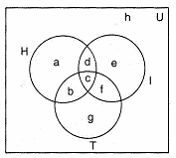
Putting value of c in (vii),
3 + f = 8 $\Rightarrow$ f = 5
Putting value of c in (vi),
3 + b = 11 $\Rightarrow$ b = 8
Putting values of c in (v),
3 + d = 9 $\Rightarrow$ d = 6
Putting value of c, d, f in (iv),
3 + 6 + e + 5 = 26 $\Rightarrow$ e = 26 - 14= 12
Putting value of b, c, f in (iii),
8 + 3 + 5 + g = 26 $\Rightarrow$ g = 26 - 16= 10
Putting value of b, c, d in (ii)
a + 8 + 3 + 6 = 25 $\Rightarrow$ a = 25 - 17 = 8
Number of people who read exactly one newspapers
= a + e + g
= 8 + 12 + 10 = 30
View full question & answer→Question 151 Mark
In a survey of 60 people, it was found that 25 people read newspaper H, 26 read newspaper T, 26 read newspaper I, 9 read both H and I, 11 read both H and T, 8 read both T and I, 3 read all three newspapers.
Find the number of people who read at least one of the newspaper.
AnswerHere
n(U) = a + b + c + d + e + f + g + h = 60....(i)
n (H) = a + b + c +d = 25....(ii)
n(T) = b + c + f + g = 26 .....(iii)
n(I) = c + d + e + f = 26....(iv)
$n(H \cap I) $ = c + d = 9 .....(v)
$n(H \cap T) $ = b + c = 11 .....(vi)
$n(T \cap I) $= c + f = 8 ....(vii)
$n(H \cap T \cap I) $= c = 3 ....(viii)
Putting value of c in (vii),
3 + f = 8 $\Rightarrow$f = 5
Putting value of c in (vi),
3 + b = 11$\Rightarrow$b = 8
Putting values of c in (v),
3 + d = 9$\Rightarrow$d = 6
Putting value of c, d, f in (iv),
3 + 6 + e + 5 = 26$\Rightarrow$ e = 26 - 14= 12
Putting value of b, c, f in (iii),
8 + 3 + 5 + g = 26 $\Rightarrow$g = 26 - 16= 10
Putting value of b, c, d in (ii)
a + 8 + 3 + 6 = 25 $\Rightarrow$a = 25 - 17 = 8
Number of people who read at least one of the three newspapers
= a + b + c + d + e + f + g
= 8 + 8 + 3 + 6 + 12 + 5 + 10 = 52
View full question & answer→Question 161 Mark
In a group of students, 100 students know Hindi, 50 know English and 25 know both. Each of the students knows either Hindi or English. How many students are there in the group?
AnswerLet H be the set of students who know Hindi and E be the set of students who know English.
Here n(H) = 100, n(E) = 50 and$n(H \cap E) = 25$
We know that$n(H \cup E) = n(H) + n(E) - n(H \cap E)$
= 100 + 50 - 25 = 125.
View full question & answer→Question 171 Mark
In a survey of 600 students in a school, 150 students were found to be taking tea and 225 taking coffee, 100 were taking both tea and coffee. Find how many students were taking neither tea nor coffee.
AnswerLet T be the set of students who like tea and C be the set of students who like coffee.
Here n(T) = 150, m (C) = 225 and$n(C \cap T) = 100$
We know that$n(C \cup T) = n(C) + n(T) - n(C \cap T)$
= 150 + 225 - 100 = 275
$\therefore$Number of students taking either tea or coffee += 275
$\therefore$Number of students taking neither tea nor coffee = 600 - 275 = 325
View full question & answer→Question 181 Mark
If $A \not \subset B$ and $B \not \subset C$ , then $A \not \subset C$.If it is true, prove it. If it is false, give an example.
AnswerIt is given in the question that,
$A \not \subset B$
And$B \not \subset C$
Let us now assume, A = {1, 2}
B = {0, 6, 8}
And, C = {0, 1, 2, 6, 9}
$\therefore $A $\subset$ C
Hence, the given statement is false
View full question & answer→Question 191 Mark
Find sets A, B and C such that$A \cap B,B \cap C$and $A \cap C$are non-empty sets and$A \cap B \cap C = \phi $
AnswerTake A = {1, 2} B = {1, 4} and C = {2, 4}
Now$A \cap B = \{ 1\} \ne \phi$
$B \cap C = \{ 4\} \ne \phi$
$A \cap C = \{ 2\} \ne \phi$
But$A \cap B \cap C = \phi$
View full question & answer→Question 201 Mark
Show that $A \cap B = A \cap C$need not imply B = C.
AnswerLet A = {1, 2, 3, 4} , B = {2, 3, 4, 5, 6}, C = {2, 3, 4, 9, 10}
$\therefore A \cap B$= {1, 2, 3, 4} $ \cap ${2, 3, 4, 5, 6}
= {2,3, 4}
$A \cap C$= {1, 2, 3, 4}, B = {2, 3, 4, 5, 6}, C = {2, 3, 4, 9, 10}
= {2, 3, 4}
$A \cap C$= {1, 2, 3, 4} $ \cap ${2, 3, 4, 9, 10}
= {2, 3, 4}
Now we have$A \cap B = A \cap C$
But$B \ne C$
View full question & answer→Question 211 Mark
In a committee, 50 people speak French, 20 speak Spanish and 10 speak both Spanish and French. How many speak at least one of these two languages?
AnswerLet F be the set of people who speak French and 'S' be the set of people who speak Spanish.
Here n(F) = 50, n(S) = 20 and $n(F \cap S) = 10$
We know that$n(F \cup S) = n(F) + n(S) - n(F \cap S)$
$\therefore n(F \cup S) = 50 + 20 - 10 = 60$
Number of people who speak at least one of these two languages = 60
View full question & answer→Question 221 Mark
In a group of 65 people, 40 like cricket, 10 like both cricket and tennis. How many like tennis only and not cricket? How many like tennis?
AnswerLet C be the set of people who like cricket and T be the set of people who like tennis.
Here n(C) = 40,$n(C \cap T) = 10$and $n(C \cup T) = 65$
We know that$n(C \cup T) = n(C) + n(T) - n(C \cap T)$
$\therefore$65 = 40 + n(T) - 10
$\therefore$n(T) = 65 - 30= 35
Number of people who like tennis = 35
Now number of people who like tennis only and not cricket
= n(T - C) $ = n(T) - n(C \cap T)$
= 35 - 10 = 25
View full question & answer→Question 231 Mark
In a group of 70 people, 37 like coffee, 52 like tea and each person likes at least one of the two drinks. How many people like both coffee and tea?
AnswerLet C be the set of persons who like coffee and T be the set of persons who like tea.
$\therefore $n(C) = 30,n(T) = 52 and$n(C \cup T) $ = 70
We know that$n(C \cup T) = n(C) + n(T) - n(C \cap T)$
$\therefore$ 70 = 37 + 52 - n(C$ \cap$ T)
$\therefore n(C \cap T) $ = 89 - 70 = 19
View full question & answer→Question 241 Mark
If X and Y are two sets such that X has 40 elements$X \cup Y$has 60 elements and$X \cap Y$has 10 elements, how many elements does Y have?
AnswerHere n(X) = 40,$n(X \cup Y) = 60$and$n(X \cap Y) = 10$
We know that$n(X \cup Y) = n(X) + n(Y) - n(X \cap Y)$
60 = 40 + n(Y) - 10
$\therefore n(Y) = 60 - 30 = 30.$
View full question & answer→Question 251 Mark
If S and T are two sets such that S has 21 elements T has 32 elements and$S \cap T$has 11 elements, how many elements does$S \cup T$have?
AnswerHere n(S) = 21, n(T) = 32 and$n(S \cap T) = 11$ We know that$n(S \cup T) = n(S) + n(T) - n(S \cap T)$
$\therefore n(S \cup T) = 21 + 32 - 11 = 42.$
View full question & answer→Question 261 Mark
In a group of 400 people, 250 can speak Hindi and 200 can speak English. How many people can speak both Hindi and English.
AnswerLet H be the set of people speaking Hindi and E be the set of people speaking English.
$\therefore$n(H) = 250, n(E) = 200 and $n(H \cup E) = 400$
We have to find $n(H \cap E)$
We know that$n(H \cap E) = n(H) + n(E) - n(H \cap E)$
$\therefore 400 = 250 + 200 - n(H \cap E)$
$\therefore n(H \cap E) = 450 - 400 = 50$
View full question & answer→Question 271 Mark
If X and Y are two sets such that X $\cup$Y has 18 elements, X has 8 elements and Y has 15 elements ; how many elements does X $\cap$Y have?
AnswerHere,
n(X) = 8, n(Y) = 15, and n(X$\cup$ Y) = 18
We know that-
n(X$\cup$ Y) = n(X) + n(Y) -n(X$\cap$ Y)
$\Rightarrow$18 = 8 + 15-n(X$\cap$ Y)
$\Rightarrow$18 = 23-n(X$\cap$ Y)
$\Rightarrow$n(X$\cap$ Y) = 23 - 18 Therefore,
$$ n(X$\cap$ Y) = 5
View full question & answer→Question 281 Mark
If X andY are two sets such that n(X) = 17, n(Y) = 23 and n ( X $\cup$ Y) = 38, find n(X $\cap$ Y).
AnswerWe know that,
$n ( X \cup Y ) = n ( X ) + n ( Y ) - n ( X \cap Y )$
$\Rightarrow 38 = 17 + 23 - n ( X \cap Y )$
$\Rightarrow n ( X \cap Y )$ = 40 - 38 = 2
View full question & answer→Question 291 Mark
U′ $\cap$ A = ________
View full question & answer→Question 301 Mark
A $\cap$ A′ = ________
View full question & answer→Question 311 Mark
$\phi$′ $\cap$ A = ________
View full question & answer→Question 321 Mark
A $\cup$ A′ = ________
View full question & answer→Question 331 Mark
Let U be the set of all triangles in a plane. If A is the set of all triangles with at least one angle different from 60° what is ${A'}$?
AnswerHere U = {x : x is a triangle}
A = {x : x is a triangle and has at least one angle different from 60°}
$\therefore A' = U - A = ${x : x is a triangle} - {x : x is a triangle and has atleast one angle different from 60°}
= {x : x is a triangle and has all angles equal to 60°}
= Set of all equilateral triangles.
View full question & answer→Question 341 Mark
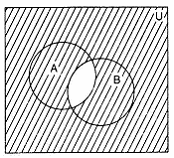
Draw appropriate Venn diagram for: A'$\cup$ B'
AnswerThe Venn diagram for A'$\cup$ B' The shaded portion represents A'$\cup$ B'
View full question & answer→Question 351 Mark
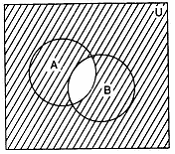
Draw appropriate Venn diagram for: $(A \cap B)'$
AnswerThe Venn diagram for$(A \cap B)'$The shaded portion represents$(A \cap B)'$
View full question & answer→Question 361 Mark
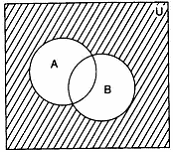
Draw appropriate Venn diagram for: A' $\cap$B'
AnswerThe Venn diagram forA' $\cap$B' The shaded portion representsA' $\cap$B'
View full question & answer→Question 371 Mark
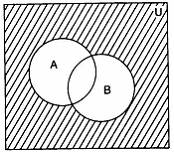
Draw appropriate Venn diagram for:$(A \cup B)'$
AnswerThe Venn diagram for$(A \cup B)'$The shaded portion represents $(A \cup B)'$
View full question & answer→Question 381 Mark
If U = {1, 2, 3, 4, 5, 6, 7, 8, 9}, A = {2, 4, 6, 8} and B= {2, 3, 5, 7}, verify that: (A $\cap$ B)' = A' $\cup$ B'.
AnswerHere U = {1, 2, 3, 4, 5, 6, 7, 8, 9}
A = {2, 4, 6, 8} and B = {2, 3, 5, 7}
$A \cap B $ = {2, 4, 6, 8} $\cap$ {2, 3, 5, 7}
= {2}
$(A \cap B)' = U - (A \cap B) $ = {1, 2, 3, 4, 5, 6, 7, 8, 9} - {2}
= {1, 3, 4, 5, 6, 7, 8, 9} . . . (i)
A' = U - A = {1, 2, 3, 4, 5, 6, 7, 8, 9} - {2, 4, 6, 8}
= {1, 3, 5, 7, 8}
B' = U - B = {1, 2, 3, 4, 5, 6, 7, 8, 9} - {2, 3, 5, 7}
= {1, 4, 6, 8, 9}
$A' \cup B'$ = {1, 3, 5, 7, 9} $\cup$ {1, 4, 6, 8, 9}
= {1, 3, 4, 5, 6, 7, 8, 9} . . . (ii)
From (i) and (ii) we have
$(A \cap B)' = A' \cup B'$
View full question & answer→Question 391 Mark
If U = {1, 2, 3, 4, 5, 6, 7, 8, 9}, A = {2, 4, 6, 8} and B= {2, 3, 5, 7}, verify that: (A $\cup$ B)' = A' $\cap$ B'
AnswerHere U = {1, 2, 3, 4, 5, 6, 7, 8, 9}
A = {2, 4, 6, 8} and B = {2, 3, 5, 7}
$A \cup B $ = {2, 4, 6, 8} $\cup$ {2, 3, 5, 7}
= {2, 3, 4, 5, 6, 7,8}
$\therefore (A \cup B)' = U - (A \cup B)$= {1,2, 3, 4, 5, 6, 7, 8, 9} - {2, 3, 4, 5, 6, 7, 8}
= {1, 9} . . . (i)
A' = U - A = {1, 2, 3, 4, 5, 6, 7, 8, 9} - {2, 4, 6, 8}
= {1, 3, 5, 7, 9}
B' = U - B = {1, 2, 3, 4, 5, 6, 7, 8, 9} - {2, 3, 5, 7}
= {1, 4, 6, 8, 9}
$A' \cap B' $ = {1, 3, 5, 7, 9} $\cap$ {1, 4, 6, 8, 9} = {1, 9} ....(ii)
From (i) and (ii), we have
$(A \cup B)' = A' \cap B'$
View full question & answer→Question 401 Mark
Taking the set of natural numbers as the universal set, write down the complement of the set: {x : 2x + 5 = 9}
AnswerHere $U = \{ x:x \in N\}$
Let A = {x : 2x + 5 = 9{ = {2}
$A' = U - A = \{ x:x \in N\} - \{ 2\}$
$= \{ x:x \in N,x \ne 2\}$
View full question & answer→Question 411 Mark
Taking the set of natural numbers as the universal set, write down the complement of the set: {x : x + 5 = 8}
AnswerHere $U = \{ x:x \in N\}$
Let A = {x : x + 5 = 8} = {3}
$A' = U - A = \{ x:x \in N\} -$
$= \{ x:x \in N,x \ne 3\}$
View full question & answer→Question 421 Mark
Taking the set of natural numbesrs as the universal set, write down the complement of the set: {x : x is a perfect cube}
AnswerHere $U = \{ x:x \in N\}$
Let A = {x : x is a perfect cube}
$A' = U - A = \{ x:x \in N\} -${x : x is a perfect cube}
= {x : x $ \in $N , x is not a perfect cube}
View full question & answer→Question 431 Mark
Taking the set of natural numbers as the universal set, write down the complement of the set: {x : x is a perfect square}
AnswerHere $U = \{ x:x \in N\}$
Let A = {x : x is a perfect square}
$A' = U - A = \{ x:x \in N\} -${x : x is a perfect square}
= {$x:x \in N$, x is not a perfect square}
View full question & answer→Question 441 Mark
Taking the set of natural numbers as the universal set, write down the complement of the set: {x : x is a natural number divisible by 3 and 5}
AnswerHere $U = \{ x:x \in N\}$
Let A = {x : x is a natural number divisible by 3 and 5}
$A' = U - A = \{ x:x \in N\} -${x : x is a natural number divisible by 3 and 5}
= {$x:x \in N$} - {x : x is a natural number divisible by 15}
= { $x:x \in N$, x is not divisible by 15}
View full question & answer→Question 451 Mark
Taking the set of natural numbers as the universal set, write down the complement of the set: {x : x is a prime number}
AnswerHere $U = \{ x:x \in N\}$
Let A = {x : x is a prime number}
$A' = U - A = \{ x:x \in N\} -${x : x is a prime number}
= { $x:x \in N$, x is not a prime number}
or {x : x is positive composite number and x = 1}
View full question & answer→Question 461 Mark
Taking the set of natural numbers as the universal set, write down the complement of the set: {x : x is a positive multiple of 3}
AnswerHere $U = \{ x:x \in N\}$
Let A = {x : x is a positive multiple of 3}
$\therefore A' = U - A = \{ x:x \in N\} -${x :x is a positive multiple of 3}
= { $x:x \in N$, x is not a multiple of 3}
View full question & answer→Question 471 Mark
Taking the set of natural numbers as the universal set, write down the complement of the set:{x : x is an odd natural number}
AnswerHere$U = \{ x:x \in N\}$ Let A = {x : x is an odd natural number}
$A' = U - A = \{ x:x \in N\} -${x : x is an odd natural number}
= {x : x is an even natural number}
View full question & answer→Question 481 Mark
Taking the set of natural numbers as the universal set, write down the complement of the set:$\{ x:x \in N\,\,and\,\,2x + 1 > 10\}$
AnswerHere $U = \{ x:x \in N\}$
Let A = {$x:x \in N$and 2x + 1 > 10} = {5, 6, 7, 8 , . . . }
$A' = U - A = \{ x:x \in N\} - \{ 5,6,7,8,.....\}$
= {1, 2, 3, 4}
View full question & answer→Question 491 Mark
Taking the set of natural numbers as the universal set, write down the complement of the set: $\{ x:x \ge 7\}$
AnswerHere $U = \{ x:x \in N\}$
Let$A = \{ x:x \geqslant 7\} = \{ 7,8,9,10,......\}$
$A' = U - A = \{ x:x \in N\} - \{ 7,8,9,10,.....\}$
= {1, 2, 3, 4, 5, 6}
= {$x:x \in N$and x < 7}
View full question & answer→Question 501 Mark
Taking the set of natural numbers as the universal set, write down the complement of the set:{x : x is an even natural number}
AnswerHere$U = \{ x:x \in N\}$
Let A = {x : x is an even natural number}
$A' = U - A = \{ x:x \in N\} -${x : x is an even natural number}
= {x : x is an odd natural number}
View full question & answer→Question 511 Mark
If U = {a, b, c, d, e, f, g, h}, find the complement of the set: D = {f, g, h, a}
Answer$D' = U - D = \{ a,b,c,d,e,f,g,h\} - \{ f,g,h,a\}$={b, c, d, e}
View full question & answer→Question 521 Mark
If U = {a, b, c, d, e, f, g, h}, find the complement of the set: C = {a, c, e, g}
Answer$C' = U - C = \{ a,b,c,d,e,f,g,h\} - \{ a,c,e,g\}$= {b, d, f, h}
View full question & answer→Question 531 Mark
If U = {a, b, c, d, e, f, g, h}, find the complement of the set: B = {d, e, f, g}
Answer$B' = U - B = \{ a,b,c,d,e,f,g,h\} - \{ d,e,f,g\}$={a, b, c, h}
View full question & answer→Question 541 Mark
If U = {a, b, c, d, e, f, g, h}, find the complement of the set: A = {a, b, c}
Answer$A' = U - A = \{ a,b,c,d,e,f,g,h\} - \{ a,b,c\}$= {d, e, f, g, h}
View full question & answer→Question 551 Mark
Let U = {1, 2, 3, 4, 5, 6, 7, 8, 9}, A = {1, 2, 3, 4}, B = {2,4, 6, 8} and C = {3, 4, 5, 6}. Find:(B - C)'
AnswerHere U = {1, 2, 3, 4, 5, 6, 7, 8, 9},
B - C = {2, 4, 6, 8} - {3, 4, 5, 6}
= {2, 8}
(B - C)' = U - (B - C) = {1, 2, 3, 4, 5, 6, 7, 8, 9} - {2, 8}
= {1, 3, 4, 5, 6, 7, 9}
View full question & answer→Question 561 Mark
Let U = {1, 2, 3, 4, 5, 6, 7, 8, 9}, A = {1, 2, 3, 4}, B = {2, 4, 6, 8} and C = {3, 4, 5, 6}. Find:(A')'
AnswerHere U = {1, 2, 3, 4, 5, 6, 7, 8, 9},
A' = U - A' = {1, 2, 3, 4, 5, 6, 7, 8, 9} - {5, 6, 7, 8, 9}
= {5, 6, 7, 8, 9}
A' = U - A' = {1, 2, 3, 4, 5, 6, 7, 8, 9} - {5, 6, 7, 8, 9}
= {1, 2, 3, 4} = A
View full question & answer→Question 571 Mark
Let U = {1, 2, 3, 4, 5, 6, 7, 8, 9}, A = {1, 2, 3, 4}, B = {2,4, 6, 8} and C = {3, 4, 5, 6}. Find: $(A \cup B)'$
AnswerHere U = {1, 2, 3, 4, 5, 6, 7, 8, 9},
$A \cup B $ = {1, 2, 3, 4} $ \cup $ {2, 4, 6 ,8}
= {1, 2, 3, 4, 6, 8}
$(A \cup B)' = U - (A \cup B)$ = {1, 2, 3, 4, 5, 6, 7, 8, 9} - {1, 2, 3, 4, 6, 8}
= {5, 7, 9}
View full question & answer→Question 581 Mark
Let U = {1, 2, 3, 4, 5, 6, 7, 8, 9}, A = {1, 2, 3, 4}, B = {2,4, 6, 8} and C = {3, 4, 5, 6}.
Find: $(A \cup C)'$
AnswerHere U = {1, 2, 3, 4, 5, 6, 7, 8, 9},
$A \cup C$= {1, 2, 3, 4} $ \cap ${3, 4, 5, 6}
= {1, 2, 3, 4, 5, 6}
$(A \cup C)' = U - (A \cup C)$= {1, 2, 3, 4, 5, 6, 7, 8, 9} - {1, 2, 3, 4, 5, 6}
={7, 8, 9}
View full question & answer→Question 591 Mark
Let U = {1, 2, 3, 4, 5, 6, 7, 8, 9}, A = {1, 2, 3, 4}, B = {2,4, 6, 8} and C = {3, 4, 5, 6}. Find: B'
AnswerHere U = {1, 2, 3, 4, 5, 6, 7, 8, 9}, A = {1, 2, 3, 4}, B = {2, 4, 6, 8} and C = {3, 4, 5, 6}
B' = U - B= {1, 2, 3, 4, 5, 6, 7, 8, 9} - {2, 4, 6, 8}
= {1, 3, 5, 7, 9}
View full question & answer→Question 601 Mark
Let U = {1, 2, 3, 4, 5, 6, 7, 8, 9}, A = {1, 2, 3, 4}, B = {2,4, 6, 8} and C = {3, 4, 5, 6}. Find :$\begin{equation} \mathbf{A}^{\prime} \end{equation}$
Answerwehave to find the complement of,which is given by (U - A)
WhereU = {1, 2, 3, 4, 5, 6, 7, 8, 9} andA = {1, 2, 3, 4},
$\therefore$$\begin{equation} \mathbf{A}^{\prime} \end{equation}$= U - A
$\Rightarrow$ $\begin{equation} \mathbf{A}^{\prime} \end{equation}$= {1, 2, 3, 4, 5, 6, 7, 8, 9} -{1, 2, 3, 4}
$\Rightarrow$ $\begin{equation} \mathbf{A}^{\prime} \end{equation}$={5, 6, 7, 8, 9}
View full question & answer→Question 611 Mark
If A = {3, 6, 9, 12, 15, 18, 21}, B = {4, 8, 12,16, 20}, C = {2, 4, 6, 8, 10, 12, 14, 16}, D = {5, 10, 15, 20}, find:C - B
AnswerHere A = {3, 6,9, 12, 15, 18, 21}, B = {4, 8, 12, 16, 20}, C = {2, 4, 6, 8, 10, 12, 14, 16}, D = {5, 10, 15, 20}
C - B = {2,4,6,8,10,12,14,16} - {4,8,12,16,20}
= {2,6,10,14}
View full question & answer→Question 621 Mark
If A = {3, 6, 9, 12, 15, 18, 21}, B = {4, 8, 12, 16, 20}, C = {2, 4, 6, 8, 10, 12, 14, 16}, D = {5, 10, 15, 20}. Find: B - D.
AnswerHere A = {3, 6, 9, 12, 15, 18, 21}, B = {4, 8, 12, 16, 20}, C = {2, 4, 6, 8, 10, 12, 14, 16}, D = {5, 10, 15, 20}
B - D = {4, 8, 12, 16, 20} - {5, 10, 15, 20}
= {4, 8, 12, 16}
View full question & answer→Question 631 Mark
If A = {3, 6, 9, 12, 15, 18, 21}, B = {4, 8, 12,16, 20}, C = {2, 4, 6, 8, 10, 12, 14, 16}, D = {5, 10, 15, 20}. Find:B - C
AnswerHere A = {3, 6, 9, 12, 15, 18, 21}, B = {4, 8, 12, 16, 20}
C = {2, 4, 6, 8, 10, 12, 14, 16}, D = {5, 10, 15, 20}
B - C = {4, 8, 12, 16, 20} - {2, 4, 6, 8, 10, 12, 14, 16}
= {20}
View full question & answer→Question 641 Mark
If A = {3, 6, 9, 12, 15, 18, 21}, B = {4, 8, 12,16, 20}, C = {2, 4, 6, 8, 10, 12, 14, 16}, D = {5, 10, 15, 20}. Find:D - A
AnswerHere A = {3, 6, 9, 12, 15, 18, 21}, B = {4, 8, 12, 16, 20}, C = {2, 4, 6, 8, 10, 12, 14, 16}, D = {5, 10, 15, 20}
D - A = {5, 10, 15, 20} - {3, 6, 9, 12, 15, 18, 21}
= {5, 10, 20}
View full question & answer→Question 651 Mark
If A = {3, 6, 9, 12, 15, 18, 21}, B = {4, 8, 12,16, 20}, C = {2, 4, 6, 8, 10, 12, 14, 16}, D = {5, 10, 15, 20}, find:C - A
AnswerHere A = {3, 6,9, 12, 15, 18, 21}, B = {4, 8, 12, 16, 20}, C = {2, 4, 6, 8, 10, 12, 14, 16}, D = {5, 10, 15, 20}
C - A = {2,4,6,8,10,12,14,16} - {3,6,9,12,15,18,21}
= {2,4,8,10,14,16}
View full question & answer→Question 661 Mark
If A = {3, 6, 9, 12, 15, 18, 21}, B = {4, 8, 12,16, 20}, C = {2, 4, 6, 8, 10, 12, 14, 16}, D = {5, 10, 15, 20}, find: B - A
AnswerHere A = {3, 6, 9, 12, 15, 18, 21}, B = {4, 8, 12, 16, 20}, C = {2, 4, 6, 8, 10, 12, 14, 16}, D = {5, 10, 15, 20}
B - A = {4, 8, 12, 16, 20} - {3, 6, 9, 12, 15, 18, 21}
= {4, 8, 16, 20}
View full question & answer→Question 671 Mark
If A = {3, 6, 9, 12, 15, 18, 21}, B = {4, 8, 12,16, 20}, C = {2, 4, 6, 8, 10, 12, 14, 16}, D = {5, 10, 15, 20}, find:A - D
AnswerHere A = {3, 6, 9, 12, 15, 18, 21}, B = {4, 8, 12, 16, 20}, C = {2, 4, 6, 8, 10, 12, 14, 16}, D = {5, 10, 15, 20}
A - D = {3, 6, 9, 12, 15, 18, 21} - {5, 10, 15, 20}
= {3, 6, 9, 12, 18, 21}
View full question & answer→Question 681 Mark
If A = {3, 6, 9, 12, 15, 18, 21}, B = {4, 8, 12,16, 20}, C = {2, 4, 6, 8, 10, 12, 14, 16}, D = {5, 10, 15, 20}, find: A - C
AnswerHere A = {3, 6, 9, 12, 15, 18, 21}, B = {4, 8, 12, 16, 20}
C = {2, 4, 6, 8, 10, 12, 14, 16}, D = {5, 10, 15, 20}
A - C = {3, 6, 9, 12, 15, 18, 21} - {2, 4, 6, 8, 10, 12, 14, 16}
={3, 9, 15, 18, 21}
View full question & answer→Question 691 Mark
If A = {3, 6, 9, 12, 15, 18, 21}, B = {4, 8, 12,16, 20}, C = {2, 4, 6, 8, 10, 12, 14, 16}, D = {5, 10, 15, 20}, find:D - C
AnswerHere A = {3, 6,9, 12, 15, 18, 21}, B = {4, 8, 12, 16, 20}, C = {2, 4, 6, 8, 10, 12, 14, 16}, D = {5, 10, 15, 20}
D - C = {5,10,15,20} - {2,4,6,8,10,12,14,16}
= {5,15,20}
View full question & answer→Question 701 Mark
If A = {3, 6, 9, 12, 15, 18, 21}, B = {4, 8, 12,16, 20}, C = {2, 4, 6, 8, 10, 12, 14, 16}, D = {5, 10, 15, 20}, find:C - D
AnswerHere A = {3, 6,9, 12, 15, 18, 21}, B = {4, 8, 12, 16, 20}, C = {2, 4, 6, 8, 10, 12, 14, 16}, D = {5, 10, 15, 20}
C - D = {2,4,6,8,10,12,14,16} - {5,10,15,20}
= {2,4,6,8,12,14,16}
View full question & answer→Question 711 Mark
If A = {3, 6, 9, 12, 15, 18, 21}, B = {4, 8, 12,16, 20}, C = {2, 4, 6, 8, 10, 12, 14, 16}, D = {5, 10, 15, 20}, find:D - B
AnswerHere A = {3, 6,9, 12, 15, 18, 21}, B = {4, 8, 12, 16, 20}
C = {2, 4, 6, 8, 10, 12, 14, 16}, D = {5, 10, 15, 20}
D - B = {5,10,15,20} - {4,8,12,16,20}
= {5,10,15}
View full question & answer→Question 721 Mark
If A = {3, 6, 9, 12, 15, 18, 21}, B = {4, 8, 12,16, 20}, C = {2, 4, 6, 8, 10, 12, 14, 16}, D = {5, 10, 15, 20}, find: A - B
AnswerHere A = {3, 6, 9, 12, 15, 18, 21}, B = {4, 8, 12, 16, 20}
C = {2, 4, 6, 8, 10, 12, 14, 16}, D = {5, 10, 15, 20}
A - B = {3, 6, 9, 12, 15, 18, 21} - {4, 8, 12, 16, 20}
= { 3, 6, 9, 15, 18, 21}
View full question & answer→Question 731 Mark
Given pairof sets are disjoint?{x : x is an even integer} and {x : x is an odd integer}
AnswerLet A = {x : x is an even integer}
and B = {x : x is an odd integer}
$\therefore A \cap B = \phi $
Hence A and B are disjoint.
View full question & answer→Question 741 Mark
Given pairof sets are disjoint?{a, e, i, o, u} and {c, d, e, f}
Answer(ii) Let A = {a, e, i, o, u}
and B = {c, d, e, f}
$\therefore A \cap B ≠ \phi$
Hence A and B are not disjoint.
View full question & answer→Question 751 Mark
Given pairof sets are disjoint?{1, 2, 3, 4} and {x : x is a natural number and$4 \leq x \leq 6$
AnswerLet A = {1, 2, 3, 4}
and B = {x : x is a natural number and $4 \leq x \leq 6$
= {4, 5, 6}
$\therefore A \cap B = \{ 1,2,3,4\} \cap \{ 4,5,6\}$
= {4}
Hence A and B are not disjoint.
View full question & answer→Question 761 Mark
If A = {x : x is a natural number}, B = {x : x is an even natural number}, C = {x : x is an odd natural number} and D = {x : x is a prime number}, find:$C \cap D$
AnswerHere A = {x : x is a natural number} = {1, 2, 3, 4, 5, . . .}
B = { x : x is an even natural number} = {2, 4, 6, . . . }
C = {x : x is an odd natural number} = {1, 3, 5, 7, . . .}
and D = {x : x is a prime nmber} = {2, 3, 5, 7. . . . } $C \cap D$= {x : x is an odd natural number} $ \cap ${x : x is a prime number}
= {x : x is an odd prime number}
View full question & answer→Question 771 Mark
If A = {x : x is a natural number}, B = {x : x is an even natural number}, C = {x : x is an odd natural number} and D = {x : x is a prime number}, find:$B \cap D$
AnswerHere A = {x : x is a natural number} = {1, 2, 3, 4, 5, . . .}
B = { x : x is an even natural number} = {2, 4, 6, . . . }
C = {x : x is an odd natural number} = {1, 3, 5, 7, . . .}
and D = {x : x is a prime nmber} = {2, 3, 5, 7. . . . } $B \cap D$= {x : x is an even natural number) $ \cap ${x : x is a prime number}
= {2}
View full question & answer→Question 781 Mark
If A = {x : x is a natural number}, B = {x : x is an even natural number}, C = {x : x is an odd natural number} and D = {x : x is a prime number}, find:$B \cap C$
AnswerHere A = {x : x is a natural number} = {1, 2, 3, 4, 5, . . .}
B = { x : x is an even natural number} = {2, 4, 6, . . . }
C = {x : x is an odd natural number} = {1, 3, 5, 7, . . .}
and D = {x : x is a prime nmber} = {2, 3, 5, 7. . . . } $B \cap C$= {x : x is an even natural number} $ \cap${x : x is an odd natural number}
$ = \phi $
View full question & answer→Question 791 Mark
If A = {x : x is a natural number}, B = {x : x is an even natural number}, C = {x : x is an odd natural number} and D = {x : x is a prime number}, find:$A \cap D$
AnswerHere A = {x : x is a natural number} = {1, 2, 3, 4, 5, . . .}
B = { x : x is an even natural number} = {2, 4, 6, . . . }
C = {x : x is an odd natural number} = {1, 3, 5, 7, . . .}
and D = {x : x is a prime nmber} = {2, 3, 5, 7. . . . } $A \cap D$= {x : x is a natural number) $ \cap${x : x is a prime number}
= {x : x is a prime number}
= D
View full question & answer→Question 801 Mark
If A = {x : x is a natural number}, B = {x : x is an even natural number}, C = {x : x is an odd natural number} and D = {x : x is a prime number}, find: $A \cap C$
AnswerHere A = {x : x is a natural number} = {1, 2, 3, 4, 5, . . .}
B = { x : x is an even natural number} = {2, 4, 6, . . . }
C = {x : x is an odd natural number} = {1, 3, 5, 7, . . .}
and D = {x : x is a prime nmber} = {2, 3, 5, 7. . . . } $A \cap C$= {x : x is a natural number} $ \cap ${x : x is an odd natural number}
= { x : x is an odd natural number }
= C
View full question & answer→Question 811 Mark
If A = {x : x is a natural number}, B = {x : x is an even natural number}, C = {x : x is an odd natural number} and D = {x : x is a prime number}, find: $A \cap B$?
AnswerHere A = {x : x is a natural number} = {1, 2, 3, 4, 5, . . .}
B = { x : x is an even natural number} = {2, 4, 6, . . . }
C = {x : x is an odd natural number} = {1, 3, 5, 7, . . .}
and D = {x : x is a prime nmber} = {2, 3, 5, 7. . . . } $A \cap B$= {x :x is a natural number)$ \cap ${x : x is an even natural number}
= {x : x is an even natural number}
= B
View full question & answer→Question 821 Mark
If A = {3, 5, 7, 9, 11} , B = {7, 9, 11, 13}, C = {11, 13, 15} and D = {15, 17} find:$(A \cap B) \cap (B \cup C)$
AnswerHere A = {3, 5, 7, 9, 11} , B = {7, 9, 11, 13}, C = {11, 13, 15} and D = {15, 17} $(A \cap B) \cap (B \cup C) =$$(\{ 3,5,7,9,11\} \cap \{ 7,9,11,13\} ) \cap (\{ 7,9,11,13\} \cup \{ 11,13,15\} )$
$ = \{ 7,9,11\} \cap \{ 7,9,11,13,15\}$
= {7, 9, 11}
View full question & answer→Question 831 Mark
If A = {3, 5, 7, 9, 11} , B = {7, 9, 11, 13}, C = {11, 13, 15} and D = {15, 17} find:$A \cap (B \cup D)$
AnswerHere A = {3,5,7,9,11}, B = {7,9,11,13}, C = {11,13,15} and D = {15,17} $A \cap (B \cup D) = $$A \cap (B \cup D) = \{ 3,5,7,9,11\} \cap (\{ 7,9,11,13\} \cup \{ 15,17\} )$
$ = \{ 3,5,7,9,11\} \cap \{ 7,9,11,13,15,17\} $
= {7,9, 11}
View full question & answer→Question 841 Mark
If A = {3, 5, 7, 9, 11} , B = {7, 9, 11, 13}, C = {11, 13, 15} and D = {15, 17} find$A \cap D$
AnswerHere A = {3, 5, 7, 9, 11} , B = {7, 9, 11, 13}, C = {11, 13, 15} and D = {15, 17} $A \cap D = \{ 3,5,7,9,11\} \cap \{ 15,17\} = \phi $
View full question & answer→Question 851 Mark
If A = {3, 5, 7, 9, 11} , B = {7, 9, 11, 13}, C = {11, 13, 15} and D = {15, 17} find:$A \cap (B \cup C)$
AnswerHere A = {3,5,7,9,11}, B = {7,9,11,13}, C = {11,13,15} and D = {15,17} $A \cap (B \cup D) = \{ 3,5,7,9,11\} \cap (\{ 7,9,11,13\} \cup \{ 11,13,15\} )$
$ = \{ 3,5,7,9,11\} \cap \{ 7,9,11,13,15\} $
= {7, 9, 11}
View full question & answer→Question 861 Mark
If A = {3, 5, 7, 9, 11} , B = {7, 9, 11, 13}, C = {11, 13, 15} and D = {15, 17} find:$B \cap D$
AnswerHere A = {3,5,7,9,11}, B = {7,9,11,13}, C = {11,13,15} and D = {15,17} $B \cap D = \{ 7,9,11,13\} \cap \{ 15,17\} = \phi $
View full question & answer→Question 871 Mark
If A = {3, 5, 7, 9, 11} , B = {7, 9, 11, 13}, C = {11, 13, 15} and D = {15, 17} find$A \cap C$
AnswerHere A = {3, 5, 7, 9, 11} , B = {7, 9, 11, 13}, C = {11, 13, 15} and D = {15, 17} $A \cap C = \{ 3,5,7,9,11\} \cap \{ 11,13,15\}$= {11}
View full question & answer→Question 881 Mark
If A = {3, 5, 7, 9, 11} , B = {7, 9, 11, 13}, C = {11, 13, 15} and D = {15, 17} find$A \cap C \cap D$
AnswerHere A = {3, 5, 7, 9, 11} , B = {7, 9, 11, 13}, C = {11, 13, 15} and D = {15, 17} $A \cap C \cap D = \{ 3,5,7,9,11\} \cap \{ 11,13,15\} \cap \{ 15,17\} = \phi $
View full question & answer→Question 891 Mark
If A = {3, 5, 7, 9, 11} , B = {7, 9, 11, 13}, C = {11, 13, 15} and D = {15, 17} find$B \cap C$
AnswerHere A = {3, 5, 7, 9, 11} , B = {7, 9, 11, 13}, C = {11, 13, 15} and D = {15, 17} $B \cap C = \{ 7,9,11,13\} \cap \{ 11,13,15\} $= {11, 13}
View full question & answer→Question 901 Mark
If A = {3, 5, 7, 9, 11} , B = {7, 9, 11, 13}, C = {11, 13, 15} and D = {15, 17} find:$(A \cup D) \cap (B \cup C)$
AnswerHere A = {3, 5, 7, 9, 11} , B = {7, 9, 11, 13}, C = {11, 13, 15} and D = {15, 17} $(A \cup D) \cap (B \cup C) = $$(\{ 3,5,7,9,11\} \cup \{ 15,17\} ) \cap (\{ 7,9,11,13\} \cup \{ 11,13,15\} )$
$ = \{ 3,5,7,9,11,13,15,17\} \cap \{ 7,9,11,13,15\}$
= {7, 9, 11,15}
View full question & answer→Question 911 Mark
If A = {3, 5, 7, 9, 11} , B = {7, 9, 11, 13}, C = {11, 13, 15} and D = {15, 17} find: $A \cap B$?
AnswerHere A = {3,5,7,9,11}, B = {7,9,11,13}, C = {11,13,15} and D = {15,17} $A \cap B = \{ 3,5,6,7,11\} \cap \{ 7,9,11,13\} = \{ 7,9,11\}$
View full question & answer→Question 921 Mark
Find the intersectionpair ofthe set :A = {1, 2, 3}, B =$\phi$
AnswerWe have,
A = {1, 2, 3}
And, B =$\phi$
$\therefore$A$\cap$B ={$\phi$}
View full question & answer→Question 931 Mark
Find the intersectionpair ofthe set :A = {x : x is a natural number and 1 < x $\leq$6 }, B = {x : x is a natural number and 6 < x < 10}
AnswerWe have,
A = {2, 3, 4, 5, 6}
And, B = {7, 8, 9}
$\therefore$A$\cap$B = {$\phi$}
View full question & answer→Question 941 Mark
Find the intersectionpair ofthe set :A = {x : x is a natural number and multiple of 3}, B = {x : x is a natural number less than 6}
AnswerGiven,
A = {3, 6, 9, 12, 15, 18, ....}
And, B = {1, 2, 3, 4, 5}
$\therefore$A$\cap$B = {a}
View full question & answer→Question 951 Mark
Find the intersectionpair ofthe set :A = {a, e, i, o, u} B = {a, b, c}
AnswerWe have
A = {a, e, i, o, u}
And, B = {a, b, c}
$\therefore$A$\cap$ B = {a}
View full question & answer→Question 961 Mark
Find the intersectionpair ofthe set :X = {1, 3, 5} Y = {1, 2, 3}
AnswerHere, we have
X = {1, 3, 5}
And, Y = {1, 2, 3}
$\therefore$X$\cap$ Y = {1, 3}
View full question & answer→Question 971 Mark
If A = {1, 2, 3, 4}, B = {3, 4, 5, 6}, C = {5, 6, 7, 8} and D = {7, 8, 9, 10} find:$B \cup C \cup D$
AnswerHere A = {1, 2, 3, 4}, B = {3, 4, 5, 6}, C = {5, 6, 7, 8} and D ={7, 8, 9, 10} $B \cup C \cup D =$
$= \{ 3,4,5,6\} \cup \{ 5,6,7,8\} \cup \{ 7,8,9,10\}$
$= \{ 3,4,5,6,7,8\} \cup \{ 7,8,9,10\}$
= {3, 4, 5, 6, 7, 8, 9,10}
View full question & answer→Question 981 Mark
If A = {1, 2, 3, 4}, B = {3, 4, 5, 6}, C = {5, 6, 7, 8} and D = {7, 8, 9, 10} find:$A \cup B \cup D$
AnswerHere A = {1, 2, 3, 4}, B = {3, 4, 5, 6}, C = {5, 6, 7, 8} and D ={7, 8, 9, 10} $A \cup B \cup D = \{ 1,2,3,4\} \cup \{ 3,4,5,6\} \cup \{ 7,8,9,10\}$
$= \{ 1,2,3,4,5,6\} \cup \{ 5,6,7,8\}$
= {1, 2, 3, 4, 5, 6, 7, 8, 9, 10}
View full question & answer→Question 991 Mark
If A = {1, 2, 3, 4}, B = {3, 4, 5, 6}, C = {5, 6, 7, 8} and D = {7, 8, 9, 10} find:$A \cup B \cup C$
AnswerHere A = {1, 2, 3, 4}, B = {3, 4, 5, 6}, C = {5, 6, 7, 8} and D ={7, 8, 9, 10} $A \cup B \cup C = \{ 1,2,3,4\} \cup \{ 3,4,5,6\} \cup \{ 5,6,7,8\} $
$= \{ 1,2,3,4,5,6\} \cup \{ 5,6,7,8\}$
= {1, 2, 3,4, 5, 6, 7, 8}
View full question & answer→Question 1001 Mark
If A = {1, 2, 3, 4}, B = {3, 4, 5, 6}, C = {5, 6, 7, 8} and D = {7, 8, 9, 10} find:$B \cup D$
AnswerHere A = {1, 2, 3, 4}, B = {3, 4, 5, 6}, C = {5, 6, 7, 8} and D ={7, 8, 9, 10} $B \cup D = \{ 3,4,5,6\} \cup \{ 7,8,9,10\}$= {3, 4, 5, 6, 7, 8, 9, 10}
View full question & answer→Question 1011 Mark
If A = {1, 2, 3, 4}, B = {3, 4, 5, 6}, C = {5, 6, 7, 8} and D = {7, 8, 9, 10} find:$B \cup C$
AnswerHere A = {1, 2, 3, 4}, B = {3, 4, 5, 6}, C = {5, 6, 7, 8} and D ={7, 8, 9, 10} $B \cup C = \{ 3,4,5,6\} \cup \{ 5,6,7,8\}$= {3, 4, 5, 6, 7, 8}
View full question & answer→Question 1021 Mark
If A = {1, 2, 3, 4}, B = {3, 4, 5, 6}, C = {5, 6, 7, 8} and D = {7, 8, 9, 10} find:$A \cup C$
AnswerHere A = {1, 2, 3, 4}, B = {3, 4, 5, 6}, C = {5, 6, 7, 8} and D ={7, 8, 9, 10} $A \cup C = \{ 1,2,3,4\} \cup \{ 5,6,7,8\}$= {1, 2, 3, 4, 5, 6, 7, 8}
View full question & answer→Question 1031 Mark
If A = {1, 2, 3, 4}, B = {3, 4, 5, 6}, C = {5, 6, 7, 8} and D = {7, 8, 9, 10} find: $A \cup B$
AnswerHere A = {1, 2, 3, 4}, B = {3, 4, 5, 6}, C = {5, 6, 7, 8} and D ={7, 8, 9, 10} $A \cup B = \{ 1,2,3,4\} \cup \{ 3,4,5,6\}$= {1, 2, 3, 4, 5, 6}
View full question & answer→Question 1041 Mark
If A and B are two sets such that$A \subset B,$then what is $A \cup B$?
AnswerHere A and B are two sets such that$A \subset B$
Then $A \cup B$= B
View full question & answer→Question 1051 Mark
Let A = {a, b}, B = {a, b, c}. Is A $\subset$ B ? What is A $\cup$B?
AnswerWe have,
$A =\{a, b\}$
And, B = {a, b, c}
Here, it is clearly seen that all the elements of set A are present in set B
$\therefore \ A \subset B$
And, $A \cup B=\{a, b, c\}=B$
View full question & answer→Question 1061 Mark
Find the union pairof set:A = {1, 2, 3} and B = $\phi$
AnswerHere A = {1, 2, 3} and$B = \phi ,\,\,\therefore A \cup B = \{ 1,2,3\} $
View full question & answer→Question 1071 Mark
Find the union pairof set:A = {x : x is a natural number and 1 < x $\leq$6} and B = {x : x is a natural number and 6 < x < 10}
AnswerHere A = {x : x is a natural number and$1 < x \leq 6$}
= {2, 3, 4, 5, 6}
and B = {x : x is a natural number and 6 < x < 10}
= {7, 8, 9}
$\therefore$$A \cup B$= {2,3,4,5,6,7,8,9}
View full question & answer→Question 1081 Mark
Find the union pairof set: A = {x : x is a natural number and multiple of 3} and B = {x : x is a natural number less than 6}
AnswerHere A = {x : x is a natural number and multiple of 3}
= {3, 6, 9, 12, . . . }
and B = {x : x is a natural number less than 6}
= {1, 2, 3, 4, 5}$\therefore A \cup B = \{ 1,2,3,4,5,6,9,12,15,....\}$
View full question & answer→Question 1091 Mark
{2, 6, 10} and {3, 7, 11} are disjoint sets.
AnswerLet A = {2, 6, 10} and B = {3, 7, 11}
Now$A \cap B = \{ 2,6,10,\} \cap \{ 3,7,11\}$
$= \phi$
Hence A and B are disjoint sets. So the statement is true.
View full question & answer→Question 1101 Mark
{2, 6, 10, 14} and {3, 7, 11, 15} are disjoint sets.
AnswerLet A = {2, 6, 10, 14} and B = {3, 7, 11, 15}
Now$A \cap B = \{ 2,6,10,14\} \cap \{ 3,7,11,15\}$
$= \phi$
Hence A and B are disjoint sets. So the statement is true.
View full question & answer→Question 1111 Mark
{a, e, i, o, u) and {a, b, c, d} are disjoint sets.
AnswerLet A = {a, e, i, o, u} and B ={a, b, c, d}
Now$A \cap B = \{ a,e,i,o,u\} \cap \{ a,b,c,d\}$
= {a}
Hence A and B are not disjoint. So the statement is false.
View full question & answer→Question 1121 Mark
{2,3, 4, 5} and {3, 6} are disjoint sets.
AnswerLet A= {2, 3, 4, 5} and B = {3, 6}
Now$A \cap B = \{ 2,3,4,5\} \cap \{ 3,6\}$
= {3}
Hence A and B are not disjoint sets. So the statementis false.
View full question & answer→Question 1131 Mark
Find the union pairof set:A = {a, e, i, o, u} and B = {a, b, c}
AnswerHere A = {a, e, i, o, u} and B = {a, b, c},$\therefore A \cup B = \{ a,b,c,e,i,o,u\}$
View full question & answer→Question 1141 Mark
If R is the set of real numbers and Q is the set of rational numbers, then what is R - Q?
AnswerWe know that set of real numbers contain rational and irrational number.
So R - Qset of irrational numbers.
View full question & answer→Question 1151 Mark
Find the union pairof set: X = {1, 3, 5} and Y = {1, 2, 3}
AnswerHere X = {1, 3, 5} and Y = {1, 2, 3},$\therefore X \cup Y = \{ 1,2,3,5\}$
View full question & answer→Question 1161 Mark
If X = {a, b, c, d} and Y = {f, b, d, g} find:$X \cap Y$
AnswerHere X = {a, b, c, d} and Y = {f, b, d, g} $X \cap Y = \{ a,b,c,d\} \cap \{ f,b,d,g\} $= {b, d}
View full question & answer→Question 1171 Mark
If X = {a, b, c, d} and Y = {f, b, d, g} find:Y - X
AnswerHere X = {a, b, c, d} and Y = {f, b, d, g}
Y - X = {f, b, d, g} - {a, b, c, d} = {f , g}
View full question & answer→Question 1181 Mark
If X = {a, b, c, d} and Y = {f, b, d, g} find: X - Y
AnswerX - Y ={a, b, c, d} - {f, b, d, g}={a,c}
View full question & answer→Question 1191 Mark
Given the set A = {1, 3, 5}, B = {2, 4, 6} and C = {0, 2, 4, 6, 8}. Is{1, 2, 3, 4, 5, 6, 7, 8} be considered as universal setfor all the three sets A, B and C?
Answer{1, 2, 3, 4, 5, 6, 7, 8} is not a universal set for A, B, C because$0 \in C$but 0 is not a member of {1, 2, 3, 4, 5, 6,7, 8}.
View full question & answer→Question 1201 Mark
Given the set A = {1, 3, 5}, B = {2, 4, 6} and C = {0, 2, 4, 6, 8}. Is{0, 1, 2, 3, 4, 5, 6, 7, 8, 9, 10}be considered as universal setfor all the three sets A, B and C?
Answer{0, 1, 2, 3, 4, 5, 6, 7, 8, 9, 10} is a universal set for A, B, C because all members of A, B, C are present in {0, 1, 2, 3, 4, 5, 6, 7, 8, 9, 10}
View full question & answer→Question 1211 Mark
Given the sets A = {1, 3, 5}, B = {2, 4, 6} and C = {0, 2, 4, 6, 8}, Is $\phi$be considered as universal setfor all the three sets A, B and C?
AnswerGiven that-A = {1, 3, 5}, B = {2, 4, 6} and C = {0, 2, 4, 6, 8}
Now, suppose D = $\phi$ Since,
D is an empty set ,it does not contain any element.
$Therefore $ D is not a universal set for A, B, C.
View full question & answer→Question 1221 Mark
Given the set A = {1, 3, 5}, B = {2, 4, 6} and C = {0, 2, 4, 6, 8}. Is {0, 1, 2, 3, 4, 5, 6}be considered as universal setfor all the three sets A, B and C?
Answer{{0,1, 2, 3, 4, 5, 6} is not a universal set for A, B, C, because$8 \in C$but 8 is not a member of {0, , 2, 3, 4, 5, 6}
View full question & answer→Question 1231 Mark
What universal setwould you propose:The set of isosceles triangles.
AnswerIsosceles triangle is a type of triangle. So the set of triangles contain all types of triangles.
$\therefore$U = {x : x is a triangle in plane}
View full question & answer→Question 1241 Mark
What universal set would you propose:The set of right triangles.
AnswerRight triangle is a type of triangle. So the set of triangles contain all types of triangles.
$\therefore$U = {x : x is a triangle in plane}
View full question & answer→Question 1251 Mark
Write the interval [-23, 5) in set builder form.
AnswerThe interval [-23, 5) can be written in set builder form as$\{ x:x \in R, - 23 \leqslant x < 12\} $
View full question & answer→Question 1261 Mark
Write the interval(6, 12] in set builder form.
AnswerThe interval (6, 12] can be written in set builder form as$\{ x:x \in R,6 \leqslant x \leqslant 12\}$
View full question & answer→Question 1271 Mark
Write the interval[6, 12] in set builder form.
AnswerThe interval [6, 12] can be written in set builder form as$\{ x:x \in R,6 \leqslant x \leqslant 12\} $
View full question & answer→Question 1281 Mark
Write the intervalin set builder form (-3, 0)
AnswerThe interval (-3, 0) can be written in set builder form as $\{ x:x \in R, - 3 < x < 0\} $
View full question & answer→Question 1291 Mark
Write $\{ X:X \in R,3 \leq X < 4\}$asinterval.
AnswerLet A =$\{ x \in R:3 \leq x \leq 4\}$
it can be written as [3,4]
View full question & answer→Question 1301 Mark
Write $\{ X:X \in R,0 \leq X < 7\}$asinterval.
AnswerLet A =$\{ x \in R:0 \leq x < 7\}$
it can be written as [0,7]
View full question & answer→Question 1311 Mark
Write $\{ X:X \in R, - 12 < X < - 10\}$as interval.
AnswerLet A = $\{ X:X \in R, - 12 < X < - 10\}$ It can be written in the form of interval as [-12, -10]
View full question & answer→Question 1321 Mark
Write {x : x $\in$ R, -4< x $\leq$ 6} as interval.
Answer{x : x $\in$ R, -4< x $\leq$6} is the set that does not contain - 5 but contains 6.
So, it can be written as an interval whose first end-point is open and last end-point is closed i.e., (-4,6].
View full question & answer→Question 1331 Mark
How many elements has P(A), if$A = \phi $?
AnswerNumber of elements in $\operatorname{set} \mathrm{A}=0$
Number of subsets of $\operatorname{set} A=2^0=1$
Hence number of element of $P(A)$ is 1
View full question & answer→Question 1341 Mark
Write down the subsets of set :$\phi$
AnswerSuppose A = $\phi$
Now, number of elements in A = 0
Number of subsets of A =$2^0$ = 1
$\therefore$ subset of A is: $\phi$
View full question & answer→Question 1351 Mark
Write down the subsets of set :{1, 2, 3}
AnswerSuppose A= {1, 2, 3}
Now, number of elements in A = 3
Number of subsets of A = $2^3$= 8
$\therefore$ subsets of A are given in below
ϕ, {1}, {2}, {3}, {1, 2}, {1, 3}, {2, 3}, {1, 2, 3}
View full question & answer→Question 1361 Mark
Write down the subsets of set : {a, b}
AnswerSuppose A= {a, b}
Now, number of elements in A = 2
Number of subsets of A = $2^2$= 4
$\therefore$ subsets of A are: $\phi$, {a}, {b}, {a, b}
View full question & answer→Question 1371 Mark
Write down the subsets of set :{a}
AnswerSuppose A = {a}
Now, number of elements in A = 1
Number of subsets of A =$2^1$
$\therefore$ subsets of A are: $\phi$, {a}
View full question & answer→Question 1381 Mark
Let A = {1, 2, {3, 4 }, 5}. Is thestatement$\phi \in$ Aincorrect and why?
AnswerHere, we can see that $\phi$ is not a member of set A
Therefore, the given statement is correct.
View full question & answer→Question 1391 Mark
Let A = {1, 2, {3, 4 }, 5}. Isthestatement{1, 2, 3} $\subset$ Aincorrect and why?
AnswerHere, we can see that 3 is not a member of set A
= {1,2,3}is not a subset of A
Theyesore,the given statement is incorrect.
View full question & answer→Question 1401 Mark
Let A = {1, 2, {3, 4 }, 5}. Isthestatement{1, 2, 5}$\in$ Aincorrect and why?
AnswerHere, we can see that 1, 2, 5is a member of set A
= {1, 2, 5}is a subset of A
Therefore, the given statement is incorrect.
View full question & answer→Question 1411 Mark
Let A = {1, 2, {3, 4}, 5}. Is the statement$\{ 1,2,5,\} \subset A$incorrect and why?
Answer1, 2, 5, are members of set A.
$\therefore ${1, 2, 5} is a subset of set A.$\therefore \{ 1,2,5\} \subset A$is correct.
View full question & answer→Question 1421 Mark
Let A = {1, 2, {3, 4 }, 5}. Is thestatement1 $\subset$Aincorrect and why?
AnswerHere, we can see that 1 is a member of set Abut is not any set itself.
Theyesore,the given statement is incorrect.
View full question & answer→Question 1431 Mark
Let A = {1, 2, {3, 4}, 5}. Isthe statement$1 \in A$incorrect and why?
Answer1 is a member of set A.
$\therefore 1 \in A$is correct.
View full question & answer→Question 1441 Mark
Let A = {1, 2, {3, 4 }, 5}. Isthestatement{{3, 4}} $\subset$ A is incorrect and why?
AnswerHere, we know that {3,4}is a member of set A = {{3,4}}is a set.
Therefore, the given statement is correct.
View full question & answer→Question 1451 Mark
Let A = {1, 2, {3, 4}, 5}. Isthe statement{3, 4}$\in$Aincorrect and why?
Answer{3, 4} is a member of set A.$\therefore \{ 3,4\} \in A$is correct.
View full question & answer→Question 1461 Mark
Let A = {1, 2, {3, 4 }, 5}. Is thestatement{$\phi$}$\subset$ Aincorrect and why?
Answer{$\phi$}is the set containing the null set.
$\{\phi\} \subset A$ is only possible if $\phi$ is in set A but it is not there. Therefore,the statement is incorrect.
View full question & answer→Question 1471 Mark
Let A = {1, 2, {3, 4}, 5}. Is the statement$\phi \subset A$incorrect and why?
AnswerSince$\phi $is subset of every set$\therefore \phi \subset A$is correct
View full question & answer→Question 1481 Mark
Let A = {1, 2, {3, 4}, 5}. IIsthe statement{3, 4}$\subset $Aincorrect and why?
Answer{3, 4} is a member of set A.
$\therefore \{ 3,4\} \in A$Hence {3, 4}$ \subset $A is incorrect.
View full question & answer→Question 1491 Mark
{x : x is an even natural number less than 6} $\subset${x : x is a natural number which divides 36}
AnswerLet A = {x : x is an even natural number less then 6}
A = {2, 4} and B = {x : x is a natural number which divides 36}
B = {1, 2, 3, 4, 6, 9, 12, 18, 36}
Here every element of A is an element of B.
$\therefore A \subset B$Hence the statement is true.
View full question & answer→Question 1501 Mark
{a}$\in${a, b, c}
AnswerLet us assume that A = {a} and B = {b, c, a}
Now, we can observe that every element of A is an element of B.
Thus, A$\subset$B
Therefore,The statement is false.
View full question & answer→Question 1511 Mark
{a}$\in${a, b, c}
AnswerLet us assume that A = {a} and B = {b, c, a}
Now, we can observe that every element of A is an element of B.
Thus, A$\subset$B
Therefore,The statement is false.
View full question & answer→Question 1521 Mark
{a} $\subset${a, b, c}
AnswerLet us assume that A = {a} and B = {b, c, a}
Now, we can observe that every element of A is an element of B.
Thus, A$\subset$B
Therefore,The statement is true.
View full question & answer→Question 1531 Mark
{ 1, 2, 3 } $⊂$ { 1, 3, 5 }
AnswerLet us assume that A = {1, 2, 3} and B = {1, 3, 5},
Now, we can observe that 2 belongs to A but 2 does not belongs to B.
Thus, A B
Therefore, The statement is false.
View full question & answer→Question 1541 Mark
{a, e}$\subset${ x, x is a vowel in the English alphabet}
AnswerLet A = {a, e} and B = {x : x is a vowel in the English alphabet}
$\therefore$B = {a, e, i, o, u} $\therefore $Then every element of A is an element of B
$\therefore A \subset B$Hence the statement is true.
View full question & answer→Question 1551 Mark
{ a, b } $⊄$ { b, c, a }
AnswerLet us assume that A = {a, b} and B = {b, c, a}
Now, we can observe that every element of A is an element of B.
Thus, A $⊂$ B
Therefore,The statement is false.
View full question & answer→Question 1561 Mark
Make correct statementby filling the symbol$\subset$or$\not\subset$in the blank space:{x : x is an even natural number} {x : x is an integer}
Answer{x : x is an even natural number}$\subset$ {x : x is an integer}
View full question & answer→Question 1571 Mark
Make correct statementby filling the symbol$\subset$or$\not\subset$in the blank space:{x : x is an equilateral triangle in a plane} {x : x is a triangle in the same plane}
Answer{x : x is an equilateral triangle in a plane} $\subset${x: x is a triangle in the same plane}
View full question & answer→Question 1581 Mark
Make correct statementby fillingthe symbol$\subset$or$\not\subset$in the blank space:{x: x is a triangle in a plane}......... {x : x is a rectangle in the same plane}
Answer{x : x is a triangle in a plane} $\not\subset${x : x is a rectangle in the plane}
View full question & answer→Question 1591 Mark
Make correct statementby filling the symbol$\subset$or$\not\subset$in the blank space:{x : x is a circle in the plane}.......{x : x is a circle in the same plane with radius 1 unit}
Answer{x : x is a circle in the plane}$\not\subset${x : x is a circle in the same plane with radius 1 unit}
View full question & answer→Question 1601 Mark
Make correct statementby filling the symbol$\subset$or$\not\subset$in the blank space:{x : x is a student of Class XI of your school} ....... {x : x student of your school}
Answer{x : x is a student of Class XI of your school} $\subset${x : x student of your school}
View full question & answer→Question 1611 Mark
Make correct statementby fillingthe symbol$\subset$or$\not\subset$in the blank space: {a, b, c} . . . {b, c, d}
Answer{a, b, c}$\not\subset${b, c, d}
View full question & answer→Question 1621 Mark
Make correct statementby fillingthe symbol$\subset$or$\not\subset$in the blank space: {2, 3, 4}. . . {1, 2, 3, 4, 5}
Answer{2, 3, 4}$\subset${1, 2, 3, 4, 5}
View full question & answer→Question 1631 Mark
From the sets given below, select equal sets:
A = {2, 4, 8, 12}, B = {1, 2, 3, 4}, C = {4, 8, 12, 14}, D = {3, 1, 4, 2}, E = {-1,1}, F = {0, a}, G = {1,-1}, H = {0, 1}
AnswerFrom the given sets, we see that sets B and D have same elements and also sets E and G have same elements. $\therefore$B = D = {1, 2, 3, 4} and E = G = {-1,1}
View full question & answer→Question 1641 Mark
Is pairof set A = {x : x is a letter of the word FOLLOW} andB = {x : x is a letter of the word WOLF} equal? Give reasons.
AnswerA = {F, O, L, W}
B = {W, O, L, F} [repetition is not allowed]
= {W, O, L, F}[The order in which the elements are written does not matter]
Hence, A = B
View full question & answer→Question 1651 Mark
Is the pair of set $A=\{2,3\}$ and $B=\left\{x: x\right.$ is solution of $\left.x^2+5 x+6=0\right\}$ equal? Give reasons.
Answer$A=\{2,3\}$ and $B=\left\{x\right.$ : $x$ is solution of $\left.x^2+5 x+6=0\right\}$
Now $x^2+5 x+6=0 \Rightarrow x^2+3 x+2 x+6=0$
$\Rightarrow(x+3)(x+2)=0 \Rightarrow x=-3,-2$
$\therefore B=\{-2,-3\}$
Hence $A$ and $B$ are not equal sets.
View full question & answer→Question 1661 Mark
State whether A = B or not if set A = {x : x is a multiple of 10} and set B = {10, 15, 20, 25, 30, . . .}
AnswerA = {x : x is a multiple of 10} can be written in roster form as A = {10, 20, 30, 40, . . .} and B = {10, 15, 20, 25,30, . . .} are not equal sets because$15 \in B,15 \notin A$
View full question & answer→Question 1671 Mark
State whether A = B or not if set A = {2, 4, 6, 8, 10} and set B = {x: x is a positive even integer and$x \leq 10$}
AnswerA= {2, 4, 6, 8, 10} and B = {x : x is a positive even integer and $x \leq 10$} which can be written in roster form as B = {2, 4, 6, 8, 10} are equal sets.
$\therefore$A = B = {2, 4, 6, 8, 10}
View full question & answer→Question 1681 Mark
State whether A = B or not if set A = {4, 8, 12, 16} and set B = {8, 4, 16, 18}
AnswerA = {4, 8, 12, 16} and B= {8, 4, 16, 18} are not equal sets because$12 \in A,12 \notin B$and$18 \in B,18 \notin A$
View full question & answer→Question 1691 Mark
State whether A = B or not if set A = {a, b, c, d} and set B = {d, c, b, a}
AnswerA = {a, b, c, d} and B = {d, c, b, a} are equal sets because order of elements does not change a set. $\therefore$A = B = {a, b, c, d}
View full question & answer→Question 1701 Mark
Is the set of circles passing through the origin (0, 0)finite or infinite?
AnswerThe set of circles passing through the origin (0, 0) is an infinite set because we can draw infinite number of circles through origin of different radii.
View full question & answer→Question 1711 Mark
Is the set of animals living on the earthfinite or infinite?
AnswerThe set of animals living on the earth is a finite set because the number of animals living on the earth is very large but finite.
View full question & answer→Question 1721 Mark
Is the set of numbers which are multiples of 5finite or infinite?
AnswerThe set of numbers which are multiple of 5 is an infinite set because there are infinite multiples of 5.
View full question & answer→Question 1731 Mark
Is the set of letters in the English alphabetfinite or infinite?
AnswerThe set of letters in the English alphabet is a finite set because there are 26 letters in the English alphabet.
View full question & answer→Question 1741 Mark
Is the set of lines which are parallel to the x-axisfinite or infinite?
AnswerThe set of lines which are parallel to the x-axis is an infinite set because we can draw infinite number of lines parallel to x-axis.
View full question & answer→Question 1751 Mark
Is the set of prime numbers less than 99 finite or infinite?
AnswerThe set of prime numbers less than 99 is a finite set because the set contains finite number of elements.
View full question & answer→Question 1761 Mark
Is the set of positive integers greater than 100finite or infinite set?
AnswerThe set of positive integers greater than 100 is an infinite set because there are infinite number of positive integers greater than 100.
View full question & answer→Question 1771 Mark
Is the set {1, 2, 3, . . . , 99, 100} is finite or infinite?
Answer{1, 2, 3, . . . , 99, 100} is a finite set because the set contains finite number of elements.
View full question & answer→Question 1781 Mark
Is the set {1, 2, 3, ............... } isfinite or infinite?
Answer{1, 2, 3, . . . }is an infinite set because there are infinite elements in the set.
View full question & answer→Question 1791 Mark
Isthe set of months of a year is a finite or infinite set?
AnswerThe set of months of a year is a finite set because there are 12 months in a year.
View full question & answer→Question 1801 Mark
Is y : y is a point common to any two parallel lines null set?
Answer{x : x is a point common to any two parallel lines} is an empty set because two parallel lines do not have a common point.
View full question & answer→Question 1811 Mark
Is x : x is a natural number, x < 5 and, x > 7 null set?
Answer{x : x is a natural number, x< 5 and x > 7} is an empty set because there is no natural number which satisfies simultaneously r < 5 and x > 7.
View full question & answer→Question 1821 Mark
Is set of even prime numbers null set?
AnswerSet of even prime numbers is {2} which is not empty set.
View full question & answer→Question 1831 Mark
Is set of odd natural numbers divisible by 2 null set?
AnswerHere, Setof odd natural numbers divisible by 2.
As we know that a set is a collection of well defined distnict objects.
Let we represent the given set in roaster form:
$⇒$Set of odd natural numbers divisible by 2 is$\phi$
Because no odd natural number can be divided by 2. Therefore, it is a null set.
View full question & answer→Question 1841 Mark
Match each of the set on the left in the roster form with the same set on the right described in set-builder form:
| a. {1, 2, 3, 6} | i. {x : x is a prime number and a divisor of 6} |
| b. {2, 3} | ii. {x : x is an odd natural number less than 10} |
| c. {M,A,T,H,E,I,C,S} | iii. {x : x is natural number and divisor of 6} |
| d. {1, 3, 5, 7, 9} | iv. {x : x is a letter of the word MATHEMATICS}. |
AnswerAns. (a) - (iii), (b) - (i), (c) - (iv), (d) - (ii)
View full question & answer→Question 1851 Mark
List the element of the set:F = {x : x is a consonant in the English alphabet which precedes K}
AnswerF = {x : x is a consonant in the English alphabet which precedes K}
$\therefore$F = {B, C, D, F, G, H, J}
View full question & answer→Question 1861 Mark
List the elementof the set: E = {x : x is a month of a year not having 31 days}
AnswerE = {x : x is a month of a year not having 31 days}
$\therefore$E = {February, April, June, September, November}
View full question & answer→Question 1871 Mark
List the elementof the set: E= {x : x is a letter in the word "LOYAL"}
AnswerE = {x : x is a letter in the word "LOYAL"}
$\therefore$E= {L, O, Y, A}
View full question & answer→Question 1881 Mark
List the elementof the set: C = {x : x is an integer, ${x^2} \leq 4$}
AnswerC = {x : x is an integer, ${x^2} \leq 4$}
$\therefore {x^2} \leq 4 \Rightarrow x \leq \pm 2$ $ \Rightarrow - 2 \leq x \leq 2$
$\therefore C = ( - 2, - 1,0,1,2)$
View full question & answer→Question 1891 Mark
List the elementof the set: C = {x : x is an integer, $\frac{1}{2}<x<\frac{9}{2}$}
AnswerB = (x : x is an integer, $ - 1/2 < x < 9/2$)
$\therefore$ B = {0, 1, 2, 3, 4}
View full question & answer→Question 1901 Mark
List the element of the set: A = {x : x is an odd natural number}
AnswerA = {x : x is an odd natural number}
$\therefore$A = {1, 3, 5, 7, . . . }
View full question & answer→Question 1911 Mark
Write the setin the set-builder form:{1, 4, 9, . . . , 100}
AnswerLet E = {1, 4, 9, ....., 100}
All objects ofthe set are perfect squares.
$\therefore D = \{ x:x = {n^2}\,and\,\,1 \leqslant n \leqslant 10\} $
View full question & answer→Question 1921 Mark
Write the setin the set-builder form:{2, 4, 6, . . . }
AnswerLet D = {2, 4,6, .......}
All objects of the set are even natural numbers.
$\therefore$D = {x : x is an even natural number}
View full question & answer→Question 1931 Mark
Write the setin the set-builder form:{5, 25, 125, 625}
AnswerLet C = {5, 25, 125, 625}
All objects of the set are natural numbers that are powers of 5.
$\therefore C = \{ x:x = {5^n},n \in N\,and\,\,1 \leqslant n \leqslant 4\} $
View full question & answer→Question 1941 Mark
Write the setin the set-builder form: {2, 4, 8, 16, 32}
AnswerLet B = {2, 4,8,16,32}
All objects of the set are natural numbers that are powers of 2.
$\therefore B = \{ x:x = {2^n},n \in N\,and\,\,1 \leqslant n \leqslant 5\} $
View full question & answer→Question 1951 Mark
Write the setin the set-builder form: {3, 6, 9, 12}
AnswerLet A = {3, 6, 9, 12}
All objects of the set are natural numbers that are multiples of 3.
$\therefore$A= {x : x = 3n,$n \in N$and$1 \leqslant n \leqslant 4$}
View full question & answer→Question 1961 Mark
Write the setin roster form:F = The set of all letters in the word BETTER.
AnswerF = The set of all letters in the word BETTER
$\therefore F$= {B, E, T, R}
View full question & answer→Question 1971 Mark
Write the setin roster form:E = The set of all letters in the word TRIGONOMETRY
AnswerE = The set of all letters in the word TRIGONOMETRY
$\therefore E$= {T, R, I, G, O, N, M, E, Y}
View full question & answer→Question 1981 Mark
Write the setin roster form:D = {x : x is a prime number which is divisor of 60}
AnswerD = {x : x is a prime number which is divisor of 60}
$\therefore D$= {2,3, 5}
View full question & answer→Question 1991 Mark
Write the set in roster form: C = {x : x is a two-digit natural number such that the sum of its digits is 8}
AnswerC = {x : x is a two-digit natural number such that the sum of its digit is 8}
$\therefore$C= {17, 26, 35, 44, 53, 62, 71, 80}
View full question & answer→Question 2001 Mark
Write the setin roster form: B = {x : x is a natural number less than 6}
AnswerB={x : x is a natural number less than 6} $\therefore$B = {1, 2, 3, 4, 5}
View full question & answer→Question 2011 Mark
Write the set in roster form:A = {x : x is an integer and -3 $\leq$ x < 7}
AnswerA = {x : x is an integer and -3 $\leq$ x < 7}
$\therefore$A = {-2, -1, 0, 1, 2, 3, 4, 5, 6}
View full question & answer→Question 2021 Mark
Let A = {1, 2, 3, 4, 5, 6}. Insert the appropriate symbol$\in$or $\notin$on the blank space:10 . . . A
AnswerA = {1, 2, 3, 4, 5, 6} 10 is not an element of set A$\therefore 10 \notin A$
View full question & answer→Question 2031 Mark
Let A = {1, 2, 3, 4, 5, 6}. Insert the appropriate symbol$\in$or $\notin$on the blank space:2 . . . A
AnswerA = {1, 2, 3, 4, 5, 6} 2 is an element of set A$\therefore 2 \in A$
View full question & answer→Question 2041 Mark
Let A = {1, 2, 3, 4, 5, 6}. Insert the appropriate symbol$\in$or $\notin$on the blank space:4. . . A
AnswerA = {1, 2, 3, 4, 5, 6} 4 is an element of set A$\therefore 4 \in A$
View full question & answer→Question 2051 Mark
Let A = {1, 2, 3, 4, 5, 6}. Insert the appropriate symbol$\in$or $\notin$on the blank space:0 . . . A
AnswerA = {1, 2, 3, 4, 5, 6} 0 is not an element of set A$\therefore 0 \notin A$
View full question & answer→Question 2061 Mark
Let A = {1, 2, 3, 4, 5, 6}. Insert the appropriate symbol$\in$or $\notin$on the blank space: 8 . . . A
AnswerA = {1, 2, 3, 4, 5, 6} 8 is not an element of set A$\therefore 8 \notin A$
View full question & answer→Question 2071 Mark
Let A = {1, 2, 3, 4, 5, 6}. Insert the appropriate symbol$\in$or $\notin$on the blank space: 5. . . A
AnswerA = {1, 2, 3, 4, 5, 6} 5 is an element of set A$\therefore 5 \in A$
View full question & answer→Question 2081 Mark
Is the collection of most dangerous animals of the world set? Justify your answer.
AnswerA collection of most dangerous animals of the world is not a very clearly defined set as the ranking of the animals keep on altering and their ranking vary from countries to countries.
The collection of distnict objects are not well–defined and don't have universal acceptance as it is.
Therefore,the collection is not set.
View full question & answer→Question 2091 Mark
Is the collection of questions in Chapter one of class 11 mathsset? Justify your answer.
AnswerNow we will to explain this is a set.the collection of the questions in this chapter is a well-defined collection and the set will have well defined dobjects. One can definitely identify the question that would belong to the collection and could easily number them. The number of questions and the type of questions will not be different for different persons.
Therefore, the collection is a set.
View full question & answer→Question 2101 Mark
Is the collection of all even integersset? Justify your answer
AnswerThe collection of all even integers is a well-defined collection because there couldn’t be difference between choosing the even integers from the collection of given numbers or all the numbers taken at a large. The choice will not vary from person to person.
The given collection has well-defined objects which meet the universal criteria.
Therefore, this collection is a well defined and distnict object ,now the set is
{x: x =….-6,- 4, -2, 0, 2, 4, 6…where n is even integer 2k for some unique interger k}
View full question & answer→Question 2111 Mark
Is acollection of novels written by the writer Munshi Prem Chandset? Justify your answer
AnswerWe will to explain a collection of novels written by the writer Munshi Prem Chand is a well-defined collection because there are finite numbers of books which Munshi Prem Chand has written. The names of the book could not vary from person to person on the basis of personal choice. The well-defined objects of the collection make it a set.
Therefore, this collection is a set.
View full question & answer→Question 2121 Mark
Is the collection of all natural numbers less than 100set? Justify your answer
AnswerThe collection of all natural numbers less than 100 is a well-defined collection because there is no ambiguity in regard of numbers and there values greater than or less than 100. There are specific numbers which belongs to the given collection. Such numbers choice doesn’t vary from person to person. Therefore, the collection is well defined and distnict object ,so
{x: x = {0, 1, 2, 3, ...99} where n $\in$N and 0 ≤ n < 100}
N is natural number.
View full question & answer→Question 2131 Mark
Is the collection of all the boys in your classset? Justify your answer
AnswerThe collection of all boys in your class is a well-defined collection and distnict object because one can definitely differentiate between boys who could belongs to this collection on the basis of appearance itself. The criteria for judging the gender would not vary from person to person. The set has very well defined object which is boys in this class.
Therefore, this collection is a set.
View full question & answer→Question 2141 Mark
Is ateam of eleven best-cricket batsmen of the world set? Justify your answer
AnswerNow,a team of eleven best cricket batsmen of the world is not a very clearly well defined collection.
The cricket team of a nation could be a well-defined set but the best cricket batsmen team would be judgemental and subjective concept varying from person to person.
Therefore, this collection is not a set.
View full question & answer→Question 2151 Mark
Is the collection of ten most talented writers of Indiaset? Justify your answer
AnswerThe collection of the given collection is quiet subjective and vary with person`s personal choice. Some people may be biased toward some as the most talented writers of India where as for other the list of most talented writers may be altogether different.Therefore, the given collection doesn’t have well defined objects with universal standards.
Therefore, this collection is not a set.
View full question & answer→Question 2161 Mark
Is the collection of all the months of a year beginning with the letter J set? Justify your answer
AnswerSet: Collection of well defined and distnict objects.
There are three months of a year which begins with the letter J, rest of the month`s name begin with different letter. Therefore, the given collection has well-defined and distnict objects namely January, June and July.
Therefore, this collection is a set.
{x: x = months of a year beginning with letter J}
Alternatively
{x: x= January, June, July where January, June, July are month of a year}
View full question & answer→Question 2171 Mark
Consider the sets $\phi$, A = { 1, 3 }, B = {1, 5, 9}, C = {1, 3, 5, 7, 9}. Insert the symbol $⊂ or ⊄$ between the pair of sets: B. . . C
AnswerB $⊂$ C as each element of B is also an elementof C.
View full question & answer→Question 2181 Mark
Consider the sets $\phi$, A = { 1, 3 }, B = {1, 5, 9}, C = {1, 3, 5, 7, 9}. Insert the symbol $⊂ or ⊄$ between the pair of set: A. . . C
AnswerSince A $⊂$ C as 1, 3 $∈$ A also belongs to C
View full question & answer→Question 2191 Mark
Consider the sets $\phi$, A = { 1, 3 }, B = {1, 5, 9}, C = {1, 3, 5, 7, 9}. Insert the symbol $⊂ or ⊄$ between the pair of set: A. . . B
AnswerA $⊄$ B as 3 $∈$ A and 3 $∉$ B
View full question & answer→Question 2201 Mark
Consider the sets $\phi$, A = { 1, 3 }, B = {1, 5, 9}, C = {1, 3, 5, 7, 9}. Insert the symbol $⊂ or ⊄$ betweenthe pair of set: $\phi$. . . B
AnswerWe have,$\phi ⊂$ B as $\phi$is a subset of every set
View full question & answer→Question 2211 Mark
Show that the given set that is $A=\left\{n: n \in Z\right.$ and $\left.n^2 \leq 4\right\}$ and $B=\left\{x: x \in R\right.$ and $\left.x^2-3 x+2=0\right\}$ are equal or not?Justify your answer.
AnswerA = {–2, –1, 0, 1, 2}, B = {1, 2}. Since 0 $\in$A and 0 $\notin$ B, hence Aand B are not equal sets.
View full question & answer→Question 2221 Mark
Show that the given set that isX, the set of letters in “ALLOY” and B, the set of letters in “LOYAL” are equal?Justify your answer.
AnswerGiven, X = {A, L, L, O, Y}, B = {L, O, Y, A, L}. Then X and B are equal sets as repetition of elements in a set do not change a set.
Therefore ,X = {A, L, O, Y} = B
View full question & answer→Question 2231 Mark
Find the pairs of equal sets, if any, give reasons: $A=\{0\}, B=\{x: x>15$ and $x<5\}, C=\{x: x-5=0\}, D=\left\{x: x^2=25\right\}, E$ $=\left\{x: x\right.$ is an integral positive root of the equation $\left.x^2-2 x-15=0\right\}$
AnswerSince $0 \in A$ and 0 does not belong to any of the sets $B, C, D$ and $E$, Therefore, $A \neq B, A \neq C, A \neq D, A \neq E$.
Since $B=\phi$ but none of the other sets are empty. Therefore $B \neq C, B \neq D$ and $B \neq E$.
Also $C=\{5\}$ but $-5 \in D$, hence $C \neq D$.
Since $E=\{5\}, C=E$. Further, $D=\{-5,5\}$ and $E=\{5\}$, we find that, $D \neq E$.
Therefore, the only pair of equal sets is C and E.
View full question & answer→Question 2241 Mark
Is the set{x : x $\in$N and x is odd} finite or infinite?
AnswerSince there are infinite number of odd numbers, therefore, the given set is infinite.
View full question & answer→Question 2251 Mark
Is theset{x: x $\in$N and x is prime} finite or infinite?
AnswerThe given set is the set of all prime numbers and since set of prime numbers is infinite. Therefore,the given set is infinite.
View full question & answer→Question 2261 Mark
Is theset{x : x $\in$N and 2x –1 = 0}finite or infinite?
AnswerGiven set = $\phi$. Therefore, this is finite.
View full question & answer→Question 2271 Mark
Istheset $\left\{x: x \in N\right.$ and $\left.x^2=4\right\}$ finite or infinite?
AnswerGiven set = {2}. Thus, it is finite.
View full question & answer→Question 2281 Mark
Is theset{x : x $\in$N and (x – 1) (x – 2) = 0}finite or infinite?
AnswerWe have the set = {1, 2}. Hence, it is finite.
View full question & answer→Question 2291 Mark
Match each of the set on the left described in the roster form with the same set on the right described in the set-builder form :
| (a){P, R, I, N, C, A, L} |
(i){ x : x is a positive integer and is a divisor of 18} |
| (b) {0} |
(ii){ x : x is an integer and $x^2 – 9 = 0$} |
| (c){1, 2, 3, 6, 9, 18} |
(iii) {x : x is an integer and $x + 1 = 1$} |
| (d){3, –3} |
(iv){x : x is a letter of the word PRINCIPAL} |
AnswerAns.(a) - (iv), (b) - (iii), (c) - (i), (d) - (ii)
View full question & answer→Question 2301 Mark
Write the set$\left[\frac{1}{2}, \frac{2}{3}, \frac{3}{4}, \frac{4}{5}, \frac{5}{6}, \frac{6}{7}\right]$ in the set-builder form.
AnswerHere,we see that each member in the given set has the numerator one less than the denominator. Also, the numerator begin from 1 and do not exceed 6.
Therefore, in the set-builder form the given set is {x : x = $\frac{n}{n+1}$,here n is a natural number and 1$\leq$n$\leq$ 6}
View full question & answer→Question 2311 Mark
A market research group conducted a survey of 1000 consumers and reported that 720 consumers like product A and 450 consumers like product B, what is the least number that must have liked both products?
AnswerLet U be the set of consumers questioned, S be the set of consumers who liked the product A and T be the set of consumers who like the product B.
Given that:
n(U) = 1000, n(S) = 720, n(T) = 450
Therefore, n(S $\cup$T) = n(S) + n(T) – n(S ∩ T)
= 720 + 450 – n (S ∩ T) = 1170 – n(S $\cup$T)
Thus, n(S $\cup$T) is maximum whenn(S $\cap$T) is least. But S $\cup$T $\subset$U implies
n(S $\cup$T) ≤ n ($\cup$) = 1000. So, maximum values of n(S $\cup$T) is 1000.
Therefore, the leastvalue of n(S $\cup$T) is 170.
View full question & answer→Question 2321 Mark
Write the set A = {1, 4, 9, 16, 25, . . . }in set-builder form.
AnswerWe have,A = {x : x is the square of a natural number}
Alternatively, we can write A = {$x : x = n^2$ , where n $\in$N}
View full question & answer→Question 2331 Mark
List all the subsets of the set { –1, 0, 1}
AnswerSuppose A = { –1, 0, 1}.
Now, we have to calculate all the subset of A having no element is the empty set $\phi$.
The subsets of A having one element are { –1}, {0}, {1}.
The subsets of
A having two elements are {–1, 0}, {–1, 1} ,{0, 1}.
The subset of A having threeelements of A is A itself.
Therefore, all the subsets of A are $\phi$, {–1}, {0}, {1}, {–1, 0}, {–1, 1}, {0, 1} and {–1, 0, 1}
View full question & answer→Question 2341 Mark
Show that the set of letters needed to spell CATARACT and the set of letters needed to spell TRACT are equal.
AnswerThe set formed by distinct letters of the word CATARACT are {A, C, R, T}
The set formed by distinct letters of the word TRACT are {A, C, R, T}
As we see, the set of letters to spell CATARACT is same to the setof letters to spell TRACT, we can say the two sets are equal.
View full question & answer→Question 2351 Mark
There are 200 individualwith a skin disorder, 120 has been exposed to chemical $C_1, 50$ to chemical $C_2$ and 30 to both the chemicals $C_1$ and $C_2$. Find the number of individualexposed to chemical $C_1$ or chemical $C_2$
AnswerThe number of individuals exposed to chemical $C_1$ or chemical $C_2$ is given by $n(A \cup B).$
Now, we have,$n (A\cup B) = n(A) + n(B) - n(A\cap B)$
$= 120 + 50 - 30$
$= 140$
Therefore, required number of individuals is $140$
View full question & answer→Question 2361 Mark
There are 200 individualwith a skin disorder, 120 has been exposed to chemical $C_1, 50$ to chemical $C_2$ and 30 to both the chemicals $C_1$ and $C_2$. Find the number of individualexposed to chemical $C_2$ but not chemical $C_1$
AnswerThe number of individuals exposed to chemical $C_2$ but not chemical $C_1$ is given by $n(\overline A\cap B$).
Now, we have n($\overline A \cap$ B) $= n (B) - n(A\cap B)$
$= 50 - 30$
$= 20$
Therefore, required number is $20.$
View full question & answer→Question 2371 Mark
There are 200 individualwith a skin disorder, 120 has been exposed to chemical $C_1, 50$ to chemical $C_2$ and 30 to both the chemicals $C_1$ and $C_2$. Find the number of individualexposed to chemical $C_1$ but not chemical $C_2$
AnswerThe number of individuals exposed to chemical $C_1$but not chemical $C_2$ is given by $n (A\cap \overline B).$
Now, we have n(A $\cap \overline B$) $= n(A) - n(A\cap B)$
$= 120 - 30$
$= 90$
Therefore, required number of individuals is $90$
View full question & answer→Question 2381 Mark
In a class of 35 students, 24 like to play cricket and 16 like to play football. Also, each student likes to play at least one of the two games. How many students like to play both cricket and football?
AnswerLet C be the set of students who like to play cricket and F be the set of students who like to play football.
Here n(C) = 24, n(F) = 16, $n(C \cup F) $ = 35.
We know that
$n(C \cup F) = n(C) + n(F) - n(C \cap F)$
35 = 24 + 16 - $n(C \cap F)$
$n(C \cap F) $ = 40 - 35 = 5
View full question & answer→Question 2391 Mark
In a school, there are 20 teachers who teach mathematics or physics. Of these, 12 teach mathematics and 4 teach physics and mathematics. How many teach physics?
AnswerLet n(P) denote the number of teachers who teach Physics and n(M) denote the number of teachers who teach mathematics.
We have,
n(P$\cup $M) = 20, n(M) = 12 and n(P$\cap$M) = 4
To find : n(P)
We know that
n(P$\cup $M) = n(P) + n(M) - n(P$\cap$M)
$\Rightarrow$ 20 = n(P) + 12 - 4
$\Rightarrow$ 20 = n(P) + 8
$\Rightarrow$ n(P) = 20 - 8
= 12
$\therefore$ 12 teachers teach Physics.
View full question & answer→Question 2401 Mark
If X and Y are two sets such that X $\cup$Y has 50 elements, X has 28 elements, and Y has 32 elements, how many elements does X $\cap$ Y have?
AnswerHere,
n (X $\cup$Y) = 50, n (X) = 28, n (Y) = 32,
n (X $\cap$Y) = ?
By using the formula,we have
n (X $\cup$Y) = n (X) + n (Y) – n (X $\cap$Y),
we find that
n (X $\cap$Y) = n (X) + n (Y) – n (X $\cup$Y)
= 28 + 32 – 50 = 10
View full question & answer→Question 2411 Mark
Let U be universal set of all the students of Class XI of a coeducational school and A be the set of all girls in Class XI. Find A′.
AnswerWe know that,In a coeducational school, there can be only boys and girls in a school.
A is the set of all girls,then
A' = Set of all Students - Set of all girls
A' = Set of all boys in class XI
View full question & answer→Question 2421 Mark
Let U = {1, 2, 3, 4, 5, 6, 7, 8, 9, 10} and A = {1, 3, 5, 7, 9}. Find A′.
AnswerWe note that 2, 4, 6, 8, 10 are the only elements of U which do not belong to A.
Therefore, A′ = { 2, 4, 6, 8,10 }
View full question & answer→Question 2431 Mark
Write the set $\left\{x\right.$ : $x$ is a positive integer and $\left.x^2<40\right\}$ in the roster form.
AnswerThe required numbers are 1, 2, 3, 4, 5, 6. Therefore, the given set in the roster form is {1, 2, 3, 4, 5, 6}.
View full question & answer→Question 2441 Mark
Let V = { a, e, i, o, u } and B = { a, i, k, u}. Find V – B and B – V
AnswerHere ,it is V -B = {e, o}, since the elements e, o belongs to V but not to B and B -V = { k }, since the element k belongs to B but not to V
View full question & answer→Question 2451 Mark
Let A = { 1, 2, 3, 4, 5, 6}, B = { 2, 4, 6, 8 }. Find A – B and B – A.
AnswerHere, A -B = {1, 3, 5}, since the elements 1, 3, 5 belong to A but not to B and also B -A = {8}, since the element 8 belongs to B and not to A.then,
We note that A -B $\ne$B – A
View full question & answer→Question 2461 Mark
Let A = {1, 2, 3, 4, 5, 6, 7, 8, 9, 10} and B = { 2, 3, 5, 7 }. Find A $\cap$B and hence show that A $\cap$B = B.
AnswerHere, A $\cap$B = { 2, 3, 5, 7 } = B. We know that B $\subset$A and that A $\cap$B = B
View full question & answer→Question 2471 Mark
Let X = {Ram, Geeta, Akbar} be the set of students of Class XI, who are in school hockey team. Let Y = {Geeta, David, Ashok} be the set of students from Class XI who are in the school football team. Find X $\cap$Y and interpret the set
AnswerWe see that element ‘Geeta’ is the only element common to both. Therefore,X $\cap$Y = {Geeta}
View full question & answer→Question 2481 Mark
Let A = { 2, 4, 6, 8} and B = { 6, 8, 10, 12}. Find A $\cap$B
AnswerWe see that 6, 8 are the only elements which are common to both A and B.
Therefore,A $\cap$B = { 6, 8 }
View full question & answer→Question 2491 Mark
Let X = {Ram, Geeta, Akbar} be the set of students of Class XI, who are in school hockey team. Let Y = {Geeta, David, Ashok} be the set of students from Class XI who are in the school football team. Find X $\cup$Y and interpret the set.
AnswerHere, X $\cup$Y = {Ram, Geeta, Akbar, David, Ashok}. So,this is the set of students from Class XI who are in the hockey team or the football team or both.
View full question & answer→Question 2501 Mark
Let A = { a, e, i, o, u } and B = { a, i, u }. Show that A $\cup$B = A
AnswerWe have, A $\cup$B = { a, e, i, o, u } = A.
This example illustrates that union of sets A and its subset B is the set A We know that if B $\subset$A, then A $\cup$B = A.
View full question & answer→Question 2511 Mark
Let A = { 2, 4, 6, 8} and B = { 6, 8, 10, 12}. Find A $\cup$ B
AnswerIt is given that A = { 2, 4, 6, 8} and B = { 6, 8, 10, 12}
$\therefore$We have A $\cup$B = { 2, 4, 6, 8, 10, 12}
View full question & answer→Question 2521 Mark
Let A, B and C be three sets. If A $∈$ B and B $⊂$ C, is it true that A $⊂$ C ?If not, give an example.
AnswerWe know that an element of a set can never be a subset of itself.
Suppose A = {1}, B = {{1}, 2} and C = {{1}, 2, 3}.
Here A $∈$ B as A = {1} and B $⊂$ C. But A $⊄$ C as 1 $∈$ A and 1 $∉$ C.
View full question & answer→Question 2531 Mark
Let A = {a, e, i, o, u} and B = {a, b, c, d}. Is A a subset of B? No. (Why?). Is B a subset of A?
Answer - Is A$\begin{equation} \subset \end{equation}$ B
According to the given we can state,
For a set to be a subset of another set, it needs to have all element presents in another set. In the set A = {e, i, o, u} elements are present but these are not present in set B.
HenceA$\begin{equation} \not \subset \end{equation}$ B - Is b$\begin{equation} \subset \end{equation}$A
According to the given we can state,
For this condition to be true, are elements of sets B should be element present in sets A.
In theset B ={b, c, d} elements are present but these elements are not an element in set A.
Hence B$\begin{equation} \not \subset \end{equation}$A
View full question & answer→Question 2541 Mark
Write the solution set of the equation $x^2 + x – 2 = 0$ in roster form.
AnswerHere,the given equation can be written as -(x – 1) (x + 2) = 0, that isx = 1, – 2
Therefore, the solution set of the given equation can be written in roster form as {1, – 2}.
View full question & answer→