Question 14 Marks
Show that the straight lines $L_1=(b+c) x+a y+1=0, L_2=(c+a) x+b y+1=0$ and $L_3=(a+b) x+c y+1=0$ are concurrent.
AnswerIf the lines are concurrent, If they have the common point of intersection. $(b+c) x+a y+1=0(c+a) x+b y+1=0$ $(a+b) x+c y+1=0$ Solving (1) and (2) $y=\frac{-1-(b+c) x}{a}$ Putting in (2) $(c+a) x+b \frac{(-1-(b+c) x)}{a}+1=0 a c x+a^2 x+b-b^2 x-b c x+a=0 x\left(a c+a^2-b^2-b c\right)=$
$b-a x\left(a c-b c+a^2-b^2\right)=b-a x(c(a-b)+(a-b)(a+b))=b-a x(c+a+$
b) $=-1$ [Cancelling $(a-b)$ both sides] $x=\frac{-1}{a+b+c} y=\frac{-1+\frac{(b+c)(-1)}{a+b+c}}{a}=\frac{-a-b-c-b-c}{a(a+b+c)}$ Putting the value of $x, y$ in (3); $(\mathrm{a}+\mathrm{b})\left(\frac{-1}{\mathrm{a}+\mathrm{b}+\mathrm{c}}\right)+\mathrm{c}\left(\frac{-\mathrm{a}-2 \mathrm{~b}-2 \mathrm{c}}{\mathrm{a}(\mathrm{a}+\mathrm{b}+\mathrm{c})}\right)+1=0-\mathrm{a}^2-\mathrm{ba}-\mathrm{ac}-2 \mathrm{bc}-2 \mathrm{c}^2+\mathrm{a}^2+\mathrm{ab}+\mathrm{ac}=00=0$ Hence, the lines are concurrent.
View full question & answer→Question 24 Marks
A line is such that its segment between the straight lines 5x - y - 4 = 0 and 3x + 4y - 4 = 0 is bisected at the point (1, 5). Obtain its equation.
Answer5x - y - 4 = 0 ...(1)3x + 4y - 4 = 0 ...(2)
P(1, 5)
Let (a, b) lie on 2; (c, d) on 1
We get 3a + 4b = 4 ...(3)
5c - d = 4 ...(4)
from midpoint formula, we have
a + b = 2 ...(5)
b + d = 10 ...(6)
Solving 3 and 5 we get 4b - 3c = -2 ...(7)
Solving 4 and 6 we get 5c + b = 14 ...(8)
Solving 7 and 8 we get $\text{c}=\frac{58}{23}$
Substitute c in 5 we get $\text{a}=\frac{-12}{23}$
Substitute above values similarly in other equations we get
$(\text{a},\text{b})=\Big(\frac{-12}{23},\frac{32}{23}\Big)$
$(\text{c},\text{d})=\Big(\frac{58}{23},\frac{198}{23}\Big)$
Slope of line connecting above points is $\frac{198-32}{58+12}=\frac{83}{35}$
Required equation of line is
$\text{y}-5=\frac{83}{35}(\text{x}-1)$
$35\text{y}-175=83\text{x}-83$
$83\text{x}-35\text{y}+92=0$
View full question & answer→Question 34 Marks
Find the values of the parameter a so that the point (a, 2) is an interior point of the triangle formed by the lines x + y - 4 = 0, 3x - 7y - 8 = 0 and 4x - y - 31 = 0.
AnswerLet ABC be the triangle. The coordinates of the vertices of the triangle ABC are marked in the following fugure.point (a, 2) lie inside or on the trianlge if.
- A and P lie on the same side of BC.
- B and P lie on the same side of AC.
- C and P lie on the same side of AB.
A and P must be on the same side of BC if,
$\big(7(3)-7(-3)-8\big)(3\text{a}-7(2)-8)>0$
$(21+21-8)(3\text{a}-14-8)>0$
$3\text{a}-22>0$
$\text{a}>\frac{22}{3} \ ...(\text{i})$
B and P must be on the same side of AC if,
$\Big(4\Big(\frac{18}{5}\Big)-\Big(\frac{2}{5}\Big)-31\Big)(4\text{a}-2-31)>0$
$4\text{a}-33>0$
$\text{a}>\frac{33}{4} \ ...(\text{ii})$
C and P must be on the same side of AB if,
$\Big(\frac{209}{25}+\frac{61}{25}\Big)-4\Big)(\text{a}+2-4)>0$
$\text{a}+2>0$
$\text{a}>-2 \ ...(\text{iii})$
From i, ii, and iii
$\text{a}\in\Big(\frac{22}{3},\frac{33}{4}\Big)$ View full question & answer→Question 44 Marks
Find the equations to the straight lines which go through the origin and trisect the portion of the straight line 3x + y = 12 which is intercepted between the axes of coordinates.
AnswerThe required straight line passes through (0, 0) and trisect the part of the line 3x + y = 12 that lies between the axes of coordinates.The line 3x + y = 12 has A(4, 0) and B(0, 12) as X and Y intercepts.
Let P and Q be the points of trisection of AB.
Since P divides AB in the ratio 1 : 2, coordinates of P are:
$\text{P}=\frac{1(0)+2(4)}{1+2},\frac{1(12)+2(0)}{1+2}=\Big(\frac{8}{3},4\Big)$
Since Q divides BA in the ratio 1 : 2, coordinates of Q are:
$\text{Q}=\frac{2(0)+1(4)}{1+2},\frac{1(0)+1(12)}{1+2}=\Big(\frac{4}{3},8\Big)$
Equation of line through (0, 0) and $\text{p}\Big(\frac{8}{3},4\Big)$ is:
$\text{y}-0=\frac{4-0}{\frac{8}{3}-0}(\text{x}-0)$
$\text{y}-0=\frac{12}{8}\text{x}$
$\text{2y}=\text{3x}$
Equation of line through (0, 0) and $ \text{Q}\Big(\frac{4}{3},8\Big)$ is:
$\text{y}-0=\frac{8-0}{\frac{4}{3}-0}(\text{x}-0)=\text{6x}$
$\text{y}=\text{6x}$
View full question & answer→Question 54 Marks
Find the image of the point (2, 1) with respect to the line mirror x + y - 5 = 0.
AnswerLet the image of the point P(2, 1) in the mirror AB be $\text{Q}(\alpha,\beta).$ Then, PQ is perpendicular bisected at R. The coordinates of R are $\Big(\frac{\alpha+2}{2},\frac{\beta+1}{2}\Big)$ And lie on the line x + y - 5 = 0 $\Big(\frac{\alpha+2}{2}\Big)+\Big(\frac{\beta+1}{2}\Big)-5=0$ $\alpha+2+\beta+1-10=0$ $\alpha+\beta=7 \ ...(1)$ Since PQ is $\perp$ to AB (Slope of AB) × (Slope of PQ) = -1 $-1\times\Big(\frac{\beta-1}{\alpha-2}\Big)=-1$ $\beta-1=\alpha-2$ $\beta-\alpha=-1 \ ...(2)$ Solving (1) and (2), we get $\alpha=5$ and $\beta=2$ $\therefore$ Image of (1, 2) in x + y - 5 = 0 is (4, 3).
View full question & answer→Question 64 Marks
Find the equation to the straight line which bisects the distance between the points (a, b), (a', b') and also bisects the distance between the points (-a, b) and (a', -b').
AnswerThe line that bisects the distance between the points A(a, b), B(a', b') and between C(-a, b), D(a', -b') means a line passing through the midpoint of AB and CDmid point of AB is $\Big(\frac{\text{a}+\text{a}'}{2},\frac{\text{b}+\text{b}'}{2}\Big)$
mid point of CD is $\Big(\frac{-\text{a}+\text{a}'}{2},\frac{\text{b}-\text{b}'}{2}\Big)$
Equation is $\text{y}-\text{y}_1=\text{m}(\text{x}-\text{x}_1)$
$\text{y}-\text{y}_1=\frac{\text{y}_2-\text{y}_1}{\text{x}_2-\text{x}_1}(\text{x}-\text{x}_1)$
$\text{y}-\Big(\frac{\text{b}+\text{b}'}{2}\Big)=\frac{\Big(\frac{\text{b}-\text{b}'}{2}\Big)-\Big(\frac{\text{b}+\text{b}'}{2}\Big)}{\Big(\frac{-\text{a}+\text{a}'}{2}-\frac{\text{a}+\text{a}'}{2}\Big)}\Big(\text{x}-\Big(\frac{\text{a}+\text{a}'}{2}\Big)\Big)$
$\text{y}-\Big(\frac{\text{b}-\text{b}'}{2}\Big)=\frac{\frac{\text{b}}{2}-\frac{\text{b}'}{2}-\frac{\text{b}}{2}-\frac{\text{b}'}{2}}{-\frac{\text{a}}{2}+\frac{\text{a}'}{2}-\frac{\text{a}}{2}-\frac{\text{a}'}{2}}\Big(\text{x}-\Big(\frac{\text{a}+\text{a}'}{2}\Big)\Big)$
$\text{y}-\Big(\frac{\text{b}+\text{b}'}{2}\Big)=\frac{+\text{b}'}{\text{a}}\Big(\text{x}-\Big(\frac{\text{a}+\text{a}'}{2}\Big)\Big) $
$2\text{ay}-2\text{b}'\text{x}=\text{ab}-\text{a}'\text{b}'$
View full question & answer→Question 74 Marks
The vertices of a quadrilateral are A (-2, 6), B (1, 2), C (10, 4) and D (7, 8). Find the equation of its diagonals.
AnswerThe quadrilateral ABCD has diagonals AC and BD.The required equation is
Since, A(-2, 6), C(10, 4), the equation for AC is:
$\text{y}-6=\frac{4-6}{10-(-2)}(\text{x}-(-2))\ \Big[\text{y}-\text{y}_1=\frac{\text{y}_2-\text{y}_1}{\text{x}_2-\text{x}_1}(\text{x}-\text{x}_1)\Big]$
$\text{y}-6=-\frac{12}{6}(\text{x}+2)$
$\text{y}-6=\frac{-(\text{x}+2)}{6}$
$\text{6y}-36=-\text{x}-2$
$\text{x}+\text{6y}-34=0$
Since, B(1, 2), D(7, 8), the equation for BD is:
$\text{y}-\text{y}_1=\frac{\text{y}_2-\text{y}_1}{\text{x}_2-\text{x}_1}(\text{x}-\text{x}_1)$
$\text{y}-2=\frac{8-2}{7-1}(\text{x}-1)$
$\text{y}-2=\frac{6}{6}(\text{x}-1)$
$\text{y}-2=\text{x}-1$
$\text{x}-\text{y}+1=0$
View full question & answer→Question 84 Marks
Find the equation of the straight line which cuts off intercepts on x-axis twice that on y-axis and is at a unit distance from the origin.
AnswerThe equation of line in intercept from is $\frac{\text{x}}{\text{a}}+\frac{\text{y}}{\text{b}}=1$ Intercept on y-axis = 2a (given) $\therefore$ equation is $\frac{\text{x}}{2\text{a}}+\frac{\text{y}}{\text{a}}=1$ $\text{ax}+2\text{ay}=2\text{a}^2 \ ...(1)$ Now, perpendicular distance of (1) from origin is given unity $\Rightarrow\frac{|\text{ax}_1+\text{by}_1+\text{c}|}{\sqrt{\text{a}^2+\text{b}^2}}=1$ $\text{a}=\text{a},\text{b}=2\text{a},\text{c}=-2\text{a}^2,\text{x}_1=0,\text{y}_1=0$ $=\frac{|\text{a}(0)+2\text{a}(0)-2\text{a}^2|}{\sqrt{(2\text{a})^2+(\text{a})^2}}=1$ $\Rightarrow-2\text{a}^2=\sqrt{5}\text{a}$ $\Rightarrow4\text{a}^2=\text{a}^25$ $\text{a}^2=\frac{5}{4}\Rightarrow\text{a}=\pm\frac{\sqrt{5}}{4}$ $\therefore$ the intercept form of straight line is $\frac{\text{x}}{2\text{a}}+\frac{\text{y}}{\text{a}}=1$ $\frac{\text{x}}{\pm\frac{2\sqrt{5}}{4}}+\frac{\text{y}}{\pm\frac{\sqrt{5}}{4}}=1$ $\text{x}+2\text{y}=\pm\sqrt{5}$ $\text{x}+2\text{y}\pm\sqrt{5}=0$
View full question & answer→Question 94 Marks
Find the angle between the line joining the points (2, 0), (0, 3) and the line x + y = 1.
AnswerThe equation between the points $(2,0)\\{\text{x}_1,\text{y}_1}$ and $(0,3)\\{\text{x}_2,\text{y}_2}$ Slope of line $=\frac{\text{y}_2-\text{y}_1}{\text{x}_2-\text{x}_1}$ $\text{m}_1=\frac{3-0}{0-2}=\frac{-3}{2}$ Also, slope of line $\text{x}+\text{y}=1$ Converting in the form $\text{y}=\text{mx}+\text{c}$ $\text{y}=1-\text{x}$ $\Rightarrow\text{m}_2=-1$ Thus, $\tan\theta=$ angle between the lines $\Rightarrow\tan\theta=\Big|\frac{\text{m}_1-\text{m}_2}{1+\text{m}_1\text{m}_2}\Big|$ $=\Bigg|\frac{\frac{-3}{2}-(-1)}{1+\big(\frac{-3}{2}\big)(-1)}\Bigg|=\Bigg|\frac{\frac{-3}{2}+1}{1+\frac{3}{2}}\Bigg|$ $=\Bigg|\frac{\frac{-3+2}{2}}{\frac{2+3}{2}}\Bigg|=\Bigg|\frac{\frac{-1}{2}}{\frac{5}{2}}\Bigg|=\frac{1}{5}$ $\Rightarrow\theta=\tan^{-1}\Big(\frac{1}{5}\Big)$
View full question & answer→Question 104 Marks
Find the equations of the medians of a triangle, the equations of whose sides are: 3x + 2y + 6 = 0, 2x - 5y + 4 = 0 and x - 3y - 6 = 0
AnswerThe given equation are as follows: 3x + 2y + 6 = 0 ...(1) 2x - 5y + 4 = 0 ...(2) x - 3y -6 = 0 ....(3) In triangle ABC, let equation (1), (2) and (3) represent the sides AB, BC and CA, respectively. Solving (1) and (2) x = -2, y = 0 Thus, AB and BC intersect at B(-2, 0). Solving (1) and (3) $\text{x}=-\frac{6}{11},\text{y}=-\frac{24}{11}$ Thus, AB and CA intersect at $\text{A}\Big(\frac{6}{11},-\frac{24}{11}\Big)$ Similarly, Solving (2) and (3) x = -42, y = -16 Thus, BC and CA intersect at C(-42, - 16). Let D, E and F be the midpoint the sides BC , CA and AB, respectively. Then, Then, we have: $\text{D}=\big(\frac{-2-42}{2},\frac{0-16}{2}\big)=(-22, -8)$ $\text{E}=\bigg(\frac{-\frac{6}{11}-42}{2},\frac{-\frac{24}{11}-16}{2}\bigg)=\Big(\frac{-234}{11},-\frac{100}{11}\Big)$ $\text{F}=\bigg(\frac{-\frac{6}{11}-2}{2},\frac{-\frac{24}{11}+0}{2}\bigg)=(-\frac{14}{11},-\frac{12}{11})$ 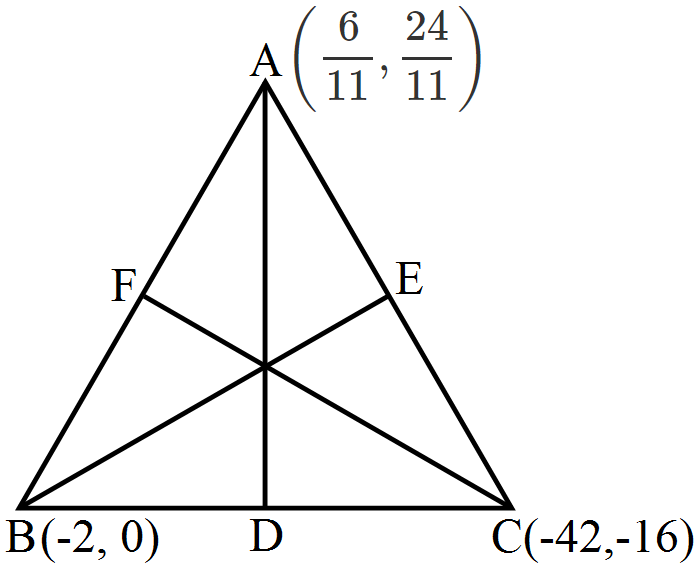 Now, the equation of median AD is $\text{y}+\frac{24}{11}=\frac{-8+\frac{24}{11}}{-22+\frac{6}{11}}(\text{x} +\frac{6}{11})$ $\Rightarrow16\text{x}-59\text{y}-120 = 0$ The equation of median BE is $\text{y}-0=\frac{-\frac{100}{11}-0}{-\frac{234}{11}+2}(x+2)$ $\Rightarrow25\text{x}-53\text{y}+50=0$ And, the equation of median CF is $\text{y}+16=\frac{-\frac{12}{11}+16}{-\frac{14}{11}+42}(\text{x}+42)$ $\Rightarrow41\text{x}-112\text{y}-70=0$
 View full question & answer→Question 114 Marks
Find the equation of the straight line through the point $(\alpha,\beta)$ and perpendicular to the line $lx + my + n = 0$.
AnswerAny line is given by equation $y - y_1 = m(x - x_1) ...(1)$ where $(x_1y_1)$ is $(\alpha,\beta)$ And m is negative reciprocal of slope of line lx + my + n = 0. i.e; $\text{y}=\frac{-\text{lx}}{\text{m}}-\frac{\text{n}}{\text{m}}$
$\Rightarrow$ Slope of line $=\frac{\text{-l}}{\text{m}}$ Putting the data in (i), we get $\text{y}-\beta=\frac{\text{m}}{\text{l}}(\text{x}-\alpha)$
$\text{ly}+\text{mx}=\text{m}\alpha+\text{l}\beta$
$\text{m}(\text{x}-\alpha)=\text{l}(\text{y}-\beta)$
View full question & answer→Question 124 Marks
Find the point of intersection of the following pairs of lines: $\text{y}=\text{m}_1\text{x}+\frac{\text{a}}{\text{m}_1}$ and $\text{y}=\text{m}_2\text{x}+\frac{\text{a}}{\text{m}_2}$
Answer$\text{y}=\text{m}_1+\frac{\text{a}}{\text{m}_1}$ and $\text{y}=\text{m}_2\text{x}+\frac{\text{a}}{\text{m}_2}$ Putting value of y from one equation to another $\text{m}_1+\frac{\text{a}}{\text{m}_1}=\text{m}_2\text{x}+\frac{\text{a}}{\text{m}_2}$ $\text{x}(\text{m}_1-\text{m}_2)=\frac{\text{a}}{\text{m}_2}-\frac{\text{a}}{\text{m}_1}=\text{a}\Big(\frac{\text{m}_1-\text{m}_2}{\text{m}_1\text{m}_2}\Big)$ $\Rightarrow\text{x}=\frac{\text{a}}{\text{m}_1\text{m}_2}$ $\Rightarrow\text{y}=\text{m}_1\text{x}+\frac{\text{a}}{\text{m}_1}$ $=\text{m}_1\Big(\frac{\text{a}}{\text{m}_1\text{m}_2}\Big)+\frac{\text{a}}{\text{m}_1}$ $=\frac{\text{a}}{\text{m}_2}+\frac{\text{a}}{\text{m}_1}$ $=\text{a}\Big(\frac{\text{m}_1+\text{m}_2}{\text{m}_1\text{m}_2}\Big)$ Thus, the point of in intersection is $\Big(\frac{\text{a}}{\text{m}_1\text{m}_2},\text{a}\Big(\frac{1}{\text{m}_1}+\frac{1}{\text{m}_2}\Big)\Big)$
View full question & answer→Question 134 Marks
Find the conditions that the straight lines $y = m_1x + c_1, y = m_2x + c_2$ and $y = m_3x + c_3$ may meet in a point.
AnswerThe three lines are $y=m_1 x+c_1 \ldots$ (1) $y=m_2 x+c_2 \ldots$ (2) $y=m_3 x+c_3 \ldots$ (3) Collinear or they meet at a point only when they have common point of intersection solving (1) and (2) for $x$ and $y m_1 x+c_1=m_2 x+c_2 x\left(m_1-m_2\right)=c_2-c_1$
$x=\frac{c_2-c_1}{m_1-m_2} \Rightarrow y=m_1 x+c_1=m_1\left(\frac{c_2-c_1}{m_1-m_2}\right)+c_1=m_1 c_2-m_1 c_1+m_1 c_1-m_2 c_1 \text { Putting } x \text { and } y \text { in (3) }$
$m_1 c_2-m_1 c_1=m_3 \frac{\left(c_2-c_1\right)}{m_1-m_2}+c_3 m_1^2 c_2-m_1 m_2 c_2-m_1 m_2 c_1+m_2^2 c_1=m_3 c_2-m_3 c_1+m_1 c_3-m_2 c_3 \Rightarrow m_1\left(c_2-c_3\right)+$
$m_2\left(c_3-c_1\right)+m_3\left(c_1-c_2\right)=0$
View full question & answer→Question 144 Marks
Find the equations of the lines through the point of intersection of the lines x - y + 1 = 0 and 2x - 3y + 5 = 0 whose distance from the point (3, 2) is $\frac{7}{5}.$
AnswerSolving two equations of lines x - y + 1 = 0 and 2x - 3y + 5 = 0 we get, intersection point (2, 3). Let equation of a line passing through (2, 3) be y = mx + c $\therefore$ 3 = 2m + c c = 3 - 2m Equation of the line is y = mx + 3 -2m ...(1) Perpendicular distance of above line from $(3,2)=\frac{7}{5}$ $\Big|\frac{3\text{m}-2+3-2\text{m}}{\sqrt{\text{m}^2+1}}\Big|=\frac{7}{5}$ $\Big|\frac{\text{m}+1}{\sqrt{\text{m}^2+1}}\Big|=\frac{7}{5}$ $\frac{(\text{m}+1)^2}{\text{m}^2+1}=\frac{49}{25}$ $25(\text{m}^2+2\text{m}+1)=49\text{m}^2+49$ $25\text{m}^2+50\text{m}+25=49\text{m}^2+49$ $24\text{m}^2-50\text{m}+24=0$ $12\text{m}^2-25\text{m}+12=0$ $\text{m}=\frac{4}{3},\text{m}=\frac{3}{4}$ Substituting m in (1), we get, $\text{y}=\frac{4}{3}\text{x}+3-\frac{2\times4}{3}$ $3\text{y}=4\text{x}+1$ $4\text{x}-3\text{y}+1=0$ $\text{y}=\frac{3}{4}\text{x}+3-\frac{2\times3}{4}$ $4\text{y}-3\text{y}+1=0$ Equations of lines are 4x - 3y + 1 = 0 and 4y - 3y + 1 = 0
View full question & answer→Question 154 Marks
Find the tangent of the angle between the lines which have intercepts 3, 4 and 1, 8 on the axes respectively.
Answer$Line_1$ is $\frac{\text{x}}{3}+\frac{\text{y}}{4}=1$ i.e $4\text{x}+3\text{y}=12$ $Line_2$ is $\frac{\text{x}}{1}+\frac{\text{y}}{8}=1$ i.e $8\text{x}+\text{y}=8$ Slope of $Line_1$ and $Line_2$ is $\frac{-4}{3}$ and $\frac{-8}{1}$ respectively. Thus, $\tan\theta=\Big|\frac{\text{m}_1-\text{m}_2}{1+\text{m}_1\text{m}_2}\Big|$ $=\Bigg|\frac{\frac{-4}{3}-(-8)}{1+\big(\frac{-4}{3}\big)(-8)}\Bigg|$ $=\Bigg|\frac{\frac{-4}{2}+8}{1+\frac{32}{3}}\Bigg|=\Bigg|\frac{-4+24}{3+32}\Bigg|$ $=\Big|\frac{20}{35}\Big|=\frac{4}{7}$ Thus, $\tan\theta=\frac{4}{7}.$
View full question & answer→Question 164 Marks
Find the equation of the straight line which has y-intercept equal to $\frac{4}{3}$ and is perpendicular to 3x - 4y + 11 = 0.
AnswerAny line having y-intercept equal to $\frac{4}{3}$ passes through the point $\Big(0,\frac{4}{3}\Big)\$\text{x}_1,\text{y}_1)$ Slope of line 3x - 4y + 11 = 0 $\text{y}=\frac{3}{4}\text{x}+\frac{11}{4}$ $\Rightarrow\text{m}=\frac{3}{4}$ The required line is perpendicular to the given line, therefore its slope is $\frac{-4}{3}$ ⇒ Equation of required line is $\text{y}-\text{y}_1=\text{m}'(\text{x}-\text{x}_1)$ $\text{y}-\frac{4}{3}=\frac{-4}{3}(\text{x}-0)$ $4\text{x}+3\text{y}-4=0$
View full question & answer→Question 174 Marks
Find the equations to the straight lines which pass through the point $(h, k)$ and are inclined at angle $\tan^{-1}$ m to the straight line $y = mx + c$.
AnswerThe required equation is y - k = m'(x - h) And this line is inclined at $\tan^{-1}m$ to straight line y = mx + c. slope $=\text{m}=\tan\theta$ Passing through $(\text{h, k})\$\text{x}_1,\text{y}_1)$
$\therefore$ Equation of line is $\text{y} - \text{y} _1 = \text{m} (\text{x} - \text{x} _1) \ ...(\text{i} )$ Also, $\tan\theta=\big|\frac{\text{m}-\text{m'}}{1+\text{mm'}}\big|$ Here, $\text{m} = \text{m}'$
$\therefore\tan\theta=\frac{\text{m}-\text{m}}{1+\text{m}^2}$ or $\big|\frac{-\text{m}-\text{m}}{1-\text{m}^2}\big|$
$=0$ or $\frac{+2\text{m}}{1-\text{m}^2}$ Substituting in (i) $\text{y} - \text{k} = 0$
$\Rightarrow\text{y} = \text{k}$ or $\text{y}-\text{k}=\frac{+2\text{m}}{1-\text{m}^2}(\text{x}-\text{h})$
$(1-\text{m}^2)(\text{y}-\text{k})=+2\text{m}(\text{x}-\text{h})$
View full question & answer→Question 184 Marks
The line 2x + 3y = 12 meets the x-axis at A and y-axis at B. The line through (5, 5) perpendicular to AB meets the x-axis and the line AB at C and E respectively. If O is the origin of coordinates, find the area of figure OCEB.
AnswerThe line 2x + 3y = 12 meets the x-axis at A and y-axis at B ⇒ A is 2x = 12 = x = 6 $\therefore$ A is (6, 0) ⇒ A is 3y = 12 y = 4 $\therefore$ B is (0, ,4) Line through (5, 5) perpendicular to 2x + 3y = 12 will have slope $=\frac{3}{2}$ $\text{y}-\text{y}_1=\text{m}(\text{x}-\text{x}_1)$ $\text{y}-5=\frac{3}{2}(\text{x}-5)$ 2y - 3x = -5 is eq of lline which meets x-axis at C and the line at E $\therefore$ C is -3x = -5 $\text{x}=\frac{-5}{3}$ $\therefore$ E is $\Big(\frac{5}{3},0\Big)$ E ⇒ point of intersection of two lines 2x + 3y = 12 2y - 3x = -5 The area of OBCE = are of AOB - area of ACE $\Rightarrow\frac{1}{2}\times\text{AO}\times\text{OB}-\frac{1}{2}\times\text{AC}\times\text{CE}$ $\Rightarrow\frac{24}{2}-\frac{1}{2}\times\sqrt{13}\times\frac{2}{3}\sqrt{13}$ $\Rightarrow\frac{24}{2}-\frac{1}{2}\times\frac{2}{3}\times13$ $\Rightarrow12-\frac{13}{3}$ $\Rightarrow\frac{23}{3} \ \text{sq units}$
View full question & answer→Question 194 Marks
Show that the path of a moving point such that its distances from two lines 3x - 2y = 5 and 3x + 2y = 5 are equal is a straight line.
AnswerLet P(h, k) be a moving point such that it is equidistant from the lines 3x - 2y - 5 = 0 and 3x + 2y - 5 = 0, then $\Big|\frac{3\text{h}-2\text{k}-5}{\sqrt{9+4}}\Big|=\Big|\frac{3\text{h}+2\text{k}-5}{\sqrt{9+4}}\Big|$ $|3\text{h}-2\text{k}-5|=|3\text{h}+2\text{k}-5|$ $4\text{k}=0\Rightarrow\text{k}=0$ or $6\text{h}-10=0\Rightarrow3\text{h}=5$ Hence, the locus of (h, k) is y = 0 or 3x = 5, which are straight lines.
View full question & answer→Question 204 Marks
Find the equation of the diagonals of the square formed by the lines x = 0, y = 0, x = 1 and y = 1.
Answer
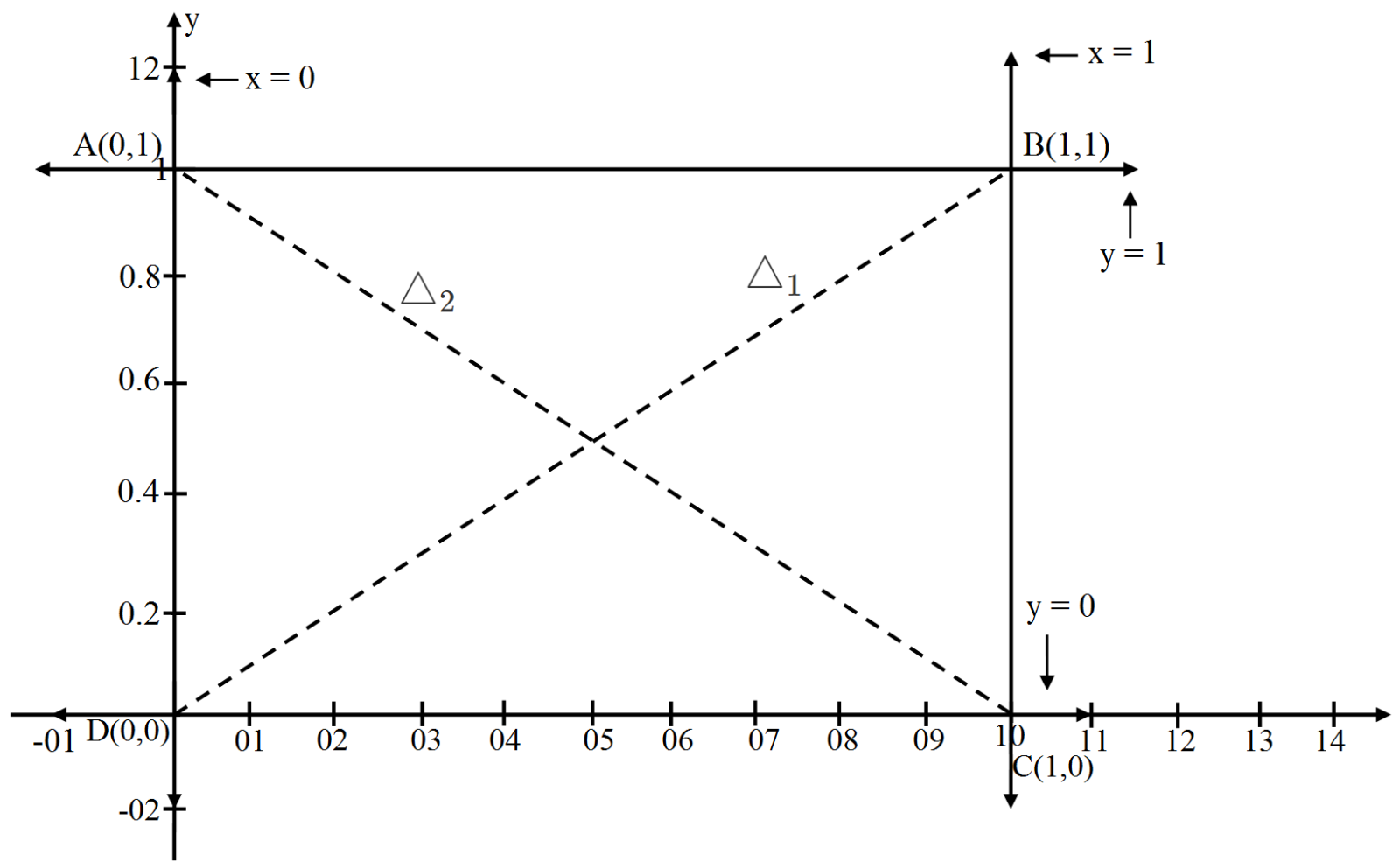
When we draw all the given equation of lines on the graph we get the points of intersection A(0, 1), B(1, 1), C(1, 0) and D(0, 0).
Let $d_1$ be the diagonal formed by joining the points B and D.
Let $d_2$ be the diagonal formed by joining the points A and C.
Equation of the diagonal $d_1$ is given by,
$(\text{y}-1)=\frac{(0-1)}{(0-1)}(\text{x}-1)$
$(\text{y}-1)=1(\text{x}-1)$
$\text{y}=\text{x}$
Equation of the diagonal $d_2$ is given by,
$(\text{y}-1)=\frac{(0-1)}{(1-0)}(\text{x}-0)$
$(\text{y}-1)=-\text{1x}$
$\text{y}+\text{x}=1$
$\therefore $ The equations of the diagonals are $\text{y}=\text{x}$ and $\text{y}+\text{x}=1.$ View full question & answer→Question 214 Marks
If sum of perpendicular distances of a variable point P (x, y) from the lines x + y - 5 = 0 and 3x - 2y + 7 = 0 is always 10. Show that P must move on a line.
AnswerIt is given that the sum of the perpendicular distance of a variable point p(x, y) from the lines (x + y - 5) = 0 and 3x - 2y + 7 = 0 is always 10. Therefore, $\frac{\text{x}+\text{y}-5}{\sqrt{2}}+\frac{3\text{x}-2\text{y}+7}{\sqrt{13}}=10$ $\big(3\sqrt{2}+\sqrt{13}\big)\text{x}+\big(\sqrt{13}-2\sqrt{2}\big)\text{y}+\big(7\sqrt{2}-5\sqrt{13}-10\sqrt{26}\big)=0$ Clearly, it is a straight line.
View full question & answer→Question 224 Marks
Find the angles between the following pairs of straight lines: 3x + 4y - 7 = 0 and 4x - 3y + 5 = 0
AnswerTo find angles between the lines, convert the equations in the form$\text{y}=\text{mx}+\text{c}$
$3\text{x}+4\text{y}-7=0$
$\Rightarrow4\text{y}=-3\text{x}+7$
$\text{y}=\frac{-3}{4}\text{y}+\frac{7}{4}$
$\Rightarrow\text{m}_1=\frac{-3}{4}$
Also, $4\text{x}-3\text{y}+5=0$
$\Rightarrow3\text{y}=4\text{x}+5$
$\Rightarrow\text{y}=\frac{4}{3}\text{x}+\frac{5}{3}$
$\Rightarrow\text{m}_1=\frac{4}{3}$
The angle between the lines is given by
$\tan\theta=\Big|\frac{\text{m}_1-\text{m}_2}{1+\text{m}_1\text{m}_2}\Big|$
$=\Bigg|\frac{\frac{-3}{4}-\frac{4}{3}}{1+\frac{(-3)}{4}\big(\frac{4}{3}\big)}\Bigg|=\Bigg|\frac{\frac{-3}{4}-\frac{4}{3}}{1-1}\Bigg|$
$\Rightarrow\theta=\frac{\pi}{2}$ or $90^\circ$
View full question & answer→Question 234 Marks
Find the coordinates of the foot of the perpendicular from the point (-1, 3) to the line 3x- 4y - 16 = 0.
AnswerLet foot of perpendicular of P(-1, 3) on line 3x - 4y = 16 be $\text{Q}(\alpha,\beta)$ Then, (Slope of line) × (Slope of PQ) = -1 $\frac{3}{4}\times\frac{\beta-3}{\alpha+1}=-1$ $3(\beta-3)=-4\alpha-4$ $3\beta-9=-4\alpha-4$ $=4\alpha+3\beta=5 \ ...(1)$ $\alpha$ and $\beta$ should lie on 3x -4y = 16 $\therefore 3\alpha-4\beta = 16 \ ...(2)$ From (1) and (2) $\alpha=\Big(\frac{68}{25}\Big), \ \beta=\Big(\frac{-49}{25}\Big)$ $\therefore$ Q is $\Big(\frac{68}{25},\frac{-49}{25}\Big)$
View full question & answer→Question 244 Marks
Show that the product of perpendiculars on the line $\frac{\text{x}}{\text{a}}\cos\theta+\frac{\text{y}}{\text{b}}\sin\theta=1$ from the points $\Big(\sqrt{\text{a}^2-\text{b}^2},0\Big)$ is $\text{b}^2.$
AnswerPerpendicular distance from $\Big(\sqrt{\text{a}^2-\text{b}^2},0\Big)$ to $\frac{\text{x}}{\text{a}}\cos\theta+\frac{\text{y}}{\text{b}}\sin\theta=1$ $\begin{vmatrix}\frac{\frac{\sqrt{\text{a}^2-\text{b}^2}}{\text{a}}\cos\theta+\frac{0\text{x}}{\text{b}}\sin\theta-1}{\frac{\cos^2\theta}{\text{a}^2}+\frac{\sin^2\theta}{\text{b}^2}}\end{vmatrix}$ $=\frac{\frac{\sqrt{\text{a}^2-\text{b}^2}}{\text{a}}\cos\theta-1}{\frac{\cos^2\theta}{\text{a}^2}+\frac{\sin^2\theta}{\text{b}^2}} \ ...(\text{i})$ Also, perpendicular from $\Big(-\sqrt{\text{a}^2-\text{b}^2},0\Big)$ to $\frac{\text{x}}{\text{a}}\cos\theta+\frac{\text{y}}{\text{b}}\sin\theta-1=0$ $\begin{vmatrix}\frac{-\frac{\sqrt{\text{a}^2-\text{b}^2}}{\text{a}}\cos\theta+0-1}{\frac{\cos^2\theta}{\text{a}^2}+\frac{\sin^2\theta}{\text{b}^2}}\end{vmatrix} \ ...(\text{ii})$ (i) × (ii) $\frac{\Big(\frac{\text{a}^2-\text{b}^2}{\text{a}}\Big)\cos^2\theta-1}{\frac{\cos^2\theta}{\text{a}^2}+\frac{\sin^2\theta}{\text{b}^2}}=\text{b}^2$
View full question & answer→Question 254 Marks
If two opposite vertices of a square are $(1, 2)$ and $(5, 8)$, find the coordinates of its other two vertices and the equations of its sides.
AnswerLet $A(1, 2), C(5, 8), B(x_1, y_1), D(x_2,y_2)$ Slope of $\text{AC}=\frac{8-2}{5-1}=\frac{6}{4}=\frac{3}{2}$
Let m be the slope of a line making on angle 45º with AC
$\therefore\tan45^\circ=\Bigg|\frac{\text{m}_1-\frac{3}{2}}{1+\text{m}\times\frac{3}{2}}\Bigg|$
$1=\frac{\text{m}-\frac{3}{2}}{1+\frac{3\text{m}}{2}}$
$1+\frac{3\text{m}}{2}=\text{m}-\frac{3}{2}$ or, $1+\frac{3\text{m}}{2}=-\Big(\text{m}-\frac{3}{2}\Big)$
$\frac{3\text{m}}2-\text{m}=\frac{-3}{2}-1$ or, $1+\frac{3\text{m}}2=-\text{m}+\frac{3}{2}$
$\frac{1}{2}\text{m}=\frac{-5}{2}$ or, $\frac{3\text{m}}{2}+\text{m}=\frac{3}{2}-1$
$\text{m}=-5$ or, $\frac{5\text{m}}{2}=\frac{1}{2}$
$\text{m}=\frac{1}{5}$
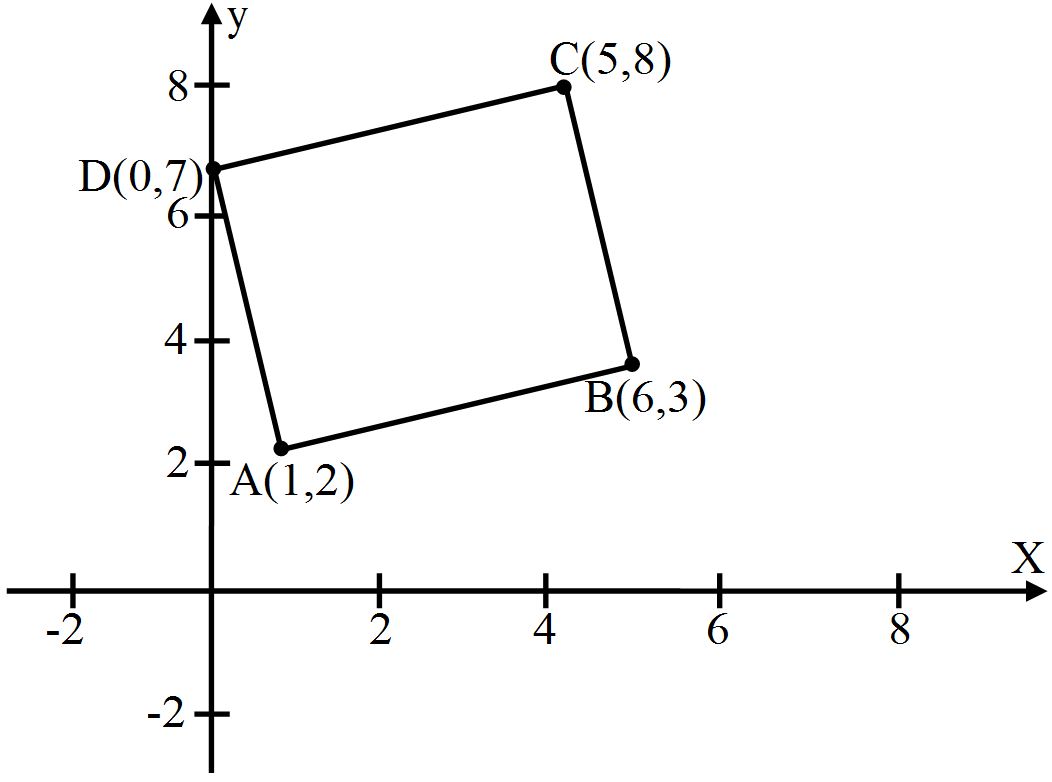
Hence, equation of AD
y - 2 = -5(x - 1)
5x + y = 7
Equation of CD
$\text{y}-8=\frac{1}{5}(\text{x}-5)$
$\text{y}-8=\frac{\text{x}}{5}-1$
$5\text{y}-\text{x}=39$
Hence, the coodinates are (6, 3), (0, 7).
The equation of AB is
$\text{y}-2=\frac{1}{5}(\text{x}-1)$
$\Rightarrow5\text{y}-10=\text{x}-1$
$\Rightarrow\text{x}-5\text{y}+9=0$
And the equation of BC is
$\text{y}-8=-5(\text{x}-5)$
$\Rightarrow\text{y}-8=-5\text{x}+25$
$\Rightarrow5\text{x}+\text{y}-33=0$ View full question & answer→Question 264 Marks
Prove that the points $(2, -1), (0, 2), (2, 3)$ and $(4, 0)$ are the coordinates of the vertices of a parallelogram and find the angle between its diagonals.
AnswerLet A(2, -1), B(0, 2), C(2, 3) and D(4, 0) be the vertices. Slope of $\text{AB}=\frac{2+1}{0-2}=-\frac{3}{2}$ Slope of $\text{BC}=\frac{3-2}{2-0}=-\frac{1}{2}$ Slope of $\text{CD}=\frac{0-3}{4-2}=-\frac{3}{2}$ Slope of $\text{DA}=\frac{-1-0}{2-4}=\frac{1}{2}$ Thus, AB is parallel to CD and BC is parallel to DA Therefore, the given points are the vertices of parallelogram.
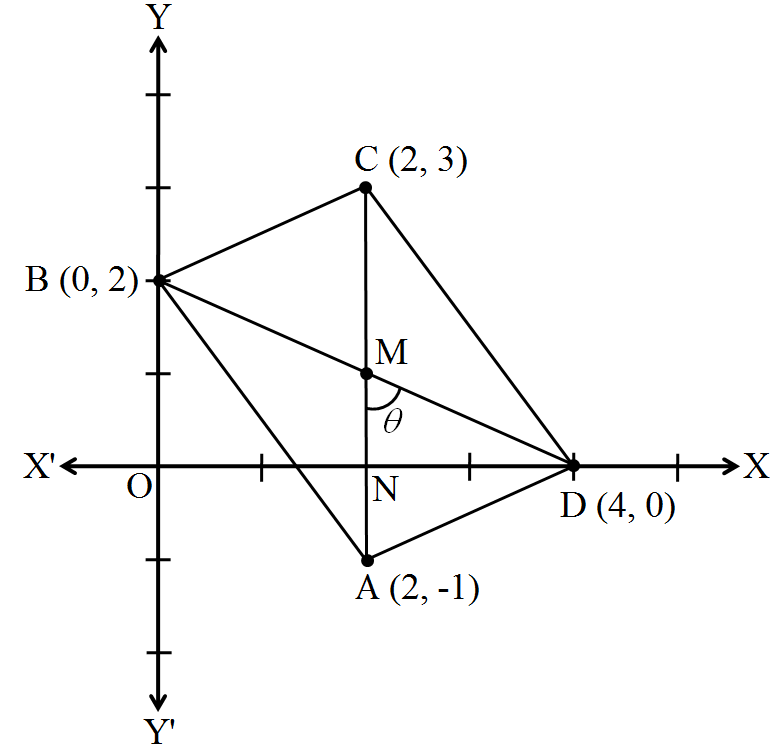
Now, let us find the angle between the diagonals AC and BD. Let $m_1$ and $m_2$ be the slopes of AC and BD, respectively. $\therefore\text{m}_1=\frac{3+1}{2-2}=\infty$ $\text{m}_2=\frac{0-2}{4-0}=-\frac{1}{2}$ Thus, the diagonal AC is parallel to the y-axis. $\therefore\angle\text{ODB}-\tan^{-1}\big(\frac{1}{2}\big)$ In trianlge MND, $\angle\text{DMN}=\frac{\pi}{2}-\tan^{-1}\big(\frac{1}{2}\big)$ Hence, the acute angle between the diagonals is $\frac{\pi}{2}-\tan^{-1}\big(\frac{1}{2}\big).$ View full question & answer→Question 274 Marks
Determine whether the point (-3, 2) lies inside or outside the triangle whose sides are given by the equations x + y - 4 = 0, 3x - 7y + 8 = 0, 4x - y - 31 = 0.
AnswerLet ABC be the triangle, then coordinates of the vertices are marked in the following figure. p(-3, 2) lie inside if. A and P, B and P, C and P lie on the same side of BC, AC and BA respectively. If A and P lie on the same jside of bc then, (3(7) - 7(-3) + 8)(3(-3) - 7(2) + 8) > 0 (21 + 21 + 8)(-9 - 14 + 8) > 0 But, (50)(-15) is not > 0 $\therefore$ The point (-3, 2) is outside ABC.
View full question & answer→Question 284 Marks
In what ratio is the line joining the points (2, 3) and (4, -5) divided by the line passing through the points (6, 8) and (-3, -2).
AnswerIn what ratio is the line joining the points (2, 3) and (4, -5) divided by the line passing through the points (6, 8) and (-3, -2)Let the equation of AB joining the points (6, 8) and (-3, -2) be
$\text{y}-\text{y}_1=\text{m}(\text{x}-\text{x}_1)$
$\text{y}-\text{y}_1=\frac{\text{y}_2-\text{y}_1}{\text{x}_2-\text{x}_1}(\text{x}-\text{x}_1)$
$\text{y}-8=\frac{-2-8}{-3-6}(\text{x}-6)$
$\text{y}-8=\frac{10}{9}(\text{x}-6)$
$\text{9y}-\text{10x}=12\ ....(\text{i})$
Suppose the line joining (2, 3) and (4, -5) is divided by the line 9y - 10x = 12 in the ratio k : 1 at the point (x, y), then
$\text{x}=\frac{\text{k}(4)+1(2)}{\text{k}+1},\text{y}\frac{\text{k}(-5)+1(3)}{\text{k}+1}$
Substituiting in equation (i), we get:
$\frac{9(-5\text{k}+3)}{\text{k}+1}-10\Big(\frac{4\text{k}+2}{\text{k}+1}\Big)=12$
$\Rightarrow-45\text{k}+27-40\text{k}-20=12\text{k}+12$
$\Rightarrow97\text{k}=5$
$\Rightarrow\text{k}=\frac{5}{27}$
View full question & answer→Question 294 Marks
Show that the tangent of an angle between the lines $\frac{\text{x}}{\text{a}}+\frac{\text{y}}{\text{b}}=1$ and $\frac{\text{x}}{\text{a}}-\frac{\text{y}}{\text{b}}=1$ is $\frac{2\text{ab}}{\text{a}^2-\text{b}^2}.$
AnswerLet the line $\frac{\text{x}}{\text{a}}+\frac{\text{y}}{\text{b}}=1$ be AB $\frac{\text{x}}{\text{a}}-\frac{\text{y}}{\text{b}}=1$ be CD. Equation of AB, $\frac{\text{bx}+\text{ay}}{\text{ab}}=1$ $\Rightarrow\text{ay}=-\text{bx}+\text{ab}$ $\Rightarrow\text{y}=-\frac{\text{bx}}{\text{a}}+\text{b}$ Therefore $\text{m}_1=-\frac{\text{b}}{\text{a}}$ Similarly, the equation of CD, $\frac{\text{bx}-\text{ay}}{\text{ab}}=1$ $\Rightarrow\text{bx}-\text{ay}=\text{ab}$ $\Rightarrow\text{ay}=\frac{\text{bx}}{\text{a}}-\text{a}$ Therefore, $\text{m}_2=\frac{\text{b}}{\text{a}}$ The tangent of angle between the lines AB and CD is $\Rightarrow\tan\theta=\Big|\frac{\text{m}_1-\text{m}_2}{1+\text{m}_1\text{m}_2}\Big|$ $=\Bigg|\frac{-\frac{\text{b}}{\text{a}}-\frac{\text{b}}{\text{a}}}{1+\big(-\frac{\text{b}}{\text{a}}\big)\big(\frac{\text{b}}{\text{a}}\big)}\Bigg|=\Bigg|\frac{-\frac{2\text{b}}{\text{a}}}{\frac{\text{a}^2-\text{b}^2}{\text{a}^2}}\Bigg|$ $=\Big|\frac{-2\text{ab}}{\text{a}^2-\text{b}^2}\Big|$ $=\frac{2\text{ab}}{\text{a}^2-\text{b}^2}$ The tangent of the angle between the lines $=\frac{2\text{ab}}{\text{a}^2-\text{b}^2}$
View full question & answer→Question 304 Marks
Show that the lines $a^2x + ay + 1 = 0$ is perpendicular to the lines $x - ay = 1$ for all non-zero real values of a.
Answer$a^2x + ay + 1 = 0 x - ay = 1$ Converting these two equations inn the form y = mx + c $\text{y}=-\frac{\text{a}^2}{\text{a}}\text{x}-\frac{1}{\text{a}}=-\text{ax}-\frac{1}{\text{a}}$
$\Rightarrow\text{m}_1=-\text{a}$ Also, $\text{y}=\frac{\text{x}}{\text{a}}-\frac{1}{\text{a}}$
$\Rightarrow\text{m}_2=\frac{1}{\text{a}}$ Thus, $\text{m}_1\text{m}_2=-\text{a}\times\frac{1}{\text{a}}=-1$ The two lines are perpendicular as the product of slopes is -1.
View full question & answer→Question 314 Marks
What are the points on X-axis whose perpendicular distance from the straight line $\frac{\text{x}}{\text{a}}+\frac{\text{y}}{\text{b}}=1$ is a?
AnswerAny point on x-axis is $(\pm\text{a},0)\$\text{x}_1,\text{y}_1)$ Perpendicular distance from a line bx + ay = ab is $\Big|\frac{\text{ax}_1+\text{by}_1+\text{c}}{\sqrt{\text{a}^2+\text{b}^2}}\Big|=\text{a}$ where, $\text{a}=\text{b}, \ \text{b}=\text{a}, \ \text{c}=\text{-ab}, \ \text{x}_1=\pm\text{a}, \ \text{y}_1=0$ $=\Big|\frac{\text{b}(\text{x})+\text{a}(0)-\text{ab}}{\sqrt{\text{a}^2+\text{b}^2}}\Big|=\text{a}$ $\text{a}=0$ or $=\frac{\text{b}(\text{x})+\text{a}(0)-\text{ab}}{\sqrt{\text{a}^2+\text{b}^2}}=\text{a}$ $\frac{\text{b}}{\text{a}}\text{x}=\pm\sqrt{\text{a}^2+\text{b}^2}+\text{b}$ $\text{x}=\frac{\text{a}}{\text{b}}\Big(\text{b}\pm\sqrt{\text{a}^2+\text{b}^2}\Big)$ $\text{x}=0$
View full question & answer→Question 324 Marks
Find the equation of a line perpendicular to the line $3x - y + 5 = 0$ and at a distance of $3$ units from the origin.
AnswerAny line perpendicular to line $\sqrt{3}\text{x}-\text{y}+5=0$ will have the slope $\frac{-1}{\text{m}}$ Where, $\text{m}\Rightarrow\text{y}=\text{mx}+\text{c}$
$\text{y}=\sqrt{3}\text{x}+5$
$\text{m}=\sqrt{3}$ Point is $(x_1y_1) = (3, 3) \text{y}-\text{y}_1=\frac{-1}{\text{m}}(\text{x}-\text{x}_1)$
$\text{y}-3=\frac{-1}{\sqrt{3}}(\text{x}-3)$
$\text{x}+\sqrt{3}\text{y}+6=0$ Point can be (-3, -3) Then, equation is $\text{x}+\sqrt{3}\text{y}-6$
$\therefore \ \text{x}+\sqrt{3}\text{y}\pm6$
View full question & answer→Question 334 Marks
If the lines $p_1x + q_1y = 1, p_2x + q_2y = 1$ and $p_3x + q_3y = 1$ be concurrent, show that the points $(p_1, q_1), (p_2, q_2)$ and $(p_3, q_3)$ are collinear.
AnswerIf the lines are concurrent, then the lines have common point of intersection. The given line are $p_1x + q_1y = 1 ...(1) p_2x + q_2y = 1 ...(2) p_3x + q_3y = 1 ...(3)$
Solving (1) and (2) $\text{x}=\frac{1-\text{q}_1\text{y}}{\text{p}_1}$
$\text{p}_2\Big(\frac{1-\text{q}_1\text{y}}{\text{p}_1}\Big)+\text{q}_2\text{y}=1$
$\text{p}_2=\text{p}_2\text{q}_1\text{y}+\text{p}_1\text{q}_2\text{y}=\text{p}_1$
$\text{y}=\frac{\text{p}_1-\text{p}_2}{\text{p}_1\text{q}_2-\text{p}_2\text{q}_1}\Rightarrow\text{x}=\frac{1-\text{q}_1\Big(\frac{\text{p}_1-\text{p}_2}{\text{p}_1\text{q}_2-\text{p}_2\text{q}_1}\Big)}{\text{p}_1}$ Putting x, y in (3) $\text{p}_3[(\text{p}_1\text{q}_2 - \text{p}_2\text{q}_1) - \text{q}_1\text{p}_1 - \text{q}_1\text{p}_2][\text{p}_1\text{q}_2 - \text{p}_2\text{p}_1] + \text{q}_3\text{p}_1(\text{p}_1 - \text{p}_2) = 1$
$(\text{p}_1\text{p}_3\text{q}_2 - \text{p}_2\text{p}_3\text{q}_1 - \text{p}_1\text{p}_3\text{q}_1 + \text{p}_2\text{p}_3\text{q}_1)(\text{p}_1\text{q}_2 - \text{p}_2\text{q}_1) + \text{q}_3\text{p}_1^2 - \text{q}_3\text{p}_1\text{p}_2 = 1$
$(\text{p}_1\text{p}_3\text{q}_2 - \text{p}_1\text{p}_3\text{q}_1)(\text{p}_1\text{q}_2 - \text{p}_1\text{q}_2) + \text{q}_3\text{p}_1^2 - \text{q}_3\text{p}_1\text{p}_2 = 1$
$\text{p}_1^2\text{p}_3\text{q}_2^2 - \text{p}_1\text{p}_2\text{p}_3\text{q}_1\text{q}_2 - \text{p}_1^2\text{p}_3\text{q}_1\text{q}_2 + \text{p}_1\text{p}_2\text{p}_3\text{q}_1^2 + \text{q}_3\text{p}_1^2 + \text{q}_3\text{p}_1\text{p}_2 = 1$ Also if $(p_1q_1)(p_2q_2)(p_3q_3)$ are collinear Then, $\text{p}_1(\text{q}_2 - \text{q}_3) + \text{p}_2(\text{q}_3 - \text{q}_1) + \text{p}_3(\text{q}_1 - \text{q}_3) = 0$ From (1) $\text{p}_1[\text{p}_1\text{p}_3\text{q}_2^2 - \text{p}_2\text{p}_3\text{q}_1\text{q}_2 - \text{p}_1\text{p}_3\text{q}_1\text{q}_2 - \text{p}_1\text{p}_3\text{q}_1\text{q}_2 + \text{p}_2\text{p}_3\text{q}_1^2 + \text{q}_3\text{p}_1 - \text{q}_3\text{p}_2] = 1$
$\text{p}_1[\text{p}_3\text{q}_2(\text{p}_1\text{q}_2 - \text{p}_2\text{q}_1) - \text{p}_3\text{q}_1(\text{p}_1\text{q}_2 - \text{p}_2\text{q}_1) + \text{q}_3(\text{p}_1 - \text{p}_2)] = 1$ Hence, the points are collinear.
View full question & answer→Question 344 Marks
If the three lines $ax + a^2y + 1 = 0, bx + b^2y + 1 = 0$ and $cx + c^2y + 1 = 0$ are concurrent, show that at least two of three constants $a, b, c$ are equal.
AnswerIf three lines are concurrent then the point of intersection of (1) and (2) should verify the (3) line, where $ax + a^2y + 1 = 0 ...(1) bx + b^2y + 1 = 0 ...(2) cx + c^2y + 1 = 0 ...(3)$ Solving (1) and (2) $\text{x}=\frac{-1-\text{a}^2\text{y}}{\text{a}}\Rightarrow\text{b}\Big(\frac{-1-\text{a}^2\text{y}}{\text{a}}\Big)+\text{b}^2\text{y}+1=0-\text{b}\text{a}^2\text{by}+\text{ab}^2\text{y}+\text{a}=0$
$\text{y}=\frac{\text{b}-\text{a}}{\text{ab}(\text{b}-\text{a})}=\frac{1}{\text{ab}}$
$\Rightarrow\text{x}=\frac{1-\text{a}^2\times\frac{1}{\text{ab}}}{\text{a}}=\frac{1-\frac{\text{a}}{\text{b}}}{\text{a}}=\frac{\text{b}-\text{a}}{\text{ab}}$ Putting in (3) $\text{c}\Big(\frac{\text{b}-\text{a}}{\text{ab}}\Big)+\text{c}^2\Big(\frac{1}{\text{ab}}\Big)+1=0$
$bc - ac + c^2 + ab = 0 bc + c^2 - ac + ab = 0 c(b + c) - a(c - b) = 0 \Rightarrow Either c = b \Rightarrow 2bc = 0 \Rightarrow 2c^2 = 0 \Rightarrow c = 0$
View full question & answer→Question 354 Marks
If a, b, c are in A.P., prove that the straight lines ax + 2y + 1 = 0, bx + 3y + 1 = 0 and cx + 4y + 1 = 0 are concurrent.
AnswerIf a, b, c are in A.P. b - a = c - b 2b = a + c [Common difference] To prove that the straight lines are concurent then they ihave the common point of intersection. ax + 2y + 1 = 0 ...(1) bx + 3y + 1 = 0 ...(2) cx + 4y + 1 = 0 ...(3) Solving (1) and (2) $\text{x}=\frac{-1-2\text{y}}{\text{a}}$ Put in (2) $\text{b}=\Big(\frac{-1-2\text{y}}{\text{a}}\Big)+3\text{y}+1=0$ $\text{y}=\frac{\text{b}-\text{a}}{3\text{a}-2\text{b}}\Rightarrow\text{x}=\frac{-1-\frac{2(\text{b}-\text{a})}{3\text{a}-2\text{b}}}{\text{a}}=\frac{-3\text{a}+2\text{b}-2\text{b}+2\text{a}}{\text{a}(3\text{a}-2\text{b})}$ $\text{x}=\frac{-1}{3\text{a}-2\text{b}}$ Putting x, y in (3) $\text{c}\Big(\frac{-1}{3\text{a}-2\text{b}}\Big)+4\Big(\frac{\text{b}-\text{a}}{3\text{a}-2\text{b}}\Big)+1=0$ $-\text{c}+4\text{b}-4\text{a}+3\text{a}-2\text{b}=0$ $-\text{a}+2\text{b}-\text{c}=0$ $-\text{a}+\text{a}+\text{c}-\text{c}=0$ $0 = 0$
View full question & answer→Question 364 Marks
Find the equation of the straight line perpendicular to $5x - 2y = 8$ and which passes through the mid-point of the line segment joining $(2, 3)$ and $(4, 5)$.
AnswerThe equation of the required line is $y - y_1 = m(x - x_1) ...(1) (x_1, y_1)$ is mid point of $(2,3)\$\text{x}_1,\text{y}_1)$ and $(4,5)\$\text{x}_2,\text{y}_2)$
$\Rightarrow\text{x}=\frac{\text{x}_1+\text{x}_2}{2},\text{y}=\frac{\text{y}_1+\text{y}_2}{2}$
$\Rightarrow\text{x}=\Big(\frac{2+4}{2}\Big),\text{y}=\Big(\frac{3+5}{2}\Big)$
$\Rightarrow(\text{x}_1\text{y}_1)\Leftrightarrow(3,4)$ Also slope of given line is 5x - 2y = 8 $\text{y}=\frac{5}{2}\text{x}-4$
$\Rightarrow\text{m}'=\frac{5}{2}$ Required line is perpendicular to the given line $\therefore \ \text{m}=\frac{-2}{5}$ Putting m and $(x_1, y_1)$ in (1) $\text{y}-4=\frac{-2}{5}(\text{x}-3)$
$5\text{y}+2\text{x}=26$
$2\text{x}+5\text{y}-26=0$
View full question & answer→Question 374 Marks
Prove that the lines $\text{y}=\sqrt{3}\text{x}+1,\text{y}=4$ and $\text{y}=-\sqrt{3}\text{x}+2$ form an equilateral triangle.
AnswerThe given equations are as follows: $\text{y}=\sqrt3\text{x}+1\ ...(1)$ $\text{y}=4\ ...(2)$ $\text{y} = -\sqrt{3}\text{x}+2\ ...(3)$ In triangle ABC, let equation (1), (2) and (3) represent the sides AB, BC and CA, respectively. Solving (1) and (2) $\text{x}= \sqrt3,\text{y}=4$ Thus, AB and BC intersect at $\text{B}\big(\sqrt3,4\big)$ Solving (1) and (3) $\text{x} = \frac{1}{2\sqrt3}, \text{y} = \frac{3}{2}$ Thus, AB and CA intersect at $\text{A}\big(\frac{1}{2\sqrt3},\frac{3}{2}\big).$ Similarly, solving (2) and (3) $\text{x} = -\frac{2}{\sqrt3}, \text{y}= 4$ Thus, BC and AC intersect at $\text{C}\big(-\frac{2}{\sqrt{3}},4\big).$ Now, we have: $\text{AB}=\sqrt{\Big(\frac{1}{2\sqrt{3}}-\sqrt{3}\Big)^2+\Big(\frac{3}{2}-4\Big)^2}=\frac{5}{\sqrt3}$ $\text{BC}=\sqrt{\Big(\sqrt{3}+\frac{2}{\sqrt3}\Big)^2+\Big(4-4\Big)^2}=\frac{5}{\sqrt3}$ $\text{AC}=\sqrt{\Big(\frac{1}{2\sqrt3}+\frac{2}{\sqrt3}\Big)^2+\Big(\frac{3}{2}-4\Big)^2}=\frac{5}{\sqrt3}$ Hence, the given lines form an equilateral triangle.
View full question & answer→Question 384 Marks
Find the equation of the straight line perpendicular to $2x - 3y = 5$ and cutting off an intercept $1$ on the positive direction of the x-axis.
AnswerLet the equation of the required line be y - y1 = m(x - x1), where 'm' denotes the slope of the line and $(x_1, y_1)$ be the point through which the line passes. Since the x-intercept of the line is 1 on the positive direction of the x-axis therefore the line passes through (1, 0) Also, 2x - 3y = 5 3y = 2x - 5 $\text{y}=\frac{2\text{x}}{3}-\frac{5}{3}$ Therefore, the slope of the given line is $\frac{2}{3}$ Slope of the required line $=\frac{-2}{\frac{2}{3}}=-\frac{3}{2}$ Therefore the equation of the required line is $\text{y}-\text{y}_1=\text{m}(\text{x}-\text{x}_1)$
$\text{y}-0=\frac{2}{3}(\text{x}-1)$
$\text{y}=-\frac{3}{2}(\text{x}-1)$
$2\text{y}=-3\text{x}+3$ The equation of the required line is 3x + 2y - 3 = 0
View full question & answer→Question 394 Marks
Show that the perpendicular bisectors of the sides of a triangle are concurrent.
AnswerLet coordinates of $\triangle\text{ABC}$ A(0, 0), B(a, 0), c(0, b). Then mid points of AB, BC and CA are → $\text{D}\Big(\frac{\text{a}}{2},0\Big), \text{E}\Big(\frac{\text{a}}{2},\frac{\text{b}}{2}\Big)$ and $\text{F}\Big(0,\frac{\text{b}}{2}\Big)$ Then equation of CD, AE and BF are $\text{CD}\Rightarrow\text{y}-\text{b}=\frac{\text{a}-\text{b}}{\frac{\text{a}}{2}-0}(\text{x}-0)$ $\Rightarrow\text{y}-\text{b}=\frac{-2\text{b}}{\text{a}}(\text{x})$ $\Rightarrow\text{ay}-\text{ab}=-2\text{bx}$ $\Rightarrow\text{ay}+2\text{bx}-\text{ab}=0 \ ...(1)$ $\text{BF}\Rightarrow\text{y}-0=\frac{\frac{\text{b}}{2}-0}{0-\text{a}}(\text{x}-0)$ $\Rightarrow\text{y}=\frac{-\text{b}}{2\text{a}}(\text{x}-\text{a})$ $\Rightarrow-2\text{ay}-\text{bx}=\text{ba} \ ...(2)$ $\text{AE}\Rightarrow\text{y}-0=\frac{0-\frac{\text{b}}{2}}{0-\frac{\text{a}}{2}}(\text{x}-0)$ $\Rightarrow\text{ya}=+\text{bx} \ ...(3)$ Adding (1), (2) and (3) $\text{ay}+2\text{bx}-\text{ab}+2\text{b}^2-2\text{ay}-\text{bx}-\text{ab}+\text{ay}-\text{bx}=0$ then, $\lambda_1\text{L}_1+\lambda_2\text{L}_2+\lambda_3\text{L}_3=0.$ where $\lambda_1=\lambda_2=\lambda_3=1.$ Hence, lines are concurrent.
View full question & answer→Question 404 Marks
Prove that the family of lines represented by $\text{x}(1+\lambda)=\text{y}(2-\lambda)+5=0,$ $\lambda$ being arbitrary, pass through a fixed point. Also, find that point.
Answer$\text{x}(1+\lambda)+\text{y}(2-\lambda)+5=0$ $\Rightarrow\text{x}+\text{x}\lambda+2\text{y}-\lambda\text{y}+5=0$ $\Rightarrow\lambda(\text{x}-\text{y})+(\text{x}+2\text{y}+5)=0$ $\Rightarrow(\text{x}+2\text{y}+5)+\lambda(\text{x}-\text{y})=0$ This is of the form $\text{L}_1+\lambda\text{L}_2=0$ So it represents a line passing through the intersection of x - y = 0 and x + 2y = -5. Solving the two equations, we get $\Big(\frac{-5}{3},\frac{-5}{3}\Big)$ which is the fixed point through which the given family of lines passes for any value of $\lambda.$
View full question & answer→Question 414 Marks
Show that the area of the triangle formed by the lines $y = m_1x, y = m_2x$ and y = c is equal to $\frac{\text{c}^2}{4}(\sqrt{33}+\sqrt{11}),$ , where $m_1, m_2$ are the roots of the equation $\text{x}^2+(\sqrt{3}+2)\text{x}+\sqrt{3}-1=0.$
Answer$y = m_1x, y = m_2x$ and y = c Vertices of triangle formed by above lines are $\text{A}(0,0) ; \ \text{B}(\frac{\text{c}}{\text{m}_1},\text{c}); \ \text{C}(\frac{\text{c}}{\text{m}_2},\text{c})$
So Area of triangle when three vertices are given is $\frac{1}{2}(\text{x}_1(\text{y}_2-\text{y}_3)+\text{x}_2(\text{y}_3-\text{y}_1)+\text{x}_3(\text{y}_1-\text{y}_2))$
$=\frac{1}{2}\bigg[\bigg|\frac{\text{c}^2}{\text{m}_1}-\frac{\text{c}^2}{\text{m}_2}\bigg|\bigg]=\frac{\text{c}^2}{2}\bigg[\bigg|\frac{\text{m}_2-\text{m}_1}{\text{m}_1\text{m}_2}\bigg|\bigg]$
Given $m_1$ and $m_2$ are roots of $\text{x}^2+(\sqrt3+2)\text{x}+\sqrt3-1=0$ Product of roots $=\text{m}_1\text{m}_2=\sqrt3-1$
$|\text{m}_2-\text{m}_1|=\sqrt{(\text{m}_2+\text{m}_1)^2-4\text{m}_1\text{m}_2}=\sqrt{(\sqrt3+2)^2-4\sqrt3+4}$
$|\text{m}_2-\text{m}_1|=\sqrt{3+4+4\sqrt3-4\sqrt3+4}=\sqrt{11}$ Area $=\frac{\text{c}^2}{2}\bigg[\frac{\sqrt11}{\sqrt3-1}\bigg]$ Rationalising denominator gives $\frac{\text{c}^2}{4}\big[\sqrt33+\sqrt11\big]$ Hence proved
View full question & answer→Question 424 Marks
Find the equation of the straight line which passes through the point of intersection of the lines 3x - y = 5 and x + 3y = 1 and makes equal and positive intercepts on the axes.
AnswerThe required line is $(3\text{x}-\text{y}-5)+\lambda(\text{x}+3\text{y}-1)=0$ or, $(3+\lambda)\text{x}+(-1+3\lambda)\text{y}-5-\lambda=0$ or, $\frac{\text{x}}{\Big(\frac{5+\lambda}{3+\lambda}\Big)}+\frac{\text{y}}{\frac{5+\lambda}{3\lambda-1}}=1$ And the line makes equal and positive intercepts with the line (given) $\therefore \ \frac{5+\lambda}{3+\lambda}=\frac{5+\lambda}{3\lambda-1}$ $3\lambda-1=3+\lambda$ $2\lambda=4$ $\lambda=2$ $\therefore$ The required line is 3x - y - 5 + 2x + 6y - 2 = 0 or, 5x + 5y = 7
View full question & answer→Question 434 Marks
Prove that the following sets of three lines are concurrent: 15x - 18y + 1 = 0, 12x + 10y - 3 = 0 and 6x + 66y - 11 = 0
AnswerIf the lines are concurrent then point of intersection of any two lines satisfies the third line 15x - 18y + 1 = 0 ...(1) 12x + 10y - 3 = 0 ...(2) 6x + 66y - 11 = 0 ...(3) Solving (1) and (2) $\text{x}=\frac{18\text{y}-1}{5}$ $12\Big(\frac{18\text{y}-1}{15}\Big)+10\text{y}-3=0$ $216\text{y}-12+150\text{y}-45=0$ $366\text{y}=57$ $\text{y}=\frac{57}{366}=\frac{19}{122}$ $\Rightarrow\text{x}=\frac{18\text{y}-1}{15}$ $=\frac{18\times\frac{19}{122}-1}{15}$ $=\frac{18\times19-122}{122\times15}$ $=\frac{342-122}{1730}$ $=\frac{220}{1730}$ $=\frac{22}{173}$ Putting x and y in (3) $6\Big(\frac{22}{173}\Big)+66\Big(\frac{19}{122}\Big)-11=0$ $6\times22\times122+66\times19\times173-11\times173\times122=0$ $0=0$
View full question & answer→Question 444 Marks
Find the equations of the lines through the point of intersection of the lines x - 3y + 1 = 0 and 2x + 5y - 9 = 0 and whose distance from the origin is $\sqrt{5}.$
AnswerThe required line is $\text{x}-3\text{y}+1+\lambda(2\text{x}+5\text{y}-9)=0$ or, $(1+2\lambda)\text{x}+(-3+5\lambda)\text{y}+1-9\lambda=0$ Distance from origin of this line is $\Bigg|\frac{(1+2\lambda)0+(-3+5\lambda)0+1-9\lambda}{\sqrt{(1+2\lambda)^2+(5\lambda-3)^2}}\Bigg| \ \Big[\text{using} \ \frac{\text{ax}_1+\text{by}_1+\text{c}}{\sqrt{\text{a}^2+\text{b}^2}}\Big]$ $\Rightarrow\sqrt{5}=\Big|\frac{1-9\lambda}{\sqrt{1+4\lambda^2+4\lambda+25\lambda^2+9-30\lambda}}\Big|$ $\Rightarrow\sqrt{5}=\Big|\frac{1-9\lambda}{\sqrt{10+29\lambda^2-26\lambda}}\Big|$ $\Rightarrow5(10+29\lambda^2-26\lambda)=(1-9\lambda)^2$ $\Rightarrow50+145\lambda^2-130\lambda=1+81\lambda^2-18\lambda^2$ $\Rightarrow64\lambda^2-112\lambda+49=0$ $\Rightarrow(8\lambda-7)^2=0$ or, $\lambda=\frac{7}{8}$ $\therefore$ Required line is $\text{x}-3\text{y}+1+\frac{7}{8}(2\text{x}+5\text{y}-9)=0$ $\Rightarrow8\text{x}-24\text{y}+8+14\text{x}+35\text{y}-63=0$ $\Rightarrow22\text{x}+11\text{y}-55=0$ $\Rightarrow2\text{x}+\text{y}-5=0$
View full question & answer→Question 454 Marks
Find the equation of straight line passing through (-2, -7) and having an intercept of length 3 between the straight lines 4x + 3y = 12 and 4x + 3y = 3.
AnswerThe equation of any line passing through (-2, -7) is$\frac{\text{x}+2}{\cos\theta}_+\frac{\text{y}+7}{\sin\theta}=\text{r}$
B and C are at distance r and (r + 3)
Thus, coordinates of B and C are $(-2+\text{r}\cos\theta,\ -7+\text{r}\sin\theta)$ and $(-2 + (\text{r} + 3)\cos\theta,\ -7+(\text{r}+3)\sin\theta)$
B lies on 4x + 3y = 12
$\Rightarrow4(-2+\text{r}\cos\theta)+3(-7+\text{r}\sin\theta)=12\dots(1)$
C lies on 4x + 3y = 3
$\Rightarrow4(-2+(\text{r}+3)\cos\theta)+3(-7+(\text{r}+3)\sin\theta)=3\dots(2)$
Subtarcting (1) from (2)
$12\cos\theta +9\sin\theta=-9$
$\Rightarrow4\cos\theta=-3(1-\sin\theta)$
$\Rightarrow16\cos^2\theta=9(1+\sin^2\theta-2\sin\theta)$
$\Rightarrow16(1-\sin^2\theta)=9(1+\sin^2\theta-2\sin\theta)$
$\Rightarrow16-16\sin^2\theta =9+9\sin^2\theta-18\sin\theta$
$\Rightarrow25\sin^2\theta-18\sin\theta-7=0$
$\Rightarrow25\sin^2\theta-25\sin\theta+7\sin\theta-7=0$
$\Rightarrow25\sin\theta(\sin\theta-1)-7(\sin\theta-1)=0$
$\sin\theta=1,\ \sin\theta=\frac{7}{25}$
Now, $\sin\theta=1\Rightarrow\cos\theta=0$
$\therefore\text{x}+2=0\dots(1)$
and if, $\sin\theta=\frac{7}{25}$ then $\cos\theta=\frac{24}{5}$
$\therefore\frac{\text{x}+2}{\frac{24}{25}}=\frac{\text{y}+7}{\frac{7}{25}}$
$\Rightarrow7\text{x}+\text{24y}+182=9\dots(2)$
View full question & answer→Question 464 Marks
The equations of perpendicular bisectors of the sides AB and AC of a triangle ABC are $x - y + 5 = 0$ and $x + 2y = 0$ respectively. If the point A is $(1, -2)$, find the equation of the line BC.
AnswerLet $(x_1, y_1)$ and $(x_2, y_2)$ be the coordinates of B and C. Perpendicular bisector of AB is x - y + 5 = 0 Its slope = 1 Coordinates of F $\Big(\frac{\text{x}_1+1}{2},\frac{\text{y}_1-2}{2}\Big)$ F lies on the x - y + 5 = 0 $\Rightarrow\frac{\text{x}_1+1}{2}-\frac{\text{y}_1-2}{2}+5=0$
$\Rightarrow\text{x}_1+1-\text{y}_1+2+10=0$
$\text{x}_1-\text{y}_1+13=0 \ ...(1)$ AB is perpendicular to HF (Slope of AB)(Slope of HF) = -1 $\Big(\frac{\text{y}_1+2}{\text{X}_1-1}\Big)(1)=-1$
$\text{x}_1+\text{y}_1+1=0 \ ...(2)$ Solving equation (1) and (2), $x_1 = -7, y_1 = 6$ Thus, B is (-7, 6) Now, perpendicular bisector of AC is x + 2y = 0 Slope of this is $=-\frac{1}{2}$ Mid-point of $\text{ACE}=\Big(\frac{\text{x}_2+1}{2},\frac{\text{y}_2-2}{2}\Big)$ E lies on perpendicular bisector of AC $\Rightarrow\Big(\frac{\text{x}_2+1}{2}\Big)+2\Big(\frac{\text{y}_2-2}{2}\Big)=0$
$\text{x}_2+1+2\text{y}_2-4=0$
$\text{x}_2+2\text{y}_2-3=0 \ ...(3)$ AC is perpendicular to HE (Slope of AC)(Slope of HE) = -1 $\Big(\frac{\text{y}_2+2}{\text{x}_2-1}\Big)\Big(-\frac{1}{2}\Big)=-1$
$\text{y}_2+2=2\text{x}_2-2$
$2\text{x}_2-\text{y}_2=4 \ ...(4)$ Solving equation (3) and (4), we get $\text{x}_2=\frac{11}{5},\text{y}_2=\frac{2}{5}$ Thus, point C is $\Big(\frac{11}{5},\frac{2}{5}\Big)$ Equation of BC is $\text{y}-\text{y}_1=\frac{\text{y}_2-\text{y}_1}{\text{x}_2-\text{x}_1}(\text{x}-\text{x}_1)$
$\text{y}-6=\frac{\frac{2}{5}-6}{\frac{11}{5}+7}(\text{x}+7)$
$\text{y}-6=\frac{-\frac{28}{5}}{\frac{46}{5}}(\text{x}+7)$
$\text{y}-6={\frac{-14}{23}}(\text{x}+7)$
$23\text{y}-138=-14\text{x}-98$
$14\text{x}+23\text{y}-40=0$
View full question & answer→Question 474 Marks
Find the equations to the altitudes of the triangle whose angular points are A(2, -2), B(1, 1) and C(-1, 0).
AnswerAD,BE and CF are the three altitudes of the triangle We know, Slope of AD × Slope of BC = -1; AD passes through A(2, -2) Slope of BE × Slope of AC = -1; AD passes through A(1, 1) Slope of CF × Slope of AB = -1; AD passes through C(-1, 0) Slope of $\text{BC}=\frac{0-1}{-1-1}=\frac{-1}{-2}=\frac{1}{2} \Rightarrow$ Slope of AD = -2 Slope of $\text{AC}=\frac{0-(-2)}{-1-2}=\frac{2}{-3}=\frac{-2}{3}\Rightarrow$ Slope of $\text{BE}=\frac{3}{2}$ Slope of $\text{AB}=\frac{1+2}{1-2}=\frac{3}{-1}=-3\Rightarrow$ Slope of $\text{CF}=\frac{1}{3}$ So, for AD, we have $\text{y}-\text{y}_1=\text{m}(\text{x}-\text{x})_1$$\Rightarrow\ \text{y}-(-2)=-2(\text{x}-2)$
$\Rightarrow\ \text{y}+2=-2\text{x}+4$
$\Rightarrow\ \text{2x}+\text{y}-2=0$
And, for BE, WE have
$\Rightarrow\text{y}-\text{y}_1=\text{m}(\text{x}-\text{x}_1)$
$\Rightarrow\text{y}-1=\frac{3}{2}(\text{x}-1)$
$\Rightarrow\ \text{2y}-\text{3x}+1=0$
And, for CF, We have
$\text{y}-\text{y}=\text{m}(\text{x}-\text{x}_1)$$\Rightarrow\ \text{y}-0=\frac{1}{3}(\text{x}+1)$
$\Rightarrow\ \text{x}-\text{3y}+1=0$
View full question & answer→Question 484 Marks
Two sides of an isosceles triangle are given by the equations $7x - y + 3 = 0$ and $x + y - 3 = 0$ and its third side passes through the point $(1, -10)$. Determine the equation of the third side.
AnswerSolving $7 x-y+3=0$ and $x+y-3=0$ we get, $A(0,3)$ The slope of $7 x-y+3=0\left(m_1\right)$ and $x+y-3=0\left(m_2\right)$ are 7 and -1 respectively. Any line through the point $(1,-10)$ is $y+10=m(x-1) \ldots$ (i) Since it make equal angle say $\theta$ with the given lines, therefore $\tan \theta=\frac{m-7}{1+7 \mathrm{~m}}=\frac{\mathrm{m}-(-1)}{1+\mathrm{m}(-1)}$
$\Rightarrow \mathrm{m}=-3$ or $\frac{1}{3}$ Putting in (i) $y+10=-3(x-1) y+10=-3 x$
$+33 x+y+7=0 y+10=\frac{1}{3}(x-1) \Rightarrow \frac{x}{3}-\frac{1}{3} 3 y-x+31=0$
View full question & answer→Question 494 Marks
Prove that the area of the parallelogram formed by the lines 3x - 4y + a = 0, 3x - 4y + 3a= 0, 4x - 3y - a = 0 and 4x - 3y - 2a = 0 is $\frac{2\text{a}^2}{7}$ sq.units.
AnswerThe area of a parallelogram is $=\frac{|\text{c}_1-\text{d}_1||\text{c}_2-\text{d}_2|}{|\text{a}_2\text{b}_1-\text{b}_2\text{a}_1|}$ $=\frac{|-\text{a}+2\text{a}||3\text{a}-\text{a}|}{|3(-3)-4(-4)|}$ $=\frac{\text{a}\times2\text{a}}{7}$ $=\frac{2}{7}\text{a}^2$ Hence proved.
View full question & answer→Question 504 Marks
Find the projection of the point (1, 0) on the line joining the points (-1, 2) and (5, 4).
AnswerLet AB be the line, A = (-1, 2), B = (5, -4) Then, equation of line AB is $\text{y}-\text{y}_1=\text{m}(\text{x}-\text{x}_1)$ $\text{y}-\text{y}_1=\frac{\text{y}_2-\text{y}_1}{\text{x}_2-\text{x}_1}(\text{x}-\text{x}_1)$ $\text{y}-2=\frac{4-2}{5+1}(\text{x}+1)$ $\text{y}-2=\frac{2}{6}(\text{x}+1)$ $3\text{y}-\text{x}=7 \ ...(1)$ Slope $=\frac{1}{3}.$ Let P point (1, 0) be the given point Let $Q(x_1, y_1)$ be the projection of P Slope of PQ = -3 $\big[\text{PQ}\perp\text{AB},\text{m}_1\text{m}_2=-1\big]$ Eq of PQ, $\text{y} - 0 = -3(\text{x} - 1)$ $\text{y} = -3\text{x} + 3 \ ...(2)$ Solving (1) and (2) $3\text{y}-\Big(\frac{\text{y}-3}{-3}\Big)=7$ $-9\text{y}-\text{y}+3=-21$ $-10\text{y}=-24$ $\Rightarrow\frac{12}{5}=-3\text{x}+3$ $-3\text{x}=+\frac{12}{5}-3=\frac{+12-15}{5}=\frac{-3}{5}$ $\text{x}=\frac{1}{5}$ $\therefore\text{N}\Big(\frac{1}{5},\frac{`12}{5}\Big)$
View full question & answer→Question 514 Marks
If the image of the point (2, 1) with respect to the line mirror be (5, 2), find the equation of the mirror.
AnswerLet Q(5, 2) be the mirror image of P(2, -1) with respect to the line mirror AB × (ax + by + c = 0) Then, (Slope of AB) × (Slope of PQ) = -1 $\frac{-\text{a}}{\text{b}}\times\Big(\frac{2-1}{5-2}\Big)=-1$ $\frac{-\text{a}}{\text{b}}\times\frac{1}{3}=-1$ $-\text{a}=-3\text{b}$ $\text{a}=3\text{b} \ ...(1)$ and (R) mid point of PQ should line in AB, as PQ perpendicularlly bisects AB. $\therefore$ Coordinates of R are $\Big(\frac{5+2}{2},\frac{2+1}{2}\Big)=\Big(\frac{7}{2},\frac{3}{2}\Big)$ $\therefore\frac{7}{2}\text{a}+\frac{3}{2}\text{b}+\text{c}=0$ $7\text{a}+3\Big(\frac{\text{a}}{3}\Big)+2\text{c}=0 \ \Big[\because\text{b}=\frac{\text{a}}{3} \ \text{from(1)}\Big]$ $8\text{a}+2\text{c}=0$ or, $-4\text{a}=6 \ ...(2)$ $\therefore$ equation of line is ax + by + c = 0 or, $\text{ax}+\frac{\text{a}}{3}\text{y}-4\text{a}=0$ or, $3\text{x}+\text{y}-12=0$
View full question & answer→Question 524 Marks
If θ is the angle which the straight line joining the points ($x_1, y_1$) and ($x_2, y_2$) subtends at the origin, prove that $\tan\theta=\frac{\text{x}_2\text{y}_1-\text{x}_1\text{y}_2}{\text{x}_1\text{x}_2+\text{y}_1\text{y}_2}$ and $\cos\theta=\frac{\text{x}_1\text{x}_2+\text{y}_1\text{y}_2}{\sqrt{\text{x}_1^2+\text{y}_1^2}\sqrt{\text{x}_2^2+\text{y}_2^2}}$
AnswerLet l_1, be the line joining AO and Let $l_2$_, be the line joining BO Then, line $l_1$_ is $\text{y}-0=\Big(\frac{0-\text{x}_1}{0-\text{y}_1}\Big)(\text{x}-0)$
$\text{y}\text{y}_1=\text{x}_1\text{x}=0$ Then, $\text{m}_1=\frac{\text{x}_1}{\text{y}_1}$ Then line l_2 is $\text{y}-0=\Big(\frac{0-\text{x}_2}{0-\text{y}_2}\Big)(\text{x}-0)$ Then, $\text{m}_2=\frac{\text{x}_2}{\text{y}_2}$ Then, $\Rightarrow\tan\theta=\Big|\frac{\text{m}_1-\text{m}_2}{1+\text{m}_1\text{m}_2}\Big|=\Bigg|\frac{\frac{\text{x}_1}{\text{y}_1}-\frac{\text{x}_2}{\text{y}_2}}{1+\frac{\text{x}_1}{\text{y}_1}\frac{\text{x}_2}{\text{y}_2}}\Bigg|$
$=\Big|\frac{\text{x}_1\text{y}_2-\text{y}_1\text{x}_2}{\text{y}_1\text{y}_2+\text{x}_1\text{x}_2}\Big|$ From triangle, $\text{AC}=\sqrt{(\text{AB})^2+(\text{BC})^2}$
$=\sqrt{(\text{m}_1^2+\text{m}_2^2-2\text{m}_1\text{m}_2)+(1+\text{m}_1\text{m}_2)^2}$
$=\sqrt{\text{m}_1^2+\text{m}_2^2-2\text{m}_1\text{m}_2+1+\text{m}_1^2\text{m}_2^2+2\text{m}_1\text{m}_2}$
$=\sqrt{\text{m}_1^2+\text{m}_2^2+1+\text{m}_1^2\text{m}_2^2}$
$\cos\theta=\frac{\text{BC}}{{\text{AC}}}=\frac{1+\text{m}_1\text{m}_2}{\sqrt{\text{m}_1^2+\text{m}_2^2+\text{m}_1^2\text{m}_2^2+1}}$
$=\frac{1+\frac{\text{x}_1}{\text{y}_1}\frac{\text{x}_2}{\text{y}_2}}{\sqrt{\frac{\text{x}_1^2}{\text{y}_1^2}+\frac{\text{x}_2^2}{\text{y}_2^2}+\frac{\text{x}_1^2\text{x}_2^2}{\text{y}_1^2\text{y}_2^2}}+1}$
$=\frac{\frac{\text{y}_1\text{y}_2+\text{x}_1\text{x}_2}{\text{y}_1\text{y}_2}}{\sqrt{\frac{\text{x}_1^2\text{y}_2^2+\text{x}_2^2\text{y}_1^2+\text{x}_1^2\text{x}_2^2+\text{y}_1^2\text{y}_2^2}{\text{y}_1^2\text{y}_2^2}}}$
$=\frac{\text{y}_1\text{y}_2+\text{x}_1\text{x}_2}{\sqrt{\text{x}_1^2(\text{y}_2^2+\text{x}_2^2)+\text{y}_1^2(\text{y}_2^2+\text{x}_2^2)}}$
$=\frac{\text{y}_1\text{y}_2+\text{x}_1\text{x}_2}{\sqrt{\text{x}_1^2+\text{y}_1^2}\sqrt{\text{y}_2^2+\text{x}_2^2}}$ Hence proved.
View full question & answer→Question 534 Marks
Find the equation of the straight line drawn through the point of intersection of the lines x + y = 4 and 2x - 3y = 1 and perpendicular to the line cutting off intercepts 5, 6 on the axes.
AnswerThe required line is $(\text{x}+\text{y}-4)+\lambda(2\text{x}-3\text{y}-1)=0$ or, $\text{x}(1+2\lambda)+\text{y}(1-3\lambda)-4-\lambda=0$ And it is perpendicular to $\frac{\text{x}}{5}+\frac{\text{y}}{6}=1$ $\therefore(\text{slope of required line})\times\Big(\text{slope of} \ \frac{\text{x}}{5}+\frac{\text{y}}{6}=1\Big)=-1$ $\Rightarrow-\Big(\frac{1+2\lambda}{1-3\lambda}\Big)\times\frac{-6}{5}=-1$ $\Rightarrow\frac{1+2\lambda}{1-3\lambda}=\frac{-5}{6}$ $\Rightarrow6+12\lambda=-5+15\lambda$ $\Rightarrow11=3\lambda$ or $\lambda=\frac{11}{3}$ $\therefore$ The required line is $(\text{x}+\text{y}-4)+\frac{11}{3}(2\text{x}-3\text{y}-1)=0$ $3\text{x}+3\text{y}-12+22\text{x}-33\text{y}-11=0$ $25\text{x}-30\text{y}-23=0$
View full question & answer→Question 544 Marks
Prove that the following sets of three lines are concurrent: $\frac{\text{x}}{\text{a}}+\frac{\text{y}}{\text{b}}=1, \frac{\text{x}}{\text{b}}+\frac{\text{y}}{\text{a}}=1$ and $\text{y}=\text{x}.$
Answer$\frac{\text{x}}{\text{a}}+\frac{\text{y}}{\text{b}}=1, \frac{\text{x}}{\text{b}}+\frac{\text{y}}{\text{a}}=1$ and $\text{y}=\text{x}$ bx + ax = ab, ax + by = ab put y = x bx + ax = ab, ax + bx = ab Hence the lines are concurrent
View full question & answer→Question 554 Marks
Prove that the area of the parallelogram formed by the lines $a_1x + b_1y + c_1 = 0, a_1x + b_1y+ d_1 = 0, a_2x + b_2y + c_2 = 0, a_2x + b_2y + d_2 = 0$ is $\Big|\frac{(\text{d}_1-\text{c}_1)(\text{d}_2-\text{c}_2)}{\text{a}_1\text{b}_2-\text{a}_2\text{b}_1}\Big|$ sq.units. Deduce the condition for these lines to form a rhombus.
AnswerLet ABCD be a parallelogram the equation of whose sides AB, BC, CD and DA are $a_1x + b_1y + c_1 = 0, a_1x + b_1y+ d_1 = 0, a_2x + b_2y + c_2 = 0, a_2x + b_2y + d_2 = 0$. Let $p_1$ and $p_2$ be the distance between the pairs of parallel side of ABCD. $\sin\theta\frac{\text{p}_1}{\text{AD}}=\frac{\text{p}_2}{\text{AB}}$
$\therefore\text{AD}=\frac{\text{p}_1}{\sin\theta}$ and $\text{AB}=\frac{\text{p}_2}{\sin\theta}$ Area of ABCD $=\text{AB}\times\text{p}_1=\frac{\text{p}_1\text{p}_2}{\sin\theta}$ or $\Rightarrow\text{AD}\times\text{p}_2=\frac{\text{p}_1\text{p}_2}{\sin\theta}$ Now, $m_1$ = slope of $\text{AB}=\frac{\text{a}_1}{\text{b}_1}$ $m_2$ = slope of $\text{AD}=\frac{-\text{a}_2}{\text{b}_1}$ Since $\theta$ is angle between AB and AC. $\tan\theta=\frac{\text{m}_1-\text{m}_2}{1+\text{m}_1\text{m}_2}$
$=\frac{\frac{-\text{a}_2}{\text{b}_2}+\frac{\text{a}_1}{\text{b}_1}}{1-\frac{\text{a}_1\text{a}_2}{\text{b}_1\text{b}_2}}$
$\tan\theta=\frac{\text{a}_2\text{b}_1-\text{a}_1\text{b}_2}{\text{a}_1\text{a}_2+\text{b}_1\text{b}_2}\Rightarrow\sin\theta=\frac{\text{a}_2\text{b}_1-\text{a}_1+\text{b}_2}{\sqrt{\big(\text{a}_1^2+\text{b}_1^2\big)\big(\text{a}_2^2+\text{b}_2^2\big)}}$ $p_1$ = Distance between AB and AD. $=\Bigg|\frac{\text{c}_1-\text{d}_1}{\sqrt{\text{a}_1^2+\text{b}_1^2}}\Bigg|$ $p_2$ = Distance between AD and BC. $=\Bigg|\frac{\text{c}_2-\text{d}_2}{\sqrt{\text{a}_2^2+\text{b}_2^2}}\Bigg|$
$\therefore$ Area of parallelogram is $\frac{|\text{c}_1-\text{d}_1||\text{c}_2-\text{d}_2|}{|\text{a}_2\text{b}_1-\text{a}_1\text{b}_2|}$
$\Big|\frac{(\text{d}_1-\text{c}_1)(\text{d}_2-\text{c}_2)}{\text{a}_1\text{b}_2-\text{a}_2\text{b}_1}\Big|$ Hence, proved. Rhombus is a paralleogram with all side equal.
$\therefore p_1 = p_2 $
$\therefore$ Modifing the formula of area of parallelogram divided above. The area of rhombus $=\frac{\text{p}_1\text{p}_2}{\sin\theta}$
$=\frac{2\text{p}_1}{\sin\theta}=\frac{2\text{p}_2}{\sin\theta}$
$=2\Big|\frac{(\text{c}_1-\text{d}_1)}{\text{a}_1\text{b}_1-\text{a}_1\text{b }_2}\Big|$ or $2\Big|\frac{(\text{c}_2-\text{d}_2)}{\text{a}_2\text{b}_1-\text{b}_2\text{a}_1}\Big|$
View full question & answer→Question 564 Marks
Prove that the following sets of three lines are concurrent: 3x - 5y - 11 = 0, 5x + 3y - 7 = 0 and x + 2y = 0
Answer3x - 5y - 11 = 0, 5x + 3y - 7 = 0 and x + 2y = 0 3x - 5y - 11 = 0 ...(1) 5x + 3y - 7 = 0 ...(2) x + 2y = 0 ...(3) Solving (1) and (2) x = -2y 5(-2y) + 3y - 7 = 0 -10y + 3y - 7 = 0 -7y = y y = -1 ⇒ x = 2 substituting x and y in (1) 3(2) - 5(-1) - 11 = 0 6 + 5 - 11 = 0 0 = 0 Hence, the lines are concurrent
View full question & answer→Question 574 Marks
Find the equations of two straight lines passing through $(1, 2)$ and making an angle of $60°$ with the line $x + y = 0$. Find also the area of the triangle formed by the three lines.
AnswerAC and BC are inclided to (AB) x + y = 0 at an angle of $60^\circ$
$\therefore\Delta\text{ABC}$ is equilateral triangle. The slope of AB is -1 and let slope of AC be $m_1$
$\tan60^\circ=\frac{\text{m}_1+{1}}{1-\text{m}_1}$ or $\sqrt3(1-\text{m}_1)=\text{m}_1+1$
$\sqrt3-1=\text{m}_1+\sqrt3\text{m}$
$\Rightarrow\text{m}_1=\frac{\sqrt{3}-1}{\sqrt{3}+1}=2-\sqrt3$ and, slope of BC is m_2 $\tan60^\circ=\frac{\text{m}_2-1}{1+\text{m}_1}=\sqrt3$
$\therefore\text{m}_2=\sqrt3+2$
$\therefore$ Equation of AC and BC are $\text{y}-2=(2-\sqrt{3})(\text{x}-1) \ ...(\text{i})$
$\text{y}-2=(2+\sqrt3)(\text{x}-1)$ using (i) and x + y = 0 A is $\Big(\frac{-1-\sqrt3}{2},\frac{1+\sqrt3}{2}\Big)$A AC is $\sqrt{\Big(\frac{2+1+\sqrt{3}}{2}\Big)^2+\Big(\frac{3-\sqrt{3}}{2}\Big)^2}$
$=\sqrt\frac{9+3+6\sqrt{3}+9+3-6\sqrt{3}}{4}$
$\text{AC}=\sqrt{\frac{24}{6}}$
$=\sqrt6$ The area of $\Delta\text{ABC}$
$=\frac{\sqrt3}{4}(\text{AC})^2$
$=\frac{\sqrt3}{4}\times(\sqrt6)^2$
$=\frac{3}{2}\sqrt{3} \text{ sq untis.}$
View full question & answer→Question 584 Marks
Find the image of the point (3, 8) with respect to the line x + 3y = 7 assuming the line to be a plane mirror.
AnswerLet the image of p(3, 8) in x + 3y = 7 be $\text{Q}(\alpha,\beta)$ Then. PQ is perpendicular bisected at R. Then, $\text{R}=\Big(\frac{\alpha+3}{2},\frac{\beta+8}{2}\Big)$ and lie on x + 3y = 7 $\frac{\alpha+3}{2}+\frac{3\beta+24}{2}=7$ $\alpha+3+3\beta+24=14$ $\alpha+3\beta=-13 \ ...(1)$ And since PQ is perpendicular to x + 3y = 7 (Slope of line) × (Slope of PQ) = -1 $\frac{-1}{3}\times\frac{\beta-8}{\alpha-3}=-1$ $\beta-8=3\alpha-9$ $\beta-3\alpha=-1 \ ...(2)$ Solving (1) and (2) $\beta=-4, \alpha=-1$ $\therefore$ Q is (-1, -4)
View full question & answer→Question 594 Marks
Find the equations to the sides of an isosceles right angled triangle the equation of whose hypotenues is $3x + 4y = 4$ and the opposite vertex is the point $(2, 2)$.
AnswerLet the isosceles right triangle be. AC = 3x + 4y = 4 C(2, 2) Then, slope of $\text{AC}=\frac{-3}{4}$ AB = BC $\big[\therefore$ It is an isoscales right triangle $\big]$ Then, angle between (AB and AC) and (BC and AC) is $45^\circ$. $\tan\frac{\pi}{4}=\frac{\text{m}_1-\big(\frac{-3}{4}\big)}{1+\big(\frac{-3}{4}\big)\text{m}_1}$ [when $m_1$ = slope of BC] $1=\frac{\text{m}_1+\frac{3}{4}}{1-\frac{3}{4}\text{m}}$
$4-3\text{m}_1=4\text{m}_1+3$
$7\text{m}_1=1$
$\text{m}_1=\frac{1}{7}$ and, $\text{AB}\perp\text{BC}$
$\therefore$ (Slope of AB) \times (slope of BC) = -1 $\text{m}_2\times\frac{1}{7}=-1$
$\text{m}_2=-7$ The equation of BC is $(\text{y}-2)=\frac{1}{7}(\text{x}-2)$
$7\text{y}-14=\text{x}-2$
$\text{x}-7\text{y}+12=0$ and The equation of AB is $(\text{y}-2)=-7(\text{x}-2)$
$\text{y}-2=-\text{x}+14$
$\text{y}+7\text{x}-16=0$
View full question & answer→Question 604 Marks
Find the coordinates of the vertices of a triangle, the equations of whose sides are: x + y - 4 = 0, 2x - y + 3 = 0 and x - 3y + 2 = 0
Answer
- The point of in intersection of two side will give the vertex
x + y - 4 = 0 ...(1)
2x - y + 3 =0 ...(2)
x - 3y + 2 = 0 ...(3)
solving (1) and (2)
x + y = 4
y = 4 - x
Putting y in (2)
2x - (4 - x) + 3 = 0
2x - 4 + x + 3 = 0
3x - 1 = 0
$\text{x}=\frac{1}{3}$
Putting x in (1)
$\frac{1}{3}+\text{y}-4=0$
$\text{y}=4-\frac{1}{3}=\frac{11}{3}$
$\therefore$ one vertex is $\bigg(\frac{1}{3},\frac{11}{3}\bigg)$
- Solving (2) and (3), we get
y = 2x + 3 and putting in (3)
x - 3y + 2 = 0
x - 3(2x + 3) + 2 = 0
x - 6x - 9 + 2 = 0
-5x = +7
$\text{x}=\frac{-7}{5}$
$\Rightarrow \text{y}=2\text{x}+3=2\Big(\frac{-7}{5}\Big)+3=\frac{-14}{5}+3=\frac{1}{5}$
- $\therefore$ Second vertex is $\Big(\frac{-7}{5},\frac{1}{5}\Big)$
For find vertex
x + y - 4 = 0
x - 3y + 2 = 0
x = 4 - y
4 - y - 3y + 2 = 0
4 - 4y -3y + 2 = 0
-4y = -6
$\text{y}=\frac{3}{2}$
$\Rightarrow\text{x}=4-\text{y}$
$4-\frac{3}{2}$
$\frac{8-3}{2}=\frac{5}{2}$
$\therefore$ The third vertex is $\Big(\frac{5}{2},\frac{3}{2}\Big)$ View full question & answer→Question 614 Marks
The equation of the base of an equilateral triangle is x + y = 2 and its vertex is (2, -1). Find the length and equations of its sides.
AnswerThe slope of AB = -1 Let slope of AC be m Then, $\tan60^\circ=\frac{\text{m+1}}{1-\text{m}}$ $\text{m}=2-\sqrt3$ And similarly slope of $\text{AB}=2+\sqrt3.$ Equation of AC and AB are $(\text{y+1})=(2-\sqrt3)(\text{x}-2)$ or, $(2-\sqrt3)\text{ x}-\text{y}-5+2\sqrt3=0 \ ...(\text{i})$ and, $(\text{y}-1)=(2+\sqrt3)(\text{x}-2)$ or, $(2+\sqrt3)\text{ x}-\text{y}-5-2\sqrt{3}=0 \ ...(\text{ii})$ On solving (i) with x + y = 2, we get $\text{A}\Big(\frac{21-11\sqrt3}{6},\frac{11\sqrt3-9}{6}\Big)$ $\text{AB}=\text{AC}=\text{BC}$ $=\sqrt{\Big(\frac{21-11\sqrt3-1}{6}\Big)^2+\Big(\frac{11\sqrt3-9-1}{6}\Big)^2}$ $=\sqrt{\frac{225+363-330\sqrt{3}+363+225-330\sqrt{3}}{36}}$ $=\sqrt{\frac{2}{3}}$
View full question & answer→Question 624 Marks
For what value of λ are the three lines 2x - 5y + 3 = 0, 5x - 9y + λ = 0 and x − 2y + 1 = 0 concurrent?
AnswerThe three lines are concurrent if they have the common point of intersection. 2x - 5y + 3 = 0 ...(1) x - 2y + 1 = 0 ...(2) Solving (1) and (2) 2x = 5y - 3 $\text{x}=\frac{5\text{y}-3}{2}$ $\frac{5\text{y}-3}{2}-2\text{y}+1=0$ 5y - 3 - 4y + 2 = 0 y = 0 $\Rightarrow\text{x}=\frac{5\text{y}-3}{2}=\frac{5-3}{2}=\frac{2}{2}=1$ Substituting x and y is 5x - 9y + λ = 0 5(1) - 9(1) + λ = 0 5 - 9 + λ = 0 λ = 4
View full question & answer→Question 634 Marks
Find the values of $\alpha$ so that the point $\text{p}(\alpha^2,\alpha)$ lies inside or on the triangle formed by the lines x - 5y + 6 = 0, x - 3y + 2 = 0 and x - 2y - 3 = 0.
AnswerLet ABC be the triangle of the equations whose sides AB, BC and CA are respectively x - 5y + 6 = 0, x - 3y + 2 = 0 and x - 2y - 3 = 0 The coordinates of the vertices are A(9, 3), B(4, 2) and C(13, 5). If the point $\text{p}(\alpha^2,\alpha)$ lies n side the $\triangle\text{ABC},$ THEN
- A and P must be on the same side of BC.
- B and P must be on the same side of AC.
- C and P must be on the same side of AB.
Now, A and P must be on the same side of BC if, $\big(9(1)+3(-3)+2\big)\Big(\alpha^2-3\alpha+2\Big)>0$ $(9-9+2)\big(\alpha^2-3\alpha+2\big)>0$ $\alpha^2-3\alpha+2>0$ $(\alpha-1)(\alpha-2)>0 $ $\alpha\in(-\infty,1)\cup(2,\infty) \ ...(\text{i})$ B and P must be on the same side of AC if, $\big(13(1)+5(-5)+6\big)\Big(\alpha^2-5\alpha+6\Big)>0$ $\Rightarrow(-6)\big(\alpha^2-5\alpha+6\big)>0$ $\Rightarrow\alpha^2-5\alpha+6<0$ $\Rightarrow(\alpha-2)(\alpha-3)<0 $ $\Rightarrow\alpha\in(2, 3) \ ...(\text{ii})$ C and P must be on the same side of AB if, $\big(4(1)+2(-2)-3\big)\Big(\alpha^2-2\alpha-3\Big)>0$ $(-3)\big(\alpha^2-2\alpha-3\big)>0$ $\alpha^2-2\alpha-3<0$ $(\alpha-3)(\alpha+1)<0 $ $\Rightarrow\alpha\in(-1, 3) \ ...(\text{iii})$ From i, ii, and iii $\alpha\in[2, 3]$ View full question & answer→Question 644 Marks
Show that the straight lines given by $(2 + k)x + (1 + k)y = 5 + 7k$ for different values of k pass through a fixed point. Also, find that point.
Answer$(2+k) x+(1+k) y=5+7 k$ or, $(2 x+y-5)+k(x+y-7)=0$ It is of the form $L_1+K L_2=0$ i.e., the equation of line passing through the intersection of 2 lines $L_1$ and $L_2$. So, it represents a line passing through $2 x+y-5=0$ and $x+y$ $-7=0$. Solving the two equation we get, $(-2,9)$. Which is the fixed point through which the given line pass. For any value of $k$.
View full question & answer→Question 654 Marks
Find the equations of the two straight lines through (1, 2) forming two sides of a square of which 4x + 7y = 12 is one diagonal.
AnswerLet ABCD be a square whose diagnal BD is 4x + 7y = 12 Then, slope of $\text{BD}=\frac{-4}{7}$ Let slope of AB = m Then, $\tan45^\circ=\frac{\text{m}+\frac{4}{7}}{1-\frac{4}{7}\text{m}}$ $7-4\text{m}=7\text{m}+4$ $11\text{m}=3$ $\therefore \text{m}=\frac{3}{11}$ $\therefore $ slope of $\text{BC}=\frac{-1}{\text{slope of AB}}$ $=\frac{-11}{3}$ $\therefore$ Equation of AB is $(\text{y}-2)=\frac{3}{11}(\text{x}-1)$ $11\text{y}-22=3\text{x}-3$ $3\text{x}-11\text{y}+19=0$ and Equation of BC is $(\text{y}-2)=\frac{-11}{3}(\text{x}-1)$ $11\text{x}+3\text{y}-17=0$
View full question & answer→Question 664 Marks
Find the equation of the straight line passing through the point of intersection of the lines 5x - 6y - 1 = 0 and 3x + 2y + 5 = 0 and perpendicular to the line 3x - 5y + 11 = 0
AnswerSolving equations 5x - 6y - 1 = 0 and 3x + 2y + 5 = 0, we get x = -1 and y = 1 SO, the given intersect at the point whose coordinate are (-1, -1), We know that, the equation of the required line is perpendicular to the line 3x - 5y + 11 = 0 Slope of the required line $=-\frac{5}{3}$ Equation of the required line is given by, $(\text{y+1})=-\frac{5}{3}(\text{x+1})$ 3y + 5x + 8 = 0
View full question & answer→Question 674 Marks
Find the equations of the straight lines which pass through the origin and trisect the portion of the straight line 2x + 3y = 6 which is intercepted between the axes.
AnswerThe line 2x + 3y = 6 cuts coordinates axis at A(3, 0) and B(0, 2). The portion AB intercepted between the axis is trisected by points P and Q. $\therefore\frac{\text{AP}}{\text{PB}}=\frac{1}{2}$ and $\frac{\text{AQ}}{\text{QB}}=\frac{2}{1}$ ⇒ Coordinate of P $=\Big(\frac{1\times0+3\times2}{3},\frac{1\times2+0}{3}\Big)=\Big(\frac{1}{3},\frac{2}{3}\Big)$ ⇒ Coordinate of Q $=\Big(\frac{2\times0+3\times1}{3},\frac{4+0}{3}\Big)=\Big(\frac{3}{3},\frac{4}{3}\Big)$ Equation of OQ $=\text{y}-0=\frac{\frac{4}{3}-0}{\frac{3}{3}-0}(\text{x}-0)$ 3y = 4x Equation of OP $=\text{y}-0=\frac{\frac{2}{3}-0}{\frac{1}{3}-0}(\text{x}-0)$ x - 3y = 0
View full question & answer→Question 684 Marks
Find the equation of a straight line passing through the point of intersection of 2x - 7y + 11 = 0 and x + 3y - 8 = 0 and is parallel to (i) x-axis (ii) y-axis.
AnswerThe required line is $2\text{x}-7\text{y}+11+\lambda(\text{x}+3\text{y}-8)=0$ or, $\text{x}(2+\lambda)+\text{y}(-7+3\lambda)+11-8\lambda=0$ When the line is parallel to x-axis. It slope is 0 $\therefore-\frac{(2+\lambda)}{3\lambda-7}=0$ $\lambda=-2$ $\therefore$ Equation of line is $2\text{x}-7\text{y}+11-2(\text{x}+3\text{y}-8)=0$ $-13\text{y}+27=0$ When the line is parallel to y-axis then, $\frac{-1}{\text{slope}}=0$ i.e., $\frac{3\lambda-7}{2+\lambda}=0$ $\therefore$ Equation of line is $2\text{x}-7\text{y}+11+\frac{7}{3}(\text{x}+3\text{y}-8)=0$ $\Rightarrow\frac{6\text{x}-21\text{y}+33+7\text{x}+21\text{y}-56}{3}=0$ $\Rightarrow6\text{x}-21\text{y}+33+7\text{x}+21\text{y}-56=0$ $\Rightarrow13\text{x}-23=0$ $\Rightarrow13\text{x}=23$
View full question & answer→Question 694 Marks
Find the area of the triangle formed by the lines: $x + y - 6 = 0, x - 3y - 2 = 0$ and $5x - 3y + 2 = 0$
Answer$x+y-6=0 \ldots$ (1) $x-3 y-2=0 \ldots$ (2) $5 x-3 y+2=3 \ldots(3)$ Solving 1 and 2 gives us $\left(x_1, y_1\right)=(5,1)$ Solving 2 and 3 gives us $\left(x_2, y_2\right)=(-1,-1)$ Solving 3 and 1 gives us $\left(x_3, y_3\right)=(2,4)$ So Area of triangle when three vertices are given is $\frac{1}{2}(\text{x}_1(\text{y}_2 - \text{y}_3)+ \text{x}_2(\text{y}_3 - \text{y}_1)+ \text{x}_3(\text{y}_1 - \text{y}_2))$ $=\frac{1}{2}[|-25 - 3 +4|]$ $=12 \ \text{squnits}$
View full question & answer→Question 704 Marks
Find the distance of the point of intersection of the lines $2x + 3y = 21$ and $3x - 4y + 11 = 0$ from the line $8x + 6y + 5 = 0$.
AnswerThe point of intersection of two lines can be calculated by solving the equations Solving $2 x+3 y=21$ and $3 x-4 y+11=0$, we get the point of intersection as $p(3,-5)$ Distance of $p$ from $8 x+6 y+5=0$ is Here, $a=8, b=-6, c=5, x_1=3, y_1=5$ $\frac{|\text{ax}_1+\text{by}_1+\text{c}|}{\sqrt{\text{a}^2+\text{b}^2}}$
$\Rightarrow\frac{|8(3)-6(-5)+5|}{\sqrt{64+36}}$
$\Rightarrow\frac{|24+30+5|}{\sqrt{100}}=\frac{|59|}{10}$
$\Rightarrow\frac{59}{10}$
View full question & answer→Question 714 Marks
Find the equations to the straight lines which pass through the origin and are inclined at an angle of 75° to the straight line $\text{x}+\text{y}+\sqrt{3}(\text{y}-\text{x})=\text{a}.$
AnswerLet the required equation be y = mx + c But, c = 0 as it passes through origin (0, 0) $\therefore$ equation of the lines is y = mx. Slope of $\text{x}+\text{y}+\sqrt3\text{y}=\sqrt{3}\text{x}=\text{a}$ or $(\sqrt{3}+1)\text{x}+(1-\sqrt3)\text{y}=\text{ a }$ is $\frac{\sqrt3+1}{\sqrt{3-1}}=\frac{4-2\sqrt{3}}{2}=2-\sqrt{3}$ The angle between $\text{x}+\text{y}+\sqrt3\text{y}-\sqrt3=\text{a}$ and $\text{y}=\text{ mx }$ is 75° $\tan(75^\circ)=\frac{\text{m}_1\pm\text{m}_2}{1\mp\text{m}_1\text{m}_2}$ $\tan(30^\circ+45^\circ)=\frac{\text{m}\pm(2-\sqrt3)}{1-\text{m}(2-\sqrt3)}$ $\frac{\frac{1}{\sqrt{3}}+1}{1-\frac{1}{\sqrt{3}}\times1}=\frac{\text{m}\pm(2-\sqrt{3})}{1-\text{m}(2-\sqrt{3})}$ $2+\sqrt{3}=\frac{\text{m+2}-\sqrt{3}}{1+\text{m}(\sqrt3-2)}$ and $2+\sqrt3=\frac{\text{m}+\sqrt3-2}{1+\text{m}(2-\sqrt3)}$ $\therefore\frac{1}{\text{m}}=0$ or $\text{m}=-\sqrt3$ $\therefore \text{y}=\text{mx}$ $\text{y}=-\sqrt3\text{x}$ and x = 0 are the required equations.
View full question & answer→Question 724 Marks
Find the equations of the straight lines each of which passes through the point (3, 2) and cuts off intercepts a and b respectively on X and Y-axes such that a - b = 2.
AnswerThe equation of line is $\frac{\text{x}}{\text{a}}+\frac{\text{y}}{\text{b}}=1$ Here, a - b = 2 or a = 2 + b $\therefore\frac{\text{x}}{\text{b}+2}+\frac{\text{y}}{\text{b}}=1 \ ...(\text{i})$ It passes through (3, 2) $\therefore \frac{3}{\text{b}+2}+\frac{2}{\text{b}}=1$ $\text{3b}+\text{2b}+4=\text{b}^2+\text{2b}$ $\Rightarrow\text{b}^2-\text{3b}-4=0$ ⇒ b = 4 or -1 ⇒ a = 6 or 1. $\therefore$ Equation of lines are $\frac{\text{x}}{\text{6}}+\frac{\text{y}}{\text{4}}=1$ $\Rightarrow\text{2x}+\text{3y}=12$ or $\frac{\text{x}}{1}-\frac{\text{y}}{1}=1$ $\therefore\text{x}-\text{y}=1$
View full question & answer→Question 734 Marks
Prove that the lines 2x - 3y + 1 = 0, x + y = 3, 2x - 3y = 2 and x + y = 4 form a parallelogram.
AnswerIn a paralleogram opposite sides are parallel and parallel sides have equal slope. Slopes of line 2x - 3y + 1 = 0 $\text{m}_1=\frac{2}{3} \ ...(1)$ Slopes of line x + y = 3 $\text{m}_2=1 \ ...(2)$ Slopes of line 2x - 3y - 2 = 0 $\text{m}_3=\frac{2}{3} \ ...(3)$ Slopes of line x + y = 4 $\text{m}_4=-1 \ ...(4)$ From (1), (2), (3) and (4) We observe that opposite sides of ABCD have same slope and hence are parallel. Hence proved, the given quadrilateral is a parallelogram.
View full question & answer→Question 744 Marks
Find the equation of a line which is perpendicular to the line $\sqrt{3}\text{x}-\text{y}+5=0$ and which cuts off an intercept of 4 units with the negative direction of y-axis.
AnswerRequired equation of line is $y - y_1 = m'(x - x_1) ...(1)$
point is $(x_1y_1) = (0, -4)$ It is perpendicular to line $\sqrt{3}\text{x}-\text{y}+5=0$ ⇒ Slope is y = mx + c $\text{y}=\sqrt{3}\text{x}+5$ $\text{m}=\sqrt{3}$ $\text{m}'=\frac{-1}{\text{m}}=\frac{-1}{\sqrt{3}}$ Putting m' and $(x_1y_1)$ in (1) $\text{y}-(-4)=\frac{-1}{\sqrt{3}}(\text{x}-0)$ $\text{y}+4=\frac{-\text{x}}{\sqrt{3}}$ $\text{x}+\sqrt{3}\text{y}+4\sqrt{3}=0$
View full question & answer→Question 754 Marks
The perpendicular distance of a line from the origin is 5 units and its slope is -1. Find the equation of the line.
AnswerThe perpendicular distance from the origin to the line is 5, so $\text{x}\cos\alpha+\text{y}\sin\alpha=5$ $\text{y}\sin\alpha=-\text{x}\cos\alpha+5$ $\text{y}=-\frac{\cos\alpha}{\sin\alpha}\text{x}+5$ $\text{y}=-\cot\alpha\text{x}+5$ Comparing with y = mx + c $\text{m}=-\cot\alpha$ $-1=-\cot\alpha$ $\cot\alpha=1$ $\alpha=\frac{\pi}{4}$ So, the equation of line is $\text{x}\cos\frac{\pi}{4}+\text{y}\sin\frac{\pi}{4}=5$ $\frac{\text{x}}{\sqrt{2}}+\frac{\text{y}}{\sqrt{2}}=5$ $\text{x}+\text{y}+5\sqrt{2}$
View full question & answer→Question 764 Marks
If the length of the perpendicular from the point (1, 1) to the line ax - by + c = 0 be unity, show that $\frac{1}{\text{c}}+\frac{1}{\text{a}}-\frac{1}{\text{b}}=\frac{\text{c}}{2\text{ab}}.$
AnswerLength of perpendicular from (1, 1) to ax - by + c = 0 $\Rightarrow\Bigg|\frac{\text{a}(1)-\text{b}(1)+\text{c}}{\sqrt{\text{a}^2+\text{b}^2}}\Bigg|=1$ $\text{a}-\text{b}+\text{c}=\sqrt{\text{a}^2+\text{b}^2}$ $(\text{a}-\text{b}+\text{c})^2=\text{a}^2+\text{b}^2$ $\text{a}^2+\text{b}^2+\text{c}^2+2\text{ac}-2\text{bc}-2\text{ab}=\text{a}^2+\text{b}^2$ $\text{c}^2+2\text{ac}-2\text{bc}=2\text{ab}$ $\text{c}+2\text{a}-2\text{b}=\frac{2\text{ab}}{\text{c}}$ $\frac{\text{c}}{2\text{ab}}+\frac{2\text{a}}{2\text{ab}}-\frac{2\text{b}}{2\text{ab}}=\frac{1}{\text{c}}$ $\frac{\text{c}}{2\text{ab}}=\frac{1}{\text{c}}+\frac{1}{\text{a}}-\frac{1}{\text{b}}$ Hence, prove
View full question & answer→Question 774 Marks
Find the area of the triangle formed by the lines: y = 0, x = 2 and x + 2y = 3.
Answery = 0 ...(1) x = 2 ...(2) x + 2y = 3 ...(3) In triangle ABC, let equations (1), (2) and (3) represent the sides AB, BC and CA, respectively. Solving (1) and (2) x = 2, y = 0 Thus AB and BC intersect at B(2, 0) Solving (1) and (3) x = 3, y = 0 Thus, AB and CA intersect at A(3, 0) Similary, solving (2) and (3) $\text{x}=2,\text{y}=\frac{1}{2}$ Thus, BC and CA interset at $\text{C}(2,\frac{1}{2})$ $ \therefore$ Area of triangle ABC $=\frac{1}{2}\begin{bmatrix}2&0&1\\3&0&1\\2&\frac{1}{2}&1\end{bmatrix}=\frac{1}{4}$
View full question & answer→Question 784 Marks
The perpendicular from the origin to the line y = mx + c meets it at the point (-1, 2). Find the values of m and c.
AnswerOP is perpendicular to the given line y = mx + c $\therefore$ (Slope of OP) × (Slope of line) = -1 $\frac{2-0}{-1-0}\times\text{m}=-1$ $\text{m}=\frac{-1\times-1}{2}=\frac{1}{2}$ and (-1, 2) lies on the line $\text{y}=\frac{1}{2}+\text{c}$ $\therefore2=\frac{1}{2}(-1)+\text{c}$ $\text{c}=2+\frac{1}{2}=\frac{5}{2}$ $\therefore\text{c}=\frac{5}{2}$ and $\text{m}=\frac{1}{2}$
View full question & answer→Question 794 Marks
Prove that the perpendicular drawn from the point (4, 1) on the join of (2, -1) and (6, 5) divides it in the ratio 5:8.
AnswerLet the perpendicular drawn from P(4, 1) on the line joining A(2, -1) and B(6, 5) divides in the ratio k : 1 at the point R. Using section formula, coordinates of R are: $\text{x}=\frac{6\text{k}+2}{\text{k}+1}$ and $\text{y}=\frac{5\text{k}-1}{\text{k}+1} \ ...(\text{i})$ PR prependicular to AB $\therefore$(slope of PR) × (slope of AB)= -1 $\Rightarrow\Big(\frac{\text{y}-1}{\text{x}-4}\Big)\times\Big(\frac{5-(-1)}{6-2}\Big)=-1$ $\Rightarrow\frac{\frac{\text{5k}-1}{\text{k}+1}-1}{\frac{\text{6k}+2}{\text{k}+1}-4}\times\frac{6}{4}=-1$ $\Rightarrow\frac{\text{5k}-1-\text{k}-1}{\text{6k}+2-\text{4k}-4}=\frac{-4}{6}$ $\frac{\text{4k}-2}{\text{2k}-2}=\frac{-2}{3}$ $3(\text{2x}-1)=-2(\text{k}-1)$ $\Rightarrow\text{6k}-3=-2\text{k}+2$ $\text{8k}=5$ $\Rightarrow\text{k}=\frac{5}{8}$ ratio is 5 : 8 $\therefore$ R divides ABin the ratio 5 : 8
View full question & answer→Question 804 Marks
The owner of a milk store finds that he can sell 980 litres milk each week at Rs 14 per liter and 1220 liters of milk each week at Rs 16 per liter. Assuming a linear relationship between selling price and demand, how many liters could he sell weekly at Rs 17 per liter.
AnswerAssuming x be the price per liter and y be the quantity of the milk sold at this price.So,the line representing the relationship passes through (14,980) and (16,1220).
So its equation is
$\text{y}-980=\frac{1220-980}{16-14}(\text{x}-14)$
$\text{y}-980=120(\text{x}-14)$
$\text{120x}-\text{y}-7000=00$
When $\text{x}=17,120\times17-\text{y}-700=0$
$\text{y}=1340$
View full question & answer→Question 814 Marks
Find the equations of the sides of the triangles the coordinates of whose angular points are respectively: (0, 1), (2, 0) and (-1, -2).
AnswerLet A(0, 1), B(2, 0) and C(-1, -2)then equation of side AB is
$\text{y}-\text{y}_1=\frac{\text{y}_2-\text{y}_1}{\text{x}_2-\text{x}_1}(\text{x}-\text{x}_1)$
$\text{y}-1=\frac{0-1}{2-0}(\text{x}-0)$
$\text{y}-1=-\frac{1}{2}(\text{x})$
$\text{x}+\text{2y}=2$
Equation of side BC is
$\text{y}-\text{y}_2=\frac{\text{y}_3-\text{y}_2}{\text{x}_3-\text{x}_2}(\text{x}-\text{x}_2)$
$\text{y}-0=\frac{-2-0}{-1-2}(\text{x}-2)$
$\text{y}=\frac{2}{3}(\text{x}-2)$
$\text{2x}-\text{3y}=4$
Equation of side AC is
$\text{y}-\text{y}_1=\frac{\text{y}_3-\text{y}_1}{\text{x}_3-\text{x}_1}(\text{x}-\text{x}_ 1)$
$\text{y}-1=\frac{-2-1}{-1-0}(\text{x}-0)$
$\text{y}-1=3(\text{x}-0)$
$\text{y}-\text{3x}=1$
View full question & answer→Question 824 Marks
Prove that the straight lines (a + b)x + (a - b )y = 2ab, (a - b)x + (a + b)y = 2ab and x + y = 0 form an isosceles triangle whose vertical angle is $2\tan^{-1}\Big(\frac{\text{a}}{\text{b}}\Big).$
Answer(a + b)x + (a - b )y = 2ab ...(i) (a - b)x + (a + b)y = 2ab ...(ii) x + y = 0 ...(iii) Converting all the equation in the form $\text{y}=\text{mx}+\text{c}$ $\text{y}=\frac{-(\text{a}+\text{b})\text{x}}{\text{a}-\text{b}}+\frac{2\text{ab}}{\text{a}+\text{b}}$ $\Rightarrow\text{m}_2=\frac{-(\text{a}-\text{b})}{\text{a}-\text{b}}$ $\text{y}=-\text{x}$ $\Rightarrow\text{m}_3=-1$ Thus angle between (i) and (ii) $\tan\theta_1=\Big|\frac{\text{m}_1-\text{m}_2}{1+\text{m}_1\text{m}_2}\Big|$ $=\begin{vmatrix}\frac{-\Big(\frac{\text{a}+\text{b}}{\text{a}-\text{b}}\Big)+\Big(\frac{\text{a}-\text{b}}{\text{a}+\text{b}}\Big)}{1+\Big(\frac{\text{a}+\text{b}}{\text{a}-\text{b}}\times\frac{\text{a}-\text{b}}{\text{a}+\text{b}}\Big)}\end{vmatrix}$ $=\frac{2\text{ab}}{\text{b}^2-\text{a}^2}$ $=\frac{2\frac{\text{a}}{\text{b}}}{1-\Big(\frac{\text{a}}{\text{b}}\Big)^2}$ $\tan\theta_1=\tan\Big(2\tan^{-1}\Big(\frac{\text{a}}{\text{b}}\Big)\Big)$ $\theta_1=2\tan^{-1}\Big(\frac{\text{a}}{\text{b}}\Big)$ $\tan\theta_2=\Big|\frac{\text{m}_2-\text{m}_3}{1+\text{m}_2\text{m}_3}\Big|$ $=\begin{vmatrix}\frac{-\Big(\frac{\text{a}-\text{b}}{\text{a}+\text{b}}\Big)+1}{1+\frac{\text{a}-\text{b}}{\text{a}+\text{b}}}\end{vmatrix}$ $=\Big|\frac{-\text{a}+\text{b}+\text{a}+\text{b}}{\text{a}+\text{b}+\text{a}-\text{b}}\Big|=\Big|\frac{2\text{b}}{2\text{a}}\Big|=\frac{\text{b}}{\text{a}}$ $\tan\theta_3=\Big|\frac{\text{m}_1-\text{m}_3}{1+\text{m}_1\text{m}_3}\Big|$ $=\begin{vmatrix}\frac{-\Big(\frac{\text{a}+\text{b}}{\text{a}-\text{b}}\Big)+1}{1+\frac{\text{a}+\text{b}}{\text{a}-\text{b}}}\end{vmatrix}$ $=\Big|\frac{-\text{a}-\text{b}+\text{a}-\text{b}}{\text{a}-\text{b}+\text{a}+\text{b}}\Big|=\Big|\frac{-2\text{b}}{2\text{a}}\Big|=\frac{\text{b}}{\text{a}}$ Thus, the vertical angle is $2\tan^{-1}\Big(\frac{\text{b}}{\text{a}}\Big).$
View full question & answer→Question 834 Marks
Find the equation of the line, which passes through P (1, -7) and meets the axes at Aand B respectively so that 4 AP - 3 BP = 0.
AnswerLet the equation of line be $\frac{\text{x}}{\text{a}}+\frac{\text{y}}{\text{b}}=1$and a + b = 9
$\therefore$ b = 9 - a
$\therefore$ Equation is
$\frac{\text{x}}{\text{a}}+\frac{\text{y}}{9-\text{a}}=1$
and it passes through (2, 2)
$\therefore$ $\frac{2}{\text{a}}+\frac{2}{(\text{a}-\text{a})}=1$
$18-2\text{a}+2\text{a}=\text{9a}-\text{a}^2$
$\text{a}^2-\text{9a}+18=0$
a = 6, 3
$\therefore$ b = 3, 6
The equation of line are
$\frac{\text{x}}{6}+\frac{\text{y}}{3}=1$ or $\frac{\text{x}}{3}+\frac{\text{y}}{6}=1$
2x + y - 6 = 0 or x + 2y - 6 = 0
View full question & answer→Question 844 Marks
Find the equation of a straight line passing through the point of intersection of 2x + 3y + 1 = 0 and 3x - 5y - 5 = 0 and equally inclined to the axes.
AnswerThe required line is $(2\text{x}+3\text{y}-1)+\lambda(3\text{x}-5\text{y}-5)=0$ or, $\text{x}(2+3\lambda)+\text{y}(3-5\lambda)-1-5\lambda=0$ Since this lines is equally inclined to both the axes, it slope should be 1 or -1 $\therefore\frac{-2-3\lambda}{3-5\lambda}=1$ or, $\frac{-2-3\lambda}{3-5\lambda}=-1$ $\Rightarrow3-5\lambda=-2-3\lambda$ or, $\Rightarrow-2-3\lambda=-3+5\lambda$ $\Rightarrow5=2\lambda$ or, $\Rightarrow1=8\lambda$ $\Rightarrow\lambda=\frac{5}{2}$ or, $\Rightarrow\lambda=\frac{1}{8}$ $\therefore$ The required line is $2\text{x}+3\text{y}+1+\frac{5}{2}(3\text{x}-5\text{y}-5)=0$ $4\text{x}+6\text{y}+2+15\text{x}-25\text{y}-25=0$ $19\text{x}-19\text{y}-23=0$ or $(2\text{x}+3\text{y}+1)+\frac{1}{8}(3\text{x}-5\text{y}-5)=0$ $16\text{x}+24\text{y}+8+3\text{x}-5\text{y}-5=0$ $19\text{x}+19\text{y}+3=0$ $\therefore$ The two possible equation are $19\text{x}-19\text{y}-23=0$ or $19\text{x}+19\text{y}+3=0$
View full question & answer→Question 854 Marks
Find the angles between the following pairs of straight lines: 3x + y + 12 = 0 and x + 2y - 1 = 0
AnswerWriting the equation in the form $\text{y}=\text{mx}+\text{c}$ $3\text{x}+\text{y}+12=0$ $\text{y}=-3\text{x}-12$ $\Rightarrow\text{m}_1=-3$ Also $\text{x}+2\text{y}-1=0$ $2\text{y}=1-\text{x}$ $\text{y}=\frac{1}{2}-\frac{\text{x}}{2}$ $\Rightarrow\text{m}_2=\frac{-1}{2}$ Angle between the lines $\tan\theta=\Big|\frac{\text{m}_1-\text{m}_2}{1+\text{m}_1\text{m}_2}\Big|$ $=\Bigg|\frac{-3-\big(\frac{-1}{2}\big)}{1+(-3)\big(\frac{-1}{2}\big)}\Bigg|$ $=\Bigg|\frac{-3+\frac{1}{2}}{1+\frac{3}{2}}\Bigg|=\Bigg|\frac{\frac{-6+12}{2}}{\frac{2+3}{2}}\Bigg|$ $=\Big|\frac{-5}{5}\Big|=1$ ⇒ angle $=\frac{\pi}{4}$
View full question & answer→Question 864 Marks
Find the equation of the straight line passing through the origin and bisecting the portion of the line ax + by + c = 0 intercepted between the coordinate axes.
AnswerThe equation of the given line is,$\text{ax}+\text{by}+\text{c}=0$
$\text{ax}+\text{by}=-\text{c}$
$\frac{\text{x}}{\frac{\text{-c}}{\text{a}}}+\frac{\text{y}}{\frac{-\text{c}}{\text{b}}}=1$
$\text{c}=\Bigg(\frac{\frac{\text{-c}}{\text{a}}+0}{2},\frac{0-\frac{\text{c}}{\text{a}}}{2}\Bigg)$
$\text{c}=\Big(\frac{-c}{2\text{a}},\frac{-\text{c}}{2\text{b}}\Big)$
The equation of line passing through the point (0, 0) and $\text{c}=\Big(\frac{-\text{c}}{\text{2a}},\frac{-\text{c}}{\text{2b}}\Big),$
$\Big(\text{y}+\frac{\text{c}}{\text{2b}}\Big)=\Bigg(\frac{\frac{-\text{c}}{\text{2b}}}{\frac{-\text{c}}{\text{2a}}}\Bigg)\Big(\text{x}+\frac{\text{c}}{\text{2a}}\Big)$
$\Rightarrow\frac{-\text{c}}{\text{2a}}\Big(\text{y}+\frac{\text{c}}{\text{2b}}\Big)=\Big(\frac{-\text{c}}{\text{2b}}\Big)\Big(\text{x}+\frac{\text{c}}{\text{2b}}\Big)$
$\Rightarrow\frac{-\text{y}}{\text{a}}+\frac{\text{x}}{\text{b}}=0$
$\Rightarrow\text{ax}-\text{by}=0$
View full question & answer→Question 874 Marks
Find the equations of the straight lines passing through $(2, -1)$ and making an angle of $45°$ with the line $6x + 5y - 8 = 0$.
AnswerWe know that the equations of two lines passing through a point $(x_1,y_1)$ and making an angle $\alpha$ with the given line y = mx + c are $\text{y}-\text{y}_1=\frac{\text{m}\pm\tan\alpha}{1\mp\text{m}\tan\alpha}(\text{x}-\text{x}_1)$ Here, Equation of the given line is, $6\text{x}+5\text{y}-8=0$
$\Rightarrow5\text{y}=-6\text{x}+8$
$\Rightarrow\text{y}=-\frac{6}{5}\text{x}+\frac{8}{5}$ Comparing this equation with y = mx + c we get, $\text{m}=-\frac{6}{5}$
$\text{x}_1=2,\text{ y}_1=-1,\alpha=45^\circ,\text{ m}=-\frac{6}{5}$ So, the equation of the required lines are $\text{y}+1=\frac{-\frac{6}{5}+\tan45^\circ}{1+\frac{6}{5}\tan45^\circ}(\text{x}-2)$ and $\text{y}+1=\frac{-\frac{6}{5}-\tan45^\circ}{1-\frac{6}{5}\tan45^\circ}(\text{x}-2)$
$\Rightarrow\text{y+1=}\frac{-\frac{6}{5}+1}{1+\frac{6}{5}}(\text{x}-2)$ and $\text{y+1}=\frac{-\frac{6}{5}-1}{1-\frac{6}{5}}(\text{x}-2)$
$\Rightarrow\text{y+1}=\frac{-1}{11}(\text{x}-2)$ and $\text{y+1}=\frac{-11}{-1}(\text{x}-2)$
$\Rightarrow\text{x}+11\text{y}+9=0$ and $11\text{x}-\text{y}-23=0$
View full question & answer→Question 884 Marks
Find the perpendicular distance from the origin of the perpendicular from the point (1, 2) upon the straight line $\text{x}-\sqrt{3}\text{y}+4=0.$
AnswerThe perpendicular of (1, 2) on the straight line $\text{x}-\sqrt{3}\text{y}-4$ Then, the equation is $\text{y}-\text{y}_1=\text{m}'(\text{x}-\text{x}_1)$ $\text{x}_1=1, \ \text{y}_1=2, \ \text{m}=\frac{1}{\sqrt{3}}, \ \text{m}'=-\sqrt{3}$ $\text{y}-2=-\sqrt{3}(\text{x}-1)$ $\text{y}+\sqrt{3}\text{x}-(2+\sqrt{3})=0 \ ...(\text{i})$ The perpendicular distance from (0, 0) to (i) is $\frac{|\text{ax}_1+\text{by}_1+\text{c}|}{\sqrt{\text{a}^2+\text{b}^2}}$ $\text{a}=\sqrt{3}, \ \text{b}=1, \ \text{c}=-(2+\sqrt{3})$ $\text{x}_1=0, \ \text{y}_1=0$ $=\frac{\big|\sqrt{3}(0)+1(0)+(-2-\sqrt{3})\big|}{\sqrt{(3)^2+(1)^2}}=\frac{2+\sqrt{3}}{2}$
View full question & answer→Question 894 Marks
Find the equations of the medians of a triangle, the coordinates of whose vertices are (-1, 6), (-3, -9) and (5, -8).
AnswerLet A(-1, 6), B(-3, -9) and C(5, -8) be the coordinates of the given triangle.Let D,E and F be midpoints of BC,CA and AB, respectively.
So, the coordinates od D,E and F are
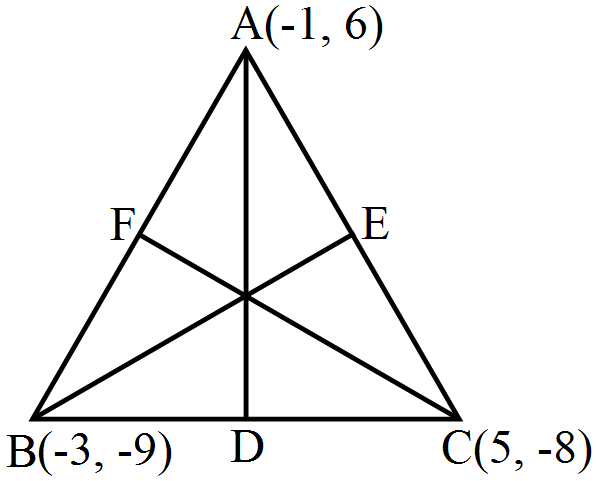
$\text{D}\equiv\Big(\frac{-3+5}{2},\frac{-9-8}{2}\Big)=\Big(1,\frac{-17}{2}\Big)$
$\text{E}\equiv \Big(\frac{-1+5}{2},\frac{6-8}{2}\Big)=(2,-1)$
$\text{F}\equiv \Big(\frac{-1-3}{2},\frac{6-9}{2}\Big)=\Big(-2,-\frac{3}{2}\Big)$
Median Ad passes through A(-1,6) and $\text{D}\Big(1,-\frac{17}{2}\Big)$
So, its equation is
$\text{y}-6=\frac{-\frac{17}{2}-6}{1+1}(\text{x}+1)$
$\Rightarrow4\text{y}-24=-29\text{x}-29$
$29\text{x}+4\text{y}+5=0$
Median BE passes through B(-3, -9) and E(2, -1).
So, its equation is
$\text{y}+9=\frac{-1+9}{2+3}(\text{x}+3)$
$\Rightarrow5\text{y}+45=8\text{x}+24$
$8\text{x}-5\text{y}-21=0$
Median CF passes through C(5, -8) and $\text{F}\Big(-2,\ -\frac{3}{2}\Big).$
So, its equation is
$\text{y}+8=\frac{-\frac{3}{2}+8}{-2-5}(\text{x}-5)$
$\Rightarrow-14\text{y}-112=3\text{x}-65$
$\Rightarrow13\text{x}+14\text{y}+47=0$ View full question & answer→Question 904 Marks
Reduce the equation 3x - 2y + 6 = 0 to the intercept form and find the x and y intercepts.
Answer$\frac{\text{x}}{\text{a}}+\frac{\text{y}}{\text{b}}=1$ 3x - 2y + 6 = 0 3x - 2y = -6 $\frac{-3\text{x}}{-6}-\frac{2\text{y}}{-6}=1$ $\frac{\text{x}}{\frac{-6}{3}}+\frac{\text{y}}{\frac{-6}{-2}}=1$ $\frac{\text{x}}{-2}+\frac{\text{y}}{3}=1$ ⇒ x-intercept = a = -2 y-intercept = b = 3
View full question & answer→Question 914 Marks
Find the equation of the line passing through the point of intersection of the lines 4x - 7y - 3 = 0 and 2x - 3y + 1 = 0 that has equal intercepts on the axes.
AnswerGiven lines are, 4x - 7y = 3 2x - 3y = -1 Solving these two, we get the point of intersection, x = -8, y = -5 Point of intersection of given lines is (-8, -5) equation of line makeing equal intercepts (a) on the coordinate axes is, $\frac{\text{x}}{\text{a}}+\frac{\text{y}}{\text{a}}=1$ x + y = a -8 - 5 = a a = -13 So, Equation of required line is x + y = -13
View full question & answer→Question 924 Marks
Find the equation of the straight line passing through the point of intersection of $2x + y - 1 = 0$ and $x + 3y - 2 = 0$ and making with the coordinate axes a triangle of area $\frac{3}{8}$ sq.units.
Answer$\text{L}_1+\lambda\text{L}_2=0$ is the equation of line passing through two lines $L_1$ and $L_2$.
$\therefore(2\text{x}+\text{y}-1)+\lambda(\text{x}+3\text{y}-2)=0$ is the required equation ...(i) or, $\text{x}(2+\lambda)+\text{y}(1+3\lambda)-1-2\lambda=0$
$\frac{\text{x}}{\frac{1+2\lambda}{2+\lambda}}+\frac{4}{\frac{1+2\lambda}{1+3\lambda}}=1$
$\text{Area of} \ \triangle=\frac{1}{2}\times\text{OB}\times\text{OA}$
$\frac{8}{3}=\frac{1}{2} \times$ (y intercept) $\times$ (x intercept) $\frac{8}{3}=\frac{1}{2}\times\Big(\frac{1+2\lambda}{1+3\lambda}\Big)\times\Big(\frac{1+2\lambda}{2+\lambda}\Big)$
$\frac{16}{3}=\frac{1+4\lambda^2+4\lambda}{2+3\lambda^2+7\lambda}$
$32+48\lambda^2+112\lambda=-3-12\lambda^2-12\lambda$
$60\lambda^2+124\lambda+35=0$
$\lambda=\frac{-124\pm\sqrt{(124)^2-4\times60\times35}}{2\times60}$ Approximately = 1
$\therefore$ Subtituting in (i) \Rightarrow 3x + 4y - 3 = 0, 12x + y - 3 = 0
View full question & answer→Question 934 Marks
Find the equation of the right bisector of the line segment joining the points (3, 4) and (-1, 2).
AnswerThe slope of line joining (3, 4) and (-1, 2) is $\frac{2-4}{-1-3}=\frac{-2}{-4}=\frac{1}{2}$ The required line is $\perp$ to the given line $\therefore$ (Slope of required line) $\times\frac{1}{2}=-1 \big[\because\text{m}_1\times\text{m}_2$ for perpendicular lines$\big]$ $\text{m}_1=-2$ And the line passes through the mid point of line joining (3, 4) and (1, 2) i.e; $\Big(\frac{3-1}{2},\frac{4+2}{2}\Big)$ or $(1,3)$ $\therefore$ equation of the required line is y - 3 = (-2)(x - 1) or y - 3 = -2x + 2 or 2x + y - 5 = 0
View full question & answer→Question 944 Marks
Find the equation of the side BC of the triangle ABC whose vertices are (-1, -2), (0, 1) and (2, 0) respectively. Also, find the equation of the median through (-1, -2).
AnswerEquation of BC$\text{y}-\text{y}_1=\frac{\text{y}_2-\text{y}_1}{\text{x}_2-\text{x}_1}(\text{x}-\text{x}_1)$
$\text{y}-1=\frac{0-1}{2-0}(\text{x}-0)$ $\Big[$$\because$ B(0, 1), C(2, 0)$\Big]$
$2\text{y}-2=-\text{x}$
$\text{x}+\text{2y}=2$
D is midpoint of BC
So,
$\text{D}=\Big(\frac{\text{x}_1+\text{x}_2}{2},\frac{\text{y}_1+\text{y}_2}{2}\Big)=\Big(\frac{0+2}{2},\frac{1+0}{2}\Big)=\Big(1,\frac{1}{2}\Big)$
$\therefore$ Equation of the median AD:
$\text{y}-\text{y}_1=\frac{\text{y}_2-\text{y}_1}{\text{x}_2-\text{x}_1}(\text{x}-\text{x}_1)$
$\text{y}-(-2)=\frac{\frac{1}{2}-(-2)}{1-(-1)}(\text{x}-(-1))=\frac{\frac{5}{2}}{2}(\text{x}+1)\ \Big[\because\text{A}(-1, -2),\text{D}\Big(1,\frac{1}{2}\Big)\Big]$
$\text{4y}+8=\text{5x}+5$
$5\text{x}-\text{4y}-3=0$
View full question & answer→Question 954 Marks
If the image of the point (2, 1) with respect to a line mirror is (5, 2), find the equation of the mirror.
AnswerHere, Let l be line mirror and B is image of A Let m be slope of line l So, m(slope of AB) = -1 $\text{m}\Big(\frac{2-1}{5-2}\Big)=-1$ $\text{m}\Big(\frac{1}{3}\Big)=-1$ $\text{m}=-3$ M is mid point of AB $\text{m}\Big(\frac{2+5}{2},\frac{2+1}{2}\Big)$ $\text{m}\Big(\frac{7}{2},\frac{3}{2}\Big)$ Equation line l is, $\text{y}-\text{y}_1=\text{m}(\text{x}-\text{x}_1)$ $\text{y}-\frac{3}{2}=(-3)\Big(\text{x}-\frac{7}{2}\Big)$ $\frac{2\text{y}-3}{2}=-3\text{x}+\frac{21}{2}$ $2\text{y}-3=-6\text{x}+21$ $6\text{x}+2\text{y}=24$ $3\text{x}+\text{y}=12$
View full question & answer→Question 964 Marks
Find the equation of the right bisector of the line segment joining the points $(a, b)$ and $(a_1, b_1)$.
AnswerAny line which is right bisector to another line segment passes through the mid-point of end-points and is perpendicular to it.
$\Rightarrow$ mid point of $(a, b)$ and $(a_1,b_1)$ is $(\text{x}_1,\text{y}_1)=\Big(\frac{\text{a}+\text{a}_1}{2},\frac{\text{b}+\text{b}_1}{2}\Big)$ Slope of line $(\text{m})=\frac{\text{b}_1-\text{b}}{\text{a}_1-\text{a}}$ Slope of required line is $\text{m}'=\frac{\text{a}-\text{a}_1}{\text{b}-\text{b}_1}$ Equation of required line is $\text{y}-\text{y}_1=\text{m}'(\text{x}-\text{x}_1)$
$\text{y}-\Big(\frac{\text{b}+\text{b}_1}{2}\Big)=\frac{\text{a}-\text{a}_1}{\text{b}-\text{b}_1}\Big(\text{x}-\frac{\text{a}+\text{a}_1}{2}\Big)$
$2\text{x}(\text{a}_1-\text{a})+2\text{y}(\text{b}_1-\text{b})+\text{a}_2+\text{b}_2=\text{a}_1^2+\text{b}_1^2$
View full question & answer→Question 974 Marks
Find the equation of the line, which passes through P (1, -7) and meets the axes at Aand B respectively so that 4 AP - 3 BP = 0.
AnswerThe equation of straight line is$\text{y}-\text{y}_1=\text{m}(\text{x}-\text{x}_1) \ ...(\text{i})$
The line passes through (x, y) ie, (1, 7) and meets the axes at A and B
⇒ A point is (a, 0) and B is (0, b)
$\frac{\text{AP}}{\text{BP}}=\frac{3}{4}$
Using section formula $\frac{\text{lx}_2+\text{mx}_1}{\text{l}+\text{m}},\frac{\text{ly}_2+\text{my}_1}{\text{l}+\text{m}}$
$\text{l}:\text{m}=3:4, (\text{a},0)\Leftrightarrow(\text{x}_1,\text{y}_1),(0,\text{b})\Leftrightarrow(\text{x}_2,\text{y}_2)$
$\Rightarrow1=\frac{3(0)+4(\text{a})}{3+4}$
$\Rightarrow1=\frac{4\text{a}}{7}$
$\Rightarrow\text{a}=\frac{4}{7}$
$-7=\frac{3(\text{b})+4(0)}{3+4}$
$\Rightarrow-7=\frac{3b}{7}$
$\Rightarrow\text{b}=\frac{-49}{3}$
then $\text{A}\Big(\frac{7}{4},0\Big),\ \text{B}\Big(0,\frac{-49}{3}\Big)$ Putting in (1)
$\text{y}-\text{y}_1=\frac{\text{y}_2-\text{y}_1}{\text{x}_2-\text{x}_1}(\text{x}-\text{x}_1)$
$\text{y}-0=\frac{\frac{-49}{3}-0}{0-\frac{7}{4}}\Big(\text{x}-\frac{7}{4}\Big)$
$\text{y}-0=\frac{49}{3}\times\frac{4}{7}\Big(\text{x}-\frac{7}{4}\Big)$
$\text{y}=\frac{28}{3}\Big(\text{x}-\frac{7}{4}\Big)$
$\text{3y}-\text{28x}+49=0$
View full question & answer→Question 984 Marks
Find the coordinates of the incentre and centroid of the triangle whose sides have the equations 3x - 4y = 0, 12y + 5x = 0 and y - 15 = 0.
AnswerLet ABC be the triangle whose side BC, CA and AB have the equations y - 15 = 0, BC 3x - 4y = 0, AC 5x + 12y = 0, AB Solving these equation pair wise we can obtain the coordinates of the vertices A, B, C as A(0, 0), B(-36, 15), C(20, 15) respectively Centroid $\Big(\frac{-36+20+0}{3},\frac{15+15+0}{3}\Big)=\Big(\frac{-16}{3},10\Big)$ For incentre, We have $\text{a}=\text{BC}=\sqrt{56^2+0}=56$ $\text{b}=\text{CA}=\sqrt{20^2+15^2}=25$ $\text{c}=\text{AB}=\sqrt{36^2+16^2}=39$ Coordinates of incenter are $\Big(\frac{56\times0+25\times-36+39\times20}{36+25+39},\frac{56\times0+25\times15+39\times15}{36+25+39}\Big)$ $=(-1.8)$
View full question & answer→Question 994 Marks
Find the equation of the line passing through the point (-3, 5) and perpendicular to the line joining (2, 5) and (-3, 6).
AnswerThe line passes through the point (-3, 5)So $(\text{x}_1\text{y}_1)=(3,5)$
The line is perpendicular to the line joining (2, 5) and (-3, 6)
$\Rightarrow\text{m}=\frac{-1}{\text{slope of line joining (2,5) and (-3,6)}}=\frac{-1}{\frac{\text{y}_2-\text{y}_1}{\text{x}_2-\text{x}_1}}=\frac{-1}{\frac{6-5}{-3-2}}\frac{-1}{\frac{-1}{5}}$
$\therefore \text{m}=5$
Hence the equation of straight line is
$\text{y}-\text{y}_1=\text{m}(\text{x}-\text{x}_1)$
$\text{y}-5=5\big(\text{x}(-3)\big)$
$\text{y}-5=\text{5x}+15$
$\text{5x}-\text{y}+20=0$
View full question & answer→Question 1004 Marks
Find the equation of the straight line which divides the join of the points (2, 3) and (−5, 8) in the ratio 3 : 4 and is also perpendicular to it.
AnswerThe coordinates of the point which divides the join of the points (2, 3) and (-5, 8) in the ratio 3 : 4 is given by (x, y) where,$\text{x}=\frac{\text{lx}_2+\text{mx}_1}{\text{l}+\text{m}}=\frac{3(-5)+4(2)}{3+4}=\frac{-15+6}{7}=\frac{-9}{7}$
$\text{y}=\frac{\text{ly}_2+\text{my}_1}{\text{l}+\text{m}}=\frac{3(8)+4(3)}{3+4}=\frac{24+12}{7}=\frac{36}{7}$
Slope of the line joining the points (2, 3) and (5, 8) $=\frac{8-3}{-5-2}=\frac{5}{-7}=\frac{-5}{7}$
$\therefore$ Slope of line perpendicular to line $=\text{m}=\frac{7}{5}$
The required equation is:
$\text{y} - \text{y}_1 = \text{m}(\text{x} - \text{x}_1)$
$\text{y}-\frac{36}{7}=\frac{7}{5}\Big(\text{x}-\Big(\frac{-9}{7}\Big)\Big)$
$49\text{x}-35\text{y}+229=0$
View full question & answer→Question 1014 Marks
Find the angles between the following pairs of straight lines: 3x - y + 5 = 0 and x - 3y + 1 = 0
AnswerFinding slopes of the lines by converting the equation in the form$\text{y}=\text{mx}+\text{c}$
$3\text{x}-\text{y}+5=0$
$\Rightarrow\text{y}=3\text{x}+5$
$\Rightarrow\text{m}_1=3$
Also
$\text{x}-3\text{y}+1=0$
$3\text{y}=\text{x}+1$
$\text{y}=\frac{\text{x}}{3}+\frac{1}{3}$
$\Rightarrow\text{m}_2=\frac{1}{3}$
Thus angle between the lines is
$\tan\theta=\Big|\frac{\text{m}_1-\text{m}_2}{1+\text{m}_1\text{m}_2}\Big|$
$=\Bigg|\frac{3-\frac{1}{3}}{1+3\times\frac{1}{3}}\Bigg|=\Bigg|\frac{\frac{9-1}{3}}{1+1}\Bigg|$
$=\Bigg|\frac{\frac{8}{3}}{2}\Bigg|=\Big|\frac{8}{6}\Big|=\frac{4}{3}$
$\Rightarrow\theta=\tan^{-1}\Big(\frac{4}{3}\Big)$
View full question & answer→Question 1024 Marks
Find the equation of the straight lines passing through the following pair of points: $(\text{a}\cos\alpha, \ \text{a} \ \sin\alpha)$ and $(\text{a}\cos\beta, \ \text{a} \ \sin\beta)$
AnswerLet $\text{A}(\text{x}_1\text{y}_1)$ be $(\text{a}\cos\alpha,\text{a}\sin\alpha)$$\text{B}(\text{x}_2\text{y}_2)$ be $(\text{a}\cos\beta,\text{a}\sin\beta)$
$\Rightarrow\text{y}-\text{y}_1=\frac{\text{y}_2-\text{y}_1}{\text{x}_2-\text{x}_1}(\text{x}-\text{x}_1)$
$\Rightarrow\text{y}-\text{a}\sin\alpha=\frac{\text{a}\sin\beta-\text{a}\sin\alpha}{\text{a}\cos\beta-\text{A}\cos\alpha}(\text{x}-\text{a}\cos\alpha)$
$\Rightarrow\text{y}-\text{a}\sin\alpha=\frac{a\Big(-2\sin\big(\frac{\beta-\alpha}{2}\big)\Big)\cos\beta\Big(\frac{\beta+\alpha}{2}\Big)}{\text{a}\Big(-2\sin\frac{\beta-\alpha}{2}\Big)\sin\Big(\frac{\beta+\alpha}{2}\Big)}(\text{x}-\text{a}\cos\alpha)$
$\Rightarrow \text{y}-\text{a}\sin\alpha=\frac{\cos\Big(\frac{\alpha+\beta}{2}\Big)}{\sin\Big(\frac{\alpha+\beta}{2}\Big)}(\text{x}-\text{a}\cos\alpha)$
$\Rightarrow \text{x}\cos\Big(\frac{\alpha+\beta}{2}\Big)+\text{y}\sin\frac{\alpha+\beta}{2}=\text{a}\cos\frac{\alpha-\beta}{2}$
$\therefore$ The equation of line joining the points $(\text{a}\cos\alpha,\text{a}\sin\alpha)$and $(\text{a}\cos\beta,\text{a}\sin\beta)$ is $\text{x}\cos\Big(\frac{\alpha+\beta}{2}\Big)+\text{y}\sin\frac{\alpha+\beta}{2}=\text{a}\cos\frac{\alpha-\beta}{2}$
View full question & answer→Question 1034 Marks
Find the length of the perpendicular from the point (4, -7) to the line joining the origin and the point of intersection of the lines 2x - 3y + 14 = 0 and 5x + 4y - 7 = 0.
Answer
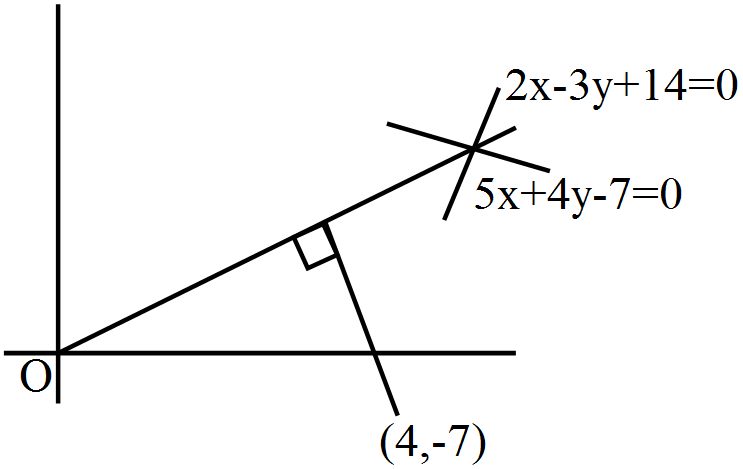 The point of intersection of the lines 2x - 3y + 14 = 0 and 5x + 4y - 7 = 0 can be found out by solving these equations.
Solving these equations we get, $\text{x}=-\frac{35}{23}$ and $\text{y}=\frac{252}{69}$
Equation of line joining origin and the point $\Big(-\frac{35}{23},\frac{252}{69}\Big)$ is y = mx, where $\text{m}=\frac{\frac{252}{69}}{-\frac{35}{23}}=-\frac{12}{5}$
Therefore the equation of required line is $\text{y}=-\frac{12\text{x}}{5}$
$12\text{x}+5\text{y}=0$
Perpendicular distance from (4, -7) to 12x + 5y = 0 is
$\text{p}=\Bigg|\frac{12(4)+5(-7)}{\sqrt{12^2+(-5)^2}}\Bigg|=\frac{13}{13}=1$ View full question & answer→Question 1044 Marks
Show that the origin is equidistant from the lines $4x + 3y + 10 = 0; 5x - 12y + 26 = 0$ and $7x + 24y = 50$.
AnswerReduce 4x + 3y + 10 = 0 to perpendicular form 4x + 3y = -10 -4x - 3y = 10 Dividing each term by $\sqrt{(-4)^2+(-3)^2}=\sqrt{16+9}=\sqrt{25}=5$ $\frac{-4}{5}\text{x}-\frac{3}{5}\text{y}=\frac{10}{5}=2$
⇒ $p_1 = 2 ...(1) 5x - 12y + 26 = 0 5x - 12y = -26$ Dividing each term by $\sqrt{(-5)^2+(12)^2}=\sqrt{25+144}=\sqrt{169}=13$ $\frac{-5}{13}\text{x}+\frac{12}{13}\text{y}=\frac{26}{13}=2$
⇒ $p_1 = 2 ...(2) 7x + 24y = 50$ Dividing each term by $\sqrt{(7)^2+(24)^2}=\sqrt{49+576}=\sqrt{625}=25$
$\frac{7}{25}\text{x}+\frac{24}{25}\text{y}=\frac{50}{25}=2$
$\Rightarrow p_1 = 2 ...(3)$
Hence, origin is equidistant from all three lines.
View full question & answer→Question 1054 Marks
Find the equation of the straight lines passing through the following pair of points: $\Big(\text{at}_1,\frac{\text{a}}{\text{t}_1}\Big)$ and $\Big(\text{at}_2,\frac{\text{a}}{\text{t}_2}\Big)$
AnswerLet $\text{A}(\text{x}_1\text{y}_1)$ be $\Big(\text{at}_1,\frac{\text{a}}{\text{t}_1}\Big)$$\text{B}(\text{x}_2\text{y}_2)$ be $\Big(\text{at}_2,\frac{\text{a}}{\text{t}_2}\Big)$
Then equation of line AB is
$\Rightarrow\text{y}-\text{y}_1=\frac{\text{y}_2-\text{y}_1}{\text{x}_2-\text{x}_1}(\text{x}-\text{x}_1)$
$\Rightarrow\text{y}-\frac{\text{a}}{\text{t}_1}=\frac{\frac{\text{a}}{\text{t}_2}-\frac{\text{a}}{\text{t}_1}}{\text{at}_2-\text{at}_1}(\text{x}-\text{at}_1)$
$\Rightarrow \text{y}-\frac{\text{a}}{\text{t}_1}=\frac{a(\text{t}_1-\text{t}_2)}{\text{at}_1\text{t}_2(\text{t}_2-\text{t}_1)}(\text{x}-\text{at}_1)$
$\Rightarrow\text{y}-\frac{\text{a}}{\text{t}_1}=\frac{-1}{\text{t}_1\text{t}_2}(\text{x}-\text{at}_1)$
$\Rightarrow\text{t}_1\text{t}_2\text{y}+\text{x}=\text{a}(\text{t}_1+\text{t}_2)$
$\therefore$ The equation of the line joining the points $\Big(\text{at}_1,\frac{\text{a}}{\text{t}_1}\Big)$ and $\Big(\text{at}_2,\frac{\text{a}}{\text{t}_2}\Big)$ is $\text{t}_1\text{t}_2\text{y}+\text{x}=\text{a}(\text{t}_1+\text{t}_2)$
View full question & answer→Question 1064 Marks
In the triangle ABC with vertices A (2, 3), B (4, -1) and C (1, 2), find the equation and the length of the altitude from the vertex A.
AnswerThe equation of BC is $\text{y}+1=\frac{2+1}{1-4}(\text{x}-4)$ $\text{y}+1=-\text{x}+4$ $\text{x}+\text{y}-3=0$ $\text{AL}=\big|\frac{2+3-3}{\sqrt{1+1}}\big|$ $=\sqrt{2}$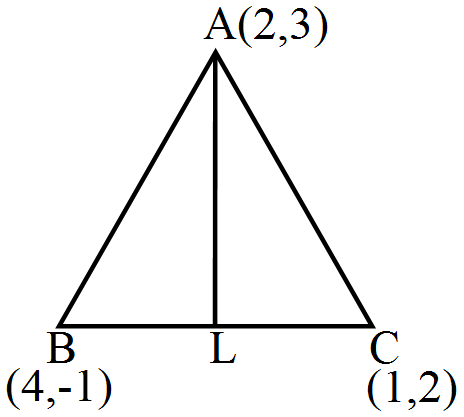
Clearly, slope of BC having equation x + y - 3 = 0 is -1. So, slope of AL is 1. As it passes through A(2, 3) so, its equation is y - 3 = 1(x - 2) or x - y + 1 = 0 View full question & answer→Question 1074 Marks
Find the angles between the following pairs of straight lines:x - 4y = 3 and 6x - y = 11
AnswerTo find angle convert the equation in the form$\text{y}=\text{mx}+\text{c}$
$\text{x}-4\text{y}=3$
$\Rightarrow4\text{y}=\text{x}-3$
$\text{y}=\frac{\text{x}}{4}-\frac{3}{4}$
$\Rightarrow\text{m}_1=\frac{1}{4}$
Also, $6\text{x}-\text{y}=11$
$\text{y}=6\text{x}-11$
$\Rightarrow\text{m}_2=6$
Thus, angle between the lines is
$\tan\theta=\Big|\frac{\text{m}_1-\text{m}_2}{1+\text{m}_1\text{m}_2}\Big|$
$=\Bigg|\frac{\frac{1}{4}-6}{1+\frac{1}{4}\times6}\Bigg|$
$=\Bigg|\frac{\frac{-23}{4}}{1+\frac{3}{2}}\Bigg|=\Bigg|\frac{\frac{-23}{4}}{\frac{5}{2}}\Bigg|$
$\Rightarrow\theta=\tan^{-1}\Big(\frac{23}{10}\Big)$
View full question & answer→Question 1084 Marks
Find the distance of the line 2x + y = 3 from the point (-1, -3) in the direction of the line whose slope is 1.
AnswerThe slope of the line = 1$\tan\theta=1 $
or $\theta =\frac{\pi}{4}$
$\therefore$ Equation of line is
$\frac{\text{x}+1}{\cos\frac{\pi}{4}}=\frac{\text{y}+3}{\sin\frac{\pi}{4}}=\text{r}$
or
$\text{x}=\frac{\text{r}}{\sqrt2}-1$ and $\text{y}=\frac{\text{r}}{\sqrt2}-3$
$\text{p}\Big(\frac{\text{r}}{\sqrt2}-1,\ \frac{\text{r}}{\sqrt2}-3\Big)$ lie in $2\text{x}+\text{y}=3$
$\therefore2\Big(\frac{\text{r}}{\sqrt2}-1\Big)+\Big(\frac{\text{r}}{\sqrt2}-3\Big)=3$
$\Rightarrow\frac{\text{3r}}{\sqrt2}=8$
$\text{r}=\frac{8\sqrt2}{3}$
The equation of 2x + y = 3 from (-1, -3) is $\frac{8\sqrt2}{3}$ units.
View full question & answer→Question 1094 Marks
The equation of one side of an equilateral triangle is $x - y = 0$ and one vertex is $(2+\sqrt3,5).$ Prove that a second side is $\text{y}+(2-\sqrt{3})\text{x}=6$ and find the equation of the third side.f
AnswerLet $\text{C}(2+\sqrt3,5)$ be vertex and x = y be the opposite side of equilateral triangle ABC. The other two sides makes an angle of 60^\circ with other two sides. slope of x - y = 0 is 1 .
$\therefore\text{y}-5=\frac{1\pm\tan60^\circ}{1\mp\tan60^\circ}(\text{x}-2-\sqrt3)$
$\text{y}-5=\frac{1+\sqrt{3}}{1-\sqrt{3}}(\text{x}-2-\sqrt{3})$ and $\text{y}-5=\frac{1-\sqrt{3}}{1+\sqrt{3}}(\text{x}-2-\sqrt{3})$
$\text{y}-5=(\sqrt{3}-2)(\text{x}-2-\sqrt{3})$ and $\text{y}-5=(\sqrt{3}-2)(\text{x}-2-\sqrt{3})$
$\text{y}+(2+\sqrt{3})\text{x}=12+4\sqrt3$ and $\text{y}+(2-\sqrt{3})\text{x}=6$ Hence proved the $2^{nd}$^ side of $\Delta\text{ABC}$ is $\text{y}+(2-\sqrt3)\text{x}=6$ and the $3^{rd}$^ side is $\text{y}+(2+\sqrt{3})\text{x}=12+4\sqrt3.$
View full question & answer→Question 1104 Marks
Find the equation of the line joining the point (3, 5) to the point of intersection of the lines 4x + y - 1 = 0 and 7x - 3y - 35 = 0.
AnswerThe point of intersection of the lines 4x + y - 1 = 0 and 7x - 3y - 35 = 0 is y = 1 - 4x 7x - 3(1 - 4x) - 35 = 0 7x - 3 + 12x - 35 = 0 19x = 38 x = 2 ⇒ y = 1 - 4x = 1 - 8 = -7 $\therefore$ Let P(2, -7) and Q(3, 5) The equation of line PQ is $\text{y} - \text{y}_1 = \text{m}(\text{x} - \text{x}_1)$ $\text{y-y}_1=\frac{\text{y}_2-\text{y}_1}{\text{x}_2-\text{x}_1}(\text{x-x}_1)$ $\text{y}-(-7)=\frac{5-(-7)}{3-2}(\text{x}-2)$ $\text{y} + 7 = 12(\text{x} - 2)$ $\text{y} - 12\text{x} = -31$ $12\text{x} - \text{y} - 31 = 0$
View full question & answer→Question 1114 Marks
Find the equation to the straight line parallel to 3x - 4y + 6 = 0 and passing through the middle point of the join of points (2, 3) and (4, -1).
AnswerThe slope of the given line is equal to the slope of line 3x -4y + 6 = 0 as the two lines are parallel to each other $\therefore \ \text{m}_1=\text{m}_2=\frac{3}{4}$ And the line passes through mid point of points (2, 3) and (4, -1) i.e; $\Big(\frac{2+4}{2},\frac{3-1}{2}\Big)$ [using mid point formula] $\Rightarrow(3,1)$ $\therefore$ Using one point-slope equation of line $(\text{y}-1)=\frac{3}{4}(\text{x}-3)$ $4\text{y}-4=3\text{x}-9$ $3\text{x}-4\text{y}=5$ Is the required line.
View full question & answer→Question 1124 Marks
Find the angles between the following pairs of straight lines: $\left(m^2-m n\right) y=\left(m n+n^2\right) x+n^3$ and $\left(m n+m^2\right) y=(m n-$ $\left.\mathrm{n}^2\right) \mathrm{x}+\mathrm{m}^3$.
AnswerConverting the equation in the form $\text{y}=\text{mx}+\text{c}$ $\text{y}=\frac{(\text{mn}+\text{n}^2)}{\text{m}^2-\text{mn}}\text{x}+\frac{\text{n}^3}{(\text{m}^2-\text{mn})}$ $\Rightarrow\text{m}_1=\frac{\text{mn}+\text{n}^2}{\text{m}^2-\text{mn}}$ Also, $\text{y}=\frac{(\text{mn}-\text{n}^2)}{\text{mn}+\text{m}^2}\text{x}+\frac{\text{m}^3}{\text{mn}+\text{m}^2}$ $\Rightarrow\text{m}_2=\frac{\text{mn}-\text{n}^2}{\text{mn}+\text{m}^2}$ Thus, angle between 2 lines is $\tan\theta$ $\tan\theta=\Big|\frac{\text{m}_1-\text{m}_2}{1+\text{m}_1\text{m}_2}\Big|$ $=\begin{vmatrix}\frac{\Big(\frac{\text{mn}+\text{n}^2}{\text{m}^2-\text{mn}}\Big)-\Big(\frac{\text{mn}-\text{n}^2}{\text{mn}+\text{m}^2}\Big)}{1+\Big(\frac{\text{mn}+\text{n}^2}{\text{m}^2-\text{mn}}\Big)\Big(\frac{\text{mn}-\text{n}^2}{\text{mn}+\text{m}^2}\Big)}\end{vmatrix}$ $=\Bigg|\frac{\text{m}^2\text{n}^2+\text{m}^3\text{n}+\text{n}^3\text{m}+\text{n}^2\text{m}^2-\text{m}^3\text{n}+\text{m}^2\text{n}^2+\text{n}^2\text{m}^2-\text{m}\text{n}^3}{\text{m}^3\text{n}+\text{m}^4-\text{m}^2\text{n}^2-\text{m}^3\text{n}+\text{m}^2\text{n}^2-\text{m}\text{n}^3+\text{m}\text{n}^3-\text{n}^4}\Bigg|$ $=\Bigg|\frac{4\text{m}^2\text{n}^2}{\text{m}^4-\text{n}^4}\Bigg|$ $\Rightarrow\theta=\tan^{-1}\Big|\frac{4\text{m}^2\text{n}^2}{\text{m}^4-\text{n}^4}\Big|$
View full question & answer→Question 1134 Marks
Find the equation of the bisector of angle A of the triangle whose vertices are A (4, 3), B(0, 0) and C (2, 3).
AnswerLet AD be the bisector of $\angle\text{A}$Then, BD : DC=AB : AC
Now,
$|\text{AB}|=\sqrt{(4-0)^2+(3-0)^2}=5$
$|\text{AC|}=\sqrt{(4-2)^2+(3-3)^2}=2$
$\Rightarrow\frac{\text{AB}}{\text{AC}{}}=\frac{\text{BD}}{\text{DC}}=\frac{5}{2}$
⇒ D divides BC in the ratio 5 : 2
So the coordinates of D are $\Big(\frac{5\times2+0}{5+2},\frac{5\times3+0}{5+2}\Big)=\Big(\frac{10}{7},\frac{15}{7}\Big)$
$\therefore$ The equation of AD is
$\text{y}-3=\Bigg(\frac{\frac{15}{7}-3}{\frac{10}{7}-4}\Bigg)(\text{x}-4)$
$\text{y}-3=\Big(\frac{15-21}{10-28}\Big)(\text{x}-4)$
$\Rightarrow\text{y}-3=\frac{1}{3}(\text{x}-4)$
$\Rightarrow3(\text{y}-3)=\text{x}-4$
$\Rightarrow\text{x}-\text{3y}+9-4=0$
$\Rightarrow\text{x}-\text{3y}+5=0$
View full question & answer→Question 1144 Marks
The line through (h, 3) and (4, 1) intersects the line 7x - 9y - 19 = 0 at right angle. Find the value of h.
AnswerIf two lines intersect at right angles, then product of their slope is -1. Slope of 7x - 9y -19 = 0 is $\text{m}_1=\frac{7}{9} \ ...(1)$ Slope of line joining (h, 3) and $(4,1)=\frac{1-3}{4-\text{h}}$ or, $\text{m}_2=\frac{2}{\text{h}-4} \ ...(2)$ $\text{m}_1\times\text{m}_2=-1$ $\frac{7}{9}\times\frac{2}{\text{h}-4}=-1$ $14=-9\text{h}+36$ $9\text{h}=36-14$ $\text{h}=\frac{22}{9}$
View full question & answer→Question 1154 Marks
Find the equation of a straight line through the point of intersection of the lines 4x - 3y = 0 and 2x - 5y + 3 = 0 and parallel to 4x + 5y + 6 = 0.
AnswerLine through the intersection of 4x - 3y = 0 and 2x - 5y + 3 = 0 is $(4\text{x}-3\text{y})+\lambda(2\text{x}-5\text{y}+3)=0 \ ...(\text{i})$ or $\text{x}(4+2\lambda)-\text{y}(3+5\lambda)+3\lambda=0$ And thr required line is parallel to 4x+ 5y + 6 $\therefore$ slope of required = slope of $4\text{x}+5\text{y}+6=\frac{-4}{3}$ $\therefore\frac{-(4+2\lambda)}{-(3+5\lambda)}=\frac{-4}{3}$ $\Rightarrow5(4+2\lambda)=-4(3+5\lambda)$ $\Rightarrow20+10\lambda=-12-20\lambda$ $\Rightarrow30\lambda=-32$ $\Rightarrow\lambda=\frac{-16}{15}$ putting $\lambda$ in equation (i) $(4\text{x}-3\text{y})-\frac{16}{15}(2\text{x}-5\text{y}+3)=0$ $\Rightarrow60\text{x}-45\text{y}-32\text{x}+80\text{y}-48=0$ $\Rightarrow28\text{x}+35\text{y}-48=0$ Is thr required line.
View full question & answer→Question 1164 Marks
Find the equations to the diagonals of the rectangle the equations of whose sides are x = a, x = a', y = b and y = b'.
AnswerThe rectangle ABCD will have diagonals AC and BDAC passes through A(a, b) and C(a', b').
Thus the equation of AC is:
$\frac{\text{y}-\text{y}_1}{\text{y}_2-\text{y}_1}=\frac{\text{x}-\text{x}_1}{\text{x}_2-\text{x}_1}$
$\Rightarrow\frac{\text{y}-\text{b}}{\text{b}'-\text{b}}=\frac{\text{x}-\text{a}}{\text{a}'-\text{a}}$
$\Rightarrow(\text{y}-\text{b})(\text{a}'-\text{a})=(\text{x}-\text{a})(\text{b}'-\text{b})$
$\Rightarrow\text{y}(\text{a}'-\text{a})-\text{a}'\text{b}+\text{ab}=\text{x}(\text{b}'-\text{b})-\text{ab}'+\text{ab}$
$\Rightarrow\text{y}(\text{a}'-\text{a})=\text{x}(\text{b}'-\text{b})-\text{ab}'+\text{a}'\text{b}$
$\Rightarrow\text{y}(\text{a}'-\text{a})-\text{x}(\text{b}'-\text{b})=\text{a}'\text{b}-\text{a}\text{b}'$
BD passes through B(a',b)and D(a,b').
Thus the equation of BD is:
$\frac{\text{y}-\text{y}_1}{\text{y}_2-\text{y}_1}=\frac{\text{x}-\text{x}_1}{\text{x}_2-\text{x}_1}$
$\Rightarrow\frac{\text{y}-\text{b}}{\text{b}'-\text{b}}=\frac{\text{x}-\text{a}'}{\text{a}-\text{a}'}$
$\Rightarrow(\text{y}-\text{b})(\text{a}-\text{a}')=(\text{x}-\text{a}')(\text{b}'-\text{b})$
$\Rightarrow-\text{y}(\text{a}'-\text{a})-\text{ab}+\text{a}'\text{b}=\text{x}(\text{b}'-\text{b})-\text{a}'\text{b}'+\text{a}'\text{b}$
$\Rightarrow\text{a}'\text{b}'-\text{ab}=\text{x}(\text{b}'-\text{b})+\text{y}(\text{a}'-\text{a})$
$\Rightarrow\text{x}(\text{b}'-\text{b})+\text{y}(\text{a}'-\text{a})=\text{a}'\text{b}'-\text{ab}$
View full question & answer→Question 1174 Marks
Find the lines through the point $(0, 2)$ making angles $\frac{\pi}{3}$ and $\frac{2\pi}{3}$ with the x-axis. Also, find the lines parallel to them cutting the y-axis at a distance of $2$ units below the origin.
AnswerEquation of the line passing through $(x_1, y_1)$ and making angle $\theta$ with the x-axis is, $(\text{y}-\text{y}_1)=\tan\theta(\text{x}-\text{x}_1)$ For the first line: $(\text{x}_1, \text{y}_1)=(0, 2),\theta=\frac{\pi}{3}$
$(\text{y}-\text{y}_1)=\tan\theta(\text{x}-\text{x}_1)$
$(\text{y}-2)=\Big(\tan\frac{\pi}{3}\Big)(\text{x}-0)$
$\text{y}-2=\sqrt{3}\text{x}$
$\sqrt{3}\text{x}-\text{y}+2=0$ For the second line: $(\text{x}_1, \text{y}_1)=(0, 2),\theta=\frac{2\pi}{3}$
$(\text{y}-\text{y}_1)=\tan\theta(\text{x}-\text{x}_1)$
$(\text{y}-2)=\Big(\tan\frac{2\pi}{3}\Big)(\text{x}-0)$
$\text{y}-2=-\sqrt{3}\text{x}$
$\sqrt{3}\text{x}+\text{y}-2=0$ The line parallel to $\sqrt{3}\text{x}-\text{y}+2=0$ and cutting y-axis at a distance of 2 units below the origin. $\text{y}=\sqrt{3}\text{x}-2$
$\sqrt{3}\text{x}+\text{y}-2=0$ The line parallel to $\sqrt{3}\text{x}+\text{y}-2=0$ and cutting y-axis at a distance of 2 units below the origin. $\text{y}=-\sqrt{3}\text{x}-2$
$\sqrt{3}\text{x}+\text{y}+2=0$
View full question & answer→Question 1184 Marks
Find the acute angle between the lines 2x - y + 3 = 0 and x + y + 2 = 0.
AnswerSlpoe of line 2x - y + 3 = 0 is $\frac{-2}{-1}=\frac{-(\text{coefficient of x})}{(\text{coefficient of y})}=2$ $\therefore\text{m}_1=2 \ ...(\text{i})$ Slpoe of line x + y + 2 = 0 is $\frac{-1}{1}=\frac{-(\text{coefficient of x})}{(\text{coefficient of y})}$ $\therefore\text{m}_2=-1 \ ...(\text{ii})$ Acute angle between lines $\theta=\tan^{-1}=\Big|\frac{\text{m}_1-\text{m}_2}{1+\text{m}_1\text{m}_2}\Big|$ $=\tan^{-1}=\Big|\frac{2-(-1)}{1-(2)(-1)}\Big|$ $=\tan^{-1}=\Big|\frac{3}{1-2}\Big|=\tan^{-1}=\Big|\frac{3}{1}\Big|=\tan^{-1}|3|$
View full question & answer→Question 1194 Marks
Reduce the lines 3x - 4y - 4 = 0 and 2x + 4y - 5 = 0 to the normal form and hence find which line is nearer to the origin.
AnswerThe normal form is obtained each term of the equation by $\sqrt{\text{a}^2+\text{b}^2},$ a = coefficient of x b = coefficient of y 3x - 4y + 4 = 0 ...(1) 3x - 4y = - 4 Dividing each term by $\sqrt{(-3)^2+(4)^2}=\sqrt{9+16}=\sqrt{25}=5$ $\frac{-3}{5}\text{x}+\frac{\text{y}}{5}\text{y}=\frac{4}{5}$ $\Rightarrow\text{p}=\frac{4}{5}$ for equation (1) Also 2x + 4y - 5 = 0 ...(2) 2x + 4y = 5 Dividing each term by $\sqrt{(2)^2+(4)^2}=\sqrt{4+16}=\sqrt{20}$ $\frac{2\text{x}}{\sqrt{20}}+\frac{4\text{y}}{\sqrt{20}}=\frac{5}{\sqrt{20}}$ $\text{p}=\frac{5}{\sqrt{20}}=\frac{5}{4.4}$ for equation (2) Comparing p of (1) and (2) we conclude that 3x - 4y + 4 = 0 is nearest to origin.
View full question & answer→Question 1204 Marks
Find the angle between the lines x = a and by + c = 0.
Answer$\text{x}=\text{a}$ $\Rightarrow\text{m}_1=\frac{1}{0}$ $\text{by}+\text{c}=0$ $\text{y}=\frac{-\text{c}}{\text{b}}$ $\text{m}_2=0$ Comparing with y = mx + c Then, putting in $\tan\theta=\Big|\frac{\text{m}_1-\text{m}_2}{1+\text{m}_1\text{m}_2}\Big|$ $=\Bigg|\frac{\frac{1}{0}-0}{1+\frac{1}{0}\times0}\Bigg|$ $=\frac{1}{0}=\infty$ $\Rightarrow\theta=90^\circ$
View full question & answer→Question 1214 Marks
Find the equations to the straight lines passing through the point (2, 3) and inclined at and angle of 45° to the line 3x + y - 5 = 0.
AnswerHere, $\text{x}_1=2,\text{y}_1=3,\alpha=45^\circ$ m = slope of line 3x + y - 5 = 0 $=\frac{-\text{coeff of x}}{\text{coeff of y}}=-3$ The equation of the required line are $\text{y}-\text{y}_1=\frac{-3-\tan45^\circ}{1+(-3)\tan45^\circ}(\text{x}-2)$ $\text{y}-3=\frac{-3-1}{1+(-3)(1)}(\text{x}-2)$ $\text{y}-3=\frac{-4}{2}(\text{x}-2)=2\text{x}-4$ $2\text{x}-\text{y}-1=0$ Also, $\text{y}-3=\frac{-3+\tan45^\circ}{1-(-3)\tan45}(\text{x}-2)$ $\text{y}-3=\frac{-3+1}{1+3}(\text{x}-2)$ $\text{y}-3=\frac{-2}{4}(\text{x}-2)=\frac{-\text{x}}{2}+1$ $\text{x}+2\text{y}-8$
View full question & answer→Question 1224 Marks
Find the distance of the point (2, 5) from the line 3x + y + 4 = 0 measured parallel to the line 3x - 4y + 8 = 0.
AnswerSlope of required line = slope of $3\text{x}-\text{4y}+8=0=\frac{3}{4}=\tan\theta$
$\therefore$ Equation of required line
$\frac{\text{x}-2}{\frac{4}{5}}=\frac{\text{y}-5}{\frac{3}{5}}=\text{r}$
or
$\text{P}\Big(\frac{4}{5}\text{r}+2,\ \frac{3\text{r}}{5}+5\Big)$
and P lies in 3x + y + 4 = 0
$\therefore3\Big(\frac{4\text{r}}{3}+2\Big)+\Big(\frac{3\text{r}}{5}+5\Big)+4=0$
$\Rightarrow12\text{r}+30+3\text{r}+25+20=0$
$\Rightarrow\text{15r}+75=0$
$\Rightarrow\text{r}=5$
View full question & answer→Question 1234 Marks
Show that the point (3, -5) lies between the parallel lines 2x + 3y - 7 = 0 and 2x + 3y + 12 = 0 and find the equation of lines through (3, -5) cutting the above lines at an angle of 45°.
AnswerThe distance fram (3, -5) to the line 2x + 3y - 7 = 0 is $\Big|\frac{\text{ax}_1+\text{by}_1+\text{c}}{\sqrt{\text{a}^2+\text{b}^2}}\Big|$ $=\frac{|2(3)+3(-5)-7|}{\sqrt{(2)^2+(3)^2}}$ $=\frac{|6-15-7|}{\sqrt{13}}$ $=\frac{16}{\sqrt{13}} $ Also, distance of (3, -5) fram the second line 2x + 3y + 12 =0 $\Big|\frac{\text{ax}_1+\text{by}_1+\text{c}}{\sqrt{\text{a}^2+\text{b}^2}}\Big|$ $=\frac{|2(3)+3(-5)+12|}{\sqrt{(2)^2+(3)^2}}$ $=\frac{|6-15+12|}{\sqrt{13}}$ $=\frac{21}{\sqrt{13}} \ ...(\text{i})$ Now, $\text{c}_1-\text{c}_2=12-7=15$ Also difference between (i) and (ii) is 5 $\therefore$ (3, -5) lies between the two lines equation of line through (3, -5) cutting the lines at 45º is $\tan\theta=\frac{\text{m}_1-\text{m}_2}{1+\text{m}_1\text{m}_2}$ $\tan45^\circ=\frac{\text{m}-(\frac{-2}{3})}{1-\frac{2}{3}\text{m}}=\pm1$ $\text{m}+\frac{2}{3}=1-\frac{2}{3}\text{m}$ or, $\text{m}+\frac{2}{3}=-1+\frac{2}{3}\text{m}$ $\text{m}\Big(1+\frac{2}{3}\Big)=1-\frac{2}{3}$ or, $\text{m}\Big(1-\frac{2}{3}\Big)=-1-\frac{2}{3}$ $\text{m}\Big(\frac{5}{3}\Big)=\frac{1}{3}$ or, $\text{m}\Big(\frac{1}{3}\Big)=\frac{-5}{3}$ $\text{m=}\frac{1}{5}$ or, $\text{m}=-5$ $\therefore$ Equation is $\text{y}-\text{y}_1=\text{m}(\text{x}-\text{x}_1)$or, $\text{y}+5=-5(\text{x}-3)$ $\text{y}+5=\frac{1}{5}(\text{x}-3)$ or, $5\text{x}+\text{y}-10=0$ $5\text{y}-\text{x}+28=0$
View full question & answer→Question 1244 Marks
Find the equation of a line which passes through the point (22, -6) and is such that the intercept of x-axis exceeds the intercept of y-axis by 5.
AnswerLet the equation of line be$\frac{\text{x}}{\text{a}}+\frac{\text{y}}{\text{b}}=1$
then a = b + 5
$\therefore\frac{\text{x}}{\text{b+5}}+\frac{\text{y}}{\text{b}}=1$
It passes through (22, -6)
$\Rightarrow\frac{22}{\text{b}+5}-\frac{6}{\text{b}}=1$
$\Rightarrow22\text{b}-\text{6b}-30=\text{b}^2+\text{5b}$
$\Rightarrow\text{b}^2-\text{11b}+30=0$
$\therefore$ a = 10 or 11
$\therefore$ Equation of line are
$\frac{\text{x}}{\text{10}}+\frac{\text{y}}{\text{5}}=1$
or $\text{x}+2\text{y}-10=0$
and
$\frac{\text{x}}{11}+\frac{\text{y}}{6}=1$
$6\text{x}+\text{11y}=66$
View full question & answer→