Question 514 Marks
If the image of the point (2, 1) with respect to the line mirror be (5, 2), find the equation of the mirror.
AnswerLet Q(5, 2) be the mirror image of P(2, -1) with respect to the line mirror AB × (ax + by + c = 0) Then, (Slope of AB) × (Slope of PQ) = -1 $\frac{-\text{a}}{\text{b}}\times\Big(\frac{2-1}{5-2}\Big)=-1$ $\frac{-\text{a}}{\text{b}}\times\frac{1}{3}=-1$ $-\text{a}=-3\text{b}$ $\text{a}=3\text{b} \ ...(1)$ and (R) mid point of PQ should line in AB, as PQ perpendicularlly bisects AB. $\therefore$ Coordinates of R are $\Big(\frac{5+2}{2},\frac{2+1}{2}\Big)=\Big(\frac{7}{2},\frac{3}{2}\Big)$ $\therefore\frac{7}{2}\text{a}+\frac{3}{2}\text{b}+\text{c}=0$ $7\text{a}+3\Big(\frac{\text{a}}{3}\Big)+2\text{c}=0 \ \Big[\because\text{b}=\frac{\text{a}}{3} \ \text{from(1)}\Big]$ $8\text{a}+2\text{c}=0$ or, $-4\text{a}=6 \ ...(2)$ $\therefore$ equation of line is ax + by + c = 0 or, $\text{ax}+\frac{\text{a}}{3}\text{y}-4\text{a}=0$ or, $3\text{x}+\text{y}-12=0$
View full question & answer→Question 524 Marks
If θ is the angle which the straight line joining the points ($x_1, y_1$) and ($x_2, y_2$) subtends at the origin, prove that $\tan\theta=\frac{\text{x}_2\text{y}_1-\text{x}_1\text{y}_2}{\text{x}_1\text{x}_2+\text{y}_1\text{y}_2}$ and $\cos\theta=\frac{\text{x}_1\text{x}_2+\text{y}_1\text{y}_2}{\sqrt{\text{x}_1^2+\text{y}_1^2}\sqrt{\text{x}_2^2+\text{y}_2^2}}$
AnswerLet l_1, be the line joining AO and Let $l_2$_, be the line joining BO Then, line $l_1$_ is $\text{y}-0=\Big(\frac{0-\text{x}_1}{0-\text{y}_1}\Big)(\text{x}-0)$
$\text{y}\text{y}_1=\text{x}_1\text{x}=0$ Then, $\text{m}_1=\frac{\text{x}_1}{\text{y}_1}$ Then line l_2 is $\text{y}-0=\Big(\frac{0-\text{x}_2}{0-\text{y}_2}\Big)(\text{x}-0)$ Then, $\text{m}_2=\frac{\text{x}_2}{\text{y}_2}$ Then, $\Rightarrow\tan\theta=\Big|\frac{\text{m}_1-\text{m}_2}{1+\text{m}_1\text{m}_2}\Big|=\Bigg|\frac{\frac{\text{x}_1}{\text{y}_1}-\frac{\text{x}_2}{\text{y}_2}}{1+\frac{\text{x}_1}{\text{y}_1}\frac{\text{x}_2}{\text{y}_2}}\Bigg|$
$=\Big|\frac{\text{x}_1\text{y}_2-\text{y}_1\text{x}_2}{\text{y}_1\text{y}_2+\text{x}_1\text{x}_2}\Big|$ From triangle, $\text{AC}=\sqrt{(\text{AB})^2+(\text{BC})^2}$
$=\sqrt{(\text{m}_1^2+\text{m}_2^2-2\text{m}_1\text{m}_2)+(1+\text{m}_1\text{m}_2)^2}$
$=\sqrt{\text{m}_1^2+\text{m}_2^2-2\text{m}_1\text{m}_2+1+\text{m}_1^2\text{m}_2^2+2\text{m}_1\text{m}_2}$
$=\sqrt{\text{m}_1^2+\text{m}_2^2+1+\text{m}_1^2\text{m}_2^2}$
$\cos\theta=\frac{\text{BC}}{{\text{AC}}}=\frac{1+\text{m}_1\text{m}_2}{\sqrt{\text{m}_1^2+\text{m}_2^2+\text{m}_1^2\text{m}_2^2+1}}$
$=\frac{1+\frac{\text{x}_1}{\text{y}_1}\frac{\text{x}_2}{\text{y}_2}}{\sqrt{\frac{\text{x}_1^2}{\text{y}_1^2}+\frac{\text{x}_2^2}{\text{y}_2^2}+\frac{\text{x}_1^2\text{x}_2^2}{\text{y}_1^2\text{y}_2^2}}+1}$
$=\frac{\frac{\text{y}_1\text{y}_2+\text{x}_1\text{x}_2}{\text{y}_1\text{y}_2}}{\sqrt{\frac{\text{x}_1^2\text{y}_2^2+\text{x}_2^2\text{y}_1^2+\text{x}_1^2\text{x}_2^2+\text{y}_1^2\text{y}_2^2}{\text{y}_1^2\text{y}_2^2}}}$
$=\frac{\text{y}_1\text{y}_2+\text{x}_1\text{x}_2}{\sqrt{\text{x}_1^2(\text{y}_2^2+\text{x}_2^2)+\text{y}_1^2(\text{y}_2^2+\text{x}_2^2)}}$
$=\frac{\text{y}_1\text{y}_2+\text{x}_1\text{x}_2}{\sqrt{\text{x}_1^2+\text{y}_1^2}\sqrt{\text{y}_2^2+\text{x}_2^2}}$ Hence proved.
View full question & answer→Question 534 Marks
Find the equation of the straight line drawn through the point of intersection of the lines x + y = 4 and 2x - 3y = 1 and perpendicular to the line cutting off intercepts 5, 6 on the axes.
AnswerThe required line is $(\text{x}+\text{y}-4)+\lambda(2\text{x}-3\text{y}-1)=0$ or, $\text{x}(1+2\lambda)+\text{y}(1-3\lambda)-4-\lambda=0$ And it is perpendicular to $\frac{\text{x}}{5}+\frac{\text{y}}{6}=1$ $\therefore(\text{slope of required line})\times\Big(\text{slope of} \ \frac{\text{x}}{5}+\frac{\text{y}}{6}=1\Big)=-1$ $\Rightarrow-\Big(\frac{1+2\lambda}{1-3\lambda}\Big)\times\frac{-6}{5}=-1$ $\Rightarrow\frac{1+2\lambda}{1-3\lambda}=\frac{-5}{6}$ $\Rightarrow6+12\lambda=-5+15\lambda$ $\Rightarrow11=3\lambda$ or $\lambda=\frac{11}{3}$ $\therefore$ The required line is $(\text{x}+\text{y}-4)+\frac{11}{3}(2\text{x}-3\text{y}-1)=0$ $3\text{x}+3\text{y}-12+22\text{x}-33\text{y}-11=0$ $25\text{x}-30\text{y}-23=0$
View full question & answer→Question 544 Marks
Prove that the following sets of three lines are concurrent: $\frac{\text{x}}{\text{a}}+\frac{\text{y}}{\text{b}}=1, \frac{\text{x}}{\text{b}}+\frac{\text{y}}{\text{a}}=1$ and $\text{y}=\text{x}.$
Answer$\frac{\text{x}}{\text{a}}+\frac{\text{y}}{\text{b}}=1, \frac{\text{x}}{\text{b}}+\frac{\text{y}}{\text{a}}=1$ and $\text{y}=\text{x}$ bx + ax = ab, ax + by = ab put y = x bx + ax = ab, ax + bx = ab Hence the lines are concurrent
View full question & answer→Question 554 Marks
Prove that the area of the parallelogram formed by the lines $a_1x + b_1y + c_1 = 0, a_1x + b_1y+ d_1 = 0, a_2x + b_2y + c_2 = 0, a_2x + b_2y + d_2 = 0$ is $\Big|\frac{(\text{d}_1-\text{c}_1)(\text{d}_2-\text{c}_2)}{\text{a}_1\text{b}_2-\text{a}_2\text{b}_1}\Big|$ sq.units. Deduce the condition for these lines to form a rhombus.
AnswerLet ABCD be a parallelogram the equation of whose sides AB, BC, CD and DA are $a_1x + b_1y + c_1 = 0, a_1x + b_1y+ d_1 = 0, a_2x + b_2y + c_2 = 0, a_2x + b_2y + d_2 = 0$. Let $p_1$ and $p_2$ be the distance between the pairs of parallel side of ABCD. $\sin\theta\frac{\text{p}_1}{\text{AD}}=\frac{\text{p}_2}{\text{AB}}$
$\therefore\text{AD}=\frac{\text{p}_1}{\sin\theta}$ and $\text{AB}=\frac{\text{p}_2}{\sin\theta}$ Area of ABCD $=\text{AB}\times\text{p}_1=\frac{\text{p}_1\text{p}_2}{\sin\theta}$ or $\Rightarrow\text{AD}\times\text{p}_2=\frac{\text{p}_1\text{p}_2}{\sin\theta}$ Now, $m_1$ = slope of $\text{AB}=\frac{\text{a}_1}{\text{b}_1}$ $m_2$ = slope of $\text{AD}=\frac{-\text{a}_2}{\text{b}_1}$ Since $\theta$ is angle between AB and AC. $\tan\theta=\frac{\text{m}_1-\text{m}_2}{1+\text{m}_1\text{m}_2}$
$=\frac{\frac{-\text{a}_2}{\text{b}_2}+\frac{\text{a}_1}{\text{b}_1}}{1-\frac{\text{a}_1\text{a}_2}{\text{b}_1\text{b}_2}}$
$\tan\theta=\frac{\text{a}_2\text{b}_1-\text{a}_1\text{b}_2}{\text{a}_1\text{a}_2+\text{b}_1\text{b}_2}\Rightarrow\sin\theta=\frac{\text{a}_2\text{b}_1-\text{a}_1+\text{b}_2}{\sqrt{\big(\text{a}_1^2+\text{b}_1^2\big)\big(\text{a}_2^2+\text{b}_2^2\big)}}$ $p_1$ = Distance between AB and AD. $=\Bigg|\frac{\text{c}_1-\text{d}_1}{\sqrt{\text{a}_1^2+\text{b}_1^2}}\Bigg|$ $p_2$ = Distance between AD and BC. $=\Bigg|\frac{\text{c}_2-\text{d}_2}{\sqrt{\text{a}_2^2+\text{b}_2^2}}\Bigg|$
$\therefore$ Area of parallelogram is $\frac{|\text{c}_1-\text{d}_1||\text{c}_2-\text{d}_2|}{|\text{a}_2\text{b}_1-\text{a}_1\text{b}_2|}$
$\Big|\frac{(\text{d}_1-\text{c}_1)(\text{d}_2-\text{c}_2)}{\text{a}_1\text{b}_2-\text{a}_2\text{b}_1}\Big|$ Hence, proved. Rhombus is a paralleogram with all side equal.
$\therefore p_1 = p_2 $
$\therefore$ Modifing the formula of area of parallelogram divided above. The area of rhombus $=\frac{\text{p}_1\text{p}_2}{\sin\theta}$
$=\frac{2\text{p}_1}{\sin\theta}=\frac{2\text{p}_2}{\sin\theta}$
$=2\Big|\frac{(\text{c}_1-\text{d}_1)}{\text{a}_1\text{b}_1-\text{a}_1\text{b }_2}\Big|$ or $2\Big|\frac{(\text{c}_2-\text{d}_2)}{\text{a}_2\text{b}_1-\text{b}_2\text{a}_1}\Big|$
View full question & answer→Question 564 Marks
Prove that the following sets of three lines are concurrent: 3x - 5y - 11 = 0, 5x + 3y - 7 = 0 and x + 2y = 0
Answer3x - 5y - 11 = 0, 5x + 3y - 7 = 0 and x + 2y = 0 3x - 5y - 11 = 0 ...(1) 5x + 3y - 7 = 0 ...(2) x + 2y = 0 ...(3) Solving (1) and (2) x = -2y 5(-2y) + 3y - 7 = 0 -10y + 3y - 7 = 0 -7y = y y = -1 ⇒ x = 2 substituting x and y in (1) 3(2) - 5(-1) - 11 = 0 6 + 5 - 11 = 0 0 = 0 Hence, the lines are concurrent
View full question & answer→Question 574 Marks
Find the equations of two straight lines passing through $(1, 2)$ and making an angle of $60°$ with the line $x + y = 0$. Find also the area of the triangle formed by the three lines.
AnswerAC and BC are inclided to (AB) x + y = 0 at an angle of $60^\circ$
$\therefore\Delta\text{ABC}$ is equilateral triangle. The slope of AB is -1 and let slope of AC be $m_1$
$\tan60^\circ=\frac{\text{m}_1+{1}}{1-\text{m}_1}$ or $\sqrt3(1-\text{m}_1)=\text{m}_1+1$
$\sqrt3-1=\text{m}_1+\sqrt3\text{m}$
$\Rightarrow\text{m}_1=\frac{\sqrt{3}-1}{\sqrt{3}+1}=2-\sqrt3$ and, slope of BC is m_2 $\tan60^\circ=\frac{\text{m}_2-1}{1+\text{m}_1}=\sqrt3$
$\therefore\text{m}_2=\sqrt3+2$
$\therefore$ Equation of AC and BC are $\text{y}-2=(2-\sqrt{3})(\text{x}-1) \ ...(\text{i})$
$\text{y}-2=(2+\sqrt3)(\text{x}-1)$ using (i) and x + y = 0 A is $\Big(\frac{-1-\sqrt3}{2},\frac{1+\sqrt3}{2}\Big)$A AC is $\sqrt{\Big(\frac{2+1+\sqrt{3}}{2}\Big)^2+\Big(\frac{3-\sqrt{3}}{2}\Big)^2}$
$=\sqrt\frac{9+3+6\sqrt{3}+9+3-6\sqrt{3}}{4}$
$\text{AC}=\sqrt{\frac{24}{6}}$
$=\sqrt6$ The area of $\Delta\text{ABC}$
$=\frac{\sqrt3}{4}(\text{AC})^2$
$=\frac{\sqrt3}{4}\times(\sqrt6)^2$
$=\frac{3}{2}\sqrt{3} \text{ sq untis.}$
View full question & answer→Question 584 Marks
Find the image of the point (3, 8) with respect to the line x + 3y = 7 assuming the line to be a plane mirror.
AnswerLet the image of p(3, 8) in x + 3y = 7 be $\text{Q}(\alpha,\beta)$ Then. PQ is perpendicular bisected at R. Then, $\text{R}=\Big(\frac{\alpha+3}{2},\frac{\beta+8}{2}\Big)$ and lie on x + 3y = 7 $\frac{\alpha+3}{2}+\frac{3\beta+24}{2}=7$ $\alpha+3+3\beta+24=14$ $\alpha+3\beta=-13 \ ...(1)$ And since PQ is perpendicular to x + 3y = 7 (Slope of line) × (Slope of PQ) = -1 $\frac{-1}{3}\times\frac{\beta-8}{\alpha-3}=-1$ $\beta-8=3\alpha-9$ $\beta-3\alpha=-1 \ ...(2)$ Solving (1) and (2) $\beta=-4, \alpha=-1$ $\therefore$ Q is (-1, -4)
View full question & answer→Question 594 Marks
Find the equations to the sides of an isosceles right angled triangle the equation of whose hypotenues is $3x + 4y = 4$ and the opposite vertex is the point $(2, 2)$.
AnswerLet the isosceles right triangle be. AC = 3x + 4y = 4 C(2, 2) Then, slope of $\text{AC}=\frac{-3}{4}$ AB = BC $\big[\therefore$ It is an isoscales right triangle $\big]$ Then, angle between (AB and AC) and (BC and AC) is $45^\circ$. $\tan\frac{\pi}{4}=\frac{\text{m}_1-\big(\frac{-3}{4}\big)}{1+\big(\frac{-3}{4}\big)\text{m}_1}$ [when $m_1$ = slope of BC] $1=\frac{\text{m}_1+\frac{3}{4}}{1-\frac{3}{4}\text{m}}$
$4-3\text{m}_1=4\text{m}_1+3$
$7\text{m}_1=1$
$\text{m}_1=\frac{1}{7}$ and, $\text{AB}\perp\text{BC}$
$\therefore$ (Slope of AB) \times (slope of BC) = -1 $\text{m}_2\times\frac{1}{7}=-1$
$\text{m}_2=-7$ The equation of BC is $(\text{y}-2)=\frac{1}{7}(\text{x}-2)$
$7\text{y}-14=\text{x}-2$
$\text{x}-7\text{y}+12=0$ and The equation of AB is $(\text{y}-2)=-7(\text{x}-2)$
$\text{y}-2=-\text{x}+14$
$\text{y}+7\text{x}-16=0$
View full question & answer→Question 604 Marks
Find the coordinates of the vertices of a triangle, the equations of whose sides are: x + y - 4 = 0, 2x - y + 3 = 0 and x - 3y + 2 = 0
Answer
- The point of in intersection of two side will give the vertex
x + y - 4 = 0 ...(1)
2x - y + 3 =0 ...(2)
x - 3y + 2 = 0 ...(3)
solving (1) and (2)
x + y = 4
y = 4 - x
Putting y in (2)
2x - (4 - x) + 3 = 0
2x - 4 + x + 3 = 0
3x - 1 = 0
$\text{x}=\frac{1}{3}$
Putting x in (1)
$\frac{1}{3}+\text{y}-4=0$
$\text{y}=4-\frac{1}{3}=\frac{11}{3}$
$\therefore$ one vertex is $\bigg(\frac{1}{3},\frac{11}{3}\bigg)$
- Solving (2) and (3), we get
y = 2x + 3 and putting in (3)
x - 3y + 2 = 0
x - 3(2x + 3) + 2 = 0
x - 6x - 9 + 2 = 0
-5x = +7
$\text{x}=\frac{-7}{5}$
$\Rightarrow \text{y}=2\text{x}+3=2\Big(\frac{-7}{5}\Big)+3=\frac{-14}{5}+3=\frac{1}{5}$
- $\therefore$ Second vertex is $\Big(\frac{-7}{5},\frac{1}{5}\Big)$
For find vertex
x + y - 4 = 0
x - 3y + 2 = 0
x = 4 - y
4 - y - 3y + 2 = 0
4 - 4y -3y + 2 = 0
-4y = -6
$\text{y}=\frac{3}{2}$
$\Rightarrow\text{x}=4-\text{y}$
$4-\frac{3}{2}$
$\frac{8-3}{2}=\frac{5}{2}$
$\therefore$ The third vertex is $\Big(\frac{5}{2},\frac{3}{2}\Big)$ View full question & answer→Question 614 Marks
The equation of the base of an equilateral triangle is x + y = 2 and its vertex is (2, -1). Find the length and equations of its sides.
AnswerThe slope of AB = -1 Let slope of AC be m Then, $\tan60^\circ=\frac{\text{m+1}}{1-\text{m}}$ $\text{m}=2-\sqrt3$ And similarly slope of $\text{AB}=2+\sqrt3.$ Equation of AC and AB are $(\text{y+1})=(2-\sqrt3)(\text{x}-2)$ or, $(2-\sqrt3)\text{ x}-\text{y}-5+2\sqrt3=0 \ ...(\text{i})$ and, $(\text{y}-1)=(2+\sqrt3)(\text{x}-2)$ or, $(2+\sqrt3)\text{ x}-\text{y}-5-2\sqrt{3}=0 \ ...(\text{ii})$ On solving (i) with x + y = 2, we get $\text{A}\Big(\frac{21-11\sqrt3}{6},\frac{11\sqrt3-9}{6}\Big)$ $\text{AB}=\text{AC}=\text{BC}$ $=\sqrt{\Big(\frac{21-11\sqrt3-1}{6}\Big)^2+\Big(\frac{11\sqrt3-9-1}{6}\Big)^2}$ $=\sqrt{\frac{225+363-330\sqrt{3}+363+225-330\sqrt{3}}{36}}$ $=\sqrt{\frac{2}{3}}$
View full question & answer→Question 624 Marks
For what value of λ are the three lines 2x - 5y + 3 = 0, 5x - 9y + λ = 0 and x − 2y + 1 = 0 concurrent?
AnswerThe three lines are concurrent if they have the common point of intersection. 2x - 5y + 3 = 0 ...(1) x - 2y + 1 = 0 ...(2) Solving (1) and (2) 2x = 5y - 3 $\text{x}=\frac{5\text{y}-3}{2}$ $\frac{5\text{y}-3}{2}-2\text{y}+1=0$ 5y - 3 - 4y + 2 = 0 y = 0 $\Rightarrow\text{x}=\frac{5\text{y}-3}{2}=\frac{5-3}{2}=\frac{2}{2}=1$ Substituting x and y is 5x - 9y + λ = 0 5(1) - 9(1) + λ = 0 5 - 9 + λ = 0 λ = 4
View full question & answer→Question 634 Marks
Find the values of $\alpha$ so that the point $\text{p}(\alpha^2,\alpha)$ lies inside or on the triangle formed by the lines x - 5y + 6 = 0, x - 3y + 2 = 0 and x - 2y - 3 = 0.
AnswerLet ABC be the triangle of the equations whose sides AB, BC and CA are respectively x - 5y + 6 = 0, x - 3y + 2 = 0 and x - 2y - 3 = 0 The coordinates of the vertices are A(9, 3), B(4, 2) and C(13, 5). If the point $\text{p}(\alpha^2,\alpha)$ lies n side the $\triangle\text{ABC},$ THEN
- A and P must be on the same side of BC.
- B and P must be on the same side of AC.
- C and P must be on the same side of AB.
Now, A and P must be on the same side of BC if, $\big(9(1)+3(-3)+2\big)\Big(\alpha^2-3\alpha+2\Big)>0$ $(9-9+2)\big(\alpha^2-3\alpha+2\big)>0$ $\alpha^2-3\alpha+2>0$ $(\alpha-1)(\alpha-2)>0 $ $\alpha\in(-\infty,1)\cup(2,\infty) \ ...(\text{i})$ B and P must be on the same side of AC if, $\big(13(1)+5(-5)+6\big)\Big(\alpha^2-5\alpha+6\Big)>0$ $\Rightarrow(-6)\big(\alpha^2-5\alpha+6\big)>0$ $\Rightarrow\alpha^2-5\alpha+6<0$ $\Rightarrow(\alpha-2)(\alpha-3)<0 $ $\Rightarrow\alpha\in(2, 3) \ ...(\text{ii})$ C and P must be on the same side of AB if, $\big(4(1)+2(-2)-3\big)\Big(\alpha^2-2\alpha-3\Big)>0$ $(-3)\big(\alpha^2-2\alpha-3\big)>0$ $\alpha^2-2\alpha-3<0$ $(\alpha-3)(\alpha+1)<0 $ $\Rightarrow\alpha\in(-1, 3) \ ...(\text{iii})$ From i, ii, and iii $\alpha\in[2, 3]$ View full question & answer→Question 644 Marks
Show that the straight lines given by $(2 + k)x + (1 + k)y = 5 + 7k$ for different values of k pass through a fixed point. Also, find that point.
Answer$(2+k) x+(1+k) y=5+7 k$ or, $(2 x+y-5)+k(x+y-7)=0$ It is of the form $L_1+K L_2=0$ i.e., the equation of line passing through the intersection of 2 lines $L_1$ and $L_2$. So, it represents a line passing through $2 x+y-5=0$ and $x+y$ $-7=0$. Solving the two equation we get, $(-2,9)$. Which is the fixed point through which the given line pass. For any value of $k$.
View full question & answer→Question 654 Marks
Find the equations of the two straight lines through (1, 2) forming two sides of a square of which 4x + 7y = 12 is one diagonal.
AnswerLet ABCD be a square whose diagnal BD is 4x + 7y = 12 Then, slope of $\text{BD}=\frac{-4}{7}$ Let slope of AB = m Then, $\tan45^\circ=\frac{\text{m}+\frac{4}{7}}{1-\frac{4}{7}\text{m}}$ $7-4\text{m}=7\text{m}+4$ $11\text{m}=3$ $\therefore \text{m}=\frac{3}{11}$ $\therefore $ slope of $\text{BC}=\frac{-1}{\text{slope of AB}}$ $=\frac{-11}{3}$ $\therefore$ Equation of AB is $(\text{y}-2)=\frac{3}{11}(\text{x}-1)$ $11\text{y}-22=3\text{x}-3$ $3\text{x}-11\text{y}+19=0$ and Equation of BC is $(\text{y}-2)=\frac{-11}{3}(\text{x}-1)$ $11\text{x}+3\text{y}-17=0$
View full question & answer→Question 664 Marks
Find the equation of the straight line passing through the point of intersection of the lines 5x - 6y - 1 = 0 and 3x + 2y + 5 = 0 and perpendicular to the line 3x - 5y + 11 = 0
AnswerSolving equations 5x - 6y - 1 = 0 and 3x + 2y + 5 = 0, we get x = -1 and y = 1 SO, the given intersect at the point whose coordinate are (-1, -1), We know that, the equation of the required line is perpendicular to the line 3x - 5y + 11 = 0 Slope of the required line $=-\frac{5}{3}$ Equation of the required line is given by, $(\text{y+1})=-\frac{5}{3}(\text{x+1})$ 3y + 5x + 8 = 0
View full question & answer→Question 674 Marks
Find the equations of the straight lines which pass through the origin and trisect the portion of the straight line 2x + 3y = 6 which is intercepted between the axes.
AnswerThe line 2x + 3y = 6 cuts coordinates axis at A(3, 0) and B(0, 2). The portion AB intercepted between the axis is trisected by points P and Q. $\therefore\frac{\text{AP}}{\text{PB}}=\frac{1}{2}$ and $\frac{\text{AQ}}{\text{QB}}=\frac{2}{1}$ ⇒ Coordinate of P $=\Big(\frac{1\times0+3\times2}{3},\frac{1\times2+0}{3}\Big)=\Big(\frac{1}{3},\frac{2}{3}\Big)$ ⇒ Coordinate of Q $=\Big(\frac{2\times0+3\times1}{3},\frac{4+0}{3}\Big)=\Big(\frac{3}{3},\frac{4}{3}\Big)$ Equation of OQ $=\text{y}-0=\frac{\frac{4}{3}-0}{\frac{3}{3}-0}(\text{x}-0)$ 3y = 4x Equation of OP $=\text{y}-0=\frac{\frac{2}{3}-0}{\frac{1}{3}-0}(\text{x}-0)$ x - 3y = 0
View full question & answer→Question 684 Marks
Find the equation of a straight line passing through the point of intersection of 2x - 7y + 11 = 0 and x + 3y - 8 = 0 and is parallel to (i) x-axis (ii) y-axis.
AnswerThe required line is $2\text{x}-7\text{y}+11+\lambda(\text{x}+3\text{y}-8)=0$ or, $\text{x}(2+\lambda)+\text{y}(-7+3\lambda)+11-8\lambda=0$ When the line is parallel to x-axis. It slope is 0 $\therefore-\frac{(2+\lambda)}{3\lambda-7}=0$ $\lambda=-2$ $\therefore$ Equation of line is $2\text{x}-7\text{y}+11-2(\text{x}+3\text{y}-8)=0$ $-13\text{y}+27=0$ When the line is parallel to y-axis then, $\frac{-1}{\text{slope}}=0$ i.e., $\frac{3\lambda-7}{2+\lambda}=0$ $\therefore$ Equation of line is $2\text{x}-7\text{y}+11+\frac{7}{3}(\text{x}+3\text{y}-8)=0$ $\Rightarrow\frac{6\text{x}-21\text{y}+33+7\text{x}+21\text{y}-56}{3}=0$ $\Rightarrow6\text{x}-21\text{y}+33+7\text{x}+21\text{y}-56=0$ $\Rightarrow13\text{x}-23=0$ $\Rightarrow13\text{x}=23$
View full question & answer→Question 694 Marks
Find the area of the triangle formed by the lines: $x + y - 6 = 0, x - 3y - 2 = 0$ and $5x - 3y + 2 = 0$
Answer$x+y-6=0 \ldots$ (1) $x-3 y-2=0 \ldots$ (2) $5 x-3 y+2=3 \ldots(3)$ Solving 1 and 2 gives us $\left(x_1, y_1\right)=(5,1)$ Solving 2 and 3 gives us $\left(x_2, y_2\right)=(-1,-1)$ Solving 3 and 1 gives us $\left(x_3, y_3\right)=(2,4)$ So Area of triangle when three vertices are given is $\frac{1}{2}(\text{x}_1(\text{y}_2 - \text{y}_3)+ \text{x}_2(\text{y}_3 - \text{y}_1)+ \text{x}_3(\text{y}_1 - \text{y}_2))$ $=\frac{1}{2}[|-25 - 3 +4|]$ $=12 \ \text{squnits}$
View full question & answer→Question 704 Marks
Find the distance of the point of intersection of the lines $2x + 3y = 21$ and $3x - 4y + 11 = 0$ from the line $8x + 6y + 5 = 0$.
AnswerThe point of intersection of two lines can be calculated by solving the equations Solving $2 x+3 y=21$ and $3 x-4 y+11=0$, we get the point of intersection as $p(3,-5)$ Distance of $p$ from $8 x+6 y+5=0$ is Here, $a=8, b=-6, c=5, x_1=3, y_1=5$ $\frac{|\text{ax}_1+\text{by}_1+\text{c}|}{\sqrt{\text{a}^2+\text{b}^2}}$
$\Rightarrow\frac{|8(3)-6(-5)+5|}{\sqrt{64+36}}$
$\Rightarrow\frac{|24+30+5|}{\sqrt{100}}=\frac{|59|}{10}$
$\Rightarrow\frac{59}{10}$
View full question & answer→Question 714 Marks
Find the equations to the straight lines which pass through the origin and are inclined at an angle of 75° to the straight line $\text{x}+\text{y}+\sqrt{3}(\text{y}-\text{x})=\text{a}.$
AnswerLet the required equation be y = mx + c But, c = 0 as it passes through origin (0, 0) $\therefore$ equation of the lines is y = mx. Slope of $\text{x}+\text{y}+\sqrt3\text{y}=\sqrt{3}\text{x}=\text{a}$ or $(\sqrt{3}+1)\text{x}+(1-\sqrt3)\text{y}=\text{ a }$ is $\frac{\sqrt3+1}{\sqrt{3-1}}=\frac{4-2\sqrt{3}}{2}=2-\sqrt{3}$ The angle between $\text{x}+\text{y}+\sqrt3\text{y}-\sqrt3=\text{a}$ and $\text{y}=\text{ mx }$ is 75° $\tan(75^\circ)=\frac{\text{m}_1\pm\text{m}_2}{1\mp\text{m}_1\text{m}_2}$ $\tan(30^\circ+45^\circ)=\frac{\text{m}\pm(2-\sqrt3)}{1-\text{m}(2-\sqrt3)}$ $\frac{\frac{1}{\sqrt{3}}+1}{1-\frac{1}{\sqrt{3}}\times1}=\frac{\text{m}\pm(2-\sqrt{3})}{1-\text{m}(2-\sqrt{3})}$ $2+\sqrt{3}=\frac{\text{m+2}-\sqrt{3}}{1+\text{m}(\sqrt3-2)}$ and $2+\sqrt3=\frac{\text{m}+\sqrt3-2}{1+\text{m}(2-\sqrt3)}$ $\therefore\frac{1}{\text{m}}=0$ or $\text{m}=-\sqrt3$ $\therefore \text{y}=\text{mx}$ $\text{y}=-\sqrt3\text{x}$ and x = 0 are the required equations.
View full question & answer→Question 724 Marks
Find the equations of the straight lines each of which passes through the point (3, 2) and cuts off intercepts a and b respectively on X and Y-axes such that a - b = 2.
AnswerThe equation of line is $\frac{\text{x}}{\text{a}}+\frac{\text{y}}{\text{b}}=1$ Here, a - b = 2 or a = 2 + b $\therefore\frac{\text{x}}{\text{b}+2}+\frac{\text{y}}{\text{b}}=1 \ ...(\text{i})$ It passes through (3, 2) $\therefore \frac{3}{\text{b}+2}+\frac{2}{\text{b}}=1$ $\text{3b}+\text{2b}+4=\text{b}^2+\text{2b}$ $\Rightarrow\text{b}^2-\text{3b}-4=0$ ⇒ b = 4 or -1 ⇒ a = 6 or 1. $\therefore$ Equation of lines are $\frac{\text{x}}{\text{6}}+\frac{\text{y}}{\text{4}}=1$ $\Rightarrow\text{2x}+\text{3y}=12$ or $\frac{\text{x}}{1}-\frac{\text{y}}{1}=1$ $\therefore\text{x}-\text{y}=1$
View full question & answer→Question 734 Marks
Prove that the lines 2x - 3y + 1 = 0, x + y = 3, 2x - 3y = 2 and x + y = 4 form a parallelogram.
AnswerIn a paralleogram opposite sides are parallel and parallel sides have equal slope. Slopes of line 2x - 3y + 1 = 0 $\text{m}_1=\frac{2}{3} \ ...(1)$ Slopes of line x + y = 3 $\text{m}_2=1 \ ...(2)$ Slopes of line 2x - 3y - 2 = 0 $\text{m}_3=\frac{2}{3} \ ...(3)$ Slopes of line x + y = 4 $\text{m}_4=-1 \ ...(4)$ From (1), (2), (3) and (4) We observe that opposite sides of ABCD have same slope and hence are parallel. Hence proved, the given quadrilateral is a parallelogram.
View full question & answer→Question 744 Marks
Find the equation of a line which is perpendicular to the line $\sqrt{3}\text{x}-\text{y}+5=0$ and which cuts off an intercept of 4 units with the negative direction of y-axis.
AnswerRequired equation of line is $y - y_1 = m'(x - x_1) ...(1)$
point is $(x_1y_1) = (0, -4)$ It is perpendicular to line $\sqrt{3}\text{x}-\text{y}+5=0$ ⇒ Slope is y = mx + c $\text{y}=\sqrt{3}\text{x}+5$ $\text{m}=\sqrt{3}$ $\text{m}'=\frac{-1}{\text{m}}=\frac{-1}{\sqrt{3}}$ Putting m' and $(x_1y_1)$ in (1) $\text{y}-(-4)=\frac{-1}{\sqrt{3}}(\text{x}-0)$ $\text{y}+4=\frac{-\text{x}}{\sqrt{3}}$ $\text{x}+\sqrt{3}\text{y}+4\sqrt{3}=0$
View full question & answer→Question 754 Marks
The perpendicular distance of a line from the origin is 5 units and its slope is -1. Find the equation of the line.
AnswerThe perpendicular distance from the origin to the line is 5, so $\text{x}\cos\alpha+\text{y}\sin\alpha=5$ $\text{y}\sin\alpha=-\text{x}\cos\alpha+5$ $\text{y}=-\frac{\cos\alpha}{\sin\alpha}\text{x}+5$ $\text{y}=-\cot\alpha\text{x}+5$ Comparing with y = mx + c $\text{m}=-\cot\alpha$ $-1=-\cot\alpha$ $\cot\alpha=1$ $\alpha=\frac{\pi}{4}$ So, the equation of line is $\text{x}\cos\frac{\pi}{4}+\text{y}\sin\frac{\pi}{4}=5$ $\frac{\text{x}}{\sqrt{2}}+\frac{\text{y}}{\sqrt{2}}=5$ $\text{x}+\text{y}+5\sqrt{2}$
View full question & answer→Question 764 Marks
If the length of the perpendicular from the point (1, 1) to the line ax - by + c = 0 be unity, show that $\frac{1}{\text{c}}+\frac{1}{\text{a}}-\frac{1}{\text{b}}=\frac{\text{c}}{2\text{ab}}.$
AnswerLength of perpendicular from (1, 1) to ax - by + c = 0 $\Rightarrow\Bigg|\frac{\text{a}(1)-\text{b}(1)+\text{c}}{\sqrt{\text{a}^2+\text{b}^2}}\Bigg|=1$ $\text{a}-\text{b}+\text{c}=\sqrt{\text{a}^2+\text{b}^2}$ $(\text{a}-\text{b}+\text{c})^2=\text{a}^2+\text{b}^2$ $\text{a}^2+\text{b}^2+\text{c}^2+2\text{ac}-2\text{bc}-2\text{ab}=\text{a}^2+\text{b}^2$ $\text{c}^2+2\text{ac}-2\text{bc}=2\text{ab}$ $\text{c}+2\text{a}-2\text{b}=\frac{2\text{ab}}{\text{c}}$ $\frac{\text{c}}{2\text{ab}}+\frac{2\text{a}}{2\text{ab}}-\frac{2\text{b}}{2\text{ab}}=\frac{1}{\text{c}}$ $\frac{\text{c}}{2\text{ab}}=\frac{1}{\text{c}}+\frac{1}{\text{a}}-\frac{1}{\text{b}}$ Hence, prove
View full question & answer→Question 774 Marks
Find the area of the triangle formed by the lines: y = 0, x = 2 and x + 2y = 3.
Answery = 0 ...(1) x = 2 ...(2) x + 2y = 3 ...(3) In triangle ABC, let equations (1), (2) and (3) represent the sides AB, BC and CA, respectively. Solving (1) and (2) x = 2, y = 0 Thus AB and BC intersect at B(2, 0) Solving (1) and (3) x = 3, y = 0 Thus, AB and CA intersect at A(3, 0) Similary, solving (2) and (3) $\text{x}=2,\text{y}=\frac{1}{2}$ Thus, BC and CA interset at $\text{C}(2,\frac{1}{2})$ $ \therefore$ Area of triangle ABC $=\frac{1}{2}\begin{bmatrix}2&0&1\\3&0&1\\2&\frac{1}{2}&1\end{bmatrix}=\frac{1}{4}$
View full question & answer→Question 784 Marks
The perpendicular from the origin to the line y = mx + c meets it at the point (-1, 2). Find the values of m and c.
AnswerOP is perpendicular to the given line y = mx + c $\therefore$ (Slope of OP) × (Slope of line) = -1 $\frac{2-0}{-1-0}\times\text{m}=-1$ $\text{m}=\frac{-1\times-1}{2}=\frac{1}{2}$ and (-1, 2) lies on the line $\text{y}=\frac{1}{2}+\text{c}$ $\therefore2=\frac{1}{2}(-1)+\text{c}$ $\text{c}=2+\frac{1}{2}=\frac{5}{2}$ $\therefore\text{c}=\frac{5}{2}$ and $\text{m}=\frac{1}{2}$
View full question & answer→Question 794 Marks
Prove that the perpendicular drawn from the point (4, 1) on the join of (2, -1) and (6, 5) divides it in the ratio 5:8.
AnswerLet the perpendicular drawn from P(4, 1) on the line joining A(2, -1) and B(6, 5) divides in the ratio k : 1 at the point R. Using section formula, coordinates of R are: $\text{x}=\frac{6\text{k}+2}{\text{k}+1}$ and $\text{y}=\frac{5\text{k}-1}{\text{k}+1} \ ...(\text{i})$ PR prependicular to AB $\therefore$(slope of PR) × (slope of AB)= -1 $\Rightarrow\Big(\frac{\text{y}-1}{\text{x}-4}\Big)\times\Big(\frac{5-(-1)}{6-2}\Big)=-1$ $\Rightarrow\frac{\frac{\text{5k}-1}{\text{k}+1}-1}{\frac{\text{6k}+2}{\text{k}+1}-4}\times\frac{6}{4}=-1$ $\Rightarrow\frac{\text{5k}-1-\text{k}-1}{\text{6k}+2-\text{4k}-4}=\frac{-4}{6}$ $\frac{\text{4k}-2}{\text{2k}-2}=\frac{-2}{3}$ $3(\text{2x}-1)=-2(\text{k}-1)$ $\Rightarrow\text{6k}-3=-2\text{k}+2$ $\text{8k}=5$ $\Rightarrow\text{k}=\frac{5}{8}$ ratio is 5 : 8 $\therefore$ R divides ABin the ratio 5 : 8
View full question & answer→Question 804 Marks
The owner of a milk store finds that he can sell 980 litres milk each week at Rs 14 per liter and 1220 liters of milk each week at Rs 16 per liter. Assuming a linear relationship between selling price and demand, how many liters could he sell weekly at Rs 17 per liter.
AnswerAssuming x be the price per liter and y be the quantity of the milk sold at this price.So,the line representing the relationship passes through (14,980) and (16,1220).
So its equation is
$\text{y}-980=\frac{1220-980}{16-14}(\text{x}-14)$
$\text{y}-980=120(\text{x}-14)$
$\text{120x}-\text{y}-7000=00$
When $\text{x}=17,120\times17-\text{y}-700=0$
$\text{y}=1340$
View full question & answer→Question 814 Marks
Find the equations of the sides of the triangles the coordinates of whose angular points are respectively: (0, 1), (2, 0) and (-1, -2).
AnswerLet A(0, 1), B(2, 0) and C(-1, -2)then equation of side AB is
$\text{y}-\text{y}_1=\frac{\text{y}_2-\text{y}_1}{\text{x}_2-\text{x}_1}(\text{x}-\text{x}_1)$
$\text{y}-1=\frac{0-1}{2-0}(\text{x}-0)$
$\text{y}-1=-\frac{1}{2}(\text{x})$
$\text{x}+\text{2y}=2$
Equation of side BC is
$\text{y}-\text{y}_2=\frac{\text{y}_3-\text{y}_2}{\text{x}_3-\text{x}_2}(\text{x}-\text{x}_2)$
$\text{y}-0=\frac{-2-0}{-1-2}(\text{x}-2)$
$\text{y}=\frac{2}{3}(\text{x}-2)$
$\text{2x}-\text{3y}=4$
Equation of side AC is
$\text{y}-\text{y}_1=\frac{\text{y}_3-\text{y}_1}{\text{x}_3-\text{x}_1}(\text{x}-\text{x}_ 1)$
$\text{y}-1=\frac{-2-1}{-1-0}(\text{x}-0)$
$\text{y}-1=3(\text{x}-0)$
$\text{y}-\text{3x}=1$
View full question & answer→Question 824 Marks
Prove that the straight lines (a + b)x + (a - b )y = 2ab, (a - b)x + (a + b)y = 2ab and x + y = 0 form an isosceles triangle whose vertical angle is $2\tan^{-1}\Big(\frac{\text{a}}{\text{b}}\Big).$
Answer(a + b)x + (a - b )y = 2ab ...(i) (a - b)x + (a + b)y = 2ab ...(ii) x + y = 0 ...(iii) Converting all the equation in the form $\text{y}=\text{mx}+\text{c}$ $\text{y}=\frac{-(\text{a}+\text{b})\text{x}}{\text{a}-\text{b}}+\frac{2\text{ab}}{\text{a}+\text{b}}$ $\Rightarrow\text{m}_2=\frac{-(\text{a}-\text{b})}{\text{a}-\text{b}}$ $\text{y}=-\text{x}$ $\Rightarrow\text{m}_3=-1$ Thus angle between (i) and (ii) $\tan\theta_1=\Big|\frac{\text{m}_1-\text{m}_2}{1+\text{m}_1\text{m}_2}\Big|$ $=\begin{vmatrix}\frac{-\Big(\frac{\text{a}+\text{b}}{\text{a}-\text{b}}\Big)+\Big(\frac{\text{a}-\text{b}}{\text{a}+\text{b}}\Big)}{1+\Big(\frac{\text{a}+\text{b}}{\text{a}-\text{b}}\times\frac{\text{a}-\text{b}}{\text{a}+\text{b}}\Big)}\end{vmatrix}$ $=\frac{2\text{ab}}{\text{b}^2-\text{a}^2}$ $=\frac{2\frac{\text{a}}{\text{b}}}{1-\Big(\frac{\text{a}}{\text{b}}\Big)^2}$ $\tan\theta_1=\tan\Big(2\tan^{-1}\Big(\frac{\text{a}}{\text{b}}\Big)\Big)$ $\theta_1=2\tan^{-1}\Big(\frac{\text{a}}{\text{b}}\Big)$ $\tan\theta_2=\Big|\frac{\text{m}_2-\text{m}_3}{1+\text{m}_2\text{m}_3}\Big|$ $=\begin{vmatrix}\frac{-\Big(\frac{\text{a}-\text{b}}{\text{a}+\text{b}}\Big)+1}{1+\frac{\text{a}-\text{b}}{\text{a}+\text{b}}}\end{vmatrix}$ $=\Big|\frac{-\text{a}+\text{b}+\text{a}+\text{b}}{\text{a}+\text{b}+\text{a}-\text{b}}\Big|=\Big|\frac{2\text{b}}{2\text{a}}\Big|=\frac{\text{b}}{\text{a}}$ $\tan\theta_3=\Big|\frac{\text{m}_1-\text{m}_3}{1+\text{m}_1\text{m}_3}\Big|$ $=\begin{vmatrix}\frac{-\Big(\frac{\text{a}+\text{b}}{\text{a}-\text{b}}\Big)+1}{1+\frac{\text{a}+\text{b}}{\text{a}-\text{b}}}\end{vmatrix}$ $=\Big|\frac{-\text{a}-\text{b}+\text{a}-\text{b}}{\text{a}-\text{b}+\text{a}+\text{b}}\Big|=\Big|\frac{-2\text{b}}{2\text{a}}\Big|=\frac{\text{b}}{\text{a}}$ Thus, the vertical angle is $2\tan^{-1}\Big(\frac{\text{b}}{\text{a}}\Big).$
View full question & answer→Question 834 Marks
Find the equation of the line, which passes through P (1, -7) and meets the axes at Aand B respectively so that 4 AP - 3 BP = 0.
AnswerLet the equation of line be $\frac{\text{x}}{\text{a}}+\frac{\text{y}}{\text{b}}=1$and a + b = 9
$\therefore$ b = 9 - a
$\therefore$ Equation is
$\frac{\text{x}}{\text{a}}+\frac{\text{y}}{9-\text{a}}=1$
and it passes through (2, 2)
$\therefore$ $\frac{2}{\text{a}}+\frac{2}{(\text{a}-\text{a})}=1$
$18-2\text{a}+2\text{a}=\text{9a}-\text{a}^2$
$\text{a}^2-\text{9a}+18=0$
a = 6, 3
$\therefore$ b = 3, 6
The equation of line are
$\frac{\text{x}}{6}+\frac{\text{y}}{3}=1$ or $\frac{\text{x}}{3}+\frac{\text{y}}{6}=1$
2x + y - 6 = 0 or x + 2y - 6 = 0
View full question & answer→Question 844 Marks
Find the equation of a straight line passing through the point of intersection of 2x + 3y + 1 = 0 and 3x - 5y - 5 = 0 and equally inclined to the axes.
AnswerThe required line is $(2\text{x}+3\text{y}-1)+\lambda(3\text{x}-5\text{y}-5)=0$ or, $\text{x}(2+3\lambda)+\text{y}(3-5\lambda)-1-5\lambda=0$ Since this lines is equally inclined to both the axes, it slope should be 1 or -1 $\therefore\frac{-2-3\lambda}{3-5\lambda}=1$ or, $\frac{-2-3\lambda}{3-5\lambda}=-1$ $\Rightarrow3-5\lambda=-2-3\lambda$ or, $\Rightarrow-2-3\lambda=-3+5\lambda$ $\Rightarrow5=2\lambda$ or, $\Rightarrow1=8\lambda$ $\Rightarrow\lambda=\frac{5}{2}$ or, $\Rightarrow\lambda=\frac{1}{8}$ $\therefore$ The required line is $2\text{x}+3\text{y}+1+\frac{5}{2}(3\text{x}-5\text{y}-5)=0$ $4\text{x}+6\text{y}+2+15\text{x}-25\text{y}-25=0$ $19\text{x}-19\text{y}-23=0$ or $(2\text{x}+3\text{y}+1)+\frac{1}{8}(3\text{x}-5\text{y}-5)=0$ $16\text{x}+24\text{y}+8+3\text{x}-5\text{y}-5=0$ $19\text{x}+19\text{y}+3=0$ $\therefore$ The two possible equation are $19\text{x}-19\text{y}-23=0$ or $19\text{x}+19\text{y}+3=0$
View full question & answer→Question 854 Marks
Find the angles between the following pairs of straight lines: 3x + y + 12 = 0 and x + 2y - 1 = 0
AnswerWriting the equation in the form $\text{y}=\text{mx}+\text{c}$ $3\text{x}+\text{y}+12=0$ $\text{y}=-3\text{x}-12$ $\Rightarrow\text{m}_1=-3$ Also $\text{x}+2\text{y}-1=0$ $2\text{y}=1-\text{x}$ $\text{y}=\frac{1}{2}-\frac{\text{x}}{2}$ $\Rightarrow\text{m}_2=\frac{-1}{2}$ Angle between the lines $\tan\theta=\Big|\frac{\text{m}_1-\text{m}_2}{1+\text{m}_1\text{m}_2}\Big|$ $=\Bigg|\frac{-3-\big(\frac{-1}{2}\big)}{1+(-3)\big(\frac{-1}{2}\big)}\Bigg|$ $=\Bigg|\frac{-3+\frac{1}{2}}{1+\frac{3}{2}}\Bigg|=\Bigg|\frac{\frac{-6+12}{2}}{\frac{2+3}{2}}\Bigg|$ $=\Big|\frac{-5}{5}\Big|=1$ ⇒ angle $=\frac{\pi}{4}$
View full question & answer→Question 864 Marks
Find the equation of the straight line passing through the origin and bisecting the portion of the line ax + by + c = 0 intercepted between the coordinate axes.
AnswerThe equation of the given line is,$\text{ax}+\text{by}+\text{c}=0$
$\text{ax}+\text{by}=-\text{c}$
$\frac{\text{x}}{\frac{\text{-c}}{\text{a}}}+\frac{\text{y}}{\frac{-\text{c}}{\text{b}}}=1$
$\text{c}=\Bigg(\frac{\frac{\text{-c}}{\text{a}}+0}{2},\frac{0-\frac{\text{c}}{\text{a}}}{2}\Bigg)$
$\text{c}=\Big(\frac{-c}{2\text{a}},\frac{-\text{c}}{2\text{b}}\Big)$
The equation of line passing through the point (0, 0) and $\text{c}=\Big(\frac{-\text{c}}{\text{2a}},\frac{-\text{c}}{\text{2b}}\Big),$
$\Big(\text{y}+\frac{\text{c}}{\text{2b}}\Big)=\Bigg(\frac{\frac{-\text{c}}{\text{2b}}}{\frac{-\text{c}}{\text{2a}}}\Bigg)\Big(\text{x}+\frac{\text{c}}{\text{2a}}\Big)$
$\Rightarrow\frac{-\text{c}}{\text{2a}}\Big(\text{y}+\frac{\text{c}}{\text{2b}}\Big)=\Big(\frac{-\text{c}}{\text{2b}}\Big)\Big(\text{x}+\frac{\text{c}}{\text{2b}}\Big)$
$\Rightarrow\frac{-\text{y}}{\text{a}}+\frac{\text{x}}{\text{b}}=0$
$\Rightarrow\text{ax}-\text{by}=0$
View full question & answer→Question 874 Marks
Find the equations of the straight lines passing through $(2, -1)$ and making an angle of $45°$ with the line $6x + 5y - 8 = 0$.
AnswerWe know that the equations of two lines passing through a point $(x_1,y_1)$ and making an angle $\alpha$ with the given line y = mx + c are $\text{y}-\text{y}_1=\frac{\text{m}\pm\tan\alpha}{1\mp\text{m}\tan\alpha}(\text{x}-\text{x}_1)$ Here, Equation of the given line is, $6\text{x}+5\text{y}-8=0$
$\Rightarrow5\text{y}=-6\text{x}+8$
$\Rightarrow\text{y}=-\frac{6}{5}\text{x}+\frac{8}{5}$ Comparing this equation with y = mx + c we get, $\text{m}=-\frac{6}{5}$
$\text{x}_1=2,\text{ y}_1=-1,\alpha=45^\circ,\text{ m}=-\frac{6}{5}$ So, the equation of the required lines are $\text{y}+1=\frac{-\frac{6}{5}+\tan45^\circ}{1+\frac{6}{5}\tan45^\circ}(\text{x}-2)$ and $\text{y}+1=\frac{-\frac{6}{5}-\tan45^\circ}{1-\frac{6}{5}\tan45^\circ}(\text{x}-2)$
$\Rightarrow\text{y+1=}\frac{-\frac{6}{5}+1}{1+\frac{6}{5}}(\text{x}-2)$ and $\text{y+1}=\frac{-\frac{6}{5}-1}{1-\frac{6}{5}}(\text{x}-2)$
$\Rightarrow\text{y+1}=\frac{-1}{11}(\text{x}-2)$ and $\text{y+1}=\frac{-11}{-1}(\text{x}-2)$
$\Rightarrow\text{x}+11\text{y}+9=0$ and $11\text{x}-\text{y}-23=0$
View full question & answer→Question 884 Marks
Find the perpendicular distance from the origin of the perpendicular from the point (1, 2) upon the straight line $\text{x}-\sqrt{3}\text{y}+4=0.$
AnswerThe perpendicular of (1, 2) on the straight line $\text{x}-\sqrt{3}\text{y}-4$ Then, the equation is $\text{y}-\text{y}_1=\text{m}'(\text{x}-\text{x}_1)$ $\text{x}_1=1, \ \text{y}_1=2, \ \text{m}=\frac{1}{\sqrt{3}}, \ \text{m}'=-\sqrt{3}$ $\text{y}-2=-\sqrt{3}(\text{x}-1)$ $\text{y}+\sqrt{3}\text{x}-(2+\sqrt{3})=0 \ ...(\text{i})$ The perpendicular distance from (0, 0) to (i) is $\frac{|\text{ax}_1+\text{by}_1+\text{c}|}{\sqrt{\text{a}^2+\text{b}^2}}$ $\text{a}=\sqrt{3}, \ \text{b}=1, \ \text{c}=-(2+\sqrt{3})$ $\text{x}_1=0, \ \text{y}_1=0$ $=\frac{\big|\sqrt{3}(0)+1(0)+(-2-\sqrt{3})\big|}{\sqrt{(3)^2+(1)^2}}=\frac{2+\sqrt{3}}{2}$
View full question & answer→Question 894 Marks
Find the equations of the medians of a triangle, the coordinates of whose vertices are (-1, 6), (-3, -9) and (5, -8).
AnswerLet A(-1, 6), B(-3, -9) and C(5, -8) be the coordinates of the given triangle.Let D,E and F be midpoints of BC,CA and AB, respectively.
So, the coordinates od D,E and F are
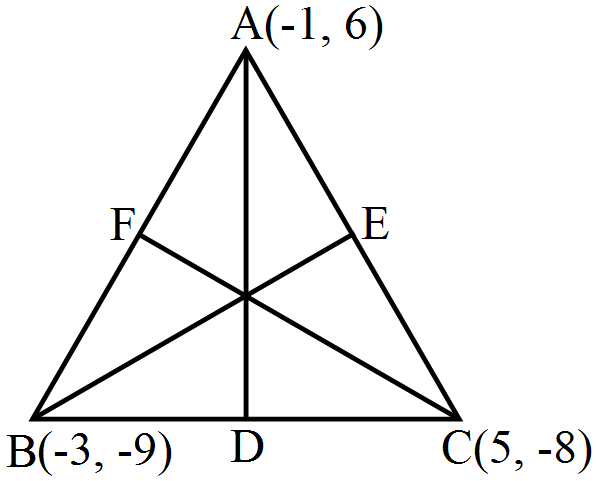
$\text{D}\equiv\Big(\frac{-3+5}{2},\frac{-9-8}{2}\Big)=\Big(1,\frac{-17}{2}\Big)$
$\text{E}\equiv \Big(\frac{-1+5}{2},\frac{6-8}{2}\Big)=(2,-1)$
$\text{F}\equiv \Big(\frac{-1-3}{2},\frac{6-9}{2}\Big)=\Big(-2,-\frac{3}{2}\Big)$
Median Ad passes through A(-1,6) and $\text{D}\Big(1,-\frac{17}{2}\Big)$
So, its equation is
$\text{y}-6=\frac{-\frac{17}{2}-6}{1+1}(\text{x}+1)$
$\Rightarrow4\text{y}-24=-29\text{x}-29$
$29\text{x}+4\text{y}+5=0$
Median BE passes through B(-3, -9) and E(2, -1).
So, its equation is
$\text{y}+9=\frac{-1+9}{2+3}(\text{x}+3)$
$\Rightarrow5\text{y}+45=8\text{x}+24$
$8\text{x}-5\text{y}-21=0$
Median CF passes through C(5, -8) and $\text{F}\Big(-2,\ -\frac{3}{2}\Big).$
So, its equation is
$\text{y}+8=\frac{-\frac{3}{2}+8}{-2-5}(\text{x}-5)$
$\Rightarrow-14\text{y}-112=3\text{x}-65$
$\Rightarrow13\text{x}+14\text{y}+47=0$ View full question & answer→Question 904 Marks
Reduce the equation 3x - 2y + 6 = 0 to the intercept form and find the x and y intercepts.
Answer$\frac{\text{x}}{\text{a}}+\frac{\text{y}}{\text{b}}=1$ 3x - 2y + 6 = 0 3x - 2y = -6 $\frac{-3\text{x}}{-6}-\frac{2\text{y}}{-6}=1$ $\frac{\text{x}}{\frac{-6}{3}}+\frac{\text{y}}{\frac{-6}{-2}}=1$ $\frac{\text{x}}{-2}+\frac{\text{y}}{3}=1$ ⇒ x-intercept = a = -2 y-intercept = b = 3
View full question & answer→Question 914 Marks
Find the equation of the line passing through the point of intersection of the lines 4x - 7y - 3 = 0 and 2x - 3y + 1 = 0 that has equal intercepts on the axes.
AnswerGiven lines are, 4x - 7y = 3 2x - 3y = -1 Solving these two, we get the point of intersection, x = -8, y = -5 Point of intersection of given lines is (-8, -5) equation of line makeing equal intercepts (a) on the coordinate axes is, $\frac{\text{x}}{\text{a}}+\frac{\text{y}}{\text{a}}=1$ x + y = a -8 - 5 = a a = -13 So, Equation of required line is x + y = -13
View full question & answer→Question 924 Marks
Find the equation of the straight line passing through the point of intersection of $2x + y - 1 = 0$ and $x + 3y - 2 = 0$ and making with the coordinate axes a triangle of area $\frac{3}{8}$ sq.units.
Answer$\text{L}_1+\lambda\text{L}_2=0$ is the equation of line passing through two lines $L_1$ and $L_2$.
$\therefore(2\text{x}+\text{y}-1)+\lambda(\text{x}+3\text{y}-2)=0$ is the required equation ...(i) or, $\text{x}(2+\lambda)+\text{y}(1+3\lambda)-1-2\lambda=0$
$\frac{\text{x}}{\frac{1+2\lambda}{2+\lambda}}+\frac{4}{\frac{1+2\lambda}{1+3\lambda}}=1$
$\text{Area of} \ \triangle=\frac{1}{2}\times\text{OB}\times\text{OA}$
$\frac{8}{3}=\frac{1}{2} \times$ (y intercept) $\times$ (x intercept) $\frac{8}{3}=\frac{1}{2}\times\Big(\frac{1+2\lambda}{1+3\lambda}\Big)\times\Big(\frac{1+2\lambda}{2+\lambda}\Big)$
$\frac{16}{3}=\frac{1+4\lambda^2+4\lambda}{2+3\lambda^2+7\lambda}$
$32+48\lambda^2+112\lambda=-3-12\lambda^2-12\lambda$
$60\lambda^2+124\lambda+35=0$
$\lambda=\frac{-124\pm\sqrt{(124)^2-4\times60\times35}}{2\times60}$ Approximately = 1
$\therefore$ Subtituting in (i) \Rightarrow 3x + 4y - 3 = 0, 12x + y - 3 = 0
View full question & answer→Question 934 Marks
Find the equation of the right bisector of the line segment joining the points (3, 4) and (-1, 2).
AnswerThe slope of line joining (3, 4) and (-1, 2) is $\frac{2-4}{-1-3}=\frac{-2}{-4}=\frac{1}{2}$ The required line is $\perp$ to the given line $\therefore$ (Slope of required line) $\times\frac{1}{2}=-1 \big[\because\text{m}_1\times\text{m}_2$ for perpendicular lines$\big]$ $\text{m}_1=-2$ And the line passes through the mid point of line joining (3, 4) and (1, 2) i.e; $\Big(\frac{3-1}{2},\frac{4+2}{2}\Big)$ or $(1,3)$ $\therefore$ equation of the required line is y - 3 = (-2)(x - 1) or y - 3 = -2x + 2 or 2x + y - 5 = 0
View full question & answer→Question 944 Marks
Find the equation of the side BC of the triangle ABC whose vertices are (-1, -2), (0, 1) and (2, 0) respectively. Also, find the equation of the median through (-1, -2).
AnswerEquation of BC$\text{y}-\text{y}_1=\frac{\text{y}_2-\text{y}_1}{\text{x}_2-\text{x}_1}(\text{x}-\text{x}_1)$
$\text{y}-1=\frac{0-1}{2-0}(\text{x}-0)$ $\Big[$$\because$ B(0, 1), C(2, 0)$\Big]$
$2\text{y}-2=-\text{x}$
$\text{x}+\text{2y}=2$
D is midpoint of BC
So,
$\text{D}=\Big(\frac{\text{x}_1+\text{x}_2}{2},\frac{\text{y}_1+\text{y}_2}{2}\Big)=\Big(\frac{0+2}{2},\frac{1+0}{2}\Big)=\Big(1,\frac{1}{2}\Big)$
$\therefore$ Equation of the median AD:
$\text{y}-\text{y}_1=\frac{\text{y}_2-\text{y}_1}{\text{x}_2-\text{x}_1}(\text{x}-\text{x}_1)$
$\text{y}-(-2)=\frac{\frac{1}{2}-(-2)}{1-(-1)}(\text{x}-(-1))=\frac{\frac{5}{2}}{2}(\text{x}+1)\ \Big[\because\text{A}(-1, -2),\text{D}\Big(1,\frac{1}{2}\Big)\Big]$
$\text{4y}+8=\text{5x}+5$
$5\text{x}-\text{4y}-3=0$
View full question & answer→Question 954 Marks
If the image of the point (2, 1) with respect to a line mirror is (5, 2), find the equation of the mirror.
AnswerHere, Let l be line mirror and B is image of A Let m be slope of line l So, m(slope of AB) = -1 $\text{m}\Big(\frac{2-1}{5-2}\Big)=-1$ $\text{m}\Big(\frac{1}{3}\Big)=-1$ $\text{m}=-3$ M is mid point of AB $\text{m}\Big(\frac{2+5}{2},\frac{2+1}{2}\Big)$ $\text{m}\Big(\frac{7}{2},\frac{3}{2}\Big)$ Equation line l is, $\text{y}-\text{y}_1=\text{m}(\text{x}-\text{x}_1)$ $\text{y}-\frac{3}{2}=(-3)\Big(\text{x}-\frac{7}{2}\Big)$ $\frac{2\text{y}-3}{2}=-3\text{x}+\frac{21}{2}$ $2\text{y}-3=-6\text{x}+21$ $6\text{x}+2\text{y}=24$ $3\text{x}+\text{y}=12$
View full question & answer→Question 964 Marks
Find the equation of the right bisector of the line segment joining the points $(a, b)$ and $(a_1, b_1)$.
AnswerAny line which is right bisector to another line segment passes through the mid-point of end-points and is perpendicular to it.
$\Rightarrow$ mid point of $(a, b)$ and $(a_1,b_1)$ is $(\text{x}_1,\text{y}_1)=\Big(\frac{\text{a}+\text{a}_1}{2},\frac{\text{b}+\text{b}_1}{2}\Big)$ Slope of line $(\text{m})=\frac{\text{b}_1-\text{b}}{\text{a}_1-\text{a}}$ Slope of required line is $\text{m}'=\frac{\text{a}-\text{a}_1}{\text{b}-\text{b}_1}$ Equation of required line is $\text{y}-\text{y}_1=\text{m}'(\text{x}-\text{x}_1)$
$\text{y}-\Big(\frac{\text{b}+\text{b}_1}{2}\Big)=\frac{\text{a}-\text{a}_1}{\text{b}-\text{b}_1}\Big(\text{x}-\frac{\text{a}+\text{a}_1}{2}\Big)$
$2\text{x}(\text{a}_1-\text{a})+2\text{y}(\text{b}_1-\text{b})+\text{a}_2+\text{b}_2=\text{a}_1^2+\text{b}_1^2$
View full question & answer→Question 974 Marks
Find the equation of the line, which passes through P (1, -7) and meets the axes at Aand B respectively so that 4 AP - 3 BP = 0.
AnswerThe equation of straight line is$\text{y}-\text{y}_1=\text{m}(\text{x}-\text{x}_1) \ ...(\text{i})$
The line passes through (x, y) ie, (1, 7) and meets the axes at A and B
⇒ A point is (a, 0) and B is (0, b)
$\frac{\text{AP}}{\text{BP}}=\frac{3}{4}$
Using section formula $\frac{\text{lx}_2+\text{mx}_1}{\text{l}+\text{m}},\frac{\text{ly}_2+\text{my}_1}{\text{l}+\text{m}}$
$\text{l}:\text{m}=3:4, (\text{a},0)\Leftrightarrow(\text{x}_1,\text{y}_1),(0,\text{b})\Leftrightarrow(\text{x}_2,\text{y}_2)$
$\Rightarrow1=\frac{3(0)+4(\text{a})}{3+4}$
$\Rightarrow1=\frac{4\text{a}}{7}$
$\Rightarrow\text{a}=\frac{4}{7}$
$-7=\frac{3(\text{b})+4(0)}{3+4}$
$\Rightarrow-7=\frac{3b}{7}$
$\Rightarrow\text{b}=\frac{-49}{3}$
then $\text{A}\Big(\frac{7}{4},0\Big),\ \text{B}\Big(0,\frac{-49}{3}\Big)$ Putting in (1)
$\text{y}-\text{y}_1=\frac{\text{y}_2-\text{y}_1}{\text{x}_2-\text{x}_1}(\text{x}-\text{x}_1)$
$\text{y}-0=\frac{\frac{-49}{3}-0}{0-\frac{7}{4}}\Big(\text{x}-\frac{7}{4}\Big)$
$\text{y}-0=\frac{49}{3}\times\frac{4}{7}\Big(\text{x}-\frac{7}{4}\Big)$
$\text{y}=\frac{28}{3}\Big(\text{x}-\frac{7}{4}\Big)$
$\text{3y}-\text{28x}+49=0$
View full question & answer→Question 984 Marks
Find the coordinates of the incentre and centroid of the triangle whose sides have the equations 3x - 4y = 0, 12y + 5x = 0 and y - 15 = 0.
AnswerLet ABC be the triangle whose side BC, CA and AB have the equations y - 15 = 0, BC 3x - 4y = 0, AC 5x + 12y = 0, AB Solving these equation pair wise we can obtain the coordinates of the vertices A, B, C as A(0, 0), B(-36, 15), C(20, 15) respectively Centroid $\Big(\frac{-36+20+0}{3},\frac{15+15+0}{3}\Big)=\Big(\frac{-16}{3},10\Big)$ For incentre, We have $\text{a}=\text{BC}=\sqrt{56^2+0}=56$ $\text{b}=\text{CA}=\sqrt{20^2+15^2}=25$ $\text{c}=\text{AB}=\sqrt{36^2+16^2}=39$ Coordinates of incenter are $\Big(\frac{56\times0+25\times-36+39\times20}{36+25+39},\frac{56\times0+25\times15+39\times15}{36+25+39}\Big)$ $=(-1.8)$
View full question & answer→Question 994 Marks
Find the equation of the line passing through the point (-3, 5) and perpendicular to the line joining (2, 5) and (-3, 6).
AnswerThe line passes through the point (-3, 5)So $(\text{x}_1\text{y}_1)=(3,5)$
The line is perpendicular to the line joining (2, 5) and (-3, 6)
$\Rightarrow\text{m}=\frac{-1}{\text{slope of line joining (2,5) and (-3,6)}}=\frac{-1}{\frac{\text{y}_2-\text{y}_1}{\text{x}_2-\text{x}_1}}=\frac{-1}{\frac{6-5}{-3-2}}\frac{-1}{\frac{-1}{5}}$
$\therefore \text{m}=5$
Hence the equation of straight line is
$\text{y}-\text{y}_1=\text{m}(\text{x}-\text{x}_1)$
$\text{y}-5=5\big(\text{x}(-3)\big)$
$\text{y}-5=\text{5x}+15$
$\text{5x}-\text{y}+20=0$
View full question & answer→Question 1004 Marks
Find the equation of the straight line which divides the join of the points (2, 3) and (−5, 8) in the ratio 3 : 4 and is also perpendicular to it.
AnswerThe coordinates of the point which divides the join of the points (2, 3) and (-5, 8) in the ratio 3 : 4 is given by (x, y) where,$\text{x}=\frac{\text{lx}_2+\text{mx}_1}{\text{l}+\text{m}}=\frac{3(-5)+4(2)}{3+4}=\frac{-15+6}{7}=\frac{-9}{7}$
$\text{y}=\frac{\text{ly}_2+\text{my}_1}{\text{l}+\text{m}}=\frac{3(8)+4(3)}{3+4}=\frac{24+12}{7}=\frac{36}{7}$
Slope of the line joining the points (2, 3) and (5, 8) $=\frac{8-3}{-5-2}=\frac{5}{-7}=\frac{-5}{7}$
$\therefore$ Slope of line perpendicular to line $=\text{m}=\frac{7}{5}$
The required equation is:
$\text{y} - \text{y}_1 = \text{m}(\text{x} - \text{x}_1)$
$\text{y}-\frac{36}{7}=\frac{7}{5}\Big(\text{x}-\Big(\frac{-9}{7}\Big)\Big)$
$49\text{x}-35\text{y}+229=0$
View full question & answer→