Question 12 Marks
Prove that : $\frac { ( \sin 7 x + \sin 5 x ) + ( \sin 9 x + \sin 3 x ) } { ( \cos 7 x + \cos 5 x ) + ( \cos 9 x + \cos 3 x ) } = \tan 6 x$
AnswerWe have L.H.S. $= \frac { ( \sin 7 x + \sin 5 x ) + ( \sin 9 x + \sin 3 x ) } { ( \cos 7 x + \cos 5 x ) + ( \cos 9 x + \cos 3 x ) }$
$= \frac { \left[ 2 \sin \left( \frac { 7 \mathrm { x } + 5 \mathrm { x } } { 2 } \right) \cos \left( \frac { 7 \mathrm { x } - 5 \mathrm { x } } { 2 } \right) \right] + \left[ 2 \sin \left( \frac { 9 \mathrm { x } + 3 \mathrm { x } } { 2 } \right) \cos \left( \frac { 9 \mathrm { x } - 3 \mathrm { x } } { 2 } \right) \right] } { \left[ 2 \cos \left( \frac { 7 \mathrm { x } - 5 \mathrm { x } } { 2 } \right) \cos \left( \frac { 7 \mathrm { x } - 5 \mathrm { x } } { 2 } \right) \right] + \left[ 2 \cos \left( \frac { 9 \mathrm { x } + 3 \mathrm { x } } { 2 } \right) \cos \left( \frac { 9 \mathrm { x } - 3 \mathrm { x } } { 2 } \right) \right] }$
$= \frac { 2 \sin 6 x \cos x + 2 \sin 6 x \cos 3 x } { 2 \cos 6 x \cos x + 2 \cos 6 x \cos 3 x }$
$= \frac { 2 \sin 6 x ( \cos x + \cos 3 x ) } { 2 \cos 6 x ( \cos x + \cos 3 x ) }$
$= \frac { \sin 6 \mathrm { x } } { \cos 6 \mathrm { x } }$= tan 6x = R.H.S.
View full question & answer→Question 22 Marks
Prove that : sin x + sin 3x + sin 5x + sin 7x = 4 cos x cos 2x sin 4x
AnswerWe have L.H.S. = sin x + sin 3x + sin 5x + sin 7x
= (sin 7x + sin x ) + (sin 5x + sin 3x)
$ = \left[ {2\sin \left( {\frac{{7x + x}}{2}} \right)\cos \left( {\frac{{7x - x}}{2}} \right)} \right]$$ + \left[ {2\sin \left( {\frac{{5x + 3x}}{2}} \right)\cos \left( {\frac{{5x - 3x}}{2}} \right)} \right]$
= 2sin 4xcos3x + 2sin 4xcosx
$\left[ {\therefore \sin \;C + \sin D} \right.$$\left. { = 2\sin \frac{{C + D}}{2} \cdot \cos \frac{{C - D}}{2}} \right]$
= 2 sin 4x [cos 3x + cos x ]
$ = 2\sin 4x\left[ {2\cos \left( {\frac{{3x + x}}{2}} \right)\cos \left( {\frac{{3x - x}}{2}} \right)} \right]$
$\left[ {\because \cos C + \cos D} \right.$$\left. { = 2\cos \frac{{C + D}}{2} \cdot \cos \frac{{C - D}}{2}} \right]$
= 2 sin 4x [2 cos 2x cos x]
= 4cos x cos 2x sin 4x = R.H.S.
View full question & answer→Question 32 Marks
Prove that: $(\cos x-\cos y)^{2}+(\sin x-\sin y)^{2}=4 \sin ^{2} \frac{x-y}{2}$
AnswerTo prove: $(\cos x-\cos y)^{2}+(\sin x-\sin y)^{2}=4 \sin ^{2} \frac{x-y}{2}$
We know that:
$\cos x-\cos y=-2 \sin \left(\frac{x+y}{2}\right) \sin \left(\frac{x-y}{2}\right)$
$\sin x-\sin y=2 \cos \left(\frac{x+y}{2}\right) \sin \left(\frac{x-y}{2}\right)$
Using these formulae in L.H.S. we get,
L.H.S $=(\cos x-\cos y)^2+(\sin x-\sin y)^2$
$=\left(-2 \sin \left(\frac{\mathrm{x}+\mathrm{y}}{2}\right) \sin \left(\frac{\mathrm{x}-\mathrm{y}}{2}\right)\right)^{2}+\left(2 \cos \left(\frac{\mathrm{x}+\mathrm{y}}{2}\right) \sin \left(\frac{\mathrm{x}-\mathrm{y}}{2}\right)\right)^{2}$
$=4 \sin ^{2}\left(\frac{\mathrm{x}+\mathrm{y}}{2}\right) \sin ^{2}\left(\frac{\mathrm{x}-\mathrm{y}}{2}\right)+4 \cos ^{2}\left(\frac{\mathrm{x}+\mathrm{y}}{2}\right) \sin ^{2}\left(\frac{\mathrm{x}-\mathrm{y}}{2}\right)$
$=4 \sin ^{2}\left(\frac{\mathrm{x}-\mathrm{y}}{2}\right)\left(\sin ^{2}\left(\frac{\mathrm{x}+\mathrm{y}}{2}\right)+\cos ^{2}\left(\frac{\mathrm{x}+\mathrm{y}}{2}\right)\right)$
= 4 $\sin ^{2}\left(\frac{\mathrm{x}-\mathrm{y}}{2}\right)$
= R.H.S
Hence, L.H.S = R. H. S
View full question & answer→Question 42 Marks
Prove that : $(\cos x+\cos y)^2+(\sin x-\sin y)^2 = 4{\cos ^2}\frac{{x + y}}{2}$
AnswerWe have L.H.S. $=(\cos x+\cos y)^2+(\sin x-\sin y)^2$
$ = {\left[ {2\cos \left( {\frac{{x + y}}{2}} \right)\cos \left( {\frac{{x - y}}{2}} \right)} \right]^2}$$ + {\left[ {2\cos \left( {\frac{{x + y}}{2}} \right)\sin \left( {\frac{{x - y}}{2}} \right)} \right]^2}$
$ = 4{\cos ^2}\left( {\frac{{x + y}}{2}} \right){\cos ^2}\left( {\frac{{x - y}}{2}} \right)$$ + 4{\cos ^2}\left( {\frac{{x + y}}{2}} \right){\sin ^2}\left( {\frac{{x - y}}{2}} \right)$
$ = 4{\cos ^2}\left( {\frac{{x + y}}{2}} \right)$$\left[ {{{\cos }^2}\left( {\frac{{x - y}}{2}} \right) + {{\sin }^2}\left( {\frac{{x - y}}{2}} \right)} \right]$
$ = 4{\cos ^2}\left( {\frac{{x + y}}{2}} \right) = R.H.S.$
View full question & answer→Question 52 Marks
Prove that : (sin 3x + sin x) sin x + (cos 3x - cos x) cos x = 0
AnswerWe have L.H.S. = (sin 3x + sin x) sin x + (cos 3x - cosx) cos x
$ = \left[ {2\sin \left( {\frac{{3x + x}}{2}} \right)\cos \left( {\frac{{3x - x}}{2}} \right)} \right]\sin x$$ + \left[ { - 2\sin \left( {\frac{{3x + x}}{2}} \right)\sin \left( {\frac{{3x - x}}{2}} \right)} \right]\cos x$
= [2sin 2xcosx]sinx + [-2sin 2xsin x] cosx
= 2sin 2xcosxsin x - 2 sin 2x cos x sin x
= 0 = R.H.S.
View full question & answer→Question 62 Marks
Prove that: $2 \cos \frac{\pi}{13} \cos \frac{9 \pi}{13}+\cos \frac{3 \pi}{13}+\cos \frac{5 \pi}{13}=0$.
AnswerLHS $=2 \cos \frac{\pi}{13} \cos \frac{9 \pi}{13}+\cos \frac{3 \pi}{13}+\cos \frac{5 \pi}{13}$
$=\cos \left(\frac{9 \pi}{13}+\frac{\pi}{13}\right)+\cos \left(\frac{9 \pi}{13}-\frac{\pi}{13}\right)+\cos \frac{3 \pi}{13}+\cos \frac{5 \pi}{13}$
$=\cos \frac{10 \pi}{13}+\cos \frac{8 \pi}{13}+\cos \frac{3 \pi}{13}+\cos \frac{5 \pi}{13}$
$=\cos \left(\pi-\frac{3 \pi}{13}\right)+\cos \left(\pi-\frac{5 \pi}{13}\right)+\cos \frac{3 \pi}{13}+\cos \frac{5 \pi}{13}$
$=-\cos \frac{3 \pi}{13}-\cos \frac{5 \pi}{13}+\cos \frac{3 \pi}{13}+\cos \frac{5 \pi}{13}$0 = RHS [$\therefore$ cos ($\pi$ - x) = -cos x]
View full question & answer→Question 72 Marks
Prove that: $\cos \left(\frac{3 \pi}{2}+x\right) \cos (2 \pi+x)\left[\cot \left(\frac{3 \pi}{2}-x\right)+\cot (2 \pi+x)\right]=1$
AnswerTo prove: $\cos \left(\frac{3 \pi}{2}+x\right) \cos (2 \pi+x)\left[\cot \left(\frac{3 \pi}{2}-x\right)+\cot (2 \pi+x)\right]=1$
Taking L.H.S., we have
LHS = $\cos \left(\frac{3 \pi}{2}+x\right) \cos (2 \pi+x)\left[\cot \left(\frac{3 \pi}{2}-x\right)+\cot (2 \pi+x)\right]$
$\cos \left(n \frac{\pi}{2}+\theta\right)$ = sin $\theta$, if n is odd
$\cos \left(n \frac{\pi}{2}+\theta\right)=\cos \theta$ if n is even we know that,
$\cot \left(n \frac{\pi}{2}-\theta\right)=\tan \theta$ if n is odd
$\cot \left(n \frac{\pi}{2}+\theta\right)$ = cot $\theta$, if n is even
Therefore, L.H.S becomes,
LHS = sin x cos x $[\tan x+\cot x]$ = sin x cos x $\left[\frac{\sin x}{\cos x}+\frac{\cos x}{\sin x}\right]$
L.H.S = sin x. sin x + cos x. cos x
L.H.S = $sin^2 x + cos^2 x$
Since, $sin^2 x + cos^2 x = 1$
So, LHS = 1
$\therefore$ LHS = RHS
View full question & answer→Question 82 Marks
Find the value of tan $15^o$
AnswerLet y = $\tan 15^{\circ}$, then
$y=\tan \left(45^{\circ}-30^{\circ}\right)$
$\tan (x-y)=\frac{\tan x-\tan y}{1+\tan x \tan y}$
$\tan 15^{\circ}=\tan \left(45^{\circ}-30^{\circ}\right)$
$\tan 15^{\circ}=\frac{\tan 45^{\circ}-\tan 30^{\circ}}{1+\tan 45^{\circ} \tan 30^{\circ}}$
$\tan 15^{\circ}=\frac{1-\frac{1}{\sqrt{3}}}{1+1 \times \frac{1}{\sqrt{3}}}=\frac{\sqrt{3}-1}{\sqrt{3}+1}$
$\begin{equation} \tan 15^{\circ}=\frac{(\sqrt{3}-1) \times(\sqrt{3}-1)}{(\sqrt{3}+1) \times(\sqrt{3}-1)}=\frac{(\sqrt{3}-1)^{2}}{(\sqrt{3})^{2}-1^{2}}=\frac{3+1-2 \sqrt{3}}{3-1}=\frac{2(2-\sqrt{3})}{2} \end{equation}$
$\begin{equation} \tan 15^{\circ}=2-\sqrt{3} \end{equation}$
View full question & answer→Question 92 Marks
Find the value of sin 75°
Answersin 75° = sin (45° + 30°) = sin 45° cos 30° + cos 45° sin 30°
$ = \frac{1}{{\sqrt 2 }} \times \frac{{\sqrt 3 }}{2} + \frac{1}{{\sqrt 2 }} \times \frac{1}{2} = \frac{\sqrt 3}{{2\sqrt 2 }} + \frac{1}{{2\sqrt 2 }}$$ = \frac{{\sqrt 3 + 1}}{{2\sqrt 2 }}$
View full question & answer→Question 102 Marks
Prove that: $\begin{equation} 2 \sin ^{2} \frac{3 \pi}{4}+2 \cos ^{2} \frac{\pi}{4}+2 \sec ^{2} \frac{\pi}{3}=10 \end{equation}$
AnswerTo prove: $\begin{equation} 2 \sin ^{2} \frac{3 \pi}{4}+2 \cos ^{2} \frac{\pi}{4}+2 \sec ^{2} \frac{\pi}{3}=10 \end{equation}$
Taking L.H.S we have,
LHS = $\begin{equation} 2 \sin ^{2} \frac{3 \pi}{4}+2 \cos ^{2} \frac{\pi}{4}+2 \sec ^{2} \frac{\pi}{3} \end{equation}$
LHS = $\begin{equation} 2 \sin ^{2}\left(\pi-\frac{\pi}{4}\right)+2 \cos ^{2} \frac{\pi}{4}+2 \sec ^{2} \frac{\pi}{3} \end{equation}$
LHS = $\begin{equation} 2 \sin ^{2} \frac{\pi}{4}+2 \cos ^{2} \frac{\pi}{4}+2 \sec ^{2} \frac{\pi}{3} \end{equation}$
LHS = $\begin{equation} 2 \times\left(\frac{1}{\sqrt{2}}\right)^{2}+2 \times\left(\frac{1}{\sqrt{2}}\right)^{2}+2 \times 2^{2} \end{equation}$
LHS = $\begin{equation} 2 \times \frac{1}{2}+2 \times \frac{1}{2}+2 \times 4 \end{equation}$
LHS = 1 + 1 + 8 = 10 = RHS
$\therefore$ LHS = RHS
Hence, proved.
View full question & answer→Question 112 Marks
Prove that: $\begin{equation} \cot ^{2} \frac{\pi}{6}+\ cosec \frac{5 \pi}{6}+3 \tan ^{2} \frac{\pi}{6}=6 \end{equation}$
AnswerTo prove: $\begin{equation} \cot ^{2} \frac{\pi}{6}+\ cosec \frac{5 \pi}{6}+3 \tan ^{2} \frac{\pi}{6}=6 \end{equation}$
Taking L.H.S, we have
LHS = $\begin{equation} \cot ^{2} \frac{\pi}{6}+\ cosec \frac{5 \pi}{6}+3 \tan ^{2} \frac{\pi}{6} \end{equation}$
LHS = $\begin{equation} (\sqrt{3})^{2}+\ cosec \left(\pi-\frac{\pi}{6}\right)+3 \times\left(\frac{1}{\sqrt{3}}\right)^{2} \end{equation}$
LHS = $\begin{equation} 3+\ cosec \frac{\pi}{6}+3 \times \frac{1}{3} \end{equation}$
LHS = 3 + 1 + 2 = 6 = RHS
$\therefore$ LHS = RHS
Hence, proved.
View full question & answer→Question 122 Marks
Prove that: $\cos 4 x=1-8 \sin ^2 x \cos ^2 x$
AnswerWe have L.H.S. $=\cos 4 \mathrm{x}=1-2 \sin ^2 2 \mathrm{x}\left[\because \cos 2 \theta=1-2 \sin ^2 \theta\right]$
$=1-2(2 \sin x \cos x)^2[\because \sin 2 \theta=2 \sin \theta \cos \theta]$
$=1-2\left(4 \sin ^2 x \cos ^2 x\right)$
$=1-8 \sin ^2 x \cos ^2 x=\text { R.H.S. }$
View full question & answer→Question 132 Marks
Prove that: $\tan 4x = \frac{{4\tan x(1 - {{\tan }^2}x)}}{{1 - 6{{\tan }^2}x + {{\tan }^4}x}}$
AnswerWe have L.H.S. = tan 4x $ = \frac{{2\tan 2x}}{{1 - {{\tan }^2}2x}}\left[ {\because \tan 2A = \frac{{2\tan A}}{{1 - {{\tan }^2}A}}} \right]$
$ = \frac{{2 \cdot \frac{{2\tan x}}{{1 - {{\tan }^2}x}}}}{{1 - {{\left( {\frac{{2\tan x}}{{1 - {{\tan }^2}x}}} \right)}^2}}}$$ = \frac{{\frac{{4\tan x}}{{1 - {{\tan }^2}x}}}}{{\frac{{{{(1 - {{\tan }^2}x)}^2} - 4{{\tan }^2}x}}{{{{(1 - {{\tan }^2}x)}^2}}}}}$
$ = \frac{{4\tan x}}{{1 - {{\tan }^2}x}} \times $$\frac{{{{(1 - {{\tan }^2}x)}^2}}}{{1 + {{\tan }^4}x - 2{{\tan }^2}x - 4{{\tan }^2}x}}$
$ = \frac{{4\tan x(1 - {{\tan }^2}x)}}{{1 - 6{{\tan }^2}x + {{\tan }^4}x}}$ = R.H.S.
View full question & answer→Question 142 Marks
Prove that: $\frac { \cos 4 x + \cos 3 x + \cos 2 x } { \sin 4 x + \sin 3 x + \sin 2 x }$= cot 3x.
AnswerTo prove : $\frac { \cos 4 x + \cos 3 x + \cos 2 x } { \sin 4 x + \sin 3 x + \sin 2 x } = cot \ 3x$ LHS = $\frac { \cos 4 x + \cos 3 x + \cos 2 x } { \sin 4 x + \sin 3 x + \sin 2 x }$
= $\frac { ( \cos 4 x + \cos 2 x ) + \cos 3 x } { ( \sin 4 x + \sin 2 x ) + \sin 3 x }$
= $\frac { 2 \cos \frac { 4 x + 2 x } { 2 } \cos \frac { 4 x - 2 x } { 2 } + \cos 3 x } { 2 \sin \frac { 4 x + 2 x } { 2 } \cos \frac { 4 x - 2 x } { 2 } + \sin 3 x }$ [by formulae]
= $\frac { 2 \cos 3 x \cos x + \cos 3 x } { 2 \sin 3 x \cos x + \sin 3 x }$
= $\frac { \cos 3 x ( 2 \cos x + 1 ) } { \sin 3 x ( 2 \cos x + 1 ) }$ $= cot 3x $ = RHS
Hence proved.
View full question & answer→Question 152 Marks
Prove that: $\frac{\sin x-\sin 3 x}{\sin ^2 x-\cos ^2 x} = 2\sin x$
AnswerWe have,
$ \text { L. H. S.} =\frac{\sin x-\sin 3 x}{\sin ^2 x-\cos ^2 x}=\frac{-(\sin 3 x-\sin x)}{-\left(\cos ^2 x-\sin ^2 x\right)}=\frac{\left(\sin 3 x-\sin ^2 x\right)}{\left(\cos ^2 x-\sin ^2 x\right)}$
$=\frac{2 \cos \left(\frac{3 x+x}{2}\right) \sin \left(\frac{3 x-x}{2}\right)}{\cos 2 x}$
$=\frac{2 \cos 2 x \sin x}{\cos 2 x}=2 \sin x $
View full question & answer→Question 162 Marks
Prove that: $2{\sin ^2}\frac{\pi }{6} + \cos e{c^2}\frac{{7\pi }}{6}{\cos ^2}\frac{\pi }{3} = \frac{3}{2}$
AnswerWe have L.H.S.$2{\sin ^2}\frac{\pi }{6} + \cos e{c^2}\frac{{7\pi }}{6}{\cos ^2}\frac{\pi }{3}$
Now $\cos ec\frac{{7\pi }}{6} = \cos ec\left( {\pi + \frac{\pi }{6}} \right) = \cos ec\frac{\pi }{6} = - 2$
$\therefore 2{\sin ^2}\frac{\pi }{6} + \cos e{c^2}\frac{{7\pi }}{6}{\cos ^2}\frac{\pi }{3}$$ = 2 \times {\left( {\frac{1}{2}} \right)^2} + {(2)^2} \times {\left( {\frac{1}{2}} \right)^2}$
$ = \frac{{2 \times 1}}{4} + \frac{{4 \times 1}}{4} = \frac{6}{4} = \frac{3}{2}$R.H.S.
View full question & answer→Question 172 Marks
Prove that: cot 4x (sin 5x + sin 3x) = cotx(sin 5x - sin 3x)
AnswerWe have L.H.S. = cot 4x (sin 5x + sin 3x)
$ = \frac{{\cos 4x}}{{\sin 4x}}\left[ {2\sin \left( {\frac{{5x + 3x}}{2}} \right)\cos \left( {\frac{{5x - 3x}}{2}} \right)} \right]$
$ = \frac{{\cos 4x}}{{\sin 4x}}[2\sin 4x\cos x]$= 2 cos 4x cos x
We have R.H.S. = cot x[sin5x - sin3x]
$ = \frac{{\cos x}}{{\sin x}}\left[ {2\cos \left( {\frac{{5x + 3x}}{2}} \right)\sin \left( {\frac{{5x - 3x}}{2}} \right)} \right]$
$\left[ {\because \sin C - \sin D = 2\cos \frac{{C + D}}{2} \cdot \sin \frac{{C - D}}{2}} \right]$
$ = \frac{{\cos x}}{{\sin x}}$ [2 cos 4x sin x] = 2 cos 4x cos x
Hence L.H.S. = R.H.S
View full question & answer→Question 182 Marks
Prove that: $\sin 2 x+2 \sin 4 x+\sin 6 x=4 \cos ^2 x \sin 4 x$
AnswerWe have L.H.S. = sin 2x + 2 sin 4x + sin 6x
= [ sin 4x + sin 2x ] + [sin 6x + sin 4x]
$ = 2\sin \left( {\frac{{4x + 2x}}{2}} \right)\cos \left( {\frac{{4x - 2x}}{2}} \right)$$ + 2\sin \left( {\frac{{6x + 4}}{2}} \right)\cos \left( {\frac{{6x - 4x}}{2}} \right)$
$\left[ {\because \sin C + \sin D = } \right.$$\left. { = 2\sin \left( {\frac{{C - D}}{2}} \right)\cos \left( {\frac{{C - D}}{2}} \right)} \right]$
= 2 sin 2x cos x + 2 sin 5x cos x
= 2 cos x [sin 3x + sin 5x]
$ = 2\cos x\left[ {2\sin \left( {\frac{{5x + 3x}}{2}} \right) \cdot \cos \left( {\frac{{5x - 3x}}{2}} \right)} \right]$
$ = 2\cos x\left[ {2\sin 4x \cdot \cos x} \right]= 4cos^2x\sin4x= R.H.S.$
View full question & answer→Question 192 Marks
Prove that: $\cos ^2 2 x-\cos ^2 6 x=\sin 4 x \sin 8 x$
AnswerWe have L.H.S $=\cos ^2 2 x-\cos ^2 6 x$
$\left[\because \cos ^2 B-\cos ^2 A=\sin (A+B) \sin (A-B)\right]$
$=\sin 8 x \sin 4 x=$ R.H.S.
View full question & answer→Question 202 Marks
Prove that $\cos \left( {\frac{{3\pi }}{4} + x} \right) - \cos \left( {\frac{{3\pi }}{4} - x} \right) = - \sqrt 2 \sin x$
AnswerWe have L.H.S. $\cos \left( {\frac{{3\pi }}{4} + x} \right) - \cos \left( {\frac{{3\pi }}{4} - x} \right)$
$ = - 2\sin \frac{{3\pi }}{4}\sin x$
[$\because $ cos (A+ B) - cos (A- B) = -2 sin A sin B]
$ = - 2\sin \left( {\pi - \frac{\pi }{4}} \right)\sin x$
$ = - 2\sin \frac{\pi }{4}\sin x\;[\because \sin (\pi - \theta ) = \sin \theta ]$
$ = - 2 \times \frac{1}{{\sqrt 2 }}\sin x$
$ = - \sqrt 2 \sin x = R.H.S.$
View full question & answer→Question 212 Marks
Prove that: ${\sin ^2}\frac{\pi }{6} + {\cos ^2}\frac{\pi }{3} - {\tan ^2}\frac{\pi }{4} = - \frac{1}{2}$
AnswerWe have
L.H.S. $ = {\sin ^2}\frac{\pi }{6} + {\cos ^2}\frac{\pi }{3} - {\tan ^2}\frac{\pi }{4}$
$ = {\left( {\frac{1}{2}} \right)^2} + {\left( {\frac{1}{2}} \right)^2} - {(1)^2}$$ = \frac{{1 + 1 - 4}}{4} = \frac{{ - 2}}{4}$
$ = \frac{{ - 1}}{2}$ RHS
View full question & answer→Question 222 Marks
Find the value of other five trigonometric function: $\tan x = \frac{{ - 5}}{{12}}$, x lies in second quadrant.
AnswerHere $\tan x = \frac{{ - 5}}{{12}}$
$\cot x = \frac{1}{{\tan x}} = \frac{{ - 12}}{5}$
Now ${\sec ^2}x = 1 + {\tan ^2}x \Rightarrow {\sec ^2}x = 1 + {\left( {\frac{{ - 5}}{{12}}} \right)^2}$$ \Rightarrow {\sec ^2}x = \frac{{169}}{{144}}$
$ \Rightarrow \sec x = \pm \frac{{13}}{{12}}$
But x lies in second quadrant.
$\therefore sex = \frac{{ - 13}}{{12}}$
$\cos x = \frac{1}{{\sec x}} = \frac{{ - 12}}{{13}}$
Also ${\sin ^2}x + {\cos ^2}x = 1 \Rightarrow {\sin ^2}x + {\left( {\frac{{ - 12}}{{13}}} \right)^2} = 1$$ \Rightarrow {\sin ^2}x = 1 - \frac{{144}}{{169}}$
$ \Rightarrow {\sin ^2}x = \frac{{25}}{{169}} \Rightarrow \sin x = \pm \frac{5}{{13}}$
But x lies in second quadrant.
$\therefore \sin x = \frac{5}{{13}}$
$\cos ecx = \frac{1}{{\sin x}} = \frac{{13}}{5}$
View full question & answer→Question 232 Marks
Find the values of other five trigonometric functions: $\begin{equation} \sec x=\frac{13}{5} \end{equation}$, x lies in fourth quadrant.
AnswerGiven, $\begin{equation} \sec x=\frac{13}{5} \end{equation}$, x lies in $4^{th}$ quadrant.
we know that, $\begin{equation} 1+\tan ^{2} x=\sec ^{2} x \end{equation}$
$\begin{equation} \tan ^{2} x=\sec ^{2} x-1 \end{equation}$
$\begin{equation} \tan ^{2} x=\frac{169}{25}-1 \end{equation}$
$\begin{equation} \tan ^{2} x=\frac{144}{25} \end{equation}$
$\begin{equation} \tan x=\frac{-12}{5} \end{equation}$ ($\because$ x lies in $4^{th}$ quadrant)
Now, we also have
$\begin{equation} \cos x=\frac{1}{\sec x}=\frac{5}{13} \end{equation}$
Also, $\sin ^{2} x+\cos ^{2} x=1 $
$\begin{equation} \sin ^{2} x+\frac{25}{169}=1 \end{equation}$
$\begin{equation} \sin ^{2} x=1-\frac{25}{169}=\frac{144}{169} \end{equation}$
$\begin{equation} \sin x=\frac{-12}{13} \end{equation}$
cosec x $=\frac{1}{\sin x}=\frac{-13}{12}$
$\cot x=\frac{\cos x}{\sin x}=\frac{-5}{12}$
View full question & answer→Question 242 Marks
Find the value of other five trigonometric function: $\cot x = \frac{3}{4}$, x lies in third quadrant.
AnswerHere $\cot x = \frac{3}{4}$
$\tan x = \frac{1}{{\cot x}} = \frac{4}{3}$
Now ${\sec ^2}x = 1 + {\tan ^2}x \Rightarrow {\sec ^2}x = 1 + {\left( {\frac{4}{3}} \right)^2}$
$ \Rightarrow {\sec ^2}x = 1 + \frac{{16}}{9} \Rightarrow {\sec ^2}x = \frac{{25}}{9}$
$ \Rightarrow \sec x = \pm \frac{5}{3}$
But x lies in third quadrant.
$\therefore \sec x = \frac{{ - 5}}{3}$
$\cos x = \frac{1}{{\sec x}} = \frac{{ - 3}}{5}$
Also ${\sin ^2}x + {\cos ^2}x = 1 \Rightarrow {\sin ^2}x + {\left( {\frac{{ - 3}}{5}} \right)^2} = 1$$ \Rightarrow {\sin ^2}x = 1 - \frac{9}{{25}}$
$ \Rightarrow {\sin ^2}x = \frac{{16}}{{25}} \Rightarrow \sin x = \pm \frac{4}{5}$
But x lies in third quadrant.
$\therefore \sin x\;={{ - 4}\over{5}}$
$\therefore \cos ecx = \frac{1}{{\sin x}} = \frac{{ - 5}}{4}$
View full question & answer→Question 252 Marks
Find the value of other five trigonometric function: sin $x = \frac{3}{5}$, x lies in second quadrant.
AnswerHere $\sin x = \frac{3}{5}$
Now ${\sin ^2}x + {\cos ^2}x = 1 \Rightarrow {\left( {\frac{3}{5}} \right)^2} + {\cos ^2}x = 1$$ \Rightarrow {\cos ^2}x = 1 - \frac{9}{{25}}$
$ \Rightarrow {\cos ^2}x = \frac{{16}}{{25}} \Rightarrow \cos x = \pm \frac{4}{5}$
But x lies in second quadrant.
$\therefore \cos x = - \frac{4}{5}$
Now $\cos ec\;x = \frac{1}{{\sin x}} = \frac{5}{3}$ and $\sec \;x = \frac{1}{{\cos x}} = - \frac{5}{4}$
$\tan x = \frac{{\sin x}}{{\cos x}} = \frac{{3/5}}{{ - 4/5}} = \frac{{ - 3}}{4}$ and $\cot x = \frac{{\cos x}}{{\sin x}} = \frac{{ - 4/5}}{{3/5}} = \frac{{ - 4}}{3}$
View full question & answer→Question 262 Marks
Find the value of other five trigonometric function: $\cos x = - \frac{1}{2}$, x lies in third quadrant.
AnswerHere $\cos x = - \frac{1}{2}$
Now ${\sin ^2}x + {\cos ^2}x = 1 \Rightarrow {\sin ^2}x + {\left( { - \frac{1}{2}} \right)^2} = 1$$ \Rightarrow {\sin ^2}x = 1 - \frac{1}{4}$
$ \Rightarrow {\sin ^2}x = \frac{3}{4} \Rightarrow \sin x = \pm \frac{{\sqrt 3 }}{2}$
But x lies in third quadrant.
$\therefore \sin x = - \frac{{\sqrt 3 }}{2}$
Now cosec x $ = \frac{1}{{\sin x}} = - \frac{2}{{\sqrt 3 }}$ and $\sec x = \frac{1}{{\cos x}} = - 2$
$\tan x = \frac{{\sin x}}{{\cos }} = \frac{{ - \sqrt 3 /2}}{{ - 1/2}} = \sqrt 3 $ and $\cot x = \frac{{\cos x}}{{\sin x}} = \frac{{ - 1/2}}{{ - \sqrt 3 /2}} = \frac{1}{{\sqrt 3 }}$
View full question & answer→Question 272 Marks
Find the angle in radian through which a pendulum swings, if its length is 75 cm and tip describes an arc of length 21 cm.
AnswerGiven,
Radius (r) = length of the pendulum $= 75 cm$
Length of arc $( l )$ $= 21 cm$
Now, $\theta = \frac { l } { r } = \frac { 21 } { 75 } = \frac { 7 } { 25 }$ rad
View full question & answer→Question 282 Marks
Find the angle in radian through which a pendulum swings if its length is 75 cm and the tip describes an arc of length 15 cm.
AnswerHere it is given that: $l$ = 15 cm (length of arc) and r = 75 cm (radius of circle)
We know that $\theta=\frac{1}{r}$ (here, $\theta$ is angle subtended by arc)
$\therefore \theta=\frac{15}{75}=\frac{1}{5}$ radians.
$\therefore$ The angle by which the pendulum of length 75 cm swings if it describes an arc of 21 cm is $\frac{1}{5}$radians.
View full question & answer→Question 292 Marks
Find the angle in radian through which a pendulum swings if its length is 75 cm and the tip describes an arc of length 10 cm.
AnswerGiven that: $l$ = 10 cm (length of arc) and r = 75 cm (radius of circle)
We know that $\theta=\frac{1}{r}$ (here, $\theta$ is angle subtended by an arc)
$\therefore ~~\theta=\frac{10}{75}=\frac{2}{15}$ radians
Therefore, The angle by which the pendulum of length 75 cm swings if it describes an arc of 21 cm is $\frac{2}{15}$ radians.
View full question & answer→Question 302 Marks
If in two circles, arcs of the same length subtend angles 60° and 75° at the centre, find the ratio of their radii.
AnswerHere it is given that the two circles with arcs of the same length and subtend angles 60° and 75° at the centre respectively.
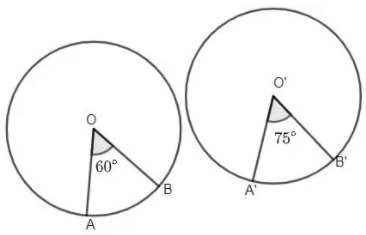
Let r be the length of the arcs.
Let $r_1$ be the radius of the first circle and let $r_2$ be the radius of the second circle. We know the formula ,
$\theta=\frac{l}{r}$
where, $\theta$ = angles subtended at the centre, l = length of the arc, and r = radius of the circle
Now for Circle with centre O,
$\theta_{1}=\frac{l}{r_{1}}$
And Circle with Centre O; $\theta_{2}=\frac{l}{r_{2}}$
Now taking the ratio of angles we get,
$\frac{\theta_{1}}{\theta_{2}}=\frac{\frac{l}{r_{1}}}{\frac{l}{r_{2}}}=\frac{r_{2}}{r_{1}}$
Therefore, we have, $\frac{r_{1}}{r_{2}}=\frac{\theta_{2}}{\theta_{1}}$ = $\frac{75^{\circ}}{60^{\circ}}=\frac{5}{4}$
Hence, $r_1: r_2 = 5:4$ View full question & answer→Question 312 Marks
In a circle of diameter 40 cm, the length of a chord is 20 cm. Find the length of minor arc of the chord.
AnswerHere diameter AB = 40 cm
Radius OA = 20 cm
Chord AC = 20 cm
$\therefore \Delta AOC$ is an equilateral triangle
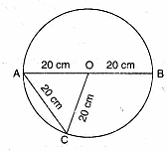
So $\angle AOC = 60^\circ = {\left( {\frac{{60 \times \pi }}{{180}}} \right)^{^C}} = {\left( {\frac{\pi }{3}} \right)^C}$
We know that ${\theta ^C} = \frac{1}{r}$
$\therefore \frac{\pi }{3} = \frac{1}{{20}} \Rightarrow l = \frac{{20\pi }}{3}cm$
View full question & answer→Question 322 Marks
Find the degree measure of the angle subtended at the centre of a circle of radius $100$ cm by an arc of length $22$ cm $\left( {use\;\pi = \frac{{22}}{7}} \right)$
Answer$\mathrm{We}\;\mathrm{know}\;\mathrm{that},\;\mathrm\theta\;=\;\frac{\mathrm{arc}}{\mathrm{radius}}\;=\;\frac{22}{100}\;=\frac{11}{50}\;\mathrm{radians}$
$=\left(\frac{11}{50} \times \frac{180}{\pi}\right)^{\circ}=\left(\frac{11}{50} \times \frac{180 \times 7}{\pi}\right)^{\circ} \quad\left[\because \pi=\frac{22}{7}\right] $
$=\left(\frac{63}{5}\right)^{\circ}=\left(12 \frac{3}{5}\right)^{\circ}$
$ =12^{\circ}\left(\frac{3}{5} \times 60\right)^{\prime}$
$=12^{\circ} 36^{\prime}$
View full question & answer→Question 332 Marks
A wheel makes 360 revolutions in one minute. Through how many radians does it turn in one second?
AnswerNumber of revolutions in one minute = 360 revolutions
Number of revolutions in 60 seconds = 360 revolutions
Number of revolutions in 1 second $ = \frac{{360}}{{60}}$ = 6 revolutions.
Angle made by wheel in 6 revolutions $ = 360 \times 6 = 2160^\circ $
Now $2160^\circ = {\left( {2160 \times \frac{\pi }{{180}}} \right)^C} = {(12\pi )^C}$
View full question & answer→Question 342 Marks
Solve: $\tan 2 x=-\cot \left(x+\frac{\pi}{3}\right)$
AnswerHere we have, tan 2x = $-\cot \left(x+\frac{\pi}{3}\right)=\tan \left(\frac{\pi}{2}+x+\frac{\pi}{3}\right)$
or tan2x = $\tan \left(x+\frac{5 \pi}{6}\right)$
Therefore, 2x = $n \pi+x+\frac{5 \pi}{6}$, where n $\in$ Z
or x = $n \pi+x+\frac{5 \pi}{6}$, where n $\in$ Z.
View full question & answer→Question 352 Marks
Solve: cos x = $\frac{1}{2}$
AnswerHere we have, cos x = $\frac{1}{2}$ = cos $\frac{\pi}{3}$
Therefore, $x=2 n \pi \pm \frac{\pi}{3}$, where n $\in$ Z
View full question & answer→Question 362 Marks
Find the solution of sin x = – $\frac{\sqrt{3}}{2}$
AnswerHere we have sin x = $-\frac{\sqrt{3}}{2}=-\sin \frac{\pi}{3}=\sin \left(\pi+\frac{\pi}{3}\right)=\sin \frac{4 \pi}{3}$
Hence, sin x = $\sin \frac{4 \pi}{3}$, which gives
x = $n \pi+(-1)^{n} \frac{4 \pi}{3}$, where n $\in$ Z
View full question & answer→Question 372 Marks
Find the principal solution of the equation tan x = $\frac { - 1 } { \sqrt { 3 } }$
AnswerGiven, $tan\ x =$ $\frac { - 1 } { \sqrt { 3 } }$
Here, value of $tan\ x$ is negative. So, x lies in II and IV quadrants.
As we know, $tan$ $\frac { \pi } { 6 }$ = $\frac { - 1 } { \sqrt { 3 } }$
$\therefore$ $tan$ $\left( \pi - \frac { \pi } { 6 } \right)$ = - $\frac { 1 } { \sqrt { 3 } }$ $\Rightarrow$ tan $\frac { 5 \pi } { 6 } = \frac { - 1 } { \sqrt { 3 } }$
$\therefore$ $x =$ $\frac { 5 \pi } { 6 }$, which lies in I quadrant.
$tan$ $\left( 2 \pi - \frac { \pi } { 6 } \right)$ = - tan $\frac { \pi } { 6 }$
$\Rightarrow$ tan $\frac { 11 \pi } { 6 } = - \frac { 1 } { \sqrt { 3 } }$
$\therefore$ $x =$ $\frac { 11 \pi } { 6 }$, which lies in IV quadrant.
$\therefore$ principal solutions are $x =$ $\frac { 5 \pi } { 6 }$ and $x =$ $\frac { 11 \pi } { 6 }$.
View full question & answer→Question 382 Marks
Find the principal solution of the equation: sin x = $\frac { \sqrt { 3 } } { 2 }$
AnswerGiven, $sin x =$ $\frac { \sqrt { 3 } } { 2 }$
As we know, $sin$ $\frac { \pi } { 3 }$ = $\frac { \sqrt { 3 } } { 2 }$
$\therefore$ $x =$ $\frac { \pi } { 3 }$, which lies in I quadrant.
and $sin$ ($\pi - \frac { \pi } { 3 }$) = $\frac { \sqrt { 3 } } { 2 }$
$\Rightarrow$ $sin$ $\frac { 2 \pi } { 3 }$ = $\frac { \sqrt { 3 } } { 2 }$
$\therefore$ x = $\frac { 2 \pi } { 3 }$, which lies in II quadrant.
View full question & answer→Question 392 Marks
Prove that: $\begin{equation} \frac{\sin 5 x-2 \sin 3 x+\sin x}{\cos 5 x-\cos x}=\tan x \end{equation}$
AnswerTake L.H.S. we have,
LHS = $\begin{equation} \frac{\sin 5 x-2 \sin 3 x+\sin x}{\cos 5 x-\cos x}=\frac{\sin 5 x+\sin x-2 \sin 3 x}{\cos 5 x-\cos x} \end{equation}$
= $\begin{equation} \frac{2 \sin 3 x \cos 2 x-2 \sin 3 x}{-2 \sin 3 x \sin 2 x}=-\frac{\sin 3 x(\cos 2 x-1)}{\sin 3 x \sin 2 x} \end{equation}$
$\begin{equation} =\frac{1-\cos 2 x}{\sin 2 x}=\frac{2 \sin ^{2} x}{2 \sin x \cos x} \end{equation}$ = tan x = R.H.S.
Hence proved.
View full question & answer→Question 402 Marks
Prove that $\begin{equation} \frac{\cos 7 x+\cos 5 x}{\sin 7 x-\sin 5 x}=\cot x \end{equation}$
AnswerTaking L.H.S, we have
LHS = $\frac{\cos 7 x+\cos 5 x}{\sin 7 x-\sin 5 x}$
Using the cos x + cos y = $\frac{x+y}{2} \cos \frac{x-y}{2}$ and sin x – sin y = $\begin{equation} 2 \cos \frac{x+y}{2} \sin \frac{x-y}{2} \end{equation}$, we have
L.H.S. = $\begin{equation} \frac{2 \cos \frac{7 x+5 x}{2} \cos \frac{7 x-5 x}{2}}{2 \cos \frac{7 x+5 x}{2} \sin \frac{7 x-5 x}{2}}=\frac{\cos x}{\sin x} \end{equation}$ = cot x = R.H.S.
View full question & answer→Question 412 Marks
Prove that: $\begin{equation} \cos \left(\frac{\pi}{4}+x\right)+\cos \left(\frac{\pi}{4}-x\right)=\sqrt{2} \cos x \end{equation}$
AnswerTake L.H.S. we have
LHS = $\begin{equation} \cos \left(\frac{\pi}{4}+x\right)+\cos \left(\frac{\pi}{4}-x\right) \end{equation}$
Using the cos x + cos y = $2~\cos(\frac{x+y}{2}) \cos (\frac{x-y}{2})$, we have
$\begin{equation}L.H.S =2 \cos \left(\frac{\frac{\pi}{4}+x+\frac{\pi}{4}-x}{2}\right) \cos \left(\frac{\frac{\pi}{4}+x-\left(\frac{\pi}{4}-x\right)}{2}\right) \end{equation}$
$\begin{equation} =2 \cos \frac{\pi}{4} \cos x=2 \times \frac{1}{\sqrt{2}} \cos x=\sqrt{2} \cos x \end{equation}$ = R.H.S.
Hence proved.
View full question & answer→Question 422 Marks
Show that tan 3 x tan 2 x tan x = tan 3x – tan 2 x – tan x
AnswerTo prove: tan 3 x tan 2 x tan x = tan 3x – tan 2 x – tan x
We know that 3x = 2x + x
Therefore, tan 3x = tan (2x + x)
or $\begin{equation} \tan 3 x=\frac{\tan 2 x+\tan x}{1-\tan 2 x \tan x} \end{equation}$
or tan 3x – tan 3x tan 2x tan x = tan 2x + tan x
or tan 3x – tan 2x – tan x = tan 3x tan 2x tan x
or tan 3x tan 2x tan x = tan 3x – tan 2x – tan x
Hence proved.
View full question & answer→Question 432 Marks
Prove that: $\begin{equation} \frac{\sin (x+y)}{\sin (x-y)}=\frac{\tan x+\tan y}{\tan x-\tan y} \end{equation}$
AnswerHere we have, L.H.S. = $\begin{equation} \frac{\sin (x+y)}{\sin (x-y)}=\frac{\sin x \cos y+\cos x \sin y}{\sin x \cos y-\cos x \sin y} \end{equation}$
Dividing the numerator and denominator by cos x cos y, we get
$\begin{equation} \frac{\sin (x+y)}{\sin (x-y)}=\frac{\tan x+\tan y}{\tan x-\tan y} \end{equation}$
Hence proved.
View full question & answer→Question 442 Marks
Find the value of tan $\begin{equation} \frac{13 \pi}{12} \end{equation}$
AnswerHere we have,
$\begin{equation} \tan \frac{13 \pi}{12}=\tan \left(\pi+\frac{\pi}{12}\right)=\tan \frac{\pi}{12}=\tan \left(\frac{\pi}{4}-\frac{\pi}{6}\right) \end{equation}$
$\begin{equation} =\frac{\tan \frac{\pi}{4}-\tan \frac{\pi}{6}}{1+\tan \frac{\pi}{4} \tan \frac{\pi}{6}}=\frac{1-\frac{1}{\sqrt{3}}}{1+\frac{1}{\sqrt{3}}}=\frac{\sqrt{3}-1}{\sqrt{3}+1}=2-\sqrt{3} \end{equation}$
View full question & answer→Question 452 Marks
Find the value of sin 15°
AnswerHere we have,
sin 15° = sin (45° – 30°)
= sin 45° cos 30° – cos 45° sin 30°
$\begin{equation} =\frac{1}{\sqrt{2}} \times \frac{\sqrt{3}}{2}-\frac{1}{\sqrt{2}} \times \frac{1}{2}=\frac{\sqrt{3}-1}{2 \sqrt{2}} \end{equation}$
View full question & answer→Question 462 Marks
Prove that: 3 sin $\frac { \pi } { 6 }$ sec $\frac { \pi } { 3 }$ - 4 sin $\frac { 5 \pi } { 6 }$ cot $\frac { \pi } { 4 }$ = 1.
AnswerLHS $= 3 sin $ $\frac { \pi } { 6 }$ $\times$$ sec$ $\frac { \pi } { 3 }$ $- 4 sin$ $\frac { 5 \pi } { 6 }$ $\times$ $cot$ $\frac { \pi } { 4 }$
= 3 $\times$ $\frac { 1 } { 2 }$ $\times$ 2 - 4 sin $\left( \pi - \frac { \pi } { 6 } \right)$ $\times$ cot $\frac { \pi } { 4 }$
= 3 - 4 sin $\frac { \pi } { 6 }$ $\times$ 1 [$\because$ sin $( \pi - \theta )$ = sin $\theta$]
$= 3 - 4$ $\times$ $\frac { 1 } { 2 }$ $= 3 - 2 = 1 =$ RHS
$\therefore$ LHS = RHS
Hence proved.
View full question & answer→