MCQ
The electromagnetic wave travelling in a medium has relative permeability 1.3 and relative permittivity 2.14. The speed of EM wave in that medium will be
  • A
    $13.6 \times 10^6 m / s$
  • B
    $1.8 \times 10^6 m / s$
  • C
    $3.6 \times 10^8 m / s$
  • $1.8 \times 10^8 m / s$

Answer

Correct option: D.
$1.8 \times 10^8 m / s$
(D) $1.8 \times 10^8 m / s$
$v=\frac{c}{\sqrt{\mu_0 \varepsilon_0}}=\frac{3 \times 10^8}{\sqrt{1.3 \times 2.14}}=1.8 \times 10^8 m / s$

Need a full question paper?

Generate a complete, print-ready paper with questions like this in minutes — across 16+ boards, with answer keys.

Start Generating Free

Similar questions

In the Bohr model an electron moves in a circular orbit around the proton . Considering the orbiting electron to be a circular current loop, the magnetic moment of the hydrogen atom; when the electron is in $n^{th}$ excited state, is
The velocity at the maximum height of a projectile is $\frac{\sqrt{3}}{2}$ times its initial velocity of projection $(u)$. Its range on the horizontal plane is .............
A photon of energy $8 eV$ is incident on a metal surface of threshold frequency $1.6 \times {10^{15}}\,Hz$, then the maximum kinetic energy of photoelectrons emitted is ............... $eV$ $(h = 6.6 \times {10^{ - 34}}\,Js)$
Two point dipoles p $\hat{ k }$ and $\frac{ p }{2} \hat{ k }$ are located at $(0,0,0)$ and $(1 m , 0,2 m )$ respectively. The resultant electric field due to the two dipoles at the point $(1 m , 0,0)$ is
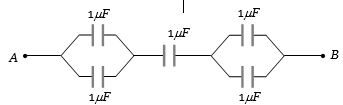
The equivalent capacitance between $A$ and $B$ is.......$\mu \,F$
A body performs $S.H.M.$ Its kinetic energy $K$ varies with time $t$ as indicated by graph
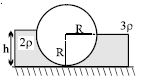
In the figure shown, the heavy cylinder (radius $R$) resting on a smooth surface separates two liquids of densities $2\ \rho$ and $3\ \rho$ . The height $‘h’$ for the equilibrium of cylinder must be
A wire of length $L$ metre carrying a current of $I$ ampere is bent in the form of circle. Its magnetic moment is
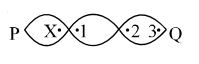
Figure, shows a stationary wave between two fixed points $P$ and $Q$. Which point$(s)$ of $1, 2$ and $3$ are in phase with the point $X?$
A piece of copper and another of germanium are cooled from room temperature to $80\, K$. The resistance of :-