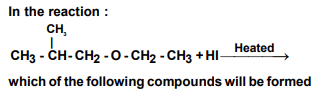
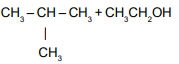
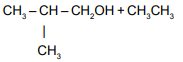
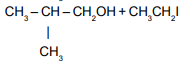
Question 14 Marks
Macth the Column I with Column II and select the correct answer using given codes.
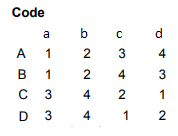
| Column I | Column II |
| A. 3d-transition series | 1. Cerium (Z = 58) |
| B. 4d-transition series | 2. Actinium (Z = 89) |
| C. 4f-inner transition series | 3. Zinc (Z = 30) |
| D. 5f-inner transition | 4.Yttrium (Z = 39) |
Answer(D)
The correct match is
$
A \rightarrow 2 ; B \rightarrow 3 ; C \rightarrow 1 ; D \rightarrow 2 .
$
14 elements of both sixth period [from $Z=58$ to $Z=$ 71] and seventh period [from $Z=90$ to $Z=103$ ] are known as lanthanoids and activoids respectively.
View full question & answer→MCQ 24 Marks
Glycerol can be separated from spent-lye in soap industry by :
- A
- B
- C
- ✓
distillaltion under reduced pressure
AnswerCorrect option: D. distillaltion under reduced pressure
(D)distillaltion under reduced pressure
Glycerol can be separated from spent-lye in soap industry by distillation under reduced pressure. This method is used because glycerol decomposes at its boiling point.
View full question & answer→MCQ 34 Marks
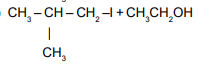
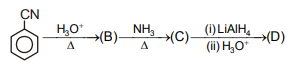
Identify the product (D) in the following reaction sequence:
Answer(D)

Identify the product (D) in the following reaction sequence:
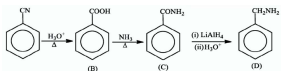
View full question & answer→MCQ 44 Marks
View full question & answer→MCQ 54 Marks
Match the compounds given in column I with the name reactions given by them in column II and select the correct option given below:
| Column I | Column II |
| a. Phenol | (i) Etard |
| b. Acetic acid | (ii) Canniozzaro |
| c. Formaldehyde | (iii) Reimer-Tiemann |
| d. Toluene | (iv) Hell-Volhard Zelinsky |
- A
a(iii), b(i), c(ii), d(iv)
- B
a(iii), b(iv), c(i), d(ii)
- C
a(ii), b(i), c(iv), d(iii)
- ✓
a(iii), b(iv), c(ii), d(i)
AnswerCorrect option: D. a(iii), b(iv), c(ii), d(i)
(D).a(iii), b(iv), c(ii), d(i)
Correct matches are:
| a. Phenol | Reimer-Tiemann |
| b. Acetic acid | Hell-Volhard-Zelinsky |
| c. Formaldehyde | Canniozzaro |
| d. Toluene | Etard |
View full question & answer→MCQ 64 Marks
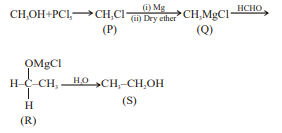
$
CH_3 OH+PCl_5 \rightarrow
$
$
P \xrightarrow{\text { Mg/Dry ether }} Q \xrightarrow{HCHO} R \xrightarrow{H_2 O} S
$
"S" is:
- A
$CH _3 MgCl$
- B
$CH _3 CHOMgCl$
- C
$CH _3- OH$
- D
$CH _3 CH _2- OH$
View full question & answer→MCQ 74 Marks
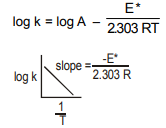
The temperature dependence of rate constant (k) of a chemical reaction is written in terms of Arrhenius equation, $k = A e ^{- E ^{\prime V R T}}$. Activation energy $\left(E^{\circ}\right)$ of the reaction can be calculated by ploting:
AnswerCorrect option: A. $\log kvs \frac{1}{T}$
(A)$\log kvs \frac{1}{T}$
View full question & answer→MCQ 84 Marks
For reaction
$
5 Br^{-}(aq)+BrO_3^{-}(aq)+6 H^{+} \rightarrow 3 Br_2(aq)+3 H_2 O(l)
$
The correct relation is :
- A
$\frac{ d \left[ Br _2\right]}{ dt }=\frac{4 d\left[ H _2 O \right]}{ dt }$
- ✓
$-\frac{ d \left[ Br ^{-}\right]}{ dt }=\frac{-5}{6} \frac{d\left[ H ^{+}\right]}{ dt }$
- C
$-\frac{ d \left[ H ^{+}\right]}{ dt }=\frac{1}{2} \frac{d\left[ Br _2\right]}{ dt }$
- D
$-\frac{ d \left[ BrO _3^{-}\right]}{ dt }=\frac{1}{2} \frac{d\left[ H _2 O \right]}{ dt }$
AnswerCorrect option: B. $-\frac{ d \left[ Br ^{-}\right]}{ dt }=\frac{-5}{6} \frac{d\left[ H ^{+}\right]}{ dt }$
(B)Rate of reaction will be$-\frac{ d \left[ Br ^{-}\right]}{ dt }=\frac{-5}{6} \frac{d\left[ H ^{+}\right]}{ dt }$
View full question & answer→MCQ 94 Marks
For the reaction, $N _2+3 H _2 \rightarrow 2 \mathrm { NH } _ { 3 }$, if :
$\frac{ d \left[ NH _3\right]}{ dt }=3 \times 10^{-4} mol L ^{-1}$, the value of $\frac{- d \left[ N _2\right]}{ dt }$ would be :
- A
$4 \times 10^{-4} mol L ^{-1} s^{-1}$
- B
$6 \times 10^{-4} mol L ^{-1} s^{-1}$
- ✓
$1.5 \times 10^{-4} mol L ^{-1} s^{-1}$
- D
$3 \times 10^{-4} mol L ^{-1} s^{-1}$
AnswerCorrect option: C. $1.5 \times 10^{-4} mol L ^{-1} s^{-1}$
(C)$1.5 \times 10^{-4} mol L ^{-1} s^{-1}$
$\begin{array}{l}\frac{ d \left[ N _2\right]}{ dt }=\frac{1}{2} \frac{d\left[ NH _3\right]}{ dt } \\ =\frac{1}{2} \times 3 \times 10^{-4}=1.5 \times 10^{-4} mol lit ^{-1} sec ^{-1}\end{array}$
View full question & answer→MCQ 104 Marks
Compound A used as strong oxidising agent is amphoteric in nature. It is the part of lead storage batteries. Compound A is :
- ✓
$PbO _2$
- B
- C
$PbSO _4$
- D
$Pb _3 O _4$
AnswerCorrect option: A. $PbO _2$
(A)$PbO _2$
Pb is a member of $14^{\text {th }}$ group and it shows +2 and +4 oxidation state but due to inert pair effect, $Pb ^{+2}$ is more stable than $Pb ^{+4}$. $So Pb ( IV )$ compounds are strong oxidising agent as $Pb ^{+4}$ gets easily reduced to more stable $Pb ^{+2}$.
$
Pb^{+4}+2 e^{-} \rightarrow Pb^{+2} \Delta G^0<0 \text { (spontaneous) }
$
$PbO _2$ is used in lead storage batteries where as a grid of lead packed with $PbO _2$ acts as cathode and also it is amphoteric in nature.
View full question & answer→MCQ 114 Marks
$\Lambda_{ m }^{\infty}$ for $NaCl , HCl$ and NaA are 126.4, 425.9 and $100.5 S cm ^2 mol^{-1}$ respectively. If the conductivity of 0.001 M HA is $5 \times 10^{-5} Scm ^{-1}$, degree of dissociation of HA is
Answer(D)0.125
$\begin{array}{l}\Lambda_{ m ( HA )}^{\infty}=\stackrel{\propto}{ HCl }+\stackrel{\propto}{ NaA }-\stackrel{\propto}{ NaCl } \\ =425.9+100.5-126.4 \\ =400 s cm ^2 mol^{-1}\end{array}$
$
\Lambda_{m(HA)}=\frac{K \times 1000}{M}=5 \times 10^{-5} \times \frac{1000}{0.001}=50
$
$
\alpha=\frac{\Lambda_{m(HA)}}{\Lambda_{m(HA)}^{\infty}}=\frac{50}{400}=0.125
$
View full question & answer→MCQ 124 Marks
Given below are two statements: one is labelled as Assertion(A) and the other is labelled as Reason (R).
Assertion(A) : Molar conductivity increases with decrease in concentration for weak electrolytes.
Reason (R) : No. of ions increases and No. of ions per unit volume decreases due to dilution. In the light of the above statements, choose the most appropriate answer from the options given below:
- ✓
Both Assertion (A) and Reason (R) are true and Reason (R) is the correct explanation of Assertion (A).
- B
Both Assertion (A) and Reason (R) are true and Reason (R) is not the correct explanation of Assertion (A).
- C
Assertion (A) is true but Reason (R) is false
- D
Both Assertion (A) and Reason (R) are false
AnswerCorrect option: A. Both Assertion (A) and Reason (R) are true and Reason (R) is the correct explanation of Assertion (A).
(A)Both Assertion (A) and Reason (R) are true and Reason (R) is the correct explanation of Assertion (A).
View full question & answer→MCQ 134 Marks
The electrode potential for $Cu _{( aq )}^{2+}+ e ^{-} \rightarrow Cu _{( aq )}^{+}$ and $Cu _{( aq )}^{+}+ e ^{-} \rightarrow Cu _{( s )}$ are $+0.15V$ and $+0.50 V$ respectively. The value of $E _{ Cu ^{+2} / Cu }^0$ will be :
View full question & answer→MCQ 144 Marks
Given below are two statements: one is labelled as Assertion(A) and the other is labelled as Reason (R).
Assertion(A) : $E^{\circ}$ value for $Mn ^{3+} / Mn ^{2+}$ couple is much more positive than that of $E ^{\circ}$ value for $Cr ^{3+} / Cr ^{2+}$ or $Fe ^{3+} / Fe ^{2+}$.
Reason ( R ) : Mn have very high value of 3rd ionization energy in comparision to Cr and Fe .
In the light of the above statements, choose the most appropriate answer from the options given below:
- ✓
Both Assertion (A) and Reason (R) are true and Reason (R) is the correct explanation of Assertion (A).
- B
Both Assertion (A) and Reason (R) are true and Reason (R) is not the correct explanation of Assertion (A).
- C
Assertion (A) is true but Reason (R) is false.
- D
Both Assertion (A) and Reason (R) are false
AnswerCorrect option: A. Both Assertion (A) and Reason (R) are true and Reason (R) is the correct explanation of Assertion (A).
View full question & answer→MCQ 154 Marks
If the$E ^{\circ}$ cell for a given reaction has a negative value, which of the following gives the correct relationships for the value of$\Delta G ^{\circ}$ and$K _{ eq }$ :
- ✓
$\Delta G^{\circ}>0, K_{\text {eq }}<1$
- B
$\Delta G ^{\circ}>0, K_{\text {eq }}>0$
- C
$\Delta G ^{\circ}<0, K_{\text {eq }}>1$
- D
$\Delta G ^{\circ}<0, K_{ eq }<1$
AnswerCorrect option: A. $\Delta G^{\circ}>0, K_{\text {eq }}<1$
(A)$\Delta G^{\circ}>0, K_{\text {eq }}<1$
$\Delta G ^{\circ}=- nFE E ^{\circ}$ cell
If $E^{\circ}$ cell $=-$ ve then $\Delta G^{\circ}=+$ ve ie, $\Delta G^{\circ}>0$
$
\Delta G^{\circ}=-n R T \log K_{e q}
$
for $\Delta G ^{\circ}=+$ ve, $K _{ eq }=- ve$ ie, $K _{ eq }<1$
View full question & answer→MCQ 164 Marks
Given below are two statements :
Statement I: Nephthalene is an aromatic compound and has
$10 \pi$ electrons.
Statement II : Pyridine is an heterocyclic aromatic compound .
In the light of the above statements, choose the most appropriate answer from the options given below :
- A
Both Statement I and Statement II are incorrect
- B
Statement I is correct but Statement II is incorrect
- C
Statement I is incorrect but Statement II is correct
- ✓
Both Statement I and Statement II are correc
AnswerCorrect option: D. Both Statement I and Statement II are correc
View full question & answer→MCQ 174 Marks
$CH _3 MgBr \xrightarrow[ H _2 O / H ^{+}]{ CH _3 CHO } A \xrightarrow{ PCl _5} B \xrightarrow[\text { ether }]{ Na } C , C$ है ।
View full question & answer→MCQ 184 Marks
The compound that does not give a blue colour in Lassaigne's test for nitrogen is :
MCQ 194 Marks
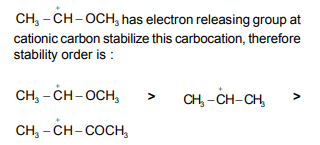
The descreasing order of the stability of the ions
I. $CH _3-\dot{ C } H - CH _3$
II. $CH _3-\dot{ C } H - OCH _3$
III. $CH _3-\dot{ C } H - COCH _3$
View full question & answer→MCQ 204 Marks
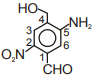
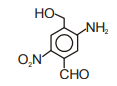
The IUPAC name of the following compounds is :
- A
2-nitro-4-hydroxymethyl-5-aminobenzaldehyde
- B
5-amino-4-hydroxymethyl-1-2-nitrobenzaldehyde
- C
4-amino-2-formyl-5-hydroxymethyl-nitrobenzene
- D
3-amino-4-hydroxymethyl-1-5-nitrobenzaldehyde
View full question & answer→MCQ 214 Marks
Which of the following reaction is disproportionation redox reaction :
- A
$N _2(g)+ O _2(g) \rightarrow 2 NO ( g )$
- B
$2 Pb\left( NO _3\right)_2(s) \rightarrow 2 PbO ( g )+2 NO _2(g)+1 / 2 O _2(g)$
- C
$NaH ( s )+ H _2 O ( l ) \rightarrow NaOH ( aq )+ H _2(g)$
- ✓
$2 NO _2(g)+2 OH ( aq ) \rightarrow NO _2^{-}-( aq )+ NO _3^{-}-( aq )+ H _2 O ( l )$
AnswerCorrect option: D. $2 NO _2(g)+2 OH ( aq ) \rightarrow NO _2^{-}-( aq )+ NO _3^{-}-( aq )+ H _2 O ( l )$
(D)$2 NO _2(g)+2 OH ( aq ) \rightarrow NO _2^{-}-( aq )+ NO _3^{-}-( aq )+ H _2 O ( l )$
The reaction (4), involves disproportionation of $NO _2(+4)$ into $NO _2^{-(+3)}$ and $NO _3^{-(+5) .}$
View full question & answer→MCQ 224 Marks
At equilibrium, the concentration of $N _2=3.0 \times 10^{-3}$ $M , O _2=4.2 \times 10^{-3} M$ and $NO =2.8 \times 10^{-3} M$ in a sealed vessel at 800 K . Value of Kc will be :
$
N_2(g)+O_2(g) \rightleftharpoons 2 NO(g)
$
Answer(B)0.622
$\begin{array}{l} K _{ c }=\frac{[ NO ]^2}{\left[N_2\right] \times\left[ O _2\right]} \\ \frac{\left(2.8 \times 10^{-3}\right)^2}{\left(3.0 \times 10^{-3}\right) \times\left(4.2 \times 10^{-3}\right)} \\ =0.622\end{array}$
View full question & answer→MCQ 234 Marks
A solution containing 10 g per $dm ^3$ of urea (m.w. = 60) is isotonic with a 5% solution of a non-volatile solute. The molecular mass of this non-volatile solute is :
- A
$250 g mol ^{-1}$
- ✓
$300 g mol ^{-1}$
- C
$350 g mol ^{-1}$
- D
$200 g mol ^{-1}$
AnswerCorrect option: B. $300 g mol ^{-1}$
(B)$300 g mol ^{-1}$
C1 (urea) = C2 (unknown solute)
$\begin{array}{l}{\left[\frac{ w _{ B } \times 1000}{m_{ B } \times V }\right]_{\text {Urea }}=\left[\frac{ w _{ B } \times 1000}{m_{ B } \times V }\right]_{\text {urkenown solute }}} \\ \frac{10 \times 1000}{60 \times 1000}=\frac{5 \times 1000}{m_{ B } \times 100} m_{ B }=300 g mol ^{-1}\end{array}$
View full question & answer→MCQ 244 Marks
A mixture showing negative deviation from Raoult’s law is:
Answer(D)Nitric acid + Water
If A–B interactions > A–A or B–B interactions then mixture shows negative deviation from Raoult’s law.
| Hexane + Heptane | : No deviation |
| Benzene + Toluene | : No deviation |
| Water + Ethanol | : +ve deviation |
| Nitric acid + Water | : –ve deviation |
View full question & answer→MCQ 254 Marks
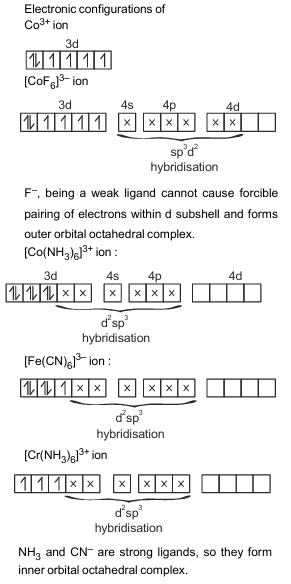
Among $\left[ Ni ( CO )_4\right],\left[ Ni ( CN )_4\right]^2,\left[ Ni ( Cl )_4\right]^2$ species, thehybridisation states of the Ni is, respectively: (At. no. of $Ni =28$ ) :
AnswerCorrect option: B. $sp ^3, dsp ^2, sp ^3$
(B)$sp ^3, dsp ^2, sp ^3$
Among $\left[ Ni ( CO )_4\right],\left[ Ni ( CN )_4\right]^{2-},\left[ Ni ( Cl )_4\right]^2$ species, the-hybridisation states of the Ni is, respectively $sp ^3, dsp p ^2, sp ^3$
View full question & answer→MCQ 264 Marks
Which one of the following is an inner orbital complex as well as diamagnetic in nature :
- A
$\left[ Cr \left( NH _3\right)_6\right]^{+3}$
- ✓
$\left[ Co \left( NH _3\right)_6\right]^{3+}$
- C
$\left[ Ni \left( NH _3\right)_6\right]^{2+}$
- D
$\left[ Zn \left( NH _3\right)_6\right]^{2+}$
AnswerCorrect option: B. $\left[ Co \left( NH _3\right)_6\right]^{3+}$
(B) $\ln \left[ Co \left( NH _3\right)_6\right]^{3+}$, Co exists as $Co ^{3+}$
${ }_{27} Co :[ Ar ], 3 d^7, 4 s^2$
$Co ^{3 *}:[ Ar ], 3 d^{66}$, It is $d^2 s p^3$ inner orbital complex with 3 electron pairs of 6d-electrons
View full question & answer→MCQ 274 Marks
In which of the following complex ion, the central metal ion is in a state of $sp ^3 d^2$ hybridisation :
- A
$\left[ CoF _6\right]^{3-}$
- B
$\left[ Co \left( NH _3\right)_6\right]^{3+}$
- C
$\left[ Fe ( CN )_6\right]^{3-}$
- D
$\left[ Cr \left( NH _3\right)_6\right]^{3+}$
View full question & answer→MCQ 284 Marks
The complex that can show fac - and Mer - isomer is :
- A
$\left[ Pt \left( NH _3\right)_2 Cl _2\right]$
- ✓
$\left[ Co \left( NH _3\right)_3\left( NO _2\right)_3\right]$
- C
$\left[ Co \left( NH _3\right)_4 Cl _2\right]^{+}$
- D
$\left[ CoCl _2( en )_2\right]$
AnswerCorrect option: B. $\left[ Co \left( NH _3\right)_3\left( NO _2\right)_3\right]$
View full question & answer→MCQ 294 Marks
Strong reducing and oxidizing agents among the following, respectively, are :
- A
$Ce ^{4+}$ and $Eu ^{2+}$
- ✓
$Eu ^{2+}$ and $Ce ^{4+}$
- C
$Ce ^{3+}$ and $Ce ^{4+}$
- D
$Ce ^{4+}$ and $Tb ^{4+}$
AnswerCorrect option: B. $Eu ^{2+}$ and $Ce ^{4+}$
(B)$Eu ^{2+}$ and $Ce ^{4+}$
The stable oxidation state of lanthanoids is $+3 . Ce ^{4+}$ tends to accept an electron to change to +3 state. Hence, it acts as a good oxidising agent.
$E u^{2+}$ has a strong tendency to lose an electron to attain the more stable +3 oxidation state of lanthanoids. Hence, it is a strong reducing agent.
View full question & answer→MCQ 304 Marks
Given below are two statements: one is labelled as Assertion(A) and the other is labelled as Reason (R).
Assertion(A) : In p-block, when we move down in group, stability of highest oxidation state decreases.
Reason (R) : In d-block, when we move down in group, stability of highest oxidation state increases.
In the light of the above statements, choose the most appropriate answer from the options given below:
- A
Both Assertion (A) and Reason (R) are true and Reason (R) is the correct explanation of Assertion (A).
- ✓
Both Assertion (A) and Reason (R) are true and Reason (R) is not the correct explanation of Assertion (A).
- C
Assertion (A) is true but Reason (R) is false.
- D
Both Assertion (A) and Reason (R) are false
AnswerCorrect option: B. Both Assertion (A) and Reason (R) are true and Reason (R) is not the correct explanation of Assertion (A).
View full question & answer→MCQ 314 Marks
Match list- I with list-II| List- I | List- II |
| (A) $\left[ Ni ( Cl )_4\right]^{-2}$ | (i) $5.92 B . M$. |
| (B) $\left[ CO \left( C _2 O _4\right)_3\right]^{-3}$ | (ii) $1.73 B . M$. |
| (C) $\left[ FeF _6\right]^{-3}$ | (iii) 0 B.M. |
| (D) $\left[ Mn ( CN )_6\right]^{-4}$ | (iv) 2.82 B.M. |
Choose the correct answer from the options given below: - ✓
A-(iv), (B)-(iii), (C)- (i), (D)-(ii)
- B
A-(iv), (B)-(iii), (C)- (ii), (D)-(i)
- C
A-(iii), (B)-(iv), (C)- (i), (D)-(ii)
- D
A-(i), (B)-(iii), (C)- (ii), (D)-(iv)
AnswerCorrect option: A. A-(iv), (B)-(iii), (C)- (i), (D)-(ii)
(A)A-(iv), (B)-(iii), (C)- (i), (D)-(ii)| $\left[ Ni ( Cl )_4\right]^{-2}$ | – 2.82 B.M. |
| $\left[ Co \left( C _2 O _4\right)_3\right]^{-3}$ | – 0 B.M. |
| $\left[ FeF _8\right]^{-3}$ | – 5.92 B.M. |
| $\left[ Mn ( CN )_6\right]^{-4}$ | – 1.73 B.M. |
View full question & answer→MCQ 324 Marks
Calculate the magnetic moment of a divalent ion in aqueous sotluion. If its atomic number is 25 :
Answer(B)5.92 BM
$d^5$ configuration (five unpaired electrons). The magnetic moment, $\mu$ is $\mu=\sqrt{5(5+2)}=5.92 BM$
View full question & answer→MCQ 334 Marks
The molarity of concentrated sulphuric acid ( $d =1.834 g cm ^{-3}$ ) containing $95 \%$ of $H _2 SO _4$ by mass is
Answer(D)17.78 M
Molarity $=\frac{\text { Mass } \% \times 10 \times d }{ GMM }$
View full question & answer→MCQ 344 Marks
Which of the following sets of quantum numbers is correct for an electron in 4f- orbital:
- A
$n =4, I =3, M =+4, S=+1 / 2$
- B
$n=4, I=4, M=-4, S=-1 / 2$
- ✓
$n=4, I=3, M=+1, S=+1 / 2$
- D
$n=3, I=2, M=-2, S=+1 / 2$
AnswerCorrect option: C. $n=4, I=3, M=+1, S=+1 / 2$
View full question & answer→MCQ 354 Marks
What is the maximum wave length of line of Balmer series of hydrogen spectrum?$\left( R =1.09 \times 10^7 m^{-1}\right)$
Answer(B)660 nm
$\begin{array}{l}\frac{1}{\lambda}=R\left(\frac{1}{n_1^2}-\frac{1}{n_2^2}\right) \\ (3 \rightarrow 2) \\ \frac{1}{\lambda}=1.09 \times 10^7\left(\frac{1}{2^2}-\frac{1}{3^2}\right)=1.09 \times 10^7\left(\frac{9-4}{9 \times 4}\right) \\ \lambda=\frac{36}{5 \times 1.09} \times 10^{-7}=\frac{3600}{5 \times 1.09} nm=660 nm\end{array}$
View full question & answer→MCQ 364 Marks
Solubility of a salt $M_2 X_3$ in $y ~ m o l ~ d m ~ d r ~ . ~ T h e ~$ solubility product of the salt will be:
- A
$6 y^4$
- B
$64 y^4$
- C
$36 y^5$
- ✓
$108 y^5$
AnswerCorrect option: D. $108 y^5$
(D)$108 y^5$
$\begin{array}{l}\underset{1- y }{ M _2 X _3(s)} \underset{2 y }{2 M ^{3+}}( aq )+3 X _{3 y }^{2-}( aq ) \\ K _{ sp }=\left[ M ^3+\right]^2\left[ X ^2-\right]^3 \\ =(2 y )^2(3 y )^3 \\ K_{ sp }=108 y ^5\end{array}$
View full question & answer→MCQ 374 Marks
Three sparingly soluble salts$M_2 X, M X$ and $M X$ have same value of solubility product. Their solubilities follows the order :
- A
$MX _3> MX > M _2 X$
- B
$MX > MX _3> M _2 X$
- C
$MX > M _2 X > MX _3$
- ✓
$M X_3>M_2 X>M X$
AnswerCorrect option: D. $M X_3>M_2 X>M X$
(D)$M X_3>M_2 X>M X$
Solubility product =
$\begin{array}{l}M_2 X=K_{s p}=4 s^3 \\ M X=K_{s p}=s^2 \\ M X_3=K_{s p}=27 s^4\end{array}$
View full question & answer→MCQ 384 Marks
The maximum number of molecules are in :
- A
1.6 g of $CH _4$
- B
16 g of $CH _4$
- ✓
16 moles of $CH _4$
- D
16 mg of $CH _4$
AnswerCorrect option: C. 16 moles of $CH _4$
(C)16 moles of $CH _4$| 1.6 g CH4 | n = 0.1 |
| 16 g CH4 | n = 1 |
| 16 moles CH4 | n = 16 Maximum moles,
Maximum molecules |
| 16 mg CH4 | n = 10–3 |
View full question & answer→MCQ 394 Marks
Enthalpy of neutralisation of four acids A, B, C and D with NaOH are –10.5, –13.7, –5.9 and $-12.7 kcal eq ^{-1}$respectively. Out of A, B, C and D the strongest acid is:
Answer(D)
If A–B interactions > A–A or B–B interactions then mixture shows negative deviation from Raoult’s law.
| Hexane + Heptane | : No deviation |
| Benzene + Toluene | : No deviation |
| Water + Ethanol | : +ve deviation |
| Nitric acid + Water | : –ve deviation |
View full question & answer→MCQ 404 Marks
Given
$
\begin{array}{l}
C_{\text {graphite }}+O_2 \rightarrow CO_2(g): \\
\Delta_{r} H^0=-393.5 KJ / mol
\end{array}
$
$
H_2(g)+\frac{1}{2} O_2(g) \rightarrow H_2 O(l)
$
$
\Delta_r H^0=-285.8 kJ / mol
$
$
CO_2(g)+2 H_2 O(l) \rightarrow CH_4(g)+2 O_2(g):
$
$
\Delta_r H^0=+890.3 kJ mol^{-1}
$
Based on the above thermochemical equations, the value of $\Delta_r H^0$ at 298 K for the reaction
$
C_{\text {(graphite) }}+2 H_2(g) \rightarrow CH_4(g) \text { will be : }
$
- A
$+144.0 kJ mol ^{-1}$
- ✓
$-74.8 kJ mol ^{-1}$
- C
$-144.0 kJ mol ^{-1}$
- D
$+74.8 kJ mol ^{-1}$
AnswerCorrect option: B. $-74.8 kJ mol ^{-1}$
(B)$-74.8 kJ mol ^{-1}$
$-393.5-285.8 \times 2+890.3=-74.8 kJ / mol$
View full question & answer→MCQ 414 Marks
In how many half lives a first order reaction is completed 87.5%.
Answer(C)3
$\begin{array}{l}T=n t_{y / 2} \\ \frac{2.303}{K} \log \left(\frac{100}{12.5}\right)=n\left(\frac{2.303}{K} \log \frac{100}{50}\right) \\ n=\frac{\log \left(\frac{100}{12.5}\right)}{\log 2}=3\end{array}$
View full question & answer→MCQ 424 Marks
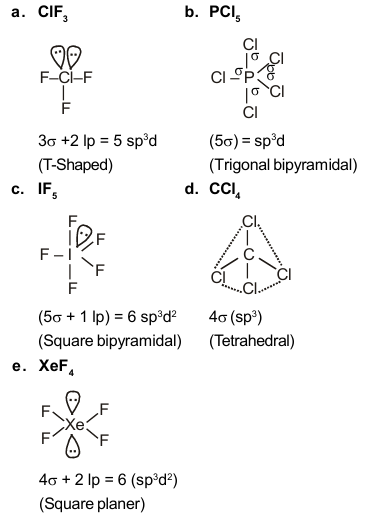
Match List I and List II and pick out correct matching from a given choices :| List I (Compound) | List II (Structure) |
| a. $ClF _3$ | i. Square planar |
| b. $PCl _5$ | ii. Tetrahedral |
| c. $IF _5$ | iii. Trigonal bipyramidal |
| d. $CCI _4$ | iv. Square bipyramidal |
| e. $XeF _4$ | v. T-shaped |
- A
a-v, b-iv, c-iii, d-i, e-ii
- B
a-v, b-iii, c-iv, d-ii, e-i
- C
a-iv, b-iii, c-v, d-ii, e-i
- D
a-iii, b-iv, c-i, d-v, e-i
View full question & answer→MCQ 434 Marks
Given below are two statements: one is labelled as Assertion(A) and the other is labelled as Reason (R).
Assertion(A) : $FeCl _3$ is more covalent then $FeCl _2$.
Reason ( R ) : Greater the charge on cation greater is covalent character.
In the light of the above statements, choose the most appropriate answer from the options given below:
- ✓
Both Assertion (A) and Reason (R) are true and Reason (R) is the correct explanation of Assertion (A).
- B
Both Assertion (A) and Reason (R) are true and Reason (R) is not the correct explanation of Assertion (A).
- C
Assertion (A) is true but Reason (R) is false.
- D
Both Assertion (A) and Reason (R) are false
AnswerCorrect option: A. Both Assertion (A) and Reason (R) are true and Reason (R) is the correct explanation of Assertion (A).
View full question & answer→MCQ 444 Marks
$KMnO _4$ reacts with oxalic acid according to the equation,
$
2 MnO_4^{-}+5 C_2 O_4{ }^{2-}+16 H^{+} \rightarrow 2 Mn^{2+}+10 CO_2+8 H_2 O .
$
Here, $2 0 ~ m L$ of $0.1 M KMnO _4$ is equivalent to :
- A
120 mL of $0.25 M H _2 C _2 O _4$
- B
150 mL of $0.1 M H _2 C _2 O _4$
- ✓
50 mL of $0.1 M H _2 C _2 O _4$
- D
50 mL का $0.2 M H _2 C _2 O _4$
AnswerCorrect option: C. 50 mL of $0.1 M H _2 C _2 O _4$
(C)50 mL of $0.1 M H _2 C _2 O _4$
$KMnO _4$ reacts with oxalic acid according to the equation,
$
\begin{array}{l}
2 MnO_4^{-}+5 C_2 O_4{ }^{2-}+16 H^{+} \rightarrow 2 Mn^{2+}+10 CO_2+ \\
8 H_2 O .
\end{array}
$
Here, 20 mL of $0.1 M KMnO _4$ is equivalent to 50 mL of $0.1 M H _2 C _2 O _4$
View full question & answer→MCQ 454 Marks
Statement-I : Copper liberates hydrogen from a dilute solution of hydrochloric acid
Statement-II : Hydrogen is below copper in the electrochemical series.
- ✓
Both Statement I and Statement II are incorrect
- B
Statement I is correct but Statement II is incorrect
- C
Statement I is incorrect but Statement II is correct
- D
Both Statement I and Statement II are correct.
AnswerCorrect option: A. Both Statement I and Statement II are incorrect
View full question & answer→