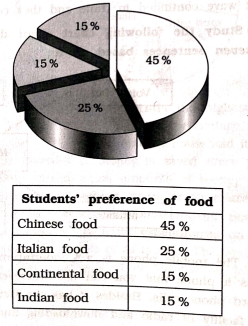
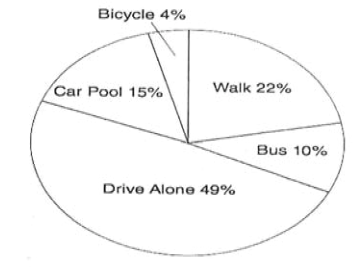
Question types

Section : D question types

149 questions across 7 question groups — pick any mix to generate a ENGLISH paper with step-by-step answer keys.

149
Questions
7
Question groups
5
Question types
Sample Questions

Section : D questions

One sample from each question group in this chapter. Select any group above to see the full set with answer keys.

Tradition. In Miss Ralston's class the boys have always carried the water bucket. Until one day, the girls decide its time to challenge the rule.
The last hour of school on Friday afternoons was for Junior Red Cross. The little kids would get out their Junior Red Cross pins and put them on and we big kids would start elbowing down the aisles to the book cupboard at the back to see who would get the interesting magazines. There was a big pile of them and they were of two kinds: The National Geographic and the Junior Red CrossNews. Apart from the magazines for the hig kids and may be the teacher reading a story to the little kids, about the only other thing that happened regularly during Red Cross was picking the two boys who would carry water the next week.
Questions:
Q.1. What is the tradition in Miss Ralston's class?
Q.2. What did the big kids do on last Friday?
Q.3. Which were the two kinds of books available?
Q.4. What was the other thing that happened on Friday ?
Q.5. Suggest a title to the paragraph
View full solution
The young liftman in a city office who threw a passenger out of his lift the other morning and was fined for the offence was undoubtedly in the wrong. It was a question of ‘Please.’ The complainant entering the lift, said, ‘Top.’ The liftman demanded ‘Top-please,’ and this concession being refused he not only declined to comply with the instruction but hurled the passenger out of the lift. This, of course, was carrying a comment on manners too far. Discourtesy is not a legal offence, and it does not excuse assault and battery. If a burglar breaks into my house and I knock him down, the law will acquit me, and if I am physically assaulted, it will permit me to retaliate with reasonable violence. It does this because the burglar and my assailant have broken quite definite commands of the law. But no legal system could attempt to legislate against bad manners or could sanction the use of violence against something which it does not itself recognize as a legally punishable offence. And whatever our sympathy with the lift-man, we must admit that the law is reasonable. It would never do if we were at liberty to box people’s ears because we did not like their behaviour, or the tone of their voices, or the scowl on their faces. Our fists would never be idle, and the gutters of the city would run with blood all day.
But though we are bound to endorse the verdict against the lift-man, most people will have a certain sympathy with him. While it is true that there is no law that compels us to say ‘Please,’ there is a social practice much older and much more sacred than any law which enjoins us to be civil. And the first requirement of civility is that we should acknowledge a service. ‘Please’ and ‘Thank you’ are the small changes with which we pay our way as social beings. They are the little courtesies by which we keep the machine of life oiled and running sweetly.
Questions:
Q.1. What did the liftman do to the passenger?
Q.2. Why is physically assaulting a burglar who breaks into your house legally permissible?
Q.2. What would happen if people were permitted to attack those who spoke rudely or mannerlessly?
Q.4. How were both the liftman and the passenger in the wrong?
Q.3. The writer obviously sympathises with the lift-man. Why does he do so?
View full solution
Why is it easy to form bad habits, and so hard to form good ones? The reason is plain. Our natural inclination is to take the line of least resistance. It requires at first a distinct effort to take the more difficult of two possible courses of action. For instance, it is easier to lie in bed on a cold morning than to get up early. It is easier to tell a lie than to own up and take the punishment for a fault. It is easier to put off today’s duties to tomorrow than to do them at the right time. Now a habit is formed by repetition. Every time we yield to temptation makes it easier to yield, and harder to resist the next time. So we form the habits of laziness, lying and unpunctuality.
Happily good habits are formed in the same way. The forming of them calls for effort and determination at first, but every time we resist temptation and do what is, in the long run, wise and good, we make the next struggle less severe. At last, we form a good habit which would be hard to break even if we wanted to break it. Get into the habit of early rising and you will not want to lie in bed like a lazybones. Get into the habit of telling the truth, and you will find it really hard to tell a lie. Get into the habit of doing today’s work today, and you will feel uncomfortable if you have to put anything off till tomorrow.
Habit-forming is very important, for character is simply a bundle of habits. If we form good habits, we build up a good character, if we form bad habits we form a bad character.
Questions:
Q.1. What is character?
Q.2. What determines good character?
Q.3. What are the steps in the formation of a bad habit?
Q.4. What should we do when we are faced with temptation?
Q.5. Which of the following are hard to break good habits or bad habits
View full solution
People are always talking about ‘the problem of youth’. If there is one which I take leave to doubt – then it is older people who create it, not the young themselves. Let us get down to the fundamentals and agree that the young are after all human beings – people just like their elders. There is only one difference between an old man and a young one; the young man has a glorious future before him and the old one has a splendid past behind him, and maybe that is where the rub is. When I was a teenager, I felt that I was just young and uncertain – that I was a new boy in a huge school. I would have been very pleased to be regarded as something so interesting as a problem. For one thing, being a problem gives you a certain identity and that is one of the things the young are busily engaged in seeking. I find young people exciting. They have an air of freedom, and they have not a dreary commitment to mean ambition or love of comfort. They are not anxious social climbers, and they have no devotion to material things. All this is in my mind when I meet a young person. He may be conceited, ill-mannered, presumptuous, but I do not turn for protection to dreary dictates about respect for elders-as if mere age were a reason for respect. I accept that we are equals and I will argue with him as an equal if I think he is wrong.
Questions :
Q.1. How did the writer feel when he was a teenager?
Q.2. What characteristics might a young person have?
Q.3. Categorise the following into those that refer to the youth and those that refer to the elderly person :
(a) He has a splendid past behind him.
(b) He has not a dreary commitment to mean ambition or love of comfort,
(c) He has an exciting air of freedom about him. (d) He expects to be respected because of his age.
Q.4. Which of the following correctly express the writer’s feelings and interactions for and with youth?
(а) He finds them exciting,
(b) He encourages them to be social climbers,
(c) He likes to argue with them as an equal,
(d) He considers them a problem.
Q.5. Which characteristics of elderly people does the writer obviously criticise?
View full solution
The evil effects of tobacco are not confined to children alone. They are equally injurious to adults too as is strongly maintained by medical men, who have given this matter their special consideration. Excessive smoking gives rise to chronic pharyngitis with irritability of the throat and cough and might ultimately predispose to tuberculosis. The blood becomes impoverished and circulation affected; palpitation of the heart and pain over the heart region, being the chief results. Sometimes, though rarely, the cardiac pain may be so intense as to stimulate angina pectoris. Tobacco-heart (also called Irritable heart or Soldier’s heart) is a dangerous affliction rendering the victim unfit of thousands of would-be recruited to the late wars, and colleges and universities have recognised that cigarette-smoking has seriously interfered with the efficiency of their athletic teams, and whoever desires to be in the best form should abstain from smoking. Confirmed smokers have never been amongst long-distance swimmers or rowers or cyclists. Dr Seawer, Professor of Physical Culture in the Yale University, found by a series of experiments that non-smoking students made far better records in physical development than smokers, their increase in height was 24 per cent more than the others, while in their chest or breathing capacity their superiority was more than 77 per cent.
Questions:
Q.1. What was the finding of colleges and universities?
Q.2. What are the problems of the respiratory tract that smokers may face?
Q.3. What were Dr Seawer’s findings?
Q.4. Why have long time smokers never been amongst long-distance swimmers, rowers or cyclists?
Q.5. Why do you think smokers could not be recruited as soldiers?
View full solution
When I pass to my reward, whatever that may be,
I’d like my friends to think of me,
As one who loved a tree.
I’d like a tree to mark the spot,
Where I am laid to rest
For that would be the epitaph That I would like the best,
The’ it’s not carved upon a stone,
For those who come to see
But friends would know that resting there
Is he, who loved a tree.
Questions :
Q.1. What is the poet passionate about ?
Q.2. Write the desire of the poet when he dies.
Q.3. Where the epitaph is generally carved on ?
Q.4. How will the poet’s friends know about his resting place ?
Q.5. Give a suitable title to the poem.
View full solution
I know I shall meet my fate
Some where among the clouds above;
Those that fight I do not hate,
Those that I guard I do not love;
My country is Kiltartan’s poor;
No likely end could bring them loss
Or leave them happier than before.
Nor law nor duty bade me fight,
No public men, nor cheering crowds,
A lonely impulse of delight
Drove this tumult in the clouds;
I balanced all, brought all to mind,
The years to come seemed waste of breath.
A waste of breath the years behind
In balance with this life, this death (S. S. Exam 2017)
[In the poem, the speaker is an Irish air-man. He decides to fight in the World War I. He declares that he knows he will die fighting among the clouds (in the air as a fighter pilot). His past life seems a waste and his death will balance his life.]
Questions
Q.1. Enlist the rhyming words in the poem.
Q.2. What mood of the poet does the poem reflect?
Q.3. waste of breath’, Comment on the phrase in the light of the poem.
Q.4. Give the poem a title.
Q.5. What lesson does this poem give?
View full solution
Behold her single in the field
Yon solitary Highland lass!
Reaping and singing by herself;
Stop here or gently pass!”
Alone she cuts and binds the grain.
And sings a meloncholy strain;
O listen! for the Vale profound.
Is overflowing with the sound.
Will no one tell me what she sings?
Perhaps the plaintive numbers flow
For old, unhappy, far off things.
And battles long ago;
Or is it some more humble lay.
Familiar matter of today?
Some natural sorrow, loss or pain.
That has been and may be again? (S. S. Exam 2016)
[In this poem, the poet invites the passers-by to turn their attention to a young woman working alone in a field. She is harvesting grain and tying it into bundles and as she does so, she is singing a sad song that fills the valley. The poet advises that people should either stop and listen or pass quietly.]
Questions
Q.1. What is the Highland girl doing by herself?
Q.2. ‘Stop here or gently pass! Why does the writer say so?
Q.3. According to the poet, what may be the theme of the girl’s song?
Q.4. What kind of song was being sung by the girl?
Q.5. The Vale profound is overflowing with the sound. Explain.

View full solution
Does the road wind uphill all the way ?
Yes, to the very end.
Will the day’s journey take the whole long day?
From morn to night, my friend
But is there for the night a resting-place ?
A roof for when the slow, dark hours begin.
May not the darkness hide it from my face?
You cannot miss that inn.
hall I meet other wayfarers at night?
Those who have gone before.
Then must I knock, or call when just in sight?
They will not keep you standing at the door.
Shall I find comfort, travel-sore and weak?
Of labour you shall find the sum.
Will there be beds for me and all who seek ?
Yea, beds for all who come. (S.S. Exam 2016)
[In the poem, life is compared to a journey uphill. According to the poem, as walking uphill is challenging, so is the life. It is always challenging. The poem is written using questions and answers.]
Questions
Q.1. How long has one to walk to reach uphill ?
Q.2. What does ‘inn’ mean here?
Q.3. What act will determine the reward ?
Q.4. What are the fears of the wayfarer ?
Q.5. Why does the speaker wish for comforts ?
View full solution
All the world’s a stage,
And all the men and women merely players :
They have their exits and their entrances;
And one man in his time plays many parts,
His acts being seven ages. At first, the infant,
Mewling and puking in the nurse’s arms.
Then the whining schoolboy, with his satchel
And shining morning face, creeping like snail
Unwillingly to school. And then the lover,
Sighing like furnace, with a woeful ballad
Made to his mistress’ eyebrow. Then a soldier,
Full of strange oaths and bearded like the pard,
Jealous in honour, sudden and quick in quarrel,
Seeking the bubble reputation
Even in the cannon’s mouth. And then the justice,
In fair round belly with good capon lined,
With eyes severe and beard of formal cut,
Full of wise saws and modern instances;
And so he plays his part. (S.S. Exam 2014)
[Shakespeare compares man to an actor. He plays the part of an infant and mostly passes his time in crying. Then he is a school going child, then a romantic lover, then a soldier and then a judge, etc.]
Questions
Q.1. How many roles does a person play in his lifetime ?
Q.2. List the similes and metaphors the poet has used in the poem.
Q.3. How has the poet described the ‘justice’?
Q.4. Write two characteristics of a soldier.
Q.5. Which role do you find more interesting ? Why?
View full solution
Q 11Advertisements5 Marks
You are a leading ground handling agency. You want to provide services to reputed international airlines. You want to appoint some personnel for your agency. You will have to indicate your specific requirements. With these details, prepare an advertisement inviting people for a personal walk-in-interview at a hotel.
View full solution
Q 12Advertisements5 Marks
You have got special guts for market research. You can train some more people setting up a well-infrastructured organisation. Prepare an advertisement in the name of your organisation to invite people for the training.
View full solution
Q 13Advertisements5 Marks
You are transferred to a big city, so you want to dispose off some of the household goods. Draft an advertisement for a local newspaper. (25 to 30 words)
View full solution
Q 14Advertisements5 Marks
You are Ashwini Kumar. You make beautiful greeting cards. You are interested in clearing the stock on the occasion of Diwali. Draft an advertisement for publication in the local newspaper. (25 to 30 words)
View full solution
Q 15Advertisements5 Marks
You are holding an exhibition for your sale items. You are a fashion joint. Prepare an advertisement to attract customers to visit your exhibition and buy your sale items at discounted prices.
View full solution
I will meet you yet again

How and where? I know not.
Perhaps I will become a

figment of your imagination

and may be, spreading myself

in a mysterious line

on your canvas,
I will keep staring at you.
Perhaps I will become a ray

of sunshine, to be

embraced by your colours.
I will paint myself on your canvas

I know not how and where ’

but I will meet you for sure.
Maybe I will turn into a spring,

and rub the foaming ’

drops of water on your body,

and rest my coolness on

your burning chest.
I know nothing else
but that this life
will walk along with me.
When the body perishes, all perishes;
but the threads of memory

are woven with enduring specks.
I will pick these particles
weave the threads,
and I will meet you yet again.

View full solution
It takes much time to kill a tree,
Not a simple jab of the knife Will do it.

It has grown Slowly consuming the earth,
Rising out of it, feeding

Upon its crust, absorbing

Years of sunlight, air, water,
And out of its leprous hide

Sprouting leaves.
So hack and chop
But this alone won’t do it.
Not so much pain will do it.
The bleeding bark will heal

And from close to the ground ’

Will rise curled green twigs,
Miniature boughs
Which if unchecked will expand again

To former size.
No,
The root is to be pulled out

Out of the anchoring earth;
It is to be roped, tied,
And pulled out-snapped out

Or pulled out entirely,
Out. from the earth-cave,
And the strength of the tree exposed,
The source, white and wet,
The most sensitive, hidden

For years inside the earth.
Then the matter

Of scorching and choking In sun and air,
Browning, hardening,
Twisting, withering,
And then it is done.

View full solution
A bird came down the walk:
He did not know I saw;
He bit an angle-Worm in halves

And ate the fellow, raw.
And then he drank a dew

From a convenient grass,
And then hopped sidewise to the wall

To let a beetle pass.
He glanced with rapid eyes

That hurried all abroad,
They looked like frightened beads,

I thought; He stirred his velvet head

Like one in danger; cautious,
I offered him a crumb,
And he unrolled his feathers

And rowed him softer home

Than oars divide the ocean,
Too silver for a seam,
Or butterflies, off banks of noon,
Leap, plashless, as they swim.

View full solution
“Across the years he could recall

His father one way best of all.”
“In the stillest hour of night

The boy awakened to a light.”
“Half in dreams, he saw his sire

With his great hands full of fire.”
“The man had struck a match to see

If his son slept peacefully.”

View full solution
“Pretty women wonder where my secret lies.

I’m not cute or built to suit a fashion model’s size
But when I start to tell them,
They think I’m telling lies.
I say,
It’s in the reach of my arms The span of my hips,
The stride of my step,
The curl of my lips.
I’m a woman Phenomenally.
Phenomenal woman,
That’s me.
I walk into a room Just as cool as you please,
And to a man,
The fellows stand or Fall down on their knees.
Then they swarm around me,
A hive of honey bees.
I say,
It’s the fire in my eyes,
And the flash of my teeth,
The swing in my waist,
And the joy in my feet.
I’m a woman Phenomenally.
Phenomenal woman,
That’s me.”

View full solution
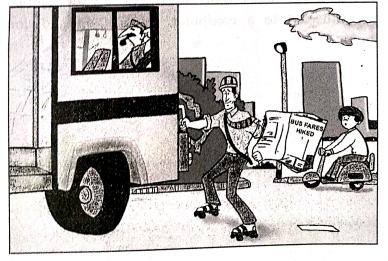
The recent hike in bus fares prompted the artist to draw the following cartoon showing bus fares have become unaffordable.

Based on the cartoon above and using yo own ideas write about six to seven sentences
View full solution
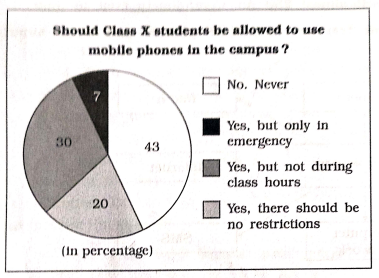
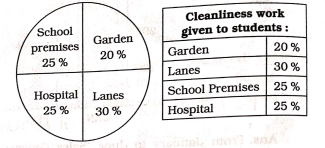
A survey was conducted among the teachers of New Hope High School to find out whether Class X students should be allowed to use mobile phones in the campus. The results of the survey are shown in the ple-chart below. Write about six to seven sentences based on it :
View full solution
Q 26Note Making5 Marks
We all want to help one another. Human beings are like that. We want to live by each other's happiness, not by each other's misery. We don't want to hate and despise one another. In this world there is room for everyone.
And the good earth is rich and can provide for everyone. The way of life can be free and beautiful, but we have lost the way.
Greed has poisoned men's souls; has barricaded the world with hate; has goose stepped us into misery and bloodshed. We have developed speed, but we have shut ourselves in. Machinery that gives abundance, has left us in want. Our knowledge has made us cynical: our cleverness, hard and unkind.
We think too much and feel too little. More than machinery, we need humanity. More than cleverness, we need kindness and gentleness.
Without these qualities, life will be violent and all will be lost. The aeroplane and the radio have brough us closer together. The very nature of these inventions cries out for the goodness in man: cries out for universal brotherhood: for the unity of us all.
View full solution
Q 27Note Making5 Marks
It is physically impossible for a well-educated, intellectual, or brave man to make money the chief object of his thoughts just as it is for him to make his dinner the principal object of them. All healthy people like their dinners, but their dinner is not the main object of their lives. So all healthy minded people like making money ought to like it and enjoy the sensation of winning it; it is something better than money. A good soldier, for instance, mainly wishes to do his fighting well. He is glad of his pay very properly so and justly grumbles when you keep him ten years without it ;till, his main mission of life is to win battles, not to be paid for winning them. So of clergymen. The clergymans object is essentially baptize and preach not to be paid for preaching. So of doctors. They like fees no doubt ,ought to like them; yet if they are brave and well-educated the entire object to their lives is not fees. They on the whole, desire to cure the sick; and if they are good doctors and the choice were fairly to them, would rather cure their patient and lose their fee than kill him and get it. And so with all the other brave and rightly trained men: their work is first, their fee second—very important always; but still second.
View full solution
Q 28Note Making5 Marks
Good decoration reflects the personality of the people who live in the home. It should, first of all, be distinctive, just as each person is distinctive. A home should have unity not only within each rooms but also throughout the house. Rooms should, to some degree, harmonize with each other. The colour and styling of each room, particularly, should fit into the colour and styling of the rooms which run out of it.
Attractive home furnishings set the stage for pleasant living if they are an expression of yourself, you will have a feeling of satisfaction every time you enter your home, and friends will share your enjoyment.
However, furnishings and surroundings expressive of just the right note of restfulness. gay informality, or elegant simplicity are not often assembled by accident. Even enthusiasm alone is not enough. For most home decorators, it takes poring over plans, trying colour schemes, finding Ingenious ways to make the best of what you have, and shopping around to search out just the right purchases at prices you can afford to pay. But there is keen pleasure in striving for the perfect result, and great satisfaction in achieving it.
A successful house and successful rooms will depend upon the proper relationship of each element in it to the others and to the whole.Therefore, in selecting each piece it is well to consider the background. the usage, the draperies. the floor covering the upholstering materials, the woods, shapes, colour scheme, and the "feeling you prefer for the room.
Work and plan to enjoy your house. Limit the expenditures of time, effort and money to the extent of your abilities, so that just running the house doesn't dominate your life. Elegance and delicate things may be a drain you can afford only in a limited way. If you can't afford outside help, select a house and furnishings that require less care. Plan your activities so that tumult and upset are limited to a few rooms-an activity room or a bedroom, or a corner of the dining room.
You'll get more pleasure out of a house if you have a hobby connected with it-collecting glass or antiques, gardening or indoor flower growing ceramics, art, cooking, decorating, flower arrangements, ete. And you'll get more satisfaction and a great deal of help from studying household activities.
You can select a pleasing combination of colours from a wallpaper, a fabric, an oriental rug a flower or scene, or even a picture in a magazine. If you don't already have the furniture or rugs. It is a good idea to make up a colour scheme in this way. Let one colour predominate Limit a colour scheme to two or three colours. with white or gray tones.
View full solution
Q 29Note Making5 Marks
A good business letter is one that gets results. The best way to get results is to develop a letter that, in its appearance, style and content. conveys information efficiently. To perform this function, a business letter should be concise. clear and courteous.
The business letter must be concise: don't waste words. Little introduction or preliminary chat is necessary Get to the point. make the point, and leave it. It is safe to assume that your letter is being read by a very busy person with all kinds of papers to deal with. Re-read and revise your message until the words and sentences you have used are precise. This takes time, but is a necessary part of a good bustness letter A short business letter that makes Its point quickly has much more impact on a reader than a long-winded, rambling exercise in creative writing. This does not mean that there is no place for style and even, on occasion, humour in the business letter. While it conveys a message in its contents, the letter also provides the reader with an impression of you, its author: the medium is part of the message.
The business letter must be clear. You should have a very firm idea of what you want to say. and you should let the reader know I Use the structure of the letter-the paragraphs, topic sentences, introduction and conclusion-to guide the reader point by point from your thesis, through your reasoning to your conclusion. Paragraph often, to break up the page and to lend an air of organisation to the letter. Use an accepted business-letter format. Re-read what you have written from the point of view of someone who in seeing it for the first time, and be sure that all explanations are adequate. all information provided (including reference numbers, dates, and other Identification). A clear message, clearly delivered. in the essence of business communication.
The business letter must be courteous. Sarcasm and insults are ineffective and can often work against you. If you are sure you are right. point that out as politely as possible, explain why you are right, and outline what the reader t expected to do about it. Another form of courtesy is taking care in your writing and typing of the business letter. Grammatical and spelling errors (even if you call them typing errors) tell a reader that you don't think enough of him or can lower the reader's opinion of your personality faster than anything you say, no matter how idiotic. There are excuses for ignorance: there are no excuses for sloppiness.
The business letter is your custom-made representative. It speaks for you and is a permanent record of your message. It can pay big dividends on the time you invest in giving it a concise message, a clear structure, and a courteous tone.
View full solution
Q 30Note Making5 Marks
Conversation is indeed the most easily teachable of all arts. All you need to do in order to become a good conversationalist is to find a subject that interests you and your listeners. There are, for example, mumberless hobbies to talk about. But the important thing is that you must Italk about other fellow's hobby rather than your own. Therein lies the secret of your popularity. Talk to your friends about the things that interest them and you will get a reputation for good fellowship, charming wit, and a brilliant mind. There is nothing that pleases people so much as your interest in their interest.
It is just as important to know what subjects to avoid and what subjects to select for good conversation. If you don't want to be set down as a wet blanket or a bore, be careful to avoid certain unpleasant subjects. Avoid talking about yourself, unless you are asked to do so. People are interested in their own problems not in yours Sickness or death bores everybody. The only one who willingly listens to such talk is the doctor. but he gets paid for it.
To be a good conversationalist you must know not only what to say, but how also to say it. Be mentally quick and witty But don't hurt others with your wit. Finally try to avoid mannerism in your conversation. Don't bite your lips or click your tongue, or roll your eyes or use your hands excessively as you speak.
Don't be like that Frenchman who said, "How can I talk if you hold my hand?
View full solution
Q 32E-Mail Writing5 Marks
Write an e-mail to The Editor. The Times of India' requesting him/her to publish your article in the newspaper. Your article is based on Beti Padhao. Beti Bachao.
View full solution

Generate a Section : D paper free

Pick question groups from the list above, set marks and difficulty, and export a branded PDF with step-by-step answer keys. First 3 chapters free — no signup.

Download App