Questions

3 Marks Question

Take a timed test

72 questions · self-marked practice — reveal the answer and mark yourself.

Question 13 Marks
How do ecologists estimate the total number of species present in the world?
Answer
The diversity of living organisms present on the Earth is very vast. According to an estimate by researchers, it is about seven millions. The total number of species present in the world is calculated by ecologists by statistical comparison between a species richness of a well-studied group of insects of temperate and tropical regions. Then, these ratios are extrapolated with other groups of plants and animals to calculate the total species richness present on the Earth.
View full question & answer
Question 23 Marks
What is the significance of the slope of regression in a species-area relationship?
Answer
The slope of regression (z) has a great significance in order to find a species-area relationship. It gives an estimate of species richness of area. It is independent of taxonomical category or type of area studied. It has been found that in smaller areas where the species-area relationship is analysed, the value of slopes of regression is similar regardless of the taxonomic group or the region. However, when a similar analysis is done in larger areas, then the slope of regression is much steeper.
View full question & answer
Question 33 Marks
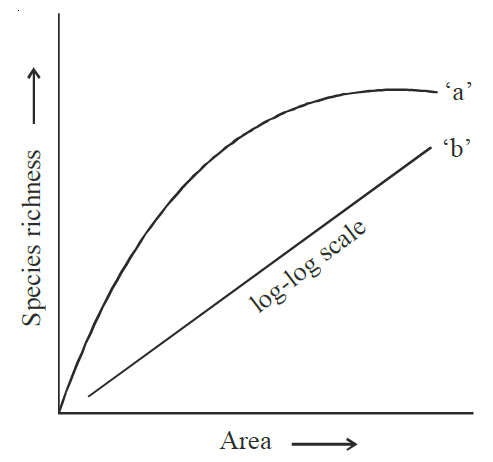
The following graph shows the species-area relationship. Answer the following question as directed.
  1. Name the naturalist who studied the kind of relationship shown in the graph. Write the observation made by him.
  2. Write the situations as discovered by the ecologists when the value of 'Z' (slope of the line) lies.
  1. 0.1 and 0.2
  2. 0.6 and 1.2
What does 'Z' stand for?
  1. When would the slope of the line 'b' become steeper?
Answer
  1. Alexander Von Humboldt. Within a region species, richness increased with increasing explored area but only up to a limit.
  2.  
  • The slopes of regression lines are the similar/unaffected distribution in an area/normal range.
  • The slope of regression is steeper when we analyse the species-area relationship among very large areas like entire continent.
Z (slope of the line) regression co-efficient.
  1. If species richness is more/0.62 - 1.2
View full question & answer
Question 43 Marks
Explain, giving three reasons, why tropics show greatest lavels of species diversity.
Answer
  1. Tropical latitude have remained relatively undisturbed, have a long evolutionary time for species diversification.
  2. Less seasonal variations, constant and predictable environmental condition, promote niche specialization for greater species diversity.
  3. More availability of solar energy, contributes to higher productivity.
View full question & answer
Question 53 Marks
Community Service department of your school plans a visit to a slum area near the school with an objective to educate the slum dwellers with respect to health and hygiene.
  1. Why is there a need to organize such visits?
  2. Write the steps you will highlight, as a member of this department, in your interaction with them to enable them to lead a healthy life.
Answer
  1. To create awareness about disease and their effects on the body/about immunization/health and hygiene.
  2.  
  • Disposal of waste.
  • Control of Vectors.
  • Hygienic food and water/fresh drinking water/Balanced diet/Regular exercise/Yoga.
View full question & answer
Question 63 Marks
Alien species are highly invasive and are a threat to indigenous species. Substantiate this statement with any three examples.
Answer
Nile perch introduced into lakeVictoria in East Africa led to the extinction of Cichlid fish.Parthenium/Lantana/Eichhornia invasive plants and pose a threat to indigenous species.
Introduction of African catfish (Clarias gariepinus) to aquaculture is a threat to Indian catfishes.
View full question & answer
Question 73 Marks
Narrowly utilitarian arguments are put forth in support of biodiversity conservation. Explain the other two arguments that are put forth in support of the same cause.
Answer
  • Broadly utilitarian.
  • Ecosystem services: Purify air, cycling of nutrients, habitat for wildlife, pollinating crops, aesthetic pleasure.
  • Ethical.
  • Philosophical/spiritual/moral duty towards future generations.
View full question & answer
Question 83 Marks
Co-extinction and introduction of alien species too are responsible for the loss of biodiversity. Explain, how.
Answer
Co-extinction- When a species becomes extinct, the plant and animal species associated with it in the obligatory way, also becomes extinct.
Introduction of alien species- When alien species are introduced, some of them turn invasive (because of not having their predator there), and hence cause decline/extinction of indigenous species.
View full question & answer
Question 93 Marks
Name and describe any three causes of biodiversity losses.
Answer
Habitat loss and fragmentation, Habitat loss from tropical rainforest/The Amazon rain forest is being cut and cleared/for raising cattle/for conversion to grass lands/for cultivating soyabeans/large habitats are broken up into small fragments due to human activities/mammals and birds requiring large territories are badly affected leading to decline in population.
Over exploitation, when 'need' turns 'greed' lead to over exploitation of natural resources/steller’s sea cow/passenger pigeon were over exploited/marine fish populations around the world are over exploited/endangering existance of commercially important species.
Alien species invasions, when introduced unintentionally or deliberately for any purpose some of them turn invasive and decline indigenous species/carrot grass/parthenium/African cat fish/Clarias gariepinus poses threat to indigenous cat fishes of our river.
Co-extinctions, when a species becomes extinct the plant or animal species associated with it (an obligate way) become extinct/when a host species becomes extinct (its unique assemblage of) parasites meets the same fate/extinction of any member in plant pollinator mutualism leads to extinction of other.
View full question & answer
Question 103 Marks
There are many animals that have become extinct in the wild but continue to be maintained in Zoological parks.
  1. What type of biodiversity conservation is observed in this case?
  2. Explain any other two ways which help in this type of conservation.
Answer
  1. Ex - situ conservation.
  2. Botanical garden, Wild life safaries, Cryopreservation, In-vitro, Seed bank, Tissue culture propagation.
View full question & answer
Question 113 Marks
Many plant and animal species are on the verge of their extinction because of loss of forest land by indiscriminate use by the humans. As a biology student what method would you suggest along with its advantages that can protect such threatened species from getting extinct?
Answer
Ex-situ conservation.
Threatened animals and plants are taken out from their natural habitat and placed in special setting where they can be protected and given special care.
Botanical garden/tissue culture/micro propagation/seed bank.
Zoological Park/wild life safari park/cryopreservation.
View full question & answer
Question 123 Marks
'in-situ' conservation can help endangered/threatened species. Justify the statement.
Answer
Threatened organisms are conserved in their natural habitat/eco system, and such regions are legally protected.
As hotspots/biosphere reserves/national parks/sancturies/sacred groves/ramsar sites.
View full question & answer
Question 133 Marks
How have human activities caused desertification? Explain.
Answer
Human activities contribute to desertification—
  1. Deforestation- Humans cut down trees to serve own purpose like construction of houses and roads. Which is the main cause of desertification.
  2. Improper farming practices- If same crop is grown continuously makes the soil deficient of nutrients resulting in the loss of fertility of soil.
  3. Soil Erosion- That is by different human activities like deforestation due to construction of houses and industrialisation.
View full question & answer
Question 143 Marks
  1. ‘‘India has greater ecosystem diversity than Norway.’’ Do you agree with the statement? Give reasons in support of your answer.
  2. Write the difference between genetic biodiversity and species biodiversity that exists at all the levels of biological organisation.
Answer
  1. Yes, India has greater ecosystem diversystem diversity than norway having deserts, rain forests, mangroves, coral reefs, wetlands, estuaries, and alphine meadows.
  2. Genetic diversity:
  1. Genetic diversity is the total number of genetic characteristics in the genetic makeup of a species.
  2. A single species might show high diversity at the genetic level (E.g. Man: Chinese, Indian American, African etc.) India has more than 50,000 genetically different strains of rice and 1,000 varieties of mango.
  3. Genetic diversity allows species to adapt to changing environments. This diversity aims to ensure that some species survive drastic changes and thus carry on desirable genes.
Specific diversity:
  1. It is the ratio of one species population over total number of organisms across all species in the given biome. ‘Zero’ would be infinite diversity, and ‘one’ represents only one species present.
  2. Species diversity is a measure of the diversity within an ecological community that incorporates both species richness (the number of species in a community) and the eveness of species.
  3. For example, the Western Ghats have a greater amphibian species diversity than the Eastern Ghats. There are more than 2,00,000 species in India of which several are confined to India (endemic).
View full question & answer
Question 153 Marks
Alien species invasion has been a threat to biodiversity. Justify with the help of a suitable example. List any other three causes responsible for such a loss.
Answer
Example of Alien species invasion Nile Perch, introduced into lake Victoria (in East Africa), led to extinction of Cichlid fish (more than 200 species) in the lake Introduction of African cat fish (Clarias gariepinus), for aquaculture, posing threat to indigenous catfish Introduction of carrot grass (Parthenium)/ Lantana/ Water hyacinth (Eicchornia), which are invasive weed, that pose threat to native species or any other appropriate example.
Causes of biodiversity loss:
  1. Habitat loss and fragmentation.
  2. Over exploitation.
  3. Co-extinction.
View full question & answer
Question 163 Marks
List six advantages of "ex-situ" approach to conservation of biodiversity.
Answer
The Ex-situ conservation involves protection of the plants and animals away from the natural habitat. Zoological parks, botanical gardens, and wildlife safari parks serve this purpose. It offers the following advantages:
  1. The endangered organisms are protected from their exploitation and can be maintained in artificial habitats.
  2. Their breeding programs can be regulated and the gametes, as well as embryos, can be preserved in viable and fertile conditions.
  3. Seeds from different genetic strains can be made to undergo hybridization and can be kept for future experiments.
  4. The health of individuals can be monitored and medical assistance can be given as required.
  5. Modern reproductive technology can increase the chances of reproductive success.
  6. Research into reproductive physiology, lifestyle, and ecology of an endangered species is made easier.
View full question & answer
Question 173 Marks
Give three reasons as to why the prokaryotes are not given any figures for their diversity by the ecologists.
Answer
Prokaryotes are not given any number because:
  1. The conventional taxonomic methods are not suitable/ sufficient for identifying these microbes.
  2. Many of these cannot be cultured under laboratory conditions.
  3. Biochemical and molecular biology techniques would put their diversity into millions.
View full question & answer
Question 183 Marks
Explain as to how protection of biodiversity hot spots alone can reduce up to 30% of the current rate of species extinction.
Answer
Although all the biodiversity hot spots put together cover less than 2 percent of the earth’s land area, the number of species they collectively harbour is extremely high and strict protection of these hot spots could reduce the ongoing mass extinctions by almost 30 percent.
View full question & answer
Question 193 Marks
Why should biodiversity be conserved? Explain giving three reasons.
Answer
Biodiversity should be conserved for the following reasons:
  1. The broadly utilitarian argument says that biodiversity plays a major role in many ecosystem services that nature provides.
  2. The narrow utilitarian argument says that humans derive countless direct economic benefits from nature and products of medicinal importance.
  3. The ethical argument for conserving biodiversity relates to what we owe to millions of plant, animal and microbe species with whom we share this planet.
View full question & answer
Question 203 Marks
What do you mean by fragmented habitat? Give one example.
Answer
Destruction of habitat is the most important cause of extinction of both plants and animals species, e.g. dui to habitat loss, 14% of the earth's land surface covered by tropical rainforest is now limited to only 60 loss in the last few years.
The Amazon rainforest (lungs of the planet) are also being cut and destroyed for cultivation of soybean or is converted to grasslands for raising beef cattle. Besides total loss, the degradation of many habitats by pollution also threatens the survival of many species.
View full question & answer
Question 213 Marks
Define co-extinction and give a example.
Answer
When a species becomes extinct, the plant and animal species associated with it also become extinct. This is called co-exitnction.
Example: Certain obligatory mutualistic relationships exist in nature like Pronuba yuccaselles and Yucca; extinction of one will cause extinction of the other.
View full question & answer
Question 223 Marks
Explain giving one example, how co-extinction is one of the cause of biodiversity loss? List the other three causes also.
Answer
When a species becomes extinct, the plant and animal species associated with it in an obligatory may also become extinct. This is called co-extinction. For example, when a host fish species becomes extinct, its unique assemblage of parasites also becomes extinct.Three other causes are:
  1. Habitat Loss and Fragmentation: Destruction of habitat is the most important causes of extinction of both plants and animals species, e.g. dui to habitat loss, 14% of the earth's land surface covered by tropical rainforest is now limited to only 60% loss in the last few years.
When large habitats are broken up into small fragments due to various human activities, mammals and birds requiring large territories and certain animals with migratory habits are badly affected, leading to their population declines.
  1. Over-exploitation: Humans are always dependent on nature for food and shelter. But when human needs turn into greed, it leads to the degradation and extinction of natural resources Many species are extinct in last 500 years due ro over exploitation, e.g. Steller's sea cow, passenger pigeon, etc.
  2. Alien species invasion: Introduction of alien species also causes the risk of extinction. When alien species are introduced, some of them turn invasive and cause decline or extinction of indigenous species, e.g. Nile perch, a large predator Fish, when introduced into the fake Victoria in East Africa, eventually led to the extinction of an ecologically unique assemblage of more than 200 species of cichlid fish in the lake.
Some well-known invasive weed species like Partbenium (carrot grass), Lantana and, water hyacinth (Eichhonia), had caused immense environmental damage and posed threar to our native species. The recent introduction of African catfish (Clarias gariepinus) illegally for aquaculture purpose is posing a threat to the indigenous catfishes of Indian rivers.
View full question & answer
Question 233 Marks
With an example explain lattitude gradient, as a pattern of biodiversity.
Answer
The diversity of plants and animals is not uniform throughout the world but shows a rather uneven distribution. For many group of animals or plants, there are interesting patterns in diversity, the most well- known being the latitudinal gradient in diversity.
The largely tropical Amazonian rain forest in South America has the greatest biodiversity on earth- it is home to more than 40,000 species of plants, 3,000 of fishes, 1,300 of birds, 427 of mammals, 427 of amphibians, 378 of reptiles and of more than 1,25,000 invertebrates. Scientists estimate that in these rain forests there might be at least two million insect species waiting to be discovered and named.
View full question & answer
Question 243 Marks
Why are the conventional methods not suitable for the assessment of biodiversity of bacteria?
Answer
Conventional methods are not sufficient to identify many prokaryotic species. Scientists are yet to discover many species of bacteria which are living on this earth. Without complete knowledge of all the species present, it is not possible to properly assess the biodiversity of bacteria.
View full question & answer
Question 253 Marks
Answer the following questions:
Biologists are not sure about how many prokaryotic species there might be. Give reasons.
Answer
Biologists are not sure about the number of prokaryotic species because:
  1. The conventional taxonomic methods are not sufficient for identifying these microbial species.
  2. Many of the species cannot be cultured under laboratory conditions.
  3. Biochemical and molecular biology techniques would put their diversity into millions.
View full question & answer
Question 263 Marks
The species diversity of plants (22 per cent) is much less than that of animals (72 per cent). What could be the explanations to how animals achieved greater diversification?
Answer
Species diversity refers to the variety of species within a region which is less in plants as compared to animals. It is due to greater dispersal/ more number of surviving individuals.Most animals possess simple or complex nervous system to control and coordinate various activities. They possess receptors to receive against them. Most of their responses are adaptive and ensure their survival in changing environmental conditions. They, therefore, have evolved to reveal much higher species diversity than plants who do not possess nervous system and respond differently against environment stimuli.
View full question & answer
Question 273 Marks
What could be the possible explanation for greater vulnerability of amphibians to extinction as compared to other animal groups?
Answer
Scientist have yet to understand the proper cause for large scale extinction of amphibians. Some of the possible reasons are: disease, habitat destruction and modification, exploitation, pollution, pesticide use, exotic species and ultraviolet-B radiation. Their complex reproductive need may be one of the cause of high vulnerability of amphibians to extinction.
View full question & answer
Question 283 Marks
Who gave the concept of hot spots? What are the major criteria for number of species conserved there?
Answer
Norman Myers gave the concept of hotspot in 1988.
  1. Species diversity and species density.
  2. Degree of endemism.
  3. Degree of threat due to degradation, habitat loss.
  4. Degree of exploitation.
View full question & answer
Question 293 Marks
What are the major causes of species losses in a geographical region?
Answer
Biodiversity is the variety of living forms present in various ecosystems. It includes variability among life forms from all sources including land, air, and water. Biodiversity around the world is declining at a very fast pace. The following are the major causes for the loss of biodiversity around the world.
  • Habitat loss and fragmentation: Habitats of various organisms are altered or destroyed by uncontrolled and unsustainable human activities such as deforestation, slash and burn agriculture, mining, and urbanization. This results in the breaking up of the habitat into small pieces, which effects the movement of migratory animals and also, decreases the genetic exchange between populations leading to a declination of species.
  • Over-exploitation: Due to over-hunting and over-exploitation of various plants and animals by humans, many species have become endangered or extinct (such as the tiger and the passenger pigeon).
  • Alien species Invasions: Accidental or intentional introduction of non- native species into a habitat has also led to the declination or extinction of indigenous species. For example, the Nile perch introduced in Lake Victoria in Kenya led to the extinction of more than two hundred species of native fish in the lake.
  • Co-extinction: In a native habitat, one species is connected to the other in an intricate network. The extinction of one species causes the extinction of other species, which is associated with it in an obligatory way. For example, the extinction of the host will cause the extinction of its parasites.
View full question & answer
Question 303 Marks
There are many animals that have become extinct in the wild but continue to be maintained in zoological parks.
Which type of biodiversity conservation is observed in this case?
Answer
It is an example of ex-situ (offsite) conservation. In this approach, threatened plants and animals are taken out of their natural habitat and placed in suitable settings and given special care.
View full question & answer
Question 313 Marks
What is co-extinction? Explain with a suitable example?
Answer
When a species becomes extinct, the plant and animal species associated with it in an obligatory way also become extinct. When a host fish species becomes extinct, its unique assemblage of parasites also meets the same fate. Another example is the case of a coevolved plant-pollinator mutualism where extinction of one invariably leads to the extinction of the other.
View full question & answer
Question 323 Marks
How is biodiversity important for ecosystem functioning?
Answer
Biodiversity is important for ecosystem functioning because,
  1. It contributes to productivity.
  2. It cause more efficient recycling of energy and matter.
  3. It has many alternative pathways for survival under diverse conditions.
  4. Rich biodiversity provides alternatives available at each trophic level. All organisms are linked in food chains and interact with their abiotic environment in such a way so as to keep the natural cycles going and make the ecosystems self - sustaining units. Disappearance of any link in a food chain will not affect the ecosystem as other alternatives are there.
View full question & answer
Question 333 Marks
Differentiate between:
Keystone species and endangered species.
Answer
S. No.
Keystone species
Endangered species
(i)
It is a species of lower abundance that plays vital role in sustaining the community.
It is a species of lower abundance that may or may not have a vital role in sustaining the community.
(ii)
The species is not threatened, e.g., Ficus.
The species is at high risk of extinction in near future, e.g., Red Panda.
View full question & answer
Question 343 Marks
What is red list? Give two uses of red list.
Answer
IUCN maintains a red data book or red list which is a catalogue of taxa facing risk of extinction.Uses:
  1. Identification and documentation of endangered species.
  2. Creating awareness about importance of threatened biodiversity.
View full question & answer
Question 353 Marks
Define biodiversity Name the two most biodiversity rich zones of India.
Answer
Biodiversity is the occurrence of different types of ecosystems, different species of organisms with the whole range of their variants (biotypes) and genes along with their interactions and processes.
Western Ghats and North-East (Eastern Himalayas) region.
View full question & answer
Question 363 Marks
How do scientists extrapolate the total number of species on Earth?
Answer
Scientists make a statistical comparison of the temperate-tropical species richness of an exhaustively studied group of insects and extrapolate this ratio to other groups of animals and plants to come up with a gross estimate of the total number of species on earth.
View full question & answer
Question 373 Marks
What accounts for the greater ecological diversity of India?
Answer
Following are the reasons for greater ecological diversity of India:
  1. Low Latitude: Biodiversity is higher in lower latitudes than in higher latitudes.
  2. Presence of rainforests and deciduous forests.
  3. Presence of mountain forests.
View full question & answer
Question 383 Marks
During an excursion to a botanical garden, the teacher shows an old tree, which was on the verge of extinction. As soon as the teacher advanced with the students, some enthusiastic students climbed up the tree and started cutting the branches, collecting its leaves as precious collection. Rajesh instead took photographs of the tree from various angles. The boys mocked at Rajesh while the teacher appreciated him.
  1. How can biodiversity be conserved?
  2. What international initiatives were taken to conserve biodiversity?
  3. What values did Rajesh possess?
Answer
  1. Biodiversity can be conserved in the following two ways In situ conservation Sacred groves, biosphere reserves (terrestrial and marine), national parks and wildlife sanctuaries, etc. Er-situ conservation Sacred plants, home gardens, seed banks, gene bank, cryopreservations, botanical garden, zoological garden and aquariums.
  2. For conserving biodiversity, the Earth Summit was held in 1992 and World Summit was held in 2002.
  3. The values possessed by Rajesh are respect for nature, scientific attitude with a vision of the future.
View full question & answer
Question 393 Marks
Answer the following questions:
Would Western Ghats ecosystems be less functional if one of its tree frog species is lost forever? Substantiate your answer in the light of hypothesis proposed by Paul Ehrlich.
Answer
According to the hypothesis proposed by Paul Ehrlich, the "Rivet popper hypothesis", each species is essential in the balance of nature. If one is lost that much imbalance is caused in the ecosystem.
View full question & answer
Question 403 Marks
Seeing a crowd of students in one corner of the school, the principal rushed to see the matter and found some children beating and chasing a small lizard. On seeing the principal, all the children fled to their classes except Alok who requested the principal to arrange for some medical assistance for the injured animal. The principal rewarded Alok for his attitude to save guard our biodiversity.
  1. Mention the factors resulting in loss of biodiversity
  2. Was Alok an indisciplined boy, who did not run to the class on seeing the principal? What values does the act promote?
Answer
  1. There are four major factors that results in loss of bidiversity and these are:
  1. Habitat loss and fragmentation.
  2. Over-exploitation.
  3. Alien species invasion.
  4. Co-extinction.
  1. No, Alok was a brave and courteous boy. He expressed his love for animals, commitment towards natural resources and their conservation.
View full question & answer
Question 413 Marks
Name the three important components of biodiversity.
Answer
Biodiversity refers to the variability of living organisms on Earth. The main biological components or levels of biodiversity are:
  • Genetic diversity: It is the genetic variability among a species.
  • Species diversity: It refers to the number of species that live in a particular place.
  • Ecological diversity: It refers to the variation in ecosystems in a particular region or variation in ecosystem across the planet.
View full question & answer
Question 423 Marks
Differentiate between in situ and ex situ approaches of conserving biodiversity.
Answer
 
In situ conservation
Ex situ conservation
1.
It means conservation on site, i.e. protecting an endangered species in its natural habitat by maintaining the habitat itself and defending the species from predators and poachers.
It means off-site conservation, i.e. protecting an endangered species by removing it from the threatened habitat and placing it under the care of humans.
2.
This approach emphasizes on the protection of total ecosystem.
This approach restricts to the protection of genetic resources at population and species level.
3.
This approach includes methods of protection like hot spots, national parks, wildlife sanctuaries and biosphere reserves.
It is done through live collections of animals and plants in zoos, botanical gardens, seed banks etc.
View full question & answer
Question 433 Marks
Mention the three attributes that a stable community has.
Answer
Attributes of a Stable Community:
  1. It shall not show too much variation in the year-to-year productivity.
  2. It must be either resistant or resilient to seasonal disturbances.
  3. It must be resistant to invasion of alien species.
View full question & answer
Question 443 Marks
Humans benefit from diversity of life. Give two examples.
Answer
Following are the two benefits which human beings derive from biodiversity:
  1. We get food, medicines, raw materials, wood, etc. from nature and this is possible become of biodiversity.
  2. Biodiversity helps in maintaining the ecosystem. A healthy ecosystem is beneficial for all of us.
View full question & answer
Question 453 Marks
Differentiate between:
Genetic diversity and species diversity.
Answer
S. No. Genetic diversity Species diversity
(i) It represents the variety of genetic information present in an organism. It is the variety of species and their relative abundance found within a region.
(ii) It is trait of an organism. It is trait of a biotic community.
View full question & answer
Question 463 Marks
  1. Explain two approaches of biodiversity conservation.
  2. Which conservation method is used to maintain the species of wildlife in their natural habitats?
Answer
  1. This is an apporach for in sin method of conservation. Eminent conservationists have identified certain regions for the maximum protection, these regions are called biodiversity hotspots.
These are regions with very high levels of species richness, high degree of endemism (species confined to a region and not found anywhere else) and accelerated habitat loss. Initially, 25 biodiversity hotspots were identified. Now, there are 34 hotspots all over the world.
These hotspots are in India, i.e. Western Ghats and Sri Lanka Indo-Burma and Eastern Himalaya. If all the biodiversity hotspots are put together, they cover less than 2% of the earth's land area, but harbor extremely high diversity. Ongoing mass extinctions could be reduced by 30% through strict protection of these hotspots.
  1. There are two methods of conservation:
  1. In Situ (On site) Conservation: It is the conservation and protection of the whole ecosystem and its biodiversity at all levels in order to protect the threatened species. However, it is not economically feasible to conserve all the biological wealth at all the existing ecosystems.
  2. Ex-Situ (Off site) Conservation: This approach involves placing the threatened animals and plants in special care units for their protection. Ex-situ conservation includes off site collections and gene bank.
View full question & answer
Question 473 Marks
What criteria should one use in categorizing a species as threatened?
Answer
  1. Extinction risk: Number of the individuals of th species are declining at an alarming pace.
  2. Predation pressure.
  3. Habitat loss and fragmentation.
View full question & answer
Question 483 Marks
Where are the main centres of biodiversity in Western Ghats? Mention two significance of conservation of biodiversity.
Answer
Main centres of biodiversity in Western Ghats are- Agasthyamali hills, Silent Valley and Amambalam Reserve.
Significance of biodiversity conservation:
  1. Conserved species can be used to restore degraded land, reintroduce species into wild and restock depleted populations.
  2. It provides breeders and genetic engineers with a ready source of genetic material.
View full question & answer
Question 493 Marks
  1. What are two types of desirable approaches to conserve biodiversity? Explain with examples bringing out the difference between two types.
  2. What is the association between the bumble bee and its favourite orchid Ophrys? How could extinction or change of one would affect the other?
Answer
  1. Practices that help to protect rare, threatened species are as follows:
  • In-situ (onsite) conservation involves protection of species in their natural habitat. It involves biosphere reserves, national parks, wildlife sanctuaries, sacred groves, etc.
  • Ex-situ (offsite) conservation involves placing of threatened animals and plants in special care units for their protection Zoological parks, botanical gardens and wildlife safari parks serve this purpose.
  1. Commensalism because Ophrys employs sexual deceit to get pollinated by species of bee as petal of its flower bears resemblance to female of the bee in size, colour and marking and so, male bee is attracted to what it perceives as female; pseudocopulates with the flower and thus, pollinates it. If the female bee's colour patterns change even slightly due to any reason during evolution, pollination success will be reduced unless the orchid flowers co-evolves to maintain the resemblance of its petal to the female bee.
View full question & answer
Question 503 Marks
Write a note on cultural and religious importance of biodiversity Which type of conservation measures, in situ or ex-situ will help the larger number species to survive? Explain.
Answer
Biodiversity is not only important because we obtain useful things from it but beyond the material need. It also plays a significant role in our cultural life. Biodiversity is a source of inspiration, some people admire its intrinsic beauty, it motivates poets, writer, etc.
It also gives a religious identity in terms of festivals and rituals, we have. In terms of religion as well, some plants are considered sacred like tulsi and peepal. Similarly, many animals are worshiped and have religious value described in the scriptures, e.g. Kaamdhenu and feeding monkeys are regarded as the representative of Lord Hanuman.
View full question & answer
Question 513 Marks
  1. Why is Amazon rain forest referred to as lungs of the planet earth?
  2. Name any four industrial products obtained from nature.
Answer
  1. Because 20% of the total oxygen in the almosphere is produced by the plants of this forest.
  2. The industrial products include:
  1. Dyes.
  2. Tannin.
  3. Resins.
  4. Lubricants.
  5. Perfumes, etc.
View full question & answer
Question 523 Marks
Can you think of a situation where we deliberately want to make a species extinct? How would you justify it?
Answer
Yes, there are various kinds of parasites and disease-causing microbes that we deliberately want to eradicate from the Earth. Since these micro-organisms are harmful to human beings, scientists are working hard to fight against them.
Scientists have been able to eliminate small pox virus from the world through the use of vaccinations. This shows that humans deliberately want to make these species extinct. Several other eradication programmes such as polio and Hepatitis B vaccinations are aimed to eliminate these disease-causing microbes.
View full question & answer
Question 533 Marks
What percent of all bird species and mammal species, respectively face the threat of extinction?
Answer
12% bird species, 23% of mammal species.
View full question & answer
Question 543 Marks
On his visit to a national park, Harshendra was very angry as the forest authorities did not allow him to enter a specified area. On returning back, he discussed the matter with his friend, who explained him the reason.
  1. Which category of conservation strategy does national park belong?
  2. Name India's first national park.
  3. At present, there are how many national parks in India?
  4. What values are shown by Harshendra's friend?
Answer
  1. National Park belongs to in situ conservation method.
  2. First national park of India is Haileys National Park which is now called as Jim Corbett National Park.
  3. According to National Wildlife Database Cell, Wildlife Institute of India, there are 103 national parks till now.
  4. His friend is calm and has knowledge about biodiversity.
View full question & answer
Question 553 Marks
Indiscriminate human activities such as alien species invasion, fragmentation and habitat loss have accelerated the loss of biodiversity. Justify by taking one example for each.
Answer
Human activities have accelerated the rate of extinction of species from the earth.
  1. The four major causes also called the Evil Quartet responsible for the loss of biodiversity are:
  1. Habitat Loss and Fragmentation: Destruction of habitat is the most important causes of extinction of both plants and animals species, e.g. dui to habitat loss, 14% of the earth's land surface covered by tropical rainforest is now limited to only 60 loss in the last few years.
When large habitats are broken up into small fragments due to various human activities, mammals and birds requiring large territories and certain animals with migratory habits are badly affected, leading to their population declines.
  1. Over-exploitation: Humans are always dependent on nature for food and shelter. But when human needs turn into greed, it leads to the degradation and extinction of natural resources Many species are extinct in last 500 years due ro over exploitation, e.g. Steller's sea cow, passenger pigeon, etc.
  2. Alien species invasion: Introduction of alien species also causes the risk of extinction. When alien species are introduced, some of them turn invasive and cause decline or extinction of indigenous species, e.g. Nile perch, a large predator Fish, when introduced into the fake Victoria in East Africa, eventually led to the extinction of an ecologically unique assemblage of more than 200 species of cichlid fish in the lake.
Some well-known invasive weed species like Partbenium (carrot grass), Lantana and, water hyacinth (Eichhonia), had caused immense environmental damage and posed threar to our native species. The recent introduction of African catfish (Clarias gariepinus) illegally for aquaculture purpose is posing a threat to the indigenous catfishes of Indian rivers.
  1.  
  1. IUCN Red Data list: IUCN red list of threatened species is an inventory of global conservation status of biological species, which is compiled in Red Data Book. It was initiated in 1963. IUCN Red List (2004) enlists the extinction of 784 species (including 338 vertebrates, 359 invertebrates and 87 plant) in the last 500 years. The red list of 2012 contains 132 plant and animal species of India.
  2. Hotspots in conservation of biodiversity: This is an apporach for in situ method of conservation. Eminent conservationists have identified certain regions for the maximum protection, these regions are called biodiversity hotspots.
These are regions with very high levels of species richness, high degree of endemism (species confined to a region and not found anywhere else) and accelerated habitat loss. Initially, 25 biodiversity hotspots were identified. Now, there are 34 hotspots all over the world.
View full question & answer
Question 563 Marks
What are sacred groves? What is their role in conservation?
Answer
Sacred groves are tracts of forest which are regenerated around places of worship. Sacred groves are found in Rajasthan, Western Ghats of Karnataka and Maharashtra, Meghalaya, and Madhya Pradesh.
Sacred groves help in the protection of many rare, threatened, and endemic species of plants and animals found in an area. The process of deforestation is strictly prohibited in this region by tribals. Hence, the sacred grove biodiversity is a rich area.
View full question & answer
Question 573 Marks
Among the ecosystem services are control of floods and soil erosion. How is this achieved by the biotic components of the ecosystem?
Answer
The biotic components of an ecosystem include the living organisms such as plants and animals. Plants play a very important role in controlling floods and soil erosion. The roots of plants hold the soil particles together, thereby preventing the top layer of the soil to get eroded by wind or running water. The roots also make the soil porous, thereby allowing ground water infiltration and preventing floods. Hence, plants are able to prevent soil erosion and natural calamities such as floods and droughts. They also increase the fertility of soil and biodiversity.
View full question & answer
Question 583 Marks
Give three hypotheses for explaining why tropics show greatest levels of species richness.
Answer
  1. The tropical area have a more stable climate than temperate zones. Local species continues to live in absence of natural disturbances.
  2. Warm temperature and high humidity in most tropical areas provide favourable conditions for growth and survival of diverse species.
  3. Tropical areas receive more solar energy over year and thus tropical communities are more productive and can support a wide range of species.
View full question & answer
Question 593 Marks
Explain how biodiversity is important for human.
Answer
  1. Humans derive numerous economic benefits directly from diversity of organisms.
  1. Food products (cereals, pulses and fruits), firewood and fibre (cotton, jute from plants and Silk, wool from animals).
  2. Construction material (timber for making furniture, houses and sports goods), industrial products (tannis, lubricant, dyes, resins and perfumes) and products of medicinal importance (about 25.000 plants are used in traditional medicine).
  1. There are huge indirect benefits that humans derive from the diversity of life. These are, pure oxygen, natural pollinators, flood and soil erosion control, nutrient replenishment, waste recycling by microbes and aesthetic pleasure and mental peace.
View full question & answer
Question 603 Marks
The sacred groves of Aravalli Hills and Ooty botanical garden, both aim at biodiversity conservation. How do they differ in their approaches? Explain.
Answer
The sacred groves of Aravalli Hills serve as a method of in situ (on site) conservation and the Ooty Botanical garden is a method of ex situ (off site) conservation.
View full question & answer
Question 613 Marks
What is the 'wise use concept of Ramsar Convention? Name four types of wetlands included in its mission.
Answer
The 'wise use of wetlands refers to the maintenance of their ecological characters through the implementation of ecosystem approaches and the conservation and sustainable use of wetlands and their resources for human benefit.
e.g. swamps and marshes, coral reefs, mangroves, estuaries, near-shore marine areas, peatlands.
View full question & answer
Question 623 Marks
Describe with an example the latitudinal gradients of biodiversity.
Answer
  1. Species diversity decreases as one moves away from the equator towards poles.
  2. In general tropics (latitudinal range of 23.5°N to 23.5°S) harbour more species than temperate or polar regions, because they have constant environments and more solar radiation.
  3. e.g. Colombia located near the equator has about 1400 species of birds whereas New York (41°N) has only 105 species and Greenland (71°N) has only 56 species of birds.
View full question & answer
Question 633 Marks
What is an endangered species? Give an example of an endangered plant and animal species each?
Answer
A species which has been categorized by IUCN Red list as likely to become extinct is called an endangered species.
  1. Platanthera praeclara (a type of orchid) is an endangered plant.
  2. Panthera pardus orientalis (a type of leopard) is an endangered animal.
View full question & answer
Question 643 Marks
What will be consequences of loss of biodiversity?
Answer
Biodiversity is the biological wealth of world.The loss of biodiversity results in:
  1. Decline in plant production.
  2. Extinction of various species.
  3. As man is dependent on biodiversity for food and other necessities, its loss will be hard pressed for mankind.
View full question & answer
Question 653 Marks
What are sacred groves and their role in biodiversity conservation?
Answer
In many cultures, tracts of forest were set aside, and all the trees and wildlife within were venerated and given total protection. Such sacred groves are found in Khasi and Jaintia Hills in Meghalaya, Aravalli Hills of Rajasthan, Western Ghat regions of Karnataka and Maharashtra and the Sarguja. Chanda and Bastar areas of Madhya Pradesh. In Meghalaya, the sacred groves are the last refuges for a large number of rare and threatened plants.
View full question & answer
Question 663 Marks
Express your opinion on removal of tribal people out of forest due to developmental activities in the forest.
Answer
Recently, it has been a trend of removing the tribal people out of the forest in the name of conservation measures. To ensure conservation of habitat and prevention of any sort of danger to biodiversity, government tends to seclude even tribal people from their home. It is an ethical issue. Tribal people are equally a part of the forest. They have lived there for years and have evolved along with the forest.
They share a mutual relationship with the biodiversity present there.
In their unique ways, they also conserve and protect the diversity. Therefore, we must make policies, which include tribals in the conservation measures and utilize their indigenous knowledge as a conservation tool.
View full question & answer
Question 673 Marks
What characteristics make a community stable?
Answer
Following characteristics make a community stable:
  1. Least variation in productivity from year to year.
  2. Resistance to occasional disturbances.
  3. Resistance to invasion by alien species.
View full question & answer
Question 683 Marks
List any three natural world heritage sites of India.
Answer
 
Site
 
State
a.
Kaziranga National Park
-
Assam
b.
Nanda Devi National Park
-
Punjab
c.
Sundarban National Park
-
West Bengal
View full question & answer
Question 693 Marks
Is it possible that productivity and diversity of a natural community remain constant over a time period of, say one hundred years?
Answer
A community in which productivity and diversity is constant is called a climax community. It takes millions of years for a community to progress form primary stage to climax stage. A period of one hundred years is just a small blip in the timeline of community succession. Hence, in most of the cases, a community can easily maintain constancy of productivity and diversity over a time period of hundred years.
View full question & answer
Question 703 Marks
Amazonian rain forest has the greatest biodiversity on earth. List any two hypothesis that are proposed by the biologists to account for the greater biological diversity.
Answer
The hypothesis are:
  1. Speciation is generally a function of time; unlike temperate regions which are subjected to frequent glaciations in the past, tropical latitudes have remained undisturbed for millions of years and hence had a long time for species diversification.
  2. Tropical environments are less seasonal, relatively more constant and predictable; such constant environments promote niche specialisation and lead to a greater species diversity.
  3. There is more solar energy available in the tropics, which contributes to higher productivity; this in turn might contribute indirectly to species diversity.
View full question & answer
Question 713 Marks
Why should we conserve biodiversity? How can we do it?OR
Why should we conserve biodiversity? Why is it a moral as well as social duty to contribute towards its protection?
Answer
  1. Biodiversity should be conserved for the following reasons:
  • The broadly utilitarian argument says that biodiversity plays a major role in many ecosystem services that nature provides.
  • The narrow utilitarian argument says that humans derive countless direct economic benefits from nature and products of medicinal importance.
  • The ethical argument for conserving biodiversity relates to what we owe to millions of plant, animal and microbe species with whom we share this planet.
  1. Importance of biodiversity hotspots and sacred groves: Biodiversity hotspots are the regions of accelerated habitat loss. These can reduce the ongoing mass extinctions by almost 30%. Sacred groves are important in biodiversity conservation, as these are naturally protected by the native population without much effort. In Meghalaya, the sacred groves are the last refuges for large number of rare and threatened plants.
View full question & answer
Question 723 Marks
What is meant by the term ‘hot spots’ in biodiversity? List two criteria used for determining a ‘hot spot’. Name two hot spots of India.
Answer
A hot spot is an area having endangered endemic species with very high levels of species richness.Criteria used for determining a hot spot:
  1. Number of endemic species, i.e., species which are not found anywhere else.
  2. Degree of threat which is measured in terms of habitat loss.
Western Ghats and Eastern Himalayas are two hot spots in India.
View full question & answer