Questions

5 Marks Questions

Take a timed test

18 questions · self-marked practice — reveal the answer and mark yourself.

Question 25 Marks
Explain the difference between apes and human.
Answer
Differences between ape and human :
CharactersHumanApe
1. HabitalTerrestrialArboreal
2. LocomotionErect and plantigrade (on soles)Semierect and on outer edges of feet
3. Limb-sizeLegs longer than armsArms longer than legs
4. PollexOpposableOpposable
5. HalluxNot opposableOpposable
6. Simian gap (between incisor and canine)AbsentPresent
7. Anterior premolars of lower jawSmall and bicuspidLarge and pointed
8. Neck musclesAttached below the brain boxAttached to back of brain box.
9. Basin (Space between pelvic girdles)Broad basinNarrow basin
10. Body hairShort and softLong and coarse
11. ClawsAbsent. Nails presentPresent in Gibbon
12. Ischial callositiesAbsentPresent in Gibbon
13. Cranial cavity1450-1600c.c.Gibbon 100 c.c; Orangutan = 395, c.c., Chimpanzee = 400 c.c.; Gorilla = 520 c.c.
14. Curves in vertebral columnFourOne
15. FaceOrthognathous (flat)Prognathous (protruding)
16. Supra-orbital ridgesAbsentPresent
17. ChinDistinctIndistinct
18. Lumbar curvePresentAbsent
19. Dental archRounded parabolaU-shaped parabola
View full question & answer
Question 35 Marks
What is Mutation? Describe the main points of mutation theory?
Answer
Hugo de Vries (1901) experiment on Evening Primrose (7'0 clock plant) revealed that some plants suddenly become completely different from their own species. Not only this, various traits are inherited and passed from one generation to the next and create new species. De Vries termed sudden hereditary changes inherited form one to next generation as mutation and propounded the theory of mutation. It has also been known, from modern research that mutation in living organisms is caused by changes in the arrangement, structure and sequence of chromosomes and genes located in germ cells of organisms.
Following are the facts of DeVries's mutation theory :
1. Naturally reproducing species or species develop mutations from time to time. Mutant organisms are different from parent life.
2. Mutations are hereditary and lead to the development of new species.
3. Mutation appear all of a sudden. They become operational immediately.
4. Mutations are the raw material of evolution.
5. They can occur in any direction, hence they can be both beneficial and harmful.
6. Natural selection has an effect on mutation. Useful mutations are selected by where as Lethal mutations are eliminated however useless and less harmful once can persist in the progeny.
7. Darwin named these sudden changes as sports.
8. Excessive specialization of organs is explained by these sports or the initial stage of development of organs can be explained by the theory of mutation because mutations are complete from the beginning.
Importance of Mutation : There is not the slightest doubt that mutations occur in nature and their role in development. Natural selection and isolation of were also essential for evolution.
View full question & answer
Question 45 Marks
(a) Write the name of primates existing on earth about 15 million years ago. Write its important characteristics also?
(b) (i) From where did the animals similar to human being meet?
(ii) In which sequence were neanderthal, homohabilis and homo erectus evolved on earth?
(iii) When did modern man evolve on this planet?
Answer
(a) Dryopithecus existed on the earth about 15 million years ago.
Characteristics : (i) Round forehead, (ii) Long canine teeth similar to apes, (iii) Walks somewhat bent over on all fourslegs.
(b) (i) First mammals of this planet are shrews found in East Africa. (ii) Homohabilis, Homoerectus and Neanderthal (iii) About 10000 to 11000 years ago, modern man evolved.
View full question & answer
Question 55 Marks
What evidence for biological evolution is obtained from, comparative anatomy? Describe in detail
Answer
self
View full question & answer
Question 85 Marks
What do you understand by the evidences of Evolutions describe in detail with suitable example the three evidences of evolution?
Answer
self
View full question & answer
Question 95 Marks
Describe in detail the various ancient and modern hypothesis given to explain the origin of life on earth.
Answer
self
View full question & answer
Question 115 Marks
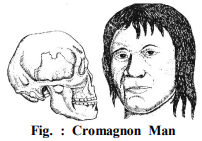
Write the important characteristic of cromagnon man and also clarify that it was closest ancestor of modern man?
Answer
Homo sapiens fossilis (Cromagnonman) : The fossils were excavated from Cromagnon rocks of France by MacGregor (1868). They were found about 20 to 50 thousands years ago. They had following characters :
1. Body length was about 1.8 metre.
2. Cranial capacity was about 1600C.C.
3. Absence of eyebrow ridges and flattened forehead.
Image
4. Upright locomotion because lumbar curve had been fully developed.
5. Well developed chin and elevated nose were present.
6. Face was orthognathons, jaws not protruded.
7. Evidences of making tools, and ornaments, uses of skin clothes, cave painting, burial ceremony of dead bodies confirmed their better advance life than other prehistoric man. According to modern concept, Neanderthal were not become extinct but got enterminged worth cromaynon as a result of mutual reproduction. Since cromagnon man resembles closely to modern man hence evolution of modern man is only the cultural development.
View full question & answer
Question 125 Marks
Who gave theory of use and disuse of organs? Discuss in detail the inheritance acquired character?
Answer
self
View full question & answer
Question 135 Marks
Describe in detail that formation of life was preceded by chemical evolution.
OR
Write an essay on Oparin theory of origin of life.
Answer
self
View full question & answer
Question 145 Marks
Write an essay on Darwinism.
OR
What do you understand by Darwinism? Describe in detail.
OR
Discuss various steps explaining the detail mechanism of natural selection theory given by Darwin.
Answer
self
View full question & answer
Question 155 Marks
Differentiate between homology and analogy. Also discuss the homologous and vestigeal organs with example and how do they explain the evidence of evolution.
Answer
self
View full question & answer
Question 175 Marks
How did geographical evolution helpful in explaining evolution? Justify your answer with suitable example?
Answer
Geographical distribution of animals provides evidence of biological evolution. Diverse types of animals and plants are found in different regions of the world. Although some countries are geographically different but they have similar types of flora and fauna there. While some countries with similar climates have wide variety of animals and plants. For example, elephants and lions are found in Africa, but not in Australia and America. Tiger is found in India but not in America and Australia. Similarly, animals of the marsupialia order like kangaroo, Tasmanian wolfin Australia, hippopotamus, giraffe gorilla in Africa are found, which are not found anywhere else in the world. Darwin observed black finches on Galapagos Island in the Pacific Ocean on the western coast of South America. In the study of finches, it was found that these birds are similar to the birds found in America, but there is a difference in the shape and structure of their beak. He said that the difference in the beak of these birds is the result of their adaptability to the local environment and the food available in it. In this way, many species and subspecies evolved from birds originally of one species which adapted to different environments. In this way, the geographical distribution of animals was helpful in biological evolution. Therefore, the process of evolution of different species starting from one point in a particular geographical area and spreading to other geographical areas is called adaptive radiation. Another example is the Australian marsupials. Most of the marsupials that were completely different from each other evolved from a single ancestral influence and all of them evolved within the continent of Australia. When more than one adaptive radiation appears in an isolated geographical area, it is called convergent evolution. The placental mammals of Australia are also said to display an adaptive distribution in the evolution of this type of mammalian species, each resembling a matching marsupial.
View full question & answer
Question 185 Marks
How many types of natural selection are there? Discuss each type with a suitable example.
Answer
Natural selection is the process by which comparatively better adapted individuals out of a heterogeneous population are favoured by the nature over the less adapted individuals. There are three different types of natural selections observed which are as follows :
1. Stabilizing selection or balancing selection : This type of selection favours average sized individuals which eliminates small sized individuals. It reduces variation and hence does not promote evolutionary changes however it maintains the mean value from generation to generation if graphical representation is made for the population it comes to be bell shaped.
Example : Infant Mortality : Birth weight in human infants is also an example of stabilizing selection. The optimal weight of new-born infants is 7.3 pounds. Those who weigh less than 5.5 pounds or more than 10 pounds have a higher mortality rate.
2. Directional Selection : This type of selection is related to changes in the environment. It motivates the genetic structure of the population in the direction by selecting the extreme organisms. This type of selection makes a large number of organisms located at a level other than normal or average extinct and on the other hand, it increases the number of living organisms. It selects such individuals which is most suitable according to the changed environment. In this way, it changes the mean value of the population in a certain direction, that is, it produces a change in the frequency of living organisms. It causes the local character and is followed by environmental changes.
Example : (i) Development of resistance in insect against DDT and (ii) industrial mechanism in Bistonbetularia.
3. Distractive Selection : This kind of selection is rare in nature but it is very important in bringing about evolutionary changes. This type of selection favours both small sized and large sized individuals.lt eliminates most of the members with mean expressions so produces two peaks in the distribution of the traits that may lead to the development of two different populations or sub populations, if there occurs no gene flow between these two sub population than each population may evolve as new species.
Example : There are two types of shells found in marine molluscs (Limpet)-white or brown. White colored molluscs live on white colored barnacles and brown coloredmolluscs live on brown colored rocks. Both survive because they are most suited to their respective environments and their numbers remain constant in the population.
View full question & answer