Question
How did geographical evolution helpful in explaining evolution? Justify your answer with suitable example?

Answer

Geographical distribution of animals provides evidence of biological evolution. Diverse types of animals and plants are found in different regions of the world. Although some countries are geographically different but they have similar types of flora and fauna there. While some countries with similar climates have wide variety of animals and plants. For example, elephants and lions are found in Africa, but not in Australia and America. Tiger is found in India but not in America and Australia. Similarly, animals of the marsupialia order like kangaroo, Tasmanian wolfin Australia, hippopotamus, giraffe gorilla in Africa are found, which are not found anywhere else in the world. Darwin observed black finches on Galapagos Island in the Pacific Ocean on the western coast of South America. In the study of finches, it was found that these birds are similar to the birds found in America, but there is a difference in the shape and structure of their beak. He said that the difference in the beak of these birds is the result of their adaptability to the local environment and the food available in it. In this way, many species and subspecies evolved from birds originally of one species which adapted to different environments. In this way, the geographical distribution of animals was helpful in biological evolution. Therefore, the process of evolution of different species starting from one point in a particular geographical area and spreading to other geographical areas is called adaptive radiation. Another example is the Australian marsupials. Most of the marsupials that were completely different from each other evolved from a single ancestral influence and all of them evolved within the continent of Australia. When more than one adaptive radiation appears in an isolated geographical area, it is called convergent evolution. The placental mammals of Australia are also said to display an adaptive distribution in the evolution of this type of mammalian species, each resembling a matching marsupial.
Need a full question paper?

Generate a complete, print-ready paper with questions like this in minutes — across 16+ boards, with answer keys.

Start Generating Free

Similar questions

Inheritance pattern of flower colour in garden pea plant and snapdragon differs. Why is this difference observed? Explain showing the crosses up to $F_2$ generation.
Answer the following questions:
You are given tall pea plants with yellow seeds whose genotypes are unknown. How would you find the genotype of these plants? Explain with the help of cross.
Which of the following ecosystems will be more productive in terms of primary productivity? Justify your answer.
A young forest, a natural old forest, a shallow polluted lake, alpine meadow.
  1. Draw a simplified model of phosphorus cycling in a terrestrial ecosystem.
  2. Write the importance of such cycles in ecosystems.
What are the reasons for biodiversity conservation?
Use this key for Questions A-D Key:
  1. thymus gland.
  2. spleen.
  3. lymph node.
  4. red bone marrow.
  1. Causes differentiation of T-cells.
  2. Purifies lymph.
  3. Contains red pulp and white pulp.
  4. Formation of granular and a granular leukocytes.
Transcription in eukaryotes is more complex process than in prokaryotes. Justify and compare the initiation, elongation and termination in bacterial cells with eukaryotes.
  1. How are Mendelian inheritance, polygenic inheritance and pleiotropy different from each other?
  2. Explain polygenic inheritance pattern with the help of a suitable example.
How bacterial cells are made competent to take up DNA?
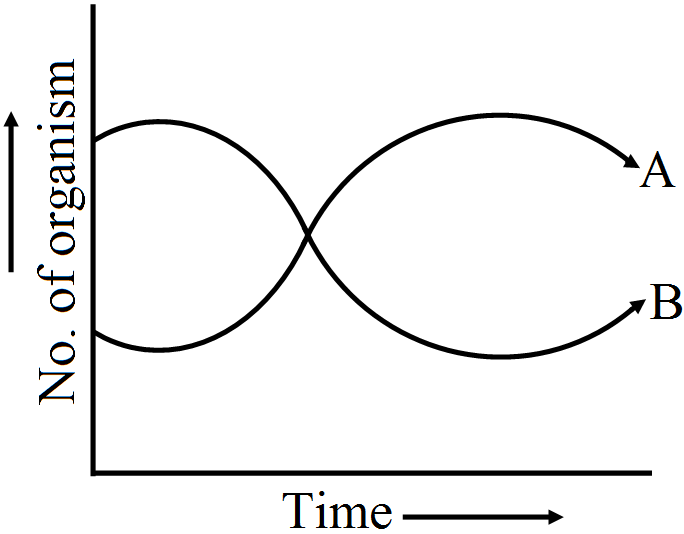
  1. The graph below represents the growth patterns of two types of aquatic organisms over a brief period of time in a water body, surrounded by agricultural land, extensively supplied with fertilisers. Identify the organisms that would represent: (i) A and (ii) B.
  2. State the reason for such a change in the water body and also write the term given to it.