Question
Derive integrated rate equation for first order reaction containing gaseous components.
Answer

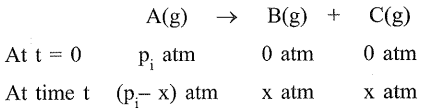
→ Let us consider a typical first order gas phase reaction.
→ A(g) → B(g) + C(g)
→ Let $p_i$ be the initial pressure of $A$ and $p_t$ the total pressure at time ' $t$ '. Integrated rate equation for such a reaction can be derived as
→ Total pressure $p _{ t }= p _{ A }+ p _{ B }+ p _{ C }$ (pressure units)
→ $p _{ A }, p _{ B }$ and $p _{ C }$ are partial pressures of $A , B$ and $C$ respectively. If $x$ atm can be the decrease in pressure of $A$ at time $t$ and one mole each of $B$ and C is being formed. The increase in pressure of B and C will also be X atm each
Image
where, $p_i$ is the initial pressure at time $t=0$
$
\begin{array}{l}
p _{ t }=\left( p _{ i }- x \right)+ x + x = p _{ i }+ x \\
x =\left( p _{ t }- p _{ i }\right)
\end{array}
$
where, $p_A=p_i-x=p_i-\left(p_t-p_i\right)=2 p_i-p_t$
$
\begin{aligned}
k & =\left(\frac{2.303}{ t }\right)\left(\log \frac{ p _{ i }}{ p _{ A }}\right) \\
& =\frac{2.303}{ t } \log \frac{ p _{ i }}{2 p _{ i }- p _{ t }}
\end{aligned}
$

Need a full question paper?

Generate a complete, print-ready paper with questions like this in minutes — across 16+ boards, with answer keys.

Start Generating Free

Similar questions

Differentiate between retention and inversion.
Explain standard hydrogen electrode. (SHE)

Complete the following reactions:

  1. $\text{CH}_{3}\text{CH}_{2}\text{NH}_{2}+\text{CHCl}_{3}+\text{alc. KOH}\rightarrow$
  2. $\text{C}_{6}\text{H}_{5}\text{N}_{2}^{+}\text{Cl}^{-}\xrightarrow[\text{(Room}\text{ temp.)}]{H_2O}$

Chromium metal can be plated out from an acidic solution containing CrO3 according to the following equation:
$\text{CrO}_3(\text{aq})+6\text{H}^+(\text{aq})+6\text{e}^-\xrightarrow{ \ \ \ \ \ \ \ \ \ \ \ }\text{Cr(s)}+3\text{H}_2\text{O}$
Calculate:
  1. How many grams of chromium will be plated out by 24,000 coulombs.
  2. How long will it take to plate out 1.5g of chromium by using 12.5A current?
(At. mass of Cr = 52).
A decimolar solution of potassium ferrocyanide is 50% dissociated at 300K. Calculate the osmotic pressure of the solution. (R = 8.314J K-1 mol-1).
Which is a stronger acid-phenol or cresol? Explain.
How would you account for the following?
  1. The atomic radii of the metals of the third (5d) series of transition elements are virtually the same as those of the corresponding members of the second (4d) series.
  2. The Eo value for the Mn3+/Mn2+ couple is much more positive than that for Cr3+/Cr2+ couple or Fe3+/Fe2+ couple.
  3. The highest oxidation state of a metal is exhibited in its oxide or fluoride.
When a current of 50 ampere is passed for 2 hours in the molton NaCl :
(a) How many gram of chlorine gas will be obtained at anode?
(b) What will be the volume of chlorine gas obtained at standard temperature and pressure (NTP)?
Write a note on Sandmeyer reaction.
For the reaction
2NO(g) + Cl2(g) → 2 NOCl(g)
The following data were collected. All the measurements were taken at 263K:

Experiment. No. Initial [NO] (M) Initial [Cl2] (M)

Initial rate of disappearance of Cl2 (M/min)

1 0.15 0.15 0.60
2 0.15 0.30 1.20
3 0.30 0.15 2.40
4 0.25 0.25 ?
  1. Write the expression for rate law.
  2. Calculate the value of rate constant and specify its units.
  3. What is the initial rate of disappearance of Cl2 in exp. 4?