MCQ 1011 Mark
Let $J=\int_0^1 \frac{x}{1+x^8} d x$
Consider the following assertions:
$I$. $J>\frac{1}{4}$
$II$. $J<\frac{\pi}{8}$ Then,
AnswerCorrect option: A. only $I$ is true
a
(a)
As we know, $1+x^8<2, \forall x \in(0,1)$
$\Rightarrow \quad \frac{1}{2}<\frac{1}{1+x^8}, \forall x \in(0,1)$
$\Rightarrow \quad \frac{x}{2}<\frac{x}{1+x^8}, \forall x \in(0,1)$
$\Rightarrow \int_0^1 \frac{x}{2} d x<\int_0^1 \frac{x}{1+x^8} d x$
$\Rightarrow \int_0^1 \frac{x}{1+x^8} d x>\frac{1}{4}$
$\Rightarrow \quad \text { Similarly, as we know, } 1+x^8<1+x^4$
$\forall x \in(0,1)$
$\Rightarrow \int_0^1 \frac{x}{1+x^4} d x<\int_0^1 1+x^8 d x$
$\Rightarrow J>\frac{1}{2}\left[\tan { }^{-1}\left(x^2\right)\right]_0^1$
$\Rightarrow J>\frac{\pi}{8}$
$\therefore$ Statement $J=\int_0^1 \frac{x}{1+x^8} d x>\frac{1}{4}$ is true, while the statement $J=\int_0^1 \frac{x}{1+x^8} d x<\frac{\pi}{8}$ is not true.
View full question & answer→MCQ 1021 Mark
Suppose a continuous function $f:(0, \infty) \rightarrow R$ satisfies $f(x)=2 \int_0^x t f(t) d t+1, \forall x \geq 0$.Then, $f(1)$ equals
Answera
$(a)$
It is given that a continuous function
$f:[0, \infty) \rightarrow R$ satisfies
$f(x) =2 \int_0^x t f(t) d t+1, \forall x \geq 0$
$\therefore f^{\prime}(x) =2 x f(x)$
$\Rightarrow \frac{f^{\prime}(x)}{f(x)} =2 x$
On integrating both sides, we get
$\ln |f(x)|=x^2+c$
$\Rightarrow f(x)=K e^{x^2}, \text { where } K=e^c$
$\because f(0)=2 \int_0^0 t f(t) d t+1=1$
$\therefore K=1$
$\therefore f(1)=e$
View full question & answer→MCQ 1031 Mark
For $x \in R$, let $f(x)=|\sin x|$ and $g(x)=\int_0^x f(t) d t .$ Let $p(x)=g(x)-\frac{2}{\pi} x$ Then
- ✓
$p(x+\pi)=p(x)$ for all $x$
- B
$p(x+\pi) \neq p(x)$ for at least one but finitely many $x$
- C
$p(x+\pi) \neq p(x)$ for infinitely many $x$
- D
$p$ is a one-one function
AnswerCorrect option: A. $p(x+\pi)=p(x)$ for all $x$
a
(a)
Given, for $x \in R$
$f(x)=|\sin x|$
$g(x)=\int_0^x f(t) d t$, and
$p(x)=g(x)-\frac{2}{\pi} x$
$\because p(x+\pi)=g(x+\pi)-\frac{2}{\pi}(x+\pi)$
$=\int \limits_0^{x+\pi}|\sin (t)| d t-\frac{2}{\pi} x-2$
$=\int \limits_0^\pi|\sin t| d t+\int \limits_\pi^{\pi+x}|\sin t| d t-\frac{2}{\pi} x-2$
$=2 \int \limits_0^{\pi / 2} \sin t d t+\int \limits_0^x|\sin t| d t-\frac{2}{\pi} x-2$
$[\because|\sin t|$ is periodic function having period $\pi$ ]
$2[-\cos t]_0^{\pi / 2}+g(x)-\frac{2}{\pi} x-2$
$2(0-(-1))+g(x)-\frac{2}{\pi} x-2$
$2+g(x)-\frac{2}{\pi} x-2=g(x)-\frac{2}{\pi} x=p(x)$
$\therefore p(x+\pi)=p(x)$ for all $x$.
View full question & answer→MCQ 1041 Mark
Let $f:[0,1] \rightarrow[0,1]$ be a continuous function such that $x^2+(f(x))^2 \leq 1$ for all $x \in[0,1]$ and $\int_0^1 f(x) d x=\frac{\pi}{4}$ Then, $\int_{\frac{1}{2}}^{\frac{1}{\sqrt{2}}} \frac{f(x)}{1-x^2} d x$ equals
AnswerCorrect option: A. $\frac{\pi}{12}$
a
(a)
For a continuous function $f:[0,1] \longrightarrow[0,1]$, it is given that
$x^2+(f(x))^2 \leq 1$
$\Rightarrow(f(x))^2 \leq 1-x^2$
$\left.\Rightarrow \quad f(x) \leq \sqrt{1-x^2} \quad \quad \quad \because f(x) \in[0,1]\right\}$
$\therefore \int_0^1 f(x) d x \leq \int_0^1 \sqrt{1-x^2} d x$
$\Rightarrow \int_0^1 f(x) d x \leq\left[\frac{x}{2} \sqrt{1-x^2}+\frac{1}{2} \sin ^{-1} x\right]_0^1$
$\Rightarrow \int_0^1 f(x) d x \leq \frac{\pi}{4}$
So, $f(x)=\sqrt{1-x^2}$, because it is given that
$lint_0^1 f(x)=\frac{\pi}{4}$
Now,
$\int_{1 / 2}^{1 / \sqrt{2}} \frac{f(x)}{1-x^2} d x=\int_{1 / 2}^{1 / \sqrt{2}} \frac{d x}{\sqrt{1-x^2}}=\left[\sin ^{-1} x\right]_{1 / 2}^{1 / \sqrt{2}}$
$=\frac{\pi}{4}-\frac{\pi}{6}=\frac{\pi}{12}$
View full question & answer→MCQ 1051 Mark
The value of the integral $\int_0^\pi(1-|\sin 8 x|) d x$ is
- A
$0$
- B
$\pi-1$
- ✓
$\pi-2$
- D
$\pi-3$
AnswerCorrect option: C. $\pi-2$
c
(c)
Let $I=\int_0^\pi(1-|\sin 8 x|) d x$
$I=\int_0^\pi d x-\int_0^\pi|\sin 8 x| d x$
$I=\pi-\int_0^{\frac{\pi}{8} \times 8}|\sin 8 x| d x$
$I=\pi-8 \int_0^{\frac{\pi}{8}} \sin 8 x d x[\because \sin 8 x B$ periodic
$I=\pi-8\left[\frac{-\cos 8 x}{8}\right]_0^{\pi / 8}$
$I=\pi+(\cos \pi-\cos 0)=\pi-2$
View full question & answer→MCQ 1061 Mark
Suppose the limit $L=\lim _{n \rightarrow \infty} \sqrt{n} \int_0^1 \frac{1}{\left(1+x^2\right)^n} d x$ exists and is larger than $\frac{1}{2}$. Then,
- ✓
$\frac{1}{2} < L < 2$
- B
$2 < L < 3$
- C
$3 < L < 3$
- D
$L \geq 4$
AnswerCorrect option: A. $\frac{1}{2} < L < 2$
a
(a)
We have,
$L= \lim _{n \rightarrow \infty} \sqrt{n} \int \limits_0^1 \frac{1}{\left(1+x^2\right)^n} d x$ $\left(1+x^2\right)^n>1+n x^2$
$\left(1+x^2\right)^n > 1+n x^2$
$\frac{1}{\left(1+x^2\right)^n} < \frac{1}{1+n x^2}$
$\int \limits_0^1 \frac{d x}{\left(1+x^2\right)^n} < \int_0^1 \frac{d x}{1+n x^2}$
$\int \limits_0^1 \frac{d x}{\left(1+x^2\right)^n}<\frac{1}{\sqrt{n}}\left[\tan ^{-1} \sqrt{n} x\right]_0^1$
$\int \limits_0^1 \frac{d x}{\left(1+x^2\right)^n}<\frac{1}{\sqrt{n}} \tan ^{-1} \sqrt{n}$
$L=\lim _{n \rightarrow \infty} \sqrt{n} \int_0^1 \frac{1}{\left(1+x^2\right)^n} d x$
$<\lim _{n \rightarrow \infty} \frac{\sqrt{n}}{\sqrt{n}}\left(\tan ^{-1} \sqrt{n}\right)$
$L<\tan ^{-1} \infty=\frac{\pi}{2}$
$\frac{1}{2} < L < 2$
View full question & answer→MCQ 1071 Mark
Let $S$ be the set of real numbers $p$ such that there is no non-zero continuous function $f: R \rightarrow R$ satisfying $\int_0^x f(t) d t=p f(x)$ for all $x \in R$. Then, $S$ is
- A
- B
the set of all rational numbers
- C
the set of all irrational numbers
- ✓
the whole set $R$
AnswerCorrect option: D. the whole set $R$
d
(d)
$\int \limits_0^x f(t) d t =p f(x)$
$f(x) =p f^{\prime}(x)$
$\frac{f^{\prime}(x)}{f(x)} =\frac{1}{p}$
$\log f(x) =\frac{x}{p}+C$
$f(x) =A e^{x / p}$
Putting $x=0$
$f(0)=A e^0 \Rightarrow A=0 \quad[\because f(0)=0]$
$f(x) =0$
$p(0) =0$
$f(0) =0\,\,p \neq 0$
Case$I$
There is no non-zero continuous to $f(x)$.
Case$II$
$p=0$
$\int \limits_0^x f(t) d t=0, \forall x \in R$
If is possible when $f(x)=0$.
Hence, $\forall p \in R$. There is no non-zero continous function. Hence, $S \in R$.
View full question & answer→MCQ 1081 Mark
Let $\ln x$ denote the logarithm of $x$ with respect to the base $e$. Let $S \subset R$ be the set of all points where the function $\ln \left(x^2-1\right)$ is well-defined. Then, the number of functions $f: S \rightarrow R$ that are differentiable, satisfy $f^{\prime}(x)=\ln \left(x^2-1\right)$ for all $x \in S$ and $f(2)=0$, is
Answerd
(d)
We have,
$f^{\prime}(x) =\ln \left(x^2+1\right)$
$f(x) =\int \ln \left(x^2-1\right) d x$
$f(x) =x \ln \left(x^2-1\right)-\int \frac{2 x^2}{x^2-1} d x$
$f(x)=x \ln \left(x^2-1\right)-2 \int\left(\frac{x^2-1}{x^2-1}+\frac{1}{x^2-1}\right) d x$
$f(x)=x \ln \left(x^2-1\right)-2 x-\ln \left(\frac{x-1}{x+1}\right)+C$
$f(2)=2 \ln (3)-4-\ln \left(\frac{1}{3}\right)+C=0$
$\Rightarrow C=4-3 \ln 3$
$\therefore f(x)=x \ln \left(x^2-1\right)-2 n \ln \frac{(x-1)}{(x+1)}+4-3 \ln 3$
defincd for Sinfinite $C$ values possible in set $S$ such that $f^{\prime}(x)=\ln \left(x^2-1\right)$
View full question & answer→MCQ 1091 Mark
Let $I_n=\int_0^1 e^{-y} y^n d y$, where $n$ is a non-negative integer. Then, $\sum_{n=1}^{\infty} \frac{I_n}{n !}$ is
- A
$ 1$
- B
$1-\frac{1}{e}$
- ✓
$\frac{1}{e}$
- D
$1+\frac{1}{e}$
AnswerCorrect option: C. $\frac{1}{e}$
c
(c)
We have, $J_n=\int_0^1 e^{-y} y^n d y$
$I_n =\left[-y^n e^{-y}\right]_0^1+\int_0^1 n y^{n-1} e^{-y} d y$
$I_n =-\frac{1}{e}+n I_{n-1}$
$\Rightarrow \frac{I_n}{n !} =\frac{-1}{n ! e}+\frac{I_{n-1}}{(n-1) !}$
$\Rightarrow \frac{I_n}{n !}-\frac{I_{n-1}}{(n-1) !}=\frac{-1}{n ! e}$
$n =1 \frac{I_1}{1 !}-\frac{I_0}{0 !}=-\frac{1}{e}$
$n =2 \frac{I_2}{2 !}-\frac{I_1}{1 !}=-\frac{1}{2 ! e}$
$n =3 \frac{I_3}{3 !}-\frac{I_1}{2 !}=-\frac{1}{3 ! e}$
$n =n \frac{I_n}{n !}-\frac{I_n}{n-1}=\frac{1}{n ! e}$
$\text { Adding these form, we get }$
$\frac{I_n}{n !}-I_0 =-\frac{1}{e}\left(1+\frac{1}{1 !}+\frac{1}{2 !}+\ldots+\frac{1}{n !}\right)$
$\frac{I_n}{n !} =\frac{I_0}{n !}-\frac{1}{e}\left(1+\frac{1}{1 !}+\frac{1}{2 !}+\ldots+\frac{1}{n !}\right)$
$n ! =\frac{1}{e}+1-\frac{1}{e}(e)\left[\because e=1+\frac{1}{1 !}+\frac{1}{2 !}+\ldots\right]$
$=\frac{1}{e}+1-1$
View full question & answer→MCQ 1101 Mark
Let $f(x)=\max \left\{3, x^2, \frac{1}{x^2}\right\}$ for $\frac{1}{2} \leq x \leq 2$. Then, the value of the integral $\int_{1 / 2}^2 f(x) d x$ is
- A
$\frac{11}{3}$
- B
$\frac{13}{3}$
- ✓
$\frac{14}{3}$
- D
$\frac{16}{3}$
AnswerCorrect option: C. $\frac{14}{3}$
c
(c)
We have,
$f(x)=\max \left\{3, x^2, \frac{1}{x^2}\right\} \text { for } x \in\left[\frac{1}{2}, 2\right]$
$\int \limits_{1 / 2}^2 f(x) d x=\int \limits_{1 / 2}^{1 / \sqrt{3}} \frac{1}{x^2} d x+\int \limits_{1 / \sqrt{3}}^{\sqrt{3}} 3 d x+\int \limits_{\sqrt{3}}^2 x^2 d x$
$\left[-\frac{1}{x}\right]_{1 / 2}^{1 / \sqrt{3}}+[3 x]_{1 / \sqrt{3}}^{\sqrt{3}}+\left[\frac{x^3}{3}\right]_{\sqrt{3}}^2$
$=-\sqrt{3}+2+3 \sqrt{3}-3 \sqrt{3}+\frac{8}{3}-\frac{3 \sqrt{3}}{3}=\frac{14}{3}$
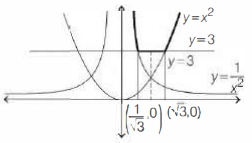
View full question & answer→MCQ 1111 Mark
Let $g(x)=\int_0^{|x|^{3 / 4}} t^{2 / 3} \sin \frac{1}{t} d t$, for all real $x$. Then, $\lim _{x \rightarrow 0} \frac{g(x)}{x}$ is equal to
- A
$\infty$
- B
$-\infty$
- ✓
$0$
- D
$\frac{3}{4}$
Answerc
(c)
We have,
$g(x) =\int_0^{|x|^{3 / 4}} t^{23} \sin \frac{1}{t} d t$
$g^{\prime}(x) =|x|^{\frac{1}{2}} \sin \frac{1}{|x|^{3 / 4}}$
$\lim _{x \rightarrow 0} \frac{g(x)}{x} =\lim _{x \rightarrow 0} \frac{g^{\prime}(x)}{1}$
$=\lim _{x \rightarrow 0}||^{1 / 2} \sin \frac{1}{|x|^{3 / 4}}$
$=0$
View full question & answer→MCQ 1121 Mark
Let $a_n=\int_{-\pi}^\pi|x-1| \cos n x d x$ for all natural numbers $n$. Then, the sequence $\left(a_n\right)_{n \geq 0}$ satisfies
- A
$\lim _{n \rightarrow \infty} a_n=\infty$
- B
$\lim _{n \rightarrow \infty} a_n=-\infty$
- C
$\lim _{n \rightarrow \infty} a_n$ exists and is positive
- ✓
$\lim _{n \rightarrow \infty} a_n=0$
AnswerCorrect option: D. $\lim _{n \rightarrow \infty} a_n=0$
d
(d)
We have,
$a_n=\int \limits_{-\pi}^\pi|x-1| \cos n x d x$
$a_n=\int \limits_{-\pi}^1-(x-1) \cos n x d x$
$a_n=-\left[\frac{(x-1) \sin n x]^1}{n}\right]_{-\pi}^{-}-\left[\frac{\cos n \pi}{n^2}\right]_{-\pi}^1$
$\quad+\left[\frac{(x-1) \sin n x}{n}\right]_1^\pi-\left[\frac{\cos n \pi}{n^2}\right]_1^\pi$
$a_n=\frac{2 \pi \sin n \pi}{n}+\frac{2}{n^2} \cos n \pi-\frac{2}{n^2} \cos x \pi$
$a_n=\frac{2 \pi \sin n \pi}{n}$
$\lim _{x \rightarrow \infty} a_n=\lim _{n \rightarrow \infty} \frac{2 \pi \sin n \pi}{n}=0$
View full question & answer→MCQ 1131 Mark
The number of continuous functions $f:[0,1] \rightarrow R$ that satisfy $\int \limits_0^1 x f(x) d x=\frac{1}{3}+\frac{1}{4} \int \limits_0^1(f(x))^2 d x$ is
Answerb
(b)
We have,
$\int_0^1 x f(x) d x=\frac{1}{3}+\frac{1}{4} \int \limits_0^1(f(x))^2 d x$
$\Rightarrow -\frac{1}{3}=\frac{1}{4}\left[\int \limits_0^1\left[(f(x))^2-4 x f(x)\right] d x\right.$
$\Rightarrow-\frac{1}{3}=\frac{1}{4}\left[\int \limits_0^1(f(x))^2-4 x f(x)+(2 x)^2-(2 x)^2\right] d x$
$\Rightarrow-\frac{1}{3}=\frac{1}{4}\left[\int \limits_0^1[f(x)-2 x]^2 d x-\int \limits_0^1 4 x^2 d x\right]$
$\Rightarrow-\frac{4}{3}=\int \limits_0^1[f(x)-2 x]^2 d x-\left[\frac{4 x^3}{3}\right]_0^1$
$\Rightarrow-\frac{4}{3}=\int \limits_0^1[f(x)-2 x]^2 d x-\frac{4}{3}$
$\Rightarrow \quad \int \limits_0^1[f(x)-2 x]^2 d x=0$
$\therefore$ Only one continuous function.
View full question & answer→MCQ 1141 Mark
The limit $\lim _{x \rightarrow \infty} x^2 \int \limits_0^x e^{t^3-x^3} d t$ equals
- ✓
$\frac{1}{3}$
- B
$2$
- C
$\infty$
- D
$\frac{2}{3}$
AnswerCorrect option: A. $\frac{1}{3}$
a
(a)
We have,
$\lim _{x \rightarrow \infty} x^2 \int \limits_0^x e^{t^3-x^3} d t =\lim _{x \rightarrow \infty} x^2 e^{-x^3} \int \limits_0^x e^{e^3} d t$
$=\lim _{x \rightarrow \infty} \frac{x^2 \int \limits_0^x e^{t^3} d t}{e^{x^3}}$
Apply $L$ Hospital's rule
$=\lim _{x \rightarrow \infty} \frac{2 x \int \limits_0^x e^{t^3} d t+x^2 e^{x^3}}{3 x^2 e^{x^3}}$ $=\lim _{x \rightarrow \infty} \frac{2 \int \limits_0^x e^{t^3} d t+x^2 e^{x^3}}{3 x^2 e^{x^3}}$
Again Apply $L$ Hospital's rule, we get
$=\lim _{x \rightarrow \infty} \frac{2 e^{x^3}+e^{x^3}+3 x^3 e^{x^3}}{3 e^{x^3}+9 x^3 e^{x^3}}$
$=\lim _{x \rightarrow \infty} \frac{e^{x^3}\left(3+3 x^3\right)}{e^{x^3}\left(3+9 x^3\right)}=\frac{1}{3}$
View full question & answer→MCQ 1151 Mark
On the real line $R$, we define two functions $f$ and $g$ as follows:
$f(x)=\min \{x-[x], 1-x+[x]\}$
$g(x)=\max \{x-[x], 1-x+[x]\}$
where $[x]$ denotes the largest integer not exceeding $x$ :
The positive integer $n$ for which
$\int_0^n(g(x)-f(x)) d x=100$ is
Answerc
(c)
We have, $f(x)=\min \{x-[x], 1-x+[x]\}$ $g(x)=\max \{x-[x], 1-x+[x]\}$ Graph of $f(x)$ is
$\int \limits_0^n g(x) d x=\int_0^n g(x) d x=\frac{3 n}{4}$
$\int \limits_0^n f(x) d x=\frac{n}{4}$
$\because \quad \int_0^n(g(x)-f(x)) d x=\frac{3 n}{4}-\frac{n}{4}=100$
$\Rightarrow \quad \frac{n}{2}=100 \Rightarrow n=200$
View full question & answer→MCQ 1161 Mark
Let $f$ be a continuous function defined on $[0,1]$ such that $\int_0^1 f^2(x) d x=\left(\int_0^1 f(x) d x\right)^2$. Then, the range of $f$
- A
- B
- C
is the interval $[0,1]$
- ✓
Answerd
(d)
We have,
$\int \limits_0^1 f^2(x) d x=\left(\int \limits_0^1 f(x) d x\right)^2, x \in[0,1]$
We know Cauchy Schwartz inequality
${\left[\int_a^b f(x) \cdot g(x) d x\right]^2 \leq \int_a^b(f(x))^2 d x }$
$\int_a^b(g(x))^2 d x$
Here, $g(x)=1$ and equality holds only when $\frac{f(x)}{g(x)}=\lambda$
So, $f(x)$ is constant function.
$\therefore f(x)$ is a singleton.
View full question & answer→MCQ 1171 Mark
Define a function $f: R \rightarrow R$ by $f(x)=\max$ $\{|x|,|x-1|, \ldots,|x-2 n|\}$, where $n$ is a fixed natural number. Then, $\int \limits_0^{2 n} f(x) d x$ is
AnswerCorrect option: D. $3 n^2$
d
(d)
We have,
$f(x)=\max \{|x|,|x-1|, \ldots,|x-2 n|\}$
$\int \limits_0 ^{2 n} f(x) d x=\int \limits_0^n f(x) d x+\int \limits_n^{2 n} f(x) d x$
$=\int \limits_0^n|x-2 n| d x+\int \limits_n^{2 n}|x| d x$
$=\int \limits_0^n(2 n-x) d x+\int \limits_n^{2 n} x d x$
$=\left[2 n x-\frac{x^2}{2}\right]_0^n+\left[\frac{x^2}{2}\right]_n^{2 n}$
$=\left(2 n^2-\frac{n^2}{2}\right)+\left(\frac{4 n^2}{2}-\frac{n^2}{2}\right)$
$=2 n^2-\frac{n^2}{2}+2 n^2-\frac{n^2}{2}=3 n^2$
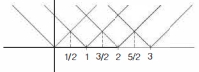
View full question & answer→MCQ 1181 Mark
If $p(x)$ is a cubic polynomial with $p(1)=3, p(0)=2$ and $p(-1)=4$, then $\int \limits_{-1}^1 p(x) d x$ is
Answerd
(d)
We have,
$p(x)$ is cubic polynomial.
Let $p(x)=a x^3+b x^2+c x+d$
$p(1)=a+b+c+d=3$
$p(0)=d=2$
$p(-1)=-a+b-c+d=4$
From Eqs.$(i)$ and $(iii)$, we get
$2(b+d)=7 \Rightarrow b+d=\frac{7}{2}$
On putting the value of $d$ in Eq. $(iv)$, we get
$b=\frac{3}{2}$
Now, $\int \limits_{-1}^1 p(x) d x=\int \limits_{-1}^1\left(a x^3+b x^2+c x+d\right) d x$
$=2 \int \limits_{-1}^1\left(b x^2+d\right) d x$
$\because a x^3$ and $c x$ are odd functions]
$=2\left[\frac{b x^3}{3}+d x\right]_0^1=2\left(\frac{b}{3}+d\right)$
$=2\left[\frac{3}{2 \times 3}+2\right]=2\left[\frac{5}{2}\right]=5$
View full question & answer→MCQ 1191 Mark
Let $x > 0$ be a fixed real number. Then, the integral $\int \limits_0^{\infty} e^{-t}|x-t| d t$ is equal to
- ✓
$x+2 e^{-x}-1$
- B
$x-2 e^{-x}+1$
- C
$x+2 e^{-x}+1$
- D
$-x-2 e^{-x}+1$
AnswerCorrect option: A. $x+2 e^{-x}-1$
a
(a)
Let $I=\int \limits_0^{\infty} e^{-t}|x-t| d t, x > 0$
$\Rightarrow \quad I=\int \limits_0^x e^{-t}(x-t) d t+\int \limits_x^{\infty} e^{-t}(t-x) d t$
$\Rightarrow \quad I=\left[-(x-t) e^{-t}\right]_0^x+\int \limits_0^x \frac{d(x-t)}{d x} e^{-t} d t$
$+\left[\frac{(t-x) e^{-t}}{-1}\right]_x^{\infty}+\int \limits_x^{\infty} e^{-t} d t$
$\Rightarrow I=x+\left[e^{-t}\right]_0^x+\left[-e^{-t}\right]_x^{\infty}$
$\Rightarrow I=x+e^{-x}-1+e^{-x}$
$\Rightarrow I=x+2 e^{-x}-1$
View full question & answer→MCQ 1201 Mark
Let $f: R \rightarrow R$ be a continuous function satisfying $f(x)+\int \limits_0^x t f(t) d t+x^2=0$,for all $x \in R$. Then
- A
$\lim _{x \rightarrow \infty} f(x)=2$
- ✓
$\lim _{x \rightarrow-\infty} f(x)=-2$
- C
$f(x)$ has more than one point in common with the $X$-axis
- D
$f(x)$ is an odd function
AnswerCorrect option: B. $\lim _{x \rightarrow-\infty} f(x)=-2$
b
(b)
We have,
$f(x)+\int_0^x t f(t) d t+x^2=0$
On differentiating, we get
$f^{\prime}(x)+x f(x)+2 x =0$
$\Rightarrow f^{\prime}(x) =-x(f(x)+2)$
$\Rightarrow \frac{f^{\prime}(x)}{f(x)+2} =-x$
On integrating, we get
$\quad \log (f(x)+2)=-\frac{x^2}{2}+C$
$\Rightarrow \quad f(x)=A e^{-x^2 / 2}-2$
$\Rightarrow \quad f(0)=0=A-2 \Rightarrow A=2$
$\therefore \quad \lim _{x \rightarrow \infty} f(x)=-2$
$\qquad \quad \lim ^{-x^2 / 2}-2$
$\Rightarrow(x) \text { is an even function. }$
$f(x) \text { intersect } X \text {-axis at one point }(0,0)$
$\therefore \text { Option (b) is correct. }$
View full question & answer→MCQ 1211 Mark
For a real number $x$ let $[x]$ denote the largest integer less than or equal to $x$. The smallest positive integer $n$ for which the integral $\int \limits_1^n[x][\sqrt{x}] d x$ exceeds $60$ is
Answerb
(b)
Let $I=\int \limits_1^n[x][\sqrt{x}] d x$
$\Rightarrow I=\int \limits_1^2 d x+\int \limits_2^3 d x+\int \limits_3^4 3 d x+\int \limits_4^5 8 d x+\int \limits_5^6 10 d x$
$+\int \limits_6^7 12 d x+\int \limits_7^8 14 d x+\int \limits_8^9 16 d x+\int \limits_9^{10} 27 d x+\ldots$
But $I > 60$ $I=1+2+3+8+10+12+14+16=66$
So, least value of $n=9$
View full question & answer→MCQ 1221 Mark
For a real number $x$ let $[x]$ denote the largest integer less than or equal to $x$ and $\{x\}=x-[x]$. Let $n$ be a positive integer. Then, $\int \limits_0^n \cos (2 \pi[x]\{x\}) d x$ is equal to
Answerb
(b)
Let $I=\int \limits_0^n \cos (2 \pi[x]\{x\}) d x$
$\begin{aligned} \{x\}=x-[x] \\ \therefore \quad I =\int\limits_0^n \cos [2 \pi[x](x-[x])] d x \end{aligned}$
$\Rightarrow \quad I=\int \limits_0^1 \cos 0 d x+\int \limits_1^2 \cos 2 \pi(x-1) d x$
$+\int \limits_2^3 \cos 2 \pi(x-2) d x$
$+\ldots+\int \limits_{n=1}^n \cos 2 \pi(x-(n-1) d x$
$\Rightarrow \quad I=1+\int \limits_1^2 \cos 2 \pi x d x+\int \limits_2^3 \cos 4 \pi x d x$
$+\ldots+\int \limits_{n-1}^n \cos 2 \pi(n-1) x d x$
$\Rightarrow \quad I=1+\left[\frac{\sin 2 \pi x}{2 \pi}\right]_1^2+\left(\frac{\sin 4 \pi x}{4 \pi}\right)_2^3+\ldots$
$+\left[\frac{\sin 2 \pi(n-1) x}{2 \pi(n-1)}\right]_{n-1}^n$
$\Rightarrow \quad I=1+0+0+\ldots+0 \Rightarrow I=1$
View full question & answer→MCQ 1231 Mark
A continuous function $f: R \rightarrow R$ satisfies the equation $f(x)=x+\int_0^x f(t) d t$. Which of the following options true?
AnswerCorrect option: C. $f(x+y)=f(x)+f(y)+f(x)(y)$
c
(c)
We have, $f(x)=x+\int \limits_0^x f(t) d t$
$f^{\prime}(x)=1+f(x)$
On integrating, we get
$\log (1+f(x))=x+c$
$1+f(x)=A e^x$
$f(x)=A e^x-1$
$f(0)=A-1$
$0=A-1 \quad[\because f(0)=0]$
$\Rightarrow \quad A=1$
$\therefore \quad f(x)=e^x-1$
$f(y)=e^y-1$
$f(x+y)=e^{x+y}-1=e^x \cdot e^y-1$
$f(x)+f(y)+f(x) f(y)$
$=e^x-1+e^y-1+\left(e^x-1\right)\left(e^y-1\right)$
$=e^x-1+e^y-1+e^{x+y}-e^x-e^y+1$
$=e^{x+y}-1$
Hence, $f(x+y)=f(x)+f(y)+f(x) f(y)$
View full question & answer→MCQ 1241 Mark
Let $f:[0,1] \rightarrow[0, \infty)$ be a continuous function such that $\int_0^1 f(x) d x=10$. Which of the following statements is NOT necessarily true?
- A
$\int \limits_0^1 e^{-x} f(x) d x \leq 10$
- B
$\int \limits_0^1-\frac{f(x)}{(1+x)^2} d x \leq 10$
- C
$-10 \leq \int \limits_0^1 \sin (100 x) f(x) d x \leq 10$
- ✓
$\int \limits_0^1 f(x)^2 d x \leq 100$
AnswerCorrect option: D. $\int \limits_0^1 f(x)^2 d x \leq 100$
d
(d)
$\therefore F ( x ) \geq 0$
$\int_0^1 f(x)^2 d x \leq 100$
not necessarily true.
because $(f(x))^2$ can take very high values then area bounded by $(f(x))^2, x$-axis $x$ $=0$ to $1$ may cross $100$
View full question & answer→MCQ 1251 Mark
Let $I_n=\int_0^{\pi / 2} x^n \cos x d x$, where $n$ is a non-negative integer. Then, $\sum \limits_{n=2}^{\infty}\left(\frac{I_n}{n !}+\frac{I_n-2}{(n-2) !}\right)$ equals
AnswerCorrect option: A. $e^{\pi / 2}-1-\frac{\pi}{2}$
a
(a)
We have,
$I_n=\int \limits_0^{\pi / 2} x^n \cos x d x$
$\Rightarrow \quad I_n =\left[x^n \sin x\right]_0^{\pi / 2}-\int \limits_0^{\pi / 2} n x^{n-1} \sin x d x$
$\Rightarrow \quad I_n =\left(\frac{\pi}{2}\right)^n-\left[n x^{n-1}(-\cos x)\right]_0^{\pi / 2}$
$\Rightarrow \quad I_n =\left(\frac{\pi}{2}\right)^n-n(n-1) I_{n-2}^{\pi / 2} n(n-1) x^{n-2} \cos x d x$
$\Rightarrow \quad I_n+n n(n-1) I_{n-2}=\left(\frac{\pi}{2}\right)^n$
$\text { Now, } \sum \limits_{n=2}^{\infty}\left[\frac{I_n}{n !}+\frac{I_{n-2}}{(n-2) !}\right]$
$\Rightarrow \quad \sum \limits_{n=2}^{\infty}\left[\frac{I_n}{n !} n(n-1) I_{n-2}\right]$
$\sum \limits_{n=2}^{\infty} \frac{\left(\frac{\pi}{2}\right)^n}{n !}=e^{\pi / 2}-1-\frac{\pi}{2}$
View full question & answer→MCQ 1261 Mark
For $x, t \in R$ let $p_t(x)=(\sin t) x^2-(2 \cos t) x+\sin t$ be a family of quadratic polynomials in $x$ with variable coefficients. Let $A(t)=\int \limits_0^1 p_t(x) d x$. Which of the following statements are true?
$I$. $A(t) < 0$ for all $t$.
$II$. $A(t)$ has infinitely many critical points.
$III.$ $A(t)=0$ for infinitely many $t$.
$IV$. $A^{\prime}(t) < 0$ for all $t$.
- A
$I$ and $II$ only
- ✓
$II$ and $III$ only
- C
$III$ and $IV$ only
- D
$IV$ and $I$ only
AnswerCorrect option: B. $II$ and $III$ only
b
(b)
We have,
$p_t(x)=(\sin t) x^2-(2 \cos t) x+\sin t$
$A(t)=\int_0^1 p_t(x) d x$
$A(t)=\int_0^1\left((\sin t) x^2-(2 \cos t) x+\sin t\right) d x$
$A(t)=\left[\frac{x^3}{3} \sin t-x^2 \cos t+x \sin t\right]_0^1$
$A(t)=\frac{1}{3} \sin t-\cos t+\sin t$
$A(t)=\frac{4}{3} \sin t-\cos t$
$A^{\prime}(t)=\frac{4}{3} \cos t+\sin t$
$A(t) \text { has infinitely critical points. }$
$A(t)=0 \text { for infinitely many value of } t$
$\text { Hence, II and III statements are truc. }$
View full question & answer→MCQ 1271 Mark
For a real number $x$, let $[x]$ denote the largest integer less than or equal to $x$ and $\{x\}=x-[x]$. The smallest possible integer value of $n$ for which $\int_1^n[x]\{x\} d x$ exceeds $2013$ is
Answerd
(d)
Let $I=\int \limits_1^n[x]\{x\} d x$
$I=\int \limits_1^2\{x\} d x+\int\limits_2^3 2\{x\} d x+\ldots+\int\limits_{n-1}^n(n-1)\{x\} d x$
$I=(1+2+3+4+\ldots+(n-1)) \int\limits_0^1\{x\} d x$
$L=\frac{n(n-1)}{2} \int\limits_0^1 x d x$
$I=\frac{n(n-1)}{2}\left[\frac{x^2}{2}\right]_0^1=\frac{n(n-1)}{4}$
Given, $I \geq 2013$
$\frac{n(n-1)}{4} \geq 2013$
$\begin{aligned} \Rightarrow & & n^2-n & \geq 4052 \\ \Rightarrow & & n^2-n+\frac{1}{4} & \geq 4052+\frac{1}{4} \end{aligned}$
$\Rightarrow \quad\left(n-\frac{1}{2}\right)^2 \geq \frac{32209}{4}$
$\Rightarrow \quad n \geq \frac{\sqrt{32209}}{2}+\frac{1}{2}$
$\Rightarrow \quad n \geq \frac{17946+1}{2}$
$=\frac{180.46}{2}$
$\Rightarrow \quad n \geq 90.23$
$\therefore$ Least value of $x$ is $91$
View full question & answer→MCQ 1281 Mark
Let $n$ be a positive integer. For a real number $x$, let $[x]$ denote the largest integer not exceeding $x$ and $\{x\}=x-[x]$. Then, $\int \limits_1^{n+1} \frac{(\{x\})^{[x]}}{[x]} d x$ is equal to
AnswerCorrect option: C. $\frac{n}{n+1}$
c
(c)
Let
$I=\int \limits_1^{n+1} \frac{(\{x\})^{[x]}}{[x]} d x$
$I=\int \limits_1^2 \frac{\{x\}}{1} d x+\int \limits_2^3 \frac{\{x\}^2}{2} d x+\int \limits_3^4 \frac{\{x\}^2}{3} d x+$ $\cdots \int \limits_n^{n+1} \frac{\{x\}^n}{n} d x$
$\Rightarrow \quad I=\int \limits_0^1\left(\frac{x}{1}+\frac{x^2}{2}+\frac{x^3}{3}+\ldots+\frac{x^n}{n}\right) d x$
$\Rightarrow I=\left[\frac{x^2}{1 \times 2}+\frac{x^3}{2 \times 3}+\frac{x^4}{3 \times 4}+\ldots+\frac{x^{n+1}}{n(n+1)}\right]_0^1$
$\Rightarrow I=\frac{1}{1 \times 2}+\frac{1}{2 \times 3}+\frac{1}{3 \times 4}+\ldots+\frac{1}{n(n+1)}$
$\Rightarrow I=\left(1-\frac{1}{2}\right)+\left(\frac{1}{2}-\frac{1}{3}\right)+\left(\frac{1}{3}-\frac{1}{4}\right)+\ldots$
$\Rightarrow I=1-\frac{1}{n+1}=\frac{n+1-1}{n+1}=\frac{n}{n+1}$
View full question & answer→MCQ 1291 Mark
For real $x$ with $-10 \leq x \leq 10$ define $f(x)=\int_{-10}^x 2^{[t]} d t$ where for a real number $r$ we denote by $[r]$ the largest integer less than or equal to $r$. The number of points of discontinuity of $f$ in the interval $(-10,10)$ is
Answera
(a)
We have,
$f(x)=\int \limits_{-10}^x 2^{[t]} d t, x \in[-10,10]$
Let $r$ be an integer $r \in[-10,10]$
For LHL $\lim \limits_{x \rightarrow r^{-}} \int \limits_{-10}^x 2^{[t]} d t$
$\lim \limits_{x \rightarrow r-h} \int \limits_{-10}^{r-h} 2^{[t]} d t$
$\lim \limits_{h \rightarrow 0}\left[\int \limits_{-1}^{-9} 2^{[t]} d t+\int \limits_{-9}^{-8} 2^{[t]} d t+\ldots+\int \limits_{r-1}^{r-h} 2^{[t]} d t\right]$
$\lim \limits_{h \rightarrow 0}\left[2^{-10}+2^{-9}+2^{-8}+\ldots+2^{r-1}(1-h)\right]$
$2^{-10}+2^{-9}+2^{-8}+\ldots+2^{r-1}$
$RHL \lim \limits_{x \rightarrow r^{+}} \int\limits_{-10}^x 2^{[t]} d t \Rightarrow \lim \limits_{x \rightarrow r+h} \int\limits_{-10}^{r+h} 2^{[t]} d t$
$\lim \limits_{h \rightarrow 0}\left[\int\limits_{-10}^{-9} 2^{[t]} d t+\int\limits_{-9}^{-8} 2^{[t]} d t+\ldots+\int\limits_r^{r+h} 2^{[t]} d t\right]$
$=2^{-10}+2^{-9}+2^{-8}+\ldots+2^{r-1}$
$f(r)=\int\limits_{-10}^r 2^{[t]} d t=2^{-10}+2^{-9}+\ldots+2^{r-1}$
$\lim \limits_{x \rightarrow r^{-}} f(x)=\lim \limits_{x \rightarrow r^{+}} f(x)=f(x)$
Hence, $f(x)$ is continuous for all $r \in(-10,10)$
View full question & answer→MCQ 1301 Mark
The value of $\frac{\int_0^{\pi / 2}(\sin x)^{\sqrt{2}+1} d x}{\int_0^{\pi / 2}(\sin x)^{\sqrt{2}-1} d x}$ is $........$
- A
$\frac{\sqrt{2}+1}{\sqrt{2}-1}$
- B
$\frac{\sqrt{2}-1}{\sqrt{2}+1}$
- C
$\frac{\sqrt{2}+1}{\sqrt{2}}$
- ✓
$2-\sqrt{2}$
AnswerCorrect option: D. $2-\sqrt{2}$
d
(d)
Let
$I=\frac{\int \limits_0^{\pi / 2}(\sin x)^{\sqrt{2}+1} d x}{\int \limits_0^{\pi / 2}(\sin x)^{\sqrt{2}-1} d x}$
$I=\frac{\int \limits_0^{\pi i 2}(\sin x)^{\sqrt{2}} \sin x d x}{\int \limits_0^{\pi / 2}(\sin x)^{\sqrt{2}-1} d x}$
$\quad\left[-(\sin x)^{\sqrt{2}} \cos x\right]_0^{\pi / 2}+\sqrt{2}$
$I=\frac{\int \limits_0^{\pi / 2}(\sin x)^{\sqrt{2}-1} \cos ^2 x d x}{\int \limits_0^{\pi / 2}(\sin x)^{\sqrt{2}-1} d x}$
$I=\frac{\sqrt{2} \int \limits_0^{\pi / 2}(\sin x)^{\sqrt{2}-1}\left(1-\sin ^2 x\right) d x}{\sqrt{2}\left[\int \limits_0^{\pi / 2}(\sin x)^{\sqrt{2}-1}-\int \limits_0^{\pi / 2}(\sin x)^{\sqrt{2}+1} d x\right]}$
$I=\frac{\pi(2 \sin x)^{\sqrt{2}-1} d x}{\int \limits_0^{\pi / 2}(\sin x)^{\sqrt{2}-1} d x}$
$I=\sqrt{2}\left[1-\frac{\int \limits_0^{\pi / 2}(\sin x)^{\sqrt{2}+1} d x}{\pi / 2} \int \limits_0^{\sqrt{2}}(\sin x)^{\sqrt{2}-1} d x\right]$
$I=\sqrt{2}[1-I]$
$I=\sqrt{2}-\sqrt{2} I \Rightarrow I+\sqrt{2} I=\sqrt{2}$
$I=\frac{\sqrt{2}}{\sqrt{2}+1} \Rightarrow I=\frac{\sqrt{2}(\sqrt{2}-1)}{2-1}$
$I=2-\sqrt{2}$
View full question & answer→MCQ 1311 Mark
The value of $\int \limits_{-2012}^{2012}\left(\sin \left(x^3\right)+x^5+1\right) d x$ is
- A
$2012$
- B
$2013$
- C
$0$
- ✓
$4024$
AnswerCorrect option: D. $4024$
d
(d)
Let
$I =\int \limits_{-2012}^{2012}\left(\sin \left(x^3\right)+x^5+1\right) d x$
$\Rightarrow I =\int \limits_{-2012}^{2012} \sin x^3 d x+\int \limits_{-2012}^{2012} x^5 d x+\int \limits_{-2012}^{2012} d x$
$\Rightarrow I =0+0+2 \int \limits_0^{2012} d x$
$\Rightarrow I {\left[\because \sin x^3 \text { and } x^5 \text { are odd function }\right] }$
$=2[x]_0^{2012}=2 \times(2012)=4024$
View full question & answer→MCQ 1321 Mark
Let $[x]$ and $\{x\}$ be the integer part and fractional part of a real number $x$ respectively. The value of the integral $\int_0^5[x]\{x\} d x$ is
- A
$\frac{5}{2}$
- ✓
$5$
- C
$34.5$
- D
$35.5$
Answerb
(b)
Let $I=\int \limits_0^5[x]\{x\} d x$
$I=\int \limits_0^1 0\{x\} d x+\int \limits_1^2 1 \cdot\{x\} d x+\int \limits_2^3 2\{x\} d x$
$+\int \limits_3^4 3\{x\} d x+\int \limits_4^5 4\{x\} d x$
$I=0+1 \int \limits_0^1 x d x+2 \int \limits_0^1 x d x+3 \int \limits_0^1 x d x$
$I=(1+2+3+4) \int \limits_0^1 x d x \quad+4 \int \limits_0^1 x d x$
$I=10\left[\frac{x^2}{2}\right]_0^1 \Rightarrow I=10\left(\frac{1}{2}-0\right)=5$
View full question & answer→MCQ 1331 Mark
The value of the integral $\int_{-\pi}^\pi \frac{\cos ^2 x}{1+a^x} d x$, where $a > 0$, is
- A
$\pi$
- B
$a \pi$
- ✓
$\frac{\pi}{2}$
- D
$2 \pi$
AnswerCorrect option: C. $\frac{\pi}{2}$
c
(c)
Let $I=\int \limits_{-\pi}^\pi \frac{\cos ^2 x}{1+a^x} d x$
$\Rightarrow \quad I=\int \limits_{-\pi}^\pi \frac{\cos ^2(\pi-\pi-x)}{1+a^{\pi-\pi-x}} d x$
$\quad\left[\because \int \limits_a^b f(x) d x=\int_a^b f(a+b-x) d x\right]$
$\Rightarrow \quad I=\int \limits_{-\pi}^\pi \frac{\cos ^2 x}{1+a^{-x}} d x$
$\Rightarrow \quad 2 I=\int \limits_{-\pi}^\pi \cos ^2 x d x$
$\Rightarrow \quad 2 I=2 \int \limits_0^\pi \cos ^2 x d x$
$\Rightarrow \quad I=\int \limits_0^\pi \cos ^2 x d x$
$\Rightarrow \quad I=2 \int \limits_0^{\pi / 2} \cos ^2 x d x$
$\Rightarrow \quad I=2 \int \limits_0^{\pi / 2} \cos ^2\left(\frac{\pi}{2}-x\right) d x$
$I=2 \int \limits_0^{\pi / 2} \sin ^2 x d x$
$2 I=2 \int \limits_0^{\pi / 2}\left(\cos ^2 x+\sin ^2 x\right) d x$
$2 I=2 \int \limits_0^{\pi / 2} x d x \Rightarrow I=\lfloor x]_0^{\pi / 2}=\frac{\pi}{2}$
View full question & answer→MCQ 1341 Mark
Consider, $L=\sqrt[3]{2012}+\sqrt[3]{2013}+\ldots+\sqrt[3]{3011}$ $R=\sqrt[3]{2013}+\sqrt[3]{2014}+\ldots+\sqrt[3]{3012}$ and $I=\int \limits_{2012}^{3012} \sqrt[3]{x} d x$ Then,
- ✓
$L+R < 2 I$
- B
$L+R=2 I$
- C
$L+R > 2 I$
- D
$\sqrt{L R}=1$
AnswerCorrect option: A. $L+R < 2 I$
a
(a)
We have,
$L=(2012)^{1 / 3}+(2013)^{1 / 3}+\ldots+(3011)^{1 / 3}$
$R=(2013)^{1 / 3}+(2014)^{1 / 3}+\ldots+(3012)^{1 / 3}$
and $I=\int \limits_{2012}^{3012}(x)^{1 / 3} d x$
Let $f(x)=x^{1 / 3}$
$n h=b-a$
$n h=3012-2012=1000$
$\Rightarrow \quad n=1000 \quad[\because h=1]$
$I=\frac{b-a}{h}[f(a)+f(a+h)+f(a+2 h)+$
$\quad \ldots+f(a+(n-1) h]$
$I=1000\left[(2012)^{1 / 3}+(2011)^{1 / 3}\right.$
$\left.+\ldots+(3011)^{1 / 3}\right]$
$2 I=1000 \times 2[2012]^{1 / 3}+(2013)^{1 / 3}$
$\left.+\ldots+(3011)^{1 / 3}\right]$
$2 I=1000\left[(2012)^{1 / 3}+L+R-(3012)^{1 / 3}\right]$
$\therefore L+R < 2 I$
View full question & answer→MCQ 1351 Mark
Let $[x]$ denote the largest integer not exceeding $x$ and $\{x\}=x-[x]$. Then, $\int \limits_0^{2012} \frac{e^{\cos (\pi\{x\})}}{e^{\cos (\pi\{x\})}+e^{-\cos (\pi\{x\})}} d x$ is equal to
- A
$0$
- ✓
$1006$
- C
$2012$
- D
$2012\,\pi$
AnswerCorrect option: B. $1006$
b
(b)
Explanation :-
$I =2012 \int \limits_0^1 \frac{e^{\cos \pi x}}{e^{\cos \pi x}+e^{-\cos \pi x}} d x$
using king property
$I =2012 \int \limits_0^1 \frac{e^{-\cos \pi x}}{e^{-\cos \pi x}+e^{\cos \pi x}} d x$
$\Rightarrow 2 I =2012 \Rightarrow I =1006$
View full question & answer→MCQ 1361 Mark
Let $f:(2, \infty) \rightarrow N$ be defined by $f(x)=$ the largest prime factor of $[x]$. Then, $\int \limits_2^8 f(x) d x$ is equal to
Answerb
(b)
We have, $f:(2, \infty) \rightarrow N$
$f(x)=$ The largest prime factor of $[x]$.
Let $I=\int_2^8 f(x) d x$
$\Rightarrow \quad I=\int \limits_2^3 2 d x+\int \limits_3^4 3 d x+\int \limits_4^5 2 d x+\int \limits_5^6 5 d x$
$+\int \limits_6^7 3 d x+\int \limits_7^8 7 d x$
$\Rightarrow \quad I=2+3+2+5+3+7=22$
View full question & answer→MCQ 1371 Mark
For each positive integer $n$, defined $f_n(x)=$ minimum $\left(\frac{x^n}{n !}, \frac{(1-x)^n}{n !}\right)$, for $0 \leq x \leq 1 .$ Let $I_n=\int \limits_0^1 f_n(x) d x, n \geq 1$. Then, $\sum \limits_{n=1}^{\infty} I_n$ is equal to
- ✓
$2 \sqrt{e}-3$
- B
$2 \sqrt{e}-2$
- C
$2 \sqrt{e}-1$
- D
$2 \sqrt{e}$
AnswerCorrect option: A. $2 \sqrt{e}-3$
a
(a)
We have,
$f_n(x) =\operatorname{minimum}\left(\frac{x^n}{n !}, \frac{(1-x)^n}{n !}\right), x \in[0,1]$
$I_n =\int \limits_0^1 f_n(x) d x$
$I_n =\left|\int \limits_0^{1 / 2} \frac{x^n}{n !} d x\right|+\left|\int_{1 / 2}^1 \frac{(1-x)^n}{n !} d x\right|$
$I_n =\left|\left[\frac{x^{n+1}}{(n+1) n !}\right]_0^{1 / 2}\right|+\mid\left[\left.\frac{(1-x)^{n+1}}{(n+1) n !}\right|_{1 / 2} ^1 \mid\right.$
$I_n =\frac{2}{(n+1) !}\left[\left(\frac{1}{2}\right)^{n+1}\right]$
$\sum \limits_{n=1}^{\infty} I_n =2\left[\frac{1}{2 !}\left(\frac{1}{2}\right)^2+\frac{1}{3 !}\left(\frac{1}{2}\right)^3\right]$
$\sum \limits_{n=1}^{\infty} I_n =2\left[e^{1 / 2}-\left(1+\frac{1}{2}\right)\right]$
$=2 \sqrt{e}-3$
View full question & answer→MCQ 1381 Mark
The value of $\lim _{n \rightarrow \infty}(-\frac{1}{\sqrt{4 n^2-1}}+-\frac{1}{\sqrt{4 n^2-4}}+\ldots +\frac{1}{\sqrt{4 n^2-n^2}})$ is
- A
$\frac{1}{4}$
- B
$\frac{\pi}{12}$
- C
$\frac{\pi}{4}$
- ✓
$\frac{\pi}{6}$
AnswerCorrect option: D. $\frac{\pi}{6}$
d
(d)
Let
$I=\lim _{n \rightarrow \infty}\left(\begin{array}{l}\frac{1}{\sqrt{4 n^2-1}}+\frac{1}{\sqrt{4 n^2-4}}+\ldots \\ +\frac{1}{\sqrt{4 n^2-n^2}}\end{array}\right)$
$=I=\lim _{n \rightarrow \infty} \frac{1}{n} \sum_{r=1}^n \frac{1}{\sqrt{4-\left(\frac{r}{n}\right)^2}}$
$I=\int \limits_0^1 \frac{1}{\sqrt{4-x^2}} d x$
$I=\left[\sin ^{-1} \frac{x}{2}\right]_0^1=\sin ^{-1} \frac{1}{2}-\sin ^{-1} 0=\frac{\pi}{6}$
View full question & answer→MCQ 1391 Mark
Let $I_n=\int \limits_1^0(\log x)^n d x$, where $n$ is a non-negative integer. Then, $I_{2011}+2011\,\,\,\,\,I_{2010}$ is equal to
- A
$I_{1000}+999 I_{998}$
- B
$I_{889}+890 I_{891}$
- ✓
$I_{100}+100 I_{99}$
- D
$I_{53}+54 I_{52}$
AnswerCorrect option: C. $I_{100}+100 I_{99}$
c
(c)
We have,
$I_n=\int_1^{\bullet}(\log x)^n d x$
Put $\log x=t \Rightarrow x=e^t$
$\Rightarrow \quad d x=e^t d t$
When $x=1, t=0$
and $\quad x=e \Rightarrow t=1$
$\therefore \quad I_n=\int_0^1 t^n e^t d t$
$\Rightarrow \quad I_n=\left[t^n e^t\right]_0^1-n \int_0^1 t^{n-1} e^t d t$
$\Rightarrow \quad I_n=e-n I_{n-1} \quad[\because$ by parts]
$\Rightarrow \quad I_n+n I_{n-1}=e$
$\Rightarrow \quad I_{2011}+2011 I_{2010}=e$
Similarly, $I_{100}+100 I_{99}=e$
Hence, option $(c)$ is correct.
View full question & answer→MCQ 1401 Mark
What is the value of $\int \limits_0^1 \cos (\pi x) \cos ([2 x] \pi) d x$ ? (Here [t] denotes the integral part of the real numbert.)
- A
$1$
- B
$-1$
- ✓
$\frac{2}{\pi}$
- D
$\frac{-2}{\pi}$
AnswerCorrect option: C. $\frac{2}{\pi}$
c
(c)
Let
$I =\int \limits_0^1 \cos (\pi x) \cos [2 x] \pi d x$
$\Rightarrow I =\int \limits_0^{1 / 2} \cos (\pi x) \cos 0 d x+\int \limits_{1 / 2}^1 \cos \pi x \cos \pi d x$
$\Rightarrow I =\int \limits_0^{1 / 2} \cos \pi x d x-\int \limits_{1 / 2}^1 \cos \pi x d x$
$\Rightarrow I =\left[\frac{\sin \pi x]^{1 / 2}}{\pi}\right]_0-\left[\frac{\sin \pi x}{\pi}\right]_{1 / 2}^1$
$\Rightarrow I =\frac{1}{\pi}\left[\sin \frac{\pi}{2}-\sin 0\right]-\frac{1}{\pi}\left[\sin \pi-\sin \frac{\pi}{2}\right]$
$\Rightarrow I =\frac{1}{\pi}[1-0]-\frac{1}{\pi}[0-1]=\frac{2}{\pi}$
View full question & answer→MCQ 1411 Mark
The value of the limit $\lim _{n \rightarrow \infty} \int \limits_0^1 x^{10} \sin (n x) d x$ equals
- ✓
$0$
- B
$\frac{1}{10 !}$
- C
$\frac{\pi}{2}$
- D
$1$
Answera
(a)
Let $I=\int \limits_0^1 x^{10} \sin n x d x$
$\Rightarrow I=\left[\frac{-x^{10} \cos n x}{n}\right]_0^1+\frac{10}{n} \int \limits_0^1 x^9 \cos n x d x$
$\Rightarrow I=-\frac{\cos n}{n}+\frac{10 \sin n}{n^2}-\frac{90}{n} \int \limits_0^1 x^8 \sin n x d x$
$\lim _{n \rightarrow \infty} I=0 \quad n \rightarrow \infty I=0$
View full question & answer→MCQ 1421 Mark
The integral $\int_{1 / 4}^{3 / 4} \cos \left(2 \cot ^{-1} \sqrt{\frac{1-\mathrm{x}}{1+\mathrm{x}}}\right) \mathrm{dx}$ is equal to:
- A
$-1 / 2$
- B
$1 / 4$
- C
$1 / 2$
- ✓
$-1 / 4$
AnswerCorrect option: D. $-1 / 4$
d
$ I=\int_{1 / 4}^{3 / 4} \cos \left(2 \cot ^{-1}\left(\sqrt{\frac{1-x}{1+x}}\right) d x\right) $
$ \int_{1 / 4}^{3 / 4} \cos \left(2\left(\tan ^{-1} \sqrt{\frac{1+\mathrm{x}}{1+\mathrm{x}}}\right)\right) \mathrm{dx} $
$ \left.\int_{1 / 4}^{3 / 4} \frac{1-\tan ^2\left(\tan ^{-1} \sqrt{\frac{1+\mathrm{x}}{1-\mathrm{x}}}\right.}{1+\tan ^2\left(\tan ^{-1} \sqrt{\frac{1+\mathrm{x}}{1-\mathrm{x}}}\right.}\right) d x $
$ =\int_{1 / 4}^{3 / 4} \frac{1-\left(\frac{1+x}{1-x}\right)}{1+\left(\frac{1+x}{1-x}\right)} d x=\int_{1 / 4}^{3 / 4} \frac{-2 x}{2} d x $
$ =\int_{1 / 4}^{3 / 4}(-x) d x=-\left(\frac{x^2}{2}\right)_{1 / 4}^{3 / 4} $
$ =-\frac{1}{2}\left[\frac{9}{16}-\frac{1}{16}\right] $
$ =-\frac{1}{4} $
View full question & answer→MCQ 1431 Mark
$\int_0^{\pi / 4} \frac{\cos ^2 x \sin ^2 x}{\left(\cos ^3 x+\sin ^3 x\right)^2} d x$ is equal to
- A
$1 / 12$
- B
$1 / 9$
- ✓
$1 / 6$
- D
$1 / 3$
AnswerCorrect option: C. $1 / 6$
c
Divide $\mathrm{Nr} \& \mathrm{Dr}$ by $\cos \mathrm{x}$
$\int_0^{\pi / 4} \frac{\tan ^2 x \sec ^2 x d x}{\left(1+\tan ^3 x\right)^2} d x$
Let $1+\tan ^3 \mathrm{x}=\mathrm{t}$
$\tan ^2 \mathrm{x} \sec ^2 \mathrm{x} d \mathrm{x}=\frac{\mathrm{dt}}{3}$
$\frac{1}{3} \int_1^2 \frac{\mathrm{dt}}{\mathrm{t}^2}=\frac{1}{6}$
View full question & answer→MCQ 1441 Mark
If the value of the integral $\int_{-\frac{\pi}{2}}^{\frac{\pi}{2}}\left(\frac{x^2 \cos x}{1+\pi^x}+\frac{1+\sin ^2 x}{1+e^{\sin x^{323}}}\right) d x=\frac{\pi}{4}(\pi+a)-2$, then the value of $a$ is
- ✓
$3$
- B
$-\frac{3}{2}$
- C
$2$
- D
$\frac{3}{2}$
Answera
$ I=\int_{-\pi / 2}^{\pi / 2}\left(\frac{x^2 \cos x}{1+\pi^x}+\frac{1+\sin ^2 x}{1+e^{\sin x^{2023}}}\right) d x $
$ I=\int_{-\pi / 2}^{\pi / 2}\left(\frac{x^2 \cos x}{1+\pi^{-x}}+\frac{1+\sin ^2 x}{1+e^{\sin (-x)^{2023}}}\right) d x$
On Adding, we get
$2 I=\int_{-\pi / 2}^{\pi / 2}\left(x^2 \cos x+1+\sin ^2 x\right) d x$
On solving
$ I=\frac{\pi^2}{4}+\frac{3 \pi}{4}-2 $
$ a=3$
View full question & answer→MCQ 1451 Mark
The value of $\int_0^1\left(2 x^3-3 x^2-x+1\right)^{\frac{1}{3}} d x$ is equal to:
Answera
$I=\int_0^1\left(2 x^3-3 x^2-x+1\right)^{\frac{1}{3}} d x$
Using $\int_0^{2 a} f(x) d x=0$ where $f(2 a-x)=-f(x)$
Here $\quad f(1-x)=-f(x)$
$\therefore \mathrm{I}=0$
View full question & answer→MCQ 1461 Mark
If $\int_0^1 \frac{1}{\sqrt{3+x}+\sqrt{1+x}} d x=a+b \sqrt{2}+c \sqrt{3}$, where $a, b, c$ are rational numbers, then $2 a+3 b-4 c$ is equal to :
Answerd
$ \int_0^1 \frac{1}{\sqrt{3+x}+\sqrt{1+x}} d x=\int_0^1 \frac{\sqrt{3+x}-\sqrt{1+x}}{(3+x)-(1+x)} d x $
$ \frac{1}{2}\left[\int_0^1 \sqrt{3+x} d x-\int_0^1(\sqrt{1+x}) d x\right]$
$ \frac{1}{2}\left[2 \frac{(3+x)^{\frac{3}{2}}}{3}-\frac{2(1+x)^{\frac{3}{2}}}{3}\right]_0^1 $
$ \frac{1}{2}\left[\frac{2}{3}(8-3 \sqrt{3})-\frac{2}{3}\left(2^{\frac{3}{2}}-1\right)\right] $
$ \frac{1}{3}[8-3 \sqrt{3}-2 \sqrt{2}+1] $
$ =3-\sqrt{3}-\frac{2}{3} \sqrt{2}=a+b \sqrt{2}+c \sqrt{3} $
$ a=3, b=-\frac{2}{3}, c=-1 $
$ 2 a+3 b-4 c=6-2+4=8$
View full question & answer→MCQ 1471 Mark
If $\int_{\frac{\pi}{6}}^{\frac{\pi}{3}} \sqrt{1-\sin 2 x} d x=\alpha+\beta \sqrt{2}+\gamma \sqrt{3}$, where $\alpha, \beta$ and $\gamma$ are rational numbers, then $3 \alpha+4 \beta-\gamma$ is equal to ..........
Answerd
$ =\int_{\frac{\pi}{6}}^{\frac{\pi}{3}} \sqrt{1-\sin 2 x} d x $
$ =\int_{\frac{\pi}{6}}^{\frac{\pi}{3}}|\sin x-\cos x| d x $
$ =\int_{\frac{\pi}{6}}^{\frac{\pi}{4}}(\cos x-\sin x) d x+\int_{\frac{\pi}{4}}^{\frac{\pi}{3}}(\sin x-\cos x) d x $
$ =-1+2 \sqrt{2}-\sqrt{3} $
$ =\alpha+\beta \sqrt{2}+\gamma \sqrt{3} $
$ \alpha=-1, \beta=2, \gamma=-1 $
$ 3 \alpha+4 \beta-\gamma=6$
View full question & answer→MCQ 1481 Mark
The value $9 \int_0^9\left[\sqrt{\frac{10 x}{x+1}}\right] d x$, where $[t]$ denotes the greatest integer less than or equal to $t$, is___________.
Answera
$\frac{10 x}{x+1}=1$ $\Rightarrow x=\frac{1}{9}$
$\frac{10 x}{x+1}=4$ $\Rightarrow x=\frac{2}{3}$
$\frac{10 x}{x+1}=9$ $\Rightarrow x=9$
$\mathrm{I}=9\left(\int_0^{1 / 9} 0 \mathrm{dx}+\int_{1 / 9}^{2 / 3} 1 . \mathrm{dx}+\int_{2 / 3}^9 2 \mathrm{dx}\right)$
$=155$
View full question & answer→MCQ 1491 Mark
If $\int_0^{\frac{\pi}{3}} \cos ^4 x d x=a \pi+b \sqrt{3}$, where $a$ and $b$ are rational numbers, then $9 a+8 b$ is equal to:
- ✓
$2$
- B
$1$
- C
$3$
- D
$\frac{3}{2}$
Answera
$ \int_0^{\pi / 3} \cos ^4 x d x $
$ =\int_0^{\pi / 3}\left(\frac{1+\cos 2 x}{2}\right)^2 d x $
$ =\frac{1}{4} \int_0^{\pi / 3}\left(1+2 \cos 2 x+\cos ^2 2 x\right) d x $
$ =\frac{1}{4}\left[\int_0^{\pi / 3} d x+2 \int_0^{\pi / 3} \cos 2 x d x+\int_0^{\pi / 3} \frac{1+\cos 4 x}{2} d x\right] $
$ =\frac{1}{4}\left[\frac{\pi}{3}+(\sin 2 x)_0^{\pi / 3}+\frac{1}{2}\left(\frac{\pi}{3}\right)+\frac{1}{8}(\sin 4 x)_0^{\pi / 3}\right] $
$ =\frac{1}{4}\left[\frac{\pi}{3}+(\sin 2 x)_0^{\pi / 3}+\frac{1}{2}\left(\frac{\pi}{3}\right)+\frac{1}{8}(\sin 4 x)_0^{\pi / 3}\right] $
$ =\frac{1}{4}\left[\frac{\pi}{2}+\frac{\sqrt{3}}{2}+\frac{1}{8} \times\left(-\frac{\sqrt{3}}{2}\right)\right] $
$ =\frac{\pi}{8}+\frac{7 \sqrt{3}}{64} $
$ \therefore \mathrm{a}=\frac{1}{8} ; b=\frac{7}{64} $
$ \therefore 9 \mathrm{a}+8 \mathrm{~b}=\frac{9}{8}+\frac{7}{8}=2$
View full question & answer→MCQ 1501 Mark
Let $[t]$ denote the largest integer less than or equal to $t$. If
$\int_0^3\left(\left[x^2\right]+\left[\frac{x^2}{2}\right]\right) d x=a+b \sqrt{2}-\sqrt{3}-\sqrt{5}+c \sqrt{6}-\sqrt{7},$ where $a, b, c \in z$, then $a+b+c$ is equal to.........
Answerd
$ \int_0^3\left[x^2\right] d x+\int_0^3\left[\frac{x^2}{2}\right] d x $
$ =\int_0^1 0 d x+\int_1^{12} 1 d x+\int_{\sqrt{2}}^{\sqrt{3}} 2 d x$
$ +\int_{\sqrt{3}}^2 3 \mathrm{dx}+\int_2^{\sqrt{5}} 4 \mathrm{dx}+\int_{\sqrt{5}}^{\sqrt{6}} 5 \mathrm{dx} $
$ +\int_{\sqrt{6}}^{\sqrt{7}} 6 \mathrm{dx}+\int_{\sqrt{7}}^{\sqrt{8}} 7 \mathrm{dx}+\int_{\sqrt{8}}^3 8 \mathrm{dx} $
$ +\int_0^{\sqrt{2}} 0 \mathrm{dx}+\int_{\sqrt{2}}^2 1 \mathrm{dx} $
$ +\int_2^{\sqrt{6}} 2 \mathrm{dx}+\int_{\sqrt{6}}^{\sqrt{8}} 3 \mathrm{dx}+\int_{\sqrt{8}}^3 4 \mathrm{dx}=31-6 \sqrt{2}-\sqrt{3}-\sqrt{5} $
$ -2 \sqrt{6}-\sqrt{7} $
$ \mathrm{a}=31 \quad b=-6 \quad c=-2 $
$ \mathrm{a}+\mathrm{b}+\mathrm{c}=31-6-2=23$
View full question & answer→