MCQ 1511 Mark
Consider the matrices : $\mathrm{A}=\left[\begin{array}{cc}2 & -5 \\ 3 & \mathrm{~m}\end{array}\right], \mathrm{B}=\left[\begin{array}{l}20 \\ \mathrm{~m}\end{array}\right]$ and $X=\left[\begin{array}{l}x \\ y\end{array}\right]$. Let the set of all $m$, for which the system of equations $\mathrm{AX}=\mathrm{B}$ has a negative solution (i.e., $\mathrm{x}<0$ and $\mathrm{y}<0$ ), be the interval ( $\mathrm{a}, \mathrm{b}$ ). Then $8 \int_a^b|\mathrm{~A}| \mathrm{dm}$ is equal to.............
Answerb
$\begin{aligned} & A=\left(\begin{array}{ll}2 & -5 \\ 3 & \mathrm{~m}\end{array}\right), \mathrm{B}=\left(\begin{array}{c}20 \\ \mathrm{~m}\end{array}\right) \\ & \mathrm{X}=\left(\begin{array}{l}\mathrm{x} \\ \mathrm{y}\end{array}\right)\end{aligned}$
$ 2 \mathrm{x}-5 \mathrm{y}=20 $
$ 3 \mathrm{x}+\mathrm{my}=\mathrm{m} $
$ \Rightarrow \mathrm{y}=\frac{2 \mathrm{~m}-60}{2 \mathrm{~m}+15} $
$ \mathrm{y}<0 \Rightarrow \mathrm{m} \in\left(\frac{-15}{2}, 30\right) $
$ \mathrm{x}=\frac{25 \mathrm{~m}}{2 \mathrm{~m}+15} $
$ \mathrm{x}<0 \Rightarrow \mathrm{m} \in\left(\frac{-15}{2}, 0\right) $
$ \Rightarrow \mathrm{m} \in\left(\frac{-15}{2}, 0\right) $
$ |\mathrm{A}|=2 \mathrm{~m}+15 $
$ \text { Now, } $
$ 8 \int_{-15}^0(2 \mathrm{~m}+15) \mathrm{dm}=8\left\{\mathrm{~m}^2+15 \mathrm{~m}\right\}_{\frac{-15}{2}}^0 $
$ \Rightarrow 8\left\{-\left(\frac{225}{4}-\frac{225}{2}\right)\right\} $
$ =8 \times \frac{225}{4}=450$
Now,
$ 8 \int_{\frac{-15}{2}}^0(2 \mathrm{~m}+15) \mathrm{dm}=8\left\{\mathrm{~m}^2+15 \mathrm{~m}\right\}_{\frac{-15}{2}}^0 $
$ \Rightarrow 8\left\{-\left(\frac{225}{4}-\frac{225}{2}\right)\right\} $
$ =8 \times \frac{225}{4}=450$
View full question & answer→MCQ 1521 Mark
Let $\mathrm{f}: \mathrm{R} \rightarrow \mathrm{R}$ be a function defined $f(x)=\frac{x}{\left(1+x^4\right)^{1 / 4}}$ and $g(x)=f(f(f(f(x))))$ then $18 \int_0^{\sqrt{2 \sqrt{5}}} x^2 g(x) d x$
Answerd
$ f(x)=\frac{x}{\left(1+x^4\right)^{1 / 4}} $
$ f \circ f(x)=\frac{f(x)}{\left(1+f(x)^4\right)^{1 / 4}}=\frac{\frac{x}{\left(1+x^4\right)^{1 / 4}}}{\left(1+\frac{x^4}{1+x^4}\right)^{1 / 4}}=\frac{x}{\left(1+2 x^4\right)^{1 / 4}}$
$ f(f(f(f(x))))=\frac{x}{\left(1+4 x^4\right)^{1 / 4}}$
$ 18 \int_0^{\sqrt{2 \sqrt{5}}} \frac{\mathrm{x}^3}{\left(1+4 \mathrm{x}^4\right)^{1 / 4}} \mathrm{dx} $
$ \text { Let } 1+4 \mathrm{x}^4=\mathrm{t}^4 $
$ \quad 16 \mathrm{x}^3 \mathrm{dx}=4 \mathrm{t}^3 \mathrm{dt} $
$ \frac{18}{4} \int_1^3 \frac{\mathrm{t}^3 \mathrm{dt}}{\mathrm{t}} $
$ =\frac{9}{2}\left(\frac{\mathrm{t}^3}{3}\right)_1^3 $
$ =\frac{3}{2}[26]=39$
View full question & answer→MCQ 1531 Mark
If the integral $525 \int_0^{\frac{\pi}{2}} \sin 2 x \cos ^{\frac{11}{2}} x\left(1+\cos ^{\frac{5}{2}} x\right)^{\frac{1}{2}} d x$ is equal to $(n \sqrt{2}-64)$, then $n$ is equal to
Answera
$I=\int_0^{\frac{\pi}{2}} \sin 2 x \cdot(\cos x)^{\frac{11}{2}}\left(1+(\cos x)^{\frac{5}{2}}\right)^{\frac{1}{2}} d x$
Put $\cos x=t^2 \Rightarrow \sin x d x=-2 t d t$
$\therefore \mathrm{I}=4 \int_0^1 \mathrm{t}^2 \cdot \mathrm{t}^{11} \sqrt{\left(1+\mathrm{t}^5\right)}(\mathrm{t}) \mathrm{dt}$
$\mathrm{I}=4 \int_0^1 \mathrm{t}^{14} \sqrt{1+\mathrm{t}^5} \mathrm{dt}$
Put $1+\mathrm{t}^5==\mathrm{k}^2$
$\Rightarrow 5 t^4 d t=2 k d k$
$ \therefore I=4 \cdot \int_1^{\sqrt{2}}\left(k^2-1\right)^2 \cdot k \frac{2 k}{5} d k $
$I=\frac{8}{5} \int_1^{\sqrt{2}} k^6-2 k^4+k^2 d k $
$ I=\frac{8}{5}\left[\frac{k^7}{7}-\frac{2 k^5}{5}+\frac{k^3}{3}\right]_1^{\sqrt{2}} $
$ I=\frac{8}{5}\left[\frac{8 \sqrt{2}}{7}-\frac{8 \sqrt{2}}{5}+\frac{2 \sqrt{2}}{3}-\frac{1}{7}+\frac{2}{5}-\frac{1}{3}\right] $
$ I=\frac{8}{5}\left[\frac{22 \sqrt{2}}{105}-\frac{8}{105}\right]$
$\therefore 525 \cdot I=176 \sqrt{2}-64$
View full question & answer→MCQ 1541 Mark
The integral $\int_0^{\frac{\pi}{4}} \frac{136 \sin x}{3 \sin x+5 \cos x} d x$ is equal to :
- ✓
$3 \pi-50 \log _e 2+20 \log _e 5$
- B
$3 \pi-25 \log _e 2+10 \log _e 5$
- C
$3 \pi-10 \log _e(2 \sqrt{2})+10 \log _e 5$
- D
$3 \pi-30 \log _e 2+20 \log _e 5$
AnswerCorrect option: A. $3 \pi-50 \log _e 2+20 \log _e 5$
a
$ \mathrm{I}=\int_0^{\pi / 4} \frac{136 \sin \mathrm{x}}{3 \sin \mathrm{x}+5 \cos \mathrm{x}} \mathrm{dx} $
$ 136 \sin \mathrm{x}=\mathrm{A}(3 \sin \mathrm{x}+5 \cos \mathrm{x})+\mathrm{B}(3 \cos \mathrm{x}-5 \sin \mathrm{x}) $
$ 136=3 \mathrm{~A}-5 \mathrm{~B} \quad \ldots(1) $
$ 0=5 \mathrm{~A}+3 \mathrm{~B} \quad \ldots(2) $
$ 3 \mathrm{~B}=-5 \mathrm{~A} \Rightarrow \mathrm{B}=-\frac{5}{3} \mathrm{~A} $
$ 136=3 \mathrm{~A}-5\left(-\frac{5}{3} \mathrm{~A}\right) $
$ 136=3 \mathrm{~A}+\frac{25}{3} \mathrm{~A} $
$ 136=\frac{34 \mathrm{~A}}{3} $
$ \Rightarrow \mathrm{A}=\frac{136 \times 3}{34}=12 $
$ \mathrm{~B}=\frac{-5}{3}(12)=-20$
$ I=\int_0^{\pi / 4} \frac{A(3 \sin x+5 \cos x)}{3 \sin x+5 \cos x}+\int_0^{\pi / 4} \frac{B(3 \cos x-5 \sin x)}{3 \sin x+5 \cos x} $
$ =A(x)_0^{\pi / 4}+B[\ln (3 \sin x+5 \cos x)]_0^{\pi / 4} $
$ =12\left(\frac{\pi}{4}\right)-20 \ln \left(\frac{3}{\sqrt{2}}+\frac{5}{\sqrt{2}}\right)-\ln (0+5) $
$ =3 \pi-20 \ln 4 \sqrt{2}+20 \ln 5 $
$ =3 \pi-20 \times \frac{5}{2} \ln 2+20 \ln 5 $
$ =3 \pi-50 \ln 2+20 \ln 5$
View full question & answer→MCQ 1551 Mark
Let $\beta(m, n)=\int_0^1 x^{m-1}(1-x)^{n-1} d x, m, n>0$. If $\int_0^1\left(1-x^{10}\right)^{20} d x=a \times \beta(b, c)$, then $100(a+b+x)$ equals
- A
$1021$
- B
$1120$
- C
$2012$
- ✓
$2120$
AnswerCorrect option: D. $2120$
d
$ I=\int_0^1 1 \cdot\left(1-x^{10}\right)^{20} d x $
$ x^{10}=t $
$ x=t^{1 / 10} $
$ d x=\frac{1}{10}(t)^{-9 / 10} d t $
$ I=\int_0^1(1-t)^{20} \frac{1}{10}(t)^{-9 / 10} d t $
$ I=\frac{1}{10} \int_0^1 t^{-9 / 10}(1-t)^{20} d t $
$ a=\frac{1}{10} \quad b=\frac{1}{10} \quad c=21$
View full question & answer→MCQ 1561 Mark
If $f(t)=\int_0^\pi \frac{2 x d x}{1-\cos ^2 \sin ^2 x}, 0 < t < \pi$, then the value of $\int_0^{\frac{\pi}{2}} \frac{\pi^2 d t}{f(t)}$ equals..........
Answerc
$f(t)=\int_0^\pi \frac{2 x}{1-\cos ^2 t \sin ^2 x} d x$ ..................($1$)
$=2 \int_0^\pi \frac{(\pi-x) d x}{1-\cos ^2 \sin ^2 x}$ ..................($2$)
$ 2 f(t)=2 \int_0^\pi \frac{\pi}{1-\cos ^2 t \sin ^2 x} d x $
$ f(t)=\int_0^\pi \frac{\pi}{1-\cos ^2 t \sin ^2 x} d x$
divide & by $\cos ^2 \mathrm{x}$
$ f(t)=\pi \int_0^\pi \frac{\sec ^2 x d x}{\sec ^2 x-\cos ^2 t \tan ^2 x} $
$ f(t)=2 \pi \int_0^{\pi / 2} \frac{\sec ^2 x d x}{\sec ^2 x-\cos ^2 t \tan ^2 x} $
$ \tan x=z $
$ \sec ^2 x d x=d z $
$ f(t)=2 \pi \int_0^{\infty} \frac{d z}{1+\sin ^2 t \cdot z^2} $
$ =\frac{\pi^2}{\sin t}$
Then $\int_0^{\pi / 2} \frac{\pi^2}{f(t)} d t$
$ =\int_0^{\pi / 2} \sin t d t $
$ =1$
View full question & answer→MCQ 1571 Mark
Let $\int_\alpha^{\log _e^4} \frac{\mathrm{dx}}{\sqrt{\mathrm{e}^{\mathrm{x}}-1}}=\frac{\pi}{6}$. Then $\mathrm{e}^\alpha$ and $\mathrm{e}^{-\alpha}$ are the roots of the equation :
AnswerCorrect option: A. $2 \mathrm{x}^2-5 \mathrm{x}+2=0$
a
$ \int_\alpha^{\log _e 4} \frac{\mathrm{dx}}{\sqrt{\mathrm{e}^{\mathrm{x}}-1}}=\frac{\pi}{6} $
$ \text { Let } \mathrm{e}^{\mathrm{x}}-1=\mathrm{t}^2 $
$ \mathrm{e}^{\mathrm{x}} \mathrm{dx}=2 \mathrm{t} \mathrm{dt} $
$ =\int \frac{2 \mathrm{dt}}{\mathrm{t}^2+1} $
$ =2 \tan ^{-1} \mathrm{t} $
$ =\left.2 \tan ^{-1}\left(\sqrt{\mathrm{e}^{\mathrm{x}}-1}\right)\right|_\alpha ^{\log _e^4} $
$ =2\left[\tan ^{-1} \sqrt{3}-\tan ^{-1} \sqrt{\mathrm{e}^\alpha-1}\right]=\frac{\pi}{6} $
$ =\frac{\pi}{3}-\tan ^{-1} \sqrt{\mathrm{e}^\alpha-1}=\frac{\pi}{12} $
$ \Rightarrow \tan ^{-1} \sqrt{\mathrm{e}^\alpha-1}=\frac{\pi}{4} $
$ \mathrm{e}^\alpha=2 \quad \mathrm{e}^{-\alpha}=\frac{1}{2} $
$ \mathrm{x}^2-\left(2+\frac{1}{2}\right) \mathrm{x}+1=0 $
$ 2 \mathrm{x}^2-5 \mathrm{x}+2=0$
View full question & answer→MCQ 1581 Mark
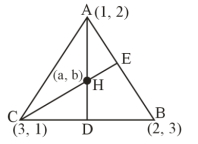
If $(a, b)$ be the orthocentre of the triangle whose vertices are $(1,2),(2,3)$ and $(3,1)$, and $I_1=\int_{\mathrm{a}}^{\mathrm{b}} \mathrm{x} \sin \left(4 \mathrm{x}-\mathrm{x}^2\right) \mathrm{dx}, \mathrm{I}_2=\int_{\mathrm{a}}^{\mathrm{b}} \sin \left(4 \mathrm{x}-\mathrm{x}^2\right) \mathrm{dx}$ , then $36 \frac{\mathrm{I}_1}{\mathrm{I}_2}$ is equal to :
Answera
Equation of $\mathrm{CE}$
$ y-1=-(x-3)$
$ x+y=4$
orthocentre lies on the line $x+y=4$
$ \text { so, } a+b=4 $
$ I_1=\int_a^b x \sin (x(4-x)) d x$ $.....(i)$
Using king rule
$ I_1=\int_a^b(4-x) \sin (x(4-x)) d x $$......(ii)$
$text { (i) }+ \text { (ii) }$
$ 2 I_1=\int_a^b 4 \sin (x(4-x)) d x $
$2 I_1=4 I_2 $
$ I_1=2 I_2 $
$ \frac{I_1}{I_2}=2 $
$ \frac{36 I_1}{I_2}=72$
View full question & answer→MCQ 1591 Mark
For $0 < a < 1$, the value of the integral $\int_0^\pi \frac{\mathrm{d} x}{1-2 \mathrm{a} \cos x+\mathrm{a}^2}$
- A
$\frac{\pi^2}{\pi+a^2}$
- B
$\frac{\pi^2}{\pi-a^2}$
- ✓
$\frac{\pi}{1-a^2}$
- D
$\frac{\pi}{1+a^2}$
AnswerCorrect option: C. $\frac{\pi}{1-a^2}$
c
$ I=\int_0^\pi \frac{d x}{1-2 a \cos x+a^2} ; 0 < a < 1 $
$ I=\int_0^\pi \frac{d x}{1+2 a \cos x+a^2} $
$ 2 I=2 \int_0^{\pi / 2} \frac{2\left(1+a^2\right)}{\left(1+a^2\right)^2-4 a^2 \cos ^2 x} d x $
$ \Rightarrow I=\int_0^{\pi / 2} \frac{2\left(1+a^2\right) \cdot \sec ^2 x}{\left(1+a^2\right)^2 \cdot \sec ^2 x-4 a^2} d x $
$ \Rightarrow I=\int_0^{\pi / 2} \frac{2 \cdot\left(1+a^2\right) \cdot \sec ^2 x}{\left(1+a^2\right)^2 \cdot \tan ^2 x+\left(1-a^2\right)^2} d x$
$\Rightarrow I=\int_0^{\pi / 2} \frac{\frac{2 \cdot \sec ^2 x}{1+a^2} \cdot d x}{\tan ^2 x+\left(\frac{1-a^2}{1+a^2}\right)^2}$
$ \Rightarrow I=\frac{2}{\left(1-a^2\right)}\left[\frac{\pi}{2}-0\right] $
$ I=\frac{\pi}{1-a^2}$
View full question & answer→MCQ 1601 Mark
Let $f: R \rightarrow R$ be defined $f(x)=a e^{2 x}+b e^x+c x$. If $f(0)=-1, f^{\prime}\left(\log _e 2\right)=21$ and $\int_0^{\log _e 4}(f(x)-c x) d x=\frac{39}{2}$, then the value of $|a+b+c|$ equals:
Answerd
$f(x)=a e^{2 x}+b e^x+c x \quad f(0)=-1$ $a+b=-1$
$\mathrm{f}^{\prime}(\mathrm{x})=2 \mathrm{ae}^{2 \mathrm{x}}+\mathrm{be}^{\mathrm{x}}+\mathrm{c} \quad \mathrm{f}^{\prime}(\ln 2)=21$ $8 a+2 b+c=21$
$\int_0^{\ln 4}\left(a e^{2 x}+b e^x\right) d x=\frac{39}{2}$
$ \left[\frac{a e^{2 x}}{2}+b e^x\right]_0^{\ln 4}=\frac{39}{2}$
$ \Rightarrow 8 a+4 b-\frac{a}{2}-b=\frac{39}{2} $
$\left[\frac{a e^{2 x}}{2}+b e^x\right]_0^{\ln 4}=\frac{39}{2}$
$ \Rightarrow 8 a+4 b- \frac{a}{2}-b=\frac{39}{2} $
$ 15 a+6 b=39 $
$ 15 a-6 a-6=39 $
$ 9 a=45 \Rightarrow a=5 $
$ b=-6 $
$ c=21-40+12=-7 $
$ a+b+c=-8 $
$ |a+b+c|=8$
View full question & answer→MCQ 1611 Mark
Let $\mathrm{f}: \mathbb{R} \rightarrow \mathbb{R}$ be a function defined by $f(x)=\frac{4^x}{4^x+2}$ and $M=\int_{f(a)}^{f(1-a)} x \sin ^4(x(1-x)) d x,$ $N=\int_{f(a)}^{f(1-a)} \sin ^4(x(1-x)) d x ; a \neq \frac{1}{2} . \text { If }$ $\alpha \mathrm{M}=\beta \mathrm{N}, \alpha, \beta \in \mathbb{N}$, then the least value of $\alpha^2+\beta^2$ is equal to $ . . . . .$
Answerb
$f(a)+f(1-a)=1 .$
$M=\int_{f(a)}^{f(1-a)}(1-x) \cdot \sin ^4 x(1-x) d x$
$M=N-M \quad 2 M=N$
$\alpha=2 ; \beta=1 ;$
Ans. $5$
View full question & answer→MCQ 1621 Mark
$\left|\frac{120}{\pi^3} \int_0^\pi \frac{x^2 \sin x \cos x}{\sin ^4 x+\cos ^4 x} d x\right|$ is equal to....................
Answera
$\int_0^\pi \frac{x^2 \sin x \cdot \cos x}{\sin ^4 x+\cos ^4 x} d x$
$=\int_0^{\frac{\pi}{2}} \frac{\sin x \cdot \cos x}{\sin ^4 x+\cos ^4 x}\left(x^2-(\pi-x)^2\right) d x$
$=\int_0^{\frac{\pi}{2}} \frac{\sin x \cdot \cos x\left(2 \pi x-\pi^2\right)}{\sin ^4 x+\cos ^4 x}$
$=2 \pi \int_0^{\frac{\pi}{2}} \frac{x \sin x \cos x}{\sin ^4 x+\cos ^4 x} d x-\pi^2 \int_0^{\frac{\pi}{2}} \frac{\sin x \cos x}{\sin ^4 x+\cos 4} d x$
$=2 \pi \cdot \frac{\pi}{4} \int_0^{\frac{\pi}{2}} \frac{\sin x \cos ^4 x}{\sin ^4 x+\cos ^4 x} d x-\pi^2 \int_0^{\frac{\pi}{2}} \frac{\sin x \cos ^2 x}{\sin ^4 x+\cos ^4 x} d x$
$=-\frac{\pi^2}{2} \int_0^{\frac{\pi}{2}} \frac{\sin x \cos x}{\sin ^4 x+\cos ^4 x} d x$
$=-\frac{\pi^2}{2} \int_0^{\frac{\pi}{2}} \frac{\sin x \cos x d x}{1-2 \sin ^2 x \times \cos ^2 x}$
$=-\frac{\pi^2}{2} \int_0^{\frac{\pi}{2}} \frac{\sin 2 x}{2-\sin ^2 2 x} d x$
$=-\frac{\pi^2}{2} \int_0^{\frac{\pi}{2}} \frac{\sin 2 x}{1+\cos ^2 2 x} d x$
Let $\cos 2 \mathrm{x}=\mathrm{t}$
View full question & answer→MCQ 1631 Mark
The value of the integral $\int_0^{\frac{\pi}{4}} \frac{x d x}{\sin ^4(2 x)+\cos ^4(2 x)}$ equals :
- A
$\frac{\sqrt{2} \pi^2}{8}$
- B
$\frac{\sqrt{2} \pi^2}{16}$
- ✓
$\frac{\sqrt{2} \pi^2}{32}$
- D
$\frac{\sqrt{2} \pi^2}{64}$
AnswerCorrect option: C. $\frac{\sqrt{2} \pi^2}{32}$
c
$\int_0^{\frac{\pi}{4}} \frac{x d x}{\sin ^4(2 x)+\cos ^4(2 x)}$
Let $2 x=t$ then $d x=\frac{1}{2} d t$
$I=\frac{1}{4} \int_0^{\frac{\pi}{2}} \frac{t d t}{\sin ^4 t+\cos ^4 t}$
$I=\frac{1}{4} \int_0^{\frac{\pi}{2}} \frac{\left(\frac{\pi}{2}-t\right) d t}{\sin ^4\left(\frac{\pi}{2}-t\right)+\cos ^4\left(\frac{\pi}{2}-t\right)}$
$I=\frac{1}{4} \int_0^{\frac{\pi}{2}} \frac{\frac{\pi}{2} d t}{\sin ^4 t+\cos ^4 t}-I$
$2 I=\frac{\pi}{8} \int_0^{\frac{\pi}{2}} \frac{d t}{\sin ^4 t+\cos ^4 t}$
$2 I=\frac{\pi}{8} \int_0^{\frac{\pi}{2}} \frac{\sec ^4 t d t}{\tan ^4 t+1}$
Let $\operatorname{tant}=\mathrm{y}$ then $\sec ^2 \mathrm{t} \mathrm{dt}=\mathrm{dy}$
$2 I=\frac{\pi}{8} \int_0^{\infty} \frac{\left(1+y^2\right) d y}{1+y^4}$
$=\frac{\pi}{16} \int_0^{\infty} \frac{1+\frac{1}{\mathrm{y}^2}}{\mathrm{y}^2+\frac{1}{\mathrm{y}^2}} \mathrm{dy}$
Put $y-\frac{1}{y}=p$
$\mathrm{I}=\frac{\pi}{16} \int_{-\infty}^{\infty} \frac{\mathrm{dp}}{\mathrm{p}^2+(\sqrt{2})^2}$
$=\frac{\pi}{16 \sqrt{2}}\left[\tan ^{-1}\left(\frac{\mathrm{p}}{\sqrt{2}}\right)\right]_{-\infty}^{\infty}$
$I=\frac{\pi^2}{16 \sqrt{2}}$
View full question & answer→MCQ 1641 Mark
If $\int_{-\pi / 2}^{\pi / 2} \frac{8 \sqrt{2} \cos x d x}{\left(1+e^{\sin x}\right)\left(1+\sin ^4 x\right)}=\alpha \pi+\beta \log _e(3+2$ $\sqrt{2}$ ), where $\alpha, \beta$ are integers, then $\alpha^2+\beta^2$ equals.....................
Answerd
$I=\int_{-\frac{\pi}{2}}^{\frac{\pi}{2}} \frac{8 \sqrt{2} \cos x}{\left(1+e^{\sin x}\right)\left(1+\sin ^4 x\right)} d x$
Apply king
$I=\int_{-\frac{\pi}{2}}^{\frac{\pi}{2}} \frac{8 \sqrt{2} \cos x\left(e^{\sin x}\right)}{\left(1+e^{\sin x}\right)\left(1+\sin ^4 x\right)} d x$
adding $(1)\ \&\ (2)$
$2 I=\int_{-\frac{\pi}{2}}^{\frac{\pi}{2}} \frac{8 \sqrt{2} \cos x}{1+\sin ^4 x} d x$
$I=\int_0^{\frac{\pi}{2}} \frac{8 \sqrt{2} \cos x}{1+\sin ^4 x} d x,$
$\sin x=t$
$I=\int_0^1 \frac{8 \sqrt{2}}{1+t^4} d x$
$I=4 \sqrt{2} \int_0^1\left(\frac{1+\frac{1}{t^2}}{t^2+\frac{1}{t^2}}-\frac{1-\frac{1}{t^2}}{t^2+\frac{1}{t^2}} d t\right.$
$I=4 \sqrt{2} \int_0^1 \frac{\left(1+\frac{1}{t^2}\right)}{\left(t-\frac{1}{t}\right)^2+2}-\frac{1}{\left(t+\frac{1}{t}\right)^2-2} d t$
Let $t-\frac{1}{t}=z \& t+\frac{1}{t}=k$
$=4 \sqrt{2}\left[\int_{-\infty}^0 \frac{d z}{z^2+2}-\int_{\infty}^2 \frac{d k}{k^2-2}\right]$
$=4 \sqrt{2}\left[\frac{1}{\sqrt{2}} \tan ^{-1} \frac{z}{\sqrt{2}}\right]_{-\infty}^0-\left[\frac{1}{2 \sqrt{2}} \ln \left(\frac{k-\sqrt{2}}{k+\sqrt{2}}\right)\right]_{\infty}^2$
$=4 \sqrt{2}\left[\frac{\pi}{2 \sqrt{2}}-\frac{1}{2 \sqrt{2}}\left[\ln \frac{2-\sqrt{2}}{2+\sqrt{2}}\right]\right]$
$=2 \pi+2 \ln (3+2 \sqrt{2})$
$\alpha=2$
$\beta=2$
View full question & answer→MCQ 1651 Mark
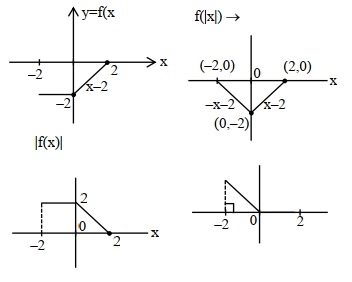
Let $f(x)=\left\{\begin{array}{cc}-2, & -2 \leq x \leq 0 \\ x-2, & 0 < x \leq 2\end{array}\right.$ and $h(x)=f(|x|)+|f(x)|$. Then $\int_{-2}^2 \mathrm{~h}(\mathrm{x}) \mathrm{dx}$ is equal to :
Answera
$Image$
$h(x)=\left\{\begin{array}{cc}x-2+2-x=0, & 0 \leq x \leq 2 \\ -x-2+2=-x & -2 \leq x<0\end{array}\right.$
$Image$
View full question & answer→MCQ 1661 Mark
If $\int_0^{\frac{\pi}{4}} \frac{\sin ^2 x}{1+\sin x \cos x} d x=\frac{1}{a} \log _e\left(\frac{a}{3}\right)+\frac{\pi}{b \sqrt{3}}$, where a, $\mathrm{b} \in \mathrm{N}$, then $\mathrm{a}+\mathrm{b}$ is equal to ....................
Answerb
$ \int_0^{\frac{\pi}{2}} \frac{\sin ^2 x}{1+\frac{1}{2} \sin 2 x} d x=\int_0^{\frac{\pi}{4}} \frac{1-\cos 2 x}{2+\sin 2 x} d x $
$ \int \frac{1}{2+\sin 2 x}-\int \frac{\cos 2 x}{2+\sin 2 x}$
$ \left.\left(\mathrm{I}_1\right)-\mathrm{I}_2\right) $
$ \left(\mathrm{I}_1\right)=\int \frac{\mathrm{dx}}{2+\frac{2 \tan \mathrm{x}}{1+\tan ^2 \mathrm{x}}} $
$ \int_0^{\frac{\pi}{4}} \frac{\sec ^2 \mathrm{xdx}}{2 \tan ^2 \mathrm{x}+2 \tan \mathrm{x}+2}$
$ \frac{1}{2} \int_0^1 \frac{d t}{\left(t+\frac{1}{2}\right)^2+\frac{3}{4}}=\frac{\pi}{6 \sqrt{3}} $
$ I_2=\int_0^{\pi / 4} \frac{\cos 2 x}{2+\sin 2 x} d x=\frac{1}{2}\left(\ln \frac{3}{2}\right) $
$ I_1-I_2=\frac{1}{\sqrt{3}} \frac{\pi}{6}+\frac{1}{2} \ln \frac{2}{3} $
$ \Rightarrow a=2, b=6$
Ans. $8$
View full question & answer→MCQ 1671 Mark
If the value of the integral $\int_{-1}^1 \frac{\cos \alpha x}{1+3^x} d x$ is $\frac{2}{\pi}$. Then, a value of $\alpha$ is
- A
$\frac{\pi}{6}$
- ✓
$\frac{\pi}{2}$
- C
$\frac{\pi}{3}$
- D
$\frac{\pi}{4}$
AnswerCorrect option: B. $\frac{\pi}{2}$
b
Let $I=\int_{-1}^{+1} \frac{\cos \alpha x}{1+3^x} d x$
$ I=\int_{-1}^{+1} \frac{\cos \alpha x}{1+3^{-x}} d x $
$ \left(\text { using } \int_a^b f(x) d x=\int_a^b f(a+b-x) d x\right)$
Add ($1$) and ($II$)
$ 2 I=\int_{-1}^{+1} \cos (\alpha x) d x=2 \int_0^1 \cos (\alpha x) d x $
$ I=\frac{\sin \alpha}{\alpha}=\frac{2}{\pi}(\text { given }) $
$ \therefore \alpha=\frac{\pi}{2}$
View full question & answer→MCQ 1681 Mark
The value of $\int_{-\pi}^\pi \frac{2 y(1+\sin y)}{1+\cos ^2 y} d y$ is :
- ✓
$\pi^2$
- B
$\frac{\pi^2}{2}$
- C
$\frac{\pi}{2}$
- D
$2 \pi^2$
AnswerCorrect option: A. $\pi^2$
a
$\int_{-\pi}^\pi \frac{2 y(1+\sin y)}{1+\cos ^2 y} d y$
$ =\int_{-\pi}^\pi \frac{2 y}{1+\cos ^2 y} d y+\int_{-\pi}^\pi \frac{2 y \sin y}{1+\cos ^2 y} d y $
$ =0+2 \cdot 2 \int_0^\pi y\left(\frac{\sin y}{1+\cos ^2 y}\right) d y $
$ I=4 \int_0^\pi \frac{y \sin y}{1+\cos ^2 y} d y $
$ I=4 \int_0^\pi \frac{(\pi-y) \sin y}{1+\cos ^2 y} d y $
$ 2 I=4 \int_0^\pi \frac{\pi \sin y}{1+\cos ^2 y} d y $
$ I=2 \pi \int_0^\pi \frac{\sin y}{1+\cos ^2 y} d y $
$ =2 \pi\left(-\tan ^{-1}(\cos y)\right)_0^\pi $
$ =-2 \pi\left[\left(-\frac{\pi}{4}\right)-\left(\frac{\pi}{4}\right)\right] $
$ =-2 \pi\left[-\frac{2 \pi}{4}\right]=\pi^2$
View full question & answer→MCQ 1691 Mark
Let $r_k=\frac{\int_0^1\left(1-x^7\right)^k d x}{\int_0^1\left(1-x^7\right)^{k+1} d x}, k \in N$. Then the value of $\sum_{\mathrm{k}=1}^{10} \frac{1}{7\left(\mathrm{r}_{\mathrm{k}}-1\right)}$ is equal to ...........
Answerc
$ I_K=\int 1 \cdot\left(1-x^7\right)^K d x $
$ I_K=\left.\left(1-x^7\right)^K x\right|_0 ^1+7 K \int_0^1\left(1-x^7\right)^{K-1} x^6 \cdot x d x $
$ I_K=-7 K \int_0^1\left(1-x^7\right)^{K-1}\left(\left(1-x^7\right)-1\right) d x $
$ I_K=-7 K $
$ I_K+7 K I_{K-1} $
$ \Rightarrow \frac{I_K}{I_{K+1}}=\frac{7 K+8}{7 K+7} $
$ r_K=\frac{7 K+8}{7 K+7} $
$ r_K-1=\frac{1}{7(K+1)} $
$ \Rightarrow 7\left(r_K-1\right)=\frac{1}{K+1} $
$ \sum_{K=1}^{10}(K+1)=11(6)-1=65$
View full question & answer→MCQ 1701 Mark
The value of $\mathrm{k} \in \mathbb{N}$ for which the integral
$I_n=\int_0^1\left(1-x^k\right)^n d x, n \in \mathbb{N} \text {, satisfies } 147 I_{20}=148 I_{21}$ is :
Answerd
$ I_n=\int_0^1\left(1-x^k\right)^n \cdot 1 d x $
$ I_n=\left(1-x^k\right)^n \cdot x-n k \int_0^1\left(1-x^k\right)^{n-1} \cdot x^{k-1} \cdot d x $
$ I_n=n k \int_0^1\left[\left(1-x^k\right)^n-\left(1-x^k\right)^{n-1}\right] d x $
$ I_n=n k I_n-n k I_n $
$ \frac{I_n}{I_{n-1}}=\frac{n k}{n k+1} $
$ \frac{I_{21}}{I_{20}}=\frac{21 k}{1+21 k} $
$ =\frac{147}{148} \Rightarrow k=7$
View full question & answer→MCQ 1711 Mark
Let $f(x)=\int_0^x g(t) \log _e\left(\frac{1-t}{1+t}\right) d t$, where $g$ is a continuous odd function. If $\int_{-\pi / 2}^{\pi / 2}\left(f(x)+\frac{x^2 \cos x}{1+e^x}\right) d x=\left(\frac{\pi}{\alpha}\right)^2-\alpha$, then $\alpha$ is equal to..............
Answerc
$f(x)=\int_0^x g(t) \ln \left(\frac{1-t}{1+t}\right) d t$
$f(-x)=\int_0^{-x} g(t) \ln \left(\frac{1-t}{1+t}\right) d t$
$f(-x)=-\int_0^x g(-y) \ln \left(\frac{1+y}{1-y}\right) d y$
$=-\int_0^x g(y) \ln \left(\frac{1-y}{1+y}\right) d y$ (g is odd)
$f(-x)=-f(x) \Rightarrow f$ is also odd
Now,
$I=\int_{-\pi / 2}^{\pi / 2}\left(f(x)+\frac{x^2 \cos x}{1+e^x}\right) d x$
$I=\int_{-\pi / 2}^{\pi / 2}\left(f(-x)+\frac{x^2 e^x \cos x}{1+e^x}\right) d x$
$2 I=\int_{-\pi / 2}^{\pi / 2} x^2 \cos x d x=2 \int_0^{\pi / 2} x^2 \cos x d x$
$ I=\left(x^2 \sin x\right)_0^{\pi / 2}-\int_0^{\pi / 2} 2 x \sin x d x $
$ =\frac{\pi^2}{4}-2\left(-x \cos x+\int \cos x d x\right)_0^{\pi / 2} $
$ =\frac{\pi^2}{4}-2(0+1)=\frac{\pi^2}{4}-2 \Rightarrow\left(\frac{\pi}{2}\right)^2-2 $
$ \therefore \alpha=2$
View full question & answer→MCQ 1721 Mark
$\lim _{x \rightarrow \frac{\pi}{2}}\left(\frac{1}{\left(x-\frac{\pi}{2}\right)^2} \int_{x^3}^{\left(\frac{\pi}{2}\right)^3} \cos \left(\frac{1}{t^3}\right) d t\right)$ is equal to
- A
$\frac{3 \pi}{8}$
- B
$\frac{3 \pi^2}{4}$
- ✓
$\frac{3 \pi^2}{8}$
- D
$\frac{3 \pi}{4}$
AnswerCorrect option: C. $\frac{3 \pi^2}{8}$
c
Using L'hopital rule
$ =\lim _{x \rightarrow \frac{\pi^{-}}{2}} \frac{0-\cos x \times 3 x^2}{2\left(x-\frac{\pi}{2}\right)} $
$ =\lim _{x \rightarrow \frac{\pi^{-}}{2}} \frac{\sin \left(x-\frac{\pi}{2}\right)}{2\left(x-\frac{\pi}{2}\right)} \times \frac{3 \pi^2}{4}$
$ =\frac{3 \pi^2}{8}$
View full question & answer→MCQ 1731 Mark
Let the slope of the line $45 x+5 y+3=0$ be $27 r_1+\frac{9 r_2}{2} \quad$ for some $r_1, \quad r_2 \in R$. Then $\operatorname{Lim}_{x \rightarrow 3}\left(\int_3^\pi \frac{8 t^2}{\frac{3 r_2 x}{2}-r_2 x^2-r_1 x^3-3 x} d t\right)$ is equal to ...................
Answerb
According to the question,
$ 27 \mathrm{r}_1+\frac{9 \mathrm{r}_2}{2}=-9 $
$ \lim _{x \rightarrow 3} \frac{\int_3^\pi 8 t^2 d t}{\frac{3 r_2 x}{2}-r_2 x^2-r_1 x^3-3 x} $
$ =\lim _{\mathrm{r} \rightarrow 3} \frac{8 \mathrm{x}^2}{\frac{3 \mathrm{r}_2^2}{2}-2 \mathrm{r}_2 \mathrm{x}-3 \mathrm{r}_1 \mathrm{x}^2-3} \text { (using LH' Rule) } $
$ =\frac{72}{\frac{3 r_2}{2}-6 r_2-27 r_1-3} $
$ =\frac{72}{-\frac{9 r_2}{2}-27 r_1-3} $
$ =\frac{72}{9-3}=12 $
View full question & answer→MCQ 1741 Mark
The value of $\lim _{n \rightarrow \infty} \sum_{k=1}^n \frac{n^3}{\left(n^2+k^2\right)\left(n^2+3 k^2\right)}$ is:
- A
$\frac{(2 \sqrt{3}+3) \pi}{24}$
- ✓
$\frac{13 \pi}{8(4 \sqrt{3}+3)}$
- C
$\frac{13(2 \sqrt{3}-3) \pi}{8}$
- D
$\frac{\pi}{8(2 \sqrt{3}+3)}$
AnswerCorrect option: B. $\frac{13 \pi}{8(4 \sqrt{3}+3)}$
b
$ \lim _{n \rightarrow \infty} \sum_{k=1}^n \frac{n^3}{n^4\left(1+\frac{k^2}{n^2}\right)\left(1+\frac{3 k^2}{n^2}\right)} $
$ =\lim _{n \rightarrow \infty} \frac{1}{n} \sum_{k=1}^n \frac{n^3}{\left(1+\frac{k^2}{n^2}\right)\left(1+\frac{3 k^2}{n^2}\right)}$
$ =\int_{03}^1 \frac{d x}{\left(1+x^2\right)\left(\frac{1}{3}+x^2\right)}$
$ =\int_0^1 \frac{1}{3} \times \frac{3}{2} \frac{\left(x^2+1\right)-\left(x^2+\frac{1}{3}\right)}{\left(1+x^2\right)\left(x^2+\frac{1}{3}\right)} d x $
$ =\frac{1}{2} \int_0^1\left[\frac{1}{x^2+\left(\frac{1}{\sqrt{3}}\right)^2}-\frac{1}{1+x^2}\right] d x $
$ =\frac{1}{2}\left[\sqrt{3} \tan ^{-1}(\sqrt{3} x)\right]_0^1-\frac{1}{2}\left(\tan ^{-1} x\right)_0^1 $
$ =\frac{\sqrt{3}}{2}\left(\frac{\pi}{3}\right)-\frac{1}{2}\left(\frac{\pi}{4}\right)=\frac{\pi}{2 \sqrt{3}}-\frac{\pi}{8}$
$ =\frac{13 \pi}{8 \cdot(4 \sqrt{3}+3)}$
View full question & answer→MCQ 1751 Mark
Let $f:\left[-\frac{\pi}{2}, \frac{\pi}{2}\right] \rightarrow R$ be a differentiable function such that $f(0)=\frac{1}{2}$, If the $\lim _{x \rightarrow 0} \frac{x \int_0^x f(t) d t}{e^{x^2}-1}=\alpha$, then $8 \alpha^2$ is equal to :
Answerb
$ \lim _{x \rightarrow 0} \frac{x \int_0^x f(t) d t}{\left(\frac{e^{x^2}-1}{x^2}\right) \times x^2}$
$ \lim _{x \rightarrow 0} \frac{\int_0^x f(t) d t}{x} \quad\left(\lim _{x \rightarrow 0} \frac{e^{x^2}-1}{x^2}=1\right)$
$ =\lim _{x \rightarrow 0} \frac{f(x)}{1} \text { (using L Hospital) }$
$ f(0)=\frac{1}{2} $
$ \alpha=\frac{1}{2} $
$ 8 \alpha^2=2$
View full question & answer→MCQ 1761 Mark
Let $f:(0, \infty) \rightarrow R$ and $F(x)=\int_0^x t f(t) d t$. If $F\left(x^2\right)=$ $x^4+x^5$, then $\sum_{r=1}^{12} f\left(r^2\right)$ is equal to :
Answerc
$ F(x)=\int_0^x t \cdot f(t) d t $
$ \mathrm{~F}^1(\mathrm{x})=\mathrm{xf}(\mathrm{x}) $
$ \text { Given } $
$ F\left(x^2\right)=x^4+x^5, \quad \text { let } x^2=t $
$ F(t)=t^2+t^{5 / 2} $
$ F^{\prime}(t)=2 t+5 / 2 t^{3 / 2} $
$ t \cdot f(t)=2 t+5 / 2 t^{3 / 2} $
$ f(t)=2+5 / 2 t^{1 / 2} $
$ \sum_{\mathrm{r}=1}^{12} \mathrm{f}\left(\mathrm{r}^2\right)=\sum_{\mathrm{r}=1}^{12} 2+\frac{5}{2} \mathrm{r} $
$ =24+5 / 2\left[\frac{12(13)}{2}\right]$
$ =219 $
View full question & answer→MCQ 1771 Mark
Let $ \lim _{n \rightarrow \infty}\left(\frac{n}{\sqrt{n^4+1}}-\frac{2 n}{\left(n^2+1\right) \sqrt{n^4+1}}+\frac{n}{\sqrt{n^4+16}}-\frac{8 n}{\left(n^2+4\right) \sqrt{n^4+16}}\right. $ $ \left.+\ldots \ldots+\frac{n}{\sqrt{n^4+n^4}}-\frac{2 n \cdot n^2}{\left(n^2+n^2\right) \sqrt{n^4+n^4}}\right) \text { be } \frac{\pi}{k},$ using only the principal values of the inverse trigonometric functions. Then $\mathrm{k}^2$ is equal to..............
Answerd
$ \sum_{\mathrm{r}=1}^{\infty} \frac{\mathrm{n}}{\sqrt{\mathrm{n}^4+\mathrm{r}^4}}-\frac{2 \mathrm{nr}^2}{\left(\mathrm{n}^2+\mathrm{r}^2\right) \sqrt{\mathrm{n}^4+\mathrm{r}^4}} $
$ \sum_{\mathrm{r}=1}^{\infty} \frac{\frac{1}{\mathrm{n}}}{\sqrt{1+\left(\frac{\mathrm{r}}{\mathrm{n}}\right)^4}}-\frac{2\left(\frac{1}{\mathrm{n}}\right)\left(\frac{\mathrm{r}}{\mathrm{n}}\right)^2}{\left(1+\left(\frac{\mathrm{r}}{\mathrm{n}}\right)^2\right) \sqrt{1+\left(\frac{\mathrm{r}}{\mathrm{n}}\right)^4}} $
$ \Rightarrow \int_0^1 \frac{\mathrm{dx}}{\sqrt{1+\mathrm{x}^4}}-\frac{2 \mathrm{x}^2 \mathrm{dx}}{\left(1+\mathrm{x}^2\right) \sqrt{1+\mathrm{x}^4}} $
$ \Rightarrow \int_0^1 \frac{1-x^2}{\left(1+x^2\right) \sqrt{1+x^4}} d x $
$ \Rightarrow \int_0^1 \frac{\frac{1}{x^2}-1}{\left(x+\frac{1}{x}\right) \sqrt{x^2+\frac{1}{x^2}}} d x $
$ \Rightarrow-\int_0^1 \frac{1-\frac{1}{x^2}}{\left(x+\frac{1}{x}\right) \sqrt{\left(x+\frac{1}{x}\right)^2-2}} d x $
$ \mathrm{x}+\frac{1}{\mathrm{x}}=\mathrm{t} \Rightarrow 1-\frac{1}{\mathrm{x}^2} \mathrm{dx}=\mathrm{dt} $
$ \Rightarrow-\int_{\infty}^2 \frac{\mathrm{dt}}{\mathrm{t} \sqrt{\mathrm{t}^2-2}} $
$ \Rightarrow-\int_{\infty}^2 \frac{\mathrm{tdt}}{\mathrm{t}^2 \sqrt{\mathrm{t}^2-2}}$
take $\mathrm{t}^2-2=\alpha^2$
$\mathrm{tdt}=\alpha \mathrm{d} \alpha$
$ \Rightarrow-\int_{\infty}^{\sqrt{2}} \frac{\alpha \mathrm{d} \alpha}{\left(\alpha^2+2\right) \alpha} $
$ \Rightarrow-\int_{\infty}^{\sqrt{2}} \frac{\mathrm{d} \alpha}{\alpha^2+2} $
$ \left.\Rightarrow \frac{-1}{\sqrt{2}} \tan ^{-1} \frac{\alpha}{\sqrt{2}}\right]_{\infty}^{\sqrt{2}} $
$ \Rightarrow \frac{-1}{\sqrt{2}}\left\{\tan ^{-1} 1\right\}+\frac{1}{\sqrt{2}} \tan ^{-1} \infty $
$ \Rightarrow \frac{1}{\sqrt{2}}\left\{\frac{\pi}{2}-\frac{\pi}{4}\right\} $
$ \Rightarrow \frac{\pi}{4 \sqrt{2}}=\frac{\pi}{\mathrm{K}}$
So $\mathrm{K}=4 \sqrt{2}$
$\mathrm{K}^2=32$
View full question & answer→MCQ 1781 Mark
Let $y=f(x)$ be a thrice differentiable function in $(-5,5)$. Let the tangents to the curve $y=f(x)$ at $(1, \mathrm{f}(1))$ and $(3, \mathrm{f}(3))$ make angles $\frac{\pi}{6}$ and $\frac{\pi}{4}$, respectively with positive $x$-axis. If $27 \int_1^3\left(\left(f^{\prime}(t)\right)^2+1\right) f^{\prime \prime}(t) d t=\alpha+\beta \sqrt{3} \quad$ where $\alpha, \quad \beta$ are integers, then the value of $\alpha+\beta$ equals
Answerb
$y=f(x) \Rightarrow \frac{d y}{d x}=f^{\prime}(x)$
$ \left.\frac{d y}{d x}\right)_{(1, f(1))}=f^{\prime}(1)=\tan \frac{\pi}{6}=\frac{1}{\sqrt{3}} \Rightarrow f^{\prime}(1)=\frac{1}{\sqrt{3}} $
$ \left.\frac{d y}{d x}\right)_{(3, f(3))}=f^{\prime}(3)=\tan \frac{\pi}{4}=1 \Rightarrow f^{\prime}(3)=1 $
$ 27 \int_1^3\left(\left(f^{\prime}(t)\right)^2+1\right) f^{\prime \prime}(t) d t=\alpha+\beta \sqrt{3} $
$ I=\int_1^3\left(\left(f^{\prime}(t)\right)^2+1\right) f^{\prime \prime}(t) d t $
$ f(t)=z \Rightarrow f^{\prime}(t) d t=d z $
$ z=f^{\prime}(3)=1$
$z=f^{\prime}(1)=\frac{1}{\sqrt{3}} $
$I=\int_{1 / \sqrt{3}}^1\left(z^2+1\right) d z=\left(\frac{z^3}{3}+z\right)_{1 / \sqrt{3}}^1$
$ =\left(\frac{1}{3}+1\right)-\left(\frac{1}{3} \cdot \frac{1}{3 \sqrt{3}}+\frac{1}{\sqrt{3}}\right)$
$ =\frac{4}{3}-\frac{10}{9 \sqrt{3}}=\frac{4}{3}-\frac{10}{27} \sqrt{3} $
$ \alpha+\beta \sqrt{3}=27\left(\frac{4}{3}-\frac{10}{27} \sqrt{3}\right)=36-10 \sqrt{3} $
$ \alpha=36, \beta=-10$
$ \alpha+\beta=36-10=26$
View full question & answer→MCQ 1791 Mark
Let $\mathrm{a}$ and $\mathrm{b}$ be real constants such that the function $f$ defined by $f(x)=\left\{\begin{array}{cc}x^2+3 x+a & x \leq 1 \\ b x+2, & x>1\end{array}\right.$ be differentiable on $R$. Then, the value of $\int_{-2}^2 f(x) d x$ equals
- A
$\frac{15}{6}$
- B
$\frac{19}{6}$
- C
$21$
- ✓
$17$
Answerd
$ \mathrm{f} \text { is continuous } \quad \mathrm{f}^{\prime}(\mathrm{x})=2 \mathrm{x}+3, \mathrm{x}<1 $
$ \therefore 4+\mathrm{a}=\mathrm{b}+2$
$ \text { b }, x>1 $
$ \mathrm{a}=\mathrm{b}-2 \quad \mathrm{f} \text { is differentiable } $
$ \therefore \mathrm{b}=5 $
$ \therefore \quad \mathrm{a}=3 $
$ \int_{-2}^1\left(x^2+3 x+3\right) d x+\int_1^2(5 x+2) d x $
$ =\left[\frac{\mathrm{x}^3}{3}+\frac{3 \mathrm{x}^2}{2}+3 \mathrm{x}\right]_{-2}^1+\left[\frac{5 \mathrm{x}^2}{2}+2 \mathrm{x}\right]_1^2$
$ =\left(\frac{1}{3}+\frac{3}{2}+3\right)-\left(\frac{-8}{3}+6-6\right)+\left(10+4-\frac{5}{2}-2\right)$
$ =6+\frac{3}{2}+12-\frac{5}{2}=17 $
View full question & answer→MCQ 1801 Mark
Let $f, g:(0, \infty) \rightarrow R$ be two functions defined by $f(x)=\int_{-x}^x\left(|t|-t^2\right) e^{-t^2} d t$ and $g(x)=\int_0^{x^2} t^{1 / 2} e^{-t} d t$. Then the value of $\left(\mathrm{f}\left(\sqrt{\log _{\mathrm{e}} 9}\right)+\mathrm{g}\left(\sqrt{\log _{\mathrm{e}} 9}\right)\right)$ is
Answerc
$\mathrm{f}(\mathrm{x})=\int_{-\mathrm{x}}^{\mathrm{x}}\left(|\mathrm{t}|-\mathrm{t}^2\right) \mathrm{e}^{-\mathrm{t}^2} \mathrm{dt}$
$\Rightarrow \mathrm{f}^{\prime}(\mathrm{x})=2 \cdot\left(|\mathrm{x}|-\mathrm{x}^2\right) \mathrm{e}^{-\mathrm{x}^2} \ldots \ldots \ldots \ldots(1)$
$\mathrm{g}(\mathrm{x})=\int_0^{\mathrm{x}^2} \mathrm{t}^{\frac{1}{2}} \mathrm{e}^{-\mathrm{t}} \mathrm{dt}$
$\mathrm{g}^{\prime}(\mathrm{x})=\mathrm{xe}^{-\mathrm{x}^2}(2 \mathrm{x})-0$
$\mathrm{f}^{\prime}(\mathrm{x})+\mathrm{g}^{\prime}(\mathrm{x})=2 \mathrm{xe}^{-\mathrm{x}^2}-2 \mathrm{x}^2 \mathrm{e}^{-\mathrm{x}^2}+2 \mathrm{x}^2 \mathrm{e}^{-\mathrm{x}^2}$
Integrating both sides w.r.t. $x$
$\mathrm{f}(\mathrm{x})+\mathrm{g}(\mathrm{x})=\int_0^\alpha 2 \mathrm{xe}^{-\mathrm{x}^2} \mathrm{dx}$
$\mathrm{x}^2=\mathrm{t}$
$\Rightarrow \int_0^{\sqrt{\alpha}} \mathrm{e}^{-\mathrm{t}} \mathrm{dt}=\left[-\mathrm{e}^{-\mathrm{t}}\right]_0^{\sqrt{\alpha}} $
$ =-\mathrm{e}^{\left(\log _{\mathrm{c}}(9)^{-1}\right)+1} $
$\Rightarrow 9(\mathrm{f}(\mathrm{x})+\mathrm{g}(\mathrm{x}))=\left(1-\frac{1}{9}\right) 9=8$
View full question & answer→MCQ 1811 Mark
The value of $12 \int \limits_0^3\left|x^2-3 x+2\right| d x$ is $.............$
Answerc
$12 \int \limits_0^3\left| x ^2-3 x +2\right| dx$
$={ }_{12} \int_0^3\left|\left( x -\frac{3}{2}\right)^2-\frac{1}{4}\right| dx$
If $x-\frac{3}{2}=t$
$dx = dt$
$=24 \int \limits_0^{3 / 2}\left| t ^2-\frac{1}{4}\right| dt$
$=24\left[-\int^{1 / 2}\left(t^2-\frac{1}{4}\right) d t+\int \limits_0^{3 / 2}\left(t^2-\frac{1}{4}\right) d t\right]=22$
View full question & answer→MCQ 1821 Mark
$\lim _{n \rightarrow \infty}\left(\frac{1}{1+n}+\frac{1}{2+n}+\frac{1}{3+n}+\ldots+\frac{1}{2 n}\right)$ is equal to :-
AnswerCorrect option: B. $\log _{ e } 2$
b
$\lim _{n \rightarrow \infty}\left(\frac{1}{1+n}+\ldots .+\frac{1}{n+n}\right)=\lim _{n \rightarrow \infty} \sum \limits_{r=1}^n \frac{1}{n+r}$
$=\lim _{ n \rightarrow \infty} \sum \limits_{ r =1}^{ n } \frac{1}{ n }\left(\frac{1}{1+\frac{ r }{ n }}\right)$
$=\int \limits_0^1 \frac{1}{1+x} d x=\left[\ell n (1+x]_0^1=\ell n 2\right.$
View full question & answer→MCQ 1831 Mark
The value of $\frac{8}{\pi} \int \limits_0^{\frac{\pi}{2}} \frac{(\cos x)^{2023}}{(\sin x)^{2023}+(\cos x)^{2023}} d x$ is $.............$.
Answerc
$I =\frac{8}{\pi} \int \limits_0^{\frac{\pi}{2}} \frac{(\cos x )^{2023}}{(\sin x )^{2023}+(\cos x )^{2023}} dx$
$U \sin g \int \limits_0^{ a } f ( x ) dx =\int_0^{ a } f ( a - x ) dx$
$Adding \frac{8}{\pi} \int \limits_0^{\frac{\pi}{2}} \frac{(\sin x )^{2023}}{(\sin x )^{2023}+(\cos x )^{2023}} dx$
$2 I =\frac{8}{\pi} \int \limits_0^{\frac{\pi}{2}} 1 dx$
$I =2$
View full question & answer→MCQ 1841 Mark
$\int \limits_{\frac{3 \sqrt{2}}{4}}^{\frac{3 \sqrt{3}}{4}} \frac{48}{\sqrt{9-4 x^2}} d x$ is equal to
- A
$\frac{\pi}{3}$
- B
$\frac{\pi}{2}$
- C
$\frac{\pi}{6}$
- ✓
$2 \pi$
AnswerCorrect option: D. $2 \pi$
d
$\int \limits_{\frac{3 \sqrt{2}}{4}}^{\frac{3 \sqrt{3}}{4}} \frac{48}{\sqrt{9-4 x^2}} d x$
We have $\int \frac{d x}{\sqrt{a^2-x^2}}=\sin ^{-1} \frac{x}{a}+C$
$\text { Hence } \int \limits_{\frac{3 \sqrt{2}}{4}}^{\frac{3 \sqrt{3}}{4}} \frac{48}{\sqrt{9-4 x^2}} dx =\frac{48}{2} \times\left[\sin ^{-1} \frac{2 x}{3}\right]_{\frac{3 \sqrt{2}}{4}}^{\frac{3 \sqrt{3}}{4}}$
$=24 \times\left[\sin ^{-1}\left(\frac{2}{3} \times \frac{3 \sqrt{3}}{4}\right)-\sin ^{-1}\left(\frac{2}{3} \times \frac{3 \sqrt{2}}{4}\right)\right]$
$=24 \times\left[\sin ^{-1} \frac{\sqrt{3}}{2}-\sin ^{-1} \frac{1}{\sqrt{2}}\right]$
$=24 \times\left(\frac{\pi}{3}-\frac{\pi}{4}\right)$
$=24 \times \frac{\pi}{12}=2 \pi$
View full question & answer→MCQ 1851 Mark
The integral $16 \int \limits_1^2 \frac{d x}{x^3\left(x^2+2\right)^2}$ is equal to
AnswerCorrect option: D. $\frac{11}{6}-\log _e 4$
d
$I=16 \int \limits_1^2 \frac{d x}{x^3\left(x^2+2\right)^2}$
$=16 \int \limits_1^2 \frac{d x}{x^3 x^4\left(1+\frac{2}{x^2}\right)^2}$
Let, $1+\frac{2}{x^2}=t \Rightarrow \frac{-4}{x^3} d x=d t$
$I=-4 \int \limits_3^{\frac{3}{2}} \frac{d t}{\left(\frac{2}{t-1}\right)^2 t^2}$
$I=-4 \int \limits_3^{\frac{3}{2}}\left(\frac{t-1}{2}\right)^2 \frac{d t}{t^2}$
$I=-\frac{4}{4} \int \limits_3^{\frac{3}{2}}\left(1-\frac{2}{t}+\frac{1}{t^2}\right) d t$
$I=-1\left[t-2 \ell n|t|-\frac{1}{t}\right]_3^{\frac{3}{2}}$
$I=-1\left[\left(\frac{3}{2}-2 \ell n \frac{3}{2}-\frac{2}{3}\right)-\left(3-2 \ell n 3-\frac{1}{3}\right)\right]$
$I=-1\left[2 \ell n 2-\frac{11}{6}\right]$
$I=\frac{11}{6}-\ell n 4$
View full question & answer→MCQ 1861 Mark
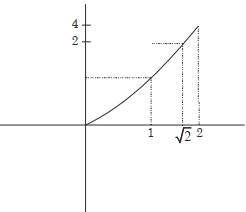
Let $[ x ]$ denote the greatest integer $\leq x$. Consider the function $f(x)=\max \left\{x^2, 1+[x]\right\}$. Then the value of the integral $\int \limits_0^2 f ( x ) dx$ is :
- ✓
$\frac{5+4 \sqrt{2}}{3}$
- B
$\frac{8+4 \sqrt{2}}{3}$
- C
$\frac{1+5 \sqrt{2}}{3}$
- D
$\frac{4+5 \sqrt{2}}{3}$
AnswerCorrect option: A. $\frac{5+4 \sqrt{2}}{3}$
a
$A=\int \limits_0^1 1 . d x+\int \limits_1^{\sqrt{2}} 2 d x+\int \limits_{\sqrt{2}}^2 x^2 d x$
$=1+2 \sqrt{2}-2+\frac{8}{3}-\frac{2 \sqrt{2}}{3}$
$=\frac{5}{3}+\frac{4 \sqrt{2}}{3}$
View full question & answer→MCQ 1871 Mark
The value of the integral $\int \limits_1^2\left(\frac{t^4+1}{t^6+1}\right) d t$ is $..........$.
- A
$\tan ^{-1} \frac{1}{2}+\frac{1}{3} \tan ^{-1} 8-\frac{\pi}{3}$
- B
$\tan ^{-1} 2-\frac{1}{3} \tan ^{-1} 8+\frac{\pi}{3}$
- ✓
$\tan ^{-1} 2+\frac{1}{3} \tan ^{-1} 8-\frac{\pi}{3}$
- D
$\tan ^{-1} \frac{1}{2}-\frac{1}{3} \tan ^{-1} 8+\frac{\pi}{3}$
AnswerCorrect option: C. $\tan ^{-1} 2+\frac{1}{3} \tan ^{-1} 8-\frac{\pi}{3}$
c
$I=\int \limits_1^2\left(\frac{t^4+1}{t^6+1}\right) d t$
$=\int \limits_1^2 \frac{\left(t^4+1-t^2\right)+t^2}{\left(t^2+1\right)\left(t^4-t^2+1\right)} d t$
$=\int \limits_1^2\left(\frac{1}{t^2+1}+\frac{t^2}{t^6+1}\right) d t$
$=\int \limits_1^2\left(\frac{1}{t^2+1}+\frac{1}{3} \frac{3 t^2}{\left(t^3\right)^2+1}\right) d t$
$=\tan ^{-1}( t )+\left.\frac{1}{3} \tan ^{-1}\left( t ^3\right)\right|_1 ^2$
$=\left(\tan ^{-1}(2)-\tan ^{-1}(1)\right)+\frac{1}{3}\left(\tan ^{-1}\left(2^3\right)-\tan ^{-1}\left(1^3\right)\right)$
$=\tan ^{-1}(2)+\frac{1}{3} \tan ^{-1}(8)-\frac{\pi}{3}$
View full question & answer→MCQ 1881 Mark
Let $\alpha \in(0,1)$ and $\beta=\log _{ c }(1-\alpha)$. Let $P_n(x)=x+\frac{x^2}{2}+\frac{x^3}{3}+\ldots . .+\frac{x^n}{n}, x \in(0,1)$ Then the integral $\int \limits_0^\alpha \frac{ t ^{50}}{1- t } dt$ is equal to
AnswerCorrect option: B. $-\left(\beta+ P _{50}(\alpha)\right)$
b
$\int \limits_0^\alpha \frac{t^{50}-1+1}{1-t}=-\int \limits_0^\alpha\left(1+t+\ldots . .+ t ^{49}\right)+\int \limits_0^\alpha \frac{1}{1- t } dt$
$=-\left(\frac{\alpha^{50}}{50}+\frac{\alpha^{49}}{49}+\ldots . .+\frac{\alpha^1}{1}\right)+\left(\frac{\ln (1- f )}{-1}\right)_0^\alpha$
$=- P _{50}(\alpha)-\ln (1-\alpha)$
$=- P _{50}(\alpha)-\beta$
View full question & answer→MCQ 1891 Mark
Let $\alpha > 0$. If $\int \limits _0^\alpha \frac{ x }{\sqrt{ x +\alpha}-\sqrt{ x }} dx =\frac{16+20 \sqrt{2}}{15}$, then $\alpha$ is equal to :
- ✓
$2$
- B
$4$
- C
$\sqrt{2}$
- D
$2 \sqrt{2}$
Answera
After rationalising
$\int \limits_0^\alpha \frac{ x }{\alpha}(\sqrt{ x +\alpha}+\sqrt{ x })$
$\int \limits _0^\alpha \frac{1}{\alpha}\left[( x +\alpha)^{3 / 2}-\alpha( x +\alpha)^{1 / 2}+ x ^{3 / 2}\right]$
$\left.\frac{1}{\alpha}\left[\frac{2}{5}( x +\alpha)^{5 / 2}-\alpha \frac{2}{3}( x +\alpha)^{3 / 2}+\frac{2}{5} x ^{5 / 2}\right]\right|_0 ^\alpha$
$= \frac{1}{\alpha}\left(\frac{5}{2}(2 \alpha)^{5 / 2}-\frac{2 \alpha}{3}(2 \alpha)^{3 / 2}+\frac{2}{5} \alpha^{5 / 2}-\frac{2}{5} \alpha^{5 / 2}+\frac{2}{3} \alpha^{5 / 2}\right)$
$= \frac{1}{\alpha}\left(\frac{2^{7 / 2} \alpha^{5 / 2}}{5} \frac{2^{5 / 2} \alpha^{5 / 2}}{3}+\frac{2}{3} \alpha^{5 / 2}\right)$
$=\alpha^{3 / 2}\left(\frac{2^{7 / 2}}{5}-\frac{2^{5 / 2}}{3}+\frac{2}{3}\right)$
$=\frac{\alpha^{3 / 2}}{15}(24 \sqrt{2}-20 \sqrt{2}+10)=\frac{\alpha^{3 / 2}}{15}(4 \sqrt{2}+10)$
Now,
$\frac{\alpha^{3 / 2}}{15}(4 \sqrt{2}+10)=\frac{16+20 \sqrt{2}}{15}$
$\Rightarrow \alpha=2$
View full question & answer→MCQ 1901 Mark
Let $5 f(x)+4 f\left(\frac{1}{x}\right)=\frac{1}{x}+3, x > 0$. Then $18 \int \limits_1^2 f(x) d x$ is equal to:
- ✓
$10 \log _e 2-6$
- B
$10 \log _e 2+6$
- C
$5 \log _e 2+3$
- D
$5 \log _e 2-3$
AnswerCorrect option: A. $10 \log _e 2-6$
a
$5 f(x)+4 f\left(\frac{1}{x}\right)=\frac{1}{x}+3$
replace $x \rightarrow \frac{1}{ x }$
$5 f\left(\frac{1}{x}\right)+4 f(x)=x+3$
Eq. (1) $\times 5-$ eq. (2) $\times 4$
$f(x)=\frac{1}{9}\left(\frac{5}{x}-4 x+3\right)$
$I=18 \int \limits_1^2 \frac{1}{9}\left(\frac{5}{x}-4 x+3\right) d x=10 \log _e 2-6$
View full question & answer→MCQ 1911 Mark
Let $[t]$ denote the greatest integer function. If $\int \limits_0^{2.4}\left[x^2\right] d x=\alpha+\beta \sqrt{2}+\gamma \sqrt{3}+\delta \sqrt{5}$, then $\alpha+\beta+\gamma+$ $\delta$ is equal to $..............$.
Answera
$\int \limits_0^1 0 dx +\int \limits_1^{\sqrt{2}} 1 dx +\int \limits_{\sqrt{2}}^{\sqrt{3}} 2 dv +\int \limits_{\sqrt{3}}^2 3 dx +\int \limits_2^{\sqrt{5}} 4 dx +\int \limits_{\sqrt{5}}^{2 \cdot 4} 5 dx$
$\sqrt{2}-1+2(\sqrt{3}-\sqrt{2})+3(2-\sqrt{3})+4(\sqrt{5}-2)+5((2 \cdot 4)-\sqrt{5})$
$=9-\sqrt{2}-\sqrt{3}-\sqrt{5}$
$\alpha+\beta+\gamma+\delta=9-1-1-1=6$
View full question & answer→MCQ 1921 Mark
$\int \limits_0^{\infty} \frac{6}{e^{3 x}+6 e^{2 x}+11 e^x+6} d x$
- A
$\log _e\left(\frac{512}{81}\right)$
- ✓
$\log _e\left(\frac{32}{27}\right)$
- C
$\log _e\left(\frac{256}{81}\right)$
- D
$\log _e\left(\frac{64}{27}\right)$
AnswerCorrect option: B. $\log _e\left(\frac{32}{27}\right)$
b
$1=\int \limits_0^{\infty} \frac{6}{\left(e^x+1\right)\left(e^{ x }+2\right)\left( e ^{ x }+3\right)} dx$
$=6 \int \limits_0^{\infty}\left(\frac{\frac{1}{2}}{ e ^{ x }+1}+\frac{-1}{ e ^{ x }+2}+\frac{\frac{1}{2}}{ e ^{ x }+3}\right) d x$
$=3 \int \limits_0^{\infty} \frac{ e ^{- x }}{1+ e ^{- x }} dx -6 \int \limits_0^{\infty} \frac{ e ^{- x } dx }{1+2 e ^{- x }}+3 \int \limits_0^{\infty} \frac{ e ^{- x }}{1+3 e ^{- x }} dx$
$=3\left[-\ln \left(1+ e ^{- x }\right)\right]_0^{\infty}+6 \frac{1}{2}\left[\ln \left(1+2 e ^{- x }\right)\right]_0^{\infty}$
$-\frac{3}{3}\left[\ln \left(1+3 e ^{- x }\right)\right]_0^{\infty}$
$=3 \ln 2-3 \ln 3+\ln 4$
$=3 \ln \frac{2}{3}+\ln 4$
$=\ln \frac{32}{27}$
View full question & answer→MCQ 1931 Mark
The value of $\frac{e^{-\frac{\pi}{4}}+\int \limits_0^{\frac{\pi}{4}} e^{-x} \tan ^{50} x d x}{\int \limits_0^{\frac{\pi}{4}} e^{-x}\left(\tan ^{49} x+\tan ^{51} x\right) d x}$ is
Answera
$\int \limits_0^{\pi / 4} e^{-x} \tan ^{50} x d x$
$\left[-e^{-y}(\tan x)^{50}\right]_0^{\pi / 4}+\int \limits_0^{\pi / 4} e^{-x}(50)(\tan x)^{49} \sec ^2 x$
$=-e^{-\pi / 4}+0+50 \int \limits_0^{\pi / 4} e^{-x}(\tan x)^{49}\left(\tan ^2 x+1\right)$
$=-e^{-\pi / 4}+50\left(\int \limits_0^{\pi / 4} e^{-x}(\tan x)^{51}+(\tan x)^{49}\right) d x$
Now,$\frac{-e^{-\pi / 4}+\int \limits_0^{\pi / 4} e^{-x}(\tan x)^{50} d x}{\int \limits_0^{\pi / 4} e^{-x}\left(\tan ^{49} x+\tan ^{51} x\right) d x}$
$\frac{50 \int \limits_0^{\pi / 4} e^{-x}\left((\tan x)^{51}+(\tan x)^{49}\right) d x}{\int \limits_0^{\pi / 4} e^{-x}\left(\tan ^{49} x+\tan ^{51} x\right) d x}=50$
View full question & answer→MCQ 1941 Mark
If $[t]$ denotes the greatest integer $\leq 1$, then the value of $\frac{3(e-1)^2}{e} \int \limits_1^2 x^2 e^{[x]+\left[x^3\right]} d x$ is :
- A
$e^9-e$
- ✓
$e ^8- e$
- C
$e^7-1$
- D
$e^8-1$
AnswerCorrect option: B. $e ^8- e$
b
$\int \limits_1^2 x ^2 e ^{\left[ x ^3\right]+1} dx$
$x ^3= t$
$3 x ^2 dx = dt$
$=\frac{ e }{3} \int \limits_1^8 e ^{[t]} dt$
$=\frac{ e }{3}\left\{\int \limits_1^2 e dt +\int_2^3 e ^2 dt +\ldots \ldots \ldots+\int_7^8 e ^7 dt \right\}$
$=\frac{ e }{3}\left( e + e ^2+\ldots \ldots \ldots+ e ^7\right)$
$=\frac{ e ^2}{3}\left(1+ e +\ldots \ldots \ldots+ e ^6\right)=\frac{ e ^2}{3} \frac{\left( e ^7-1\right)}{( e -1)}$
$\frac{3( e -1)}{ e } \int \limits_1^2 x ^2 \times e ^{[ x ]+\left[ x ^3\right]} dx =\frac{3}{ e }( e -1) \times \frac{ e ^2}{3} \frac{\left( e ^7-1\right)}{( e -1)}$
$= e \left( e ^7-1\right)$
$= e ^8- e$
View full question & answer→MCQ 1951 Mark
If $\int \limits_0^1\left(x^{21}+x^{14}+x^7\right)\left(2 x^{14}+3 x^7+6\right)^{1 / 7} d x=\frac{1}{l}(11)^{m / n}$ where $l, m , n \in N , m$ and $n$ are coprime then $l+m+n$ is equal to $...........$.
Answerc
$\int\left(x^{20}+x^{13}+x^6\right)\left(2 x^{21}+3 x^{14}+6 x^7\right)^{1 / 7} d x$
$2 x ^{21}+3 x ^{14}+6 x ^7= t$
$42\left( x ^{20}+ x ^{13}+ x ^6\right) dx = dt$
$\frac{1}{42} \int \limits_0^{11} t^{\frac{1}{7}} d t=\left(\frac{t^{\frac{8}{7}}}{\frac{8}{7}} \times \frac{1}{42}\right)_0^{11}$
$=\frac{1}{48}\left(t^{\frac{8}{7}}\right)_0^{11}=\frac{1}{48}(11)^{8 / 7}$
$l=48, m =8, n =7$
$l+ m + n =63$
View full question & answer→MCQ 1961 Mark
For $m, n > 0$, let $\alpha(m, n)=\int_0^2 t^m(1+3 t)^n d t$. If $11 \alpha(10,6)+18 \alpha(11,5)= p (14)^6$, then $p$ is equal to $......$.
Answerb
$\alpha( m , n )=\int \limits_0^2 t ^{ m }(1+3 t )^{ n } dt$
$\text { If } 11 \alpha(10,6)+18 \alpha(11,5)= p (14)^6 \text { then } P$
$=11 \int \limits_0^2 \frac{ t ^{10}}{ II } \frac{(1+3 t )^6}{ I }+10 \int^2 t ^{11}(1+3 t )^5 dt$
$=11\left[(1+3 t )^6 \cdot \frac{ t ^{11}}{11}-\int 6(1+3 t )^5 \cdot 3 \frac{ t ^{11}}{11}\right]_0^2$
$+18 \int \limits_0^2 t ^{11}(1+3 t )^5 dt$
$=\left( t ^{11}(1+3 t )^6\right)_0^2$
$=2^{11}(7)^6$
$=2^5(14)^6$
$=32(14)^6$
View full question & answer→MCQ 1971 Mark
If $\int \limits_{\frac{1}{3}}^3\left|\log _e x\right| d x=\frac{m}{n} \log _e\left(\frac{n^2}{e}\right)$, where $m$ and $n$ are coprime natural numbers, then $m ^2+ n ^2-5$ is equal to $............$.
Answera
$\int \limits_{\frac{1}{3}}^3|\operatorname{nx}| dx =\int \limits_{\frac{1}{3}}^1(-\ell nx ) dx +\int_1^3(\ell nx ) dx$
$=-[ x \ell nx - x ]_{\ell / 3}^1+[ x \ell nx - x ]_1^3$
$=-\left[-1-\left(\frac{1}{3} \ell \ln \frac{1}{3}-\frac{1}{3}\right)\right]+[3 \ln 3-3-(-1)]$
$=\left[-\frac{2}{3}-\frac{1}{3} \ln \frac{1}{3}\right]+[3 \ln 3-2] ~\\ =-\frac{4}{3}+\frac{8}{3} \ln 3$
$=\frac{4}{3}(2 \ell n 3-1)$
$=\frac{4}{3}\left(\ln \frac{9}{ e }\right)$
$\therefore m =4, n =3$
$\text { Now }, m ^2+ n ^2-5=16+9-5=20$
View full question & answer→MCQ 1981 Mark
Let $\quad f(x)=x+\frac{a}{\pi^2-4} \sin x+\frac{b}{\pi^2-4} \cos x$ $x \in R$ be a function which satisfies $f(x)=x+\int \limits_0^{\pi / 2} \sin (x+y) f(y) d y$. Then $( a + b )$ is equal to $............$
- A
$-\pi(\pi+2)$
- ✓
$-2 \pi(\pi+2)$
- C
$-2 \pi(\pi-2)$
- D
$-\pi(\pi-2)$
AnswerCorrect option: B. $-2 \pi(\pi+2)$
b
$f(x)=x+\int \limits_0^{\pi / 2}(\sin x \cos y+\cos x \sin y) f(y) d y$
$f(x)=x+\int \limits_0^{\pi / 2}((\cos y f(y) d y) \sin x+(\sin y f(y) d y) \cos x).......(1)$
On comparing with
$f(x)=x+\frac{a}{\pi^2-4} \sin x+\frac{b}{\pi^2-4} \cos x, x \in R$ then
$\Rightarrow \frac{a}{\pi^2-4}=\int \limits_0^{\pi / 2} \cos y f(y) d y..........(2)$
$\Rightarrow \frac{b}{\pi^2-4}=\int \limits_0^{\pi / 2} \sin y f(y) d y........(3)$
Add $(2)$ and $(3)$
$\frac{a+b}{\pi^2-4}=\int \limits_0^{\pi / 2}(\sin y+\cos y) f(y) d y \ldots \ldots$
$\frac{a+b}{\pi^2-4}=\int \limits_0^{\pi / 2}(\sin y+\cos y) f\left(\frac{\pi}{2}-y\right) d y$
Add $(4)$ and $(5)$
$\frac{2(a+b)}{\pi^2-4}=\int \limits_0^{\pi / 2}(\sin y+\cos y)\left(\frac{\pi}{2}+\frac{(a+b)}{\pi^2-4}(\sin y+\cos y)\right) d y$
$=\pi+\frac{a+b}{\pi^2-4}\left(\frac{\pi}{2}+1\right)$
$(a+b)=-2 \pi(\pi+2)$
View full question & answer→MCQ 1991 Mark
The value of the integral $\int \limits_{1 / 2}^2 \frac{\tan ^{-1} x}{x} d x$ is equal to
- A
$\pi \log _e 2$
- B
$\frac{1}{2} \log _{ e } 2$
- C
$\frac{\pi}{4} \log _e 2$
- ✓
$\frac{\pi}{2} \log _{ e } 2$
AnswerCorrect option: D. $\frac{\pi}{2} \log _{ e } 2$
d
$I =\int \limits_{1 / 2}^2 \frac{\tan ^{-1} x }{ x } dx$
$\text { Put } x \quad =\frac{1}{ t } dx =-\frac{1}{ t ^2} dt$
$I =-\int \limits_2^{1 / 2} \frac{\tan ^{-1} \frac{1}{ t }}{\frac{1}{ t }} \cdot \frac{1}{ t ^2} dt =-\int \limits_2^{1 / 2} \frac{\tan ^{-1} \frac{1}{ t }}{ t } dt$
$I =\int \limits_{1 / 2}^2 \frac{\cot ^{-1} t }{ t } dt =\int \limits_{1 / 2}^2 \frac{\cot ^{-1} x }{ x } dx \ldots \ldots(ii)$
Add both equation
$2 I =\int \limits_{1 / 2}^2 \frac{\tan ^{-1} x +\cot ^{-1} x }{ x } dx =\frac{\pi}{2} \int \limits_{1 / 2}^2 \frac{ dx }{ x }=\frac{\pi}{2}(\ell \ln 2)_{1 / 2}^2$
$=\frac{\pi}{2}\left(\ell n 2-\ell n \frac{1}{2}\right)=\pi \ell n 2$
$I =\frac{\pi}{2} \ell n 2$
View full question & answer→MCQ 2001 Mark
The value of $\int \limits_{\frac{\pi}{3}}^{\frac{\pi}{2}} \frac{(2+3 \sin x)}{\sin x(1+\cos x)} d x$ is equal to
- A
$\frac{7}{2}-\sqrt{3}-\log _e \sqrt{3}$
- B
$-2+3 \sqrt{3}+\log _e \sqrt{3}$
- ✓
$\frac{10}{3}-\sqrt{3}+\log _e \sqrt{3}$
- D
$\frac{10}{3}-\sqrt{3}-\log _e \sqrt{3}$
AnswerCorrect option: C. $\frac{10}{3}-\sqrt{3}+\log _e \sqrt{3}$
c
$\int \limits_{\pi / 3}^{\pi / 2}\left(\frac{2+3 \sin x}{\sin x(1+\cos x)}\right) d x=2 \int \limits_{\pi / 3}^{\pi / 2} \frac{d x}{\sin x+\sin x \cos x}+3$
$3 \int \limits_{\pi / 3}^{\pi / 2} \frac{d x}{1+\cos x}$
$\int \limits_{\pi / 3}^{\pi / 2} \frac{d x}{1+\cos x}=\int \limits_{\pi / 3}^{\pi / 2} \frac{1-\cos x}{\sin ^2 x} d x$
$=\int \limits_{\pi / 3}^{\pi / 2}\left(\operatorname{cosec}{ }^2 x-\cot x \operatorname{cosec} x\right) d x$
$=(\operatorname{cosecx}-\cot x) \int \limits_{\pi / 3}^{\pi / 2}=(1)-\left(\frac{2}{\sqrt{3}}-\frac{1}{\sqrt{3}}\right)=1-\frac{1}{\sqrt{3}}$
$\int \limits_{\pi / 3}^{\pi / 2} \frac{d x}{\sin x(1+\cos x)}= \int \frac{d x}{(2 \tan x / 2)\left(1+1-\tan ^2 x / 2\right)}$
$=\int \frac{\left(1+\tan ^2 x / 2\right) \sec ^2 x / 2 d x}{2 \tan x / 2}$
$\tan x / 2= t \quad \sec x / 2 \frac{1}{2} dx = dt$
$\frac{1}{2} \int\left(\frac{1+ t ^2}{ t }\right) dt =\frac{1}{2}\left[\ell nt +\frac{ t ^2}{2}\right]_{\frac{1}{\sqrt{3}}}^1$
$=\frac{1}{2}\left[\left(0+\frac{1}{2}\right)-\left(\ln \frac{1}{\sqrt{3}}+\frac{1}{6}\right)\right]=\left(\frac{1}{3}+\ell n \sqrt{3}\right) \frac{1}{2}$
$=\left(\frac{1}{6}+\frac{1}{2} \ell n \sqrt{3}\right)$
$2\left(\frac{1}{6}+\frac{1}{2} \ell n \sqrt{3}\right)+3\left(1-\frac{1}{\sqrt{3}}\right)$
$=\frac{1}{3}+\ell n \sqrt{3}+3-\sqrt{3}=\frac{10}{3}+\ln \sqrt{3}-\sqrt{3}$
View full question & answer→