Based on the above information, answer the following questions.
- Point of intersection of both the given curves is.
- $(0, 4)$
- $(0, 2\sqrt{2})$
- $(2\sqrt{ 2},2\sqrt{2})$
- $(2,\sqrt{2},4)$
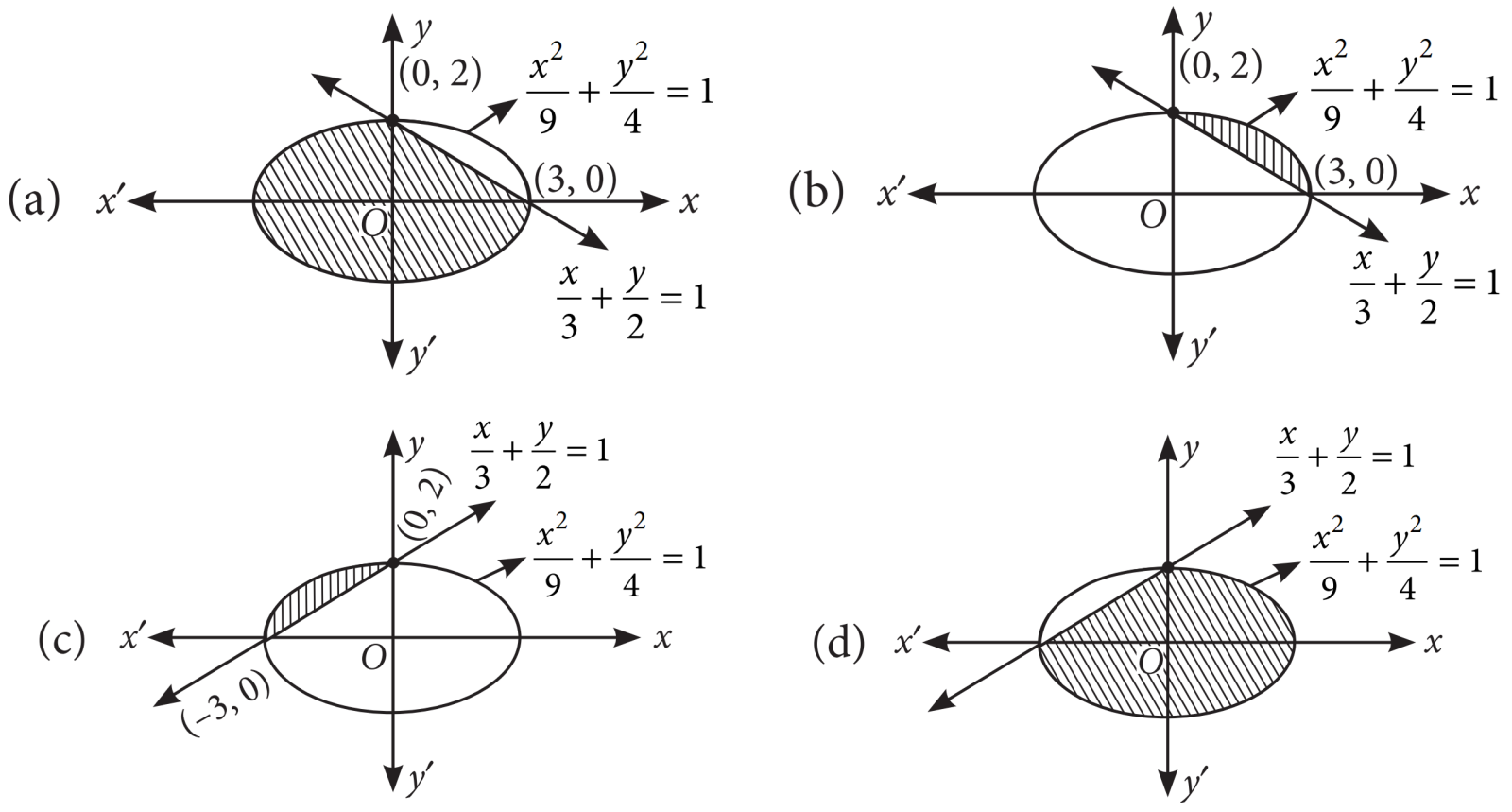
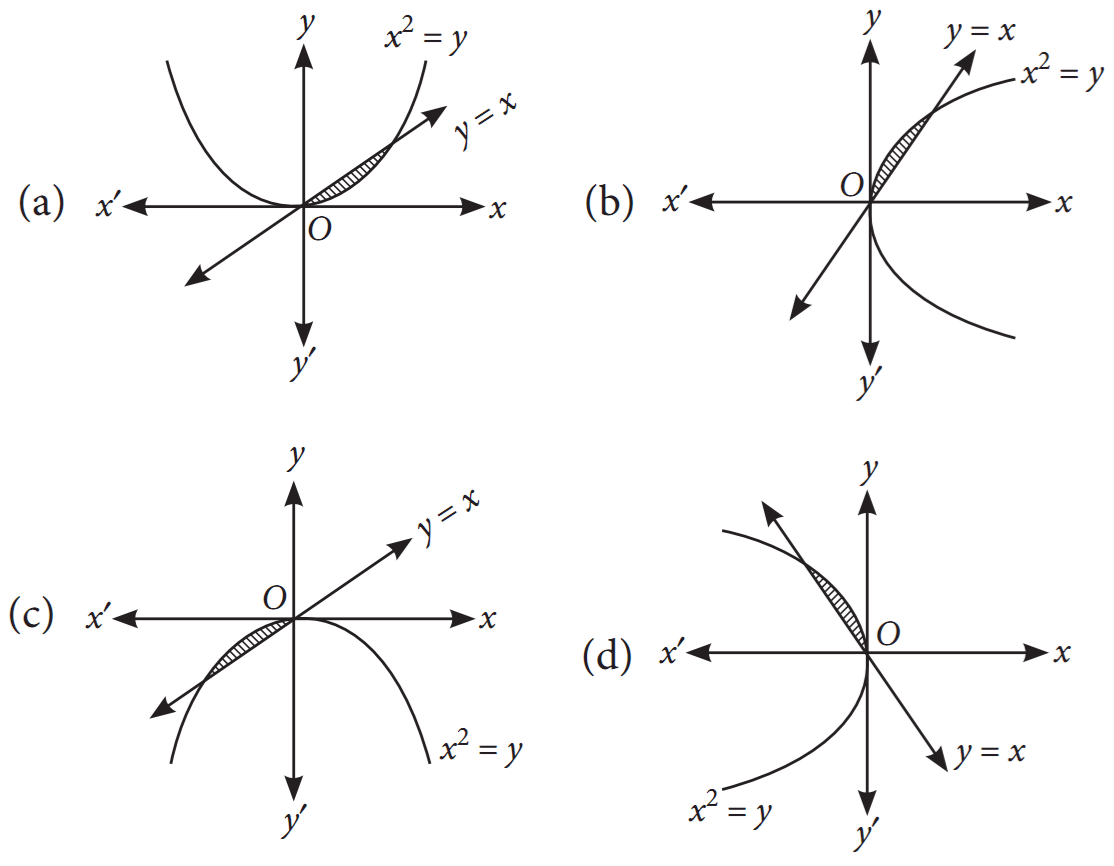
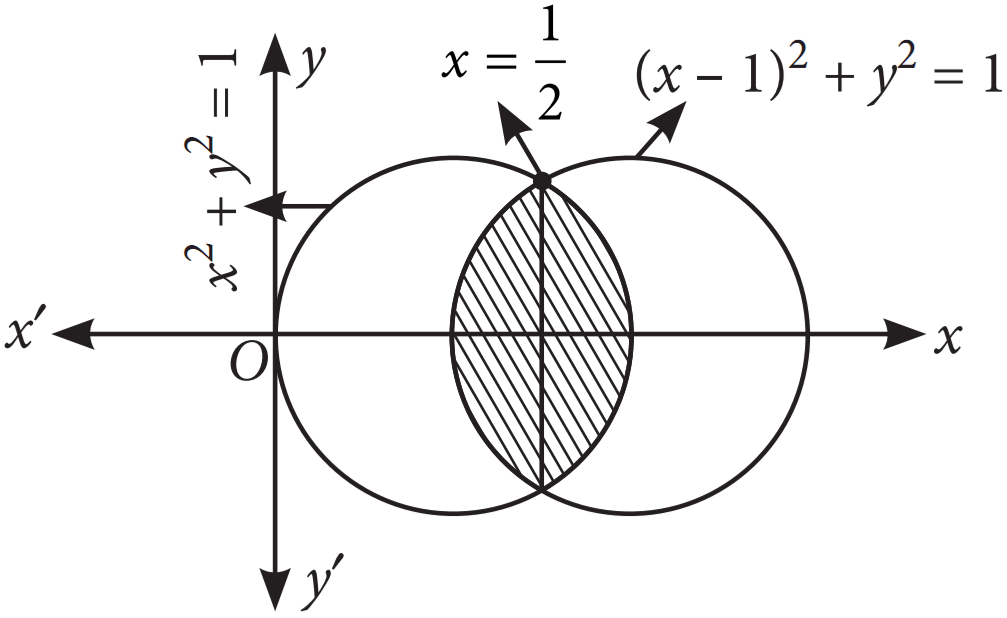
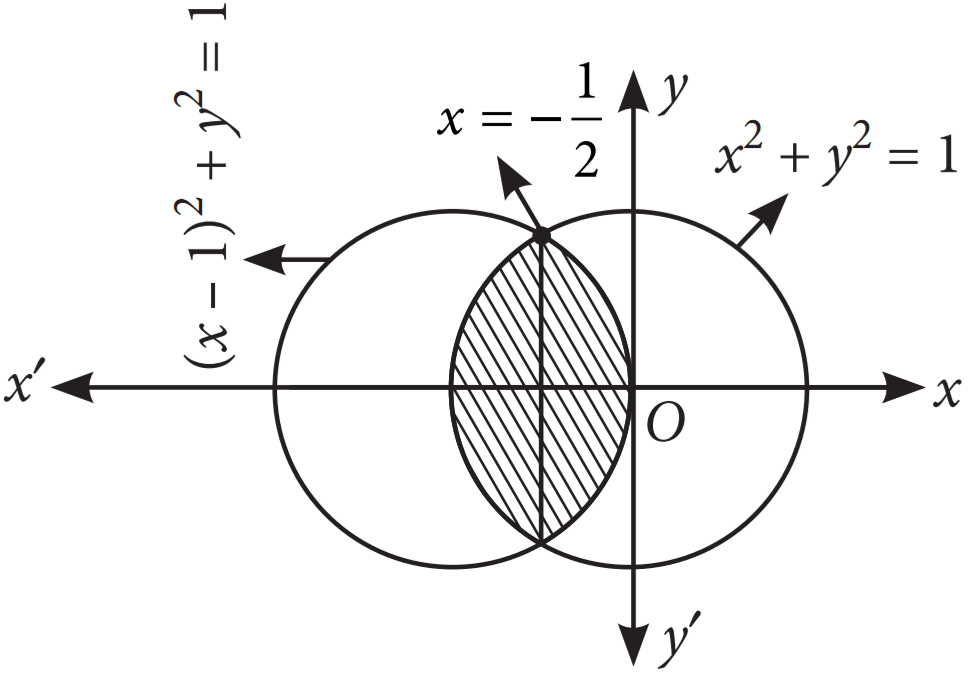
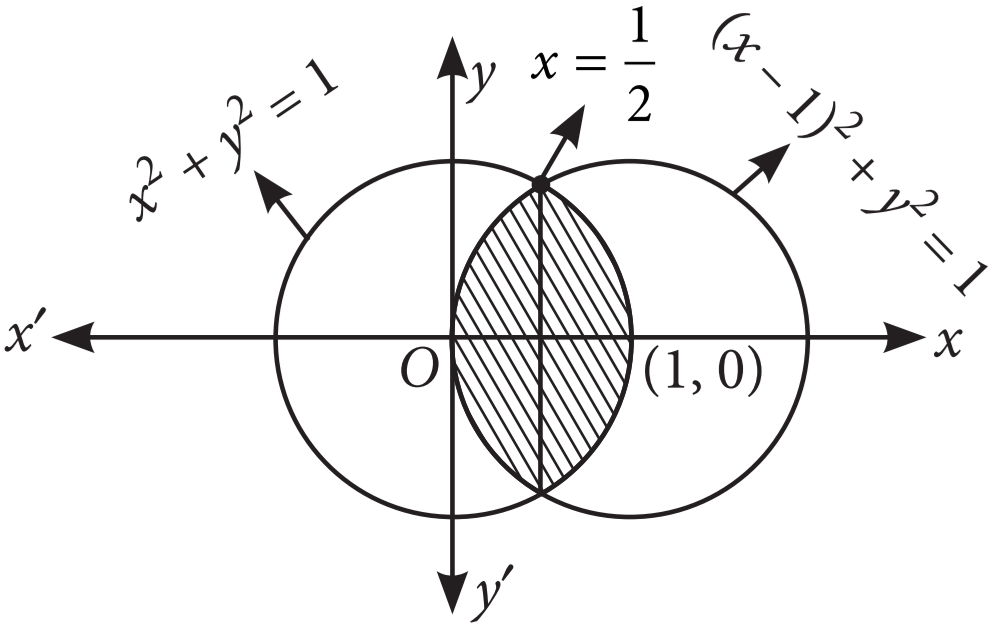
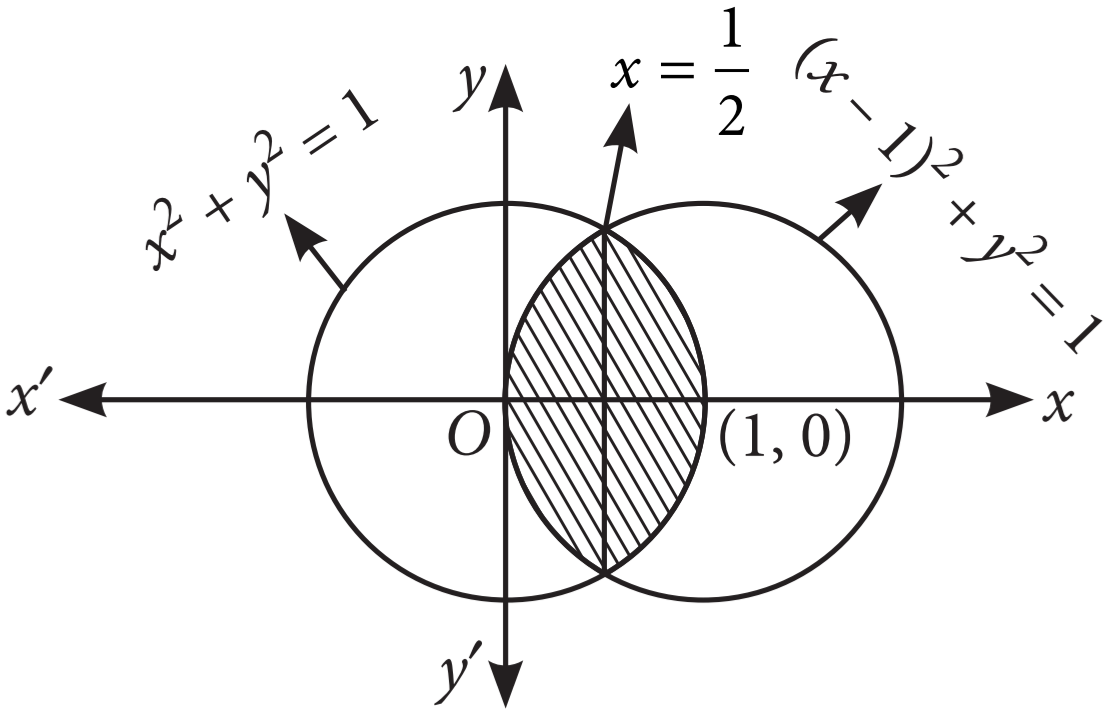
- Which of the following shaded portion represent the area bounded by given two curves?
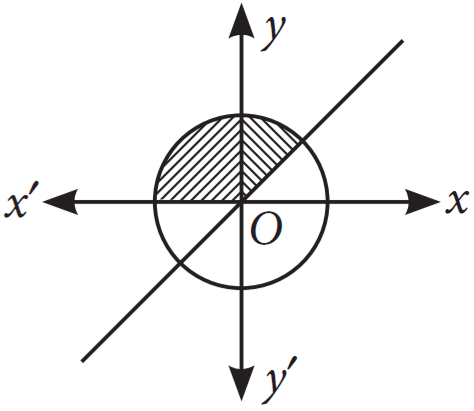
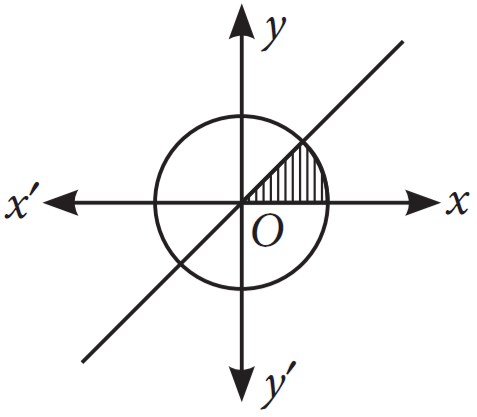
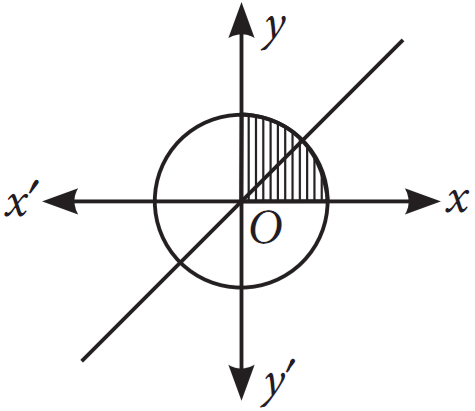
- None of these
- The value of the integral $\int\limits_{0}^{2\sqrt{2}}\text{x}\text{dx}$ is.
- 0
- 1
- 2
- 4
- The value of the integral $\int\limits_{2\sqrt{2}}^{0}\sqrt{16-\text{x}^2}\text{ dx}$ is.
- $2(\pi-2)$
- $2(\pi-8)$
- $4(\pi-2)$
- $4(\pi+2)$
- Area bounded by the two given curves is.
- $3\pi\text{ sq.units}$
- $\frac{\pi}{2}\text{ sq.units}$
- $\pi\text{ sq.units}$
- $2\pi\text{ sq.units}$
- (c) $(2\sqrt{ 2},2\sqrt{2})$
Solution:
We have x2 + y2 = 16 and y = x
From (i) and (ii) $\text{2x}=16$
$\Rightarrow\text{x}^2=8$
$\Rightarrow\text{x}=2\sqrt{2}$
($\therefore$ x lies in first quadrant)
$\therefore$ Point of intersection of (i) and (ii) in first quadrant $(2\sqrt{2},(2\sqrt{2})$
- (b)
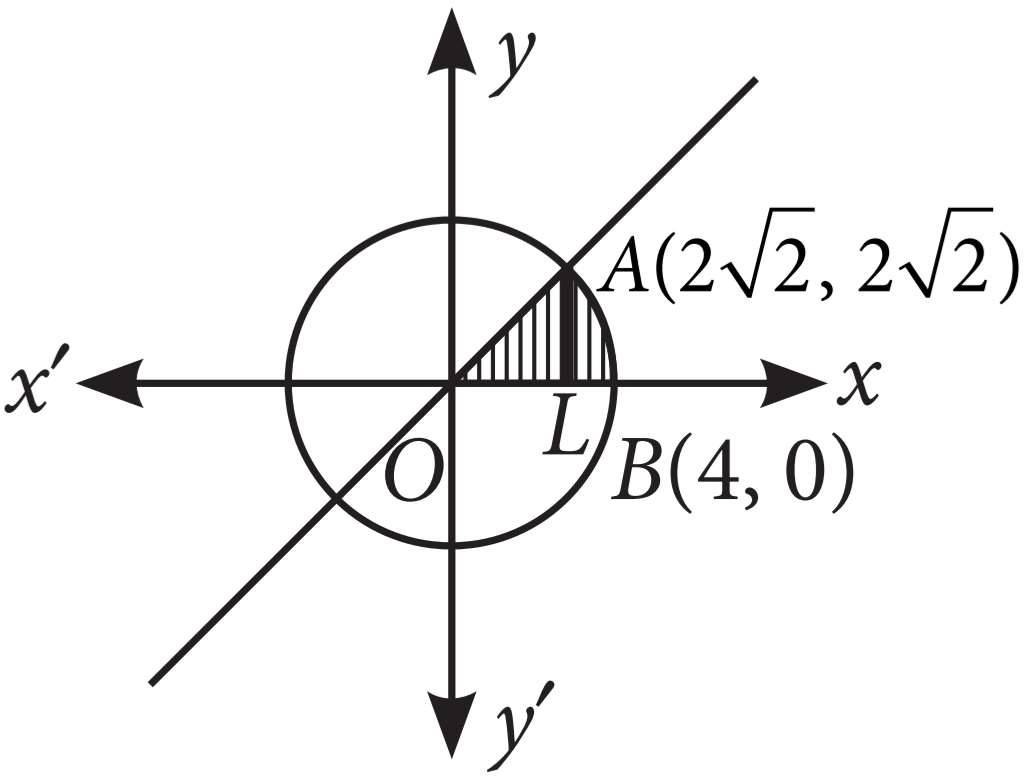
Solution:
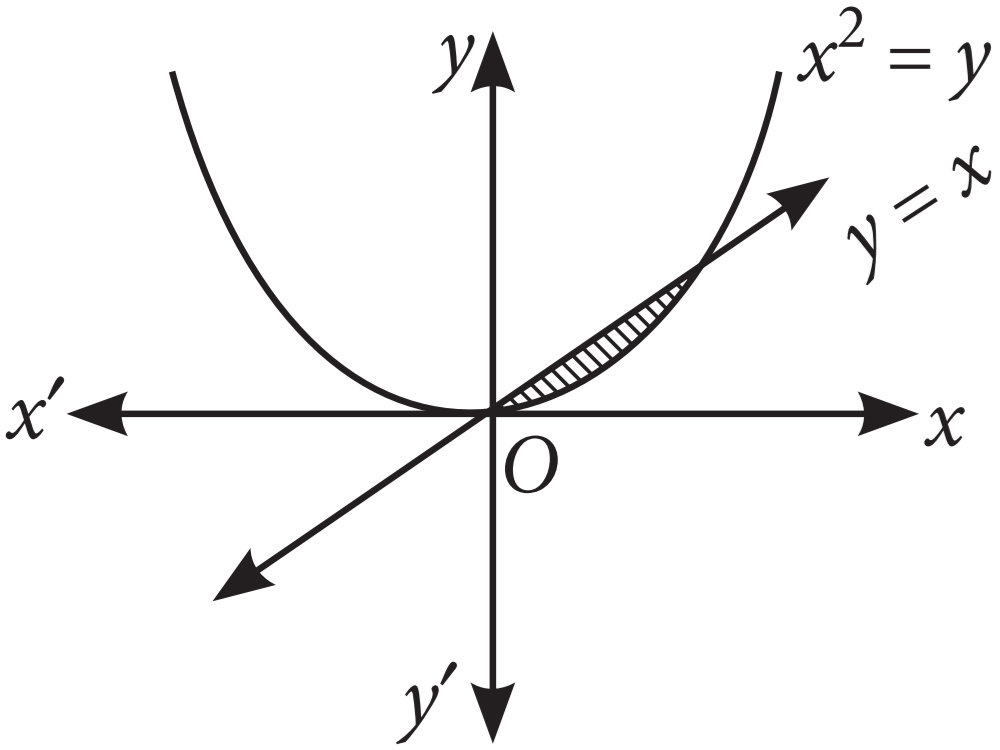
The shaded region which represent the area bounded by two given curves in first quadrant is shown below.
- (d) 4
Solution:
$\int\limits_{0}^{2\sqrt{2}}\text{x}\text{dx}=\Big[\frac{\text{x}^2}{2}\Big]^2_0=\frac{(2\sqrt{2})}{2}=\frac{8}{2}=4$
- (a)
$2(\pi-2)$
Solution:
$\int\limits_{2\sqrt{2}}^{4}\sqrt{16-\text{x}^2}$
$\text{ dx}=\Big[\frac{\text{x}}{2}\sqrt{16-\text{x}^2}+\frac{16}{2}\text{sin}^{-1}\Big(\frac{\text{x}}{4}\Big)\Big]^4_{2\sqrt{2}}$
$=8\text{sin}^{-1}(1)-4-8\text{sin}^{-1}\Big(\frac{1}{\sqrt{2}}\Big)$
$=8\Big(\frac{\pi}{2}\Big)-4-8\Big(\frac{\pi}{4}\Big)$
$=4\pi-4-2\pi=2\pi-4=2(\pi-2)$
- (d)
$2\pi\text{ sq.units}$
Solution:
Required area = Area (OLA) + Area (BAL)
$\int\limits_{0}^{2\sqrt{2}}\text{x}\text{dx}+\int\limits_{2\sqrt{2}}^{4}\sqrt{16-\text{x}^2}\text{dx}$
$4+2(\pi-2)=2\pi\text{ sq.units}$
 Based on the above information, answer the following questions.