Question
Graphs of two function $\text{f}(\text{x})=\text{sin}\text{ x}$ and $\text{(g)}\text{x}=\text{cos}\text{ x}$ is given below:
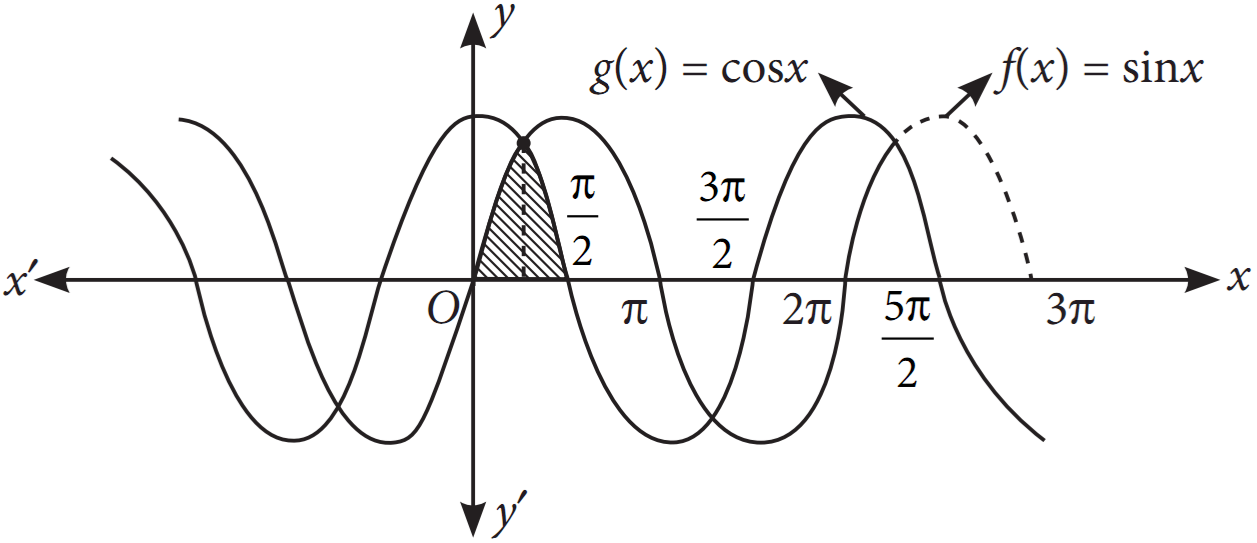
Based on the above information, answer the following questions.

  1. In $(0, \pi)$, the curves $\text{f}(\text{x})=\text{sin}\text{ x}$ and $\text{g}\text{ (x)}=\text{cos}\text{ x}$ at $\text{x}=$ 
    1. $\frac{\pi}{2}$
    2. $\frac{\pi}{3}$
    3. $\frac{\pi}{4}$
    4. ${\pi}$
  2. Value of $\int\limits_{0}^{\frac{\pi}{4}}\text{sin}\text{ x}\text{ dx}$ is.
    1. $1-\frac{1}{\sqrt{2}}$
    2. $1+\frac{1}{\sqrt{2}}$
    3. $2-\frac{1}{\sqrt{2}}$
    4. $2+\frac{1}{\sqrt{2}}$
  1. Value of $\int\limits_\frac{\pi}{4}^{\frac{\pi}{2}}\text{cos}\text{ x}\text{ dx}$ is.
    1. $1+\frac{1}{\sqrt{2}}$
    2. $1-\frac{1}{\sqrt{2}}$
    3. $2-\sqrt{2}$
    4. $2+\sqrt{2}$
  2. Value of $\int\limits_{0}^{\pi}\text{sin}\text{ x}\text{ dx}$ is.
  1. 0
  2. 1
  3. 2
  4. -2
  1. Value of $\int\limits_{0}^\frac{\pi}{2}\text{sin}\text{ x}\text{ dx}$ is.
  1. 0
  2. 1
  3. 3
  4. 4

Answer

  1. (c) $\frac{\pi}{4}$

Solution:

for point of intersection, we have

$\text{sin}\text{ x}=\text{cos}\text{ x}$

$\Rightarrow\frac{\text{sin}\text{ x}}{\text{cos}\text{ x}}=1$

$\Rightarrow\text{tan}\text{ x}=1$

$\Rightarrow\text{x}=\frac{\pi}{4}$

  1. (a) $1-\frac{1}{\sqrt{2}}$

Solution:

$\int\limits_{0}^{\frac{\pi}{4}}\text{sin}\text{ x}\text{ dx}=\big[-\text{cos x}\big]^\frac{\pi}{4}_0=-\text{cos}\frac{\pi}{4}+\text{cos}0$

$=1-\frac{1}{\sqrt{2}}$

  1. (b) $1-\frac{1}{\sqrt{2}}$

Solution:

$\int\limits_{\frac{\pi}{2}}^{\frac{\pi}{4}}\text{cos}\text{ x}\text{ dx}=\big[\text{sin x}\big]^\frac{\pi}{2}_\frac{\pi}{4}=\text{sin}\frac{\pi}{2}-\text{sin}\frac{\pi}{4}$

$=1-\frac{1}{\sqrt{2}}$

  1. (c) 2

Solution:

$\int\limits_{0}^{\pi}\text{sin}\text{ x}\text{ dx}=\big[-\text{cos x}\big]^{\pi}_0=\big[-\text{cos}{\pi}+\text{cos}0\big]=2$

  1. (b) 1

Solution:

$\int\limits_{0}^\frac{\pi}{2}\text{sin}\text{ x}\text{ dx}=\big[-\text{cos x}\big]^\frac{\pi}{2}_0=\Big[-\text{cos}\frac{\pi}{2}+\text{cos}0\Big]$

$=0+1+1$

Need a full question paper?

Generate a complete, print-ready paper with questions like this in minutes — across 16+ boards, with answer keys.

Start Generating Free

Similar questions

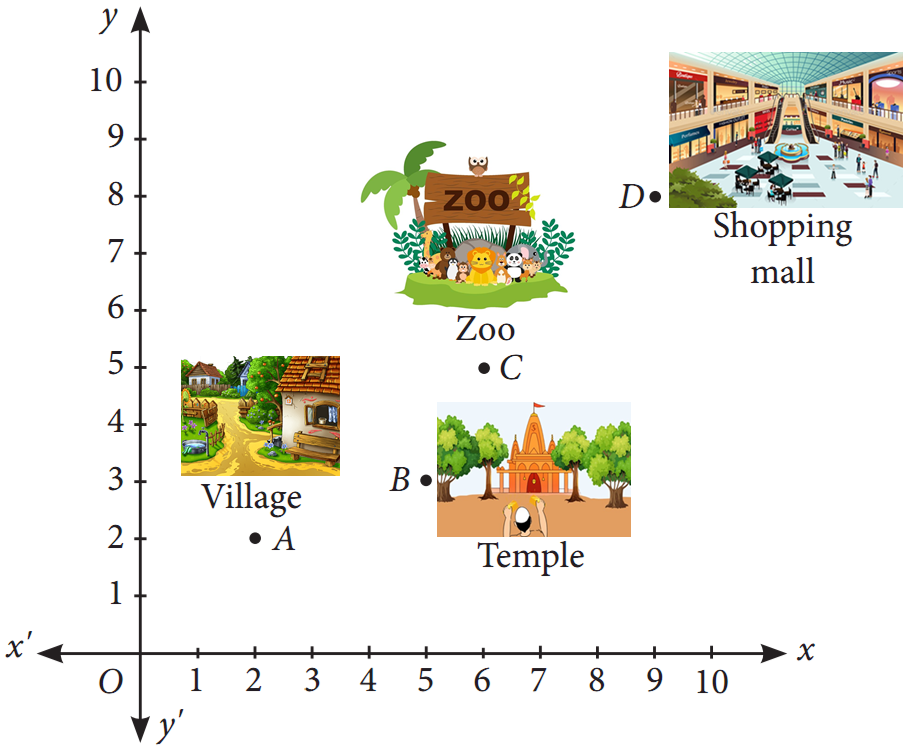
Ishaan left from his village on weekend. First, he travelled up to temple. After this, he left for the zoo. After this, he left for shopping in a mall. The positions of Jshaan at different places is given in the following graph.

Based on the above information, answer the following questions.
  1. Position vector of B is:
  1. $3\hat{\text{i}}+5\hat{\text{j}}$
  2. $5\hat{\text{i}}+3\hat{\text{j}}$
  3. $-5\hat{\text{i}}-3\hat{\text{j}}$
  4. $-5\hat{\text{i}}+3\hat{\text{j}}$
  1. Position vector of D is:
  1. $5\hat{\text{i}}+3\hat{\text{j}}$
  2. $3\hat{\text{i}}+5\hat{\text{j}}$
  3. $8\hat{\text{i}}+9\hat{\text{j}}$
  4. $9\hat{\text{i}}+8\hat{\text{j}}$
  1. Find the vector $\overline{\text{BC}}$ in terms of $\hat{\text{i}},\hat{\text{j}}.$
  1. $\hat{\text{i}}-2\hat{\text{j}}$
  2. $\hat{\text{i}}+2\hat{\text{j}}$
  3. $2\hat{\text{i}}+\hat{\text{j}}$
  4. $2\hat{\text{i}}-\hat{\text{j}}$
  1. Length of vector $\overline{\text{AB}}$ is:
  1. $\sqrt{67}\text{ units}$
  2. $\sqrt{85}\text{ units}$
  3. 90 units
  4. 100 units
  1. If $\vec{\text{M}}=4\hat{\text{j}}+3\hat{\text{k}},$ then its unit vector is:
  1. $\frac{4}{5}\hat{\text{j}}+\frac{3}{5}\hat{\text{k}}$
  2. $\frac{4}{5}\hat{\text{j}}-\frac{3}{5}\hat{\text{k}}$
  3. $-\frac{4}{5}\hat{\text{j}}+\frac{3}{5}\hat{\text{k}}$
  4. $-\frac{4}{5}\hat{\text{j}}-\frac{3}{5}\hat{\text{k}}$
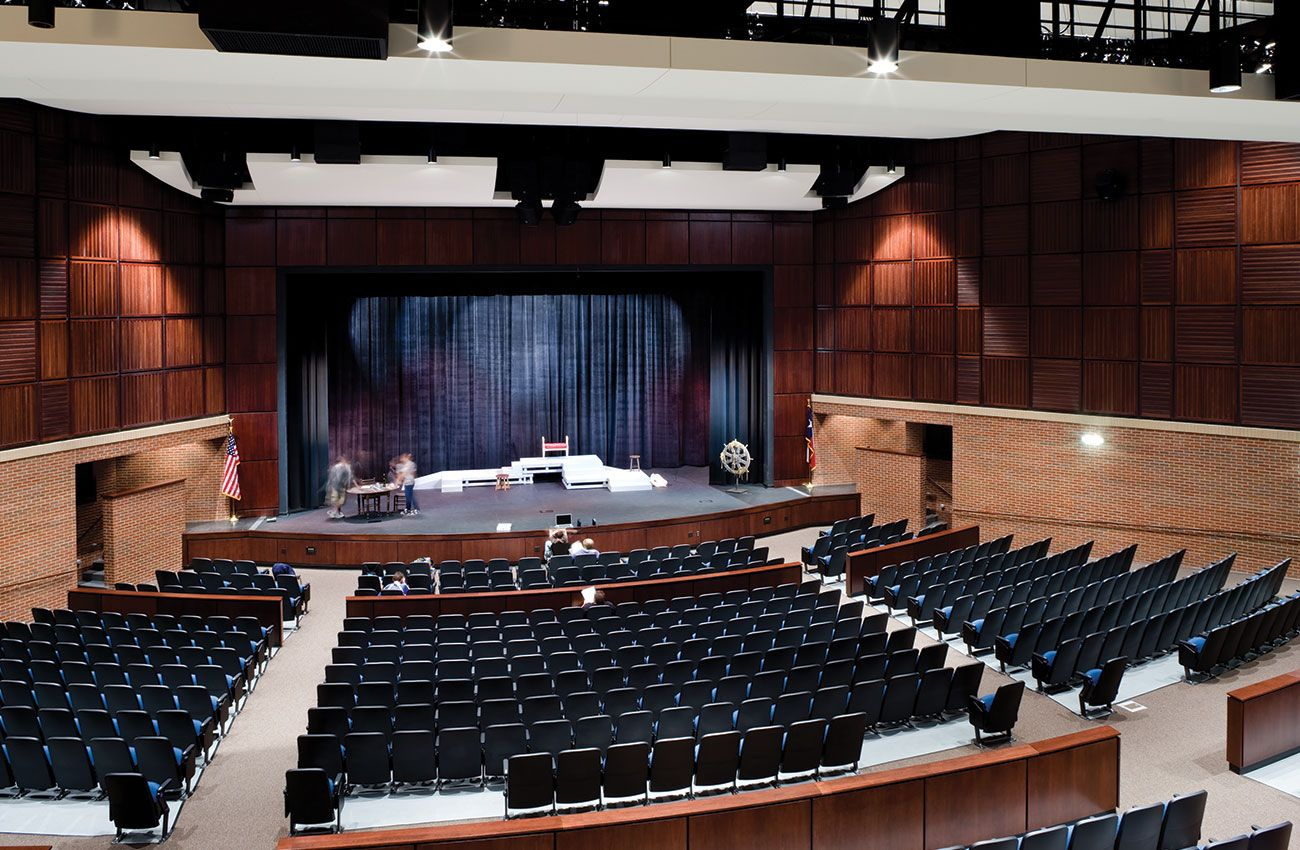
An architecture design a auditorium for a school for its cultural activities. The floor of the auditorium is rectangular in shape and has a fixed perimeter P.

Based on the above information, answer the following questions.
  1. If x and y represents the length and breadth of the rectangular region, then relation between the variable is.
  1. x + y = P
  2. x2 + y2 = P2
  3. 2(x + y) = P
  4. x + 2y = P
  1. The area (A) of the rectangular region, as a function of x, can be expressed as.
  1. $\text{A}=\text{px}+\frac{\text{x}}{2}$
  2. $\text{A}=\frac{\text{px}+\text{x}^2}{2}$
  3. $\text{A}=\frac{\text{px}-\text{2x}^2}{2}$
  4. $\text{A}=\frac{\text{x}^2}{2}+\text{px}^2$
  1. School's manager is interested in maximising the area of floor 'A' for this to be happen, the value of x should be.
  1. $\text{P}$
  2. $\frac{\text{P}}{2}$
  3. $\frac{\text{P}}{3}$
  4. $\frac{\text{P}}{4}$
  1. The value of y, for which the area of floor is maximum, is.
  1. $\frac{\text{P}}{2}$
  2. $\frac{\text{P}}{3}$
  3. $\frac{\text{P}}{4}$
  4. $\frac{\text{P}}{16}$
  1. Maximum area of floor is.
  1. $\frac{\text{P}^2}{16}$
  2. $\frac{\text{P}^2}{64}$
  3. $\frac{\text{P}^2}{4}$
  4. $\frac{\text{P}^2}{28}$
 In a wedding ceremony, consists of father, mother, daughter and son line up at random for a family photograph, as shown in figure.

Based on the above information, answer the following questions.

  1. Find the probability that daughter is at one end, given that father and mother are in the middle.
  1. $1$

  2. $\frac{1}{2}$

  3. $\frac{1}{3}$

  4. $\frac{2}{3}$
  1. Find the probability that mother is at right end, given that son and daughter are together.
  1. $\frac{1}{2}$

  2. $\frac{1}{3}$

  3. $\frac{1}{4}$

  4. $0$
  1. Find the probability that father and mother are in the middle, given that son is at right end.
  1. $\frac{1}{4}$

  2. $\frac{1}{2}$

  3. $\frac{1}{3}$

  4. $\frac{2}{3}$

  1. Find the probability that father and son are standing together, given that mother and daughter are standing together.
  1. $0$

  2. $1$

  3. $\frac{1}{2}$

  4. $\frac{2}{3}$

  1. Find the probability that father and mother are on either of the ends, given that son is at second position from the right end.
  1. $\frac{1}{3}$

  2. $\frac{2}{3}$

  3. $\frac{1}{4}$

  4. $\frac{2}{5}$  

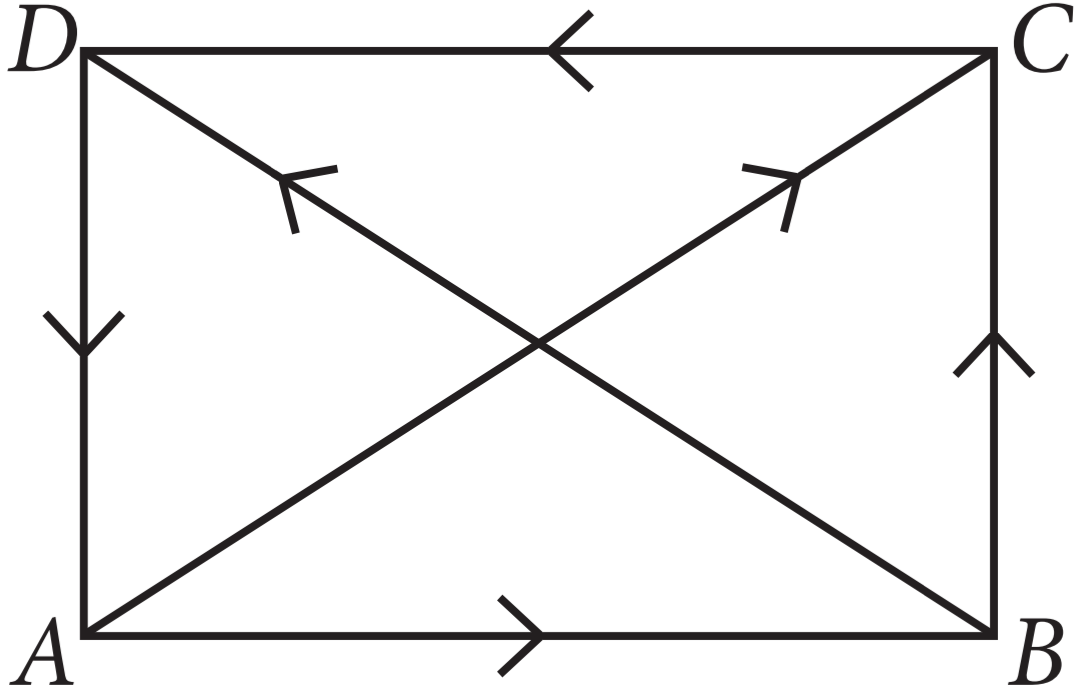
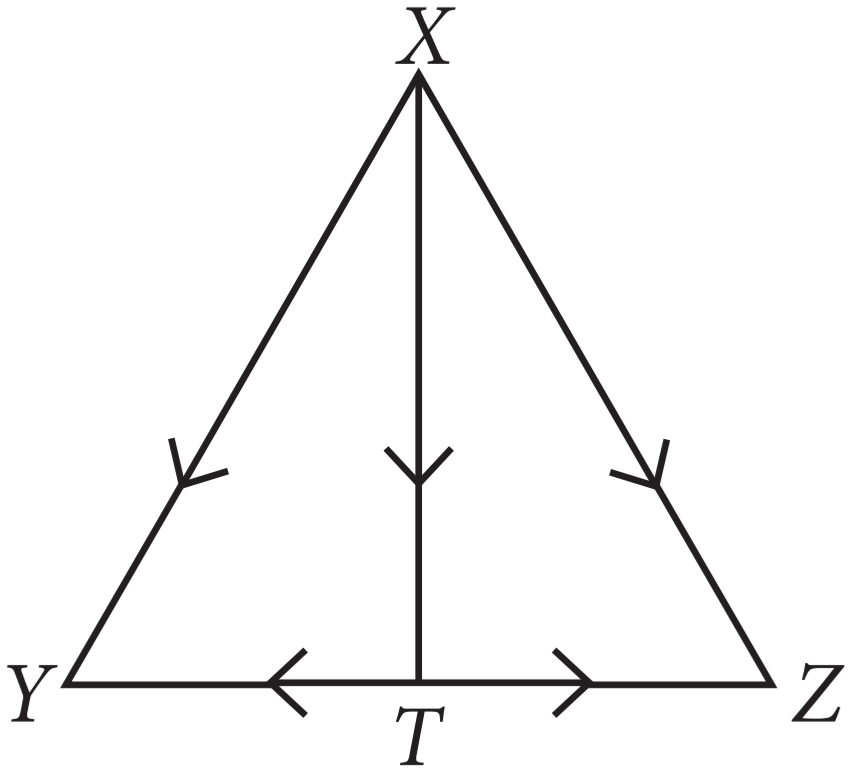
If two vectors are represented by the two sides of a triangle taken in order, then their sum is represented by the third side of the triangle taken in opposite order and this is known as triangle law of vector addition. Based on the above information, answer the following questions.

  1. If $\vec{\text{p}},\vec{\text{q}},\vec{\text{r}}$ are the vectors represented by the sides of a triangle taken in order, then $\vec{\text{q}},+\vec{\text{r}}=$
  1. $\vec{\text{p}}$

  2. $2\vec{\text{p}}$

  3. $-\vec{\text{p}}$

  4. None of these
  1. If ABCD is a parallelogram and AC and BD are its diagonals, then $\overline{\text{AC}}+\overline{\text{BD}}=$
  1. $2\overline{\text{DA}}$

  2. $2\overline{\text{AB}}$

  3. $2\overline{\text{BC}}$

  4. $2\overline{\text{BD}}$

  1. If ABCD is a parallelogram, where $\overline{\text{AB}}=2\vec{\text{a}}$ and $\overline{\text{BC}}=2\vec{\text{b}},$ then $\overline{\text{AC}}-\overline{\text{BD}}=$
  1. $3\vec{\text{a}}$

  2. $4\vec{\text{a}}$

  3. $2\vec{\text{b}}$

  4. $4\vec{\text{b}}$

  1. If ABCD is a quadrilateral whose diagonals are $\overline{\text{AC}}$ and $\overline{\text{BD}},$ then $\overline{\text{BA}}+\overline{\text{DC}}=$

  1. $\overline{\text{AC}}+\overline{\text{DB}}$

  2.  $\overline{\text{AC}}+\overline{\text{BD}}$

  3. $\overline{\text{BC}}+\overline{\text{AD}}$

  4. $\overline{\text{BD}}+\overline{\text{CA}}$

  1. If T is the mid point of side YZ of $\triangle\text{XYZ},$ then $\overline{\text{XY}}+\overline{\text{XZ}}=$

  1. $2\overline{\text{YT}}$

  2. $2\overline{\text{XT}}$

  3. $2\overline{\text{TZ}}$

  4. None of these
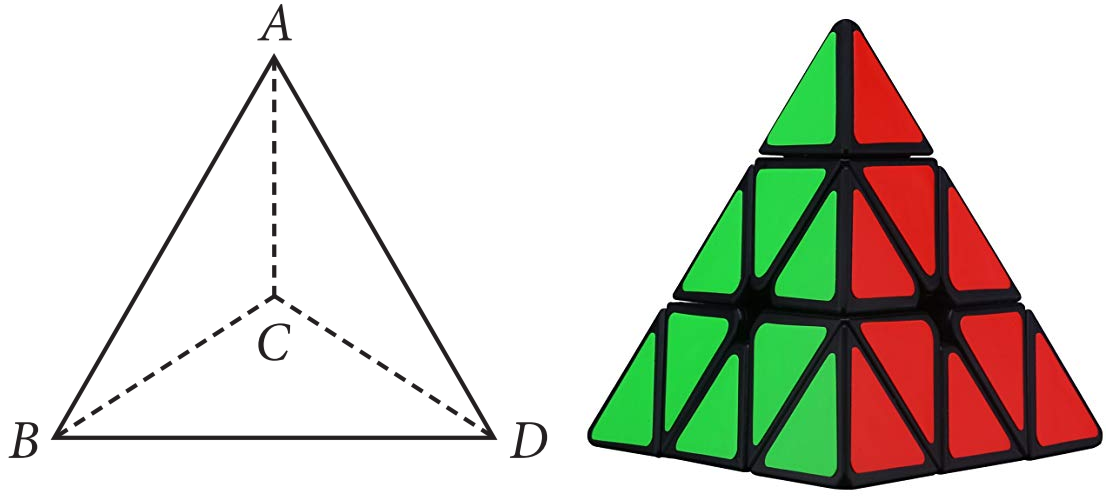
A building is to be constructed in the form of a triangular pyramid, ABCD as shown in the figure.

Let its angular points are A(0, 1, 2), B(3, 0, 1), C(4, 3, 6), and D(2, 3, 2), and G be the point of intersection of the medians of $\triangle\text{BCD}.$
Based on the above information, answer the following questions.
  1. The coordinates of point Gare:
  1. (2, 3, 3)
  2. (3, 3, 2)
  3. (3, 2, 3)
  4. (0, 2, 3)
  1. The length of vector $\overline{\text{AG}}$ is:
  1. $\sqrt{17}\text{ units}$
  2. $\sqrt{11}\text{ units}$
  3. $\sqrt{13}\text{ units}$
  4. $\sqrt{19}\text{ units}$
  1. Area of $\triangle\text{ABC}$ (in sq. units) is:
  1. $\sqrt{10}$
  2. $2\sqrt{10}$
  3. $3\sqrt{10}$
  4. $5\sqrt{10}$
  1. The sum of lengths of $\overline{\text{AB}}$ and $\overline{\text{AC}}$ is:
  1. 5 units
  2. 9.32 units
  3. 10 units
  4. 11 units
  1. The length of the perpendicular from the vertex D on the opposite face is:
  1. $\frac{6}{\sqrt{10}}\text{ units}$
  2. $\frac{2}{\sqrt{10}}\text{ units}$
  3. $\frac{3}{\sqrt{10}}\text{ units}$
  4. $8\sqrt{10}\text{ units}$
If a real valued function f{x) is finitely derivable at any point of its domain, it is necessarily continuous at that point. But its converse need not be true.
For example, every polynomial, constant function are both continuous as well as differentiable and inverse trigonometric functions are continuous and differentiable in its domains etc.
Based on the above information, answer the following questions.
  1. If $\text{f}(\text{x})=\begin{cases}\text{x},\text{for x}\leq0\\0,\text{for x}>0\end{cases},$ then at x = 0
  1. f(x) is differentiable and continuous.
  2. f(x) is neither continuous nor differentiable.
  3. f(x) is continuous but not differentiable.
  4. None of these.
  1. If $\text{f}(\text{x})=|\text{x}-1|,\text{x }\in\text{ R},$ then at x = 1
  1. f(x) is not continuous.
  2. f(x) is continuous but not differentiable.
  3. f(x) is continuous and differentiable.
  4. None of these.
  1. f(x) = x3 is:
  1. Continuous but not differentiable at x = 3
  2. Continuous but not differentiable at x = 3
  3. Neither continuous nor differentiable at x = 3
  4. None of these.
  1. If $\text{f}(\text{x})=[\sin\text{x}],$ then which of the following is true?
  1. f(x) is continuous and differentiable at x = 0.
  2. f(x) is discontinuous at x = 0.
  3. f(x) is continuous at x = 0 but not differentiable.
  4. f(x) is differentiable but not continuous at $\text{x}=\frac{\pi}{2}.$
  1. If $\text{f}(\text{x})=\sin^{-1}\text{x},-1\leq\text{x}\leq1,$ then:
  1. f(x) is both continuous and differentiable.
  2. f(x) is neither continuous nor differentiable.
  3. f(x) is continuous but not differentiable.
  4. None of these.
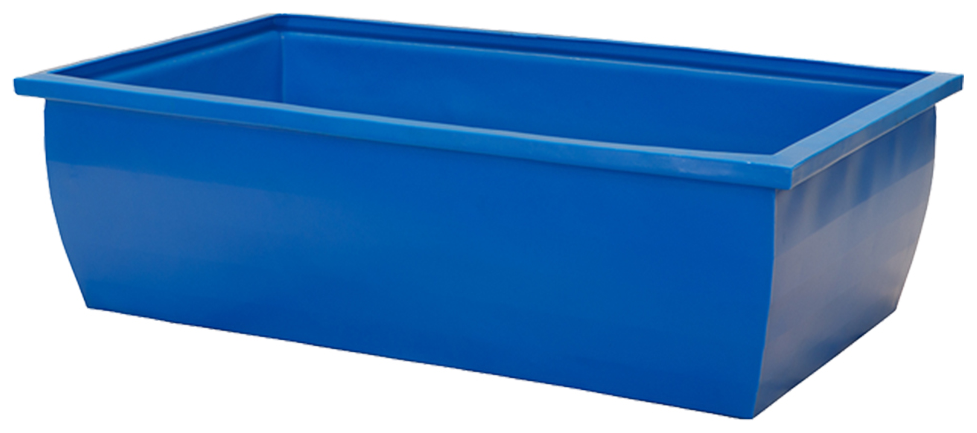
Nitin wants to construct a rectangular plastic tank for his house that can hold 80 ft3 of water. The top of the tank is open. The width of tank will be 5 ft but the length and heights are variables. Building the tank cost? ₹ 20 per sq. foot for the base and ₹ 10 per sq. foot for the side.

Based on the above information, answer the following questions.
  1. In order to make a least expensive water tank, Nitin need to minimize its.
  1. Volume
  2. Base
  3. Curved surface area
  4. Cost
  1. Total cost of tank as a function of h can be represented as.
  1. c(h) = 100h - 320 - 1600/ h
  2. c(h) = 100h - 320h - 720h2
  3. c(h) = 100 + 320h + 1600h2
  4. $\text{c}\big(\text{h}\big)=100\text{h}+320+\frac{1600}{\text{h}}$
  1. Range of h is.
  1. (3, 5)
  2. $\big(0,\infty\big)$
  3. (0, 8)
  4. (0, 3)
  1. Value of hat which c(h) is minimum, is.
  1. 4
  2. 5
  3. 6
  4. 6, 7
  1. The cost of least expensive tank is.
  1. ₹ 1020
  2. ₹ 1100
  3. ₹ 1120
  4. ₹ 1220
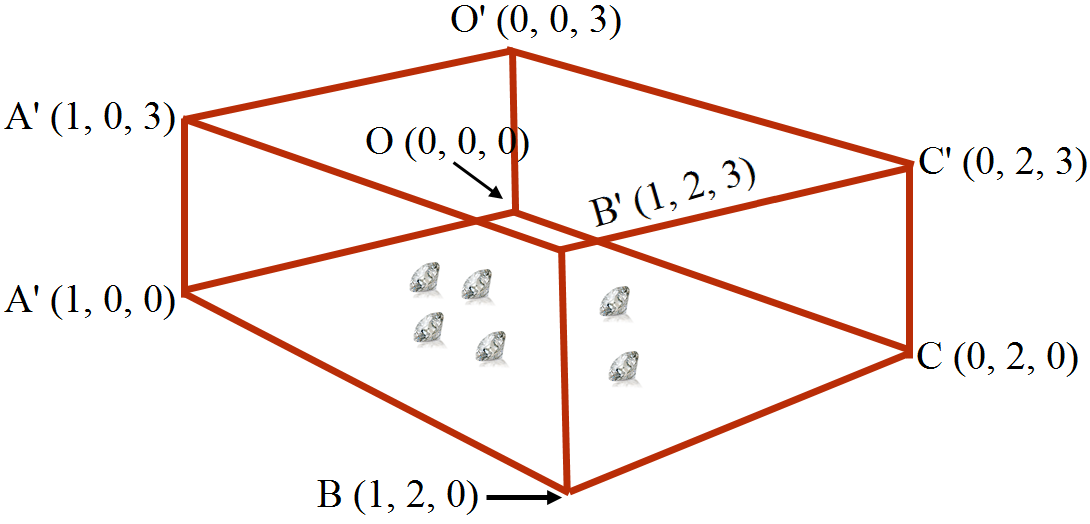
In a diamond exhibition, a diamond is covered in cubical glass box having coordinates O(0, 0, 0), A(1, 0, 0), B(1, 2, 0), C(0, 2, 0), O'(0, 0, 3), A'(1, 0, 3), B'(1, 2, 3) and C'(0, 2, 3).

Based on the above information, answer the following questions.

  1. Direction ratios of OA are:
  1. < 0, 1, 0 >
  2. < 1, 0, 0 >
  3. < 0, 0, 1 >
  4. None of these
  1. Equation of diagonal OB' is:
  1. $\frac{\text{x}}{1}=\frac{\text{y}}{2}=\frac{\text{z}}{3}$

  2. $\frac{\text{x}}{0}=\frac{\text{y}}{1}=\frac{\text{z}}{2}$

  3. $\frac{\text{x}}{1}=\frac{\text{y}}{0}=\frac{\text{z}}{2}$

  4. None of these
  1. Equation of plane OABC is:
  1. x = 0
  2. y = 0
  3. z = 0
  4. None of these
  1. Equation of plane O' A' B' C' is:
  1. x = 3
  2. y = 3
  3. z = 3
  4. z = 2
  1. Equation of plane ABB' A' is:
  1. x = 1
  2. y = 1
  3. z = 2
  4. x = 3
A magazine company in a town has 5000 subscribers on its list and collects fix charges of ₹ 3000 per year from each subscriber. 'The company proposes to increase the annual charges, and it is believed that for every increase of ₹ 1 one subscriber will discontinue service.

Based on the above information, answer the following questions.
  1. If x denote the amount of increase in annual charges, then revenue R, as a function of x can be represented as.
  1. R(x) = 3000 × 5000 × x
  2. R(x) = (3000 - 2x)(5000 + 2x)
  3. R(x) = (5000 + x)(3000 - x)
  4. R(x) = (3000 + x)(5000 - x)
  1. If magazine company increases ₹ 500 as annual charges, then R is equal to.
  1. ₹ 15750000
  2. ₹ 16750000
  3. ₹ 17500000
  4. ₹ 15000000
  1. If revenue collected by the magazine company is ₹ 15640000, then value of amount increased as annual charges for each subscriber, is.
  1. 400
  2. 1600
  3. Both (a) and (b)
  4. None of these
  1. What amount of increase in annual charges will bring maximum revenue?
  1. ₹ 1000
  2. ₹ 2000
  3. ₹ 3000
  4. ₹ 4000
  1. Maximum revenue is equal to.
  1. ₹ 15000000
  2. ₹ 16000000
  3. ₹ 20500000
  4. ₹ 25000000
If two vectors are represented by the two sides of a triangle taken in order, then their sum is represented by the third side of the triangle taken in opposite order and this is known as triangle law of vector addition. Based on the above information, answer the following questions.

  1. If $\vec{\text{p}},\vec{\text{q}},\vec{\text{r}}$ are the vectors represented by the sides of a triangle taken in order, then $\vec{\text{q}},+\vec{\text{r}}=$
  1. $\vec{\text{p}}$

  2. $2\vec{\text{p}}$

  3. $-\vec{\text{p}}$

  4. None of these
  1. If ABCD is a parallelogram and AC and BD are its diagonals, then $\overline{\text{AC}}+\overline{\text{BD}}=$
  1. $2\overline{\text{DA}}$

  2. $2\overline{\text{AB}}$

  3. $2\overline{\text{BC}}$

  4. $2\overline{\text{BD}}$

  1. If ABCD is a parallelogram, where $\overline{\text{AB}}=2\vec{\text{a}}$ and $\overline{\text{BC}}=2\vec{\text{b}},$ then $\overline{\text{AC}}-\overline{\text{BD}}=$
  1. $3\vec{\text{a}}$

  2. $4\vec{\text{a}}$

  3. $2\vec{\text{b}}$

  4. $4\vec{\text{b}}$

  1. If ABCD is a quadrilateral whose diagonals are $\overline{\text{AC}}$ and $\overline{\text{BD}},$ then $\overline{\text{BA}}+\overline{\text{DC}}=$

  1. $\overline{\text{AC}}+\overline{\text{DB}}$

  2.  $\overline{\text{AC}}+\overline{\text{BD}}$

  3. $\overline{\text{BC}}+\overline{\text{AD}}$

  4. $\overline{\text{BD}}+\overline{\text{CA}}$

  1. If T is the mid point of side YZ of $\triangle\text{XYZ},$ then $\overline{\text{XY}}+\overline{\text{XZ}}=$

  1. $2\overline{\text{YT}}$

  2. $2\overline{\text{XT}}$

  3. $2\overline{\text{TZ}}$

  4. None of these