Questions · Page 2 of 4

M.C.Q (1 Marks)

Question 511 Mark
If f(x) defind by $\text{f(x)}=\begin{cases}\frac{|\text{x}^2-\text{x}|}{\text{x}^2-\text{x}},&\text{x}\neq0,1\\1,&\text{x}=0\\-1,&\text{x}=1\end{cases}$ then f(x) is continuse for all:
  1. x
  2. x except at x = 0
  3. x except at x = 1
  4.  x except at x = 0 and x = 1
Answer
  1. x except at x = 0 and x = 1

Solution:

Given function $\text{f(x)}=\frac{|\text{x}^2-\text{x}|}{\text{x}^2-\text{x}}$

Consider,

$\text{f}(0^+)=\lim\limits_{\text{x}\rightarrow0}\frac{|\text{x}^2-\text{x}|}{\text{x}^2-\text{x}}=\lim\limits_{\text{x}\rightarrow0}\frac{|\text{x(x}-1)|}{\text{x(x}-1)}=\lim\limits_{\text{x}\rightarrow0}\frac{\text{x(x}-1)}{\text{x(x}-1)}=1$

$\text{f}(0^-)=\lim\limits_{\text{x}\rightarrow0}\frac{|\text{x}^2-\text{x}|}{\text{x}^2-\text{x}}=\lim\limits_{\text{x}\rightarrow0}\frac{|\text{x}(\text{x}-1)|}{\text{x}(\text{x}-1)}=\lim\limits_{\text{x}\rightarrow0}\frac{-\text{x}(\text{x}-1)}{\text{x}(\text{x}-1)}=-1$

Also, for f(1+) and f(1-) you can check.

View full question & answer
Question 521 Mark
Let f(x) = (x + |x|) |x|. Then, for all x:
  1. f is continuous.
  2. f is differentiable for some x
  3. f' is continuous.
  4. f'' is continuous.
Answer
  1. f is continuous and,
  1. f' is continuous.

Solution :

$\text{f(x)}=(\text{x}+|\text{x}|)|\text{x}|$

$\Rightarrow\text{f(x)}=2\text{x}^2,\text{ x}>0$

$=0,\text{ x}<0$

$\lim\limits_{\text{x}\rightarrow0}2\text{x}^2=0$

Function is continuous at x = 0.

Also, differentiable at x = 0 as it is polynomial function.

View full question & answer
Question 531 Mark
Choose the correct answers from the given four options:
For the function $\text{f(x)}=\text{x}+\frac{1}{\text{x}},\text{x}\in[1,3],$ the value of c for mean value theorem is:
  1. 1
  2. $\sqrt{3}$
  3. 2
  4. None of these
Answer
  1. $\sqrt{3}$

Solution:

$\text{f(x)}=\text{x}+\frac{1}{\text{x}},$ which is continuous and differentiable.

So, by mean value theorem there exists atleast one $\text{c}\in(1,3)$ such that

$\because\ \text{f}'\text{c}=\frac{\text{f(b)}-\text{f(a)}}{\text{b}-\text{a}}$

$\Rightarrow\ 1-\frac{1}{\text{c}^2}=\frac{\frac{10}{3}-2}{3-1}$

$\Rightarrow\ \frac{\text{c}^2-1}{\text{c}^2}=\frac{2}{3}$

$\Rightarrow\ 3(\text{c}^2-1)=2\text{c}^2$

$\Rightarrow\ 3\text{c}^2-2\text{c}^2=3$

$\Rightarrow\ \text{c}^2=3$

$\Rightarrow\ \text{c}=\sqrt{3}\in(1,3)$

View full question & answer
Question 541 Mark
If $\text{f(x)}=\begin{cases}\text{ax}^2+\text{b},&0\leq\text{x}<1\\4,&\text{x}=1\\\text{x}+3,&1<\text{x}\leq2\end{cases}$ then the value of (a, b) for which f(x) cannot be continuous at x = 1, is:
  1. (2, 2)
  2. (3, 1)
  3. (4, 0)
  4. (5, 2)
Answer
  1. (5, 2)

Solution:

$\lim\limits_{\text{x}\rightarrow1^-}\text{f(x)}=\text{f}(1)$

$\lim\limits_{\text{x}\rightarrow1}\text{ax}^2+\text{b}=4$

a + b = 4

We have possible values as (2, 2), (3, 1), (4, 0)

But can not be (5, 2).

Function is can not be continuous at (5, 2).

View full question & answer
Question 551 Mark
Let $\text{f(x)}\begin{cases}\text{ax}^2+1,&\text{x}<1\\\text{x}+\frac{1}{2},&\text{x}\leq1\end{cases}.$ Then, f(x) is derivable at x = 1, if:
  1. a = 2
  2. a = 1
  3. a = 0
  4. $\text{a}=\frac{1}{2}$.
Answer
  1. $\text{a}=\frac{1}{2}.$

Solution:

Given: $\text{f(x)}=\begin{cases}\text{ax}^2+1,&\text{x}<1\\\text{x}+\frac{1}{2},&\text{x}\leq1\end{cases}$

The function is derivable at x = 1, if left hand derivative and right hand derivative of the function are equal at x = 1.

(LHL at x = 1) $=\lim\limits_{\text{x}\rightarrow1^{-}}\frac{\text{f(x)}-\text{f}(1)}{\text{x}-1}$

(LHL at x = 1) $=\lim\limits_{\text{h}\rightarrow0}\frac{\text{f}(1-\text{h})-\text{f}(1)}{1-\text{h}-1}$

(LHL at x = 1) $=\lim\limits_{\text{h}\rightarrow0}\frac{\text{f}(1-\text{h})-\text{f}(1)}{-\text{h}}$

(LHL at x = 1) $=\lim\limits_{\text{h}\rightarrow0}\frac{\Big(1-\text{h}+\frac{1}{2}\Big)-\frac{3}{2}}{-\text{h}}=1$

(RHL at x = 1) $=\lim\limits_{\text{x}\rightarrow1^{+}}\frac{\text{f(x)}-\text{f}(1)}{\text{x}-1}$

(RHL at x = 1) $=\lim\limits_{\text{h}\rightarrow0}\frac{\text{f}(1+\text{h})-\text{f}(1)}{1+\text{h}-1}$

(RHL at x = 1) $=\lim\limits_{\text{h}\rightarrow0}\frac{\text{f}(1+\text{h})-\text{f}(1)}{\text{h}}$

(RHL at x = 1) $=\lim\limits_{\text{h}\rightarrow0}\frac{\text{a}(1+\text{h})^2+1-\frac{3}{2}}{\text{h}}$

(RHL at x = 1) $=\lim\limits_{\text{h}\rightarrow0}\frac{\text{a}(1-\text{h}^2+2\text{h})-\frac{1}{2}}{\text{h}}$

$\therefore\text{LHL}=\text{RHL}$

$\Rightarrow\text{a}-\frac{1}{2}=0$

$\Rightarrow\text{a}-\frac{1}{2}$

View full question & answer
Question 561 Mark
Choose the correct answers from the given four options:
If $\text{y}=\sqrt{\sin\text{x}+\text{y}},$ then $\frac{\text{dy}}{\text{dx}}$ is equal to:
  1. $\frac{\cos\text{x}}{2\text{y}-1}$
  2. $\frac{\cos\text{x}}{1-2\text{y}}$
  3. $\frac{\sin\text{x}}{1-2\text{y}}$
  4. $\frac{\sin\text{x}}{2\text{y}-1}$
Answer
  1.  $\frac{\cos\text{x}}{2\text{y}-1}$

Solution:

We have, $\because\text{y}=(\sin\text{x}+\text{y})^{\frac{1}{2}}$

$\therefore\ \frac{\text{dy}}{\text{dx}}=\frac{1}{2}(\sin\text{x}+\text{y})^{\frac{-1}{2}}\cdot\frac{\text{d}}{\text{dx}}(\sin\text{x}+\text{y})$

$\Rightarrow\ \frac{\text{dy}}{\text{dx}}=\frac{1}{2}\cdot\frac{1}{(\sin\text{x}+\text{y})^{\frac{1}{2}}}\cdot\Big(\cos\text{x}+\frac{\text{dy}}{\text{dx}}\Big)$

$\Rightarrow\ \frac{\text{dy}}{\text{dx}}=\frac{1}{2\text{y}}\cdot\Big(\cos\text{x}+\frac{\text{dy}}{\text{dx}}\Big)$ $\big[\because(\sin\text{x}+\text{y})^{\frac{1}{2}}=\text{y}\big]$

$\Rightarrow\ \frac{\text{dy}}{\text{dx}}\Big(1-\frac{1}{2\text{y}}\Big)=\frac{\cos\text{x}}{2\text{y}}$

$\therefore\ \frac{\text{dy}}{\text{dx}}=\frac{\cos\text{x}}{2\text{y}}\cdot\frac{2\text{y}}{2\text{y}-1}=\frac{\cos\text{x}}{2\text{y}-1}$ 

View full question & answer
Question 571 Mark
The function $\text{f(x)}=|\cos\text{x}|$ is:
  1. Differentiable at$\text{x}=(2\text{n}+1)\frac{\pi}{2},\text{n}\in\text{Z}$
  2. Continuous but not differentiable at $\text{x}=(2\text{n}+1)\frac{\pi}{2},\text{n}\in\text{Z}$
  3. Neither differentiable nor continuous at $\text{x}=\text{n}\in\text{Z}$
  4. None of these.
Answer
  1. Continuous but not differentiable at $\text{x}=(2\text{n}+1)\frac{\pi}{2},\text{n}\in\text{Z}.$

Solution:

$\text{f(x)}=|\cos\text{x}|$

Given function is trigonometric function.

⇒ Hence, it is continuous.

Function is not differentiable at odd multiples of $\frac{\pi}{2}$

⇒ f(x) is not differentiable at $\text{x}=(2+\text{n}+1)\frac{\pi}{2}.$

View full question & answer
Question 581 Mark
Let $\text{f(x)=}\begin{cases}\frac{\text{x}^4-5\text{x}^2+4}{|(\text{x}-1)(\text{x-2})|},\text{x}\neq1,2\\6, \text{x}=1\\12,\text{x}=2\end{cases}$ Then f(x) is continuous on the set:
  1. R
  2. R - {1}
  3. R - {2}
  4. R - {1, 2}
Answer
  1. R - {1, 2}

Solution:

Given:

$\text{f(x)=}\begin{cases}\frac{\text{x}^4-5\text{x}^2+4}{|(\text{x}-1)(\text{x-2})|},\text{x}\neq1,2\\6, \text{x}=1\\12,\text{x}=2\end{cases}$

Now,

$\Rightarrow\text{x}^4-5\text{x}^2+4=\text{x}^4-\text{x}^2-4\text{x}^2+4\\=\text{x}^2(\text{x}^2-1)-4(\text{x}^2-1)$

$=(\text{x}^2-1)(\text{x}^2-4)=(\text{x}-1)(\text{x}+1)(\text{x}-2)(\text{x}+2)$

$\Rightarrow\text{f(x)}=\begin{cases}\frac{(\text{x}-1)(\text{x}+1)(\text{x}-2)(\text{x}+2)}{|(\text{x}-2)(\text{x}-1)|},&\text{x}\neq1,2\\6,& \text{x}=1\\12,&\text{x}=2\end{cases}$

$\Rightarrow\text{f(x)}=\begin{cases}(\text{x}+1)(\text{x}+2),&\text{x}<1\\-(\text{x+1})(\text{x}+2),&1<\text{x}<2\$\text{x+1})(\text{x}+2),&\text{x}>2\\6,&\text{x=1}\\12,&\text{x}=2\end{cases}$

So,

$\Rightarrow\lim\limits_{\text{x}\rightarrow1^-}\text{f(x)}=\lim\limits_{\text{h}\rightarrow0}\text{f}(1-\text{h})\\=\lim\limits_{\text{h}\rightarrow0}(1-\text{h}+1)(1-\text{h}+2)\\=2\times3=6$

$\Rightarrow\lim\limits_{\text{x}\rightarrow1^+}\text{f(x)}=\lim\limits_{\text{h}\rightarrow0}(1+\text{h})\\=-\lim\limits_{\text{h}\rightarrow0}(1+\text{h}+1)(1+\text{h}+2)\\=-2\times3=-6$

Also,

$\Rightarrow\lim\limits_{\text{x}\rightarrow2^-}\text{f(x)}=\lim\limits_{\text{h}\rightarrow0}\text{f}(2-\text{h})\\=-\lim\limits_{\text{h}\rightarrow0}(2-\text{h}+1)(2-\text{h}+2)=-12$

$\Rightarrow\lim\limits_{\text{x}\rightarrow2^+}\text{f(x)}=\lim\limits_{\text{h}\rightarrow0}\text{f}(2+\text{h})\\=\lim\limits_{\text{h}\rightarrow0}(2+\text{h}+1)(2+\text{h}+2)=12$

Thus,

$\Rightarrow\lim\limits_{\text{x}\rightarrow1^+}\text{f(x)}\neq\lim\limits_{\text{x}\rightarrow1^-}\text{f(x)}$ and $\lim\limits_{\text{x}\rightarrow2^+}\text{f(x)}\neq\lim\limits_{\text{x}\rightarrow2^-}\text{f(x)}$

$\therefore$ The only point of discontinuities of the function f(x) are x = 1 and x = 2. Hence, the given function is continuous on the set R - {1, 2}.

View full question & answer
Question 591 Mark
Choose the correct answers from the given four options:
The set of points where the function f given by $\text{f(x)}=|2\text{x}-1|\sin\text{x}$ is differentiable is:
  1. $\text{R}$
  2. $\text{R}-\Big\{\frac{1}{2}\Big\}$
  3. $(0,\infty)$
  4. $\text{None of these}$
Answer
  1. $\text{R}-\Big\{\frac{1}{2}\Big\}$

Solution:

We have, $\text{f(x)}=|2\text{x}-1|\sin\text{x}$

At $\text{x}=\frac{1}{2},\text{ f(x)}$ is not differentiable

Hence, f(x) is differentiable in $\text{R}-\Big\{\frac{1}{2}\Big\}$

$\because\ \text{Rf}'\Big(\frac{1}{2}\Big)=\lim\limits_{\text{h}\rightarrow0}\frac{\text{f}\Big(\frac{1}{2}+\text{h}\Big)-\text{f}\Big(\frac{1}{2}\Big)}{\text{h}}$

$=\lim\limits_{\text{h}\rightarrow0}\frac{\bigg|2\Big(\frac{1}{2}+\text{h}\Big)-1\bigg|\sin\Big(\frac{1}{2}+\text{h}\Big)-0}{\text{h}}$

$=\lim\limits_{\text{h}\rightarrow0}\frac{|2\text{h}|.\sin\Big(\frac{1+2\text{h}}{2}\Big)}{\text{h}}=2\sin\frac{1}{2}$

and $\text{Lf}'\Big(\frac{1}{2}\Big)=\lim\limits_{\text{h}\rightarrow0}\frac{\text{f}\Big(\frac{1}{2}-\text{h}\Big)-\text{f}\Big(\frac{1}{2}\Big)}{-\text{h}}$

$=\lim\limits_{\text{h}\rightarrow0}\frac{\bigg|2\Big(\frac{1}{2}-\text{h}\Big)^{-1}\bigg|\sin\Big(\frac{1}{2}-\text{h}\Big)-0}{-\text{h}}$

$=\lim\limits_{\text{h}\rightarrow0}\frac{|0-2\text{h}|-\sin\Big(\frac{1}{2}-\text{h}\Big)}{-\text{h}}=2\sin\Big(\frac{1}{2}\Big)$

$\therefore\ \text{Rf}'\Big(\frac{1}{2}\Big)\neq\text{Lf}'\Big(\frac{1}{2}\Big)$

So, f(x) is not differentiable at $\text{x}=\frac{1}{2}.$

View full question & answer
Question 601 Mark
Let $\text{f(x)}=\text{x}+\text{b}|\text{x}|+\text{c}|\text{x}|^4,$ where a, b, and c are real constants. Then, f (x) is differentiable at x = 0, if:
  1. a = 0
  2. b = 0
  3. c = 0
  4. None of these.
Answer
  1. b = 0

Solution:

We have,

$\text{f(x)}=\text{x}+\text{b}|\text{x}|+\text{c}|\text{x}|^4$

$\text{f(x)}=\begin{cases}\text{x}+\text{b}\text{x}+\text{c}\text{x}^4&\text{x}\geq0\\\text{x}+\text{b}\text{x}+\text{c}\text{x}^4&\text{x}<0\end{cases}$

Here, f(x) is differentiable at x = 0

$\therefore$ (LHL at x = 0) = (RHL at x = 0)

$\Rightarrow\lim\limits_{\text{x}\rightarrow0^{-}}\frac{\text{f(x)}-\text{x}(0)}{\text{x}-0}=\lim\limits_{\text{x}\rightarrow0^{+}}\frac{\text{f(x)}-\text{x}(0)}{\text{x}-0}$

$\Rightarrow\lim\limits_{\text{x}\rightarrow0^{-}}\frac{\text{a}-\text{bx}+\text{cx}^4-\text{a}}{\text{x}}=\lim\limits_{\text{x}\rightarrow0^{+}}\frac{\text{a}+\text{bx}^4-\text{a}}{\text{x}}$

$\Rightarrow\lim\limits_{\text{h}\rightarrow0}\frac{\text{a}-\text{b}(0-\text{h})+\text{c}(0-\text{h})^4-\text{a}}{0-\text{h}}=\lim\limits_{\text{h}\rightarrow0}\frac{\text{a}+\text{b}(0+\text{h})+\text{c}(0+\text{h})^4-\text{a}}{0+\text{h}}$

$\Rightarrow\lim\limits_{\text{h}\rightarrow0}\frac{\text{a}+\text{b}\text{h}+\text{c}\text{h}^4-\text{a}}{-\text{h}}=\lim\limits_{\text{h}\rightarrow0}\frac{\text{a}+\text{b}\text{h}+\text{c}\text{h}^4-\text{a}}{\text{h}}$

$\Rightarrow\lim\limits_{\text{h}\rightarrow0}\frac{\text{b}\text{h}+\text{c}\text{h}^4}{-\text{h}}=\lim\limits_{\text{h}\rightarrow0}\frac{\text{b}\text{h}+\text{c}\text{h}^4}{\text{h}}$

$\Rightarrow\lim\limits_{\text{h}\rightarrow0}(-\text{b}-\text{bh}^3)=\lim\limits_{\text{h}\rightarrow0}(\text{b}+\text{ch}^3)$

$\Rightarrow-\text{b}=\text{b}$

$\Rightarrow2\text{b}=0$

$\Rightarrow\text{b}=0$

View full question & answer
Question 611 Mark
If 4a + 2b + c = 0, then the equation 3ax2 + 2bx + c = 0 has atleast one real root lying in the interval:
  1. (0, 1)
  2. (1, 2)
  3. (0, 2)
  4. None of these.
Answer
  1. (0, 2)

Solution:

Let, f(x) = ax+ bx2 + cx + d

f(0) = d

f(2) = 8a + 4b + 2c + d

= 2(4a + 2b + c) + d

= 2 × 0 + d

= 0
f is continuous and differentiable on (0, 2)

f(0) = f(2)

Using Rolle's theorem,

f'(x) = 0 for (0, 2)

3ax2 + 2bx + c = 0

f(x) has atleast one root in the interval (0, 2).

Hence f'(x) must have root in the interval (0, 2).

View full question & answer
Question 621 Mark
Let f(x) = |x| and g(x) = |x3|, then:
  1. f(x) and g(x) both are continuous at x = 0
  2. f(x) and g(x) both are differentiable at x = 0
  3. f(x) is differentiable but g(x) is not differentiable at x = 0
  4. f(x) and g(x) both are not differentiable at x = 0
Answer
  1. f(x) and g(x) both are continuous at x = 0

Solution:

Absolute value function is continuous on R.

View full question & answer
Question 631 Mark
The points of discontinuity of the function $\text{f(x)}=\begin{cases}\frac{1}{5}(2\text{x}^2+3),&\text{x}\leq1\\6-5\text{x},&1<\text{x}<3\\\text{x}-3,&\text{x}\geq3\end{cases}$ is (are):
  1. x = 1
  2. x = 3
  3. x = 1, 3
  4. none of these
Answer
  1. x = 3

Solution:

$\lim\limits_{\text{x}\rightarrow1^-}\text{f(x)}=\lim\limits_{\text{x}\rightarrow1}\frac{1}{5}(2\text{x}^2+3)=1$

$\lim\limits_{\text{x}\rightarrow1^+}\text{f(x)}=\lim\limits_{\text{x}\rightarrow1}6-5\text{x}=1$

Function is continuou at x = 1

$\lim\limits_{\text{x}\rightarrow3^-}\text{f(x)}=\lim\limits_{\text{x}\rightarrow3}6-5\text{x}=-9$

$\lim\limits_{\text{x}\rightarrow3^+}\text{f(x)}=\lim\limits_{\text{x}\rightarrow3}\text{x}-3=0$

Function is discontinuous at x = 3

View full question & answer
Question 641 Mark
If $\sin(\text{x}+\text{y})=\log(\text{x}+\text{y}),$ then $\frac{\text{dy}}{\text{dx}}=$
  1. 2
  2. -2
  3. 1
  4. -1
Answer
  1. -1

Solution:

We have, $\sin(\text{x}+\text{y})=\log(\text{x}+\text{y})$

$\Rightarrow\cos(\text{x}+\text{y})\Big(1+\frac{\text{dy}}{\text{dx}}\Big)=\frac{1}{(\text{x}+\text{y})}\Big(1+\frac{\text{dy}}{\text{dx}}\Big)$

$\Rightarrow\cos(\text{x}+\text{y})+\cos(\text{x}+\text{y})\frac{\text{dy}}{\text{dx}}=\frac{1}{(\text{x}+\text{y})}+\frac{1}{(\text{x}+\text{y})}\frac{\text{dy}}{\text{dx}}$

$\Rightarrow\cos(\text{x}+\text{y})\frac{\text{dy}}{\text{dx}}-\frac{1}{(\text{x}+\text{y})}\frac{\text{dy}}{\text{dx}}=\frac{1}{(\text{x}+\text{y})}-\cos(\text{x}+\text{y})$

$\Rightarrow\Big\{\cos(\text{x}+\text{y})-\frac{1}{(\text{x}+\text{y})}\Big\}\frac{\text{dy}}{\text{dx}}=\frac{1}{\text{x}+\text{y}}-\cos(\text{x}+\text{y})$

$\Rightarrow\cos(\text{x}+\text{y})\frac{\text{dy}}{\text{dx}}-\frac{1}{(\text{x}+\text{y})}\frac{\text{dy}}{\text{dx}}=\frac{1}{(\text{x}+\text{y})}-\cos(\text{x}+\text{y})$

$\Rightarrow\Big\{\cos(\text{x}+\text{y})-\frac{1}{(\text{x}+\text{y})}\Big\}\frac{\text{dy}}{\text{dx}}=\frac{1}{(\text{x}+\text{y})}-\cos(\text{x}+\text{y})$

$\Rightarrow\Big\{\frac{1}{(\text{x}+\text{y})}-\cos(\text{x}+\text{y})\Big\}\frac{\text{dy}}{\text{dx}}=\frac{1}{(\text{x}+\text{y})}-\cos(\text{x}+\text{y})$

$\Rightarrow\frac{\text{dy}}{\text{dx}}=-1$

View full question & answer
Question 651 Mark
If $\text{y}=\frac{\text{ax}+\text{b}}{\text{x}^2+\text{c}},$ then $(2\text{xy}_1+\text{y})\text{y}_3=$
  1. 3(xy2 + y1) y2
  2. 3(xy1 + y2) y2
  3. 3(xy1 + y2) y1
  4. None of these
Answer
  1. 3 (xy2 + y1) y2

Solution:

$\text{y}=\frac{\text{ax}+\text{b}}{\text{x}^2+\text{c}}$

$\Rightarrow(\text{x}^2+\text{c})\text{y}=\text{ax}+\text{b}$

Differentiating w.r.t.x, we get

$2\text{xy}+(\text{x}^2+\text{c})\frac{\text{dy}}{\text{dx}}=\text{a}$

Differentiating w.r.t.x, we get

$2\text{y}+2\text{xy}_1+2\text{xy}+(\text{x}^2+\text{c})\text{y}_2=0$

$\Rightarrow2\text{y}+4\text{xy}_1+\text{x}^2+\text{cy}_2=0$

Differentiating w.r.t.x, we get

$2\text{y}_1+4\text{y}_1+4\text{xy}_2+(\text{x}^2+\text{c})\text{y}_3+2\text{xy}_2=0$

$\Rightarrow6\text{y}_1+6\text{xy}_2+(\text{x}^2+\text{c})\text{y}_3=0$

$\Rightarrow6\text{y}_1+6\text{xy}_2+\Big(\frac{-2\text{y}-4\text{xy}_1}{\text{y}_2}\Big)\text{y}_3=0$ $[\because2\text{y}+4\text{xy}_1+(\text{x}^2+\text{c})\text{y}_2=0]$

$\Rightarrow6\text{y}_1\text{y}_2+6\text{x}(\text{y}_2)^2-2\text{y}-4\text{xy}_1\text{y}_3=0$

$\Rightarrow3\text{y}_1\text{y}_2+3\text{x}(\text{y}_2)^2-\text{y}-2\text{xy}_1\text{y}_3=0$

$\Rightarrow(\text{y}_1+\text{xy}_2)3\text{y}_2=(2\text{xy}_1+\text{y})\text{y}_3$

View full question & answer
Question 661 Mark
The value of f(0), so that the function $\text{f(x)}=\frac{2-(256-7\text{x})^{\frac{1}{8}}}{(5\text{x}+32)^\frac{1}{5}-2},\text{ x}\neq0$ is continuous everywhere, is given by:
  1. -1
  2. 1
  3. 26
  4. none of these
Answer
  1. none of these.

Solution:

$\text{f}(0)=\lim\limits_{\text{x}\rightarrow0}\frac{2-(256-7\text{x})^{\frac{1}{8}}}{(5\text{x}+32)^\frac{1}{5}-2}$

$\text{f}(0)=\lim\limits_{\text{x}\rightarrow0}\frac{-\bigg[(256-7\text{x})^\frac{1}{8}-256^\frac{1}{8}\bigg]}{(5\text{x+32})^\frac{1}{5}-32\frac{1}{5}}$

$\text{f}(0)=\lim\limits_{\text{x}\rightarrow0}\frac{\frac{-\bigg[(256-7\text{x})^{\frac{1}{8}}-256\bigg]}{-7\text{x}}}{\frac{(5\text{x}+32)^{\frac{1}{5}}-32^\frac{1}{5}}{5\text{x}}}$

$\text{f}(0)=\lim\limits_{\text{x}\rightarrow0}\frac{\frac{-\bigg[(256-7\text{x})^\frac{1}{8}-256^\frac{1}{8}\bigg]}{-7\text{x}}\text{x}-7}{\frac{(5\text{x}+32)^\frac{1}{5}-32^\frac{1}{5}}{5\text{x}}\times5}$

$\text{f}(0)=\frac{7}{5}\times\frac{\frac{1}{8}\times256^\frac{-7}{8}}{\frac{1}{5}\times32^\frac{-4}{5}}$

$\text{f}(0)=\frac{7}{5}\times\frac{5\times2^4}{8\times2^7}=\frac{7}{8}\times\frac{1}{8}=\frac{7}{64}$

View full question & answer
Question 671 Mark
The value of c in Rolle's theorem when
f(x) = 2x3 - 5x2 - 4x + 3, $\text{x}\in\Big[\frac{1}{3},3\Big]$ is:
  1. $2$
  2. $-\frac{1}{3}$
  3. $-2$
  4. $\frac{2}{3}$
Answer
  1. 2

Solution:

f(x) = 2x3 - 5x2 - 4x + 3

Differentiating the given function with respect to x, we get

f'(x) = 6x2 - 10x - 4

⇒ f'(c) = 6c2 - 10c - 4

$\therefore$ f'(c) =0

⇒ 3c2 - 5c - 2 = 0

⇒ 3c2 - 6c + c - 2 = 0

⇒ 3c(c - 2) + c - 2 = 0

⇒ (3c + 1)(c - 2) = 0

$\Rightarrow\text{c}=2, \frac{-1}{3}$

$\therefore\ \text{c}=2\in\Big(\frac{1}{3},3\Big)$

Thus, $\text{c}=2\in\Big(\frac{1}{3},3\Big)$ for which Rolle's theorem holds.

Hence, the required value of c is 2.

View full question & answer
Question 681 Mark
Let $\text{y}=\sqrt{\sin\text{x}+\text{y}},$ then $\frac{\text{dy}}{\text{dx}}=$
  1. $\frac{\sin\text{x}}{2\text{y}-1}$
  2. $\frac{\sin\text{x}}{1-2\text{y}}$
  3. $\frac{\cos\text{x}}{1-2\text{y}}$
  4. $\frac{\cos\text{x}}{2\text{y}-1}$
Answer
  1. $\frac{\cos\text{x}}{2\text{y}-1}$

Solution:

$\text{y}=\sqrt{\sin\text{x}+\text{y}}$

$\frac{\text{dy}}{\text{dx}}=\frac{1}{2\sqrt{\sin\text{x}+\text{y}}}\times\Big(\cos\text{x}+\frac{\text{dy}}{\text{dx}}\Big)$

$\frac{\text{dy}}{\text{dx}}=\frac{\cos\text{x}}{2\sqrt{\sin\text{x}+\text{y}}}+\frac{1}{2\sqrt{\sin\text{x}+\text{y}}}\frac{\text{dy}}{\text{dx}}$

$\frac{\text{dy}}{\text{dx}}-\frac{1}{2\sqrt{\sin\text{x}+\text{y}}}\frac{\text{dy}}{\text{dx}}=\frac{\cos\text{x}}{2\sqrt{\sin\text{x}+\text{y}}}$

$\Big(1-\frac{1}{2\sqrt{\sin\text{x}+\text{y}}}\Big)\frac{\text{dy}}{\text{dx}}=\frac{\cos\text{x}}{2\sqrt{\sin\text{x}+\text{y}}}$

$\Big(1-\frac{1}{2\text{y}}\Big)\frac{\text{dy}}{\text{dx}}=\frac{\cos\text{x}}{2\text{y}}$

$\Big(\frac{2\text{y}-1}{2\text{y}}\Big)\frac{\text{dy}}{\text{dx}}=\frac{\cos\text{x}}{2\text{y}}$

$\frac{\text{dy}}{\text{dx}}=\frac{\cos\text{x}}{2\text{y}-1}$

View full question & answer
Question 691 Mark
If the function $\text{f(x)}=\frac{2\text{x}-\sin^{-1}\text{x}}{2\text{x}+\tan^{-1}\text{x}}$ is continuous at each point of its domain, then the value of f(0) is:
  1. $2$
  2. $\frac{1}{3}$
  3. $-\frac{1}{3}$
  4. $\frac{2}{3}$
Answer
  1. $\frac{1}{3}$

Solution:

$\text{f}(0)=\lim\limits_{\text{x}\rightarrow0}\frac{2\times-\sin^{-1}\text{x}}{2\times+\tan^{-1}\text{x}}$

$\text{f}\text{(0)}=\lim\limits_{\text{x}\rightarrow0}\frac{2\times-\frac{\sin^{-1}\text{x}}{\text{x}}}{2+\frac{\tan^{-1}\text{x}}{\text{x}}}$

$\text{f}(0)=\frac{2-1}{2+1}=\frac{1}{3}$

View full question & answer
Question 711 Mark
The function $\text{f(x)}=\frac{4-\text{x}^2}{4\text{x}-\text{x}^3}$
  1. Discontinuous at only one point.
  2. Discontinuous exactly at two points.
  3. Discontinuous exactly at three points.
  4. None of these.
Answer
  1. Discontinuous exactly at three points.

Solution:

Given,

$\text{f(x)}=\frac{4-\text{x}^2}{4\text{x}-\text{x}^3}$

$\Rightarrow\text{f(x)}=\frac{4-\text{x}^2}{\text{x}(4-\text{x}^2)}$

$\Rightarrow\text{f(x)}=\frac{1}{\text{x}},\text{x}\neq0 $ and  $4-\text{x}^2\neq0 $  or $ \text{x}\neq0,\pm2$

Clearly, f(x) is defined and continuous for all real numbers except $\left\{0,\pm2\right\}$

Therefore, f(x) is discontinuous exactly at three points.

View full question & answer
Question 721 Mark
If $\text{f}(\text{x})=\sqrt{\text{x}^2+6\text{x}+9},$ then f'(x) is equal to:
  1. 1 for x < -3
  2. -1 for x < -3
  3. 1 for all $\text{x}\in\text{R}$
  4. None of these.
Answer
  1. -1 for x < -3

Solution:

We have, $\text{f}(\text{x})=\sqrt{\text{x}^2+6\text{x}+9}$

$=\sqrt{(\text{x}+3)^2}$

$=|\text{x}+3|$

$\text{f}(\text{x})=\begin{cases}\text{x}+ 3,\text{x}\geq-3\\ -\text{x}-3,\text{x}<-3\end{cases}$

$\Rightarrow\text{f}'(\text{x})=\begin{cases} 1,\text{x}\geq-3\\ -1,\text{x}<-3\end{cases}$

$\therefore$ f'(x) = -1 for x < -3

View full question & answer
Question 731 Mark
If $\text{x}=\text{t}^2,\text{y}=\text{t}^3$ Then $\frac{\text{d}^2\text{y}}{\text{dx}^2}=$
  1. $\frac{3}{2}$
  2. $\frac{3}{4\text{t}}$
  3. $\frac{3}{2\text{t}}$
  4. $\frac{3\text{t}}{2}$
Answer
  1. $\frac{3\text{t}}{2}$

Solution:

$\text{x}=\text{t}^2\Rightarrow\frac{\text{dx}}{\text{dt}}=2\text{t}$

$\text{y}=\text{t}^3\Rightarrow\frac{\text{dy}}{\text{dt}}=3\text{t}^2$

$\Rightarrow\frac{\text{dy}}{\text{dx}}=\frac{\frac{\text{dy}}{\text{dt}}}{\frac{\text{dx}}{\text{dt}}}$

$\Rightarrow\frac{\text{dy}}{\text{dx}}=\frac{3\text{t}^2}{2\text{t}}$

$\Rightarrow\frac{\text{dy}}{\text{dx}}=\frac{3\text{t}}{2}$

View full question & answer
Question 741 Mark
The function f(x) = e|x| is:
  1. Continuous everywhere but not differentiable at x = 0
  2. Continuous and differentiable everywhere
  3. Not continuous at x = 0
  4. None of these.
Answer
  1. Continuous everywhere but not differentiable at x = 0
View full question & answer
Question 751 Mark
If $\text{f(x)}=\frac{1}{1-\text{x}},$ then the set of points discontinuity of the function f(f(f(x))) is:
  1. {1}
  2. {0,1}
  3. {-1, 1}
  4. none of these
Answer
  1. {0, 1}

Solution:

Given, $\text{f}\text{(x)}=\frac{1}{1-\text{x}}$

Clearly, $\text{f}:\text{R}-\big\{1\big\}\rightarrow\text{R}$

Now,

$\text{f}\big(\text{f}\text{(x)}\big)=\text{f}\Big(\frac{1}{1-\text{x}}\Big)=\Bigg(\frac{1}{1-\big(\frac{1}{1-\text{x}}\big)}\Bigg)$

$=\Big(\frac{1-\text{x}}{-\text{x}}\Big)=\Big(\frac{\text{x}-1}{\text{x}}\Big)$

$\therefore\text{f}\text{o}\text{f}:\text{R}-\big\{0,1\big\}\rightarrow\text{R}$

Now,

$\text{f}\big(\text{f}\text{(x)}\big)=\text{f}\Big(\frac{1}{1-\text{x}}\Big)=\Bigg(\frac{1}{1-\big(\frac{1}{1-\text{x}}\big)}\Bigg)=\text{x}$

$\therefore\ \text{f}\text{o}\text{f}:\text{R}-\big\{0,1\big\}\rightarrow\text{R}$

Thus, f(f(f(x))) is not defind at x = 0, 1

Hence, f(f(f(x))) is discontinuous at {0, 1}

View full question & answer
Question 761 Mark
If $\text{y}=\text{a}\sin\text{mx}+\text{b}\cos\text{mx},$ then $\frac{\text{d}^2\text{y}}{\text{dx}^2}$ is equal to:
  1. -m2y
  2. m2y
  3. -my
  4. my
Answer
  1. -m2y

Solution:

$\text{y}=\text{a}\sin\text{mx}+\text{b}\cos\text{mx}$

$\frac{\text{dy}}{\text{dx}}=\text{am}\cos\text{mx}-\text{bm}\sin\text{mx}$

$\frac{\text{d}^2\text{y}}{\text{dx}^2}=-\text{am}^2\sin\text{mx}-\text{bm}^2\cos\text{mx}=-\text{m}^2\text{y}$

View full question & answer
Question 771 Mark
If $\text{f(x)}=|\text{x}-\text{a}|\ \phi\ (\text{x}),$ where $\phi(\text{x})$ is continuous function, then:
  1.  $\text{f}'(\text{a}^+)=\phi(\text{a})$
  2. $\text{f}'(\text{a}^-)=-\phi(\text{a})$
  3. $\text{f}'(\text{a}^+)=\text{f}'(\text{a}^-)$
  4. None of these
Answer
  1. $\text{f}'(\text{a}^-)=-\phi(\text{a})$

Solution:

Given that $\text{f(x)}=|\text{x}-\text{a}|\ \phi\ (\text{x}),$ where $\phi(\text{x})$ continuous function.

$|\text{x}-\text{a}|\Rightarrow\text{x}-\text{a}$ if $\text{x}-\text{a}>0$

$|\text{x}-\text{a}|\Rightarrow-(\text{x}-\text{a})$ if $\text{x}-\text{a}<0$

By definition of continuity,

$\text{f}'(\text{a})= \lim\limits_{\text{h}\rightarrow0}\frac{\text{f}(\text{a}+\text{h})-\text{f(a)}}{\text{h}}$

Hence, $\text{f}(\text{a}^+)=\phi(\text{x})$ and $\text{f}'(\text{a}^-)=-\phi(\text{x})$

View full question & answer
Question 781 Mark
Choose the correct answers from the given four options:
The function $\text{f(x)}=\text{e}^{|\text{x}|}$ is:
  1. Continuous everywhere but not differentiable at x = 0.
  2. Continuous and differentiable everywhere.
  3. Not continuous at x = 0.
  4. None of these.
Answer
  1. Continuous everywhere but not differentiable at x = 0.

Solution:

Let $\text{u(x)}=|\text{x}|$ and $\text{v(x)}=\text{e}^\text{x}$

$\therefore\ \text{f(x)}=\text{vou(x)}=\text{v}[\text{u(x)]}$

$=\text{v}|\text{x}|=\text{e}^{|\text{x}|}$

Since, u(x) and v(x) are both continuous functions.

So, f(x) is also continuous function but u(x) = |x| is not differentiable at x = 0, whereas v(x) = ex is differentiable at everywhere.

Hence, f(x) is continuous everywhere but not differentiable at x = 0.

View full question & answer
Question 791 Mark
If $\frac{\text{d}}{\text{dx}}[\text{x}^\text{n}-\text{a}_1\text{x}^{\text{n}-1}+\text{a}_2\text{x}^{\text{n}-2}+...+(-1)^\text{n}\text{a}_\text{n }]\text{e}^\text{x}=\text{x}^\text{n}\ \text{e}^\text{x},$ then the value of a, 0 < r < is equals to:
  1. $\frac{\text{n}!}{\text{r}!}$
  2. $\frac{(\text{n}-\text{r})!}{\text{r}!}$
  3. $\frac{\text{n}!}{(\text{n}-\text{r})!}$
  4. $\text{None of these}$
Answer
  1. $\frac{\text{n}!}{(\text{n}-\text{r})!}$

Solution:

$\frac{\text{d}}{\text{dx}}[\text{x}^\text{n}-\text{a}_1\text{x}^{\text{n}-1}+\text{a}_2\text{x}^{\text{n}-2}+...+(-1)^\text{n}\text{a}_\text{n }]\text{e}^\text{x}=\text{x}^\text{n}\ \text{e}^\text{x},$

$\Rightarrow\text{e}^\text{x}(\text{nx}^{\text{n-1}}-\text{a}_1(\text{n}-1)\text{x}^{\text{n-2}}+\text{a}_2(\text{n}-2)\text{x}^{\text{n}-3}+...+(-1)^{\text{n}-1}\text{a}_{\text{n}-1}+\text{x}^\text{a}-\text{a}_1\text{x}^{\text{n-2}}+...+(-1)^\text{n}\text{a}_\text{n})=\text{x}^\text{n}\text{e}^\text{x}$

$\Rightarrow\text{e}^\text{x}(\text{x}^\text{n}+(\text{n}-\text{a}_1)\text{x}^{\text{n}-1}-(\text{a}_1(\text{n-1})-\text{a}_2)\text{x}^{\text{n}-2}\\+(\text{a}_2(\text{n}-2)-\text{a}_3)\text{x}^{\text{n}-3}-...)=\text{x}^\text{n}\text{e}^\text{x}$

on comparing both sides we get

$\text{n}-\text{a}_1=0$

$\Rightarrow\text{a}_1=\text{n}$

$\text{a}_1(\text{n}-1)-\text{a}_2=0$

$\Rightarrow\text{a}_2=\text{a}_1(\text{n}-1)=\text{n}(\text{n}-1)$

$\text{a}_2(\text{n}-2)-\text{a}_3=0$

$\Rightarrow\text{a}_3=\text{a}_2(\text{n}-2)=\text{n}(\text{n}-1)(\text{n}-2)$

So,

$\text{a}_\text{r}=\text{n}(\text{n-1})(\text{n}-2)...(\text{n}-(\text{r}-1)=\frac{\text{n}!}{(\text{n}-\text{r})!}$

View full question & answer
Question 801 Mark
The function f(x) = [x], where [x] denotes the greatest integer function, is continuous at:
  1. 4
  2. -2
  3. 1
  4. 1.5
Answer
  1. 1.5
View full question & answer
Question 811 Mark
The function $\text{f(x)}=\frac{\text{x}^3+\text{x}^2-16\text{x}+20}{\text{x}-2}$ is not defind for x = 2. in order to make f(x) continuous at x = 2, here f(2) should be defined as:
  1. 0
  2. 1
  3. 2
  4. 3
Answer
  1. 0

Solution:

Here,

x+ x- 16x + 20

= x- 2x+ 3x- 6x - 10x + 20

= x2(x - 2) + 3x(x - 2) - 10(x - 2)

= (x - 2)(x+ 3x - 10)

= (x - 2)(x - 2) (x - 5)

= (x - 2)2(x + 5)

So, the given function can be rewritten as 

$\text{f(x)}=\frac{(\text{x}-2)^2(\text{x}+5)}{\text{x}-2}$

$\Rightarrow\text{f(x)}=(\text{x}-2)(\text{x}+5)$

If f(x) is continuous at x = 2, then

$\lim\limits_{\text{x}\rightarrow2}\text{f(x)}=\text{f}(2)$

$\Rightarrow\lim\limits_{\text{x}\rightarrow2}(\text{x}-2)(\text{x}+5)=\text{f}(2)$

$\Rightarrow\text{f}(2)=0$

Hence, in order to make f(x) continuous at x = 2, f(2) should be defined as 0.

View full question & answer
Question 821 Mark
If $\text{f(x)}=|\log_\text{e}|\text{x}||,$ then:
  1. f(x) is continuous and differentiable for all x in its domain.
  2. f(x) is continuous for all for all × in its domain but not differentiable at $\text{x}=\pm1$
  3. f(x) is neither continuous nor differentiable at $\text{x}=\pm1$
  4. None of these.
Answer
  1. f(x) is continuous for all for all × in its domain but not differentiable at $\text{x}=\pm1$

Solution:

We have,

$\text{f(x)}=|\log_\text{e}|\text{x}||$

We know that log function is defined for posirive value.

Here, |x| is positive for all non zero x.

Therefore, domian of function is R - {0}

And we know that logarithmic function continuous in its domain.

Therefore, $|\log_\text{e}|\text{x}||$ is continuous in its domain.

We will check the differentiability at its critical points.

$|\log_\text{e}|\text{x}||=\begin{cases}\log_\text{e}(-\text{x}) & -\infty<\text{x<-1}\\-\log_\text{e}(-\text{x}) &-1<\text{x}<0\\-\log_\text{e}(\text{x})&0<\text{x}<1\\\log_\text{e}(\text{x})&1<\text{x}<\infty\end{cases}$

(LHL at x = -1) $=\lim\limits_{\text{x}\rightarrow-1^{-}}\frac{\text{f(x)}-\text{f}(0)}{\text{x}-(-1)}$

$=\lim\limits_{\text{x}\rightarrow-1^{-}}\frac{\log_\text{e}(-\text{x})-0}{\text{x}+1}$

$=\lim\limits_{\text{h}\rightarrow0}\frac{\log_\text{e}[-(-1-\text{h})]}{-1-\text{h}+1}$

$=\lim\limits_{\text{h}\rightarrow0}\frac{\log_\text{e}(1+\text{h})}{-\text{h}}$

$=-1$

(RHL at x = -1) $=\lim\limits_{\text{x}\rightarrow-1^{+}}\frac{\text{f(x)}-\text{f}(0)}{\text{x}-(-1)}$

$=\lim\limits_{\text{x}\rightarrow-1^{+}}\frac{-\log_\text{e}(-\text{x})-0}{\text{x}+1}$

$=\lim\limits_{\text{h}\rightarrow0}\frac{-\log_\text{e}[-(-1+\text{h})]}{-1+\text{h}+1}$

$=\lim\limits_{\text{h}\rightarrow0}\frac{-\log_\text{e}(1-\text{h})}{\text{h}}$

$=-\lim\limits_{\text{h}\rightarrow0}\frac{\log_\text{e}(1-\text{h})}{\text{h}}$

$=-1\times-1=1$

Here, $\text{LHL}\neq\text{RHL}$

Therefore, the given function is not differentiable at x = -1.

(LHL at x = 1) $=\lim\limits_{\text{x}\rightarrow-1^{-}}\frac{\text{f(x)}-\text{f}(1)}{\text{x}-1}$

$=\lim\limits_{\text{x}\rightarrow-1^{-}}\frac{-\log_\text{e}(\text{x})-0}{\text{x}-1}$

$=\lim\limits_{\text{h}\rightarrow0}\frac{-\log_\text{e}[(1-\text{h})]}{1-\text{h}-1}$

$=\lim\limits_{\text{h}\rightarrow0}\frac{\log_\text{e}(1-\text{h})}{\text{h}}$

$=-1$

(RHL at x = 1) $=\lim\limits_{\text{x}\rightarrow1^{+}}\frac{\text{f(x)}-\text{f}(1)}{\text{x}-(1)}$

$=\lim\limits_{\text{x}\rightarrow1^{+}}\frac{\log_\text{e}(\text{x})-0}{\text{x}-1}$

$=\lim\limits_{\text{h}\rightarrow0}\frac{\log_\text{e}[(1+\text{h})]}{1+\text{h}-1}$

$=\lim\limits_{\text{h}\rightarrow0}\frac{\log_\text{e}(1+\text{h})}{\text{h}}$

$=1$

Here, $\text{LHL}\neq\text{RHL}$

Therefore, the given function is not differentiable at x =1.

Therefore, given function is continuous for all x in its domain but not differentiable at $\text{x}=\pm1.$
View full question & answer
Question 831 Mark
Choose the correct answers from the given four options:
If x = t2, y = t3, then $\frac{\text{d}^2\text{y}}{\text{dx}^2}$ is:
  1. $\frac{3}{2}$
  2. $\frac{3}{4\text{t}}$
  3. $\frac{3}{2\text{t}}$
  4. $\frac{3}{2\text{t}}$
Answer
  1.  $\frac{3}{4\text{t}}$

Solution:

We are given, x = t2 and y = t3

$\Rightarrow\ \frac{\text{dx}}{\text{dt}}=2\text{t}$ and $\frac{\text{dy}}{\text{dt}}=3\text{t}^2$

$\therefore\ \frac{\text{dy}}{\text{dx}}=\frac{\frac{\text{dy}}{\text{dt}}}{\frac{\text{dx}}{\text{dt}}}$

$\Rightarrow\ \frac{\text{dy}}{\text{dx}}=\frac{3\text{t}^2}{2\text{t}}$

$\Rightarrow\ \frac{\text{dy}}{\text{dx}}=\frac{3}{2}\text{t}$

$\Rightarrow\ \frac{\text{d}^2\text{y}}{\text{dx}^2}=\frac{3}{2}\cdot\frac{\text{dt}}{\text{dx}}$

$=\frac{3}{2}\cdot\frac{1}{2\text{t}}$ $\begin{bmatrix}\because\frac{\text{dx}}{\text{dt}}=2\text{t}\\\Rightarrow\frac{\text{dt}}{\text{dx}}=\frac{1}{2\text{t}}\end{bmatrix}$

$=\frac{3}{4\text{t}}$ 

View full question & answer
Question 841 Mark
If $\text{f(x)}=\text{x}^2+\frac{\text{x}^2}{1+\text{x}^2}+\frac{\text{x}^2}{(1+\text{x}^2)}+....+\frac{\text{x}^2}{(1+\text{x}^2)}+....,$ then at x = 0, f(x):
  1. Has not limit.
  2. Is discontinuous.
  3. Is continuous but not differentiable.
  4. Is differentiable.
Answer
  1. Is discontinuous.

Solution:

$\lim\limits_{\text{x}\rightarrow0}\text{f(x)}=\lim\limits_{\text{x}\rightarrow0}\Big(\text{x}^2+\frac{\text{x}^2}{1+\text{x}^2}+\frac{\text{x}^2}{(1+\text{x}^2)^2}+....+\frac{\text{x}^2}{(1+\text{x}^2)^\text{n}}+....,\Big)$

$\lim\limits_{\text{x}\rightarrow0}\text{f(x)}=\lim\limits_{\text{x}\rightarrow0}\text{x}^2\Big(1+\frac{\text{x}^2}{1+\text{x}^2}+\frac{\text{x}^2}{(1+\text{x}^2)^2}+....+\frac{\text{x}^2}{(1+\text{x}^2)^\text{n}}+....,\Big)$

$\lim\limits_{\text{x}\rightarrow0}\text{f(x)}=\lim\limits_{\text{x}\rightarrow0}\text{x}^2\bigg(\frac{1}{1-\frac{1}{1+\text{x}^2}}\bigg)$

$\lim\limits_{\text{x}\rightarrow0}\text{f(x)}=\lim\limits_{\text{x}\rightarrow0}(1+\text{x}^2)$

$\lim\limits_{\text{x}\rightarrow0}\text{f(x)}=\lim\limits_{\text{x}\rightarrow0}=1$

But, f(0)=0

$\text{f}(0)\neq\lim\limits_{\text{x}\rightarrow0}\text{f(x)}$

Function is discontinuous.

View full question & answer
Question 851 Mark
If $\text{f(x)}=|\log_\text{e}\text{x}|,$ then:
  1. $\text{f}'(1^+)=1$
  2. $\text{f}'(1^-)=-1$
  3. $\text{f}'(1)=1$
  4. $\text{f}'(1)=-1$
Answer
  1. $\text{f}'(1^+)=1$ and

  2. $\text{f}'(1^-)=-1$

Solution:

$\text{f(x)}=|\log_\text{e}\text{x}|,=\begin{cases}-\log_\text{e}\text{x}, & \text{for}0<\text{x}<1\\\log_\text{e}\text{x}, & \text{for x}\geq1\end{cases}$

Differentiability at x = 1,

We have,

(LHL at x = 1)

$=\lim\limits_{\text{x}\rightarrow1^{-}}\frac{\text{f(c)}-\text{f}(1)}{\text{x}-1}$

$=\lim\limits_{\text{x}\rightarrow1^{-}}\frac{-\log\text{x}-\log12}{\text{x}-1}$

$=\lim\limits_{\text{x}\rightarrow1^{-}}\frac{\log\text{x}}{\text{x}-1}$

$=\lim\limits_{\text{h}\rightarrow0}\frac{\log(1-\text{h})}{1-\text{h}-1}$

$=\lim\limits_{\text{h}\rightarrow0}\frac{\log(1-\text{h})}{-\text{h}}$

$=-1$

(RHL at x = 1)

$=\lim\limits_{\text{x}\rightarrow1^{+}}\frac{\text{f(c)}-\text{f}(1)}{\text{x}-1}$

$=\lim\limits_{\text{x}\rightarrow1^{+}}\frac{\log\text{x}-\log1}{\text{x}-1}$

$=\lim\limits_{\text{h}\rightarrow0}\frac{\log(1+\text{h})}{\text{x}-1}$

$=\lim\limits_{\text{h}\rightarrow0}\frac{\log(1+\text{h})}{\text{h}}$

$=1$

View full question & answer
Question 861 Mark
Choose the correct answers from the given four options:
If $\text{f(x)}=\begin{cases}\text{mx}+1,&\text{if x}\leq\frac{\pi}{2}\\\sin\text{x}+\text{n},&\text{if x}>\frac{\pi}{2}\end{cases},$ is continuous at $\text{x}=\frac{\pi}{2},$ then:
  1. $\text{m}=1,\text{n}=0$
  2. $\text{m}=\frac{\text{n}\pi}{2}+1$
  3. $\text{n}=\frac{\text{m}\pi}{2}$
  4. $\text{m}=\text{n}=\frac{\pi}{2}$
Answer
  1. $\text{n}=\frac{\text{m}\pi}{2}$

Solution:

We have, $\text{f(x)}=\begin{cases}\text{mx}+1,&\text{if x}\leq\frac{\pi}{2}\\\sin\text{x}+\text{n},&\text{if x}>\frac{\pi}{2}\end{cases},$ is continuous at $\text{x}=\frac{\pi}{2}$

$\therefore\ \text{L.H.L}=\lim\limits_{\text{x}\rightarrow\frac{\pi}{2}^-}(\text{mx}+1)$ $=\lim\limits_{\text{h}\rightarrow0}\bigg[\text{m}\Big(\frac{\pi}{2}-\text{h}\Big)+1\bigg]=\frac{\text{m}\pi}{2}+1$

and $\text{R.H.L}=\lim\limits_{\text{x}\rightarrow\frac{\pi}{2}^+}(\sin\text{x}+\text{n})$ $\lim\limits_{\text{h}\rightarrow0}\bigg[\sin\Big(\frac{\pi}{2}+\text{h}\Big)+\text{n}\bigg]$

$\lim\limits_{\text{h}\rightarrow0}[\cos\text{h}+\text{n}]=1+\text{n}$

We must have L.H.L = R.H.L

$\Rightarrow\ \text{m}\frac{\pi}{2}+1=\text{n}+1$

$\therefore\ \text{n}=\text{m}\frac{\pi}{2}$

View full question & answer
Question 871 Mark
The function $\text{f(x)}=\begin{cases}\frac{\text{x}^2}{\text{a}},&0\leq\text{x}<1\\\text{a},&1\leq\text{x}<\sqrt{2}\\\frac{2\text{b}^2-4\text{b}}{\text{x}^2},&\sqrt{2}\leq\text{x}<\infty\end{cases}$ is continuous for $0\leq\text{x}<\infty,$ then the most suitable values of a and b are:

  1. $\text{a}=1,\text{ b}=-1$

  2. $\text{a}=-1,\text{ b}=1+\sqrt{2}$

  3. $\text{a}=-1,\text{ b}=1$

  4. $\text{None os these}.$

Answer
  1. a = -1, b = 1

Solution:

Given, f(x) is continuous for $0\leq\text{x}<\infty.$

This means that f(x) is continuous for $\text{x}=1,\sqrt{2.}$

Now,

If(x) is continuons at x = 1, then

$\lim\limits_{\text{x}\rightarrow1^-}\text{f(x)}=\text{f}(1)$

$\Rightarrow\lim\limits_{\text{h}\rightarrow0}\text{f}(1-\text{h})=\text{a}$

$\Rightarrow\frac{(1-\text{h})^2}{\text{a}}=\text{a}$

$\Rightarrow\frac{1}{\text{a}}=\text{a}$

$\Rightarrow\text{a}^2=1$

$\Rightarrow\text{a}=\pm1$

If f(x) is continuous at $\text{x}={\sqrt{2}},$ then

$\lim\limits_{\text{x}\rightarrow\sqrt{2}^-}\text{f(x)}=\text{f}(\sqrt{2})$

$\Rightarrow\lim\limits_{\text{h}\rightarrow0}\text{f}(\sqrt{2}-\text{h})=\frac{2\text{b}^2-4\text{b}}{2}$

$\Rightarrow\lim\limits_{\text{h}\rightarrow0}\text{a=b}^2-2\text{b}$

$\Rightarrow\text{a = b}^2-2\text{b}$

$\Rightarrow\text{b}^2-2\text{b - a}=0$

$\therefore$ For a = -1, We have

$\text{b}^2-2\text{b}+1=0$

$\Rightarrow(\text{b}-1)^2=0$

$\Rightarrow\text{b}=1$

Thus, a = -1 and b=1

View full question & answer
Question 881 Mark
$\frac{\text{d}}{\text{dx}}\Big\{\tan^{-1}\Big(\frac{\cos\text{x}}{1+\sin\text{x}}\Big)\Big\}$ equals:
  1. $\frac{1}{2}$
  2. $-\frac{1}{2}$
  3. $1$
  4. $-1$
Answer
  1. $-\frac{1}{2}$

Solution:

Let $\text{u}=\tan^{-1}\Big(\frac{\cos\text{x}}{1+\sin\text{x}}\Big)$

$\Rightarrow\text{u}=\tan^{-1}\bigg(\frac{\cos^2\frac{\text{x}}{2}-\sin^2\frac{\text{x}}{2}}{\cos^2\frac{\text{x}}{2}+\sin^2\frac{\text{x}}{2}+2\sin\frac{\text{x}}{2}\cos\frac{\text{x}}{2}}\bigg)$

$\Rightarrow\text{u}=\tan^{-1}\frac{\big(\cos\frac{\text{x}}{2}-\sin\frac{\text{x}}{2}\big)\big(\cos\frac{\text{x}}{2}+\sin\frac{\text{x}}{2}\big)}{\big(\cos\frac{\text{x}}{2}+\sin\frac{\text{x}}{2}\big)^2}$

$\Rightarrow\text{u}=\tan^{-1}\bigg(\frac{\cos\frac{\text{x}}{2}-\sin\frac{\text{x}}{2}}{\cos\frac{\text{x}}{2}+\sin\frac{\text{x}}{2}}\bigg)$

dividing by $\cos\frac{\text{x}}{2}$

$\Rightarrow\text{u}=\tan^{-1}\bigg[\frac{1-\tan\frac{\text{x}}{2}}{1+\tan\frac{\text{x}}{2}}\bigg]$

$\Rightarrow\text{u}=\tan^{-1}\bigg[\frac{\tan\frac{\pi}{2}-\tan\frac{\text{x}}{2}}{1+\tan\frac{\text{x}}{2}\times\tan\frac{\text{x}}{2}}\bigg]$

$\Rightarrow\text{u}=\tan^{-1}\Big[\tan\Big(\frac{\pi}{2}-\frac{\text{x}}{2}\Big)\Big]$

$\Rightarrow\text{u}=\frac{\pi}{4}-\frac{\text{x}}{2}$

$\Rightarrow\frac{\text{du}}{\text{dx}}=0-\Big(\frac{1}{2}\Big)$

$\Rightarrow\frac{\text{du}}{\text{dx}}=-\frac{1}{2}$

View full question & answer
Question 891 Mark
Differential coefficient of $\sec(\tan^{-1}\text{x})$ is:
  1. $\frac{\text{x}}{1+\text{x}^2}$
  2. $\text{x}\sqrt{1+\text{x}^2}$
  3. $\frac{\text{x}}{\sqrt{1+\text{x}^2}}$
  4. $\frac{\text{x}}{\sqrt{1+\text{x}^2}}$
Answer
  1. $\frac{\text{x}}{\sqrt{1+\text{x}^2}}$

Solution:

We have, $\text{y}=\sec(\tan^{-1}\text{x})$

$\Rightarrow\frac{\text{dy}}{\text{dx}}=\sec\big(\tan^{-1}\text{x}\big)\tan\big(\tan^{-1}\text{x}\big)\times\frac{\text{d}}{\text{dx}}\big(\tan^{-1}\text{x}\big)$

$\Rightarrow\frac{\text{dy}}{\text{dx}}=\sec\big(\tan^{-1}\text{x}\big)\tan\big(\tan^{-1}\text{x}\big)\times\frac{1}{\sqrt{1+\text{x}^2}}$

$\Rightarrow\frac{\text{dy}}{\text{dx}}=\text{y}\Big(\frac{\text{x}}{\sqrt{1+\text{x}^2}}\Big)$

$\Rightarrow\frac{\text{dy}}{\text{dx}}=\Big(\frac{\text{x}}{\sqrt{1+\text{x}^2}}\Big)\text{y}$

View full question & answer
Question 901 Mark
If $\text{f}(\text{x})=\tan^{-1}\sqrt{\frac{1+\sin\text{x}}{1-\sin\text{x}}},0\leq\text{x}\leq\frac{\pi}{2},$ then $\text{f}'\Big(\frac{\pi}{6}\Big)$ is:
  1. $-\frac{1}{4}$
  2. $-\frac{1}{2}$
  3. $\frac{1}{4}$
  4. $\frac{1}{2}$
Answer
  1. $\frac{1}{2}$

Solution:

$\text{f}(\text{x})=\tan^{-1}\sqrt{\frac{1+\sin\text{x}}{1-\sin\text{x}}}$

$\text{f}(\text{x})=\tan^{-1}\sqrt{\frac{\Big(\cos\frac{\text{x}}{2}+\sin\frac{\text{x}}{2}\Big)^2}{\Big(\cos\frac{\text{x}}{2}-\sin\frac{\text{x}}{2}\Big)^2}}$

$\text{f}(\text{x})=\tan^{-1}\frac{\cos\frac{\text{x}}{2}+\sin\frac{\text{x}}{2}}{\cos\frac{\text{x}}{2}-\sin\frac{\text{x}}{2}}$

$\text{f}(\text{x})=\tan^{-1}\Bigg(\tan\bigg(\frac{1+\tan\frac{\text{x}}{2}}{1+\tan\frac{\text{x}}{2}}\bigg)\Bigg)$

$\text{f}(\text{x})=\tan^{-1}\Big(\tan\Big(\frac{\pi}{4}+\frac{\text{x}}{2}\Big)\Big)$

$\text{f}(\text{x})=\frac{\pi}{4}+\frac{\text{x}}{2}$

$\text{f}'(\text{x})=\frac{1}{2}$

View full question & answer
Question 911 Mark
If $\text{f(x)}=\begin{cases}\text{x}\sin\frac{\pi}{2}(\text{x}+1),&\text{x}\leq0\\\frac{\tan\text{x}-\sin\text{x}}{\text{x}^3},&\text{x}>0\end{cases}$ is continuous at x = 0, then a equals:
  1. $\frac{1}{2}$
  2. $\frac{1}{3}$
  3. $\frac{1}{4}$
  4. $\frac{1}{6}$
Answer
  1. $\frac{1}{2}$ 

Solution:

Given, $\text{f(x)}=\begin{cases}\text{x}\sin\frac{\pi}{2}(\text{x}+1),&\text{x}\leq0\\\frac{\tan\text{x}-\sin\text{x}}{\text{x}^3},&\text{x}>0\end{cases}$

We have,

$(\text{LHL at x}=0)=\lim\limits_{\text{x}\rightarrow0^{-}}\text{f(x)}=\lim\limits_{\text{h}\rightarrow0}\text{f}(0-\text{h})\\=\lim\limits_{\text{h}\rightarrow0}\text{f}(-\text{h})=\lim\limits_{\text{h}\rightarrow0}\text{a}\sin\Big(\frac{\pi}{2}(-\text{h+1})\Big)=\text{a}\sin\Big(\frac{\pi}{2}\Big)=\text{a}$

$(\text{RHL at x}=0)=\lim\limits_{\text{x}\rightarrow0^+}\text{f(x)}\\=\lim\limits_{\text{h}\rightarrow0}\text{f}(0+\text{h})=\lim\limits_{\text{h}\rightarrow0}\text{f(h)}=\lim\limits\frac{\tan\text{h}-\sin\text{h}}{\text{h}^3}$

$=\lim\limits_{\text{h}\rightarrow0}\frac{\frac{\sin\text{h}}{\cos\text{h} }-\sin\text{h}}{\text{h}^3}$

$=\lim\limits_{\text{h}\rightarrow0}\frac{\frac{\sin\text{h}}{\cos\text{h}}(1-\cos\text{h})}{\text{h}^3}$

$=\lim\limits_{\text{h}\rightarrow0}\frac{(1-\cos\text{h})\tan\text{h}}{\text{h}^3}$

$=\lim\limits_{\text{h}\rightarrow0}\frac{2\sin^2\frac{\text{h}}{2}\tan\text{h}}{4\times\frac{\text{h}^2}{4}\times\text{h}}$

$=\frac{2}{4}\lim\limits_{\text{h}\rightarrow0}\frac{\sin^2\frac{\text{h}}{2}\tan\text{h}}{\frac{\text{h}^2}{4}\times\text{h}}$

$=\frac{1}{2}\lim\limits_{\text{h}\rightarrow0}\bigg(\frac{\sin\frac{\text{h}}{2}}{\frac{\text{h}}{2}}\bigg)^2\times\lim\limits_{\text{h}\rightarrow0}\frac{\tan\text{h}}{\text{h}}$

$=\frac{1}{2}\times1\times1$

$=\frac{1}{2}$

If f(x) is continuous at x = 0, then

$\lim\limits_{\text{x}\rightarrow0^-}\text{f(x)}=\lim\limits_{\text{x}\rightarrow0^+}\text{f(x)}$

$\Rightarrow\text{a}=\frac{1}{2}$

View full question & answer
Question 921 Mark
The derivative of $\cos^{-1}(2\text{x}^2-1)$ with respect to $\cos^{-1}\text{x}$ is:
  1. $2$
  2. $\frac{1}{2\sqrt{1+\text{x}^2}}$
  3. $\frac{2}{\text{x}}$
  4. $1-\text{x}^2$
Answer
  1. 2

Solution:

Let, $\text{u}=\cos^{-1}(2\text{x}^2-1)\text{ and v}=\cos^{-1}\text{x}$

Put $\text{x}=\cos\theta\Rightarrow\theta=\cos^{-1}\text{x}$

$\text{u}=\cos^{-1}(2\cos^2\theta-1)\text{ and v}=\cos^-1(\cos\theta)$

$\text{u}=\cos^{-1}(\cos2\theta)\text{ and v}=\theta$

$\text{u}=2\theta$

$\text{u}=2\cos^{-1}\text{x}\text{ and v}=\cos^{-1}\text{x}$

$\frac{\text{du}}{\text{dx}}=\frac{-2}{\sqrt{1-\text{x}^2}}\text{ and }\frac{\text{dv}}{\text{dx}}=\frac{-1}{\sqrt{1-\text{x}^2}}$

$\Rightarrow\frac{\text{du}}{\text{dv}}=\frac{\frac{-2}{\sqrt{1-\text{x}^2}}}{\frac{-1}{\sqrt{1-\text{x}^2}}}=2$

View full question & answer
Question 931 Mark
If xy = ex-y then $\frac{\text{dy}}{\text{dx}}$ is:
  1. $\frac{1+\text{x}}{1+\log\text{x}}$
  2. $\frac{1-\log\text{x}}{1+\log\text{x}}$
  3. $\text{Not defined.}$
  4. $\frac{\log\text{x}}{(1+\log\text{x})^2}$
Answer
  1. $\frac{\log\text{x}}{(1+\log\text{x})^2}$

Solution:

We have, xy = ex-y

Taking $\log$ on both sides we get,

$\Rightarrow\text{y}\log\text{x}=(\text{x}-\text{y})\log)_\text{e}\text{e}$

$\Rightarrow\text{y}\log\text{x}=\text{x}-\text{y}$

$\Rightarrow\text{y}\log\text{x}+\text{y}=\text{x}$

$\Rightarrow\text{y}(1+\log\text{x})=\text{x}$

$\Rightarrow\text{y}=\frac{\text{x}}{(1+\log\text{x})}$

$\Rightarrow\frac{\text{dy}}{\text{dx}}=\frac{(1+\log\text{x})\times1-\text{x}\times\Big(1+\frac{1}{\text{x}}\Big)}{(1+\log\text{x})^2}$

$\Rightarrow\frac{\text{dy}}{\text{dx}}=\frac{1+\log\text{x}-1}{(1+\log\text{x})^2}$

$\Rightarrow\frac{\text{dy}}{\text{dx}}=\frac{\log\text{x}}{(1+\log\text{x})^2}$

View full question & answer
Question 941 Mark
Let $\sin\text{y}=\text{x}\sin(\text{a}+\text{y}),$ then $\frac{\text{dy}}{\text{dx}}$ is:
  1. $\frac{\sin\text{a}}{\sin\text{a}\sin^2(\text{a}+\text{y})}$
  2. $\frac{\sin^2(\text{a}+\text{y})}{\sin\text{a}}$
  3. $\sin\text{a}\sin^2(\text{a}+\text{y})$
  4. $\frac{\sin^2(\text{a}+\text{y})}{\sin\text{a}}$
Answer
  1. $\frac{\sin^2(\text{a}+\text{y})}{\sin\text{a}}$

Solution:

We have, $\sin\text{y}=\text{x}\sin(\text{a}+\text{y})$

$\Rightarrow\frac{\text{d}}{\text{dx}}(\sin\text{y})=\frac{\text{d}}{\text{dx}}\big[\text{x}\sin(\text{a}+\text{y})\big]$

$\Rightarrow\cos\text{y}\frac{\text{dy}}{\text{dx}}=\sin(\text{a}+\text{y})\frac{\text{d}}{\text{dx}}(\text{x})+\text{x}\frac{\text{d}}{\text{dx}}\big\{\sin(\text{a}+\text{y})\big\}$

$\Rightarrow\cos\text{y}\frac{\text{dy}}{\text{dx}}=\sin(\text{a}+\text{y})\times1+\text{x}\cos(\text{a}+\text{y})\frac{\text{dy}}{\text{dx}}$

$\Rightarrow\cos\text{y}\frac{\text{dy}}{\text{dx}}=\sin(\text{a}+\text{y})+\text{x}\cos(\text{a}+\text{y})\frac{\text{dy}}{\text{dx}}$

$\Rightarrow\cos\text{y}\frac{\text{dy}}{\text{dx}}-\text{x}\cos(\text{a}+\text{y})\frac{\text{dy}}{\text{dx}}=\sin(\text{a}+\text{y})$

$\Rightarrow\big\{\cos\text{y}-\text{x}\cos(\text{a}+\text{y})\big\}\frac{\text{dy}}{\text{dx}}=\sin(\text{a}+\text{y})$

$\Rightarrow\Big\{\cos\text{y}-\frac{\sin\text{y}}{\sin(\text{a}+\text{y})}\times\cos(\text{a}+\text{y})\Big\}\frac{\text{dy}}{\text{dx}}=\sin(\text{a}+\text{y})$

$\begin{bmatrix} \because \sin\text{y}=2\sin\text{c}\cos\text{x} \\ \therefore\text{x}=\frac{\sin\text{y}}{\sin(\text{a}+\text{y})} \end{bmatrix}$

$\Rightarrow\Big\{\frac{\sin(\text{a}+\text{y})\cos\text{y}-\sin\text{y}\cos(\text{a}+\text{y})}{\sin(\text{a}+\text{y})}\Big\}\frac{\text{dy}}{\text{dx}}=\sin(\text{a}+\text{y})$

$\Rightarrow\frac{\sin(\text{a}+\text{y}-\text{y})}{\sin(\text{a}+\text{y})}\times\frac{\text{dy}}{\text{dx}}=\sin(\text{a}+\text{y})$

$\Rightarrow\frac{\text{dy}}{\text{dx}}=\frac{\sin^2(\text{a}+\text{y})}{\sin\text{a}}$

View full question & answer
Question 951 Mark
The value of f(0), so that the function $\text{f(x)}=\frac{\sqrt{\text{a}^2+\text{ax+x}^2}-\sqrt{\text{a}^2+\text{ax+x}^2}{}}{\sqrt{\text{a+x}}-\sqrt{\text{a-x}}}$ becomes continuous for all x, given by:
  1. $\text{a}^{\frac{3}{2}}$
  2. $\text{a}^{\frac{1}{2}}$
  3. $-\text{a}^{\frac{1}{2}}$
  4. $-\text{a}^{\frac{3}{2}}$
Answer
  1. $-\text{a}^{\frac{1}{2}}$

Solution:

Given, $\text{f(x)}=\frac{\sqrt{\text{a}^2+\text{ax+x}^2}-\sqrt{\text{a}^2+\text{ax+x}^2}{}}{\sqrt{\text{a+x}}-\sqrt{\text{a-x}}}$

$\Rightarrow\text{f(x)}=\frac{\big(\sqrt{\text{a}^2-\text{ax+x}^2}-\sqrt{\text{a}^2+\text{ax+x}^2}\big)\big(\sqrt{\text{a}^2-\text{ax+x}^2}+\sqrt{\text{a}^2+\text{ax+x}^2}\big)}{\big(\sqrt{\text{a+x}}-\sqrt{\text{a-x}}\big)\big(\sqrt{\text{a}^2-\text{ax+x}^2}+\sqrt{\text{a}^2+\text{ax+x}^2}\big)}$

$\Rightarrow\text{f(x)}=\frac{\big(\text{a}^2-\text{ax+x}^2\big)-\big(\text{a}^2+\text{ax+x}^2\big)}{\big(\sqrt{\text{a+x}}-\sqrt{\text{a-x}}\big)\big(\sqrt{\text{a}^2-\text{ax+x}^2}+\sqrt{\text{a}^2+\text{ax+x}^2}\big)}$

$\Rightarrow\text{f(x)}=\frac{(-2\text{ax})\big(\sqrt{\text{a+x}}+\sqrt{\text{a-x}}\big)}{\big(\sqrt{\text{a+x}}-\sqrt{\text{a-x}}\big)\big(\sqrt{\text{a}^2-\text{ax+x}^2}+\sqrt{\text{a}^2+\text{ax+x}^2}\big)\big(\sqrt{\text{a+x}}+\sqrt{\text{a-x}}\big)}$

$\Rightarrow\text{f(x)}=\frac{(-2\text{ax})\big(\sqrt{\text{a+x}}+\sqrt{\text{a-x}}\big)}{\big(\text{a+x-a+x}\big)\big(\sqrt{\text{a}^2-\text{ax+x}^2}+\sqrt{\text{a}^2}+\text{ax+x}^2\big)}$

$\Rightarrow\text{f(x)}=\frac{(-2\text{ax})\big(\sqrt{\text{a+x}}+\sqrt{\text{a-x}}\big)}{(2\text{x})\big(\sqrt{\text{a}^2-\text{ax+x}^2}+\sqrt{\text{a}^2+\text{ax+x}^2}\big)}$

$\Rightarrow\text{f(x)}=\frac{-\text{a}\big(\sqrt{\text{a+x}}+\sqrt{\text{a-x}}\big)}{\big(\sqrt{\text{a}^2-\text{ax+x}^2}+\sqrt{\text{a}^2+\text{ax+x}^2}\big)}$

So, if f(x) is continuous at x = 0, then

$\lim\limits_{\text{x}\rightarrow0}\text{f(x)}=\text{f(0)}$

$\Rightarrow\lim\limits_{\text{x}\rightarrow0}\Bigg[\frac{-\text{a}\big(\sqrt{\text{a+x}}+\sqrt{\text{a-x}}\big)}{\big(\sqrt{\text{a}^2-\text{ax+x}}+\sqrt{\text{a}^2+\text{ax+x}^2}\big)} \Bigg]$

$\Rightarrow\bigg[\frac{-2\text{a}(\sqrt{\text{a}})}{(\sqrt{a}^2+\sqrt{\text{a}^2})}\bigg]=\text{f(0)}$

$\Rightarrow\begin{bmatrix}\frac{-2\text{a}(\sqrt{a})}{(\text{a+a})} \end{bmatrix}=\text{f(0)}$

$\Rightarrow\text{f}(0)$

$=-\sqrt{a}$

View full question & answer
Question 961 Mark
The value of c in Rolle's theorem for the function $\text{f}(\text{x})=\frac{\text{x}(\text{x}+1)}{\text{e}^{\text{x}}}$ defined on [-1, 0] is:
  1. $0.5$
  2. $\frac{1+\sqrt5}{2}$
  3. $\frac{1-\sqrt5}{2}$
  4. $-0.5$
Answer
  1. $\frac{1-\sqrt5}{2}$

Solution:

$\text{f}(\text{x})=\frac{\text{x}(\text{x}+1)}{\text{e}^{\text{x}}}$ defined on [-1, 0]

⇒ f(-1) = 0 also f(0) = 0

Now, f(x) = e-x(x2 + x)

⇒ f'(x) = e-x(2x + 1) - (x2 + x)e-x

⇒ f'(x) = e-x(2x + 1 - x2 + x)

⇒ f'(x) = e-x(-x2 + x - 1)

⇒ f'(x) = 0

⇒ e-x(-x2 + x - 1) = 0

⇒ -x2 + x - 1 = 0

⇒ x2 - x + 1 = 0

$\Rightarrow\text{x}=\frac{1\pm\sqrt5}{2}$

As, $\text{x}\in[-1,0]$

$\text{x}=\frac{1-\sqrt5}{2}$

View full question & answer
Question 971 Mark
If $\text{f(x)}=\begin{cases}\frac{1-\cos\text{x}}{\text{x}\sin\text{x}}, & \text{x}\neq 0\\\frac{1}{2} & \text{x}= 0\end{cases}$ then at x = 0, f(x) is:
  1. Continuous and differentiable.
  2. Differentiable but not continuous.
  3. Continuous but not differentiable.
  4. Neither continuous not differentiale.
Answer
  1. Continuous and differentiable.

Solution:

We have,

$\text{f(x)}=\begin{cases}\frac{1-\cos\text{x}}{\text{x}\sin\text{x}}, & \text{x}\neq 0\\\frac{1}{2}, & \text{x}= 0\end{cases}$

Continuity at x = 0

(RHL at x = 0) $=\lim\limits_{\text{x}\rightarrow0^{+}}\text{f(x)}$

$=\lim\limits_{\text{h}\rightarrow0}\text{f}(0+\text{h})$

$=\lim\limits_{\text{h}\rightarrow0}\text{f(h)}$

$=\lim\limits_{\text{h}\rightarrow0}\frac{1-\cos\text{h}}{(\text{h})\sin(\text{h})}$

$=\lim\limits_{\text{h}\rightarrow0}\frac{1-\cos\text{h}}{\text{h}\sin\text{h}}$

$=\lim\limits_{\text{h}\rightarrow0}1-\cos\text{h}\lim\limits_{\text{h}\rightarrow0}\frac{1}{\text{h}\sin\text{h}}$

$=1-\cos0.\frac{1}{0\sin0}$

$=0$

Hence, f(x) is continuous at x = 0.

For differentiable at = 0

(LHL at x = 0) $=\lim\limits_{\text{x}\rightarrow0^{-}}\frac{\text{f(x)}-\text{f}(0)}{\text{x}-0}$

$=\lim\limits_{\text{h}\rightarrow0}\frac{\text{f}(0-\text{h})-\text{f}(0)}{0-\text{h}-0}$

$=\lim\limits_{\text{h}\rightarrow0}\frac{\text{f}(-\text{h})-\frac{1}{2}}{-\text{h}}$

$=\lim\limits_{\text{h}\rightarrow0}\frac{\frac{1-\cos(-\text{h})}{-\text{h}\sin(-\text{h})}-\frac{1}{2}}{-\text{h}}$

$=\frac{1}{\text{h}}\lim\limits_{\text{h}\rightarrow0}\frac{1-\cos\text{h}}{\text{h}\sin\text{h}}-\lim\limits_{\text{h}\rightarrow0}\frac{1}{2}$

$=\frac{1}{2}-0=\frac{1}{2}$

(RHL at x = 0) $=\lim\limits_{\text{x}\rightarrow0^{+}}\frac{\text{f(x)}-\text{f}(0)}{\text{x}-0}$

$=\lim\limits_{\text{h}\rightarrow0}\frac{\text{f}(0+\text{h})-\text{f}(0)}{0-\text{h}-0}$

$=\lim\limits_{\text{h}\rightarrow0}\frac{\text{f}(\text{h})-\frac{1}{2}}{-\text{h}}$

$=\lim\limits_{\text{h}\rightarrow0}\frac{\frac{1-\cos(\text{h})}{-\text{h}\sin(\text{h})}-\frac{1}{2}}{-\text{h}}$

$=-\frac{1}{\text{h}}\lim\limits_{\text{h}\rightarrow0}\frac{1-\cos\text{h}}{\text{h}\sin\text{h}}-\lim\limits_{\text{h}\rightarrow0}\frac{1}{2}$

$=\frac{1}{2}-0=\frac{1}{2}$

(LHL at x = x) $=\lim\limits_{\text{x}\rightarrow0^{-}}\text{f(x)}$

$=\lim\limits_{\text{h}\rightarrow0}\text{f}(0-\text{h})$

$=\lim\limits_{\text{h}\rightarrow0}\text{f}(-\text{h})$

$=\lim\limits_{\text{h}\rightarrow0}\frac{1-\cos(-\text{h})}{(-\text{h})\sin(-\text{h})}$

$=\lim\limits_{\text{h}\rightarrow0}\frac{1-\cos\text{h}}{\text{h}\sin\text{h}}$

$=\lim\limits_{\text{h}\rightarrow0}1-\cos\text{h}\lim\limits_{\text{h}\rightarrow0}\frac{1}{\text{h}\sin\text{h}}$

$=1-\cos(0).\frac{1}{0\sin0}$

View full question & answer
Question 981 Mark
If $\text{x}=\text{a}\cos^3\theta,\text{y}=\text{a}\sin^3,$ then $\sqrt{1+\Big(\frac{\text{dy}}{\text{dx}}\Big)^2}=$
  1. $\tan^2\theta$
  2. $\sec^2\theta$
  3. $\sec^2\theta$
  4. $|\sec\theta|$
Answer
  1. $|\sec\theta|$

Solution:

We have, $\text{x}=\text{a}\cos^2\theta$

$\Rightarrow\frac{\text{dx}}{\text{d}\theta}=\text{a}\frac{\text{d}}{\text{d}\theta}(\cos^2\theta)$

$\Rightarrow\frac{\text{dx}}{\text{d}\theta}=3\text{a}\cos^2\theta\frac{\text{d}}{\text{d}\theta}(\cos\theta)$

$\Rightarrow\frac{\text{dx}}{\text{d}\theta}=-3\text{a}\cos^2\theta\sin\theta\ .....(\text{i})$

And,

$\text{y}=\text{a}\sin^3\theta$

$\Rightarrow\frac{\text{dx}}{\text{d}\theta}=\text{a}\frac{\text{d}}{\text{d}\theta}(\sin^3\theta)$

$\Rightarrow\frac{\text{dx}}{\text{d}\theta}=3\text{a}\sin^2\theta\frac{\text{d}}{\text{d}\theta}(\sin\theta)$

$\Rightarrow\frac{\text{dx}}{\text{d}\theta}=3\text{a}\sin^2\theta\cos\theta\ .....(\text{ii})$

Dividing (ii) by (i), we get,

$\frac{\frac{\text{dy}}{\text{d}\theta}}{\frac{\text{dx}}{\text{d}\theta}}=\frac{3\text{a}\sin^2\theta\cos\theta}{-3\text{a}\cos^2\theta\sin\theta}$

$\Rightarrow\frac{\text{dy}}{\text{dx}}=\frac{\sin\theta}{-\cos\theta}$

$\Rightarrow\frac{\text{dy}}{\text{dx}}=-\tan\theta$

Now, $\sqrt{1+\Big(\frac{\text{dy}}{\text{dx}}\Big)^2}=\sqrt{1+\tan^2\theta}$

$=\sqrt{\sec^2\theta}=|\sec\theta|$

View full question & answer
Question 991 Mark
If $\text{y}=\tan^{-1}\Big\{\frac{\log(\frac{\text{e}}{\text{x}})^2}{\log(\frac{\text{e}}{\text{x}})^2}\Big\}+\tan^{-1}\Big(\frac{3-2\log,\text{x}}{1-6\log,\text{x}}\Big)$ then $\frac{\text{d}^2\text{y}}{\text{dx}^2}=$
  1. 2
  2. 1
  3. 0
  4. -1
Answer
  1. 0

Solution:

$\text{y}=\tan^{-1}\Big\{\frac{\log(\frac{\text{e}}{\text{x}})^2}{\log(\frac{\text{e}}{\text{x}})^2}\Big\}+\tan^{-1}\Big(\frac{3-2\log,\text{x}}{1-6\log,\text{x}}\Big)$

$=\tan^{-1}\Big\{\frac{1-2\log_\text{e}\text{x}}{1+2\log_\text{e}\text{x}}\Big\}+\tan^{-1}\Big\{\frac{3+2\log_\text{e}\text{x}}{1-6\log_\text{e}\text{x}}\Big\}$

$=\tan^{-1}1-\tan^{-1}(2\log_\text{e}\text{x})+\tan^{-1}(3)+\tan^{-1}(2\log_\text{e}\text{x})$

$=\tan^{-1}+\tan^{-1}(3)$

$\frac{\text{d}^2\text{y}}{\text{dx}^2}=0$

View full question & answer
Question 1001 Mark
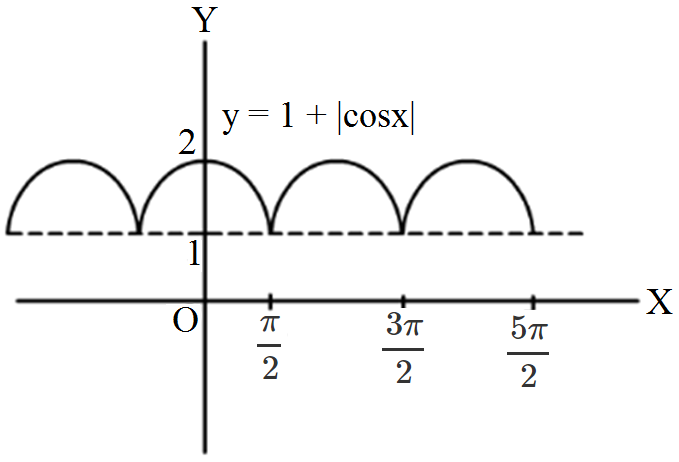
The function$\text{f(x)}=1+|\cos\text{x}|$ is:
  1. Continuous no where.
  2. Continuous everywhere.
  3. Not differentiable at x = 0
  4. Not differentiable at $\text{x}=\text{n}\pi,\text{n}\in\text{Z}.$
Answer
  1. Continuous everywhere.

Solution:

Graph of the function $\text{f(x)}=1+|\cos\text{x}|$ is as show blow:

From the graph, we can see that f(x) is everywhere continuous but not differentiable at $\text{x}=(2\text{n}+1)\frac{\pi}{2},\text{n}\in\text{Z}.$

View full question & answer