Questions · Page 3 of 8

4 Marks

Question 1014 Marks
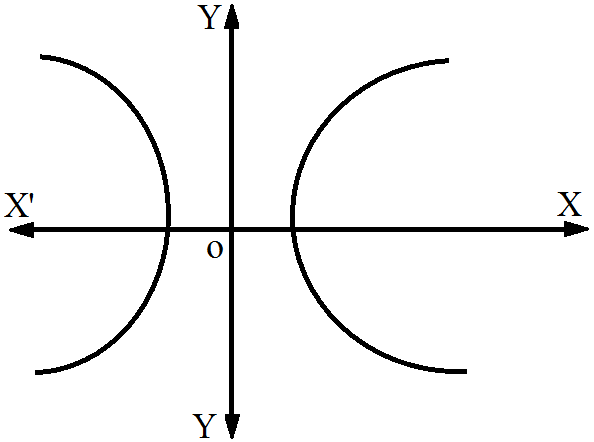
Form the differential equation of the family of hyperbolas having foci on x-axis and centre at origin.
Answer
The equation of the family of hyperbolas with the centre at origin and foci along the x-axis is:

$\frac{\text{x}^2}{\text{a}^2} - \frac{\text{y}^2}{\text{b}^2}=1 \ ...(1)$

Differentiating both sides of equation (1) with respect to x, we get:

$\frac{2\text{x}}{\text{a}^2}-\frac{2\text{yy}'}{\text{b}^2}=0$

$\Rightarrow \frac{\text{x}}{\text{a}^2}-\frac{\text{yy}'}{\text{b}^2}=0 \ ...(2)$

Again, differentiating both sides with respect to x, we get:

$\frac{1}{\text{a}^2}-\frac{\text{y}'\cdot\text{y}'\ +\ \text{yy}''}{\text{b}^2}=0$

$\Rightarrow \frac{1}{\text{a}^2}=\frac{1}{\text{b}^2}\Big((\text{y}')^2+\text{yy}''\Big)$

Substituting this value of $\frac{1}{\text{a}^2}$ in equation (2), we get:

$\frac{\text{x}}{\text{b}^2}\Big((\text{y}')^2+\text{yy}''\Big)-\frac{\text{yy}'}{\text{b}^2} =0$

$\Rightarrow \text{x(y}')^2+\text{xyy}''-\text{yy}'=0$

$\Rightarrow\text{xyy}''+\text{x}(\text{y}')^2-\text{yy}'=0$

This is the required differential equation.

View full question & answer
Question 1024 Marks
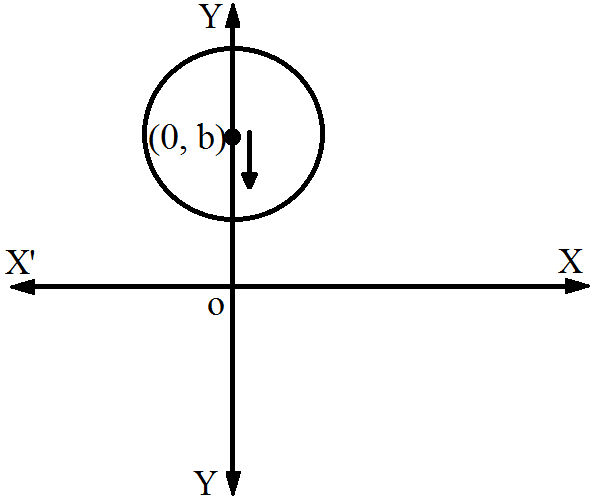
Form the differential equation of the family of circles having centre on y-axis and radius 3 units.
Answer
Let the centre of the circle on y-axis be (0, b).

The differential equation of the family of circles with centre at (0, b) and radium 3 is as follows:

$\text{x}^2 + (\text{y}-\text{b})^2=3^2$

$\Rightarrow \text{x}^2+(\text{y}-\text{b})^2=9 \ ...(1)$

Differentiating equation (1) with respect to x, we get:

$2\text{x}+2(\text{y}-\text{b})\cdot\text{y}'=0$

$\Rightarrow (\text{y}-\text{b})\cdot\text{y}'=-\text{x}$

$\Rightarrow \text{y}-\text{b}=\frac{-\text{x}}{\text{y}'}$

Substituting the value of $(\text{y}-\text{b})$ in equation (1), we get:

$\text{x}^2+\bigg(\frac{-\text{x}}{\text{y}'}\bigg)^2=9$

$\Rightarrow \text{x}^2\bigg[1+\frac{1}{(\text{y}')^2}\bigg]=9$

$\Rightarrow \text{x}^2 \Big((\text{y}')^2+1\Big)=9(\text{y}')^2$

$\Rightarrow \Big(\text{x}^2-9\Big)(\text{y}')^2 +\text{x}^2=0$

This is the required differential equation.

View full question & answer
Question 1034 Marks
The slope of the tangent at each point of a curve is equal to the sum of the coordinates of the point. Find the curve that passes through the origin.
Answer
Given,
Slop of tangent at (x, y) = x + y
$\frac{\text{dy}}{\text{dx}}=\text{x}+\text{y}$
$\frac{\text{dy}}{\text{dx}}-\text{y}=\text{x}$
It is a liner differential equation. Comparing it with $\text{P}=-1, \text{Q}=\text{x}$
$\text{I.F}=\text{e}^{\int\text{P}\text{dx}}$
$=\text{e}^{\int\text{(-1)}\text{dx}}$
$=\text{e}^{-\text{x}}$
Solution of equation is given by,
$\text{y}(\text{I.F})=\int\text{Q}(\text{I.F})\text{dx}+\text{C}$
$\text{y}(\text{e}^{-\text{x}})=\int\text{x}(\text{e}^{-\text{x}})\text{dx}+\text{C}$
$\text{y}\text{e}^{-\text{x}}=\text{x}(\text{e}^{-\text{x}})+\int(1\times\text{e}^{-\text{x}})\text{dx}+\text{C}$
It ispassing through origin 
$0=0-1+\text{Ce}^{0}$
$1=\text{C}$
Put $\text{C}=1$ is equation, 
$\text{y}=-\text{x}-1+\text{e}^{\text{x}}$
$\text{y}+\text{x}+1=\text{e}^{\text{x}}$
View full question & answer
Question 1044 Marks
The decay rate of radium at any time t is proportional to its mass at that time. Find the time when the mass will be halved of its intial mass.
Answer
Let A be the quantity of mass at any time t, So
$\frac{\text{dA}}{\text{dt}}\propto\text{A}$
$\frac{\text{dA}}{\text{dt}}=-\lambda\text{A}$
$\frac{\text{dA}}{\text{A}}=-\lambda\text{dt}$
$\int \frac{\text{dA}}{\text{A}}=-\lambda\int\text{dt}$
$\log\text{A}=-\lambda\text{t}+\text{C}\ ...(\text{i})$
Let intial of mass be A, So
$\log\text{A}_{0}=-\lambda(0)+\text{C}$
$\log(\text{A}_{0})=\text{C}$
Now, eq. (i),
$\log\text{A}=-\lambda\text{t}+\log\text{A}_{0}$
$\log\frac{\text{A}}{\text{A}_{0}}=-\lambda\text{t}$
Let be the time to half the mass $\text{A}=\frac{1}{2}\text{A}_{0}$
$\log\frac{\text{A}}{\text{A}_{0}}=-\lambda\text{t}$
$\log\frac{\text{A}}{\text{2A}}=-\lambda\text{t}$
$-\log2=-\lambda\text{t}$
$\frac{1}{\lambda}\log2=\text{t}$
Required time is  $\frac{1}{\lambda}\log2$ units of proportion.
View full question & answer
Question 1054 Marks
Solve the following differential equation
$\frac{\text{dy}}{\text{dx}}-\text{x}\text{e}^\text{x}-\frac{5}{2}+\cos^2\text{x}$
Answer
$\frac{\text{dy}}{\text{dx}}-\text{x}\text{e}^\text{x}-\frac{5}{2}+\cos^2\text{x}$
$\text{dy}=\Big(\text{xe}^\text{x}-\frac{5}{2}+\cos^2\text{x}\Big)\text{dx}$
$\int\text{dy}=\int\text{xe}^\text{x}\text{dx}-\frac{5}{2}\int\text{dx}+\cos^2\text{x dx}$
$\int\text{dy}=\int\text{xe}^\text{x}\text{dx}-\frac{5}{2}\int\text{dx}+\int\Big(\frac{1+\cos2\text{x}}{2}\Big)\text{dx}$
$=\int\text{xe}^\text{x}-\frac{5}{2}\int\text{dx}+\frac{1}{2}\int\text{dx}+\frac{1}{2}\int\cos2\text{x dx}$
$\int\text{dy}=\int\text{xe}^\text{x}-2\int\text{dx}+\frac{1}{2}\int\cos2\text{x dx}$
$\text{y}=[\text{x}\times\int\text{e}^\text{x}\text{dx}-\int(1\times\int\text{e}^\text{x}\text{dx})\text{dx}]-2\text{x}+\frac{1}{2}\frac{\sin2\text{x}}{2}+\text{C}$
Using integration by parts
$\text{y}=\text{xe}^\text{x}-\text{e}^\text{x}-2\text{x}+\frac{1}{4}\sin2\text{x}+\text{C}$
View full question & answer
Question 1064 Marks
Solve the following differential equation
$\sin^4\text{x}\frac{\text{dy}}{\text{dx}}=\cos\text{x}$
Answer
We have,
$\sin^4\text{x}\frac{\text{dy}}{\text{dx}}=\cos\text{x}$
$\Rightarrow\text{dy}=\frac{\cos\text{x}}{\sin^4\text{x}}\ \text{dx}$
Integrating both sides, we get
$\Rightarrow\int\text{dy}=\int\frac{\cos\text{x}}{\sin^4\text{x}}\ \text{dx}$
$\Rightarrow\text{y}=\int\frac{\cos\text{x}}{\sin^4\text{x}}\ \text{dx}$
Putting $\sin\text{x}=\text{t}$
$\Rightarrow\cos\text{x dx}=\text{dt}$
$\therefore\text{y}=\int\frac{1}{\text{t}^4}\ \text{dt}$
$=\frac{\text{t}^{-3}}{-3}+\text{C}$
$=\frac{-\sin^{-3}}{3}+\text{C}$
$=-\frac{1}{3}\text{cosec}^3\text{x}+\text{C}$
hence, $\text{y}=-\frac{1}{3}\text{cosec}^3\text{x}+\text{C}$ is the solution to the given differential equation.
View full question & answer
Question 1074 Marks
Experiments show that radium disintegrates at a rate proportional to the amount of radium present at the moment. Its half - life is 1590 years. What percentage will disappear in one year?
Answer
Let A be the quantity of mass at any time t, So
$\frac{\text{dA}}{\text{dt}}\propto\text{A}$
$\frac{\text{dA}}{\text{dt}}=-\lambda\text{A}$
$\frac{\text{dA}}{\text{A}}=-\lambda\text{dt}$
$\int \frac{\text{dA}}{\text{A}}=-\lambda\int\text{dt}$
$\log\text{A}=-\lambda\text{t}+\text{C}\ ...(\text{i})$
Let intial of mass be A, So
$\log\text{A}_{0}=-\lambda(0)+\text{C}$
$\log(\text{A}_{0})=\text{C}$
Now, eq. (i),
$\log\text{A}=-\lambda\text{t}+\log\text{A}_{0}$
$\log\frac{\text{A}}{\text{A}_{0}}=-\lambda\text{t}\ ...(\text{ii})$
Given, its half - life is 1590 years, 
$\log\Big(\frac{\frac{1}{2}\text{A}_{0}}{\text{A}_{0}}\Big)=-\lambda(1590)$
$\log\Big(\frac{1}{2}\Big)=-\lambda(1590)$
$-\log2=-\lambda(1590)$
$\frac{\log2}{1590}=\lambda$
Now, eq.(i) becomes
$\log\Big(\frac{\text{A}}{\text{A}_{0}}\Big)=-\frac{\log2}{1590}\text{t}$
View full question & answer
Question 1084 Marks
Solve the following differential equation:
$\cos^2(\text{x}-2\text{y}) = 1-2\frac{\text{dy}}{\text{dx}}$
Answer
We have,
$\cos^2(\text{x}-2\text{y}) = 1-2\frac{\text{dy}}{\text{dx}}$
$\Rightarrow 2\frac{\text{dy}}{\text{dx}} = 1 - \cos^2(\text{x}-2\text{y} )$
Let $\text{x}-2\text{y}=\text{v}$
$\Rightarrow1-2\frac{\text{dy}}{\text{dx}}=\frac{\text{dv}}{\text{dx}}$
$\Rightarrow 2\frac{\text{dy}}{\text{dx}} = 1 -\frac{\text{dv}}{\text{dx}}$
$\therefore 1 - \frac{\text{dv}}{\text{dx}} = 1 - \cos^2\text{v}$
$\Rightarrow \frac{\text{dv}}{\text{dx}} = \cos^2\text{v}$
$\Rightarrow \sec^2 \text{v}\text{ dv} = \text{dx}$
Integrating both sides, we get
$\int\sec^2\text{v}\text{ dv} = \int \text{dx}$
$\Rightarrow \tan \text{v} = \text{x} - \text{C}$
$\Rightarrow \tan (\text{x}-2\text{y}) = \text{x}-\text{C}$
$\Rightarrow \text{x} = \tan (\text{x}-2\text{y})+\text{C}$
View full question & answer
Question 1094 Marks
Find the equation of the curve that passes through the point (0, a) and is such that at any point (x, y) on it, the product of its slope and the ordinate is equal to the abscissa.
Answer
According to the quation,
$\text{y}\frac{\text{dy}}{\text{dx}}=\text{x}$
$\Rightarrow \text{y}\ \text{dy}=\text{x}\ \text{dx}$
Integrating both sides with respect to x, we get 
$\int\text{y}\ \text{dy}=\int\text{x}\ \text{dx}$
$\frac{\text{y}^{2}}{2}=\frac{\text{x}^{2}}{2}+\text{C}$
It is passing through (0, a)
$\frac{\text{a}^{2}}{2}=\frac{(0)}{2}+\text{C}$
$\text{C}=\frac{\text{a}^{2}}{2}$
Put is equation,
$\frac{\text{y}^{2}}{2}=\frac{\text{x}^{2}}{2}+\frac{\text{a}^{2}}{2}$
$\text{x}^{2}-{\text{y}^{2}}=-\text{a}^{2}$ 
View full question & answer
Question 1104 Marks
Solve the following differential equations:
$2(\text{y}+3)-\text{xy}\frac{\text{dy}}{\text{dx}}=0,\text{y}(1)=-2$
Answer
$2(\text{y}+3)-\text{xy}\frac{\text{dy}}{\text{dx}}=0$
$\Rightarrow2(\text{y}+3)=\text{xy}\frac{\text{dy}}{\text{dx}}$
$\Rightarrow\frac{2}{\text{x}}\text{dx}=\frac{\text{y}}{\text{y}+3}\text{dy}$
$\Rightarrow\frac{2}{\text{x}}\text{dx}=\frac{\text{y}+3-3}{\text{y}+3}\text{dy}$
$\Rightarrow\frac{2}{\text{x}}\text{dx}=\Big(1-\frac{3}{\text{y}+3}\Big)\text{dy}$
$\Rightarrow\int\frac{2}{\text{x}}\text{dx}=\int\Big(1-\frac{3}{\text{y}+3}\Big)\text{dy}$
$\Rightarrow2\log\text{x = y}-3\log|\text{y}+3|+\text{C}$
$\Rightarrow\log\text{x}^2+\log|(\text{y}+3)^3|=\text{y + C}$
$\Rightarrow\log|(\text{x}^2)(\text{y}+3)^3|=\text{y + C}...(1)$
$\Rightarrow\log|(1)^2(-2+3)^3|=-2+\text{C}$
$\Rightarrow\text{C}=2$
Substituting the value of C in (1), we get
$\log|(\text{x}^2)(\text{y}+3)^3|=\text{y}+2$
$\Rightarrow(\text{x}^2)(\text{y}+3)^3=\text{e}^{\text{y}+2}$
View full question & answer
Question 1114 Marks
Solve the differential equation (1 + y2) tan-1x dx + 2y (1 + x2) dy = 0.
Answer
Given differential equation is
$(1+\text{y}^2)\tan^{-1}\text{x}\text{dx}+2\text{y}(1+\text{x}^2)\text{dy}=0$
$\Rightarrow(1+\text{y}^2)\tan^{-1}\text{x}\text{dx}=-2\text{y}(1+\text{x}^2)\text{dy}=0$
$\Rightarrow\frac{\tan^{-1}\text{xdx}}{1+\text{x}^2}=-\frac{2\text{y}}{1+\text{y}^2}\text{dy}$
On integrating both sides, we get,
$\int\frac{\tan^{-1}\text{x}}{1+\text{x}^2}\text{dx}=-\int\frac{2\text{y}}{1+\text{y}^2}\text{dy}$
Put $\tan^{-1}=\text{t}$ in L.H.S. we get,
$\frac{1}{1+\text{x}^2}\text{dx}=\text{dt}$
And put $1 +\text{ y}^2 =\text{u}$ in R.H.S. we get,
$2\text{y}\text{dy}=\text{du}$
Putting $\tan^{-1}=\text{t}$ and $1 +\text{ y}^2 =\text{u}$ in equation (i) we get:
$\int\text{t}\text{dt}=-\int\frac{1}{\text{u}}\text{du}$
$\Rightarrow\frac{\text{t}^2}{2}=-\log\text{u}+\text{C}$
$\Rightarrow\frac{1}{2}(\tan^{-1}\text{x})^2=-\log(1+\text{y}^2)+\text{C}$
$\Rightarrow\frac{1}{2}(\tan^{-1}\text{x})^2+\log(1+\text{y}^2)=\text{C}$
View full question & answer
Question 1124 Marks
Solve the differential equation $\frac{\text{dy}}{\text{dx}}+2\text{xy}=\text{y}.$
Answer
We have $\frac{\text{dy}}{\text{dx}}+2\text{xy}=\text{y}$
$\Rightarrow\frac{\text{dy}}{\text{dx}}+2\text{xy}-\text{y}=0$
$\Rightarrow\frac{\text{dy}}{\text{dx}}+(2\text{x}-1)\text{y}=0$
$\Rightarrow\frac{\text{dy}}{\text{dx}}=\text{y}(1-2\text{x})\text{dx}$
$\Rightarrow\frac{\text{dy}}{\text{y}}=(1-2\text{x})\text{dx}$
Integrating both sides we get,
$\int\frac{\text{dy}}{\text{y}}=\int(1-2\text{x})\text{dx}$
$\Rightarrow\log\text{y}=\text{x}-\text{x}^2+\log\text{C}$
$\Rightarrow\log\text{y}-\log\text{C}=\text{x}-\text{x}^2$
$\Rightarrow\log\frac{\text{y}}{\text{C}}=\text{x}-\text{x}^2$
$\Rightarrow\frac{\text{y}}{\text{C}}=\text{e}^{\text{x}-\text{x}^2}$
$\Rightarrow\text{y}=\text{C}\text{e}^{\text{x}-\text{x}^2}$
View full question & answer
Question 1134 Marks
Show that $\text{y}=4\text{ax}$ is a solution of the differential equation $\text{y}=\text{x}\frac{\text{d}\text{y}}{\text{dx}}+\text{a}\frac{\text{dx}}{\text{dy}}.$
Answer

We have,

$\text{y}=4\text{ax}\ ...(1)$

Differentiating both sides of equation (1) with respect to 3, we get

$2\text{y}\frac{\text{dy}}{\text{dx}}=4\text{a}$

$\Rightarrow\frac{\text{dy}}{\text{dx}}=\frac{2\text{a}}{\text{y}}\ ...(2)$

now, differentiating both sided of (1) with respect to y, we get

$2\text{y}=4\text{a}\frac{\text{dy}}{\text{dx}}$

$\Rightarrow\frac{\text{dy}}{\text{dx}}=\frac{\text{y}}{2\text{a}}\ ...(3)$

$\therefore\text{x}\frac{\text{dy}}{\text{dx}}+\text{a}\frac{\text{dy}}{\text{dx}}=\text{x}\Big(\frac{2\text{a}}{\text{y}}\Big)+\text{a}\Big(\frac{\text{y}}{2\text{a}}\Big)$

$\Rightarrow\text{x}\frac{\text{dy}}{\text{dx}}+\text{a}\frac{\text{dy}}{\text{dx}}=\frac{2\text{ax}}{\text{y}}+\frac{\text{y}}{2}$

$\Rightarrow\text{x}\frac{\text{dy}}{\text{dx}}+\text{a}\frac{\text{dy}}{\text{dx}}=\frac{\text{y}^2}{2\text{y}}+\frac{\text{y}}{2}$

$\Rightarrow\text{x}\frac{\text{dy}}{\text{dx}}+\text{a}\frac{\text{dy}}{\text{dx}}=\frac{\text{y}}{2}+\frac{\text{y}}{2}$

$\Rightarrow\text{x}\frac{\text{dy}}{\text{dx}}+\text{a}\frac{\text{dy}}{\text{dx}}=\text{y}$

$\Rightarrow\text{y}=\text{x}\frac{\text{dy}}{\text{dx}}+\text{a}\frac{\text{dy}}{\text{dx}}$

Hence, the given function is the solution to the given differential equation.

View full question & answer
Question 1144 Marks
Form the differential equation corresponding to $\text{y}^2-2\text{ay}+\text{x}^2=\text{a}^2$ by eliminating a.
Answer

The equation of the family of curves is

y2 - 2ay + 2+ = a...(1)

 where a is a parameter.

This equation contains only one arbitrary constant, so we shall get a differential equation of first order.

Differentiating equation (1) with respect to x, we get

$2\text{y}\frac{\text{dy}}{\text{dx}}-2\text{a}\frac{\text{dy}}{\text{dx}}+2\text{x}=0$

$\Rightarrow2\text{y}\frac{\text{dy}}{\text{dx}}+2\text{x}=2\text{a}\frac{\text{dy}}{\text{dx}}$

$\Rightarrow\text{y}+\frac{\text{x}}{\frac{\text{dy}}{\text{dx}}}=\text{a}$

Substituting the value of a in equation (2), we get

$\text{y}^2-2\Bigg(\text{y}+\frac{\text{x}}{\frac{\text{dy}}{\text{dx}}}\Bigg)\text{y}+\text{x}^2=\Bigg(\text{y}+\frac{\text{x}}{\frac{\text{dy}}{\text{dx}}}\Bigg)^2$

$\Rightarrow\frac{\text{y}^2\frac{\text{dy}}{\text{dx}}-2\Big(\text{y}\frac{\text{dy}}{\text{dx}}+\text{x}\Big)\text{y}+\text{x}^2\frac{\text{dy}}{\text{dx}}}{\frac{\text{dy}}{\text{dx}}}=\frac{\Big(\text{y}\frac{\text{dy}}{\text{dx}}+\text{x}\Big)}{\Big(\frac{\text{dy}}{\text{dx}}\Big)^2}$

$\Rightarrow\text{y}^2\Big(\frac{\text{dy}}{\text{dx}}\Big)^2-2\text{y}^2\Big(\frac{\text{dy}}{\text{dx}}\Big)^2-2\text{xy}\Big(\frac{\text{dy}}{\text{dx}}\Big)+\text{x}\Big(\frac{\text{dy}}{\text{dx}}\Big)^2\\=\text{y}^2\Big(\frac{\text{dy}}{\text{dx}}\Big)^2+2\text{xy}\Big(\frac{\text{dy}}{\text{dx}}\Big)+\text{x}^2$

$\Rightarrow(\text{x}^2-2\text{y}^2)\Big(\frac{\text{dy}}{\text{dx}}\Big)^2-4\text{xy}\Big(\frac{\text{dy}}{\text{dx}}\Big)-\text{x}^2=0$

It is the required differential equation.

View full question & answer
Question 1154 Marks
Evaluate the following integrals:
$\int\limits^{\frac{\pi}{4}}_{-\frac{\pi}{4}}\frac{\cos^{2}\text{x}}{1+\text{e}^{\text{x}}}\text{ dx}$
Answer
We know,

$\int\limits_{\text{a}}^{\text{b}}\text{f}\text{(x)}\text{dx}=\int\limits_{\text{a}}^{\text{b}}\text{f}(\text{a}+\text{b}-\text{x})\text{dx}$

Hence,

$\int\limits_{-\frac{\pi}{2}}^{\frac{\pi}{2}}\frac{\cos^2\text{x}}{1+\text{e}^\text{x}}\text{dx}=\int\limits_{-\frac{\pi}{2}}^{\frac{\pi}{2}}\frac{\cos^2\text{(-x)}}{1+\text{e}^\text{-x}}\text{dx}$

$\int\limits_{-\frac{\pi}{2}}^{\frac{\pi}{2}}\frac{\cos^2\text{x}}{1+\text{e}^\text{x}}\text{dx}=\int\limits_{-\frac{\pi}{2}}^{\frac{\pi}{2}}\frac{\cos^2\text{x}}{1+\text{e}^\text{-x}}\text{dx}$

If,

$\text{I}=\int\limits_{-\frac{\pi}{2}}^{\frac{\pi}{2}}\frac{\cos^2\text{x}}{1+\text{e}^\text{x}}\text{dx}$

Then

$\text{I}=\int\limits_{-\frac{\pi}{2}}^{\frac{\pi}{2}}\frac{\cos^2\text{x}}{1+\text{e}^\text{x}}\text{dx}$

So,

$2\text{I}=\int\limits_{-\frac{\pi}{2}}^{\frac{\pi}{2}}\frac{\cos^2\text{x}}{1+\text{e}^\text{x}}+\frac{\cos^2\text{x}}{1+\text{e}^\text{-x}}\text{dx}$

$2\text{I}=\int\limits_{-\frac{\pi}{2}}^{\frac{\pi}{2}}\frac{\cos^2\text{x}}{1+\text{e}^\text{x}}+\frac{\text{e}^\text{x}\cos^2\text{x}}{1+\text{e}^\text{-x}}\text{dx}$

$2\text{I}=\int\limits_{-\frac{\pi}{2}}^{\frac{\pi}{2}}\frac{(1+\text{e}^\text{x})\cos^2\text{x}}{1+\text{e}^\text{x}}$

$2\text{I}=\int\limits_{-\frac{\pi}{2}}^{\frac{\pi}{2}}\cos^2\text{x}\text{dx}$

$2\text{I}=\int\limits_{-\frac{\pi}{2}}^{\frac{\pi}{2}}\frac{1+\cos2\text{x}}{2}\text{dx}$

$\text{I}=\int\limits_{-\frac{\pi}{2}}^{\frac{\pi}{2}}\frac{1}{4}\bigg\{\text{x}+\frac{\sin2\text{x}}{2}\bigg\}^\frac{\pi}{2}_{-\frac{\pi}{2}}$

$\text{I}=\frac{1}{4}\bigg\{\bigg(\frac{\pi}{2}\bigg)-\bigg(-\frac{\pi}{2}\bigg)\bigg\} $

$\text{I}=\frac{\pi}{4}$

View full question & answer
Question 1164 Marks
Evaluate the following integrals:
$\int\limits^{\frac{\pi}{4}}_{-\frac{\pi}{4}}\frac{\tan^{2}\text{x}}{1+\text{e}^{\text{x}}}\text{ dx}$
Answer
We now 

 $\int_\limits{a}^{b}\text{f}\text{(x)}\text{dx}=\int_\limits{a}^{b} \text{f}(\text{a}+\text{b}-\text{x}) \text{dx}$

Hence,

$\int_\limits{-\frac{\pi}{4}}^{\frac{\pi}{4}}\frac{\tan^2\text{x}}{{1}+\text{e}^\text{x}}\text{dx}=\int_\limits{-\frac{\pi}{4}}^{\frac{\pi}{4}}\frac{\tan^2\text{(-x)}}{1-\text{e}^\text{-x}}\text{dx}$

$\int_\limits{-\frac{\pi}{4}}^{\frac{\pi}{4}}\frac{\tan^2\text{x}}{{1}+\text{e}^\text{x}}\text{dx}=\int_\limits{-\frac{\pi}{4}}^{\frac{\pi}{4}}\frac{\tan^2\text{x}}{1-\text{e}^\text{-x}}\text{dx}$

If,

$\text{I}=\int_\limits{-\frac{\pi}{4}}^{\frac{\pi}{4}}\frac{\tan^2\text{x}}{{1}+\text{e}^\text{x}}\text{dx}$

Then

$\text{I}=\int_\limits{-\frac{\pi}{4}}^{\frac{\pi}{4}}\frac{\tan^2\text{x}}{{1}+\text{e}^\text{-x}}\text{dx}$ 

So,

$2\text{I}=\int_\limits{-\frac{\pi}{4}}^{\frac{\pi}{4}}\frac{\tan^2\text{x}}{{1}+\text{e}^\text{x}}+\frac{\tan^2\text{x}}{1+\text{e}^\text{-x}}\text{dx}$

$2\text{I}=\int_\limits{-\frac{\pi}{4}}^{\frac{\pi}{4}}\frac{\tan^2\text{x}}{{1}+\text{e}^\text{x}}+\frac{\tan^2\text{x}}{1+\text{e}^\text{-x}}\text{dx}$

$2\text{I}=\int_\limits{-\frac{\pi}{4}}^{\frac{\pi}{4}}\frac{\tan^2\text{x}}{{1}+\text{e}^\text{x}}+\frac{\text{e}^x\tan^2\text{x}}{1+\text{e}^\text{x}}\text{dx}$

$2\text{I}=\int_\limits{-\frac{\pi}{4}}^{\frac{\pi}{4}}\frac{\tan^2\text{x}}{1+\text{e}^\text{x}}+\frac{\text{e}^\text{x}\tan^2\text{x}}{1+\text{e}^2}\text{dx}$

$2\text{I}=\int_\limits{\frac{\pi}{4}}^{\frac{\pi}{4}}\frac{\tan^2\text{x}+\text{e}^\text{x}\tan^2\text{x}}{1+\text{e}^\text{x}}\text{dx}$

$2\text{I}=\int_\limits{\frac{\pi}{4}}^{\frac{\pi}{4}}\frac{(1+\text{e}^\text{x})\tan^2\text{x}}{1+\text{e}^\text{x}}\text{dx}$

$2\text{I}=\int_\limits{\frac{\pi}{4}}^{\frac{\pi}{4}}\frac{\tan^2\text{x}+\text{e}^\text{x}\tan^2\text{x}}{1+\text{e}^\text{x}}\text{dx}$


$2\text{I}=\int_\limits{\frac{\pi}{4}}^{\frac{\pi}{4}}\frac{(1+\text{e}^\text{x})\tan^2\text{x}}{1+\text{e}^\text{x}}\text{dx}$

$2\text{I}=\int_\limits{-\frac{\pi}{4}}^{\frac{\pi}{4}}\tan^2\text{x}\text{dx}$.

$\text{I}=\frac{1}{2}\int_\limits{-\frac{\pi}{4}}^{\frac{\pi}{4}}\tan^2\text{x}\text{dx}$

We know 

If f(x)is even

$\int_\limits{-a}^{a} \text{f}\text{(x)}\text{dx}=2\int_\limits{0}^{a}\text{f}\text{(x)}\text{dx}$

If f(x)is odd

$\int_\limits{-a}^{a} \text{f}\text{(x)}\text{dx}=0$

Here

$\text{f}\text{(x)}=\tan^2\text{x}$

f(x)is even,hence

$\text{I}=\int\limits_{0}^{\frac{\pi}{4}}\tan^2\text{x}\text{dx}$

$\text{I}=\int\limits_{0}^{\frac{\pi}{4}}\sec^2\text{x}-1\text{dx}$.

$\text{I}=\big\{\tan\text{x}-\text{x}\big\}\frac{\frac{\pi}{4}}{0 }$

$\text{I}=1-\frac{\pi}{4}$
View full question & answer
Question 1174 Marks
Represent the following families of curves by forming the corresponding differential equation:
$\frac{\text{x}^2}{\text{a}^2}-\frac{\text{y}^2}{\text{b}^2}=1$
Answer

The equation of the family of curves is

$\frac{\text{x}^2}{\text{a}^2}-\frac{\text{y}^2}{\text{b}^2}=1$

where a is a parameter.

As this equation has only one arbitrary constant, we shall get a differential equation of first order.

Differentiating (1) with respect to x, we get

$\frac{2\text{x}}{\text{a}^2}-\frac{2\text{y}}{\text{b}^2}\frac{\text{dy}}{\text{dx}}=0\ ...(2)$

Differentiating (2) with respect to x, we get

$\frac{2}{\text{a}^2}-\frac{2}{\text{b}^2}\Big(\frac{\text{dy}}{\text{dx}}\Big)^2-\frac{2\text{y}}{\text{b}^2}\frac{\text{d}^2\text{y}}{\text{dx}^2}=0$

$\Rightarrow\frac{2}{\text{a}^2}=\frac{2}{\text{b}^2}\Big[\text{y}\frac{\text{d}^2\text{y}}{\text{dx}^2}+\Big(\frac{\text{dy}}{\text{dx}}\Big)^2\Big]$

$\Rightarrow\frac{\text{b}^2}{\text{a}^2}=\Big[\text{y}\frac{\text{d}^2\text{y}}{\text{dx}^2}+\Big(\frac{\text{dy}}{\text{dx}}\Big)^2\Big]\ ...(3)$

Now, from (2), we get

$\frac{2\text{x}}{\text{a}^2}=\frac{2\text{y}}{\text{b}^2}\frac{\text{dy}}{\text{dx}}$

$\Rightarrow\frac{\text{b}^2}{\text{a}^2}=\frac{\text{y}^2}{\text{x}}\frac{\text{dy}}{\text{dx}}$

From (3), (4), we get

$\frac{\text{y}}{\text{x}}\frac{\text{dy}}{\text{dx}}=\Big[\text{y}\frac{\text{d}^2\text{y}}{\text{dx}^2}+\Big(\frac{\text{dy}}{\text{dx}}\Big)^2\Big]$

$\Rightarrow\text{x}\Big[\text{y}\frac{\text{d}^2\text{y}}{\text{dx}^2}+\Big(\frac{\text{dy}}{\text{dx}}\Big)^2\Big]=\text{y}\frac{\text{dy}}{\text{dx}}$

It is the required differential equation.

View full question & answer
Question 1184 Marks
In each of the show that the given differential equation is homogeneous and solve each of them.

$(\text{x}-\text{y})\ \text{dy}- (\text{x}+\text{y})\ \text{dx}=0$


Answer
Given: Differential equation $(\text{x}-\text{y})\ \text{dy}- (\text{x}+\text{y})\ \text{dx}=0\ \ ....​​\text{(i)}$

This given equation is homogeneous because each coefficients of dx and dy is of degree 1.

$\Rightarrow\ \ \frac{\text{dy}}{\text{dx}}=\frac{\text{x}+\text{y}}{\text{x}-\text{y}}\ \ \Rightarrow\ \ \frac{\text{dy}}{\text{dx}}=\frac{\text{x}\Big(1+\frac{\text{y}}{\text{x}}\Big)}{\text{x}\Big(1-\frac{\text{y}}{\text{x}}\Big)}$ $=\frac{\text{dy}}{\text{dx}}=\frac{1+\frac{\text{y}}{\text{x}}}{1-\frac{\text{y}}{\text{x}}}=f\Big(\frac{\text{y}}{\text{x}}\Big)$

 $\text{Putting}\frac{\text{y}}{\text{x}}=\text{v}\ \ \Rightarrow\ \ \text{y}=\text{vx}\ \ $ $\Rightarrow\ \ \frac{\text{dy}}{\text{dx}}=\text{v}.1+\text{x}\frac{\text{dv}}{\text{dx}}=\text{v}+\text{x}\frac{\text{dv}}{\text{dx}}\ \ ....\text{(ii)}$

$\text{Putting value of y and}\ \frac{\text{dy}}{\text{dx}}\ \text{in eq. (ii)}$

$\text{v}+\text{x}\frac{\text{dv}}{\text{dx}}=\frac{1+\text{v}}{1-\text{v}}\ \ \Rightarrow\ \ \text{x}\frac{\text{dv}}{\text{dx}}=\frac{1+\text{v}}{1-\text{v}}-\text{v}$ $\ \ \Rightarrow\ \ \text{x}\frac{\text{dv}}{\text{dx}}=\frac{1+\text{v}-\text{v}+\text{v}^2}{1-\text{v}}$

$\Rightarrow\ \ \text{x}\frac{\text{dv}}{\text{dx}}=\frac{1+\text{v}^2}{1-\text{v}}\ \ \Rightarrow\ \ \text{x}(1-\text{v})\ \text{dv}=(1+\text{v}^2)\ \text{dx}$

$\Rightarrow\ \ \frac{(1-\text{v})}{1+\text{v}^2}\ \text{dv}=\frac{\text{dx}}{\text{x}}\ \ [\text{Separating variables]}$

$\text{Integrating both sides,}\ \ \int\frac{(1-\text{v})}{1+\text{v}^2}\ \text{dv}=\int\frac{1}{\text{x}}\ \text{dx}$.

$\Rightarrow \ \ \int\frac{1}{1+\text{v}^2}\ \text{dv}-\int\frac{\text{v}}{1+\text{v}^2}\ \text{dv}=\int\frac{1}{\text{x}}\ \text{dx}+\text{c}$ $\Rightarrow \ \ \tan^{-1}\ \text{v}-\frac{1}{2}\int\frac{2\text{v}}{1+\text{v}^2}\ \text{dv}=\int\frac{1}{\text{x}}\ \text{dx}+\text{c}$

$\Rightarrow \ \ \tan^{-1}\ \text{v}-\frac{1}{2}\log(1+\text{v}^2)=\log\text{x}+\text{c}$

$\text{Putting v}=\frac{\text{y}}{\text{x}},$ $\ \ \tan^{-1}\ \frac{\text{y}}{\text{x}}-\frac{1}{2}\log\Big(1+\frac{\text{y}^2}{\text{x}^2}\Big)=\log\text{x}+\text{c}$

$\Rightarrow\ \ \tan^{-1}\ \frac{\text{y}}{\text{x}}-\frac{1}{2}\log\bigg(\frac{\text{x}^2+\text{y}^2}{\text{x}^2}\bigg)=\log\text{x}+\text{c}$

$\Rightarrow\ \ \tan^{-1}\ \frac{\text{y}}{\text{x}}-\bigg[\frac{1}{2}\log(\text{x}^2+\text{y}^2)-\log\text{x}^2\bigg]=\log\text{x}+\text{c}$

$\Rightarrow\ \ \tan^{-1}\ \frac{\text{y}}{\text{x}}-\frac{1}{2}\log(\text{x}^2+\text{y}^2)+\frac{1}{2}\log\text{x}^2=\log\text{x}+\text{c}$

$\Rightarrow\ \ \tan^{-1}\ \frac{\text{y}}{\text{x}}-\frac{1}{2}\log(\text{x}^2+\text{y}^2)+\frac{1}{2}.2\log\text{x}=\log\text{x}+\text{c}$

$\Rightarrow\ \ \tan^{-1}\ \frac{\text{y}}{\text{x}}-\frac{1}{2}\log(\text{x}^2+\text{y}^2)=\text{c}$ 

$\Rightarrow\ \ \tan^{-1}\ \frac{\text{y}}{\text{x}}=\frac{1}{2}\log(\text{x}^2+\text{y}^2)+\text{c}$

View full question & answer
Question 1194 Marks
Solve the following differential equation
$\text{x}\frac{\text{dy}}{\text{dx}}+1=0;\text{y}(-1)=0$
Answer
$\text{x}\frac{\text{dy}}{\text{dx}}+1=0,\text{y}(-1)=0$
$\text{x}\frac{\text{dy}}{\text{dx}}=-1$
$\text{dy}=-\frac{\text{dx}}{\text{x}}$
$\int\text{dy}=\int-\frac{\text{dx}}{\text{x}}$
$\text{y}=-\log|\text{x}|+\text{C}$
Put x = -1 and y = 0
0 = 0 + c
c = 0
put c = 0 in equation (1),
$\text{y}=-\log|\text{x}|,\text{x}<0$
View full question & answer
Question 1204 Marks
verify that $\text{y}^2=4\text{a}(\text{x}+\text{a})$ is a solution of the differential equation $\Big\{1-\Big(\frac{\text{dy}}{\text{dx}}\Big)^2\Big\}=2\text{x}\frac{\text{dy}}{\text{dx}}.$
Answer
$\text{y}^2=4\text{a}(\text{x}+\text{a})\ ...(1)$
Differentiating both sides of (1) with respect to x, we get
$2\text{y}\frac{\text{dy}}{\text{dx}}=4\text{a}$
$\frac{\text{dy}}{\text{dx}}=\frac{2\text{a}}{\text{y}}\ ...(2)$
Now,
$\text{y}\Big\{1-\Big(\frac{\text{dy}}{\text{dx}}\Big)^2\Big\}$
$=\Big[\text{y}^2\Big\{1-\Big(\frac{\text{dy}}{\text{dx}}\Big)^2\Big\}\Big]\frac{1}{\text{y}}$
$=\Big[4\text{a}(\text{x}+\text{a})-4\text{a}(\text{x}+\text{a})\Big(\frac{2\text{a}}{\text{y}}\Big)^2\Big]\frac{1}{\text{y}}$
Using equation (1) and (2)
$=\Big[4\text{ax}+4\text{a}^2-\frac{16\text{a}3\text{x}}{\text{y}^2}-\frac{16\text{a}^4}{\text{y}^2}\Big]\frac{1}{\text{y}}$
$=\frac{4\text{a}}{\text{y}^3}[\text{xy}^2+\text{ay}^2-4\text{a}^2\text{x}-4\text{a}^3\Big]$
$=\frac{4\text{a}}{\text{y}^3}[\text{y}^2(\text{a}+\text{x})-4\text{a}^2(\text{x}+\text{a})]$
$\frac{4\text{a}}{\text{y}^3}(\text{a}+\text{x})(\text{y}^2-4\text{a}^2)$
View full question & answer
Question 1214 Marks
Solve the following differential equation:
$\text{x}\frac{\text{dy}}{\text{dx}}=\text{y}-\text{x}\cos^2\Big(\frac{\text{y}}{\text{x}}\Big)$
Answer
Here, $\text{x}\frac{\text{dy}}{\text{dx}}=\text{y}-\text{x}\cos^2\Big(\frac{\text{y}}{\text{x}}\Big)$
$\Rightarrow\ \frac{\text{dy}}{\text{dx}}=\frac{\text{y}-\text{x}\cos^2\Big(\frac{\text{y}}{\text{x}}\Big)}{\text{x}}$
It is a homogeneous equation.
Put x = vy
and $\frac{\text{dy}}{\text{dx}}=\text{v + x}\frac{\text{dv}}{\text{dx}}$
So,
$\text{v + x}\frac{\text{dv}}{\text{dx}}=\frac{\text{vx}-\text{x}\cos^2\big(\frac{\text{vx}}{\text{x}}\big)}{\text{x}}$
$\text{v + x}\frac{\text{dv}}{\text{dx}}=\text{v}-\cos^2\text{v}$
$\text{x}\frac{\text{dv}}{\text{dx}}=\text{v}-\cos^2\text{v}-\text{v}$
$\text{x}\frac{\text{dv}}{\text{dx}}=-\cos^2\text{v}$
$\frac{\text{dv}}{\cos^2\text{v}}=-\frac{\text{dx}}{\text{x}}$
$\int\sec^2\text{vdv}=-\int\frac{\text{dx}}{\text{x}}$
$\tan\text{v}=-\log|\text{x}|+\log\text{C}$
$\tan\frac{\text{y}}{\text{x}}=\log\Big|\frac{\text{C}}{\text{x}}\Big|$
View full question & answer
Question 1224 Marks
Solve the following differential equation:
$\text{y dx}+\Big\{\text{x}\log\Big(\frac{\text{y}}{\text{x}}\Big)\Big\}\text{dy}-2\text{x dy}=0$
Answer
We have,

$\text{y dx}+\Big\{\text{x}\log\Big(\frac{\text{y}}{\text{x}}\Big)\Big\}\text{dy}-2\text{x dy}=0$

$\Rightarrow\ \Big\{2\text{x}-\text{x}\log\Big(\frac{\text{y}}{\text{x}}\Big)\Big\}\text{dy}=\text{y dx}$

$\Rightarrow\ \frac{\text{dy}}{\text{dx}}=\frac{\text{y}}{2\text{x}-\text{x}\log\big(\frac{\text{y}}{\text{x}}\big)}$

This is a homogeneous differential equation.

Put y = vx and $\frac{\text{dy}}{\text{dx}}=\text{v + x}\frac{\text{dv}}{\text{dx}},$ we get

$\text{v + x}\frac{\text{dv}}{\text{dx}}=\frac{\text{vx}}{2\text{x}-\text{x}\log\text{v}}$

$\Rightarrow\ \text{v + x}\frac{\text{dv}}{\text{dx}}=\frac{\text{v}}{2-\log\text{v}}$

$\Rightarrow\ \text{x}\frac{\text{dv}}{\text{dx}}=\frac{\text{v}}{2-\log\text{v}}-\text{v}$

$\Rightarrow\ \text{x}\frac{\text{dv}}{\text{dx}}=\frac{\text{v}-2\text{v + v}\log\text{v}}{2-\log\text{v}}$

$\Rightarrow\ \text{x}\frac{\text{dv}}{\text{dx}}=\frac{\text{v}\log\text{v}-\text{v}}{2-\log\text{v}}$

$\Rightarrow\ \frac{2-\log\text{v}}{\text{v}\log\text{v}-\text{v}}\text{dv}=\frac{1}{\text{x}}\text{dx}$

integrating both sides, we get

$\int\frac{2-\log\text{v}}{\text{v}\log\text{v}-\text{v}}\text{dv}=\int\frac{1}{\text{x}}\text{dx}$

$\Rightarrow\ \int\frac{1-(\log\text{v}-1)}{\text{v}(\log\text{v}-1)}\text{dv}=\int\frac{1}{\text{x}}\text{dx}$

Putting $\log\text{v}-1=\text{t}$

$\Rightarrow\ \frac{1}{\text{v}}\text{dv}=\text{dt}$

$\therefore\ \int\frac{1-\text{t}}{\text{t}}\text{dt}=\int\frac{1}{\text{x}}\text{dx}$

$\Rightarrow\ \int\Big(\frac{1}{\text{t}}-1\Big)\text{dt}=\int\frac{1}{\text{x}}\text{dx}$

$\Rightarrow\ \log|\text{t}|-\text{t}=\log|\text{x}|+\log\text{C}$

$\Rightarrow\ \log|\log\text{v}-1|-(\log\text{v}-1)=\log|\text{x}|+\log\text{C}$

$\Rightarrow\ \log|\log\text{v}-1|-\log\text{v}=\log|\text{x}|+\log\text{C}$ $\big($where, $\log\text{C}_1=\log\text{C}-1\big)$

$\Rightarrow\ \log\Big|\frac{\log\text{v}-1}{\text{v}}\Big|=\log|\text{C}_1\text{x}|$

$\Rightarrow\ \frac{\log\text{v}-1}{\text{v}}=\text{C}_1\text{x}$

$\Rightarrow\ \log\text{v}-1=\text{C}_1\text{xv}$

Putting $\text{v}=\frac{\text{y}}{\text{x}},$ we get

$\log\frac{\text{y}}{\text{x}}-1=\text{C}_1\text{x}\times\frac{\text{y}}{\text{x}}$

$\Rightarrow\ \log\frac{\text{y}}{\text{x}}-1=\text{C}_1\text{y}$

Hence, $\log\frac{\text{y}}{\text{x}}-1=\text{C}_1\text{y}$ is the required solution.

View full question & answer
Question 1234 Marks
Show that aii curve for which the slope at any point (x, y) on its is  $\frac{\text{x}^{2}+\text{y}^{2}}{\text{2xy}}$ are rectangular hyperbola.
Answer
We have,
$\frac{\text{dy}}{\text{dx}}=\frac{\text{x}^{2}+\text{y}^{2}}{\text{2xy}}$
Let y = vx
$\frac{\text{dy}}{\text{dx}}=\text{v}+\text{x}\frac{\text{dv}}{\text{dx}}$
$\therefore \text{v}+\text{x}\frac{\text{dv}}{\text{dx}}=\frac{\text{x}^{2}+\text{v}^{2}\text{x}^{2}}{2\text{vx}^{2}}$
$\Rightarrow \text{x}\frac{\text{dv}}{\text{dx}}=\frac{\text{1}+\text{v}^{2}}{2\text{v}}-\text{v}$
$\Rightarrow \text{x}\frac{\text{dv}}{\text{dx}}=\frac{\text{1}+\text{v}^{2}-2\text{v}^{2}}{2\text{v}}$
$\Rightarrow \text{x}\frac{\text{dv}}{\text{dx}}=\frac{\text{1}+\text{v}^{2}}{2\text{v}}$
$\Rightarrow\frac{2\text{v}}{1-\text{v}^{2}}\text{dv}=\frac{1}{\text{x}}\text{dx}$
Integrating both sides, we get
$\int\frac{2\text{v}}{1-\text{v}^{2}}\text{dv}=\int\frac{1}{\text{x}}\text{dx}$
$\Rightarrow-\log|1-\text{v}^{2}|=\log|\text{x}|-\log|\text{C}|$
$\Rightarrow-\log\Big|\frac{1-\text{v}^{2}}{\text{C}}\Big|=-\log|\text{x}|$
$\Rightarrow 1-\text{v}^{2}=\frac{\text{C}}{\text{x}}$
$\Rightarrow \frac{\text{x}^{2}-\text{y}^{2}}{\text{x}^{2}}=\frac{\text{C}}{\text{x}}$
$\Rightarrow \text{x}^{2}-\text{y}^{2}=\text{Cx}$
View full question & answer
Question 1244 Marks
Solve the following differential equation:
$\frac{\text{dy}}{\text{dx}}=\frac{\text{y}}{\text{x}}\{\log\text{y}-\log\text{x}+1\}$
Answer
Here, $\frac{\text{dy}}{\text{dx}}=\frac{\text{y}}{\text{x}}\{\log\text{y}-\log\text{x}+1\}$
$\Rightarrow\ \frac{\text{dy}}{\text{dx}}=\frac{\text{y}}{\text{x}}-\Big\{\log\Big(\frac{\text{y}}{\text{x}}\Big)+1\Big\}$ 
It is a homogeneous equation.
Put y = vx and $\frac{\text{dy}}{\text{dx}}=\text{v + x}\frac{\text{dv}}{\text{dx}}$
So,
$\text{v + x}\frac{\text{dv}}{\text{dx}}=\frac{\text{vx}}{\text{x}}\Big\{\log\Big(\frac{\text{vx}}{\text{x}}\Big)+1\Big\}$
$\text{v + x}\frac{\text{dv}}{\text{dx}}=\text{v}\log\text{v + v}$
$\text{x}\frac{\text{dv}}{\text{dx}}=\text{v}\log\text{v}$
$\int\frac{1}{\text{v}\log\text{v}}\text{dv}=\int\frac{\text{dx}}{\text{x}}$
$\log\log\text{v}=\log|\text{x}|+\log\text{C}$
$\log\text{v}=\text{xC}$
$\log\frac{\text{y}}{\text{x}}=\text{xC}$
$\frac{\text{y}}{\text{x}}=\text{e}^{\text{xC}}$
$\text{y}=\text{xe}^{\text{xC}}$
View full question & answer
Question 1254 Marks
Find the equation of the curve which passes through the point (2, 2) and satisfies the differential equation $\text{y}-\text{x}\frac{\text{dy}}{\text{dx}}=\text{y}^{2}+\frac{\text{dy}}{\text{dx}}.$
Answer
$\text{y}-\text{x}\frac{\text{dy}}{\text{dx}}=\text{y}^{2}+\frac{\text{dy}}{\text{dx}}$
$\frac{\text{dy}}{\text{dx}}+\text{x}\frac{\text{dy}}{\text{dx}}=\text{y}-\text{y}^{2}$
$(1-\text{x})\frac{\text{dy}}{\text{dx}}=\text{y}-\text{y}^{2}$
$\frac{\text{dy}}{\text{y}-\text{y}^{2}}=\frac{\text{dx}}{1+\text{x}}$
$\frac{\text{dy}}{\text{y}(1-\text{y})}=\frac{\text{dx}}{1+\text{x}}$
$\int\Big(\frac{1}{\text{y}}+\frac{1}{1-\text{y}}\Big)\text{dx}=\int\frac{\text{dx}}{1+\text{x}}$
$\log|\text{y}|-\log|1-\text{y}|=\log|1+\text{x}|+\log|\text{c}|$
$\frac{\text{y}}{1-\text{y}}=\text{c}(1+\text{x})$
$\text{y}=(1-\text{y})\text{c}(1+\text{x})\ ...(\text{i})$
It is passing through (2, 2) so,
$2=(1-2)\text{c}(1+2)$
$2=-3\text{c}$
$\text{c}=-\frac{2}{3}$
from eq.(i)
$\text{y}=-\frac{2}{3}(1-\text{y})(1+\text{x})$
$3\text{y}=-2(1+\text{x}-\text{y}-\text{xy})$
$3\text{y}+2+2\text{x}-2\text{y}-2\text{xy}=0$
$\text{y}+2\text{y}-2\text{xy}+2=0$
$2\text{xy}+2\text{x}-2-\text{y}=0$
Chapter 22 Differential eq.
It is passing through $\Big(1, \frac{\pi}{4}\Big)$,
$\tan\Big(\frac{\pi}{4}\Big)=-\log|1|+\text{C}$
$1-0+\text{C}$
$\text{C}=1$
Now, eq. (i) become
$\tan\Big(\frac{\text{y}}{\text{x}}\Big)=-\log|\text{x}|+\text{1}$
Therefore,
$\tan\Big(\frac{\text{y}}{\text{x}}\Big)=\log|\frac{\text{e}}{\text{x}}|$
View full question & answer
Question 1264 Marks
Solve the following initial value problems:
$\frac{\text{dy}}{\text{dx}}+2\text{y}\tan\text{x}=\sin\text{x},\text{ y}=0,\text{ when x}=\frac{\pi}{3}$
Answer
We have,
$\frac{\text{dy}}{\text{dx}}+2\text{y}\tan\text{x}=\sin\text{x}\ ...(1)$
Clearly, it is a linear differential equation of the form
$\frac{\text{dy}}{\text{dx}}+\text{Py}=\text{Q}$
Where $\text{P}=2\tan\text{x}$ and $\text{Q}=\sin\text{x}$
$\therefore\text{ I.F.}=\text{e}^{\int\text{Pdx}}$
$=\text{e}^{2\int\tan\text{x dx}}$
$=\text{e}^{2\log|\sec\text{x}|}$
$=\sec^2\text{x}$
Multiplying both sides of (1) by $\text{I.F.}=\sec^2\text{x},$ we get
$\sec^2\text{x}\Big(\frac{\text{dy}}{\text{dx}}+2\text{y}\tan\text{x}\Big)=\sec^2\text{x}\times\sin\text{x}$
$\sec^2\text{x}\Big(\frac{\text{dy}}{\text{dx}}+2\text{y}\tan\text{x}\Big)=\tan\text{x }\sec\text{x}$
Integrating both sides with respect to x, we get
$\text{y}\sec^2\text{x}=\int\tan\text{x}\sec\text{x dx}+\text{C}$
$\text{y}\sec^2\text{x}=\sec{\text{x}}+\text{C}\ ...(2)$
Now,
$\text{y}\Big(\frac{\pi}{3}\Big)=0$
$\therefore\ 0\Big(\sec\frac{\pi}{3}\Big)^2=\sec\frac{\pi}{3}+\text{C}$
$\Rightarrow\text{C}=-2$
Putting the value of C in (2), we get
$\text{y}\sec^2\text{x}=\sec\text{x}-2$
$\Rightarrow\text{y}=\cos\text{x}-2\cos^2\text{x}$
Hence, $\text{y}=\cos\text{x}-2\cos^2\text{x}$ is the required solution.
View full question & answer
Question 1274 Marks
The x-intercept of the tangent line to a curve is equal to the ordinate of the point of contact. Find the particular curve through the point (1, 1).
Answer
Let P(x, y) be the point on the curve y = f(x) such that tangent at P cuts the coordinate axes at A and B.
The quation of tangent is,
 $\text{y}-\text{y}=\frac{\text{dy}}{\text{dx}}(\text{x}-\text{x})$
Put y = 0
$-\text{y}=\frac{\text{dy}}{\text{dx}}(\text{x}-\text{x})$
$-\text{y}\frac{\text{dy}}{\text{dx}}+\text{x}=\text{x}$
Coording of $\text{B}=\Big(-\text{y}\frac{\text{dy}}{\text{dx}}+\text{x}, 0\Big)$
Here, x intercept of tangent = y
$-\text{y}\frac{\text{dy}}{\text{dx}}+\text{x}=\text{y}$
$\frac{\text{dy}}{\text{dx}}-\frac{\text{x}}{\text{y}}=-1$
It is a differential equation on it with $\text{P}=\frac{1}{\text{y}}, \text{Q}=-1$
$\text{I.F}=\text{e}^{\int\frac{1}{\text{y}}\text{dy}}$
$=\text{e}^{\log\text{y}}$
$=\frac{1}{\text{y}}$
Solution of the equation is given by,
$\text{x}(\text{I.F})=\int\text{Q}(\text{I.F})\text{dy}+\text{C}$
$\text{x}(\frac{1}{\text{y}})=\int\text{(-1)}(\frac{1}{\text{y}})\text{dy}+\text{C}$
$\text{x}(\frac{1}{\text{y}})=-\log\text{y}+\text{C}\ ...(\text{i})$
It is passing through (1, 1)
$\frac{1}{\text{1}}=-\log\text{1}+\text{C}$
$\text{C}=1$
Put C = 1 is equation (i)
$\frac{\text{x}}{\text{y}}=-\log\text{y}+\text{1}$
$\text{x}={\text{y}}-\text{y}\log\text{y}$
$\text{x}+\text{y}\log\text{y}=\text{y}$
View full question & answer
Question 1284 Marks
Solve the following differential equation:
$(\text{x}^2-2\text{xy})\text{dy}+(\text{x}^2-3\text{xy}+2\text{y}^2)\text{dx}=0$
Answer
Here, $(\text{x}^2-2\text{xy})\text{dy}+(\text{x}^2-3\text{xy}+2\text{y}^2)\text{dx}=0$
$\Rightarrow\ \frac{\text{dy}}{\text{dx}}=\frac{\text{x}^2-3\text{xy}+2\text{y}^2}{2\text{xy}-\text{x}^2}$
It is a homogeneous equation.
Put x = vy
and $\frac{\text{dy}}{\text{dx}}=\text{v + x}\frac{\text{dv}}{\text{dx}}$
So,
$\text{v + x}\frac{\text{dv}}{\text{dx}}=\frac{\text{x}^2-3\text{xvx}+2\text{v}^2\text{x}^2}{2\text{xvx}-\text{x}^2}$
$\text{x}\frac{\text{dv}}{\text{dx}}=\frac{1-3\text{v}+2\text{v}^2}{2\text{v}-1}-\text{v}$
$\text{x}\frac{\text{dv}}{\text{dx}}=\frac{1-3\text{v}+2\text{v}^2-2\text{v}^2+\text{v}}{2\text{v}-1}$
$\text{x}\frac{\text{dv}}{\text{dx}}=\frac{1-2\text{v}}{2\text{v}-1}$
$\frac{2\text{v}-1}{1-2\text{v}}\text{dv}=\frac{\text{dx}}{\text{x}}$
$\frac{1-2\text{v}}{1-2\text{v}}\text{dv}=-\int\frac{\text{dx}}{\text{x}}$
$\int\text{dv}=-\int\frac{\text{dx}}{\text{x}}$
$\text{v}=-\log|\text{x}|+\text{C}$
$\frac{\text{y}}{\text{x}}+\log\text{x}=\text{C}$
View full question & answer
Question 1294 Marks
Solve the following differential equation:
$\text{xy}\log\Big(\frac{\text{y}}{\text{x}}\Big)\text{dx}+\Big\{\text{y}^2-\text{x}^2\log\Big(\frac{\text{y}}{\text{x}}\Big)\Big\}\text{dy}=0$
Answer
$\text{xy}\log\Big(\frac{\text{y}}{\text{x}}\Big)\text{dx}+\Big\{\text{y}^2-\text{x}^2\log\Big(\frac{\text{y}}{\text{x}}\Big)\Big\}\text{dy}=0$

$\Rightarrow\ \text{xy}\log\Big(\frac{\text{y}}{\text{x}}\Big)\text{dx}=-\Big\{\text{y}^2-\text{x}^2\log\Big(\frac{\text{y}}{\text{x}}\Big)\Big\}\text{dy}$

$\Rightarrow\ \frac{\text{dx}}{\text{dy}}=\frac{-\big\{\text{y}^2-\text{x}^2\log\big(\frac{\text{y}}{\text{x}}\big)\big\}}{\text{xy}\log\big(\frac{\text{x}}{\text{y}}\big)}$

$=\frac{\text{x}^2\log\big(\frac{\text{x}}{\text{y}}\big)-\text{y}^2}{\text{xy}\log\big(\frac{\text{x}}{\text{y}}\big)}$

It is a homogeneous equation.

We put x = vy

$\frac{\text{dx}}{\text{dy}}=\text{v + y}\frac{\text{dv}}{\text{dy}}$

So, $\text{v + y}\frac{\text{dv}}{\text{dy}}=\frac{\text{v}^2\text{y}^2\log(\text{v})-\text{y}^2}{\text{vy}^2\log(\text{v})}$

$\text{v + y}\frac{\text{dv}}{\text{dy}}=\frac{\text{v}^2\log(\text{v})-1}{\text{v}\log(\text{v})}$

$\Rightarrow\ \text{y}\frac{\text{dv}}{\text{dy}}=\frac{\text{v}^2\log(\text{v})-1}{\text{v}\log(\text{v})}-\text{v}$

$\Rightarrow\ \text{y}\frac{\text{dv}}{\text{dy}}=\frac{\text{v}^2\log(\text{v})-1-\text{v}^2\log(\text{v})}{\text{v}\log(\text{v})}$

$\Rightarrow\ \text{y}\frac{\text{dv}}{\text{dy}}=\frac{-1}{\text{v}\log(\text{v})}$

$\Rightarrow\ \text{v}\log(\text{v})\text{dv}=\frac{-1}{\text{y}}\text{dy}$

On integrating both sides we get,

$\int\text{v}\log(\text{v})\text{dv}=-\int\frac{1}{\text{y}}\text{dy}$

$\Rightarrow\ \frac{\text{v}^2}2\log(\text{v})-\int\frac{\text{v}}2\text{dv}=-\log\text{y + C}$

$\Rightarrow\ \frac{\text{v}^2}2\log(\text{v})-\frac{\text{v}^2}4=-\log\text{y + C}$

$\Rightarrow\ \frac{\text{v}^2}2\Big[\log(\text{v})-\frac{1}2\Big]=-\log\text{y + C}$

$\Rightarrow\ \text{v}^2\Big[\log(\text{v})-\frac{1}2\Big]=-2\log\text{y + C}$

Now putting back the values of v as $\frac{\text{x}}{\text{y}}$ we get,

$\frac{\text{x}^2}{\text{y}^2}\Big[\log(\text{v})-\frac{1}2\Big]+\log\text{y}^2=\text{C}$

View full question & answer
Question 1304 Marks
In each of the show that the given differential equation is homogeneous and solve each of them.
$\text{x dy}-\text{y dx}=\sqrt{\text{x}^2+\text{y}^2}\ \text{dx}$
Answer
Given: Differential equation $\text{x dy}-\text{y dx}=\sqrt{\text{x}^2+\text{y}^2}\ \text{dx}$
$\Rightarrow\ \ \text{x dy}=\text{y dx}+\sqrt{\text{x}^2+\text{y}^2}\text{dx}$ $\ \ \Rightarrow\ \ \text{x}\frac{\text{dy}}{\text{dx}}=\text{y}+\sqrt{\text{x}^2+\text{y}^2}$
$ \Rightarrow\ \ \text{x}\frac{\text{dy}}{\text{dx}}=\text{y}+\text{x}\sqrt{1+\Big(\frac{\text{y}}{\text{x}}\Big)^2}$ $ \Rightarrow\ \ \frac{\text{dy}}{\text{dx}}=\frac{\text{y}}{\text{x}}+\sqrt{1+\Big(\frac{\text{y}}{\text{x}}\Big)^2}=f\Big(\frac{\text{y}}{\text{x}}\Big)\ \ [\text{Dividing by x}]$
Therefore given differential equation is homogeneous.
$\text{Putting}\ \frac{\text{y}}{\text{x}}=\text{v}\ \ \Rightarrow\ \ \text{y}=\text{vx}\ \ $ $ \Rightarrow\ \ \frac{\text{dy}}{\text{dx}}=\text{v}.1+\text{x}\frac{\text{dv}}{\text{dx}}=\text{v}+\text{x}\frac{\text{dv}}{\text{dx}}$
$\text{Putting these values of}\ \frac{\text{y}}{\text{x}}\ \text{and}\ \frac{\text{dy}}{\text{dx}}\ \text{in eq. (i), we get}$
$\text{v}+\text{x}\frac{\text{dv}}{\text{dx}}=\text{v}+\sqrt{1+\text{v}^2}\ \ $ $\Rightarrow\ \ \text{x}\frac{\text{dv}}{\text{dx}}=\sqrt{1+\text{v}^2}\ \ \Rightarrow\ \ \frac{\text{dv}}{\sqrt{1+\text{v}^2}}=\frac{\text{dx}}{x}$
$\text{Integrating both sides},\ \ \int\frac{\text{dv}}{\sqrt{1+\text{v}^2}}=\int\frac{\text{dx}}{\text{x}}$ $\Rightarrow\ \ \log\big(\text{v}+\sqrt{1+\text{v}^2}\big)=\log\text{x}+\log\text{c}$
$\text{Putting}\ \frac{\text{y}}{\text{x}}=\text{v},$ $\log\bigg(\frac{\text{y}}{\text{x}}+\sqrt{1+\Big(\frac{\text{y}}{\text{x}}\Big)^2}\bigg)=\log\text{xc}$
$\Rightarrow\ \ \log\Bigg(\frac{\text{y}+\sqrt{\text{x}^2+\text{y}^2}}{\text{x}}\Bigg)=\log\text{cx}$ $\Rightarrow\ \ \text{y}+\sqrt{\text{x}^2+\text{y}^2}=\text{cx}^2$
View full question & answer
Question 1314 Marks
Solve the following differential equation
$\frac{\text{dy}}{\text{dx}}=\frac{1-\cos\text{x}}{1+\cos\text{x}}$
Answer
We have,
$\frac{\text{dy}}{\text{dx}}=\frac{1-\cos\text{x}}{1+\cos\text{x}}$
$\Rightarrow\text{dy}=\frac{2\sin^2\frac{\text{x}}{2}}{2\cos^2\frac{\text{x}}{2}}$
$\Rightarrow\text{dy}=\tan^2\frac{\text{x}}{2}$
$\Rightarrow\text{dy}=\Big(\tan^2\frac{\text{x}}{2}\Big)\text{dx}$
Intergrating both sides, we get
$\Rightarrow\int\text{dy}=\int\Big(\tan^2\frac{\text{x}}{2}\Big)\text{dx}$
$\Rightarrow\int\text{dy}=\int\Big(\sec^2\frac{\text{x}}{2}-1\Big)\text{dx}$
$\Rightarrow\text{y}=2\tan\frac{\text{x}}{2}-\text{x}+\text{C}$
so, $\Rightarrow\text{y}=2\tan\frac{\text{x}}{2}-\text{x}+\text{C}$ is defined for all $\text{x}\in\text{R}$
Hence,  $\Rightarrow\text{y}=\tan^{-1}\text{x}+\text{C}$, where $\text{x}\in\text{R}$ is the solution o the given differential equation.
View full question & answer
Question 1324 Marks
In each of the show that the given differential equation is homogeneous and solve each of them.
$\text{x}\frac{\text{dy}}{\text{dx}}-\text{y}+\text{x}\sin\bigg(\frac{\text{y}}{\text{x}}\bigg)=0$
Answer
Given: Differential equation $\text{x}\frac{\text{dy}}{\text{dx}}-\text{y}+\text{x}\sin\bigg(\frac{\text{y}}{\text{x}}\bigg)=0$
$\Rightarrow\ \ \text{x}\frac{\text{dy}}{\text{dx}}-\text{y}+\text{x}\sin=0\bigg(\frac{\text{y}}{\text{x}}\bigg)$ $\Rightarrow\ \ \frac{\text{dy}}{\text{dx}}=\frac{\text{y}}{\text{x}}-\sin\bigg(\frac{\text{y}}{\text{x}}\bigg)=f\bigg(\frac{\text{y}}{\text{x}}\bigg)\ \ ...(\text{i})$
Therefore, the given differential equation is homogeneous.
$\text{Putting}\frac{\text{y}}{\text{x}}=\text{v}\ \ \Rightarrow\ \ \text{y}=\text{vx}\ \ $ $\Rightarrow\ \ \frac{\text{dy}}{\text{dx}}=\text{v}.1+\text{x}\frac{\text{dv}}{\text{dx}}=\text{v}+\text{x}\frac{\text{dv}}{\text{dx}}$
$\text{Putting these values of}\ \frac{\text{y}}{\text{x}}\ \text{and}\ \frac{\text{dy}}{\text{dx}}\ \text{in eq. (i), we get}$
$\text{v}+\text{x}\frac{\text{dv}}{\text{dx}}=\text{v}-\sin\text{v}\ \ \Rightarrow\ \ \text{x}\frac{\text{dv}}{\text{dx}}=-\sin\text{v}$ $\ \ \Rightarrow\ \ \text{x dv}=-\sin\text{v dx}$
$\Rightarrow\ \ \frac{\text{dv}}{\sin\text{v}}=\frac{-\text{dx}}{\text{x}}\ \ \Rightarrow\ \ \cos\text{ec v dv}=\frac{-\text{dx}}{\text{x}}$
$\text{Integrating both sides},\ \ \int\cos\text{ec v dv}=-\int\frac{1}{\text{x}}\text{dx}$
$\Rightarrow\ \ \log|\cos\text{ec v}-\cot\text{v}|=-\log|\text{x}|+\log|\text{c}|\ \ $$\Rightarrow\ \ \log|\cos\text{ec v}-\cot\text{v}|=\log\bigg|\frac{\text{c}}{\text{x}}\bigg|$ 
$\Rightarrow\ \ \cos\text{ec v}-\cot\text{v}=\pm\frac{\text{c}}{\text{x}}$ $\Rightarrow\ \ \cos\text{ec}\ \frac{\text{y}}{\text{x}}-\cot\frac{\text{y}}{\text{x}}=\pm\frac{\text{c}}{\text{x}}\ \ \big[\text{putting v}=\frac{\text{y}}{\text{x}}\big]$
$\Rightarrow\ \ \frac{1}{\sin\frac{\text{y}}{\text{x}}}-\frac{\cos\frac{\text{y}}{\text{x}}}{\sin\frac{\text{y}}{\text{x}}}=\frac{\text{C}}{\text{x}}$ $\Rightarrow\ \ \frac{1-\cos\frac{\text{y}}{\text{x}}}{\sin\frac{\text{y}}{\text{x}}}=\frac{\text{C}}{\text{x}}\ \ \text{where}\pm\text{c}=\text{C}$
$\Rightarrow\ \ \text{x}\bigg(1-\cos\frac{\text{y}}{\text{x}}\bigg)=\text{C}\sin\frac{\text{y}}{\text{x}}$
View full question & answer
Question 1334 Marks
Solve the following differential equation:
$\Big(1+\text{e}^{\frac{\text{x}}{\text{y}}}\Big)\text{dx}+\text{e}^{\frac{\text{x}}{\text{y}}}\Big(1-\frac{\text{x}}{\text{y}}\Big)\text{dy}=0$
Answer
We have,
$\Big(1+\text{e}^{\frac{\text{x}}{\text{y}}}\Big)\text{dx}+\text{e}^{\frac{\text{x}}{\text{y}}}\Big(1-\frac{\text{x}}{\text{y}}\Big)\text{dy}=0$
$\Rightarrow\ \frac{\text{dx}}{\text{dy}}=-\frac{\text{e}^{\frac{\text{x}}{\text{y}}}\Big(1-\frac{\text{x}}{\text{y}}\Big)}{1+\text{e}^{\frac{\text{x}}{\text{y}}}}$
This is a homogeneous differential equation.
Putting x = vy and $\frac{\text{dx}}{\text{dy}}=\text{v + y}\frac{\text{dv}}{\text{dy}}$, we get
$\text{v + y}\frac{\text{dv}}{\text{dy}}=-\frac{\text{e}^{\text{v}}(1-\text{v})}{1+\text{e}^{\text{v}}}$
$\Rightarrow\ \text{y}\frac{\text{dv}}{\text{dy}}=-\frac{\text{e}^{\text{v}}(1-\text{v})}{1+\text{e}^{\text{v}}}-\text{v}$
$\Rightarrow\ \text{y}\frac{\text{dv}}{\text{dy}}=\frac{-\text{e}^{\text{v}}+\text{e}^{\text{v}}\text{v}-\text{v}-\text{v}\text{e}^{\text{v}}}{1+\text{e}^{\text{v}}}$
$\Rightarrow\ \text{y}\frac{\text{dv}}{\text{dy}}=-\frac{\text{v}+\text{e}^{\text{v}}}{1+\text{e}^{\text{v}}}$
$\Rightarrow\ \frac{1+\text{e}^{\text{v}}}{\text{v}+\text{e}^{\text{v}}}\text{dv}=-\frac{1}{\text{y}}\text{dy}$
Integrating both sides, we get
$\int\frac{1+\text{e}^{\text{v}}}{\text{v}+\text{e}^{\text{v}}}\text{dv}=-\int\frac{1}{\text{y}}\text{dy}$
$\Rightarrow\ \log|\text{v}+\text{e}^{\text{v}}|=-\log|\text{y}|+\log\text{C}$
$\Rightarrow\ |\text{v}+\text{e}^{\text{v}}|=\Big|\frac{\text{C}}{\text{y}}\Big|$
$\Rightarrow\ \text{v}+\text{e}^{\text{v}}=\frac{\text{C}}{\text{y}}$
Putting $\text{v}=\frac{\text{x}}{\text{y}}$, we get
$\frac{\text{x}}{\text{y}}+\text{e}^{\frac{\text{x}}{\text{y}}}=\frac{\text{C}}{\text{y}}$
$\Rightarrow\ \text{x}+\text{ye}^{\frac{\text{x}}{\text{y}}}=\text{C}$
Hence, $\text{x}+\text{ye}^{\frac{\text{x}}{\text{y}}}=\text{C}$ is the required solution.
View full question & answer
Question 1344 Marks
Show that $\text{y}=\text{e}^\text{x}(\text{A}\cos\text{x}+\text{B}\sin\text{x})$ is a solution of the differential equation $\frac{\text{d}^2\text{y}}{\text{dx}^2}-2\frac{\text{dy}}{\text{dx}}+2\text{y}=0$
Answer
We have,
$\text{y}=\text{e}^\text{x}(\text{A}\cos\text{x}+\text{B}\sin\text{x})\ ...(1)$
$\frac{\text{dy}}{\text{dx}}\text{e}^\text{x}(\text{A}\cos\text{x}+\text{B}\sin\text{x})\ ...(1)$
$\frac{\text{dy}}{\text{dx}}=\text{e}^\text{x}[(\text{A}+\text{B})\cos\text{x}-(\text{A}-\text{B})\sin\text{x}]\ ...(2)$
$\frac{\text{d}^2\text{y}}{\text{dx}^2}=\text{e}^\text{x}[(\text{A}+\text{B})\cos\text{x}-(\text{A}-\text{B})\sin\text{x}]+\text{e}^\text{x}[-(\text{A}-\text{B})\cos\text{x}]$
$\frac{\text{d}^2\text{y}}{\text{dx}^2}=2\text{e}^\text{x}[(\text{A}+\text{B})\cos\text{x}-(\text{A}-\text{B})\sin\text{x}]$
$2\text{y}+\frac{\text{d}^2\text{y}}{\text{dx}^2}=2\frac{\text{dy}}{\text{dx}}$
$\frac{\text{d}^2\text{y}}{\text{dx}^2}=2\frac{\text{dy}}{\text{dx}}+2\text{y}=0$
Hence, $\text{y}=\text{e}^\text{x}(\text{A}\cos\text{x}+\text{B}\sin\text{x})$ is the solution to the given differential equation.
$\frac{\text{d}^2\text{y}}{\text{dx}^2}-2\frac{\text{dy}}{\text{dx}}+2\text{y}=0$
View full question & answer
Question 1354 Marks
Find the differential equation of the family of curve $\text{y}=\text{Ae}^\text{2x}+\text{Be}^{-2\text{x}},$ where A and B are arbitrary constants.
Answer
The equation of family of curves is

$\text{y}=\text{Ae}^\text{2x}+\text{Be}^{-2\text{x}}\ ...(1)$

where A and B is an arbitrary constant.

This equation contains only one arbitrary constant, so we shall get a differential equation of secound order.

Differentiating equation (1) with respect to x, we get

$\frac{\text{dy}}{\text{dx}}=2\text{Ae}^{2\text{x}}-2\text{Be}^{-2\text{x}}\ ...(2)$

Differentiating equation (2) with respect to x, we get

$\frac{\text{d}^2\text{y}}{\text{dx}}=4\text{Ae}^{2\text{x}}-2\text{Be}^{-2\text{x}}$

$\Rightarrow\frac{\text{d}^2\text{y}}{\text{dx}^2}=4(\text{Ae}^{2\text{x}}+\text{Be}^{-2\text{x}})$

$\Rightarrow\frac{\text{d}^2\text{y}}{\text{dx}^2}=4\text{y}$

It is the required differential equation.

View full question & answer
Question 1364 Marks
Solve the following differential equations:
$\text{y}\sqrt{1+\text{x}^2}+\text{x}\sqrt{1+\text{y}^2}\ \frac{\text{dy}}{\text{dx}}=0$
Answer
We have,
$\text{y}\sqrt{1+\text{x}^2}+\text{x}\sqrt{1+\text{y}^2}\ \frac{\text{dy}}{\text{dx}}=0$
$\Rightarrow\text{x}\sqrt{1+\text{y}^2}\ \frac{\text{dy}}{\text{dx}}=-\text{y}\sqrt{1+\text{x}^2}$
$\Rightarrow\frac{\sqrt{1+\text{y}^2}}{\text{y}}\ \text{dy}=-\frac{\sqrt{1+\text{x}^2}}{\text{x}}\ \text{dx}$
Integrating both sides, we get
$\int\frac{\sqrt{1+\text{y}^2}}{\text{y}}\ \text{dy}=-\int\frac{\sqrt{1+\text{x}^2}}{\text{x}}\ \text{dx}$
Putting 1 + y= t2 and 1 + x2 = u2, we get
2y dy = 2t dt and 2x dx = 2u du
$\Rightarrow\text{dy}=\frac{\text{t}}{\text{y}}\ \text{dt}\ \text{and}\ \text{dx}=\frac{\text{u}}{\text{x}}\ \text{du}$
$\therefore\int\frac{\text{t}^2}{\text{y}^2}\ \text{dt}=-\int\frac{\text{u}^2}{\text{x}^2}\ \text{dx}$
$\Rightarrow\int\frac{\text{t}^2}{\text{t}^2-1}\ \text{dt}=-\int\frac{\text{u}^2}{\text{u}^2-1}\ \text{du}$
$\Rightarrow\int\frac{\text{t}^2-1+1}{\text{t}^2-1}\ \text{dt}=-\int\frac{\text{u}^2-1+1}{\text{u}^2-1}\ \text{du}$
$\int\text{dt}+\int\frac{1}{\text{t}^2-1}\ \text{dt}=-\int\text{du}-\int\frac{1}{\text{u}^2-1}\ \text{du}$
Substituting t by $\sqrt{1+\text{y}^2}$ and u by $\sqrt{1+\text{x}^2}$
$\sqrt{1+\text{y}^2}+\frac{1}{2}\log\Big|\frac{\sqrt{1+\text{y}^2}-1}{\sqrt{1+\text{y}^2}+1}\Big|=-\sqrt{1+\text{x}^2}\\-\frac{1}{2}\log\Big|\frac{\sqrt{1+\text{x}^2}-1}{\sqrt{1+\text{x}^2}+1}\Big|+\frac{1}{2}\log\Big|\frac{\sqrt{1+\text{y}^2}-1}{\sqrt{1+\text{y}^2}+1}\Big|+\text{C}$
$$$\Rightarrow\sqrt{1+\text{y}^2}+\sqrt{1+\text{x}^2}+\frac{1}{2}\log\Big|\frac{\sqrt{1+\text{x}^2}-1}{\sqrt{1+\text{x}^2}+1}\Big|+\frac{1}{2}\log\Big|\frac{\sqrt{1+\text{y}^2}-1}{\sqrt{1+\text{y}^2}+1}\Big|=\text{C}$
Hence, $\sqrt{1+\text{y}^2}+\sqrt{1+\text{x}^2}+\frac{1}{2}\log\Big|\frac{\sqrt{1+\text{x}^2}-1}{\sqrt{1+\text{x}^2}+1}\Big|+\frac{1}{2}\log\Big|\frac{\sqrt{1+\text{y}^2}-1}{\sqrt{1+\text{y}^2}+1}\Big|=\text{C}$ is the required solution.
View full question & answer
Question 1374 Marks
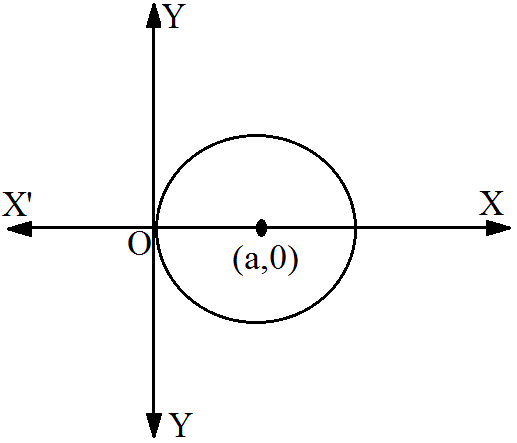
Form the differential equation of the family of circles touching the y-axis at origin.
Answer
The centre of the circle touching the y-axis at origin lies on the x-axis.

Let (a, 0) be the centre of the circle.

Since it touches the y-axis at origin, its radius is a.

Now, the equation of the circle with centre (a, 0) and radius (a) is

$(\text{x}-\text{a})^2 + \text{y}^2=\text{a}^2.$

$\Rightarrow \text{x}^2+\text{y}^2=2\text{ax} \ ....(1)$

Differentiating equation (1) with respect to x, get:

$2\text{x} + 2\text{yy}'=2\text{a}$

$\Rightarrow \text{x}+\text{yy}' = \text{a}$

Now, on substituting the value of a in equation (1), we get:

$\text{x}^2+\text{y}^2 = 2 (\text{x+yy}')\text{x}$

$\Rightarrow \text{x}^2+\text{y}^2=2\text{x}^2+2\text{xyy}'$

$\Rightarrow 2\text{xyy}' + \text{x}^2=\text{y}^2$

This is the required differential equation.

View full question & answer
Question 1384 Marks
Solve the following differential equation
$(\text{x}^2+1)\frac{\text{dy}}{\text{dx}}=1$
Answer
We have,
$(\text{x}^2+1)\frac{\text{dy}}{\text{dx}}=1$
$\Rightarrow\text{dy}=\frac{1}{\text{x}^2+1}$
Intergrating both sides, we get
$\Rightarrow\int\text{dy}=\int\Big(\frac{1}{\text{x}^2+1}\Big)\text{dx}$
$\Rightarrow\text{y}=\tan^{-1}\text{x}+\text{C}$
so, $\Rightarrow\text{y}=\tan^{-1}\text{x}+\text{C}$ is defined for all $\text{x}\in\text{R}$ except x = 0
Hence,  $\Rightarrow\text{y}=\tan^{-1}\text{x}+\text{C}$, where $\text{x}\in\text{R}-\{0\},$ is the solution o the given differential equation.
View full question & answer
Question 1394 Marks
The rate of growth of a population is proportional to the number present. If the population of a city doubled in the past 25 year, and the present population is 100000, when will the city have a population of 500000?
Answer
Let the origional population be N and the population at any time t be P.
Given: $\frac{\text{dP}}{\text{dt}}\propto\text{P}$
$\Rightarrow\frac{\text{dP}}{\text{dt}}=\text{aP}$
$\Rightarrow\frac{\text{dP}}{\text{P}}=\text{a}\text{dt}$
$\Rightarrow\log|\text{P}|=\text{at}+\text{C}\ ...(\text{i})$
Now,
$\text{P}=\text{N}$ at $\text{t}=0$
Putting $\text{P}=\text{N}$ at $\text{t}=0$ in (i), we get
$\log|\text{N}|=\text{C}$
Putting $\text{C}=\log|\text{N}|$ in (i), we get
$\log|\text{P}|=\text{at}+\log|\text{N}|$
$\Rightarrow \text{log}|\frac{\text{P}}{\text{N}}|=\text{at}\ ...(\text{ii})$
According to the question, 
$\log|\frac{2\text{N}}{\text{N}}|=25\text{a}$
$\Rightarrow\ \text{a}=\frac{1}{25}\log|2|$
$=\frac{1}{25}\times0.6931=0.0277$
Putting $\text{a}=0.0277$ in (ii), we get
$\log|\frac{\text{P}}{\text{N}}|=0.0277 \text{t}\ ...(\text{iii})$
For $\text{P}=500000$ and  $\text{N}=100000$
$\log|\frac{500000}{100000}|=0.0277 \text{t}$
$\Rightarrow \text{t}=\frac{\log\ 5}{0.0277}=\frac{1.609}{0.0277}$
$=58.08\ \text{year}$
View full question & answer
Question 1404 Marks
Solve the following differential equation:
$(\text{x}-\text{y})\frac{\text{dy}}{\text{dx}}=\text{x + 2y}$
Answer
Here, $(\text{x}-\text{y})\frac{\text{dy}}{\text{dx}}=\text{x + 2y}$
$\Rightarrow\ \frac{\text{dy}}{\text{dx}}=\frac{\text{x}+2\text{y}}{\text{x}-\text{y}}$
It is a homogeneous equation.
Put x = vy
and $\frac{\text{dy}}{\text{dx}}=\text{v + x}\frac{\text{dv}}{\text{dx}}$
So,
$\text{v + x}\frac{\text{dv}}{\text{dx}}=\frac{\text{x}+2\text{vx}}{\text{x}-\text{vx}}$
$\text{x}\frac{\text{dv}}{\text{dx}}=\frac{1+2\text{v}}{1+\text{v}}-\text{v}$
$\text{x}\frac{\text{dv}}{\text{dx}}=\frac{1+2\text{v}-\text{v + v}^2}{1-\text{v}}$
$\text{x}\frac{\text{dv}}{\text{dx}}=\frac{1+\text{v + v}^2}{1-\text{v}}$
$\frac{1-\text{v}}{\text{v}^2+\text{v}+1}\text{dv}=\frac{\text{dx}}{\text{x}}$
$-\frac{\text{v}-1}{\text{v}^2+\text{v}+1}\text{dv}=\frac{\text{dx}}{\text{x}}$
$\frac{1}2\times\frac{2\text{v}-2}{\text{v}^2+\text{v}+1}\text{dv}=\frac{-\text{dx}}{\text{x}}$
$\int\frac{(2\text{v}+1)-3}{\text{v}^2+\text{v}+1}\text{dv}=-\int\frac{2\text{dx}}{\text{x}}$
$\int\frac{2\text{v}+1}{\text{v}^2+\text{v}+1}\text{dv}-\int\frac{3}{\text{v}^2+2\text{v}\big(\frac{1}2\big)+\big(\frac{1}2\big)^2-\big(\frac{1}2\big)^2+1}=-2\int\frac{\text{dx}}{\text{x}}$
$\int\frac{2\text{v}+1}{\text{v}^2+\text{v}+1}\text{dv}-\int\frac{3}{\big(\text{v}+\frac{1}2\big)^2+\big(\frac{\sqrt3}2\big)^2}\text{dv}=-2\int\frac{\text{dx}}{\text{x}}$
$\log|\text{v}^2+\text{v}+1|-3\Big(\frac{2}{\sqrt3}\Big)\tan^{-1}\Bigg(\frac{\text{v}+\frac{1}2}{\frac{\sqrt3}{2}}\Bigg)=-2\log|\text{x}|+\text{C}$
$\log|\text{y}^2+\text{xy}+\text{x}^2|=2\sqrt3\tan^{-1}\Big(\frac{2\text{y + x}}{\text{x}\sqrt3}\Big)+\text{C}$
View full question & answer
Question 1414 Marks
Find the solution of $\frac{\text{dy}}{\text{dx}}=2^\text{y-x}.$
Answer
Given that, $\frac{\text{dy}}{\text{dx}}=2^\text{y-x}$
$\Big[\because\text{a}^\text{m-n}=\frac{\text{a}^\text{m}}{\text{a}^\text{n}}\Big]$
$\Rightarrow\frac{\text{dy}}{\text{dx}}=\frac{2^\text{y}}{2^\text{x}}$
$\Rightarrow\frac{\text{dy}}{2^\text{y}}=\frac{\text{dx}}{2^\text{x}}$
On integrating both sides, we get
$\int2^\text{-y}\text{dy}=\int2^\text{x}\text{dx}$
$\Rightarrow\frac{-2^\text{-y}}{\log2}=\frac{-2^\text{-x}}{\log2}+\text{C}$
$\Rightarrow-2^\text{-y}+2^\text{-x}=+\text{C}\log2$
$\Rightarrow-2^\text{-x}+2^\text{-x}=+\text{C}\log2$
$\Rightarrow2^\text{-x}-2^\text{-y}=-\text{C}\log2$
$\Rightarrow2^\text{-x}-2^\text{-y}=\text{K}$ $[\text{where}, \text{K} = +\text{C}\log2]$
View full question & answer
Question 1424 Marks
Solve the following initial value problems:
$(\text{x}^2+\text{y}^2)\text{dx}=2\text{xy dy, y}(1)=0$
Answer
$(\text{x}^2+\text{y}^2)\text{dx}=2\text{xy dy, y}(1)=0$

$\frac{\text{dy}}{\text{dx}}=\frac{\text{x}^2+\text{y}^2}{2\text{xy}}$

It is a homogeneous equation.

Put y = vx
and $\frac{\text{dy}}{\text{dx}}=\text{v + x}\frac{\text{dv}}{\text{dx}},$

So,

$\text{v + x}\frac{\text{dv}}{\text{dx}}=\frac{\text{x}^2+\text{v}^2\text{x}^2}{2\text{xvx}}$

$\text{x}\frac{\text{dv}}{\text{dx}}=\frac{1+\text{v}^2}{2\text{v}}-\text{v}$

$\text{x}\frac{\text{dv}}{\text{dx}}=\frac{1+\text{v}^2-2\text{v}^2}{2\text{v}}$

$\text{x}\frac{\text{dv}}{\text{dx}}=\frac{1-\text{v}^2}{2\text{v}}$

$\int\frac{2\text{v}}{1-\text{v}^2}=\int\frac{\text{dx}}{\text{x}}$

$\log|1-\text{v}^2|=-\log|\text{x}|+\log|\text{C}|$

$\log|1-\text{v}^2|=\log\Big|\frac{\text{C}}{\text{x}}\Big|$

$\Big|\frac{\text{x}^2-\text{y}^2}{\text{x}^2}\Big|=\Big|\frac{\text{C}}{\text{x}}\Big|$

$|\text{x}^2-\text{y}^2|=|\text{Cx}|\ \dots(\text{i})$

Put y = 0, x = 1

1 - 0 = C

C = 1

Put the value of C in equation (i),

$|\text{x}^2-\text{y}^2|=|\text{x}|$

$(\text{x}^2-\text{y}^2)^2=\text{x}^2$

View full question & answer
Question 1434 Marks
Solve the following differential equation
$(\text{x}-1)\frac{\text{dy}}{\text{dx}}=2\text{xy}$
Answer
We have
$(\text{x}-1)\frac{\text{dy}}{\text{dx}}=2\text{xy}$
$\Rightarrow(\text{x}-1)\text{dy}=2\text{xy dx}$
$\Rightarrow\frac{2\text{x}}{(\text{x}-1)}\ \text{dx}=\frac{1}{\text{y}}\text{ dy}$
Integrating both sides, we get
$2\int\frac{\text{x}}{(\text{x}-1)}\ \text{dx}=\int\frac{1}{\text{y}}\ \text{dy}$
$\Rightarrow2\int\frac{\text{x}-1+1}{\text{x}-1}\ \text{dx}=\int\frac{1}{\text{y}}\ \text{dx}$
$\Rightarrow2\int\text{dx}+2\int\frac{1}{\text{x}-1}\text{dx}=\int\frac{1}{\text{y}}\ \text{dy}$
$\Rightarrow2\text{x}+2\log|\text{x}-1|=\log|\text{y}|+\text{C}$
View full question & answer
Question 1444 Marks
For each of the differential equations given in find the general solution:
$\frac{\text{dy}}{\text{dx}}+2\text{y}=\sin\text{x}$
Answer
The given differential equation is $\frac{\text{dy}}{\text{dx}}+2\text{y}=\sin\text{x}.$

This is in the form of $\frac{\text{dy}}{\text{dx}}+\text{py}=\text{Q}$ (where p = 2 and Q = sin x).

$\text{Now, I.F}=\text{e}^{\int\text{pdx}}=\text{e}^{\int2\text{dx}}=\text{e}^{2\text{x}}.$

The solution of the given differential equation is given by the relation,

$\text{y}(\text{I.F})=\int(\text{Q}\times\text{I.F})\text{dx}+\text{C}$

$\Rightarrow\ \text{ye}^{2\text{x}}=\int\sin\text{x}\cdot\text{e}^{2\text{x}}\text{dx}+\text{C}\ \ ....{(1)}$

$\text{Let}\ I=\int\sin\text{x}\cdot\text{e}^{2\text{x}}.$

$\Rightarrow\ I=\sin\text{x}\cdot\int\text{e}^{2\text{x}}\text{dx}-\int\bigg(\frac{\text{d}}{\text{dx}}(\sin\text{x})\cdot\int\text{e}^{2\text{x}}\text{dx}\bigg)\text{dx}$

$\Rightarrow\ I=\sin\text{x}\cdot\frac{\text{e}^{2\text{x}}}{2}-\int\bigg(\cos\text{x}\cdot\frac{\text{e}^{2\text{x}}}{2}\bigg)\text{dx}$

$\Rightarrow\ I=\frac{\text{e}^{2\text{x}}\sin\text{x}}{2}-\frac{1}{2}\bigg[\cos\text{x}\cdot\int\text{e}^{2\text{x}}-\int\bigg(\frac{\text{d}}{\text{dx}}(\cos\text{x})\cdot\int\text{e}^{2\text{x}}\text{dx}\bigg)\text{dx}\bigg]$

$\Rightarrow\ I=\frac{\text{e}^{2\text{x}}\sin\text{x}}{2}-\frac{1}{2}\bigg[\cos\text{x}\cdot\frac{\text{e}^{2\text{x}}}{2}-\int\bigg[(-\sin\text{x})\cdot\frac{\text{e}^{2\text{x}}}{2}\bigg]\text{dx}\bigg]$

$\Rightarrow\ I=\frac{\text{e}^{2\text{x}}\sin\text{x}}{2}-\frac{\text{e}^{2\text{x}}\cos\text{x}}{4}-\frac{1}{4}\int\big(\sin\text{x}.\text{e}^{2\text{x}}\big)\text{dx}$

$\Rightarrow\ I=\frac{\text{e}^{2\text{x}}}{4}(2\sin\text{x}-\cos\text{x})-\frac{1}{4}I$

$\Rightarrow\ \frac{5}{4}I=\frac{\text{e}^{2\text{x}}}{4}(2\sin\text{x}-\cos\text{x})$

$\Rightarrow\ I=\frac{\text{e}^{2\text{x}}}{5}(2\sin\text{x}-\cos\text{x})$

Therefore, equation (1) becomes:

$\text{y}^{2\text{x}}=\frac{\text{e}^{2\text{x}}}{5}(2\sin\text{x}-\cos\text{x})+\text{C}$

$\Rightarrow\ \text{y}=\frac{1}{5}(2\sin\text{x}-\cos\text{x})+\text{C}\text{e}^{-2\text{x}}$

This is the required general solution of the given differential equation.

View full question & answer
Question 1454 Marks
In each of the form a differential equation representing the given family of curves by eliminating arbitrary constants a and b.
y = ae3x + be–2x
Answer
y = ae3x + be–2x ....(1)
Differentiating both sides with respect to x, we get:
y'= 3ae3x - 2be-2x ....(2)
Again, differentiating both sides with respect to x, we get:
y'' = 9ae3x + 4be-2x ............(3)
Multiplying equation (1) with (2) and then adding it to equation (2), we get:
(2ae3x + 2be-2x) + (3ae3x - 2bc-2x) = 2y + y'
$\Rightarrow 5\text{ae}^{3\text{x}} = 2\text{y} + \text{y}'$
$\Rightarrow \text{ae}^{3\text{x}} = \frac{2\text{y}+\text{y}'}{5}$
Now, multiplying equation (1) with 3 and subtracting equation (2) from it, we get:
(3ae3x + 3be-2x) - (3ae3x - 2be-2x) = 3y - y'
$\Rightarrow 5\text{be}^{-2\text{x}}= 3\text{y}-\text{y}'$
$\Rightarrow \text{be}^{-2\text{x}} = \frac{3\text{y}-\text{y}'}{5}$
Substituting the values of ae3x and be-2x in equation (3), we get:
$\text{y}''=9\cdot\frac{(2\text{y+y}')}{5}+4\frac{(3\text{y-y}')}{5}$
$\Rightarrow \text{y}''= \frac{18\text{y}+9\text{y}'}{5}+\frac{12\text{y}-4\text{y}'}{5}$
$\Rightarrow{\text{y}''}=\frac{30\text{y}+5\text{y}}{5}'$
$\Rightarrow \text{y}'' = 6\text{y}+\text{y}'$
$\Rightarrow \text{y}'' -\text{y}'-6\text{y}=0$
This is the required differential equation of the given curve.
View full question & answer
Question 1464 Marks
Solve the following initial value problems:
$\frac{\text{dy}}{\text{dx}}+2\text{y}=\text{e}^{-2\text{x}}\sin\text{x},\text{ y}(0)=0$
Answer
We have,
$\frac{\text{dy}}{\text{dx}}+2\text{y}=\text{e}^{-2\text{x}}\sin\text{x}\ ...(\text{i})$
Clearly, it is a linear differential equation of the form
$\frac{\text{dy}}{\text{dx}}+\text{Py}=\text{Q}$
Where $\text{P}=2$ and $\text{Q}=\text{e}^{-2\text{x}}\sin\text{x}$
$\therefore\text{ I.F.}=\text{e}^{\int\text{Pdx}}$
$=\text{e}^{\int2\text{dx}}$
$=\text{e}^{2\text{x}}$
Multiplying both sides of (1) by $\text{I.F.}=\text{e}^{2\text{x}},$ we get
$\text{e}^{2\text{x}}\Big(\frac{\text{dy}}{\text{dx}}+2\text{y}\Big)=\text{e}^{2\text{x}}\text{e}^-{2\text{x}}\sin\text{x}$
$\Rightarrow\text{e}^{2\text{x}}\Big(\frac{\text{dy}}{\text{dx}}+2\text{y}\Big)=\sin\text{x}$
Integrating both sides with respect to x, we get
$\text{y}\text{e}^{2\text{x}}=\int\sin\text{x dx}+\text{C}$
$\Rightarrow\text{y}\text{e}^{2\text{x}}=-\cos\text{x}+\text{C}\ ....(\text{ii})$
Now,
$\text{y}(0)=0$
$\therefore\ 0\times\text{e}^0=-\cos0+\text{C}$
$\Rightarrow\text{C}=1$
Putting the value of C in (2), we get
$\text{y}\text{e}^{2\text{x}}=-\cos\text{x}+1$
$\Rightarrow\text{y}\text{e}^{2\text{x}}=1-\cos\text{x}$
Hence, $\text{y}\text{e}^{2\text{x}}=1-\cos\text{x}$ is the required solution.
View full question & answer
Question 1474 Marks
The slope of a curve at each of its points is equal to the square of the abscissa of the point. Find the particular curve through the point (−1, 1).
Answer
Given, 
Slope of tangent at (x, y) = x2
$\frac{\text{dy}}{\text{dx}}=\text{x}^{2}$
$\text{dy}=\text{x}^{2}\text{dx}$
$\int \text{dy}=\int\text{x}^{2}\text{dx}$
$\text{y}=\frac{\text{x}^{3}}{3}+\text{C}\ ...(\text{i})$
It is passing through (-1, 1)
$1=\frac{(-1)}{3}+\text{C}$
$1=-\frac{1}{3}+\text{C}$
$\text{C}=\frac{4}{3}$
Put is equation,
$\text{y}=\frac{\text{x}^{3}}{3}+\frac{4}{3}$
$3\text{y}=\text{x}^{3}+{4}$
View full question & answer
Question 1484 Marks
Solve the following differential equations:
$\frac{\text{dy}}{\text{dx}}=1+\text{x}+\text{y}^2+\text{xy}^2$ when $\text{y}=0,\text{x}=0$
Answer
$\frac{\text{dy}}{\text{dx}}=1+\text{x}+\text{y}^2+\text{xy}^2$
$\frac{\text{dy}}{\text{dx}}=(1+\text{x})(1+\text{y}^2)$
$\frac{1}{(1+\text{y}^2)}\text{dy}=(1+\text{x})\text{dx}$
Integrating on both the sides we get
$\int\frac{1}{(1+\text{y}^2)}\text{dy}=\int(1+\text{x})\text{dx}$
$\tan^{-1}\text{y = x}+\frac{\text{x}^2}{2}+\text{C}...(1)$
Put $\text{y}=0,\text{x}=0$ then
$\tan^{-1}0=0+0+\text{C}$
$\text{C}=0$
From (1) we have
$\tan^{-1}\text{y = x}+\frac{\text{x}^2}{2}$
$\text{y}=\tan\Big(\text{x}+\frac{\text{x}^2}{2}\Big)$
View full question & answer
Question 1494 Marks
Write the minors and cofactors of element of the first column of the following matrices and hence evaluate the determinant in case:
$\text{A}=\begin{vmatrix}0&2&6\\1&5&0\\3&7&1 \end{vmatrix}$
Answer
Let Mij and Cij are respectively the minor and co-factor of the element aij.
Now,
$\text{M}_{11}=\begin{vmatrix}5&0\\7&1 \end{vmatrix}=5-0=5$
$\text{M}_{21}=\begin{vmatrix}2&6\\7&1 \end{vmatrix}=2-42=-40$
$\text{M}_{31}=\begin{vmatrix}2&6\\5&0 \end{vmatrix}=0-30=-30$
$\text{C}_{11}=(-1)^{1+1}\text{M}_{11}=5$
$\text{C}_{21}=(-1)^{2+1}\text{M}_{21}=(-1)(-40)=40$
$\text{C}_{31}=(-1)^{3+1}\text{M}_{31}=(-30)=-30$
Now, expanding the determinant along the first column.
$|\text{A}|=\text{a}_{11}\text{C}_{11}+\text{a}_{21}\text{C}_{21}+\text{a}_{31}\text{C}_{31}$
$=0\times5+1\times(40)+3\times(-30)$
$=40-90$
$=-50$
View full question & answer
Question 1504 Marks
In each of the form a differential equation representing the given family of curves by eliminating arbitrary constants a and b.
y = ex (acos x + bsin x)
Answer
y = ex (acos x + bsin x) ....(1)
Differentiating both sides with respect to x, we get:
$\text{y}'=\text{e}^\text{x}(\text{acos x + bsin x)} + \text{e}^\text{x}(-\text{asin x + bcos x})$
$\Rightarrow \text{y}'=\text{e}^\text{x} \big[(\text{a+b)cos x} -(\text{a}-\text{b) sin x} \big] \ ...(2)$
Again, differentiating with respect to x, we get:
$\text{y}''=\text{e}^\text{x}\big[(\text{a + b)cos x} - (\text{a}-\text{b})\text{sin x} \big] + \text{e}^\text{x} \big[-(\text{a+b)sin x} - (\text{a}-\text{b) cos x}\big]$
$\text{y}''=\text{e}^\text{x} [2\text{bcos x - 2asin x]}$
$\text{y}''=2\text{e}^\text{x} (\text{bcos x} - \text{asin x)}$
$\Rightarrow \frac{\text{y}''}{2}=\text{e}^\text{x} (\text{bcos x} - \text{asin x)} \ ....(3)$
Adding equations (1) and (3), we get:
$\text{y}+\frac{\text{y}''}{2}=\text{e}^\text{x}\big[(\text{a+b)cos x} -(\text{a}-\text{b)sin x} \big]$
$\Rightarrow \text{y}+ \frac{\text{y}''}{2}=\text{y}'$
$\Rightarrow 2\text{y}+\text{y}''=2\text{y}'$
$\Rightarrow \text{y}'' - 2\text{y}'+2\text{y}=0$
This is the required differential equation of the given curve.
View full question & answer