Questions · Page 2 of 5

4 Marks

Question 514 Marks
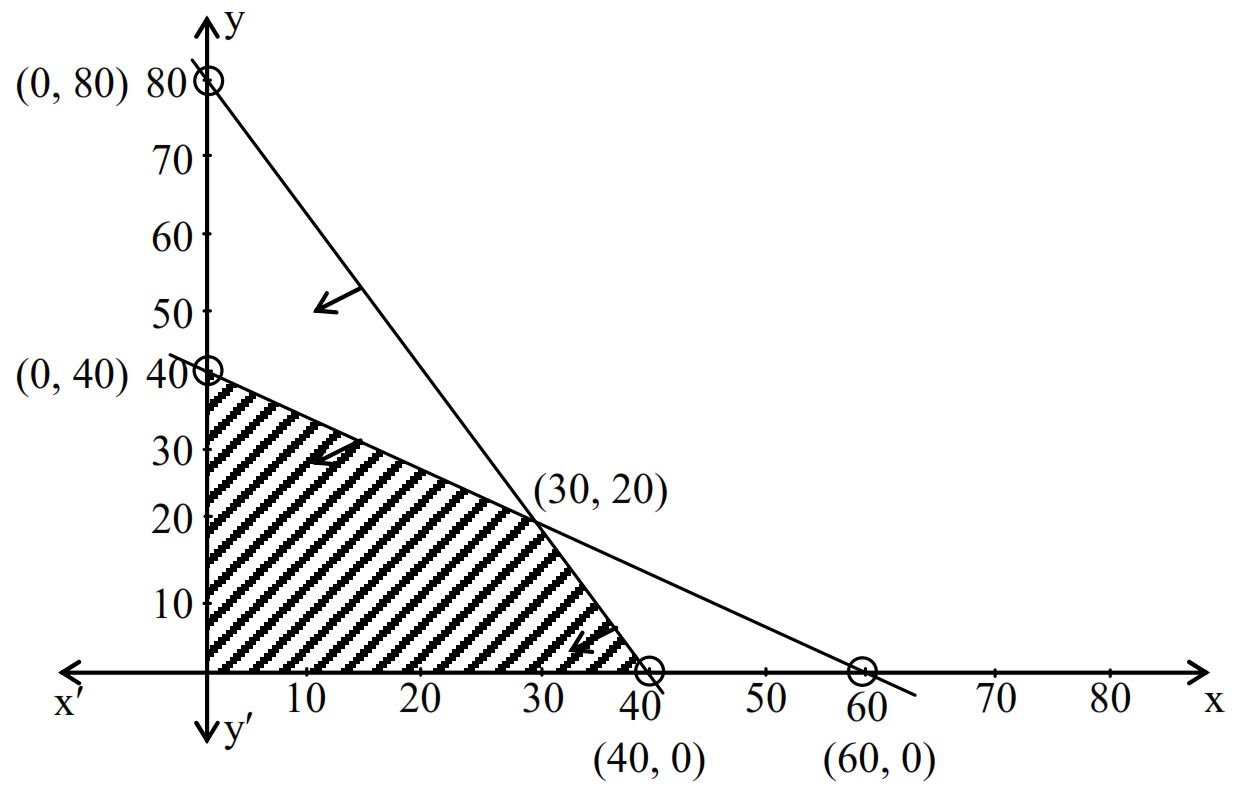
A factory manufactures two types of screws A and B, each type requiring the use of two machines, an automatic and a hand-operated. It takes 4 minutes on the automatic and 6 minutes on the hand-operated machines to manufacture a packet of screws ‘A’ while it takes 6 minutes on the automatic and 3 minutes on the hand-operated machine to manufacture a packet of screws ‘B’. Each machine is available for at most 4 hours on any day. The manufacturer can sell a packet of screws ‘A’ at a profit of 70 paise and screws ‘B’ at a profit of Rs. 1. Assuming that he can sell all the screws he manufactures, how many packets of each type should the factory owner produce in a day in order to maximize his profit? Formulate the above LPP and solve it graphically and find the maximum profit.
Answer
Let the number of package of screw A = x

Number of packages of screw B = y

Item
Number
Machine A
Machine B
Profit
Screw A
x
4 minutes
6 minutes
To paise = 7 Rs
Screw B
y
6 minutes
3 minutes
Rs. 1
Max time
Available
 
4 hours
= 240 min
4 hours
= 240 minutes


Automated Machine

Works for screw A → 4 min

Works on screw B → 6 min

$\therefore4\text{x}+6\text{y}\leq240$

$2\text{x}+3\text{y}\leq120$

$\text{x},\text{y}\geq0$

Hand operated machine

Works on screw A → 6 min

Works on screw B → 3 min

$\therefore6\text{x}+3\text{y}\leq240$

$2\text{x}+\text{y}\leq80$

$\text{x},\text{y}\geq0$

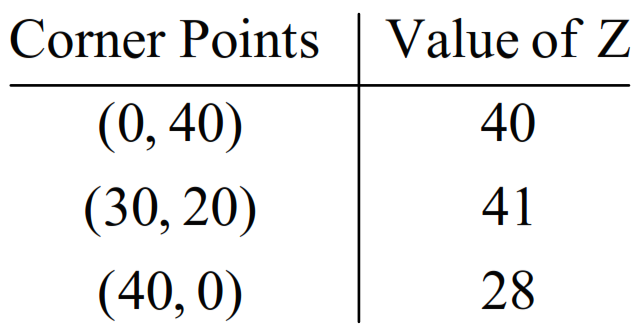
Now max Z = 0.7 x + y

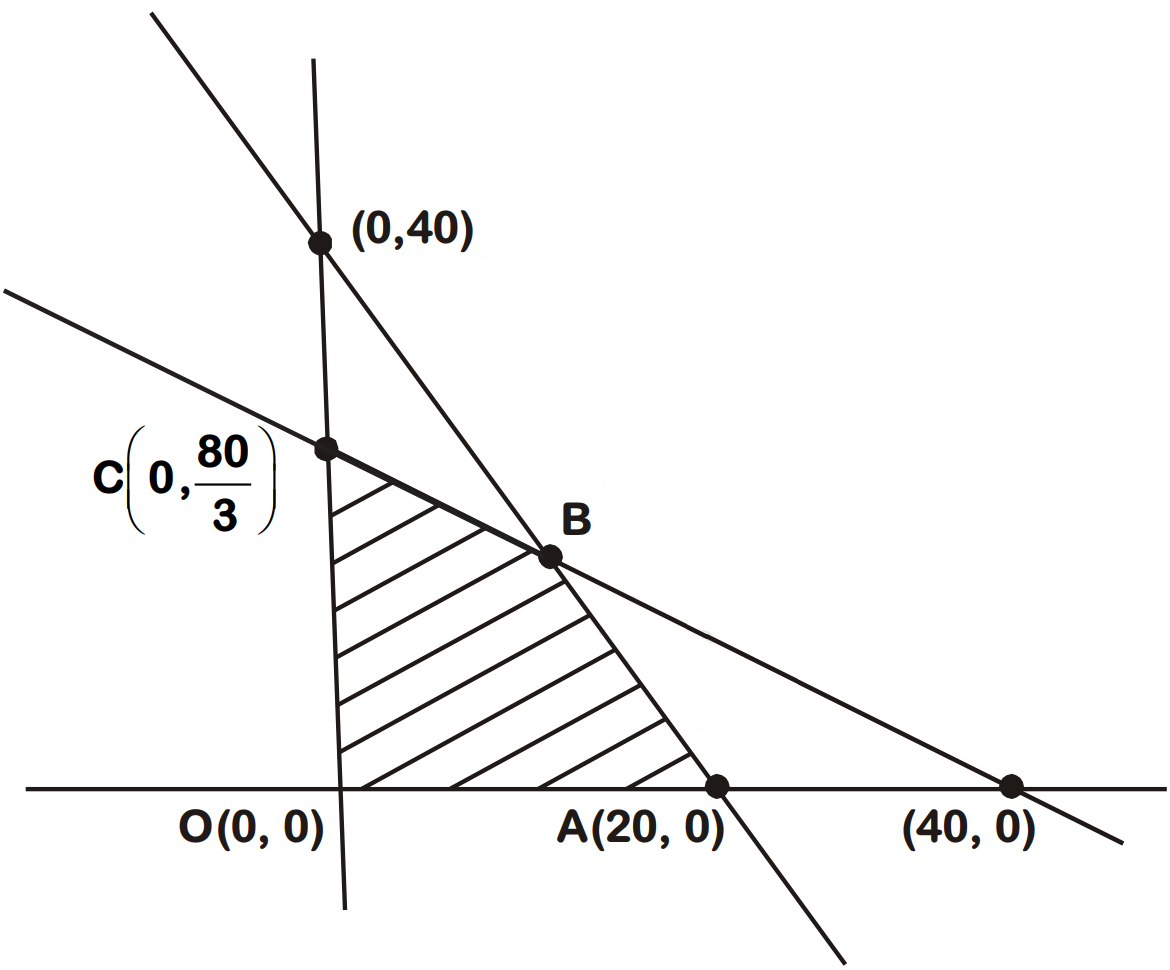
$2\text{x}+3\text{y}\leq120$

$2\text{x}+\text{y}\leq80$

$\text{x},\text{y}\geq0$

$2\text{x}+3\text{y}\leq120$

$\begin{array}{c|c} \text{x}&0 & 60 \\ \hline \text{y}&40 & 0 \end{array}$

$2\text{x}+\text{y}\leq80$

$\begin{array}{c|c} \text{x}&0 & 40 \\ \hline \text{y}&80 & 0 \end{array}$
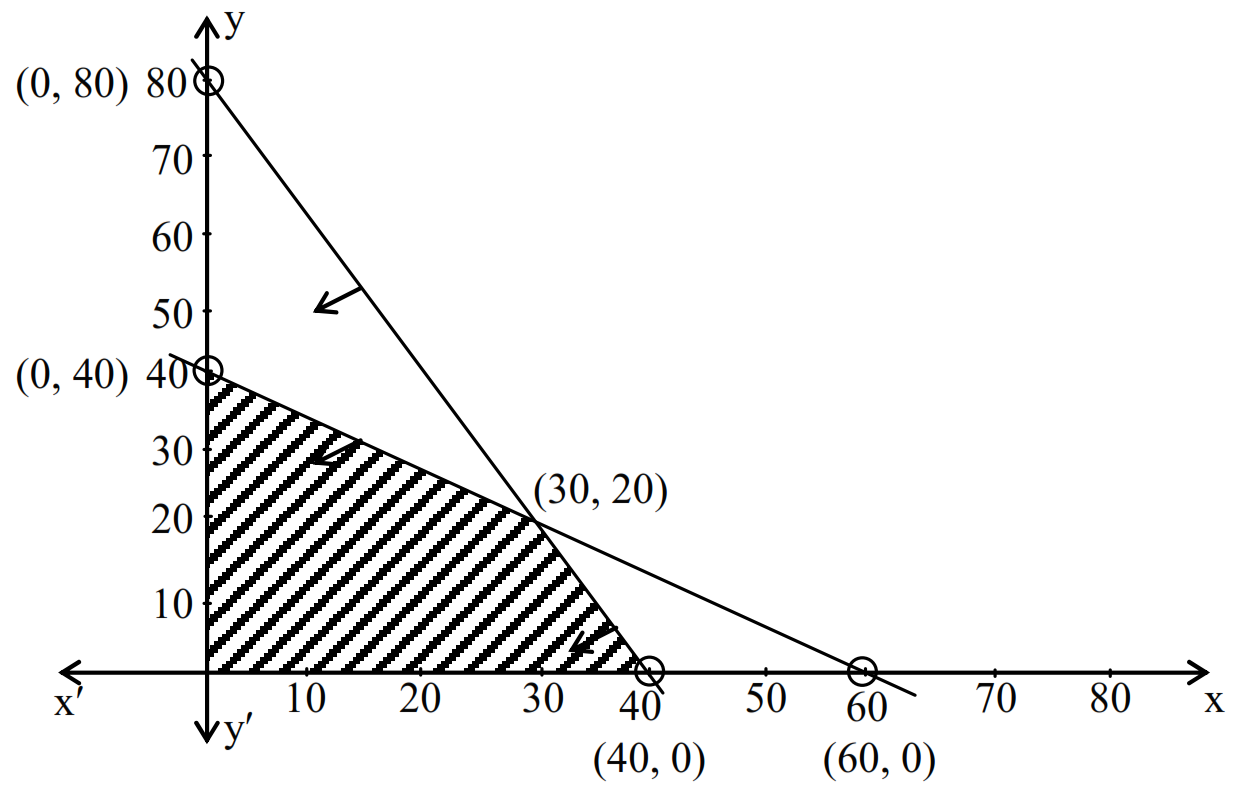
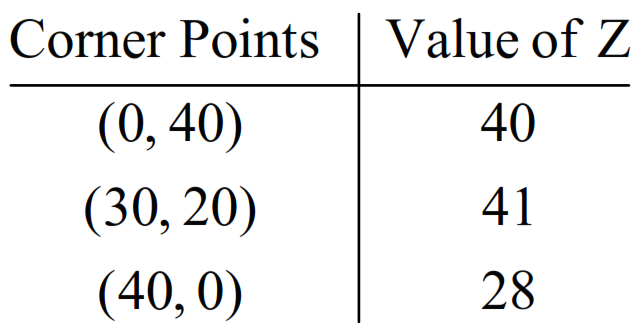
Hence, profit will be maximum, if the company produces,

30 packages of screw A

20 packages of screw B

Maximum Profit = Rs. 41.

View full question & answer
Question 524 Marks
A factory manufactures two types of screws A and B, each type requiring the use of two machines, an automatic and a hand-operated. It takes 4 minutes on the automatic and 6 minutes on the hand-operated machines to manufacture a packet of screws ‘A’ while it takes 6 minutes on the automatic and 3 minutes on the hand-operated machine to manufacture a packet of screws ‘B’. Each machine is available for at most 4 hours on any day. The manufacturer can sell a packet of screws ‘A’ at a profit of 70 paise and screws ‘B’ at a profit of Rs. 1. Assuming that he can sell all the screws he manufactures, how many packets of each type should the factory owner produce in a day in order to maximize his profit? Formulate the above LPP and solve it graphically and find the maximum profit.
Answer
Let the number of package of screw A = x

Number of packages of screw B = y

Item
Number
Machine A
Machine B
Profit
Screw A
x
4 minutes
6 minutes
To paise = 7 Rs
Screw B
y
6 minutes
3 minutes
Rs. 1
Max time
Available
 
4 hours
= 240 min
4 hours
= 240 minutes


Automated Machine

Works for screw A → 4 min

Works on screw B → 6 min

$\therefore4\text{x}+6\text{y}\leq240$

$2\text{x}+3\text{y}\leq120$

$\text{x},\text{y}\geq0$

Hand operated machine

Works on screw A → 6 min

Works on screw B → 3 min

$\therefore6\text{x}+3\text{y}\leq240$

$2\text{x}+\text{y}\leq80$

$\text{x},\text{y}\geq0$

Now max Z = 0.7 x + y

$2\text{x}+3\text{y}\leq120$

$2\text{x}+\text{y}\leq80$

$\text{x},\text{y}\geq0$

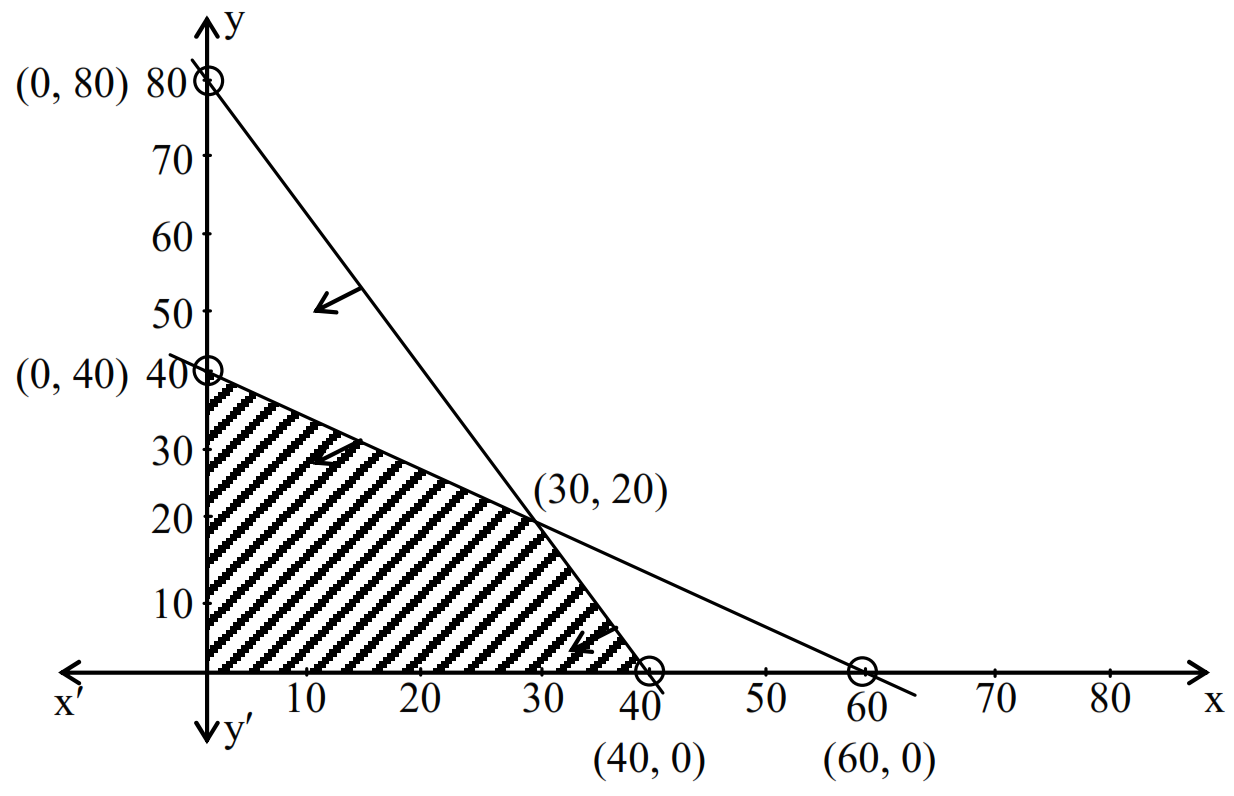
$2\text{x}+3\text{y}\leq120$

$\begin{array}{c|c} \text{x}&0 & 60 \\ \hline \text{y}&40 & 0 \end{array}$

$2\text{x}+\text{y}\leq80$

$\begin{array}{c|c} \text{x}&0 & 40 \\ \hline \text{y}&80 & 0 \end{array}$
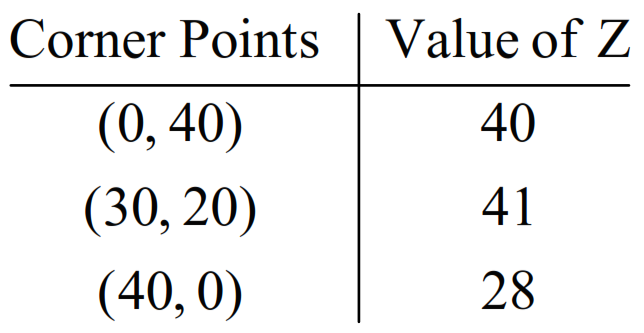
Hence, profit will be maximum, if the company produces,

30 packages of screw A

20 packages of screw B

Maximum Profit = Rs. 41.
View full question & answer
Question 534 Marks
A factory manufactures two types of screws A and B, each type requiring the use of two machines, an automatic and a hand-operated. It takes 4 minutes on the automatic and 6 minutes on the hand-operated machines to manufacture a packet of screws ‘A’ while it takes 6 minutes on the automatic and 3 minutes on the hand-operated machine to manufacture a packet of screws ‘B’. Each machine is available for at most 4 hours on any day. The manufacturer can sell a packet of screws ‘A’ at a profit of 70 paise and screws ‘B’ at a profit of Rs. 1. Assuming that he can sell all the screws he manufactures, how many packets of each type should the factory owner produce in a day in order to maximize his profit? Formulate the above LPP and solve it graphically and find the maximum profit.
Answer
Let the number of package of screw A = x

Number of packages of screw B = y

Item
Number
Machine A
Machine B
Profit
Screw A
x
4 minutes
6 minutes
To paise = 7 Rs
Screw B
y
6 minutes
3 minutes
Rs. 1
Max time
Available
 
4 hours
= 240 min
4 hours
= 240 minutes


Automated Machine

Works for screw A → 4 min

Works on screw B → 6 min

$\therefore4\text{x}+6\text{y}\leq240$

$2\text{x}+3\text{y}\leq120$

$\text{x},\text{y}\geq0$

Hand operated machine

Works on screw A → 6 min

Works on screw B → 3 min

$\therefore6\text{x}+3\text{y}\leq240$

$2\text{x}+\text{y}\leq80$

$\text{x},\text{y}\geq0$

Now max Z = 0.7 x + y

$2\text{x}+3\text{y}\leq120$

$2\text{x}+\text{y}\leq80$

$\text{x},\text{y}\geq0$

$2\text{x}+3\text{y}\leq120$

$\begin{array}{c|c} \text{x}&0 & 60 \\ \hline \text{y}&40 & 0 \end{array}$

$2\text{x}+\text{y}\leq80$

$\begin{array}{c|c} \text{x}&0 & 40 \\ \hline \text{y}&80 & 0 \end{array}$

Hence, profit will be maximum, if the company produces,

30 packages of screw A

20 packages of screw B

Maximum Profit = Rs. 41.
View full question & answer
Question 544 Marks
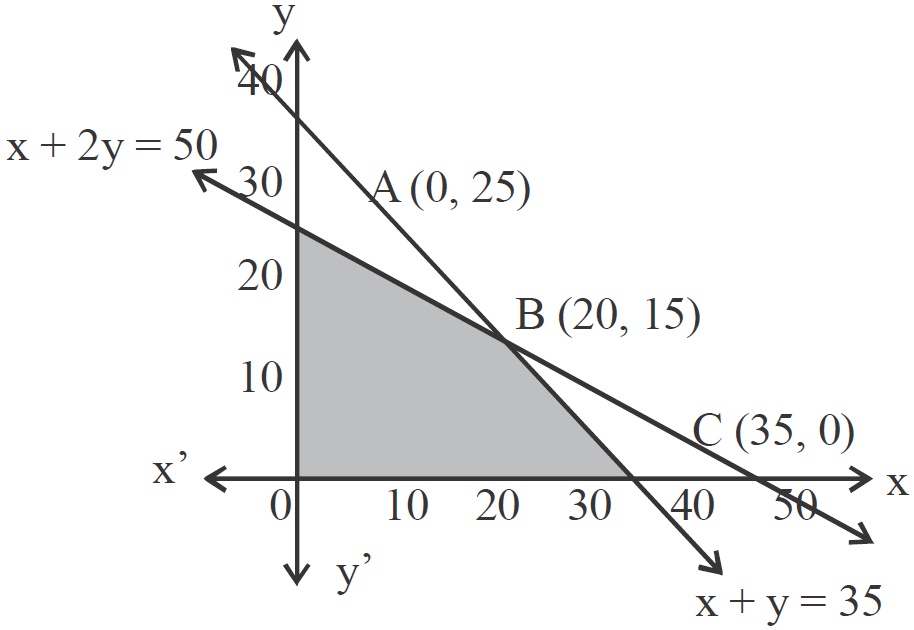
A furniture trader deals in only two items – chairs and tables. He has ₹ 50,000 to invest and a space to store at most 35 items. A chair costs him ₹ 1000 and a table costs him ₹ 2000 The trader earns a profit of ₹ 150 and ₹ 250 on a chair and table, respectively. Formulate the above problem as an LPP to maximise the profit and solve it graphically.
Answer
Let x and y be the number of chairs and tables. 
cost of x table = ₹ 2000 and cost of y chair = ₹ 1000 
Since the dealer is maximum invest ₹ 50,000 and the maximum number of items.
Also, the dealer want to sell a chair and table at the profit ₹ 150 and ₹ 250 respectively.
So, from the above explanation, we get following mathematical form as follows
2000x + 1000y ≤ 50,000
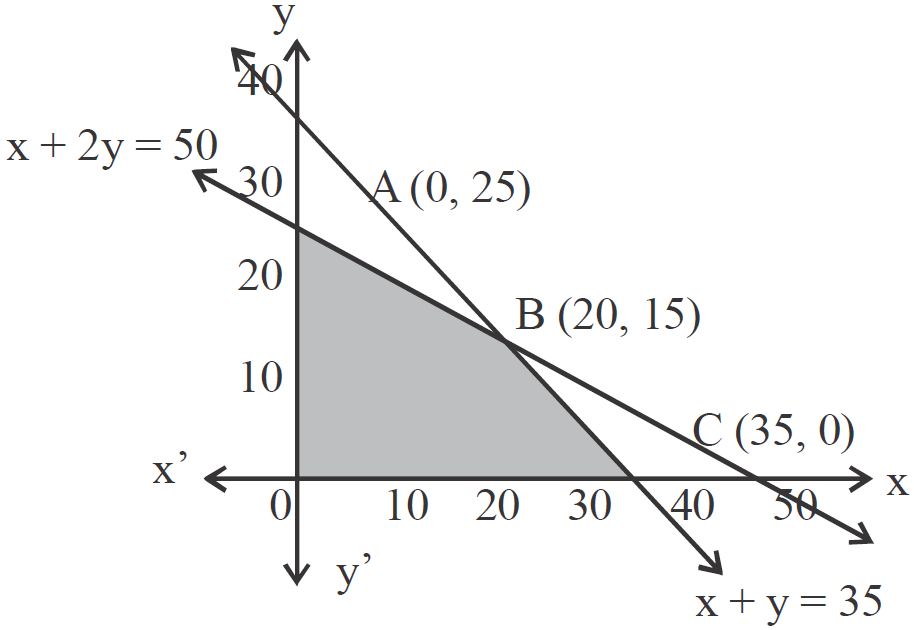
x + 2y ≤ 50
x + y ≤ 35, x ≥ 0, y ≥ 0
and objective function Z = 150x + 250y
Now, we have to maximize Z = 250x + 150y
Subject to constraints
x + 2y = 50
x + y = 35,
x = 0, y = 0

Corner Points Z = 150x + 250y
A(0, 25)
Z = 150 ₹ 0 + 250 ₹ 25
Z = 6250
B(20, 15)
Z = 150 ₹ 20 + 250 ₹ 15
Z = 3000 + 3750
Z = 6750
C(35, 0)
Z = 150 ₹ 35 + 250 ₹ 0
Z = 5250
Hence, the value of Z = 6750 is the maximum value
6750 = 150x + 250y
675 = 15x + 25y
135 = 3x + 5y ...(i)
35 = x + y ...(ii)
x = 35 - y
3(35 - y) + 5y = 135
105 - 3y +5y = 135
2y = 135 - 105
2y = 30
y = 15 Tables
x = 35 - 15
x = 20 Chairs.
View full question & answer
Question 554 Marks
A manufacturer has employed 5 skilled men and 10 semi-skilled men and makes two models A and B of an article. The making of one item of model A requires 2 hours work by a skilled man and 2 hours work by a semi-skilled man. One item of model B requires 1 hour by a skilled man and 3 hours by a semi-skilled man. No man is expected to work more than 8 hours per day. The manufacturer’s profit on an item of model A is Rs. 15 and on an item of model B is Rs. 10. How many of items of each model should be made per day in order to maximize daily profit? Formulate the above LPP and solve it graphically and find the maximum profit.
Answer
Let x articles of model A and y articles of model B be made.

Number of articles cannot be negative.

Therefore, $\text{x},\text{y}\leq0$

According to the question, the making of a model A requires 2 hrs. work by a skilled man and the model B requires 1 hrs. by a skilled man

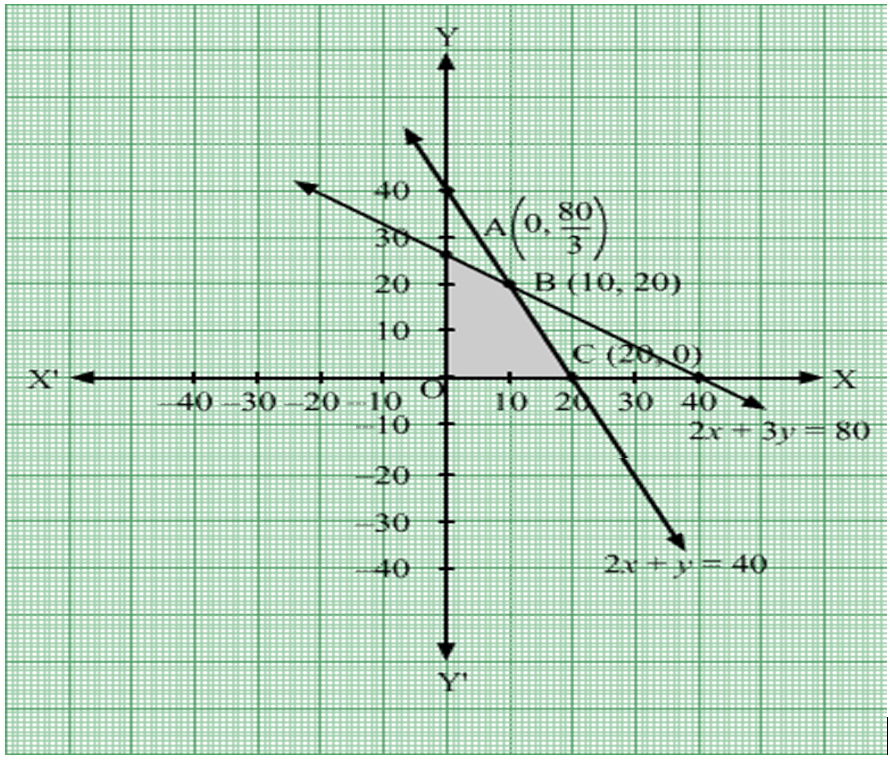
$2\text{x}+\text{y}\leq40$

The making of a model A requires 2 hrs. work by a semi-skilled man model B requires 3 hrs. work by a semi-skilled man.

$2\text{x}+3\text{y}\leq80$

Total profit = Z = 15x + 10y which is to be maximised

Thus, the mathematical formulat​ion of the given linear programmimg problem is

Max Z = 15x + 10y

Subject to

$2\text{x}+\text{y}\leq40$

$2\text{x}+3\text{y}\leq80$

$\text{x}\geq0$

$\text{y}\geq0$

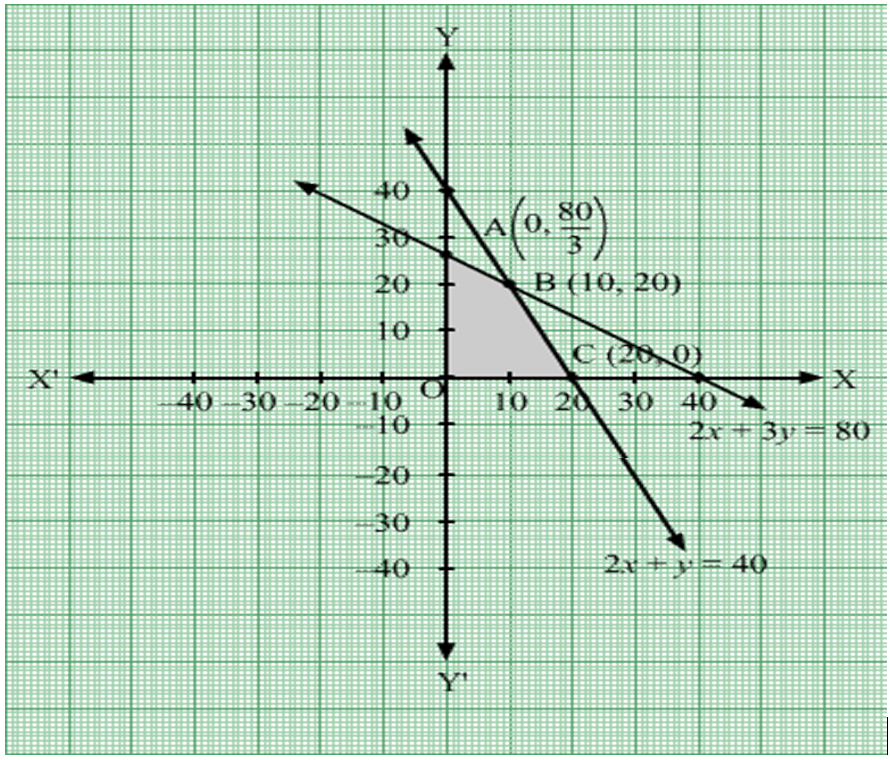
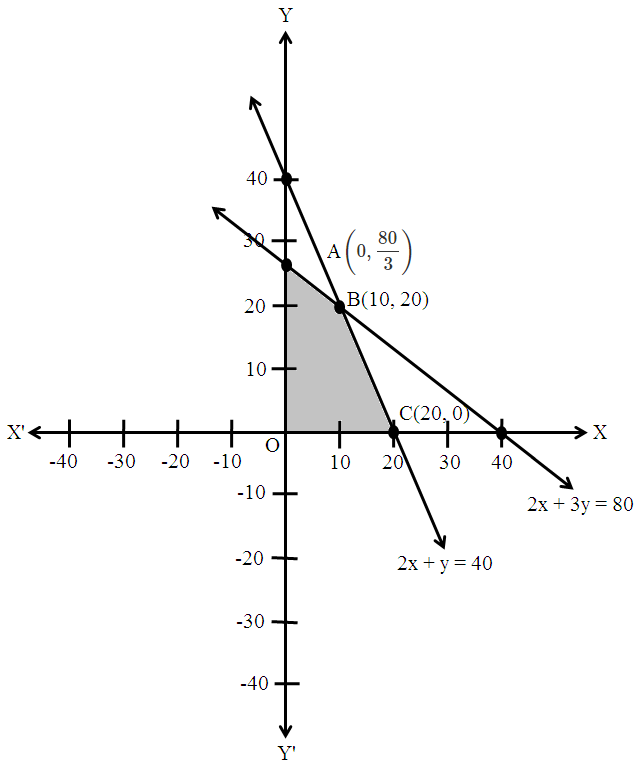
The feasible region determined by the system of constraints is

The corner points are $\text{A}\Big(\frac{80}{3}\Big), \text{B}(10, 20), \text{C}(20, 0)$

The values of Z at these corner points are as follows

Corner point

Z = 15x + 10y

A

$\frac{800}{3}$

B

$350$

C

$300$

The maximum value of Z is 300 which is attained at C(20, 0)

Thus, the maximum profit is Rs. 300 obtained when 10 units of deluxe model and 20 unit of ordinary model is produced.

View full question & answer
Question 564 Marks
A furniture trader deals in only two items – chairs and tables. He has ₹ 50,000 to invest and a space to store at most 35 items. A chair costs him ₹ 1000 and a table costs him ₹ 2000 The trader earns a profit of ₹ 150 and ₹ 250 on a chair and table, respectively. Formulate the above problem as an LPP to maximise the profit and solve it graphically.
Answer
Let x and y be the number of chairs and tables. 
cost of x table = ₹ 2000 and cost of y chair = ₹ 1000 
Since the dealer is maximum invest ₹ 50,000 and the maximum number of items.
Also, the dealer want to sell a chair and table at the profit ₹ 150 and ₹ 250 respectively.
So, from the above explanation, we get following mathematical form as follows
2000x + 1000y ≤ 50,000
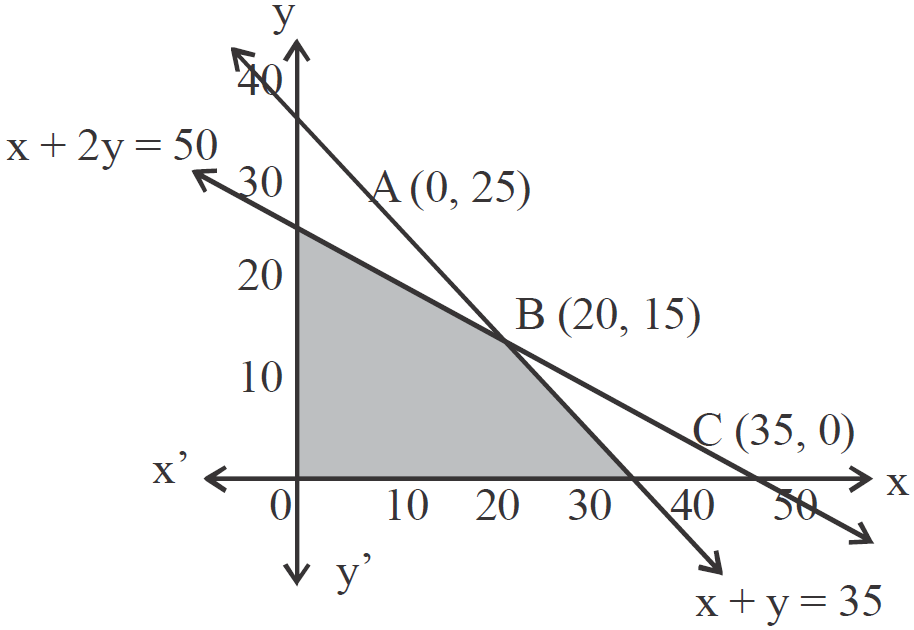
x + 2y ≤ 50
x + y ≤ 35, x ≥ 0, y ≥ 0
and objective function Z = 150x + 250y
Now, we have to maximize Z = 250x + 150y
Subject to constraints
x + 2y = 50
x + y = 35,
x = 0, y = 0

Corner Points Z = 150x + 250y
A(0, 25)
Z = 150 ₹ 0 + 250 ₹ 25
Z = 6250
B(20, 15)
Z = 150 ₹ 20 + 250 ₹ 15
Z = 3000 + 3750
Z = 6750
C(35, 0)
Z = 150 ₹ 35 + 250 ₹ 0
Z = 5250
Hence, the value of Z = 6750 is the maximum value
6750 = 150x + 250y
675 = 15x + 25y
135 = 3x + 5y ...(i)
35 = x + y ...(ii)
x = 35 - y
3(35 - y) + 5y = 135
105 - 3y +5y = 135
2y = 135 - 105
2y = 30
y = 15 Tables
x = 35 - 15
x = 20 Chairs.
View full question & answer
Question 574 Marks
A manufacturer has employed 5 skilled men and 10 semi-skilled men and makes two models A and B of an article. The making of one item of model A requires 2 hours work by a skilled man and 2 hours work by a semi-skilled man. One item of model B requires 1 hour by a skilled man and 3 hours by a semi-skilled man. No man is expected to work more than 8 hours per day. The manufacturer’s profit on an item of model A is Rs. 15 and on an item of model B is Rs. 10. How many of items of each model should be made per day in order to maximize daily profit? Formulate the above LPP and solve it graphically and find the maximum profit.
Answer
Let x articles of model A and y articles of model B be made.

Number of articles cannot be negative.

Therefore, $\text{x},\text{y}\leq0$

According to the question, the making of a model A requires 2 hrs. work by a skilled man and the model B requires 1 hrs. by a skilled man

$2\text{x}+\text{y}\leq40$

The making of a model A requires 2 hrs. work by a semi-skilled man model B requires 3 hrs. work by a semi-skilled man.

$2\text{x}+3\text{y}\leq80$

Total profit = Z = 15x + 10y which is to be maximised

Thus, the mathematical formulat​ion of the given linear programmimg problem is

Max Z = 15x + 10y

Subject to

$2\text{x}+\text{y}\leq40$

$2\text{x}+3\text{y}\leq80$

$\text{x}\geq0$

$\text{y}\geq0$

The feasible region determined by the system of constraints is

The corner points are $\text{A}\Big(\frac{80}{3}\Big),\text{B}(10,20),\text{C}(20,0)$

The values of Z at these corner points are as follows

Corner point

Z = 15x + 10y

A

$\frac{800}{3}$

B

$350$

C

$300$

The maximum value of Z is 300 which is attained at C(20, 0)

Thus, the maximum profit is Rs. 300 obtained when 10 units of deluxe model and 20 unit of ordinary model is produced.

View full question & answer
Question 584 Marks
A furniture trader deals in only two items – chairs and tables. He has ₹ 50,000 to invest and a space to store at most 35 items. A chair costs him ₹ 1000 and a table costs him ₹ 2000 The trader earns a profit of ₹ 150 and ₹ 250 on a chair and table, respectively. Formulate the above problem as an LPP to maximise the profit and solve it graphically.
Answer
Let x and y be the number of chairs and tables. 
cost of x table = ₹ 2000 and cost of y chair = ₹ 1000 
Since the dealer is maximum invest ₹ 50,000 and the maximum number of items.
Also, the dealer want to sell a chair and table at the profit ₹ 150 and ₹ 250 respectively.
So, from the above explanation, we get following mathematical form as follows
2000x + 1000y ≤ 50,000
x + 2y ≤ 50
x + y ≤ 35, x ≥ 0, y ≥ 0
and objective function Z = 150x + 250y
Now, we have to maximize Z = 250x + 150y
Subject to constraints
x + 2y = 50
x + y = 35,
x = 0, y = 0

Corner Points Z = 150x + 250y
A(0, 25)
Z = 150 ₹ 0 + 250 ₹ 25
Z = 6250
B(20, 15)
Z = 150 ₹ 20 + 250 ₹ 15
Z = 3000 + 3750
Z = 6750
C(35, 0)
Z = 150 ₹ 35 + 250 ₹ 0
Z = 5250
Hence, the value of Z = 6750 is the maximum value
6750 = 150x + 250y
675 = 15x + 25y
135 = 3x + 5y ...(i)
35 = x + y ...(ii)
x = 35 - y
3(35 - y) + 5y = 135
105 - 3y +5y = 135
2y = 135 - 105
2y = 30
y = 15 Tables
x = 35 - 15
x = 20 Chairs.
View full question & answer
Question 594 Marks
A manufacturer has employed 5 skilled men and 10 semi-skilled men and makes two models A and B of an article. The making of one item of model A requires 2 hours work by a skilled man and 2 hours work by a semi-skilled man. One item of model B requires 1 hour by a skilled man and 3 hours by a semi-skilled man. No man is expected to work more than 8 hours per day. The manufacturer’s profit on an item of model A is Rs. 15 and on an item of model B is Rs. 10. How many of items of each model should be made per day in order to maximize daily profit? Formulate the above LPP and solve it graphically and find the maximum profit.
Answer
Let x articles of model A and y articles of model B be made.

Number of articles cannot be negative.

Therefore, $\text{x},\text{y}\leq0$

According to the question, the making of a model A requires 2 hrs. work by a skilled man and the model B requires 1 hrs. By a skilled man

$2\text{x}+\text{y}\leq40$

The making of a model A requires 3 hrs. work by a semi-skilled man model B requires 3 hrs. Work by a semi-skilled man.

$2\text{x}+3\text{y}\leq80$

Total profit = Z = 15x + 10y which is to be maximised

Thus, the mathematical formulat​ion of the given linear programmimg problem is

Max Z = 15x + 10y

Subject to,

$2\text{x}+\text{y}\leq40$

$2\text{x}+3\text{y}\leq80$

$\text{x}\geq0$

$\text{y}\geq0$

The feasible region determined by the system of constraints is

The corner points are $\text{A}=0,\frac{80}{3}$, B(10, 20), C(20, 0)

The values of Z at these corner points are as follows

Corner point

Z = 15x + 10y

A

$\frac{800}{3}$

B

$350$

C

$300$

The maximum value of Z is 300 which is attained at C(20, 0)

Thus, the maximum profit is Rs. 300 obtained when 10 units of deluxe model and 20 unit of ordinary model is produced.

View full question & answer
Question 604 Marks
Maximize Z = 9x + 3y
Subject to
$2\text{x}+3\text{y}\leq13$
$3\text{x}+\text{y}\leq5$
$\text{x},\text{y}\geq0$
Answer

Coverting the given inequation into equations, we get

2x + 3y = 13, 3x + y = 5 and x = 0, y = 0

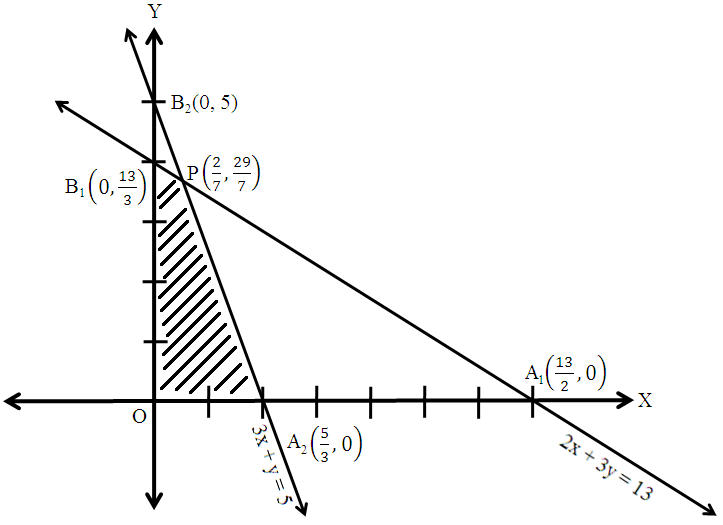
Region represented by $2\text{x}+3\text{y}\leq13:$

The line meets coordinate axes at $\text{A}_1\Big(\frac{13}{2},0\Big)$ and $\text{B}_1\Big(0,\frac{13}{3}\Big)$ respectively.

Join these points to obtain the line 2x + 3y = 13, clearly, (0,0) satisfies the in eqation $2\text{x}+3\text{y}\leq13$, so, the region in xy-plane that contains origin represents the solution set of $2\text{x}+3\text{y}\leq13$.

Region represented by $3\text{x}+\text{y}\leq5:$

The line meets coordinate axes at $\text{A}_2\Big(\frac{5}{3},0\Big)$ and B2(0, 5) respectively.

Join these points to obtain the line 3x + y = 5, clearly, (0, 0) satisfies the in eqation $3\text{x}+\text{y}\leq5$, so, the region in xy-plane that contains origin represents the solution set of $3\text{x}+\text{y}\leq5$.

Region represented by $\text{x},\text{y}\geq0:$

It clearly represent first quadrant of xy-plane.

The common region to regions represented by above in equalities.

The coordinates of the corner points of the shaded region are $\text{O}(0,0),\text{A}\Big(\frac{5}{3},0\Big),\text{P}\Big(\frac{2}{7},\frac{29}{7}\Big),\text{B}_2\Big(0,\frac{13}{3}\Big)$.

The value of Z = 9x + 3y at

$\text{O}(0,0)=9(0)+3(0)=0$

$\text{A}_1\Big(\frac{5}{3},0\Big)=9\Big(\frac{5}{3}\Big)+3(0)=15$

$\text{P}\Big(\frac{2}{7},\frac{29}{7}\Big)=9\Big(\frac{2}{7}\Big)+3\Big(\frac{29}{7}\Big)=15$

$\text{B}_2\Big(0,\frac{13}{3}\Big)=9(0)+3\Big(\frac{13}{3}\Big)=13$

Clearly, Z is maximum at every point on the line joining A1 and P, So

$\text{x}=\frac{2}{7}$ or $\frac{2}{7}$$\text{y}=0$ or $\frac{29}{7}$

and maximum Z = 15.

View full question & answer
Question 614 Marks
A company sells two different products A and B. The two products are produced in a common production process and are sold in two different markets. The production process has a total capacity of 45000 man-hours. It takes 5 hours to produce a unit of A and 3 hours to produce a unit of B. The market has been surveyed and company officials feel that the maximum number of units of A that can be sold is 7000 and that of B is 10,000. If the profit is Rs. 60 per unit for the product A and Rs. 40 per unit for the product B, how many units of each product should be sold to maximize profit? Formulate the problem as LPP.
Answer
Product
Man hours
Maximum demand
Profit
A
5
7000
60
B
3
10000
40
Total capacity
45000
   

Let required production of product A be x units and production of product B be y units.

Given, profits on one unit of product A and B are Rs. 60 and Rs. 40 respectively, so profits on x units of product A and y units of product B are Rs. 60x and Rs. 40y.

Let Z be the total profit, so

Z = 60x + 40y

Given, production of one unit of product A and B require 5 hours and 3 hours respectively man hours, so x unit of product A and y units of product 8 require 5x hours and 3y hours of man hours respectively but total man hours available are 45000 hours, so

5x + 3y = 45000 (First constraint)

Given, dem and for product A is maximum 7000, so

$\times\leq7000$ (Second constraint)

Hence, mathematical formulation of LPP is,

Find x and y which

maximize Z = 60x + 40y

Subject to constraints,

$5\text{x}+3\text{y}\leq45000$

$\text{x}\leq7000$

$\text{y}\leq10000$

$\text{x},\text{y}\geq0$ [Since production can not be less than zero].

View full question & answer
Question 624 Marks
Reshma wishes to mix two types of food P and Q in such a way that the vitamin contents of the mixture contain at least 8 units of vitamin A and 11 units of vitamin B. Food P costs Rs 60/kg and Food Q costs Rs 80/kg. Food P contains 3 units/kg of Vitamin A and 5 units/kg of Vitamin B while food Q contains 4 units/kg of Vitamin A and 2 units/kg of vitamin B. Determine the minimum cost of the mixture?
Answer
Let the mixture contain x kg of food P and y kg of food Q. Therefore,
$\text{x}\geq0\text{ and }\text{y}\geq0$
The given inforrnation can be compiled in a table as follows.
  Vitamin A (units/kg) Vitamin B (units/kg) Cost (Rs/kg)
Food P 3 5 60
Food Q 4 2 80
Requirement (units/kg) 8 11  
The mixture must contain at least 8 units of vitamin A and 11 units of vitamin B.
Therefore, the constraints are
$3\text{x}+4\text{y}\geq8$
$5\text{x}+2\text{y}\geq11$
Total cost, z, of purchasing food is, z = 60x + 8oy
The methematical formulation of the given problem is Minimise Z = 60x + 80y ... (1)
subject to the constraints,
$3\text{x}+4\text{y}\geq8\dots(2)$
$5\text{x}+2\text{y}\geq11\dots(3)$
$\text{x},\ \text{y}\geq0\dots(4)$
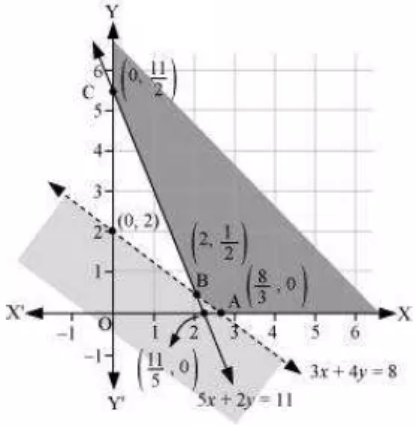
The feasible region determined by the system of constraints is as follows.

It can be seen that the feasible region is unbounded.
The corner points of the feasible region are $\text{A}\Big(\frac83,\ 0\Big),\ \text{B}\Big(2,\ \frac12\Big),\ \text{and C}\Big(0,\frac{11}{2}\Big)$
The values of z at these corner points are as follows.
Corner point Z = 60x + 80y  
$\text{A}\Big(\frac83,\ 0\Big)$ 160 $\Bigg\}\rightarrow\text{Minimum}$
$\text{B}\Big(2,\frac12\Big)$ 160
$\text{C}\Big(0,\frac{11}{2}\Big)$ 440  
As the feasible region is unbounded, therefore, 160 may or may not be the minimum value of z.
For this, we graph the inequality, 60x + 80y < 160 or 3x + 4y < 8, and check whether the resulting half plane has points in common with the feasible region or not.
It can be seen that the feasible region has no common point with 3x + 4y < 8 Therefore, the minimum cost of the mixture will be Rs 160 at the line segment joining the points $\Big(\frac83,\ 0\Big)\text{ and }\Big(2,\ \frac12\Big).$
View full question & answer
Question 634 Marks
A factory manufactures two types of screws, A and B. Each type of screw requires the use of two machines, an automatic and a hand operated. It takes 4 minutes on the automatic and 6 minutes on hand operated machines to manufacture a package of screws A, while it takes 6 minutes on automatic and 3 minutes on the hand operated machines to manufacture a package of screws B. Each machine is available for at the most 4 hours on any day. The manufacturer can sell a package of screws A at a profit of Rs 7 and screws B at a profit of Rs 10. Assuming that he can sell all the screws he manufactures, how many packages of each type should the factory owner produce in a day in order to maximise his profit? Determine the maximum profit.
Answer
Let the factory manufacture x screws of type A and y screws of type B on each day. Therefore, $\text{x}\ge0\text{ and y}\ge0.$
The given information can be compiled in a table as follows.
  Screw A Screw B Availability
Automatic Machine (min) 4 6 4 × 60 = 120
Hand Operated Machine (min) 6 3 4 × 60 = 120
The proflt on a package of screws A is Rs 7 and on the package of screws B is Rs 10.
Therefore, the constraints are
$4\text{x}+6\text{y}\le240\\6\text{x}+3\text{y}\le240$
Total profit, z = 7x + 10y
The mathematical formulation of the given problem is Maximize Z = 7x + 10y ... (1)
subject to the constraints,
$4\text{x}+6\text{y}\le240\dots(2)\\6\text{x}+3\text{y}\le240\dots(3)\\\text{x},\ \text{y}\ge0\dots(4)$
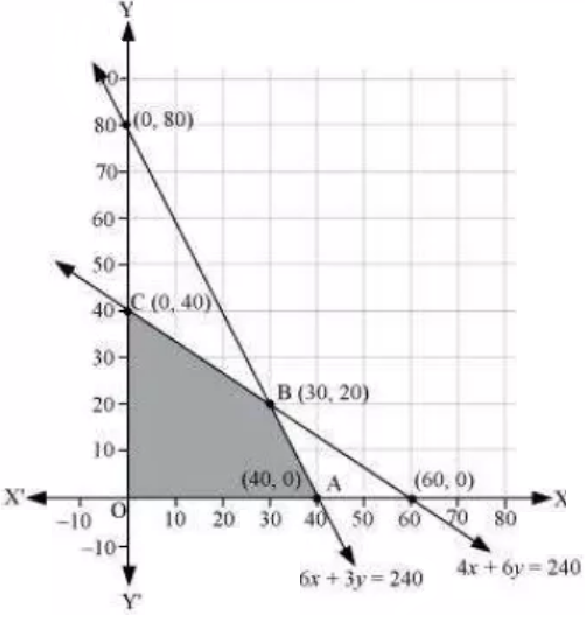
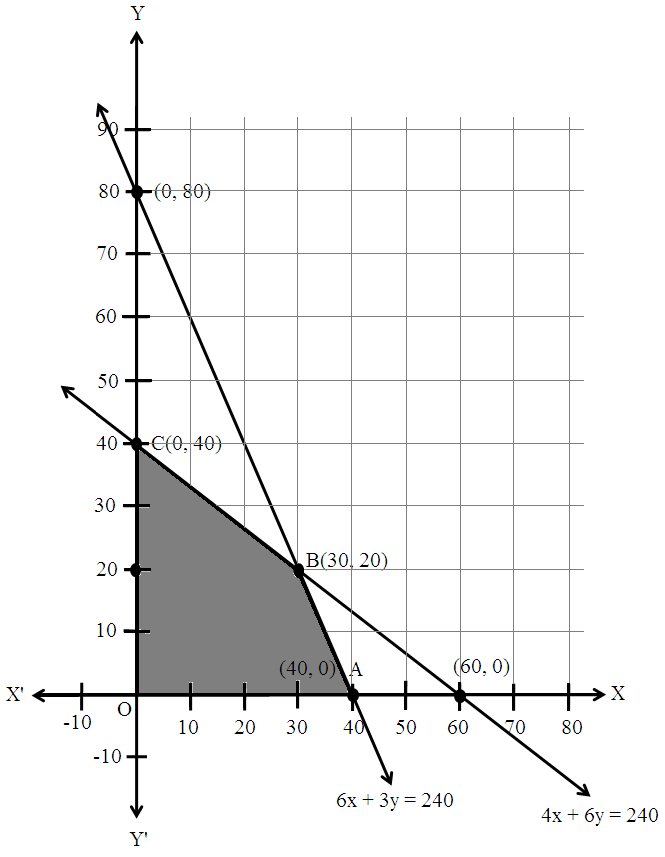
The feasible region determined by the system of constraints is

The corner points are A(40, 0), B(30, 20), and C(0, 40).
The values of Z at these corner points are as follows.
Corner point Z = 7x + 10y  
A(40, 0) 280  
B(30, 20) 410 → Maximum
C(0, 40) 400  
The maximum value of Z is 410 at (30, 20).
Thus, the factory should produce 30 packages of screws A and 20 packages of screws B to get the maximum profit of Rs 410.
View full question & answer
Question 644 Marks
A factory makes tennis rackets and cricket bats. A tennis racket takes 1.5 hours of machine time and 3 hours of craftman's time in its making while a cricket bat takes 3 hours of machine time and 1 hour of craftman's time. In a day, the factory has the availability of not more than 42 hours of machine time and 24 hours of craftman's time. If the profit on a racket and on a bat is Rs. 20 and Rs. 10 respectively, find the number of tennis rackets and cricket bats that the factory must manufacture to earn the maximum profit. Make it as an LPP and solve it graphically.
Answer

Let x number of tennis rackets and y number of cricket bats were sold.

Number of tennis rackets and cricket balls cannot be negative.

Therefore, x ≥ 0, y ≥ 0

It is given that a tennis racket takes 1.5 hours of machine time and 3 hours of craftman's time in its making while a cricket bat takes 3 hours of machine time and 1 hour of craftman's time.

Also, the factory has the availability of not more than 42 hours of machine time and 24 hours of craftman's time.

Therefore,

1.5x plus 3y less or equal than 42

3x plus y less or equal than 24

If the profit on a racket and on a bat is Rs. 20 and Rs. 10 respectively.

Therefore, profit made on x tennis rackets and y cricket bats is Rs. 20x and Rs. 10y respectively.

Total profit = Z = 20x + 10y

The mathematical form of the given LPP is

Maximize Z = 20x + 10y

Subject to constraints:

1.5 x plus 3y less or equal than 42

3x plus y less or equal than 24

x ≥ 0, y ≥ 0

First we will convert inequations into equations as follows:

1.5x + 3y = 42, 3x + y = 24, x = 0 and y = 0

Region represented by 1.5x + 3y ≤ 42:

The line 1.5x + 3y = 42 meets the coordinate axes at A1(28, 0) and B1(0, 14) respectively.

By joining these points we obtain the line 1.5x + 3y = 42.

Clearly (0, 0) satisfies the 1.5x + 3y = 42.

So, the region which contains the origin represents the solution set of the inequation 1.5x + 3y ≤ 42.

Region represented by 3x + y ≤ 24:

The line 3x + y = 24 meets the coordinate axes at C1(8, 0) and D1(0, 24) respectively.

By joining these points we obtain the line 3x + y = 24.

Clearly (0, 0) satisfies the inequation 3x + y ≤ 24.

So, the region which contains the origin represents the solution set of the inequation 3x + y ≤ 24.

Region represented by x ≥ 0 and y ≥ 0:

Since, every point in the first quadrant satisfies these inequations.

So, the first quadrant is the region represented by the inequations x ≥ 0, and y ≥ 0.

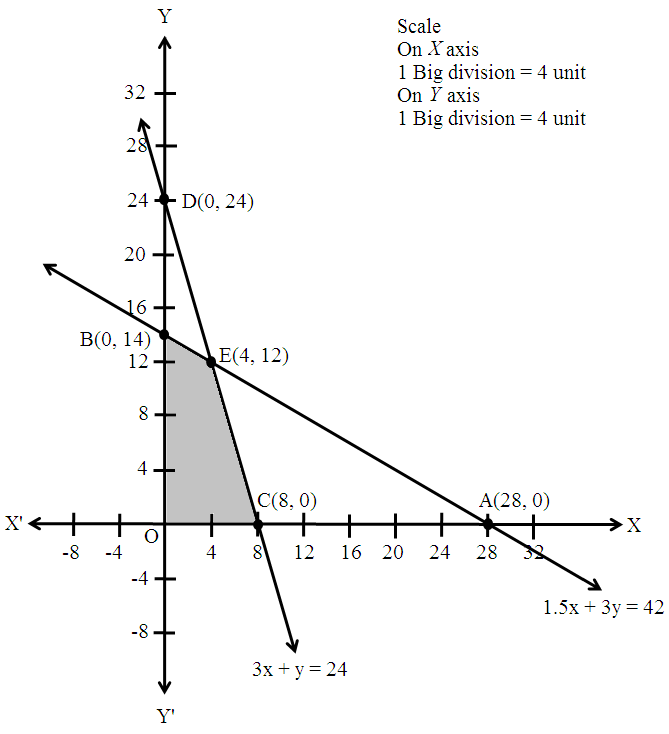
The feasible region determined by the system of constraints 1.5x + 3y ≤ 42, 3x + y ≤ 24, X ≥ 0 and y ≥ 0 are as follows.

In the above graph, the shaded region is the feasible region.

The corner points are O(0, 0), B1(0, 14), E1(4, 12), and C1(8, 0).

The values of the objective function Z at corner points of the feasible region are given in the following table:

Corner Points
Z = 20x + 10y
 
O(0, 0)
0
 
B1(0, 14)
140
 
E1(4, 12)
200
→ Maximum
C1(8, 0)
16
 

Clearly, Z is maximum at x = 4 and y = 12 and the maximum value of Z at this point is 200.

Thus, maximum profit is of Rs. 200 obtained when 4 tennis rackets and 12 cricket bats were sold.

View full question & answer
Question 654 Marks
A factory manufactures two types of screws, A and B, each type requiring the use of two machines - an automatic and a hand-operated. It takes 4 minute on the automatic and 6 minutes on the hand-operated machines to manufacture a package of screws 'A', while it takes 6 minutes on the automatic and 3 minutes on the hand-operated machine to manufacture a package of screws 'B'. Each machine is available for at most 4 hours on any day. The manufacturer can sell a package of screws 'A' at a profit of 70 P and screws 'B' at a profit of Rs. 1. Assuming that he can sell all the screws he can manufacture, how many packages of each type should the factory owner produce in a day in order to maximize his profit? Determine the maximum profit.
Answer

Let the factory manufacture x screws of type A and y screws of type B on each day.

Therefore, $\text{x}\geq0$ and $\text{y}\geq0$

The given information can be compiled in a table as follows.

 
Screw A
Screw B
Availability
Automatic Machine (min)
4
6
4 × 60 = 120
Hand Operated Machine (min)
6
3
4 × 60 = 120

The profit on a package of screws A is Rs. 7 and on the package of screws B is Rs. 10.

Therefore, the constraints are

$4\text{x}+6\text{y}\geq240$

$6\text{x}+3\text{y}\geq240$

Total profit, Z = 7x + 10y.

The mathematical formulation of the given problem is,

Maximize Z = 7x + 10y ...(1)

Subject to the constraints, $4\text{x}+6\text{y}\geq240\dots(2)$

$6\text{x}+3\text{y}\geq240\dots(3)$

$\text{x},\text{y}\geq0\dots(4)$

The feasible region determined by the system of constraints is

The corner points are A(40, 0), B(30, 20) and C(0, 40).

The values of Z at these corner points are as follows.

Corner point
Z = 7x + 10y
 
A(40, 0)
280
 
B(30, 20)
410
→ Maximum
C(0, 40)
400
 

The maximum value of Z is 410 at (30, 20).

Thus, the factory should produce 30 packages of screws A and 20 packages of screws B to get the maximum profit of Rs 410.

View full question & answer
Question 664 Marks
A manufacturer makes two products A and B. Product A sells at Rs. 200 each and takes 1/2 hour to make. Product B sells at Rs. 300 each and takes 1 hour to make. There is a permanent order for 14 of product A and 16 of product B. A working week consists of 40 hours of production and weekly turnover must not be less than Rs 10000. If the profit on each of product A is Rs. 20 and on product B is Rs. 30, then how many of each should be produced so that the profit is maximum. Also, find the maximum profit.
Answer

Let x units of product A and y units of product B were manufactured.

Number of units cannot be negative.

Therefore,  x, y ≥ 0

According to question, the given information can be tabulated as

 
Type A
Type B
Availability
Cutting (min)
5
8
3 × 60 + 20 = 200
Assembling (min)
10
8
4 × 60 = 240

Also, the availability of time is 40 hours and the revenue should be atleast Rs 10000.

Further, it is given that there is a permanent order for 14 units of product A and 16 units of product B.

Therefore, the constraints are

$200\text{x}+300\text{y}\geq10000$

$0.5\text{x}+\text{y}\leq40$

$\text{x}\geq14$

$\text{y}\geq16$

If the profit on each of product A is Rs 20 and on product B is Rs 30.Therefore, profit gained on x units of product A and y units of product B is Rs 20x and Rs 30y respectively.

Total profit = Z = 20x+30y which is to be maximised

Thus, the mathematical formulat​ion of the given linear programmimg problem is 

Max Z = 20x + 30y

Subject to

$2\text{x}+3\text{y}\geq100$

$\text{x}+2\text{y}\leq80$

$\text{x}\geq14$

$\text{y}\geq16$

$\text{x},\text{y}\geq0$

First we will convert inequations into equations as follows:

2x + 3y = 100

x + 2y = 80

x = 14

y = 16

x = 0

y = 0

Region represented by 2x + 3y ≥ 100:

The line 2x + 3y = 100 meets the coordinate axes at A1(50, 0) and $\text{B}_1\Big(0,\frac{100}3{}\Big)$ respectively.

By joining these points we obtain the line 2x + 3y = 100.

Clearly (0, 0) does not satisfies the 2x + 3y = 100.

So, the region which does not contain the origin represents the solution set of the inequation 2x + 3y ≥ 100.

Region represented by x + 2y ≤ 80:

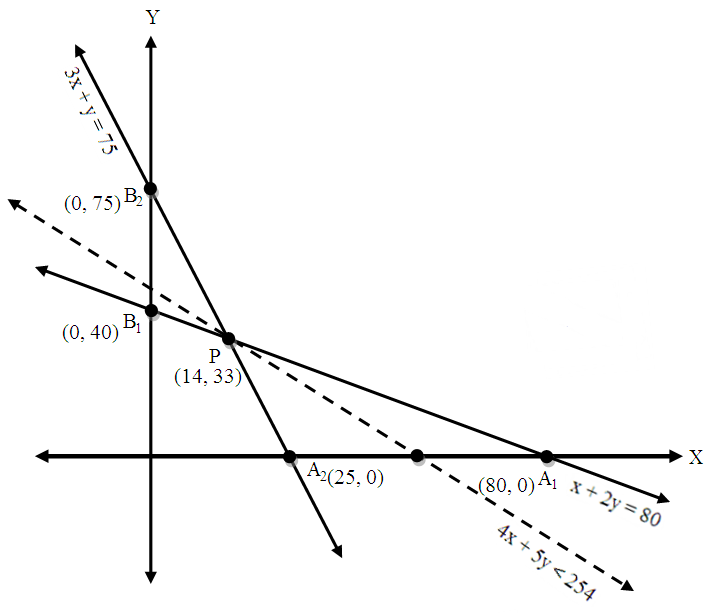
The line x + 2y = 80 meets the coordinate axes at C1(80, 0) and D1(0, 40) respectively.

By joining these points we obtain the line x + 2y = 80.

Clearly (0, 0) satisfies the inequation x + 2y ≤ 80.

So, the region which contains the origin represents the solution set of the inequation x + 2y ≤ 80.

Region represented by x ≥ 14

x = 14 is the line passes through (14, 0) and is parallel to the Y axis.

The region to the right of the line x = 14 will satisfy the inequation.

Region represented by y ≥ 16

y = 16 is the line passes through (0, 16) and is parallel to the X axis.

The region above the line y = 16 will satisfy the inequation.

Region represented by x ≥ 0 and y ≥ 0:

Since, every point in the first quadrant satisfies these inequations.

So, the first quadrant is the region represented by the inequations x ≥ 0, and y ≥ 0.

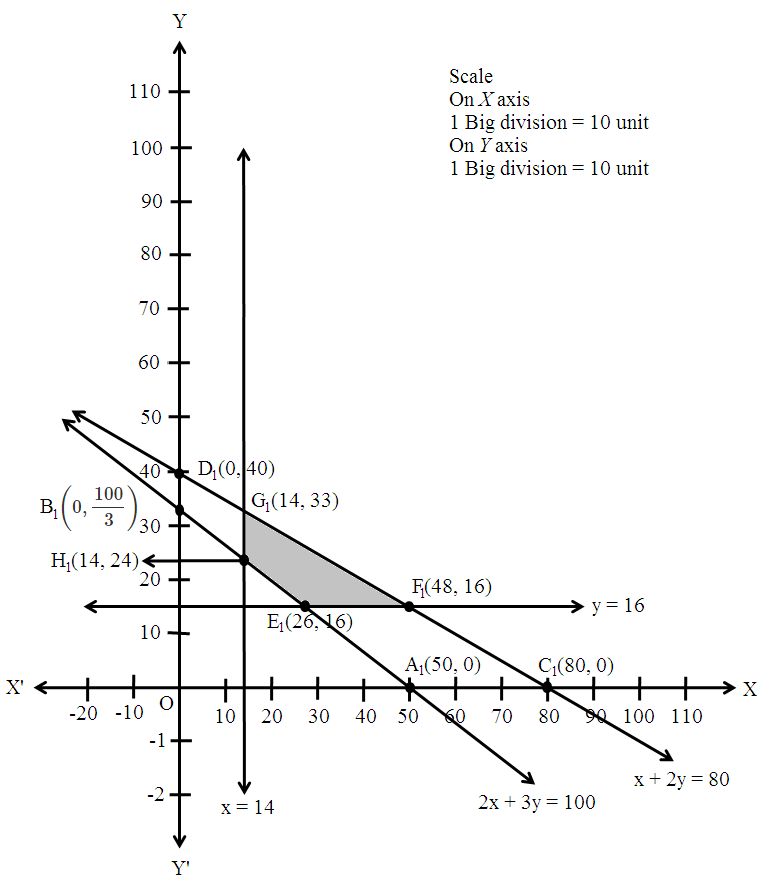
The feasible region determined by the system of constraints 2x + 3y ≥ 100, x + 2y ≤ 80, x ≥ 14, y ≥ 16, x ≥ 0 and y ≥ 0 are as follows.

The corner points of the feasible region are E1(26, 16), F1(48, 16), G1(14, 33) and H1(14, 24)

The values of Z at these corner points are as follows.

Corner point
Z = 5x + 6y
E1
1000
F1
1440
G1
1270
H1 1000

The maximum value of Z is Rs 1440 which is attained at F1(48, 16).

Thus, the maximum profit is Rs 1440 obtained when 48 units of product A and 16 units of product B were manufactured.

View full question & answer
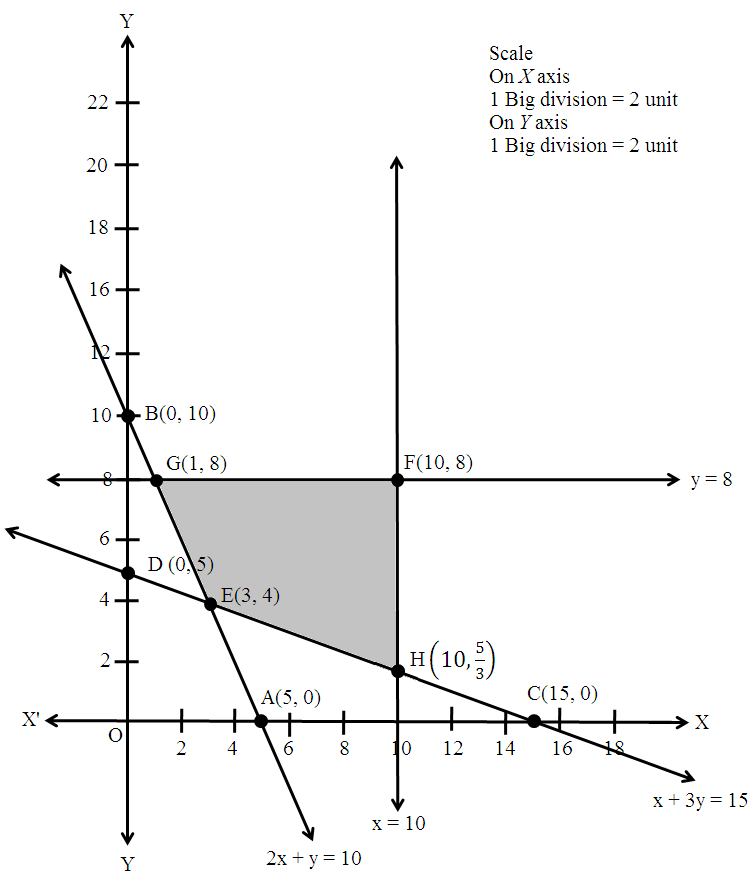
Question 674 Marks
Maximum Z = 5x + 3y

Subject to

$2\text{x}+\text{y}\geq10$

$\text{x}+3\text{y}\geq15$

$\text{x}\leq10$

$\text{y}\leq8$

$\text{x},\text{y}\geq0$

Answer

First, we will convert the given inequations into equations, we obtain the following equations:

2x + y = 10, x + 3y = 15, x = 10, y = 8

Region represented by $2\text{x}+\text{y}\geq10$:

The line 2x + y = 10 meets the coordinate axes at A(5, 0) and B(0, 10) respectively.

By joining these points we obtain the line 2x + y = 10. Clearly (0, 0) does not satisfies the inequation $2\text{x}+\text{y}\geq10$.

So,the region in xy plane which does not contain the origin represents the solution set of the inequation $2\text{x}+\text{y}\geq10$.

Region represented by $\text{x}+3\text{y}\geq15$:

The line x + 3y = 15 meets the coordinate axes at C(15, 0) and D(0, 5) respectively.

By joining these points we obtain the line x + 3y = 15.

Clearly (0, 0) satisfies the inequation $\text{x}+3\text{y}\geq15$. o, the region in xy plane which does not contain the origin represents the solution set of the inequation $\text{x}+3\text{y}\geq15$.

The line x = 10 is the line that passes through the point (10, 0) and is parallel to Y axis. $\text{x}\leq10$ is the region to the left of the line x = 10.

The line y = 8 is the line that passes through the point (0, 8) and is parallel to X axis. $\text{y}\leq8$ is the region below the line y = 8.

Region represented by $\text{x}\geq0$ and $\text{y}\geq0$:

Since, every point in the first quadrant satisfies these inequations.

So, the first quadrant is the region represented by the inequations $\text{x}\geq0$ and $\text{y}\geq0$.

The feasible region determined by the system of constraints, $2\text{x}+\text{y}\geq10$$\text{x}+3\text{y}\geq15$$\text{x}\leq10$, $\text{y}\leq8$$\text{x}\geq0$ and $\text{y}\geq0$ are as follows.

The corner point of the feasible region are E(3, 4), $\text{H}\Big(10,\frac{5}{3}\Big),$ F(10, 8) and G(1, 8).

The values of Z at these corner points are as follows.

$\text{Corner point}$
$\text{Z}=5\text{x}+3\text{y}$
$\text{E}(3, 4)$
$5\times3+3\times4=27$
$\text{H}\Big(10,\frac{5}{3}\Big)$
$5\times10+3\times\frac{5}{3}=55$
$\text{F}(10, 8)$
$5\times10+3\times8=74$
$\text{G}(1, 8)$
$5\times1+3\times8=29$

Therefore, the minimum value of Z is 27 at the point F(3, 4).

Hence, x = 3 and y = 4 is the optimal solution of the given LPP.

Thus, the optimal value of Z is 27.

View full question & answer
Question 684 Marks
A manufacturer has three machine I, II, III installed in his factory. Machines I and II are capable of being operated for at most 12 hours whereas machine III must be operated for atleast 5 hours a day. She produces only two items M and N each requiring the use of all the three machines.
The number of hours required for producing 1 unit each of M and N on the three machines are given in the following table:
Item
Number of hours required on machines
 
I
II
III
M
1
2
1
N
2
1
1.25
She makes a profit of Rs. 600 and Rs. 400 on items M and N respectively. How many of each item should she produce so as to maximise her profit assuming that she can sell all the items that she produced? What will be the maximum profit?
Answer
Suppose x units of item M and y units of item N are produced to maximise the profit.

Since each unit of item M require 1 hours on machine I and each unit of item N require 2 hours on machine I, therefore, the total hours required for producing x units of item M and yunits of item N on machine I are (2x + y).

But, machines I is capable of being operated for at most 12 hours.

2x + y ≤ 12 Similarly, each unit of item M require 2 hours on machine II and each unit of item N require 1 hour on machine II, therefore, the total hours required for producing x units of item M and yunits of item N on machine II are (x + 2y).

But, machines II is capable of being operated for at most 12 hours.

x + 2y ≤ 12 Also, each unit of item M require 1 hour on machine III and each unit of item N require 1.25 hour on machine III, therefore, the total hours required for producing x units of item M and yunits of item N on machine III are (x+ 1.25y).

But, machines III must be operated for atleast 5 hours.

x + 1.25 ≥ 5

The profit from each unit of item M is 2600 and each unit of item N is Rs. 400.

Therefore, the total profit from x units of item M and yunits of item N is Rs. (600x + 400y).

Thus, the given linear programming problem is Maximise Z = 600x + 400y

Subject to the constraints

2x + y ≤ 12

x + 2y ≤ 12

x + 1.25y ≥ 5

x, y ≥ 0

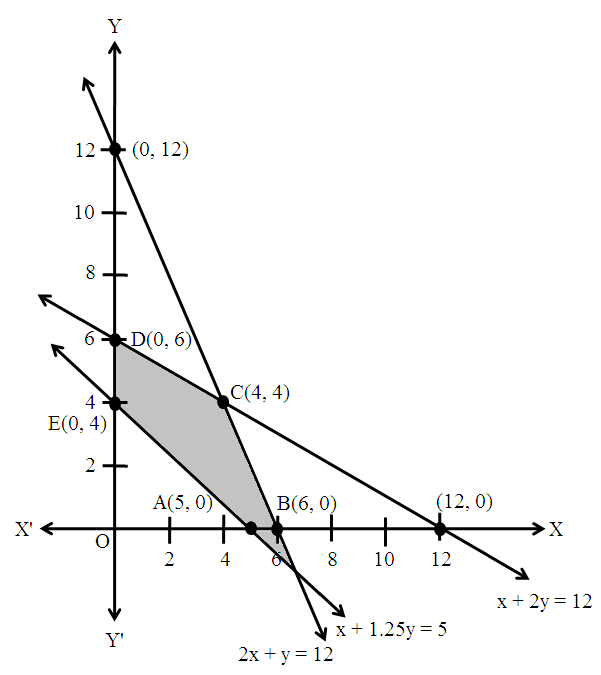
The feasible region determined by the given constraints can be diagrammatically represented.

The coordinates of the corner points of the feasible region are A(5, 0), B(6, 0), C(4, 4), D(0, 6) and E(0, 4).

The value of the objective function at these points are given in the following table.

Corner Point
Z = 600x + 400y
 
(5, 0)
600 × 5 + 400 × 0 = 3000
 
(6, 0)
600 × 6 + 400 × 0 = 3600
 
(4, 4)
600 × 4 + 400 × 4 = 4000
→ Maximum
(0, 6)
600 × 0 + 400 × 6 = 2400
 
(0, 4)
600 × 0 + 400 × 4 = 1600
 

The maximum value of Z is 4000 at x = 4, y = 4.

Hence, 4 units of item M and 4 units of item N should be produced to maximise the profit.

The maximum profit of the manufacturer is Rs. 4,000.

View full question & answer
Question 694 Marks
A company manufactures two types of novelty Souvenirs made of plywood. Souvenirs of type A require 5 minutes each for cutting and 10 minutes each for assembling. Souvenirs of type B require 8 minutes each for cutting and 8 minutes each for assembling. There are 3 hours 20 minutes available for cutting and 4 hours available for assembling. The profit is 50 paise each for type A and 60 paise each for type B souvenirs. How many souvenirs of each type should the company manufacture in order to maximize the profit?
Answer

Let the company manufacture x souvenirs of type A and y souvenirs of type B.

Therefore, $\text{x}\geq0$ and $\text{y}\geq0$ The given information can be complied in a table as follows.

 
Type A
Type B
Availability
Cutting (min)
5
8
3 × 60 + 20 = 200
Assembling (min)
10
8
4 × 60 = 240

The profit on type A souvenirs is Rs. 5 and on type B souvenirs is Rs. 6.

Therefore, the constraints are

$5\text{x}+8\text{y}\leq200$

$10\text{x}+8\text{y}\leq240$

i.e., $5\text{x}+4\text{y}\leq120$

Total profit, Z = 5x + 6y

The mathematical formulation of the given problem is

Maximize Z = 5x + 6y ... (1)

Subject to the constraints,

$5\text{x}+8\text{y}\leq200 \dots (2)$

$5\text{x}+4\text{y}\leq120\dots(3)$

$\text{x},\text{y}\geq0\dots(4)$

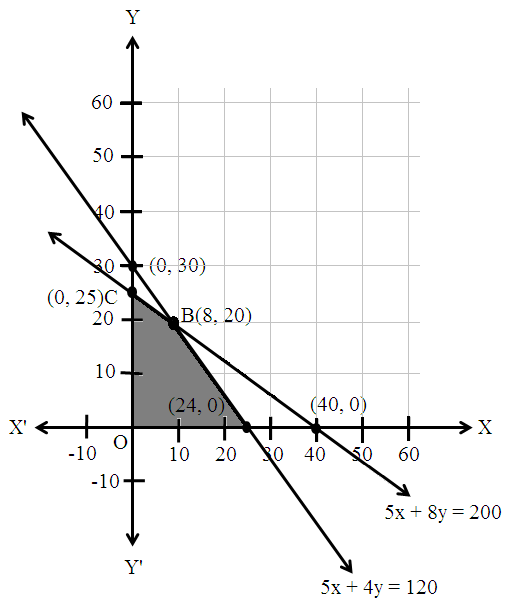
The feasible region determined by the system of constraints is as follows.

The corner point are A(24, 0), B(8, 20), and C(0, 25).

The values of Z at these corner points are as follows.

Corner point
Z = 5x + 6y
 
A(24, 0)
120
 
B(8, 20)
160
→ Maximum
C(0, 25)
150
 

The maximum value of Z is 200 at (8, 20).

Thus, 8 souvenirs of type A and 20 souvenirs of type B should be produced each day to get the maximum profit of Rs. 160.

View full question & answer
Question 704 Marks
A manufacturer produces two types of steel trunks. He has two machines A and B. For completing, the first types of the trunk requires 3 hours on machine A and 3 hours on machine B, whereas the second type of the trunk requires 3 hours on machine A and 2 hours on machine B. Machines A and B can work at most for 18 hours and 15 hours per day respectively. He earns a profit of Rs. 30 and Rs. 25 per trunk of the first type and the second type respectively. How many trunks of each type must he make each day to make maximum profit?
Answer

Let x trunks of first type and y trunks of second type were manufactured.

Number of trunks cannot be negative.

Therefore,

x, y ≥ 0

According to question, the given information can be tabulated as

 
Machine A (hrs)
Machine B (hrs)
First type (x)
3
3
Second type (y)
3
2
Availability
18
15

Therefore, the constraints are

$3\text{x}+3\text{y}\leq18$

$3\text{x}+2\text{y}\leq15$

He earns a profit of Rs. 30 and Rs. 25 per trunk of the first type and the second type respectively.

Therefore, profit gained by him from x trunks of first type and y trunks of second type is Rs. 30x and Rs. 25y respectively.

Total profit = Z = 30x + 25y which is to be maximised

Thus, the mathematical formulat​ion of the given linear programmimg problem is

Max Z = 30x + 25y

Subject to

$3\text{x}+3\text{y}\leq18$

$3\text{x}+2\text{y}\leq15$

$\text{x},\text{y}\geq0$

First we will convert inequations into equations as follows:

3x + 3y = 18, 3x + 2y = 15, x = 0 and y = 0

Region represented by 3x + 3y ≤ 18:

The line 3x + 3y = 18 meets the coordinate axes at A1(6, 0) and B1(0, 6) respectively.

By joining these points we obtain the line 3x + 3y = 18.

Clearly (0, 0) satisfies the 3x + 3y = 18.

So, the region which contains the origin represents the solution set of the inequation 3x + 3y ≤ 18.

Region represented by 3x + 2y ≤ 15:
The line 3x + 2y = 15 meets the coordinate axes at C1(5, 0) and $\text{D}_1\Big(0,\frac{15}{2}\Big)$ respectively.

By joining these points we obtain the line 3x + 2y = 15.

Clearly (0, 0) satisfies the inequation 3x + 2y ≤ 15.

So, the region which contains the origin represents the solution set of the inequation 3x + 2y ≤ 15.

Region represented by x ≥ 0 and y ≥ 0:

Since, every point in the first quadrant satisfies these inequations.

So, the first quadrant is the region represented by the inequations x ≥ 0, and y ≥ 0.

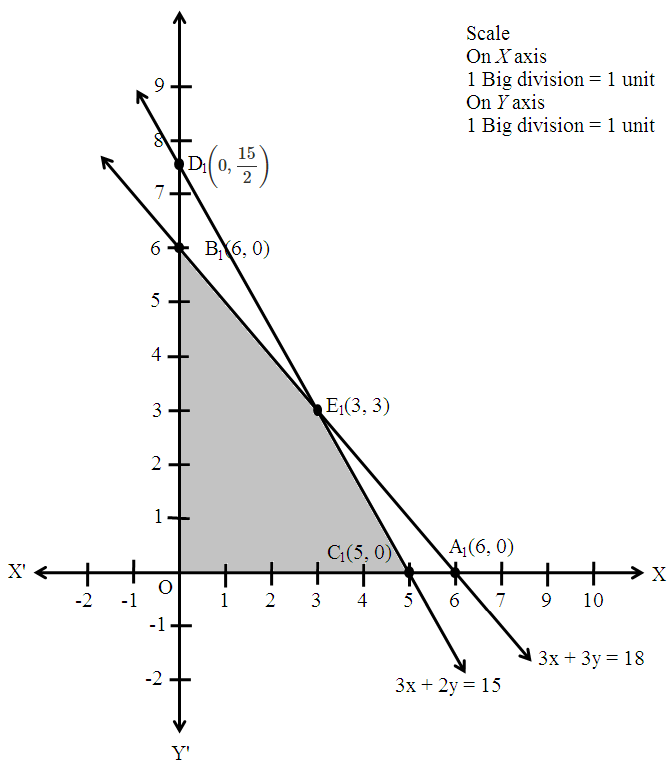
The feasible region determined by the system of constraints 3x + 3y ≤ 18, 3x + 2y ≤ 15, x ≥ 0 and y ≥ 0 are as follows.

The corner points are O(0, 0), B1(0, 6), E1(3, 3) and C1(5, 0).

The values of Z at these corner points are as follows.

Corner point
Z = 30x + 25y
O
0
B1
15
E1
165
C1 150

The maximum value of Z is 165 which is attained at E1(3, 3).

Thus, the maximum profit is Rs. 165 obtained when 3 units of each type of trunk is manufactured.

View full question & answer
Question 714 Marks
A diet of two foods F1 and F2 contains nutrients thiamine, phosphorous and iron.
The amount of each nutrient in each of the food (in milligrams per 25gms) is given in the following table:
Nutrients Food F1 F2
Thiamine 0.25 0.10
Phosphorous 0.75 1.50
Iron 1.60 0.80
The minimum requirement of the nutrients in the diet are 1.00mg of thiamine, 7.50mg of phosphorous and 10.00mg of iron.
The cost of F1 is 20 paise per 25gms while the cost of F2 is 15 paise per 25gms.
Find the minimum cost of diet.
Answer

Let 25x grams of food F1 and 25y grams of food F2 be used to fulfil the minimum requirement of thiamine, phosphorus and iron.

As, we are given,

Nutrients Food F1 F2
Thiamine 0.25 0.10
Phosphorous 0.75 1.50
Iron 1.60 0.80

And the minimum requirement of the nutrients in the diet are 1.00mg of thiamine, 7.50mg of phosphorous and 10.00mg of iron.

Therefore, $0.25\text{x}+0.10\text{y}\geq1$

$0.75\text{x}+1.50\text{y}\geq7.5$

$1.6\text{x}+0.8\text{y}\geq10$

Since the quantity cannot be negative

$\therefore\text{x},\text{y}\geq0$

The cost of F1 is 20 paise per 25gms while the cost of F2 is 15 paise per 25 gms.

Therefore, the cost of 25x grams of food F1 and 25y grams of food F2 is Rs. (0.20x + 0.15y).

Hence,

Minimize Z = 0.20x + 0.15y

Subject to

$0.25\text{x}+0.10\text{y}\geq1,0.75\text{x}+1.50\text{y}\geq7.5,$ $1.6\text{x}+0.8\text{y}\geq10,\text{x},\text{y}\geq0.$

First, we will convert the given inequations into equations, we obtain the following equations:

0.25x + 0.10y = 1, 0.75x + 1.50y = 7.5, 1.6x + 0.8y = 10, x = 0 and y = 0.

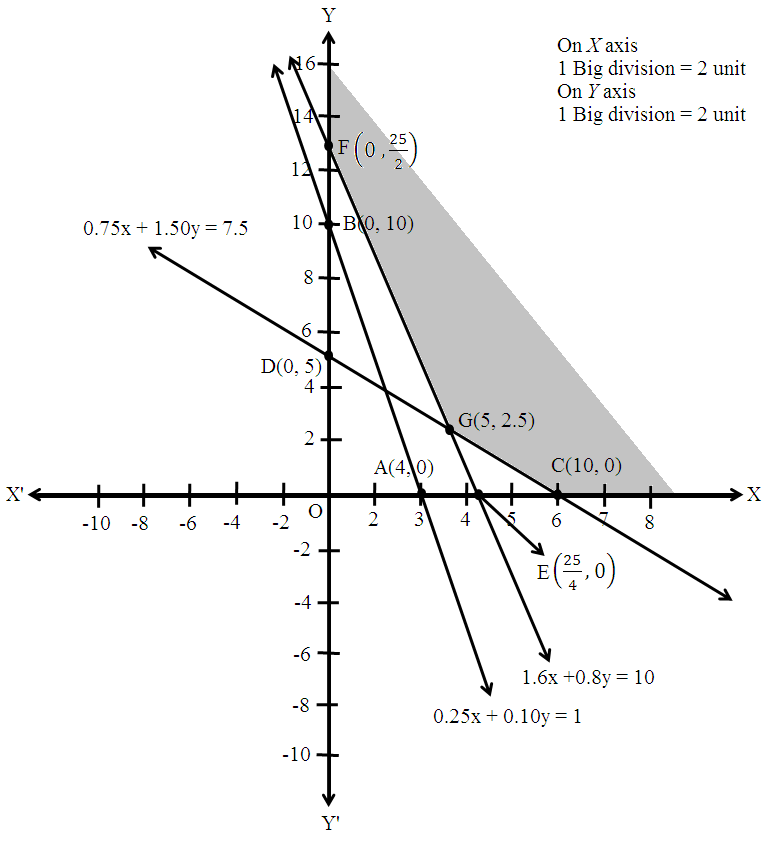
The line 0.25x + 0.10y = 1 meets the coordinate axis at A(4, 0) and B(0, 10).

Join these points to obtain the line 0.25x + 0.10y = 1.

Clearly, (0, 0) does not satisfies the inequation $0.25\text{x}+0.10\text{y}\geq1$.

So, the region in xy-plane that does not contains the origin represents the solution set of the given equation.

The line 0.75x + 1.50y = 7.5. meets the coordinate axis at C(10, 0) and D(0, 5).

Join these points to obtain the line 0.75x + 1.50y = 7.5.

Clearly, (0, 0) does not satisfies the inequation $0.75\text{x}+1.50\text{y}\geq7.5$.

So, the region in xyplane that does not contains the origin represents the solution set of the given equation.

The line 1.6x + 0.8y = 10 meets the coordinate axis at $\text{E}\Big(\frac{25}{4},0\Big)$ and $\text{F}\Big(0,\frac{25}{2}\Big).$

Join these points to obtain the line 1.6x + 0.8y = 10.

Clearly, (0, 0) does not satisfies the inequation $1.6\text{x}+0.8\text{y}\geq10$.

So, the region in xy-plane that does not contains the origin represents the solution set of the given equation.

Region represented by $\text{x}\geq0$ and $\text{y}\geq0$:

Since, every point in the first quadrant satisfies these inequations.

So, the first quadrant is the region represented by the inequations.

These lines are drawn using a suitable scale.

The corner points of the feasible region are F(0, 12.5), G(5, 2.5), C(10, 0)

The value of the objective function at these points are given by the following table:

Points Value of Z
F 0.20(0) + 0.15(12.5) = 1.875
G 0.20(5) + 0.15(2.5) = 1.375
C 0.20(10) + 0.15(0) = 200

Thus, the minimum cost is at G which is Rs. 1.375.

View full question & answer
Question 724 Marks
A box manufacturer makes large and small boxes from a large piece of cardboard. The large boxes require 4 sq. metre per box while the small boxes require 3 sq. metre per box. The manufacturer is required to make at least three large boxes and at least twice as many small boxes as large boxes. If 60 sq. metre of cardboard is in stock, and if the profits on the large and small boxes are Rs. 3 and Rs. 2 per box, how many of each should be made in order to maximize the total profit?
Answer

Let required quantity of large and small boxes are x and y respectively.

Since, profits on each unit of large and small boxes are Rs. 3 and Rs. 2 respectively, so, profit on x units of large and y units of small boxes are Rs. 3x and Rs. 2y respectively

Let Z be total profit so,

Z = 3x + 2y

Since each large and small box require 4 sq. m. and 3 sq. m. cardboard respectively, so, x units of large and y units of small boxes require 4x and 3y sq.m. cardboard respectivley but only 60 sq. m. of cardboard is available, so

4x + 3y ≤ 60 (first constraint)

Since manufacturer is required to make at least three large boxes, so,

X ≥ 3 (second constraint)

Since manufacturer is required to make at least twice as many small boxes as large boxes, so,

y ≥ 2x (third constraint)

Hence, mathematical formulation of LPP is find x and y which

Maximize Z = 20x + 15y

Subject to constriants,

4x + 3y ≤ 60

x ≥ 3

y ≥ 2x

x, y ≥ 0 [Since production can not be less than zero]

Region 4x + 3y ≤ 60:

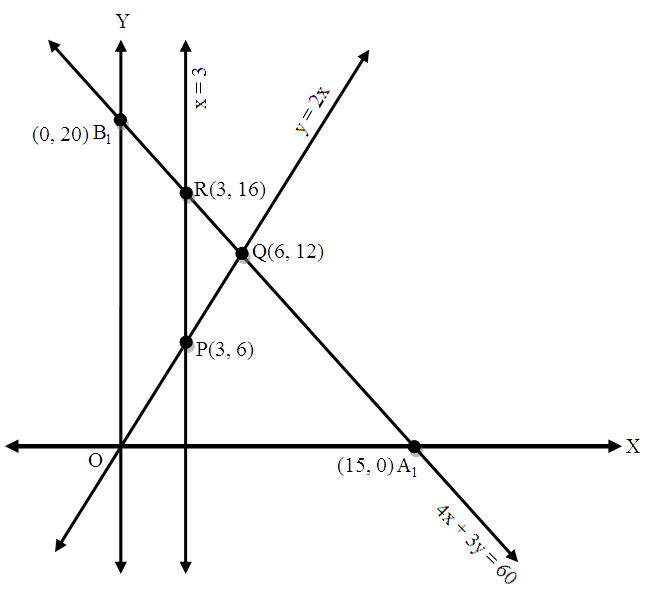
Line 4x + 3y = 60 meets axes at A1(15, 0), B1(0, 20) respectively.

Region containing origin represents 4x + 3y ≤ 60 as (0, 0) satisfies 4x + 3y ≤ 60.

Region x ≥ 3:

Line x = 3 is parallel to y-axis meets x-axes at A2(3, 0).

Region containing origin represents x ≥ 70 as(0, 0) satisfies x ≥ 3.

Region y ≥ 2x:

Line y = 2x is passes throgh origin and P(3, 6).

Region containging B1(0, 20) represents y ≥ 2x as (0, 20) satisfies y ≥ 2x.

Region x, y ≥ 0:

It represent first quandrant.

Shaded region PQR represents feasible region.

Point Q(6, 12) is obtained by solving y = 2x and 4x + 3y = 60

Point R(3, 16) is obtained by solving x = 3 and 4x + 3y = 60.

The value of Z = 3x + 2y at

P(3, 6) = 3(3) +2(6) = 21

Q(6, 12) = 3(6) + 2(12) = 42

R(3, 16) = 3(3) +2(16) = 41

Maximum Z = 42 at x = 6, y = 12

Number of large box = 6, small box =12

Maximum profit - Rs. 42.

View full question & answer
Question 734 Marks
A company sells two different products, A and B. The two products are produced in a common production process, which has a total capacity of 500 man-hours. It takes 5 hours to produce a unit of A and 3 hours to produce a unit of B. The market has been surveyed and company officials feel that the maximum number of unit of A that can be sold is 70 and that for B is 125. If the profit is Rs. 20 per unit for the product A and Rs. 15 per unit for the product B, how many units of each product should be sold to maximize profit?
Answer

Let x units of product A and y units of product B were manufactured.

Clearly, x ≥ 0, y ≥ 0

It takes 5 hours to produce a unit of A and 3 hours to produce a unit of B.

The two products are produced in a common production process, which has a total capacity of 500 man-hours.

5x + 3y ≤ 500

The maximum number of unit of A that can be sold is 70 and that for B is 125.

X ≤ 70

y ≤ 125

If the profit is Rs. 20 per unit for the product A and Rs. 15 per unit for the product B.

Therefore, profit x units of product A and y units of product B is Rs. 20x and Rs. 15y respectively.

Total profit = Z = 20x + 15y

The mathematical formulation of the given problem is

Max Z = 20x + 15y

Subject to

5x + 3y ≤ 500

x ≤ 70

y ≤ 125

x ≥ 0

y ≥ 0

First we will convert inequations into equations as follows:

5x + 3y = 500, x = 70, y = 125, x = 0 and y = 0

Region represented by 5x + 3y ≤ 500:

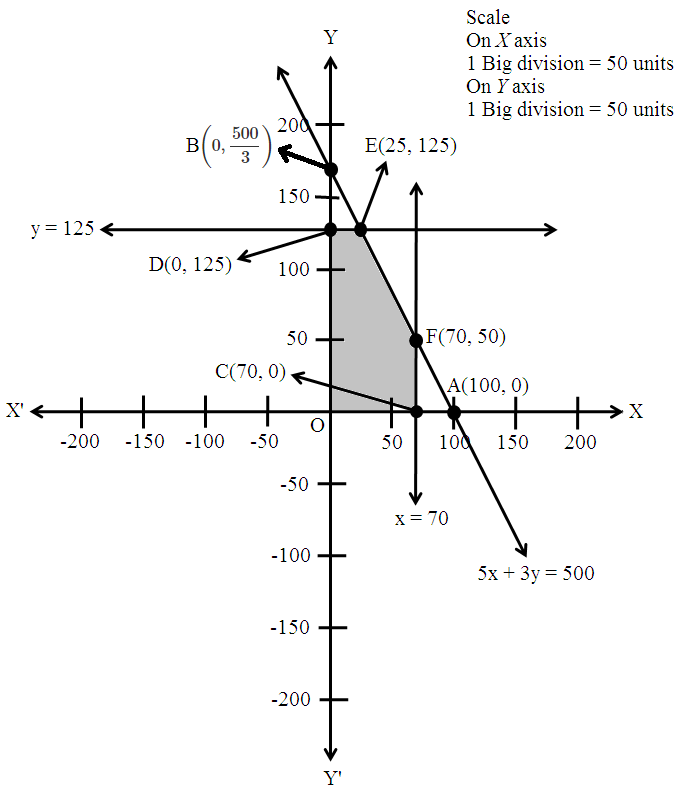
The line 5x + 3y = 500 meets the coordinate axes at A1(100, 0) and B1(0,5003) respectively.

By joining these points we obtain the line 5x + 3y = 500.

Clearly (0, 0) satisfies the 5x + 3y = 500.

So, the region which contains the origin represents the solution set of the inequation 5x + 3y ≤ 500.

Region represented by x ≤ 70:

The line x = 70 is the line passes through C1(70, 0) and is parallel to Y axis.

The region to the left of the line x = 70 will satisfy the inequation x ≤ 70.

Region represented by y ≤ 125:

The line y = 125 is the line passes through D1(0, 125) and is parallel to X axis.

The region below the the line y = 125 will satisfy the inequation y ≤ 125.

Region represented by x ≥ 0 and y ≥ 0:

Since, every point in the first quadrant satisfies these inequations.

So, the first quadrant is the region represented by the inequations x ≥ 0, and y ≥ 0.

The feasible region determined by the system of constraints 5x + 3y ≤ 500, x ≤ 70, y ≤ 125, x ≥ 0 and y ≥ 0 are as follows.

The corner points are O(0, 0), D1(0, 125), E1(25, 125), F1(70, 50) and C1(70, 0).

The values of Z at the corner points are

Corner points
Z = 20x + 15y
O
0
D1
1875
E1
2375
F1
2150
C1
1400

The maximum value of Z is 2375 which is at E1(25, 125).

Thus, maximum profit is Rs. 2375, 25 units of A and 125 units of B should be manufactured.

View full question & answer
Question 744 Marks
Kellogg is a new cereal formed of a mixture of bran and rice that contains at least 88 grams of protein and at least 36 milligrams of iron. Knowing that bran contains 80 grams of protein and 40 milligrams of iron per kilogram, and that rice contains 100 grams of protein and 30 milligrams of iron per kilogram, find the minimum cost of producing this new cereal if bran costs Rs. 5 per kg and rice costs Rs 4 per kg.
Answer

Let required quantity of bran and rice be x kg and y kg.

Given, costs of one kg of bran and rice are Rs. 5 and Rs. 4 per kg,

So, costs of X unit of bran and Y kg of rice are 5x and Rs 4y respectively,

Let total cost of bran and rice be Z, so,

Z = 5x + 4y

Since one kg of bran and rice contain 80 and 100 mg of protien, so, x kg of bran and y kg of rice contain 80x and 100y grms of protien respectively, but minimum requirement of protien for kelloggs is 88 gms, so

$80\text{x}+100\text{y}\geq88$

$20\text{x}+25\text{y}\geq22$ (first constraint)

Since one kg of bran and rice contain 40 mg and 30 mg of iron, so, x kg of bran and y kg of rice contain 40x and 30y mg of iron respectively, but minimum requirement of iron is 36 mg for kelloggs, so $40\text{x}+30\text{y}\geq36$

$40\text{x}+30\text{y}\geq36$ (second constraint)

Hence, mathematical formulation of LPP is,

Find x and y which minimize

Z = 5x + 4y

subject to constraints,

$20\text{x}+25\text{y}\geq22$

$40\text{x}+30\text{y}\geq36$

$\text{x},\text{y}\geq0$ [Since quantity of bran and rice can not be less than zero]

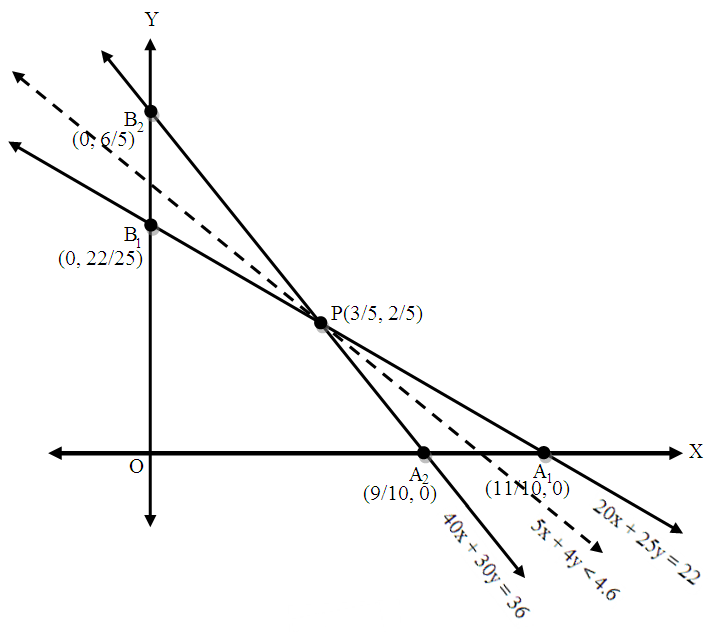
Region $20\text{x}+25\text{y}\geq22$: line 20x + 25y = 22 meets axes at $\text{A}_1\Big(\frac{11}{10},0\Big),\text{B}_1\Big(0,\frac{22}{25}\Big)$ espectively.

Region not containing origin represents $20\text{x}+25\text{y}\geq22$ as (0, 0) does not satisfy $20\text{x}+25\text{y}\geq22$.

Region $40\text{x}+30\text{y}\geq36$ line 40x + 30y = 36 meets axes at $\text{A}_1\Big(\frac{9}{10},0\Big),\text{B}_1\Big(0,\frac{6}{5}\Big)$

Region not containing origin represents $40\text{x}+30\text{y}\geq36$ as (0, 0) does not satisfy $40\text{x}+30\text{y}\geq36$.

The value of Z = 5x + 4y at

$\text{A}_1\Big(\frac{11}{10},0\Big)=5\Big(\frac{11}{10}\Big)+4(0)=5.5$

$\text{P}\Big(\frac{3}{5},\frac{2}{5}\Big)=5\Big(\frac{3}{5}\Big)+4\Big(\frac{6}{5}\Big)=4.6$

$\text{B}_2\Big(0,\frac{6}{5}\Big)=5(0)+4\Big(\frac{6}{5}\Big)=4.8$

Smallest value of Z is 4.6.

Now open half plane 5x + 4y < 4.6 has no point in common with feasible region so, smallest value z is the minimum value.

Hence,

Minimum cost of mixture = Rs 4.6

View full question & answer
Question 754 Marks
Maximum Z = 15x + 10y
Subject to
$3\text{x}+2\text{y}\leq80$
$2\text{x}+3\text{y}\leq70$
$\text{x},\text{y}\geq0$
Answer

First, we will convert the given inequations into equations, we obtain the following equations:

3x + 2y = 80, 2x + 3y = 70, x = 0 and y=0

Region represented by $3\text{x}+2\text{y}\leq80:$

The line 3x + 2y = 80 meets the coordinate axes at $\text{A}\Big(\frac{80}{3},0\Big)$ and B(0, 40) respectively.

By joining these points we obtain the line 3x + 2y = 80.

Clearly (0,0) satisfies the inequation $3\text{x}+2\text{y}\leq80$.

So, the region containing the origin represents the solution set of the inequation $3\text{x}+2\text{y}\leq80$.

Region represented by $2\text{x}+3\text{y}\leq70:$

The line 2x + 3y = 70 meets the coordinate axes at C(35, 0) and $\text{D}\Big(0,\frac{70}{3}\Big)$ respectively.

By joining these points we obtain the line $2\text{x}+3\text{y}\leq70$.

Clearly (0,0) satisfies the inequation $2\text{x}+3\text{y}\leq70$.

So, the region containing the origin represents the solution set of the inequation $2\text{x}+3\text{y}\leq70$.

Region represented by $\text{x}\geq0$ and $\text{y}\geq0$.

Since, every point in the first quadrant satisfies these inequations.

So, the first quadrant is the region represented by the inequations $\text{x}\geq0$ and $\text{y}\geq0$.

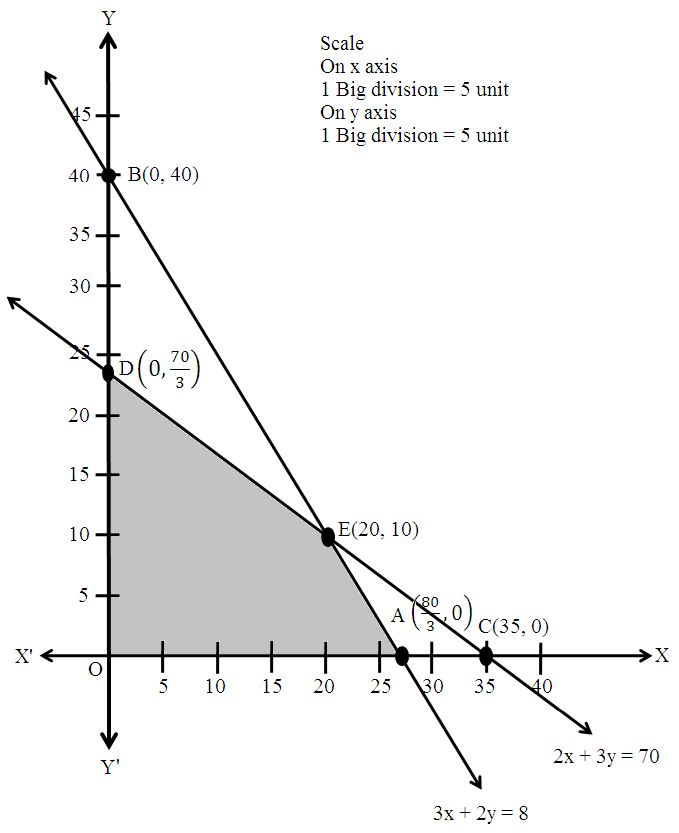
The feasible region determined by the system of constraints $3\text{x}+2\text{y}\leq80$$2\text{x}+3\text{y}\leq70$$\text{x}\geq0$ and $\text{y}\geq0$ are as follows.

The corner points of the feasible are O(0, 0), $\text{A}\Big(\frac{80}{3},0\Big)\text{E}(20,10)$ and $\text{D}\Big(0,\frac{700}{3}\Big)$ .

The values of Z at these corner point are as follows.

$\text{Corner point}$
$\text{Z}=15\text{x}+10\text{y}$
$\text{O}(0, 0)$
$15\times0+10\times0=0$
$\text{A}\Big(\frac{80}{3},0\Big)$
$15\times\frac{80}{3}+10\times0=400$
$\text{E}(20, 10)$
$15\times20+10\times10=400$
$\text{D}\Big(0,\frac{70}{3}\Big)$
$15\times0+10\times\frac{70}{3}=\frac{700}{3}$

We see that maximum value of the objective functioin Z is 400 which is at $\text{A}\Big(\frac{80}{3},0\Big)$ and E(20, 10).

Thus, the optimal value of Z is 400.

View full question & answer
Question 764 Marks
A manufacturer produces two products A and B. Both the products are processed on two different machines. The available capacity of first machine is 12 hours and that of second machine is 9 hours per day. Each unit of product A requires 3 hours on both machines and each unit of product B requires 2 hours on first machine and 1 hour on second machine. Each unit of product A is sold at Rs. 7 profit and that of B at a profit of Rs. 4. Find the production level per day for maximum profit graphically.
Answer
Let x units of product A and y units of product B be manufactured by the manufacturer per day.
It is given that one unit of product A requires 3 hours of processing time on first machine, while one unit of product B requires 2 hours of processing time on first machine.
It is also given that first machine is available for 12 hours per day.
$\therefore$ 3x + 2y ≤ 12
Also, one unit of product A requires 3 hours of processing time on second machine, while one unit of product B requires 1 hour of processing time on second machine.
It is also given that second machine is available for 9 hours per day.
$\therefore$ 3x + y ≤ 9
The profits on one unit each of product A and product B is Rs. 7 and Rs 4, respectively.
So, the objective function is given by Z =  Rs. (7x + 4y).
Therefore, the mathematical formulation of the given linear programming problem can be stated as:

Maximize Z = 7x + 4y 
Subject to the constraints
3x + 2y ≤ 12 .....(1)
3x + y ≤ 9 .....(2)
x ≥ 0, y ≥ 0 .....(3)
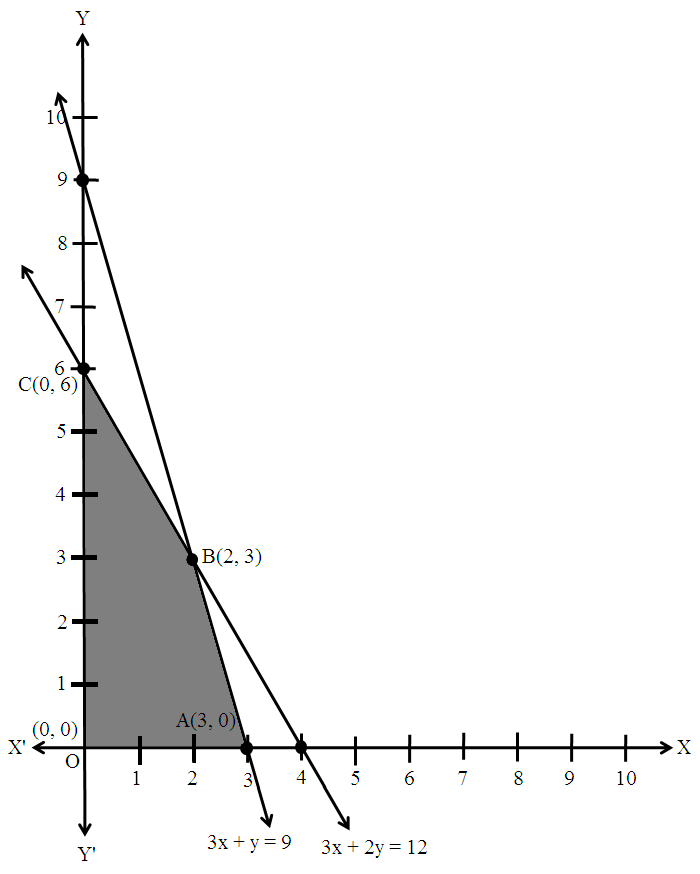
The feasible region determined by constraints (1) to (3) is graphically represented as:

Here, it is seen that OABCO is the feasible region and it is bounded.
The values of Z at the corner points of the feasible region are represented in tabular form as:
Corner point
Z = 7x + 4y
O(0, 0)
Z = 7 × 0 + 4 × 0 = 0
A(0, 10)
Z = 7 × 3 + 4 × 0 = 21
B(173, 0)
Z = 7 × 2 + 4 × 3 = 26
C(3, 8)
Z = 7 × 0 + 4 × 6 = 24
The maximum value of Z is 26, which is obtained at x = 2 and y = 3.
Thus, 2 units of product A and 3 units of product B should be manufactured by the manufacturer per day in order to maximize the profit.
Also, the maximum daily profit of the manufacturer is Rs. 26.
View full question & answer
Question 774 Marks
A diet is to contain at least 80 units of vitamin A and 100 units of minerals. Two foods F1 and F2 are available. Food F1 costs Rs 4 per unit and F2 costs Rs 6 per unit one unit of food F1 contains 3 units of vitamin A and 4 units of minerals. One unit of food F2 contains 6 units of vitamin A and 3 units of minerals. Formulate this as a linear programming problem and find graphically the minimum cost for diet that consists of mixture of these foods and also meets the mineral nutritional requirements.
Answer

Let the dietician wishes to mix x units of food F1 and y kg of F2.

Clearly, $\text{x},\text{y}\geq0$ 

The given information can be tabulated as follows:

 
Vitamin A
Vitamin B
Food F1
3 4
Food F2
6 3
Minimum requirement 80 100

The constraints are

$3\text{x}+6\text{y}\geq80$

$4\text{x}+3\text{y}\geq100$

It is given that cost of food Fand F2 is Rs. 4 and Rs. 6 per unit respectively.

Therefore, cost of x units of food F1 and y units of food F2 is Rs. 4x and Rs. 6y respectively.

Let Z denote the total cost

$\therefore$ Z = 4x + 6y

Thus, the mathematical formulat​ion of the given linear programmimg problem is Minimize Z = 4x+6y

subject to

$3\text{x}+6\text{y}\geq80$

$4\text{x}+3\text{y}\geq100$

$\text{x},\text{y}\geq0$

First, we will convert the given inequations into equations, we obtain the following equations:

3x + 6y = 80, 4x + 3y = 100, x = 0 and y = 0

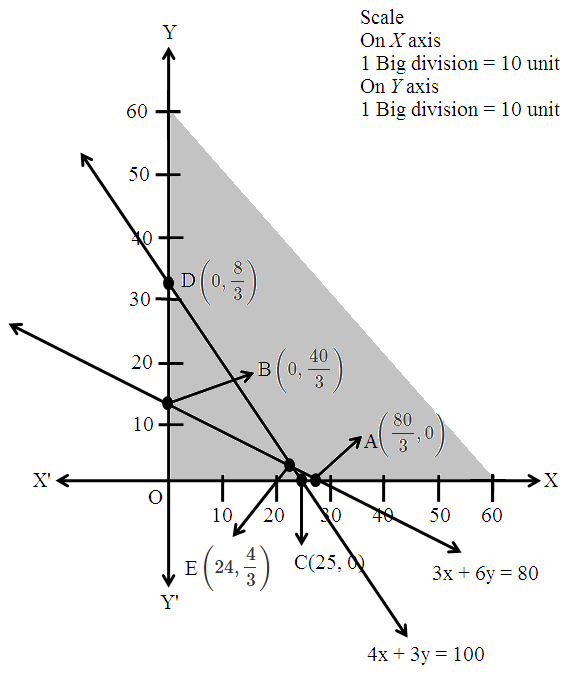
The line 3x + 6y = 80 meets the coordinate axis at $\text{A}\Big(\frac{80}{3},0\Big)$ and $\text{B}\Big(0,\frac{40}{3}\Big)$.

Join these points to obtain the line 3x + 6y= 80.

Clearly, (0, 0) does not satisfies the inequation $3\text{x}+6\text{y}\geq80$.

So, the region in xy-plane that does not contains the origin represents the solution set of the given equation.

The line 4x + 3y = 100 meets the coordinate axis at C(25, 0) and $\text{D}\Big(0,\frac{100}{3}\Big)$.

Join these points to obtain the line 4x + 3y = 100.

Clearly, (0, 0) does not satisfies the inequation $4\text{x}+3\text{y}\geq100$.

So, the region in xyplane that does not contains the origin represents the solution set of the given equation.

Region represented by x ≥ 0 and y ≥ 0:

Since, every point in the first quadrant satisfies these inequations.

So, the first quadrant is the region represented by the inequations.

These lines are drawn using a suitable scale.

The feasible region determined by the system of constraints is

The corner points are $\text{D}\Big(0,\frac{100}{3}\Big),\text{E}\Big(24,\frac{4}{3}\Big)$ and $\text{A}\Big(\frac{80}{3},0\Big)$.

The values of Z at these corner points are as follows:

$\text{Corner point}$

$\text{Z}=4\text{x}+6\text{y}$

$\text{D}\Big(0,\frac{100}{3}\Big)$

$200$

$\text{E}\Big(24,\frac{4}{3}\Big)$

$104$

$\text{A}\Big(\frac{80}{3},0\Big)$

$\frac{320}{3}$

The minimum value of Z is Rs. 104 which is at $\text{E}\Big(24,\frac{4}{3}\Big)$.

View full question & answer
Question 784 Marks
A dietician wishes to mix together two kinds of food X and Y in such a way that the mixture contains at least 10 units of vitamin A, 12 units of vitamin B and 8 units of vitamin C. The vitamin contents of one kg food is given below:
Food
Vitamin A
Vitamin B
Vitamin C
X
1
2
3
Y
2
2
1
One kg of food X costs Rs. 16 and one kg of food Y costs Rs 20. Find the least cost of the mixture which will produce the required diet?
Answer

Let x be the amount of food X and Y be the amount of food Y that is to be mixed which will produce the required diet.

Then the mathematical modal of the LPP is as follows:

Minimise Z = 16x + 20y

Subject to 

$2\text{x}+2\text{y}\geq12$

$3\text{x}+\text{y}\geq8$

$\text{x}\geq0,\text{y}\geq0$

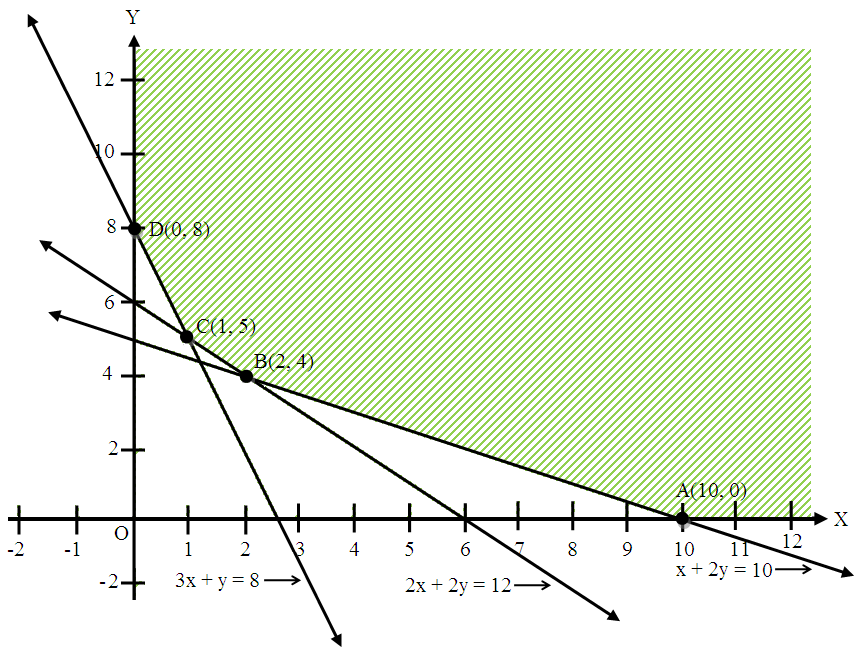
To solve the LPP we draw the lines,

x + 2y = 10

2x + 2y = 12

3x + y = 8

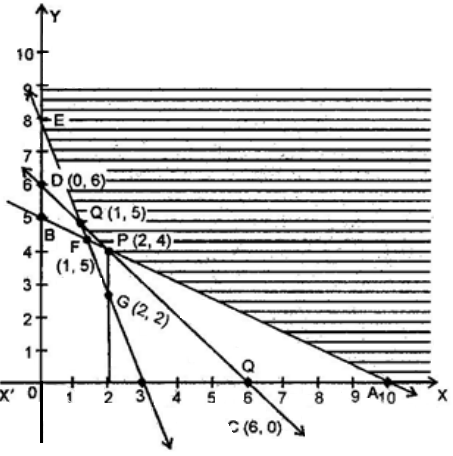
The feasible region of the LPP is shaded in graph.

The coordinates of the vertices (corner points) of the feasible region ABCD are A(10, 0), B(2, 4), C(1, 5) and D(0, 8).

The value of the objective function at these points are given in the following table.

Point (x1, x2)
Value of objective function Z = 16x + 20y
A(10, 0) Z = 160
B(2, 4)
Z = 112
C(1, 5) Z = 116
D(0, 8) Z = 160

2kg of food X and 4kg of food Y will be required to minimize the cost of the diet.

The least cost of the mixture is Rs. 112.

View full question & answer
Question 794 Marks
A company manufactures two articles A and B. There are two departments through which these articles are processed: (i) assembly and (ii) finishing departments. The maximum capacity of the first department is 60 hours a week and that of other department is 48 hours per week. The product of each unit of article A requires 4 hours in assembly and 2 hours in finishing and that of each unit of B requires 2 hours in assembly and 4 hours in finishing. If the profit is Rs. 6 for each unit of A and Rs 8 for each unit of B, find the number of units of A and B to be produced per week in order to have maximum profit.
Answer

Let x units and y units of articles A and B are produced respectively.

Number of articles cannot be negative.

Therefore, x, y ≥ 0

The product of each unit of article A requires 4 hours in assembly and that of article B requires 2 hours in assembly and the maximum capacity of the assembly department is 60 hours a week

4x + 2y ≤ 60

The product of each unit of article A requires 2 hours in finishing and that of article B requires 4 hours in assembly and the maximum capacity of the finishing department is 48 hours a week.

2x + 4y ≤ 48

If the profit is Rs. 6 for each unit of A and Rs. 8 for each unit of B.

Therefore, profit gained from​ x units and y units of articles A and B respectively is Rs. 6x and Rs. 8y respectively.

Total revenue = Z = 6x + 8y which is to be maximised.

Thus, the mathematical formulat​ion of the given linear programmimg problem is

Max Z =  6x + 8y

Subject to

2x + 4y ≤ 48

4x + 2y ≤ 60

x, y ≥ 0

First we will convert inequations into equations as follows:

2x + 4y = 48, 4x + 2y = 60, x = 0 and y = 0 

Region represented by 2x + 4y ≤ 48:

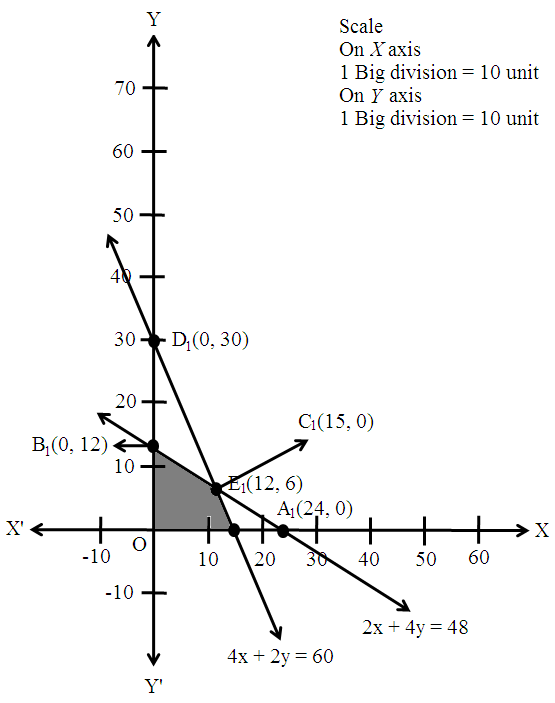
The line 2x + 4y = 48 meets the coordinate axes at A1(24, 0) and B1(0, 12) respectively.

By joining these points we obtain the line 2x + 4y = 48.

Clearly (0, 0) satisfies the 2x + 4y = 48.

So, the region which contains the origin represents the solution set of the inequation  2x + 4y ≤ 48.

Region represented by 4x + 2y ≤ 60:

The line 4x + 2y = 60 meets the coordinate axes at C1(15, 0) and D1(0, 30) respectively.

By joining these points we obtain the line 4x + 2y = 60.

Clearly (0, 0) satisfies the inequation 4x + 2y ≤ 60.

So, the region which contains the origin represents the solution set of the inequation 4x + 2y ≤ 60.

Region represented by x ≥ 0 and y ≥ 0:

Since, every point in the first quadrant satisfies these inequations.

So, the first quadrant is the region represented by the inequations x ≥ 0, and y ≥ 0.

The feasible region determined by the system of constraints 2x + 4y ≤ 48, 4x + 2y ≤ 60, x ≥ 0 and y ≥ 0 are as follows.

The corner points are O(0, 0), B1(0, 12), E1(12, 6) and C1(15, 0). 

The values of Z at these corner points are as follows.

Corner points
Z = 6x + 8y
O
0
B1
96
E1
120
C1
90

The maximum value of Z is 120 which is attained at E1(12, 6).

Thus, the maximum profit is Rs. 120 obtained when 12 units of article A and 6 units of article B were manufactured.

View full question & answer
Question 804 Marks
A company produces two types of goods, A and B, that require gold and silver. Each unit of type A requires 3gm of silver and 1 gm of gold while that of type B requires 1 gm of silver and 2gm of gold. The company can produce 9gm of silver and 8gm of gold. If each unit of type A brings a profit of Rs. 40 and that of type B Rs. 50, find the number of units of each type that the company should produce to maximize the profit. What is the maximum profit?
Answer

Let number of goods A and B are x and y respectively.

Since, profits on each A and B are Rs. 40 and Rs. 50 respectively.

So, profits on x of type A and y of type B are 40x and 50y respectively, Let Z be total profit on A and B, so,

Z = 40x + 50y

Since, each A and B require 3gm and 1gm of silver respectively.

So, x of type A and y type B require 3x and y gm silver respectively but, Total silver available is 9 gm. so,

$3\text{x}+\text{y}\leq9$ (first constraint)

Since, each A and B require 1gm and 2gm of gold respectively.

So, x of type A and y type B require x and 2y gm of gold respectively but, Total gold available is 8 gm, so,

$\text{x}+2\text{y}\leq8$ (second constraint)

Hence, mathematical formulation of LPP is,

Find x and y which maximize

Z = 40x + 50y

Subject to constraints,

$3\text{x}+\text{y}\leq9$

$\text{x}+2\text{y}\leq8$

$\text{x},\text{y}\geq0$ [Since production of A and B can not be less than zero]

Region $3\text{x}+\text{y}\leq9$:

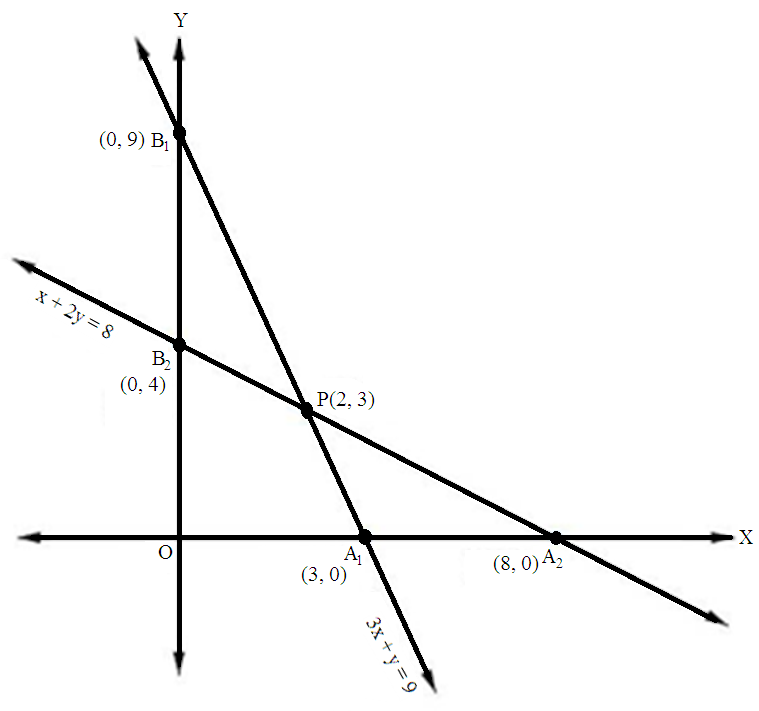
Line 3x +y = 9 meets axes at A(3, 0), B(0, 9) respectively.

Region containing origin represents $3\text{x}+\text{y}\leq9$ as (0, 0) satisfies $3\text{x}+\text{y}\leq9$.

Region $\text{x}+2\text{y}\leq8$:

Line x +2y = 8 meets axes at A2(8, 0), B2(0, 4) respectively.

Region containing origin represents $\text{x}+2\text{y}\leq8$ as (0, 0) satisfies $\text{x}+2\text{y}\leq8$.

Region $\text{x},\text{y}\geq0$:

It represents first quadrant.

Shaded region OA2PB2 is the feasible region.

Point P(2, 3) is obtained by solving 3x + y - 9 and x + 2y = 8

The value of Z = 40x + 50y at

O(0, 0) = 40(0) + 50(0) = 0

A1(3, 0) = 40(3) + 50(0) = 120

P(2, 3) = 40(2) + 50(3) = 230

B2(0, 4) = 40(0) + 50(4) = 200

Therefore maximum Z = 230 at x = 2, y = 3

Hence,

Maximum profit = Rs. 230 number of goods of type A = 2, type B = 3

View full question & answer
Question 814 Marks
A small manufacturer has employed 5 skilled men and 10 semi-skilled men and makes an article in two qualities deluxe model and an ordinary model. The making of a deluxe model requires 2 hrs. work by a skilled man and 2 hrs. work by a semi-skilled man. The ordinary model requires 1 hr by a skilled man and 3 hrs. by a semi-skilled man. By union rules no man may work more than 8 hrs per day. The manufacturers clear profit on deluxe model is Rs. 15 and on an ordinary model is Rs. 10. How many of each type should be made in order to maximize his total daily profit.
Answer

Let x articles of deluxe model and y articles of an ordinary model be made.

Number of articles cannot be negative.

Therefore, $\text{x},\text{y}\geq0$

According to the question, the making of a deluxe model requires 2 hrs.

Work by a skilled man and the ordinary model requires 1 hr by a skilled man

$2\text{x}+\text{y}\leq40$

The making of a deluxe model requires 2 hrs.

Work by a semi-skilled man ordinary model requires 3 hrs.

Work by a semi-skilled man. $2\text{x}+3\text{y}\leq80$

Total profit = Z = 152 + 10y which is to be maximised

Thus, the mathematical formulation of the given linear programmimg problem is

Max Z = 15x + 10y

Subject to

$2\text{x}+\text{y}\leq40$

$2\text{x}+3\text{y}\leq80$

$\text{x}\geq0$

$\text{y}\geq0$

The feasible region determined by the system of constraints is:

The corner points are $\text{A}\Big(0,\frac{800}{3}\Big)$, B(10, 20), C(20, 0).

The values of Z at these corner points are as follows.

Corner point
Z = 15x + 10y
A
$\frac{800}{3}$
B
350
C
300

The maximum value of Z is 300 which is attained at C(20, 0).

Thus, the maximum profit is Rs. 300 obtained when 10 units of deluxe modal and 20 unit of ordinary model is produced.

View full question & answer
Question 824 Marks
A firm manufactures 3 products A, B and C. The profits are Rs. 3, Rs. 2 and Rs. 4 respectively. The firm has 2 machines and below is the required processing time in minutes for each machine on each product:
Machine
Products
A
B
C
M1
4
3
5
M2
2
2
4
Machines M1 and Mhave 2000 and 2500 machine minutes respectively. The firm must manufacture 100 A's, 200 B's and 50 C's but not more than 150 A's. Set up a LPP to maximize the profit.
Answer
Product
Machine (M1)
Machine (M2)
Profit
A
4
2
3
B
3
2
2
C
5
4
4
Capacity maximum
2000
2500
 

Let required production of product A, B and C bex,y and z units respectively.

Given, profit on one unit of product A, B and C are Rs. 3, RS. 2, RS. 4, so Profit on x unit of A, y unit of B and z unit of C are given by Rs. 3x, Rs. 2y, Rs. 4z.

Let U be the total profit, so

U = 3x + 2y + 4z

Given, one unit of product A, B and C requires 4,3 and 5 minutes on machine M. So, x units of product A, y units of B and z units of product C need 4x, 3y and 5z minutes on machine M, is 2000 minutes, so

$4\text{x}+3\text{y}+5\text{z}\leq200$ (First constraint)

Given, one unit of product A, B and C requires 2,2 and 4 minutes on machine M2. So, X units of A, y units of B and z units of C require 2x, 2y and 4z minutes on machine M2 is 2500 minutes, so

$2\text{x}+2\text{y}+4\text{z}\leq2500$ (Second constraint)

Also, given that firm must manufacture 100 A's, 200 B's and 50 C's but not more than 150 A's.

$100\leq\times\leq150$

$\text{y}\geq200$ (Other constraints)

$\text{z}\geq50$

Hence, mathematical formulation of LPP is:-

Find x, y and z which

maximize U = 3x + 2y + 4z

Subject to constraints,

$4\text{x}+3\text{y}+5\text{z}\leq2000$

$2\text{x}+2\text{y}+4\text{z}\leq2500$

$100\leq\times\leq150$

$\text{y}\geq200$

$\text{z}\geq50$

And, $\text{x},\text{y},\text{z}\geq0$ [Since, x, y, z are non-negative]

View full question & answer
Question 834 Marks
A chemical company produces two compounds, A and B. The following table gives the units of ingredients, C and D per kg of compounds A and B as well as minimum requirements of C and D and costs per kg of A and B. Find the quantities of A and B which would give a supply of C and D at a minimum cost.
 
Compound
Minimum requirement
A
B
 
Ingredient C
1
2
80
Ingredient D
3
1
75
Coist (in Rs.) per Kg
4
6
 
Answer

Let required quantity of compound A and B are x and y kg.

Since, cost of one kg of compound A and B are Rs. 4 and Rs. 6 per kg.

So, cost of x kg. of compound A and y kg. of compound B are Rs. 4x and Rs by respectively,

Let Z be the total cost of compounds, so,

Z = 4x + 6y

Since, compound A and B contain 1 and 2 units of ingredient c per kg, respectively, so, x kg. of compound A and y kg. of compound B contain x and 2y units of ingredient C respectively but minimum requirement of ingredient C is 80 units, so,

$\text{x}+2\text{y}\geq80$ (first constraint)

Since, compound A and B contain 3 and 1 unit of ingredient D per kg, respectively, so, x kg. of compound A and y kg. of compound B contain 3x and y units of ingredient respectively but minimum requirement of ingredient D is 75 units, so,

$3\text{x}+\text{y}\geq75$ (second constraint)

Hence, mathematical formulation of LPP is,

Find x and y which minimize

Z = 4x + 6y

Subject to constraints,

$\text{x}+2\text{y}\geq80$

$3\text{x}+\text{y}\geq75$

$\text{x},\text{y}\geq0$ [Since production can not be less than zero]

Region $\text{x}+2\text{y}\geq80$:

Line x + 2y = 80 meets axes at A1(80, 0), B1(0, 40) respectively.

Region not containing origin represents $\text{x}+2\text{y}\geq80$ as (0, 0) does not satisfy $\text{x}+2\text{y}\geq80$.

Region $3\text{x}+\text{y}\geq75$:

Line 3x +y = 75 meets axes at A2(25, 0), B2(0, 75) respectively.

Region not containing origin represents $3\text{x}+\text{y}\geq75$ as (0, 0) does not satisfy $3\text{x}+\text{y}\geq75$.

Region $\text{x},\text{y}\geq0$:

It represents first quadrant.

Unbouded shaded region A1PB2 represents feasible region point is obtained by solving x + 2y = 80 and 3x + y = 75

The value of Z = 4x + 6y at

A1(80, 0) = 4(80) + 6(0) = 320

P(14, 33) = 4(14) + 6(33) = 254

B2(0, 75) = 4(0) + 6(75) = 450

Smallest value of Z = 254 open half plane 4x + 6y < 254 has no point in common with feasible region.

So,

Smallest value is the minimum value.

Minimum cost = Rs. 254

Quantity of A = 14kg

Quantity of B = 33kg.

View full question & answer
Question 844 Marks
Two tailors A and B earn Rs 150 and Rs 200 per day respectively. A can stitch 6 shirts and 4 pants per day while B can stitch 10 shirts and 4 pants per day. Form a linear programming problem to minimize the labour cost to produce at least 60 shirts and 32 pants.
Answer

Let tailor A work for x days and tailor B work for y days.

In one day, A can stitch 6 shirts and 4 pants whereas B can stitch 10 shirts and 4 pants. Thus, in x days A can stitch 6x shirts and 4x pants. Similarly, in y days B can stitch 10y shirts and 4y pants.

It is given that the minimum requirement of the shirts and pants are respectively 60 and 32 respectively.

Thus,

$6\text{x}+10\text{y}\geq60,4\text{x}+4\text{y}\geq32$

Further it is given that A and B earn Rs 150 and Rs 200 per day respectively. Thus, in x days and y days, A and B earn Rs 150x and Rs 200y respectively.

Let Z denotes the total cost

$\therefore$ Z = Rs 150x + 200 y

Number of days cannot be negative.

Therefore, $\text{x},\text{y}\geq0$

Hence, the required LPP is as follows:

Minimize Z=150x + 200 y

Subject to

$6\text{x}+10\text{y}\geq60$

$4\text{x}+4\text{y}\geq32$

$\text{x}\geq0,\text{y}\geq0$

View full question & answer
Question 854 Marks
To maintain his health a person must fulfil certain minimum daily requirements for several kinds of nutrients. Assuming that there are only three kinds of nutrients-calcium, protein and calories and the person's diet consists of only two food items, I and II, whose price and nutrient contents are shown in the table below:
 
Food I
(per Ib)
Food II
(per Ib)
Minimum daliy requarement
for the nutrient
Calcium
10
5
20
Protein
5
4
20
Calories
2
6
13
Price (Rs)
60
100
 
What combination of two food items will satisfy the daily requirement and entail the least cost? Formulate this as a LPP.
Answer

Let the person takes x lbs and y lbs of food I and II respectively that were taken in the diet. Since, per lb of food I costs Rs 60 and that of food II costs Rs 100.

Therefore, x lbs of food I costs Rs 60x and y lbs of food II costs Rs 100y.

Total cost per day = Rs (60x + 100y)

Let Z denote the total cost per day

Then, Z = 60x + 100 y

Total amount of calcium in the diet is 10x+5y

Since, each lb of food I contains 10 units of calcium. Therefore, x lbs of food I contains 10x units of calciumn.

Each lb of food II contains 5 units of calciu.So,y lbs of food II contains 5y units of calcium.

Thus, x lbs of food I and y lbs of food II contains 10x + 5y units of calcium.

But, the minimum requirement is 20 lbs of calcium.

$\therefore10\text{x}+5\text{y}\geq20$

Since, each lb of food I contains 5 units of protein. Therefore, x lbs of food I contains 5x units of protein,

Each lb of food II contains 4 units of protein. So,y lbs of food II contains 4y units of protein,

Thus, x lbs of food I and y lbs of food II contains 5x + 4y units of protein.

But, the minimum requirement is 20 lbs of protein.

$\therefore5\text{x}+4\text{y}\geq20$

Since, each lb of food I contains 2 units of calories. Therefore, x lbs of food I contains 2x units of calories.

Each lb of food II contains units of calories. So,y lbs of food II contains by units of calories.

Thus, x lbs of food I and y lbs of food II contains 2x + 6y units of calories.

But, the minimum requirement is 13 lbs of calories.

$\therefore2\text{x}+6\text{y}\geq13$

Finally, the quantities of food I and food II are non negative values.

So,$\text{x},\text{y}\geq0$

Hence, the required LPP is as follows:

Min Z = 60x + 100y

subject to

$10\text{x}+5\text{y}\geq20$

$5\text{x}+4\text{y}\geq20$

$2\text{x}+6\text{y}\geq13$

$\text{x},\text{y}\geq0$

View full question & answer
Question 864 Marks
An aeroplane can carry a maximum of 200 passengers. A profit of Rs.1000 is made on each executive class ticket and a profit of Rs.600 is made on each economy class ticket. The airline reserves atleast 20 seats for executive class. However, atleast 4 times as many passengers prefer to travel by economy class than by the executive class. Determine how many tickets of each type must be sold in order to maximise the profit of the airline. What is the maximum profit?
Answer
Suppose x tickets of executive class and y tickets of economy class are sold by the airline.

The profit on each executive class ticket is Rs. 1000 and on each economy class ticket is Rs.600.

Therefore, the total profit from x executive class tickets and y economy class ticket is Rs.(1000x + 600y).

Now, the aeroplane can carry a maximum of 200 passengers.

x + y ≤ 200

The airline reserves atleast 20 seats for executive class.

x ≥ 20

Also, atleast 4 times as many passengers prefer to travel by economy class than by the executive class.

y ≥ 4x

Thus, the given linear programming problem is

Maximise Z = 1000x + 600y

Subject to the constraints

x + y ≤ 200

x ≥ 20

y ≥ 4x

x, y ≥ 0

The feasible region determined by the given constraints can be diagrammatically represented as,

The coordinates of the corner points of the feasible region are A(20, 80), B(40, 160) and C(20, 180).

The value of the objective function at these points are given in the following table.

Corner Point
Z =1000x + 600y
(20, 8)
1000 × 20 + 600 × 80 = 68000
(40, 10)
1000 × 40 + 600 × 160 = 136000 → Maximum
(20, 180)
1000 × 20 + 600 × 180 =128000

The maximum value of Z is 136000 at x = 40, y = 160.

Hence, 40 tickets of executive class and 160 tickets of economy class should be sold to maximise the profit.

The maximum profit of the airline is Rs. 1,36,000.

View full question & answer
Question 874 Marks
A fruit grower can use two types of fertilizer in his garden, brand P and Q. The amounts (in kg) of nitrogen, phosphoric acid, potash, and chlorine in a bag of each brand are given in the table. Tests indicate that the garden needs at least 240kg of phosphoric acid, at least 270kg of potash and at most 310kg of chlorine.
Kg per bag
 
Brand P
Brand P
Nitrogen
32
3.5
Phosphoric
1
2
Potash
3
1.5
Chlorine
1.5
2
If the grower wants to minimize the amount of nitrogen added to the garden, how many bags of each brand should be used? What is the minimum amount of nitrogen added in the garden?
Answer

Let x bags of fertilizer P and Y bags of fertilizer Q used in the garden to minimize the usage of nitrogen.

Then the mathematical modal of the LPP is as follows:

Minimise Z = 3x + 3.5y

Subject to 

$\text{x}+2\text{y}\geq240$

$3\text{x}+1.5\text{y}\geq270$

$1.5\text{x}+2\text{y}\leq310$

$\text{x}\geq0,\text{y}\geq0$

To solve the LPP we draw the lines,

x + 2y = 240

3x + 1.5y = 270

1.5x + 2y = 310

The feasible region of the LPP is shaded in graph.

The coordinates of the vertices (corner points) of the feasible region ABC are A(40, 100), B(140, 50), and C(20, 140).

The value of the objective function at these points are given in the following table.

Point (x1, x2)
Value of objective function Z = 3x + 3.5y
A(40, 100) Z = 470
B(140, 50)
Z = 595
C(20, 140) Z = 550
D(0, 8) Z = 160

40 bags of brand P and 100 bags of brand Q should be used to minimize.

The amount of nitrogen added to the garden.

The minimum amount of notrogen added in the garden is 470kg.

View full question & answer
Question 884 Marks
A dietician mixes together two kinds of food in such a way that the mixture contains at least 6 units of vitamin A, 7 units of vitamin B, 11 units of vitamin C and 9 units of vitamin D. The vitamin contents of 1kg of food X and 1kg of food Y are given below:
 
Vitamin
A
Vitamin
B
Vitamin
C
Vitamin
D
Food X
1
1
1
2
Food Y
2
1
3
1
One kg food X costs Rs. 5, whereas one kg of food Y costs Rs. 8.
Find the least cost of the mixture which will produce the desired diet.
Answer

Let the dietician wishes to mix x kg of food X and y kg of Y.

Therefore, 

As we are given,

 
Vitamin
A
Vitamin
B
Vitamin
C
Vitamin
D
Food X
1
1
1
2
Food Y
2
1
3
1

It is given that the mixture should contain at least 6 units of vitamin A, 7 units of vitamin B, 11 units of vitamin C and 9 units of vitamin D.

Therefore, the constrants are

$\text{x}+2\text{y}\geq6$

$\text{x}+\text{y}\geq7$

$\text{x}+3\text{y}\geq11$

$2\text{x}+\text{y}\geq9$

It is given that cost of food X is Rs 5 per kg and cost of food Y is Rs. 8 per kg.

Thus, Z= 5x+8y

Thus, the mathematical formulation of the given linear programmimg problem is

Minimize Z= 5x+8y

subject to

$\text{x}+2\text{y}\geq6$

$\text{x}+\text{y}\geq7$

$\text{x}+3\text{y}\geq11$

$2\text{x}+\text{y}\geq9$

First, we will convert the given inequations into equations, we obtain the following equations:

x + 2y = 6, x + y = 7, x + 3y = 11, 2x + y =9, x = 0 and y=0.

The line x + 2y = 6 meets the coordinate axis at A1(6, 0) and B1(0, 3).

Join these points to obtain the line x + 2y = 6.

Clearly, (0, 0) does not satisfies the inequation $\text{x}+2\text{y}\geq6$.

So, the region in xy-plane that does not contains the origin represents the solution set of the given equation.

The line x + y = 7 meets the coordinate axis at C1(7, 0) and D1(0, 7).

Join these points to obtain the line x + y = 7.

Clearly, (0, 0) does not satisfies the inequation $\text{x}+\text{y}\geq7$.

So, the region in xy-plane that does not contains the origin represents the solution set of the given equation.

The line x + 3y = 11 meets the coordinate axis at E1(11, 0) and $\text{F}_1\Big(0,\frac{11}{3}\Big)$.

Join these points to obtain the line x + 3y = 11.

Clearly, (0, 0) does not satisfies the inequation $\text{x}+3\text{y}\geq11$.

So, the region in xy-plane that does not contains the origin represents the solution set of the given equation.

The line 2x + y = 9 meets the coordinate axis at $\text{G}_1\Big(\frac{9}{2},0\Big)$ and H(0, 9).

Join these points to obtain the line 2x + y = 9.

Clearly, (0, 0) does not satisfies the inequation $2\text{x}+\text{y}\geq9$.

So, the region in xy-plane that does not contains the origin represents the solution set of the given equation.

Region represented by $\text{x}\geq0$ and $\text{y}\geq0$:

Since, every point in the first quadrant satisfies these inequations.

So, the first quadrant is the region represented by the inequations.

These lines are drawn using a suitable scale.

The feasible region determined by the system of constraints is

The corner points are H1(0, 9), I1(2, 5), J1(5, 2), E1(11, 0).

The values of Z at these corner points are as follows

Corner point
Z =5x + 8y
H1
72
I1
50
J1
41
E1
55

The minimum value of Z is at J1(5, 2) which is Rs. 41.
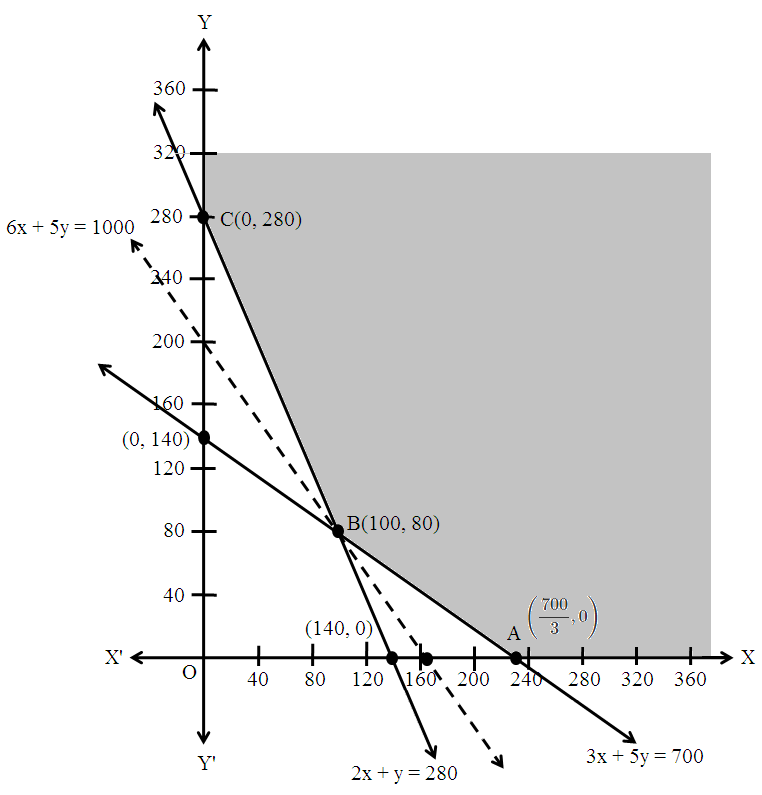
Hence, cheapest combination of foods will be 5 units of food X and 2 units of food Y.

View full question & answer
Question 894 Marks
A dietician has to develop a special diet using two foods P and Q. Each packet (containing 30g) of food P contains 12 units of calcium, 4 units of iron, 6 units of cholesterol and 6 units of vitamin A. Each packet of the same quantity of food Q contains 3 units of calcium, 20 units of iron, 4 units of cholesterol and 3 units of vitamin A. The diet requires atleast 240 units of calcium, atleast 460 units of iron and at most 300 units of cholesterol. How many packets of each food should be used to minimise the amount of vitamin A in the diet? What is the minimum Amount of vitamin A.
Answer

Let x packets of food P and y packets of food Q be used to make the diet.

Each packet of food P contains 6 units of vitamin A and each packet of food Q contains 3 units of vitamin A.

Therefore, x packets of food P and y packets of food Q contains (6x + 3y) units of vitamin A.

Since each packet of food P contains 12 units of calcium and each packet of food Q contains 3 units of calcium, therefore, x packets food P and y packets of food Q will contain (12x + 4y) units of calcium.

But, the diet should contain atleast 240 units of calcium.

$\therefore12\text{x}+3\text{y}\geq240$

$\Rightarrow4\text{x}+\text{y}\geq80$

Similarly, x packets of food P and y packets of food Q will contain (4x + 207) units of iron. But, the diet should contain atleast 460 units of iron.

$\therefore4\text{x}+20\text{y}\geq460$

$\Rightarrow\text{x}+5\text{y}\geq115$

Also, x packets of food P and y packets of food Q will contain (6x + 4y) units of cholesterol.

But, the diet should contain atmost 300 units of cholesterol.

$\therefore6\text{x}+4\text{y}\leq300$

$3\text{x}+2\text{y}\leq150$

Thus, the given linear programming problem is

Minimise Z = 6x + 3y

subject to the constraints

$4\text{x}+\text{y}\geq80$

$\text{x}+5\text{y}\geq115$

$3\text{x}+2\text{y}\leq150$

$\text{x},\text{y}\geq0$

The feasible region determined by the given constraints can be diagrammatically represented as,

The coordinates of the corner points of the feasible region are A(2, 72), B(15, 20) and C(40, 15).

The value of the objective function at these points are given in the following table.

Corner Point
Z = 6x + 3y
(2, 72)
6 × 0 + 3 × 72 = 216
(15, 20)
6 × 15 + 3 × 20 = 150
(40, 15) 6 × 40 + 3 × 15 = 285

The smallest value of Z is 150 which is obtained at x = 15 and y = 20.

It can be verified that the open half-plane represented by $6\text{x}+3\text{y}\leq150$ has no common points with the feasible region.

Thus, 15 packets of food P and 20 packets of food Q should be used to minimise the amount of vitamin A in the diet.

Hence, the minimum amount of vitamin A is 150 units.

View full question & answer
Question 904 Marks
There are two types of fertilizers Fand F2. Fconsists of 10% nitrogen and 6% phosphoric acid and ​Fconsists of 5% nitrogen and 10% phosphoric acid. After testing the soil conditions, a farmer finds the she needs atleast 14kg of nitrogen and 14kg of phosphoric acid for her crop. If Fcosts Rs 6/kg and Fcosts Rs 5/kg, determine how much of each type of fertilizer should be used so that the nutrient requirements are met at minimum cost. What is the minimum cost?
Answer
Suppose x kg of fertilizer F1 and and y kg of fertilizer F2 is used to meet the nutrient requirements.

F1 consists of 10% nitrogen and F2 consists of 5% nitrogen.

But, the farmer needs atleast 14kg of nitorgen for the crops.

10% of x kg + 5% of y kg 14kg

$\Rightarrow\frac{\text{x}}{10}+\frac{\text{y}}{20}\geq14$

$\Rightarrow2\text{x}+\text{y}\geq280$

Similarly, F1 consists of 6% phosphoric acid and F2 consists of 10% phosphoric acid.

But, the farmer needs atleast 14kg of phosphoric acid for the crops.

$\Rightarrow\frac{6\text{x}}{100}+\frac{10\text{y}}{100}\geq14$

$\Rightarrow3\text{x}+5\text{y}\geq700$

The cost of fertilizer F1 is Rs. 6/kg and fertilizer F2 is Rs. 5/kg,

Therefore, total cost of x kg of fertilizer F1 and and y kg of fertilizer F2 is Rs. (6x + 5y).

Thus, the given linear programming problem is

Minimise Z = 6x + 5y

Subject to the constraints

2x + y ≥ 280

3x + 5y ≥ 700

x, y ≥ 0

The feasible region determined by the given constraints can be diagrammatically represented as,

The coordinates of the corner points of the feasible region are al $\text{A}\Big(\frac{700}{3},0\Big),$ B(100, 80) and C(0, 280).

The value of the objective function at these points are given in the following table.

$\text{Corner Point}$ $\text{Z} = 6\text{x} + 5\text{y}$
$\Big(\frac{700}{3},0\Big)$ $6\times\frac{700}{3}+5 \times 0= 1400$
$(100, 80)$ $6 \times 100+ 5 \times 80 = 1000 → \text{Minimum}$
$(0, 280)$ $6 \times 0 + 5 \times 280 =1400$

The smallest value of Z is 1000 which is obtained at x = 100, y = 80.

It can be seen that the open half-plane represented by has no common points with the feasible region.

So, the minimum value of Z is 1000.

Hence, 100kg of fertilizer F1 and 80kg of fretilizer F2 should be used so that the nutrient requirements are met at minimum cost.

The minimum cost is Rs. 1,000.

View full question & answer
Question 914 Marks
 Tow godowns, A and B, have grain storage capacity of 100 quintals and 50 quintals respectively. They supply to 3 ration shops, D, E and F, whose requirements are 60, 50 and 40 quintals respectively. The cost of transportation per quintal from the godowns to the shops are given in the following table:

How should the supplies be transported in order that the transportation cost is minimum? 

Answer
Let godown A supply x quintals and y quintals of grain to the shops D and E respectively.

Then, (100 - x - y) will be supplied to shop F.

The requirement at shop D is 60 quintals since, x quintals are transported from godown A.

Therefore, the remaining (60 - x) quintals will be transported from godown B.

Similarly, (50 - y) quintals and 40 - (100 - x - y) i.e. (x + y - 60) quintals will be transported from godown B to shop E and F respectively.

The given problem can be represented diagrammatically as follows.

Quantity of the grain cannot be negative.

Therefore, x ≥ 0, y ≥ 0, and 100 - x - y ≥ 0

x ≥ 0, y ≥ 0, and x + y ≤ 100

60 - x ≥ 0, 50 - y ≥ 0, and x + y - 60 ≥ 0

x ≤ 60, y ≤ 50, and x + y ≥ 60

Total transportation cost Z is given by,

Z = 6x + 3y + 2.5 (100 - x - y) + 4(60 - x) + 2(50 - y) + 3(x + y - 60)

= 6x + 3y + 250 - 2.5x - 2. 5y + 240 - 4x + 100 - 2y + 3x + 3y - 180

= 2.5x + 1. 5y + 410
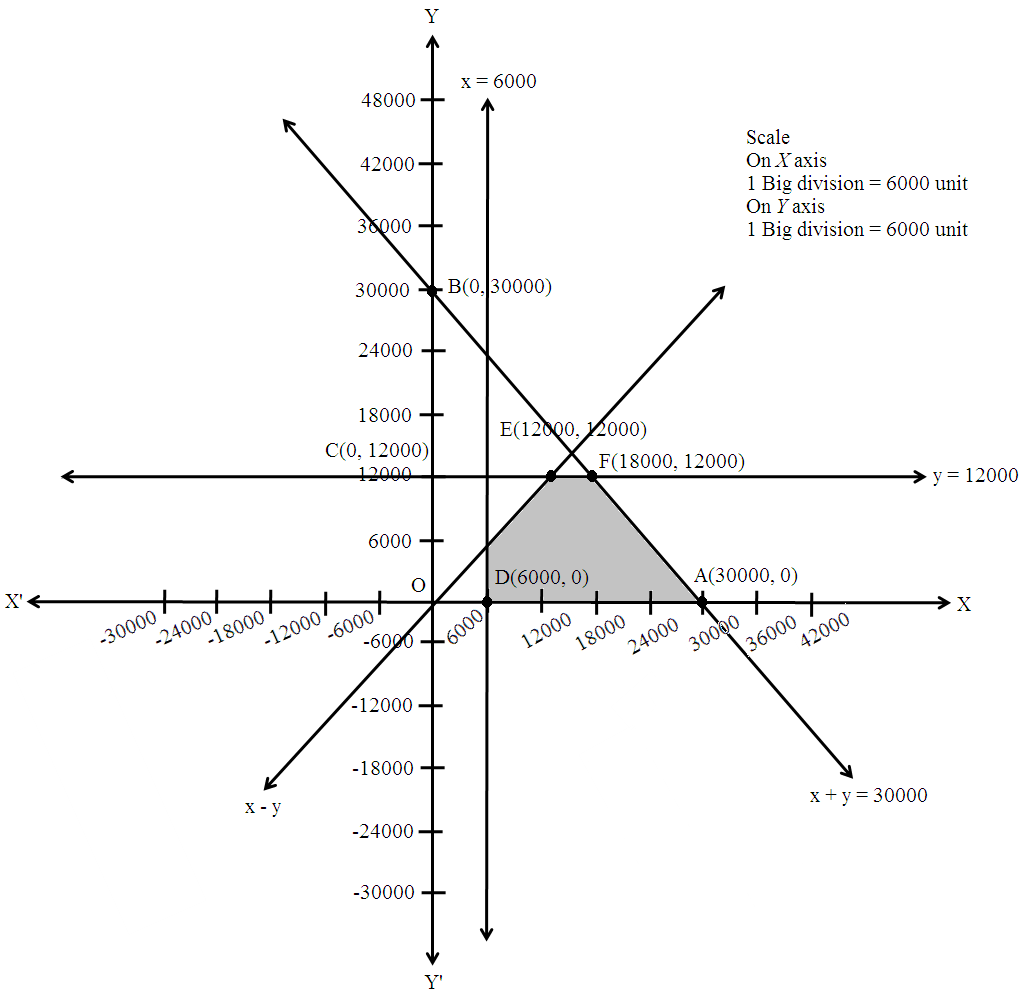
The given problem can be formulated as:

Minimize Z = 2.5x + 1.5y + 410

Subject to the constraints,

x + y ≤ 100

X ≤ 60

y ≤ 50

x + y ≥ 60

x, y ≥ 0

First we will convert inequations into equations as follows:

x + y = 100, x = 60, y = 50, x + y = 60, x = 0 and y = 0

Region represented by x + y ≤ 100:

The line x + y = 100 meets the coordinate axes at A1(100, 0) and B1(0, 100) respectively.
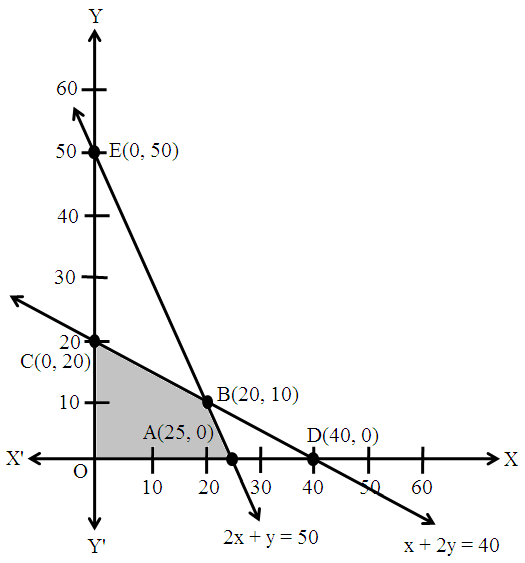
By joining these points we obtain the line x + y = 100.

Clearly (0, 0) satisfies the x + y ≤ 100.

So, the region which contains the origin represents the solution set of the inequation

x + y ≤ 100.

Region represented by x ≤ 60:

x = 60 is the line that passes (60, 0) and is parallel to the y-axis.

The region to the left of the line x = 60 will satisfy the inequation x ≤ 60.

Region represented by y ≤ 50:

y = 50 is the line that passes (0, 50) and is parallel to the x-axis.

The region below the line y = 50 will satisfy the inequation y ≤ 50.

Region represented by x + y ≥ 60:

The line x + y= 60 meets the coordinate axes at C1(60, 0) and D1(0, 60) respectively.

By joining these points we obtain the line x + y = 60.

Clearly (0, 0) does not satisfies the inequation x + y ≥ 60.

So, the region which does not contain the origin represents the solution set of the inequation x + y ≥ 60.

Region represented by x ≥ 0 and y ≥ 0:

Since, every point in the first quadrant satisfies these inequations.

So, the first quadrant is the region represented by the inequations x ≥ 0, and y ≥ 0.

The feasible region determined by the system of constraints x + y ≤ 100, x ≤ 60, y ≤ 50, x + y ≥ 60, x ≥ 0 and y ≥ 0 are as follows.

The corner points are C1(60, 0), G1(60, 40), F1(50, 50), and E1(10, 50).

The values of Z at these corner points are as follows:

Corner point
Z = 2.5x + 1.5y + 410
C1(60, 0)
560
G1(60, 0)
620
F1(50, 5)
610
E1(10, 0)
510

The minimum value of Z is 510 at E1(10, 50).

Thus, the amount of grain transported from A to D, E, and F is 10 quintals, 50 quintals, and 40 quintals respectively and from B to D, E, and F is 50 quintals, 0 quintals, and 0 quintals respectively.

The minimum cost is Rs. 510.

View full question & answer
Question 924 Marks
A dietician wishes to mix together two kinds of food X and Y in such a way that the mixture contains at least 10 units of vitamin A, 12 units of vitamin B and 8 units of vitamin C. The vitamin contents of one kg food is given below:
Food Vitamin A Vitamin B Vitamin C
X 1 2 3
Y 2 2 1
One kg of food X costs Rs. 16 and one kg of food Y costs Rs. 20. Find the least cost of the mixture which will produce the required diet?
Answer
Let in the mixture food X weighs = x kg and in the mixture food Y weighs = y kg.

We have to minimize Z = 16x + 20 y subject to constraints $\text{x}+2\text{y}\geq10,\ 2\text{x}+2\text{y}\geq12,\ 3\text{x}+\text{y}\geq8,\ \text{x}\geq0,\ \text{y}\geq0$

Consider $\text{x}+2\text{y}\geq10$

Let x + 2y = 10

$\Rightarrow\ \frac{\text{x}}{10}+\frac{\text{y}}{5}=1$

$\therefore\ $Points  A(10, 0) and B(0, 5) lies on the line. Here, (0, 0) does not satisfy the inequation $\text{x}+2\text{y}\geq10,$ therefore the required half plane does not include (0, 0). Again consider $2\text{x}+2\text{y}\geq12$

Let 2x + 2y = 12

$\Rightarrow\ $ x + y = 6

$\Rightarrow\ \frac{\text{x}}{6}+\frac{\text{x}}{6}=1$

$\therefore\ $Points C(6, 0) and D(0, 6) lies on the line. Again consider $3\text{x}+\text{y}\geq8$

Let 3x + y = 8

$\Rightarrow\ \text{y}=8-3\text{x}$

Again in the inequation (0, 0) is not included in the required half plane.

  E F G
X 0 100 200
Y 140 80 20
The shaded region is our feasible solution A(10, 0), P(2, 4), Q(1, 5), E(0, 8).

The corners of the feasible region are A(10, 0), P(2, 4), Q(1, 5), E(0, 8).

Now Z = 16x + 20y

At A(10, 0) Z = 16 × 10 + 20 × 0 = 160
At P(2, 4) Z = 16 × 2 + 20 × 4 = 112
At Q(1, 5) Z = 16 × 1 + 20 × 5 = 116
At E(0, 8) Z = 16 × 0 +20 × 8 = 160
Therefore minimum Z = Rs. 112 at x = 2, y = 4

Hence, minimum cost of the mixture = Rs. 112 when he mixes 2 kg of food X and 4 kg of food Y.

View full question & answer
Question 934 Marks
Maximize Z = 5x + 3y
Subject to
$3\text{x}+5\text{y}\leq15$
$5\text{x}+2\text{y}\leq10$
$\text{x},\text{y}\geq0$
Answer

First, we will convert the given inequations into equations, we obtain the following equations:

3x + 5y = 15, 5x + 2 y = 10, x = 0 and y = 0

Region represented by $3\text{x}+5\text{y}\leq15:$

The line 3x + 5y = 15 meets the coordinate axes at A(5, 0) and B(0, 3) respectively.

By joining these points we obtain the line 3x + 5y = 15.

Clearly (0, 0) satisfies the inequation $3\text{x}+5\text{y}\leq15$.

So, the region containing the origin represents the solution set of the inequation $3\text{x}+5\text{y}\leq15$.

Region represented by $5\text{x}+2\text{y}\leq10:$

The line 5x + 2y = 10 meets the coordinate axes at C(2, 0) and D(0, 5) respectively.

By joining these points we obtain the line 5x + 2y = 10.

Clearly (0, 0) satisfies the inequation $5\text{x}+2\text{y}\leq10$.

So, the region containing the origin represents the solution set of the inequation $5\text{x}+2\text{y}\leq10$.

Region represented by $\text{x}\geq0$ and $\text{y}\geq0:$

Since, every point in the first quadrant satisfies these inequations.

So, the first quadrant is the region represented by the inequations $\text{x}\geq0$, and $\text{y}\geq0$.

The feasible region determined by the system of constraints, $3\text{x}+5\text{y}\leq15,5\text{x}+2\text{y}\leq10,\text{x}\geq0$ and $\text{y}\geq0$,are as follows.

View full question & answer
Question 944 Marks
A man rides his motorcycle at the speed of 50km/ hour. He has to spend Rs. 2 per km on petrol. If he rides it at a faster speed of 80km/ hour, the petrol cost increases to Rs. 3 per km. He has atmost Rs. 120 to spend on petrol and one hour’s time. He wishes to find the maximum distance that he can travel.
Express this problem as a linear programming problem.
Answer
Let the man rides to his motorcycle to a distance x km at the speed of 50km/h and to a distance y km at the speed of 80 km/h.

Therefore, he has to spend Rs. 120 at most on petrol.

$\therefore2\text{x}+3\text{y}\leq120\ ......(\text{i})$

Also, he has at most 1 hour time.

$\therefore\frac{\text{x}}{50}+\frac{\text{y}}{80}\leq1$

$\Rightarrow8\text{x}+5\text{y}\leq400\ .....(\text{ii})$

Also, we have $​​\text{x}\geq0,​​\text{y}\geq0$ [non-negative constraints]

Thus, required LPP to travel maximum distance by him is

 Maximise $\text{Z}=\text{x}+\text{y},$ subject to $2\text{x}+3\text{y}\leq120,8\text{x}+5\text{y}\leq400,\text{x}\geq0,\text{y}\geq0.$

View full question & answer
Question 954 Marks
A small firm manufactures necklaces and bracelets. The total number of necklaces and bracelets that it can handle per day is at most 24. It takes one hour to make a bracelet and half an hour to make a necklace. The maximum number of hours available per day is 16. If the profit on a necklace is Rs. 100 and that on a bracelet is Rs. 300. Formulate on L.P.P. for finding how many of each should be produced daily to maximize the profit?
It is being given that at least one of each must be produced.
Answer

Let the number of necklaces manufacture be x, and the number of bracelets manufacture be y.

Since the total number of items are at most 24.

$\text{x}+\text{y}\leq24\ ....(1)$

Bracelets takes 1 hour to manufacture and necklaces takes half an hour to manufacture.

x item takes x hour to manufacture and y items take y/2 hour to manufacture and maximum time available is 16 hours. therefore

$\text{x}_2+\text{y}\leq16\ ....(2)$

the profit on one necklace is Rs. 100 and the profit on one bracelet is Rs. 300

Let the profit be Z.

Now we wish to maximize the profit.

So,

Max Z = 100x + 300y ....(3)

So,

$\text{x}+\text{y}\leq24$

$\text{x}_2+\text{y}\leq16$

Max Z = 100x + 300 is the required L.P.P.

View full question & answer
Question 964 Marks
Maximum Z = 3x + 4y

Subject to

$\text{x}+\text{y}\leq30000$

$\text{y}\leq12000$

$\text{x}\geq6000$

$\text{x}\geq\text{y}$

$\text{x},\text{y}\geq0$

Answer

We have to maximize Z = 7x + 10y

First, we will convert the given inequations into equations, we obtain the following equations:

x + y = 30000.y = 12000, x = 6000, x = y, x = 0 and y = 0.

Region represented by $\text{x}+\text{y}\leq30000$:

The line x + y = 30000 meets the coordinate axes at A(30000, 0) and B(0, 30000) respectively.

By joining these points we obtain the line x + y = 30000. Clearly (0, 0) satisfies the inequation $\text{x}+\text{y}\leq30000$.

So, the region containing the origin represents the solution set of the inequation $\text{x}+\text{y}\leq30000$.

The line y = 12000 is the line that passes through C(0, 12000) and parallel to x axis.

The line x = 6000 is the line that passes through (6000, 0) and parallel to y axis.

Region represented by $\text{x}\geq\text{y}$

The line x = y is the line that passes through origin.

The points to the right of the line x=y satisfy the inequation $\text{x}\geq\text{y}$.

Like by taking the point (-12000, 6000).

Here, 6000 > -12000 which implies y > x.

Hence, the points to the left of the line x = y will not satisfy the given inequation $\text{x}\geq\text{y}$.

Region represented by $\text{x}\geq0$ and $\text{y}\geq0$: Since, every point in the first quadrant satisfies these inequations. So, the first quadrant is the region represented by the inequations $\text{x}\geq0$ and $\text{y}\geq0$.

The feasible region determined by the system of constraints, $\text{x}+\text{y}\leq30000,\text{y}\leq12000,\text{x}\geq6000,\text{x}\geq\text{y},\text{x}\geq0$  and $\text{y}\geq0$ are as follows:

The corner points of the feasible region are D(6000, 0), A(3000,0), F(18000, 12000) and E(12000, 12000).

The values of Z at these corner points are as follows:

View full question & answer
Question 974 Marks
One kind of cake requires 200g of flour and 25g of fat, and another kind of cake requires 100g of flour and 50g of fat. Find the maximum number of cakes which can be made from 5kg of flour and 1kg of fat assuming that there is no shortage of the other ingredients used in making the cakes.
Answer

Let the number of cakes of one kind and another kind be x and y, respectively.

Therefore, the total number of cakes produced are (x + y).

One kind of cake requires 200g of flour and another kind of cake requires 100g of flour.

So, x cakes of one kind and ycakes of another kind requires (200x + 100y)g of flour.

But, cakes should contain atmost 5kg of flour.

$200\text{x}+100\text{y}\leq1000$

$2\text{x}+\text{y}\leq50$

One kind of cake requires 25g of fat and another kind of cake requires 50g of fat.

So, X cakes of one kind and y cakes of another kind requires (25x + 50y)g of fat.

But, cakes should contain atmost 1 kg of fat.

$25\text{x}+50\text{y}\leq1000$

$\text{x}+2\text{y}\leq40$

Thus, the given linear programming problem is Minimise

Z= x + y

Subject to the constraints

$2\text{x}+\text{y}\leq50$

$\text{x}+2\text{y}\leq40$

$\text{x},\text{y}\geq0$

The feasible region determined by the given constraints can be diagrammatically represented as,

The coordinates of the corner points of the feasible region are O(0, 0), A(25, 0), B(20, 10) and C(0, 20).

The value of the objective function at these points are given in the following table.

Corner Point
Z = x + y
(0, 0)
0 + 0 = 0
(25, 0)
25 + 0 = 25
(20, 10)
20 + 10 = 30 → Maximum
(0, 20)
0 + 20 = 20

Thus, the maximum value of Z is 30 at x = 20, y = 10.

Hence, the maximum number of cakes which can be made are 30.

View full question & answer
Question 984 Marks
A cottage industry manufactures pedestal lamps and wooden shades, each requiring the use of grinding/cutting machine and sprayer. It takes 2 hours on the grinding/cutting machine and 3 hours on the sprayer to manufacture a pedestal lamp while it takes 1 hour on the grinding/cutting machine and 2 hours on the sprayer to manufacture a shade. On any day, the sprayer is available for at most 20 hours and the grinding/cutting machine for at most 12 hours. The profit from the sale of a lamp is Rs. 5.00 and a shade is Rs. 3.00. Assuming that the manufacturer can sell all the lamps and shades that he produces, how should he schedule his daily production in order to maximise his profit?
Answer

Let the cottage industry manufacture x pedestal lamps and y wooden shades.

Therefore, x ≥ 0 and y ≥ 0

The given information can be compiled in a table as follows.

 
Lamps
shades
Availability
Grinding/Cutting Machine (h)
2
1
12
Sprayer (h)
3
2
20

The profit on a lamp is Rs. 5 and on the shades is Rs 3.

Therefore, the constraints are

2x + y ≤ 12

3x + 2y ≤ 0

Total profit, Z = 5x + 3y

The mathematical formulation of the given problem is Maximize Z = 5x + 3y ... (1)

subject to the constraints,

2x + y ≤ 12... (2)

3x +2y ≤ 0... (3)

X, y ≥ 0... (4)

The feasible region determined by the system of constraints is as follows.

The corner points are A(6, 0), B(4, 4) and C(0, 10).

The values of Z at these corner points are as follows.

Corner point Z = 5x + 3y  
A(6, 0) 30  
B(4, 4) 32 → Maximum
C(0, 10) 30  

The maximum value of Z is 32 at (4, 4).

Thus, the manufacturer should produce 4 pedestal lamps and 4 wooden shades to maximize his profits.

View full question & answer
Question 994 Marks
A gardener has supply of fertilizer of type I which consists of 10% nitrogen and 6% phosphoric acid and type II fertilizer which consists of 5% nitrogen and 10% phosphoric acid. After testing the soil conditions, he finds that he needs at least 14kg of nitrogen and 14kg of phosphoric acid for his crop. If the type I fertilizer costs 60 paise per kg and type II fertilizer costs 40 paise per kg, determine how many kilograms of each fertilizer should be used so that nutrient requirements are met at a minimum cost. What is the minimum cost?
Answer

Let x kg of type 1 fertilizer and y kg of type II fertilizer are supplied.

Quantity of fertilizer cannot be negative.

Therefore, x, y ≥ 0

A gardener has supply of fertilizer of type I which consists of 10% nitrogen and type II fertilizer consists of 5% nitrogen and he needs at least 14kg of nitrogen for his crop.

10 × 100 + 5 × 100 ≥ 14 = 10x + 5x ≥ 1400

A gardener has supply of fertilizer of type I which consists 6% phosphoric acid and type II fertilizer consists of 10% phosphoric acid.

And he needs 14kg of phosphoric acid for his crop.

6 × 100 + 10 × 100 ≥ 14 = 6x + 10x ≥ 1400

Therefore, according to the question, constraints are 10x + 5y ≥ 1400, 6x + 10y ≥ 1400

If the type I fertilizer costs 60 paise per kg and type II fertilizer costs 40 paise per kg.

Therefore, cost of x kg of type 1 fertilizer and y kg of type II fertilizer is Rs. 0.60x and Rs. 0.40y respectively.

Total cost = Z = 0.60x + 0.40y which is to be minimised.

Thus, the mathematical formulation of the given linear programmimg problem is

Min Z = 0.60x + 0.40y

Subject to

6x + 10y ≥ 1400

10x + 5y ≥ 1400

x, y ≥ 0

First we will convert inequations into equations as follows:

6x + 10y = 1400, 10x + 5y = 1400, x = 0 and y = 0

Region represented by 6x +10y ≥ 1400:

The line 6x +10y = 1400 meets the coordinate axes at A(7003, 0) and B(0, 140) respectively.

By joining these points we obtain the line 6x + 10y = 1400.

Clearly (0, 0) does not satisfies the 6x + 10y = 1400.

So, the region which does not contain the origin represents the solution set of the inequation 6x + 10y ≥ 1400.

Region represented by 10x + 5y ≥ 1400:

The line 10x + 5y = 1400 meets the coordinate axes at C(140, 0) and D(0, 280) respectively.

By joining these points we obtain the line 10x + 5y = 1400.

Clearly (0, 0) does not satisfies the inequation 10x + 5y 1400.

So, the region which does not contain the origin represents the solution set of the inequation 10x + 5y ≥ 1400.

Region represented by x ≥ 0 and y ≥ 20:

Since, every point in the first quadrant satisfies these inequations.

So, the first quadrant is the region represented by the inequations x ≥ 0, and y ≥ 0.

The feasible region determined by the system of constraints 6x + 10y ≥ 1400, 10x + 5y ≥ 1400, X ≥ 0 and y ≥ 0 are as follows.

The corner points are D(0, 280), E(100, 80) and $\text{A}\Big(\frac{700}{3}, 0\Big).$

The values of Z at these corner points are as follows:

Corner point
Z = 0.60x + 0.40y
D
112
E
92
A
140

The minimum value of Z is Rs. 92 which is attained at E(100, 80).

Thus, the minimum cost is Rs. 92 obtained when 100kg of type I fertilizer and 80kg of type II fertilizer were supplied.

View full question & answer
Question 1004 Marks
A factory owner purchases two types of machines, A and B, for his factory. The requirements and limitations for the machines are as follows:
 
Area occupied by the
machine
Labour force for each
machine
Daliy outputin
units
Machines
1000 sp.m
12 mem
60
Machines
1200 sp.m
8 mem
40
He has an area of 7600 sq. m available and 72 skilled men who can operate the machines.
How many machines of each type should he buy to maximize the daily output?
Answer

Let required number of machine A and B are x and y respectively.

Since, production of each machine A and B are 60 and 40 units daily respectively.

So, productions by x number of machine A and y number of machine B are 60x and 40y respectively,

Let z denote total output daily, so,

Z = 60x + 40y

Since, each machine of type A and B require 1000 sq.m and 1200 sq.m area so, x machine of type A and y machine of type B require 100x and 1200y sq.m area but, Total area available for machine is 7600 sq.m. so,

$1000\text{x}+1200\text{y}\leq7600$

$5\text{x}+6\text{y}\leq38$ (first constraint)

Since, each machine of type A and B require 12 men and 8 men to work respectively so, x machine of type A and y machine of type B require 12x and By men to work respectively but, Total 72 men available for work so,

$12\text{x}+8\text{y}\leq72$

$3\text{x}+2\text{y}\leq18$ (second constraint)

Hence, mathematical formulation of LPP is,

Find x and y which maximize

Z = 60x + 40y

Subject to constraints,

$5\text{x}+6\text{y}\leq38$

$3\text{x}+2\text{y}\leq18$

$\text{x},\text{y}\geq0$ [Number of machines can not be less than zero]

Region $5\text{x}+6\text{y}\leq38$:

Line 5x + 6y = 38 meets axes at $\text{A}_2\Big(\frac{38}{5},0\Big),\text{B}_1\Big(0,\frac{19}{3}\Big)$ respectively.

Region containing origin represents $5\text{x}+6\text{y}\leq38$ as origin satisfies $5\text{x}+6\text{y}\leq38$.

Region $3\text{x}+2\text{y}\leq18$:

line 3x + 2y = 18 meets axes at A2(6, 0), B2(0, 9) respectively.

Region containing origin represents 3x + 2y = 18 as (0, 0) satisfies $3\text{x}+2\text{y}\leq18$.

Region $\text{x},\text{y}\geq0$:

It represents first quadrant.

Shaded region OA2PB1, is the feasible region P(4, 3) is obtained by solving 3x + 2y = 18 and 5x+6y - 38

The value of Z = 60x + 40y at

$\text{O}(0, 0) = 60(0) + 40(0) = 0$

$\text{A}_2(6, 0) = 60(6) + 40(0) = 360$

$\text{P}(4,3) =60(4)+ 40 (3) = 360$

$\text{B}_1\Big(0,\frac{19}{3}\Big)=60(0)+ 40\Big(\frac{19}{3}\Big)=\frac{760}{3}$

Therefore maximum 2 = 360 at x = 4, y = 3 or x = 6, y = 0

Output is maximum when 4 machines of type A and 3 machine of type B or 6 machines of type A and no machine of type B.

View full question & answer
4 Marks - Page 2 - Maths STD 12 Science Questions - Vidyadip