Let x units of first product and y units of second product be manufactured.
Therefore, x, y ≥ 0
The given information can be tabulated as follows:
| Product | Resource A | Resource B | Resource C |
| First(x) | 2 | 2 | 4 |
| Second (y) | 4 | 2 | 0 |
| Availability | 20 | 12 | 16 |
Therefore, the constraints are
$2\text{x}+4\text{y}\leq20$
$2\text{x}+2\text{y}\leq12$
$4\text{x}+0\text{y}\leq16$
$4\text{x}\leq16$
It is known that the first product gives a profit of 2 monetary units per unit and the second 3.
Therefore, profit gained from x units of first product and y units of second product is 2x monetary units and 4y monetary units respectively.
Total profit = Z = 2x + 3y which is to be maximised
Thus, the mathematical formulation of the given linear programmimg problem is
Max Z = 2x + 3y
Subject to
$2\text{x}+4\text{y}\leq20$
$2\text{x}+2\text{y}\leq12$
$4\text{x}+0\text{y}\leq16$
$4\text{x}\leq16$
$\text{x},\text{y}\geq0$
First we will convert inequations into equations as follows:
2x + 4y = 20, 2x + 2y = 12, 4x = 16, x = 0 and y = 0
Region represented by 2x + 4y ≤ 20:
The line 2x + 4y = 20 meets the coordinate axes at A1(10, 0) and B1(0, 5) respectively.
By joining these points we obtain the line 2x + 4y = 20.
Clearly (0, 0) satisfies the 3x + 2y = 210.
So, the region which contains the origin represents the solution set of the inequation 2x + 4y ≤ 20.
Region represented by 2x + 2y ≤ 12:
The line 2x + 2y = 16 meets the coordinate axes at C1(6, 0) and D1(0, 6) respectively.
By joining these points we obtain the line 2x + 2y = 12.
Clearly (0, 0) satisfies the inequation 2x + 2y ≤ 12.
So, the region which contains the origin represents the solution set of the inequation 2x + 2y ≤ 12.
Region represented by 4x ≤ 16:
The line 4x =16 or x = 4 is the line passing through the point E1(4, 0) and is parallel to Y axis.
The region to the left of the line x = 4 would satisfy the inequation 4x ≤ 16.
Region represented by x ≥ 0 and y ≥ 0:
Since, every point in the first quadrant satisfies these inequations.
So, the first quadrant is the region represented by the inequations x ≥ 0, and y ≥ 0.
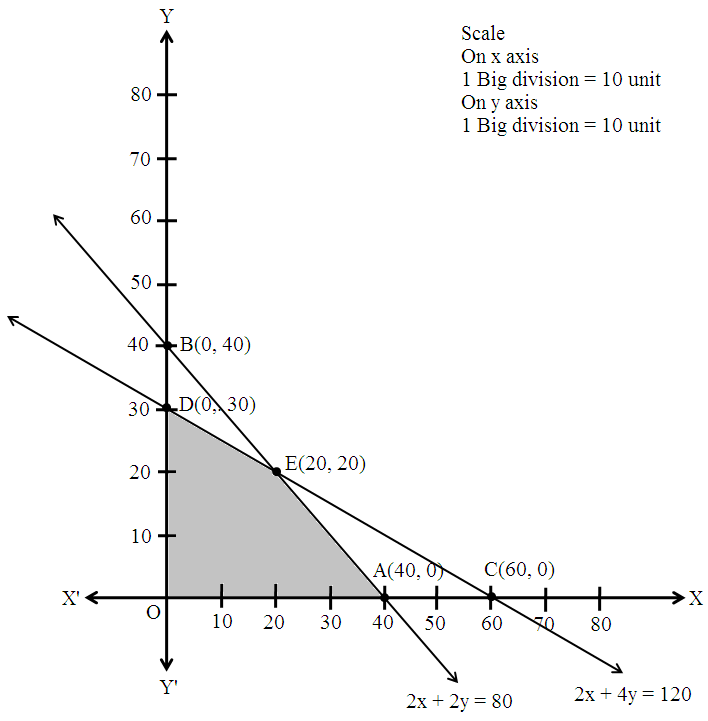
The feasible region determined by the system of constraints 2x + 4y ≤ 20, 2x + 2y ≤ 12, 4x ≤ 16, x ≥ 0 and y ≥ 0 are as follows.
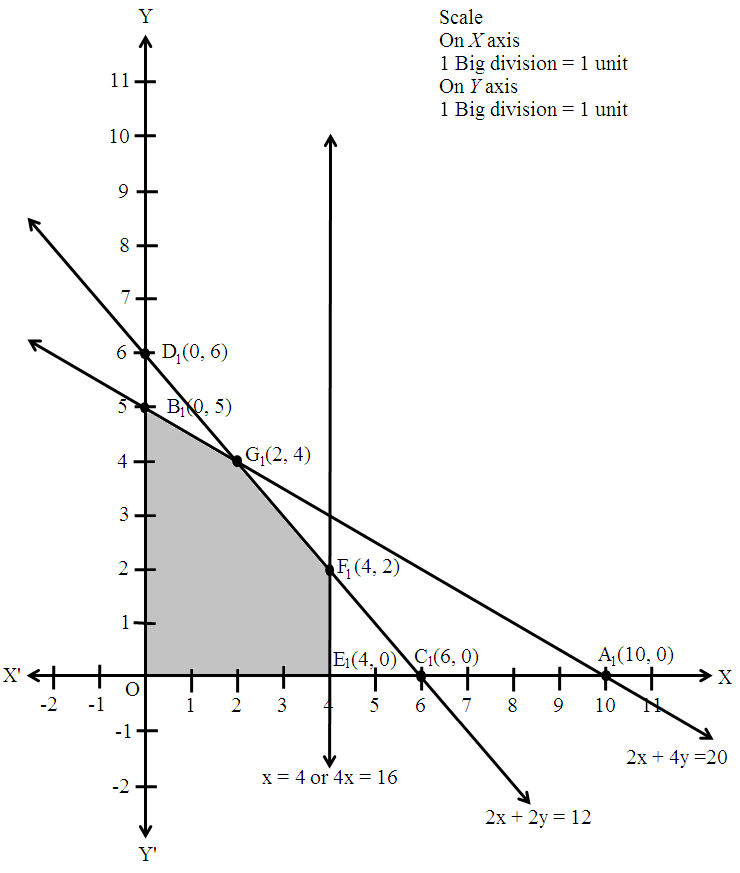
The corner points are O(0, 0), B1(0, 5), G1(2, 4), F1(4, 2) and E1(4, 0).
The values of Z at these corner points are as follows.
| Corner point | Z = 2x + 3y |
| O | 0 |
| B1 | 15 |
| G1 | 16 |
| F1 | 14 |
| E1 | 8 |
The maximum value of Z is 16 which is attained at G1(2, 4)
Thus, the maximum profit is 16 monetary units obtained when 2 units of first product and 4 units of second product were manufactured.
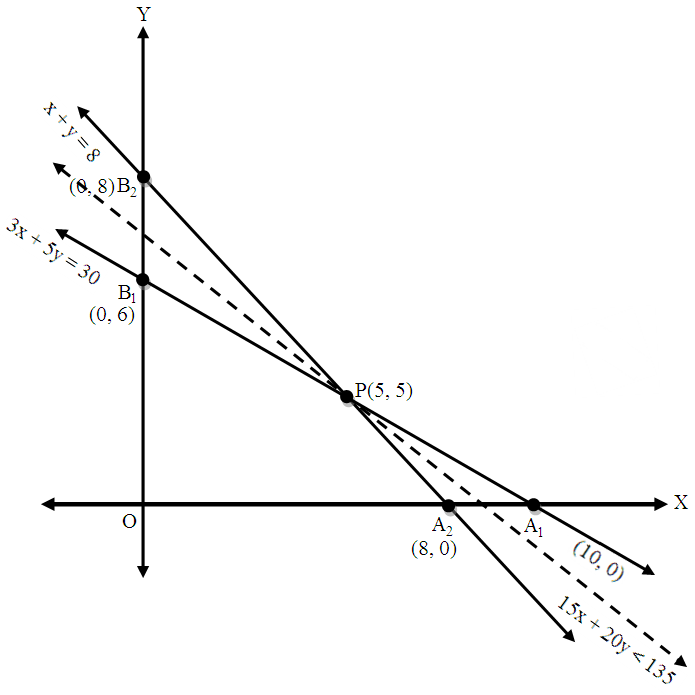
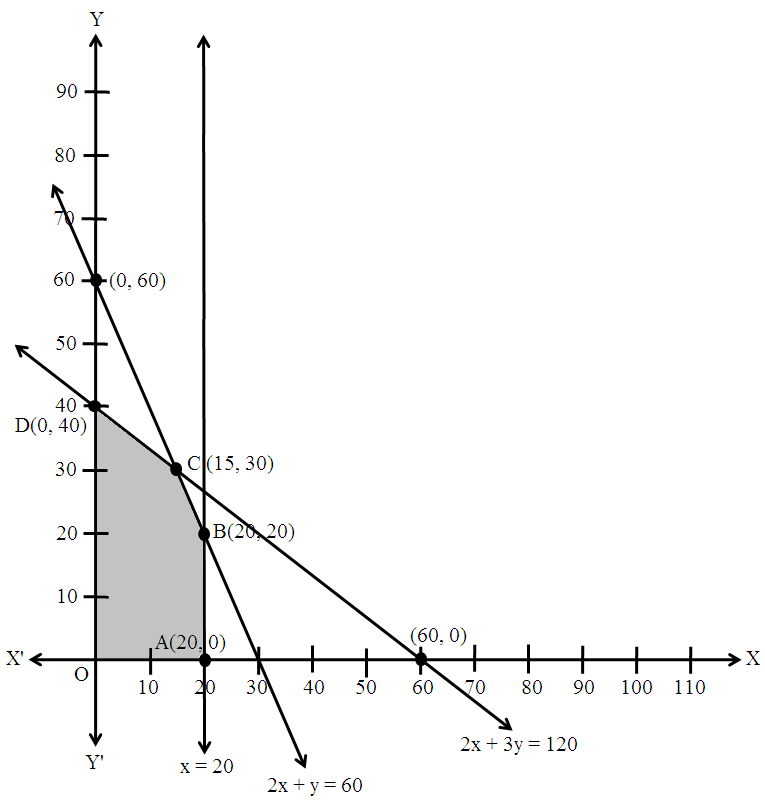
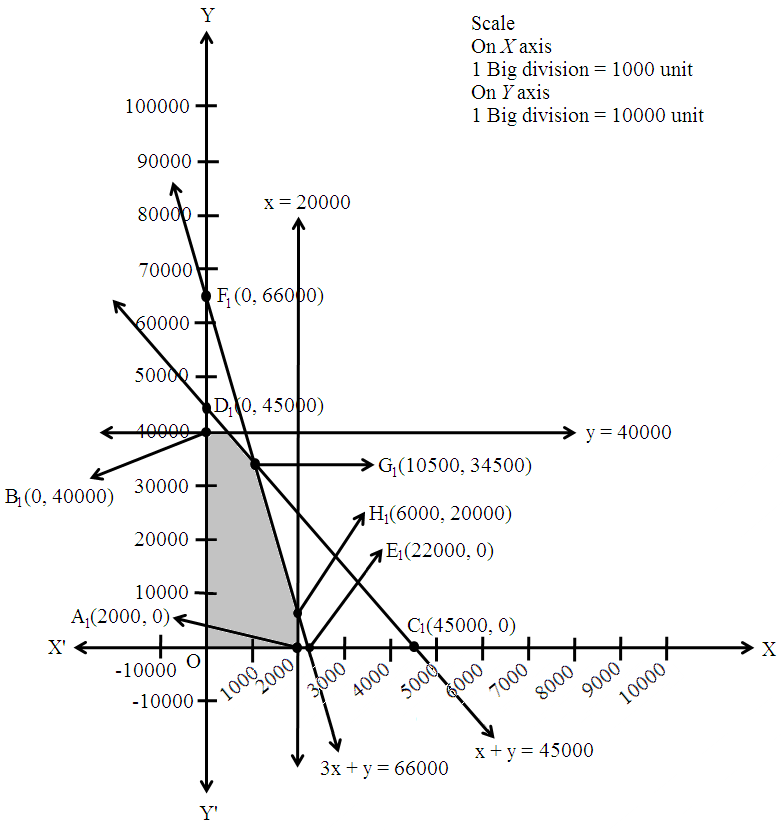
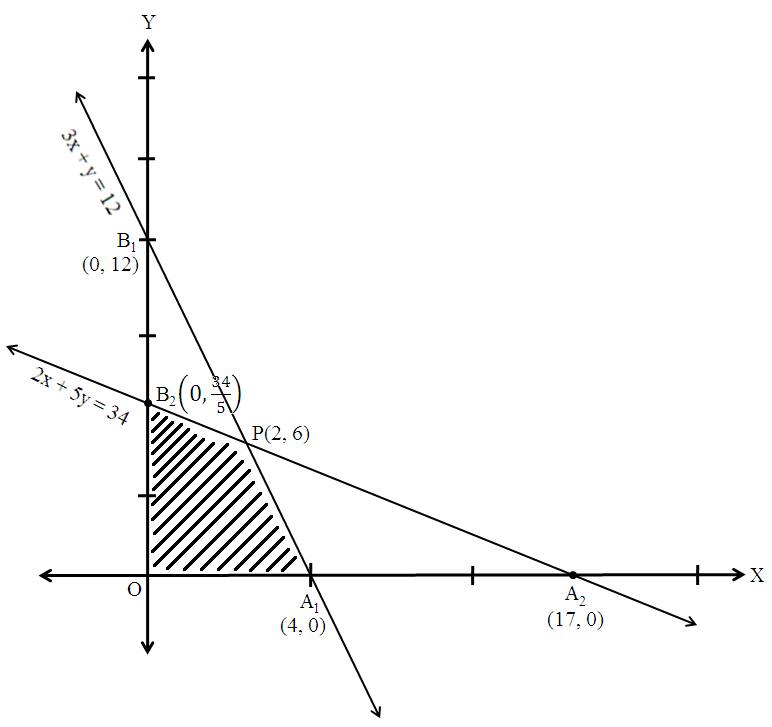
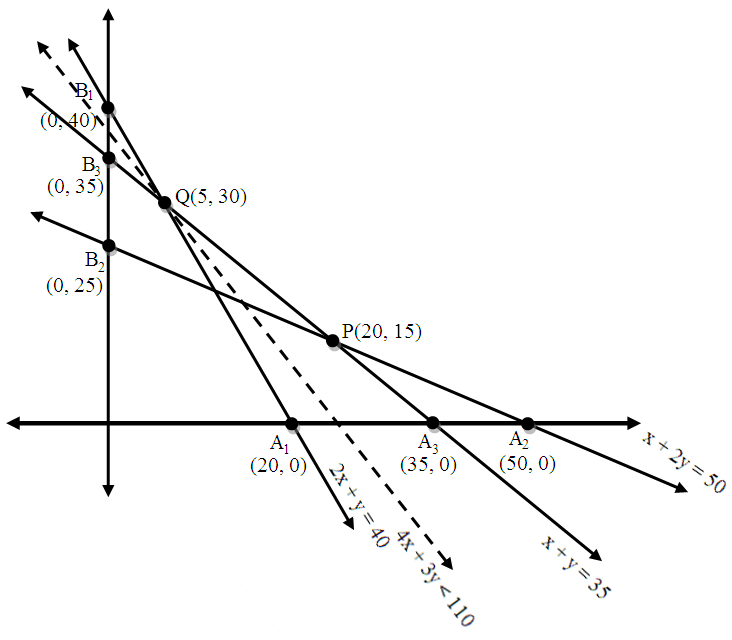
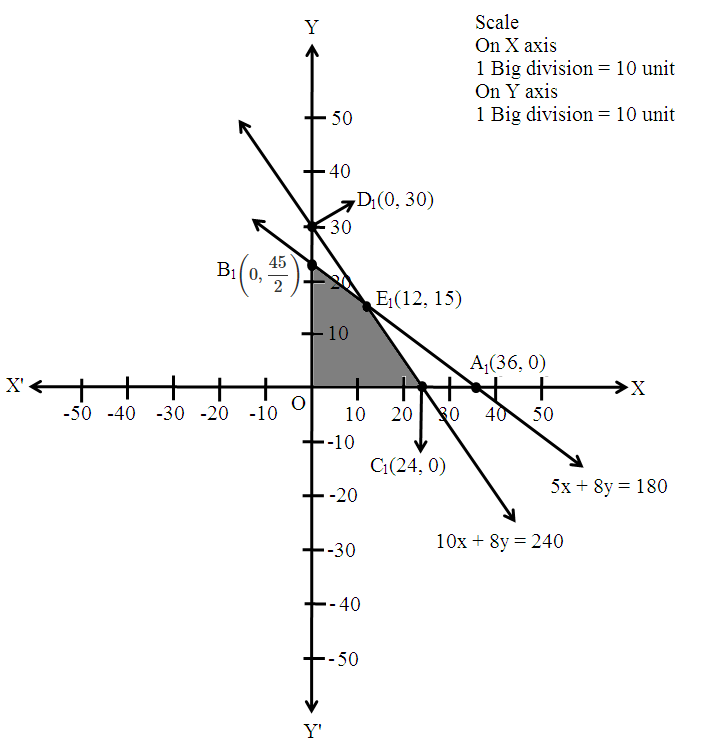
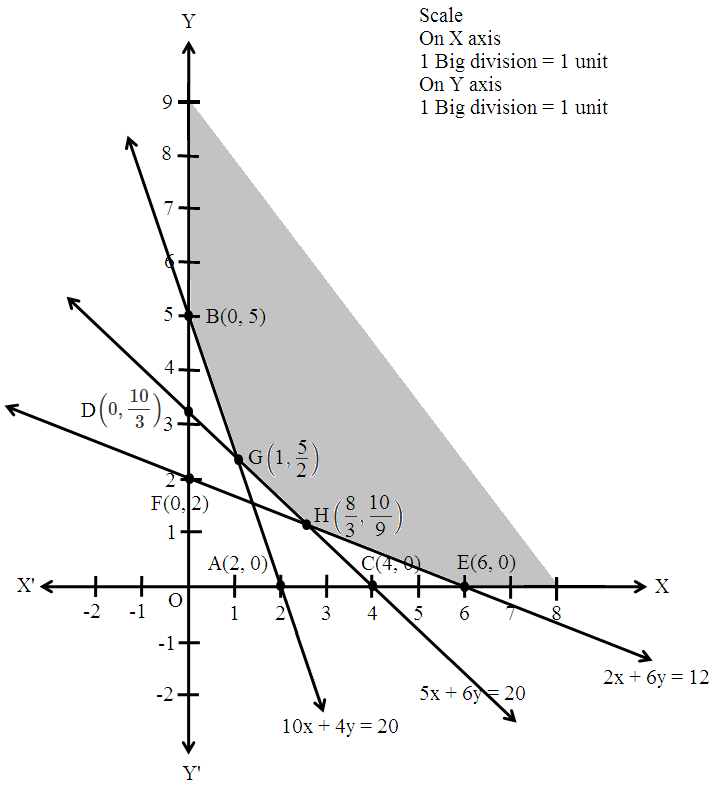
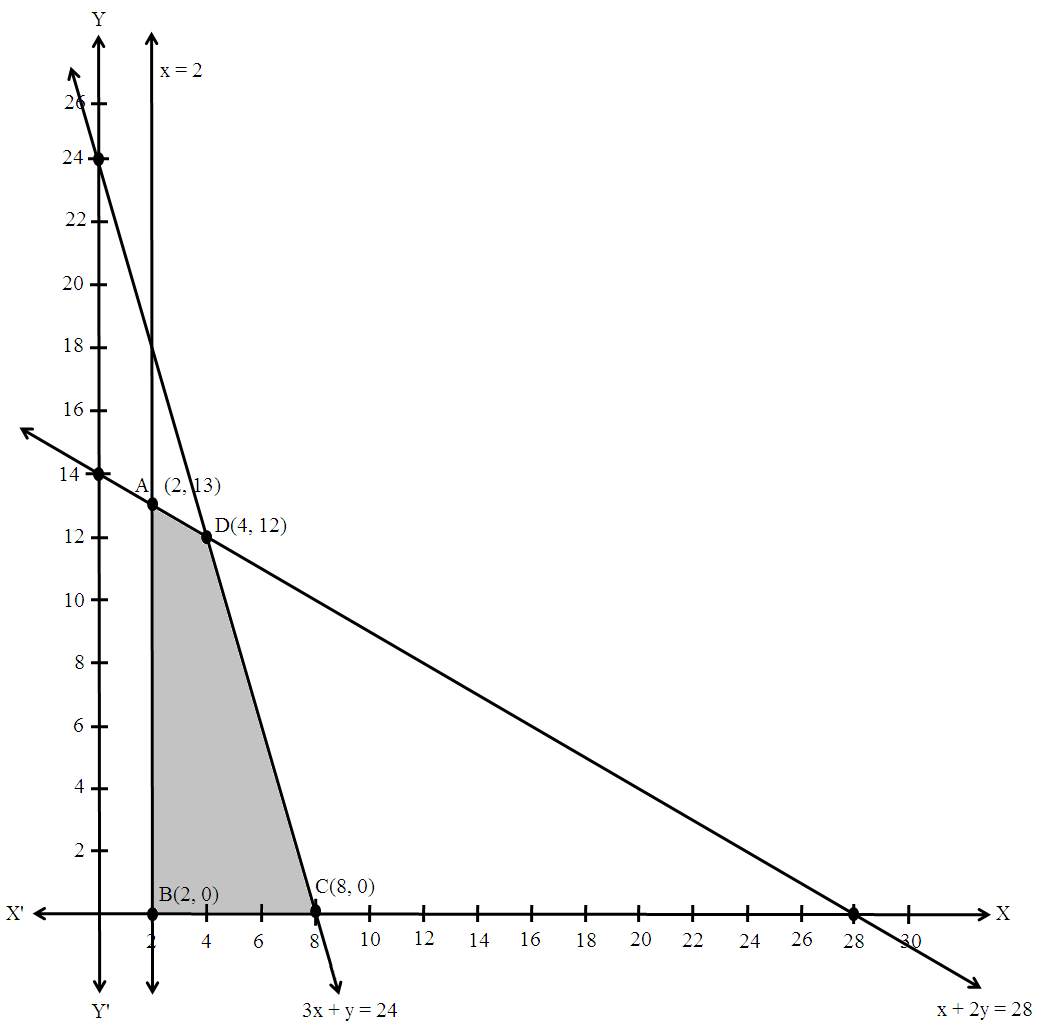
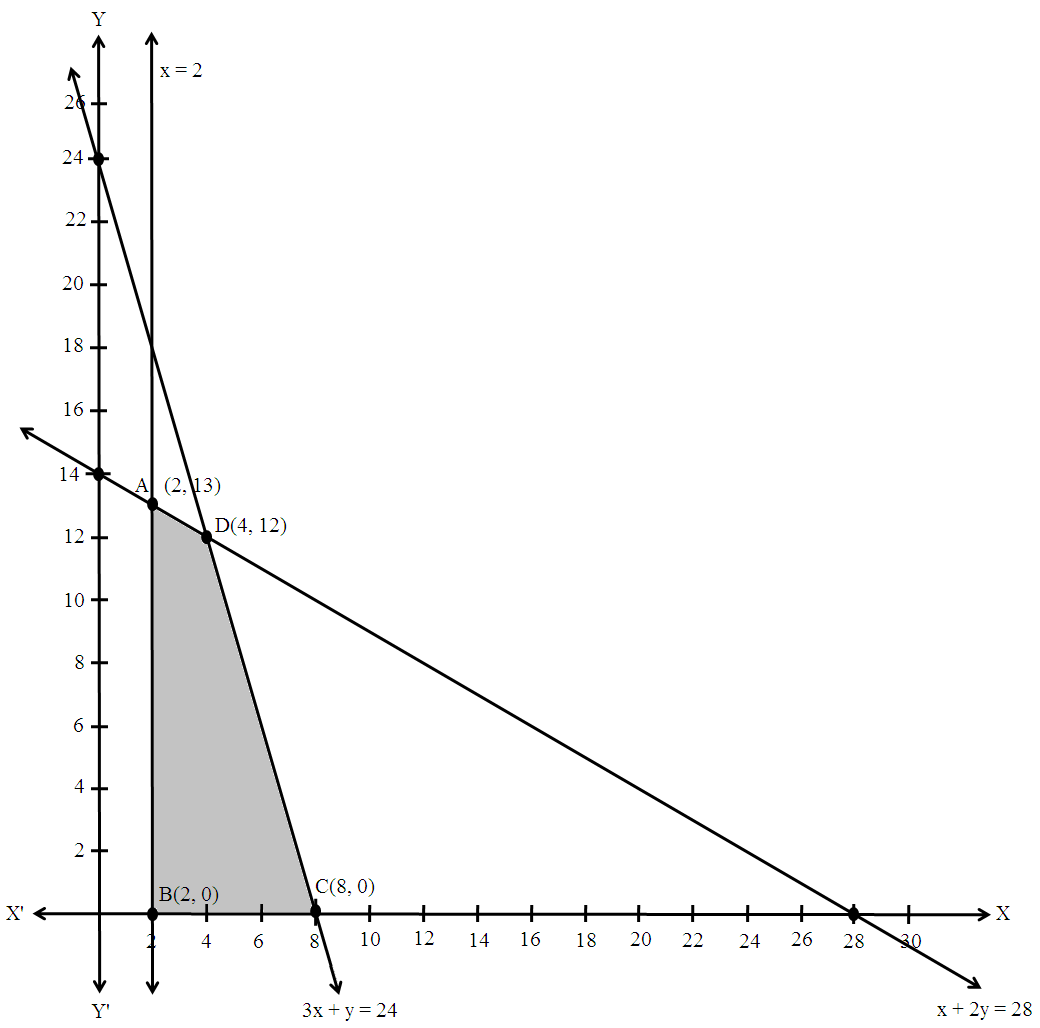
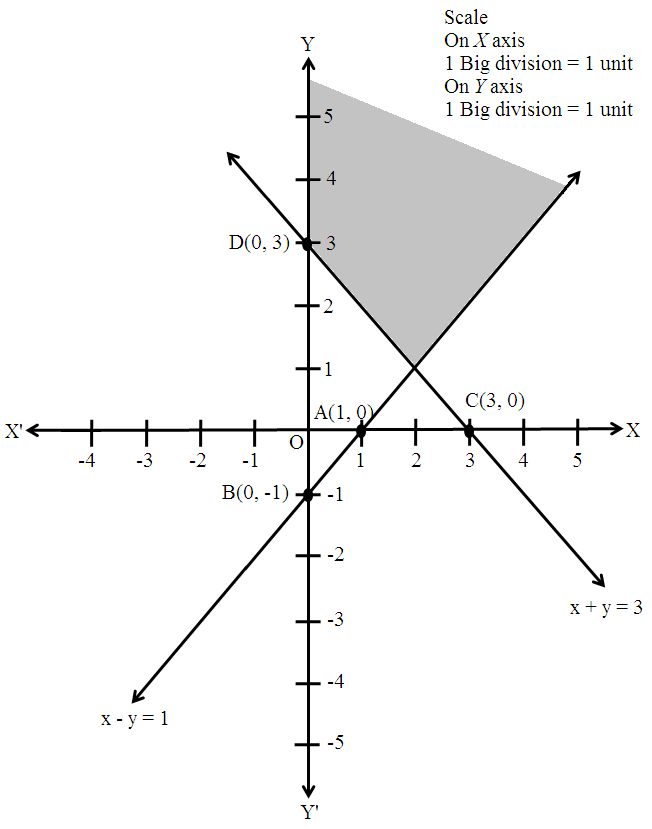
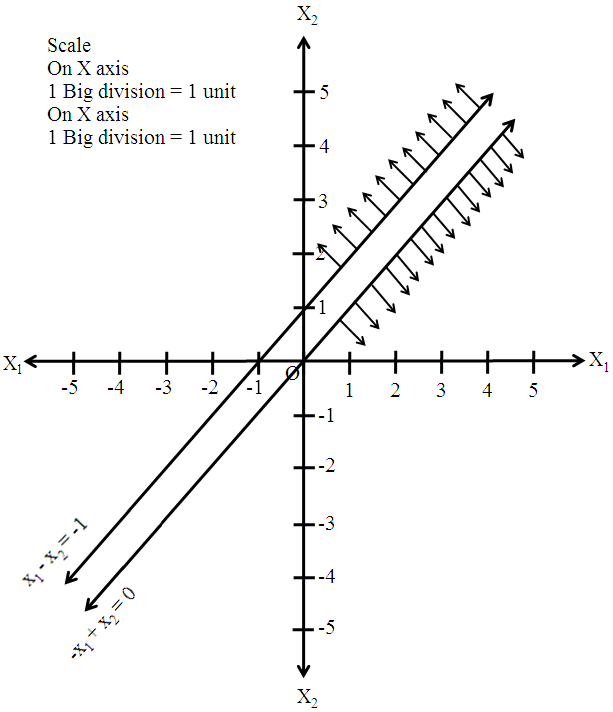
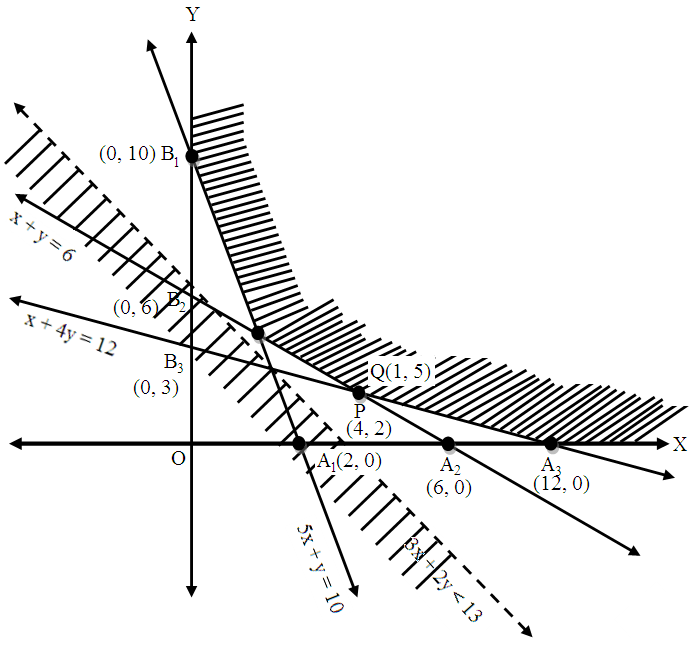
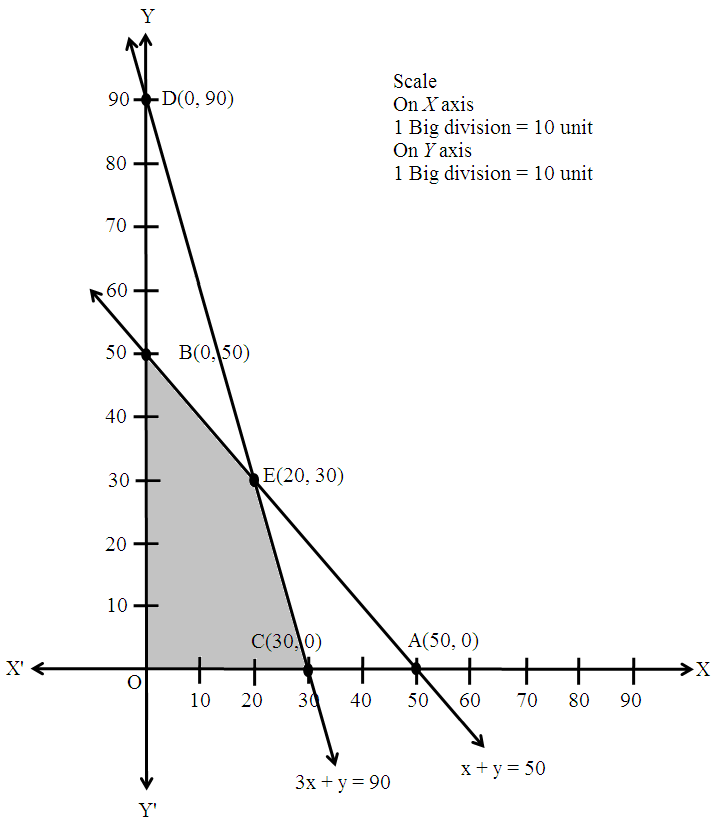
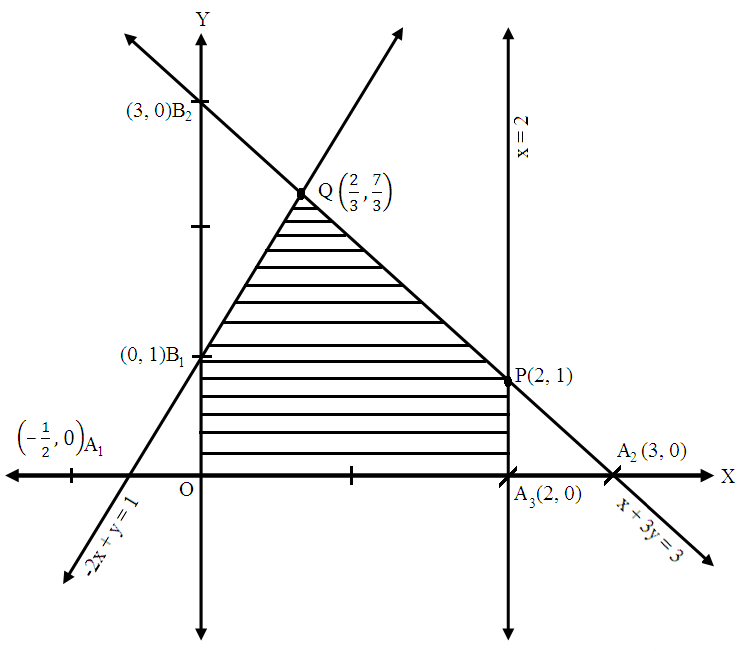
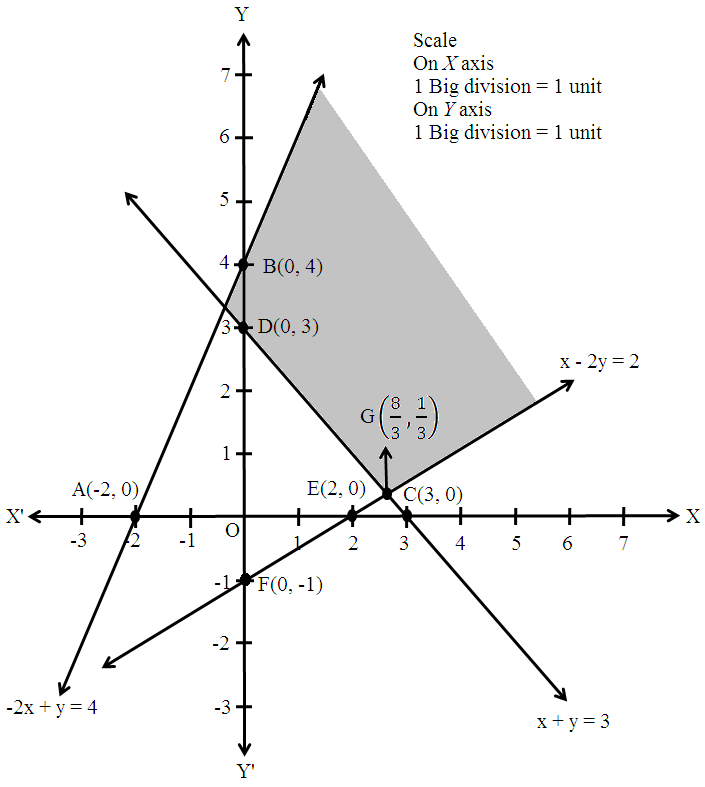
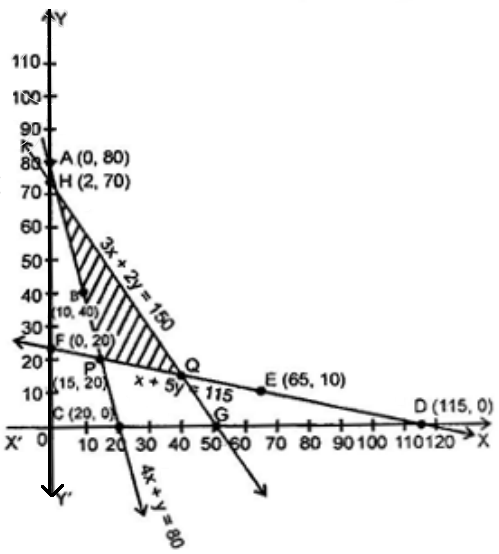
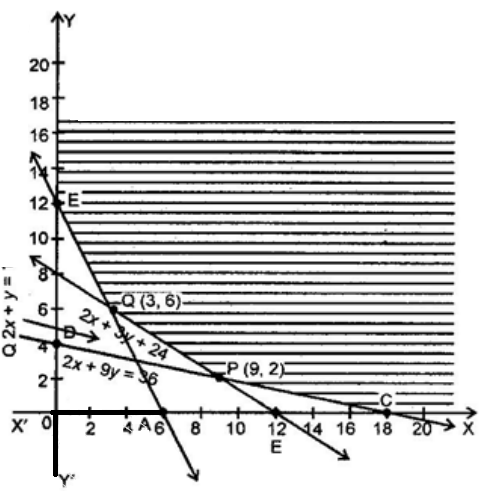
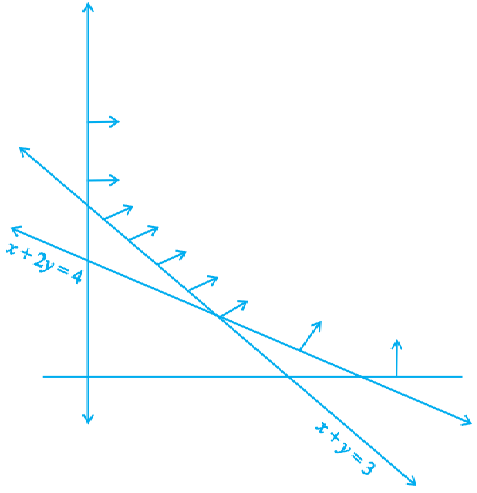
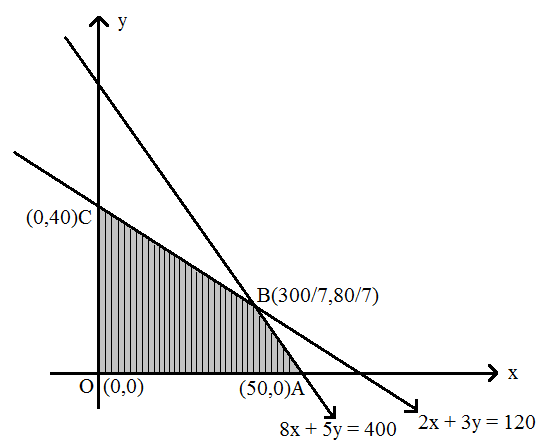
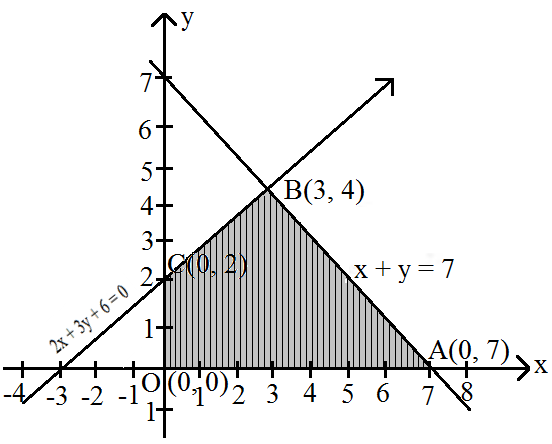
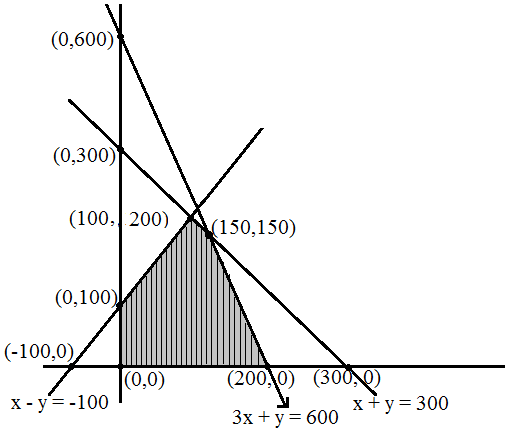
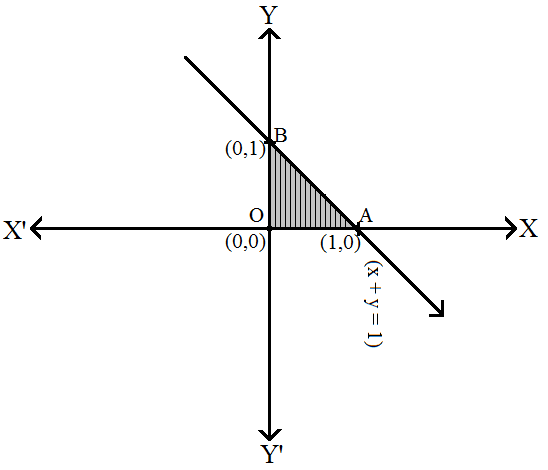
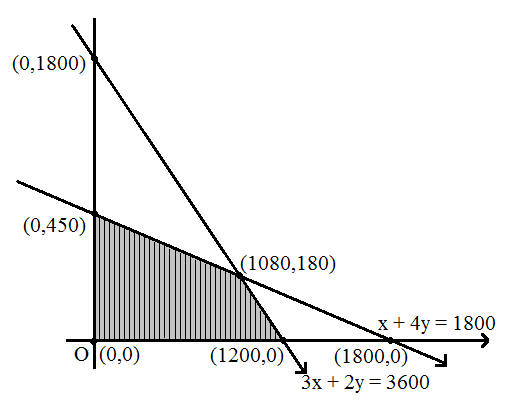
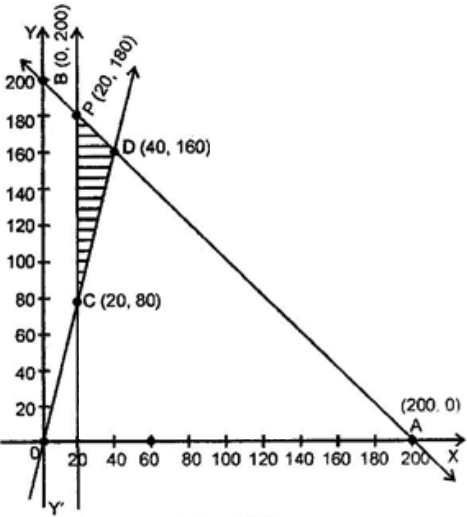
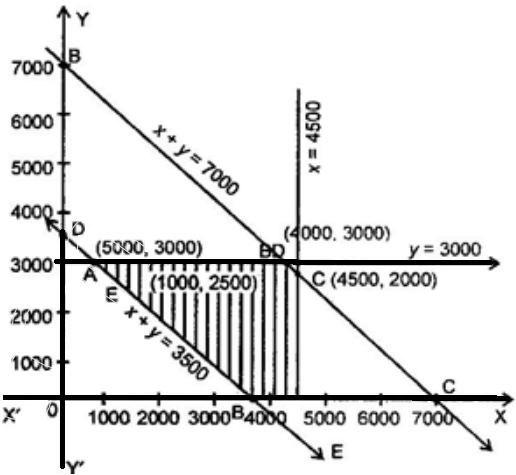
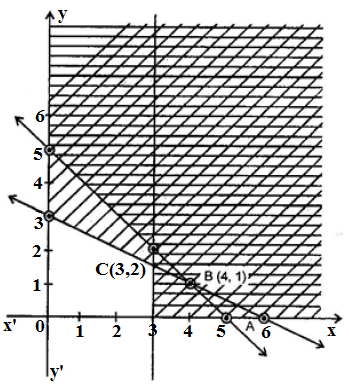
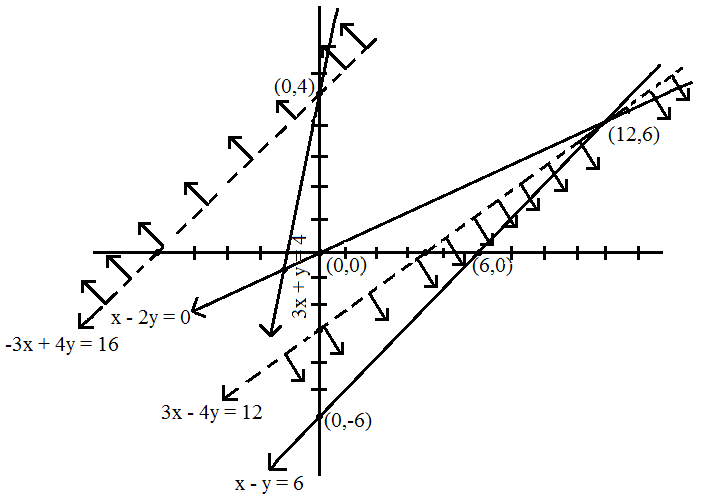 From the shown graph, for the feasible region, we see that it is unbounded and coordinates of corner points are (0, 0), (12, 6) and (0, 4).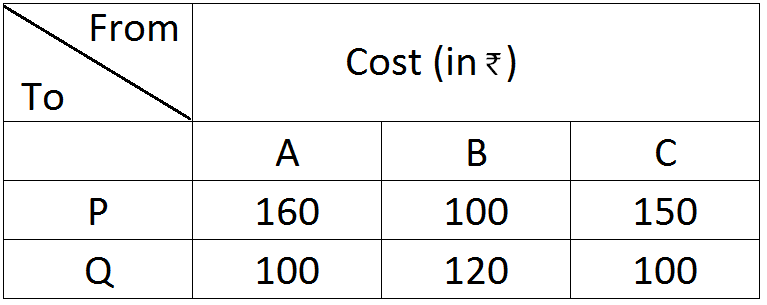
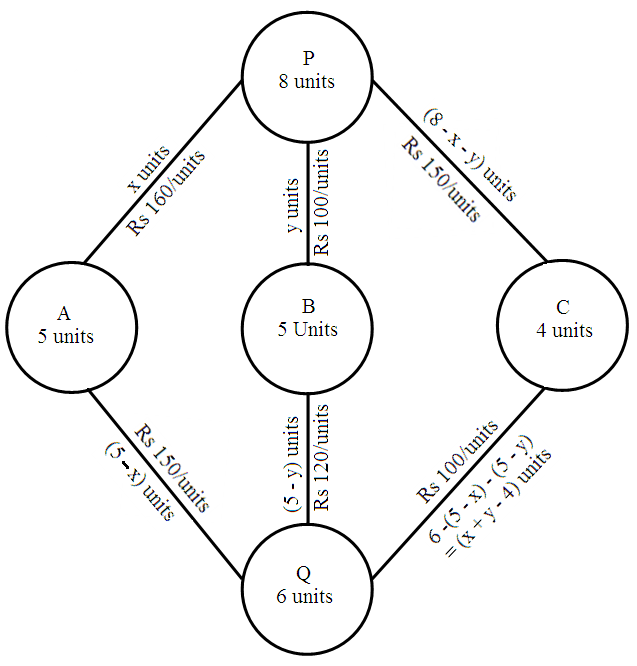
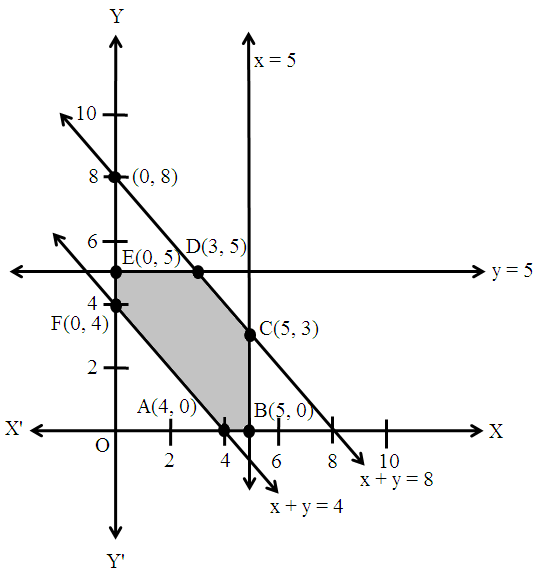 Then, (8 − x − y) units of the commodity will be transported from the factory P to the depot C. Now, the weekly requirement of depot A is 5 units of the commodity. Now, x units of the commodity are transported from factory P, so the remaining (5 − x) units of the commodity are transported from the factory Q to the depot A. The weekly requirement of depot B is 5 units of the commodity. Now, y units of the commodity are transported from factory P, so the remaining (5 − y) units of the commodity are transported from the factory Q to the depot B. Similarly, 6 − (5 − x) − (5 − y) = (x + y − 4) units of the commodity will be transported from the factory Q to the depot C. Since the number of units of commodity transported are from the factories to the depots are non-negative, therefore,