Question 1012 Marks
Find a matrix X such that 2A + B + X = 0, where.
If $\text{A}=\begin{bmatrix}8&0\\4&-2\\3&6\end{bmatrix}$ and $\text{B}=\begin{bmatrix}2&-2\\4&2\\-5&1\end{bmatrix},$ then find the matrix X of order 3 × 2 such that 2A + 3X = 5B.
Answer$2\text{A}+3\text{X}=5\text{B}$
$\Rightarrow2\begin{bmatrix}8&0\\4&-2\\3&6\end{bmatrix}+3\text{X}=5\begin{bmatrix}2&-2\\4&2\\-5&1\end{bmatrix}$
$\Rightarrow\begin{bmatrix}16&0\\8&-4\\6&12\end{bmatrix}+3\text{X}=\begin{bmatrix}10&-10\\20&10\\-25&5\end{bmatrix}$
$\Rightarrow3\text{X}=\begin{bmatrix}10&-10\\20&10\\-25&5\end{bmatrix}-\begin{bmatrix}16&0\\8&-4\\6&12\end{bmatrix}$
$\Rightarrow3\text{X}=\begin{bmatrix}10-16&-10-0\\20-8&10+4\\-25-6&5-12\end{bmatrix}$
$\Rightarrow3\text{X}=\begin{bmatrix}-6&-10\\12&14\\-31&-7\end{bmatrix}$
$\Rightarrow\text{X}=\frac{1}{3}\begin{bmatrix}-6&-10\\12&14\\-31&-7\end{bmatrix}$
$\therefore\ \text{X}=\begin{bmatrix}-2&\frac{-10}{3}\\4&\frac{14}{3}\\\frac{-31}{3}&\frac{-7}{3}\end{bmatrix}$
View full question & answer→Question 1022 Marks
If $\begin{bmatrix}\text{x}&2\end{bmatrix}\begin{bmatrix}3\\4\end{bmatrix}=2,$ find x.
AnswerGiven: $\begin{bmatrix}\text{x}&2\end{bmatrix}\begin{bmatrix}3\\4\end{bmatrix}=2$
$\Rightarrow3\text{x}+8=2$
$\Rightarrow3\text{x}=2-8$
$\Rightarrow3\text{x}=-6$
$\Rightarrow\text{x}=\frac{-6}{3}$
$\Rightarrow\text{x}=-2$
View full question & answer→Question 1032 Marks
If $\begin{bmatrix}\text{x}-\text{y}&\text{z}\\2\text{x}-\text{y}&\text{w}\end{bmatrix}=\begin{bmatrix}-1&4\\0&5\end{bmatrix},$ find x, y, z, w.
AnswerGiven, $\begin{bmatrix}\text{x}-\text{y}&\text{z}\\2\text{x}-\text{y}&\text{w}\end{bmatrix}=\begin{bmatrix}-1&4\\0&5\end{bmatrix}$ Since corresponding entries of equal matrices are equal, So x - y = -1 ...(i) z = 4 ...(ii) 2x - y = 0 ...(iii) w = 5 ...(iv) Solving equation (i) and (iii)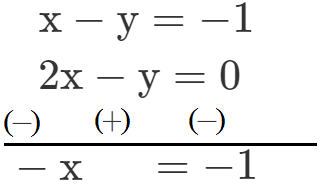
x = 1 Put x = 1 in equation (i), x - y = -1 1 - y = -1 -y = -1 - 1 -y = -2 y = 2 Equation (ii) and (iv) given the values of z and w respectively, So z = 4, w = 5 Hence, x = 1, y = 2, z = 4, w = 5 View full question & answer→Question 1042 Marks
If A is a skew-symmetric matrix and n is an odd natural number, write whether $A^n$ is symmetric or skew-symmetric or neither of the two.
AnswerGiven,
n is odd natural number and A is kew symmetric matrix.
$\Rightarrow A^T= -A$
Now,
$(A^n)^T= (A^T)^n$
$\Rightarrow (A^n)^T= (-A)^n$ since, $a^T= -A$
$\Rightarrow (A^n)^T = (-1)^n A^n$
$\Rightarrow (A^n)^T = -A^n$ {since, n is odd natural number}
We know that, a square matrix A is skew symmetric if $A^T = -A$
So,
$A^n$ is a skew symmetric matrix.
View full question & answer→Question 1052 Marks
Matrix $\text{A}=\begin{bmatrix}0&2\text{b}&-2\\3&1&3\\3\text{a}&3&-1 \end{bmatrix}$ is given to be symmetric, find values of a and b.
AnswerWe have
$\text{A}=\begin{bmatrix}0&2\text{b}&-2\\3&1&3\\3\text{a}&3&-1 \end{bmatrix}$
$\text{A}'=\begin{bmatrix}0&3&3\text{a}\\2\text{b}&1&3\\-2&3&-1\end{bmatrix}$
We know thet a matrix is symmetric if A = A'.
Thus,
$\begin{bmatrix}0&2\text{b}&-2\\3&1&3\\3\text{a}&3&-1 \end{bmatrix}=\begin{bmatrix}0&3&3\text{a}\\2\text{b}&1&3\\-2&3&-1\end{bmatrix}$
Now,
2b = 3
$\Rightarrow\text{b}=\frac{3}{2}$
Also,
3a = -2
$\Rightarrow\text{a}=\frac{-2}{3}$
Therefore,
$\text{a}=\frac{-2}{3}$ and $\text{b}=\frac{3}{2}$
View full question & answer→Question 1062 Marks
Find the value of $\lambda,$ non-zero scalar, if $\lambda\begin{bmatrix}1&0&2\\3&4&5\end{bmatrix}+2\begin{bmatrix}1&2&3\\-1&-3&2\end{bmatrix}=\begin{bmatrix}4&4&10\\4&2&14\end{bmatrix}$
AnswerGiven: $\lambda\begin{bmatrix}1&0&2\\3&4&5\end{bmatrix}+2\begin{bmatrix}1&2&3\\-1&-3&2\end{bmatrix}=\begin{bmatrix}4&4&10\\4&2&14\end{bmatrix}$
$\Rightarrow\begin{bmatrix}\lambda&0&2\lambda\\3\lambda&4\lambda&5\lambda\end{bmatrix}+\begin{bmatrix}2&4&6\\-2&-6&4\end{bmatrix}=\begin{bmatrix}4&4&10\\4&2&14\end{bmatrix}$
$\Rightarrow\begin{bmatrix}\lambda+2&0+4&2\lambda+6\\3\lambda-2&4\lambda-6&5\lambda+4\end{bmatrix}=\begin{bmatrix}4&4&10\\4&2&14\end{bmatrix}$
$\Rightarrow\lambda+2=4$
$\Rightarrow\lambda=4-2$
$\therefore\ \lambda=2$
View full question & answer→Question 1072 Marks
Let $\text{A}=\begin{bmatrix}2&4\\3&2\end{bmatrix},\text{B}=\begin{bmatrix}1&3\\-2&5\end{bmatrix}$ and $\text{C}=\begin{bmatrix}-2&5\\3&4\end{bmatrix}.$ Find each of the following:
$3\text{A}-2\text{B}+3\text{C}$
AnswerGiven, $\text{A}=\begin{bmatrix}2&4\\3&2\end{bmatrix},\text{ B}=\begin{bmatrix}1&3\\-2&5\end{bmatrix},\text{ C}=\begin{bmatrix}-2&5\\3&4\end{bmatrix}$$3\text{A}-2\text{B}+3\text{C}$
$=3\begin{bmatrix}2&4\\3&2\end{bmatrix}-2\begin{bmatrix}1&3\\-2&5 \end{bmatrix}+3\begin{bmatrix}-2&5\\3&4 \end{bmatrix}$
$=\begin{bmatrix}6&12\\9&6\end{bmatrix}-\begin{bmatrix}2&6\\-4&10\end{bmatrix}+\begin{bmatrix}-6&15\\9&12\end{bmatrix}$
$=\begin{bmatrix}6-2-6&12-6+15\\9+4+9&6-10+12\end{bmatrix}$
$=\begin{bmatrix}-2&21\\22&8\end{bmatrix}$
Hence,
$3\text{A}-2\text{B}+3\text{C}=\begin{bmatrix}-2&21\\22&8\end{bmatrix}$
View full question & answer→Question 1082 Marks
Construct a 3 × 4 matrix, whose elements are given by:$\text{a}_{\text{ij}}=\frac{1}{2} \left|-3{\text{i}+\text{j}}\right| $
Answer$\text{Let A}=\left[\text {a}_{\text {ij}}\ \text {be required}\ 3\times4\ {\text {matrix where}}\ {\text a_{\text {ij} }}={\frac{1}{2}}\left|-3{\text{i+j}}\right|\right] $ $\therefore\ \text a_{11}=\frac{1}{2}\left|{-3+1}\right|=\frac{1}{2}(2)=1, $ $\text a_{12}=\frac{1}{2}\left|{-3+2}\right|=\frac{1}{2}(1)=\frac{1}{2} $$\text a_{13}=\frac{1}{2}\left|{-3+3}\right|=\frac{1}{2}(0)=0, $
$\text a_{14}=\frac{1}{2}\left|{-3+4}\right|=\frac{1}{2}(1)=\frac {1}{2} $ $\text a_{21}=\frac{1}{2}\left|{-6+1}\right|=\frac{1}{2}(5)=\frac {5}{2}, $$\text a_{22}=\frac{1}{2}\left|-6+2 \right|=\frac {1}{2}(4)=2 $
$\text a_{23}=\frac{1}{2}\left|-6+3\right|=\frac {1}{2}(3)=\frac {3}{2}, $ $\text a_{24}=\frac{1}{2}\left|-6+4\right|=\frac{1}{2}|-2|=\frac{1}{2}\times2=1 $$\text a_{31}=\frac{1}{2}\left|-9+1\right|=\frac{1}{2}(8)=4, $
$\text a_{32}=\frac{1}{2}\left|-9+2\right|=\frac{1}{2}(7)=\frac{7}{2} $
$\text a_{33}=\frac{1}{2}\left|-9+3\right|=\frac{1}{2}(6)=3,$ $\text a_{34}=\frac{1}{2}\left|-9+4\right|=\frac {1}{2}(5)=\frac{5}{2} $ $\therefore\ \text{A}=\begin{bmatrix}1 & \frac{1}{2}&0&\frac{1}{2}\\ \frac{5}{2}&2 &\frac{3}{2} & 1\\ 4&\frac{7}{2}&3& \frac{5}{2}\end{bmatrix}$
View full question & answer→Question 1092 Marks
construct a 3 × 4 matrix, whose elements are given by:
$\text a_{\text {ij}}=2{\text{i}}-{\text{j}} $
Answer$\text{Let A}=\left[\text a_{\text{ij}}\right]\text {be required}\ 3\times4\ \text{matrix where}\ {\text a_{\text {ij}}} =2{\text{i - j}}$ $\therefore\ \text a_{11}=2-1=1,\ \text a_{12}=2-2=0,$ $ \text a_{13}=2-3=-1,\ \text a_{14}=2-4=-2 $ $\text a_{21}=4-1=3,\ \text{a}_{22}=4-2=2,$ $ \text{a}_{23}=4-3=1,\ \ \text{a}_{24}=4-4=0 $ $\text a_{31}=6-1=5,\ \ \text a_{32}=6-2=4,$ $\text a_{33}=6-3=3,\ \ \text a_{34}=6-4=2 $$\therefore\ \text A = \begin{bmatrix}1 & 0 &-1 & -2 \\3 & 2&1&0\\\ 5&4&3&2 \end{bmatrix} $
View full question & answer→Question 1102 Marks
Construct a $2 \times 2$ matrix $A = [a_{ij}]$ whose elements $a_{ij}$ are given by:
$\text{a}_\text{ij}=\frac{(2\text{i}-\text{j})^2}{2}$
AnswerHere,
$\text{a}_{11}=\frac{[2(1)+1]^2}{2}=\frac{(2+1)^2}{2}=\frac{(3)^2}{2}=\frac{9}{2},$ $\text{a}_{12}=\frac{[2(1)+2]^2}{2}=\frac{(4)^2}{2}=\frac{16}{2}=8$
$\text{a}_{21}=\frac{[2(2)+1]^2}{2}=\frac{(4+1)^2}{2}=\frac{(5)^2}{2}=\frac{25}{2},$ $\text{a}_{22}=\frac{[2(2)+2]^2}{2}=\frac{(4+2)^2}{2}=\frac{(6)^2}{2}=\frac{36}{2}=18$
So, the required matrix is $\begin{bmatrix}\frac{9}{2}&8\\\frac{25}{2}&18\end{bmatrix}.$
View full question & answer→Question 1112 Marks
Given an example of two non-zero 2×2 matrices A and B such that AB = 0.
AnswerLet,
$\text{A}=\begin{bmatrix}1&0\\0&0\end{bmatrix}\neq0$
$\text{B}=\begin{bmatrix}0&0\\0&1\end{bmatrix}\neq0$
$\text{AB}=\begin{bmatrix}1&0\\0&0\end{bmatrix}\begin{bmatrix}0&0\\0&1\end{bmatrix}$
$=\begin{bmatrix}0&0\\0&0\end{bmatrix}$
$=0$
So,
$\text{A}=\begin{bmatrix}1&0\\0&0\end{bmatrix}$
$\text{B}=\begin{bmatrix}0&0\\0&1\end{bmatrix}$
View full question & answer→Question 1122 Marks
A matrix $X$ has $a + b$ rows and $a + 2$ columns while the matrix $Y$ has $b + 1$ rows and $a + 3$ columns. Both matrices $XY$ and $YX$ exist. Find $a$ and $b$. Can you say $XY$ and $YX$ are of the same type$?$ Are they equal.
AnswerHere,
$[X]_{(a+b) \times (a+2)}$
$[Y]_{(b+1) \times (a+3)}$_
Since XY exists, the number of columns in $X$ is equal to the number of rows in$ Y.$
$\Rightarrow a + 2 = b + 1 ...(1)$
Similarly, since YX exists, the number of columns in $Y$ is equal to the number of rows in $X.$
$\Rightarrow a + b = a + 3$
$\Rightarrow b = 3$
Putting the value of b in $(1)$, we get
$a + 2 ≈ 3 + 1$
$\Rightarrow a = 2$
Since the order of the matrices $XY$ and $YX$ is not same, $XY$ and $YX$ are not of the same type and they are unequal.
View full question & answer→Question 1132 Marks
Find x, y and z so that A = B, where.
$\text{A}=\begin{bmatrix}\text{x}-2&3&2\text{z}\\18\text{z}&\text{y}+2&6\text{z}\end{bmatrix},\text{B}=\begin{bmatrix}\text{y}&\text{z}&6\\6\text{y}&\text{x}&2\text{y}\end{bmatrix}$
AnswerSince all the corresponding elements of a matrix are equal,
$\text{A}=\begin{bmatrix}\text{x}-2&3&2\text{z}\\18\text{z}&\text{y}+2&6\text{z}\end{bmatrix},\text{B}=\begin{bmatrix}\text{y}&\text{z}&6\\6\text{y}&\text{x}&2\text{y}\end{bmatrix}$
Here,
x - 2 = y ...(1)
z = 3 ...(2)
18z = 6y ...(3)
Putting the value of z in eq. (3), we get
18(3) = 6y
⇒ 54 = 6y
$\Rightarrow\text{y}=\frac{54}{6}=9$
Putting the value of y in eq. (1), we get
x - 2 = 9
⇒ x = 9 + 2
⇒ x = 11
$\therefore$ x = 11, y = 9 and z = 3
View full question & answer→Question 1142 Marks
In a legislative assembly election, a political group hired a public relations firm to promote its candidates in three ways: telephone, house calls and letters. The cost per contact (in paise) is given matrix A as.
$\ \ \ \ \ \ \ \ \ \ \ \ \text{Cost per contact}\\\text{A}=\begin{bmatrix}40&\text{Telephone}\\100&\text{House call}\\50&\text{Letter}\end{bmatrix}$
The number of contacts of each type made in two cities X and Y is given in matrix B as
$\text{BA}=\begin{bmatrix}\text{Telephone}&\text{House call}&\text{Letter}\\1000&500&5000\\3000&1000&10000\end{bmatrix} \begin{matrix}\rightarrow\text{X}\\\rightarrow\text{Y}\end{matrix}$
Find the total amount spent by the group in the two cities X and Y.
AnswerThe cost per contact (in paise) is given by,
$\text{A}=\begin{bmatrix}40&\text{Telephone}\\100&\text{House call}\\50&\text{Letter}\end{bmatrix}$
The number of contacts of each type made in the two cities X and Y is given by,
$\text{BA}=\begin{bmatrix}\text{Telephone}&\text{House call}&\text{Letter}\\1000&500&5000\\3000&1000&10000\end{bmatrix} \begin{matrix}\rightarrow\text{X}\\\rightarrow\text{Y}\end{matrix}$
Total amount spent by the group in the two cities X and Y is given by,
$\text{BA}=\begin{bmatrix}1000&500&5000\\3000&1000&10000\end{bmatrix}\begin{bmatrix}40\\100\\50\end{bmatrix}$
$=\begin{bmatrix}40000+50000+250000\\120000+100000+500000\end{bmatrix}$
$=\begin{bmatrix}340000\\720000\end{bmatrix}\begin{matrix}\text{X}\\\text{Y}\end{matrix}$
Thus, Amount spent on X = Rs. 3400
Amount spent on Y = Rs. 7200
View full question & answer→Question 1152 Marks
The monthly incomes of Aryan and Babban are in the ratio 3 : 4 and their monthly expenditures are in the ratio 5 : 7. If each saves Rs. 15,000 per month, find their monthly incomes using matrix method. This problem reflects which value?
AnswerLet the monthly incomes of Aryan and Babban be 3x and 4x, respectively.
Suppose their monthly expenditures are 5y and 7y, respectively
Since each saves Rs. 15,000 per month,
Monthly saving of Aryan: 3x - 5y = 15,000
Monthly saving of Babban: 4x - 7y = 15,000
The above system of equations can be written in the matrix form as follows:
$\begin{bmatrix}3&-5\\4&-7\end{bmatrix}\begin{bmatrix}\text{x}\\\text{y} \end{bmatrix}=\begin{bmatrix}15000\\15000 \end{bmatrix}$
Or,
AX = B, where $\text{A}=\begin{bmatrix}3&-5\\4&-7\end{bmatrix},\text{X}=\begin{bmatrix}\text{x}\\\text{y} \end{bmatrix}$ and $\text{B}=\begin{bmatrix}15000\\15000 \end{bmatrix}$
Now,
$|\text{A}|=\begin{vmatrix}3&-5\\4&-7\end{vmatrix}=-21-(-20)=-1$
$\text{Adj A}=\begin{bmatrix}-7&-4\\5&3\end{bmatrix}^\text{T}=\begin{bmatrix}-7&5\\-4&3\end{bmatrix}$
So, $\text{A}^{-1}=\frac{1}{|\text{A}|}\text{ adj A}=-1=\begin{bmatrix}-7&5\\-4&3\end{bmatrix}=\begin{bmatrix}7&-5\\4&-3\end{bmatrix}$
$\therefore\ \text{X}=\text{A}^{-1}\text{B}$
$\Rightarrow\begin{bmatrix}\text{x}\\\text{y}\end{bmatrix}=\begin{bmatrix}7&-5\\4&-3\end{bmatrix}\begin{bmatrix}15000\\15000 \end{bmatrix}$
$\Rightarrow\begin{bmatrix}\text{x}\\\text{y}\end{bmatrix}=\begin{bmatrix}105000-75000\\60000-45000 \end{bmatrix}$
$\Rightarrow\begin{bmatrix}\text{x}\\\text{y} \end{bmatrix}=\begin{bmatrix}30000\\15000\end{bmatrix}$
$\Rightarrow\text{x}=30,000$ and $\text{y}=15,000$
Therefore,
Monthly income of Aryan = 3 × Rs. 30,000 = Rs. 90,000
Monthly income of Babban = 4 × Rs. 30,000 = Rs. 1,20,000
From this problem, we are encouraged to understand the power of savings.
We should save certain part of our monthly income for the future.
View full question & answer→Question 1162 Marks
Let $\text{A}=\begin{bmatrix}1&2\\-1&3\end{bmatrix},\ \text{B}=\begin{bmatrix}4&0\\1&5\end{bmatrix},$ $\text{C}=\begin{bmatrix}2&0\\1&-2\end{bmatrix},$ a = 4, b = -2, then show that $(\text{bA})^{\text{T}}=\text{bA}^{\text{T}}.$
AnswerWe have, $\text{A}=\begin{bmatrix}1&2\\-1&3\end{bmatrix},\ \text{B}=\begin{bmatrix}4&0\\1&5\end{bmatrix},$ $\text{C}=\begin{bmatrix}2&0\\1&-2\end{bmatrix},$ and a = 4, b = -2$(\text{bA})^{\text{T}}=\begin{bmatrix}-2&2\\-4&-6\end{bmatrix}\ [\because\ \text{b}=-2]$
$=\begin{bmatrix}-2&2\\-4&-6\end{bmatrix}$
and $\text{A}^{\text{T}}=\begin{bmatrix}1&-1\\2&3\end{bmatrix}$ $\therefore\ \text{bA}^{\text{T}}=\begin{bmatrix}-2&2\\-4&-6\end{bmatrix}=(\text{bA})^{\text{T}}$ Hence proved.
View full question & answer→Question 1172 Marks
Find the value of x from the following: $\begin{bmatrix}2\text{x}-\text{y}&5\\3&\text{y} \end{bmatrix}=\begin{bmatrix}6&5\\3&-2 \end{bmatrix}$
AnswerThe corresponding elements of two equal matrices are equai.
Given: $\begin{bmatrix}2\text{x}-\text{y}&5\\3&\text{y} \end{bmatrix}=\begin{bmatrix}6&5\\3&-2 \end{bmatrix}$
2x - y = 6 $\dots(1)$
y = - 2
Putting the value of y in eq.(1)
2x - (-2) = 6
⇒ 2x + 2 = 6
⇒ 2x = 6 - 2
⇒ 2x = 4
$\Rightarrow\text{x}=\frac{4}{2}=2$
$\therefore$ x = 2
View full question & answer→Question 1182 Marks
Find the values of $x, y$ and $z$ from the following equations:
$\begin{bmatrix}\text{x+y} & 2 \\5+\text{z} & \text {xy} \end{bmatrix}=\begin{bmatrix}6 & 2 \\5& 8 \end{bmatrix}$
AnswerWe are given that
$\begin{bmatrix}\text{x+y} & 2 \\5+\text{z} & \text {xy} \end{bmatrix}=\begin{bmatrix}6 & 2 \\5& 8 \end{bmatrix}$
By defination of equality of matrices,
$x + y = 6 ...(1)$
$5 + z = 5 ...(2)$
$xy = 8 ...(3)$
Form $(2), z = 0$
Form $y = 6 - x ...(4)$
Putting $y = 6 - x$ in $(3)$, we get.
$x(6 - x) =$ or $6 x - x^2 - 8 = 0$
$\therefore x^2 - 6x + 8 = 0 ? (x - 2) (x - 4) = 0;$
$? x = 2.4$
$\therefore$ from $(4), y = 6 - 2, 6 - 4 = 4, 2$
$\therefore$ we have
$x =2, y = 4, z = 0; x = 4, y = 2, z = 0$
View full question & answer→Question 1192 Marks
Construct a $2 \times 2$ matrix $A = [a_{ij}]$ whose elements $a_{ij}$ are give by:$\frac{(\text{i}+\text{j})^2}{2}$
AnswerHere,
$\text{a}_{11}=\frac{(1+1)^2}{2}=\frac{(2)^2}{2}=\frac{4}{2}=2,$ $\text{a}_{12}=\frac{(1+2)^2}{2}=\frac{(3)^2}{2}=\frac{9}{2}$
$\text{a}_{21}=\frac{(2+1)^2}{2}=\frac{(3)^2}{2}=\frac{9}{2},$ $\text{a}_{22}=\frac{(2+2)^2}{2}=\frac{(4)^2}{2}=\frac{16}{2}=8$
So, the required matrix is $\begin{bmatrix}2\frac{9}{2}\\\frac{9}{2}8\end{bmatrix}.$
View full question & answer→Question 1202 Marks
Show that if A and B are square matrices such that $AB = BA$, then $(A + B)^2 = A^2 + 2AB + B^2$.
AnswerSince, A and B are square matrices such that $AB = BA$
$\therefore (A + B)^2 = (A + B).(A + B)$
$= A^2 + AB + BA + B^2$
$= A^2 + AB + AB + B^2$ $[\because$ AB = BA$]$
$= A^2 + 2AB + B^2$
Hence proved.
View full question & answer→Question 1212 Marks
Construct a 2 × 2 matrix, A = $[\text{a}_{\text{ ij}}]$, whose elements are given by:$\text {a}_\text {ij}=\frac {(\text{i}+2 \text{j})^{2}}{2} $
Answer$\text A=\left[\text {a}_{\text {ij}} \right]\text{is}\ 2\times2\ {\text {matrix where}}\ \text {a}_{\text {ij}}=\frac{(\text{i}+2 \text{j})^{2}}{2}$$\therefore\ \text{a}_{11}=\frac{(1+2)^2}{2}=\frac{9}{2}$, $\text{a}_{12}=\frac{(1+4)^2}{2}=\frac{25}{2}$
$\text{a}_{21}=\frac{(2+2)^2}{2}=\frac{16}{2}=8,$ $\text{a}_{22}=\frac{(2+4)^2}{2}=\frac{36}{2}=18 $
$\therefore\ \ \text{A}=\begin{bmatrix}\frac{9}{2}& \frac{25}{2} \\8 & 18 \end{bmatrix} $
View full question & answer→Question 1222 Marks
If $2\begin{bmatrix}3&4\\5&\text{x} \end{bmatrix}+\begin{bmatrix}1&\text{y}\\0&1 \end{bmatrix}=\begin{bmatrix}7&0\\10&5 \end{bmatrix},$ find x - y.
Answer$2\begin{bmatrix}3&4\\5&\text{x} \end{bmatrix}+\begin{bmatrix}1&\text{y}\\0&1 \end{bmatrix}=\begin{bmatrix}7&0\\10&5 \end{bmatrix}$
$\Rightarrow\begin{bmatrix}6+1&8+\text{y}\\10+0&2\text{x}+1 \end{bmatrix}=\begin{bmatrix}7&0\\10&5 \end{bmatrix}$
$\Rightarrow\begin{bmatrix}7&8+\text{y}\\10&2\text{x}+1 \end{bmatrix}=\begin{bmatrix}7&0\\10&5 \end{bmatrix}$
⇒ 8 + y = 0 and 2x + 1 = 5
⇒ y = - 8 and 2x = 4
⇒ y = - 8 and x = 2
Hence, x - y = 2 - (- 8) = 10.
View full question & answer→Question 1232 Marks
Let A and B be square matrices of the same order. Does $(A + B)^2 = A^2 + 2AB + B^2$ hold? If not, why?
Answer$LHS = (A + B)^2$
$= (A + B)(A + B)$
$= A(A + B) + B(A + B)$
$= A^2 + AB + BA + B^2$
We know that a matrix does not have commutative property. So,
$AB ≠ BA$
Thus,
$(A + B)^2 \neq A^2 + 2AB + B^2$
View full question & answer→Question 1242 Marks
If possible, find the sum of the matrices A and B, where $\text{A}=\begin{bmatrix}\sqrt{3}&1\\2&3\end{bmatrix}$ and $\text{B}=\begin{bmatrix}\text{x}&\text{y}&\text{z}\\\text{a}&\text{b}&\text{c}\end{bmatrix}$
AnswerWe have, $\text{A}=\begin{bmatrix}\sqrt{3}&1\\2&3\end{bmatrix}_{2\times2}$ and $\text{B}=\begin{bmatrix}\text{x}&\text{y}&\text{z}\\\text{a}&\text{b}&\text{c}\end{bmatrix}_{2\times3}$Here, A and B are of different Orders. Also, we know that the addition of two matrices A and B is possible only if order of both the matrices A and B should be same.
Hence, the sum of matrices A and B is not possible.
View full question & answer→Question 1252 Marks
If $A = [a_{ij}]$ is a square matrix such that $a_{ij} = i^2 - j^2$, then write whether A is symmetric or skew-symmetric.
AnswerHere,
$\text{a}_{\text{ij}}=\text{i}^2-\text{j}^2,1\leq\text{i}\leq2$ and $1\leq\text{j}\leq2$
$\therefore\ \text{a}_{11}=1^2-1^2=1-1=0,$ $\text{a}_{12}=1^2-2^2=1-4=-3$
$\text{a}_{21}=2^2-1^2=4-1=3$ and $\text{a}_{22}=2^2-2^2=4-4=0$
$\therefore\ \text{A}=\begin{bmatrix}\text{a}_{11}&\text{a}_{12}\\\text{a}_{21}&\text{a}_{22}\end{bmatrix}=\begin{bmatrix}0&-3\\3&0\end{bmatrix}$
$\text{A}^\text{T}=\begin{bmatrix}0&3\\-3&0\end{bmatrix}$
$\Rightarrow\text{A}^\text{T}=-\begin{bmatrix}0&-3\\3&0\end{bmatrix}$
$\Rightarrow\text{A}^\text{T}=-\text{A}$
Since $A^T = -A, A$ is skew-symmetric.
View full question & answer→Question 1262 Marks
If $\begin{bmatrix}\text{xy}&4\\\text{z}+6&\text{x}+\text{y} \end{bmatrix}=\begin{bmatrix}8&\text{w}\\0&6 \end{bmatrix},$ write the value of (x + y + z).
Answer$\begin{bmatrix}\text{xy}&4\\\text{z}+6&\text{x}+\text{y} \end{bmatrix}=\begin{bmatrix}8&\text{w}\\0&6 \end{bmatrix}$
Corresponding elements of equal matrices are equal.
$\therefore$ z + 6 = 0 and x + y = 6
⇒ z = -6 and x + y = 6
Therefore, x + y + z = 6 - 6 = 0.
View full question & answer→Question 1272 Marks
Give example of matrices:
A and B such that AB = 0 but BA ≠ 0
AnswerLet $\text{A}=\begin{bmatrix}0&1\\0&0\end{bmatrix}$ and $\text{B}=\begin{bmatrix}1&0\\0&0\end{bmatrix}$
$ \therefore\ \text{AB}=0$
and $\text{BA}=\begin{bmatrix}1&0\\0&0\end{bmatrix}\begin{bmatrix}0&1\\0&0\end{bmatrix}$
$\Rightarrow\text{BA}=\begin{bmatrix}0+0&1+0\\0+0&0+0\end{bmatrix}$
$\Rightarrow\text{BA}=\begin{bmatrix}0&1\\0&0\end{bmatrix}$
Thus, AB = 0 but BA ≠ 0
View full question & answer→Question 1282 Marks
If $B$ is a skew-symmetric matrix, write whether the matrix $AB A^T$ is symmetric or skew-symmetric.
AnswerIf $B$ is a skew-symmetric matrix, then $B^T = -B$.
$(\text{ABA}^\text{T})^\text{T}=(\text{A}^\text{T})^\text{T}\text{B}^\text{T}\text{A}^\text{T}$ $\big[\because\ (\text{ABC})^\text{T}=\text{C}^\text{T}\text{B}^\text{T}\text{A}^\text{T}\big]$
$\Rightarrow(\text{ABA}^\text{T})^\text{T}=\text{AB}^\text{T}\text{A}^\text{T}$ $\big[\because\ (\text{A}^\text{T})^\text{T}=\text{A}\big]$
$\Rightarrow(\text{ABA}^\text{T})^\text{T}=\text{A}(-\text{B})\text{A}^\text{T}$ $\big[\because\ \text{B}^\text{T}=-\text{B}\big]$
$\Rightarrow(\text{ABA}^\text{T})^\text{T}=-\text{ABA}^\text{T}$
$\therefore ABA^T$ is a skew-symmetric matrix.
View full question & answer→Question 1292 Marks
If $\begin{bmatrix}2\text{x}+1&5\text{x}\\0&\text{y}^2+1\end{bmatrix}=\begin{bmatrix}\text{x}+3&10\\0&26\end{bmatrix},$ find the value of (x + y).
AnswerAs the given matrices are equal, therefore, their corresponding elements must be equal.
Comparing the corresponding elements, we get
$\begin{bmatrix}2\text{x} + 1 = \text{x} + 3&5\text{x}=10\\0=0&\text{y}^2+1=26\end{bmatrix}$
On simplifying, we get
x = 2 and $\text{y}=\pm5$
Therefore, x + y = 2 + 5 = 7
or x + y = 2 - 5 = -3
Hence, the value of (x + y) is 7, -3.
View full question & answer→Question 1302 Marks
If $\begin{bmatrix}\text{x}+3&4\\\text{y}-4&\text{x}+\text{y} \end{bmatrix}=\begin{bmatrix}5&4\\3&9 \end{bmatrix},$ find x abd y
AnswerThe corresponding elements of two equal matrices are equai.Given: $\begin{bmatrix}\text{x}+3&4\\\text{y}-4&\text{x}+\text{y} \end{bmatrix}=\begin{bmatrix}5&4\\3&9 \end{bmatrix}$
x + 3 = 5 and y - 4 = 3
⇒ x = 5 - 3 and y = 3 + 4
⇒ x = 2 and y = 7
$\therefore$ x = 2 and y = 7
View full question & answer→Question 1312 Marks
If $\text{A}=\begin{bmatrix}0&-1&2\\4&3&-4\end{bmatrix}$ and $\text{B}=\begin{bmatrix}4&0\\1&3\\2&6\end{bmatrix},$ then verify that $(\text{A}')'=\text{A}.$
AnswerWe have, $\text{A}=\begin{bmatrix}0&-1&2\\4&3&-4\end{bmatrix}$ and $\text{B}=\begin{bmatrix}4&0\\1&3\\2&6\end{bmatrix}$We have to verify that, $(\text{A}')'=\text{A}$
$\therefore\ \text{A}'=\begin{bmatrix}0&4\\-1&3\\2&-4\end{bmatrix}$
and $(\text{A}')'=\begin{bmatrix}0&-1&2\\4&3&-4\end{bmatrix}=\text{A}$ Hence Proved.
View full question & answer→Question 1322 Marks
Find x, y, z and t, if.
$3\begin{bmatrix}\text{x}&\text{y}\\\text{z}&\text{t}\end{bmatrix}=\begin{bmatrix}\text{x}&6\\-1&2\text{t}\end{bmatrix}+\begin{bmatrix}4&\text{x}+\text{y}\\\text{z}+\text{t}&3\end{bmatrix}$
Answer$3\begin{bmatrix}\text{x}&\text{y}\\\text{z}&\text{t}\end{bmatrix}=\begin{bmatrix}\text{x}&6\\-1&2\text{t}\end{bmatrix}+\begin{bmatrix}4&\text{x}+\text{y}\\\text{z}+\text{t}&3\end{bmatrix}$
$\Rightarrow\begin{bmatrix}3\text{x}&3\text{y}\\3\text{z}&3\text{t}\end{bmatrix}=\begin{bmatrix}\text{x}+4&6+\text{x}+\text{y}\\-1+\text{z}\text+{t}&2\text{t}+3\end{bmatrix}$
$\therefore\ 3\text{x}=\text{x}+4$
$\Rightarrow3\text{x}-\text{x}=4$
$\Rightarrow2\text{x}=4$
$\Rightarrow\text{x}=2$
Also,
$3\text{y}=6+\text{x}+\text{y}$
$\Rightarrow3\text{y}-\text{y}=6+\text{x}$
$\Rightarrow2\text{y}=6+\text{x}\ \dots(1)$
Putting the value of x in eq. (1), we get
$2\text{y}=6+2$
$\Rightarrow2\text{y}=8$
$\Rightarrow\text{y}=4$
Now,
$3\text{t}=2\text{t}+3$
$\Rightarrow3\text{t}-2\text{t}=3$
$\Rightarrow\text{t}=3$
$3\text{z}=-1+\text{z}+\text{t}$
$\Rightarrow3\text{z}-\text{z}=-1+\text{t}$
$\Rightarrow2\text{z}=-1+\text{t}\ \dots(2)$
Putting the value of t in eq. (2), we get
$2\text{z}=-1+3$
$\Rightarrow2\text{z}=2$
$\Rightarrow\text{z}=1$
$\therefore\ \text{x}=2,\text{ y}=4,\text{ z}=1$ and $\text{t}=3 $
View full question & answer→Question 1332 Marks
If $\text{A}=\begin{bmatrix}-1&0&0\\0&-1&0\\0&0&-1\end{bmatrix},$ find $A^2$.
AnswerHere,
$\text{A}^2=\text{AA}$
$\Rightarrow\text{A}^2=\begin{bmatrix}-1&0&0\\0&-1&0\\0&0&-1\end{bmatrix}\begin{bmatrix}-1&0&0\\0&-1&0\\0&0&-1\end{bmatrix}$
$\Rightarrow\text{A}^2=\begin{bmatrix}1+0+0&0+0+0&0+0+0\\0+0+0&0+1+0&0+0+0\\0+0+0&0+0+0&0+0+1\end{bmatrix}$
$\Rightarrow\text{A}^2=\begin{bmatrix}1&0&0\\0&1&0\\0&0&1\end{bmatrix}$
View full question & answer→Question 1342 Marks
If $\text{A}=\begin{bmatrix}1\\2\\3\end{bmatrix},$ write $AA^T$.
AnswerIf $\text{A}=\begin{bmatrix}1\\2\\3\end{bmatrix}$
$\text{A}^\text{T}=\begin{bmatrix}1&2&3\end{bmatrix}$
Now,
$\text{AA}^\text{T}=\begin{bmatrix}1\\2\\3\end{bmatrix}\begin{bmatrix}1&2&3\end{bmatrix}$
$\Rightarrow\ \text{AA}^\text{T}=\begin{bmatrix}1&2&3\\2&4&6\ \\3&6&9\end{bmatrix}$
View full question & answer→Question 1352 Marks
If $\text{A}=\begin{bmatrix}1&2\\4&1\\5&6\end{bmatrix}$ and $\text{B}=\begin{bmatrix}1&2\\6&4\\7&3\end{bmatrix},$ then verify that $(\text{A}-\text{B})'=\text{A}'-\text{B}'.$
AnswerWe have, $\text{A}=\begin{bmatrix}1&2\\4&1\\5&6\end{bmatrix}$ and $\text{B}=\begin{bmatrix}1&2\\6&4\\7&3\end{bmatrix}$$(\text{A}-\text{B})=\begin{bmatrix}1&2\\4&1\\5&6\end{bmatrix}-\begin{bmatrix}1&2\\6&4\\7&3\end{bmatrix}$
$=\begin{bmatrix}0&0\\-2&-3\\-2&3\end{bmatrix}$
and $(\text{A}-\text{B})'=\begin{bmatrix}0&-2&-2\\0&-3&3\end{bmatrix}$
Also, $\text{A}'-\text{B}'=\begin{bmatrix}1&4&5\\2&1&6\end{bmatrix}-\begin{bmatrix}1&6&7\\2&4&3\end{bmatrix}$
$=\begin{bmatrix}0&-2&-2\\0&-3&3\end{bmatrix}$
$=(\text{A}-\text{B})'$
Hence proved.
View full question & answer→Question 1362 Marks
Let $\text{A}=\begin{bmatrix}1&2\\-1&3\end{bmatrix},\ \text{B}=\begin{bmatrix}4&0\\1&5\end{bmatrix},$ $\text{C}=\begin{bmatrix}2&0\\1&-2\end{bmatrix},$ a = 4, b = -2, then show that $\text{a}(\text{C}-\text{A})=\text{aC}-\text{aA}.$
AnswerWe have, $\text{A}=\begin{bmatrix}1&2\\-1&3\end{bmatrix},\ \text{B}=\begin{bmatrix}4&0\\1&5\end{bmatrix},$ $\text{C}=\begin{bmatrix}2&0\\1&-2\end{bmatrix},$ and a = 4, b = -2$(\text{C}-\text{A})=\begin{bmatrix}2-1&0-2\\1+1&-2-3\end{bmatrix}=\begin{bmatrix}1&-2\\2&-5\end{bmatrix}$
and $\text{a}(\text{C}-\text{A})=\begin{bmatrix}4&-8\\8&-20\end{bmatrix}\ [\because\ \text{a}=4]$ Also, $\text{aC}-\text{aA}=\begin{bmatrix}8&0\\4&-8\end{bmatrix}-\begin{bmatrix}4&8\\-4&12\end{bmatrix}$$=\begin{bmatrix}4&-8\\8&-20\end{bmatrix}$
$=\text{a}(\text{C}-\text{A})$
Hence proved.
View full question & answer→Question 1372 Marks
If $\text{P}=\begin{bmatrix}\text{x}&0&0\\0&\text{y}&0\\0&0&\text{z}\end{bmatrix}$ and $\text{Q}=\begin{bmatrix}\text{a}&0&0\\0&\text{b}&0\\0&0&\text{c}\end{bmatrix},$ then prove that $\text{PQ}=\begin{bmatrix}\text{xa}&0&0\\0&\text{yb}&0\\0&0&\text{zc}\end{bmatrix}=\text{QP}.$
Answer$\text{PQ}=\begin{bmatrix}\text{x}&0&0\\0&\text{y}&0\\0&0&\text{z}\end{bmatrix}\begin{bmatrix}\text{a}&0&0\\0&\text{b}&0\\0&0&\text{c}\end{bmatrix}$$=\begin{bmatrix}\text{xa}&0&0\\0&\text{yb}&0\\0&0&\text{zc}\end{bmatrix}\ ....(\text{i})$
and $\text{QP}=\begin{bmatrix}\text{a}&0&0\\0&\text{b}&0\\0&0&\text{c}\end{bmatrix}\begin{bmatrix}\text{x}&0&0\\0&\text{y}&0\\0&0&\text{z}\end{bmatrix}$
$=\begin{bmatrix}\text{ax}&0&0\\0&\text{by}&0\\0&0&\text{cz}\end{bmatrix}\ ....(\text{ii})$
Thus, we see that, PQ = QP [using Eq. (i) and (ii)]
Hence proved.
View full question & answer→Question 1382 Marks
For the matrix $\text{A}=\begin{bmatrix}1&5\\6&7\end{bmatrix}$, verify that
- (A + A') is a symmetric matrix.
- (A - A') is a skew symmentric matrix.
Answer$\text{A}'=\begin{bmatrix}1&6\\5&7\end{bmatrix}$
- $\text{A}+\text{A}'=\begin{bmatrix}1&5\\6&7\end{bmatrix}+\begin{bmatrix}1&6\\5&7\end{bmatrix}=\begin{bmatrix}2&11\\11&14\end{bmatrix}$
$\therefore\ (\text{A}+\text{A})'=\begin{bmatrix}2&11\\11&14\end{bmatrix} = \text{A}+\text{A}'$
Hence, $(\text{A}+\text{A}')$ is a symmentric matrix.
- $\text{A} - \text{A}'=\begin{bmatrix}1&5\\6&7\end{bmatrix}-\begin{bmatrix}1&6\\5&7\end{bmatrix}=\begin{bmatrix}0&-1\\1&0\end{bmatrix}$
$(\text{A} - \text{A}')'=\begin{bmatrix}0&1\\-1&0\end{bmatrix}=-\begin{bmatrix}0&-1\\1&0\end{bmatrix}=-(\text{A} -\text{A}')$
Hence, $(\text{A} - \text{A}')$ is a skew - symmentric matrix. View full question & answer→Question 1392 Marks
To promote making of toilets for women, an organisation tried to generate awarness through (i) house calls, (ii) letters, and (iii) announcements. The cost for each mode per attempt is given below:
- ₹ 50
- ₹ 20
- ₹ 40
The number of attempts made in three villages X, Y and Z are given below:
| |
(i) |
(ii) |
(iii) |
| X |
400 |
300 |
100 |
| Y |
300 |
250 |
75 |
| Z |
500 |
400 |
150 |
Find the total cost incurred by the organisation for three villages separately, using matrices.
AnswerThe cost for each mode per attempt is represented by 3 × 1 matrix:
$\text{A}=\begin{bmatrix}50\\20\\40\end{bmatrix}$
The number of attempts made in the three villages X, Y, and Z are represented by a 3 × 3 matrix:
$\text{B}=\begin{bmatrix}400&300&100\\300&250&75\\500&400&150\end{bmatrix}$
The total cost incurred by the prganization for the three villages seperately is given by matrix multiplication,
$\text{BA}=\begin{bmatrix}400&300&100\\300&250&75\\500&400&150\end{bmatrix}\begin{bmatrix}50\\20\\40\end{bmatrix}$
$\text{BA}=\begin{bmatrix}400\times50+300\times20+100\times40\\300\times50+250\times20+75\times40\\500\times50+400\times20+150\times40\end{bmatrix}$
$=\begin{bmatrix}30,000\\23,000\\39,000\end{bmatrix}$
Note: The answer given in the book is incorrect.
View full question & answer→Question 1402 Marks
If a matrix has 18 element, what are the possible orders it can have? What, if it has 5 elements?
AnswerWe know that a matrix of order m × n has m n elements. Therefore, for finding all possible orders of a matrix with 18 elements, we will find all ordered pairs with products of elements as 18.$\therefore$ all possible ordered pair are all possible ordered pairs are all possible ordered pair are all possible ordered pairs are all possoble ordered pairs are all possible ordered pairs are(1, 18), (18, 1), (2, 9), (9, 2), (3, 6), (6, 3)
$\therefore $ possible orders are 1 × 18, 18 × 1, 2 × 9, 9 × 2, 3 × 6, 6 × 3.
if number of elements = 5, then possible orders are 1 × 5, 5 × 1.
View full question & answer→Question 1412 Marks
Find the values of x and y if.$\begin{bmatrix}\text{x}+10&\text{y}^2+2\text{y}\\0&-4\end{bmatrix}=\begin{bmatrix}3\text{x}+4&3\\0&\text{y}^2-5\text{y}\end{bmatrix}$
AnswerHere,
$x + 10 = 3x + 4 [\because$ All the corresponding elements of the matrix are equal]
$⇒ x - 3x = 4 - 10$
$⇒ -2x = -6$
$\therefore x = 3$
Also,
$y^2 + 2y = 3$
$\Rightarrow y^2 + 2y - 3 = 0$
$\Rightarrow y^2 + 3y - y - 3 = 0$
$\Rightarrow y(y + 3) - 1(y + 3) = 0$
$\Rightarrow (y + 3)(y - 1) = 0$
$\Rightarrow y + 3 = 0$ or $y - 1 = 0$
$\Rightarrow y = -3$ or $y = 1$
Now
$-4 = y^2 - 5y$
$\Rightarrow y^2 - 5y + 4 = 0$
$\Rightarrow y^2 - 4y - y + 4 = 0$
$\Rightarrow y(y - 4) - 1(y - 4) = 0$
$\Rightarrow (y - 4)(y - 1) = 0$
$\Rightarrow y - 4 = 0$ or $y - 1 = 0$
$\Rightarrow y = 4$ or $y = 1$
Since $y^2 + 2y = 3$ and $y^2 - 5y = -4$ must hold good simultaneously, we take the common solution of these two equations.
Thus,
$y = 1, x = 3$ and $y = 1$
View full question & answer→Question 1422 Marks
The monthly incomes of Aryan and Babban are in the ratio 3 : 4 and their monthly expenditures are in the ratio 5 : 7. If each saves ₹ 15,000 per month, find their monthly incomes using matrix method. This problem reflects which value?
AnswerLet the monthly incomes of Aryan and Babban be 3x and 4x, respectively.
Suppose their monthly expenditures are 5y and 7y, respectively.
Since each saves Rs. 15,000 per month,
Monthly saving of Aryan: 3x - 5y = 15,000
Monthly saving of Babban: 4x - 7y = 15,000
The above system of equations can be written in the matrix form as follows:
$\begin{bmatrix}3&-5\\4&-7\end{bmatrix}\begin{bmatrix}\text{x}\\\text{y}\end{bmatrix}=\begin{bmatrix}15000\\15000\end{bmatrix}$
or,
AX = B, where $\text{A}=\begin{bmatrix}3&-5\\4&-7\end{bmatrix},\ \text{X}=\begin{bmatrix}\text{x}\\\text{y}\end{bmatrix}$ and $\text{B}=\begin{bmatrix}15000\\15000\end{bmatrix}$
Now,
$\big|\text{A}\big|=\begin{vmatrix}3&-5\\4&-7\end{vmatrix}=-21-(-20)=-1$
$\text{Adj}\ \text{A}=\begin{bmatrix}-7&-4\\5&3\end{bmatrix}^\text{T}=\begin{bmatrix}-7&5\\-4&3\end{bmatrix}$
So, $\text{A}^{-1}=\frac{1}{\big|\text{A}\big|}\text{ adj }\text{A}=-1\begin{bmatrix}-7&5\\-4&3\end{bmatrix}=\begin{bmatrix}7&-5\\4&-3\end{bmatrix}$
$\therefore\ \text{X}=\text{A}^{-1}\text{B}$
$ \Rightarrow\begin{bmatrix}\text{x}\\\text{y}\end{bmatrix}=\begin{bmatrix}7&-5\\4&-3\end{bmatrix}\begin{bmatrix}15000\\15000\end{bmatrix}$
$ \Rightarrow\begin{bmatrix}\text{x}\\\text{y}\end{bmatrix}=\begin{bmatrix}105000-75000\\60000-45000\end{bmatrix}$
$\Rightarrow\begin{bmatrix}\text{x}\\\text{y}\end{bmatrix}=\begin{bmatrix}30000\\15000\end{bmatrix}$
$\Rightarrow\text{x}=30,000$ and $\text{y}=15,000$
Therefore,
Monthly income of Aryan = 3 × Rs. 30,000 = Rs. 90,000
Monthly income of Babban = 4 × Rs. 30,000 = Rs. 1,20,000
From this problem, we are encouraged to understand the power of savings. We should save certain part of our monthly income for the future.
View full question & answer→Question 1432 Marks
Construct a 3 × 2 matrix whose elements are given by $\text{a}_{\text{ij}}=\text{e}^{\text{i.x}}=\sin\text{jx}.$
AnswerWe have, $\text{A}=[\text{a}_{\text{ij}}]_{3\times2},$ Such that, $\text{a}_{\text{ij}}=\text{e}^{\text{i.x}}=\sin\text{jx};$ where $1\leq\text{i}\leq3$ and $1\leq\text{j}\leq2,\ \text{i, j}\in\text{N}$
| $\therefore\ \text{a}_{11}=\text{e}^\text{x}\sin\text{x}$ |
$\text{a}_{12}=\text{e}^{\text{x}}\sin2\text{x}$ |
| $\text{a}_{21}=\text{e}^{2\text{x}}\sin\text{x}$ |
$\text{a}_{22}=\text{e}^{2\text{x}}\sin2\text{x}$ |
| $\text{a}_{31}=\text{e}^{3\text{x}}\sin\text{x}$ |
$\text{a}_{32}=\text{e}^{3\text{x}}\sin2\text{x}$ |
$\therefore\ \text{A}=\begin{bmatrix}\text{e}^{\text{x}}\sin\text{x}&\text{e}^{\text{x}}\sin2\text{x}\\\text{e}^{2\text{x}}\sin\text{x}&\text{e}^{2\text{x}}\sin2\text{x}\\\text{e}^{3\text{x}}\sin\text{x}&\text{e}^{3\text{x}}\sin2\text{x}\end{bmatrix}$ View full question & answer→Question 1442 Marks
Let $\text{A}=\begin{bmatrix}1&2\\-1&3\end{bmatrix},\ \text{B}=\begin{bmatrix}4&0\\1&5\end{bmatrix},$ $\text{C}=\begin{bmatrix}2&0\\1&-2\end{bmatrix},$ a = 4, b = -2, then show that $(\text{A}^{\text{T}})^{\text{T}}=\text{A}.$
AnswerWe have, $\text{A}=\begin{bmatrix}1&2\\-1&3\end{bmatrix},\ \text{B}=\begin{bmatrix}4&0\\1&5\end{bmatrix},$ $\text{C}=\begin{bmatrix}2&0\\1&-2\end{bmatrix},$ and a = 4, b = -2
$\text{A}^{\text{T}}=\begin{bmatrix}1&2\\-1&3\end{bmatrix}^{\text{T}}=\begin{bmatrix}1&-1\\2&3\end{bmatrix}$
Now, $(\text{A}^{\text{T}})^{\text{T}}=\begin{bmatrix}1&2\\-1&3\end{bmatrix}^{\text{T}}$
$=\text{A}$
Hence proved.
View full question & answer→Question 1452 Marks
If $\begin{bmatrix}2\text{x+y}&3\text{y}\\0&4 \end{bmatrix}=\begin{bmatrix}6&0\\6&4\end{bmatrix}$, then find x.
AnswerGiven,
$\begin{bmatrix}2\text{x+y}&3\text{y}\\0&4 \end{bmatrix}=\begin{bmatrix}6&0\\6&4\end{bmatrix}$
Since, corresponding entries of equal matrices are equal, so
3y = 0
⇒ y = 0
And 2x + y = 6
⇒ 2x + 0 = 6
⇒ 2x = 6
⇒ x = 3
So,
x = 3, y = 0
View full question & answer→Question 1462 Marks
Show that:
$\begin{bmatrix}5&-1\\6&7\end{bmatrix}\begin{bmatrix}2&1\\3&4\end{bmatrix}\neq\begin{bmatrix}2&1\\3&4\end{bmatrix}\begin{bmatrix}5&-1\\6&7\end{bmatrix}$
Answer$\text{L.H.S}=\begin{bmatrix}5&-1\\6&7\end{bmatrix}\begin{bmatrix}2&1\\3&4\end{bmatrix}$$=\begin{bmatrix}5(2) + (-1)3&5(1) + (-1)4\\6(2) + 7(3)&6(1) + 7(4)\end{bmatrix}$$ = \begin{bmatrix}7&1\\33&34\end{bmatrix} $
$\text{R.H.S} = \begin{bmatrix}2&1\\3&4\end{bmatrix}\begin{bmatrix}5&-1\\6&7\end{bmatrix} $$= \begin{bmatrix}2(5) + 1(6)&2(-1) + 1(7)\\3(5) + 4(6)&3(-1) + 4(7)\end{bmatrix} $$= \begin{bmatrix}16&5\\39&25\end{bmatrix} $
$\therefore \text{L.H.S.} \neq \text{R.H.S.}$
View full question & answer→Question 1472 Marks
Three shopkeepers A, B and C go to a store to buy stationary. A purchases 12 dozen notebooks, 5 dozen pens and 6 dozen pencils. B purchases 10 dozen notebooks, 6 dozen pens and 7 dozen pencils. Cpurchases 11 dozen notebooks, 13 dozen pens and 8 dozen pencils. A notebook costs 40 paise, a pen costs Rs. 1.25 and a pencil costs 35 paise. Use matrix multiplication to calculate each individual's bill.
Answer
| Shopkeepers |
Notebooks In dozen |
Pens In dozen |
Pencils In dozen |
| A |
12 |
5 |
6 |
| B |
10 |
6 |
7 |
| C |
11 |
3 |
8 |
Here,
Cost of notebooks per dozen = (12 × 40) paise = Rs. 4.80
Cost of pens per dozen = Rs. (12 × 1.25) = Rs. 15
Cost of Pencils per dozen = (12 × 35) paise = Rs. 4.20
$\therefore\ \begin{bmatrix}12&5&6\\10&6&7\\11&13&8\end{bmatrix}\begin{bmatrix}4.80\\15\\4.20\end{bmatrix}=\begin{bmatrix}12\times4.80+5\times15+6\times4.20\\10\times4.80+6\times15+7\times4.20\\11\times4.80+13\times15+8\times4.20\end{bmatrix}$
$=\begin{bmatrix}57.60+75+25.20\\48+90+29.40\\52.80+195+33.60\end{bmatrix}$
$=\begin{bmatrix}157.80\\167.40\\281.40\end{bmatrix}$
Thus, the bills of A, B and C are Rs. 157.80, Rs. 167.40 and 281.40, respectively. View full question & answer→Question 1482 Marks
Find the value of y, if $\begin{bmatrix}\text{x}-\text{y}&2\\\text{x}&5 \end{bmatrix}=\begin{bmatrix}2&2\\3&5 \end{bmatrix}$
AnswerGiven,
$\begin{bmatrix}\text{x}-\text{y}&2\\\text{x}&5 \end{bmatrix}=\begin{bmatrix}2&2\\3&5 \end{bmatrix}$
Since, corresponding entries of equal matrices are equal, so
x = 3
and x - y = 2
⇒ 3 - y = 2
⇒ -y = 2 - 3
⇒ -y = -1
⇒ y = 1
View full question & answer→Question 1492 Marks
Compute the indicated products:
$\begin{bmatrix}1&-2\\2&3\end{bmatrix}\begin{bmatrix}1&2&3\\-3&2&-1\end{bmatrix}$
Answer$\begin{bmatrix}1&-2\\2&3\end{bmatrix}\begin{bmatrix}1&2&3\\-3&2&-1\end{bmatrix}$
$=\begin{bmatrix}(1)(1)+(-2)(-3)&(1)(2)+(-2)(2)&(1)(3)+(-2)(1)\$2)(1)+(3)(-3)&(2)(2)+(3)(2)&(2)(3)+(3)(-1)\end{bmatrix}$
$=\begin{bmatrix}1+6&2-4&3+2\\2-9&4+6&6-3\end{bmatrix}$
$=\begin{bmatrix}7&-2&5\\-7&10&3\end{bmatrix}$
View full question & answer→Question 1502 Marks
If A is a symmetric matrix and $n ∈ N$, write whether $A^n$ is symmetric or skew-symmetric or neither of these two.
AnswerIf A is a symmetric matrix, then $A^T = A$.
Now,
$(A^n)^T = (A^T)^n [for all n \in N]$
$\Rightarrow (A^n)^T = (A)^n [\because A^T = A]$
Hence, $A^n$ is a symmetric matrix.
View full question & answer→