Questions · Page 3 of 12

M.C.Q (1 Marks)

Question 1011 Mark

Assertio : Hydrogen atom consists of only one electron but its emission spectrum has many lines.  

Reason  : Only Lyman series is found in the absorption spectrum of hydrogen atom whereas in the emission spectrum, all the series are found.

(a) If both assertion and reason are true and the reason is the correct explanation of the assertion.

(b) If both assertion and reason are true but reason is not the correct explanation of the assertion.

(c) If assertion is true but reason is false.

(d) If the assertion and reason both are false.

Answer

(b) If both assertion and reason are true but reason is not the correct explanation of the assertion.
View full question & answer
Question 1021 Mark

The rest energy of an electron is 0.511 MeV. The electron is accelerated from rest to a velocity 0.5 c. The change in its energy will be

(a) 0.026 MeV

(b) 0.051 MeV

(c) 0.079 MeV

(d) 0.105 MeV

Answer

(c) 0.079 MeV

View full question & answer
Question 1031 Mark

The binding energy per nucleon of  is 7.97 MeV and that of  is 7.75 MeV. The energy (in MeV)  required to remove a neutron from  is

(a) 3.52   

(b) 3.64

(c) 4.23   

(d) 7.86

Answer

(c) 4.23   

View full question & answer
Question 1041 Mark

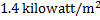
The sun radiates energy in all directions. The average radiations received on the earth surface from the sun is .The average earth- sun distance is 1.5 . The mass lost by the sun per day is (1 day = 86400 seconds)

(a) 4.4   

(b) 7.6  

(c) 3.8  

(d) 3.8  

Answer

(d) 3.8  

View full question & answer
Question 1051 Mark

If the atom   follows the Bohr model and the radius of   is n times the Bohr radius, then find n

(a) 100    

(b) 200

(c) 4  

(d)  

Answer

(d)  

View full question & answer
Question 1061 Mark

The wavelengths involved in the spectrum of deuterium  are slightly different from that of hydrogen spectrum, because

(a) The attraction between the electr on and the nucleus is different in the two cases

(b) The size of the two nuclei are different

(c) The nuclear forces are different in the two cases

(d) The masses of the two nuclei are different

Answer

(d) The masses of the two nuclei are different

View full question & answer
Question 1071 Mark

In the Bohr model of the hydrogen atom, let R, v and E represent the radius of the orbit, the speed of electron and the total energy of the electron respectively. Which of the following quantity is proportional to the quantum number n

(a) R/E

(b) E/v

(c) RE

(d) vR

Answer

(d) vR

View full question & answer
Question 1081 Mark

An electron passing through a potential difference of 4.9 V collides with a mercury atom and transfers it to the first excited state. What is the wavelength of a photon corresponding to the transition of the mercury atom to its normal state

(a) 2050 Å

(b) 2240 Å

(c) 2525 Å

(d) 2935 Å

Answer

(c) 2525 Å

View full question & answer
Question 1091 Mark

A neutron with velocity V strikes a stationary deuterium atom, its kinetic energy changes by a factor of

(a)  

(b)  

(c)   

(d) None of these

Answer

(d) None of these

View full question & answer
Question 1101 Mark

The ionisation potential of H-atom is 13.6 V. When it is excited from ground state by monochromatic radiations of 970.6  the number of emission lines will be (according to Bohr’s theory)

(a) 10

(b) 8

(c) 6  

(d) 4

Answer

(c) 6  

View full question & answer
Question 1111 Mark

A double charged lithium atom is equivalent to hydrogen whose atomic number is 3. The wavelength of required radiation for emitting electron from first to third Bohr orbit in   will be (Ionisation energy of hydrogen atom is 13.6eV)

(a) 182.51 Å

(b) 177.17 Å

(c) 142.25 Å

(d) 113.74 Å

Answer

(d) 113.74 Å

View full question & answer
Question 1121 Mark

If in Rutherford’s experiment, the number of particles scattered at 90° angle are 28 per min, then number of scattered particles at an angle 60°  and 120°  will be

(a) 112/min, 12.5/min

(b) 100/min, 200/min

(c) 50/min, 12.5/min

(d) 117/min, 25/min

Answer

(a) 112/min, 12.5/min

View full question & answer
Question 1131 Mark

What is the radius of iodine atom (at. no. 53, mass number 126)

(a) 2.5  

(b) 2.5  

(c) 7 

(d) 7 

Answer

(a) 2.5  

View full question & answer
Question 1141 Mark

In a hypothetical Bohr hydrogen, the mass of the electron is doubled. The energy  and the radius  of the first orbit will be ( is the Bohr radius)

(a)   

(b)

(c)  

(d)  

Answer

(a)   

View full question & answer
Question 1151 Mark

A radioactive material has a half-life of 8 years. The activity of the material will decrease to about 1/8 of its original value in

(a) 256 year

(b) 128 year

(c) 64 year

(d) 24 year

Answer

(d) 24 year

View full question & answer
Question 1161 Mark

A hydrogen atom in its ground state absorbs 10.2 eV of energy. The orbital angular momentum is increased by (Given Planck constant h = 6.6 J - sec)

(a) 1.05   J-sec

(b) 3.16   J-sec

(c) 2.11   J-sec

(d) 4.22   J-sec

Answer

(a) 1.05   J-sec

View full question & answer
Question 1171 Mark

A hydrogen atom in its ground state absorbs 10.2 eV of energy. The orbital angular momentum is increased by

(a) 1.05   J-sec

(b) 3.16   J-sec

(c) 2.11   J-sec

(d) 4.22   J-sec

Answer

(a) 1.05   J-sec

View full question & answer
Question 1181 Mark

An energy of 24.6 eV is required to remove one of the electrons from a neutral helium atom. The energy (in eV) required to remove both the electrons from a neutral helium atom is

(a) 79.0

 (b) 51.8

(c) 49.2   

(d) 38.2

Answer

(a) 79.0

View full question & answer
Question 1191 Mark

A sodium atom is in one of the states labeled 'Lowest excited levels'. It remains in that state for an average time of 10–8 sec, before it makes a transition back to a ground state. What is the uncertainty in energy of that excited state

(a) 6.56  × 10–8 eV

(b) 2 × 10⁻⁸ eV

(c) 10–8 eV

(d) 8 × 10⁻⁸ eV

Answer

(a) 6.56  × 10–8 eV

View full question & answer
Question 1201 Mark

In hydrogen atom, electron makes transition from n=4 to n=1 level. Recoil momentum of the H atom will be

(a) 3.4

(b) 6.8

(c)  3.4

(d)  6.8

Answer

(b) 6.8

View full question & answer
Question 1211 Mark

In a sample of radioactive material, what fraction of the initial number of active nuclei will remain undisintegrated after half of a half-life of the sample

(a)   

(b)   

(c) 

(d) 2 

Answer

(c) 

View full question & answer
Question 1221 Mark

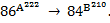
In a radioactive reaction  , the number of α - particles emitted is

(a) 7

(b) 6

(c)  5 

(d) 4

Answer

(a) 7

View full question & answer
Question 1231 Mark

If half life of radium is 77 days. Its decay constant in day will be

(a) 3 /day

(b)

 (c) 1 /day

(d) 6 /day

Answer

(b)

View full question & answer
Question 1241 Mark

The phenomenon of radioactivity is

(a) Exothermic change which increases or decreases with temperature

(b) Increases on applied pressure

(c) Nuclear process does not depend on external factors

(d) None of the above

Answer

(c) Nuclear process does not depend on external factors

View full question & answer
Question 1251 Mark

 In this reaction how many α  and β  particles are emitted

(a) 6α,3β

(b) 3 α, 4β

(c) 4 α, 3β

(d) 3α, 6β

Answer

(b) 3 α, 4β

View full question & answer
Question 1261 Mark

 has half life 5700 years. At the end of 11400 years, the actual amount left is

(a) 0.5 of original amount

(b) 0.25 of original amount

(c) 0.125 of original amount

(d) 0.0625 of original amount

Answer

(b) 0.25 of original amount

View full question & answer
Question 1271 Mark

Nuclear fusion is common to the pair

(a) Thermonuclear reactor, uranium based nuclear reactor

(b) Energy production in sun, uranium based nuclear reactor

(c) Energy production in sun, hydrogen bomb

(d) Disintegration of heavy nuclei, hydrogen bomb

Answer

(c) Energy production in sun, hydrogen bomb

View full question & answer
Question 1281 Mark

The particle that possesses half integral spin as

(a) Photon

(b) Pion  

(c) Proton

(d) K-meson

Answer

(c) Proton

View full question & answer
Question 1291 Mark

A nucleus of mass 218 amu in free state decays to emit an a-particle. Kinetic energy of the a-particle emitted is 6.7 MeV. The recoil energy (in MeV) of the daughter nucleus is

(a) 1.0

(b) 0.5

(c) 0.25

(d) 0.125

Answer

(d) 0.125

View full question & answer
Question 1301 Mark

The composition of an a -particle  can be expressed as

(a) 1 P + 1 N  

(b) 1 P + 2 N

(c) 2 P + 1 N

(d) 2 P + 2 N

Answer

(d) 2 P + 2 N

View full question & answer
Question 1311 Mark

The ratio of the speed of the electrons in the ground state of hydrogen to the speed of light in vacuum is

(a) 1/2     

(b) 2/137

(c) 1/137

 (d) 1/237

Answer

(c) 1/137

View full question & answer
Question 1321 Mark

Mean life of a radioactive sample is 100 seconds. Then its half life (in minutes) is

(a) 0.693 

(b) 1

(c) 10-4

(d) 1.155

Answer

(d) 1.155

View full question & answer
Question 1331 Mark

an isotope of thorium decays in ten stages emitting six a-particles and four b-particles in all. The end product of the decay is

(a)  

(b)  

(c)  

(d)

Answer

(c)  

View full question & answer
Question 1341 Mark

A nucleus decays by  emission followed by a gamma emission. If the atomic and mass numbers of the parent nucleus are Z and A respectively, the corresponding numbers for the daughter nucleus are respectively.

(a) Z  - 1 and A - 1  

(b) Z + 1 and A

(c) Z - 1  and A

(d) Z + 1 and A - 1

Answer

(c) Z - 1  and A

View full question & answer
Question 1351 Mark

The ratio activity of an element becomes 1/64th of its original value in 60 sec. Then the half life period is

(a) 5 sec 

(b) 10 sec

(c) 20 sec   

(d) 30 sec

Answer

(b) 10 sec

View full question & answer
Question 1361 Mark

The half-life of a radioactive substance is 3.6 days. How much of 20 mg of this radioactive substance will remain after 36 days

(a) 0.0019 mg

(b) 1.019 mg

(c) 1.109 mg

(d) 0.019 mg

Answer

(d) 0.019 mg

View full question & answer
Question 1371 Mark

The half-life of radium is about 1600 years. Of 100 g of radium existing now, 25 g will remain unchanged after

(a) 2400 years

(b) 3200 years

(c) 4800 years

(d) 6400 years

Answer

(b) 3200 years

View full question & answer
Question 1381 Mark

A radioactive decay chain starts from and produces     by successive emissions. The emitted particles can be

(a) Two a-particles and one b-particle

(b) Three   particles

(c) One a particle and two   particles

(d) One a particle and two   particles

Answer
(a) Two a-particles and one b-particle
View full question & answer
Question 1391 Mark

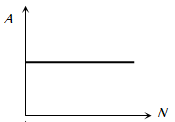
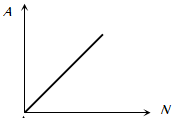
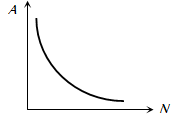
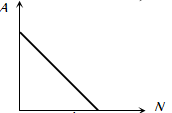
The curve between the activity A of a radioactive sample and the number of active atoms N is

(a)

(b)

(c)

(d)

Answer

(b)

View full question & answer
Question 1401 Mark

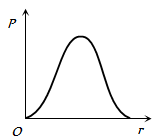
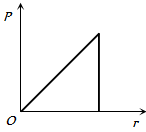
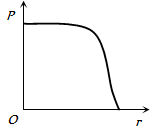
The charge density in a nucleus varies with distance from the centre of the nucleus according to the curve in Fig.

(a)

(b)

(c)

(d)

Answer

(c)

View full question & answer
Question 1411 Mark

A count rate meter shows a count of 240 per minute from a given radioactive source. One hour later the meter shows a count rate of 30 per minute. The half-life of the source is

(a) 120 min

(b) 80 min

(c) 30 min

(d) 20 min

Answer

(d) 20 min

View full question & answer
Question 1421 Mark

Radioactive nuclei that are injected into a patient collect at certain sites within its body, undergoing radioactive decay and emitting electromagnetic radiation. These radiations can then be recorded by a detector. This procedure provides an important diagnostic tool called

(a) Gamma camera

(b) CAT scan

(c) Radiotracer technique

(d) Gamma ray spectroscopy

Answer

(c) Radiotracer technique

View full question & answer
Question 1431 Mark

A radioactive sample at any instant has its disintegration rate 5000 disintegration per minute. After 5 minutes, the rate is 1250 disintegrations per minute. Then, the decay constant (per minute) is

(a) 0.8 In 2

(b) 0.4 In 2

(c) 0.2 In 2

(d) 0.1 In 2

Answer

(b) 0.4 In 2

View full question & answer
Question 1441 Mark

Which of the following radiations has the least wavelength

(a) X-rays 

(b) g-rays

(c) b -rays

(d) a-rays

Answer

(b) g-rays

View full question & answer
Question 1451 Mark

A sample of radioactive element has a mass of 10 gm at an instant t = 0.The approximate mass of this element in the sample after two mean lives is

(a) 2.50 gm

(b) 3.70 gm

(c) 6.30 gm

(d) 1.35 gm

Answer

(d) 1.35 gm

View full question & answer
Question 1461 Mark

Which of the following rays are not electromagnetic waves

(a) g-rays 

(b) b-rays

(c) Heat rays

(d) X-rays

Answer

(b) b-rays

View full question & answer
Question 1471 Mark

A radioactive substance has an average life of 5 hours. In a time of 5 hours          

(a) Half of the active nuclei decay

(b) Less than half of the active nuclei decay

(c) More than half of the active nuclei decay

(d) All active nuclei decay

Answer

(c) More than half of the active nuclei decay

View full question & answer
Question 1481 Mark

The half-life of   is 100μs. The time taken for the radioactivity of a sample of   to decay to 1/16th of its initial value is

(a) 400 μs

(b) 6.3 μs

(c) 40 μs

(d) 300 μs

Answer

(a) 400 μs

View full question & answer
Question 1501 Mark

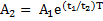
The activity of a sample of a radioactive material is A, at time  and  at time . If  its mean life T, then

(a)  

(d)  

(c)

(d)  

Answer

(c)

View full question & answer