Questions · Page 4 of 12

M.C.Q (1 Marks)

Question 1511 Mark

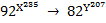
If   undergoes successively 8 a-decays and 6 b-decays, then resulting nucleus is

(a)  

(b)  

(c)  

(d)  

Answer

(b)  

View full question & answer
Question 1521 Mark

A radioactive substance emits

(a) Electromagnetic radiation

(b) Electrons revolving around the nucleus

(c) Charged particles

(d) a,c

Answer

(d) a,c

View full question & answer
Question 1531 Mark

The number of revolutions per second made by an electron in the first Bohr orbit of hydrogen atom is of the order of 3

(a)   

(b)  

(c)   

(d)    

Answer

(d)    

View full question & answer
Question 1541 Mark

Half-life of a substance is 10 years. In what time, it becomes  th part of the initial amount

(a) 5 years

(b) 10 years

(c) 20 years

(d) None of these

Answer

(c) 20 years

View full question & answer
Question 1551 Mark

A radioactive material has an initial amount 16gm. After 120 days it reduces to 1gm, then the half-life of radioactive material is

(a) 60 days

(b) 30 days

(c) 40 days

(d) 240 days

Answer

(b) 30 days

View full question & answer
Question 1561 Mark

The S.I. unit of radioactivity is

(a) Roentgen

(b) Rutherford

(c) Curie 

(d) Becqueral

Answer

(d) Becqueral

View full question & answer
Question 1571 Mark

In a sample of radioactive material, what percentage of the initial number of active nuclei will decay during one mean life

(a) 69.3%  

(b) 63%

(c) 50%

(d) 37%

Answer

(b) 63%

View full question & answer
Question 1581 Mark

10 gm of radioactive material of half-life 15 year is kept in store for 20 years. The disintegrated material is

(a) 12.5 g

(b) 10.5 g

(c) 6.03 g

(d) 4.03 g

Answer

(c) 6.03 g

View full question & answer
Question 1591 Mark

The equation   is

(a) b -emission

(b) a -emission

(c) ecapture

(d) Fission

Answer

(a) b -emission

View full question & answer
Question 1601 Mark

The half-life of a radioactive substance against a-decay is 1.2 . What is the decay rate for 4  atoms of the substance

(a) 4.6  

(b) 2.3  

(c) 4.6  

(d) 2.3  

Answer

(d) 2.3  

View full question & answer
Question 1611 Mark

The decay constant of a radioactive element is 1.5   per second. Its mean life in seconds will be

(a) 1.5  

(b) 4.62  

(c) 6.67  

(d) 10.35  

Answer

(c) 6.67  

View full question & answer
Question 1621 Mark

Certain radio-active substance reduces to 25% of its value in 16 days. Its half-life is

(a) 32 days

(b) 8 days

(c) 64 days

(d) 28 days

Answer

(d) 28 days

View full question & answer
Question 1631 Mark

Hydrogen (H), deuterium (D), singly ionized helium ( and doubly ionized lithium (Li) all have one electron around the nucleus. Consider n =2 to n = 1 transition. The wavelengths of emitted radiations are  and   respectively. Then approximately

(a)  

(b) 4

(c)  

(d)    

Answer

(a)  

View full question & answer
Question 1641 Mark

1 mg gold undergoes decay with 2.7 days half-life period, amount left after 8.1 days is

(a) 0.91 mg

(b) 0.25 mg

(c) 0.5 mg

(d) 0.125 mg

Answer

(d) 0.125 mg

View full question & answer
Question 1651 Mark

99% of a radioactive element will decay between

(a) 6 and 7 half lives

(b) 7 and 8 half lives

(c) 8 and 9 half lives

(d) 9 half lives

Answer

(a) 6 and 7 half lives

View full question & answer
Question 1661 Mark

A radioactive nucleus with Z protons and N neutrons emits an a-particle, 2b-particles and 2 gamma rays. The number of protons and neutrons in the nucleus left after the decay respectively, are

(a) Z – 3, N – 1

(b) Z – 2, N – 2

(c) Z – 1, N – 3

(d) Z, N – 4

Answer

(d) Z, N – 4

View full question & answer
Question 1671 Mark

If a radioactive substance reduces to   of its original mass in 40 days, what is its half-life

(a) 10 days

(b) 20 days

(c) 40 days

(d) None of these

Answer

(a) 10 days

View full question & answer
Question 1681 Mark

A radioactive nucleus emits a beta particle. The parent and daughter nuclei are

(a) Isotopes

(b) Isotones

(c) Isomers

(d) Isobars

Answer

(d) Isobars

View full question & answer
Question 1691 Mark

Half-life is measured by

(a) Geiger-Muller counter

(b) Carbon dating

(c) Spectroscopic method

(d) Wilson-Cloud chamber

Answer

(a) Geiger-Muller counter

View full question & answer
Question 1701 Mark

If  is the original mass of the substance of half life period   years, then the amount of substance left after 15 years is

(a)  

(b)  

(c)  

(d)  

Answer

(a)  

View full question & answer
Question 1711 Mark

A radioactive nucleus is being produced at a constant rate a per second. Its decay constant is l. If N0 are the number of nuclei at time t = 0, then maximum number of nuclei possible are

(a)  

(b)

(c) N0

(d)

Answer

(a)  

View full question & answer
Question 1721 Mark

During negative b - decay

(a) Neutron converts into proton

(b) Proton converts into neutron

(c) Neutron proton ratio increases

(d) None of these

Answer

(a) Neutron converts into proton

View full question & answer
Question 1731 Mark

When a radioactive substance emits an a -particle, its position in the periodic table is lowered by

(a) One place

(b) Two places

(c) Three places

(d) Four places

Answer

(b) Two places

View full question & answer
Question 1741 Mark

The electron emitted in beta radiation originates from

(a) Inner orbits of atoms

(b) Free electrons existing in nuclei

(c) Decay of a neutron in a nucleus

(d) Photon escaping from the nucleus

Answer

(c) Decay of a neutron in a nucleus

View full question & answer
Question 1751 Mark

In the given nuclear reaction, how many a and b particles are emitted  

(a) 3a  particles and 2b particle

(b) 4a particles and 3b particle

(c) 6a particles and 4b particle

(d) 7a particles and 4b particle

Answer

(d) 7a particles and 4b particle

View full question & answer
Question 1761 Mark

A radioactive sample is a-emitter with half life 138.6 days is observed by a student to have 2000 disintegration/sec. The number of radioactive nuclei for given activity are

(a) 3.45 × 10¹⁰

(b) 1 × 10¹⁰

(c) 3.45 × 10¹⁵

(d) 2.75 × 10¹¹

Answer

(a) 3.45 × 10¹⁰

View full question & answer
Question 1771 Mark

1 Curie is equal to

(a) 3  disintegrations/sec

(b) 3.7   disintegrations/sec

(c) 5 disintegrations/sec

(d) 3.7  disintegrations/sec

Answer

(d) 3.7  disintegrations/sec

View full question & answer
Question 1781 Mark

A radio isotope has a half life of 75 years. The fraction of the atoms of this material that would decay in 150 years will be

(a) 66.6% 

(b) 85.5%

(c) 62.5%

(d) 75%

Answer

(d) 75%

View full question & answer
Question 1791 Mark

A radioactive element  decay into  . The number of β - particles emitted are

(a) 4 

(b) 6

(c) 2  

(d) 1

Answer

(d) 1

View full question & answer
Question 1801 Mark

If half-life of a radioactive atom is 2.3 days, then its decay constant would be

(a) 0.1     

(b) 0.2

(c) 0.3  

(d) 2.3

Answer

(c) 0.3  

View full question & answer
Question 1811 Mark

In a mean life of a radioactive sample

(a) About 1/3 of substance disintegrates

(b) About 2/3 of the substance disintegrates

(c) About 90% of the substance disintegrates

(d) Almost all the substance disintegrates

Answer

(b) About 2/3 of the substance disintegrates

View full question & answer
Question 1821 Mark

The activity of a radioactive sample is 1.6 curie and its half-life is 2.5 days. Its activity after 10 days will be

(a) 0.8 curie

(b) 0.4 curie

(c) 0.1 curie

(d) 0.16 curie

Answer

(c) 0.1 curie

View full question & answer
Question 1831 Mark

What fraction of a radioactive material will get disintegrated in a period of two half-lives

(a) Whole

(b) Half

(c) One-fourth

(d) Three-fourth

Answer

(d) Three-fourth

View full question & answer
Question 1851 Mark

If half-life of a substance is 3.8 days and its quantity is 10.38 gm. Then substance quantity remaining left after 19 days will be

(a) 0.151 gm

(b) 0.32 gm

(c) 1.51 gm

(d) 0.16 gm

Answer

(b) 0.32 gm

View full question & answer
Question 1861 Mark

The activity of a radioactive sample

(a) Can be increased by heating it

(b) Is independent of physical parameter

(c) Cannot be increased by any method

(d) Both (b) and (c)

Answer

(d) Both (b) and (c)

View full question & answer
Question 1871 Mark

A radioactive substance has a half-life of 1 year. The fraction of this material, that would remain after 5 years will be

(a)  

(b)  

(c)   

(d)  

Answer

(a)  

View full question & answer
Question 1881 Mark

In beta decay

(a) The parent and daughter nuclei have same number of protons

(b) The daughter nucleus has one proton less than the parent nucleus

(c) The daughter nucleus has one proton more than the parent nucleus

(d) The daughter nucleus has one neutron more than the parent nucleus

Answer

(c) The daughter nucleus has one proton more than the parent nucleus

View full question & answer
Question 1891 Mark

The large scale destruction, that would be caused due to the use of nuclear weapons is called

(a) Nuclear holocaust

(b) Thermo-nuclear reaction

(c) Nuetron reproduction factor

(d) None of these

Answer

(a) Nuclear holocaust

View full question & answer
Question 1901 Mark

A radioactive substance emits

(a) a-rays

(b) b-rays

(c) g-rays

(d) All of these

Answer

(d) All of these

View full question & answer
Question 1911 Mark

A radioactive sample has half-life of 5 years. Probability of decay in 10 years will be

(a) 100%

(b) 75%

(c) 50%   

(d) 25%

Answer

(b) 75%

View full question & answer
Question 1921 Mark

Plutonium decays with a half-life of 24000 years. If the plutonium is stored for 72000 years, then the fraction of plutonium that remains is

(a)   

(b)  

(c)  

(d)  

Answer

(d)  

View full question & answer
Question 1931 Mark

3.8 days is the half-life period of a sample. After how many days, the sample will become 1/8th of the original substance

(a) 11.4

(b) 3.8

(c) 3  

(d) None of these

Answer

(a) 11.4

View full question & answer
Question 1941 Mark

A nucleus of an element  emits an a-particle first, a b-particle next and then a gamma photon. The final nucleus formed has an atomic number

(a) 200

(b) 199

(c) 83       

(d) 198

Answer

(c) 83       

View full question & answer
Question 1951 Mark

The half-life of radon is 3.8 days. Three forth of a radon sample decay in

(a) 5.02 days

(b) 15.2 days

(c) 7.6 days

(d) 11.4 days

Answer

(c) 7.6 days

View full question & answer
Question 1961 Mark

The activity of a sample is 64 × 10–5 Ci. Its half-life is 3 days. The activity will become 5 × 10⁻⁶ Ci after

(a) 12 days

(b) 7 days

(c) 18 days

(d) 21 days

Answer

(d) 21 days

View full question & answer
Question 1971 Mark

Consider the following two statements

A. Energy spectrum of a-particles emitted in radioactive decay is discrete

B. Energy spectrum of b-particles emitted in radioactive decay is continuous

(a) Only A is correct

(b) Only B is correct

(c) A is correct but B is wrong

(d) Both A and B are correct

Answer

(b) Only B is correct

View full question & answer
Question 1981 Mark

An artificial radioactive decay series begins with unstable . The stable nuclide obtained after eight α - decays and five β- decays is

 (a)  

(b)  

(c)  

(d)  

Answer

 (a)  

View full question & answer
Question 1991 Mark

The activity of a radioactive sample is measured as 9750 counts per minute at t = 0 and as 975 counts per minute at t = 5 minutes. The decay constant is approximately

(a) 0.230 per minute

(b) 0.461 per minute

(c) 0.691 per minute

(d) 0.922 per minute

Answer

(b) 0.461 per minute

View full question & answer
Question 2001 Mark

Decay constant of radium is λ. By a suitable process its compound radium bromide is obtained. The decay constant of radium bromide will be

(a) λ

(b) More than  λ

(c) Less than λ

(d) Zero

Answer

(a) λ

View full question & answer