Questions · Page 5 of 12

M.C.Q (1 Marks)

Question 2011 Mark

At any instant the ratio of the amount of radioactive substances is 2 : 1. If their half lives be respectively 12 and 16 hours, then after two days, what will be the ratio of the substances

(a) 1 : 1

(b) 2 : 1

(c) 1 : 2

(d) 1 : 4

Answer

(a) 1 : 1

View full question & answer
Question 2021 Mark

An element A decays into element C by a two step process :

A → B +  

B → C +  

Then

(a) A and C are isotopes

(b) A and C are isobars

(c) A and B are isotopes

(d) A and B are isobars

Answer

(a) A and C are isotopes

View full question & answer
Question 2031 Mark

A radioactive sample with a half life of 1 month has the label : “Activity=2 micro curies on 1.8.1991.'' What will be its activity two months later

(a) 1.0 micro curies

(b) 0.5 micro curies

(c) 4 micro curies

(d) 8 micro curies

Answer

(b) 0.5 micro curies

View full question & answer
Question 2051 Mark

In the given nuclear reaction A, B, C, D, E represents     

(a) A = 234, B = 90, C = 234, D = 91, E = β

(b) A = 234, B = 90, C = 238, D = 94, E = α

(c) A = 238, B = 93, C = 234, D = 91, E = β

(d) A = 234, B = 90, C = 234, D = 93, E = α

Answer

(a) A = 234, B = 90, C = 234, D = 91, E = β

View full question & answer
Question 2061 Mark

Half life of a radioactive element is 10 days. The time during which quantity remains 1/10 of initial mass will be

(a) 100 days

(b) 50 days

(c) 33 days

(d) 16 days

Answer

(c) 33 days

View full question & answer
Question 2071 Mark

The particles emitted by radioactive decay are deflected by magnetic field. The particles will be

(a) Protons and α - particles

(b) Electrons, protons and α -particles

(c) Electrons, protons and neutrons

(d) Electrons and α -particles

Answer

(d) Electrons and α -particles

View full question & answer
Question 2081 Mark

Which of the following statements are true regarding radioactivity

(I)  All radioactive elements decay exponentially with time

(II)  Half life time of a radioactive element is time required for one half of the radioactive atoms to disintegrate

(III)  Age of earth can be determined with the help of radioactive dating

(IV)  Half life time of a radioactive element is 50% of its average life period

Select correct answer using the codes given below

Codes :

(a) I and II

(b) I, III and IV

(c) I, II and III

(d) II and III

Answer

(c) I, II and III

View full question & answer
Question 2091 Mark

An atom of mass number 15 and atomic number 7 captures an α - particle and then emits a proton. The mass number and atomic number of the resulting product will respectively be

(a) 14 and 2

(b) 15 and 3

(c) 16 and 4

(d) 18 and 8

Answer

(d) 18 and 8

View full question & answer
Question 2101 Mark

Carbon -14 decays with half-life of about 5,800 years. In a sample of bone, the ratio of carbon -14 to carbon -12 is found to be   of what it is in free air. This bone may belong to a period about x centuries ago, where x is nearest to

(a) 2 × 58

(b) 58

(c) 58/2   

(d) 3 × 58

Answer

(a) 2 × 58

View full question & answer
Question 2111 Mark

The half life of  is 8 days. Given a sample of  at time t = 0, we can assert that

(a) No nucleus will decay before t = 4 days

(b) No nucleus will decay before t = 8 days

(c) All nuclei will decay before t = 16 days

(d) A given nucleus may decay at any time after t = 0

Answer

(d) A given nucleus may decay at any time after t = 0

View full question & answer
Question 2121 Mark

If the radioactive decay constant of radium is 1.07  per year, then its half life period is approximately equal to

(a) 8,900 years

(b) 7,000 years

(c) 6,476 years

(d) 2,520 years

Answer

(c) 6,476 years

View full question & answer
Question 2131 Mark

A nucleus  emits one α  and one β  particles. The resulting nucleus is

(a)  

(b)  

(c)  

(d)  

Answer

(d)  

View full question & answer
Question 2141 Mark

Half lives of two radioactive substances A and B are respectively 20 minutes and 40 minutes. Initially the sample of A and B have equal number of nuclei. After 80 minutes, the ratio of remaining number of A and B nuclei is

(a) 1 : 16 

(b) 4 : 1

(c) 1 : 4    

(d) 1 : 1

Answer

(c) 1 : 4    

View full question & answer
Question 2151 Mark
Which of the following is a correct statement

(a) Beta rays are same as cathode rays

(b) Gamma rays are high energy neutrons

(c) Alpha particles are singly ionized helium atoms

(d) Protons and neutrons have exactly the same mass

Answer

(a) Beta rays are same as cathode rays

View full question & answer
Question 2161 Mark

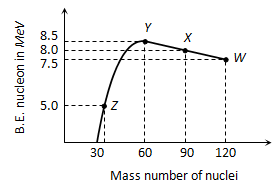
Binding energy per nucleon verses mass number curve for nuclei is shown in the figure. W, X, Y and Z are four nuclei indicated on the curve. The process that would release energy is

(a) Y   2Z

(b) W → X + Z

(c) W → 2Y

(d) X → Y + Z

Answer

(c) W → 2Y

View full question & answer
Question 2171 Mark

Which of the following isotopes is used for the treatment of cancer

(a)  

(b)  

(c)    

(d)  

Answer

(b)  

View full question & answer
Question 2181 Mark

After 1α and 2β emissions

(a) Mass number reduces by 3

(b) Mass number reduces by 4

(c) Mass number reduces by 6

(d) Atomic number remains unchanged

Answer

(b) Mass number reduces by 4

View full question & answer
Question 2191 Mark

In the uranium radioactive series, the initial nucleus is  and the final nucleus is  . When the uranium nucleus decays to lead, the number of α - particles emitted will be

(a) 1 

(b) 2

(c) 4  

(d) 8

Answer

(d) 8

View full question & answer
Question 2201 Mark

Half life of a radioactive substance is T.  The time taken for all the nuclei to disintegrate will be

(a) 2T       

(b) T2

(c) 4T

(d) Uncertain

Answer

(d) Uncertain

View full question & answer
Question 2211 Mark

The half life period of a radioactive substance is 5 min. The amount of substance decayed in 20 min will be

(a) 93.75%

(b) 75%

(c) 25%   

(d) 6.25%

Answer

(a) 93.75%

View full question & answer
Question 2221 Mark

The half life (T) and the disintegration constant (λ) of a radioactive substance are related as

(a) λT  = 1

(b) λT = 0.693

(c)   

(d)  

Answer

(b) λT = 0.693

View full question & answer
Question 2231 Mark

The rate of disintegration of fixed quantity of a radioactive element can be increased by

(a) Increasing the temperature

(b) Increasing the pressure

(c) Chemical reaction

(d) It is not possible

Answer

(d) It is not possible

View full question & answer
Question 2241 Mark

In a radioactive decay, neither the atomic number nor the mass number changes. Which of the following would be emitted in the decay process

(a) Proton

(b) Neutron

(c) Electron

(d) Photon

Answer

(d) Photon

View full question & answer
Question 2251 Mark

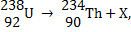
The radioactive decay of uranium into thorium is expressed by the equation  where ‘X’ is

(a) An electron

(b) A proton

(c) A deuteron

(d) An alpha particle

Answer

(d) An alpha particle

View full question & answer
Question 2261 Mark

The counting rate observed from a radioactive source at t = 0 second was 1600 counts per second and at t = 8 seconds it was 100 counts per second. The counting rate observed, as counts per second at t = 6 seconds, will be

(a) 400

(b) 300

(c) 200

(d) 150

Answer

(c) 200

View full question & answer
Question 2271 Mark

A radioactive nucleus  decays to  . Which of the following particles are emitted

(a) One alpha and one electron      

(b) Two deuterons and one positron

(c) One alpha and one proton

(d) One proton and four neutrons

Answer

(a) One alpha and one electron      

View full question & answer
Question 2281 Mark

A element used for radioactive carbon dating for more than 5600 years is

(a) C - 14 

(b) U - 234

(c) U - 238

(d) Po - 94

Answer

(a) C - 14 

View full question & answer
Question 2291 Mark

A radioactive substance has a half life of 60 minutes. After 3 hours, the fraction of atom that have decayed would be

(a)12.5%

(b) 87.5%

(c) 8.5%  

(d) 25.1%

Answer

(b) 87.5%

View full question & answer
Question 2301 Mark

A radioactive reaction is  → . How many α and β particles are emitted

(a) 10α, 6β

(b) 4 protons, 8 neutrons

(c) 6 electrons, 8 protons

(d) 6β, 8α

Answer

(d) 6β, 8α

View full question & answer
Question 2311 Mark

What is the respective number of α and β  particles emitted in the following radioactive decay

(a) 6 and 8

(b) 8 and 8

(c) 6 and 6

(d) 8 and 6

Answer

(d) 8 and 6

View full question & answer
Question 2321 Mark

The count rate of a Geiger- Muller counter for the radiation of a radioactive material of half life of 30 minutes decreases to 5 after 2 hours. The initial count rate was

(a) 25

(b) 80

(c) 625

(d) 20

Answer

(b) 80

View full question & answer
Question 2331 Mark

Unit of radioactivity is Rutherford. Its value is

(a) 3.7  disi tegrations/sec

(b) 3.7  disintegrations/sec

(c) 1.0  disintegrations/sec

(d) 1.0  disintegrations/sec

Answer

(d) 1.0  disintegrations/sec

View full question & answer
Question 2341 Mark

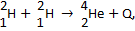
The binding energy of deuteron  is 1.112 MeV per nucleon and an α - particle  has a binding energy of 7.047 MeV per nucleon. Then in the fusion reaction  the energy Q released is

(a) 1 MeV

(b) 11.9 MeV

(c) 23.8 MeV

(d) 931 MeV

Answer

(c) 23.8 MeV

View full question & answer
Question 2351 Mark

If 20 gm of a radioactive substance due to radioactive decay reduces to 10 gm in  4 minutes, then in what time 80 gm of the same substance will reduce to 10 gm

(a) In 8 minutes

(b) In 12 minutes

(c) In 16 minutes

(d) In 20 minutes

Answer

(b) In 12 minutes

View full question & answer
Question 2361 Mark

The half life of the isotope  is 15 hrs. How much time does it take for   of a sample of this isotope to decay

(a) 75 hrs  

(b) 65 hrs

(c) 55 hrs

(d) 45 hrs

Answer

(d) 45 hrs

View full question & answer
Question 2371 Mark

Consider a radioactive material of half-life 1.0 minute. If one of the nuclei decays now, the next one will decay

(a) After 1 minute

(b) After   minute

(c) After  minute, where N is the number of nuclei present at that moment

(d) After any time

Answer

(d) After any time

View full question & answer
Question 2381 Mark

The correct order of ionizing capacity of α, β and γ - rays is

(a) α >  γ > β

(b) α > β > γ

(c) α < β <γ

(d) α > β > γ

Answer

(b) α > β > γ

View full question & answer
Question 2391 Mark

The half life of polonium is 140 days. After how many days, 16 gm polonium will be reduced to 1 gm  (or 15g will decay)

(a) 700 days

(b) 280 days

(c) 560 days

(d) 420 days

Answer

(c) 560 days

View full question & answer
Question 2401 Mark

Which can pass through 20 cm thickness of the steel

(a) α -  particles

(b) β - particles

(c) γ-  rays

(d) Ultraviolet rays

Answer

(c) γ-  rays

View full question & answer
Question 2411 Mark

Three α - particles and one β - particle decaying takes place in series from an isotope . Finally the isotope obtained will be

(a)  

(b)  

(c)  

(d)  

Answer

(c)  

View full question & answer
Question 2421 Mark

Some radioactive nucleus may emit

(a) Only one α,β or γ at a time

(b) All the three α,β  and  γ one after another

(c) All the three α,β  and γ  simultaneously

(d) Only α and β  simultaneously

Answer

(a) Only one α,β or γ at a time

View full question & answer
Question 2431 Mark

A radioactive element emits 200 particles per second. After three hours 25 particles per second are emitted. The half life period of element will be

(a) 50 minutes

(b) 60 minutes

(c) 70 minutes

(d) 80 minutes

Answer

(b) 60 minutes

View full question & answer
Question 2441 Mark

Curie is a unit of

(a) Length

(b) It is not any unit

(c) Activity

(d) Atomic number

Answer

(c) Activity

View full question & answer
Question 2451 Mark

A radio-isotope has a half- life of 5 years. The fraction of the atoms of this material that would decay in 15 years will be

(a) 1/8

(b) 2/3

(c) 7/8

(d) 5/8

Answer

(c) 7/8

View full question & answer
Question 2461 Mark

The relationship between λ and half life ( of a radioactive substance is

(a) λ =

(b)  λ =

(c) λ =

(d)  λ =

Answer

(b)  λ =

View full question & answer
Question 2471 Mark

A sample contains 16 gm of a radioactive material, the half life of which is two days. After 32 days, the amount of radioactive material left in the sample is

(a) Less than 1 mg

(b)  

(c)  

(d) 1 gm

Answer

(a) Less than 1 mg

View full question & answer
Question 2481 Mark

The decay constant of a radioactive element is 0.01 per second. Its half life period is

(a) 693 sec

(b) 6.93 sec

(c) 0.693 sec

(d) 69.3 sec

Answer

(d) 69.3 sec

View full question & answer
Question 2491 Mark

Atomic mass number of an element thorium is 232 and its atomic number is 90. The end product of this radioactive element is an isotope of lead (atomic mass 208 and atomic number 82). The number of alpha and beta particles emitted is

(a) α = 3, β = 3 

(b) α = 6, β = 4 

(c) α = 6, β = 0 

(d) α = 4, β = 6 

Answer

(b) α = 6, β = 4 

View full question & answer
Question 2501 Mark

16 gm sample of a radioactive element is taken from Bombay to Delhi in 2 hour and it was found that 1 gm of the element remained (undisintegrated). Half life of the element is

(a) 2 hour

(b) 1 hour

(c)  

(d)  

Answer

(c)  

View full question & answer