Questions

4 Marks Questions

Take a timed test

12 questions · self-marked practice — reveal the answer and mark yourself.

Question 14 Marks
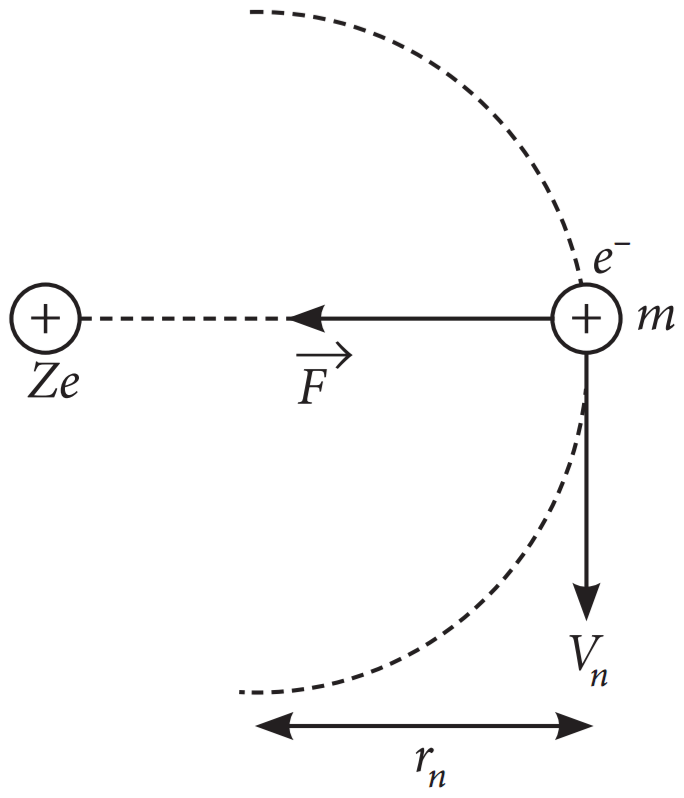
When the electron orbiting in hydrogen atom in its ground state moves to the third excited state, show how the de Broglie wavelength associated with it would be affected.
Answer
de Broglie wavelength $\lambda = \frac{\text{h}}{\text{mv}}$

$\therefore \lambda \propto\frac{1}{v} ; \text{v} \propto\frac{1}{\text{n}}$

$\therefore \lambda\propto\text{n}$

$\therefore$ 𝑑𝑒 Broglie wavelength will increase

Alternate Answer

As $2\pi\text{r}_{n} = \text{n}\lambda ; \lambda = \frac{2\pi\text{r}_{n}}{\text{n}}(\lambda\propto\frac{\text{r}_{n}}{\text{n}})$

$\text{r}_{n}\propto\text{n}^{2}$

$\therefore \lambda\propto\frac{\text{n}^{2}}{\text{n}}\Rightarrow\lambda\propto\text{n}$

$\therefore$ 𝑑𝑒 Broglie wavelength will increase.

View full question & answer
Question 24 Marks
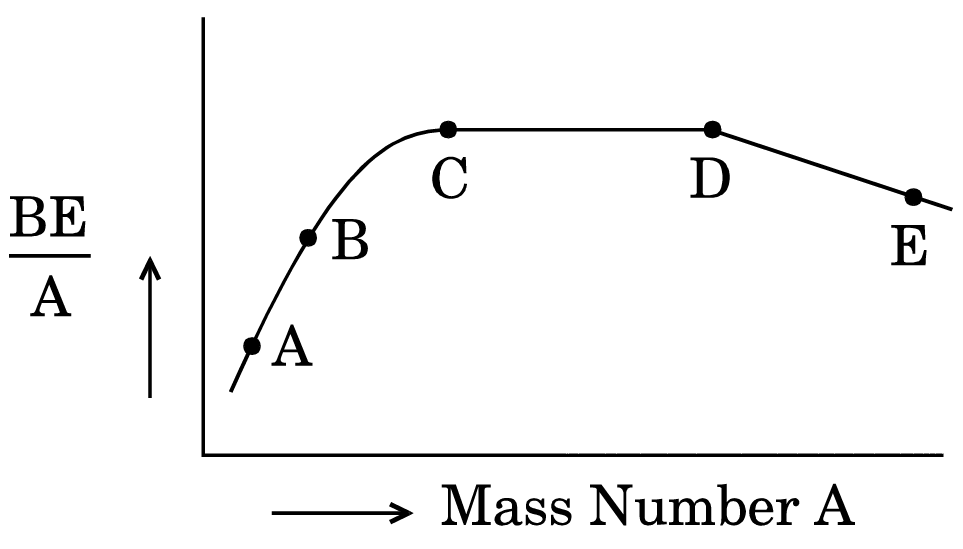
  1. The figure shows the plot of binding energy (BE) per nucleon as a function of mass number A. The letters A, B, C, D and E represent the positions of typical nuclei on the curve. Point out, giving reasons, the two processes (in terms of A, B, C, D and E), one of which can occur due to nuclear fission and the other due to nuclear fusion.

  1. Identify the nature of the radioactive radiations emitted in each step of the decay process given below.

$^{A}_{Z}\text{X}\rightarrow ^{A-4}_{Z-2}\text{Y}\rightarrow ^{A-4}_{Z-1}\text{W}$.

Answer
  1. Nuclear fission of E to D and C; as there is a increase in binding energy per nucleon.
  2. Nuclear fusion of A and B into C; as there is a increase in binding energy per nucleon.

$\text{First step} - \propto\text{ particle Second step} – \beta\text{ particle}$.

View full question & answer
Question 34 Marks
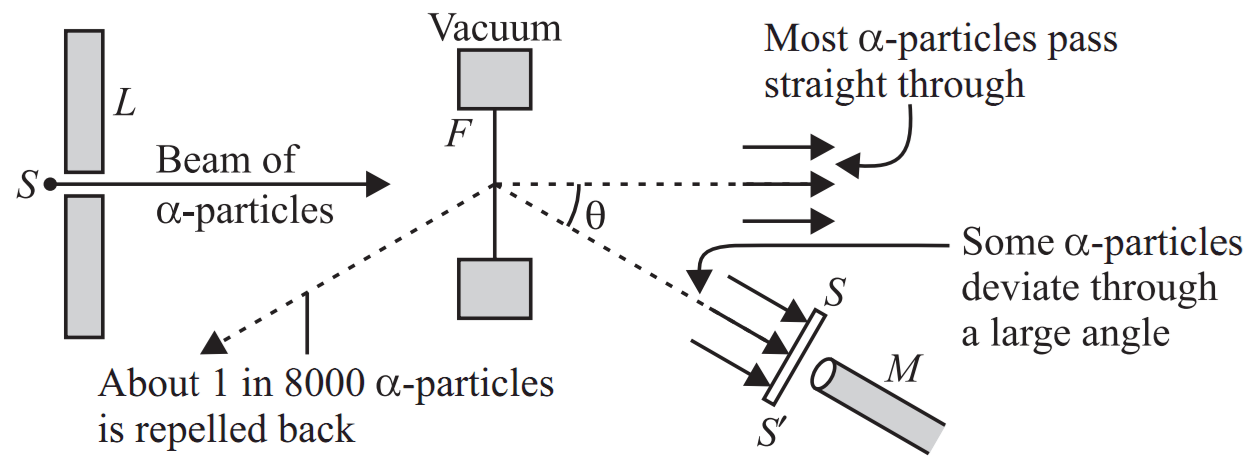
In the study of Geiger-Marsdon experiment on scattering of α  particles by a thin foil of gold, draw the trajectory ofα−particles in the Coulomb field of target nucleus. Explain briefly how one gets the information on the size of the nucleus from this study. From the relation R = R0 A1/3, where R0 is constant and A is the mass number of the nucleus, show that nuclear matter density is independent of A.
Answer

Only a small fraction of the $\alpha-$incidentparticles rebound. This shows that the mass of the atom is concentrated in a small volume in the form of nucleus and gives an idea of the size of the nucleus.
Radius of the nucleus
$\text{R} =\text{R}_{\circ}\text{A}^\frac{1}{3}$
Density $ = \frac{\text{mass}}{\text{volume}}$
$ = \frac{\text{mA}}{\frac{4}{3}\pi\text{R}^{3}}$
where, m: mass of one nucleon
A: Mass number
$ = \frac{\text{mA}}{\frac{4}{3}\pi(\text{R}_{\circ}\text{A}^\frac{1}{3})^{3}}$
$ = \frac{3\text{m}}{4\pi\text{R}_{\circ}^{3}}$
 =>Nuclear matter density is independent of A.
View full question & answer
Question 44 Marks

In 1911, Rutherford, along with his assistants, H. Geiger and E. Marsden, performed the alpha particle scattering experiment. H. Geiger and E. Marsden took radioactive source $(^{214}_{83}\text{Bi})$ for $\alpha$- particles. A collimated beam of $\alpha$-particles of energy 5.5 MeV was allowed to fall on 2.1 × 10⁻⁷ m thick gold foil. The $\alpha$-particles were observed through a rotatable detector consisting of a Zinc sulphide screen and microscope. It was found that CL-particles got scattered. These scattered $\alpha$-particles produced scintillations on the zinc sulphide screen. Observations of this experiment are as follows?

Most of the $\alpha$-particles passed through the foil without deflection.

Only about 0.14% of the incident $\alpha$-particles scattered by more than 1º

Only about one $\alpha$-particle in every 8000 $\alpha$-particles deflected by more than 90º

These observations led to many arguments and conclusions which laid down the structure of the nuclear model of an atom.

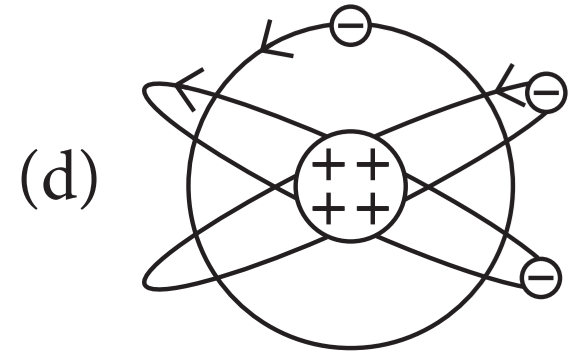
  1. Rutherford's atomic model can be visualised as.

  1. Gold foil used in Geiger-Marsden experiment is about 10-8 m thick. This ensures.
  1. Gold foil's gravitational pull is small or possible.
  2. Gold foil is deflected when $\alpha$-particle stream is not incident centrally over it.
  3. Gold foil provides no resistance to passage of $\alpha$-particles.
  4. Most $\alpha$-particle will not suffer more than 1º scattering during passage through gold foil.
  1. In Geiger-Marsden scattering experiment, the trajectory traced by an $\alpha$-particle depends on.
  1. Number of collision.
  2. Number of scattered $\alpha$- particles.
  3. Impact parameter.
  4. None of these.
  1. In the Geiger-Marsden scattering experiment, in case of head-on collision, the impact parameter should be.
  1. Maximum
  2. Minimum
  3. Infinite
  4. zero
  1. The fact only a small fraction of the number of incident particles rebound back in Rutherford scattering indicates that.
  1. Number of $\alpha$-particles undergoing head-on-collision is small.
  2. Mass of the atom is concentrated in a small volume.
  3. Mass of the atom is concentrated in a large volume.
  4. Both (a) and (b).
Answer
  1. (d)

Explanation:

Rutherford's atom had a positively charged centre and electrons were revolving outside it. It is also called the planetary model of the atom, as in option (d).

  1. (d) Most $\alpha$-particle will not suffer more than 1º scattering during passage through gold foil.

Explanation:

As the gold foil is very thin, it can be assumed that $\alpha$-particles will suffer not more than one scattering during their passage through it. Therefore, computation of the trajectory of an $\alpha$-particle scattered by a single nucleus is enough.

  1. (c) Impact parameter

Explanation:

Trajectory of $\alpha$-particles depends on impact parameter, which is the perpendicular distance of the initial velocity vector of the $\alpha$particles from the centre of the nucleus. For small impact parameter, $\alpha$ particle close to the nucleus suffers larger scattering.

  1. (b) Minimum

Explanation:

At minimum impact parameter, $\alpha$ particles rebound back$(\theta\approx\pi)$ and suffers large scattering.

  1. (d) Both (a) and (b).

Explanation:

In case of head-on-collision, the impact parameter is minimum and the $\alpha$-particle rebounds back. So, the fact that only a small fraction of the number of incident particles rebound back indicates that the number of $\alpha$-particles undergoing head-on collision is small. This in turn implies that the mass of the atom is concentrated in a small volume. Hence, option (a) and (b) are correct.

View full question & answer
Question 54 Marks
Answer
  1. (c) 4

Explanation:

$\text{E}_{\text{n}}=\frac{-13.6}{\text{n}^2}(\text{Z}^2)$

In first excited state, EH2 = 3.4 eV and EHe = -13.6 eV

So, H2 atom gives excitation energy (13.6 - 3.4 = 10.2 eV) to helium atom

Now, energy of He ion = -13.6 + 10.2 = -3.4 eV

Again, $\text{E}=\frac{-13.6}{\text{n}^2}\times\text{Z}^2$

$\Rightarrow-3.4=\frac{-13.6}{\text{n}^2}\times({2})^2$

$\Rightarrow\text{n}=4$

  1. (c) 4.8 × 10-7 m

Explanation:

$\frac{1}{\lambda}=\frac{13.6\text{Z}^2}{\text{hc}}\Big[\frac{1}{\text{h}^2_1}-\frac{1}{\text{h}^2_2}\Big]$

Here, n1 = 3 and n2 = 4

$\Rightarrow\lambda=4.8\times10^{-7}\text{m}$

  1. (a) $\frac{1}{4}$

Explanation:

Kinetic energy, $\text{K}\propto\frac{\text{z}^2}{\text{n}^2}$

$\frac{\text{K}_{\text{H}_{2}}}{\text{K}_{\text{H}_{\text{e}}}}=\bigg(\frac{\text{Z}_{\text{H}_{2}}}{\text{Z}_{\text{He}}}\bigg)^2=\big(\frac{1}{2}\big)^2=\frac{1}{4}$

  1. (b) $\frac{\text{h}^2\in_0}{\pi\text{me}^2}$

Explanation:

Radius of the permitted orbit is r $=\frac{\text{n}^2\text{h}^2\in_0}{\pi\text{mze}^2}$

For hydrogen atom in ground state, i.e.,

n = 1,Z = 1 $\Rightarrow\text{r}==\frac{\text{n}^2\in_0}{\pi\text{me}^2}$

  1. (a) $\frac{\text{h}}{\pi}$

Explanation:

Angular momentum for hydrogen atom is $\text{L}=\frac{\text{nh}}{\pi2}$

For 6 first excited state, n = 2, $\text{L}=\frac{\text{h}}{\pi}$

View full question & answer
Question 64 Marks
When white radiation is passed through a sample of hydrogen gas at room temperature, absorption lines are observed in Lyman series only. Explain.
Answer
White radiations are x-rays that have energy ranging between 5-10eV.
When white radiation is passed through a sample of hydrogen gas at room temperature, absorption lines are observed only in the Lyman series.
At room temperature, almost all the atoms are in ground state.
The minimum energy required for absorption is 10.2eV (for a transition from n = 1 to n = 2).
The white radiation has photon radiations that have an energy of around 10.2 eV.
So, they are just sufficient to transmit an electron from n = 1 to n = 2 level.
Hence, the absorption lines are observed only in the Lyman series.
View full question & answer
Question 74 Marks
Suppose in an imaginary world the angular momentum is quantized to be even integral multiples of $\frac{\text{h}}{2\pi}$ What is the longest possible wavelength emitted by hydrogen atoms in visible range in such a world according to Bohr's model?
Answer
Even quantum numbers are allowed,
$\text{n}_1=2,\text{n}_2=4\xrightarrow{\ \ \ }$ For minimum energy or for longest possible wavelength.
$\text{E}=13.6\bigg(\frac{1}{\text{n}^2_1}-\frac{1}{\text{n}^2_2}\bigg)$
$\text{E}=13.6\Big(\frac{1}{2^2}-\frac{1}{4^2}\Big)=2.55$
$2.55=\frac{\text{hc}}{\lambda}$
$\lambda=\frac{\text{hc}}{2.55}=\frac{1242}{2.55}$
$\lambda=487.05\text{nm}=487\text{nm}$
View full question & answer
Question 84 Marks
Hydrogen is the simplest atom of nature. There is one proton in its nucleus and an electron moves around the nucleus in a circular orbit. According to Niels Bohr, this electron moves in a stationary orbit. When this electron is in the stationary orbit, it emits no electromagnetic radiation.The angular momentum of the electron is quantized, i.e., ⁣$\text{mvr}=\big(\frac{\text{nh}}{2\pi}\big)$ where m = mass of the electron, v = velocity of the electron in the orbit, r = radius of the orbit and n = 1, 2, 3, .... When transition takes place from Kth orbit to Jth orbit, energy photon is emitted. If the wavelength of the emitted photon is $\lambda$ we find that $\frac{1}{\lambda}=\text{R}\bigg[\frac{1}{\text{J}^2}-\frac{1}{\text{K}^2}\bigg]$where find that On a different planet, the hydrogen atom's structure was somewhat different from ours. The angular momentum of electron was $\text{P}=2\text{n}\Big(\frac{\text{h}}{2\pi}\Big)$ i.e., an even multiple of $\Big(\frac{\text{h}}{2\pi}\Big)$.

  1. The minimum permissible radius of the orbit will be.
  1. $\frac{2\in_0\text{h}^2}{\text{m}\pi\text{e}^2}$
  2. $\frac{4\in_0\text{h}^2}{\text{m}\pi\text{e}^2}$
  3. $\frac{\in_0\text{h}^2}{\text{m}\pi\text{e}^2}$
  4. $\frac{\in_0\text{h}^2}{\text{2m}\pi\text{e}^2}$
  1. In our world, the velocity of electron is v0 when the hydrogen atom is in the ground state. The velocity of electron in this state on the other planet should be.
  1. $\text{v}_0$
  2. $\frac{\text{v}_0}{2}$
  3. $\frac{\text{v}_0}{4}$
  4. $\frac{\text{v}_0}{8}$
  1. In our world, the ionization potential energy of a hydrogen atom is 13.6eV. On the other planet, this ionization potential energy will be.
  1. 13.6eV
  2. 3.4eV
  3. 1.5eV
  4. 0.85eV
  1. Check the correctness of the following statements about the Bohr model of hydrogen atom.
  1. The acceleration of the electron in n = 2 orbit is more than that in n = 1 orbit.
  2. The angular momentum of the electron in n = 2 orbit is more than that in n = 1 orbit.
  3. The kinetic energy of the electron in n = 2 orbit is less than that in n = 1 orbit.
  1. Only (III) and (I) are correct
  2. Only (III) and (I) are correct
  3. Only (II) and (III) are correct.
  4. All the statements are correct.
  1. In Bohr's model of hydrogen atom, let PE represent potential energy and TE the total energy. In going to a higher orbit.
  1. PE increases, TE decreases
  2. PE decreases, TE increases
  3. PE increases, TE increases
  4. PE decreases, TE decreases
Answer
  1. (b) $\frac{4\in_0\text{h}^2}{\text{m}\pi\text{e}^2}$

Explanation:

On other planet : $\text{mvr}=2\text{n}\frac{\text{h}}{2\pi}\Rightarrow\frac{\text{nh}}{\pi\text{mr}}$ 

$\frac{\text{mv}^2}{\text{r}}=\frac{1}{4\pi\in_0}\frac{\text{e}^2}{\text{r}^2}$

$\Rightarrow\frac{\text{mn}^2\text{h}^2}{\text{n}^2\text{m}^2\text{r}^3}=\frac{1}{4\pi\in_0}\frac{\text{e}^2}{\text{r}^2}$

Putting n = 1, we get $\text{r}=\frac{4\text{h}^2\in_0}{\text{m}\pi\text{e}^2}$

  1. (b) $\frac{\text{v}_0}{2}$

Explanation:

On our planet:$\text{v}_0=\frac{\text{e}}{2\in_{\text{nh}}}$

On other planet:$\text{v}=\frac{\text{e}^2}{2\in_0\big(2\text{n}\big)\text{h}}=\frac{\text{v}_0}{2}$

  1. (b) 3.4eV

Explanation:

On our planet:$\text{E}_\text{n}=-\frac{13.6}{\text{n}^2}$

On other planet:$\text{E}_\text{n}=-\frac{13.6}{\big(\text{2n}\big)^2}$

$\Rightarrow\text{E}_\text{n}=\frac{\text{E}_\text{n}}{4}=-3.4\text{eV}$

  1. (c) Only (ii) and (iii) are correct.

Explanation:

Centripetal acceleration $=\frac{\text{mv}^2}{\text{r}}$

Further, as n increases, r also increases. Therefore, centripetal acceleration for n = 2 is less than that for n = 1. So, statement (i) is wrong. Statement (ii) and (iii) are correct

  1. (c) PE increases, TE increases

Explanation:

Potential energy $=\frac{-\text{C}}{\text{r}^2}$ total energy $=\frac{\text{Rhc}}{\text{n}^2}$ With higher orbit, both r and n increase. So, both become less negative hence both increase.

View full question & answer
Question 94 Marks
Hydrogen spectrum consists of discrete bright lines in a dark background, and it is specifically known as hydrogen emission spectrum. There is one more type of hydrogen spectrum that exists where we get dark lines on the bright background, it is known as absorption spectrum. Balmer found an empirical formula by the observation of a small part of this spectrum, and it is represented by $\frac{1}{\lambda}=\text{R}\bigg(\frac{1}{2^2}-\frac{1}{\text{n}^2}\bigg)$ where n = 3, 4, 5 For Lyman series, the emission is from first state to nth state, for Paschen series, it is from third state to nth state, for Brackett series, it is from fourth state to nth state and for Pfund series, it is from fifth state to nth state.
  1. Number of spectral lines in hydrogen atom is:
  1. 8
  2. 6
  3. 15
  4. $\infty$
  1. Which series of hydrogen spectrum corresponds to ultraviolet region?
  1. Balmer series.
  2. Brackett series.
  3. Paschen series.
  4. Lyman series.
  1. Which of the following lines of the H-atom spectrum belongs to the Balmer series?
  1. 1025A
  2. 1218A
  3. 4861A
  4. 18751A
  1. Rydberg constant is.
  1. A universal constant.
  2. A universal constants.
  3. Different for different elements.
  4. None of these.
  1. Hydrogen atom is excited from ground state to another state with principal quantum number equal to 4. Then the number of spectral lines in the emission spectra will be.
  1. 3
  2. 5
  3. 6
  4. 2
Answer
  1. (d) $\infty$

Explanation:

Number of spectral lines in hydrogen atom is $\infty$

  1. (d) Lyman series

Explanation:

Lyman series lies in the ultraviolet region

  1. (c) 4861 A

Explanation:

The shortest Balmer line has energy = 1|(3.4 - 1.51)|1eV = 1.89eV

and the highest energy = 1(0 - 3.4)1 = 3.4eV The corresponding wavelengths are

$\frac{12400\text{eVA}}{1.89\text{eV}}=6561\text{A}\text{ and }\frac{12400\text{eVA}}{3.4\text{eV}}=3647\text{A}$

Only 4861A is between the first and last line of the Balmer series.

  1. (a) A universal constant.
  2. (c) 6
View full question & answer
Question 104 Marks
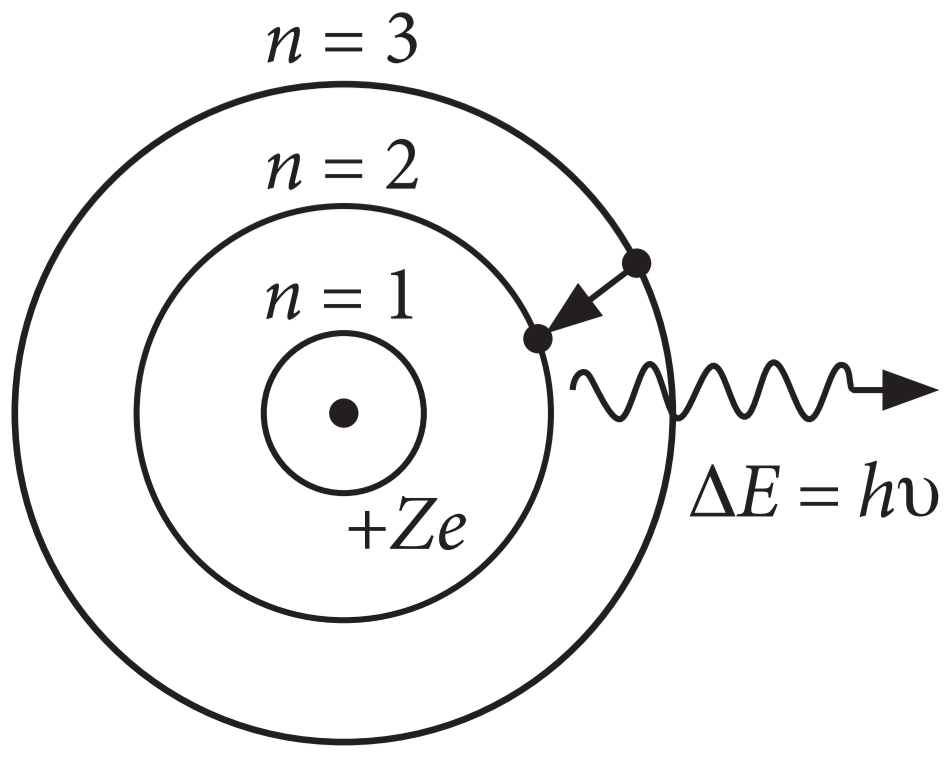
Niels Bohr introduced the atomic Hydrogen model in 1913. He described it as a positively charged nucleus, comprised of protons and neutrons, surrounded by a negatively charged electron cloud. In the model, electrons orbit the nucleus in atomic shells. The atom is held together by electrostatic forces between the positive nucleus and negative surroundings.

Bohr correctly proposed that the energy and radii of the orbits of electrons in atoms are quantized, with energy for transitions between orbits given by
$\triangle\text{E}=\text{h}\upsilon=\text{E}_\text{i}-\text{E}_\text{f}$ where $\triangle\text{E}$ is the change in energy between the initial and final orbits and $\text{h}\upsilon$ is the energy of an absorbed or emitted photon.
  1. In the Bohr model of the hydrogen atom, discrete radii and energy states result when an electron circles the atom in an integer number of
  1. De Broglie wavelengths
  2. Wave frequencies
  3. Quantum numbers
  4. Diffraction patterns.
  1. The angular speed of the electron in the nth orbit of Bohr's hydrogen atom is.
  1. Directly proportional to n
  2. Inversely proportional to $\sqrt{\text{n}}$
  3. Inversely proportional to n2
  4. Inversely proportional to n3
  1. When electron jumps from n = 4 level to n = 1 level, the angular momentum of electron changes by.
  1. $\frac{\text{h}}{2\pi}$
  2. $\frac{\text{h}}{\pi}$
  3. $\frac{\text{3h}}{2\pi}$
  4. $\frac{\text{2h}}{\pi}$
  1. The lowest Bohr orbit in hydrogen atom has.
  1. The maximum energy
  2. The least energy
  3. Infinite energy
  4. Zero energy
  1. Which of the following postulates of the Bohr model led to the quantization of energy of the hydrogen atom?
  1. The electron goes around the nucleus in circular orbits.
  2. The angular momentum of the electron can only be an integral multiple of $\frac{\text{h}}{2\pi}$.
  3. The magnitude of the linear momentum of the electron is quantized.
  4. Quantization of energy is itself a postulate of the Bohr model.
Answer
  1. (c) Quantum numbers
  2. (d) Inversely proportional to n3

Explanation:

$\omega=\frac{\text{v}}{\text{r}}$ Further $\omega\propto\frac{1}{\text{n}}$ and $\text{r}\propto\text{n}^2$ 

Hence $\omega\propto\Big(\frac{1}{\text{n}^3}\Big)$

  1. (c) $\frac{\text{3h}}{2\pi}$
  2. (b) The least energy

Explanation:

The energy of nth Bohr orbit in hydrogen atom is

$\text{E}_\text{n}=-\frac{13.6}{\text{n}^2}\text{eV}$

For lowest orbit, n = 1

$\therefore\text{E}_1=13.6\text{ eV}$

Thus, the lowest Bohr orbit in hydrogen atom has the least energy.

  1. (b) The angular momentum of the electron can only be an integral multiple of $\frac{\text{h}}{2\pi}$.
View full question & answer
Question 114 Marks
The spectral series of hydrogen atom were accounted for by Bohr using the relation $\text{V}=\text{R}\Bigg(\frac{1}{\text{n}^2_1}-\frac{1}{\text{n}^2_2}\Bigg)$where R = Rydberg constant = 1.097 × 10⁷m-1 Lyman series is obtained when an electron jumps to first orbit from any subsequent orbit. Similarly, Balmer series is obtained when an electron jumps to 2nd orbit from any subsequent orbit, Paschen series is obtained when an electron jumps to 3rd orbit from any subsequent orbit. Whereas Lyman series lies in U.V. region, Balmer series is in visible region and Pasch en series lies in infrared region. Series limit is obtained when n2$\infty$
  1. The wavelength of first spectral line of Lyman series is.
  1. 1215.4A
  2. 12154cm
  3. 1215.4m
  4. 1215.4mm
  1. The wavelength limit of Lyman series is.
  1. 1215.4A
  2. 511.9A
  3. 951.6A
  4. 911.6A
  1. The frequency of first spectral line of Bahner series is.
  1. 1.097 × 10⁷Hz
  2. 4.57 × 10¹⁴Hz
  3. 4.57 × 10¹⁵Hz
  4. 4.57 × 10¹⁶Hz
  1. Which of the following transitions in hydrogen atoms emit photons of highest frequency?
  1. n = 1 to n = 2
  2. n = 2 to n = 6
  3. n = 6 to n = 2
  4. n = 2 to n = 1
  1. The ratio of minimum to maximum wavelength in Balmer series is.
  1. 5 : 9
  2. 5 : 36
  3. 1 : 4
  4. 3 : 4
Answer
  1. (a) 1215.4 A

Explanation:

From, $\text{V}=\frac{1}{\lambda}=\text{R}\Big(\frac{1}{\text{n}^2_1}-\frac{1}{\text{n}^2_2}\Big)$

n1 = 1, n2 = 2 for first spectral line of Lyman series,

$\frac{1}{\lambda}=1.097\times10^7\bigg(\frac{1}{1^2}-\frac{1}{1^2}\bigg)$

$=\frac{3\times1.097\times10^7}{4}\text{m}^{-1}$

$\lambda=\frac{4\times10^{-7}\text{m}}{3\times1.097}$

$=\frac{4000}{3\times1.0947}\text{A}=1215.4\text{A}$

  1. (d) 911.6 A

Explanation:

For wavelength limit, we put $\text{n}_2=\infty$

$\therefore\frac{1}{\lambda}=1.097\times10^7\Big(\frac{1}{1^2}-\frac{1}{\infty}\Big)$

$\lambda=\frac{1}{1.097\times10^7}$

$\text{m}=\frac{1000}{1.097}\text{A}=911.6\text{ A}$

  1. (b) 4.57 × 10¹⁴ Hz

Explanation:

For first line of Balmer series, n1 = 2, n2 = 3

$\text{V}=\frac{1}{\lambda}=\text{R}\Bigg(\frac{1}{\text{n}^2_1}-\frac{1}{\text{n}^2_2}\Bigg)$

$\text{V}=\frac{\text{c}}{\lambda}=\text{Rc}\Bigg(\frac{1}{\text{n}^2_1}-\frac{1}{\text{n}^2_2}\Bigg)$

= 1.097 × 107 × 3 × 108$\Bigg(\frac{1}{2_2}-\frac{1}{3_2}\Bigg)$

= 1.097 × 3 × 1015 × 3 $\frac{5}{36}$ 4.57 × 10¹⁴ Hz

  1. (d) n = 2 to n = 1

Explanation:

$\text{h}\upsilon_{2\rightarrow1}=-13.6\Bigg(\frac{1}{2_2}-\frac{1}{1_2}\Bigg)\text{eV}=10.2\text{eV}$ 

Emission is n = 2 → n = 1 i.e., higher n to lower n. Transition from lower to higher levels are absorption lines.

$13.6\Bigg(\frac{1}{6_2}-\frac{1}{2_2}\Bigg)=+13.6\times\frac{2}{9}$

This is < En = 2 → En = 1

  1. (a) 5 : 9

Explanation:

$\frac{1}{\lambda_\text{max}}=\text{R}\bigg[\frac{1}{2^2}-\frac{1}{3^2}\bigg]=\frac{5\text{R}}{36}$

$\frac{1}{\lambda_\text{max}}=\text{R}\bigg[\frac{1}{2^2}-\frac{1}{\infty}\bigg]=\frac{\text{R}}{4}$

$\Rightarrow\frac{\lambda_\text{max}}{\lambda_\text{max}}=\frac{5\text{R}}{36}\times\frac{4}{\text{R}}=\frac{5}{9}$
View full question & answer
Question 124 Marks
Bohr's model explains the spectral lines of hydrogen atomic emission spectrum. While the electron of the atom remains in the ground state, its energy is unchanged. When the atom absorbs one or more quanta of energy, the electrons moves from the ground state orbit to an excited state orbit that is further away.

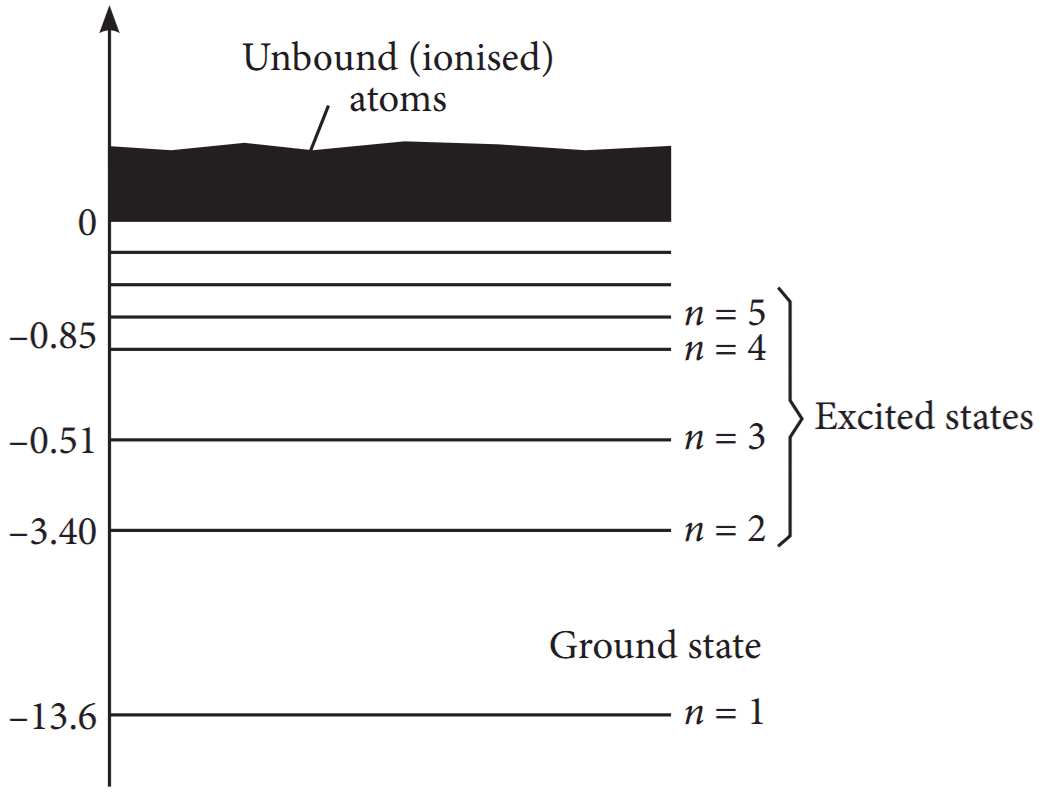
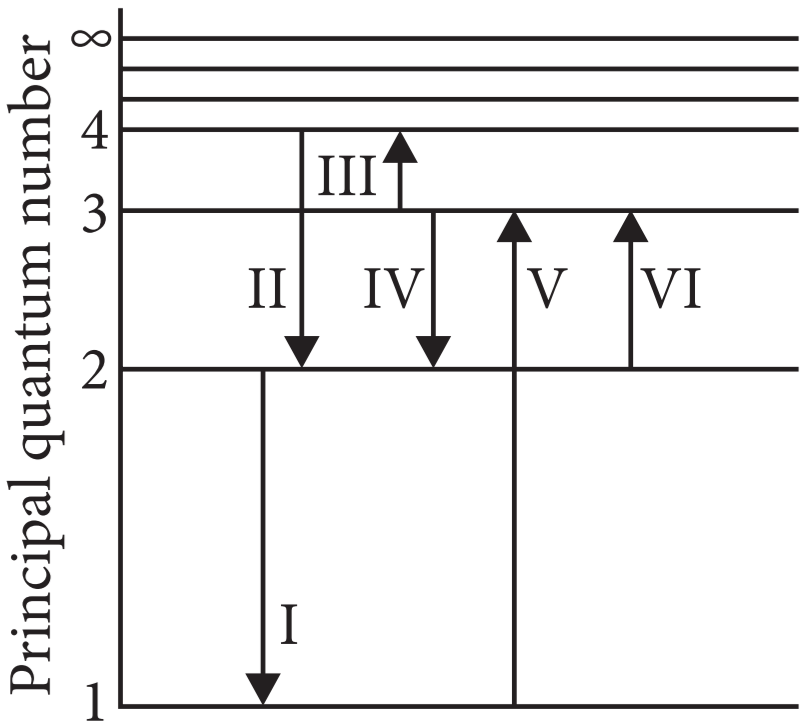
The given figure shows an energy level diagram of the hydrogen atom. Several transitions are marked as I, II, III and so on. The diagram is only indicative and not to scale.
  1. In which transition is a Balmer series photon absorbed?
  1. II
  2. III
  3. IV
  4. VI
  1. The wavelength of the radiation involved in transition II is
  1. 291nm
  2. 364nm
  3. 487nm
  4. 652nm
  1. Which transition will occur when a hydrogen atom is irradiated with radiation of wavelength 103nm?
  1. I
  2. II
  3. IV
  4. V
  1. The electron in a hydrogen atom makes a transition from n = n1 to n = n2 state. The time period of the electron in the initial state is eight times that in the final state. The possible values of n1 and n2 are.
  1. n1 = 4,n2 = 2
  2. n1 = 8,n2 = 2
  3. n1 = 8,n2 = 3
  4. n1 = 6,n2 = 2
  1. The Balmer series for the H-atom can be observed
  1. If we measure the frequencies of light emitted when an excited atom falls to the ground state.
  2. If we measure the frequencies of light emitted due to transitions between excited states and the first excited state.
  3. In any transition in a H-atom.
  4. None of these.
Answer
  1. (d) VI

Explanation:

For Balmer series, n1 = 2; n2 = 3, 4,... (lower) (higher)

Therefore, in transition (VI), photon of Balmer series is absorbed

  1. (c) 487nm

Explanation:

ln transition II,

E2 = -3.4 eV, E4 = -0.85 eV

$\triangle\text{E}=2.55\text{ eV}\Rightarrow\triangle\text{E}=\frac{\text{hc}}{\gamma}$

$\Rightarrow\gamma=\frac{\text{hc}}{\triangle \text{E}}=487\text{nm}$

  1. (d) V

Explanation:

Wavelength of radiation = 1030 A

$\triangle\text{E}=\frac{12400}{1030\text{ A}}=120\text{ eV}$

So, difference of energy should be 12.0 eV (approx.) Hence for n1 = 1 to n2 = 3

En3 -En1 = -1.51eV -(-13.6eV) $\approx$ 12eV

Therefore, transition V will occur.​​​​​​

  1. (a) n1 = 4,n2 = 2

Explanation:

$\text{T}^2\propto\text{r}^3\text{and}\text{ r}\propto\text{n}^2$

$\Rightarrow\text{T}^2\propto\text{n}^6\Rightarrow\text{T}\propto\text{n}^3$

$\frac{\text{T}_1}{\text{T}_2}=\Big(\frac{\text{n}_1}{\text{n}_2}\Big)^3$

$\Rightarrow8=\Big(\frac{\text{n}_1}{\text{n}_2}\Big)^3\text{or}\frac{\text{n}_1}{\text{n}_2}=3$

  1. (b) If we measure the frequencies of light emitted due to transitions between excited states and the first excited state.
View full question & answer