Question
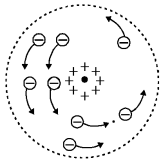
Explain the shortcomings of Rutherford's Atomic Model.###Write two shortcomings of Rutherford's Atomic Model.

Need a full question paper?

Generate a complete, print-ready paper with questions like this in minutes — across 16+ boards, with answer keys.

Start Generating Free

Similar questions

An X-OR gate has following truth table:
A B Y
0 0 0
0 1 1
1 0 1
1 1 0
It is represented by following logic relation
$\text{Y}=\bar{\text{A}}.\text{B}+\text{A}.\bar{\text{B}}$
Build this gate using AND, OR and NOT gates.
Two current-carrying wires may attract each other. In absence of other forces, the wires will move towards each other increasing the kinetic energy. Does it contradict the fact that the magnetic force cannot do any work and hence cannot increase the kinetic energy?
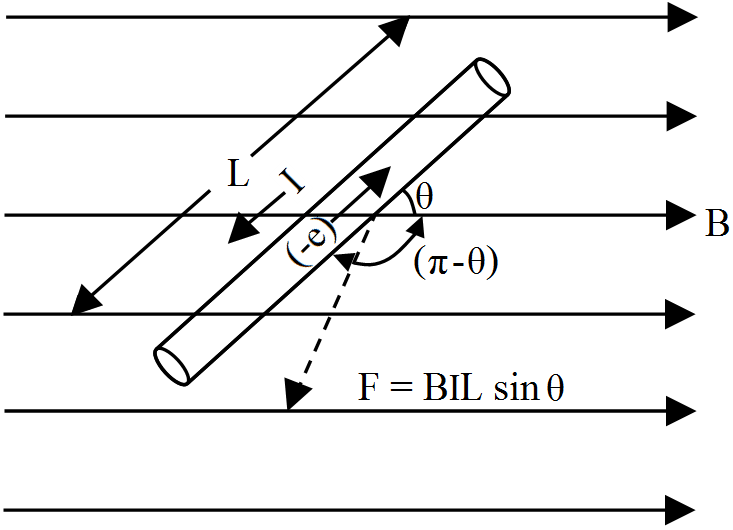
Derive an expression for the force experienced by a current carrying straight conductor placed in a magnetic field. Under what condition is this force maximum?

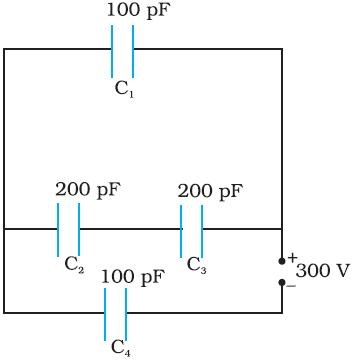
Obtain the equivalent capacitance of the network in Fig. For a 300V supply, determine the charge and voltage across each capacitor.
A system has two charges qA = 2.5 × 10⁻⁷ C and qB = –2.5 × 10⁻⁷ C located at points A: (0, 0, –15 cm) and B: (0, 0, +15 cm), respectively. What are the total charge and electric dipole moment of the system?
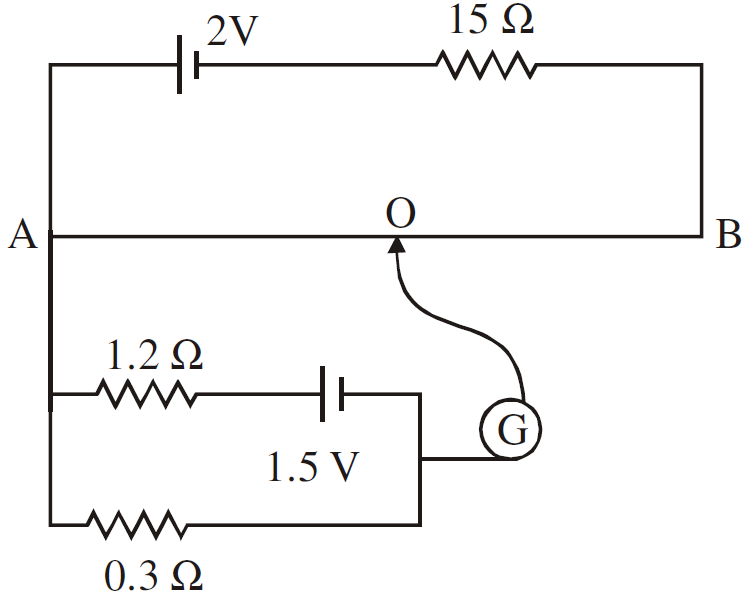
  1. State the principle of working of a potentiometer.
  2. In the following potentiometer circuit, AB is a uniform wire of length 1 m and resistance 10Ω. Calculate the potential gradient along the wire and balance length AO ( = l).

A beam of white light is incident normally on a plane surface absorbing 70% of the light and reflecting the rest. If the incident beam carries 10W of power, find the force exerted by it on the surface.
Establish a relation between electric current and drift velocity.

OR

Prove that the current density of a metallic conductor is directly proportional to the drift speed of electrons.
A group of hydrogen atoms are prepared in n = 4 states. List the wavelength that are emitted as the atoms make transitions and return to n = 2 states.
An object is placed at a distance of 30cm from a converging lens of focal length 15cm. A normal eye (near point 25cm, far point infinity) is placed close to the lens on the other side.
  1.  Can the eye see the object clearly?
  2.  What should be the minimum separation between the lens and the eye so that the eye can clearly see the object?
  3.  Can a diverging lens, placed in contact with the converging lens, help in seeing the object clearly when the eye is close to the lens?